Tag Archives: pitfalls in the first draft

Course correction, or navigating the unexpected #writing

Even if we begin with a plan, which I usually do, we never really know how a story will go. Somewhere along the line, I will deviate somewhat from the original outline. In my work, the major events usually remain as they were originally plotted, but not always.

However, an outline keeps me on track with length. Also, an outline keeps the action moving.

SO, I have recently discovered that the reason a work-in-progress that is 40,000 words toward completion doesn’t make me happy is that I have missed a great opportunity and am trying to force the plot in a direction that no longer works.

This means that while a lot of what has already been written can be reused, a fundamental part of the character arc may have to be cut and rewritten. Also, the story’s arc will change, and if I am going to stay on track so events progress logically, I need to write a new outline.

SIDE NOTE: Everything I have written and then cut is fodder for other uses. I NEVER trash anything that was already written, although I do save it in a file labeled “Outtakes.”

Even though each manuscript starts linearly, I work “back and forth” when writing rather than in a linear fashion. When I am laying down a first draft, each section of my novel is written when I am inspired to work on that part of the tale.

I list the central plot points I currently know on the outline, then write them. That will amount to about 20,000 words in five or six sections. Then, I write connecting scenes to ‘stitch’ the sections together when the draft is complete, like assembling a quilt. That brings the manuscript to about 40,000 words.

At that point, I am looking for the ending. On rare occasions, I know how it must end, but even in those cases, writing that final 20,000 words is Literary Hell, an abyss from which it feels as if I will never emerge.

And then … into the darkness comes a ray of sunlight … the seeds of the true plot begin to sprout, and suddenly I am off to the races.

At some point I will need to open my stylesheet/storyboard and correct it to show my new timeline and order of events so everything flows, with one scene transitioning to another and no jarring “Wait … what just happened?” moments.

I was a bookkeeper for most of my career, and I use a program I am familiar with, Excel. But you can use Google Sheets, a whiteboard and sticky notes, or a spiral notebook. Use whatever works for you and that you can update as needed, but my storyboard works this way:

At the Top of page one: I give the piece a working title.

When I have an idea for a short story, I include the intended publication and submission deadline (not needed if it’s for a novel). I make a note of the intended word count. Having a word count limit keeps me alert for unnecessary backstory. For most publications, you must keep strictly within their word count requirements.

Page one of the workbook contains the personnel files.

Column A: Character Names. I list the essential characters by name and the critical places where the story will be set.

Column B: About: What their role is, a note about that person or place, a brief description of who and what they are.

Column C: The Problem: What is the core conflict?

Column D: What do they want? What does each character desire?

Column E: What will they do to get it? How far will they go to achieve their desire?

Page Two: I create a page for the projected story arc on page two of the workbook. I list each chapter by the events that need to be resolved at various points in the manuscript.

Page three of the workbook is the most important—the Glossary. This list of made-up words, names, and places is crucial for the finished product. The way words appear on this list is how they should occur throughout the entire story, novel, or series. This page ensures consistency and keeps the spellings from drifting as I lay down prose in the first draft.
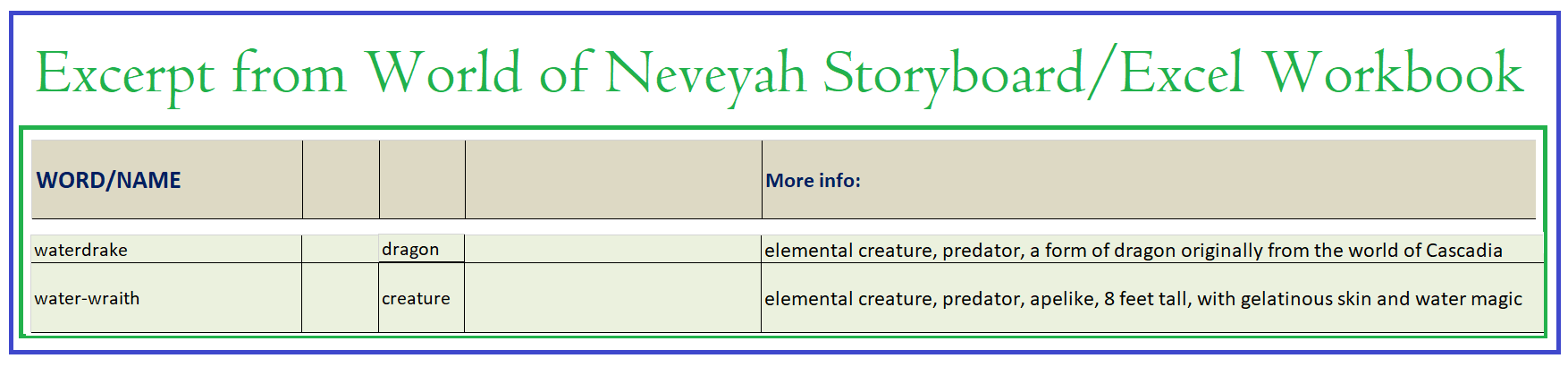
I update the glossary page whenever a word or name is added or changed. I do this even in my non-fantasy work, as it gives me a quick, easy-to-access reminder of how real-world names and places are spelled, and what story I used them in.

Page four will have maps and a calendar for that world. The calendar is a central tool that keeps events happening logically, and maps keep the traveler on the correct, previously established path.

The image below shows the page tabs for a storyboard I created in Excel for a series, and it has evolved since 2009. As you can imagine, it has grown since I took this screenshot, but it is still manageable and still useful. 

Even after five or six drafts, my editor will find things that didn’t get listed but should have been and will update the stylesheet.

Writing a novel is a process of growth and development. It doesn’t stop until you sign off on the proof copies and the book is on sale.

And even then, you will think of things you could have done better. That’s the curse of being a writer.

Leave a comment

Filed under writing

#amwriting: SW Washington Writers Conference, What I learned from @RobertDugoni

This last weekend I attended the Southwest Washington Writers Conference. I was also privileged to attend a class called Creating Plots for Page Turners, given by the keynote speaker, Robert Dugoni.

I say privileged, for this reason. Robert Dugoni is a bestselling author of thrillers, My Sister’s Grave being the book that caught my attention several years ago. Dugoni understands what makes a gripping story.

As I sat in the class, it became clear to me that attention to writing craft is integral to his work, but he also sees it from a slightly different angle. While he covered many things which I will discuss in my next blog post, several things pertain to recent posts of mine, regarding the first draft.

Bob asked a question I found intriguing: “What is your purpose as an author?” There were several different replies. He said, “Your characters must entertain the reader. Never stop entertaining.”

That was my thought, exactly. So how do we entertain our reader? What should we avoid?

One of the main pitfalls of the first draft is the info dump. These boring stretches of background info are mostly for you, the author, and are meant to set the scene in your mind. You know the rules, and don’t want them in the finished piece, but they slip into your work in insidious ways:

  1. Is the information you are about to dispense relevant to the character and his/her immediate need? Does it advance the story?
  2. Resist the urge to include character bios and random local history with the introduction of each new face or place—let that information come out only if needed. Dispense background info in small packets and only as needed.
  3. Resist the urge to explain every move, every thought your character has. This is probably the most annoying thing an author can do.
  4. Is a flashback a scene or a recollection? Recollections are boring info dumps. Scenes take the reader back in time and make them a part of a defining moment. Write scenes, not recollections.
  5. Opinions about the scene or the character, or anything—author intrusion is to be avoided.
  6. Don’t be lazy—show the story, even when it is simpler to tell it.

Points 3, 4, and 5 were concepts I consider in my own work, but never really thought about and hadn’t articulated them. They are critical and do bear mentioning here.

A question Dugoni asked was one I have often considered and discussed here. “What is a story?” The answers varied, but the one he wanted, and with which I agreed, is the story is the journey.

Frequently, stalled creativity is the result of the author having lost sight of the character’s journey, both the physical and the emotional journey.

Dugoni offered a solution for when that is the case: Ask yourself, “What is the character’s physical journey/quest?” You must ensure each character has a journey, a quest, but Dugoni adds third aspect–a dream. That idea that the journey/quest is also a dream that must be fulfilled resonated with me.

Then, consider the emotional journey. Why do these people continue in the face of great challenges? Is it love, anger, fear, duty, greed, honor, jealousy, or some deeper emotion that drives them?

Find that emotion, and you will find your character’s motivation.

Then ask yourself what happens if they don’t succeed? What are the consequences of failure?

  1. What is the public risk?
  2. What is the private risk?

Something important is at stake, or there is no story. Once you discover what it is and how it affects the characters’ emotions, the story will come together.

Classes like this are why I attend writer’s conferences. Robert Dugoni, Scott Driscoll, Cat Rambo—these people have the knowledge I need, and they are wonderful, accessible people who freely discuss all aspects of the craft in seminars, frequently at conferences I can afford and which are near me.

The companionship and support of other authors has been invaluable to me, and I have made every effort to repay their many kindnesses by supporting them in their endeavors. The friends I have made through this career are as dear to me as any I grew up with, and that circle widens with every conference I attend.

You may meet writers who are local to your area, and they will know of good writing groups near your home. They will also know about resources you can draw on, reference books you may not have heard of. If you are serious about the craft, you will seek out the company of other writers.

Find a conference in your area, and see what turns up. You may find yourself learning from a master.

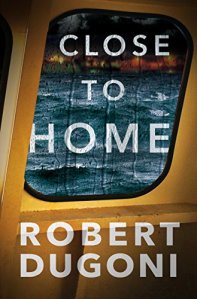
Robert Dugoni’s most recent book, Close to Home launched Sept 5th and has garnered well over 65 customer reviews on Amazon in the first week alone and maintains a 4.5 star rating.

THE BLURB:

New York Times bestselling author Robert Dugoni’s acclaimed series continues as Tracy Crosswhite is thrown headlong into the path of a killer conspiracy.

While investigating the hit-and-run death of a young boy, Seattle homicide detective Tracy Crosswhite makes a startling discovery: the suspect is an active-duty serviceman at a local naval base. After a key piece of case evidence goes missing, he is cleared of charges in a military court. But Tracy knows she can’t turn her back on this kind of injustice.

When she uncovers the driver’s ties to a rash of recent heroin overdoses in the city, she realizes that this isn’t just a case of the military protecting its own. It runs much deeper than that, and the accused wasn’t acting alone. For Tracy, it’s all hitting very close to home.

As Tracy moves closer to uncovering the truth behind this insidious conspiracy, she’s putting herself in harm’s way. And the only people she can rely on to make it out alive might be those she can no longer trust.

*

Robert Dugoni is the critically acclaimed New York Times, #1 Wall Street Journal and #1 Amazon Best Selling Author of The Tracy Crosswhite series, My Sister’s Grave, Her Final Breath, In the Clearing, and The Trapped Girl. The Crosswhite Series has sold more than 2,000,000 books and My Sister’s Grave has been optioned for television series development. He is also the author of the best-selling David Sloane series, The Jury Master, Wrongful Death, Bodily Harm, Murder One, and The Conviction. He is also the author of the stand-alone novels The 7th Canon, a 2017 finalist for the Mystery Writers of America Edgar Award for best novel, The Cyanide Canary, A Washington Post Best Book of the Year, and several short stories. Robert is the recipient of the Nancy Pearl Award for Fiction, and the Friends of Mystery, Spotted Owl Award for the best novel in the Pacific Northwest. He is a two time finalist for the International Thriller Writers award and the Mystery Writers of America Award for best novel. His David Sloane novels have twice been nominated for the Harper Lee Award for legal fiction. His books are sold worldwide in more than 25 countries and have been translated into more than two dozen languages including French, German, Italian and Spanish.

Comments Off on #amwriting: SW Washington Writers Conference, What I learned from @RobertDugoni

Filed under writing