
October has ended, and here in the Northern Hemisphere, the dark days of November are upon us. This is a great time of year for writers to hunker down and get writing.
 While NaNoWriMo no longer exists, many of us still see November as the big writing month. ProWriting Aid has a free event going on, and it has all the best aspects of the original NaNoWriMo without the drama.
Last month I mentioned that I participated in ProWritingAid’s Novel November in 2025 and had a great time. I posted about my experience here: #NovelNovember has ended, my book isn’t done, and once again, I’m clueless #writing | Life in the Realm of Fantasy
I am participating again this year. The website is simple enough for an old luddite like me to navigate, and you can get badges for each milestone.
A virtual badge? To some, that may not sound like much, but when the first days of creating a new story pass and excitement fades, writing becomes work. Each badge is a visible goal, an incentive to keep pushing ahead.
If ProWriting Aid’s free, no-strings-attached writing event doesn’t appeal to you, many other online writing challenges and groups try to keep the original spirit of NaNoWriMo alive. I have listed the links to four of them at the end of this post.
Whether you join an online challenge or not, November is a good time to get serious about the story you have always believed you could write.
Perhaps committing to a personal challenge works better for you.
Maybe you will challenge yourself to write for one hour every day for thirty days.
Or, perhaps you are aiming for a specific word count, hoping to get the basics of your novel written.
Some of us plan to write a chapter a day on our current work in progress.
 Or maybe, as I did one year, you decide to write a short story every day. In 2015, I took a different path from the usual novel-in-thirty-days approach. I named my project November Tales. I suffered from a bout of pneumonia and worked from my bed for most of the month. Even so, I managed 42 short stories, all fueled by Nyquil and desperation, totaling 107,000 words.
This mess included ten terrible poems, along with chapters 7 through 11 of Bleakbourne on Heath.
The following year, November began with a severe case of bronchitis. I named my project November Tales 2016 – 30 Days of Madness and Pot Pies. I started by writing short stories, flash fiction, drabbles, and poems. Within five days, I was writing the first draft of a novel and managed to pound out 90,000 wonky, misspelled words.
Others will write poetry and other short forms, and still others will focus on journalism and write op-eds and personal essays.
Perhaps you choose to write a blog post every day for 30 days. (Now that is difficult. I manage two a week and sometimes only one.)
Over the next few months, authors embarking on the journey of writing their first novel will hear many rules about the craft of writing. Don’t worry about grammar and mechanics at this stage of the game. Please write the story as it falls out of your head. Don’t worry too much about the rules until you get to the revision stage.
Getting those ideas out of your head now matters most. You can iron out pacing, structure flaws, and grammar hiccups in revisions.
courtesy Office360 graphics
When we are just beginning on the path to becoming an author, we feel guilty for taking the time to indulge in such a profoundly personal pleasure. Life tosses up roadblocks, and developing a regular writing habit is difficult.
We have jobs, families, duties to our community, and many other demands upon our time. We have all the extra work and activities that come along with living our lives.
As a single mother raising children in the 1980s, I could only write for half an hour or so at night. I wrote after my children were asleep, pouring my angst into song lyrics. Many times I wrote while my children did their homework. I was there, able to help, but I was doing my own “homework.” That original grounding in music is why my poetry rhymes and has a rhythm: I’m a songwriter at heart, and a melody is always floating around in my head.
The most important part of developing a writing process is finding one that works for you.
Give yourself permission to try different things until you find something that works.
- Do you work best in short bursts?
- Are you at your best when you have a long session of privacy and quiet time?
- Or is your process something in the middle, a melding of the two?
What if my style changes? What if the way that worked last month no longer works?
Give yourself permission to change, to find a way that does work. Be willing to be flexible.
Balance is the key to a happy life. We want to feel productive and creative, and we need to share our lives and interests with our family and friends.
 Therefore, authors must set aside time to write. This lets us be creative while still supporting our families, who all have activities and interests of their own.
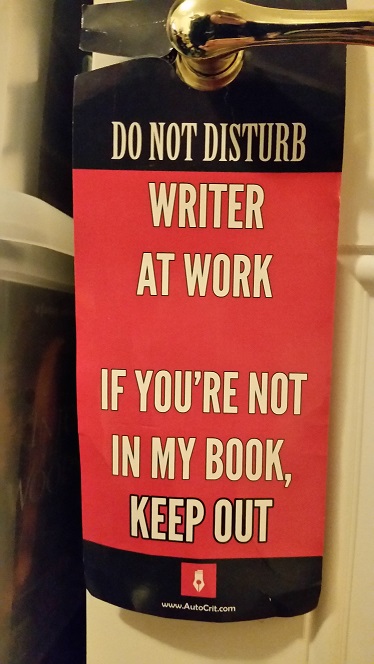
Being a writer means being supremely selfish about every aspect of life, including family time.
- It also requires discipline and the ability to set aside an hour or so just for that pursuit, a little time where no one is allowed to disturb you.
A good way to ensure you have that time is to encourage your family members to indulge in their own interests and artistic endeavors. That way, everyone has the chance to be creative in their own way during that hour, and they will understand why you value your writing time so much.
 To be happy, you need a balanced life. Don’t become so obsessed with writing about fictional lives that you aren’t present in your own.
Maybe you need a challenge to spur you into action:
Novel November™ by ProWritingAid: The Free Writing Challenge
Reedsy Studio Writing Challenges
Pathfinders Writing Collective
AutoCrit Novel 90 Writing Challenge
There are many, many more challenges out there. Just Google “writing challenges” and see if one suits your mood.
And whether you choose to participate in an online challenge or not, write when you can and enjoy the process of getting that idea out of your head and onto paper.


