
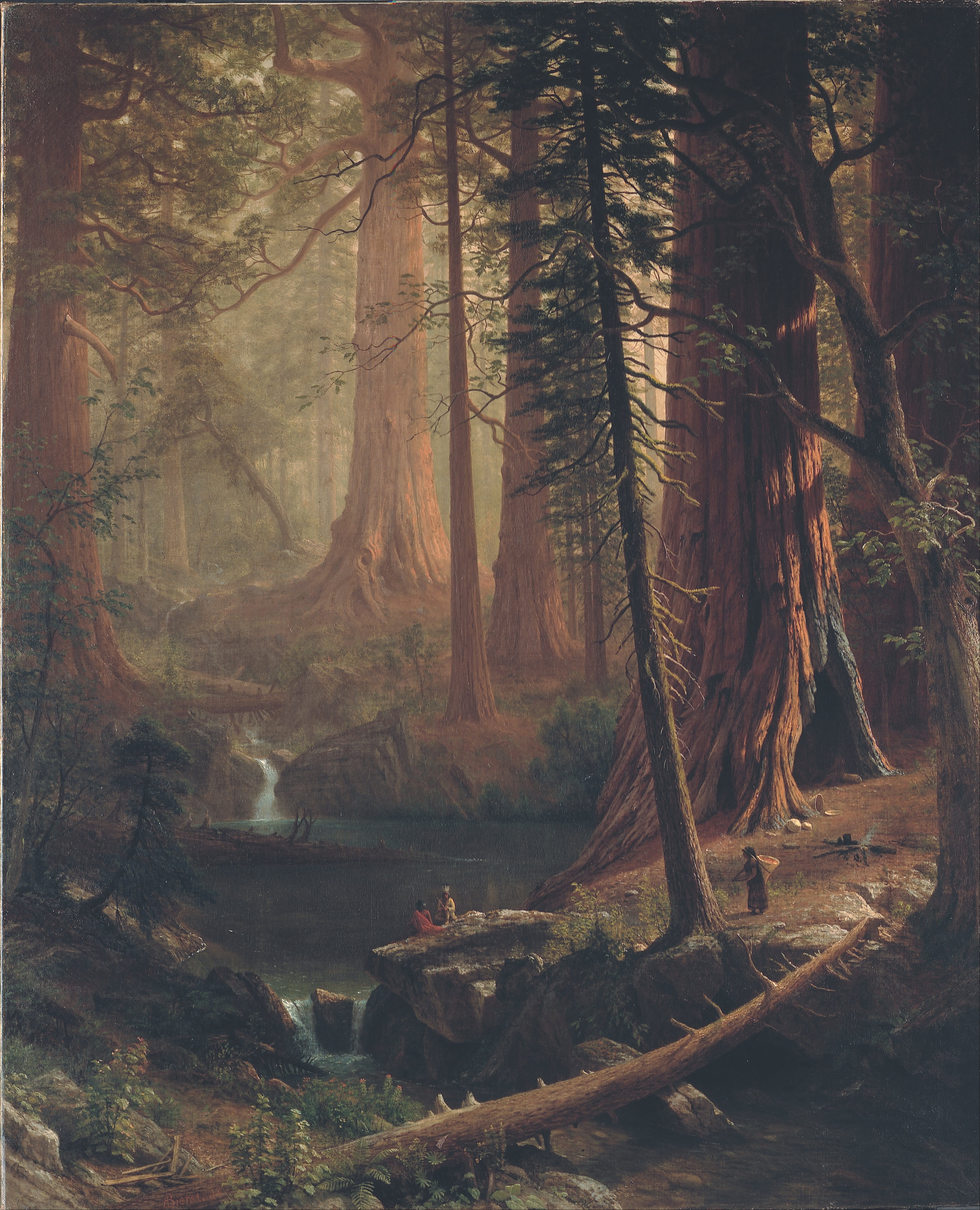
 Artist: Albert Bierstadt (1830–1902)
Title: Giant Redwood Trees of California
Object type: painting
Genre: landscape painting
Date: 1874
Medium: oil on canvas
Dimensions: height: 65.5 in (166.3 cm); width: 54.5 in (138.4 cm) (With frame)
Location: Berkshire Museum, Massachusetts
What I love about this painting:
Albert Bierstadt shows us a summer afternoon deep in the redwood forests of Northern California. The tiny figures of two native people seated on a rocky ledge above a stream demonstrate the incredible height and girth of the forest giants. A third woman carries a basket toward them from their camp at the base of an immense, burn-scarred tree. California Redwood trees have evolved to be fire resistant, thanks to the frequent wildfires the West Coast of the US experiences.
There is a mystic quality to this scene, an emotion that Bierstadt was adept at depicting.
I was privileged to visit Redwood National Forest in my late twenties, and must say that this image, accurate as it is, barely scratches the awe and majesty inspired by these endangered giants. It felt like a fantasy world, a place that couldn’t possibly exist, but which now informs my worldbuilding.
And yet it did exist and still does, albeit in pockets that are all that activists were able to save, a mere 45% of the original forest. California redwoods gateway is returned to Indigenous tribe. ‘That’s healing our people too’ – Los Angeles Times
This area was the ancestral home of several different Indigenous nations, including the Yurok, Tolowa, Hupa, and Karuk, as well as smaller groups such as the Sinkyone. I would guess that the native people depicted here are of the Yurok tribe. Yurok Redwood Groves — Sacred Forest, Living Relationship | Mythic Grounds
Albert Bierstadt had the ability to show the grandeur and beauty of the American West. During this turbulent time, he was one of the few artists who understood what the Westward Expansion meant for the Indigenous People who were forcibly displaced from their ancestral lands. The main criticism he faced was the critical disapproval of his inclusion of Indians in his landscapes.
About the author, via Wikipedia:
Albert Bierstadt (January 7, 1830 – February 18, 1902) was a German American painter best known for his lavish, sweeping landscapes of the American West. He joined several journeys of the Westward Expansion to paint the scenes. He was not the first artist to record the sites, but he was the foremost painter of them for the remainder of the 19th century.
Despite his popular success, Bierstadt was criticized by some contemporaries for the romanticism evident in his choice of subjects and for his use of light, which they found excessive. Some critics objected to Bierstadt’s paintings of Native Americans, believing that including Indigenous Americans “marred” the “impression of solitary grandeur.”
Bierstadt was born in Prussia, but his family moved to the United States when he was one year old. He returned to study painting for several years in Düsseldorf. He became part of the second generation of the Hudson River School in New York, an informal group of like-minded painters who started painting along the Hudson River. Their style was based on carefully detailed paintings with romantic, almost glowing lighting, sometimes called luminism. Bierstadt was an important interpreter of the western landscape, and he is also grouped with the Rocky Mountain School. [1]
Credits and Attributions:
IMAGE: Wikimedia Commons contributors, “File:Albert Bierstadt – Giant Redwood Trees of California – Google Art Project.jpg,” Wikimedia Commons, https://commons.wikimedia.org/w/index.php?title=File:Albert_Bierstadt_-_Giant_Redwood_Trees_of_California_-_Google_Art_Project.jpg&oldid=1036486009 (accessed November 4, 2026).
[1] Wikipedia contributors, “Albert Bierstadt,” Wikipedia, The Free Encyclopedia, https://en.wikipedia.org/w/index.php?title=Albert_Bierstadt&oldid=1365544126 (accessed November 4, 2026).


