Category Archives: Battles

Kicking off the annual PNWA writers conference

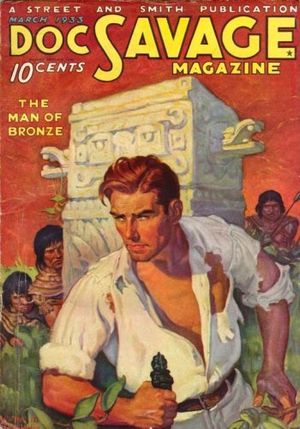
300px-DocsavageWell it’s that time of the year again–today is the first day of the Pacific Northwest Writers Association Conference, held in Seattle, Washington. I’m a proud member of PNWA, and find incredible inspiration at these conventions. This year’s keynote speaker is James Rollins, the well-known master of magic, mayhem, and monsters.  According to Wikipedia, the fount of all knowledge,  “Rollins found the authors of the Doc Savage series inspirational as a youth and acquired an extensive collection of the popular 1930′s and 1940′s pulp magazine stories.”

Quite frankly, I too adored Doc Savage, and discovering that another author was influenced by that wonderful, lurid, misogynistic series is quite a treat.  I’m looking forward to hearing him speak tonight.

Another person whose seminar I am looking forward to will be given by Lindsay Schopfer, author of The Beast Hunter. He will be talking on the subject of unlocking character motivation, and I am quite interested in hearing what he has to say on the subject, as he is an accomplished author, and his characters leap off the page.
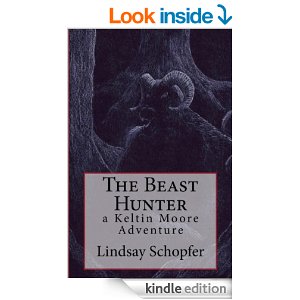
The Beast Hunter, Lindsay SchopferIt’s one thing to understand the mechanics of writing, the nuts and bolts of how to put together a coherent sentence and join it together with other sentences to make paragraphs. Most writers can do that. It’s quite another thing to write paragraphs that become stories other people will want to read.  Attending writers conferences and seminars gives me insight into how successful authors whom I’ve admired over the years think, and helps me stay fired up about my own work.

I will reconnect with many local northwest authors who I’ve become friends with over the years, and of course I’ll be connecting with agents and editors from all over the country.  This is a huge opportunity for me to absorb the mojo that happens whenever writers gather to talk shop. My next blog post will cover the events and hilarity of this one.

Jake RansomLast year I did learn one important thing–even the Hilton doesn’t have a clue when it comes to providing decent vegan entrees, no matter how the conference organizers claim they will offer them. Rather than starve as I did last year, this year I am commuting from home and bringing my own sack-lunch with plenty of snacks. It’s a bit of a drive, a little over 1 hour each way, but if the dinners provided are less than adequate, I’ll survive.

Today’s lunch will be an avocado, lettuce and tomato sandwich on whole-wheat. ♥  It doesn’t get any better than that!

Comments Off on Kicking off the annual PNWA writers conference

Filed under Adventure, Battles, Books, Humor, Publishing, Self Publishing, Uncategorized, Vegan, WordPress, writer, writing

Pareidolia

Martian_face_vikingSo I was reading a rather badly crafted novel last night–one that was entirely forgettable other than this one word: pareidolia.  I tried to get my kindle to find the meaning, and it was unable to answer that question too.  But  Wikipedia, the fount of all knowledge, came to the rescue:

Pareidolia (/pærɨˈdliə/ parr-i-doh-lee-ə) is a psychological phenomenon involving a vague and random stimulus (often an image or sound) being perceived as significant, a form of apophenia. Common examples include seeing images of animals or faces in clouds, the man in the moon or the Moon rabbit, and hearing hidden messages on records when played in reverse.

The word comes from the Greek words para (παρά, “beside, alongside, instead”) in this context meaning something faulty, wrong, instead of; and the noun eidōlon (εἴδωλον “image, form, shape”) the diminutive of eidos. Pareidolia is a type of apophenia, seeing patterns in random data.

Sir Paul McCartney, image from Rolling Stone MagazineHuh. Who knew? Apparently people have been suffering from pareidolia  for thousands of years: seeing patterns in the stars and calling them constellations,  faces and images in clouds, and seeing the face of the Virgin Mary in the patterns on their french toast. They also hear the Beatles implying “Paul is dead” when you play their songs backwards.   The Rorschach inkblot test uses pareidolia in an attempt to gain insight into a person’s mental state.

330px-Francesco_Melzi_-_Portrait_of_Leonardo_-_WGA14795You aren’t crazy–you are extremely creative and able to visualize it pretty clearly. Even Leonardo Da Vinci understood the phenomenon–apparently he wrote of pareidolia as a device for painters, writing “if you look at any walls spotted with various stains or with a mixture of different kinds of stones, if you are about to invent some scene you will be able to see in it a resemblance to various different landscapes adorned with mountains, rivers, rocks, trees, plains, wide valleys, and various groups of hills. You will also be able to see divers combats and figures in quick movement, and strange expressions of faces, and outlandish costumes, and an infinite number of things which you can then reduce into separate and well conceived forms.”

Well, it’s a word I most likely won’t use, but there it is — pareidolia — a new word in my vocabulary.


10 Comments

Filed under Adventure, Battles, blogging, Books, Fantasy, History, mythology, Self Publishing, WordPress, writer, writing

Analog, I revile thee, or how The Martian redeemed my faith in science fiction

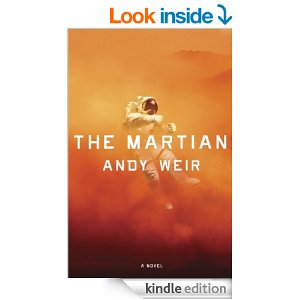
The MArtian Andy WeirI’m a book addict. Each time I crack open a book, whether in hard copy or on my Kindle, I’m hoping to be blown away by the imagery the author presents, hoping for that amazing high that comes from living a true classic. Lately I have been reading wide of my usual slot, not abandoning fantasy, but going back and seeing what I loved the most about the genre that was my first introduction to reading for pleasure. I recently had the experience of being completely and utterly blown away by a science fiction novel, The Martian, by Andy Weir.

It’s one of the best science fiction stories to come out of the last 20 years.  A real adventure story from the get-go, this story of an astronaut inadvertently left behind is gripping from page one. As a main character, Mark Watney is hilarious. He is the sort of man who gets through life by finding something positive in every disaster, and mocking the hell out of everything that is negative.

A horrendous storm destroys much of their base, and his team is forced to abort their mission.  During the emergency evacuation of the Ares 3 landing site, he is severely injured in an accident that appears to have killed him. His body is unretrievable, and unaware that he is still alive, he is left behind. His companions begin the long journey back to Earth, grief-stricken at his sudden death. THIS is an awesome, gripping, and hilarious story.

300px-Astound5006I’ve been a subscriber to a well-known science fiction magazine, Analog,  for many years. I am actually considering letting my subscription lapse, because for the last five years or so I have struggled to find something enjoyable in their magazine.  I no longer enjoy the work they are publishing and they no longer seem to care. While there are occasional nuggets, the majority of work they publish is frequently harsh, lifeless, depressing, and incomprehensible. The fact is, perhaps they have forgotten what real science fiction is about, what the average reader wants. Perhaps I am no longer smart enough for their publication–and I hate paying to be sneered at.

Despite the efforts of the publishing community, the genre of science fiction is not dead. Andy Weir ‘s brilliant work on The Martian proves that there are writers out there with exactly the sort of stories I am looking for.  And guess what–he published it in 2012 AS AN INDIE.  This is a really telling thing, that the watershed books are no longer being put out there by the Big Six, until they have proven their worth in the Indie market. Hugh Howey, A.G.Riddle, Rachel Thompson–INDIES, all of them.

In my sci-fi, I want human frailties, drama, adventure, intense life and survival against great odds, set against a backdrop of understandable and realistic science.

I want a Space Opera.  Andy Weir gave that to me.

It is that high drama that made the Star Trek empire what it is. High drama set in exotic places made George Lucas’s Star Wars series of movies the poster child for space operas. Those two series translated the intensity of feeling that the great authors of science fiction all brought to their work.

Over the years, I have written many short space operas for my own consumption. However, this fall I am embarking on the real test–putting my writing skill where my mouth is.  It just so happens that off and on for the last  3 years, I’ve been outlining a science fiction story.  Originally, I began this project  in preparation for NaNoWriMo 2013, but this will be the year to implement it, so in November this will be my work.

As a devoted fangirl of many well-known physicists, I’ve been doing  research for the last three years, and feel sure my science will hold up, which, in sci-fi, is key to the longevity of a tale. I have great characters, and a really plausible plot. I just have to spend 30 days stream-of-conscious writing to the prompts I have set forth and…well, that is the trick, isn’t it? But even if I fail to write anything worth publishing, I will have had a good time, and that is what this gig is all about: enjoying the ride.


2 Comments

Filed under Adventure, Battles, blogging, Books, Fantasy, Humor, Literature, Publishing, Self Publishing, WordPress, writer, writing

How dining in Bedlam taught me to write dialogue

Days of Wine and Roses quote copyThe family I grew up in is a loud, all-talk-at-once kind of a family, with a lot of talkative members. Family gatherings are absolute bedlam–large, loud, full of life and great food, and long on opinions and ideas. We are comprised of musicians, artists, and authors, along with engineers and software developers.

Above all, we are avid gamers of all kinds, from old-school Super Mario, to Grid Autosport, to Final Fantasy X/X-2, to Halo, to Assassin’s Creed, to  Dark Souls 2, to Minecraft–and we love to talk, loudly and all at once, about everything we love. Somehow, we all manage to have our say and allow the others have theirs, but it’s like living in a blender at times.

We, and our friends, are loud and passionate and most people love it, but every now and then a visitor can’t handle the hullabaloo.  Sometimes, less outgoing girlfriends or boyfriends don’t get it, and the general din intimidates them.

In fact most people carry on conversations, where one person says something, and the  other one answers, and this goes on like a tennis match until everything has been said.

Huh. Who knew?

So, that is how we want to write our dialogue. We want it to sound natural.

Writers need to keep in mind that when people talk, they rarely follow any grammatical rules. Any English class that writers have taken will have stressed the importance of using proper grammar and punctuation in their writing. However, when we attempt to write dialogue, those same rules should be thrown out of the window. Many times people speak in broken sentences, with pauses, and even use incorrect words.

  1. Don’t overuse character names in dialogue. People don’t use each other’s names in every sentence they speak, because it sounds silly. (“Helen, your hair is lovely.” “Thank you, Ralph.” “Do you want to watch a movie, Helen? “Sure, Ralph, but stop touching my hair.”) When you do use character names in dialogue, use them early in order to indicate to whom the speaker is talking, and after that, be sparing with the monikers.
  2. Avoid writing dialogue that’s really an excuse for “speechifying” (I love that word ♥.)  Avoid giving your characters long paragraphs with lines and lines and lines of dialogue that is uninterrupted.  In real-life conversations, people usually alternate in conversation, and like my family, they often interrupt each other. It is your job to capture the rhythm of real speech–but don’t make it choppy.
  3. The dialogue of one character shouldn’t repeat what was said by the other, unless it is for emphasis in that one instance. “So Helen, what you are saying is, ‘don’t be repetitive.'” “Yes, Ralph, don’t repeat my every word.” “Don’t repeat your sentences.”
  4. DON’T explain your dialogue by adding too many descriptors, such as: John shouted angrily, or Garran commented sulkily. If the meaning is effectively conveyed in what your characters are doing as well as saying, adding these descriptors undermines the dialogue and disengages the reader. Try removing the explanation and see if the meaning is still clear. If it isn’t clear, it’s time to rewrite. By letting the dialogue speak for itself, by describing it less and showing it more, you make it more compelling.
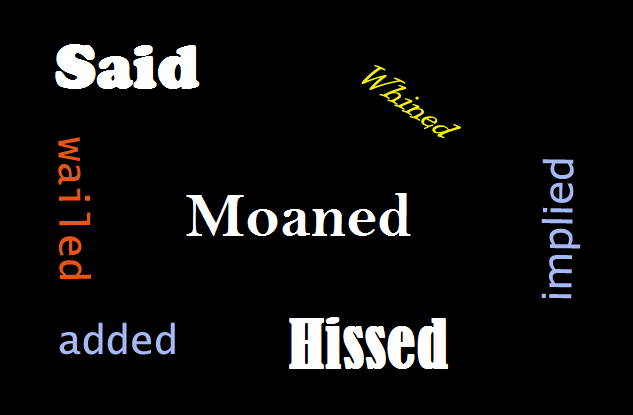
  5. DON’T get creative with your attributions, or ‘dialogue tags’ as we call them: stick to John said (not said John, which sounds archaic in modern literature.) Unless you absolutely need a John screamed or Edwin uttered (which you pretty much never do) just say it and let the reader do the rest. Fancy synonyms for ‘said’ are usually unnecessary and distracting.
  6. And now for my pet peeve:  people do not smile, snort or smirk dialogue. I mean really–“That’s a lovely dress,” snorted Clara. (eeew. )  In fact, it is often best to do away with attributions altogether for a few exchanges every now and then, if:  A. you have only 2 speakers, and B. you have established who is speaking.
  7. Most readers hope authors will avoid trying to convey accent by altering spelling. It gets tiresome to read an author’s attempt to rewrite the dictionary to fit a cockney or an Irish accent, so use colloquialisms and speech patterns instead. That said, if the character is making a MINOR appearance, using an accent will give the reader feeling that they know that character, without resorting to an info dump.
  8. Feel free to break the rules of grammar if your character shows a blatant disregard for what’s correct. If he wants to say, “I seen that movie last week. It were a real dud,” let him.  That is a way to show the description of your characters.
  9. Miss a few beats. Beats are little bits of physical action inserted into dialogue: John fell quiet and stared out the window. Marta turned and walked out the door. Used sparingly, these pauses serve to punctuate the dialogue, to give the scene movement, and to maintain a strong mental picture in the absence of description. They’re best placed where there is a natural break in the dialogue, because they allow the reader to experience the same pause as the characters. Pauses are essential to good dialogue, but don’t overdo it. If your characters are rattling pans, slicing apples or staring out the window between every line of dialogue, the scene becomes about the action and not the dialogue, and the impact of the conversation can be lost entirely.
  10. Once in a while, it is okay to have your characters tell a story within the story, but do it as naturally as possible. Speaking as an older person, I admit that some older character will be just dying to tell the younger ones how it really was. Please don’t use that plot twist as a crutch to dump a chunk of boring background. No one in real life wants to hear an old duffer go on about the good old days at Bob’s Fish Cannery, even if Skyler Webbley did lose a finger that was never found and didn’t notice it until his shift was over when he discovered his driving gloves didn’t fit right. (Just sayin’.)

In regard to proper use of punctuation: it is important to follow the rules in the general narrative but punctuation has a different role in dialogue. There are times when it is used to create pauses in dialogue.

Oh, dear. What have I done? Breathe, Irene, breathe! Inhale…exhale…it will be fine–it’s dialogue, for the love of  Chatty Cathy…we want it to sound normal, not necessarily literate. (Oh, dear, she’s turning blue… . Line editor down! Quick! Someone fan her with the Chicago Manual of Style!)

Or you can properly punctuate your dialogue to your heart’s content.  It’s your book, and your style–you make the decision.

Anyway, to write natural dialogue, observe others around you, see how they talk, what they do with their bodies, and where they pause. These are what you know of them as people, and are what you want to convey in your writing.  What we want our dialogue to do is  give the reader a clear visual of the scene, the characters and their environment. A truly great book is clearly visualized in the mind of reader, so give those clues and hints, but let the reader see for themselves the beauty or horror you are describing though good dialogue and properly setting the scene.

VOS QUOTE


20 Comments

Filed under Battles, blogging, Books, Fantasy, Final Fantasy, Humor, Literature, Music, Publishing, Self Publishing, Uncategorized, writer, writing

la vie fantastique

Map-pugetsoundMy hubby and I went to Victoria, British Columbia (Canada) over this last weekend. It was a wonderful two days, spent in a town that exists partly to govern the Province of British Columbia, but mostly to help you lighten the burden in your pocket book, and make you beg to let them do it again.  We got up at 3:00 a.m. and left our house at 4:45.

(Gah!)

I am often up at that time of the day, but not intentionally, so it was no surprise to me that I could hardly pry my eyes open. Then we drove up to Seattle, collecting two of his sisters along the way.

It’s amazing how little traffic is on I5 at that time of the morning–perhaps I will do all my traveling at ungodly hours. And parking…OMG, it was heaven.

(Sorry, too much texting the GKs lately. Makes me want to lol out loud. Might write my next book in textspeak.)

Anyway, I had my pick of prime spots in the parking garage, and found one I was easily able to maneuver the old minivan into with no trouble. I hardly gave my poor brother-in-law, Dave, a heart-attack  at all on the way up to Seattle. He  is a sweetheart of a guy but the man is a nervous and verbal passenger.  The trip back–well lets just say he wanted me to take the Alaskan Way Viaduct, and I didn’t want to.

I’m sorry, Dave. I’m afraid I can’t do that. 

I don’t trust the viaduct. It’s as shaky and narrow as a one-legged ladder.  I’d much rather drive in aimless circles around downtown Seattle hunting for a southbound freeway on-ramp, counting the number of times we pass Nordstrom’s and he doesn’t see the fun in such an exercise. But that’s another post (the one on how our family puts the fun in dysfunctional.)

Catamaran_Victoria_Clipper_IVSo we got on the Victoria Clipper at 7:30 a.m., which is definitely the way to go if you are traveling from Seattle. Victoria Clipper catamarans typically complete a one-way trip in less than 3 hours, in our case, 2 hours and 45 minutes.   To drive there would take 6 hours from our house anyway and we would still have to take a ferry, so why not just leave the car in Seattle and go in style? And we were flying over the water, traveling at 30 knots, which is just a hair over 34.5 miles per hour in landlubber-speak. That’s cruising pretty fast on the inland Salish Sea.

Then we toured the Butchart Gardens. THAT place is most definitely a fairyland.  I can’t even find the words to explain how beautiful it is.  My cellphone photos suck, to use a technical term, so I am using images cadged from WIKIPEDIA to illustrate this:

1200px-Butchart_Sunken_Gardens


1200px-Butchart-gardens-002

Needless to say, after a long day of hiking the most gorgeous gardens, and then trundling all over the downtown, spending money like water in Victoria proper, I was SO ready for a lovely meal in what is really a lovely, vegan-friendly city. A long soak in the hotel hot tub, and followed by gin & tonic in the hotel lounge (light on the gin and lots of lime wedges, thank you) and this old lady was ready for bed.  I got on the internet just long enough to check my email.  I wasn’t completely out of writer-mode–I did note my ideas down in my little book while I was on the ferry.

So, while I didn’t get any writing done I had a wonderful time with my in-laws, and that’s paradise, to me.

Victoria_harbour_-_Victoria,_British_Columbia_-_2014

4 Comments

Filed under Adventure, Battles, blogging, Fairies, Fantasy, Humor, Literature, Publishing, Self Publishing, Vegan, WordPress, writer, writing

Maya Angelou April 4, 1928 – May 28, 2014

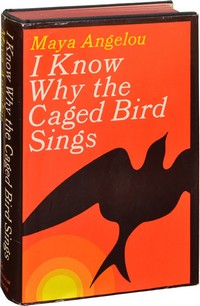
Caged_bird2Today, Maya Angelou died at the age of 86, a true hero to me and to women all over the world. She is best known for her series of seven autobiographies, which tell of her childhood and early adult experiences. The first, I Know Why the Caged Bird Sings (first published in 1969), tells of her life up to the age of seventeen, and brought her international recognition and acclaim.

From Wikipedia: I Know Why the Caged Bird Sings is the 1969 autobiography about the early years of African-American writer and poet Maya Angelou. The first in a seven-volume series, it is a coming-of-age story that illustrates how strength of character and a love of literature can help overcome racism and trauma. The book begins when three-year-old Maya and her older brother are sent to  StampsArkansas, to live with their grandmother and ends when Maya becomes a mother at the age of 16. In the course of Caged Bird, Maya transforms from a victim of racism with an inferiority complex into a self-possessed, dignified young woman capable of responding to prejudice.”

Beyond her struggles with the obvious bigotry and ignorance of the times, she represented to me the most beautiful thing of all–that a girl with very little education, who was blessed with a love of reading, could rise above the place society wanted to put her.

Some things I learned from her: “One isn’t necessarily born with courage, but one is born with potential. Without courage, we cannot practice any other virtue with consistency. We can’t be kind, true, merciful, generous, or honest.”

“You may not control all the events that happen to you, but you can decide not to be reduced by them.”

“We may encounter many defeats but we must not be defeated.”

The world is a better place because of Maya Angelou and what she represented. The literary world is a better place because of what she wrote.  Heaven is a better place, because she is there.

Comments Off on Maya Angelou April 4, 1928 – May 28, 2014

Filed under Adventure, Battles, blogging, Books, Fantasy, Literature, Uncategorized, writer, writing

Fantasy and the cold hard truth

Saint_Alban_(cropped)In a good novel, there is a moment where the interactions between certain characters can become highly charged, fraught with anger and other intense emotions. That is the case with what I am writing now:  three of my characters spent a long time fighting alongside each other, brothers and sisters in arms, completely dependent on each other.

They have a long history. Several terrible incidents occurred during the war they once fought that they don’t understand, and which created a rift between them. Some of their close companions were killed under bad circumstances (are there ever any good ones?) and each of my characters suffers a little survivor’s guilt.

After the war, they went their separate ways and for the last 25 years, have rarely seen each other or spoken. They all bear a burden of responsibility for things they can’t change, and their lives are affected by this, although they don’t know why. For each of them, their anger and remorse are expressed in different ways.

Two of them can’t be in the same room for long without trying to kill each other.

One character in particular suffers disturbing recurring flashbacks, avoidance or numbing of memories of the event, and what we call ‘fight or flight syndrome,’ the uncontrollable urge to either fight or flee. These characters all three demonstrate varying degrees of avoidance,  withdrawal, aggressive defense, or in one case, complete frozen immobility. Certain memories trigger these behaviors, and now all three are being forced to face their demons.

My challenge is to bring these people back together with sensitivity and realism, in order to advance my story, and use only 1/3 of the allotted word-count for this book.

Does this sound like Post Traumatic Stress Disorder (PTSD)? You’re right. For more information on PTSD, see an article  on the website, Military Pathways, and this news article aired by CBS on their show, 60Minutes.

Because it’s a new term, I can’t refer to this ‘injury of the spirit’ as PTSD in my manuscript. But I can give it another name and air both the symptoms and the sometimes life-long problems untreated PTSD causes.

GeorgeSPatton - WikipediaMy father, and my uncles all suffered from this long after World War II ended. In many ways it has shaped our post WWII society. Our fathers were told to just shut up and  get on with their lives–something that is not always an easy thing. Alcoholism and domestic abuse lay just under the surface of many families in our community, hidden but there.

Prior to World War I, the U.S. Army considered the symptoms of battle fatigue to be cowardice or attempts to avoid combat duty. While the causes, symptoms, and effects of the condition were familiar to physicians, it was generally less understood in military circles. General George Patton garnered substantial controversy after he slapped two United States Army soldiers under his command during the Sicily Campaign of World War II.

It was common for soldiers who reported these symptoms to receive harsh treatment. At the time of the slapping incidents, the two soldiers Patton assaulted were suffering from “battle fatigue,” otherwise known as “shell shock” or “battle stress.” Today, this condition is characterized as a form of PTSD, which can result from prolonged severe exposure to death and destruction, among many other traumatic events.

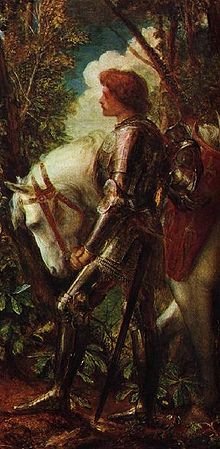
220px-Sir_Galahad_(Watts)

Even though I write fantasy, the reactions of my characters to certain situations has to be realistic, and that is where a good grasp of what really happens to our vets comes in handy. Post Traumatic Stress Disorder (PTSD) is real and affects our returning veterans. More must be done to help ease our military wounded back into society, but generally speaking we pay more lip-service to that problem than we do tax dollars.

We write about incredible personal challenges, because they make great stories. But what about the people who live through those moments? How do they quietly go back to the farm once the war is over, and pretend it never happened? This is what I am writing about now, and it has been an emotional journey for me as as an author and a human being. Everyday, our paths are crossed by men and women living with PTSD caused by a variety of terrible circumstances,  They are just ordinary people trying to keep their lives together, not understanding why they sometimes do the things they do, and wondering why things just keep going to hell all around them.


2 Comments

Filed under Adventure, Battles, Blogger, blogging, Books, Fantasy, knights, Literature, Publishing, Self Publishing, WordPress, writer, writing

What I’ve learned from George R.R. Martin

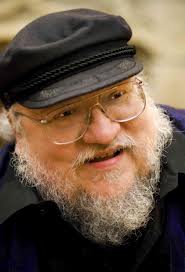
George R. R. Martin photoI’m not a fan of George R.R. Martin’s style of writing, but I adore the man as a person. He has the courage to say out loud what many people would sweep under the rug.

Recently George R.R.  Martin told journalist Dave Itzkoff of the New York Times that although his books are epic fantasy, they are based on history. He said,  “Rape and sexual violence have been a part of every war ever fought, from the ancient Sumerians to our present day.” 

“To omit them from a narrative centered on war and power would have been fundamentally false and dishonest, and would have undermined one of the themes of the books: that the true horrors of human history derive not from orcs and Dark Lords, but from ourselves. We are the monsters. (And the heroes too.) Each of us has within himself the capacity for great good, and great evil,” Martin said.

According to Martin, “History is written in blood, and although Westeros – the fictional continent where the series is set – is ‘not the Disneyland Middle Ages,’ it is “no darker nor more depraved than our own world. The atrocities in A Song of Ice and Fire, sexual and otherwise, pale in comparison to what can be found in any good history book,” he said. (End of quoted text.)

George is right, and he is not advocating or glorifying rape, in fact just the opposite. If you want to inject realism into a work of fantasy you must address uncomfortable realities that human history has shown to exist. The worst aspects of human nature are portrayed in our everyday life—things I could never dream up. Society at large is blasé about it—unless it affects one personally, it may as well not exist.  Rape in the military is a fact, friends, not a myth, and that is just within our own forces. Not only does she live in a danger zone while in the military, a  woman soldier also knows she faces rape and torture if she is captured by the enemy—that is the first step in breaking her. Many men also suffer sexual assault and torture for the same reasons, whether we wish to acknowledge their pain or not.

Image courtesy of CBS News, and Getty

Image courtesy of CBS News, and Getty

Consider this disgusting item of current news that only rarely makes it onto the nightly newscast in our town: To be a young girl in Borno, Nigeria is an invitation to be kidnapped and sold into sexual slavery. More than 200 young girls are living this nightmare right now, because an extremist group, Boko Haram, who is against educating women, goes door to door, breaking into their homes and boarding schools and taking the girls from their beds. This is done as a way to maintain political control and  keep their fathers in line. The families of the stolen children are powerless against these brutal thugs.

Do you think these schoolgirls are not being raped and tortured?  If so, you are living in a dream. The leader of these radicals publicly flaunts their intentions to sell or marry all of them, bragging to all the media that they do it because God told them to.  They loudly proclaim that they will sell all of these girls, and believe me, the world is full of buyers just waiting for such an opportunity. So far, 20 lucky girls have escaped their captors.

If I was writing modern literary fiction or political potboilers, I would have tossed out such an unbelievable plot–it would have seemed completely unrealistic–I mean, a religious cult of pedophiles and rapists systematically kidnapping 200 girls, claiming divine privilege, and no one is able to stop them? Come on, get real.

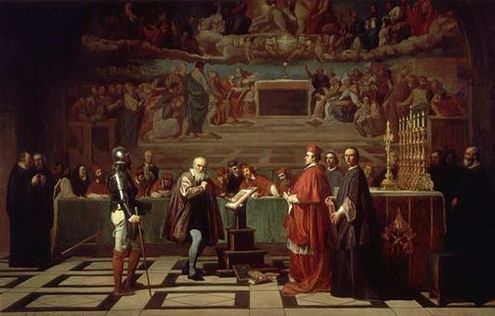
A 19th-century depiction of Galileo before the Holy Office, by Joseph-Nicolas Robert-Fleury image courtesy Wikipedia

A 19th-century depiction of Galileo before the Holy Office, by Joseph-Nicolas Robert-Fleury image courtesy Wikipedia

I suspect God would prefer we  humans didn’t give him the credit for our evil, thank you very much.

So what have I actually learned from George R.R. Martin? I have learned to be true to reality in my writing or my story will never hold water.  Draw from history, mash it up all you want, but don’t deny the roots and don’t turn away from the ugly truth. Also, we must  never forget that there is as much beauty to draw from as there is pain, for it is that contrast that makes an intense story compelling.

No work of fiction will ever be more horrific or glorious than the true history of our humanity and inhumanity. We authors will only scratch the surface, and if that small scratch makes a reader slightly uncomfortable, the reader can easily retreat to their ivory tower and read bland romance novels written by someone other than me or George R.R. Martin, where everything is rainbow perfect and happy endings are guaranteed.

If you were privileged to be allowed to learn to read, that is.

10 Comments

Filed under Battles, blogging, Books, Fantasy, news of the world, Politics, Publishing, WordPress, writing

Oh, the agony

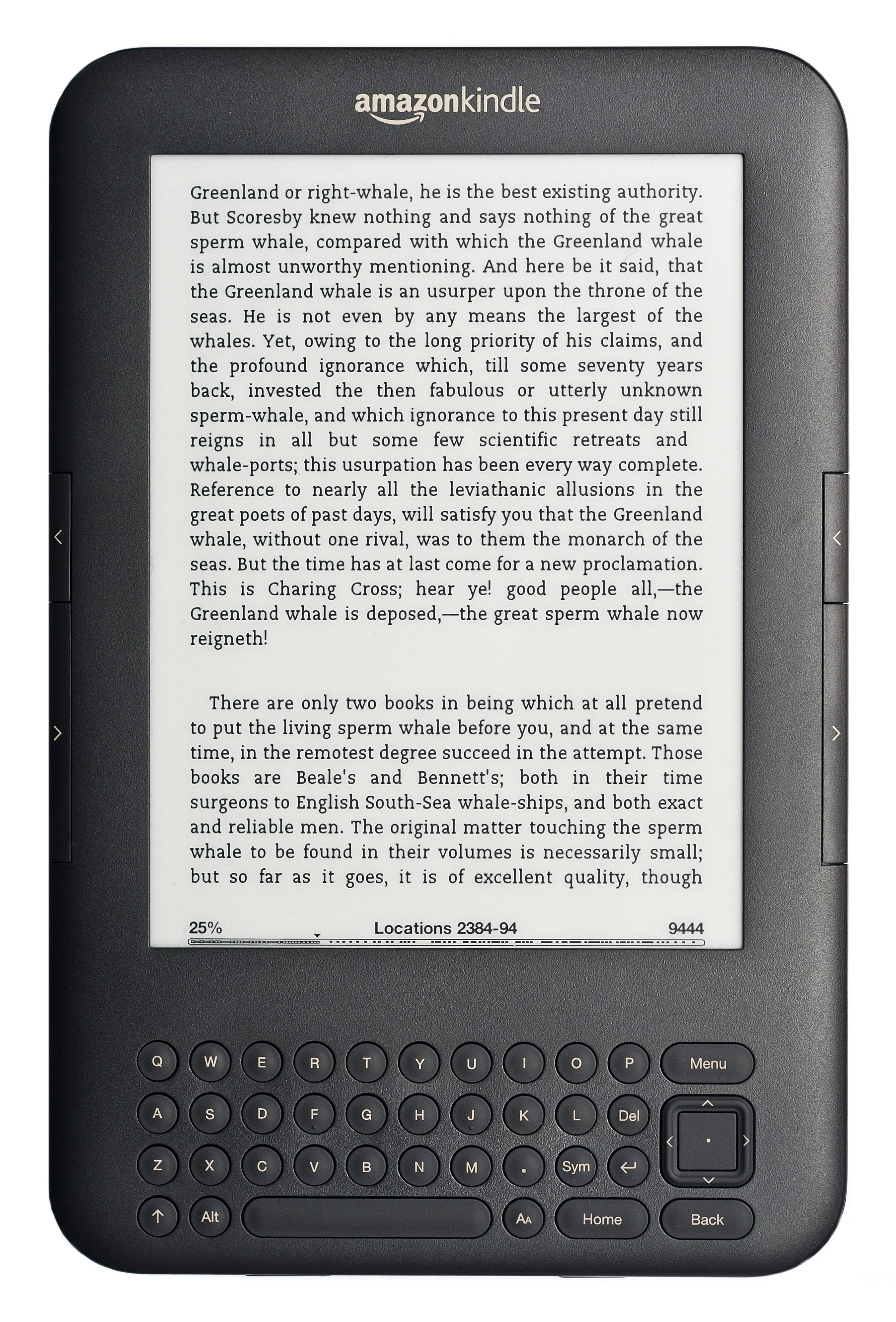
Amazon_Kindle_3I am an avid reader. I love the Kindle for the simple reason I have over 500 books and I don’t have to dust a one of them.

I have managed to get nearly every book I ever loved on my Kindle, and have become a great fan of hundreds of new authors, most of them indies.

Every now and then I read a book that is not in the genre of fantasy, sometimes taking a dip into general fiction.  I did that this week, reading a book I saw advertised on twitter.  I picked this one up because I like the title.

I don’t usually read general fiction because so many times I am left with a bad taste in my mouth. I’m OCD–if the book isn’t too horrible, I can’t put it down until I have read it to the end and confirmed that it was indeed a waste of paper and time. I hate that.

It never fails–I buy a book based on glowing reviews and after I’ve done my part and slogged through the depressing, overdone theatrics and get to the end I find that, just like an ex-lover,  it turned out to be a pretentious riff on a tired theme after all, with nothing positive to offer.

Dialogue Tags © cjjasp 2014No happy ending, and perhaps no ending at all.

Why do I ignore the warning signs?  The cringing when certain characters (once again) turn their head just so, the clenching of my teeth when the bored protagonist lights yet another cigarette. What is this fascination some authors have with portraying moneyed, bored people who cheat on each other and their taxes as if they were somehow glamorous? What makes me keep reading despite the fact that if I were to review this travesty I would give it a 3 star review and a good thrashing?

I was up to 2:a.m. reading that crap. Now I feel soiled, as if I’d suddenly developed a craving to party the night away at the local club and woke up with a horrendous hangover and a drummer named Scooter.

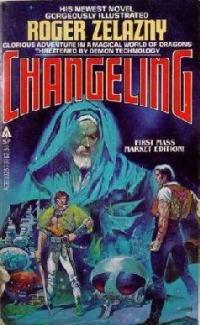
Changeling_zelaznyToday I am going back to Roger Zelazney. He’s a lover who has never let me down. I am going to revisit the scene of our most passionate affair, that amazing world of Rondoval, and Roger’s masterpiece,  Changeling.

Give me flawed characters larger than life, seething with jealous rage, untapped magic, and raw violence–and put them in an environment that makes them have to work to survive.

Oooh baby…. Now THAT is the antidote to bored ennui in my reading material!


5 Comments

Filed under Battles, Fantasy, Literature, Publishing, Self Publishing, Uncategorized, WordPress, writer, writing

My manuscript is a Doorstop

Saint_georges_dragon_grasset_beguleI give up.

I need ideas, and they–recalcitrant beasts that they are– will not appear.  Please, ideas…have pity on me and put yourself into this manuscript.

I woke with a new book in my head and now I can’t work on the one I am SUPPOSED to be doing…the one my nephew, Robbie, will beat me for if I don’t get it written…

The one that has been in limbo for more than a year.

Outline of Book: done.

First 1/4 of Book — done, done and then done some more — done to the point that there are 160,000 words: TWO books worth of done-ness to sort through and condense into no more than 50,000 words so that the total length of the Book won’t be so big that the paperback is a doorstop.

To_Green_Angel_TowerTad Williams can get away with a book  520,000 words long (To Green angel Tower) and David Foster Wallace could with Infinite Jest (543,709) –but I’m an indie.

I have to calculate my production costs, and believe me, it’s hard enough for an indie to sell work that is priced reasonably. Once an indie’s paperback increases to more than $14.99 it won’t sell at all, and at anything over 120,00 to 130,000 words your costs are well over the optimum of $12.99.


What to leave in? What to cut?

What the heck?

Second 1/4 of book mostly done, and looking good.

Last half of book nearly done, pleased with the way that is going.

Still drowning in flood of first 1/4–> think there may be a book of short-stories there.  Must decide who will live…

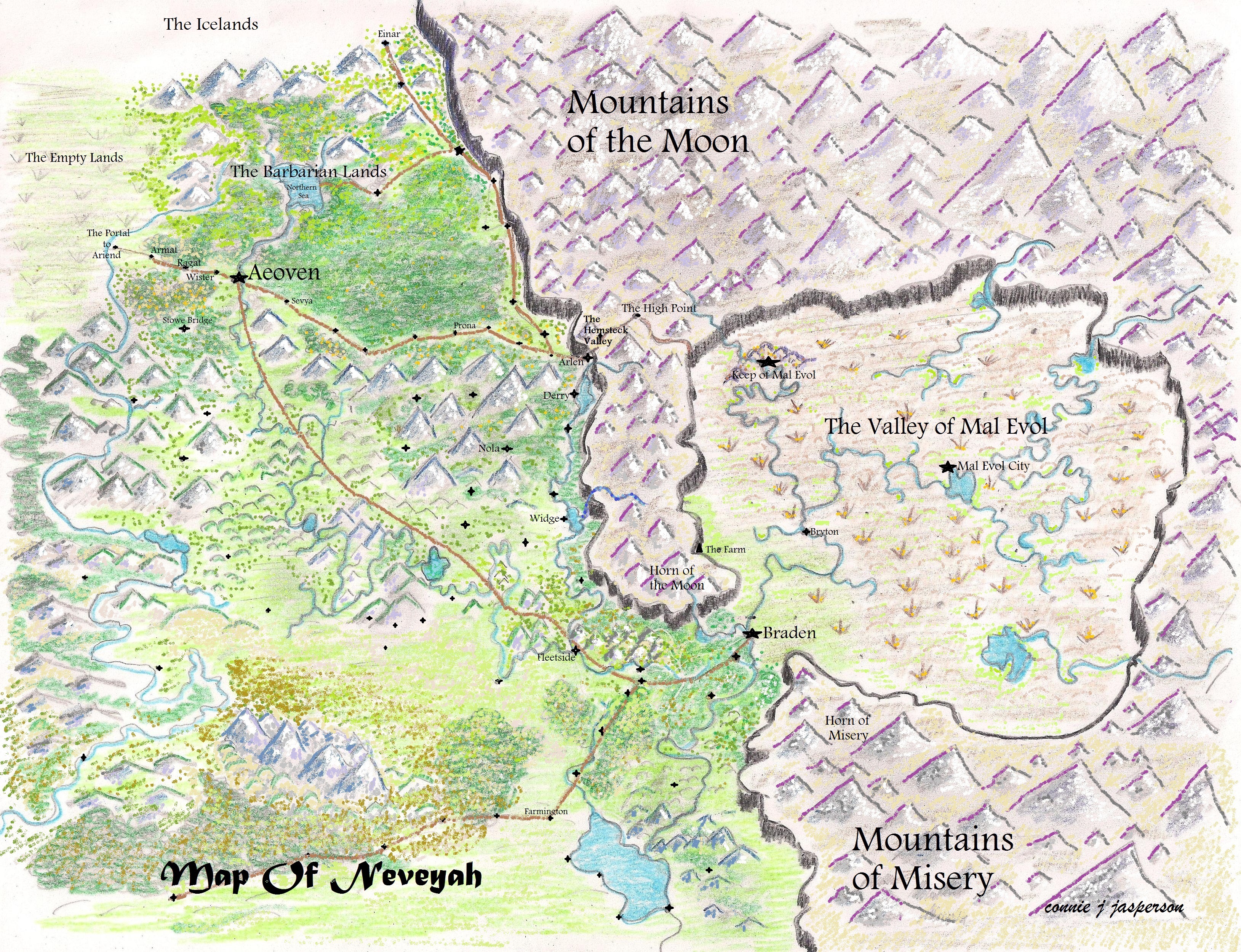
…and who will end their days in an anthology of tales of Neveyah….

Sigh.

map of Neveyah relief 3-4-2013 001


Comments Off on My manuscript is a Doorstop

Filed under Battles, blogging, Books, Fantasy, Humor, Literature, Publishing, Self Publishing, WordPress, writer, writing