Category Archives: Books

Charles Dickens was an Indie Author, Too

achristmascarol George C ScottFew people are aware that one of the most famous and inspirational books in the English language was originally self-published, and didn’t do as well as the author intended. Charles Dickens began to write A Christmas Carol in September 1843, and completed the book in six weeks with the final pages written in the beginning of December. Unfortunately he was feuding with his publisher over the meager earnings on his previous novel, Martin Chuzzlewit. Because of that, Dickens declined a lump-sum payment for the tale and chose a percentage of the profits in hopes of making more money. He then published the work at his own expense. It was as expensive then as it is now to publish quality print books and high production costs netted him only £230 (equal to £19,128 today) rather than the £1,000 (equal to £83,164 today) he’d hoped and needed, as his wife was once again pregnant. A year later, the profits were only £744 and Dickens was deeply disappointed.

Formatting was as tough in those days as it is now and Dickens was unhappy with the first edition of the tale. It contained drab, olive colored endpapers that Dickens felt was unacceptable. The publisher, Chapman and Hall, quickly replaced them with yellow endpapers but those clashed with the title page which was then redone. The final product was bound in red cloth with gilt-edged pages and was completed only two days before the release date of 19 December 1843.

I take comfort in knowing that the man who wrote the most powerful story of redemption in my personal library was an indie author too. Self-Alastair Sims - A Christmas Carolpublishing is much easier nowadays, but nevertheless it too is fraught with costs and formatting difficulties.  I have one last little formatting issue to solve in the Tower of Bones on page 361, and then I will be able to okay the final print version of it.  Wonky formatting is the curse of my life!

This is the time of year when I watch every single version of A Christmas Carol that can be found. Alastair Sims, George C. Scott, Patrick Stewart, Mr. Magoo and now Jim Carey occupy the small screen and remind me of what is really important in life – love and family.  Even Mickey Mouse has warmed the cockles of my heart in the role of Bob Cratchitt.

And now, I must go wrap presents by the flickering light of my television, as once again the Ghost of Christmas Present leads Mr. Scrooge to see what he should have seen all along – that Christmas Spirit is a year-round emotion, and has less to do with cash flow and Black Friday Shopping and more to do with charity of spirit.

If you are feeling charitable, I would recommend these fine charities:

The Salvation Army

The Union Gospel Mission

Clean Water for the World

Patrick Stewart - A Christmas CarolThere are so many worthy charities, and any gift you make to them will benefit millions of people.  I live in the lap of luxury, and I know it. I have a good roof over my head, a reliable income and a healthy family. I am grateful for all these blessings, and if you are similarly blessed, I encourage you to make some donations to your local charities as a way of giving thanks!

3 Comments

Filed under Adventure, Books, charity, Fantasy, Humor, Literature, Uncategorized, writer, writing

Punish me no More

Paradise Lost  wikimedia commons Gustave Dore PD ArtI was reminded about the book, Finnegans Wake, in a blog I regularly read.  James Joyce wrote the classic novel, and James was a man who loved words.  He loved words the way I love Ritchie Blackmore and Reese’s Peanut Butter Cups.  He couldn’t get enough of them and when old words didn’t suffice, he invented new ones. Puns, those low class examples of verbal violence, became an art form under the pen of James Joyce.

Robert MacLean’s most recent post for his fascinating blog on morality, humor, and art, ‘The Devil’s Pleasure Garden’ is on Fellini, and Shakespeare.  He rambles though Shakespeare’s Hamlet, Fellini’s 8 ½ , and lightly touches on Luis Bunuel.  I enjoy MacLean’s morality crises – his angst has led to some of the finest blog posts on creativity out there!

MacLean also mentions James Joyce’s incredible monster-piece, Finnegan’s Wake, quoting the delicious pun “…when they were jung and easily freudened.”  I realized when I was re-reading MacLean’s blog today that the reason so many people despise puns is that for a pun to be funny one has to know what the pun is about. If a reader has never heard of Carl Jung or Sigmund Freud that pun will go right over their head. They get a sour look and say “I despise James Joyce – I don’t know what people are thinking calling him a genius.”

When people don’t understand something that makes other people laugh, they feel somehow inferior and they hate it. So my job is to not make my readers feel ignorant, and yet still write in such a way that my work is not ‘dumbed-down’.  Humor is essential, and I usually love a good pun, but since the key to enjoying a good pun is knowledge and you can’t guarantee your readers will have that knowledge, it’s best to avoid puns when writing.

But for me, humor is crucial to keeping me interested in the characters. If you are going to have your characters grimly going about their work, with nothing to brighten the mood you have immediately lost me.51EwwPIAJbL__BO2,204,203,200_PIsitb-sticker-arrow-click,TopRight,35,-76_AA278_PIkin4,BottomRight,-64,22_AA300_SH20_OU01_

Shaun Allan’s brilliant work, Dark Places, is a classic example of how an author can blend humor into the darkest events, and keep his readers’ eyes on his book.

I find myself injecting humor into my work, not in a calculated way, but because it naturally flows there.  Macabre humor is what keeps my family together at times—that ability to laugh at the worst times keeps us slogging through the strangest twists and turns of life. Oh, it’s a little embarrassing at times, but it gets you through it. And that is what happens with my characters. Lackland, Huw the Bard and indeed all the Rowdies rely on their sense of humor as the way to find logic in the worst of events.

In Tower of Bones, the sense of the ridiculous surfaces several times when the characters are under the most stress. Friedr is one of my favorite characters in the TOB series, as he is the most in touch with his sense of humor and his frequent lack thereof. Christoph was born with a joke falling out of his mouth, and humor is his armor.

Good grief!  I just said “one of my favorites” – all of my characters are my favorites! Even the evil ones!

1 Comment

Filed under Adventure, Battles, Books, Fantasy, Humor, Literature, Romance, writer, writing

The Alternative Guide to Alternate Realities

The Infinity Bridge by Ross M KitsonToday we are going on a voyage, visiting three very different realities, or as I like to think of them, Blogs.  We are on a progressive blog tour, guided by the incredible Ross M. Kitson, author of the Steampunk fantasy, The Infinity Bridge.  Part I of this tour is today, here on Life in the Realm of Fantasy

Part II will be tomorrow Dec 13, 2012 at  www.alisondeluca.com – Alison Deluca’s wonderful blog.

Day III will be at Ross’s own blog http://rossmkitson.blogspot.co.uk

I encourage you to check out these blogs and follow this post through all the realities it travels through!

>>><<<

Alternative guide to Alternate Realities 1: Literature

By

Ross M. Kitson

One of the key aspects of my latest book, The Infinity Bridge, is the existence of parallel universes or alternate realities. As the book is written for the teen market upwards (MG/YA is the latest term, to avoid the patronising ‘kid’s book’ I suppose) I spent a good while musing about whether to include a meaty information dump in the next about the ideas of alternate reality. And here’s an odd thing- the more I thought about it, the more I realised that as an idea in fiction/TV/film it is so thoroughly established that I didn’t need to bother!

I think my first exposure to the idea of alternate reality came in the form of comics (which was pretty much my first form of literature anyhow). I’m going to ramble about those in a separate post—for this one I’m going to focus on alternate reality in books.

The idea that history may have taken a different course, and the ramifications of that, have been a popular theme for centuries. The first works about the topic popped up in Victorian literature (N Hawthorne’s short story ‘P Correspondence’ and C Holford’s ‘Aristopia’) but the real boom in the topic came in the pulp science fiction of the forties and fifties. During this time some awesome writers, including Heinlein, L Sprague De Camp, Poul Anderson, Andre Norton and Larry Niven turned their hand to the topic. In many of these works we have protagonist able to cross between the alternate realities, often armed with knowledge of their own historical variant, via portals or machines. In some tales they are ‘police’ figures (the best example of this being H Beam Piper’s Para-time books, which I read recently and absolutely loved) trying to address some renegade or some disruption, whereas in others the individuals are more passive in their roles, thrown into the new reality and learning of its variance as the reader dose.

The concept of parallel worlds and alternate history progressed from the pulp SF realm and into that of more popular and conventional literature. A recurrent favourite of the genre is the course of World War 2 being changed: Philip K Dick ‘The Man in the High Castle’ describes the Axis powers winning WW2 (and has a character in it who writes a book about the Allies winning!); Robert Harris ‘Fatherland’ is a similar very popular example. I’ve yet to read one where Adolf has a better moustache, however.

In MG-YA books the theme is quite a popular one too. I recently read Time Riders by Alex Scarrow in which three teens are recruited by a futuristic agency to help ‘mend time.’ The first novel explores the idea that time travellers go back in time and assist Hitler by stopping him attempting to invade Russia. The ramifications are that an alternate timeline is created, which alters the present in which the heroes occupy. My 10 year old son took the plot in his stride, and when we talked about it had no issues about the whole concept!

Purists of the SF genre would ponder whether works of alternate histories are fantasy or SF, namely is there any science behind it (I feel like Jennifer Aniston in a shampoo advert… ‘now here comes the science’).

Semantics would argue ‘alternate histories’ are not the same as ‘parallel universes.’ The idea is that parallel universes co-exist, namely they run along at the same time, whereas only one ‘alternate history’ can exist, i.e. the history has changed and continues along its new course. For me this is pretty pedantic, but since I grew up with the ideas in Star Trek, Dr Who and comics I’m hardly a hard-core sci-fi buff…

There is a school of thought in Quantum physics that gives a degree of theoretical credence to parallel worlds and alternate histories: the Many-Worlds Interpretation, or the ‘relative state formulation.’ It’s the sort of quantum theory advanced since the 1950s and sufficient to make you reach for a large spliff and say ‘Hey, man’ as someone in a brown corduroy jacket begins to explain it. Its basic tenet is familiar though- every event even at a quantum level, can go a number of ways. As a result there are a myriad set of possibilities that extend out from each other in a never ending tree. There was a famous thought experiment to do with a cat, a radioactive isotope and a vial of poison (Schrodinger’s Cat, not to be confused with Schroder’s piano in Charlie Brown). I’ve rambled enough now, so I’ll leave you to seek that one out yourself (or follow Douglas Adam’s Dirk Gently’s Holistic Detective Agency where the cat had got bored and simply wandered off).

To me the popularity of the alternate history is that it forces us into questioning our world, querying about how things came to be how they are, and extending that idea from simple practical aspects (what if we flew around in airships not planes) to greater moral and ethical considerations (what if the philosophy of the Nazis were part of our own daily belief structure; what if the Americans lost the War of Independence and remained a colony of Europe, how would it alter their perspective of the world and their Constitution-based beliefs?).

I think that the idea of alternate reality, alternate history and parallel worlds is so ingrained now in our literature that it hardly needs explanation and I think a massive part of that is the progression of the idea from 50s sci-fi into the popular realms of TV and Film.

And in my next post on the topic, I’ll explore that some more….

>>><<<

Part II will be posted tomorrow Dec 13, 2012 at  www.alisondeluca.com – Alison Deluca’s wonderful blog. http://alisondeluca.blogspot.com/2012/12/the-inspiration-behind-adventures-of.html

Day III will be at Ross’s own blog http://rossmkitson.blogspot.co.uk and will run on December 14, 2012!

>>><<<

Ross M. Kitson

Author Bio

Ross M Kitson is a published author in the fantasy genre, with an ongoing series (The Prism Series), a number of short stories on Quantum Muse web-zine and several stories in Steampunk and fantasy anthologies.

His debut series for Myrddin is due for release in October 2012, and is a sci-fi series set in modern day York. It is written for ages 12+, although its combination of killer androids, steam-powered airships, kick-ass heroines and action packed chases will appeal to all ages.

Ross works as a doctor in the UK specializing in critical care and anaesthesia. He is happily married with three awesome children, who nagged him incessantly to write something that they could read. His love of speculative fiction and comics began at a young age and shows no signs of fading.

You can Follow Ross on Twitter:   @rossmkitson

You can find him on Facebook  http://www.facebook.com/TheNuKnights http://www.facebook.com/ross.kitson.9

Ross M Kitson’s Books are available at Amazon.comUS and Amazon.comUK.

4 Comments

Filed under Adventure, Battles, Books, Fantasy, Humor, knights, mythology, Steampunk, Uncategorized, writing

Billy’s Revenge

HTB full cover for create space copyThe Billy’s Revenge series takes place in one of my favorite places: The wayside inn known as Billy’s Revenge.  Irene Luvaul is currently editing the first book in the series, Huw the Bard,  and I am making revisions per her kind-but-firm direction. I have begun work writing Book 2, Billy Ninefingers. It’s good to back among my close friends at Billy’s Revenge!

In regard to the Tower of Bones series, book 1, Tower of Bones is currently in the final stages of review and will be available in print by January 1st, 2013.  Forbidden Road is being prepped for publication and will be available in both print and Kindle format by the end of January 2013, barring any formatting issues. Carlie Cullen and I finished the fourth and final edit and Sherrie DeGraw is proof-reading the final edited version. I have made great headway on book 3 in that series, Valley of Shadows and also am nearly done with a stand-alone novel, Mountains of the Moon.

Writing consumes me – I have more ideas and stories than I have time to write them. I have a large number of works in progress at all times so that when I run out of ideas in one tale I can move on to another, and my creative mind is always flowing.

Irene Luvaul has given me some excellent advice in regard to keeping things straight.  If you have a made-up word, write it on a list of names and words you are using in that tale so that your spellings and capitalizations remain consistent throughout the work.  This is a really good idea for me, as I have a LOT of invented and fractured names in all my work!  I have done this, and I refer to it frequently.  When I find myself keying something wrong, I do a control-f search (find and replace) and make sure every instance of that word is consistent within the manuscript.  Irene is currently on a ‘which’ hunt.

*sigh*

In the course of editing Tower of Bones and Forbidden Road, I was rudely surprised by the number of instances of ‘had been’, ‘that’, and ‘very’ salting my first draft.  I’ve conquered the urge to fall back on those words to a certain extent, but now ‘which’ has become the bugaboo word for me! What happens is we use words repetitively and don’t realize it.  Carlie Cullen in the Tower of Bones Series and Irene Luvaul in the Billy’s Revenge series both keep me on track and out of trouble.  As I always say, writing is a journey and I never know what is around the corner.

At least everything is finally back on track and going forward as well as is possible in both series.  I also have my book of fairy-tales inching toward completion, and hopefully by June they will be ready to be published. There is a time-traveling story about Galahad, a modern take on a Snow White mashup along with several traditional style tales, all of which are nearly complete and will need editing soon. Writing the tales for that book is a great deal of fun, because telling the tales with a traditional, Brother’s Grimm style of narrative is rather liberating.  The tales are not for children.  If you think about it, most fairy-tales are extremely violent and involve adult situations.  I’ve always thought they were tales for grownups, anyway!

4 Comments

Filed under Adventure, Battles, Books, Dragons, Fairies, Fantasy, Humor, knights, writer, writing

‘Like’ me, please…

Berry-ellen-mcclung-by-branson Public Domain Art -Wikimedia CommonsSocial networking has always been important for girls–invite me to your birthday party and I will invite you to mine.  We both gain that way. After all, you get a present and I get a cupcake!  In childhood the little bits of social networking we did led to tears as often as it did to cupcakes, but now we’re grownups and we have a book or a music cd to market.  We can’t afford to shed tears over this.

Whether it is music or books, if you are an indie, you must take responsibility for your own marketing.

1. Decide what you are marketing.  This sounds like a no brainer, but many people are blurry on this, and they apply a lot of energy and get nowhere.  I know many people who  write, paint and ALSO make music.  If you are doing multiple things, separate your website into different pages for each aspect of your career, with a good home page that directs your prospective client to the product they are looking for.   I really like the website which Blackmore’s Night has put up, and I also like Mercedes Lackey’s website.  Both are professionally done, but a free WordPress Blog can be utilized to good advantage by a determined self-promoter.  The lovely folks at WordPress give you all the tools you need to learn how to do this!

2. Make regular posts and updates, to keep your blog fresh.  After all – we’ve all clicked on links in the google list that take us to abandoned virtual warehouses, with out of long out of date information and links to nowhere!

3. Use Twitter well and sparingly.  Twitter can easily become a spam-fest, so be careful how you use it.  Be sure to retweet your twitter-friend’s important events, and they will return the favor.  Once in a while, post your homepage, your professional Facebook page and links to your books or your music, but be wise and respect your friends.

4. The eternal sunshine of the Facebook page – again, be careful not to spam the world everyday with your links on your personal page, because your highschool chums and distant cousins won’t pay anymore attention to them than they do Aunt Caro’s constant barrage of invitations to play Farmville. In fact, they may unsubscribe from you. This is where having a professional page comes in handy. After you send out ONE invitation to your family and friends to ‘LIKE’ your professional fb page, you are good to go. Maybe in a few months, re-post the link on your personal wall, but don’t beat folks over the head with it. Do tweet the links to it once in a while, and post them on your blog/website. Page Owners need to make sure their content is interesting and in that way they are encouraging Likes, comments and Shares so that their posts continue to show up in their Fans’ News Feeds, but they MUST NOT SPAM.

BTW – My Facebook page is at https://www.facebook.com/cjjasperson and I would be awfully happy if you would stop by and ‘like’ me… I’ll save you a cupcake at my next birthday party! (…hmm…should I use ‘lol’ here or is that too hokey?) (I’m not really joking, so maybe ‘lol’ is appropriate… it’s jaunty and pretends I’m not serious…)

lol.

It’s tough trying to learn the ropes in the world of self-promotion.  There really is no handbook, because the social-network scene is always changing.

One thing hasn’t changed though and that is business etiquette. Trying to walk that fine line between getting your name out there and being that annoying acquaintance who deluges his casual acquaintances with constant demands that they buy his wretched cd or book is difficult.  I think this is where our manners come into play–what would you like your friends who are self-promoting to do? Behave the way you want them to behave for you and hopefully you will still have friends in a year!

lol. (I mean it this time.)

I do have some acquaintances on Facebook who bury me with spammy demands to push their product, and I have friends who only ask to have a product pushed once in a while.  Guess who I am always happy to help? Not Spam-the-Man Jones and their sad book of badly conceived, not-so-erotic, pornographic haikus.

Now that might actually sell.  (Note to self–consider writing a collection of seventeen-syllable erotic poems…)

Nah. lol.

5 Comments

Filed under Adventure, Books, Humor, Literature, writer, writing

The Descriptive Balancing Act, Maria V.A. Johnson

Today’s guest post is by Maria V.A. Johnson, poet and editor. Maria was the editor on Carlie M.A. Cullen’s novel of paranormal love and adventure, ‘Heart Search: Lost’. Maria can be found blogging at http://mariavajohnson.com

Maria is discussing the fine balancing act an author has when it comes to description.  For me, description is like hot-sauce. I love it, even when my lips are on fire, but I fear going over-board with it so when I am cooking, I don’t go there as often as I should.

>>><<<

The Descriptive Balancing Act

One of the hardest parts about writing is getting the level of detail correct. If you don’t describe something well enough, how are the readers supposed to connect to it? On the other hand, if you describe too much they will give up reading it completely.

It has always been a balancing act, between description and plot. One thing you need to remember though is that a story should always be either plot or character driven; it cannot be driven on description. The whole point of description is to paint the scene. Think of a painting of a woman. Is it interesting if she is standing in a white canvas, nothing around her? Not really. But is it interesting if she is standing in the middle of a huge crowd, or a forest, so you can barely see her? No. An author has to try to find the middle ground, just like with that painting.

So how do you use enough description to show the scene without overwhelming it?

Step One. Focus on telling the story. You can always go back and add more detail later if it’s needed.

Step Two. Try to be realistic. Don’t put in fancy words and elaborate phrasing just because it sounds good or you think it will stun the reader with your eloquence. Look at this phrase from the Bulwer-Lytton Fiction Contest. http://www.bulwer-lytton.com/2011win.html

The Los Angeles morning was heavy with smog, the word being a portmanteau of smoke and fog, though in LA the pollutants are typically vehicular emissions as opposed to actual smoke and fog, unlike 19th-century London where the smoke from countless small coal fires often combined with fog off the Thames to produce true smog, though back then they were not clever enough to call it that.

Now a) this sentence is way too long, which makes it difficult to follow from one end to the other, and b) you only need the first 8 words. Who doesn’t know what smog is? Who doesn’t know this author is referring to the car emissions? It is unnecessary detail. And the reference to 19th-century London? This would only be relevant if this were in a Historical Fiction novel or something similar, rather than being a throw-away comment on what real smog should be.  The author should just say “The Los Angeles morning was heavy with smog,” and then move on with the story. We all know what it looks like, and those 8 words conjure enough of a picture for us to understand the scene.

Step Three. Think about your characters. How do they act, think, feel? When they do or say something can you see their personality, their motivation, their feeling behind it? You don’t need whole paragraphs to do this unless it is a scene that calls for it, e.g. when someone is crushed by grief and the emotions are overwhelming everything – including the story, sometimes all you need is a word or two. Look at this example from Heart Search: Lost by Carlie M. A. Cullen.

“I don’t know what to say,” he moaned, anguish still apparent in his tone.

The male protagonist has just accidentally hurt his partner. You can see with just a few words how much it has affected him and how he feels about it. This tells you a lot about his character, how caring and gentle he is, and how much he loves her.

Step Four. Before sending it off to an editor, give it a read through and ask yourself “Is this something I would like to read?” If the answer is no, then ask yourself why.

Four easy steps to follow towards a balanced story. Of course, there are exceptions to every rule, but even for the exceptions there is a rule.

The Rule. If you are going to break a rule, make sure you do it well enough that nobody cares!

Let’s look at two classic examples of this – C. S. Lewis and J. R. R. Tolkien. Tolkien is known for his amazing scenes. Pick up The Lord of the Rings and you will find description on top of description. Even when they take up the entire page, it doesn’t feel too heavy. This is partly because of the length of the book, and partly because of the way he makes the scenes come to life. You don’t notice how long the descriptive passages are when you are lost within the world he has created.

On the south-eastern side the ground fell very steeply, as if the slopes of the hill were continued far down under the trees, like island-shores that really are the sides of a mountain rising out of deep waters.

Lewis is the exact opposite. Read The Chronicles of Narnia and you will see how little description he actually uses. The fact that this is a children’s book helps. A person’s imagination is most vivid as a child. He gives just enough detail to release the child to see the rest. He makes the reader the describer, letting them go where they want with only a little nudge. In The Lion, The Witch and the Wardrobe most things and people are described, but not until you are half-way through the final chapter do you learn anything about the four main characters.

And they themselves grew and changed as the years passed over them. And Peter became a tall and deep-chested man and a great warrior, and he was called King Peter the Magnificent. And Susan grew into a tall and gracious woman with black hair that fell almost to her feet … Edmund was a graver and quieter man than Peter, and great in council and judgement. He was called King Edmund the Just. But as for Lucy, she was always gay and golden-haired…


So now you know the steps to follow, you are half-way to having a decent novel which will engage your readers. Don’t forget that you should ALWAYS send it off to a professional editor – NEVER try to do it yourself!

Remember The Rule and happy writing!

1 Comment

Filed under Adventure, Books, Fantasy, Humor, Literature, Uncategorized, vampires, writer, writing

Alison DeLuca – A Sharp Left Turn

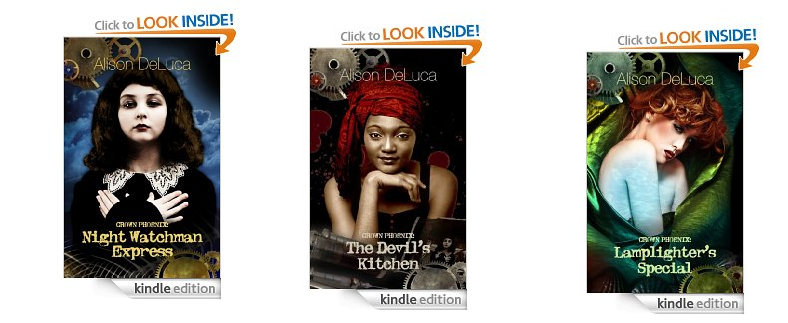
Alison DeLuca is the well-known author of the Steampunk series, ‘The Crown Phoenix’. This series has captured my imagination since I first read ‘The Night Watchman Express’, and she has just published the third book in the series, ‘Lamplighter’s Special’.  My review of the series is posted on my book review blog, Best In Fantasy.

Alison is a master of character development.  I love each and every one of her characters, feeling as if they were my dearest friends (or in some cases enemies). The premise of the series is extremely creative, involving all the finest elements of the Steampunk genre – magic, machines and the eternal battle with dark-forces.  She manages to do this magnificently and neatly avoids devolving into formulaic kitsch as some rather popular pulp-novels have done.

Because I love her characters and their depth so much, I asked her to discuss the most unlikely and intriguing pair, Riki and Neil. Two people less like to make a romantic connection never lived, and yet their story has been one of my favorite threads in the saga.

>>><<< 

A Sharp Left Turn

In my first book, Crown Phoenix: Night Watchman Express, the action changes in the middle of the book. I leave Miriam and Simon on the Night Watchman train, kidnapped and heading to a sinister, unknown destination.

Simon’s friend, Neil, heads off to the mythical island of Lampala. When I wrote the book, I based the geography on the country of Madeira. Beyond that, I wanted to completely avoid any trace of colonialism in my plot. The Lampalans had to be well-off with a thriving industry and their own government.

Neil reaches the island, thanks to the mechanics of the Crown Phoenix, a quantum typewriter. He is rescued by Riki, a girl who is very thin, energetic, and quite a pain in the behind.

Her parents are well-to-do, but they cannot control Riki. She is just one of those kids who was born yelling her head off, and she hasn’t stopped since. She gets bored easily, which probably means she is very intelligent. Furthermore, she is extremely loyal. Once Riki is your friend, she will stick by you through anything.

She can hardly believe, however, that Neil doesn’t immediately fall for her:

“Well, don’t worry. When you and I get married, you’ll be rich.”

Neil shot to his feet and dropped his sandwich onto the beach below, where it was picked up by a triumphant gull. “When we what?” he repeated in a strangled voice.

“When you marry me.” Riki smiled at him and swallowed the last of her sweet roll.

He huffed, catching his breath, and finally managed to say, “Oh, no, I’m not marrying you. No-ho. Mhp-hm.”

She looked up at him in astonishment. “You mean, you don’t want to marry me? Why not?”

“Because,” he responded, “you are, without a doubt, the rudest, most ill-mannered girl I have ever met in my entire life.”

She considered this. Her eyes turned into slits. “Well,” she finally retorted, “I’ve been nice to you today.

“Maybe. However, I’m not going to marry someone whose best claim to decent behavior is that they’ve ‘been nice today’. If I ever get married at all, that is.”

Both Riki and Neil run into Kyoge, one of the King’s Guards. I based Kyoge on a painting called, “The Moorish Chief.” He is tall and strong – a superbly athletic man. His physical prowess is matched by his shrewd wits. He, like Riki, is also very loyal. When he realizes that the true ruler of Lampala is alive and hidden on the island, he risks everything to help.

When I took that Sharp Left Turn, I knew it was a risk. Instead of following the plot and main character of the first section, I followed a new train of thought and a different set of people. Why did I do it? Not to torture my readers, but instead to increase the excitement of what followed. In that, I borrowed a page from one of my favorite children’s authors, Joan Aiken. She would reach the most exciting part of a scene and go to another set of characters. It kept me reading, agog, well past my bedtime, when I was ten years old.

I’m no Joan Aiken, but I do hope that readers enjoy my side trip to Lampala. I love the island, and I adored writing the story that happened there.

>>><<< 

Alison DeLuca grew up on an organic farm in Chester County, Pennsylvania.  Her parents were British, so in the summers she went to stay with her grandparents near Dublin.

There was no stereo or TV there, so Alison, her sister, and her cousins spent the summer inventing stories and plays for each other.  “This gave me the ability to entertain myself with my own imagination in any situation,” she says. “We used to be taken to tea with great-aunts, and we were expected to sit on an uncomfortable couch and not move or say a word.  It was possible to endure it because I was watching my own little stories play out in my mind.”

After graduating from West Chester University, Alison became a teacher of English and Spanish, teaching students from kindergarten up to college level. She loved teaching, and it was with reluctance that she left the classroom to be a fulltime mom when her daughter was born.

While she was teaching and raising her daughter, Alison took every free minute she had to write.  The Crown Phoenix Series was the result.

She is currently working on the final book in the series, as well as several other projects.

Comments Off on Alison DeLuca – A Sharp Left Turn

Filed under Battles, Books, Fantasy, Humor, Literature, Romance, Uncategorized, writer, writing

Monsoons and the Dust Bunnies of Life

To my left we have one of the most iconic heroes of the Final Fantasy Series, Cloud Strife.  He is a flawed hero, a man who is living a lie and who breaks under the strain. Nevertheless, Cloud saves the day, but only because he has the support and love of his companions. At the beginning of the game , Cloud is an island, who only reluctantly accepts friendship, and as the game progresses he falls in love.  The girl he loves is killed in one of the saddest cutscenes in gaming history, and he begins to go to pieces. Still, even though he has been living a lie, his companions rally around him and force him to do what only he can do.

So, what does Final Fantasy VII have to do with monsoons and dust bunnies?

If you have to ask, you aren’t a gamer.  For me, monsoon season is gaming season. I don’t play daily, or even weekly, but on the days I do, I play all day, and don’t emerge from the gameroom for anything short of an earthquake. I think if I didn’t have to write books, I could one day be found dead in my gameroom with the controller in my hand, having starved to death.

Final Fantasy VIII was my all time favorite because of the strong storyline and wonderful characters. Squall Leonhart was the tough guy whose hard exterior concealed his vulnerabilities. In the end, his acceptance of his own vulnerability is what makes him strong. There is a strong romance in the tale, and also a strong story Squall’s gradual discovery of his past is intertwined in the action.

I’m actually currently playing (again) Final Fantasy XII, which is my favorite in the entire franchise, because the storyline is so rich and multi-layered. For me, the attraction of gaming is the interactive aspect of it.

What you do or don’t do can affect the storyline and the outcome. It’s the same reason I write – who doesn’t love a flawed hero who overcomes the odds and saves the world?

Gaming stirs my creativity, as long as I don’t become an unkempt, pajama-clad walking wraith whose only goal in life is to level-up…

No.  Not me.

No, I’m sure I’m not that person.  Well, not today anyway.  Until NaNoWriMo is over, I have to write and can only blog about gaming. Even though the monsoons have once again set in here in dark and dreary Olympia, I will write like the wind, building on my storyline and getting as high a word-count as I’m able.

But on December 1st, I will binge on gaming, until I’ve leveled my teams up so they can beat anything they are faced with.

4 Comments

Filed under Adventure, Battles, Books, Fantasy, Final Fantasy, writer, writing

J.D.Hughes – William the Cat

Today is day 12 of NaNoWriMo – and I’ve managed to write a total of 39,700 words since day one.  It’s been a pure stream-of-consciousness,  run-for-the-money, laying down of the basic structure of the story.  Nothing of what I’ve written is anything I would be proud to show the dog at this point, but when I’ve finished with the many vignettes which form the basic storyline, I’ll begin the task of actually writing the story. I think it will be about 60,000 words when it is fully plotted.

Then the real work begins, when I have to turn this patchwork quilt of a manuscript into a book!The finishied book will be about 130,000 words.

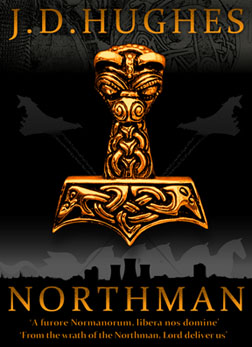
In the meantime, for your dining pleasure we are serving up a delicious guest-post by UK author and blogger-extraordinaire, J.D. Hughes.   J.D.’s new book ‘Northman’ is scheduled to be released on Friday, November 16th .  He has kindly allowed me to reuse a post from his blog, J.D.Hughes.

I must confess that having seen the cover, and read the pitch I am lurking, waiting to get my hands on my copy!  And now, without further ado I give you a reprise of my favorite post ever by one of my favorite bloggers:

WILLIAM THE CAT

Originally Posted on June 15, 2012 by J.D.Hughes

I am not a fan of cats.

They leave excrement in my orchard and pee on my windfall apples.

But, I have a grudging respect for William the cat. He is white, sleek – turning to a little tubbiness as he ages – but will kill anything smaller than he. That characteristic would be psychotic in a human being, but defines a cat.

I’ve never seen him pee on my apples or crap in my garden, so he is – in that catlike manner – returning my respect. Or so I like to think. If I am realistic he probably regards me as an occasional source of food and gruffly masculine tummy rubs but is indifferent to my opinion of him. He has repeatedly tried to get into my house after one successful raid. We are now engaged in a cat and man game, which he believes he will win. He is seeking to wear me down with persistence, but I have owned many dogs who knew more about persistence than any creature living or dead when it came to precise feeding and walking times, so he will be disappointed.

For some reason he has a liking for my garage and is often locked in for long periods of time. We have a thriving community of field mice to keep him entertained, but I think it may be an attempt to show me how easy my garage is. Logically, that ties in with his belief that my house will one day be his.

He has no remorse, no sense of guilt when some small creature is struggling in his jaws, little understanding or sympathy with anything living and zero interest in anything with which he has played and which has now stopped moving.

So, why do I respect William the cat?

Because he is being a cat.

It’s what cats do. He has no choice.

I respect human beings who tell the truth, help others, attempt to raise mankind from the gutter and try to behave in a kindly manner to their neighbours for a similar, but perhaps not the same, reason.

Not all humans behave like that. Some of William is built into our DNA and we occasionally behave badly towards our fellows.

The difference is that we have a choice. We can think rationally about whether it is a good idea to kill people smaller, weaker, less intelligent than, or different from, ourselves.

There are exceptions, of course. The sociopathic or psychotic personality may have no choice, but we do.

My previous post was about Truth and this is a (sort of) continuation. My belief is that there is nothing to be gained by being unpleasant or violent to strangers and that it is a part of our journey to the status of rational beings for us to be kind to people – do unto others and all that.

Of course, if they attack you with a machete then one should adopt the William attitude and either run away or get a bigger machete.

My own journey through life tells me that most people harbour few truly evil thoughts towards others. Occasionally, hatred will spring up in the fight for sex, resources or survival (perceived or real) but unless there is a continuing need for the above then it often dies away and people (mostly) play nice, or at least become tolerant.

So, as William wanders past with something furry clamped in his jaws I wonder how I would feel trapped in behaviours I cannot control, without choice and destined to repeat the same patterns, again and again.

Got to stop now. It’s 12.30pm, time for my Ploughman’s Lunch, a short walk, the BBC News, a nap at 1.27pm for exactly 21 minutes and a quick chase around the garden looking for small rodents or baby birds to eat.

Unless William has been there before me.

>>><<<

Below I have posted J.D.’s biography, exactly as he sent it to me. He cracks me up!

J.D. HUGHES

A ‘sort of’ Writer, living in the Peak District of Derbyshire, England.

His new supernatural thriller for adults, NORTHMAN, begins in Anglo-Saxon England, 943 AD, moves through World WarTwo, 1943 and into the present. It is an epic story of timeless love and eternal evil but contains no vampires or werewolves.

It has something infinitely more evil.

He also has several free, dark tales (links on blog). Or on Amazon if you want in a perverse gesture of altruism to buy them.

JD has worked as a writer, director and producer of commercials, short films, corporate and music promos. Recently, he accidentally gained an MA in Film Studies and Screenwriting, whilst continuing to work as a freelance. He loves film, so enjoyed the experience and almost continued on to a PhD, but decided that it would interfere with real writing and painting the shed.

JD started writing fiction aged 11 and it has taken him until now to be competent – obviously a slow learner. Some might say that point of competency is still some way off. Despite those people, JD is determined to inflict his writing on innocent readers and will be doing so to the exclusion of all other delusions (except painting the shed) for the foreseeable future.

He apologises in advance to those who will be offended, and hopes the rest of the world will enjoy some of it.

Don’t tell me the moon is shining; show me the glint of light on broken glass. ~Anton Chekhov


4 Comments

Filed under Adventure, Books, Fantasy, Humor, Literature, Uncategorized, writer, writing

On Editing, part II; guest post by Carlie Cullen

Today we continue with the second half of Carlie M.A. Cullen’s absolute gem of a post on Editing.

Here is where the principle she expressed in Monday’s Post are put into action.

Her Comments will be in Red and my response will be in Blue!

Comments:

When I edit a manuscript, I always request it in Word. I use the Review tab and insert comments which appear on the right of the document. If there are too many comments to fit on the page, the comment box will show ‘. . .’ in a small box; clicking on this will bring the comment up in full on the left of the document. By selecting the word or phrase and highlighting with the cursor, then pressing ‘New Comment’ it allows me to show the author the exact part they need to look at (see the screen print of the document I have edited for this post).

I always try to gently guide my authors. They have spent countless hours and poured a great deal of themselves into their work and I’m not in the business of trashing their self-esteem. In addition, I fully recognize they have the final say and I can only make recommendations.

The content of the comments made depend on what the problem is with the manuscript. Some comments are only one or two words long, i.e. ‘delete’ or ‘insert comma’, while others are much longer. Let’s take a moment to look at the comments on the screen print.


Comment C1 – just says remove comma”. This comma has been placed in a position where it is not needed and therefore incorrect. An author wouldn’t expect a ten line explanation of why the comma needs removing so it’s quite acceptable to have remove comma”  (done)

Comment C2 – this is a longer comment and showcases my point about realistic dialogue. The comment says Do you mean for the dialogue to be so precise here? You’ve used contractions in other places so I would suggest you change this to ‘They’re’ (done)

Comments C3, C4 and C5 – these also refer to comment C2 and the author, having read comment C2, will not expect an editor to type out the whole message for each case therefore, for these three comments I ask the author to Consider it’s / they’re / I’m(done)

Comment C6 – this comment has been showcased above when I spoke about inconsistencies. My message to the author here is If Wynn has seen a firedrake, surely he knows whether they look fiery or not. I suggest you reconsider this question.” This gives the author an opportunity to re-think and re-word. (Wynn has not seen a fire-drake.  The point of the exercise was to get him acquainted with beasts he had not encountered before.  However, Carlie has only seen this excerpt and doesn’t know this.)

Comment C7 – this relates directly to C6 as it answers the question which I believe to be inconsistent. Depending on how you handle comment C6, this may have to change or be deleted.” (left it in)

Comment C8 – in this case, I have a small issue with sentence structure. My comment, This doesn’t flow very smoothly. I suggest you consider changing the order to ‘put out the flames on its skin’”, tells the author what the problem is and gives a suggestion of how to fix it. (done)

Comment C9 – Consider changing to ‘she’s’”. This again is a dialogue issue and use of contractions. C10 – See comment C9”. There is no need for me to go into long explanations when I can refer the author to a previous point made. (done)

Comment C11 – sentence structure and the flow of it is the problem here. My comment, Having ‘healer’ and ‘healing’ in the same sentence doesn’t sound right. Consider changing ‘healing’ to something like curing/restoring, shows the author what I consider is wrong and suggests alternative words they can use. (done)

Comment C12 – deals with repetition of a phrase. You’ve used this type of phrasing above when talking about how tired Wynn was, so the repetition doesn’t work very well. If you want to emphasize how Jules looks and feels, I suggest re-wording or changing this around. Consider something like ‘Jules felt really out-of-sorts and looked quite rough’”. Using phrase repetitions, especially on the same page, annoys some readers and it doesn’t show the authors grasp of vocabulary as well as it might. By rephrasing, it removes the repetition and makes the story flow better and my suggestion gives the author another way of looking at it. (done)

Comment C13 – is to do with contractions in dialogue again. However, I can see there might be a reason why the author would not want to do so. Therefore, my comment, Consider contracting to ‘I’m’ unless you want to emphasize the ‘am’ in which case it should be in italics”, provides two possible solutions. (changed to italics)

Comment C14 – sentence structure and flow is the problem here so the comment, This is clunky and doesn’t flow at all well. Consider changing to something like ‘Shouldn’t they have challenged us with something we’ll actually be facing…?’ or similar”, explains the issue and suggests an alternative. (done)

Comment C15 – repetition. You’ve used ‘facing’ on the previous line. I suggest replacing with something like confronting / tackling / meeting”. This identifies the problem and offers a solution. (done)

Comments C16 and C17 – using contractions in dialogue. C 16, As this is dialogue, consider contracting to ‘it’ll’”. C17, “See comment C16”. (done)

Comment C18 – this comment covers two problems; repetitions and contractions in dialogue. It’s difficult for an editor (unless they are very familiar with an author’s work) to suggest changes to dialogue other than use of contractions as each author has their own ‘voice’. To get around this, I point out the problem and leave it for the author to fix, like so, You’ve used ‘it will’ 3 times in this paragraph. Consider rewording at least one of them (see also comment C16/17)”. (done)

Comments C19, C22, C23, C25, C30, C32, C34 and C35 – these again deal with use of contractions in dialogue and the comments made are almost identical to those used above. (done)

Comments C20 and C21 – both of these deal with repetitions &/or sentence structure/flow. As you can see, both comments offer suggestions for alternatives. C20, Repetition – you’ve just used ‘irritating in the previous sentence. Consider changing to something like annoying / infuriating / aggravating”. C21, “You’ve used ‘bored’ on the 1st line so this is like a repetition & doesn’t sound right. Consider replacing with tedious / monotonous / tiresome / repetitive, or similar”.  (done)

Comment C24 – because of the dialogue used, I feel there is a need for the author to show emotion in the speaker’s voice. The comment reads What inflection is in his voice? Annoyance? Exasperation?”.  (done)

Comment C26 – this is another emotive section where the character needs to come alive for the reader. I prompt the author thus, Consider what expression is on Devyn’s face and the inflection in his voice. You need to show a little something here”. (done)

Comments C27 and C36 – extraneous words have been used so a simple delete suffices. (done)

Comment C28 – You have 6 repetitions of ‘rules’ in this one paragraph. Delete this Pretty self-explanatory, I think. Comments C29, C31 and C33 deal with the other instances of the repetition within the paragraph. C29 states Delete”, C31 reads Change to ‘their directions / conventions / instructions / decrees’ or similar”, and C33, “Consider either removing this bit or changing to something like ‘… about what they want…’”.  (done)

Comment C37 – Repetition from previous paragraph. I would switch things around and remove ‘both’”, identifies the problem and offers a solution. (done)

Comment C38 – sentence structure and flow. Using ‘level’ and ‘leveling’ in the same line spoils the flow. Consider changing to flattening / razing / demolishing”. (done)

Comments C39 and C40 – incorrect punctuation. C39 states, “Remove comma and C40 reads, Insert comma”.  (done)

Comments C41, C42 and C43 – using contractions in dialogue. Comments are as previously shown.(done)

Comment C44 – showing. The reader needs to connect not only to the character in this part, but also the scene. The comment recommends, Is there a smug smile on his face? A hint of devilment in his eyes? What inflection is in his voice? Is there an aura of amusement around him? Your readers need to ‘see’ the scene”.  (I will work on it.  I don’t really do ‘devilment’, lol)

Comment C45 – punctuation can be over-used just like words can and this is a perfect example. The comment, “Too many exclamation marks – 3 in 3 sentences! Replace 1st exclamation with comma, change ‘O’ to lowercase and replace last exclamation with period”, shows how to rectify this. (What!!! er… Done)

Comment C46 – inappropriate descriptive word. This particular example was covered in the first section of this post. My comment is, Would the smiles be grim? Also, grim smiles wouldn’t light up their faces. This is payback as far as they are concerned so I would have thought there would be excitement / devilment or similar in their smiles. I suggest you look at this again and change this word to something more appropriate to the occasion”. (I will work on it)

The above comments show how I try to guide my author by posing questions and offering solutions to the identified problems.

Editing is a very time-consuming yet rewarding job; taking a raw manuscript and honing it until it shines is as much as labour of love for the editor as it is for the author. They have to work closely together for a prolonged period of time to achieve a common goal. The end result, the published book, gives an editor as much joy and satisfaction as the author.

I hope you have found the foregoing informative and interesting. As Connie’s editor, I have to say she is a consummate professional throughout the editing process and wonderful to work with. It makes a huge difference to an editor when their client approaches editing with an open mind and a positive attitude; it results in a wonderful piece of literature both parties can be proud to put their name to.

 >>><<<

 Carlie, thank you for your long hours of work doing the edit of this segment.  I know you took time away from your own work to do this, and it means more to me than you know!

And for those of you who are wondering why a proper editing is so very expensive, there were only 836 words in this snippet, and it took her every bit as long to edit it as it did for me to write it, perhaps longer.  A good editor is very much worth the price – but I warn you absolutely must be able to work closely with your editor and you must be willing to consider and act on the changes they suggest. Your manuscript is the child of your creativity, and as such you must be very careful who you allow to care for it. If you have a contract with a publisher, be sure you have final say on all changes before publication.  It doesn’t matter how much you pay, if your editor is not willing to allow you to make the changes on your own ms. It is only through making these changes and thinking outside of your normal mindset that you will really grow as an author.

6 Comments

Filed under Adventure, Books, Humor, Literature, Uncategorized, writer, writing