Category Archives: Literature

#amwriting: poetry in prose

MSClipArt MP900390083.JPG RF PD Both poetry and prose have evolved over the last two-hundred years. In 1816 words were art, and they were frequently crafted into a piece  as if you were decorating a house–the author placed them in such a way as to be artistic as well as impactful.

Think Dickens, and Byron, and Mary Shelley.

A random comment in another forum led me to think about poetry and prose, which of course, led to a blog post.

Much of the time, modern poetry doesn’t rhyme. And even without rhyme, some authors write poetic narratives. But if it doesn’t rhyme, what makes poetry “poetic?” And where does it fit into modern prose?

As always, I turned to the “college of the internet” and did some research. Wikipedia, the fount of all knowledge says, “Poetry is a form of literature that uses aesthetic and rhythmic qualities of language—such as phonaesthetics, sound symbolism, and metre—to evoke meanings in addition to, or in place of, the prosaic ostensible meaning.” (End quoted text.)

In his April 19, 2012 blog post for Harriet, (the Poetry Foundation’s blog for poetry and related news) titled The Difference Between Poetry and Prose,  Martin Earl says a number of things.

Quote: “Prose is all about accumulation (a morality of work), while poetry as it is practiced today is about the isolation of feelings (an aesthetics of omission).” 

Well, that didn’t help. Taken individually, I understood each of the words that make up that sentence. Unfortunately, I didn’t understand what Mr. Earl intended to say by combining them so incomprehensibly.

I realized I would need an interpreter. So I prevailed upon Stephen Swartz, author, and professor of English at a well-known university, who is also a good friend of mine.

Stephen explained what Martin Earl may have meant: “I can only take that to mean that the writing of prose is, e.g. like a description, a compiling of details. a productive activity. I agree with the definition of poetry being a limitation of words/details in the service of presenting something esoteric such as thoughts and feelings, abstractions rather than the concrete. For prose, we accumulate words; for poetry we try to do more with less.”

Now THAT made sense to me.

However, I did find a portion of Martin Earl’s post to be understandable without the aid of my friendly neighborhood professor. Toward the middle, he explains the evolution of how poetry became prose, places it in a historical context and then explains that continued progression away from poetic prose in modern literature.

Earl writes, “In both classical and modern languages it is poetry that evolves first and is only much later followed by prose, as though in a language’s childhood, as in our own, poetry were the more efficient communicator of ideas.”

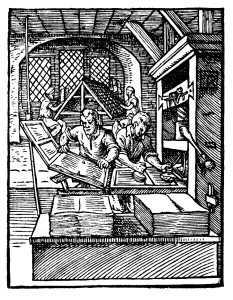
He goes on to say, “With the spread of the printing press after 1440, texts no longer had to be memorized. Poetry’s inbuilt mnemonics (rhyme, meter, refrain, line breaks) were no longer essential for processing and holding on to knowledge. Little hard drives were suddenly everywhere available.” (End quoted text.)

That makes complete sense to me on a personal level. I can remember anything I can set to a rhyme, or make into a song.

I believe using rhymes as mnemonics (which is defined as a memory device) is fundamental to human nature. We developed complex languages within our tribal communities while we were still in Africa, before the great diaspora. It was there in the earliest stages of our humanity that we gained the ability to describe the wider world to our children. With that, we had the capacity to understand and describe the motives of another person.  We could explain the how and why of an incident. We saw the divine in every aspect of life and developed mythologies combining all of these concepts to explain the world around us and our place in it.
Printer_in_1568-ceWe learned ways to memorize  and pass on ideas as abstract as legends or sagas. Through those stories, we could learn larger lessons from the mistakes and heroism of our ancestors.  My theory is that we developed poetry at the same time as we developed language.

Every tribe, every culture that ever arose in our world had this same tradition of passing down stories and legends using rhyme and meter.  Rhyme combined with repetition and rhythmic simplicity enabled us to remember and pass on wisdom to our children.

Wikipedia describes poetry as: “a form of literary art in which language is used for its aesthetic and evocative qualities in addition to, or in lieu of, its apparent meaning.”

It also describes prose as: “the most typical form of language. The English word ‘prose’ is derived from the Latin prōsa, which literally translates as ‘straight-forward.’”

In poetry, saying more with fewer words forces us to think on an abstract level. We have to choose our words based on the emotions they evoke, and the way they portray the environment around us. This is why I seem to gravitate to narratives written by authors who are also poets—the creative use of words elevates what could be mundane to a higher level of expression, and when it’s done well, the reader doesn’t consciously notice the prose, but they are moved by it.

We have no need to memorize our cultural knowledge anymore, just as we no longer need the ability to accurately tally long strings of numbers in our head.  We’ve begun to like our books with straightforward prose. Flowery language is no longer acceptable in the books we read.

This is also true of modern poetry.

The love of poetry continues, and new generations seek out the poems of the past while creating powerful poetry of their own.

Authors craft incredible narratives, often without knowing they are poets.
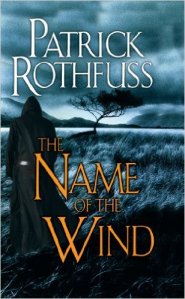
The Name of the Wind by Patrick Rothfuss 2nd coverPatrick Rothfuss, The Name of the Wind:

“It was night again. The Waystone Inn lay in silence, and it was a silence of three parts.

“The most obvious part was a hollow, echoing quiet, made by things that were lacking. If there had been a wind it would have sighed through the trees, set the inn’s sign creaking on its hooks, and brushed the silence down the road like trailing autumn leaves. If there had been a crowd, even a handful of men inside the inn, they would have filled the silence with conversation and laughter, the clatter and clamor one expects from a drinking house during the dark hours of night. If there had been music…but no, of course there was no music. In fact there were none of these things, and so the silence remained.” (End quoted text)

That is some powerful prose. It is both straightforward, and poetic.

That is where craft comes in. Choosing words for the emotions they evoke and the way they portray the environment the author has imagined is what lends great narrative prose its power. We can still appreciate beauty combined with impact when it comes to our prose.

6 Comments

Filed under Literature, writing

#amreading: The Queen of the Night by Alexander Chee

Queen of the Night alexander cheeEvery now and then I find myself reading/listening to a mainstream bestseller, and enjoying it. Alexander Chee has written just such a novel, in The Queen of the Night.

This novel has one of the best openings since Patrick Rothfuss’s brilliant opening lines in The Name of the Wind.

Quote from The Queen of the Night: When it began, it began as an opera would begin, in a palace, at a ball, in an encounter with a stranger who, you discover, has your fate in his hands. He is perhaps a demon or a god in disguise, offering you a chance at either the fulfillment of a dream or a trap for the soul. A comic element—the soprano arrives in the wrong dress—and it decides her fate.

These lines presage an immersive, sumptuous reading experience.

But first, THE BLURB:

Lilliet Berne is a sensation of the Paris Opera, a legendary soprano with every accolade except an original role, every singer’s chance at immortality. When one is finally offered to her, she realizes with alarm that the libretto is based on a hidden piece of her past. Only four could have betrayed her: one is dead, one loves her, one wants to own her. And one, she hopes, never thinks of her at all.

As she mines her memories for clues, she recalls her life as an orphan who left the American frontier for Europe and was swept up into the glitzy, gritty world of Second Empire Paris. In order to survive, she transformed herself from hippodrome rider to courtesan, from empress’s maid to debut singer, all the while weaving a complicated web of romance, obligation, and political intrigue.

Featuring a cast of characters drawn from history, The Queen of the Night follows Lilliet as she moves ever closer to the truth behind the mysterious opera and the role that could secure her reputation — or destroy her with the secrets it reveals.

The book so far:

From those intiguing opening lines forward it is filled with every kind of emotion, every human tragedy and triumph imaginable. It resounds with the pomp and grandeur of the most thrilling opera–as it should since it details the life of a Parisian opera star of outstanding brilliance–a true diva in the operatic sense.

Rumors abound regarding Lilliet–she is the topic of many conversations, but rumors barely touch on the truth of her life. Even she is not truly sure of who or what she is. Despite having achieved everything and more, she lacks something and is waiting for a “meeting with destiny” which she hopes will transform her life into the paradise she wants it to be.  That moment comes in chapter one, but the transformation….

You will have to read it to see.

This book is not cheap–the Kindle edition is $14.99. I bought it as an Audible download ($17.95) because I am heavily involved in editing right now for a Myrddin author and am also making revisions on my own work under an editor’s guidance. Then I bought the hardcover edition.

I am unable to read for pleasure until I am done with these two tasks. And because of some interesting style choices on the part of the author, such as not enclosing dialogue in quotes, I especially dare not attempt to read this particular book just now.

But I can listen to audio books, and what I am hearing in this book captivates me. When I am once again able to read for pleasure, this book will the first I crack open.

To purchase a book published by the large traditional publishers is a hefty financial commitment. To make your decision a little easier, Longreads posted the first chapter here: The Queen of the Night by Alexander Chee. Please go out to their wonderful site and if you like what you see, consider becoming a member.

4 Comments

Filed under Books, Literature

#amwriting: tips for writing clear dialogue

gibberish quoteDialogue can be tricky. Often, in our rush to get the ideas on paper, we have left off quotes, misplaced punctuation, and written interrupted dialogue with inconsistency.

While a certain amount of literary license in dialogue can enrich our work, our dialogue may be too rich with run-on sentences, and not in a good way.

Also, while everyone has read books that inspire them to become writers, some authors never learned how to write the kind of dialogue they envision. They don’t understand the fundamentals and don’t realize how their lack of understanding ruins their work.

Always begin what is actually spoken (dialogue) with a capitalized word, no matter where in the sentence it begins.

  • Mary glanced over her shoulder and said, “I’m sorry. I can’t go with you.” 

However, interrupted dialogue, when it resumes, is not capped, although the rules of punctuation and quotation marks still apply.

  • “I’m sorry to tell you,” said Mary, “but I can’t go with you.”

Direct dialogue is someone speaking to you or someone else and requires quotation marks.

  • I’m sorry. I can’t go with you,” said Mary.

I’m a US author, so I used double quotes, also called closed quotes. The UK usage is different and often uses apostrophes, or what they call inverted commas. Either way, be consistent and make sure ALL punctuation goes inside the quote marks.

Yes, I did say All punctuation. How does one set off a quote from someone else within dialogue? Set it apart with single quotes (apostrophes, inverted commas) and keep it inside the closed quotes.

George said, “When I asked her, Mary replied ‘I can’t go.’ But I’m sure she was lying.”

George said, “When I asked, Mary replied ‘I can’t go.'” Note there are 3 apostrophes there: 1 apostrophe and 1 double (closed) quote mark. This is in keeping with the rule that all punctuation in dialogue goes inside the quotation marks.

Indirect dialogue is a recapping of dialogue that someone previously spoke.

  • When asked, George said Mary couldn’t go.

Note there are no quotes used in indirect dialogue. Also in this sentence, the word that is implied between said and Mary.

Dialogue tags, or attributions, can come before the dialogue, especially if you want the dialogue tag to be noticed. To make them less noticeable put them in the middle or at the end of sentences. In my own work, I want the dialogue and not the attribution to stand out. However, when more than two people are involved in a conversation, I move the dialogue tags further to the front so the reader isn’t left wondering who is speaking.

DialogueI’ve mentioned before that I prefer simple attributions such as said, replied, and answered because they are not as likely to stop the reader’s eye. People don’t snort, smirk, smile, or frown dialogue as it is physically impossible. They can say it with a smile, but the smile is a facial expression and does not speak.

Avoid verbal tics like “hmmm…” and “ahhh…” as they just take up space and add fluff to your narrative. When people in real life preface all of their sentences with drawn-out ahs and hmms it can be aggravating to listen to them. Consider how irritating it would be to read it.

Sometimes we have two ideas in a sentence that we think are one, and we connect them with commas.  But closer examination shows they are not.

  • “Hello, sir, we bathed your dog,” she said.

The above dialogue contains a run-on sentence, despite its shortness. We may actually speak it in this fashion, words run together, but for a reader, punctuation clarifies ideas.

The dialogue contains two separate ideas. “Hello, sir,” is an acknowledgment and a greeting. “We bathed your dog,” indicates an action was taken in regard to his dog. It should be:

  • “Hello, sir. We bathed your dog,” she said.
  • When we write our conversation using proper punctuation, it looks natural, and the reader will hear it the way it was intended.

When it’s done right, dialogue is, in my opinion, the best part of the story. It’s where we discover who the characters are, and how the larger events affect them. Conversations show the world as the protagonist sees it. We can take some style and voice liberties with dialogue, and indeed, we should, but adhering to industry standard rules of punctuation ensures your reader can remain immersed in the story, and forget they are reading.

And THAT is what we all hope for.

21 Comments

Filed under Literature, writer, writing

#amwriting: Our shifting language

English is the third most widely spoken native language in the world (behind Mandarin Chinese and Spanish). It is the first language of four countries and is spoken by more than 400 million people, with five major dialects and distinct accents:

  • Countries where English is spoken natively by the majority of the populationBritish English
  • North American English
  • Australian English
  • New Zealand English
  • South African English

An American girl from a rural corner of the US can understand a girl from New Zealand fairly well, and after they adjust to the differences in their accents, they can chat freely.

Many other countries use English as their official language. According to Google, fifteen more countries have their own native language, but use English as an “Official Language and the Language of Instruction in Higher Education”:

Anguilla Ireland, Northern Singapore
Antigua and Barbuda Ireland, Republic of Solomon Islands
Australia Jamaica South Africa
Bahamas Kenya Swaziland
Barbados Lesotho Tanzania


According to Wikipedia, the Fount of All Knowledge: “Estimates that include second language speakers vary greatly, from 470 million to more than 1 billion. David Crystal calculates that non-native speakers as of 2003 outnumbered native speakers by a ratio of 3 to 1. When combining native and non-native speakers, English is the most widely spoken language worldwide.

All English speaking people can communicate through writing, and while they might not be able to understand each other well in person, they can easily communicate via the written word.

In medieval times, the lingua franca was Latin. Lingua Franca means a language that is adopted as a common language between speakers whose native languages are different. An historical example of how people can communicate using a lingua franca in writing and still be unable to understand each other when speaking it: Richard the Lionhearted spoke langue d’oïl, a French dialect, and lenga d’òc, a Romance language, and his wife, Berengaria of Navarre, spoke Navarro-Aragonese, a Spanish dialect.

During the political negotiations arranging their marriage, Richard and Berengaria communicated via letters composed and written in Latin, as neither one spoke the other’s native language. However, when they met, even though they were both speaking Latin, their accents made it nearly impossible for them to understand each other until they became used to the other’s pronunciations.

That bit of historical trivia brings us back to the modern day lingua franca: English. With so many people speaking it, new usages come into play and spread through the speaking community, and the language shifts. Sometimes it shifts more rapidly than I can keep up with.

This blending and shifting of the common usage demonstrate what happened to Latin. Latin is frequently referred to as a dead language, but it is not. Latin is actively spoken in the modern Romance languages. (Romance referring to Roman, not love.)

The five most widely spoken Romance languages by number of native speakers are:

  • Spanish (410 million)
  • Portuguese (216 million)
  • French (75 million)
  • Italian (60 million)
  • Romanian (25 million)

Latin also appears in and strongly influences our Germanic, Frisian-based English, through our Norman ancestry—after all, our great Norman kings and queens spoke Medieval French: langues d’oïl, which itself was a mingling of Gallic and Roman based languages.

The Normans came to Britain speaking French, and their children remained, speaking a blend of Anglo-Saxon-French: Old English.

270px-Rosetta_StoneAll spoken language evolves. Only languages whose sole known records are actually engraved in stone, such as Egyptian Hieroglyphics and Ancient Sumerian, are unchanging.

English is continually evolving in more than just the obvious way of snappy catch-phrases and new technology. It is evolving in its formal usage

Consider the word whilst. As conjunctions go, the words whilst and while are technically interchangeable in meaning, but whilst has become less common in standard American English. If whilst appears in an American genre fiction book, it’s an eye-stopper, awkward and old-fashioned, more suited to classical poems and literary prose. Therefore, an American author may not use whilst, but a British author might.

Yet, despite its having fallen out of fashion in the US, we all understand the word whilst when we see it written and when we hear it.

At some point, everything we write in our modern language will be as unintelligible to those who speak the future modern English as Geoffrey Chaucer’s work is to the contemporary eye and ear today:

chaucer modern translate wife of bath meme

It is clear that the eye of the translator and his perception can greatly influence the modern translation of the work. I disagree with the use of the word “Ruled” in the second line, as the intent of “Were” in this case is clearly “was.” In the common usage of the day, “were” was interchangeable with “was.” Had I been in the same program as the above translator, we would have argued over this point.

I’d have translated it as:

Experience, though no authority,

Was in this world  enough for me

To speak of the woe that is marriage.

For, Lordings, since I was twelve years of age,

Thanks be to God eternally alive!

Husbands at the church door, I have had five.

We can only see the works of our great literary giants through the lens of time, filtered through our own wishes and interpretations. And this is how our greatest works, those which do survive into the next millennium, will be seen and interpreted.

Title page of Geoffrey Chaucer’s Canterbury Tales in the hand of his personal scribe Adam Pinkhurst, c. 1400Perhaps our published work will remain a part of the public record as it is today, and be available for students of “classic” literature to interpret. Or perhaps our works will be forgotten, lodged in the dusty vaults of Bowkers, only rarely resurfacing, having been ironically relegated to the dark corners of scholastic research on obscure texts in forgotten languages.

Soon-to-be forgotten or not, I am writing for today, and writing for a contemporary reader. My usages will evolve over the life of my writing career–I ‘ve already seen this evolution at work. That is the process of growth, and it’s clear how my early works differ from my more recent work.

Growth and change drives and forms the new canon of 21st century world literature. We are all a part of its birth, whether we are readers or authors. Readers choose the works they buy and those works are written by people who chose to record the thoughts, values, and misdeeds of their contemporary society in story form.

I am so blessed to be both a reader and an author.

3 Comments

Filed under Literature, writing

#amwriting: Couriers, Pigeons, and Excalibur

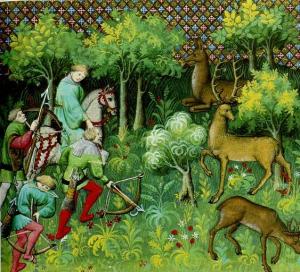
Medieval_forest wikimedia commons PD 100 yrs

Russian Forest in medieval France (1405-1410) Gaston Phoebus

I have a great deal of interest in Medieval history because I have ancestors who lived then. I’m not bragging–everyone who is alive today is here because one or two ancestors survived the Dark Ages long enough to leave behind a child who did the same.

Life was perilous, even if you grew up in a fairly sheltered environment. No one was exempt from disease–even kings regularly died young from plagues and injuries. Regardless of their personal safety, medieval kings were forced to go to war in person. They did this for several reasons.

  1. The only way for the monarch to know what was actually happening on the battlefront was to be there
  2. It was expected that a monarch should understand the art of warfare and be proficient as a warrior. He was responsible for winning or losing the battle.

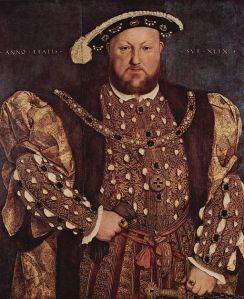
Portrait of Henry VIII (1491-1547) by Hans HolbeinDuring the Dark Ages, official news was delivered by a royal messenger and read aloud in church or in the market.

Messengers were a permanent fixture on the royal payroll. They were dedicated and well-paid to travel the kingdom continuously, carrying the king’s word. In medieval England, kings did not stay in London. Instead, they traveled all over their lands and the noble families were required to feed and house them at great expense. Their gypsy-like existence kept the messengers busy.

Wars were expensive. Henry VIII’s habit of medieval couch-surfing at the country homes of his noble courtiers was a great way for an impoverished king and his entourage to live well and cheaply, conserving the cash to pay for the troops. But it also meant that an organized and efficient messenger service was required to ensure that correspondence to and from the king: royal letters, grants, patents, and such, arrived at their intended destinations.

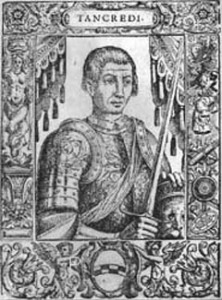
Tancred, Count of Lecce, King of Sicily via Wikimedia

Tancred, Count of Lecce, King of Sicily via Wikimedia

In the year 1190, when my direct maternal ancestor, Tancred, King of Sicily, faced Richard I of England, he was limited to what information a messenger could convey. Thus, their battles were fought in person and so were their negotiations.

These were not native Italians–the original Tancred of Hauteville (980 – 1041) was an 11th-century Norman and a minor baron of Normandy about whom little is known, other than eight of his twelve sons joined the crusades and became kings of southern Italy in the process.

So his illegitimate great-grandson, King Tancred, and King Richard the Lionhearted were Norman kings, squabbling over what was left of the Holy Land and the Mediterranean at the end of the crusades. However, Tancred was born and raised there so he was a third generation Sicilian, being the out-of-wedlock son of Roger III, the Norman duke of Apulia and Emma of Lecce, who was married to Ruggero III de Hauteville.

Quote from Wikipedia: “In 1190 Richard I of England arrived in Sicily at the head of a large crusading army on its way to the Holy Land. Richard immediately demanded the release of his sister, William II’s wife Joan, imprisoned by Tancred in 1189, along with every penny of her dowry and dower. He also insisted that Tancred fulfill the financial commitments made by William II to the crusade. When Tancred balked at these demands, Richard seized a monastery and the castle of La Bagnara.” (end quoted text)

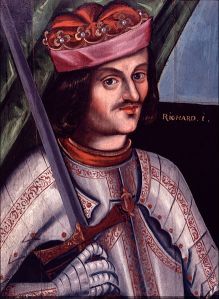
Richard I Google Art Project via Wikimedia

Richard I Google Art Project via Wikimedia

Richard was joined in Sicily by the French crusading army, led by his soon-to-be-former friend,  King Philip II of France. The presence of two foreign armies highly aggravated the local citizens who, rightfully, demanded the foreigners leave their island.

Ever the good guest, King Richard responded by attacking Messina, which he captured on 4 October 1190. Once the city had been looted and burned, Richard established his base there and decided to stay the winter—after all, winters in Sicily are a bit more pleasant than those in Normandy.

But what’s a little looting and pillaging among friends? According to Wikipedia:

“Richard remained at Messina until March 1191, when Tancred finally agreed to a treaty. According to the treaty’s main terms:

  • Joan was to be released, receiving her dower along with the dowry.
  • Richard and Philip recognized Tancred as King of Sicily and vowed to keep the peace between all three of their kingdoms.
  • Richard officially proclaimed his nephew Arthur of Brittany as his heir presumptive, and Tancred promised to marry one of his daughters to Arthur when he came of age (Arthur was four years old at the time).
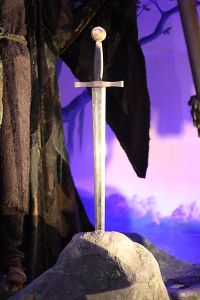
Excalibur London_Film_Museum_ via Wikipedia

Excalibur London Film Museum via Wikipedia

After signing the treaty, Richard and Philip finally left Sicily for the Holy Land. It is rumored that before he left, Richard gave Tancred a sword he claimed was Excalibur in order to secure their friendship.”

Yes, you read this correctly. King Richard the Lionhearted gave my many-times great grandfather Excalibur, the legendary sword of mythical King Arthur.

I doubt Richard the Lionhearted would really give away a sword that was supposed to prove his lineage back to the Pendragon if he actually believed it was truly Arthur’s. However, it is a documented fact that he did indeed give this sword of historical significance to Tancred.

I suspect that Tancred believed it was the true sword of King Arthur as much as I do, but in the interest of peace, he most likely smiled and thanked his departing guest. Whatever he did with it, it was never seen again. When he came to reclaim his island after Tancred’s death, Henry IV, king of the Holy Roman Empire, pillaged Tancred’s treasury and the sword was not there.

But what, you ask, does my illegitimate many-times-great grandfather’s possession of the possibly faux Excalibur have to do with communication?

Tancred and Richard both had to be there in Sicily in person and had to communicate through messengers to arrange all this swapping of women and dowries and swords of dubious origin.

Good long-distance communication has always been seen as critical to good governing. Wars were won and lost based on the information those kings and generals received. During the Middle Ages, postal systems were invented, became corrupt, and fell into disuse all over Europe. This recurred at different times up through the eighteenth century.

In 1505, Emperor Maximilian I established one of the more stable postal systems, but it was not a thing the peasant class could avail themselves of. An illiterate peasant could hire a scribe, but then they would also have to scrape up more coins to get the note sent to its destination. It was better to pay a neighbor to carry the news to wherever it had to go.

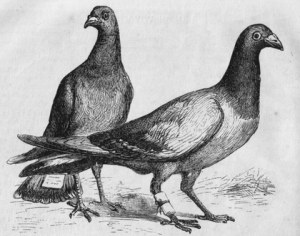
420px-Pigeon_Messengers_(Harper's_Engraving)There was a faster method of getting a letter home. Long before the Middle Ages and during them, homing pigeons were used to carry messages. Rock pigeons have the ability that taken far from their nest, they’re able to find their way home. This due to a particularly developed sense of orientation. Messages were then tied around the legs of the pigeon, which was freed and could reach its original nest.

This is of limited usefulness because pigeons will only go back to the one place that they have identified as their home. Pigeon mail can only work when the sender has a specific recipient in mind and has possession of that receiver’s pigeons.

So how did they  do this? The sender had to hand-carry the pigeons with them. Once released, the pigeons would fly back home with the note. Correspondents could not send a pigeon anywhere but the one place the birds considered their home.

If you are an author writing in an era other than the modern times, be diligent and do the research before you write about things that are outside your personal experience. Readers may have knowledge that you don’t and they will definitely not be shy about letting you know where you’ve gone wrong.

Much of my work is set in medieval environments, and so I can’t have my characters getting instantaneous information from afar without divine intervention. If my characters need to communicate over long distances, I have to consider the length of time it would take even a fast messenger to travel over roads we would consider impassable, but which were the medieval equivalent of I-5.

This kind of information is available via the internet.  Researching my subject online is how I discovered that regular mail delivery is a relatively modern invention. Perusing Ancestry.com is how I discovered the medieval Norman/Sicilian roots of my mother’s family, the (Fitz)Rogers family.

4 Comments

Filed under Battles, History, Humor, Literature, writing

#amwriting: Redemption and the Hero’s Journey

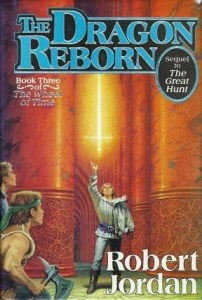
WoT03_TheDragonRebornModern fiction often employs the motif of redemption–the notion that a person can counter a lifetime of misdeeds, but to do so, one must commit selfless acts of heroism.

Within the story arc, a fall from grace can make a protagonist more compelling, more multidimensional. A main-character who is not perfect is far more intriguing than a person with no flaws, because they are unpredictable. Nothing is worse than a predictable novel.

I see characters in books as if they were real people living through the events life hands them. When a character in a book experiences confusion, it’s an opportunity for them to learn new things. If they are frustrated, they must devise a way around that frustration, and if they are tested to the limits of their endurance, they will become stronger. Keep this in mind when you are writing. Don’t make things so easy for  your beloved characters–their struggle is the story.

No tension equals boredom which equals no readers.

For today’s’ post I’m using a famous work of epic fantasy as my example, but everything that I am saying pertains to every kind and genre of book you will write, assuming it is a work of fiction and involves fictional people. (Does not pertain to technical manuals.) (Insert ‘lol’ here).

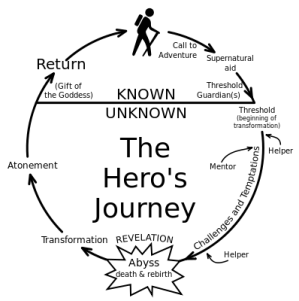
Tales that describe the hero’s journey have certain tropes: they all involve a person who goes on an adventure and, in a decisive crisis, wins a victory. He/she then comes home changed or transformed.  This is a theme that most epic fantasy novels are built around, as is my medieval fantasy, Huw the Bard, and also my epic fantasy World of Neveyah books. However, every novel about people involves a journey of the human spirit, in one way or another.

398px-Heroes journey by Christopher Vogler

Hero’s journey by Christopher Vogler

So how does redemption fit into the hero’s journey? The events the protagonist experiences change his view of the world and his place in it.

Redemption can be portrayed many ways. A person who commits a terrible crime can do a heroic act, thus counter-balancing his prior sin.

Or there is the charming rogue: at the beginning,his life is focused solely on his own survival. Over the course of the story he gradually begins to care for his companions, and about the cause.

Then, there is the main character who begins the journey as a young and naive person. The first half of the book may show his fall from grace–he becomes disillusioned and callous. At the midpoint of the story arc he is once more transformed. This time events forge him into a hero.

Let’s look at Rand al’Thor, Robert Jordan’s protagonist in the (15 volume) Wheel of Time series. The Wheel of Time has great villains–a LOT of them– which is what drives the highly convoluted story line. There are times when Rand is as villainous as those he battles.

When we first meet Rand he is a naive young man from a rural village, who is pledged to be married to Egwene al’Vere, his childhood sweetheart. Many things occur to change him over the course of the following two years–15 volumes worth of terrible changes, both physical and emotional. In just the first three books:

  1. Rand is forced to leave home in the dark of night for his own safety.
  2. He learns he can channel the male half of saidin (magic/the ‘one power’) which means he will go mad, and should be killed for everyone’s safety.
  3. He is branded on both palms by his blade during an epic battle
  4. He hears the voice of a long dead madman in his head, and is told he is the reincarnation of that man.
  5. He is at war with himself and his hated abilities as much as he is with the evil Forsaken.
  6. He falls in love with three women, who eventually become his three wives, none of whom are Egwene, his fiance. This love-quadrangle challenges his strict sense of morality, increasing his stress.
  7.  He discovers the parents he was raised by were not his birth parents, and that he is the center of a prophecy.

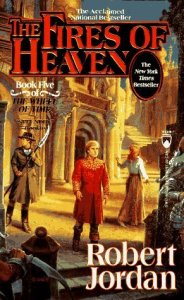
WoT05_TheFiresOfHeavenThese things are just the tip of the iceberg that is the multitude of burdens carried by Rand al’Thor. As his story arc progresses, Rand starts out with well-meaning intentions, wanting to use his powers for good. As he gains power both politically and in the use of saidin, he becomes a tyrant in his own right. But he is still a good man despite his desire to feel nothing, and once again, though his own folly, he is completely broken down to his component parts. It is during the aftermath of his final breakdown that he is made a truly strong, competent leader.

Rand’s ultimate acceptance of who he is, the reincarnation of Lews Therin Telamon, is the key to his redemption. Only then does he have the chance of winning the prophesied battle against the Forsaken at Tarmon Gai’don.

When I read a book whose protagonists and villains challenge me I return to it later and analyze what it is about those characters that inspired such an emotional reaction in me. It always comes back to their many layers of good and bad traits.

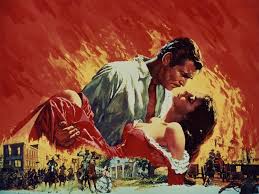
gone with the windConsider Margaret Mitchell’s classic, Gone With the Wind: Rhett Butler is a man with many faults, but who is, underneath it all, a decent, likable person.

Characters that are multi-layered are intriguing, and will keep the reader turning the pages, to see what they will do next.

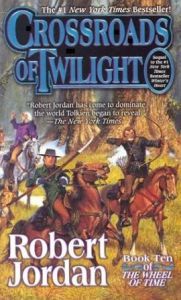
WoT10_CrossroadsOfTwilightIt is a rare person who is completely consumed by evil, and so when we see the softer side of the devil we grudgingly like him. Because of that idea, I’ve spent a lot of time looking at how Robert Jordan portrayed the Forsaken.

Lanfear and Asmodean were frequently pleasant, engaging people and one could feel a certain sympathy for them despite the knowledge that they had pledged their souls to serve evil.  Even Demandred had a certain cachet that one could relate to. Each one had the potential and the latent desire for redemption–and each chose to grasp for greater power instead.

What kept Robert Jordan’s die-hard fans waiting patiently for him to finish the series was his compelling characters–and that was also Jordan’s weakness as an author. He fell in love with the minor players and soon the side characters became as important in his mind as Rand al’Thor.

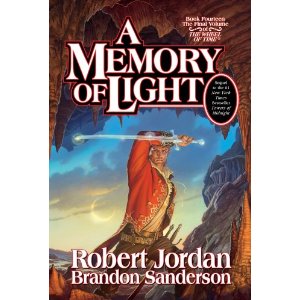
A_Memory_of_Light_cover (1)This chasing after so many character’s threads derailed the series for several books, because although they were entertaining books, they did not advance the story. Many readers lost interest by book six, and Brandon Sanderson had to really exercise restraint when, after Jordan’s death, he was tapped to finish writing the series (from Jordan’s copious notes).

Some characters in my own work also have story lines that feature elements of the hero’s journey, some experience a fall from grace, and find redemption. Character development within the core group and reining in my enthusiasm for the side characters is my current task, as I embark on the final draft of Valley of Sorrows.

Tempting though a “fifteen book trilogy” is, I vow that Edwin Farmer’s story will be completed within this last of the three books in the Tower of Bones series.

If the literary muses are willing, the side characters can have their own books, later.

4 Comments

Filed under Books, Fantasy, Literature, writing

Into the Woods, a fantasy anthology

MyrddinAnthologyECoverWe at Myrddin Publishing Group are starting the new year with the launch of our anthology, Into the Woods. We’re even having an all-weekend-long Facebook party, with Myrddin Authors dropping in and out over the course of the next few days. There will be gifts, and prizes and just fun and games with the Myrddin crew. The online Facebook Party starts here, so stop on by and and hang out with us!

This collection of amazing tales came about almost by accident.

One day last summer I was looking through stock images I’d found for a cover I was designing for another author. I came across a wonderful image of a lonely house set in the woods. I’m not sure why, but suddenly, like the proverbial dog after a squirrel, I was off looking at images of houses in the woods–like that was going to get any work done.

Of course, my brain is hardwired to write stories, so I found myself imagining all sorts of scenarios and plots to go with these amazing images. Then, it occurred to me that if I was inspired to write by these images, my fellow authors here at Myrddin Publishing would also be.

I threw out a challenge to the group: Write a short story about a house in the woods. The only caveat was the tale had to fall under the genre of fantasy, and the theme was “a house in the woods.”

And wow! What a response– I received nine wildly different tales, ranging from humor to ghostly, to romantic, to horror. These ten tales are some of the best I have read.

In the first tale, “A Peculiar Symbiosis,” Alison DeLuca gives us a moving story of a man who discovers he loves his wife–but only after she is dead.

“The Forest House” is my own take on the Tam Lin tale. Tam Lin is a character in a legendary ballad originating from the Scottish Borders as collected by Francis Child, but there are many tales from all over northern Europe featuring variations on his name, and the story will have slight variations. It is also associated with a reel of the same name, also known as Glasgow Reel. I had always wondered if Tam Lin and the Faerie Queen had a child, and if they had, what would have happened to it when Janet rescued Tam?

In “A House in the Woods,” Stephen M. Swartz takes us back to the 1960s with this dark fantasy. Two boys playing in the woods come across an abandoned house, and discover a true ghost story.

Irene Roth Luvaul takes us deep into the forest in “The Guardian.” A woman discovers her family’s history, and the terrible secret a cabinet once held.

Ross M. Kitson offers up a A Matter of Faith.” In this dark prequel to Kitson’s epic Prism series, an uptight paladin must find a way to work with a free-thinking druid, if he is to be successful in finding and killing a demon.

In “If I Have to Spell it Out” Austin musician and author Marilyn Rucker lightens things up with her hilarious take on two cousins quarreling over the tenancy of their family home, via letters.

“A Haunted Castle” by Lisa Zhang Wharton shows us that a house can can also be a haunted castle in the Bavarian Forest, in her hilarious, hallucinogenic tale of ghosts, rottweilers, and a costume party.

Myrddin Publishing Group’s own master of horror, Shaun Allan, swings us back to the dark side with a horrifying twist on the Hansel and Gretel tale, with “Rose.” Told with his usual flair for words and style, this is a chilling story of demonic magic. Definitely not your mama’s Hansel and Gretel!

In “Hidden,” Carlie M.A. Cullen takes us deep into the woods, where two young women take shelter from a storm in an abandoned house, with terrible consequences.

For the final tale in this treasury, fantasy author Lee French presents us with a post-Civil War tale of star-crossed love, in her magical tale, “Forever.” Tara and Marcus share a forbidden love–and only one place is safe for them.

I am continually amazed and awed by the talent of the wonderful authors I am privileged to work with at Myrddin Publishing Group. You can purchase this wonderful collection of short stories at Amazon by clicking on the buy button below:

Into the Woods: a fantasy anthology

Amazon Buy Button PNG

1 Comment

Filed under Books, Fantasy, Literature, writing

#amwriting: The Art of Foreshadowing: Charles Dickens

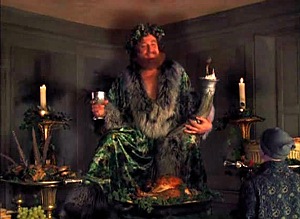
Ghost of Xmas Present[ Desmond BarrittAnother Christmas is about to join the Ghosts of Christmas Past–although, until December 26th, it is still the Ghost of Christmas Present. And as always, I want to talk about my favorite Christmas story of all time, A Christmas Carol, by Charles Dickens.

Charles Dickens was a master when it came to creating marvelous hooks and using heavy foreshadowing. Let’s have a look at the first lines of this tale:

“Marley was dead, to begin with. There is no doubt whatever about that. The register of his burial was signed by the clergyman, the clerk, the undertaker, and the chief mourner. Scrooge signed it. And Scrooge’s name was good upon ‘Change for anything he chose to put his hand to. Old Marley was as dead as a doornail.”

In that first paragraph, Dickens  tosses out the bait, sinking the hook, and landing the fish (the reader) by foreshadowing the first plot point of the story–the visitation by Marley’s ghost. We want to know why Marley’s definite state of decay was so important that the conversation between you the reader, and Dickens the author, was launched with that topic.

1999-xmas-present Desmond BarritHe picks it up and does it again several pages later, with the little scene involving the door-knocker, where Scrooge sees the face of his late business partner superimposed over the knocker.

At this point we’ve followed Scrooge through several scenes introducing the subplots. We have met the man who, as yet, is named only as ‘the clerk’ in the original manuscript, but whom we will later know to be Bob Cratchit, and we’ve met Scrooge’s nephew, Fred.

These subplots are critical, as our man Scrooge’s redemption revolves around the ultimate resolution of these two separate mini-stories–he must witness the joy and love in Cratchit’s family, who are suffering but happy in the midst of grinding poverty for which Scrooge bears a responsibility. We see that his nephew, Fred, though orphaned is well off in his own right, but craves a relationship with his uncle with no thought or care of what he might gain from it financially.

All the characters are in place. We’ve seen the city, cold and dark, with danger lurking in the shadows. We’ve observed the way Scrooge interacts with everyone around him, strangers and acquaintances alike. Now we come to the first plot point in Dickens’ story arc–Marley’s visitation. This is where the set-up ends and the story begins to take off.

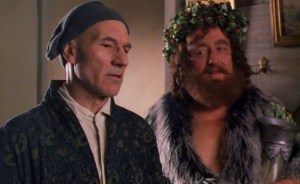
christmas-carol-1999-patrick-stewart-scrooge-desmond-barrit-ghost-of-christmas-presentI love tales of redemption–and A Christmas Carol by Charles Dickens remains one of the most beloved tales of redemption in the Western canon. Written in  1843 as a serialized novella, A Christmas Carol continues to inspire adaptations, in both movies and books.

This is a short tale, but it is a deeply moving allegory of the Christian concept of redemption that remains pertinent in modern society.

In this tale, Dickens asks you to recognize the plight of those whom the Industrial Revolution has displaced and driven into poverty, and the obligation of society to provide for them humanely. This is a concept our society continues to struggle with, and perhaps will for a long time to come.

It is that deep, underlying call for compassion that resonates down through the centuries, a call that is, unfortunately, timeless.

Comments Off on #amwriting: The Art of Foreshadowing: Charles Dickens

Filed under Fantasy, Literature, writing

#FlashFic Friday: A Million Lights

30_Doradus,_Tarantula_Nebula

Tarantula Nebula, Hubble Image courtesy NASA and Wikimedia Commons (PD)

A Million Lights

A million lights above me

Candles in the sky

Beacons in the dark of night

Cannot tell me why.


This fragile rock we live on

Trivial and lone

A home so small and simple

The only one we own.


Many voices on the wind

Striving to be heard

No matter how you dress us up

We’re petty and absurd.


A million lights above me

Darkness here below

Can’t we all just get along?

We’ve nowhere else to go.


A Million Lights © Connie J. Jasperson 2015, All Rights Reserved

4 Comments

Filed under #FlashFictionFriday, Literature, writing

#FlashFictionFriday: Irene (and Robert Hooke)

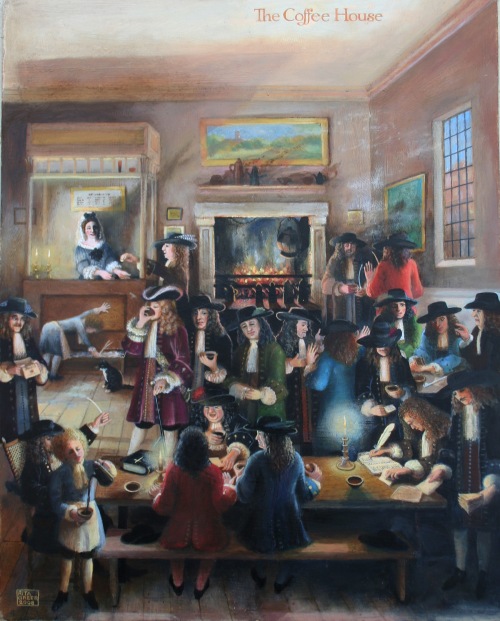
The Coffee House

copyleft symbolArtist: Rita Greer, 2008

Title:    The Coffee House,  copyleft

About this painting (quoted from Wikimedia Commons)

English: Coffee Houses played an important part in the social life of Robert Hooke. Only coffee and chocolate were served (no alcohol). Here news could be had, conversation, arguments, meetings, card games, wagers made, workmen could be paid, etc. (Hooke would sometimes carry out a scientific experiment in front of a coffee house audience as witnesses.) Hooke is shown writing (bottom left) at a table with people waiting to talk to him.

Rita Greer is a history artist, goldsmith, graphic designer, food scientist and author/writer. On retirement in 2003 Rita began the Robert Hooke project, “to put him back into history.”

According to the Institute of Physics article of Jan. 12, 2012: “Chroniclers of his time called him ‘despicable’, ‘mistrustful’ and ‘jealous’, and a rivalrous Isaac Newton might have had the only surviving portrait of him burnt, but, three centuries on, Robert Hooke is now regarded as one of the great Enlightenment scientists.”

>>><<<

I spend a large portion of my life in coffee houses too, writing and meeting with other writers, and artists. The friend who inspired the poem today was introduced to me in a coffee house in Olympia, on a dark November night in 2012. It was the kick-off meeting for NaNoWriMo that year.

Irene

I met you in a coffee shop.

Knitters and authors vied for tables

In a dark, polished, coffee-scented room.

Texas wit met Northwest irreverence

And the world was never the same.

A sisterhood built on words

And books

And commonalities.

We met as old ladies, too wise to raise much hell.

We’d have been dangerous

Had Austin met Olympia in the young, wild days.

It must have been divine intent

That our lives converged in the quiet years.

Sisterhood binds and unites us

Because family is more

Than marriage or blood.

Leaf_Decoration 1_clip_art_small


Irene © Connie J. Jasperson 2015, All Rights Reserved

4 Comments

Filed under #FlashFictionFriday, Literature, writing