Category Archives: Fantasy

Alison DeLuca – A Sharp Left Turn

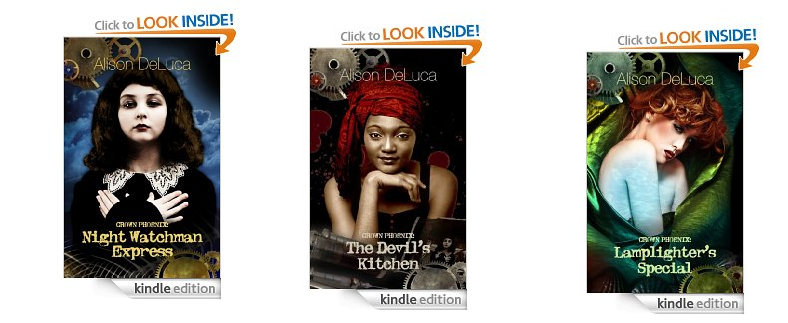
Alison DeLuca is the well-known author of the Steampunk series, ‘The Crown Phoenix’. This series has captured my imagination since I first read ‘The Night Watchman Express’, and she has just published the third book in the series, ‘Lamplighter’s Special’.  My review of the series is posted on my book review blog, Best In Fantasy.

Alison is a master of character development.  I love each and every one of her characters, feeling as if they were my dearest friends (or in some cases enemies). The premise of the series is extremely creative, involving all the finest elements of the Steampunk genre – magic, machines and the eternal battle with dark-forces.  She manages to do this magnificently and neatly avoids devolving into formulaic kitsch as some rather popular pulp-novels have done.

Because I love her characters and their depth so much, I asked her to discuss the most unlikely and intriguing pair, Riki and Neil. Two people less like to make a romantic connection never lived, and yet their story has been one of my favorite threads in the saga.

>>><<< 

A Sharp Left Turn

In my first book, Crown Phoenix: Night Watchman Express, the action changes in the middle of the book. I leave Miriam and Simon on the Night Watchman train, kidnapped and heading to a sinister, unknown destination.

Simon’s friend, Neil, heads off to the mythical island of Lampala. When I wrote the book, I based the geography on the country of Madeira. Beyond that, I wanted to completely avoid any trace of colonialism in my plot. The Lampalans had to be well-off with a thriving industry and their own government.

Neil reaches the island, thanks to the mechanics of the Crown Phoenix, a quantum typewriter. He is rescued by Riki, a girl who is very thin, energetic, and quite a pain in the behind.

Her parents are well-to-do, but they cannot control Riki. She is just one of those kids who was born yelling her head off, and she hasn’t stopped since. She gets bored easily, which probably means she is very intelligent. Furthermore, she is extremely loyal. Once Riki is your friend, she will stick by you through anything.

She can hardly believe, however, that Neil doesn’t immediately fall for her:

“Well, don’t worry. When you and I get married, you’ll be rich.”

Neil shot to his feet and dropped his sandwich onto the beach below, where it was picked up by a triumphant gull. “When we what?” he repeated in a strangled voice.

“When you marry me.” Riki smiled at him and swallowed the last of her sweet roll.

He huffed, catching his breath, and finally managed to say, “Oh, no, I’m not marrying you. No-ho. Mhp-hm.”

She looked up at him in astonishment. “You mean, you don’t want to marry me? Why not?”

“Because,” he responded, “you are, without a doubt, the rudest, most ill-mannered girl I have ever met in my entire life.”

She considered this. Her eyes turned into slits. “Well,” she finally retorted, “I’ve been nice to you today.

“Maybe. However, I’m not going to marry someone whose best claim to decent behavior is that they’ve ‘been nice today’. If I ever get married at all, that is.”

Both Riki and Neil run into Kyoge, one of the King’s Guards. I based Kyoge on a painting called, “The Moorish Chief.” He is tall and strong – a superbly athletic man. His physical prowess is matched by his shrewd wits. He, like Riki, is also very loyal. When he realizes that the true ruler of Lampala is alive and hidden on the island, he risks everything to help.

When I took that Sharp Left Turn, I knew it was a risk. Instead of following the plot and main character of the first section, I followed a new train of thought and a different set of people. Why did I do it? Not to torture my readers, but instead to increase the excitement of what followed. In that, I borrowed a page from one of my favorite children’s authors, Joan Aiken. She would reach the most exciting part of a scene and go to another set of characters. It kept me reading, agog, well past my bedtime, when I was ten years old.

I’m no Joan Aiken, but I do hope that readers enjoy my side trip to Lampala. I love the island, and I adored writing the story that happened there.

>>><<< 

Alison DeLuca grew up on an organic farm in Chester County, Pennsylvania.  Her parents were British, so in the summers she went to stay with her grandparents near Dublin.

There was no stereo or TV there, so Alison, her sister, and her cousins spent the summer inventing stories and plays for each other.  “This gave me the ability to entertain myself with my own imagination in any situation,” she says. “We used to be taken to tea with great-aunts, and we were expected to sit on an uncomfortable couch and not move or say a word.  It was possible to endure it because I was watching my own little stories play out in my mind.”

After graduating from West Chester University, Alison became a teacher of English and Spanish, teaching students from kindergarten up to college level. She loved teaching, and it was with reluctance that she left the classroom to be a fulltime mom when her daughter was born.

While she was teaching and raising her daughter, Alison took every free minute she had to write.  The Crown Phoenix Series was the result.

She is currently working on the final book in the series, as well as several other projects.

Comments Off on Alison DeLuca – A Sharp Left Turn

Filed under Battles, Books, Fantasy, Humor, Literature, Romance, Uncategorized, writer, writing

Monsoons and the Dust Bunnies of Life

To my left we have one of the most iconic heroes of the Final Fantasy Series, Cloud Strife.  He is a flawed hero, a man who is living a lie and who breaks under the strain. Nevertheless, Cloud saves the day, but only because he has the support and love of his companions. At the beginning of the game , Cloud is an island, who only reluctantly accepts friendship, and as the game progresses he falls in love.  The girl he loves is killed in one of the saddest cutscenes in gaming history, and he begins to go to pieces. Still, even though he has been living a lie, his companions rally around him and force him to do what only he can do.

So, what does Final Fantasy VII have to do with monsoons and dust bunnies?

If you have to ask, you aren’t a gamer.  For me, monsoon season is gaming season. I don’t play daily, or even weekly, but on the days I do, I play all day, and don’t emerge from the gameroom for anything short of an earthquake. I think if I didn’t have to write books, I could one day be found dead in my gameroom with the controller in my hand, having starved to death.

Final Fantasy VIII was my all time favorite because of the strong storyline and wonderful characters. Squall Leonhart was the tough guy whose hard exterior concealed his vulnerabilities. In the end, his acceptance of his own vulnerability is what makes him strong. There is a strong romance in the tale, and also a strong story Squall’s gradual discovery of his past is intertwined in the action.

I’m actually currently playing (again) Final Fantasy XII, which is my favorite in the entire franchise, because the storyline is so rich and multi-layered. For me, the attraction of gaming is the interactive aspect of it.

What you do or don’t do can affect the storyline and the outcome. It’s the same reason I write – who doesn’t love a flawed hero who overcomes the odds and saves the world?

Gaming stirs my creativity, as long as I don’t become an unkempt, pajama-clad walking wraith whose only goal in life is to level-up…

No.  Not me.

No, I’m sure I’m not that person.  Well, not today anyway.  Until NaNoWriMo is over, I have to write and can only blog about gaming. Even though the monsoons have once again set in here in dark and dreary Olympia, I will write like the wind, building on my storyline and getting as high a word-count as I’m able.

But on December 1st, I will binge on gaming, until I’ve leveled my teams up so they can beat anything they are faced with.

4 Comments

Filed under Adventure, Battles, Books, Fantasy, Final Fantasy, writer, writing

J.D.Hughes – William the Cat

Today is day 12 of NaNoWriMo – and I’ve managed to write a total of 39,700 words since day one.  It’s been a pure stream-of-consciousness,  run-for-the-money, laying down of the basic structure of the story.  Nothing of what I’ve written is anything I would be proud to show the dog at this point, but when I’ve finished with the many vignettes which form the basic storyline, I’ll begin the task of actually writing the story. I think it will be about 60,000 words when it is fully plotted.

Then the real work begins, when I have to turn this patchwork quilt of a manuscript into a book!The finishied book will be about 130,000 words.

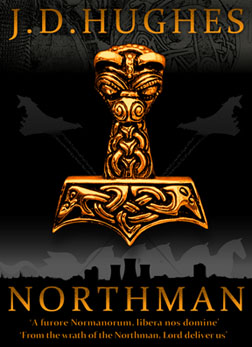
In the meantime, for your dining pleasure we are serving up a delicious guest-post by UK author and blogger-extraordinaire, J.D. Hughes.   J.D.’s new book ‘Northman’ is scheduled to be released on Friday, November 16th .  He has kindly allowed me to reuse a post from his blog, J.D.Hughes.

I must confess that having seen the cover, and read the pitch I am lurking, waiting to get my hands on my copy!  And now, without further ado I give you a reprise of my favorite post ever by one of my favorite bloggers:

WILLIAM THE CAT

Originally Posted on June 15, 2012 by J.D.Hughes

I am not a fan of cats.

They leave excrement in my orchard and pee on my windfall apples.

But, I have a grudging respect for William the cat. He is white, sleek – turning to a little tubbiness as he ages – but will kill anything smaller than he. That characteristic would be psychotic in a human being, but defines a cat.

I’ve never seen him pee on my apples or crap in my garden, so he is – in that catlike manner – returning my respect. Or so I like to think. If I am realistic he probably regards me as an occasional source of food and gruffly masculine tummy rubs but is indifferent to my opinion of him. He has repeatedly tried to get into my house after one successful raid. We are now engaged in a cat and man game, which he believes he will win. He is seeking to wear me down with persistence, but I have owned many dogs who knew more about persistence than any creature living or dead when it came to precise feeding and walking times, so he will be disappointed.

For some reason he has a liking for my garage and is often locked in for long periods of time. We have a thriving community of field mice to keep him entertained, but I think it may be an attempt to show me how easy my garage is. Logically, that ties in with his belief that my house will one day be his.

He has no remorse, no sense of guilt when some small creature is struggling in his jaws, little understanding or sympathy with anything living and zero interest in anything with which he has played and which has now stopped moving.

So, why do I respect William the cat?

Because he is being a cat.

It’s what cats do. He has no choice.

I respect human beings who tell the truth, help others, attempt to raise mankind from the gutter and try to behave in a kindly manner to their neighbours for a similar, but perhaps not the same, reason.

Not all humans behave like that. Some of William is built into our DNA and we occasionally behave badly towards our fellows.

The difference is that we have a choice. We can think rationally about whether it is a good idea to kill people smaller, weaker, less intelligent than, or different from, ourselves.

There are exceptions, of course. The sociopathic or psychotic personality may have no choice, but we do.

My previous post was about Truth and this is a (sort of) continuation. My belief is that there is nothing to be gained by being unpleasant or violent to strangers and that it is a part of our journey to the status of rational beings for us to be kind to people – do unto others and all that.

Of course, if they attack you with a machete then one should adopt the William attitude and either run away or get a bigger machete.

My own journey through life tells me that most people harbour few truly evil thoughts towards others. Occasionally, hatred will spring up in the fight for sex, resources or survival (perceived or real) but unless there is a continuing need for the above then it often dies away and people (mostly) play nice, or at least become tolerant.

So, as William wanders past with something furry clamped in his jaws I wonder how I would feel trapped in behaviours I cannot control, without choice and destined to repeat the same patterns, again and again.

Got to stop now. It’s 12.30pm, time for my Ploughman’s Lunch, a short walk, the BBC News, a nap at 1.27pm for exactly 21 minutes and a quick chase around the garden looking for small rodents or baby birds to eat.

Unless William has been there before me.

>>><<<

Below I have posted J.D.’s biography, exactly as he sent it to me. He cracks me up!

J.D. HUGHES

A ‘sort of’ Writer, living in the Peak District of Derbyshire, England.

His new supernatural thriller for adults, NORTHMAN, begins in Anglo-Saxon England, 943 AD, moves through World WarTwo, 1943 and into the present. It is an epic story of timeless love and eternal evil but contains no vampires or werewolves.

It has something infinitely more evil.

He also has several free, dark tales (links on blog). Or on Amazon if you want in a perverse gesture of altruism to buy them.

JD has worked as a writer, director and producer of commercials, short films, corporate and music promos. Recently, he accidentally gained an MA in Film Studies and Screenwriting, whilst continuing to work as a freelance. He loves film, so enjoyed the experience and almost continued on to a PhD, but decided that it would interfere with real writing and painting the shed.

JD started writing fiction aged 11 and it has taken him until now to be competent – obviously a slow learner. Some might say that point of competency is still some way off. Despite those people, JD is determined to inflict his writing on innocent readers and will be doing so to the exclusion of all other delusions (except painting the shed) for the foreseeable future.

He apologises in advance to those who will be offended, and hopes the rest of the world will enjoy some of it.

Don’t tell me the moon is shining; show me the glint of light on broken glass. ~Anton Chekhov


4 Comments

Filed under Adventure, Books, Fantasy, Humor, Literature, Uncategorized, writer, writing

On Editing, part II; guest post by Carlie Cullen

Today we continue with the second half of Carlie M.A. Cullen’s absolute gem of a post on Editing.

Here is where the principle she expressed in Monday’s Post are put into action.

Her Comments will be in Red and my response will be in Blue!

Comments:

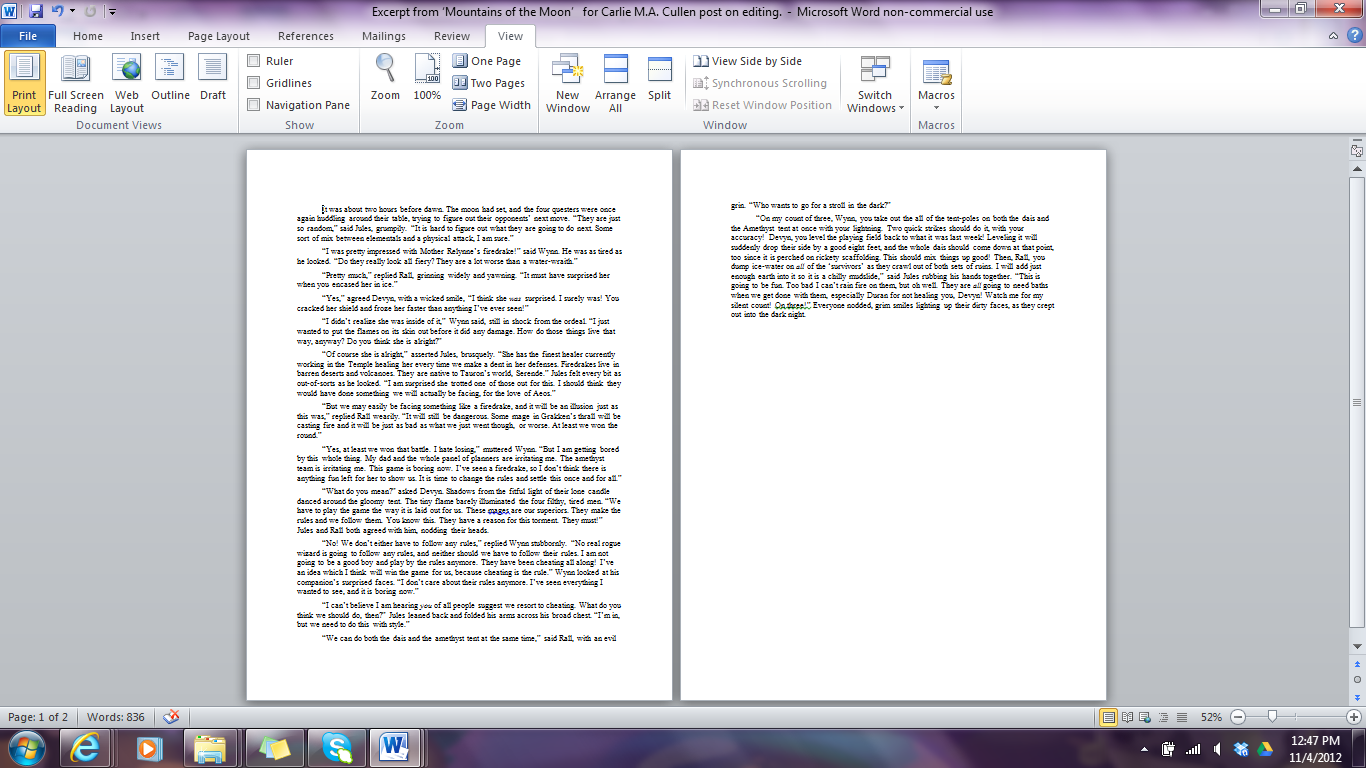
When I edit a manuscript, I always request it in Word. I use the Review tab and insert comments which appear on the right of the document. If there are too many comments to fit on the page, the comment box will show ‘. . .’ in a small box; clicking on this will bring the comment up in full on the left of the document. By selecting the word or phrase and highlighting with the cursor, then pressing ‘New Comment’ it allows me to show the author the exact part they need to look at (see the screen print of the document I have edited for this post).

I always try to gently guide my authors. They have spent countless hours and poured a great deal of themselves into their work and I’m not in the business of trashing their self-esteem. In addition, I fully recognize they have the final say and I can only make recommendations.

The content of the comments made depend on what the problem is with the manuscript. Some comments are only one or two words long, i.e. ‘delete’ or ‘insert comma’, while others are much longer. Let’s take a moment to look at the comments on the screen print.


Comment C1 – just says remove comma”. This comma has been placed in a position where it is not needed and therefore incorrect. An author wouldn’t expect a ten line explanation of why the comma needs removing so it’s quite acceptable to have remove comma”  (done)

Comment C2 – this is a longer comment and showcases my point about realistic dialogue. The comment says Do you mean for the dialogue to be so precise here? You’ve used contractions in other places so I would suggest you change this to ‘They’re’ (done)

Comments C3, C4 and C5 – these also refer to comment C2 and the author, having read comment C2, will not expect an editor to type out the whole message for each case therefore, for these three comments I ask the author to Consider it’s / they’re / I’m(done)

Comment C6 – this comment has been showcased above when I spoke about inconsistencies. My message to the author here is If Wynn has seen a firedrake, surely he knows whether they look fiery or not. I suggest you reconsider this question.” This gives the author an opportunity to re-think and re-word. (Wynn has not seen a fire-drake.  The point of the exercise was to get him acquainted with beasts he had not encountered before.  However, Carlie has only seen this excerpt and doesn’t know this.)

Comment C7 – this relates directly to C6 as it answers the question which I believe to be inconsistent. Depending on how you handle comment C6, this may have to change or be deleted.” (left it in)

Comment C8 – in this case, I have a small issue with sentence structure. My comment, This doesn’t flow very smoothly. I suggest you consider changing the order to ‘put out the flames on its skin’”, tells the author what the problem is and gives a suggestion of how to fix it. (done)

Comment C9 – Consider changing to ‘she’s’”. This again is a dialogue issue and use of contractions. C10 – See comment C9”. There is no need for me to go into long explanations when I can refer the author to a previous point made. (done)

Comment C11 – sentence structure and the flow of it is the problem here. My comment, Having ‘healer’ and ‘healing’ in the same sentence doesn’t sound right. Consider changing ‘healing’ to something like curing/restoring, shows the author what I consider is wrong and suggests alternative words they can use. (done)

Comment C12 – deals with repetition of a phrase. You’ve used this type of phrasing above when talking about how tired Wynn was, so the repetition doesn’t work very well. If you want to emphasize how Jules looks and feels, I suggest re-wording or changing this around. Consider something like ‘Jules felt really out-of-sorts and looked quite rough’”. Using phrase repetitions, especially on the same page, annoys some readers and it doesn’t show the authors grasp of vocabulary as well as it might. By rephrasing, it removes the repetition and makes the story flow better and my suggestion gives the author another way of looking at it. (done)

Comment C13 – is to do with contractions in dialogue again. However, I can see there might be a reason why the author would not want to do so. Therefore, my comment, Consider contracting to ‘I’m’ unless you want to emphasize the ‘am’ in which case it should be in italics”, provides two possible solutions. (changed to italics)

Comment C14 – sentence structure and flow is the problem here so the comment, This is clunky and doesn’t flow at all well. Consider changing to something like ‘Shouldn’t they have challenged us with something we’ll actually be facing…?’ or similar”, explains the issue and suggests an alternative. (done)

Comment C15 – repetition. You’ve used ‘facing’ on the previous line. I suggest replacing with something like confronting / tackling / meeting”. This identifies the problem and offers a solution. (done)

Comments C16 and C17 – using contractions in dialogue. C 16, As this is dialogue, consider contracting to ‘it’ll’”. C17, “See comment C16”. (done)

Comment C18 – this comment covers two problems; repetitions and contractions in dialogue. It’s difficult for an editor (unless they are very familiar with an author’s work) to suggest changes to dialogue other than use of contractions as each author has their own ‘voice’. To get around this, I point out the problem and leave it for the author to fix, like so, You’ve used ‘it will’ 3 times in this paragraph. Consider rewording at least one of them (see also comment C16/17)”. (done)

Comments C19, C22, C23, C25, C30, C32, C34 and C35 – these again deal with use of contractions in dialogue and the comments made are almost identical to those used above. (done)

Comments C20 and C21 – both of these deal with repetitions &/or sentence structure/flow. As you can see, both comments offer suggestions for alternatives. C20, Repetition – you’ve just used ‘irritating in the previous sentence. Consider changing to something like annoying / infuriating / aggravating”. C21, “You’ve used ‘bored’ on the 1st line so this is like a repetition & doesn’t sound right. Consider replacing with tedious / monotonous / tiresome / repetitive, or similar”.  (done)

Comment C24 – because of the dialogue used, I feel there is a need for the author to show emotion in the speaker’s voice. The comment reads What inflection is in his voice? Annoyance? Exasperation?”.  (done)

Comment C26 – this is another emotive section where the character needs to come alive for the reader. I prompt the author thus, Consider what expression is on Devyn’s face and the inflection in his voice. You need to show a little something here”. (done)

Comments C27 and C36 – extraneous words have been used so a simple delete suffices. (done)

Comment C28 – You have 6 repetitions of ‘rules’ in this one paragraph. Delete this Pretty self-explanatory, I think. Comments C29, C31 and C33 deal with the other instances of the repetition within the paragraph. C29 states Delete”, C31 reads Change to ‘their directions / conventions / instructions / decrees’ or similar”, and C33, “Consider either removing this bit or changing to something like ‘… about what they want…’”.  (done)

Comment C37 – Repetition from previous paragraph. I would switch things around and remove ‘both’”, identifies the problem and offers a solution. (done)

Comment C38 – sentence structure and flow. Using ‘level’ and ‘leveling’ in the same line spoils the flow. Consider changing to flattening / razing / demolishing”. (done)

Comments C39 and C40 – incorrect punctuation. C39 states, “Remove comma and C40 reads, Insert comma”.  (done)

Comments C41, C42 and C43 – using contractions in dialogue. Comments are as previously shown.(done)

Comment C44 – showing. The reader needs to connect not only to the character in this part, but also the scene. The comment recommends, Is there a smug smile on his face? A hint of devilment in his eyes? What inflection is in his voice? Is there an aura of amusement around him? Your readers need to ‘see’ the scene”.  (I will work on it.  I don’t really do ‘devilment’, lol)

Comment C45 – punctuation can be over-used just like words can and this is a perfect example. The comment, “Too many exclamation marks – 3 in 3 sentences! Replace 1st exclamation with comma, change ‘O’ to lowercase and replace last exclamation with period”, shows how to rectify this. (What!!! er… Done)

Comment C46 – inappropriate descriptive word. This particular example was covered in the first section of this post. My comment is, Would the smiles be grim? Also, grim smiles wouldn’t light up their faces. This is payback as far as they are concerned so I would have thought there would be excitement / devilment or similar in their smiles. I suggest you look at this again and change this word to something more appropriate to the occasion”. (I will work on it)

The above comments show how I try to guide my author by posing questions and offering solutions to the identified problems.

Editing is a very time-consuming yet rewarding job; taking a raw manuscript and honing it until it shines is as much as labour of love for the editor as it is for the author. They have to work closely together for a prolonged period of time to achieve a common goal. The end result, the published book, gives an editor as much joy and satisfaction as the author.

I hope you have found the foregoing informative and interesting. As Connie’s editor, I have to say she is a consummate professional throughout the editing process and wonderful to work with. It makes a huge difference to an editor when their client approaches editing with an open mind and a positive attitude; it results in a wonderful piece of literature both parties can be proud to put their name to.

 >>><<<

 Carlie, thank you for your long hours of work doing the edit of this segment.  I know you took time away from your own work to do this, and it means more to me than you know!

And for those of you who are wondering why a proper editing is so very expensive, there were only 836 words in this snippet, and it took her every bit as long to edit it as it did for me to write it, perhaps longer.  A good editor is very much worth the price – but I warn you absolutely must be able to work closely with your editor and you must be willing to consider and act on the changes they suggest. Your manuscript is the child of your creativity, and as such you must be very careful who you allow to care for it. If you have a contract with a publisher, be sure you have final say on all changes before publication.  It doesn’t matter how much you pay, if your editor is not willing to allow you to make the changes on your own ms. It is only through making these changes and thinking outside of your normal mindset that you will really grow as an author.


6 Comments

Filed under Adventure, Books, Humor, Literature, Uncategorized, writer, writing

On Editing part 1, guest post by Carlie M.A. Cullen

I’ve asked Carlie Cullen, author of Heart Search, and one of my editors on the Tower of Bones series to write a guest post detailing what an editor looks for when they receive a manuscript for the first editing. I also asked her to take a hitherto unedited bit of a current work in progress and to edit it for this post in the way she will when it actually goes to her sometime next year. The following is her post and the commentary.   To the left here, I’ve inserted  a screen shot of the unedited ms. At the bottom of this post is the screenshot of what the ms looks like now she’s sent it back to me.

What I hope you will all gain from this is (a) the importance of an impartial eye on your work, and (b) the understanding that criticism is a necessary part of growth.

I take each of her comments, and I analyze it with as fair an eye as I can.  Then I make the changes, but I do them my own way. I don’t do heavy descriptors, and Carlie’s own work is very descriptive. This is why we work well together. She brings out the places where I’ve skimped on the descriptors too much, and forces me to be more forthcoming with showing the emotions of the scene.

Today I bring you part one of Carlie M.A. Cullen on editing!

>>><<< 

Editing a raw manuscript is like dealing with an overgrown garden full of weeds; you need to cut back the long stuff before you can see the weeds choking the plants. This analogy is why editors generally do more than one round of editing, as they need to get some semblance of order to the manuscript before they can look at structure and the development of a story.

An editor has to look for a large number of things as they go through each line. As well as spelling, grammar (including correct use of tenses) and punctuation, which is the first thing I look at, there are the following:

  • ·         Sentence structure. If a sentence doesn’t flow there’s something wrong with it and an editor needs to identify what it is and give suggestions as to how to put it right.
  • ·         Consecutive sentences beginning with the same word. A couple of sentences beginning with ‘I’ for example, you can get away with, but more than that and it becomes repetitive.
  • ·         Repetition of words. This is a classic mistake every author makes and there are certain words which stick out like a sore thumb. The most common one I come across is ‘that’. In addition, I look for repetitive phrases. In the example, there is one paragraph which has ‘it will’ repeated three times.
  • ·         Dialogue. The dialogue has to be realistic otherwise the characters don’t come to life. This is more than just the actual words they say it’s also how they say it. Everybody uses contractions when they speak in everyday life (don’t / can’t / it’ll / I’m / I’ve / you’re / it’s – you get the drift) so these need to be reflected in your work. Also too many tags (he said / she said) can interrupt the flow.
  • ·         Inconsistencies. Again if we look at the example (comment C6), you will see some dialogue where Wynn is talking about seeing a firedrake and he then asks if they ‘look all fiery’. He’s already seen one so he shouldn’t be asking a question he already knows the answer to. This is just one example of how an inconsistency can occur.
  • ·         Timelines. In my first book I had an issue with a woman’s pregnancy and got the number of weeks muddled up, which thankfully, my editor picked up. An editor has to ensure the timelines are true to the story so it flows.
  • ·         Incorrect descriptive words. You will see towards the end of the example piece where the author used ‘grim smiles’. This doesn’t accurately reflect what’s happening in the story so the use of the word ‘grim’ is incorrect.
  • ·         Distinguishing ‘thoughts’ from text. Thoughts should be shown in italics to separate them from the general text and should be written in present tense, regardless of what voice is being used.

All the above is what I would normally do on a first round of editing – the cutting back of the long stuff to get to the plant-choking weeds. Then on the second round, I double check all the items above once more to ensure nothing has been missed, plus I begin the structural and developmental part of the edit. These are the sorts of things I look at:

  • ·         Imagery. A powerful analogy can help a reader picture a scene more clearly. This is where a writer can be particularly creative as using lots of clichés makes the writing boring and predictable. Also clever use of descriptive phrases can make something come alive.
  • ·         Showing not telling. This is mainly for character connection. Readers want to see expressions, gestures and mannerisms which give the character a three-dimensional quality. They want to be able to see and feel what the characters are feeling and seeing. They don’t want to be told someone is crying, they want to see the tears rolling down the cheeks and the anguish in someone’s eyes.
  • ·         Cutting extraneous text. When writing, it’s very easy to get carried away and add in all manner of superfluous detail. An editor needs to be able to isolate this extraneous text and suggest removal whilst ensuring the story isn’t compromised in any way.
  • ·         Actions reflecting character’s state of mind. Sometimes, writers give mixed messages about their characters. Their protagonist could be suffering a high state of anxiety yet their actions are portrayed as those of someone who is calm. This isn’t realistic. Therefore an editor needs to be able to identify these types of issues and suggest how to rectify the problem.
  • ·         Inflections. Think for just a moment about how people around you talk. Do they constantly talk in a monotone? When you’re out shopping and you overhear conversations, are the voices flat and devoid of any emotion whatsoever? No, and characters shouldn’t be either. By writing inflections in their voices, you are making them more rounded and real. It’s not called for in every bit of dialogue you write, but at a particularly emotive scene, whether it is anger, frustration, fear or sorrow, showing an inflection in the voice again helps the reader to connect with the characters.
  • ·         Story structure. This is where an editor looks at the story as a whole. Sometimes the starting place for the story isn’t strong enough (on the basis that you want to grip your readers early on to encourage them to continue reading). Sometimes the starting point would be better moved to another part of the book. Occasionally different P.O.V.’s (point of view) found in the same chapter can be confusing if not separated correctly. This point needs to be identified fairly early on in the editing process.
  • ·         Character development. A close look at how each character is written can reveal a great deal. Is it realistic for a character to be meek one minute and a raving psychopath the next if there is no trigger point or mention/hint of mental illness? There needs to be consistency, a journey for the character to take through the story and wild variations don’t work.
  • ·         Consistency. If a writer states in chapter two that Fred is the uncle of Lisa’s husband, he can’t be portrayed in chapter six as Lisa’s uncle. If a home is shown as being in Baltimore in chapter three, it can’t suddenly up sticks and walk to Florida in chapter twelve.

At the end of these processes and when the author has made any relevant changes, the editor has to final check the manuscript, to ensure it’s a polished gem, before it goes out for beta reading and subsequent publishing.

Thank you Carlie!  On Wednesday we will see what the lovely, colorful commentary on the finished ms above means!

3 Comments

Filed under Battles, Books, Humor, Literature, Uncategorized, writer, writing

The Zombie Apocalypse–and so it begins…

Halloween is just a day or two away. Wednesday night will see the streets of my town filled with the walking dead, the could-be-dead and the just plain skeletal remains of the dead. Should I plan poorly and run out of Reese’s Peanut Butter Cups or Hershey’s Chocolate Bars before 9:00 P.M. or so, I will most likely wish I was dead! After all, my deeds that night are all that stands between the undead apocalypse and the good people of the world.

What is this fascination we have with death?  So many books are being written about the undead, vampires and zombies.  In my town Zombies are very popular, being quite athletic and charitably minded, with many turning out this last week for the Zombie Dash 5k run.

According to Zynga executive, Travis  Boatman, who has been making games for two decades,  “People want to smash and maim and kill people,” Travis says. “But people don’t  alway like smashing and maiming and killing real people because, well, there’s  something unsettling about that. Zombies are people,” Travis continues, “so they fulfill people’s desire to  smash and maim and kill people. But they’re also already dead. So there’s  nothing unsettling about smashing and maiming and killing them.”

Read more of Travis’s Interview at : Zynga

Vampires are of course very romantic, and frequently are the most popular books on the store racks. Anne Rice made the vampire quite romantic and disturbingly sexy in her 1976 novel, Interview With the Vampire. Stephanie Meyers made them not only romantic, she made them mainstream with her mega-popular  Twilight.  Heck, she even managed to make damp, dreary Forks, Washington seem somehow  more mysterious, much more glamorous and a LOT less rainy than it actually is. After all, Forks averages 212 days per year with measurable precipitation — and trust me, that is a LOT of dark, rainy days.

I am a superhero, and  October 31st is a most important night in the calendar of this superhero. It is the one night of the year when the veil between the worlds is most thin and the undead wait, literally DYING to invade our streets. Without my efforts to stave off the annual apocalypse which each year is poised to take place on November 1st, who knows what mayhem would abound?

How do I do this?  I have certain skills… and I’ve much arcane and mystical knowledge. Dressed in my ritual garb, I will personally perform the annual sacrifice which appeases those uneasy dead who roam the streets.

The vampires and zombies who will be knocking at my door on Wednesday will be, for the most part, less than four feet tall, wearing rain coats over their rags and capes, and carrying plastic bags for the annual sacred offering of chocolate.  I will be wearing my lucky witch’s hat and  flying-cape as I ritualistically drop chocolate into the offering-bags, hoping against hope that the annual tribute will keep my neighborhood safe from the walking dead for one more year.

I take my work seriously, when it comes to protecting my town. If it wasn’t for me and fifty dollars worth of chocolate, who knows what evil these undead marauders could unleash for the next year? It’s a terribly lonely thing, knowing that one fat grandma in a witch’s hat armed only with a bucket of chocolate is all that stands between human-kind and the zombie apocalypse.

6 Comments

Filed under Adventure, Dragons, Fantasy, Humor, mythology, Romance, Uncategorized, vampires, writer, writing

You, Me and Mr W B

Today’s guest is the well-known author, blogger and editor, Carlie M.A. Cullen, author of Heart Search, a paranormal fantasy and who hails from the UK. She has consented to give us her humorous take on that bane of all writers – Writer’s Block.  Her approach is quite zen as compared to mine!  Take it away, Carlie…

You, Me and Mr W B

The vast majority of us authors have day jobs and families, so we try and squeeze in some time when we can to write. But it’s just not that easy.

Picture the scene; you’ve had a rotten day at work so you’re feeling kind of up-tight and frustrated – angry even. When you get home you find some bills in your post box so now you have to work out which ones you can pay now and which will have to wait a week or two. Your spouse/partner is worried about money, the kid(s) and is fed up because he/she broke a favourite ornament. One of the kids is ill; they’ve got a bit of a fever and keeps throwing up, and the dog has decided to expand its’ culinary repertoire by chewing on your slippers.

After all this and having had dinner, you manage to find half an hour to sit down and write. You fire up your PC or laptop, open the relevant page and nothing. Mr Writer’s Block has taken up residence in your head and you can’t think of a single thing to write. You re-read some of what you’ve written before in the hope it’ll spark something, anything, so you can continue with your story. But what happens? Zilch, zip, nada, nothing. Before you know it, your half an hour has gone, it’s time for bed and now you’re even more frustrated.

Is it any wonder?

Our busy lives get in the way of our writing and just trying to find the time is hard enough, but when you’re worried about money, job, kids et al, it’s really no wonder so many of us suffer visits from Mr Writer’s Block, is it?

For us to be productive with our writing, we need to be able to put aside all the stresses, strains and problems thrown across our paths. We need to allow our imaginations to soar in a creative way rather than imagining what will happen if a particular bill is not paid by the due date. We need to find our zone and shut everything else out. Sounds easy, right? Like heck it is!

So how do we do it?

Preparation is key here and there are a few techniques you can use to get past it. I’m going to share three with you here.

If you’re the sort of person who listens to music when you write, put on a CD or your iPod for a good 10-15 minutes before you start and really concentrate on it. If it’s instrumental, listen to how the notes rise and fall, the harmonies created by the different instruments and think what scene the music conjures; if there are vocals, listen to the words very carefully, and try to picture the artist’s mood when they were writing it or how they would look performing it on stage. By concentrating on the music, you’re beginning to free your mind.

Another way is deep breathing relaxation exercises with a twist. Sit or lay – it doesn’t matter as long as you are comfortable – and close your eyes. Start breathing deeply then begin by thinking about your feet and mentally picture the muscles relaxing and the stress as a puff of black smoke or a black cloud which appears outside your feet as the muscles relax. Then you start working your way up your body; ankles to knees, knees to top of thighs, hip / groin / stomach area, chest, shoulders, arms and hands, neck and last of all your head. Then you picture a shape, any shape you like. It starts off small then gets increasingly larger until it fills your vision. Then you allow the shape to morph or distort itself, bending in on itself, twirling around, basically anything your mind can invoke. Now you’ve spent that time relaxing and playing with the shape, it’s pushed out the worries and let your imagination go to work.

The final one is ten minutes of free-writing, using pen and paper. Most, if not all of you are likely to know what this is, but in case you don’t I’ll explain. Pick a word, any word you like, at random. Now you just write anything which pops into your head about that word. Spelling, grammar and punctuation go out the window. You don’t even need to worry about sentence structure. You can write a list of words you associate with your chosen topic, you can write sentences. It doesn’t matter what you write, how it sounds, how arbitrary it is, the important thing is concentrating on your chosen word and just keep writing. The mere fact of you concentrating on something else has opened your mind and allowed the creative side to emerge.

After doing one of these exercises you go straight to your computer or writing pad, whichever you use and begin to write. Allow your mind free rein on your work in progress; it’s primed and ready to accept the sparks of inspiration your preparations have encouraged. It might be a little hokey at first, a little off compared to how you normally write, but that’s okay. The important thing is you’re now writing and as you progress your style, sentence structure and all the things you’re used to will materialise and ‘hey presto’ you’re back in your groove. The worst thing you can do is concern yourself with your first few lines which may not be up to your normal standard – it can always be edited later – you’re putting words on the page or screen and that’s what matters.

So the next time you’re tense and Mr Writer’s Block come knocking on your door, slam it in his face, do your chosen exercise(s) then write to your heart’s content.

>>><<<

Carlie’s approach is so much more civilized than mine!  Although, I must say, my hair-dresser, Heavenly Kevin has become quite adept at disguising the flat spot I’ve gained from banging my head on my desk!  Thank you Carlie – we’ll hear more from you in November when NaNoWriMo is in full swing and I am begging for guest posts! 

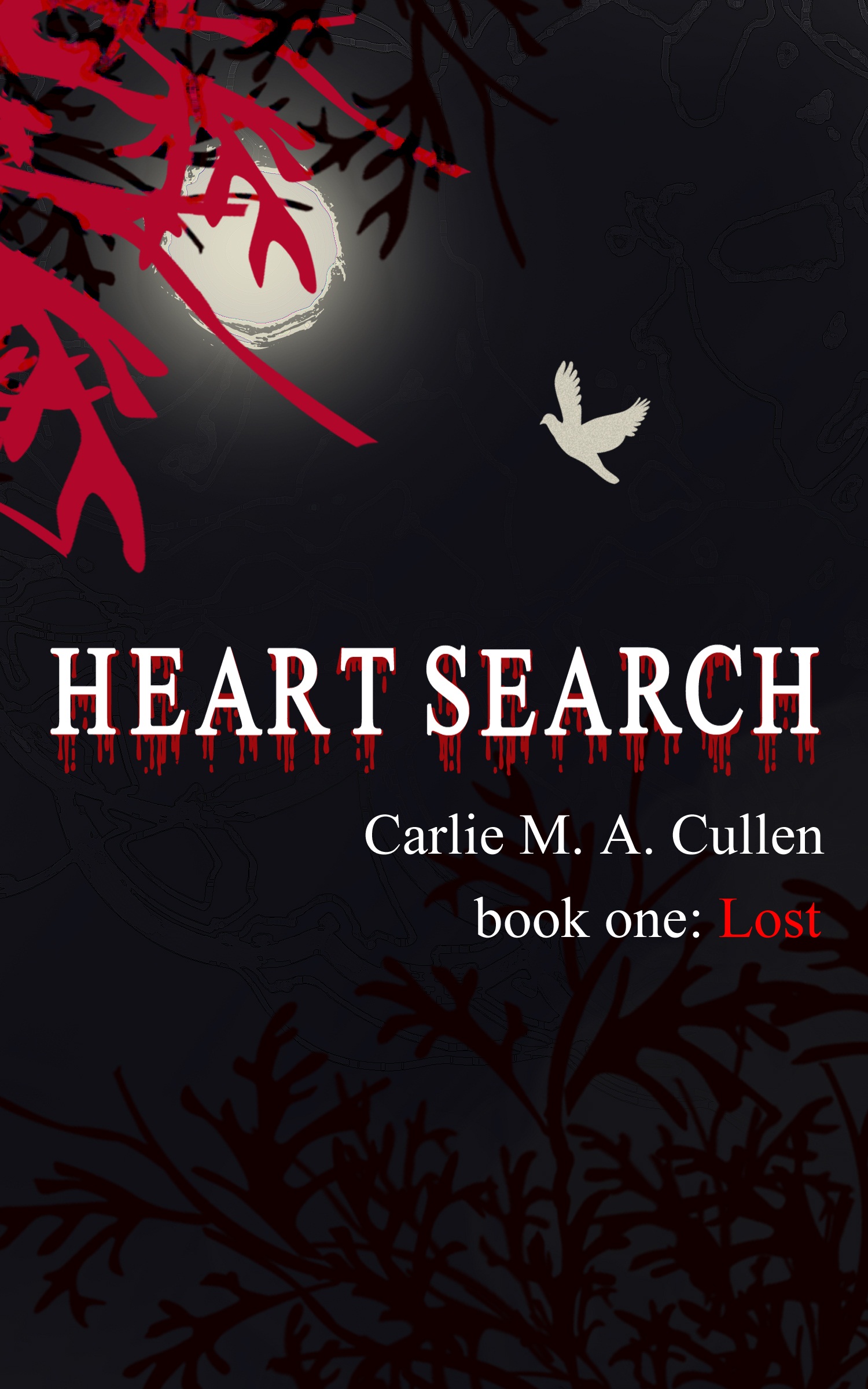
Carlie’s book, Heart Search is available at amazon.com for the amazingly affordable price of only $2.99 for the Kindle download.  I love a good tale of vampires and love gone awry!

3 Comments

Filed under Adventure, Battles, Books, Humor, Literature, Romance, Uncategorized, writer, writing