Category Archives: Fantasy

#amreading: The Queen of the Night by Alexander Chee

Queen of the Night alexander cheeEvery now and then I find myself reading/listening to a mainstream bestseller, and enjoying it. Alexander Chee has written just such a novel, in The Queen of the Night.

This novel has one of the best openings since Patrick Rothfuss’s brilliant opening lines in The Name of the Wind.

Quote from The Queen of the Night: When it began, it began as an opera would begin, in a palace, at a ball, in an encounter with a stranger who, you discover, has your fate in his hands. He is perhaps a demon or a god in disguise, offering you a chance at either the fulfillment of a dream or a trap for the soul. A comic element—the soprano arrives in the wrong dress—and it decides her fate.

These lines presage an immersive, sumptuous reading experience.

But first, THE BLURB:

Lilliet Berne is a sensation of the Paris Opera, a legendary soprano with every accolade except an original role, every singer’s chance at immortality. When one is finally offered to her, she realizes with alarm that the libretto is based on a hidden piece of her past. Only four could have betrayed her: one is dead, one loves her, one wants to own her. And one, she hopes, never thinks of her at all.

As she mines her memories for clues, she recalls her life as an orphan who left the American frontier for Europe and was swept up into the glitzy, gritty world of Second Empire Paris. In order to survive, she transformed herself from hippodrome rider to courtesan, from empress’s maid to debut singer, all the while weaving a complicated web of romance, obligation, and political intrigue.

Featuring a cast of characters drawn from history, The Queen of the Night follows Lilliet as she moves ever closer to the truth behind the mysterious opera and the role that could secure her reputation — or destroy her with the secrets it reveals.

The book so far:

From those intiguing opening lines forward it is filled with every kind of emotion, every human tragedy and triumph imaginable. It resounds with the pomp and grandeur of the most thrilling opera–as it should since it details the life of a Parisian opera star of outstanding brilliance–a true diva in the operatic sense.

Rumors abound regarding Lilliet–she is the topic of many conversations, but rumors barely touch on the truth of her life. Even she is not truly sure of who or what she is. Despite having achieved everything and more, she lacks something and is waiting for a “meeting with destiny” which she hopes will transform her life into the paradise she wants it to be.  That moment comes in chapter one, but the transformation….

You will have to read it to see.

This book is not cheap–the Kindle edition is $14.99. I bought it as an Audible download ($17.95) because I am heavily involved in editing right now for a Myrddin author and am also making revisions on my own work under an editor’s guidance. Then I bought the hardcover edition.

I am unable to read for pleasure until I am done with these two tasks. And because of some interesting style choices on the part of the author, such as not enclosing dialogue in quotes, I especially dare not attempt to read this particular book just now.

But I can listen to audio books, and what I am hearing in this book captivates me. When I am once again able to read for pleasure, this book will the first I crack open.

To purchase a book published by the large traditional publishers is a hefty financial commitment. To make your decision a little easier, Longreads posted the first chapter here: The Queen of the Night by Alexander Chee. Please go out to their wonderful site and if you like what you see, consider becoming a member.

4 Comments

Filed under Books, Literature

#amwriting: tips for writing clear dialogue

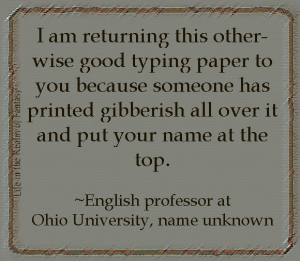
gibberish quoteDialogue can be tricky. Often, in our rush to get the ideas on paper, we have left off quotes, misplaced punctuation, and written interrupted dialogue with inconsistency.

While a certain amount of literary license in dialogue can enrich our work, our dialogue may be too rich with run-on sentences, and not in a good way.

Also, while everyone has read books that inspire them to become writers, some authors never learned how to write the kind of dialogue they envision. They don’t understand the fundamentals and don’t realize how their lack of understanding ruins their work.

Always begin what is actually spoken (dialogue) with a capitalized word, no matter where in the sentence it begins.

  • Mary glanced over her shoulder and said, “I’m sorry. I can’t go with you.” 

However, interrupted dialogue, when it resumes, is not capped, although the rules of punctuation and quotation marks still apply.

  • “I’m sorry to tell you,” said Mary, “but I can’t go with you.”

Direct dialogue is someone speaking to you or someone else and requires quotation marks.

  • I’m sorry. I can’t go with you,” said Mary.

I’m a US author, so I used double quotes, also called closed quotes. The UK usage is different and often uses apostrophes, or what they call inverted commas. Either way, be consistent and make sure ALL punctuation goes inside the quote marks.

Yes, I did say All punctuation. How does one set off a quote from someone else within dialogue? Set it apart with single quotes (apostrophes, inverted commas) and keep it inside the closed quotes.

George said, “When I asked her, Mary replied ‘I can’t go.’ But I’m sure she was lying.”

George said, “When I asked, Mary replied ‘I can’t go.'” Note there are 3 apostrophes there: 1 apostrophe and 1 double (closed) quote mark. This is in keeping with the rule that all punctuation in dialogue goes inside the quotation marks.

Indirect dialogue is a recapping of dialogue that someone previously spoke.

  • When asked, George said Mary couldn’t go.

Note there are no quotes used in indirect dialogue. Also in this sentence, the word that is implied between said and Mary.

Dialogue tags, or attributions, can come before the dialogue, especially if you want the dialogue tag to be noticed. To make them less noticeable put them in the middle or at the end of sentences. In my own work, I want the dialogue and not the attribution to stand out. However, when more than two people are involved in a conversation, I move the dialogue tags further to the front so the reader isn’t left wondering who is speaking.

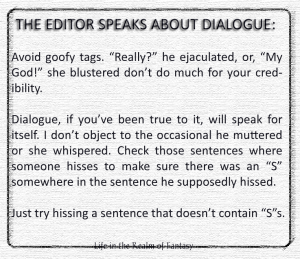
DialogueI’ve mentioned before that I prefer simple attributions such as said, replied, and answered because they are not as likely to stop the reader’s eye. People don’t snort, smirk, smile, or frown dialogue as it is physically impossible. They can say it with a smile, but the smile is a facial expression and does not speak.

Avoid verbal tics like “hmmm…” and “ahhh…” as they just take up space and add fluff to your narrative. When people in real life preface all of their sentences with drawn-out ahs and hmms it can be aggravating to listen to them. Consider how irritating it would be to read it.

Sometimes we have two ideas in a sentence that we think are one, and we connect them with commas.  But closer examination shows they are not.

  • “Hello, sir, we bathed your dog,” she said.

The above dialogue contains a run-on sentence, despite its shortness. We may actually speak it in this fashion, words run together, but for a reader, punctuation clarifies ideas.

The dialogue contains two separate ideas. “Hello, sir,” is an acknowledgment and a greeting. “We bathed your dog,” indicates an action was taken in regard to his dog. It should be:

  • “Hello, sir. We bathed your dog,” she said.
  • When we write our conversation using proper punctuation, it looks natural, and the reader will hear it the way it was intended.

When it’s done right, dialogue is, in my opinion, the best part of the story. It’s where we discover who the characters are, and how the larger events affect them. Conversations show the world as the protagonist sees it. We can take some style and voice liberties with dialogue, and indeed, we should, but adhering to industry standard rules of punctuation ensures your reader can remain immersed in the story, and forget they are reading.

And THAT is what we all hope for.

21 Comments

Filed under Literature, writer, writing

#amwriting: Our shifting language

English is the third most widely spoken native language in the world (behind Mandarin Chinese and Spanish). It is the first language of four countries and is spoken by more than 400 million people, with five major dialects and distinct accents:

  • Countries where English is spoken natively by the majority of the populationBritish English
  • North American English
  • Australian English
  • New Zealand English
  • South African English

An American girl from a rural corner of the US can understand a girl from New Zealand fairly well, and after they adjust to the differences in their accents, they can chat freely.

Many other countries use English as their official language. According to Google, fifteen more countries have their own native language, but use English as an “Official Language and the Language of Instruction in Higher Education”:

Anguilla Ireland, Northern Singapore
Antigua and Barbuda Ireland, Republic of Solomon Islands
Australia Jamaica South Africa
Bahamas Kenya Swaziland
Barbados Lesotho Tanzania


According to Wikipedia, the Fount of All Knowledge: “Estimates that include second language speakers vary greatly, from 470 million to more than 1 billion. David Crystal calculates that non-native speakers as of 2003 outnumbered native speakers by a ratio of 3 to 1. When combining native and non-native speakers, English is the most widely spoken language worldwide.

All English speaking people can communicate through writing, and while they might not be able to understand each other well in person, they can easily communicate via the written word.

In medieval times, the lingua franca was Latin. Lingua Franca means a language that is adopted as a common language between speakers whose native languages are different. An historical example of how people can communicate using a lingua franca in writing and still be unable to understand each other when speaking it: Richard the Lionhearted spoke langue d’oïl, a French dialect, and lenga d’òc, a Romance language, and his wife, Berengaria of Navarre, spoke Navarro-Aragonese, a Spanish dialect.

During the political negotiations arranging their marriage, Richard and Berengaria communicated via letters composed and written in Latin, as neither one spoke the other’s native language. However, when they met, even though they were both speaking Latin, their accents made it nearly impossible for them to understand each other until they became used to the other’s pronunciations.

That bit of historical trivia brings us back to the modern day lingua franca: English. With so many people speaking it, new usages come into play and spread through the speaking community, and the language shifts. Sometimes it shifts more rapidly than I can keep up with.

This blending and shifting of the common usage demonstrate what happened to Latin. Latin is frequently referred to as a dead language, but it is not. Latin is actively spoken in the modern Romance languages. (Romance referring to Roman, not love.)

The five most widely spoken Romance languages by number of native speakers are:

  • Spanish (410 million)
  • Portuguese (216 million)
  • French (75 million)
  • Italian (60 million)
  • Romanian (25 million)

Latin also appears in and strongly influences our Germanic, Frisian-based English, through our Norman ancestry—after all, our great Norman kings and queens spoke Medieval French: langues d’oïl, which itself was a mingling of Gallic and Roman based languages.

The Normans came to Britain speaking French, and their children remained, speaking a blend of Anglo-Saxon-French: Old English.

270px-Rosetta_StoneAll spoken language evolves. Only languages whose sole known records are actually engraved in stone, such as Egyptian Hieroglyphics and Ancient Sumerian, are unchanging.

English is continually evolving in more than just the obvious way of snappy catch-phrases and new technology. It is evolving in its formal usage

Consider the word whilst. As conjunctions go, the words whilst and while are technically interchangeable in meaning, but whilst has become less common in standard American English. If whilst appears in an American genre fiction book, it’s an eye-stopper, awkward and old-fashioned, more suited to classical poems and literary prose. Therefore, an American author may not use whilst, but a British author might.

Yet, despite its having fallen out of fashion in the US, we all understand the word whilst when we see it written and when we hear it.

At some point, everything we write in our modern language will be as unintelligible to those who speak the future modern English as Geoffrey Chaucer’s work is to the contemporary eye and ear today:

chaucer modern translate wife of bath meme

It is clear that the eye of the translator and his perception can greatly influence the modern translation of the work. I disagree with the use of the word “Ruled” in the second line, as the intent of “Were” in this case is clearly “was.” In the common usage of the day, “were” was interchangeable with “was.” Had I been in the same program as the above translator, we would have argued over this point.

I’d have translated it as:

Experience, though no authority,

Was in this world  enough for me

To speak of the woe that is marriage.

For, Lordings, since I was twelve years of age,

Thanks be to God eternally alive!

Husbands at the church door, I have had five.

We can only see the works of our great literary giants through the lens of time, filtered through our own wishes and interpretations. And this is how our greatest works, those which do survive into the next millennium, will be seen and interpreted.

Title page of Geoffrey Chaucer’s Canterbury Tales in the hand of his personal scribe Adam Pinkhurst, c. 1400Perhaps our published work will remain a part of the public record as it is today, and be available for students of “classic” literature to interpret. Or perhaps our works will be forgotten, lodged in the dusty vaults of Bowkers, only rarely resurfacing, having been ironically relegated to the dark corners of scholastic research on obscure texts in forgotten languages.

Soon-to-be forgotten or not, I am writing for today, and writing for a contemporary reader. My usages will evolve over the life of my writing career–I ‘ve already seen this evolution at work. That is the process of growth, and it’s clear how my early works differ from my more recent work.

Growth and change drives and forms the new canon of 21st century world literature. We are all a part of its birth, whether we are readers or authors. Readers choose the works they buy and those works are written by people who chose to record the thoughts, values, and misdeeds of their contemporary society in story form.

I am so blessed to be both a reader and an author.

3 Comments

Filed under Literature, writing

#amreading: The Well at World’s End, William Morris

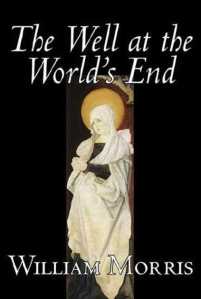
TheWellattheWorldsEnd423x630First published in 1896, and now in the public domain, The Well at World’s End by William Morris has inspired countless great fantasy authors. J.R.R. Tolkien and C.S. Lewis were students at Oxford when they became devotees of Morris’s work, to name just two. I first read this book in college (back in the dark ages) when Ballantine released it as a two-volume set. The original Ballantine covers are below, at the end of this post.

This fairly unknown literary treasure is available for free, as a download for your Kindle or any other reading device. I got my Kindle version through the Gutenberg Project on Google–and it reminded me of what my true roots as a reader of fantasy are. Give me the beautiful prose, the side-quests to nowhere, and wrap them in an illusion of magic, and I’m yours forever.

First, The Blurb:

The rich, interwoven tapestry of William Morris’s four-volume epic, “The Well at the World’s End”, is brought together in a handsome edition featuring the tale of Ralph of Upmeads. Literally and figuratively, this story is the wellspring that gave rise to both C.S. Lewis’ “Chronicles of Narnia”, and J.R.R. Tolkien’s “The Hobbit” and “Lord of the Rings”. Many elements of the story will be familiar to those who love these and other modern narratives of fantasy and adventure, set in a mythical world.

Ralph of Upmeads is the fourth and youngest son of the king of a small monarchy, and the only one forbidden of his elder brothers from going in search of his fortune. He runs away, but not before his godmother gives him a necklace with a bead on it, which unerringly directs his destiny to seek out the legendary and titular well at the end of the earth. Along the way, he encounters friends and foes in an ever-changing landscape of rolling hills and barren wood, towering mountains and meandering rivers. Through them all pass roads down which many heroes since have sojourned; united in fellowship, or alone on solitary quests.

Great and splendorous cities await, and in between, thriving towns, tiny villages, and protective farms at the edge of vast wildernesses. The further our intrepid wayfarer gets from home, the more he misses the simple pleasures of his hearth, table, and bed. Many have followed in his footsteps since, both character and reader alike.

Its language is that of another age, but its archetypical settings and denizens are the timeless stuff of once and future legend.

William_Morris_-_Project_Gutenberg_eText_13619

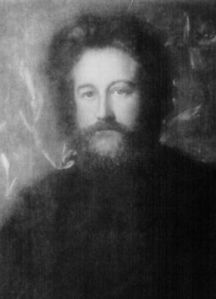
Portrait of William Morris by George Frederic Watts, 1870

My Review:

William Morris wrote beautifully crafted poems. The prose in this narrative is both medieval and sumptuous. He was born in 1834 and died in 1896. He was an important figure in the emergence of socialism in Britain, founding the Socialist League in 1884, but breaking with that organization over goals and methods by the end of the decade. Famous as a designer of textiles and wallpaper prints that made the Arts and Crafts style famous, Morris devoted much of the rest of his life to the Kelmscott Press, which he founded in 1891. Kelmscott was devoted to the publishing of limited-edition, illuminated-style print books. The 1896 Kelmscott edition of the Works of Geoffrey Chaucer is considered a masterpiece of book design.

The Well at World’s End is a real departure for the literature of the Victorian era, in that the morality is indicative of the free-thinking bohemian lifestyle of the famous and infamous artists of the day. William Morris was a member of the Pre-Raphaelite Brotherhood and was a man who enjoyed an unconventional lifestyle in the company of like-minded people, with few permanent ties, all of them celebrating musical, artistic, and literary pursuits.

Using language with elements of the medieval tales written by Chaucer and Chrétien de Troyes, who were his models, Morris tells the story of Ralph of Upmeads, the fourth and youngest son of a minor king. The king is wise and his kingdom prosperous, but nevertheless his four sons are not content. The three older brothers set out, with their father’s blessing. Ralph is still young, and his father wishes him to remain at his side.

Not happy with his lot, Ralph departs without his father’s blessing. He yearns to find knightly adventure and is encouraged by a lady, Dame Katharine, to seek the Well at the World’s End, a magic well which will confer a near-immortality and strengthened destiny on those who drink from it. The Dame is childless, and sees Ralph as a son; she gives him a necklace of blue and green stones with a small box of gold tied on to it, telling him to let no man take it from him, as it will be his salvation. She also gives him money for his journey.

The well lies at the edge of the sea beyond a wall of mountains called “The Wall of the World” by those on the near side of them but “The Wall of Strife” by the more peaceful and egalitarian people who live on the seaward side.

Ralph meets a mysterious Lady of the Dry Tree, the Lady of Abundance who has drunk from the well, and they become lovers. Together and separately, they face many foes and dangers including brigands, slave traders, unscrupulous rulers and treacherous fellow travelers. The lady is murdered, leaving Ralph bereft. Later, Ralph meets another lady, Ursula, and with her help and the aid of the Sage of Sweveham, an ancient hermit who has also drunk of the well, Ralph eventually attains the Well, after many more adventures.

Because the main character, Ralph, and a nameless lady become lovers with no thought of marriage, the novel was not well known in its time, until twenty years after Morris’s death when it was discovered by free-thinking university students, to the dismay of their strait-laced parents.

The underlying story is strong, with many twists and turns. The relationship between the Ralph and the Lady of Abundance is well portrayed, as is the jealousy of her former lover, the death of her husband, and the way she is either loved or feared by everyone around her driving the plot forward. She is a woman of mystery, alternately cruel and kind, one minute the Lady of the Dry Tree, and the next, the Lady of Abundance.

Ralph’s story really begins after her death and the intertwined threads of fate and magic are compelling. The characters Ursula and the Sage of Sweveham are both deep and well-drawn.

I freely confess that in the same way as the works of William Shakespeare are hard for a modern reader to translate, the language of William Morris’s work is difficult to follow. A quote will show you what I mean: “But Ralph gave forth a great wail of woe, and ran forward and knelt by the Lady, who lay all huddled up face down upon the grass, and he lifted her up and laid her gently on her back. The blood was flowing fast from a great wound in her breast, and he tore off a piece of his shirt to staunch it, but she without knowledge of him breathed forth her last breath ere he could touch the hurt, and he still knelt by her, staring on her as if he knew not what was toward.”

When you read it aloud, it rolls off the tongue with beauty and grace and is somehow easier to understand.

I was always intrigued by the works of the medieval and renaissance authors whose works I had to work to translate into modern English. Once translated, reading it was like opening a time capsule. It was a window into a lost world of romance and mystery.

The Well at the Worlds End is a foundational work in the canon of modern fantasy literature. All the great works of the twentieth century have some roots in this novel. The hard-core devotee of true fantasy literature will not be intimidated by the archaic prose. A wealth of tales lies within this volume, all of which come together in the end.

The_Well_at_the_Worlds_End_1-2


Parts of this review were originally published  on 31-Jan-2014 on Best in Fantasy

5 Comments

Filed under Books, Fairies, Fantasy

#amwriting: Couriers, Pigeons, and Excalibur

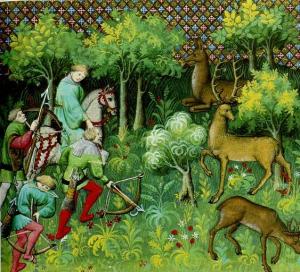
Medieval_forest wikimedia commons PD 100 yrs

Russian Forest in medieval France (1405-1410) Gaston Phoebus

I have a great deal of interest in Medieval history because I have ancestors who lived then. I’m not bragging–everyone who is alive today is here because one or two ancestors survived the Dark Ages long enough to leave behind a child who did the same.

Life was perilous, even if you grew up in a fairly sheltered environment. No one was exempt from disease–even kings regularly died young from plagues and injuries. Regardless of their personal safety, medieval kings were forced to go to war in person. They did this for several reasons.

  1. The only way for the monarch to know what was actually happening on the battlefront was to be there
  2. It was expected that a monarch should understand the art of warfare and be proficient as a warrior. He was responsible for winning or losing the battle.
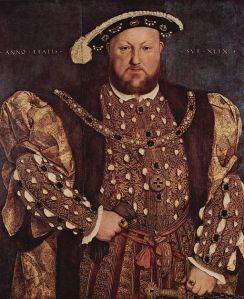
Portrait of Henry VIII (1491-1547) by Hans HolbeinDuring the Dark Ages, official news was delivered by a royal messenger and read aloud in church or in the market.

Messengers were a permanent fixture on the royal payroll. They were dedicated and well-paid to travel the kingdom continuously, carrying the king’s word. In medieval England, kings did not stay in London. Instead, they traveled all over their lands and the noble families were required to feed and house them at great expense. Their gypsy-like existence kept the messengers busy.

Wars were expensive. Henry VIII’s habit of medieval couch-surfing at the country homes of his noble courtiers was a great way for an impoverished king and his entourage to live well and cheaply, conserving the cash to pay for the troops. But it also meant that an organized and efficient messenger service was required to ensure that correspondence to and from the king: royal letters, grants, patents, and such, arrived at their intended destinations.
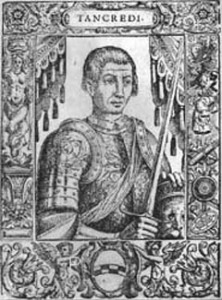
Tancred, Count of Lecce, King of Sicily via Wikimedia

Tancred, Count of Lecce, King of Sicily via Wikimedia

In the year 1190, when my direct maternal ancestor, Tancred, King of Sicily, faced Richard I of England, he was limited to what information a messenger could convey. Thus, their battles were fought in person and so were their negotiations.

These were not native Italians–the original Tancred of Hauteville (980 – 1041) was an 11th-century Norman and a minor baron of Normandy about whom little is known, other than eight of his twelve sons joined the crusades and became kings of southern Italy in the process.

So his illegitimate great-grandson, King Tancred, and King Richard the Lionhearted were Norman kings, squabbling over what was left of the Holy Land and the Mediterranean at the end of the crusades. However, Tancred was born and raised there so he was a third generation Sicilian, being the out-of-wedlock son of Roger III, the Norman duke of Apulia and Emma of Lecce, who was married to Ruggero III de Hauteville.

Quote from Wikipedia: “In 1190 Richard I of England arrived in Sicily at the head of a large crusading army on its way to the Holy Land. Richard immediately demanded the release of his sister, William II’s wife Joan, imprisoned by Tancred in 1189, along with every penny of her dowry and dower. He also insisted that Tancred fulfill the financial commitments made by William II to the crusade. When Tancred balked at these demands, Richard seized a monastery and the castle of La Bagnara.” (end quoted text)
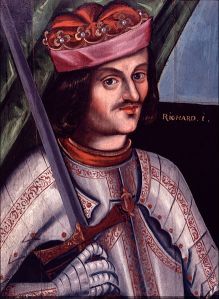
Richard I Google Art Project via Wikimedia

Richard I Google Art Project via Wikimedia

Richard was joined in Sicily by the French crusading army, led by his soon-to-be-former friend,  King Philip II of France. The presence of two foreign armies highly aggravated the local citizens who, rightfully, demanded the foreigners leave their island.

Ever the good guest, King Richard responded by attacking Messina, which he captured on 4 October 1190. Once the city had been looted and burned, Richard established his base there and decided to stay the winter—after all, winters in Sicily are a bit more pleasant than those in Normandy.

But what’s a little looting and pillaging among friends? According to Wikipedia:

“Richard remained at Messina until March 1191, when Tancred finally agreed to a treaty. According to the treaty’s main terms:

  • Joan was to be released, receiving her dower along with the dowry.
  • Richard and Philip recognized Tancred as King of Sicily and vowed to keep the peace between all three of their kingdoms.
  • Richard officially proclaimed his nephew Arthur of Brittany as his heir presumptive, and Tancred promised to marry one of his daughters to Arthur when he came of age (Arthur was four years old at the time).
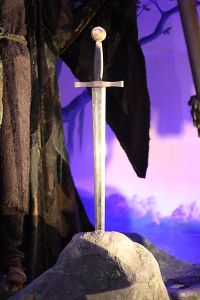
Excalibur London_Film_Museum_ via Wikipedia

Excalibur London Film Museum via Wikipedia

After signing the treaty, Richard and Philip finally left Sicily for the Holy Land. It is rumored that before he left, Richard gave Tancred a sword he claimed was Excalibur in order to secure their friendship.”

Yes, you read this correctly. King Richard the Lionhearted gave my many-times great grandfather Excalibur, the legendary sword of mythical King Arthur.

I doubt Richard the Lionhearted would really give away a sword that was supposed to prove his lineage back to the Pendragon if he actually believed it was truly Arthur’s. However, it is a documented fact that he did indeed give this sword of historical significance to Tancred.

I suspect that Tancred believed it was the true sword of King Arthur as much as I do, but in the interest of peace, he most likely smiled and thanked his departing guest. Whatever he did with it, it was never seen again. When he came to reclaim his island after Tancred’s death, Henry IV, king of the Holy Roman Empire, pillaged Tancred’s treasury and the sword was not there.

But what, you ask, does my illegitimate many-times-great grandfather’s possession of the possibly faux Excalibur have to do with communication?

Tancred and Richard both had to be there in Sicily in person and had to communicate through messengers to arrange all this swapping of women and dowries and swords of dubious origin.

Good long-distance communication has always been seen as critical to good governing. Wars were won and lost based on the information those kings and generals received. During the Middle Ages, postal systems were invented, became corrupt, and fell into disuse all over Europe. This recurred at different times up through the eighteenth century.

In 1505, Emperor Maximilian I established one of the more stable postal systems, but it was not a thing the peasant class could avail themselves of. An illiterate peasant could hire a scribe, but then they would also have to scrape up more coins to get the note sent to its destination. It was better to pay a neighbor to carry the news to wherever it had to go.
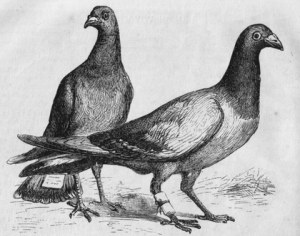
420px-Pigeon_Messengers_(Harper's_Engraving)There was a faster method of getting a letter home. Long before the Middle Ages and during them, homing pigeons were used to carry messages. Rock pigeons have the ability that taken far from their nest, they’re able to find their way home. This due to a particularly developed sense of orientation. Messages were then tied around the legs of the pigeon, which was freed and could reach its original nest.

This is of limited usefulness because pigeons will only go back to the one place that they have identified as their home. Pigeon mail can only work when the sender has a specific recipient in mind and has possession of that receiver’s pigeons.

So how did they  do this? The sender had to hand-carry the pigeons with them. Once released, the pigeons would fly back home with the note. Correspondents could not send a pigeon anywhere but the one place the birds considered their home.

If you are an author writing in an era other than the modern times, be diligent and do the research before you write about things that are outside your personal experience. Readers may have knowledge that you don’t and they will definitely not be shy about letting you know where you’ve gone wrong.

Much of my work is set in medieval environments, and so I can’t have my characters getting instantaneous information from afar without divine intervention. If my characters need to communicate over long distances, I have to consider the length of time it would take even a fast messenger to travel over roads we would consider impassable, but which were the medieval equivalent of I-5.

This kind of information is available via the internet.  Researching my subject online is how I discovered that regular mail delivery is a relatively modern invention. Perusing Ancestry.com is how I discovered the medieval Norman/Sicilian roots of my mother’s family, the (Fitz)Rogers family.

4 Comments

Filed under Battles, History, Humor, Literature, writing

#FlashFictionFriday: Laundry Day Blues

Politics and fashion may come and go, but laundry is eternal. I originally wrote this poem in 1996 as a bit of joke-on-me, when I was living in Olympia and working two jobs, one of which was 2-hour commute every day. I had no washing machine. My children and I decided that the $20.00 every two weeks I had budgeted for the laundromat would be better spent on a movie matinee or making a day trip to picnic by the ocean.

Thus, laundry was done in my bathtub and hung on lines to dry. My neighbors thought I was nuts.

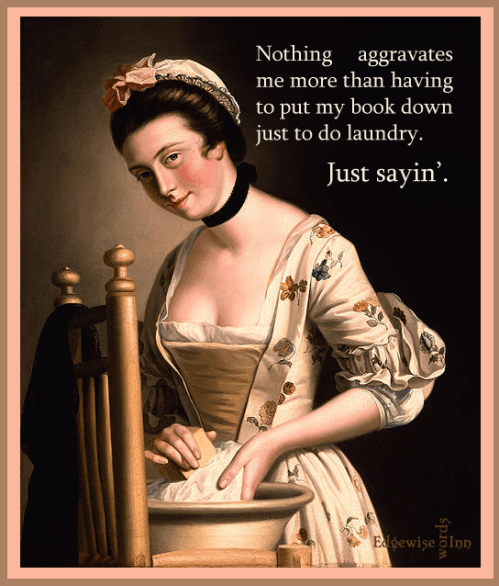
Nowadays I have that miracle of modern technology, the washing machine, and still, I resent being taken from my book just to sort, wash, fold, and put away clothes.

vi edgewise words inn, the laundry meme

LAUNDRY DAY BLUES

I’d love to claim I’m reading

the best book of the year.

I’d love to swear I’ve read it

but laundry day is here.

clothespin tiny

My book rests by the sofa

tempting and serene.

But I’ve a pile of laundry

to somehow sort and clean.

clothespin tiny

The cover art is lovely

with elves and all their kin.

It’s by my favorite author–

would reading be a sin?

clothespin tiny

Alas for me it would be

for socks don’t wash themselves.

When the task is finished.

I’ll run off with my elves.


Laundry Day Blues © Connie J. Jasperson 2016

2 Comments

Filed under #FlashFictionFriday, Fantasy, Humor

#amwriting: World building: Society, and Magic

Today we will examine society and magic, two disparate concepts with one thing in common: both require a solid framework to imagine the story around. In other words, you have to understand them well.

Luca Giordano, Frescoes in the gallery of the Palazzo Medici-Riccardi in Florence, Scene - Justizia ca 1584

Luca Giordano, Frescoes in the gallery of the Palazzo Medici-Riccardi

First let’s discuss religion and society: Who are the movers and shakers?

In all societies, there is a hierarchy of power. Someone is at the top and someone else is at the bottom.

As I create the political power-structure, I find that the opportunities for creating tension within the story also grow. I keep a list of those ideas so that when I run short on creativity I have a bit in the bank, so to speak.

When you are building a world that only exists on paper, you have a microcosm of space in which you can convey the social, religious, and political climate of your story.  You show this in small ways, with casual mentions in conversation when it becomes pertinent, and not through info dumps.

However, in order to convey that information logically and without contradictions, you must have an idea of how things work.

  • Who has the power and privilege in that society, and who is the underclass?
  • How is your society divided? Who has the wealth?
  • Who has the power? Men, women—or is it a society based on mutual respect? Is one race more entitled than another?
  • Who wants power, and what lengths are they willing to go to gain it?
  • What place does religion have in this society? Is it central to the governance of the society, or is it a peripheral, perhaps nonexistent thing?
  • What passes for morality? Is sex before marriage taboo? What constitutes murder and how is it viewed? Remember, you only need to worry about the moral dilemmas that come into your story.
  • If a character goes against society’s unwritten or moral laws what are the consequences?

This creates atmosphere. This is knowledge the characters have but the reader does not. There is no need to have an introductory chapter describing the laws and moral codes of the religious order of Grok, or the political climate of West Berlin in 1961. The way you convey this is to show how these larger societal influences affect your character and his/her ability to resolve their situation.

Consider this story: a woman is separated from her husband by the Berlin Wall.  Every day, on her way to her job, she rides her bicycle past the wall, knowing that on the other side, less than a block away, is her husband. Yet the couple is divided by an impassable barrier. How the wall affects her is shown in her everyday life. In this story, the history of how the wall came into existence isn’t as important as how its presence destroys her family. The wall represents the ideology of those who rule in her divided city, so the reader comes to know the politics of both East and West Berlin by her experiences in trying to cross that barrier.

And now for the magic:

If magic is central to your story, it is critical that you have finite rules for limiting how magic works. If you make your characters too clever, readers won’t be able to relate to their story. 

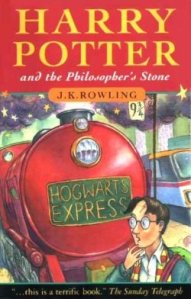
Harry_Potter_and_the_Philosopher's_Stone_Book_CoverWhen magic is part and parcel of a story, rules and limitations create the tension that moves the plot forward. J.K. Rowling’s Harry Potter series is an excellent example of this. No one character has all the power. The two most powerful wizards, Dumbledore and Voldemort, are evenly matched, but neither one is all-powerful. Both wizards want something from Harry. Harry has to work hard to gain his the full use of his abilities.

Harry’s struggle is the story.

  • Who has the magic, and what social power does this give them?
  • What are the limitations of his/her powers?

Each time you make parameters and frameworks for your magic you make opportunities for conflict within your fantasy world. Conflict is what drives the plot.

What challenge does your character have to overcome in regard to his magic?

  • Is he unable to fully use his own abilities?
  • If that is so, why is he hampered in that way?
  • How does that inability affect his companions and how do they feel about it?
  • Are they hampered in anyway themselves?
  • What has to happen before your hero can fully realize his abilities?

Without rules, there would be no conflict, no reason for the hero to struggle, and no story to tell.

Merlin, by Douglas Baulch, Via Wikimedia Commons

Merlin, by Douglas Baulch, Via Wikimedia Commons

I have three worlds with three radically different systems of magic. My serial, Bleakbourne on Heath, is set in a parallel earth that is one shadow away from this one. Bleakbourne, situated on the Heath River, is where the fey and the mortal worlds meet. Leryn, my main character, has many adventures with people who have certain parallels with our history and who are drawn from Arthurian legend, but who are given my own particular twist.

I had to sit down and write out the rules for Merlin’s magic. In Bleakbourne’s world, wizards are born with the latent ability to wield magic, but it is considered a science, and craftsmanship is valued above all else. Skill is what gives a sorcerer power. Certain rituals must be observed.

  • Spells work two ways, and the second way always reverses the first way—this is called symmetry.
  • The words used in spells are of the old, dead, Romani language. Unwords are syllables that have a null meaning and are often inserted for symmetry.
  • All the Romani words with more than one meaning must be chosen carefully because they can be either too short or too long for symmetry. Too long a word will not work at all as you can lengthen, but not shorten them. The sorcerer must choose a shorter word, which requires him/her to insert an extra, closing unword, or the two spells wouldn’t be symmetrical. There are four unwords to choose from, but only three chances to get the spell right

In the Bleakbourne series, the use (and abuse) of magic is the underlying theme.

In creating both social and magic systems, you are creating a hidden framework that will support and advance your plot. Within your magic system, there can be an occasional exception to a rule, but there has to be a damned good reason for it, and it must be clear to the reader why that exception is acceptable.

The only time the reader needs to know these systems exist is when these institutions affect the characters and their actions. Dole this information out in conversations or in other subtle ways and it will become a natural part of the environment rather than an info dump.

1 Comment

Filed under Fantasy, Publishing, writing

#amwriting: world building: maps and the mythology of history

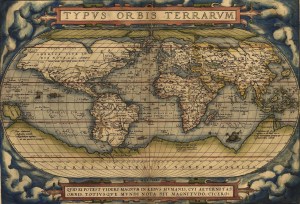
The world Ortelius' Typus Orbis Terrarum, first published 1564

The world Ortelius’ Typus Orbis Terrarum, first published 1564

After years of work on the author’s part, regardless of whether the book is an encyclopedia, a contemporary thriller, a historical fiction, or even a travelogue with photographs, the world that the book details remains untouchable by our human hands. This is because that world only exists between those pages and in the mind’s eye.

The fundamental laws of physics bar us from going back and viewing or experiencing the reality of a historical event as a participant. We can, however, read about it, paint images of it, or make a film depicting what we believe happened during the event. This is where world building comes in.

WWII US Soldiers Marching, image courtesy www.berkeley.edu

WWII US Soldiers Marching, image courtesy http://www.berkeley.edu

But wait, you say. I’m not writing fantasy. I’m writing a story about France, in 1945. I don’t have to build that world–it actually exists.

I’m sorry–the world of France in 1945 is long gone. It no longer exists, except as a memory.

Let’s assume you are writing a historical accounting of the Battle of the Bulge. But, even though it may explore a soldier’s true experiences through newsreels, the pages of his diary, and  the interview you had with him, in reality, the world of this book exists only in three places:

  • it flows from the author’s mind
  • to the pages of the book
  • into the reader’s mind through the written word

Because we can only view history through the stained glass of time, we must accept that it assumes a mythical quality when we attempt to record it. Even a documentary movie that shows events filmed by the news camera may not be portrayed exactly as it was truly experienced. The facts are filtered through the photographer’s eye and the historian’s pen.

Your mind is the medium through which the idea for a novel or story is filtered and words are how it is made real. The key to making both fiction and non-fiction real for the reader is subtle but crucial: worldbuilding. It is worldbuilding that makes a stark accounting of incidents and conversations seem real to the person reading the book.

To build a world out of ideas and words, the author must know it well:

  • Create a stylesheet to avoid contradictions in your work. This is covered in my post, Stylesheets.
  • If your work is set in a contemporary setting, make use of Google Earth. This allows you to see a recent image of the place for yourself, even if you can’t afford to travel there.
  • Go to the internet and find maps of the place in the time your are writing about. If you are writing genre fantasy or speculative fiction of any sort, create a hand-drawn map for your own reference. We will discuss this below.
  • Research/or Create and these systems if they pertain to your work: Political, Social, Religious, and Magic. (We will discuss how to do this simply in my next post.)

If you are writing fantasy you need to know what the world looks like.

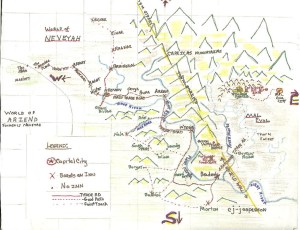
Original Map of Neveyah from 2008 ©cjjasp

Original Map of Neveyah from 2008 ©cjjasp

I love maps. My own maps start out in a rudimentary form, scribbled in pencil on graph paper, just as a way to keep my work straight. They begin looking like the one to the left of this paragraph, and evolve as the first draft of the story evolves.

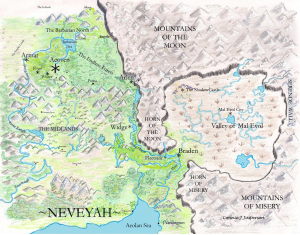
Towns get renamed. They get moved to more logical places. Whole mountain ranges are moved, and forests and savannas appear where they are supposed to be. Over the course of writing the first draft, my world becomes real and the pencil sketch  map will become the digital art you see below.

In my books, people are going hither and yon with great abandon, and if I am not really on top of it, the names of towns will evolve over the course of the novel–Maudy will become Maury (this actually happened) and distances will become too mushy even for me. The map is my indispensable tool for keeping my story straight.

Map of Neveyah, for RizAero

Map of Neveyah 2015 ©cjjasp

When your characters are traveling great distances, they may pass through villages on their way, and if these places figure in the events of the book, they should be noted on the map. This prevents you from:

  • accidentally naming a second village the same name later in the manuscript
  • misspelling the town’s name later in the narrative
  • forgetting where the characters were in chapter four

Perhaps certain things will impede your characters. If they are pertinent to the story, you will want to note their location of on your map so that you don’t contradict yourself if your party must return the way they came:

  • Rivers
  • swamps
  • mountains
  • hills
  • towns
  • forests
  • oceans

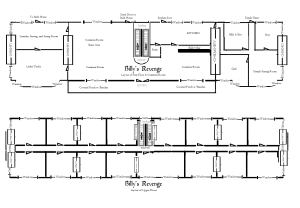
Billy's Revenge Floor plan ground floorIf your work is in sci-fi, consider making a rudimentary star-chart, if space-travel is a part of your tale. For Sci-fi, you might want to know:

  • the name of the star or stars if the system is binary/trinary
  • number of planets, their names and positions
  • which planet the story takes place on
  • moons and asteroid belts that may be relevant to the tale
  • map of the area on the planet your story takes place or
  • map of space station/ship if the story takes place in space

In the narrative, if you are writing fantasy, I suggest you keep the actual distances mushy because some readers will  nitpick the details, no matter how accurate you are. Yes, you wrote it, but they don’t see it the way you do. This is because their perception of a league may be three miles while yours might be one and a half. Despite the fact that a league has no finite length and is whatever the author decides it is, some readers feel their opinion is of such worth that they will never back down. They will become so annoyed by this that they will give your book a three-star review, simply because they disagree with the length of time your character took to travel a certain distance. 

From Wikipedia, the fount of all knowledge: “A league is a unit of length (or, in various regions, area). It was long common in Europe and Latin America, but it is no longer an official unit in any nation. The word originally meant the distance a person could walk in an hour.[1] Since the Middle Ages, many values have been specified in several countries.”

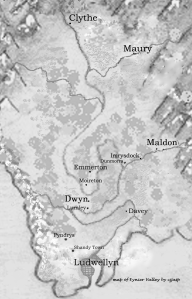
Map of Eynier Valley for 'Huw the Bard, ' ©cjjasp 2014

Map of Eynier Valley for ‘Huw the Bard, ‘ ©cjjasp 2014

Therefore, a league is what you say it is, within some loose parameters. I go with the distance you can walk in an hour, but you have to take into consideration the terrain.

Huw the Bard takes two months to travel between Ludwellyn and Clythe. In his story, Huw Owyn is walking through fields, woods, and along a several winding rivers for the first half of  his journey. He has to backtrack as frequently as he goes forward in order to sneak around those who would kill him. It’s only safe for him to walk on the main road once he makes it to Maury, weeks after fleeing Ludwellyn.

It is a stretch of road that he could have done in two weeks if he had been able to stay on the main road, and if he hadn’t had to do so much backtracking. But that inability to make progress creates opportunities for tension.

Readers love to see maps in the front of books, but you don’t have to put yours there if you don’t like your own handiwork. This map can be only for your purposes, so you will know in a concrete way where every town and village is in relation to your story.

Fantasy readers like maps. If you choose not to include your map in the finished product, consider hiring an artist to make your map from your notes. Because I am an artist, my pencil-drawn map always evolves into artwork for the book.

Every book, fiction or non-fiction, takes an idea, translates it into words, and dares the reader to believe it. It is our job as authors to take what is intangible and make it seem real to the reader who is experiencing the world and a moment in history through our writing.

11 Comments

Filed under Fantasy, writing

The Lake Isle of Innisfree, by W.B. Yeats

Skagit River Mist/PFly CC-BY-SA-2.0

THE LAKE ISLE OF INNISFREE

W.B. Yeats

I will arise and go now, and go to Innisfree,

And a small cabin build there, of clay and wattles made;

Nine bean-rows will I have there, a hive for the honey-bee,

And live alone in the bee-loud glade.


And I shall have some peace there, for peace comes dropping slow,

Dropping from the veils of the morning to where the cricket sings;

There midnight’s all a glimmer, and noon a purple glow,

And evening full of the linnet’s wings.


I will arise and go now, for always night and day

I hear lake water lapping with low sounds by the shore;

While I stand on the roadway, or on the pavements grey,

I hear it in the deep heart’s core.


William Butler Yeats (1865-1939), Nobel Prize winning Irish dramatist, author and poet.

The poetry of WB Yeats occupies a large place in my heart and is one of my favorite sources of inspiration.  In his early years, Yeat’s was not afraid to write of faeries and mystical things that fired my childish imagination. Later, as he grew as both a writer and as a person, he also wrote wonderful works that were more firmly rooted in reality. The Lake Isle of Innisfree was published in 1890.

3 Comments

Filed under #FlashFictionFriday, Fantasy, Poetry

#amwriting: the author’s voice

The sense of style steven pinkerAnyone who is a member of a writing group is regularly beaten over the head with certain basically good, but occasionally clichéd, rules. Improperly applied, this mindless interpretation of proper grammatic style can inhibit an author’s growth.

These rules are fundamentally sound, but cannot be rigidly applied across the board to every sentence, just “because it says so in Strunk and White.” I rely on the Chicago Manual of Style, but I also understand common sense.

English is a living language. As such it is in a continual state of evolution and phrasing that made sense one-hundred years ago may not work well in today’s English.

We may be writing a period piece, but we are writing it for modern readers.

You can split an infinitive: it is acceptable to boldly go where you will.

You can begin a sentence with a conjunction if you so choose. And no one will die if you do.

Stephen Pinker discusses many rules in his controversial book, The Sense of Style, and finds that some of them no longer make sense.

For example, Pinker points out that “The prohibition against clause-final prepositions is considered a superstition even by the language mavens, and it persists only among know-it-alls who have never opened a dictionary or style manual to check.” 

He notes that rigidly following “the rules” would have you doing silly things like turning “What are you looking at?” into “At what are you looking?”  I don’t know about you, but for me the first example is preferable.

In the example, the word at is a preposition, and placing it after looking makes it a clause-final preposition.  Such a construct is technically a no-no, but I suggest you break that rule.

Stardust, Neil GaimanWe are constantly told that we need to make our verbs active, rather than relying on passive constructions, and for the most part, this is true. But Pinker reminds us that “The passive is a voice and not a tense.” There are times when the use of passive phrasing is appropriate.

Consider the difference between ‘the cat scratched the child’ and ‘the child was scratched by the cat.’  The second sentence is written in the passive voice, and in this context the active voice is the one I would choose because it is simpler and less fluffy.

Pinker agrees with me that there are contexts in which the passive is preferable. Quote from The Sense of Style: “Linguistic research has shown that the passive construction has a number of indispensable functions because of the way it engages a reader’s attention and memory.”

And in writing, context is everything. 

For most genre work, editors push for active voice, but truthfully, mainstream fiction and literary fiction can use the passive voice and still sell boatloads of books. Some of the most beautiful prose out there in genre fantasy mixes passive voice in with the active, and when done right  it is immersive.

name of the wind -patrick rothfussPatrick Rothfuss’s Name of the Wind is one example, and Neil Gaiman’s Stardust is another.

These books are best sellers because both Rothfuss and Gaiman understand how to craft prose that mingles passive and active phrasings, drawing us into their work. They choose when to use passive phrasing, and apply it appropriately so the narrative is a seamless blend of properly constructed sentences chosen to reflect their distinct voices.

The modern prohibition against passive phrasing exists for a reason: improperly and excessively used, the passive voice can weaken your narrative.

Knowledge of grammar and sentence construction is critical if you are an author: Sloppy grammar habits show that your work is badly crafted.

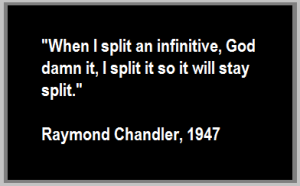
Your voice is the way you habitually phrase things despite your vast knowledge of how grammar is correctly used. Take a look at the great authors: Raymond Chandler, Ernest Hemingway, F.Scott Fitzgerald, and James Joyce: these authors each had such a distinctive voice that when you read a passage of their work, you knew immediately who you were reading.

They ALL broke the rules in their work and were famous for doing so.

Raymond chandler quote split infinitivesHowever, they understood the rules they were breaking and broke them deliberately and selectively in the crafting of their narrative.

Imagine a story set in an expensive restaurant. This story revolves around a marriage that is disintegrating. The couple, Jack and Diane, dine in silence. The food is important, but only because of what it represents. How do you convey this?

The steak was well-prepared and melted in Jack’s mouth. Nevertheless, Diane wielded her knife like a surgeon, cutting her meat into tiny, uniform chunks, chewing each bite slowly before swallowing. Jack imagined her carving his heart similarly, chewing it carefully and then spitting it out.

800px-Night_Sky_Stars_Trees_Quote“The steak was well-prepared and melted in Jack’s mouth” is written with a passive voice, and that is okay. The important thing is Jack’s observation of Diane and her mad knife skills. You don’t need to say “The chef had prepared the steak perfectly.” Unless he is having an affair with Jack or Diane, the chef who prepared the tender steak is not important and doesn’t need to be mentioned.

Steven Pinker has some words of wisdom for would-be editors: “It’s very easy to overstate rules. And if you don’t explain what the basis is behind the rule, you’re going to botch the statement of the rule—and give bad advice.”

Knowing what the rule is and why it exists allows you to choose to break it if that is your desire.

Writing style is a combination of so many things. It is how you speak through your pen or keyboard. Craft your prose with an eye to what is important to your story, and say it with your voice. With that said, your voice should not be so distinct and loud that it makes your prose obnoxious. A good editor will understand the difference and guide you away from bad writing, helping you find your voice in such a way that your work will be a joy to read.

8 Comments

Filed under Fantasy, Publishing, writing