Category Archives: #FineArtFriday

#FineArtFriday: African Violet Skies by Clark Thomas Carlton

African_Violet_Skies_by_Clark_Thomas_CarltonTITLE: African Violet Skies

BY: Clark Thomas Carlton

MEDIUM: Acrylics on canvas

DATE: ca. 2016

What I love about this painting:

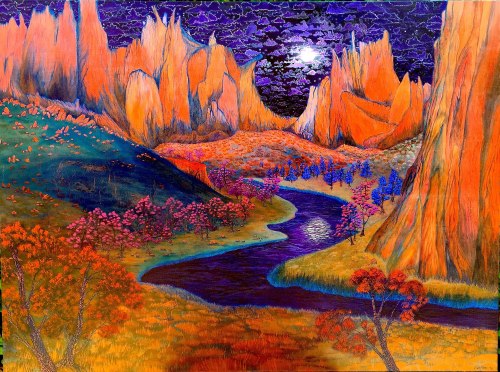
Today we’re dipping into 21st century fantasy landscape art. African Violet Skies by Clark Thomas Carlton is an explosion of color and form. The colors are so intense, I feel as if I could taste them.

I love how delicate the trees and foliage are as compared to the fierce thrust of the landscape. The mountains seem to burst through the earth at high speed, reaching for the incredible night sky, as if they would touch the moon.

This is true mastery of storytelling in an image as well as form and color. He gives us drama, and romance, and violence, and above it all, the moon softly gliding behind the delicate clouds, reflected on the serene stream below.

This painting is exactly what I need after four days of thick fog that refused to lift, followed by eternal rain.

About the Artist, via Wikipedia, the free encyclopedia

Clark Thomas Carlton is a novelist, playwright, and a screen and television writer living in Los Angeles. He has also worked as a producer of reality television. Carlton is best known for his science fiction/fantasy novel Prophets of the Ghost Ants published by HarperCollins Voyager in 2016.

Carlton is the author of Prophets of the Ghost Ants, Book 1 of the Antasy Series published by HarperCollins Voyage on December 13, 2016.  The indie version of the book was named a Best of 2011 by Kirkus Reviews.

In 1997, Carlton was awarded the Drama-Logue Critics Award for his play Self Help or the Tower of Psychobabble along with playwrights Neil Simon and Henry Ong. The play, a satire of the psychotherapy industry, was performed in Santa Monica, Palm Springs, Los Angeles and West Hollywood and directed by Michael Kearns and was also produced in Chicago.

Carlton is a painter who embraces the description of his work as “Grandma Moses on acid”. His work has been displayed through the Palm Springs Art Museum Annex through the Palm Springs Arts Council.

In December 1999, Carlton released an album of songs titled Salt Water through CD baby where he accompanied himself on acoustic guitar.  At present he is at work on Gardens of Babylon, a synth pop opera about the building of the Hanging Gardens of Babylon. The opera was written with his partner, Mike Dobson, an Emmy award winning music supervisor and composer on the daytime drama, the Young and the Restless. [1]


Credits and Attributions:

IMAGE: African Violet Skies by Clark Thomas Carlton. Wikimedia Commons contributors, “File:African Violet Skies by Clark Thomas Carlton.jpg,” Wikimedia Commons, https://commons.wikimedia.org/w/index.php?title=File:African_Violet_Skies_by_Clark_Thomas_Carlton.jpg&oldid=785979611 (accessed November 30, 2023).

[1] Wikipedia contributors, “Clark Thomas Carlton,” Wikipedia, The Free Encyclopedia, https://en.wikipedia.org/w/index.php?title=Clark_Thomas_Carlton&oldid=1171925222 (accessed November 30, 2023).
1 Comment

Filed under #FineArtFriday

#FineArtFriday: Peasant Wedding, David Teniers II (revisited)

Today is the day after Thanksgiving here in the US. Many people are out doing their Christmas shopping or looking for Black Friday bargains.

But not my husband and me. We will rest up, enjoy leftovers, and visit the storage unit to pick up our bin full of Christmas decorations. Maybe we’ll decorate the balcony, offer a little cheer to the neighbors across the way.

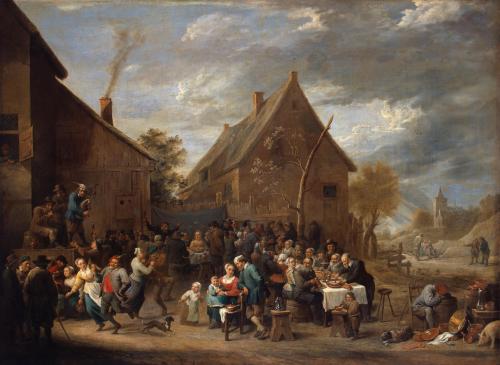
I love today’s painting, and yesterday’s family gathering made me think of revisiting it. The Peasant Wedding by the Flemish painter, print maker, David Teniers the Younger, is full of movement and life, and shows real people having a great party, not unlike we do in our modern world.

The musicians are playing, some people are singing, some are talking, and some are dancing. Most are eating and just enjoying themselves. A few of the men are becoming a little familiar with the ladies, who are not really having any of that, thank you. A few people have indulged a little too much.

Even the dog is having a good time.

Teniers was a prolific and skilled artist, a man remembered today as much for his lofty social ambitions as he is for the quantity and excellence of his work. He wanted to be a nobleman; indeed he once falsely laid claim to being descended from a noble line. Several times he nearly succeeded in this ambition, but nobility was one accolade he never achieved.

This world can be a hard place for some people to live. I am fortunate to be safe and well-fed, luxuries I thank God for every day. Wherever you are in this big world, I hope you have plenty to give thanks for.

About David Teniers II, from Wikipedia:

Teniers married into the famous Brueghel artist family when Anna Brueghel, daughter of Jan Brueghel the Elder, became his wife on 22 July 1637. Rubens, who had been the guardian of Anna Brueghel after her father’s death, was a witness at the wedding.

Through his marriage Teniers was able to cement a close relationship with Rubens who had been a good friend and frequent collaborator with his wife’s father. This is borne out by the fact that at the baptism of the first of the couple’s seven children David Teniers III, Rubens’ second wife, Hélène Fourment was the godmother.

Teniers’ wife died on 11 May 1656. On 21 October of the same year the artist remarried. His second wife was Isabella de Fren, the 32-year-old daughter of Andries de Fren, secretary of the Council of Brabant. It has been suggested that Teniers’ main motive for marrying the ‘spinster’ was her rather elevated position in society. His second wife also brought him a large dowry. The couple had four children, two sons and two daughters. His second wife’s attitude to Teniers’ children from his first marriage would later divide the family in legal battles.

At the behest of his Antwerp colleagues of the Guild of Saint Luke, Teniers became the driving force behind the foundation of the Academy in Antwerp, only the second of such type of institution in Europe after the one in Paris. The artist used his connections and sent his son David to Madrid to assist in the negotiation to successfully obtain the required licence from the Spanish King. There were great celebrations in Antwerp when, on 26 January 1663, Teniers came from Brussels with the royal charter creating the Antwerp Royal Academy of Fine Arts, the existence of which was due entirely to his persistence.

Teniers petitioned the king of Spain to be admitted to the aristocracy but gave up when the condition imposed was that he should give up painting for money.

He was an innovator in a wide range of genres such as history, genre, landscapeportrait and still life. He is now best remembered as the leading Flemish genre painter of his day


Credits and Attributions:

Wikimedia Commons contributors, “File:David Teniers de Jonge – Peasant Wedding (1650).jpg,” Wikimedia Commons, the free media repository, https://commons.wikimedia.org/w/index.php?title=File:David_Teniers_de_Jonge_-_Peasant_Wedding_(1650).jpg&oldid=225700063 (accessed November 2, 2018).

Wikipedia contributors, “David Teniers the Younger,” Wikipedia, The Free Encyclopedia, https://en.wikipedia.org/w/index.php?title=David_Teniers_the_Younger&oldid=858638339 (accessed November 2, 2018).

1 Comment

Filed under #FineArtFriday

#FineArtFriday: Two Watermills and an Open Sluice by Jacob van Ruisdael 1653

Jacob_Isaacksz._van_Ruisdael_-_Two_Watermills_and_an_Open_Sluice_-_WGA20479Artist: Jacob van Ruisdael  (1628/1629–1682)
Title: Two Watermills and an Open Sluice

Genre: landscape art

Date: 1653

Medium: oil on canvas

Dimensions: height: 664 mm (26.1 in)

Collection: Getty Center

What I Love about this painting:

This painting is the perfect writing prompt. Peaceful and serene, the scene shows us two watermills opposite each other on the stream, sharing the power of the water. These mills were examples of the highest technology of that time, and the families who owned them were prosperous middle-class people. Very likely they were literate, well-respected members of the local community.

Were these mills owned by the same family?

Or were they owned by rivals, competing to grind the grain produced by the local farmers? Is one a grist mill and the other a lumber mill? Or a weaver’s mill housing looms?

Was there a love story behind their being so close to each other, perhaps a Romeo and Juliet-style romance? (Tragedy averted, of course, or it wouldn’t be a romance.)

This is a wonderful painting, a window into the past.

About the artist, via Wikipedia, the free encyclopedia:

Jacob Isaackszoon van Ruisdael (Dutch pronunciation: [ˈjaːkɔp fɑn ˈrœyzˌdaːl] ; c. 1629 – 10 March 1682) was a Dutch painter, draughtsman, and etcher. He is generally considered the pre-eminent landscape painter of the Dutch Golden Age, a period of great wealth and cultural achievement when Dutch painting became highly popular.

Prolific and versatile, Ruisdael depicted a wide variety of landscape subjects. From 1646 he painted Dutch countryside scenes of remarkable quality for a young man. After a trip to Germany in 1650, his landscapes took on a more heroic character. In his late work, conducted when he lived and worked in Amsterdam, he added city panoramas and seascapes to his regular repertoire. In these, the sky often took up two-thirds of the canvas. In total he produced more than 150 Scandinavian views featuring waterfalls.

Ruisdael’s only registered pupil was Meindert Hobbema, one of several artists who painted figures in his landscapes. Hobbema’s work has at times been confused with Ruisdael’s. Ruisdael always spelt his name thus: Ruisdael, not Ruysdael.

Ruisdael’s work was in demand in the Dutch Republic during his lifetime. Today it is spread across private and institutional collections around the world; the National Gallery in London, the Rijksmuseum in Amsterdam, and the Hermitage Museum in St. Petersburg hold the largest collections. Ruisdael shaped landscape painting traditions worldwide, from the English Romantics to the Barbizon school in France, and the Hudson River School in the US, and influenced generations of Dutch landscape artists. [1]

To read more about this artist, go to Jacob van Ruisdael – Wikipedia

About this painting via Wikipedia, the free encyclopedia:

Two Water Mills with an Open Sluice, also known as Two Watermills and an Open SluiceTwo Undershot Water Mills with an Open Sluice is a 1653 painting by the Dutch Golden Age painter Jacob van Ruisdael. It is in the collection of the Getty Museum in Los Angeles.

The painting shows two working undershot water mills, with the major one being half-timbered with a cob-facade construction, tie beams, and vertical plank gable. This is characteristic of the water mills in the Bentheim area in Germany, to where Ruisdael had travelled in the early 1650s. This painting is one of six known variations on this theme and the only one that is dated.

Although other Western artists had depicted water mills before, Ruisdael was the first to make it the focal subject in a painting. Meindert Hobbema, Ruisdael’s pupil, started working on the water mills subject in the 1660s. Today Hobbema is more strongly associated with water mills than his teacher.

The painting is known by various names. The painting is called Two Water Mills with an Open Sluice in Seymour Slive‘s 2001 catalogue raisonné of Ruisdael, catalogue number 119. In his 2011 book on Ruisdael’s mills and water mills Slive calls it Two Undershot Water Mills with an Open Sluice. The Getty Museum calls it Two Watermills and an Open Sluice on their website, object number 82.PA.18. [2]


Credits and Attributions:

Wikipedia contributors, “Two Water Mills with an Open Sluice,” Wikipedia, The Free Encyclopedia, https://en.wikipedia.org/w/index.php?title=Two_Water_Mills_with_an_Open_Sluice&oldid=1160869306 (accessed November 16, 2023).

[2] Wikipedia contributors, “Jacob van Ruisdael,” Wikipedia, The Free Encyclopedia, https://en.wikipedia.org/w/index.php?title=Jacob_van_Ruisdael&oldid=1181677660 (accessed November 16, 2023).

2 Comments

Filed under #FineArtFriday

#FineArtFriday: Hudson River at Croton Point by Julie Hart Beers 1869

JulieBeers-Hudson_River_at_Croton_Point_1869Artist: Julie Hart Beers  (1834–1913)

Title: Hudson River at Croton Point

Genre: landscape art

Date: 1869

Medium: oil on canvas

Dimensions: height: 12.2 in (31.1 cm); width: 20.2 in (51.4 cm)

What I love about this image:

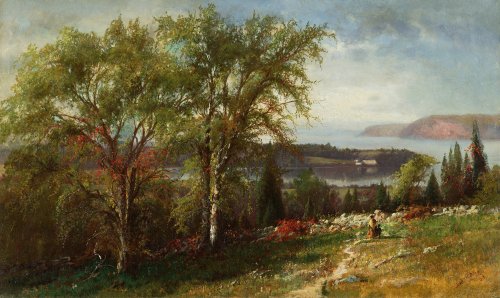
I love the way this scene is framed. We look downhill towards the Hudson River, seeing the rock outcroppings and stony land that is this part of New York State. Julie Hart Beers places a woman and child in this scene, rather than the usual men at work or draft and dairy animals that the male artists of the time usually placed in their work.

The trees at the edge of the meadow, birch and maples, are just beginning to turn red and gold—autumn is nearly here. I love the serenity of this scene, the peace of a day not too long after the end of the Civil War. It was a day of calm during a time when politics were still turbulent.

I love that Julie Hart Beers, a woman artist who was denied formal training solely because she was female, had brothers who gave her the education she needed. I love that they respected her as she made her way in an art world dominated by men jealous of their position, and achieved a grudging respect from the critics.

About the Artist, via Wikipedia:

Julie Hart Beers Kempson (1835 – August 13, 1913) was an American landscape painter associated with the Hudson River School who was one of the very few commercially successful professional women landscape painters of her day.

Born Julie Hart in Pittsfield, Massachusetts, she was the daughter of James Hart and Marion (Robertson) Hart, who had immigrated from Scotland in 1831. Her older brothers William Hart and James McDougal Hart were also important landscape painters of the Hudson River School, and her nieces Letitia Bonnet Hart and Mary Theresa Hart became well-known painters as well. Another niece, Annie L. Y. Orff, became an editor and publisher.

In 1853, she married journalist George Washington Beers. After his death in 1856 she and her two daughters moved to New York City, where her brothers had their studios. Like most women artists of the day, she had no formal art education, but it is thought that she was trained by her brothers.

Well into her forties, with her second husband, Peter Kempson, she moved to Metuchen, New Jersey, where she set up her own studio. She continued to use the surname Beers when signing her artwork.

At the time of her death she was living in Trenton.

By 1867, Beers was exhibiting her paintings. Although she had her own studio in New Jersey, she continued to use William’s studio on 10th Street in New York City as a showroom. She was one of very few women to become a professional landscape painter in the America of her day, in part because women were excluded from formal art education and exhibition opportunities.

Beers’s mature style balances sweeping, well-balanced compositions with telling details. In the 1870s and 1880s, she exhibited frequently at the National Academy of Design as well as at the Brooklyn Art Association, the Boston Athenæum, and the Pennsylvania Academy of Fine Arts. She was able to sell a good deal of work through the Brooklyn Art Association,  but she also took groups of women on sketching trips to the mountains of New York and New England to supplement her income.

She also painted some still lifes. [1]


Credits and Attributions

IMAGE: Hudson River at Croton Point by Julie Hart Beers. Wikimedia Commons contributors, “File:JulieBeers-Hudson River at Croton Point 1869.jpg,” Wikimedia Commons, https://commons.wikimedia.org/w/index.php?title=File:JulieBeers-Hudson_River_at_Croton_Point_1869.jpg&oldid=659236570 (accessed November 9, 2023).

[1] Wikipedia contributors, “Julie Hart Beers,” Wikipedia, The Free Encyclopedia, https://en.wikipedia.org/w/index.php?title=Julie_Hart_Beers&oldid=1163696436 (accessed November 9, 2023).

Comments Off on #FineArtFriday: Hudson River at Croton Point by Julie Hart Beers 1869

Filed under #FineArtFriday

#FineArtFriday: Mountain River Landscape, Jan Brueghel the younger and Joos de Momper the Younger (revisited)

A collaborative work by:

Jan Brueghel the Younger  (1601–1678)

Joos de Momper the Younger  (1564–1635)

Title:    An extensive mountainous river landscape with travellers near a village

Date:   by 1678

Medium: oil on panel

Dimensions: Height: 46.5 cm (18.3 in); Width: 66 cm (25.9 in)

Collection: Private collection

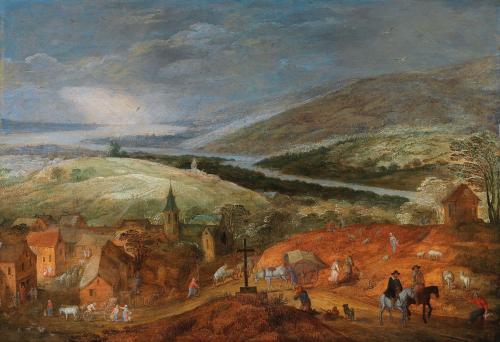
I first found this painting in November of 2020. Something about this image spawned a short story featuring the beggar, and also two (absurdly bucolic) poems about the countryside. But it was the pandemic, so there you go–I went a bit stir crazy.

Ah, those were the days, when the weekly masking up and going to pick up the groceries felt like a real day out.

What I like about this painting:

There is an intensity, a richness of color in the foreground, and a subtle chastisement the subject matter of this picture.

In the center we have a beggar on his knees and praying before a cross, with his worldly possessions stacked beside him and his dog patiently waiting. All around him, the world is going about its business. Shepherds are moving their flocks from one field to another, a merchant urges his horse-drawn cart down the hill. Further down the hill, another merchant unloads a wagon. At the right of the beggar, two travelers on horseback ignore the outstretched hand of yet another beggar, this one an old woman.

This painting is relatively less known, a scene composed and executed by two prolific artists, both of whom were the sons of two of the more famous artists of the 17th century.

At first glance this seems like an ordinary bucolic view of a village and surrounding countryside. Yet, I think the lesson they offer us is clear—we go through life relatively comfortably, unaware of the opportunities for charity that are all around us.

Both artists made their livings from their work so there was a market for what they produced. For both Brueghel and de Momper, their fathers (and in Brueghel’s case, his grandfather ) were hard acts to follow.

About the Artists, via Wikipedia:

Joos de Momper the Younger  primarily painted landscapes, the genre for which he was highly regarded during his lifetime. Only a small number of the 500 paintings attributed to de Momper are signed and just one is dated. The large output points to substantial workshop participation. He often collaborated with figure painters such as Frans Francken II, Peter Snayers, Jan Brueghel the Elder and Jan Brueghel the Younger, usually on large, mountainous landscapes, whereby the other painters painted the staffage (people) and de Momper the landscape. His works were often featured in the prestigious gallery paintings of collections (real and imagined) from the early seventeenth century.

Jan Brueghel the Younger was born and died in the 17th century in Antwerp. He was trained by his father and spent his career producing works in a similar style. Along with his brother Ambrosius, he produced landscapes, allegorical scenes and other works of meticulous detail. Brueghel also copied works by his father and sold them with his father’s signature. His work is distinguishable from that of his parent by being less well executed and lighter.

In an episode of BBC’s Britain’s Lost Masterpieces broadcast in November 2019, a very badly damaged picture of a village scene, whose panel has spilt into two pieces, was located at Birmingham Art Gallery. Following a complete restoration by Simon Gillespie, the landscape was attributed to Joos de Momper and the figures were attributed to Jan the Younger.


Credits and Attributions:

Wikimedia Commons contributors, “File:Jan Brueghel II and Joos de Momper II – An extensive mountainous river landscape with travellers near a village.jpg,” Wikimedia Commons, the free media repository, https://commons.wikimedia.org/w/index.php?title=File:Jan_Brueghel_II_and_Joos_de_Momper_II_-_An_extensive_mountainous_river_landscape_with_travellers_near_a_village.jpg&oldid=345270137 (accessed November 19, 2020).

Wikipedia contributors, “Jan Brueghel the Younger,” Wikipedia, The Free Encyclopedia, https://en.wikipedia.org/w/index.php?title=Jan_Brueghel_the_Younger&oldid=988772158 (accessed November 19, 2020).

Wikipedia contributors, “Joos de Momper,” Wikipedia, The Free Encyclopedia, https://en.wikipedia.org/w/index.php?title=Joos_de_Momper&oldid=988664019 (accessed November 19, 2020).

2 Comments

Filed under #FineArtFriday

#FineArtFriday: Cider Pressing by George Henry Durrie 1855 (revisited)
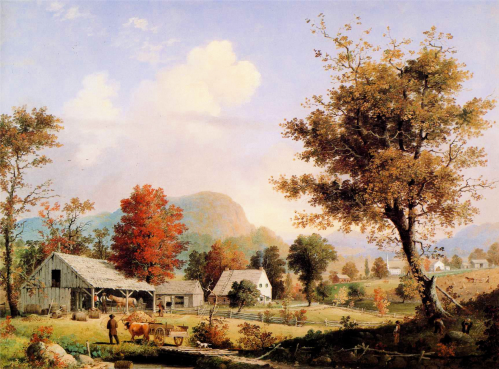
George_Henry_Durrie_-_Cider_PressingCider Pressing by George Henry Durrie 1855
Date: 1855

Medium: oil on canvas

Dimensions: Height: 22.2 in (56.5 cm); Width: 30.2 in (76.8 cm)

Collection: Private collection (Mr. & Mrs. Eugene Bugbee)

What I love about this painting:

We’re nearing the end of October, and autumn is fast sliding into the long dark of a northern November. Some trees are shedding their leaves here in the Pacific Northwest, but others are clinging to the last shreds of yellow and gold. Our native fall colors are less brilliant than those depicted in Durie’s work, but many non-native species have been introduced in the suburban landscape, offering bursts of scarlet and orange.

I love the simplicity of George Henry Durrie’s paintings. This one in particular deserves a second look. It first appeared here in September of 2021.

This is a quintessential, slightly romantic, view of history, a window into a New England day in autumn during the 19th century. A farmer leads his ox-drawn cart to the cider press. Is he selling them to the cider-man or just paying to have them juiced? Does he make his own apple jack, or is he a teamster, transporting goods for a fee?

A story can be found here, as in all Durrie’s paintings.

Juicing apples for unfermented ciders juices, jellies, and the highly fermented apple jack was an essential part of bringing in the harvest and preparing for winter, a part of the food chain we who get our food from the supermarket are disconnected from. But this was a scene that played out every fall, in every town and village.

Durrie’s colors are intensely vibrant, deep and rich, and each part of the scene is clear and placed with intent. The air is crisp and cool, but not yet cold. The leaves are turning all shades of red and gold, just as they are doing here today in the Pacific Northwest.

About the Artist, quoted from the National Gallery of Art:

Born in New Haven in 1820, the son of a Connecticut stationer, George Henry Durrie remained in that city virtually his entire life. Married to a choirmaster’s daughter, Sarah Perkins, in 1841, he immersed himself in the quiet pursuits of family and church. While he never achieved the fame of the most renowned nineteenth century American landscape painters, he appears to have had a fulfilling, productive career. His letters show that he never felt the need to move beyond his community, although he once briefly took a studio in New York and exhibited there regularly at the National Academy of Design.

Almost all of his compositions are relatively small in scale, few exceeding 18 x 24 inches, and his views are quiet and intimate. He knew and admired the works of Thomas Cole, and may have tried to emulate certain aspects of Cole’s style, yet he eschewed the Hudson River School’s compositional complexity and expansiveness. Because his paintings combined extensive genre elements with landscape they had a story-telling content that made them pleasant, accessible images to the average viewer.

The lithographic firm of Currier & Ives successfully reproduced ten of Durrie’s scenes and these, in turn, became popular calendar illustrations in the twentieth century. As a result, Durrie’s depictions of rural life in the mid-nineteenth century are now among the most familiar images in all of American art. As Martha Hutson has noted, however, these printed pictures do not convey the keen sensitivity to and understanding of conditions of atmosphere and light that are so pronounced in Durrie’s paintings. [1]

From Wikipedia:

In his teens the self-taught artist painted portraits in the New Haven area. In 1839 he received artistic instruction from Nathaniel Jocelyn, a local engraver and portrait painter. After 1842 he settled in New Haven, but made painting trips to New Jersey, New York, and Virginia. Around 1850, he began painting genre scenes of rural life, as well as the winter landscapes that became popular when Currier and Ives published them as lithographs. Four prints were published between 1860 and the artist’s death in New Haven in 1863; six additional prints were issued posthumously. The painter Jeanette Shepperd Harrison Loop studied with him. [2]


Credits and Attributions:

Wikimedia Commons contributors, “File:George Henry Durrie – Cider Pressing.JPG,” Wikimedia Commons, the free media repository, https://commons.wikimedia.org/w/index.php?title=File:George_Henry_Durrie_-_Cider_Pressing.JPG&oldid=369724230 (accessed September 15, 2021).

[1] National Gallery of Art contributors, “George Henry Durrie,” biography, © 2018 – 2021 National Gallery of Art, https://www.nga.gov/collection/artist-info.6397.html

[2] Wikipedia contributors, “George Henry Durrie,” Wikipedia, The Free Encyclopedia, https://en.wikipedia.org/w/index.php?title=George_Henry_Durrie&oldid=861433469 (accessed September 15, 2021).

2 Comments

Filed under #FineArtFriday, writing

#FineArtFriday: Calais Pier by J.M.W. Turner, 1803

Calais_pier_Joseph_Mallord_William_Turner_024

Artist: J. M. W. Turner (1775–1851)

Title: Calais Pier

Date: 1803

Medium: oil on canvas

Dimensions: height: 172 cm (67.7 in); width: 240 cm (94.4 in)

Collection: National Gallery

What I love about this painting:

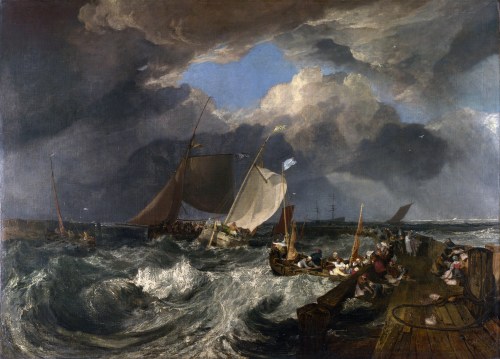
This is an emotion-packed image, the scene of a near-tragedy. The packet boat has arrived at Calais with a full load of passengers. The storm dominates the scene with lowering clouds and a heavy swell, but the sun breaks through and lights on the sail. A shaft of light shines down to the sea illuminating the center of the composition.  The young artist put his experience and terror into the image, depicting the ferocity of the sea and the violence of the landing.

The National Gallery website says of this picture, “Although it had a mixed response when first exhibited at the Royal Academy in 1803, the critic John Ruskin declared it to be the first painting to show signs of ‘Turner’s colossal power’. Calais Pier is based upon an actual event. On 15 July 1802, Turner, aged 27, began his first trip abroad, travelling from Dover to Calais in a cross-channel ferry (a packet) of the type shown here. The weather was stormy, and Turner noted in his sketchbook: ‘Our landing at Calais. Nearly swampt.’” [1] Joseph Mallord William Turner | Calais Pier | NG472 | National Gallery, London

About the Artist, Via Wikipedia:

Joseph Mallord William Turner RA (23 April 1775 – 19 December 1851), known in his time as William Turner, was an English Romantic painter, printmaker and watercolorist. He is known for his expressive coloring, imaginative landscapes and turbulent, often violent marine paintings. He left behind more than 550 oil paintings, 2,000 watercolors, and 30,000 works on paper. He was championed by the leading English art critic John Ruskin from 1840 and is today regarded as having elevated landscape painting to an eminence rivalling history painting.

Turner was born in Maiden Lane, Covent Garden, London, to a modest lower-middle-class family and retained his lower class accent, while assiduously avoiding the trappings of success and fame. A child prodigy, Turner studied at the Royal Academy of Arts from 1789, enrolling when he was 14, and exhibited his first work there at 15. During this period, he also served as an architectural draftsman. He earned a steady income from commissions and sales, which due to his troubled, contrary nature, were often begrudgingly accepted. He opened his own gallery in 1804 and became professor of perspective at the academy in 1807, where he lectured until 1828. He travelled around Europe from 1802, typically returning with voluminous sketchbooks.

Intensely private, eccentric, and reclusive, Turner was a controversial figure throughout his career. He did not marry, but fathered two daughters, Evelina (1801–1874) and Georgiana (1811–1843), by his housekeeper Sarah Danby. He became more pessimistic and morose as he got older, especially after the death of his father in 1829; when his outlook deteriorated, his gallery fell into disrepair and neglect, and his art intensified. In 1841, Turner rowed a boat into the Thames so he could not be counted as present at any property in that year’s census. He lived in squalor and poor health from 1845, and died in London in 1851 aged 76. Turner is buried in St Paul’s Cathedral, London. [2]


Credits and Attributions:

“Calais Pier” by J.M.W. Turner, 1801. Wikimedia Commons contributors, “File:Joseph Mallord William Turner 024.jpg,” Wikimedia Commons, https://commons.wikimedia.org/w/index.php?title=File:Joseph_Mallord_William_Turner_024.jpg&oldid=618399843 (accessed October 7, 2023).

[1] National Gallery contributors, Calais Pier, Joseph Mallord William Turnerhttps://www.nationalgallery.org.uk/paintings/joseph-mallord-william-turner-calais-pier (accessed  October 11, 2023).

[2] Wikipedia contributors, “J. M. W. Turner,” Wikipedia, The Free Encyclopedia, https://en.wikipedia.org/w/index.php?title=J._M._W._Turner&oldid=1179617592 (accessed October 11, 2023).

Comments Off on #FineArtFriday: Calais Pier by J.M.W. Turner, 1803

Filed under #FineArtFriday

#FineArtFriday: A Coming Storm by Sanford Robinson Gifford

Gifford_A_Coming_Storm_1863-1880_PMA

Artist: Sanford Robinson Gifford,

Title: A Coming Storm (1863)

Date: 1863 (retouched 1880)

Location: Philadelphia Museum of Art.

What I love about this painting:

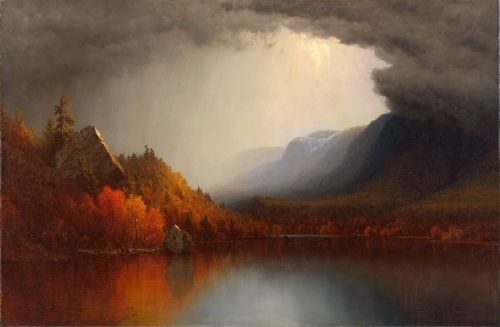
Gifford demonstrates his skill as a devotee of luminism and gives us the perfect view of a fine autumn day and the approaching storm. The way he contrasts the sun’s light against the ominous black clouds is true to nature, to how storms really look as they close in.

I like the way he shows the rock outcroppings, visible evidence of the hard stone of the mountains that lies beneath the lush finery of autumn foliage.

For the moment, the waters of the pond are quiet, reflecting the sky above. Rain cloaks the view of the distant valley, and soon we will feel the brunt of it. Enjoy the blaze of color while you can, as tomorrow those trees will be half-bare, and the ground will be covered in sodden tatters of red and gold.

While there appears to be some damage in the upper center, the integrity of the painting is still intact. It was retouched in 1880, but a modern retouching would likely bring it back to its original glory.

About the Artist, via Wikipedia:

Sanford Robinson Gifford (July 10, 1823 – August 29, 1880) was an American landscape painter and a leading member of the second generation of Hudson River School artists. A highly regarded practitioner of Luminism, his work was noted for its emphasis on light and soft atmospheric effects.

Although trained as a portrait painter, the first work Gifford exhibited at the National Academy was a landscape, in 1847. Thereafter, Gifford devoted himself primarily to landscape painting, becoming one of the finest artists of the Hudson River School. He was elected an Associate of the National Academy in 1851, and an Academician in 1854.

2008 National Academy of Design controversy:

In December 2008, one of Gifford’s paintings, Mount Mansfield, Vermont (1859), became part of a controversy over deaccessioning by the National Academy of Design. The Academy was a member of the Association of Art Museum Directors, whose policy stated that member museums could not sell works of art to cover operating expenses, only to purchase superior works or to weed out inferior or redundant ones. Prior to joining AAMD, the Academy had sold two Thomas Eakins works (including his “diploma painting,” Wrestlers) in the 1970s, and Richard Caton Woodville‘s War News from Mexico (1848) in 1994. According to its former curator, David Dearinger: “When the Academy later applied to the museum association for accreditation, Mr. Dearinger recalled, it was asked about the Woodville sale and promised not to repeat such a move.”

In a 2008 sale, the Academy quietly sold Frederic Edwin Church‘s Scene on the Magdalene (1854) and Sanford Gifford’s Mount Mansfield, Vermont (1859) to a private collector for US$13.5 million. The former was the Academy’s only painting by Church; the latter was its only painting by Gifford. Both had been “donated to the Academy in 1865 by another painter, James Augustus Suydam.” News of the sale was broken by arts blogger Lee Rosenbaum. As punishment for these actions, AAMD asked its other member museums to “cease lending artworks to the Academy and collaborating with it on exhibitions.” The Academy had contemplated selling additional paintings, but those plans were abandoned after being reported by Rosenbaum. [1]


Credits and Attributions:

IMAGE: A Coming Storm by Sanford Robinson Gifford. Wikimedia Commons contributors, “File:Gifford A Coming Storm 1863-1880 PMA.jpg,” Wikimedia Commons, https://commons.wikimedia.org/w/index.php?title=File:Gifford_A_Coming_Storm_1863-1880_PMA.jpg&oldid=803742381 (accessed October 5, 2023).

[1] Wikipedia contributors, “Sanford Robinson Gifford,” Wikipedia, The Free Encyclopedia, https://en.wikipedia.org/w/index.php?title=Sanford_Robinson_Gifford&oldid=1176083433 (accessed October 5, 2023).

Comments Off on #FineArtFriday: A Coming Storm by Sanford Robinson Gifford

Filed under #FineArtFriday

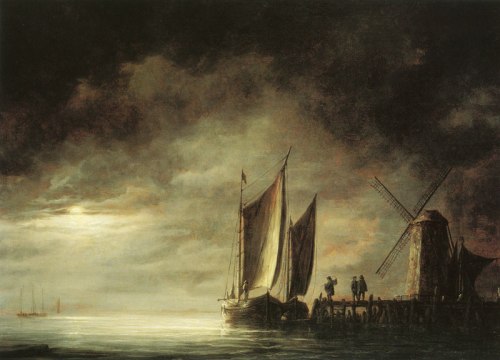
#FineArtFriday: Dordrecht Harbor by Moonlight by Aelbert Cuyp 1643

Aelbert_Cuyp_-_Dordrecht_Harbor_by_Moonlight_4168Artist: Aelbert Cuyp (1620–1691)

Title: Dordrecht Harbor by Moonlight

Genre: landscape art

Date: 1643

Medium: oil on panel

Dimensions: height: 76.5 cm (30.1 in); width: 106.5 cm (41.9 in)

Collection: Wallraf–Richartz Museum 

What I like about this scene:

Aelbert Cuyp’s paintbrush tells a story. But what kind of story is he showing us?

A ship is docked beside a mill at Dordrecht Harbor. Night has fallen, and a full moon, veiled by clouds, lights the scene. On the wharf, three figures stand, talking, perhaps making a deal. What could be so important that these men must discuss it in the dark?

The moonlight casts a pale glow over the scene, casting shadows and illuminating the mist rising in the distance. It adds to the mystery of the scene, conveying a feeling of clandestine conversations.

It’s 1643. The Eighty Years War, a revolution and quest for independence is still ongoing. It’s a battle for religious freedom as well as for the rights of the Dutch people to govern themselves.

Yes, indeed … some conversations by moonlight are best kept secret.

About Dordrecht in the 17th Century:

Dordrecht (Dutch: ) historically known in English as Dordt (still colloquially used in Dutch, pronounced) or Dort, is a city and municipality in the Western Netherlands, located in the province of South Holland.

During the Eighty Years’ War merchants from Dordrecht were involved in taking control and founding sugar cane plantations in the West Indies. At the end of the 17th century this led to a stable sugar refining industry in Dordrecht. This flourished in the 18th century, when Dordrecht had 16 sugar refineries, as opposed 120 in Amsterdam and 40 in Rotterdam. Dordrecht still has a few buildings purposely designed as a sugar refinery, e.g. the imposing Sugar Refinery Stokholm.

Overall, the economic importance of Dordrecht began to wane in the 18th century, and Rotterdam became the main city in the region. [1]

The Eighty Years’ War  or Dutch Revolt (Dutch: Nederlandse Opstand) (c. 1566/1568–1648) was an armed conflict in the Habsburg Netherlands between disparate groups of rebels and the Spanish government. The causes of the war included the Reformation, centralization, taxation, and the rights and privileges of the nobility and cities.

An end was reached in 1648 with the Peace of Münster (a treaty part of the Peace of Westphalia), when Spain retained Southern Netherlands and recognized the Dutch Republic as an independent country.[2]

About the Artist:

Aelbert Jacobszoon Cuyp or Cuijp (20 October 1620 – 15 November 1691) was one of the leading Dutch Golden Age painters, producing mainly landscapes. The most famous of a family of painters, the pupil of his father, Jacob Gerritszoon Cuyp (1594–1651/52), he is especially known for his large views of Dutch riverside scenes in a golden early morning or late afternoon light. He was born and died in Dordrecht.

Little is known about Aelbert Cuyp’s life. Even Arnold Houbraken, a noted historian of Dutch Golden Age paintings and the sole authority on Cuyp for the hundred years following his death, paints a very thin biographical picture.

His period of activity as a painter is traditionally limited to the two decades between 1639 and 1660, fitting within the generally accepted limits of the Dutch Golden Age’s most significant period, 1640–1665. He is known to have been married to Cornelia Bosman in 1658, a date coinciding so directly with the end of his productivity as a painter that it has been accepted that his marriage played a role in the end of his artistic career.

The year after his marriage, Cuyp became the deacon of the reformed church. Houbraken recalled that Cuyp was a devout Calvinist and the fact that when he died, there were no paintings of other artists found in his home. [3]

Credits and Attributions:

IMAGE:  Dordrecht Harbor by Moonlight by Aelbert Cuyp, 1643. Wikimedia Commons contributors, “File:Aelbert Cuyp – Dordrecht Harbor by Moonlight 4168.jpg,” Wikimedia Commons, https://commons.wikimedia.org/w/index.php?title=File:Aelbert_Cuyp_-_Dordrecht_Harbor_by_Moonlight_4168.jpg&oldid=782562344 (accessed September 28, 2023).

[1] Wikipedia contributors, “Dordrecht,” Wikipedia, The Free Encyclopedia, https://en.wikipedia.org/w/index.php?title=Dordrecht&oldid=1169436434 (accessed September 28, 2023).

[2] Wikipedia contributors, “Eighty Years’ War,” Wikipedia, The Free Encyclopedia, https://en.wikipedia.org/w/index.php?title=Eighty_Years%27_War&oldid=1177125376 (accessed September 28, 2023).

[3] Wikipedia contributors, “Aelbert Cuyp,” Wikipedia, The Free Encyclopedia, https://en.wikipedia.org/w/index.php?title=Aelbert_Cuyp&oldid=1177164314 (accessed September 28, 2023).

2 Comments

Filed under #FineArtFriday

#FineArtFriday: Autumn in North America by Frederic Edwin Church 1896

Autumn_in_North_America-Frederic_ChurchArtist: Frederic Edwin Church  (1826–1900)

Title: Autumn in North America

Genre: landscape art

Date: 1856

Medium: oil on board

Dimensions: height: 28.5 cm (11.2 in); width: 43.1 cm (17 in)

Collection: Thyssen-Bornemisza Museum

What I love about this picture:

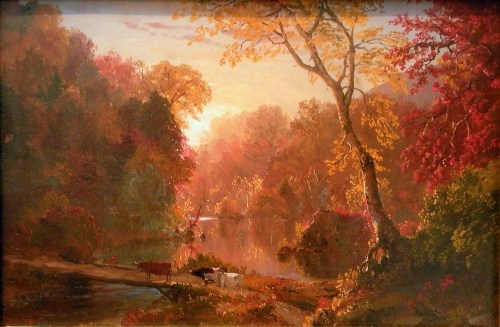
This is a New England autumn in full color, the way autumns never are here in my part of the world. Yes, non-native trees will turn these bright shades, but the only bright red fall color in native species will be vine maples. Staghorn Sumac is a non-native plant that has become a part of our local flora, and it turns bright red also. But we do have gorgeous golds and oranges beginning to show in our native deciduous forests.

Many years it is too wet for a colorful fall, and the leaves turn a soggy brown and drop off their trees, sodden masses nearly impossible to rake.

About the Artist, via Wikipedia:

Frederic Edwin Church (May 4, 1826 – April 7, 1900) was an American landscape painter born in Hartford, Connecticut. He was a central figure in the Hudson River School of American landscape painters, best known for painting large landscapes, often depicting mountains, waterfalls, and sunsets. Church’s paintings put an emphasis on realistic detail, dramatic light, and panoramic views. He debuted some of his major works in single-painting exhibitions to a paying and often enthralled audience in New York City. In his prime, he was one of the most famous painters in the United States. [1]


Credits and Attributions:

IMAGE: Wikimedia Commons contributors, “File:Autumn in North America-Frederic Church.jpg,” Wikimedia Commons, https://commons.wikimedia.org/w/index.php?title=File:Autumn_in_North_America-Frederic_Church.jpg&oldid=718218353 (accessed September 19, 2023).

[1] Wikipedia contributors, “Frederic Edwin Church,” Wikipedia, The Free Encyclopedia, https://en.wikipedia.org/w/index.php?title=Frederic_Edwin_Church&oldid=1162133197 (accessed September 19, 2023).

6 Comments

Filed under #FineArtFriday