Category Archives: #FineArtFriday

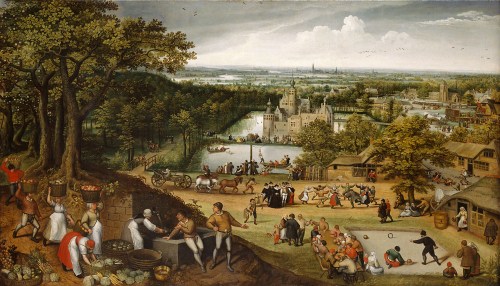
#FineArtFriday: Autumn Landscape (September) by Lucas van Valckenborch

GG_5684.tif

Artist: Lucas van Valckenborch  (1535–1597)

Title: Autumn Landscape (September)

Date: 1585

Medium: oil on canvas

Dimensions: 116 x 198 cm Rahmenmaße: 131,5 x 214 x 6,5 cm

Collection: Kunsthistorisches Museum

What I love about this painting:

We see an entire view of ordinary autumn life in the 16th century, but better than that, Lucas van Valckenborch shows us the passage of time. He depicts the chronology of how people lived and celebrated each week of the changing season by showing us September in the Netherlands.

The way he shows us this chronology is ingenious and is a signature of his work. The early weeks of September are shown in the left foreground, with laborers bringing in the harvest. Others are working to dry and preserve foods. The colors he uses are vivid, the last shades of summer.

In the bottom to middle right, he shows us mid-September with people relaxing, feasting, bowling, and dancing. The harvest is in, and people have a little time to enjoy the last days of good weather. The colors he uses are more muted, with shades of brown dominating. The leaves are brown and falling. Yet, there is a vibrancy about it, a sense of life. People celebrate a successful harvest one last time before winter’s cold grip closes in.

In late September, people fish, and the market becomes the center of village life. People are less active, but the market draws customers. The end of September presages colder weather and hints at the beginning of winter. This is shown in cool shades of gray, as if in a black-and-white photograph.

He is known for using this trick of color to denote receding distances. But he deliberately places figures performing specific activities within those colors, showing us how people lived and the passage of their days as well as distance.

The first days of September are bright, days of plenty. Yes, we’re working hard, but we’ll be grateful for the bounty when winter comes.

We look forward to the middle of September, because once the rush of harvest is over we will party like it’s 1585.

In the distance, we know the cold dark days loom, but we are prepared. Our cellars will be full and we will hunt and fish while we can.

Lucas van Valckenborch’s body of work shows us that he was a brilliant storyteller as well as an artist. Many paintings of that time show us the poverty, but here we see the prosperity of a village during the early renaissance. It wasn’t all doom and gloom after all.

About the Artist and his work, via Wikipedia:

Lucas van Valckenborch or Lucas van Valckenborch the Elder (c. 1535 in Leuven – 2 February 1597 in Frankfurt am Main) was a Flemish painter, mainly known for his landscapes. He also made contributions to portrait painting, and allegorical and market scenes. Court painter to Archduke Matthias, the governor of the Spanish Netherlands in Brussels, he later migrated to Austria and then Germany where he joined members of his extended family of artists who had moved there for religious reasons.

In their mixture of fantasy and accurate topographical details, van Valckenborch’s landscape paintings offer a view of the world and man’s relationship to it. This is particularly clear in his rocky landscapes in which the diminutive people on the winding path are reduced by the monumental cliffs. An example is the Rocky Landscape with Travelers on a Path (c. 1570, Sotheby’s 6 July 2016, London lot 3) where the distant goatherd and the silhouettes of his charges seem ant-like in comparison to the vast distance, and the vertiginous perspective of the scene. This dramatic visual depiction is clearly intended as a commentary on man’s place within the universe.

He also painted, between 1584 and 1587, a series of large pictures depicting the labours of the months, probably on commission for Archduke Matthias. These compositions, of which seven survive (five of which are in the Kunsthistorische Museum), present the various months of the year by showing the changing landscape and the traditional activities of humans during each month. It is not clear whether the five missing paintings were never painted or are lost.[4] Due to their realistic setting these compositions carry a documentary interest. The work of Pieter Bruegel the elder, who had painted a series of 6 on the times of the year, was influential on van Valckenborch. Lucas van Valckenborch moved away from the tradition of painting the landscape in three cascading distances that were rendered in three different colours: brown, green and blue for each receding plane. Rather he often left out the green tone for the middle distance. He also innovated the thematic scenes by developing them into genre scenes with a stronger narrative depth. [1]


Credits and Attributions:

[1] Wikipedia contributors, “Lucas van Valckenborch,” Wikipedia, The Free Encyclopedia, https://en.wikipedia.org/w/index.php?title=Lucas_van_Valckenborch&oldid=1173224796 (accessed September 14, 2023).

IMAGE: Autumn Landscape (September) by Lucas van Valckenborch. Wikimedia Commons contributors, “File:Lucas van Valckenborch – Autumn landscape (September).jpg,” Wikimedia Commons, https://commons.wikimedia.org/w/index.php?title=File:Lucas_van_Valckenborch_-_Autumn_landscape_(September).jpg&oldid=618977280 (accessed September 14, 2023).
3 Comments

Filed under #FineArtFriday

#FineArtFriday: Impression Sunrise by Claude Monet 1872, and the Fighting Temeraire by J.M.W. Turner 1839

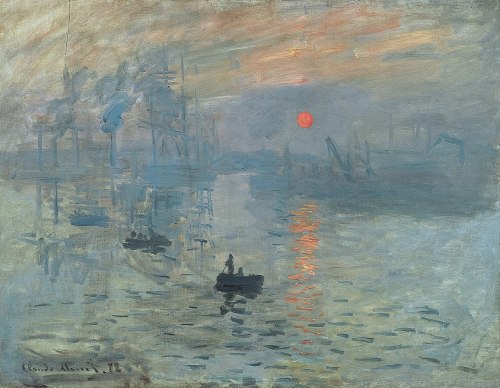
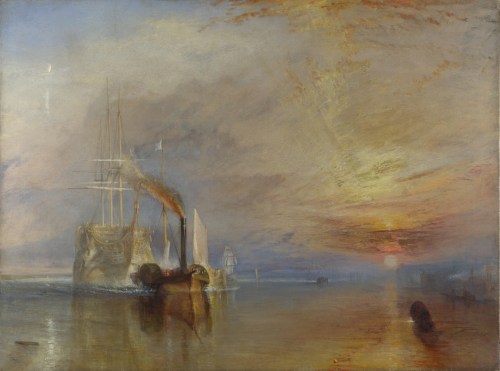
Today I am featuring two famous paintings, Claude Monet’s Impression Sunrise, the painting that gave  a name to an entire movement withing the artistic community. But Monet was not the first of the impressionists, and he freely admitted that he was an admirer of the radical and oft criticized (in his time) J.M.W. Turner.  Indeed, during the years Monet resided in England, he visited the National Gallery, viewing the works of Turner, whom he held in high regard. The painting that, in my opinion, belongs in the same room with Impression Sunrise is turner’s masterpiece, the Fighting Temeraire.

Both paintings are best viewed from a distance, and both have power. Both tell a story, and both artists faced the slings and arrows of critics who were unwilling to accept anything that strayed from traditional portraiture and landscape art.

Uncaring of the critics, both Monet and Turner wandered off in their own artistic direction, and we can be grateful for that stubborn desire to paint what they felt as well as what they saw.

Turner’s work influenced Monet, and both artists influenced generations of artists who followed them.

Claude_Monet,_Impression,_soleil_levant

Artist   Claude Monet  (1840–1926) 

Title    Impression, Sunrise

Genre  marine art

Date    1872

Medium          oil on canvas

Dimensions     height: 48 cm (18.8 in); width: 63 cm (24.8 in)

Collection       Musée Marmottan Monet  


The_Fighting_Temeraire,_JMW_Turner,_National_Gallery

Artist:  J. M. W. Turner  (1775–1851)  (by Joseph Mallord William Turner)

Title: The Fighting Temeraire 1839

Description: The Fighting Temeraire tugged to her last berth to be broken up, 1838

Date: 1839

Medium: oil on canvas  

Dimensions: height: 90.7 cm (35.7 in)

Collection: National Gallery 


Credits and Attributions:

Impression Sunrise, Claude Monet 1872 [Public domain], via Wikimedia Commons: Impression, Sunrise – Wikipedia accessed September 09, 2023.

The Fighting Temeraire, J. M. W. Turner: 1839 [Public domain], via Wikimedia Commons: The Fighting Temeraire – Wikipedia accessed September 09, 2023.

3 Comments

Filed under #FineArtFriday

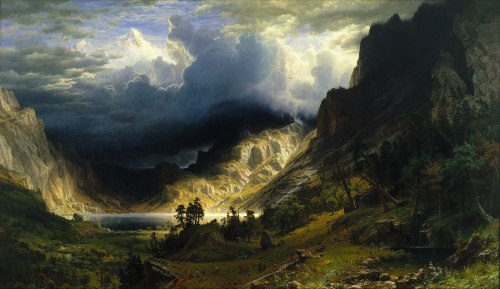
#FineArtFriday: A Storm in the Rocky Mountains – Mt. Rosalie by Albert Bierstadt 1866

Albert_Bierstadt_-_A_Storm_in_the_Rocky_Mountains,_Mt._Rosalie_-_Google_Art_ProjectArtist: Albert Bierstadt  (1830–1902)

Title: A Storm in the Rocky Mountains, Mt. Rosalie

Genre: landscape art

Date: 1866

Medium: oil on canvas

Dimensions: height: 210.8 cm (82.9 in); width: 361.3 cm (11.8 ft)

Collection: Brooklyn Museum: American Identities: A New Look, American Landscape, 5th Floor

What I love about this painting:

Albert Bierstadt painted his idea of what the American West of his time should be, grand, pristine, and wild. He painted what he saw, slightly fictionalized, so the viewer would see what he felt. He gave us entire stories on his canvas, epic explorations of the power and beauty of nature.

Bierstadt’s skies were imbued with high drama contrasted with peaceful vistas below. He took the places he had visited and made them bigger, grander, made the viewer feel the emotions he experienced when he first laid eyes on them.

About this painting via Wikipedia:

A Storm in the Rocky Mountains, Mt. Rosalie is an 1866 landscape oil painting by German-American painter Albert Bierstadt (1830-1902) which was inspired by sketches created on an 1863 expedition.

Bierstadt traveled to the Colorado Rocky Mountains where he was taken up to the Chicago Lakes beneath Mount Evans. The painting is named after Bierstadt’s mistress and, at the time, his friend’s wife, Rosalie Osborne Ludlow. The painting, measuring at 210.8 × 361.3 cm (83.0 × 142.2 in), is exhibited at the Brooklyn Museum, which acquired it in 1976.

The painting depicts Native American hunter/gatherers hunting deer in the foreground. A Native American encampment resides by a stream in the distance. The mountains are thrown into either sunlight or the darkness of a thunderstorm. In order to increase its dramatic value, Bierstadt exaggerated the scale of the Rocky Mountains.

Peering through a break in the clouds in the far distance is a snow-capped Mt. Rosalie, named after Bierstadt’s wife.

Upon its completion, the painting toured the United States for a year. On 7 February 1866, A Storm in the Rocky Mountains, Mount Rosalie exhibited for one day and evening at the Somerville Art Gallery in New York City as a benefit for the “Nursery and Child’s Hospital.” [1]

Quote from Wikimedia Commons: Albert Bierstadt enjoyed great success in the years surrounding the Civil War, producing finely detailed vistas of nature’s splendor in majestic canvases that were similarly invested with significance beyond their surface appearance.

The first technically advanced artist to portray the American West, Bierstadt offered to a rapidly transforming nation pictures whose spectacular size and fresh, dramatic subject matter supplied a visual correlative to notions of American exceptionalism, while also contributing to the developing concept of Manifest Destiny.

Trained in the highly finished manner of the Düsseldorf Academy, Bierstadt’s precise style imbued his works with a reassuring sense of veracity despite their sublime subjects and occasional liberties with geographic reality. [2]

About the Artist, via Wikipedia:

Albert Bierstadt (January 7, 1830 – February 18, 1902) was a German American painter best known for his lavish, sweeping landscapes of the American West. He joined several journeys of the Westward Expansion to paint the scenes. He was not the first artist to record the sites, but he was the foremost painter of them for the remainder of the 19th century.

Bierstadt was born in Prussia, but his family moved to the United States when he was one year old. He returned to study painting for several years in Düsseldorf. He became part of the second generation of the Hudson River School in New York, an informal group of like-minded painters who started painting along the Hudson River. Their style was based on carefully detailed paintings with romantic, almost glowing lighting, sometimes called luminism. Bierstadt was an important interpreter of the western landscape, and he is also grouped with the Rocky Mountain School.


Credits and Attributions:

Image: Wikimedia Commons contributors, ‘File:Albert Bierstadt – A Storm in the Rocky Mountains, Mt. Rosalie – Google Art Project.jpg’, Wikimedia Commons, 29 July 2023, 05:50 UTC, <https://commons.wikimedia.org/w/index.php?title=File:Albert_Bierstadt_-_A_Storm_in_the_Rocky_Mountains,_Mt._Rosalie_-_Google_Art_Project.jpg&oldid=787844562> [accessed 1 September 2023]

[1] Wikipedia contributors, “A Storm in the Rocky Mountains, Mt. Rosalie,” Wikipedia, The Free Encyclopedia, https://en.wikipedia.org/w/index.php?title=A_Storm_in_the_Rocky_Mountains,_Mt._Rosalie&oldid=1160866547 (accessed September 1, 2023).

[2] Wikimedia Commons contributors, “File:1875, Bierstadt, Albert, Mount Adams, Washington.jpg,” Wikimedia Commons, the free media repository, https://commons.wikimedia.org/w/index.php?title=File:1875,_Bierstadt,_Albert,_Mount_Adams,_Washington.jpg&oldid=272380899 (accessed March 9, 2018).

2 Comments

Filed under #FineArtFriday

#FineArtFriday: the Dragon’s Cave by Georg Janny 1917

Georg_Janny_-_The_Dragon's_Cave_1917Artist: Georg Janny  (1864–1935)

Title: The Dragon’s Cave (German: Drachenhöhle)

Date: 1917

Medium: oil on canvas

What I love about this painting:

What’s not to love about a dragon? Georg Janny gives us the beast in his natural environment. Our dragon is immense, gloriously armored with steel gray and silver scales. Twin streams of smoke rise from his nostrils, evidence of his fiery internal workings. The dragon sits at the entrance to his mountain aerie, surveying the world, and believes that he is the master.

I love fantasy paintings. The artists who painted scenery for the opera were, and are, incredibly skilled. The scenery painters of the early twentieth century were often influenced in their subject matter and style by the works of the pre-Raphaelites.

About the Artist, via Wikipedia:

Georg Janny (20 May 1864, Vienna – 21 February 1935, Vienna) was an Austrian landscape painter and set designer.

He worked as a scene painter in the studios of Carlo Brioschi and Johann Kautsky, alongside Alfons Mucha, and was a member of the Dürerbund.

In 1898, he participated in painting the “Eisernen Vorhang” (Iron Curtain) at the Vienna Volksoper for the 50th jubilee of Emperor Franz Joseph I. In 1904, he exhibited in the Austrian Pavilion at the St.Louis World’s Fair with scenes from the Imperial Royal Austrian State Railways (now at the Technisches Museum Wien). Two years later, he designed the stage for The Queen of Sheba by Karl Goldmark, one of the most popular operas of the late 19th century. Pictures from the second and third acts have been preserved.

He also painted landscapes and figures, including scenes from fairy-tales or imaginary worlds that are reminiscent of the works of Arnold Böcklin or Gustave Doré. [1]


Credits and Attributions:

Image: The Dragon’s Cave by Georg Janny. Wikimedia Commons contributors, “File:Georg Janny – The Dragon’s Cave 1917.jpg,” Wikimedia Commons, https://commons.wikimedia.org/w/index.php?title=File:Georg_Janny_-_The_Dragon%27s_Cave_1917.jpg&oldid=636191261 (accessed August 25, 2023).

[1] Wikipedia contributors, “Georg Janny,” Wikipedia, The Free Encyclopedia, https://en.wikipedia.org/w/index.php?title=Georg_Janny&oldid=1159021400 (accessed August 25, 2023).

Wikimedia Commons contributors, “File:Georg Janny – The Dragon’s Cave 1917.jpg,” Wikimedia Commons, https://commons.wikimedia.org/w/index.php?title=File:Georg_Janny_-_The_Dragon%27s_Cave_1917.jpg&oldid=636191261 (accessed August 25, 2023).

5 Comments

Filed under #FineArtFriday

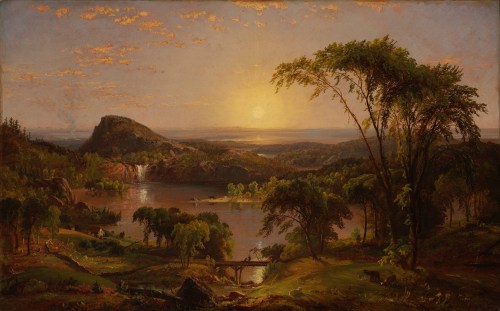
#FineArtFriday: Summer, Lake Ontario by Jasper Francis Cropsey 1857 (revisited)

Cropsey,_Jasper_Francis_-_Summer,_Lake_Ontario_-_Google_Art_ProjectTitle: Summer, Lake Ontario by Jasper Francis Cropsey (1823–1900)
Genre: landscape art

Date: 1857

Medium: oil on canvas

Collection: Indianapolis Museum of Art

What I love about this painting:

Cropsey paints a summer evening in New York State, along the shore of one of Lake Ontario’s bays. Near the bottom center, a pair of fishers are placed on the wooden bridge over a creek. This image has a fantasy quality, as if it depicts a dream or a fond memory.

Our point of view is from a hill, looking down to the creek, the bridge, and the bay shore, and then across low hills to the great lake beyond. Cropsey gives equal importance to the earth below and sky above.

Cropsey’s signature deep colors are featured in this panoramic view of a summer evening. Warm reds, browns, yellows, and dark greens are lightened by wispy mists rising in the early evening air, lit by the setting sun.

About the Artist, via Wikipedia:

Jasper Francis Cropsey (February 18, 1823 – June 22, 1900) was an important American landscape artist of the Hudson River School.

Cropsey was born on his father Jacob Rezeau Cropsey’s farm in Rossville on Staten Island, New York, the oldest of eight children. As a young boy, Cropsey had recurring periods of poor health. While absent from school, Cropsey taught himself to draw. His early drawings included architectural sketches and landscapes drawn on notepads and in the margins of his schoolbooks.

Trained as an architect, he set up his own office in 1843. Cropsey studied watercolor and life drawing at the National Academy of Design under the instruction of Edward Maury and first exhibited there in 1844. A year later he was elected an associate member and turned exclusively to landscape painting; shortly after he was featured in an exhibition entitled “Italian Compositions.”

Cropsey traveled in Europe from 1847–1849, visiting England, France, Switzerland, and Italy. He was elected a full member of the Academy in 1851. Cropsey was a personal friend of Henry Tappan, the president of the University of Michigan from 1852 to 1863. At Tappan’s invitation, he traveled to Ann Arbor in 1855 and produced two paintings, one of the Detroit Observatory, and a landscape of the campus. He went abroad again in 1856, and resided seven years in London, sending his pictures to the Royal Academy and to the International exhibition of 1862.

Returning home, he opened a studio in New York and specialized in autumnal landscape paintings of the northeastern United States, often idealized and with vivid colors. Cropsey co-founded, with ten fellow artists, the American Society of Painters in Watercolors in 1866. He also made the architectural designs for the stations of the elevated railways in New York. [1]


Credits and Attributions:

Image: Summer, Lake Ontario by Jasper Francis Cropsey 1857. Wikimedia Commons contributors, “File:Cropsey, Jasper Francis – Summer, Lake Ontario – Google Art Project.jpg,” Wikimedia Commons, the free media repository, https://commons.wikimedia.org/w/index.php?title=File:Cropsey,_Jasper_Francis_-_Summer,_Lake_Ontario_-_Google_Art_Project.jpg&oldid=618625179 (accessed June 30, 2022).

[1] Wikipedia contributors, “Jasper Francis Cropsey,” Wikipedia, The Free Encyclopedia, https://en.wikipedia.org/w/index.php?title=Jasper_Francis_Cropsey&oldid=1093620569 (accessed June 30, 2022).

2 Comments

Filed under #FineArtFriday, writing

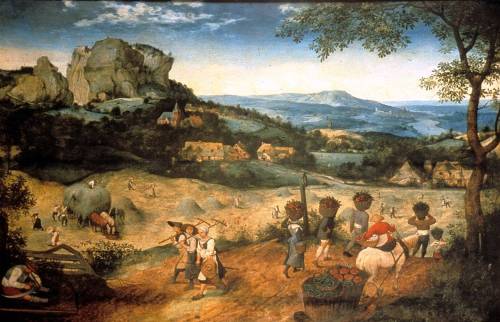
#FineArtFriday: The Hay Harvest by Pieter Bruegel the Elder, 1565 (reprise)

Haymaking,_Pieter_Brueghel_the_Elder (1)Artist: Pieter Bruegel the Elder (1526/1530–1569)
Title: The Hay Harvest

Genre: genre art

Date: 1565

Medium: oil on panel

Dimensions: Height: 117 cm (46 in) Width: 161 cm (63.3 in)

According to the Web Gallery of Art, Haymaking, also known as The Hay Harvest, belongs to the Series of the Months. All the other panels in this series are dated 1565. July and August are the months when most summer crops are harvested. This painting and the August panel (The Corn Harvest) show the bringing-in of the harvest.

I first featured this painting in August of 2021, but it is well worth a second look. Workers scythe grain in the large field toward the center of the painting. In the foreground, other laborers harvest vegetables and pick berries. Everyone works to bring in the food, men, women, and children, as winter isn’t that far away, and the hay will sustain the draft animals in the long cold months ahead.

While each painting in the series shows the traditional occupation of that month, Bruegel’s real subject is the landscape itself, its ever-changing appearance.

I have always loved Bruegel the Elder’s work because he portrays the gathering of food as a fundamental human activity. He shows us that the quantity of food we have on our tables is determined by the knowledge and labor of others.

The variety of foods we have available to us is dictated by the form of the landscape. To carve a living from the earth a farmer must understand and care for the land that sustains them. They must know what areas of soil will be best for each crop and use that knowledge when laying out how the fields will be planted, as each crop has different nutrient requirements.

Within one valley, many types of soils will exist, so what serves to grow hay may not work for more delicate vegetables.

In the lush bounty of this painting, Bruegel the Elder shows us the wisdom of farmers, knowledge that sustains us to this day. He illustrates the way all people who grow and gather our food are bound to the land.

Those who grow food in their back gardens understand and respect the labors of those small farmers who grow produce for our local markets.

About the series, Months of the Year, via Wikipedia:

(Bruegel’s) famous set of landscapes with genre figures depicting the seasons are the culmination of his landscape style; the five surviving paintings use the basic elements of the world landscape (only one lacks craggy mountains) but transform them into his own style. They are larger than most previous works, with a genre scene with several figures in the foreground, and the panoramic view seen past or through trees. Bruegel was also aware of the Danube School‘s landscape style through prints.

The series on the months of the year includes several of Bruegel’s best-known works. In 1565, a wealthy patron in Antwerp, Niclaes Jonghelinck, commissioned him to paint a series of paintings of each month of the year. There has been disagreement among art historians as to whether the series originally included six or twelve works. Today, only five of these paintings survive and some of the months are paired to form a general season. Traditional Flemish luxury books of hours (e.g., the Très Riches Heures du Duc de Berry; 1416) had calendar pages that included the Labours of the Months, depictions set in landscapes of the agricultural tasks, weather, and social life typical for that month.

Bruegel’s paintings were on a far larger scale than a typical calendar page painting, each one approximately three feet by five feet. For Bruegel, this was a large commission (the size of a commission was based on how large the painting was) and an important one. In 1565, the Calvinist riots began and it was only two years before the Eighty Years’ War broke out. Bruegel may have felt safer with a secular commission so as to not offend Calvinist or Catholic. Some of the most famous paintings from this series included The Hunters in the Snow (December–January) and The Harvesters (August). [1]

About the Artist, Via Wikipedia:

Pieter Bruegel (also Brueghel or Breughelthe Elder c. 1525–1530 – 9 September 1569) was the most significant artist of Dutch and Flemish Renaissance painting, a painter and printmaker, known for his landscapes and peasant scenes (so-called genre painting); he was a pioneer in making both types of subject the focus in large paintings.

He was a formative influence on Dutch Golden Age painting and later painting in general in his innovative choices of subject matter, as one of the first generation of artists to grow up when religious subjects had ceased to be the natural subject matter of painting. He also painted no portraits, the other mainstay of Netherlandish art. After his training and travels to Italy, he returned in 1555 to settle in Antwerp, where he worked mainly as a prolific designer of prints for the leading publisher of the day. Only towards the end of the decade did he switch to make painting his main medium, and all his famous paintings come from the following period of little more than a decade before his early death, when he was probably in his early forties, and at the height of his powers.

As well as looking forwards, his art reinvigorates medieval subjects such as marginal drolleries of ordinary life in illuminated manuscripts, and the calendar scenes of agricultural labours set in landscape backgrounds, and puts these on a much larger scale than before, and in the expensive medium of oil painting. He does the same with the fantastic and anarchic world developed in Renaissance prints and book illustrations.

He is sometimes referred to as “Peasant Bruegel”, to distinguish him from the many later painters in his family, including his son Pieter Brueghel the Younger (1564–1638). From 1559, he dropped the ‘h’ from his name and signed his paintings as Bruegel; his relatives continued to use “Brueghel” or “Breughel”. [2]


Credits and Attributions:

Wikimedia Commons contributors, “File:Haymaking, Pieter Brueghel the Elder.jpg,” Wikimedia Commons, the free media repository, https://commons.wikimedia.org/w/index.php?title=File:Haymaking,_Pieter_Brueghel_the_Elder.jpg&oldid=431869636 (accessed August 10, 2023).

[1] Wikipedia contributors, “Pieter Bruegel the Elder,” Wikipedia, The Free Encyclopedia, https://en.wikipedia.org/w/index.php?title=Pieter_Bruegel_the_Elder&oldid=1028859234 (accessed August 10, 2023).

[2] Wikipedia contributors, “Pieter Bruegel the Elder,” Wikipedia, The Free Encyclopedia, https://en.wikipedia.org/w/index.php?title=Pieter_Bruegel_the_Elder&oldid=1028859234 (accessed August 10, 2023).

1 Comment

Filed under #FineArtFriday

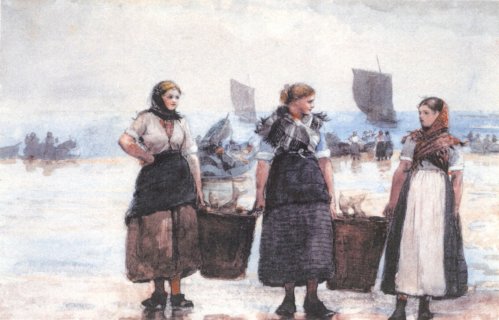
#FineArtFriday: Fisherwomen, Cullercoats by Winslow Homer 1881

Homer,_Winslow_-_'Fisherwomen,_Cullercoats',_1881,_graphite_&amp;_watercolor_on_paperArtist: Winslow Homer  (1836–1910)

Title: Fisherwomen, Cullercoats

Date:   1881

Medium: watercolor and graphite on paper

Dimensions: height: 34.2 cm (13.4 in); width: 49.2 cm (19.3 in)

Collection: Honolulu Museum of Art

What I love about this painting:

Homer shows us a foggy morning at the beach, capturing the quality of light on the strand at Cullercoats, Tyne and Wear, England. He paints the background with an impressionist’s eye and gives us realistic portraits of the working women whose labors fed the country.

The fish baskets are heavy, but they share the load. Their sleeves are rolled up for work, and skirts are shorter than if they were in town—no one wants wet skirts dragging around their ankles.

I love the way he shows these women as they were that day, treating them with respect. During his lifetime, Winslow Homer depicted men and women of all races, slaves and former slaves, and soldiers. He showed us people who worked hard, not giving us caricatures but painting portraits of real people.

Homer loved the sea and traveled widely, painting everywhere he went. Critics sometimes dismiss his work as “calendar art, appealing to the unschooled masses.” But think about it – calendars and magazines often were the only art poor and working-class people had in their homes. If you don’t have access to art, how can you become “schooled” in it? Some art critics are a little too schooled.

If you are interested in knowing more about the art of Winslow Homer, this documentary is excellent: FAKE OR FORTUNE SE1EO4 WINSLOW HOMER – YouTube

About the Artist, via Wikipedia:

Homer started painting with watercolors on a regular basis in 1873 during a summer stay in Gloucester, Massachusetts. From the beginning, his technique was natural, fluid and confident, demonstrating his innate talent for a difficult medium. His impact would be revolutionary. Here, again, the critics were puzzled at first, “A child with an ink bottle could not have done worse.” Another critic said that Homer “made a sudden and desperate plunge into water color painting”. But his watercolors proved popular and enduring, and sold more readily, improving his financial condition considerably. They varied from highly detailed (Blackboard – 1877) to broadly impressionistic (Schooner at Sunset – 1880). Some watercolors were made as preparatory sketches for oil paintings (as for “Breezing Up”) and some as finished works in themselves. Thereafter, he seldom traveled without paper, brushes and water based paints.

As a result of disappointments with women or from some other emotional turmoil, Homer became reclusive in the late 1870s, no longer enjoying urban social life and living instead in Gloucester. For a while, he even lived in secluded Eastern Point Lighthouse (with the keeper’s family). In re-establishing his love of the sea, Homer found a rich source of themes while closely observing the fishermen, the sea, and the marine weather. After 1880, he rarely featured genteel women at leisure, focusing instead on working women. [1]


Credits and Attributions:

Image: Fisherwomen, Cullercoats by Winslow Homer 1881. Wikimedia Commons contributors, “File:Homer, Winslow – ‘Fisherwomen, Cullercoats’, 1881, graphite & watercolor on paper.jpg,” Wikimedia Commons, https://commons.wikimedia.org/w/index.php?title=File:Homer,_Winslow_-_%27Fisherwomen,_Cullercoats%27,_1881,_graphite_%26_watercolor_on_paper.jpg&oldid=721923030 (accessed August 3, 2023).

[1] Wikipedia contributors, “Winslow Homer,” Wikipedia, The Free Encyclopedia, https://en.wikipedia.org/w/index.php?title=Winslow_Homer&oldid=1168361459 (accessed August 3, 2023).

Comments Off on #FineArtFriday: Fisherwomen, Cullercoats by Winslow Homer 1881

Filed under #FineArtFriday

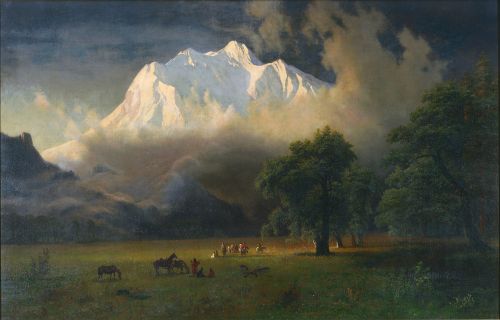
#FineArtFriday: Mount Adams by Albert Bierstadt (revisited)


I live just north of Mount Adams. When you drive down past Mt. St. Helens, you often catch glimpses of this majestic volcano, but it is not usually on the tourist routes. Several of our native tribes call this mountain Klickitat, and some call it Pahto. Although Adams has not erupted in more than 1,000 years, it is not considered extinct.

I find it interesting that while it is the second-highest mountain in Washington State, after Mount Rainier, it is the least well-known to me. As a child, we stayed at Spirit Lake Resort (long before the 1980 eruption of Mt. St. Helens) and often camped at places near Goat Rocks. Sometimes I saw it from afar and wondered but never visited.

My father was an amputee, and 1940s prosthetics were rudimentary at best. He was unable to wear his prosthetic leg and walked on crutches. He adored fishing, but couldn’t hike for any distance, so we trailer-camped in places where he could fish from a boat. While there were camp sites in the Mt. Adams area, one often had to hike into them. But despite Dad’s disability, we traveled every summer and saw as much of our beautiful state as we could.

I don’t know if Bierstadt actually visited Mt. Adams, or painted this from what he was told–he was famous for painting scenery he had never seen and doing it with some accuracy.

Quote from Wikimedia Commons: Albert Bierstadt enjoyed great success in the years surrounding the Civil War, producing finely detailed vistas of nature’s splendor in majestic canvases that were similarly invested with significance beyond their surface appearance.

The first technically advanced artist to portray the American West, Bierstadt offered to a rapidly transforming nation pictures whose spectacular size and fresh, dramatic subject matter supplied a visual correlative to notions of American exceptionalism, while also contributing to the developing concept of Manifest Destiny.

Trained in the highly finished manner of the Düsseldorf Academy, Bierstadt’s precise style imbued his works with a reassuring sense of veracity despite their sublime subjects and occasional liberties with geographic reality. In Mount Adams, Washington, he characteristically combined an impressively scaled natural background with a foreground view of American Indian life, which serves to heighten the picture’s putative realism even as it enhances its exotic appeal.

The implied movement of the clouds and the sunlit figures on horseback similarly off to the right seems to open up the depicted space for the viewer to inhabit, providing an apt pictorial metaphor for the actual occupation and exploitation of the West by the eastern interests that constituted the artist’s clientele.


Credits and Attributions:

Mount Adams by Albert Bierstadt [Public domain], via Wikimedia Commons

Wikimedia Commons contributors, “File:1875, Bierstadt, Albert, Mount Adams, Washington.jpg,” Wikimedia Commons, the free media repository, https://commons.wikimedia.org/w/index.php?title=File:1875,_Bierstadt,_Albert,_Mount_Adams,_Washington.jpg&oldid=272380899 (accessed March 9, 2018).

4 Comments

Filed under #FineArtFriday

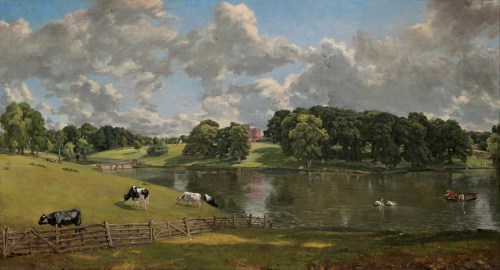
#FineArtFriday: Wivenhoe Park, Essex by John Constable 1816

John_Constable_-_Wivenhoe_Park,_Essex_-_Google_Art_ProjectArtist: John Constable  (1776–1837)

Title: Wivenhoe Park, Essex

Genre: landscape art

Date: 1816

Medium: oil on canvas oil on canvas

Dimensions: height: 56.1 cm (22 in); width: 101.2 cm (39.8 in)

Collection: National Gallery of Art

What I love about this image:

This is the painting that made John Constable’s name. It contains everything he idealized about his native country, England. He gives us a deceptively simple image of a summer’s day, with white clouds drifting above a peaceful scene.

So beautifully composed, and so relaxing. When life is crazy, a Zen picture as painted by a master reminds me to slow down and enjoy the scenery.

About this painting, via Wikipedia:

The National Gallery of Art holds this painting as one of its highlights:

A pleasant sense of ease and harmony pervades this landscape of almost photographic clarity. The large areas of brilliant sunshine and cool shade, the rambling line of the fence, and the beautiful balance of trees, meadow, and river are evidence of the artist’s creative synthesis of the actual site.

The painting was commissioned by the owner of Wivenhoe Park, Major General Francis Slater Rebow, who was among the artist’s first patrons, being a close friend of the artist’s father, Golding Constable. Wivenhoe Park is 200 acres (81 ha) of parkland, purchased by the Rebow family before 1734. Slater-Rebow commissioned several paintings from Constable, including a portrait of the general’s seven-year-old daughter in 1812. She also figures in this painting, in a donkey cart to the left. This painting, finished in September 1816, earned the artist enough money to allow him to marry his long-time love, Mary Bicknell. They married in October 1816.

Constable’s art is always penetrated by longing, melancholy and a yearning for the simple, natural life, for a bucolic, pastoral idyll, to rural subjects and aspects of life in the countryside, a “golden age” when people lived together in harmony with nature, a world on its way of disappearing when he painted his landscapes thanks to the beginning of the Industrial Revolution. He was aware of the issue of urban growth, of urban life’s unpleasantness, which he contrasted to life in the countryside. Constable’s art was rather unconventional for his time, and he loved simple things, a natural landscape without the ruins, dramatic effects or exalted, often excessive feelings, like the ones displayed in the paintings of his contemporary, J. M. W. Turner. His landscapes are flooded by a silvery brilliant light in the water and air and in the sky, and are characterised by a special intensity that is such an important feature of this artist’s works. [1]

About the Artist, via Wikipedia:

John Constable RA (11 June 1776 – 31 March 1837) was an English landscape painter in the Romantic tradition. Born in Suffolk, he is known principally for revolutionising the genre of landscape painting, with his pictures of Dedham Vale, the area surrounding his home – now known as “Constable Country” – which he invested with an intensity of affection. “I should paint my own places best”, he wrote to his friend John Fisher in 1821, “painting is but another word for feeling”.[3]

Constable’s most famous paintings include Wivenhoe Park (1816), Dedham Vale (1821) and The Hay Wain (1821). Although his paintings are now among the most popular and valuable in British art, he was never financially successful. He became a member of the establishment after he was elected to the Royal Academy of Arts at the age of 52. His work was embraced in France, where he sold more than in his native England and inspired the Barbizon school. [2]


Credits and Attributions:

[1] Image: Wikipedia contributors, “Wivenhoe Park (painting),” Wikipedia, The Free Encyclopedia, https://en.wikipedia.org/w/index.php?title=Wivenhoe_Park_(painting)&oldid=1163430201 (accessed July 20, 2023).

[2] Wikipedia contributors, “John Constable,” Wikipedia, The Free Encyclopedia, https://en.wikipedia.org/w/index.php?title=John_Constable&oldid=1162727967 (accessed July 20, 2023).

4 Comments

Filed under #FineArtFriday

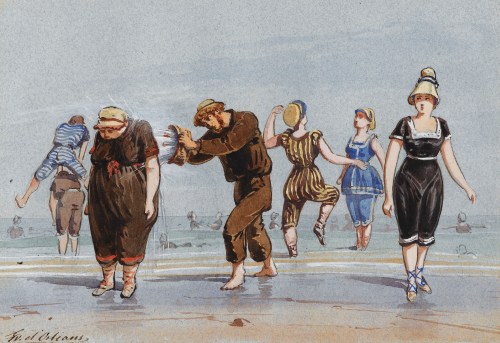
#FineArtFriday: Sur la plage, les bains de mer by François d’Orléans

François_d'Orléans_-_Sur_la_plage,_les_bains_de_merArtist: François d’Orléans, prince de Joinville (1818-1900)

Title: Sur la plage, les bains de mer (English: On the beach sea bathing)

Medium: Watercolor

Date: before 1900

What I love about this painting:

I love the wild sense of humor shown in this portrayal of upper-class Victorian-era people on vacation beside the sea. In the background two young men are clowning around, one leaping over the back of the other. Everyone is having fun, except perhaps the woman being drenched by a bucket of water. So much action! It was a party, and François d’Orléans, Prince de Joinville recorded it with his own unique style.

About the Artist, via Wikipedia:

François d’Orléans, Prince de Joinville (14 August 1818 – 16 June 1900) was the third son of Louis PhilippeKing of the French, and his wife Maria Amalia of Naples and Sicily. An admiral of the French Navy, François was famous for bringing the remains of Napoleon from Saint Helena to France, as well as being a talented artist, with 35 known watercolours.

He married Princess Francisca of Brazil, daughter of Emperor Pedro I and sister of Emperor Pedro II. The dowry received by François upon the marriage became the Brazilian city of Joinville.

François and Francisca’s grandson Jean went on to become the Orléanist claimant to the extinct French throne, a claim passed on to his son, grandson and now great-grandson Jean, Count of Paris, current Orléanist claimant to the French crown.


Credits and Attributions:

Image: Sur la plage, les bains de mer  by François d’Orléans, prince de Joinville. Wikimedia Commons contributors, “File:François d’Orléans – Sur la plage, les bains de mer.jpg,” Wikimedia Commons, https://commons.wikimedia.org/w/index.php?title=File:Fran%C3%A7ois_d%27Orl%C3%A9ans_-_Sur_la_plage,_les_bains_de_mer.jpg&oldid=757902107 (accessed July 13, 2023).

Wikipedia contributors, “François d’Orléans, Prince of Joinville,” Wikipedia, The Free Encyclopedia, https://en.wikipedia.org/w/index.php?title=Fran%C3%A7ois_d%27Orl%C3%A9ans,_Prince_of_Joinville&oldid=1160992832 (accessed July 13, 2

4 Comments

Filed under #FineArtFriday, writing