Category Archives: #FineArtFriday

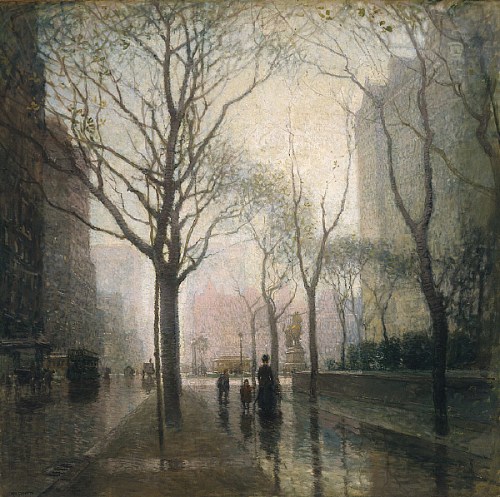
#FineArtFriday: The Plaza After the Rain by Paul Cornoyer

Paul_Cornoyer_-_The_Plaza_After_RainArtist: Paul Cornoyer  (1864–1923)

Title: The Plaza After Rain

Date: Before 1910

Medium: oil on canvas

Dimensions: 59 1/4 x 59 1/4 in. (150.5 x 150.5 cm)

Collection: Saint Louis Art Museum, Saint Louis, Missouri, United States

What I love about this painting:

Rain is a near-constant companion during a Pacific Northwest winter. Paul Cornoyer’s The Plaza After Rain depicts New York City, which is on the other side of the continent from me, and it takes place in a different era. But he shows the way rain is in early spring no matter where in the northern US you reside.

The sky is dark, but the trees are just beginning to leaf out. The rain is passing and the streets are wet, but a hint of blue is showing through the dark sky. When you see this painting, you see the story of a cold spring day. Yet, one has the feeling that sunshine could happen any minute.

Impressionism is flash fiction on a canvas. All the important things are there, everything the eye needs to have a perfect vision of the mood, the setting, and characters at that moment in time. The important things at that moment are depicted within the piece, but with economy.

The St. Louis Art Museum says this about The Plaza After the Rain:

A drizzling rain creates watery reflections on the streets and sidewalks along the Grand Army Plaza in Manhattan. The rain hampers our view down the vista, though the moody tones of pinks, grays, and blues make up for this loss. The light in the distance offers a hazy glimpse of the southeast corner of Central Park, with its beloved bronze statue of Civil War general William Tecumseh Sherman. [2]

About the Author, via Wikipedia:

Paul Cornoyer (1864–1923) was an American painter, currently best known for his popularly reproduced painting in an Impressionisttonalist, and sometimes pointillist style.

Born in St. Louis, Missouri, Cornoyer began painting in Barbizon style and first exhibited in 1887. In 1889, He moved to Paris, where he studied at the Académie Julian alongside Jules Lefebvre and Jean-Joseph Benjamin-Constant. After returning from his studies in Paris in 1894, Cornoyer was heavily influenced by the American tonalists. At the urging of William Merritt Chase, he moved to New York City in 1899. In 1908, the Albright–Knox Art Gallery (formerly the Albright Gallery) hosted a show of his work. In 1909, he was elected into the National Academy of Design as an Associate Academician. He taught at Mechanics Institute of New York and in 1917, he moved to Massachusetts, where he continued to teach and paint.

Cornoyer received a retrospective exhibition entitled Paul Cornoyer: American Impressionist at the Lakeview Center for the Arts and Sciences in Peoria, Illinois in 1973. The exhibit drew heavily from the collection of Dr. and Mrs. Lawrence Ashby, who loaned multiple paintings to the exhibit, as well as over 20 works on paper. [1]


Credits and Attributions:

IMAGE: The Plaza After the Rain by Paul Cornoyer PD|100, Wikimedia Commons contributors, “File:Paul Cornoyer – The Plaza After Rain.jpg,” Wikimedia Commons, https://commons.wikimedia.org/w/index.php?title=File:Paul_Cornoyer_-_The_Plaza_After_Rain.jpg&oldid=345336218 (accessed January 18, 2024).

[1] Wikipedia contributors, “Paul Cornoyer,” Wikipedia, The Free Encyclopedia, https://en.wikipedia.org/w/index.php?title=Paul_Cornoyer&oldid=1118249028 (accessed January 18, 2024).

[2] St. Louis Art Museum contributors, the Plaza After the Rain by Paul Cornoyer, The Plaza after the Rain – Saint Louis Art Museum (slam.org) (accessed January 18, 2024).

Comments Off on #FineArtFriday: The Plaza After the Rain by Paul Cornoyer

Filed under #FineArtFriday, writing

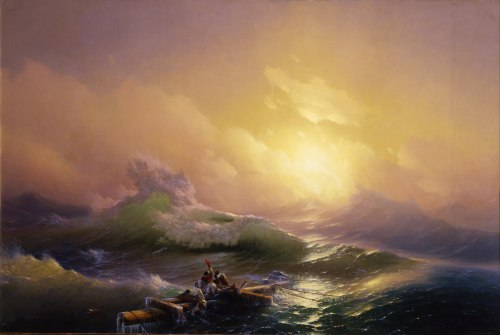
#FineArtFriday: The Ninth Wave by Ivan Aivazovsky 1850

Hovhannes_Aivazovsky_-_The_Ninth_Wave_-_Google_Art_ProjectArtist: Ivan Aivazovsky (baptized Hovhannes Aivazovsky) (1817 – 1900)
Title: The Ninth Wave

Genre: marine art

Date: 1850

Medium: oil on canvas oil on canvas

Dimensions: height: 2,210 mm (87 in); width: 3,320 mm (10.89 ft)

Collection: Russian Museum

What I love about this painting:

Aivazovsky tells a story here, an epic tale showing the power and emotion of the situation. These sailors are lost at sea; their ship has gone down in a storm and even though the sun is shining in the distance, a wave of catastrophic proportions is bearing down on them.

It’s not the first such wave they’ve survived, and it won’t be the last. But that sun shining in the distances is a beacon, and they cling to hope as desperately as they do their broken mast.

About this painting via Wikipedia:

The title refers to an old sailing expression referring to a wave of incredible size that comes after a succession of incrementally larger waves.

It depicts a sea after a night storm and people facing death attempting to save themselves by clinging to debris from a wrecked ship. The debris, in the shape of the cross, appears to be a Christian metaphor for salvation from the earthly sin. The painting has warm tones, which reduce the sea’s apparent menacing overtones and a chance for the people to survive seems plausible. This painting shows both the destructiveness and beauty of nature. [1]

About the Artist via Wikipedia:

Ivan Aivazovsky was born on 29 July [O.S. 17 July] 1817 in the city of Feodosia (Theodosia), Crimea, Russian Empire. In the baptismal records of the local St. Sargis Armenian Apostolic Church, Aivazovsky was listed as Hovhannes, son of Gevorg Aivazian. He became known as Aivazovsky since c. 1840, while in Italy. He signed an 1844 letter with an Italianized rendition of his name: “Giovani Aivazovsky”.

After meeting Aivazovsky in person, Anton Chekhov wrote a letter to his wife on 22 July 1888 describing him as follows:

Aivazovsky himself is a hale and hearty old man of about seventy-five, looking like an insignificant Armenian and a bishop; he is full of a sense of his own importance, has soft hands and shakes your hand like a general. He’s not very bright, but he is a complex personality, worthy of a further study. In him alone there are combined a general, a bishop, an artist, an Armenian, an naive old peasant, and an Othello.

The house in Feodosia, where Aivazovsky lived between 1845 and 1892. It is now an art gallery.

After traveling to Paris with his wife, in 1892 he made a trip to the United States, visiting Niagara Falls in New York and Washington D.C. In 1896, at 79, Aivazovsky was promoted to the rank of full privy councillor.

Aivazovsky was deeply affected by the Hamidian massacres that took place in the Armenian-inhabited areas of the Ottoman Empire between 1894 and 1896. He painted a number of works on the subject such as The Expulsion of the Turkish Ship, and The Armenian Massacres at Trebizond (1895). He threw the medals given to him by the Ottoman Sultan into the sea and told the Turkish consul in Feodosia: “Tell your bloodthirsty master that I’ve thrown away all the medals given to me, here are their ribbons, send it to him and if he wants, he can throw them into the seas painted by me.”  He created several other paintings capturing the events, such as Lonely Ship and Night. Tragedy in the Sea of Marmara (1897).

He spent his final years in Feodosia. In the 1890s, thanks to his efforts a commercial port (ru) was established in Feodosia and linked to the railway network of the Russian Empire. The railway station, opened in 1892, is now called Ayvazovskaya [ru] and is one of the two stations within the city of Feodosia.

Aivazovsky also supplied Feodosia with drinking water. [2]


Credits and Attributions:

IMAGE: File: Hovhannes Aivazovsky – The Ninth Wave – Google Art Project.jpg Hovhannes Aivazovsky – The Ninth Wave – Google Art Project – The Ninth Wave – Wikipedia (accessed January 10, 2024).

[1]Wikipedia contributors, “The Ninth Wave,” Wikipedia, The Free Encyclopedia, https://en.wikipedia.org/w/index.php?title=The_Ninth_Wave&oldid=1160319059 (accessed January 10, 2024).

[2] Wikipedia contributors, “Ivan Aivazovsky,” Wikipedia, The Free Encyclopedia, https://en.wikipedia.org/w/index.php?title=Ivan_Aivazovsky&oldid=1194332468 (accessed January 10, 2024).

4 Comments

Filed under #FineArtFriday

#FineArtFriday: An Out-of-Doors Study by John Singer Sargent (revisited)

Artist: John Singer Sargent  (1856–1925)

Title: An Out-of-Doors Study

Description: English: Paul César Helleu Sketching with his wife Alice

Signature bottom right: John S. Sargent

Date: 1889

Medium: oil on canvas

Dimensions: Height: 65.9 cm (25.9 ″); Width: 80.7 cm (31.7 ″)

The weather has been dark and dreary here in the Pacific Northwest. I need sunny day, and I remembered this image. An Out-of-Doors Study, 1889, is by expatriate American artist, John Singer Sargent. It depicts fellow artist and great friend, Paul César Helleu sketching with his wife Alice Guérin. What a lovely day it was, for them to be sitting on the grass, enjoying a carefree moment in life.

What I love about this painting:

This painting depicts a day in the life of two great artists. The grass looks very like that which grows beside streams in my part of the world. The colors are that mix of green and brown that long grass has when summer is just beginning. The blue sky is reflected in the water. They had taken advantage of a fine day in late May or June perhaps, fortunate to have an outing before high summer turns the meadow grass crisp and brown.

The quality of light that day was perfect for a picnic beside the water. One can imagine the two artists working on their individual projects and chatting, having a relaxing lunch, and then taking a quiet walk. We can even wonder if, later, they might have taken the canoe out.

January has been overcast and rainy with little chance of seeing sunshine. I could use a day like this, a picnic beneath blue skies, and a gathering of friends beside a quiet pond.

About the artist, via Wikipedia:

Sargent’s early enthusiasm was for landscapes, not portraiture, as evidenced by his voluminous sketches full of mountains, seascapes, and buildings. Carolus-Duran’s expertise in portraiture finally influenced Sargent in that direction. Commissions for history paintings were still considered more prestigious, but were much harder to get. Portrait painting, on the other hand, was the best way of promoting an art career, getting exhibited in the Salon, and gaining commissions to earn a livelihood.

In a time when the art world focused, in turn, on ImpressionismFauvism, and Cubism, Sargent practiced his own form of Realism, which made brilliant references to VelázquezVan Dyck, and Gainsborough.


Credits and Attributions:

Wikimedia Commons contributors, “File:Sargent – Paul Helleu Sketching with his Wife.jpg,” Wikimedia Commons, the free media repository, https://commons.wikimedia.org/w/index.php?title=File:Sargent_-_Paul_Helleu_Sketching_with_his_Wife.jpg&oldid=273586527 (accessed December 5, 2019).

Wikipedia contributors, “John Singer Sargent,” Wikipedia, The Free Encyclopedia, https://en.wikipedia.org/w/index.php?title=John_Singer_Sargent&oldid=927728162 (accessed December 5, 2019).

2 Comments

Filed under #FineArtFriday

#FineArtFriday: The Merry Family, by Jan Steen (revisited)

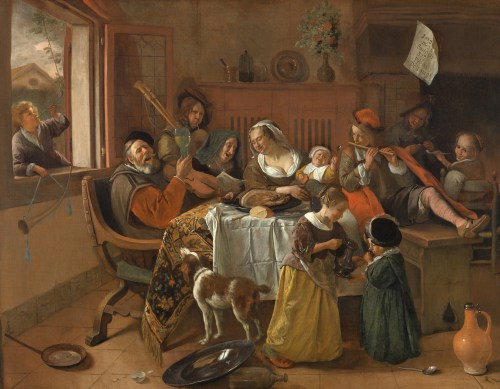
Jan Steen was fond of painting peasants and ordinary people, and this picture is a good example of that.

What I love about this image is the chaos. Is this a New Year’s party? I hope so.

The clutter of pans and dishes heedlessly fallen to the floor, the boisterous enjoyment of wine and song, and the obvious lack of parental restraint is wonderfully depicted. The numerous children are smoking and drinking to excess, vices that weren’t acceptable diversions for youngsters in those days any more than they are now. The baby is exceedingly chubby, which was uncommon and represents the vice of gluttony–in one hand it holds bread and in the other it waves a spoon.

I suspect the children grew up with a similar love of wine and song as their parents.

The note on the wall contains the moral of the story. According to the Rijksmuseum website, “The note hanging from the mantelpiece gives away the moral of the story: ‘As the old sing, so shall the young twitter.’ What will become of the children if their parents set the wrong example?”

The Age of the Puritan had swept across Europe and while it was waning in the mid-seventeenth century, puritanism had influenced life in Holland as much as elsewhere. This painting is a wonderful visual exhortation reminding the good people to live a sober life. Steen himself was not a puritan, as he was born into a family of brewers and ran taverns and breweries off and on throughout his life. But he did need to sell his paintings as he was never a successful businessman, and his allegorical paintings were quite popular.

Quote from Wikipedia: Daily life was Jan Steen’s main pictorial theme. Many of the genre scenes he portrayed, as in The Feast of Saint Nicholas, are lively to the point of chaos and lustfulness, even so much that “a Jan Steen household,” meaning a messy scene, became a Dutch proverb (een huishouden van Jan Steen). Subtle hints in his paintings seem to suggest that Steen meant to warn the viewer rather than invite him to copy this behaviour. Many of Steen’s paintings bear references to old Dutch proverbs or literature. He often used members of his family as models, and painted quite a few self-portraits in which he showed no tendency of vanity.


Credits and Attributions:

The Merry Family, Jan Steen, 1668 PD|100 via Wikimedia Commons

Moral (English translation) quoted from Rijksmuseum website,  https://www.rijksmuseum.nl/en/collection/SK-C-229, accessed 17 May 2018.

Wikipedia contributors. “Jan Steen.” Wikipedia, The Free Encyclopedia. Wikipedia, The Free Encyclopedia, 3 Jan. 2018. Web. 17 May. 2018.

Comments Off on #FineArtFriday: The Merry Family, by Jan Steen (revisited)

Filed under #FineArtFriday

#FineArtFriday: Christmas Eve, Chromolithograph by Joseph C. Hoover & Sons (revisited)

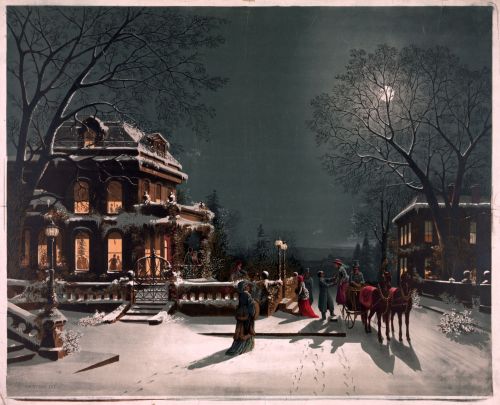
No_Known_Restrictions_Christmas_Eve_by_J._Hoover,_no_date_LOC_2122063062

Description: Christmas Eve, chromolithograph by J. C. Hoover and Sons

Date: 1880

This is a quintessential calendar or Christmas card picture, and I love it. It appeals to every sentiment a viewer might have of home and community and Christmas traditions.

This painting has many nostalgic style elements, which is why I find it so appealing. It has a Courier and Ives feel to it, and is reminiscent of George Henry Durie’s work, although it was painted seventeen years after his death. I don’t know who the artist was that painted this picture as he or she isn’t credited. It could have been one of the sons, or one of the many women artists employed in the industry at the time.

A significant number of artists employed in the publishing industry during the 19th and early 20th century were women. They painted illustrations for greeting cards, books, magazines, and newspapers. Often women were not acknowledged as the original creators, although some, like Mary Cassatt, did achieve fame and credit for their work.

About the publisher, via Art and Antiques Gallery’s website:

Hoover & Sons issued popular prints for the masses in the last decade of the 19th century and the first decade of the 20th century. This was a business much like Currier & Ives, though Hoover & Sons issued chromolithographs. Joseph Hoover was one of the few native-born Americans who achieved success with chromolithography. Hoover started by making elaborate wood frames in Philadelphia in 1856, but within a decade or so he began to produce popular prints. Initially he mostly worked for other publishers, including Duval & Hunter, and he worked with noted Philadelphia artist James F. Queen. He also issued a few hand-colored, popular prints of considerable charm. During the Centennial, Hoover won a medal for excellence for his chromolithographs after Queens renderings.

In the 1880s, Hoover began to print chromolithographs, installing a complete printing plant by 1885. By the end of the century, his firm was one of the largest print publishers in the county, with an average annual production of between 600,000 to 700,000 pictures. Using chromolithography, Hoover was able to produce attractive, colorful prints that were still affordable for anyone to use as decoration for home and office. The audience for Hoover’s prints was quite wide, extending throughout the United States, and overseas to Canada, Mexico, England and Germany. The subjects issued by the firm are extensive, including genre scenes, still life images, views of American locations, and generic landscapes, including a series of charming winter scenes. [1]

About Chromolithography, via Wikipedia:

Chromolithography is a chemical process. The process is based on the rejection of water by grease. The image is applied to stone, grained zinc or aluminium surfaces, with a grease-based crayon or ink. Limestone and zinc are two commonly used materials in the production of chromolithographs, as aluminium corrodes easily. After the image is drawn onto one of these surfaces, the image is gummed-up with a gum arabic solution and weak nitric acid to desensitize the surface. Before printing, the image is proofed before finally inking up the image with oil-based transfer or printing ink. In the direct form of printing, the inked image is transferred under pressure onto a sheet of paper using a flat-bed press. The offset indirect method uses a rubber-covered cylinder that transfers the image from the printing surface to the paper.

Alois Senefelder, the inventor of lithography, introduced the subject of colored lithography in his 1818 Vollstaendiges Lehrbuch der Steindruckerey (A Complete Course of Lithography), where he told of his plans to print using colour and explained the colours he wished to be able to print someday. Although Senefelder recorded plans for chromolithography, printers in other countries, such as France and England, were also trying to find a new way to print in colour. Godefroy Engelmann of Mulhouse in France was awarded a patent on chromolithography in July 1837, but there are disputes over whether chromolithography was already in use before this date, as some sources say, pointing to areas of printing such as the production of playing cards. [2]


Credits and Attributions:

[1] Quote from Art and Antiques Gallery https://www.pbase.com/artandantiquesgallery/joseph_hoover_and_sons_prints (accessed December 24, 2021).

[2] Wikipedia contributors, “Chromolithography,” Wikipedia, The Free Encyclopedia, https://en.wikipedia.org/w/index.php?title=Chromolithography&oldid=1058870233 (accessed December 24, 2021).

Image Credit: Public Domain. Library of Congress via pingnews. Additional information from source: TITLE: Christmas Eve CALL NUMBER: PGA – Hoover, J.–Christmas Eve (D size) [P&P] REPRODUCTION NUMBER: LC-DIG-01601 (digital file from original print) LC-USZ62-49683 (b&w film copy neg.) RIGHTS INFORMATION: No known restrictions on publication. MEDIUM: 1 print. CREATED/PUBLISHED: [no date recorded on shelflist card]

2 Comments

Filed under #FineArtFriday, writing

#FineArtFriday: Winter landscape with bullfinches by Bruno Liljefors 1891

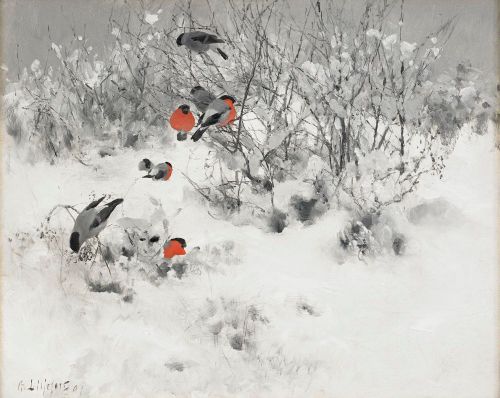
Bruno_Liljefors_-_Winter_landscape_with_bullfinches_1891Artist: Bruno Liljefors  (1860–1939)

Title: English: Winter landscape with bullfinches

Date: 1891

Medium: oil on canvas

Dimensions: height: 40 cm (15.7 in); width: 50 cm (19.6 in)

What I love about this painting:

This is a Christmas card kind of scene, and I’m sure I have seen it featured on many cards over the years. However, the birds are what attracted me to this painting. Birds of all varieties enthrall me, and these birds are gorgeous.

I love the colors of these bullfinches, love the natural way they are shown roosting in the shrubbery. These birds are European and are different from the bright yellow goldfinches I know here in the Pacific Northwest.

My childhood home had begun its life as a one room hunting cabin that had been converted to a mid-century rambler and turned into a family home in the 1950s. It was situated on a large stretch of beach on the southeastern shore of Black Lake near Olympia, Washington. Our property was centered in a thick forest of Douglas fir, western red cedars, and hemlock trees.

My parents were avid gardeners, and besides the large veggie garden and flower beds, we had many ornamental shrubs. Native Oregon Grape, salmon berries, and salal bordered the edges of our property.

One of my earliest memories is that of watching the winter birds. First, they perched in shrubs, then they flew off, and then they were back again.

Dark-eyed juncos, sparrows, and chickadees gathered in the shrubs. Larger birds, such as crows, owls, and ospreys roosted in the trees. On the lake, ducks, Canada geese, and grebes swam along with the occasional swan or loon.

Birdwatching provided endless entertainment during a time when our television antenna only picked up the signals from two stations. While we did see shows like Star Trek, Batman, Get Smart, and the Addams Family in the evenings, TV overall was a wash, as storms had cut the power to our home many times. Some winters were worse than others, and sometimes, we were without power for several weeks, waiting for the linemen to hook us back up.

To this day, birdwatching is one of my family’s favorite things to do.

About the Artist, via Wikipedia:

Bruno Andreas Liljefors, 14 May 1860 – 18 December 1939) was a Swedish artist. He is perhaps best known for his nature and animal motifs, especially with dramatic situations. He was the most important and probably most influential Swedish wildlife painter of the late nineteenth and early twentieth century. He also drew some sequential picture stories, making him one of the early Swedish comic creators. [1]

To read more about the artist, go to Bruno Liljefors – Wikipedia.


Credits and Attributions:

IMAGE: Wikimedia Commons contributors, “File:Bruno Liljefors – Winter landscape with bullfinches 1891.jpg,” Wikimedia Commons, https://commons.wikimedia.org/w/index.php?title=File:Bruno_Liljefors_-_Winter_landscape_with_bullfinches_1891.jpg&oldid=812150991 (accessed December 14, 2023).

[1] Wikipedia contributors, “Bruno Liljefors,” Wikipedia, The Free Encyclopedia, https://en.wikipedia.org/w/index.php?title=Bruno_Liljefors&oldid=1170413866 (accessed December 14, 2023).

Comments Off on #FineArtFriday: Winter landscape with bullfinches by Bruno Liljefors 1891

Filed under #FineArtFriday

#FineArtFriday: Hunters in the Snow by Pieter Brueghel the Elder 1565

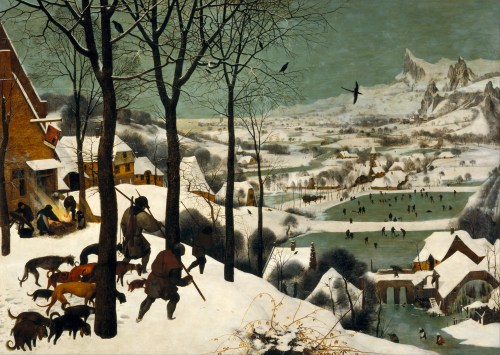
Pieter_Bruegel_the_Elder_-_Hunters_in_the_Snow_(Winter)_-_Google_Art_ProjectArtist: Pieter Brueghel the Elder (1526/1530–1569)
Title: English: Hunters in the Snow (German: Jäger im Schnee) (Winter)

Date: 1565

Medium: oil on oak wood

Dimensions: height: 1,170 mm (46.06 in); width: 1,620 mm (63.77 in)

Collection: Kunsthistorisches Museum

What I love about this painting:

This is one of Pieter Brueghel the Elder’s most famous paintings. Even if one doesn’t know who originally painted it, they have very likely seen it at some point, perhaps on a calendar or a Christmas card.

Critics didn’t praise his work, as it is unabashedly primitive, created for the common person’s enjoyment. Nonetheless, his work is still highly prized by collectors. Even now, four centuries after his era, ordinary people can relate to his work because he had such a sense of humor and the ability to show the truth about humanity and inhumanity in his work.

He lived during a time of religious revolution in the Netherlands, and walking the line between both factions must have been difficult. Some have said that Bruegel (and possibly his patron) were attempting to portray an ideal of what country life used to be or what they wish it to be.

I disagree. On the surface and from a distance, this is a bucolic scene depicting ordinary peasants enjoying the winter. But when you look deeper, really look at it, you can see the irony of it, the honesty that Brueghel hid in plain sight.

Brueghel used symbolism to convey paradox and gallows humor in every painting. Winter was harsh and for the average person, survival required a lot of work, sometimes for nothing.

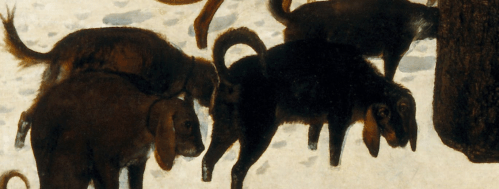
He shows us the hunters returning with empty game bags, the lone corpse of a skinny fox, and little else. One dog looks at us with starving eyes, as if hoping for scraps.

detai_Dogs_hunters_in_the_snow_Brueghel

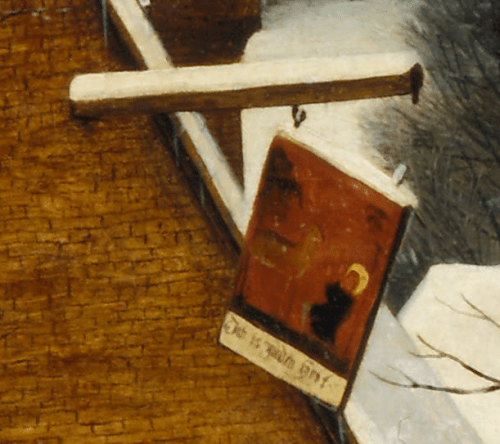
The tavern’s sign is about to fall down, a large hint that all is not well. That symbolic broken sign tells us the owners are bankrupt.

detai_sign_hunters_in_the_snow_Brueghel

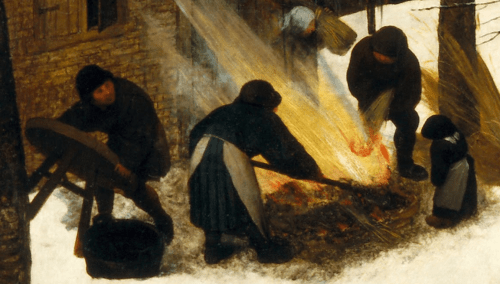
The owners are cooking outside, directly in front of the door. A woman brings a bundle of straw out of the inn to use as fuel, while in the distance an ox-drawn wagon is heavily laden with firewood. Where is it going? Not to their inn, that is for sure. And most intriguingly, a man is carrying a table away. Is he the tax collector? A thief?

detai_innkeeprs_cooking_hunters_in_the_snow_Brueghel

A rabbit has crossed the hunters’ path and evaded their snares.

detai_rabbit_tracks_hunters_in_the_snow_Brueghel

Birds of ill omen roost in the trees above the inn and the hunters and fly above the revelers, a portent of worse days to come.

detai_birds_hunters_in_the_snow_Brueghel

But Brueghel’s people have hope and faith that things will improve. In the distance (the future) people are playing winter games.

detai_skaters_hunters_in_the_snow_BrueghelBut they are indistinct and far away, shown in a fantastic, mountainous landscape, rather than the flat terrain of the Netherlands. It is almost as if they are visions of what winter could be when the harvest had been good, rather than the truth of the lone fox, hounds with empty bellies, a bankrupt tavern, and the rabbit that got away.

About this painting, via Wikipedia, the Fount of All Knowledge:

The Hunters in the Snow (Dutch: Jagers in de Sneeuw), also known as The Return of the Hunters, is a 1565 oil-on-wood painting by Pieter Bruegel the Elder. The Northern Renaissance work is one of a series of works, five of which still survive, that depict different times of the year. The painting is in the collection of the Kunsthistorisches Museum in ViennaAustria. This scene is set in the depths of winter during December/January.

The painting shows a wintry scene in which three hunters are returning from an expedition accompanied by their dogs. By appearances the outing was not successful; the hunters appear to trudge wearily, and the dogs appear downtrodden and miserable. One man carries the “meager corpse of a fox” illustrating the paucity of the hunt. In front of the hunters in the snow are the footprints of a rabbit or hare—which has escaped or been missed by the hunters. The overall visual impression is one of a calm, cold, overcast day; the colors are muted whites and grays, the trees are bare of leaves, and wood smoke hangs in the air. Several adults and a child prepare food at an inn with an outside fire. Of interest are the jagged mountain peaks which do not exist in Belgium or Holland. [1]


Credits and Attributions:

Wikimedia Commons contributors, “File:Pieter Bruegel the Elder – Hunters in the Snow (Winter) – Google Art Project.jpg,” Wikimedia Commons, https://commons.wikimedia.org/w/index.php?title=File:Pieter_Bruegel_the_Elder_-_Hunters_in_the_Snow_(Winter)_-_Google_Art_Project.jpg&oldid=723208718 (accessed December 6, 2023).

[1] Wikipedia contributors, “The Hunters in the Snow,” Wikipedia, The Free Encyclopedia, https://en.wikipedia.org/w/index.php?title=The_Hunters_in_the_Snow&oldid=1186886152 (accessed December 6, 2023).

Comments Off on #FineArtFriday: Hunters in the Snow by Pieter Brueghel the Elder 1565

Filed under #FineArtFriday, writing

#FineArtFriday: African Violet Skies by Clark Thomas Carlton

African_Violet_Skies_by_Clark_Thomas_CarltonTITLE: African Violet Skies

BY: Clark Thomas Carlton

MEDIUM: Acrylics on canvas

DATE: ca. 2016

What I love about this painting:

Today we’re dipping into 21st century fantasy landscape art. African Violet Skies by Clark Thomas Carlton is an explosion of color and form. The colors are so intense, I feel as if I could taste them.

I love how delicate the trees and foliage are as compared to the fierce thrust of the landscape. The mountains seem to burst through the earth at high speed, reaching for the incredible night sky, as if they would touch the moon.

This is true mastery of storytelling in an image as well as form and color. He gives us drama, and romance, and violence, and above it all, the moon softly gliding behind the delicate clouds, reflected on the serene stream below.

This painting is exactly what I need after four days of thick fog that refused to lift, followed by eternal rain.

About the Artist, via Wikipedia, the free encyclopedia

Clark Thomas Carlton is a novelist, playwright, and a screen and television writer living in Los Angeles. He has also worked as a producer of reality television. Carlton is best known for his science fiction/fantasy novel Prophets of the Ghost Ants published by HarperCollins Voyager in 2016.

Carlton is the author of Prophets of the Ghost Ants, Book 1 of the Antasy Series published by HarperCollins Voyage on December 13, 2016.  The indie version of the book was named a Best of 2011 by Kirkus Reviews.

In 1997, Carlton was awarded the Drama-Logue Critics Award for his play Self Help or the Tower of Psychobabble along with playwrights Neil Simon and Henry Ong. The play, a satire of the psychotherapy industry, was performed in Santa Monica, Palm Springs, Los Angeles and West Hollywood and directed by Michael Kearns and was also produced in Chicago.

Carlton is a painter who embraces the description of his work as “Grandma Moses on acid”. His work has been displayed through the Palm Springs Art Museum Annex through the Palm Springs Arts Council.

In December 1999, Carlton released an album of songs titled Salt Water through CD baby where he accompanied himself on acoustic guitar.  At present he is at work on Gardens of Babylon, a synth pop opera about the building of the Hanging Gardens of Babylon. The opera was written with his partner, Mike Dobson, an Emmy award winning music supervisor and composer on the daytime drama, the Young and the Restless. [1]


Credits and Attributions:

IMAGE: African Violet Skies by Clark Thomas Carlton. Wikimedia Commons contributors, “File:African Violet Skies by Clark Thomas Carlton.jpg,” Wikimedia Commons, https://commons.wikimedia.org/w/index.php?title=File:African_Violet_Skies_by_Clark_Thomas_Carlton.jpg&oldid=785979611 (accessed November 30, 2023).

[1] Wikipedia contributors, “Clark Thomas Carlton,” Wikipedia, The Free Encyclopedia, https://en.wikipedia.org/w/index.php?title=Clark_Thomas_Carlton&oldid=1171925222 (accessed November 30, 2023).

1 Comment

Filed under #FineArtFriday

#FineArtFriday: Peasant Wedding, David Teniers II (revisited)

Today is the day after Thanksgiving here in the US. Many people are out doing their Christmas shopping or looking for Black Friday bargains.

But not my husband and me. We will rest up, enjoy leftovers, and visit the storage unit to pick up our bin full of Christmas decorations. Maybe we’ll decorate the balcony, offer a little cheer to the neighbors across the way.

I love today’s painting, and yesterday’s family gathering made me think of revisiting it. The Peasant Wedding by the Flemish painter, print maker, David Teniers the Younger, is full of movement and life, and shows real people having a great party, not unlike we do in our modern world.

The musicians are playing, some people are singing, some are talking, and some are dancing. Most are eating and just enjoying themselves. A few of the men are becoming a little familiar with the ladies, who are not really having any of that, thank you. A few people have indulged a little too much.

Even the dog is having a good time.

Teniers was a prolific and skilled artist, a man remembered today as much for his lofty social ambitions as he is for the quantity and excellence of his work. He wanted to be a nobleman; indeed he once falsely laid claim to being descended from a noble line. Several times he nearly succeeded in this ambition, but nobility was one accolade he never achieved.

This world can be a hard place for some people to live. I am fortunate to be safe and well-fed, luxuries I thank God for every day. Wherever you are in this big world, I hope you have plenty to give thanks for.

About David Teniers II, from Wikipedia:

Teniers married into the famous Brueghel artist family when Anna Brueghel, daughter of Jan Brueghel the Elder, became his wife on 22 July 1637. Rubens, who had been the guardian of Anna Brueghel after her father’s death, was a witness at the wedding.

Through his marriage Teniers was able to cement a close relationship with Rubens who had been a good friend and frequent collaborator with his wife’s father. This is borne out by the fact that at the baptism of the first of the couple’s seven children David Teniers III, Rubens’ second wife, Hélène Fourment was the godmother.

Teniers’ wife died on 11 May 1656. On 21 October of the same year the artist remarried. His second wife was Isabella de Fren, the 32-year-old daughter of Andries de Fren, secretary of the Council of Brabant. It has been suggested that Teniers’ main motive for marrying the ‘spinster’ was her rather elevated position in society. His second wife also brought him a large dowry. The couple had four children, two sons and two daughters. His second wife’s attitude to Teniers’ children from his first marriage would later divide the family in legal battles.

At the behest of his Antwerp colleagues of the Guild of Saint Luke, Teniers became the driving force behind the foundation of the Academy in Antwerp, only the second of such type of institution in Europe after the one in Paris. The artist used his connections and sent his son David to Madrid to assist in the negotiation to successfully obtain the required licence from the Spanish King. There were great celebrations in Antwerp when, on 26 January 1663, Teniers came from Brussels with the royal charter creating the Antwerp Royal Academy of Fine Arts, the existence of which was due entirely to his persistence.

Teniers petitioned the king of Spain to be admitted to the aristocracy but gave up when the condition imposed was that he should give up painting for money.

He was an innovator in a wide range of genres such as history, genre, landscapeportrait and still life. He is now best remembered as the leading Flemish genre painter of his day


Credits and Attributions:

Wikimedia Commons contributors, “File:David Teniers de Jonge – Peasant Wedding (1650).jpg,” Wikimedia Commons, the free media repository, https://commons.wikimedia.org/w/index.php?title=File:David_Teniers_de_Jonge_-_Peasant_Wedding_(1650).jpg&oldid=225700063 (accessed November 2, 2018).

Wikipedia contributors, “David Teniers the Younger,” Wikipedia, The Free Encyclopedia, https://en.wikipedia.org/w/index.php?title=David_Teniers_the_Younger&oldid=858638339 (accessed November 2, 2018).

1 Comment

Filed under #FineArtFriday

#FineArtFriday: Two Watermills and an Open Sluice by Jacob van Ruisdael 1653

Jacob_Isaacksz._van_Ruisdael_-_Two_Watermills_and_an_Open_Sluice_-_WGA20479Artist: Jacob van Ruisdael  (1628/1629–1682)

Title: Two Watermills and an Open Sluice

Genre: landscape art

Date: 1653

Medium: oil on canvas

Dimensions: height: 664 mm (26.1 in)

Collection: Getty Center

What I Love about this painting:

This painting is the perfect writing prompt. Peaceful and serene, the scene shows us two watermills opposite each other on the stream, sharing the power of the water. These mills were examples of the highest technology of that time, and the families who owned them were prosperous middle-class people. Very likely they were literate, well-respected members of the local community.

Were these mills owned by the same family?

Or were they owned by rivals, competing to grind the grain produced by the local farmers? Is one a grist mill and the other a lumber mill? Or a weaver’s mill housing looms?

Was there a love story behind their being so close to each other, perhaps a Romeo and Juliet-style romance? (Tragedy averted, of course, or it wouldn’t be a romance.)

This is a wonderful painting, a window into the past.

About the artist, via Wikipedia, the free encyclopedia:

Jacob Isaackszoon van Ruisdael (Dutch pronunciation: [ˈjaːkɔp fɑn ˈrœyzˌdaːl] ; c. 1629 – 10 March 1682) was a Dutch painter, draughtsman, and etcher. He is generally considered the pre-eminent landscape painter of the Dutch Golden Age, a period of great wealth and cultural achievement when Dutch painting became highly popular.

Prolific and versatile, Ruisdael depicted a wide variety of landscape subjects. From 1646 he painted Dutch countryside scenes of remarkable quality for a young man. After a trip to Germany in 1650, his landscapes took on a more heroic character. In his late work, conducted when he lived and worked in Amsterdam, he added city panoramas and seascapes to his regular repertoire. In these, the sky often took up two-thirds of the canvas. In total he produced more than 150 Scandinavian views featuring waterfalls.

Ruisdael’s only registered pupil was Meindert Hobbema, one of several artists who painted figures in his landscapes. Hobbema’s work has at times been confused with Ruisdael’s. Ruisdael always spelt his name thus: Ruisdael, not Ruysdael.

Ruisdael’s work was in demand in the Dutch Republic during his lifetime. Today it is spread across private and institutional collections around the world; the National Gallery in London, the Rijksmuseum in Amsterdam, and the Hermitage Museum in St. Petersburg hold the largest collections. Ruisdael shaped landscape painting traditions worldwide, from the English Romantics to the Barbizon school in France, and the Hudson River School in the US, and influenced generations of Dutch landscape artists. [1]

To read more about this artist, go to Jacob van Ruisdael – Wikipedia

About this painting via Wikipedia, the free encyclopedia:

Two Water Mills with an Open Sluice, also known as Two Watermills and an Open SluiceTwo Undershot Water Mills with an Open Sluice is a 1653 painting by the Dutch Golden Age painter Jacob van Ruisdael. It is in the collection of the Getty Museum in Los Angeles.

The painting shows two working undershot water mills, with the major one being half-timbered with a cob-facade construction, tie beams, and vertical plank gable. This is characteristic of the water mills in the Bentheim area in Germany, to where Ruisdael had travelled in the early 1650s. This painting is one of six known variations on this theme and the only one that is dated.

Although other Western artists had depicted water mills before, Ruisdael was the first to make it the focal subject in a painting. Meindert Hobbema, Ruisdael’s pupil, started working on the water mills subject in the 1660s. Today Hobbema is more strongly associated with water mills than his teacher.

The painting is known by various names. The painting is called Two Water Mills with an Open Sluice in Seymour Slive‘s 2001 catalogue raisonné of Ruisdael, catalogue number 119. In his 2011 book on Ruisdael’s mills and water mills Slive calls it Two Undershot Water Mills with an Open Sluice. The Getty Museum calls it Two Watermills and an Open Sluice on their website, object number 82.PA.18. [2]


Credits and Attributions:

Wikipedia contributors, “Two Water Mills with an Open Sluice,” Wikipedia, The Free Encyclopedia, https://en.wikipedia.org/w/index.php?title=Two_Water_Mills_with_an_Open_Sluice&oldid=1160869306 (accessed November 16, 2023).

[2] Wikipedia contributors, “Jacob van Ruisdael,” Wikipedia, The Free Encyclopedia, https://en.wikipedia.org/w/index.php?title=Jacob_van_Ruisdael&oldid=1181677660 (accessed November 16, 2023).

2 Comments

Filed under #FineArtFriday