Category Archives: #FineArtFriday

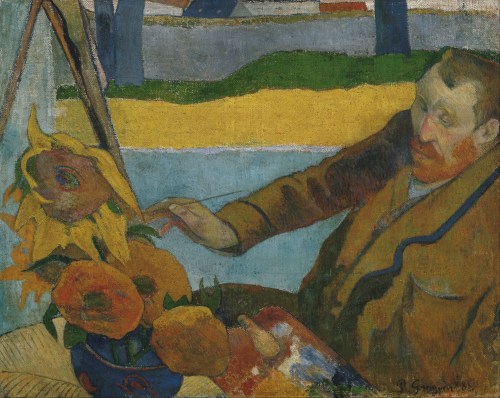
#FineArtFriday: Vincent van Gogh Painting Sunflowers by Paul Gauguin 1888 (revisited)

Title: Van Gogh Painting Sunflowers

Artist: Paul Gauguin

Genre: portrait

Date: 1888

Medium: oil on jute

Dimensions: Height: 73 cm (28.7 ″); Width: 91 cm (35.8 ″)


For a brilliant look a the life and art of Paul Gauguin, see:

Why Is Gauguin So Controversial? (Waldemar Januszczak Documentary) | Perspective – YouTube

For a wonderful documentary on Vincent’s Sunflowers, see:

The Mystery of Van Gogh’s Sunflowers | Raiders Of The Lost Art | Perspective – YouTube


About this Painting, via Wikipedia:

The portrait was painted when Gauguin visited Van Gogh in Arles, France. Vincent had pleaded with Gauguin to come to Arles to start an art-colony. Gauguin eventually agreed after funding for the transportation and expenses was provided by Vincent’s brother Theo Van Gogh; however Gauguin only stayed for two months as the two often quarreled and the famous incident where Van Gogh severed his left ear with a razor occurred after an argument with Gauguin.

Van Gogh’s first impression on seeing the painting was that Gauguin had depicted him as a madman. He later softened his view. “My face has lit up after all a lot since, but it was indeed me, extremely tired and charged with electricity as I was then.”

About the Artist, via Wikipedia:

Eugène Henri Paul Gauguin (UK: /ˈɡoʊɡæ̃/, US: /ɡoʊˈɡæ̃/; French: [øʒɛn ɑ̃ʁi pɔl ɡoɡɛ̃]; 7 June 1848 – 8 May 1903) was a French post-Impressionist artist. Unappreciated until after his death, Gauguin is now recognized for his experimental use of color and Synthetist style that were distinctly different from Impressionism. Toward the end of his life, he spent ten years in French Polynesia, and most of his paintings from this time depict people or landscapes from that region.

Gauguin’s relationship with Vincent proved fraught. In 1888, at (van Gogh’s brother)Theo’s instigation, Gauguin and Vincent spent nine weeks painting together at Vincent’s Yellow House in Arles. Their relationship deteriorated and eventually Gauguin decided to leave. On the evening of 23 December 1888 according to a much later account of Gauguin’s, van Gogh confronted Gauguin with a razor blade. Later the same evening, van Gogh cut off his own left ear. He wrapped the severed tissue in newspaper and handed it to a woman who worked at a brothel both Gauguin and van Gogh had visited, and asked her to “keep this object carefully, in remembrance of me”. Van Gogh was hospitalized the following day and Gauguin left Arles.


Credits and Attributions:

Vincent van Gogh Painting Sunflowers by Paul Gauguin 1888 [Public domain]

Wikipedia contributors, “Paul Gauguin,” Wikipedia, The Free Encyclopedia, https://en.wikipedia.org/w/index.php?title=Paul_Gauguin&oldid=899278654 (accessed May 31, 201 Wikipedia contributors, “The Painter of Sunflowers,” Wikipedia, The Free Encyclopedia, https://en.wikipedia.org/w/index.php?title=The_Painter_of_Sunflowers&oldid=853391418 (accessed May 31, 2019). 9).

Wikimedia Commons contributors, “File:Paul Gauguin – Vincent van Gogh painting sunflowers – Google Art Project.jpg,” Wikimedia Commons, the free media repository, https://commons.wikimedia.org/w/index.php?title=File:Paul_Gauguin_-_Vincent_van_Gogh_painting_sunflowers_-_Google_Art_Project.jpg&oldid=321446852 (accessed May 31, 2019).

5 Comments

Filed under #FineArtFriday

#FineArtFriday: Rhetoricians at a Window by Jan Steen ca. 1666 (revisite

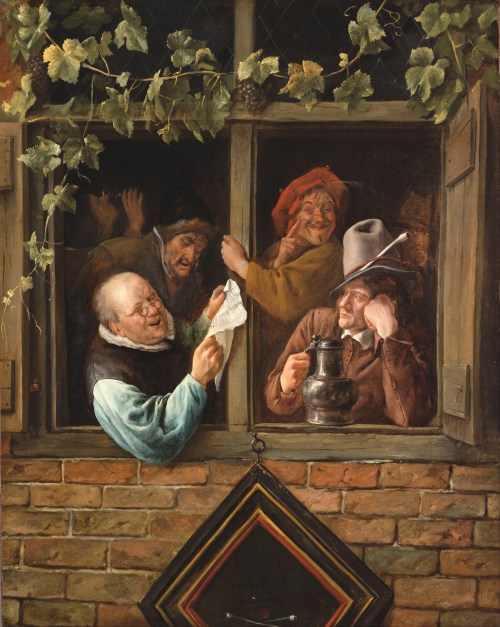
Artist: Jan Steen  (1625/1626–1679)

Title: Rhetoricians at a Window

Genre: genre art

Date: c. 1661-66

Medium: oil on canvas

Dimensions: Height: 759.46 mm (29.90 in); Width: 586.23 mm (23.07 in)

Collection: Philadelphia Museum of Art

I regularly look to art for ideas. One of my favorite images is this one, Rhetoricians at a Window by the Dutch master, Jan Steen. It has appeared here several times, but no matter how often I see this painting, I find something new to appreciate about it.

What I love about this painting:

This is one of my all-time favorite Dutch genre paintings. The vivid characters who inhabit the scene inspired some the characters who pass through my Billy’s Revenge stories, people my protagonists meet along the way. These jolly rogues have such vivid personalities that the viewer immediately feels a kinship to them. Who were they? Did they keep their day jobs?

The reading of a poem or play was clearly the opportunity for the performers to have a good time. At left, the group’s orator reads a paper titled Lof Liet (Song of Praise), while the poet who composed the verse looks on over his shoulder. From the drinker in the shadows of the background, to the grapevines growing around the window, Steen tells us that wine and rhetoric are clearly entwined.

I love the inclusion of both “the critic” who leans his head on his hand and listens analytically, and the man behind him, who is clearly “a little over the limit,” and supports himself by grasping the window frame and heartily agreeing with some point.

The actor who reads is clearly enjoying himself, as are the others.

Symbolism: Some have said the characters in this painting represent the different emotions of the human condition:

  • Sanguine, (active, enthusiastic, and social)
  • Choleric, (fast, irritable, and short-tempered)
  • Melancholic, (analytical, quiet, and wise)
  • Phlegmatic, (peaceful and relaxed)

Thanks to Eelko Kappe’s wonderful article on this painting, Rhetoricians at the Window by Jan Steen, I now have four new words to broaden my vocabulary. I may never have a use for them, but now I know what they mean!

About the Artist (Via Wikipedia):

Jan Havickszoon Steen (c. 1626 – buried 3 February 1679) was a Dutch Golden Age painter, one of the leading genre painters of the 17th century. His works are known for their psychological insight, sense of humour and abundance of colour.

Daily life was Jan Steen’s main pictorial theme. Many of the genre scenes he portrayed, as in The Feast of Saint Nicholas, are lively to the point of chaos and lustfulness, even so much that “a Jan Steen household”, meaning a messy scene, became a Dutch proverb (een huishouden van Jan Steen). Subtle hints in his paintings seem to suggest that Steen meant to warn the viewer rather than invite him to copy this behaviour. Many of Steen’s paintings bear references to old Dutch proverbs or literature. He often used members of his family as models, and painted quite a few self-portraits in which he showed no tendency of vanity.

Steen did not shy from other themes: he painted historical, mythological and religious scenes, portraits, still lifes and natural scenes. His portraits of children are famous. He is also well known for his mastery of light and attention to detail, most notably in Persian rugs and other textiles.

Steen was prolific, producing about 800 paintings, of which roughly 350 survive. His work was valued much by contemporaries and as a result he was reasonably well paid for his work. He did not have many students—only Richard Brakenburgh is recorded—but his work proved a source of inspiration for many painters. [2]

About this painting, Via Wikipedia:

Chambers of rhetoric (Dutch: rederijkerskamers) were dramatic societies in the Low Countries. Their members were called Rederijkers (singular Rederijker), from the French word ‘rhétoricien’, and during the 15th and 16th centuries were mainly interested in dramas and lyrics. These societies were closely connected with local civic leaders and their public plays were a form of early public relations for the city. [1]

In 1945, Sturla Gudlaugsson, a specialist in Dutch seventeenth-century painting and iconography and Director of the Netherlands Institute for Art History and the Mauritshuis in The Hague, wrote The Comedians in the work of Jan Steen and his Contemporaries, which revealed that a major influence on Jan Steen’s work was the guild of the Rhetoricians or Rederijkers and their theatrical endeavors.

It is often suggested that Jan Steen’s paintings are a realistic portrayal of Dutch 17th-century life. However, not everything he did was a purely realistic representation of his day-to-day environment. Many of his scenes contain idyllic and bucolic fantasies and a declamatory emphasis redolent of theater.

Jan Steen’s connection to theater is easily verifiable through his connection to the Rederijkers. There are two kinds of evidence for this connection. First, Jan Steen Steen’s uncle belonged to the Rhetoricians in Leiden, where Steen was born and lived a substantial part of his life. Second, Jan Steen portrayed many scenes from the lives of the Rederijkers, an example being the painting Rhetoricians at a Window of 1658–65. The piece is currently held in the Philadelphia Museum of Art which was established in February 1876. The humanity, humor and optimism of the figures suggest that Jan Steen knew these men well and wanted to portray them positively.

With his lavish and moralising style, it is logical that Steen would employ the stratagems from theater for his purposes. There is conclusive evidence that the characters in Steen’s paintings are predominantly theatrical characters and not ones from reality. [2]


Credits and Attributions:

This post first appeared here on Life in the Realm of Fantasy  in September of 2020.

[1] Wikipedia contributors, “Jan Steen,” Wikipedia, The Free Encyclopedia, https://en.wikipedia.org/w/index.php?title=Jan_Steen&oldid=950709901 (accessed September 10, 2020).

[2] Wikipedia contributors, “Chamber of rhetoric,” Wikipedia, The Free Encyclopedia, https://en.wikipedia.org/w/index.php?title=Chamber_of_rhetoric&oldid=975283829 (accessed September 10, 2020).

Wikimedia Commons contributors, “File:Jan Steen, Dutch (active Leiden, Haarlem, and The Hague) – Rhetoricians at a Window – Google Art Project.jpg,” Wikimedia Commons, the free media repository, https://commons.wikimedia.org/w/index.php?title=File:Jan_Steen,_Dutch_(active_Leiden,_Haarlem,_and_The_Hague)_-_Rhetoricians_at_a_Window_-_Google_Art_Project.jpg&oldid=355150081 (accessed September 10, 2020).

2 Comments

Filed under #FineArtFriday, writing

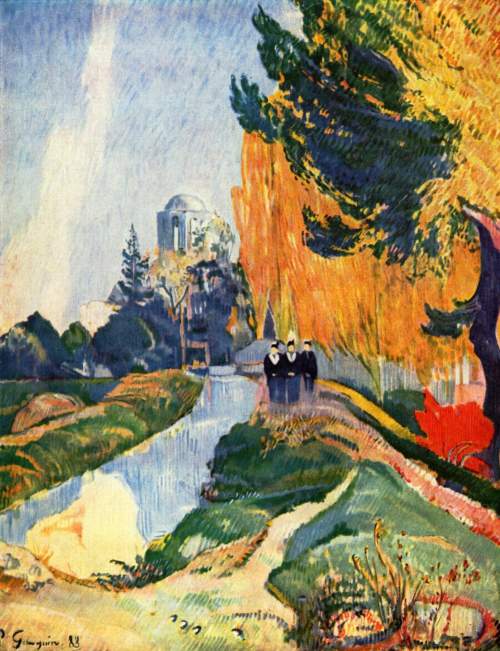
#FineArtFriday:The Alyscamps, or The Three Graces at the Temple of Venus by Paul Gauguin 1888

Paul_Gauguin_les_alyscamps085

Artist: Paul Gauguin (1848–1903)

Title:  (English)The Alyscamps, or The Three Graces at the Temple of Venus

French: French: Les Alyscamps, ou Les Trois grâces au temple de Venus

Date: 1888

Medium: oil on canvas

Dimensions: height: 91.6 cm (36 in); width: 72.5 cm (28.5 in)

Collection: Musée d’Orsay

What I love about this painting:

Color! I love the vivid colors contrasted against the pale sky. The Three Graces in classical mythology are the goddesses of charm, beauty, nature, human creativity, goodwill, and fertility. They have come to symbolize faith, hope, and charity.

The traditional mythology Paul Gauguin explores in this composition demonstrates his early education and his appreciation of classical art. Before he became an artist, he was both a stockbroker and an art dealer/collector.

Although he never trained formally, Gauguin is known for his use of bold colors, simplified forms, and strong lines. This painting is a prime example of his study of form and color.

The eye is drawn to the vertical lines of the temple standing tall on the hill behind the figures. They are also depicted with a sense of height, and the hills beyond are tall and narrow.

A calm stream flows from beneath the temple, the river of time. The three women stand almost in the background, yet impressive, observing as time passes them. They are as strong and unmovable as the rocky hills and the temple.

Gauguin tells us that time may pass, and things may change, but the Temple of Venus rises above it all. Does this Temple of Venus represent “agape,” a love that is selfless and unconditional? A kind of love that is spiritual in nature? Paul Gauguin was a complicated man, conflicted and tormented by the contrasts of morality and the realities of his life.

Who knows what that temple meant to him on the day he created it, but either way, Gauguin’s Three Graces, Faith, Hope, and Charity stand almost in the shadows, offering him comfort. They are as solid as the mountains and eternal as time. And who is the dark, mysterious fourth who peers over their shoulder?

Paul Gauguin lived an eventful life. For a wonderful documentary on the man and his life, go to:

Why Is Gauguin So Controversial? (Waldemar Januszczak Documentary) | Perspective – YouTube

Also, check out Paul Gauguin – Wikipedia.


Credits and Attributions:

Image: Wikimedia Commons contributors, “File:Paul Gauguin 085.jpg,” Wikimedia Commons, https://commons.wikimedia.org/w/index.php?title=File:Paul_Gauguin_085.jpg&oldid=710795058 (accessed April 6, 2023).

7 Comments

Filed under #FineArtFriday

#FineArtFriday: Red hollyhocks in the garden of the Ancher family at Markvej in Skagen by Anna Ancher ca. 1916 (revisited)

Anna_Ancher_-_Røde_stokroser_i_haven_ved_Ancher-familiens_hus_på_Markvej_i_SkagenArtist: Anna Ancher  (1859–1935)

Title: English: Red hollyhocks in the garden of the Ancher family at Markvej in Skagen.

Date: circa 1916

Medium: oil on canvas

Dimensions: Height: 63 cm (24.8 in); Width: 47 cm (18.5 in)

Collection: Unknown

Inscriptions: Signature bottom right: A. Ancher

What I love about this painting:

Winters tends to be dark and rainy here in the Pacific Northwest. Sunshine is brief and gloomy skies seem eternal. I need a summer day! I found us this gorgeous painting last year and loved it so much. One of my favorite artists, Anna Ancher gives us a perfect day in Skagen a century ago.

She is mostly known for her interiors, but Anna Ancher captured the essence of summer in this painting. Along with foxgloves, hollyhocks are my favorite summer flowers. Anna’s are beautiful, contrasted against the blue sky. Her eye for color was amazing. The yellow and red flowers perfectly complement the color of the building behind the garden.

I feel so much better for having had this glorious day in Anna’s serene garden.

About the Artist via Wikimedia: Anna Ancher preferred to paint interiors and simple themes from the everyday lives of the Skagen people, especially fishermen, women, and children. She was intensely preoccupied with exploring light and color, as in Interior with Clematis (1913). She also created more complex compositions such as A Funeral (1891). Anna Ancher’s works often represented Danish art abroad. Ancher has been known for portraying similar civilians from the Skagen art colony in her works, including an old blind woman.

While she studied drawing for three years at the Vilhelm Kyhn College of Painting in Copenhagen, she developed her own style and was a pioneer in observing the interplay of different colors in natural light. She also studied drawing in Paris at the atelier of Pierre Puvis de Chavannes along with Marie Triepcke, who would marry Peder Severin Krøyer, another Skagen painter.

In 1880 she married fellow painter Michael Ancher, whom she met in Skagen. They had one child, daughter Helga Ancher. Despite pressure from society that married women should devote themselves to household duties, she continued painting after marriage. [1]


Credits and Attributions:

Anna Ancher, Public domain, via Wikimedia Commons. Wikimedia Commons contributors, “File:Anna Ancher – Røde stokroser i haven ved Ancher-familiens hus på Markvej i Skagen.jpg,” Wikimedia Commons, the free media repository, https://commons.wikimedia.org/w/index.php?title=File:Anna_Ancher_-_R%C3%B8de_stokroser_i_haven_ved_Ancher-familiens_hus_p%C3%A5_Markvej_i_Skagen.jpg&oldid=616771666 (accessed January 14, 2022).

[1] Wikipedia contributors, “Anna Ancher,” Wikipedia, The Free Encyclopedia, https://en.wikipedia.org/w/index.php?title=Anna_Ancher&oldid=1041257716 (accessed January 14, 2022).

5 Comments

Filed under #FineArtFriday, writing

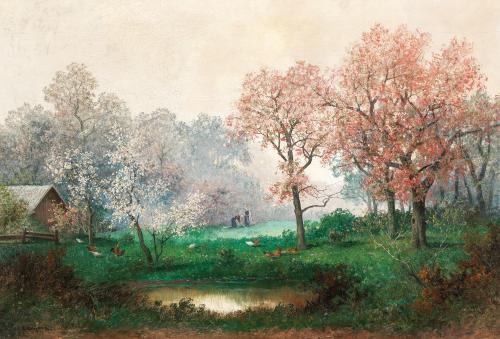
#FineArtFriday: Under flowering trees by Adolf Kaufmann

Adolf_Kaufmann_Under_the_treesjpgArtist: Adolf Kaufmann (1848–1916)

Title: Under flowering trees

Date: before 1916

Medium: oil on canvas

Inscription: signed A. Kaufmann

What I love about this painting:

Kaufmann gives us a beautiful spring day with apple trees and cherry trees in full bloom. The weather is misty, cool and damp the way spring mornings often are here in the Pacific Northwest.

Chickens roam the orchard, and two women are digging, breaking the ground for a spring garden.

To the left is a weathered building. Is it a barn? Is it their home? It’s hidden behind the shrubbery so it’s difficult to tell, but it has no window, so I think it may be a barn.

Nothing is romanticized—we see it the way the artist did on that spring day over a century ago.

About the Artist, via Wikipedia:

Adolf Kaufmann (15 May 1848, in Troppau – 25 November 1916, in Vienna) was an Austrian landscape and marine artist.

He was initially self-taught, but completed his studies with the animal painter, Émile van Marcke, in Paris and undertook several study trips, throughout Europe and the Middle East. His residence alternated between Paris, Berlin, Düsseldorf and Munich.

In 1890, he decided to settle in Vienna and opened a studio in the Wieden district. In 1900, together with Carl von Merode [de] and Heinrich Lefler, he opened an “Art School for Ladies”. He continued to visit Paris frequently and, when he painted there, signed his works with the pseudonym “A. Guyot”. Other names he signed with include “A. Papouschek”, “G. Salvi”, “A. Jarptmann”, “R. Neiber”, “J. Rollin” and “M. Bandouch”. Why he did this is unclear, although his choice of signature often reflects stylistic differences.

His landscapes were influenced by the Barbizon school and the style known as “paysage intime,” both of which he was exposed to in France during the 1870s. (The paysage intimate, French for “familiar landscape,” was a style of painting that dealt with simple, simple landscapes and emerged in the mid-19th century. It was the predecessor of the Impressionist style.) [1]


Credits and Attributions:

IMAGE: Wikimedia Commons contributors, “File:Adolf Kaufmann Unter blühenden Bäumen.jpg,” Wikimedia Commons, the free media repository, https://commons.wikimedia.org/w/index.php?title=File:Adolf_Kaufmann_Unter_bl%C3%BChenden_B%C3%A4umen.jpg&oldid=623159308 (accessed March 23, 2023).

[1] Wikipedia contributors, “Adolf Kaufmann,” Wikipedia, The Free Encyclopedia, https://en.wikipedia.org/w/index.php?title=Adolf_Kaufmann&oldid=1094252143 (accessed March 23, 2023).

7 Comments

Filed under #FineArtFriday

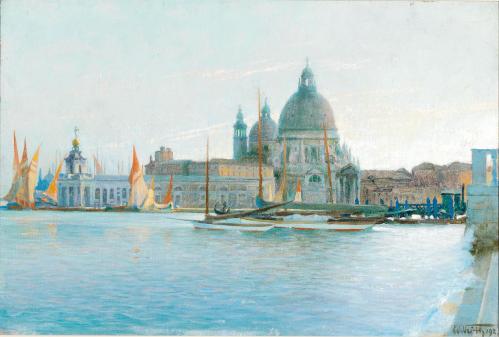
#FineArtFriday: Santa Maria della Salute by Eduard Veith

Eduard_Veith_-_Venezia-Santa_Maria_della_Salute

Artist: Eduard Veith  (1858–1925)

Title: Italian: Venezia: Santa Maria della Salute

Date: by 1925

Medium: oil on canvas

Dimensions: height: 39.5 cm (15.5 in); width: 58 cm (22.8 in)

Collection: Private collection

What I love about this painting:

Veith has captured Venice on a beautiful morning. The sun is shining, the sky is blue and the waters of the canal are calm. Colorful sails are being raised as the fishers prepare to head out to San Marco basin for the day.

In the center is the domed basilica of Santa Maria della Salute (in English, Saint Mary of Health).

This is the sort of morning that makes one feel that all is right in the world.

About the Santa Maria della Salute, via Wikipedia:

Santa Maria della Salute (English: Saint Mary of Health), commonly known simply as the Salute, is a Roman Catholic church and minor basilica located at Punta della Dogana in the Dorsoduro sestiere of the city of VeniceItaly.

It stands on the narrow finger of Punta della Dogana, between the Grand Canal and the Giudecca Canal, at the Bacino di San Marco, making the church visible when entering the Piazza San Marco from the water. The Salute is part of the parish of the Gesuati and is the most recent of the so-called plague churches.

In 1630, Venice experienced an unusually devastating outbreak of the plague. As a votive offering for the city’s deliverance from the pestilence, the Republic of Venice vowed to build and dedicate a church to Our Lady of Health. The church was designed in the then fashionable Baroque style by Baldassare Longhena, who studied under the architect Vincenzo Scamozzi. Construction began in 1631. Most of the objects of art housed in the church bear references to the Black Death. [1]

About the artist, via Wikipedia:

Eduard Veith (30 March 1858, Neutitschein – 18 March 1925, Vienna) was an Austrian portrait painter and stage designer. Many of his works were influenced by Symbolism. He was born to the decorative painter, Julius Veith (1820–1887), and his wife Susanna, née Schleif (1827–1883).

At first, he received training to follow in his father’s profession. Later, he went to Vienna, where he took classes at the Museum of Applied Arts from Professor Ferdinand Laufberger. He capped off his studies by creating sgraffito for exhibition buildings at the Exposition Universelle in Paris.

He then returned home, where he assisted his father with painting churches, synagogues and other ceremonial buildings. This was followed by several study trips to Italy, Belgium and Tunisia. He finally settled in Vienna; becoming a free-lance artist and working mostly by commission.

From 1890, he was a member of the Vienna Künstlerhaus. In 1896, he received a gold medal at the Große Berliner Kunstausstellung. In 1905, he was appointed a Professor at the University of Technology.  In 1911, he married Bertha Griesbeck (1872–1952), from Augsburg. He later taught at the University of Applied Arts Museum of Applied Arts and became a professor there in 1920. During his years in Vienna, he maintained contact with his home town, and held exhibitions there.

He died shortly before his sixty-seventh birthday. [2]


Credits and Attributions:

Image: Wikimedia Commons contributors, “File:Eduard Veith – Venezia-Santa Maria della Salute.jpg,” Wikimedia Commons, the free media repository, https://commons.wikimedia.org/w/index.php?title=File:Eduard_Veith_-_Venezia-Santa_Maria_della_Salute.jpg&oldid=627297217 (accessed March 16, 2023).

[1] Wikipedia contributors, “Santa Maria della Salute,” Wikipedia, The Free Encyclopedia, https://en.wikipedia.org/w/index.php?title=Santa_Maria_della_Salute&oldid=1134116004 (accessed March 16, 2023).

[2] Wikipedia contributors, “Eduard Veith,” Wikipedia, The Free Encyclopedia, https://en.wikipedia.org/w/index.php?title=Eduard_Veith&oldid=1133038416 (accessed March 16, 2023).

5 Comments

Filed under #FineArtFriday

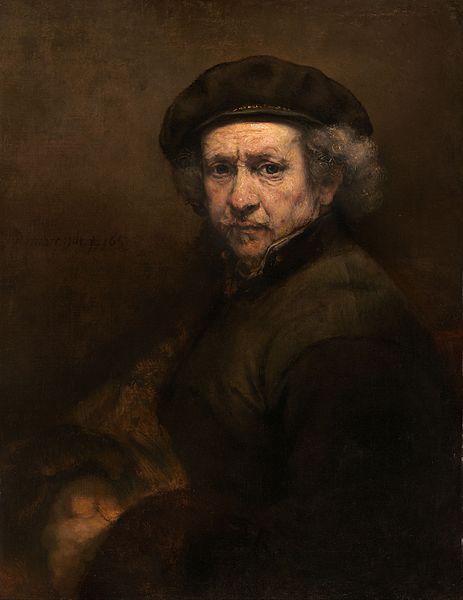
#FineArtFriday: Self Portrait, Rembrandt 1659 (revisited)

Rembrandt Harmenszoon van Rijn, commonly known simply as Rembrandt, is considered the finest artist of the 17th century. Some art historians consider him the finest artist in the history of art, and the most important artist in Dutch art history.

Speaking strictly as a Rembrandt fangirl and abject admirer, I consider his self-portraits to be more honest than those of any other artist.

Whenever he couldn’t afford to pay a model, he painted himself. And of all his known self-portraits, this is my favorite.

Quote from Wikipedia: His self-portraits form a unique and intimate biography, in which the artist surveyed himself without vanity and with the utmost sincerity.

This honesty comes across in all his works featuring himself as the subject. Each portrait shows an aspect of his personality, his sense of humor, his affection for his first wife, Saskia, who was the love of his life, and his wry acceptance of his own human frailties.

Money was a mystery to Rembrandt. He had no understanding of a budget, mishandled his son’s inheritance, spent far more than he earned, and didn’t pay his taxes. In short, he was always in trouble with the authorities, always skirting the edges of disaster.

Rembrandt knew he was talented but didn’t see himself as a creative genius. He was just a man with a passion for art, who lived beyond his means and died a pauper, as did Mozart, and as do most artists and authors.

I feel I know this man, this tired, stressed, poor old man, more so than I do the person he was in his earlier self-portraits. He’s matured, lost the brashness of his youth. When I observe the man in this self-portrait, painted ten years before his death, I see a good-humored man just trying to live a frequently difficult life as well as he can. His face is lined and blemished, not as handsome as he once was. But his eyes seem both kind and familiar, filled with the understanding that comes from living with all one’s heart and experiencing both great joy and deep sorrow.

The art of Rembrandt van Rijn shows us his world as he saw it. Others may disagree with me, but I feel his greatest gift was the ability to convey personality with each portrait. This gift allowed him to portray every person he painted as they really were, blemished and yet beautiful. This is a gift he taught his students, and they were able to copy his style quite effectively, making discerning his true work difficult even for the experts.


Credits and Attributions:

Wikipedia contributors, “Rembrandt,” Wikipedia, The Free Encyclopedia, https://en.wikipedia.org/w/index.php?title=Rembrandt&oldid=844357531(accessed June 8, 2018).

Wikimedia Commons contributors, “File:Rembrandt van Rijn – Self-Portrait – Google Art Project.jpg,” Wikimedia Commons, the free media repository, https://commons.wikimedia.org/w/index.php?title=File:Rembrandt_van_Rijn_-_Self-Portrait_-_Google_Art_Project.jpg&oldid=292800848 (accessed June 8, 2018).

Comments Off on #FineArtFriday: Self Portrait, Rembrandt 1659 (revisited)

Filed under #FineArtFriday

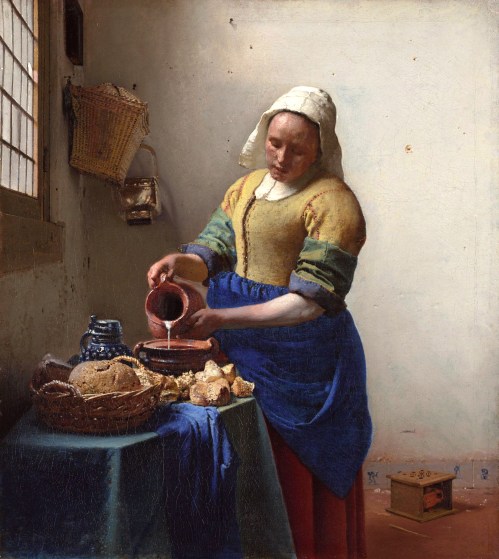
#FineArtFriday: The Milkmaid by Johannes Vermeer (revisited)

What I love about this painting:

It seems like a good time to revisit Vermeer’s famous painting, known as “the Milkmaid.” This is lovely look into the past, a window into daily life of 1657 – 1658. I love the realism, the way the maid carefully pours the milk into the bread.

All of Vermeer’s known works illustrate how the quiet moments in life can be the most profound.

Wikipedia has many things to say about this painting.


About Johannes Vermeer, the Master of Light (from Wikipedia)

Johannes Vermeer (October 1632 – December 1675) was a Dutch painter who specialized in domestic interior scenes of middle-class life. He was a moderately successful provincial genre painter in his lifetime but evidently was not wealthy, leaving his wife and children in debt at his death, perhaps because he produced relatively few paintings.

Vermeer worked slowly and with great care, and frequently used very expensive pigments. He is particularly renowned for his masterly treatment and use of light in his work.

Vermeer painted mostly domestic interior scenes. “Almost all his paintings are apparently set in two smallish rooms in his house in Delft; they show the same furniture and decorations in various arrangements and they often portray the same people, mostly women.”

He was recognized during his lifetime in Delft and The Hague, but his modest celebrity gave way to obscurity after his death. He was barely mentioned in Arnold Houbraken‘s major source book on 17th-century Dutch painting (Grand Theatre of Dutch Painters and Women Artists), and was thus omitted from subsequent surveys of Dutch art for nearly two centuries. In the 19th century, Vermeer was rediscovered by Gustav Friedrich Waagen and Théophile Thoré-Bürger, who published an essay attributing 66 pictures to him, although only 34 paintings are universally attributed to him today. Since that time, Vermeer’s reputation has grown, and he is now acknowledged as one of the greatest painters of the Dutch Golden Age. [2]

About the featured painting, The Milkmaid, also from Wikipedia:

Despite its traditional title, the picture clearly shows a kitchen or housemaid, a low-ranking indoor servant, rather than a milkmaid who actually milks the cow, in a plain room carefully pouring milk into a squat earthenware container (now commonly known as a “Dutch oven”) on a table. Also on the table are various types of bread. She is a young, sturdily built woman wearing a crisp linen cap, a blue apron and work sleeves pushed up from thick forearms. A foot warmer is on the floor behind her, near Delft wall tiles depicting Cupid (to the viewer’s left) and a figure with a pole (to the right). Intense light streams from the window on the left side of the canvas.

The painting is strikingly illusionistic, conveying not just details but a sense of the weight of the woman and the table. “The light, though bright, doesn’t wash out the rough texture of the bread crusts or flatten the volumes of the maid’s thick waist and rounded shoulders”, wrote Karen Rosenberg, an art critic for The New York Times. Yet with half of the woman’s face in shadow, it is “impossible to tell whether her downcast eyes and pursed lips express wistfulness or concentration,” she wrote.

“It’s a little bit of a Mona Lisa effect” in modern viewers’ reactions to the painting, according to Walter Liedtke, curator of the department of European paintings at The Metropolitan Museum of Art, and organizer of two Vermeer exhibits. “There’s a bit of mystery about her for modern audiences. She is going about her daily task, faintly smiling. And our reaction is ‘What is she thinking?'” [1]


Credits and Attributions:

The Milkmaid, by Johannes (Jan) Vermeer ca. 1658 [Public domain or Public domain], via Wikimedia Commons.

[1] Wikipedia contributors, “The Milkmaid (Vermeer),” Wikipedia, The Free Encyclopedia, https://en.wikipedia.org/w/index.php?title=The_Milkmaid_(Vermeer)&oldid=853243011 (accessed August 31, 2018).

[2] Wikipedia contributors, “Johannes Vermeer,” Wikipedia, The Free Encyclopedia, https://en.wikipedia.org/w/index.php?title=Johannes_Vermeer&oldid=854172655 (accessed August 31, 2018).

7 Comments

Filed under #FineArtFriday, writing

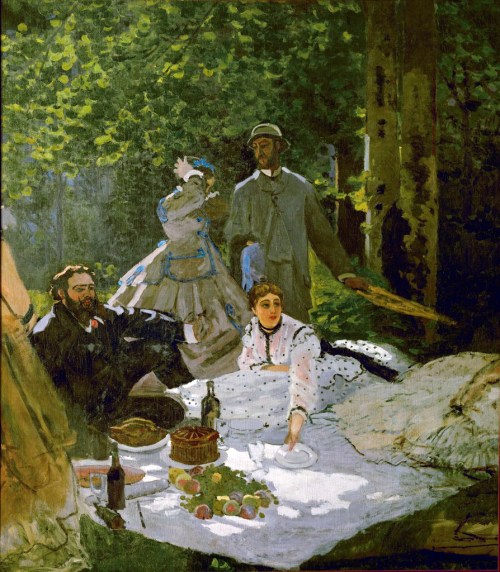
#FineArtFriday: Le Déjeuner sur l’herbe (Luncheon on the Grass) by Claude Monet ca. 1865

Monet_dejeunersurlherbeArtist: Claude Monet (1840–1926)

Title: French: Déjeuner sur l’herbe (English: Luncheon on the Grass) Central panel

Depicted people:

Date: between 1865 and 1866

Medium: oil on canvas

Dimensions: height: 248 cm (97.6 in) width: 217 cm (85.4 in)

Collection: Musée d’Orsay

Place of creation: Chailly-en-Bière

What I love about this painting:

This painting may be unfinished, but in this section, the central panel, Monet gives us a beautiful day, sunny and warm. It’s a perfect day for a picnic with friends, to forget the stresses of life and just enjoy the beauty of the world around you. It’s the perfect counterfoil to my often-gloomy Pacific Northwestern winter, the kind of day that gives me hope that a pleasant spring waits just a few weeks away.

Thank you, Monsieur Monet. I needed this glimpse of summer.

About this painting via Wikipedia:

Le Déjeuner sur l’herbe (English: Luncheon on the Grass) is an 1865–1866 oil on canvas painting by Claude Monet, produced in response to the 1863 work of the same title by Édouard Manet. It remains unfinished, but two large fragments (central and left panels) are now in the Musée d’Orsay in Paris, whilst a smaller 1866 version is now in the Pushkin Museum in Moscow.

Monet included the artist Gustave Courbet in the painting.

The painting in its whole form shows twelve people. They are clothed in Parisian clothing which was fashionable at that time. They are having a picnic in near a forest glade. All the people are gathered around a white picnic blanket, where food as fruits, cake or wine is located. The mood in this natural space is primarily created by the play of light and shadow, which is created by deciduous tree above them. [1]

About the Artist, via Wikipedia:

Oscar-Claude Monet 14 November 1840 – 5 December 1926) was a French painter and founder of impressionist painting who is seen as a key precursor to modernism, especially in his attempts to paint nature as he perceived it. During his long career, he was the most consistent and prolific practitioner of impressionism’s philosophy of expressing one’s perceptions before nature, especially as applied to plein air (outdoor) landscape painting. The term “Impressionism” is derived from the title of his painting Impression, soleil levant, exhibited in 1874 (the “exhibition of rejects”) initiated by Monet and his associates as an alternative to the Salon.

His last time exhibiting with the Impressionists was in 1882—four years before the final Impressionist exhibition.

Monet, Renoir, Pissarro, Morisot, Cézanne and Sisley proceeded to experiment with new methods of depicting reality. They rejected the dark, contrasting lighting of romantic and realist paintings, in favour of the pale tones of their peers’ paintings such as those by Jean-Baptiste-Camille Corot and Boudin. After developing methods for painting transient effects, Monet would go on to seek more demanding subjects, new patrons and collectors; his paintings produced in the early 1870s left a lasting impact on the movement and his peers—many of whom moved to Argenteuil as a result of admiring his depiction. [2]


Credits and Attributions:

IMAGE: Le Déjeuner sur l’herbe (Luncheon on the Grass) by Claude Monet ca. 1865 Wikimedia Commons contributors, “File:Monet dejeunersurlherbe.jpg,” Wikimedia Commons, the free media repository, https://commons.wikimedia.org/w/index.php?title=File:Monet_dejeunersurlherbe.jpg&oldid=711036251 (accessed February 16, 2023).

[1] Wikipedia contributors, “Le Déjeuner sur l’herbe (Monet, Paris),” Wikipedia, The Free Encyclopedia, https://en.wikipedia.org/w/index.php?title=Le_D%C3%A9jeuner_sur_l%27herbe_(Monet,_Paris)&oldid=1134534732 (accessed February 16, 2023).

[2] Wikipedia contributors, “Claude Monet,” Wikipedia, The Free Encyclopedia, https://en.wikipedia.org/w/index.php?title=Claude_Monet&oldid=1137970938 (accessed February 16, 2023).

3 Comments

Filed under #FineArtFriday

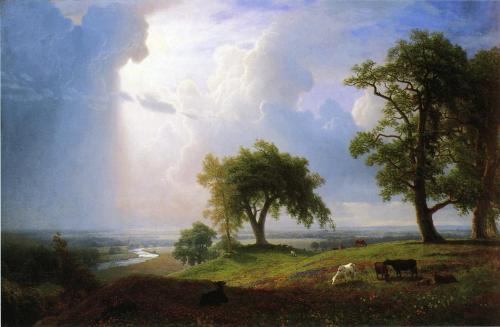
#FineArtFriday: California Spring by Albert Bierstadt 1875

Albert_Bierstadt_California_SpringArtist: Albert Bierstadt (1830–1902)

Title: California Spring

Genre: landscape art

Date: 1875

Medium: oil on canvas

Dimensions: height: 187.3 cm (73.7 in); width: 264.2 cm (104 in)

Current location: Fine Arts Museums of San Francisco

What I love about this painting:

I love this composition, the way everything is deliberately placed. Cattle graze on a hilltop beneath a grove of trees, uncaring of the rainstorm sweeping across the valley below, far off in the distance. The immensity of the sky is the focus of this scene, with the sun emerging from the clouds, a brief promise of warmer days. Spring has arrived on this hilltop.

Here at Casa del Jasperson, we’re tired of winter, done with rain and dark days. Albert Bierstadt paints us an idyllic scene of seasonal weather and the harmony of nature. The grass is green, the cattle are happy, and while rain may come, summer is around the corner.

About the artist, via Wikipedia:

Albert Bierstadt (January 7, 1830 – February 18, 1902) was a German American painter best known for his lavish, sweeping landscapes of the American West. He joined several journeys of the Westward Expansion to paint the scenes. He was not the first artist to record the sites, but he was the foremost painter of them for the remainder of the 19th century.

Bierstadt was born in Prussia, but his family moved to the United States when he was one year old. He returned to study painting for several years in Düsseldorf. He became part of the second generation of the Hudson River School in New York, an informal group of like-minded painters who started painting along the Hudson River. Their style was based on carefully detailed paintings with romantic, almost glowing lighting, sometimes called luminism. Bierstadt was an important interpreter of the western landscape, and he is also grouped with the Rocky Mountain School. [1]


Credits and Attributions:

Image: Wikimedia Commons contributors, “File:Albert Bierstadt California Spring.jpg,” Wikimedia Commons, the free media repository, https://commons.wikimedia.org/w/index.php?title=File:Albert_Bierstadt_California_Spring.jpg&oldid=701053175 (accessed February 9, 2023).

[1] Wikipedia contributors, “Albert Bierstadt,” Wikipedia, The Free Encyclopedia, https://en.wikipedia.org/w/index.php?title=Albert_Bierstadt&oldid=1137881139 (accessed February 9, 2023).

5 Comments

Filed under #FineArtFriday, writing