Category Archives: #FineArtFriday

The Great Artists are Brilliant Storytellers #writing

If you are a follower of this blog, you know that Fridays are “Fine Art Friday” here. I love the art of the past, as well as many modern pieces. I also love examining photographic art.

Paintings and photographs offer us a glimpse of a moment in time that may have occurred centuries ago or may not have occurred at all. It is the story of a moment frozen in time and preserved forever for us. Forever, that is, for as long as the painting or photograph exists.

I would love to have created beautiful visual art. I’ve shot some decent photographs, but I’m a writer. Perusing the vaults at Wikimedia Commons allows me to view images with possibilities. Each is a visual representation with a past and a possible future.

We see the whole story.

I’m not educated as an art historian and would never claim to be one. I’m just an old lady who loves the paintings of great artists. I doubt I will ever visit the great museums of Europe, as that would be an expensive endeavor, but I can view their collections in detail.

Anyone with internet access can see great art and photography from the past and present.

Every week, I scour Wikimedia Commons, looking for images that intrigue me. My goal is to give others like me access to see the art that humanity is capable of, the good and perhaps the not-so-good.

Art can be beautiful or savage, depending on the story the artist is trying to present. I love beautiful scenes, and sometimes, especially in winter, I crave the view of a warm summer’s day.

However, more than anything, I like images that tell a story. I am compelled to zoom in and look deeper whenever I view a painting. I research a museum’s website to discover the symbolism the artist snuck into the scene. I want to inform my perception of the story the artist has painted.

Whether I want if to or not, my writer’s brain will influence my interpretation. And the art of the past influences the art of today.

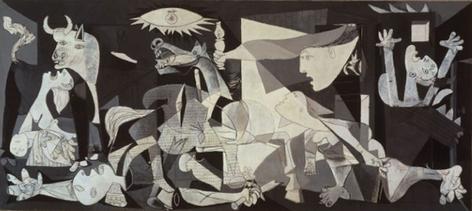
One of the most stunning works of modern art is Guernica, a 1937 painting by the Spanish artist Pablo Picasso (1881 – 1973). This painting is considered to be one of the most powerful anti-war statements of all time. This single painting, done in shades of black and white, tells the story of the bombing of Guernica, a Basque Country town in northern Spain that Nazi Germany and Fascist Italy destroyed at the request of the Spanish Nationalists.

(Yes, a faction in Spain bombed the citizens of their own country.)

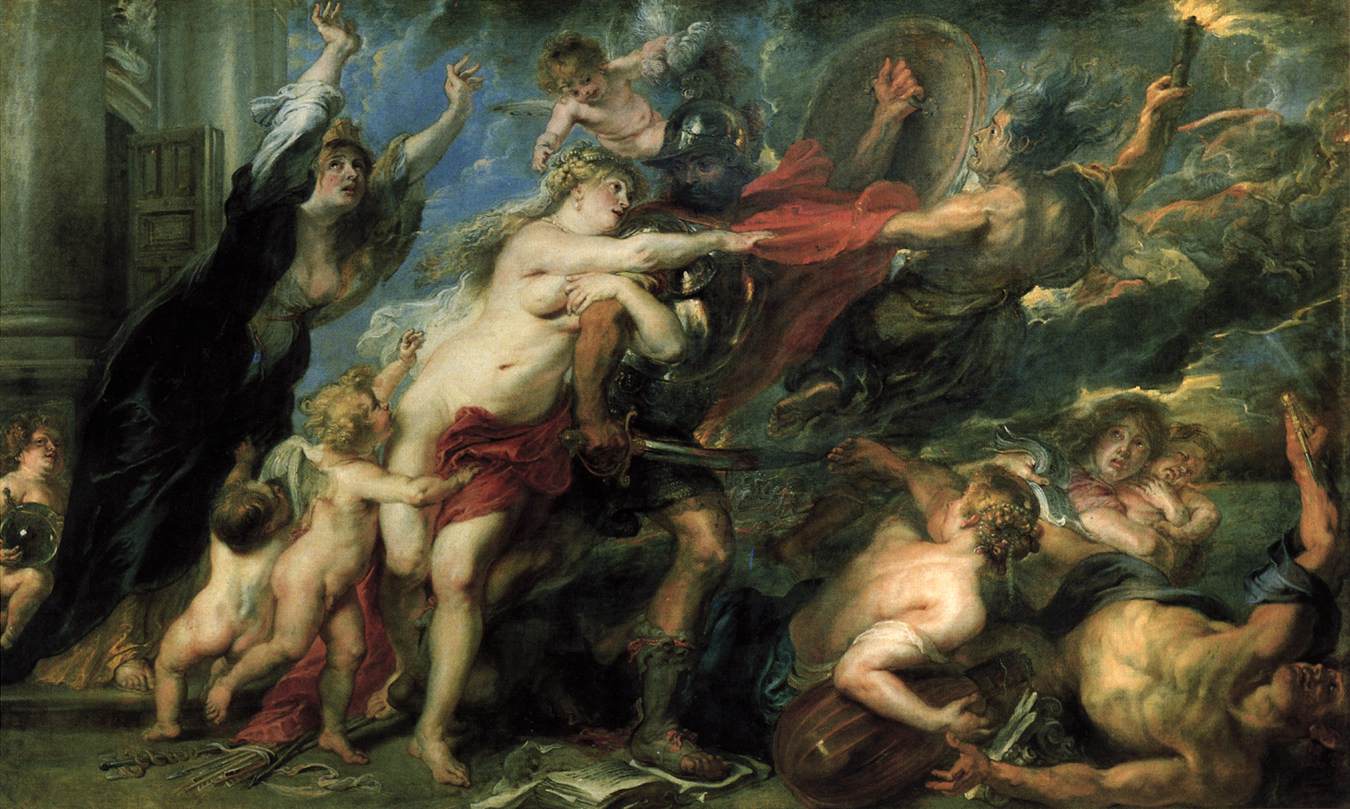
Pablo Picasso was influenced by the great art of the past and based the layout of Guernica on the layout of a history painting, The Consequences of War by Peter Paul Rubens.

Looking at art can lead the viewer to new ways of looking at the world.

Some artists offer us fantasy, and others show us the truth about historical events. Both are necessary. Art can be pretty and comforting, and art can teach us a moral lesson.

Art can be brutally truthful.

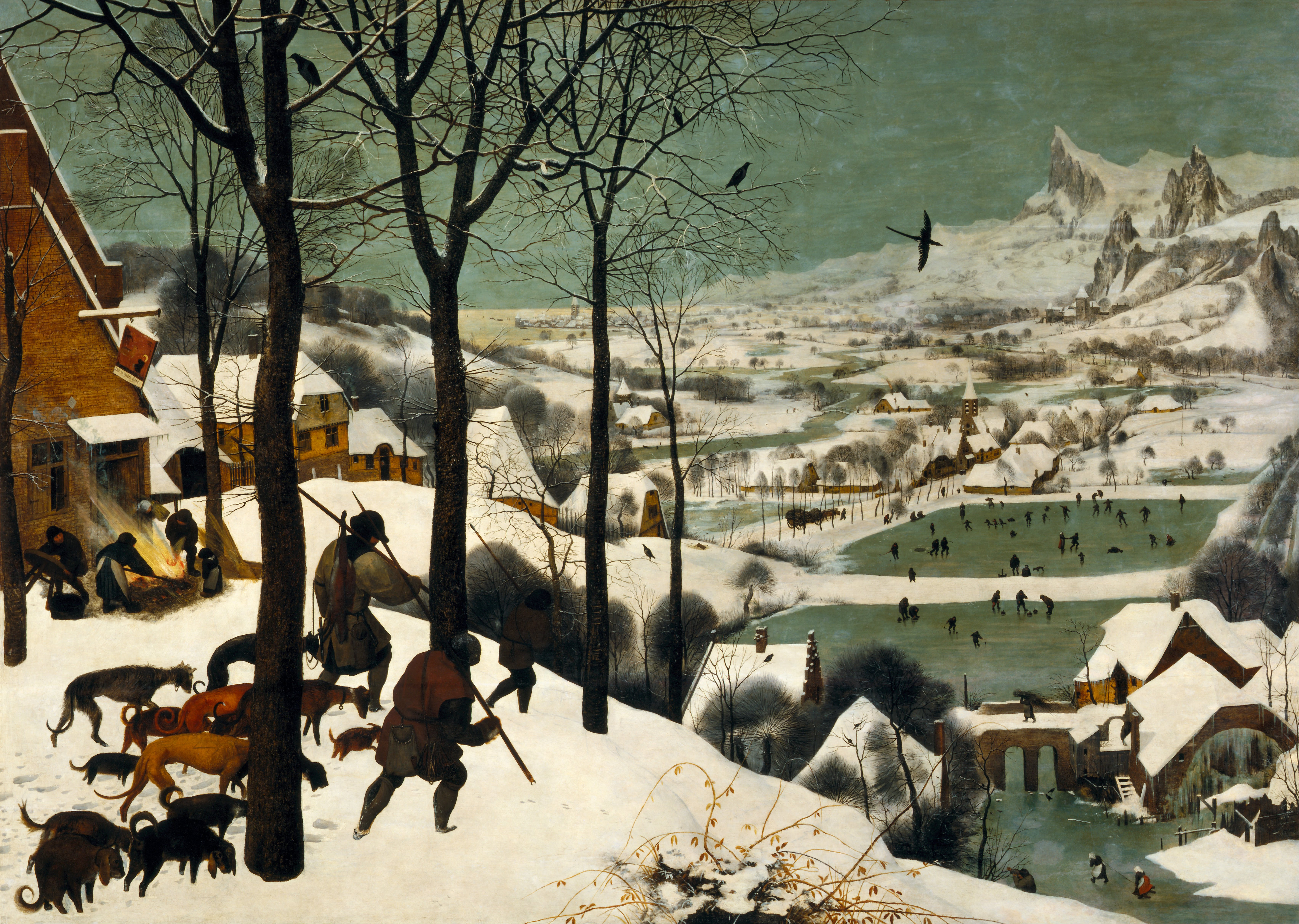
One of my favorite artists is Pieter Brueghel the Elder. His paintings always tell us a story. He embeds a moral in every aspect of his work. For example, let’s look at The Hunters in the Snow, probably his most famous painting. On first glance, we see a comforting winter scene, a bucolic view of hunters returning and people frolicking on the ice. But when we look deeper, we see the true story.

Brueghel used symbolism to convey an entire story by employing paradox and gallows humor in every painting. Here, he shows us that winter was harsh, and for the average person, survival required a lot of work, sometimes for nothing.

  • He shows us the hunters returning with empty game bags, the lone corpse of a skinny fox, and little else.
  • One dog looks at us with starving eyes, as if hoping for scraps.
  • The tavern’s sign is about to fall down, a large hint that all is not well. That symbolic broken sign tells us the owners are bankrupt.
  • The owners are cooking outside, directly in front of the door, evicted from their home and business. A woman brings a bundle of straw out of the inn to use as fuel, while in the distance an ox-drawn wagon is heavily laden with firewood. Where is it going? Not to their inn, that is for sure.
  • A man is carrying a table away. He glances over his shoulder at the meager soup they are cooking, as if they had somehow gotten it away before he could take that too. Is he the new owner, having acquired it for pennies from the city by paying the taxes at a forced bankruptcy sale? Or is he a hired thug employed by the new owner?
  • A rabbit has crossed the hunters’ path and evaded their snares.
  • Ravens, which in Medieval times were considered birds of ill omen, roost in the trees above the inn and the hunters and fly above the revelers. They are a warning of worse days to come.

But in this story, Brueghel’s characters have hope and faith that things will improve. In the distance (the future), people are playing winter games. The future is indistinct and far away, shown in a fantastic, mountainous landscape rather than the flat terrain of the Netherlands. It is almost as if they are visions of what winter could be if only the harvest had been good, rather than the truth of the dead fox, hounds with empty bellies, a bankrupt tavern, and the rabbit that got away.

If you get a chance, visit www.wikimediacommons.org and see what the picture of the day inspires in you. Will you come away with an idea for a story?

Perhaps so. But take the time to write those thoughts down. Your notes could become a storyboard, which could become a novel.

A photograph or painting might inspire you, but the way you put those ideas into action will be uniquely yours. That story will be an expression of your voice and your art.


Credits and Attributions:

IMAGE: Wikipedia contributors, “Guernica (Picasso),” Wikipedia, The Free Encyclopedia, https://en.wikipedia.org/w/index.php?title=Guernica_(Picasso)&oldid=1361273241 (accessed June 28, 2026).

IMAGE: Wikipedia contributors, “Consequences of War,” Wikipedia, The Free Encyclopedia, https://en.wikipedia.org/w/index.php?title=Consequences_of_War&oldid=1361248306 (accessed June 28, 2026).

IMAGE: Wikipedia contributors, “The Hunters in the Snow,” Wikipedia, The Free Encyclopedia, https://en.wikipedia.org/w/index.php?title=The_Hunters_in_the_Snow&oldid=1361428760 (accessed June 28, 2026).


3 Comments

Filed under #FineArtFriday, writing

#FineArtFriday: An Architectural Fantasy by Jan van der Heyden ca. 1670

Artist: Jan van der Heyden (1637–1712)

Title: English: An Architectural Fantasy

Genre: landscape painting

Date: circa 1670

Medium: oil on panel

Dimensions: height: 49.7 cm (19.5 in); width: 70.7 cm (27.8 in)

Collection: National Gallery of Art (Washington, D.C.)

What I love about this painting:

It is classical and very much in the tradition of the Dutch Masters of the 17th century, making use of light and shadow. But he has moved away from heavily shadowed subjects. The sky is as important as the scene below.

Now here is where I see Jan van der Heyden as teller of fantasy tales. His medium is the paintbrush, but he has a story to tell, nonetheless. The inclusion of the poor woman and her child begging outside the gate reminds me of the folk tale of “How the Rich Man Saw Heaven.”

In that tale, a rich man passes a beggar kneeling outside the gates to his castle every day for many years. In all that time, while his wife daily brings scraps of food to the beggar, the rich man barely notices him, other than wishing him gone.

The beggar and the rich man die on the same day, and the rich man finds himself kneeling outside the gates of heaven. He sees the beggar enter, and asks St. Peter why he must kneel outside while the beggar is ushered in.

St Peter replies, “This man, grateful for the kindness of your wife, daily prayed that you would see heaven. You ignored his plight, considered him far beneath you, resented the mercy your wife showed him. Yet, we have heard his prayers and agree that you should be allowed to see heaven.”

In this painting, God sees our world, looking down from that wonderful sky. I suspect van der Heyden is telling us a cautionary tale, one that especially pertinent in these uncertain times.

About this painting via Wikipedia:

Van der Heyden also created completely imaginary architectural fantasies, so-called capricci. An example is An Architectural Fantasy (c. 1670, National Gallery of Art), which appears to be a product of pure imagination. Italian influences are visible in the classical structure recalling the buildings of Palladio and the decorative sculptural elements.

The figures, probably painted by Adriaen van de Velde, in contrast, are unmistakably Dutch. While the great house with its sunlit formal gardens evokes an idealized world, at the elaborate gateway of the brick walls surrounding the gardens, an elegant gentleman encounters a beggar with her baby.

The inclusion of these discordant elements undermining the country idyll set van der Heyden apart from his contemporary Gerrit Berckheyde. Various of his compositions include out-of-place statuary, stray farm animals or even urban shepherdesses, which add a feeling of anomaly and contradiction. These elements contribute to the feeling of modernity typical for his works. [1]


About the artist, via Wikipedia:

Jan van der Heyden (5 March 1637, Gorinchem – 28 March 1712, Amsterdam) was a Dutch Baroque-era painter, glass painterdraughtsman and printmaker. Van der Heyden was one of the first Dutch painters to specialize in townscapes and became one of the leading architectural painters of the Dutch Golden Age. He painted a number of still lifes in the beginning and at the end of his career.

Jan van der Heyden was also an engineer and inventor who made significant contributions to contemporary firefighting technology. Together with his brother Nicolaes, who was a hydraulic engineer, he invented an improvement of the fire hose in 1672.  He modified the manual fire engine, reorganized the volunteer fire brigade (1685) and wrote and illustrated the first firefighting manual (Brandspuiten-boek). A comprehensive street lighting scheme for Amsterdam, designed and implemented by van der Heyden, remained in operation from 1669 until 1840 and was adopted as a model by many other towns and abroad.

Painting was not the sole occupation and interest of van der Heyden. In fact he never joined Amsterdam’s painters’ guild. Even while his work was in great demand, he did not rely on his art to make a living. His principal source of income was, in fact, not painting. Rather he was employed as engineer, inventor and municipal official. He was clearly greatly preoccupied with the problem of how to fight fires effectively, and, with his brother Nicolaes, devoted much time between 1668 and 1671 to inventing a new, highly successful water pumping mechanism.

He devised streetlamps and the first street-lighting system for Amsterdam and was in 1669 appointed director of street lighting.

In 1673 the two brothers received official appointments to manage the city’s fire-fighting equipment and organisation. The two official appointments were sufficient to ensure the prosperity of the artist

Jan van der Heyden moved in 1680 to the Koestraat near the St. Anthonismarkt. Here he built a new family home and a factory for producing fire equipment. In collaboration with his eldest son Jan, he published in 1690 an illustrated book on firefighting, entitled ‘Beschrijving der nieuwlijks uitgevonden en geoctrojeerde Slangbrandspuiten’ (‘Description of the recently invented and patented hose fire engines’).

Jan van der Heyden died a wealthy man in 1712. His wife survived her husband by only a month. The inventory of the estate made soon after her death include more than 70 of his own paintings. [1]


Credits and Attributions:

IMAGE: An Architectural Fantasy by Jan van der Heyden ca. 1670. Wikipedia contributors, “Jan van der Heyden,” Wikipedia, The Free Encyclopedia, https://en.wikipedia.org/w/index.php?title=Jan_van_der_Heyden&oldid=1322644726 (accessed June 25, 2026).

[1] Wikipedia contributors, “Jan van der Heyden,” Wikipedia, The Free Encyclopedia, https://en.wikipedia.org/w/index.php?title=Jan_van_der_Heyden&oldid=1322644726 (accessed June 25, 2026).

Comments Off on #FineArtFriday: An Architectural Fantasy by Jan van der Heyden ca. 1670

Filed under #FineArtFriday

#FineArtFriday: Boat building Near Flatford Mill by John Constable

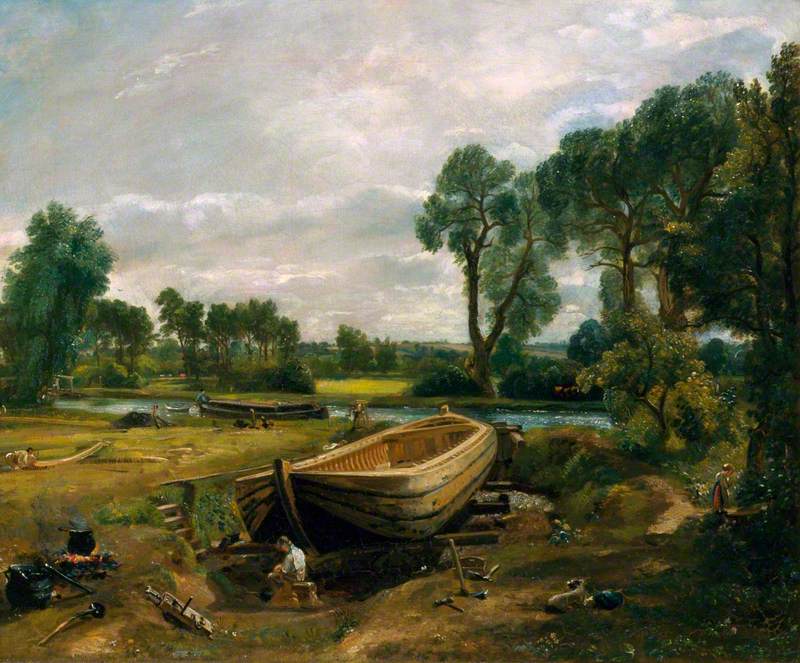
Title: Boat-Building Near Flatford Mill

Year: 1815

Type: Oil on canvas, landscape painting

Dimensions: 50.8 cm × 61.6 cm (20.0 in × 24.3 in)

Current Location: Victoria and Albert Museum, London


What I love about this painting:

I love Constable’s work, and this painting in particular. The dry dock was owned by Constable’s father.

The boat under construction is a barge and was painted from a sketch, but was painted in the open air.

The builder sits, carving a piece that will be fitted with care and precision. Building a boat nowadays requires skilled, knowledgeable craftsmen, as much as it did in 1815, although for most modern ships, it needs people with skills in different materials.

A tour of an historic sailing craft will show you that boat builders who built before the modern era were also skilled woodworkers. One of my favorite historic vessels is the Lady Washington, a replica that was built in Aberdeen Washington. Whenever it is there, I go to visit it.

About this painting, via Wikipedia:

Boat-Building Near Flatford Mill is an 1815 landscape painting by the English artist John Constable. It depicts a scene on the River Stour near to Flatford Mill on the EssexSuffolk border. Constable’s father owned Flatford Mill and the area around it is now known as Constable Country. Portraying the process of boat building, it has been described as a forerunner of his best-known Six-Foot paintings depicting scenes from the area. [1]

About the Artist, via Wikipedia:

John Constable (11 June 1776 – 31 March 1837) was an English landscape painter in the Romantic tradition. Born in Suffolk, he is known principally for revolutionizing the genre of landscape painting with his pictures of Dedham Vale, the area on the borderland of Suffolk and north Essex surrounding his home – now known as “Constable Country” – which he invested with an intensity of affection. “I should paint my own places best”, he wrote to his friend John Fisher in 1821, “painting is but another word for feeling.”

His early style has many qualities associated with his mature work, including a freshness of light, color and touch, and reveals the compositional influence of the old masters he had studied, notably of Claude Lorrain. Constable’s usual subjects, scenes of ordinary daily life, were unfashionable in an age that looked for more romantic visions of wild landscapes and ruins. He made occasional trips farther afield.

By 1803, he was exhibiting paintings at the Royal Academy. In April he spent almost a month aboard the East Indiaman Coutts as it visited south-east ports while sailing from London to Deal before leaving for China.

Another source of income was painting the portraits of country manors.

In 1817 Constable started work on his most ambitious project to date. The picture was Flatford Mill (Scene on a Navigable River). It was the largest painting of a rural scene that he had done to date and the largest he would ever complete largely outdoors. Constable was determined to paint on a larger scale, his objective not only to attract more attention at the Royal Academy exhibitions but also, it seems, to project his ideas about landscape on a scale more in keeping with the achievements of the classical landscape painters he so admired. Although Flatford Mill failed to find a buyer when it was exhibited at the Royal Academy in 1817, its fine and intricate execution drew much praise, encouraging Constable to move on to the even larger canvases that were to follow. [2]

For more information on this artist, go to: John Constable – Wikipedia.


Credits and Attributions:

[1] IMAGE: Wikipedia contributors, “Boat-Building Near Flatford Mill,” Wikipedia, The Free Encyclopedia, https://en.wikipedia.org/w/index.php?title=Boat-Building_Near_Flatford_Mill&oldid=1335473797 (accessed June 17, 2026).

[2] Wikipedia contributors, “John Constable,” Wikipedia, The Free Encyclopedia, https://en.wikipedia.org/w/index.php?title=John_Constable&oldid=1358915080 (accessed June 17, 2026).

Comments Off on #FineArtFriday: Boat building Near Flatford Mill by John Constable

Filed under #FineArtFriday

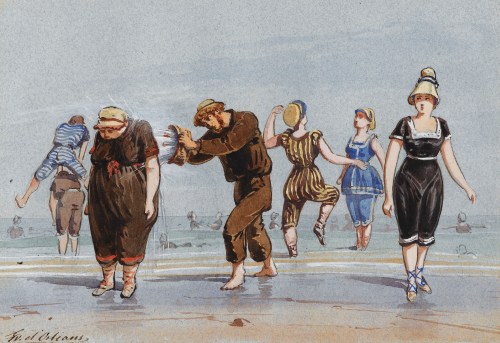
#FineArtFriday: A second look at “Sur la plage, les bains de mer” by François d’Orléans

François_d'Orléans_-_Sur_la_plage,_les_bains_de_merArtist: François d’Orléans, prince de Joinville (1818-1900)
Title: Sur la plage, les bains de mer (English: On the beach sea bathing)

Medium: Watercolor

Date: before 1900

What I love about this painting:

I first featured this painting in July of 2023. The wild sense of humor shown in this portrayal of upper-class Victorian-era people on vacation beside the sea absolutely captivated me. François d’Orléans spills the gossip in this watercolor seascape: they weren’t all as prim and proper as history would like us to believe.

I love the hilarity, the wild abandon they feel at being temporarily freed of “proper” clothing and society’s rules of politeness. When the holiday is over, they’ll have to behave. But for now, the sun is shining, the waters are warm, and the day is just getting started.

The two young men who are clowning around, one leaping over the back of the other make me laugh. They remind me of my husband’s college fraternity days circa 1978. (He did outgrow it, but some of their pranks were hilarious.)

Everyone is having fun on this glorious day beside the sea, except perhaps the woman being drenched by a bucket of water. So much action! It was a party, and François d’Orléans, Prince de Joinville recorded it with his own unique style.

About the Artist, via Wikipedia:

François d’Orléans, Prince de Joinville (14 August 1818 – 16 June 1900) was the third son of Louis PhilippeKing of the French, and his wife Maria Amalia of Naples and Sicily. An admiral of the French Navy, François was famous for bringing the remains of Napoleon from Saint Helena to France, as well as being a talented artist, with 35 known watercolours.

He married Princess Francisca of Brazil, daughter of Emperor Pedro I and sister of Emperor Pedro II. The dowry received by François upon the marriage became the Brazilian city of Joinville.

François and Francisca’s grandson Jean went on to become the Orléanist claimant to the extinct French throne, a claim passed on to his son, grandson and now great-grandson Jean, Count of Paris, current Orléanist claimant to the French crown.


Credits and Attributions:

IMAGE: Sur la plage, les bains de mer  by François d’Orléans, prince de Joinville. Wikimedia Commons contributors, “File:François d’Orléans – Sur la plage, les bains de mer.jpg,” Wikimedia Commons, https://commons.wikimedia.org/w/index.php?title=File:Fran%C3%A7ois_d%27Orl%C3%A9ans_-_Sur_la_plage,_les_bains_de_mer.jpg&oldid=757902107 (accessed June 11, 2026).

Wikipedia contributors, “François d’Orléans, Prince of Joinville,” Wikipedia, The Free Encyclopedia, https://en.wikipedia.org/w/index.php?title=Fran%C3%A7ois_d%27Orl%C3%A9ans,_Prince_of_Joinville&oldid=1160992832 (accessed June 11, 2026).

Comments Off on #FineArtFriday: A second look at “Sur la plage, les bains de mer” by François d’Orléans

Filed under #FineArtFriday, writing

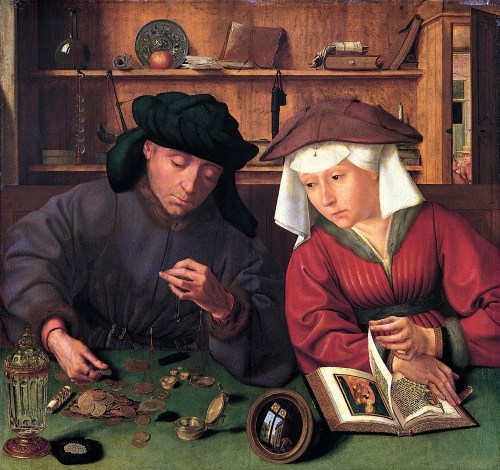
#FineArtFriday: The Money Changer and His Wife by Quentin Matsys, 1514

  • Artist: Quentin Matsys  (1456/1466–1530)
  • Title: The Moneylender and his Wife
  • Date: 1514
  • Medium: oil on panel
  • Dimensions: Height: 70.5 cm (27.7 in)
  • Current location: Louvre Museum
  • Inscriptions: Signature and date

The Money Changer and His Wife is a 1514 oil on panel painting by the Flemish renaissance artist Quentin Matsys.

What I love about this painting:

I first featured this painting in June of 2020. The pandemic was raging, and my husband and I spent many an hour on our back porch, sitting in the shade and watching the birds. I’d seen all the television I could stand, and so I talked Greg into helping me select a painting for that week’s Fine Art Friday post.

We sat in the shade, drinking iced tea.  I had my laptop out, and together we searched though the incredible storehouse of great art available on Wikimedia Commons.

That night, we fell in love with this painting.

These two people seem happy with each other. Matsys’ shows them with rich and vivid colors, and sharp, clean lines. He included the smallest details in the prayer book, the pewter plate in the background, and the crystal jar by the man’s right hand, showing a prosperous, well-educated young couple.

In some ways, Matsys’ style and level of detail reminds me of the work of the lesser-known Flemish painter, Pieter Brueghel the Younger, who was born long after Matsys’ death. The few original works of Pieter Brueghel the Younger that have survived leaned more toward caricatures and grotesques.

About this painting, via Wikipedia:

A man, who is weighing the jewels and pieces of gold on the table in front of him, sits next to his wife who is reading a book of devotion with an illustration of the Virgin and Child. The couple is not dressed as members of nobility, but rather as well-to-do burghers of Antwerp, where the painting was made. At the time, Antwerp had grown with the influx of many southern immigrants fleeing the Spanish Inquisition. Among this international community there was a demand for money-changers and money-lenders, as international commerce was increasing in the port city.

About the Artist, via Wikipedia:

Most early accounts of Matsys’ life are composed primarily of legend, and very little contemporary accounts exist of the nature of his activities or character. According to J. Molanus’ Historiae Lovaniensium, Matsys is known to be a native of Leuven with humble beginnings as an ironsmith. One of four children, Matsys was born to Joost Matsys (d. 1483) and Catherine van Kincken sometime between 4 April and 10 September 1466. Legend states that Matsys abandoned his career as a blacksmith to woo his wife, who found painting to be a more romantic profession, though Karel van Mander claimed this to be false, and the real reason was a sickness during which he was too weak to work at the smithy and instead decorated prints for the carnival celebrations.

Matsys work is considered to contain strong religious feeling—characteristic of traditional Flemish works—and is accompanied by a realism that often favored the grotesque. Matsys’ firmness of outline, clear modelling and thorough finish of detail stem from Van de Weyden’s influence; from the Van Eycks and Memling by way of Dirck Bouts, the glowing richness of transparent pigments. Matsys’ works generally reflect earnestness in expression, minutely detailed renderings, and subdued effects in light and shade. Like most Flemish artists of the time, he paid a great deal of attention to jewelry, edging of garments, and ornamentation in general.


Credits and Attributions:

The Money Changer and His Wife by Quentin Matsys, 1514 Public domain. The work of art depicted in this image and the reproduction thereof are in the public domain worldwide. The reproduction is part of a collection of reproductions compiled by The Yorck Project. The compilation copyright is held by Zenodot Verlagsgesellschaft mbH and licensed under the GNU Free Documentation License.

Wikipedia contributors, “The Money Changer and His Wife,” Wikipedia, The Free Encyclopedia, https://en.wikipedia.org/w/index.php?title=The_Money_Changer_and_His_Wife&oldid=937629150 (accessed June 04, 2026).

Wikipedia contributors, “Quentin Matsys,” Wikipedia, The Free Encyclopedia, https://en.wikipedia.org/w/index.php?title=Quentin_Matsys&oldid=960328863 (accessed June 04, 2026).


3 Comments

Filed under #FineArtFriday

#FineArtFriday: a closer look at “Children’s Games” by Pieter Bruegel the Elder 1560

Pieter_Bruegel_the_Elder_-_Children’s_Games_-_Google_Art_ProjectTitle: Children’s Games

Artist: Pieter Bruegel the Elder

Year: 1560

Type: Oil on panel

Dimensions: 118 cm × 161 cm (46 in × 63 in)

Location: Kunsthistorisches Museum, Vienna

What I love about this image:

I first featured this painting in 2024, and I still love it. Pieter Brugel the Elder was one of my first influences in the world of art appreciation. I love the chaos, the raucous jumble of humanity that Brugel always brought to a scene. It is as wild and noisy as his more famous composition, The Wedding Dance. Children have taken over the city and everything is fair game. Brugel’s depiction of village children and their play offered him an opportunity to shine a small light on the hubris and arrogance of mankind, using allegory and misdirection.

About this painting via Wikipedia:

The entire composition is full of children playing a wide variety of games. Over 90 different games that were played by children at the time have been identified.

The artist’s intention for this work is more serious than simply to compile an illustrated encyclopaedia of children’s games, though some eighty particular games have been identified. Bruegel shows the children absorbed in their games with the seriousness displayed by adults in their apparently more important pursuits. His moral is that in the mind of God, children’s games possess as much significance as the activities of their parents. This idea was a familiar one in contemporary literature: in an anonymous Flemish poem published in Antwerp in 1530 by Jan van Doesborch, mankind is compared to children who are entirely absorbed in their foolish games and concerns. [1]

I love the pandemonium Pieter Brueghel the Elder always instilled into his work. He never fails to show us that underneath the skin, we are no different than our ancestors were.

And we should find the humor in our frailties. the ability to laugh at oneself is a gift. The inability to do so is a failing so many leaders are cursed with, to the detriment of everyone.

A small dose of humility makes us approachable, makes us more human.

About the Artist, via Wikipedia:

Pieter Bruegel (also Brueghel or Breughelthe Elder c. 1525–1530 – 9 September 1569) was the most significant artist of Dutch and Flemish Renaissance painting, a painter and printmaker from Brabant, known for his landscapes and peasant scenes (so-called genre painting); he was a pioneer in making both types of subject the focus in large paintings.

He was a formative influence on Dutch Golden Age painting and later painting in general in his innovative choices of subject matter, as one of the first generation of artists to grow up when religious subjects had ceased to be the natural subject matter of painting. He also painted no portraits, the other mainstay of Netherlandish art. After his training and travels to Italy, he returned in 1555 to settle in Antwerp, where he worked mainly as a prolific designer of prints for the leading publisher of the day. Only towards the end of the decade did he switch to make painting his main medium, and all his famous paintings come from the following period of little more than a decade before his early death, when he was probably in his early forties, and at the height of his powers.

Around 1563, Bruegel moved from Antwerp to Brussels, where he married Mayken Coecke, the daughter of the painter Pieter Coecke van Aelst and Mayken Verhulst. As registered in the archives of the Cathedral of Antwerp, their deposition for marriage was registered 25 July 1563. The marriage itself was concluded in the Chapel Church, Brussels in 1563. 

Pieter the Elder had two sons: Pieter Brueghel the Younger and Jan Brueghel the Elder (both kept their name as Brueghel). Their grandmother, Mayken Verhulst, trained the sons because “the Elder” died when both were very small children. The older brother, Pieter Brueghel copied his father’s style and compositions with competence and considerable commercial success. Jan was much more original, and very versatile. He was an important figure in the transition to the Baroque style in Flemish Baroque painting and Dutch Golden Age painting in a number of its genres. He was often a collaborator with other leading artists, including with Peter Paul Rubens on many works including the Allegory of Sight.

Other members of the family include Jan van Kessel the Elder (grandson of Jan Brueghel the Elder) and Jan van Kessel the Younger. Through David Teniers the Younger, son-in-law of Jan Brueghel the Elder, the family is also related to the whole Teniers family of painters and the Quellinus family of painters and sculptors, through the marriage of Jan-Erasmus Quellinus to Cornelia, daughter of David Teniers the Younger. [2]


Credits and Attributions:

IMAGE:  Children’s Games, Wikimedia Commons contributors, “File:Pieter Bruegel the Elder – Children’s Games – Google Art Project.jpg,” Wikimedia Commons, https://commons.wikimedia.org/w/index.php?title=File:Pieter_Bruegel_the_Elder_-_Children%E2%80%99s_Games_-_Google_Art_Project.jpg&oldid=725602746 (accessed April 26, 2024).

[1] Wikipedia contributors, “Children’s Games (Bruegel),” Wikipedia, The Free Encyclopedia, https://en.wikipedia.org/w/index.php?title=Children%27s_Games_(Bruegel)&oldid=1198935116 (accessed April 26, 2024).

[2] Wikipedia contributors, “Pieter Bruegel the Elder,” Wikipedia, The Free Encyclopedia, https://en.wikipedia.org/w/index.php?title=Pieter_Bruegel_the_Elder&oldid=1218696694 (accessed April 26, 2024).

Comments Off on #FineArtFriday: a closer look at “Children’s Games” by Pieter Bruegel the Elder 1560

Filed under #FineArtFriday

#FineArtFriday: A close look at “Beware of Luxury” by Jan Steen ca.1663

Öèôðîâàÿ ðåïðîäóêöèÿ íàõîäèòñÿ â èíòåðíåò-ìóçåå Gallerix.ru

Artist: Jan Steen (1625/1626–1679)

Title: Beware of Luxury (“In Weelde Siet Toe”)

Date: circa 1663

Medium: oil on canvas

Dimensions: height: 105 cm (41.3 in); width: 145 cm (57 in)

Collection: Kunsthistorisches Museum

What I love about this painting:

I first featured this painting in 2024. I love this hilarious pictorial story featuring a family with more coins than sense. It’s the 17th-century equivalent of “party like a rock star.”

Jan Steen is one of my all-time favorite painters, as he manages to bring the absurdities, hypocrisies, and contradictions of society into each painting with a knowing eye that says, “here we are, warts and all.” He must have been a treat to know.

In this painting, Steen lampoons family life. Mother is taking a well-deserved nap, and the family is running wild, drinking to excess and partying like it was 1599. Grandma ignores the rumpus and instead, she is lecturing the Reverend on doctrine.

The house is trashed, and the dog is on the table eating the pie. The baby is playing with the mother’s pearls. The oldest daughter’s suitor is sitting with his leg over her lap is a visual nod to promiscuity. “Getting his leg over her” was slang for premarital canoodling.

Every town has a family that muddles along like this. All of society’s flaws seem to coalesce in one rundown house with a yard full of junk and a dog that roams the neighborhood. They give us the opportunity to feel superior, if only for a moment.

Some of Steen’s closest friends were actors, and they regularly appear in his paintings. Although each of the many characters and every element of set dressing is realistically depicted, this is a theatrical drama staged and satirized for our entertainment.

The Age of the Puritan had swept across Europe and while it was waning in the mid-seventeenth century, puritanism had a large influence on life in Holland as much as elsewhere.

This painting is a wonderful visual exhortation reminding the good people to live a sober life. Steen himself was not a puritan, as he was born into a family of brewers and ran taverns and breweries off and on throughout his life. But he did need to sell his paintings as he was never a successful businessman, and his allegorical paintings were quite popular.

About the Artist, via Wikipedia:

Jan Havickszoon Steen (c. 1626 – buried 3 February 1679) was a Dutch Golden Age painter, one of the leading genre painters of the 17th century. His works are known for their psychological insight, sense of humour and abundance of colour.

In 1648 Jan Steen and Gabriël Metsu founded the painters’ Guild of Saint Luke at Leiden. Soon after he became an assistant to the renowned landscape painter Jan van Goyen (1596–1656), and moved into his house on the Bierkade in The Hague. On 3 October 1649, he married van Goyen’s daughter Margriet, with whom he would have eight children. Steen worked with his father-in-law until 1654, when he moved to Delft, where he ran the brewery De Slang (“The Snake”) for three years without much success.  After the explosion in Delft in 1654 the art market was depressed, but Steen painted A Burgomaster of Delft and his daughter. It does not seem to be clear if this painting should be called a portrait or a genre work.

Steen lived in Warmond, just north of Leiden, from 1656 until 1660 and in Haarlem from 1660 until 1670 and in both periods he was especially productive. In 1670, after the death of his wife in 1669 and his father in 1670, Steen moved back to Leiden, where he stayed the rest of his life. When the art market collapsed in 1672, called the Year of Disaster, Steen opened a tavern. In April 1673 he married Maria van Egmont, who gave him another child. In 1674 he became president of the Saint Luke’s Guild. Frans van Mieris (1635–1681) became one of his drinking companions. He died in Leiden in 1679 and was interred in a family grave in the Pieterskerk. [1]


Credits and Attributions:

IMAGE: Beware of Luxury by Jan Steen, ca. 1663. Wikimedia Commons contributors, “File:Jan Steen 004b.jpg,” Wikimedia Commons, https://commons.wikimedia.org/w/index.php?title=File:Jan_Steen_004b.jpg&oldid=617576422 (accessed May 21, 2026).

[1] Wikipedia contributors, “Jan Steen,” Wikipedia, The Free Encyclopedia, https://en.wikipedia.org/w/index.php?title=Jan_Steen&oldid=1249713624 (accessed May 21, 2026).

Comments Off on #FineArtFriday: A close look at “Beware of Luxury” by Jan Steen ca.1663

Filed under #FineArtFriday

#FineArtFriday: Harvest 1915 by Zinaida Serebriakova

Artist: Zinaida Serebriakova (1884–1967)

Title: Harvest 1915

Description: English: Harvest (Français: Moisson) (Русский: Жатва)

Date: 1915

Collection: Odesa Fine Arts Museum

What I love about this painting:

I love that Zinaida Serebriakova paints women at work in the field, getting the harvest in. They are taking a midday break from raking hay. These women are barefoot, and their skirts are tied up around their waists, leaving them more able to walk easily in the fields of tall grain and field grass.

No men are there, as Russia had entered WWI a year earlier in 1914. Just like in Brittain and elsewhere, the farms were worked by the women, children, and old people.

Women managed livestock, plowed, planted, and harvested, ensuring their husbands, sons, and brothers had food on the front lines.

Their skirts are shown in shades of red, black, and brown, standing out from the field of gold. The sky overhead shows of high white clouds drifting across the afternoon sky.

Serebriakova shows us strong young women doing what women have always done: making sure that whatever needs doing gets done.

About the Artist Via Wikipedia:

Zinaida Yevgenyevna Lansere was born on 10 December [O.S. 28 November] 1884 on the estate of Neskuchnoye near Kharkov in the Russian Empire. Her father, Yevgeny Aleksandrovich Lansere (1848–1886), was a sculptor. Her mother, Yekaterina Lansere, was a painter and came from the artistic Benois family.

Serebriakova’s most famous self-portrait, At the Dressing-Table (1909, Tretyakov Gallery), was painted while she was snowed in at her family home and models from a nearby village were unable to travel there. Her brother Yevgeny encouraged Serebriakova to enter the painting in an exhibition mounted by Mir iskusstva in 1910, where it was received with enthusiasm and purchased for the Tretyakov Gallery collection.

After the outbreak of the October Revolution in 1917, Serebriakova’s life changed for the worse. In 1918, her country estate was burned to the ground. Her husband Boris was arrested, and in 1919, he died of typhus. She was left without any income, responsible for her four children and her sick mother. All the reserves of Neskuchnoye had been plundered, so the family suffered from hunger. She had to give up oil painting in favour of the less expensive techniques of charcoal and pencil. This was the time of her most tragic painting, House of Cards, which depicts their four fatherless children.

In the autumn of 1924, Serebriakova went to Paris, having received a commission for a large decorative mural. On finishing this work, she intended to return to the Soviet Union, where her mother and the four children remained. However, she was not able to return, and although she was able to bring her children, Alexandre and Catherine, to Paris in 1926 and 1928 respectively, she could not do the same for her two other children, Yevgeny and Tatiana, and did not see them again for many years.

To read more about this amazing woman’s powerful and sometimes tragic life, go to Zinaida Serebriakova – Wikipedia.


Credits and Attributions:

IMAGE: Harvest by Zinaida Serebriakova. Wikimedia Commons contributors, “File:Serebryakova Harvest 1915.jpg,” Wikimedia Commons, https://commons.wikimedia.org/w/index.php?title=File:Serebryakova_Harvest_1915.jpg&oldid=1160900234 (accessed May 9, 2026).

[1] Wikipedia contributors, “Zinaida Serebriakova,” Wikipedia, The Free Encyclopedia, https://en.wikipedia.org/w/index.php?title=Zinaida_Serebriakova&oldid=1352183665 (accessed May 9, 2026).

2 Comments

Filed under #FineArtFriday

#FineArtFriday: a closer look at “Boys in a Dory” by Winslow Homer 1873

Artist: Winslow Homer (1836–1910)

Title: Boys in a Dory

Date: 1873

Medium: Watercolor washes and gouache over graphite underdrawing on medium rough textured white wove paper

Dimensions: 9 3/4 x 13 7/8 in. (24.8 x 35.2 cm)

Collection: Metropolitan Museum of Art

Inscription: signed Homer 1873

What I love about this image:

I first featured this painting a year ago. When I was searching Wikimedia for an image to discuss today, I kept coming back to this one.  Perhaps I like it so much because it reminds me of my childhood, of taking my dad’s powerboat out with my little sister and our cousins.

My oldest cousin, Skip, was fourteen and in charge, and we were his crew. Skip ran a tight ship and never drove the boat faster than my father had decreed.

Those were the days when summers lasted forever and the future held nothing but promise. A golden moment of time before life intervened and my cousins moved away, their lives changed by the stormy seas of their parents’ divorce.

Here we have four boys out for a summer’s day on the water. Are they brothers? They all wear similar long-sleeved lightweight cotton shirts and straw hats as protection against the sun.

The two youngest ride while the older boys row. The water is calm, perfect for a sunny afternoon of freedom. Do they plan to fish or are they just out for the fun of it?

I especially like how Homer paints the water. He depicts the reflections perfectly, showing us how they mirror on the soft movement of the water’s surface. He shows us the sailing craft in the distance with minimal strokes, clearly showing the other boats heading out for a day’s fishing or pleasure boating.

About this painting via Wikipedia:

Boys in a Dory is one of Homer’s first watercolors. According to the Met’s description of the painting, the artist’s initial style of watercolors resulted in Boys being simple and direct.

The painting was rendered by Homer while he was in Gloucester, Massachusetts. [1]

About the dory, via Wikipedia:

The dory can be defined as a small boat which has:

  • a flat bottom, with the bottom planks fastened lengthwise (bow to stern).
  • a hull shape defined by the natural curve of a sawn plank (never steam-bent).
  • planks overlapping the stem at the front of the boat and an outer “false” stem covering the hood ends of the planks.
  • (with some exceptions) a fairly narrow transom often referred to as the “tombstone” due to its unique shape.

The hull’s bottom is transversely flat and usually bowed fore-and-aft. (This curvature is known as “rocker”.) The stern is frequently a raked narrow transom that tapers sharply toward the bottom forming a nearly double-ended boat. The traditional bottom is made from planks laid fore and aft and not transverse, although some hulls have a second set of planks laid over the first in a pattern that is crosswise to the main hull for additional wear and strength.

As the need for working dories diminished, the Swampscott or beach dory types were modified for pleasure sailing. These sailing dories became quite popular at the beginning of the 20th century around the town of Marblehead, Massachusetts. They were generally longer yet remained narrow with low freeboard and later were often decked over. Another common distinctive feature of the sailing dory was a long boom on the rig that angled up with a mainsail that was larger along the foot than the luff.  [2]

About the Artist via Wikipedia:

Winslow Homer (February 24, 1836 – September 29, 1910) was an American landscape painter and illustrator, best known for his marine subjects. He is considered one of the foremost painters of 19th-century America and a preeminent figure in American art in general.

Largely self-taught, Homer began his career working as a commercial illustrator. He subsequently took up oil painting and produced major studio works characterized by the weight and density he exploited from the medium. He also worked extensively in watercolor, creating a fluid and prolific oeuvre, primarily chronicling his working vacations. [3]


Credits and Attributions:

IMAGE: Boys in a Dory by Winslow Homer. Wikimedia Commons contributors, “File:Boys in a Dory MET DT5026.jpg,” Wikimedia Commons,  https://commons.wikimedia.org/w/index.php?title=File:Boys_in_a_Dory_MET_DT5026.jpg&oldid=928781177 (accessed April 3, 2025).

[1] Wikipedia contributors, “Boys in a Dory,” Wikipedia, The Free Encyclopedia, https://en.wikipedia.org/w/index.php?title=Boys_in_a_Dory&oldid=1249874568 (accessed April 3, 2025).

[2] Wikipedia contributors, “Dory (boat),” Wikipedia, The Free Encyclopedia, https://en.wikipedia.org/w/index.php?title=Dory_(boat)&oldid=1281846716 (accessed April 3, 2025).

[3] Wikipedia contributors, “Winslow Homer,” Wikipedia, The Free Encyclopedia, https://en.wikipedia.org/w/index.php?title=Winslow_Homer&oldid=1277975900 (accessed April 3, 2025).

Comments Off on #FineArtFriday: a closer look at “Boys in a Dory” by Winslow Homer 1873

Filed under #FineArtFriday, writing

#FineArtFriday: Palazzo Corner Spinelli by John Singer Sargent, ca, 1902

Artist: John Singer Sargent (1856–1925)

Title: Palazzo Corner Spinelli

Date: circa 1902.

Medium: watercolor, gouache and pencil on paper

Dimensions: 10 x 14 in. (25.4 x 35.6 cm.)

Inscriptions: signed and inscribed ‘to Miss Gertie/from her friend/John S. Sargent’ (upper left)

What I like about this painting:

John Singer Sargent’s love of Italy, and Venice in particular, is clear when you look at the number of stellar watercolor paintings he made while living there.

Sargent’s watercolors are as fine as any of his work done in oils and show us a bit of his personal life. It seems as if he paints in watercolors for fun, and oils for cash.

The day he shows us is warm and hazy. Several gondolas are moored, waiting to ferry passengers around town. The imposing architecture is balanced by water and sky.

He shows us the scene in nuanced shades of blue, cream, gray, tan and brown. This is a pleasant scene, a glimpse of a place that was clearly important to him.

About The Artist via Wikipedia:

John Singer Sargent (January 12, 1856 – April 14, 1925) was an American expatriate artist, considered the “leading portrait painter of his generation” for his evocations of Edwardian-era luxury. He created roughly 900 oil paintings and more than 2,000 watercolors, as well as countless sketches and charcoal drawings. His oeuvre documents worldwide travel, from Venice to the TyrolCorfu, the Middle East, Montana, Maine, and Florida.

Born in Florence to American parents, he was trained in Paris before moving to London, living most of his life in Europe. He enjoyed international acclaim as a portrait painter. An early submission to the Paris Salon in the 1880s, his Portrait of Madame X, was intended to consolidate his position as a society painter in Paris but instead resulted in scandal. During the next year following the scandal, Sargent departed for England where he continued a successful career as a portrait artist.

From the beginning, Sargent’s work is characterized by remarkable technical facility, particularly in his ability to draw with a brush, which in later years inspired admiration as well as criticism for a supposed superficiality. His commissioned works were consistent with the grand manner of portraiture, while his informal studies and landscape paintings displayed a familiarity with Impressionism. In later life Sargent expressed ambivalence about the restrictions of formal portrait work and devoted much of his energy to mural painting and working en plein air. Art historians generally ignored society artists such as Sargent until the late 20th century.

With his watercolors, Sargent was able to indulge his earliest artistic inclinations for nature, architecture, exotic peoples, and noble mountain landscapes. And it is in some of his late works where one senses Sargent painting most purely for himself. His watercolors were executed with a joyful fluidness. He also painted extensively family, friends, gardens, and fountains. In watercolors, he playfully portrayed his friends and family dressed in Orientalist costume, relaxing in brightly lit landscapes that allowed for a more vivid palette and experimental handling than did his commissions (The Chess Game, 1906). His first major solo exhibit of watercolor works was at the Carfax Gallery in London in 1905. In 1909, he exhibited eighty-six watercolors in New York City, eighty-three of which were bought by the Brooklyn MuseumEvan Charteris wrote in 1927:

To live with Sargent’s watercolors is to live with sunshine captured and held, with the luster of a bright and legible world, ‘the refluent shade’ and ‘the Ambient ardors of the noon.’

Although not generally accorded the critical respect given Winslow Homer, perhaps America’s greatest watercolorist, scholarship has revealed that Sargent was fluent in the entire range of opaque and transparent watercolor technique, including the methods used by Homer. [1]


Credits and Attributions:

IMAGE: Wikimedia Commons contributors, “File:Palazzo Corner Spinelli SN00666431 001 1 001.jpg,” Wikimedia Commons, https://commons.wikimedia.org/w/index.php?title=File:Palazzo_Corner_Spinelli_SN00666431_001_1_001.jpg&oldid=1013372496 (accessed April 30, 2026).

[1] Wikipedia contributors, “John Singer Sargent,” Wikipedia, The Free Encyclopedia, https://en.wikipedia.org/w/index.php?title=John_Singer_Sargent&oldid=1347366201 (accessed April 30, 2026).

Comments Off on #FineArtFriday: Palazzo Corner Spinelli by John Singer Sargent, ca, 1902

Filed under #FineArtFriday