Category Archives: #FineArtFriday

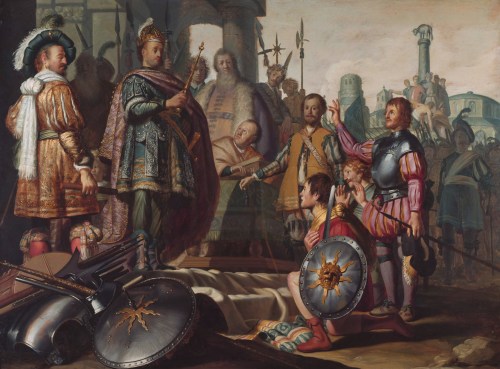
#FineArtFriday: History Painting, Titus (with self portrait of Rembrandt) by Rembrandt Harmenszoon van Rijn 1626

History Painting, Titus (with self portrait of Rembrandt) by Rembrandt Harmenszoon van Rijn 1626

  • Artist: Rembrandt  (1606–1669) Rembrandt Harmenszoon van Rijn
  • Title: Historical Scene.
  • Inscriptions: Monogram and date bottom right: RH 16[2]6
  • Object type: painting
  • Genre: history painting
  • Depicted people: Titus
  • Date: 1626
  • Medium: oil on oak panel
  • Dimensions: Height: 89.8 cm (35.3 in); Width: 121 cm (47.6 in)
  • Collection:   Museum De Lakenhal

What I love about this Painting:

This is one of Rembrandt’s earliest history paintings. The young artist went all out to compose and execute this painting. He scoured the city for props, and found old armor and weapons. Then he dressed the players richly in the finest garments of his own day, so as to befit a beloved and respected emperor.

Wikipedia says: Rembrandt’s portraits of his contemporaries, self-portraits, and illustrations of scenes from the Bible are regarded as his greatest creative triumphs. His self-portraits form a unique and intimate biography, in which the artist surveyed himself without vanity and with the utmost sincerity.

The level of detail in the weaponry and richly worked garments is remarkable, as are the faces and features of each of the players. Emperor Titus is portrayed as slightly larger than life, noble, wise, and kind.
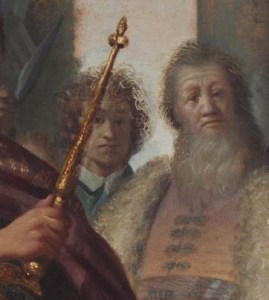
In the background, hidden by the scepter, we find Rembrandt himself, the witness who happened to come upon the scene and is looking on with wonder. Of the witnesses, he alone is shown dressed in the unadorned muted gray woolen clothing of a common man.

We know Rembrandt was well educated in history, and admired the Emperor Titus greatly, as he named his only surviving son after him.

About the Roman Emperor Titus, the Subject of this Painting (via Wikipedia):

Vespasian died of an infection on 23 June 79 AD, and was immediately succeeded by his son Titus. As Pharaoh of Egypt, Titus adopted the titulary Autokrator Titos Kaisaros Hununefer Benermerut (“Emperor Titus Caesar, the perfect and popular youth”). Because of his many (alleged) vices, many Romans feared that he would be another Nero. Against these expectations, however, Titus proved to be an effective Emperor and was well loved by the population, who praised him highly when they found that he possessed the greatest virtues instead of vices.

One of his first acts as Emperor was to order a halt to trials based on treason charges, which had long plagued the principate. The law of treason, or law of majestas, was originally intended to prosecute those who had corruptly “impaired the people and majesty of Rome” by any revolutionary action. Under Augustus, however, this custom had been revived and applied to cover slander and libel as well. This led to numerous trials and executions under TiberiusCaligula, and Nero, and the formation of networks of informers (Delators), which terrorized Rome’s political system for decades.

Titus put an end to this practice, against himself or anyone else, declaring:

“It is impossible for me to be insulted or abused in any way. For I do naught that deserves censure, and I care not for what is reported falsely. As for the emperors who are dead and gone, they will avenge themselves in case anyone does them a wrong, if in very truth they are demigods and possess any power.”

Consequently, no senators were put to death during his reign; he thus kept to his promise that he would assume the office of Pontifex Maximus “for the purpose of keeping his hands unstained.” The informants were publicly punished and banished from the city. Titus further prevented abuses by making it unlawful for a person to be tried under different laws for the same offense.  Finally, when Berenice returned to Rome, he sent her away.

As Emperor he became known for his generosity, and Suetonius states that upon realizing he had brought no benefit to anyone during a whole day, Titus remarked, “Friends, I have lost a day.”


Credits and Attributions:

History Painting, Titus (with self portrait of Rembrandt) by Rembrandt Harmenszoon van Rijn 1626

Wikipedia contributors, “Titus,” Wikipedia, The Free Encyclopedia,  https://en.wikipedia.org/w/index.php?title=Titus&oldid=950453618 (accessed April 24, 2020).

Wikimedia Commons contributors, “File:Rembrandt Historical Painting 1626 (Detail, with self-portrait).jpg,” Wikimedia Commons, the free media repository, https://commons.wikimedia.org/w/index.php?title=File:Rembrandt_Historical_Painting_1626_(Detail,_with_self-portrait).jpg&oldid=369318658 (accessed April 24, 2020).
2 Comments

Filed under #FineArtFriday

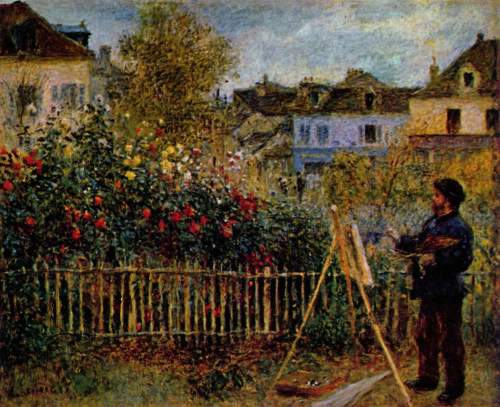
#FineArtFriday: Monet Painting in His Garden by Pierre-Auguste Renoir 1873

Monet Painting in His Garden by Pierre-Auguste Renoir

Date: 1873

Medium: oil on canvas

Dimensions : Height: 46 cm (18.1 in); Width: 60 cm (23.6 in)

Collection: Wadsworth Atheneum Museum of Art

What I love about this painting:

Renoir shows us that Claude Monet’s garden is lush and a little wild, like the man who owns it. Yet, although he is the subject of this painting, Monet is completely focused on his work. The colors are vivid, which inspires me since my own garden is only now shaking off the depredations of winter. I would love to spend time in this riotous garden.

Renoir visited his good friend many times during the years Monet lived at Argenteuil, a village on the right bank of the Seine river near Paris. In 1873, Monet purchased a small boat equipped to be used as a floating studio, which must have been a draw for Renoir and his friends.

About the artist (via Wikipedia):

In 1862, Auguste Renoir began studying art under Charles Gleyre in Paris. There he met Alfred SisleyFrédéric Bazille, and Claude Monet.  At times, during the 1860s, he did not have enough money to buy paint. Renoir had his first success at the Salon of 1868 with his painting Lise with a Parasol (1867), which depicted Lise Tréhot, his lover at the time. Although Renoir first started exhibiting paintings at the Paris Salon in 1864, recognition was slow in coming, partly as a result of the turmoil of the Franco-Prussian War.

Renoir was inspired by the style and subject matter of previous modern painters Camille Pissarro and Edouard Manet. After a series of rejections by the Salon juries, he joined forces with Monet, Sisley, Pissarro, and several other artists to mount the first Impressionist exhibition in April 1874, in which Renoir displayed six paintings. Although the critical response to the exhibition was largely unfavorable, Renoir’s work was comparatively well received.  That same year, two of his works were shown with Durand-Ruel in London. 


Credits and Attributions:

Monet Painting in His Garden by Pierre-Auguste Renoir / Public domain

Wikipedia contributors, “Pierre-Auguste Renoir,” Wikipedia, The Free Encyclopedia, https://en.wikipedia.org/w/index.php?title=Pierre-Auguste_Renoir&oldid=949963500 (accessed April 17, 2020).

Wikimedia Commons contributors, “File:Renoir-Monet painting.png,” Wikimedia Commons, the free media repository, https://commons.wikimedia.org/w/index.php?title=File:Renoir-Monet_painting.png&oldid=338421916 (accessed April 17, 2020).

Comments Off on #FineArtFriday: Monet Painting in His Garden by Pierre-Auguste Renoir 1873

Filed under #FineArtFriday

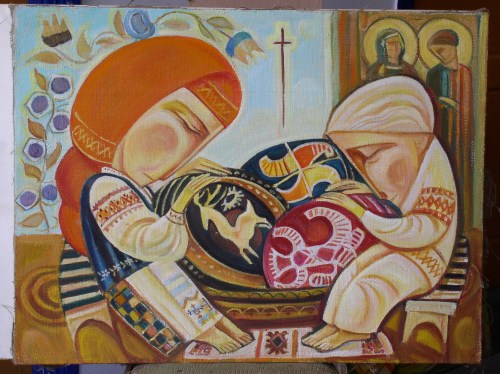
#FineArtFriday: Painting Easter Eggs, by Mykhaylo Chornyi

Today’s image is one that I posted in 2019 on Good Friday – the Friday before Easter. For me, this painting is like an Easter-card from friends far away.

This image is painted in  the Ukrainian Neo-Folk style. The artist, Mykhaylo Chornyi, lives and paints in the Ukraine. Many European ethnic groups have traditions for using the wax-resist method (psyanky) for inscribing designs on eggs.

From Wikipedia:

pysanka (Ukrainianписанка, plural: писанки) is a Slavic egg , decorated with traditional folk designs using a wax-resist method. The word pysanka comes from the verb pysaty, “to write” or “to inscribe”, as the designs are not painted on, but written (inscribed) with beeswax.

I’m captivated by the colors, the life in this amazing depiction of that most popular of Easter activities. It was painted in 2000, and to me, while it is highly stylized, it is passionate. Every time I look at this photograph of the painting, I see something new, some small detail that enchants me and draws me deeper into it. I feel like it’s an Easter gift from the artist to me.

Coloring eggs is a common activity this time of year, but these artists don’t simply dye their eggs in pastel shades the way most children here in the US do. These painters are intent, creating brilliant works of art on the most delicate of canvasses—the eggshell.

There is something reverent about the painters as they go about their work. The religious themes in the background are so much a part of the overall scene they are nearly subliminal, yet they are not hidden in any way. Who are the eggs intended as gifts for?

About the Artist, Via Wikipedia:

Mykhaylo Nikiforovich Chornyi (Ukrainian: Михайло Никифорович Чорний; Russian: Михаил Никифорович Чёрный; November 26, 1933) is a Ukrainian Realist, Neo-Primitivist) painter and graphic artist. Chornyi is described as “the founder of Ukrainian Neo-Folk Style”. A member of Ukrainian National Artists’ Union since 1968. People’s Artist of Ukraine (2003).


Credits and Attributions:

Painting Easter Eggs by Mykhaylo Chornyi first posted here on 19 APR 2019. https://conniejjasperson.com/2019/04/19/fineartfriday-painting-easter-eggs-by-mykhaylo-chornyi/

Painting Easter Egg, by Mykhaylo Chornyi (Black milly [CC BY-SA 3.0 (https://creativecommons.org/licenses/by-sa/3.0)] )

Wikimedia Commons contributors, “File:Painting Easter Eggs.jpg,” Wikimedia Commons, the free media repository, https://commons.wikimedia.org/w/index.php?title=File:Painting_Easter_Eggs.jpg&oldid=185923430 (accessed April 19, 2019).

Wikipedia contributors, “Mykhaylo Chornyi,” Wikipedia, The Free Encyclopedia, https://en.wikipedia.org/w/index.php?title=Mykhaylo_Chornyi&oldid=838782944 (accessed April 19, 2019).

Lubap Creator:Luba Petrusha [CC BY-SA 3.0 (https://creativecommons.org/licenses/by-sa/3.0)%5D

Wikipedia contributors, “Pysanka,” Wikipedia, The Free Encyclopedia, https://en.wikipedia.org/w/index.php?title=Pysanka&oldid=893148353 (accessed April 19, 2019).

2 Comments

Filed under #FineArtFriday, writing

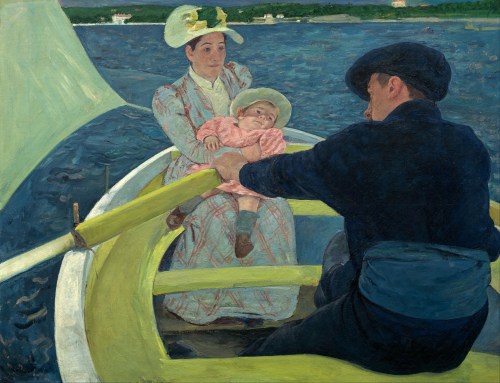
#FineArtFriday: The Boating Party, by Mary Cassatt 1893

Artist Mary Cassatt
Year 1893
Medium oil on canvas
Dimensions 90 cm × 117.3 cm (46 3/16 in × 35 7/16 in)

What I love about The Boating Party by American artist, Mary Cassatt, is impression of movement, of the life of the water. It has a feeling of contentment, of peace. There is a serenity about this painting that evokes wonderful memories of boating and water sports, of the time when my family still lived on a lake. It reminds me of the sheer joy and freedom of being on the water with no purpose other than to enjoy one’s self.

About this painting, from Wikipedia:

Art historian and museum administrator Frederick A. Sweet calls it “One of the most ambitious paintings she (Cassatt) ever attempted.” His 1966 analysis focuses on the balance of the “powerful dark silhouette of the boatman”, the angle between the oar and the arm that “thrusts powerfully into the center of the composition towards the mother and child” and “delicate, feminine ones.”

Cassatt placed the horizon at the top of the frame in Japanese fashion.

  • In 1890 Cassatt visited the great Japanese Print exhibition at the ecole de Beaux-arts in Paris.
  • Mary Cassatt owned Japanese prints by Kitagawa Utamaro (1753–1806).
  • The exhibition at Durand-Ruel of Japanese art proved the most important influence on Cassatt.

(Influence of) Manet

Frederick A. Sweet suggests that Cassatt may have been inspired by Édouard Manet‘s Boating from 1874.

I hadn’t considered that position of the horizon as being a traditional Japanese style until I read that paragraph. Then I realized that most Western artists place it lower on the canvas. In Western art, the sky (an allegory for God) traditionally dominates the work.

This painting has made me aware of  how greatly the ability to travel the world via ocean liners and contact with other cultures changed the way we produce art. Impressionism was new and daring in its time. The eye of the artist was freed from traditional confines of the various schools (Hudson Valley, etc.) by exposure to the simplicity and elegance of the previously unknown tradition of Japanese art.

Every new painting I come across leads me to another, which often leads me to another country and another tradition of style and form.

My life as an admirer of art is one of constantly finding something new about history and the world around me.

About the artist, Via Wikipedia:

Mary Stevenson Cassatt (May 22, 1844 – June 14, 1926) was an American painter and print-maker. She was born in Allegheny City, Pennsylvania (now part of Pittsburgh’s North Side), but lived much of her adult life in France, where she first befriended Edgar Degas and later exhibited among the Impressionists. Cassatt often created images of the social and private lives of women, with particular emphasis on the intimate bonds between mothers and children.

She was described by Gustave Geffroy in 1894 as one of “les trois grandes dames” (the three great ladies) of Impressionism alongside Marie Bracquemond and Berthe Morisot.


Credits and Attributions:

The Boating Party by Mary Cassatt, 1893–94

Wikipedia contributors. “The Boating Party.” Wikipedia, The Free Encyclopedia. Wikipedia, The Free Encyclopedia, 9 Dec. 2018. Web. 8 Mar. 2019.

3 Comments

Filed under #FineArtFriday, writing

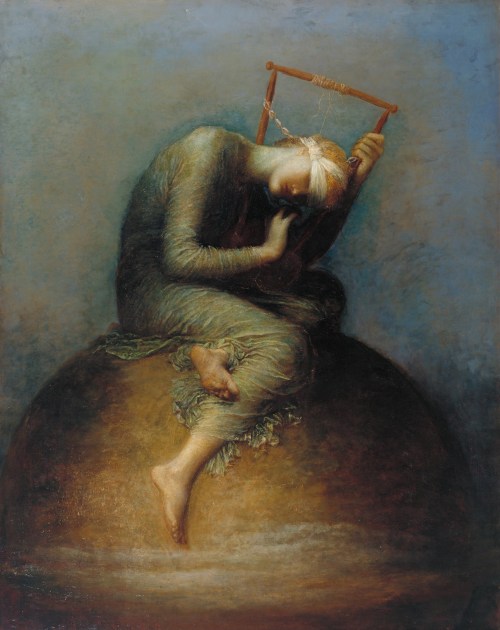
#FineArtFriday: Hope by George Frederic Watts 1886

Title: Hope, by George Frederic Watts

Date: 1886

Genre: allegory

Medium: oil on canvas

Dimensions Height: 142.2 cm (55.9 in); Width: 111.8 cm (44 in)

Collection:  Tate Britain

Notes: Presented by George Frederic Watts 1897

What I love about this painting:

This painting strikes home with me. Hope is blindfolded, battered, dressed in rags, and cast adrift in the universe. She clings to a lyre upon which only one string remains—yet Hope turns her head to hear the sound of that one string. The lone star in the sky is nearly invisible, yet it is there, deliberately placed. Watts’s choice of symbols for this allegory and the stark layout of the composition combine to create a powerful idea—Hope makes music with one string when nothing else remains.

About this painting (via Wikipedia):

Hope is a Symbolist oil painting by the English painter George Frederic Watts, who completed the first two versions in 1886. Radically different from previous treatments of the subject, it shows a lone blindfolded female figure sitting on a globe, playing a lyre that has only a single string remaining. The background is almost blank, its only visible feature a single star. Watts intentionally used symbolism not traditionally associated with hope to make the painting’s meaning ambiguous. While his use of colour in Hope was greatly admired, at the time of its exhibition many critics disliked the painting. Hope proved popular with the Aesthetic Movement, who considered beauty the primary purpose of art and were unconcerned by the ambiguity of its message. Reproductions in platinotype, and later cheap carbon prints, soon began to be sold.

Although Watts received many offers to buy the painting, he had agreed to donate his most important works to the nation and felt it would be inappropriate not to include Hope. Consequently, later in 1886 Watts and his assistant Cecil Schott painted a second version. On its completion Watts sold the original and donated the copy to the South Kensington Museum (now the Victoria and Albert Museum); thus, this second version is better known than the original. He painted at least two further versions for private sale.

About the Artist, via Wikipedia:

George Frederic Watts OM RA (23 February 1817, in London – 1 July 1904) was a British painter and sculptor associated with the Symbolist movement. He said “I paint ideas, not things.” Watts became famous in his lifetime for his allegorical works, such as Hope and Love and Life. These paintings were intended to form part of an epic symbolic cycle called the “House of Life”, in which the emotions and aspirations of life would all be represented in a universal symbolic language.


Credits and Attributions:

Hope, by George Frederic Watts 1885. Wikipedia contributors, “Hope (painting),” Wikipedia, The Free Encyclopedia, https://en.wikipedia.org/w/index.php?title=Hope_(painting)&oldid=946584185 (accessed March 27, 2020).

Wikipedia contributors, “Hope (painting),” Wikipedia, The Free Encyclopedia, https://en.wikipedia.org/w/index.php?title=Hope_(painting)&oldid=946584185 (accessed March 27, 2020).

Wikipedia contributors, “George Frederic Watts,” Wikipedia, The Free Encyclopedia, https://en.wikipedia.org/w/index.php?title=George_Frederic_Watts&oldid=947120342 (accessed March 27, 2020).

3 Comments

Filed under #FineArtFriday

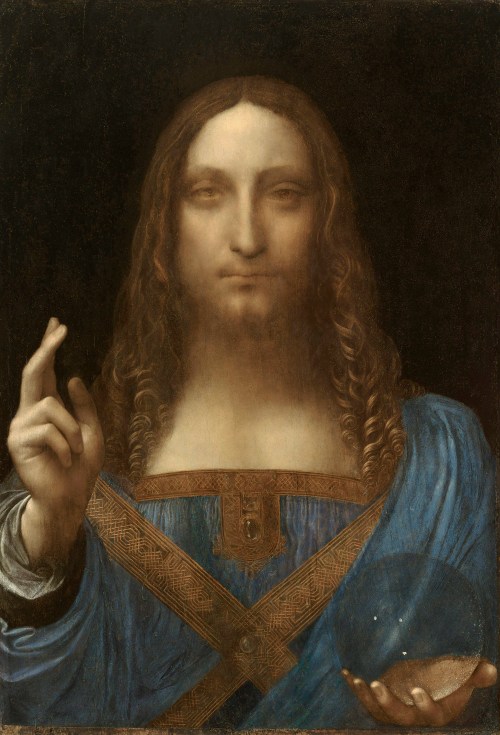
#FineArtFriday: Salvator Mundi, by Leonardo Da Vinci

  • Artist: Leonardo da Vinci  (1452–1519)
  • Title: Salvator Mundi
  • Genre  religious art
  • Description: Photographic reproduction of the painting after restoration by Dianne Dwyer Modestini, a research professor at New York University.
  • Depicted people: Jesus Christ
  • Date: circa 1500
  • Medium: oil on walnut wood
  • Dimensions: Height: 65.6 cm (25.8″); Width: 45.4 cm (17.8″)
  • Collection: Ostensibly the Louvre Abu Dhabi
  • Object history: 1958: auctioned 2007: restored
  • November 2017: acquired by Abu Dhabi Tourism & Culture Authority
  • 15 November 2017: auctioned

Leonardo da Vinci was one of history’s greatest artists and thinkers. Only about 15 of his paintings are known to exist and one, the “Salvator Mundi” (Savior of the World), was thought to be lost forever. Leonard painted it sometime around the year 1500.

About this image, via Wikipedia”

Salvator Mundi is one of Leonardo’s most copied paintings, with about 12 known examples executed by his pupils and others. Leonardo’s version was thought to have been lost after the mid-17th century. In 1978, Joanne Snow-Smith developed a compelling case that the supposed copy located in the Marquis Jean-Louis de Ganay Collection, Paris, was the lost original based on its similarity to Saint John the Baptist. Many art historians were convinced, as she was able to establish a direct historical connection between Leonardo da Vinci, the engraving by Wenceslaus Hollar and the painting in the Ganay collection.[30]

In 2005, a Salvator Mundi was presented and acquired at an auction for less than $10,000 (€8,450) by a consortium of art dealers that included Alexander Parrish and Robert Simon, a specialist in Old Masters. It was sold from the estate of Baton Rouge businessman Basil Clovis Hendry Sr., at the St. Charles Gallery auction house in New Orleans. It had been heavily over-painted so it looked like a copy, and was, before restoration, described as “a wreck, dark and gloomy”. 

The consortium believed there was a possibility that the low-quality mess (with its excessive overpainting) might actually be the long-missing da Vinci original. They commissioned Dianne Dwyer Modestini at New York University to oversee the restoration. She began by removing the overpainting with acetone, leading her to discover that at some point, a stepped area of unevenness near Christ’s face had been shaved down with a sharp object, and also leveled with a mixture of gesso, paint and glue. Using infrared photographs Simon had taken of the painting, Modestini discovered a pentimento (earlier draft) of the painting which had the blessing hand’s thumb in a straight, rather than curved, position. The discovery that Christ had two thumbs on his right hand was crucial. This pentimento (literally ‘repent’) showed the artist had a second thought about the positioning of the thumb. Such a second thought is considered evidence that this is not a copy but indeed an original, since copiers would have no doubts about composition. 

Modestini proceeded to have panel specialist Monica Griesbach chisel off a marouflaged wood panel which had been tunnelled through by worms, causing the painting to break into seven pieces. Griesbach reassembled the painting with adhesive and wood slivers.  In late 2006, Modestini began her restoration effort.

The work was subsequently authenticated as a painting by Leonardo. From November 2011 through February 2012, the painting was exhibited at the National Gallery as a work by Leonardo da Vinci, after authentication by that facility. In 2012, it was also authenticated by the Dallas Museum of Art. 

More about this painting:

In 2005 restoration by the eminent conservator, Dianne Dwyer Modestini. She commented in a video interview for the Robb Report, “This picture is a paradigm of everything that he (Da Vinci) knew technically about painting and much of what he thought about time, eternity, and the cosmos. It wasn’t just a portrait of Jesus Christ painted for the king. This was something that became very important to him.” READ MORE: http://bit.ly/LostDaVinci


Credits and Attributions:

Salvator Mundi, by Leonardo da Vinci / Public domain Circa 1490-1519, oil on panel, 45.4 cm × 65.6 cm (25.8 in × 17.9 in), private collection. (Photo by VCG Wilson/Corbis via Getty Images)

Wikimedia Commons contributors, “File:Leonardo da Vinci, Salvator Mundi, c.1500, oil on walnut, 45.4 × 65.6 cm.jpg,” Wikimedia Commons, the free media repository, https://commons.wikimedia.org/w/index.php?title=File:Leonardo_da_Vinci,_Salvator_Mundi,_c.1500,_oil_on_walnut,_45.4_%C3%97_65.6_cm.jpg&oldid=403092006 (accessed March 19, 2020).

Wikipedia contributors, “Salvator Mundi (Leonardo),” Wikipedia, The Free Encyclopedia, https://en.wikipedia.org/w/index.php?title=Salvator_Mundi_(Leonardo)&oldid=946001422 (accessed March 19, 2020).

Comments Off on #FineArtFriday: Salvator Mundi, by Leonardo Da Vinci

Filed under #FineArtFriday

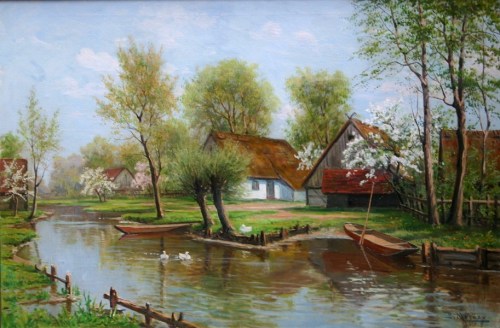
#FineArtFriday: Canal in the Spreewald in Spring by Bruno Moras

Artist: Bruno Moras, (1833 – 1939)

Title: Kanal im Spreewald im Frühling (Canal in the Spreewald in Spring)

Medium: oil on canvas

Dimensions Height: 79 cm (31.1″); Width: 119 cm (46.8″)

What I love about this picture:

Moras captured the trees as they are when the leaves first burst forth, with a bright, yellow-green. The apple and plum trees, the first signs of spring around here, are blossoming. The water reflects the  colors of the world, yet a slight breeze moves it. The small boats drawn up to the shore can carry one or two fisher folk comfortably.

About the artist:

I have been unable to find much about Bruno Moras, other than he was the son of Walter Moras, was born, lived, and died in Berlin, and never achieved the fame his father had. This is too bad, as his works are just now becoming more in demand at auctions.

Still, his work survives. In a time when modern art was moving away from traditional landscape painting, Moras painted beautiful images of what he loved most: the countryside of his Germany.

Credits and Attributions:

Wikimedia Commons contributors, “File:Bruno Moras – Kanal im Spreewald im Frühling.jpg,” Wikimedia Commons, the free media repository, https://commons.wikimedia.org/w/index.php?title=File:Bruno_Moras_-_Kanal_im_Spreewald_im_Fr%C3%BChling.jpg&oldid=273477004 (accessed March 13, 2020).

Comments Off on #FineArtFriday: Canal in the Spreewald in Spring by Bruno Moras

Filed under #FineArtFriday, writing

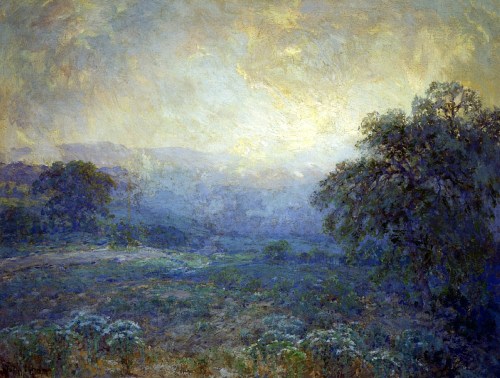
#FineArtFriday: Dawn in the Hills by Julian Onderdonk, 1922

  • Artist: Julian Onderdonk  (1882–1922)
  • Title: Dawn In The Hills
  • Date    1922
  • Medium: oil on canvas
  • Dimensions: Height: 76.2 cm (30″); Width: 101.6 cm (40″)
  • Collection: Private collection

What I love about this painting:

Onderdonk captured the surreal essence of early morning near San Antonio, Texas. The mists are rising in the hills, slowly revealing the riotous splendor of deep blue wildflowers. It is a rolling sea of bluebonnets, with the occasional white of the blackfoot or fleabane daisy mingled in.

The artist perfectly conveyed the mystical quality of that singular moment of the morning when the air is still and golden, and the day ahead is full of possibilities.

I could spend hours in this place.

About this painting:

Art historian Jeffrey Morseburg writes, “In the fall of 1922, as he was just entering his prime, Onderdonk was rushed to the hospital with an intestinal blockage. He failed to recover from the emergency surgery and died on October 27, 1922. His sudden death created an outpouring of emotion for the man who had become “The Dean of Texas Painters.” Just before he died, Onderdonk had finished a beautiful early morning view of a Texas hillside carpeted with Bluebonnets titled ‘Dawn in the Hills’ and another work, a bold fall scene titled ‘Autumn Tapestry.’” [1]

About the Artist, Via Wikipedia:

Julian Onderdonk was born in San Antonio, Texas, to Robert Jenkins Onderdonk, a painter, and Emily Gould Onderdonk. He was raised in South Texas and was an enthusiastic sketcher and painter. As a teenager Onderdonk was influenced and received some training from the prominent Texas artist Verner Moore White who also lived in San Antonio at the time. He attended the West Texas Military Academy, now the Episcopal School of Texas, graduating in 1900. His grandfather Henry Onderdonk was the Headmaster of Saint James School in Maryland, from which Julian’s father Robert graduated.

At 19, with the help of a generous neighbor, Julian left Texas in order to study with the renowned American Impressionist William Merritt Chase. Julian’s father, Robert, had also once studied with Chase. Julian spent the summer of 1901 on Long Island at Chase’s Shinnecock Hills Summer School of Art. He studied with Chase for a couple of years and then moved to New York City to attempt to make a living as an en plein air artist. While in New York he met and married Gertrude Shipman and they soon had a son.

Onderdonk returned to San Antonio in 1909, where he produced his best work. His most popular subjects were bluebonnet landscapes. Onderdonk died on October 27, 1922 in San Antonio.

President George W. Bush decorated the Oval Office with three of Onderdonk’s paintings. The Dallas Museum of Art has several rooms dedicated exclusively to Onderdonk’s work.

His art studio currently resides on the grounds of the Witte Museum.


Credits and Attributions:

[1] Julian Onderdonk, An Illustrated Biography by Jeffrey Morseburg, © 2011 https://julianonderdonk.wordpress.com/tag/julian-onderdonk-biography/  (accessed March 4, 2020).

Wikimedia Commons contributors, “File:Julian Onderdonk (1882-1922) – Dawn In The Hills (1922).jpg,” Wikimedia Commons, the free media repository, https://commons.wikimedia.org/w/index.php?title=File:Julian_Onderdonk_(1882-1922)_-_Dawn_In_The_Hills_(1922).jpg&oldid=278966540 (accessed March 4, 2020).

Wikipedia contributors, “Julian Onderdonk,” Wikipedia, The Free Encyclopedia, https://en.wikipedia.org/w/index.php?title=Julian_Onderdonk&oldid=882101452 (accessed March 4, 2020).

Comments Off on #FineArtFriday: Dawn in the Hills by Julian Onderdonk, 1922

Filed under #FineArtFriday

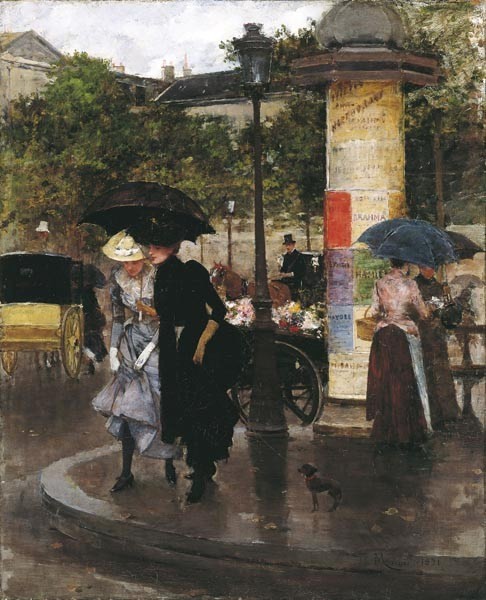
#FineArtFriday: Street Scene on a Rainy Day by Francesco Miralles Galup (ca. 1891)

What I love about this painting:

We see a perfect rainy spring afternoon in a busy cosmopolitan city. It could have been any large city at the end of the 19th century. The street is busy, full of carriages, and pedestrians must be careful where they step.

A cart full of flowers passes in the background, headed for the market. Two well-dressed ladies dodge puddles in their effort to cross the street. Around them, shoppers gossip and umbrellas abound.

Like every chihuahua I’ve ever known, the little dog is miserable, unhappy with the damp.


About the Artist, via Wikipedia:

Francisco Miralles Galup was born Francesc Miralles i Galaup (6 April 1848, Valencia – 30 October 1901, Barcelona). He was a Catalan painter, best known for his realistic scenes of bourgeois life and high society.

When he turned eighteen, he received parental permission (and financial support) to study in Paris, where he would remain until 1893, with occasional visits home. During his first years there, he copied masterworks at the Louvre and may have worked briefly with Alexandre Cabanel. He eventually had several small studios in Montmartre and on the Rue Laffitte.

He exhibited regularly at the Salon and the Sala Parés, back home in Barcelona. He also became a client of the well-known art dealership Goupil & Cie, attracting wealthy buyers throughout Europe and America. This was a relief to his family, who had initially been concerned that they might have to support him indefinitely. Their ability to do so had been compromised as they had lost much of their fortune in the Panic of 1866 and were losing more of it as they paid off their debts. In fact, they eventually moved to Paris so he could help support them.


Credits and Attributions:

Escena de carrer c1891, Francisco Miralles Galup / Public domain

Wikipedia contributors, “Francesc Miralles i Galaup,” Wikipedia, The Free Encyclopedia, https://en.wikipedia.org/w/index.php?title=Francesc_Miralles_i_Galaup&oldid=894995022 (accessed February 28, 2020).

Comments Off on #FineArtFriday: Street Scene on a Rainy Day by Francesco Miralles Galup (ca. 1891)

Filed under #FineArtFriday

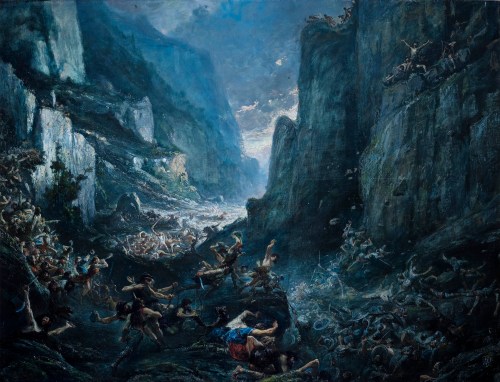
#FineArtFriday: Roland à Roncevaux, by Gustave Doré

Roland at Roncevaux, by Gustave Doré (b 1832 – d 1883)

Date: 19th century

Medium: oil on canvas

Dimensions: Height: 149 cm (58.6″); Width: 114 cm (44.8″)

Collection: Private collection

What I love about this image:

First of all, this shows the battle as being dark, ugly, and doomed, which history tells us, it was.

Doré chose to illustrate a historic battle that took place in the year 778. However, he painted a heroic image of Roland, surrounded and his unbreakable sword held high. This is as the battle was portrayed three centuries later by medieval authors whose embellishments were romanticized fantasies rather than accurate historical descriptions.

About the Artist:

Paul Gustave Louis Christophe Doré, born 6 January 1832 –  died 23 January 1883, was a French artist, print-maker, illustrator, comics artistcaricaturist, and sculptor who worked primarily with wood-engraving.

Doré was famous for his highly detailed, romantic engravings of heroic classical literature and also the Bible. His illustrations are still considered to be among the finest ever produced.

What he is not as well-known for are his paintings, which are both detailed and vivid, and portray a wide variety of subjects.

About the Story of Roland

The story of Roland’s death at Roncevaux Pass was embellished in later medieval and Renaissance literature. The first and most famous of these epic treatments was the Old French Chanson de Roland of the 11th century.

Two masterpieces of Italian Renaissance poetry, the Orlando Innamorato and Orlando Furioso (by Matteo Maria Boiardo and Ludovico Ariosto), are further detached from history than the earlier Chansons, similarly to the later Morgante by Luigi Pulci. Roland is poetically associated with his sword Durendal, his horse Veillantif, and his oliphant horn.

Roland also appears as a sometimes tragic hero in some Arthurian legends, and many Norse and Germanic tales.

The true history of Roland’s Demise at Roncevaux (via Wikipedia):

The Battle of Roncevaux Pass (French and English spelling, Roncesvalles in Spanish, Orreaga in Basque) in 778 saw a large force of Basques ambush a part of Charlemagnes army in Roncevaux Pass, a high mountain pass in the Pyrenees on the present border between France and Spain, after his invasion of the Iberian Peninsula.

The Basque attack was a retaliation for Charlemagne’s destruction of the city walls of their capital, Pamplona. As the Franks retreated across the Pyrenees back to Francia, the rearguard of Frankish lords was cut off, stood its ground, and was wiped out.

Among those killed in the battle was a relatively obscure Frankish commander, Roland, whose death elevated him and the paladins, the foremost warriors of Charlemagne’s court, into legend, becoming the quintessential role model for knights and also greatly influencing the code of chivalry in the Middle Ages.

There are numerous written works about the battle, some of which change and exaggerate events. The battle is recounted in the 11th century The Song of Roland, the oldest surviving major work of French literature, and in Orlando Furioso, one of the most celebrated works of Italian literature. Modern adaptations of the battle include books, plays, and works of fiction, and monuments in the Pyrenees.


Credits and Attributions:

Wikimedia Commons contributors, “File:Gustave Doré – Roland à Roncevaux.jpg,” Wikimedia Commons, the free media repository, https://commons.wikimedia.org/w/index.php?title=File:Gustave_Dor%C3%A9_-_Roland_%C3%A0_Roncevaux.jpg&oldid=369725623 (accessed February 20, 2020).

Wikipedia contributors, “Gustave Doré,” Wikipedia, The Free Encyclopedia, https://en.wikipedia.org/w/index.php?title=Gustave_Dor%C3%A9&oldid=939834558 (accessed February 20, 2020).

Comments Off on #FineArtFriday: Roland à Roncevaux, by Gustave Doré

Filed under #FineArtFriday