Category Archives: #FineArtFriday

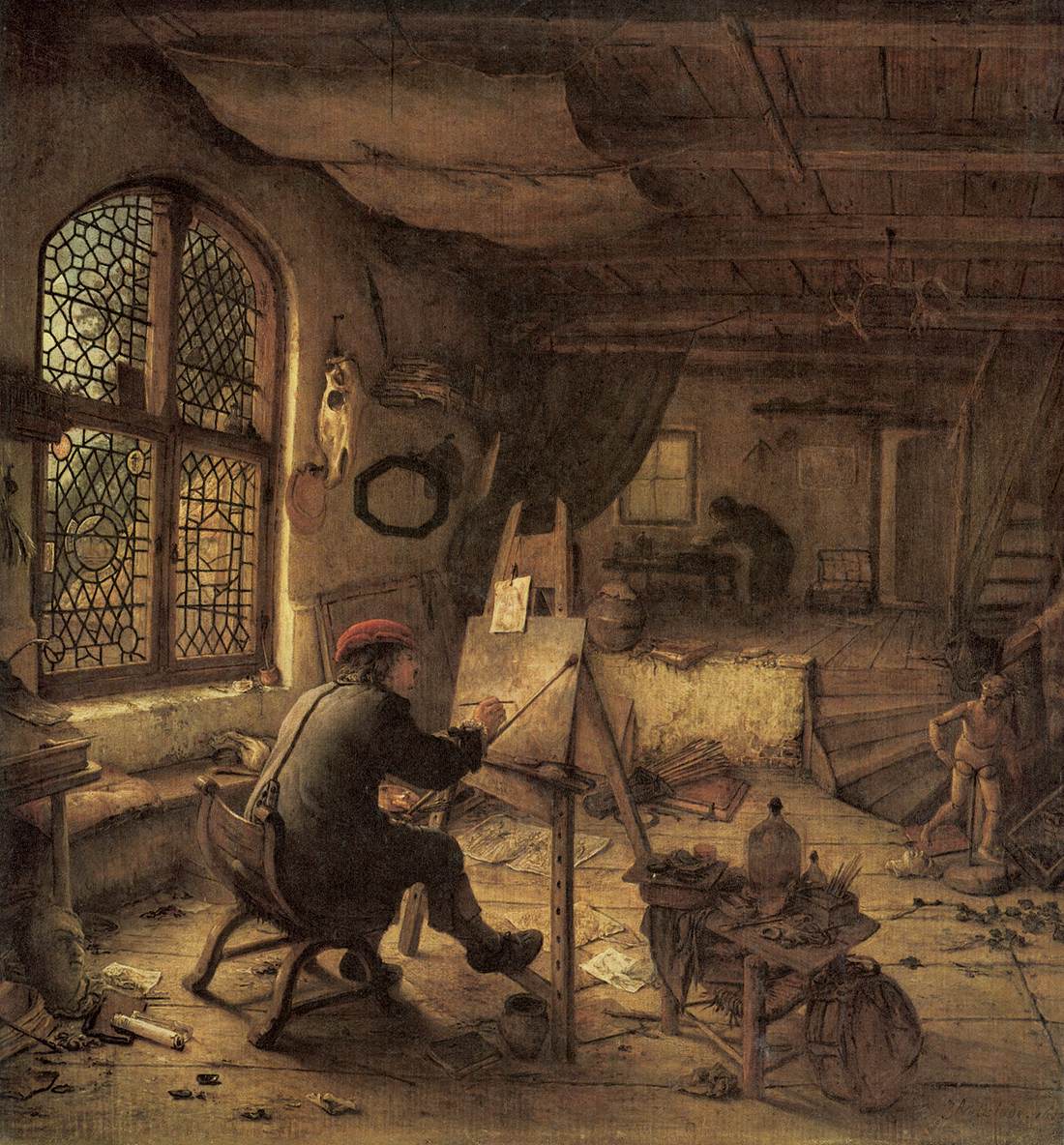
#FineArtFriday: a second look at “The Painter in his Studio” by Adriaen Van Ostade

Artist: Adriaen van Ostade (1610–1685) 

Title: German: Der Maler in seiner Werkstatt. English: The painter in his Studio.

Date: 1663

Medium: oil on oak wood

Dimensions: height: 38 cm (14.9 in); width: 35.5 cm (13.9 in)

Collection: Gemäldegalerie Alte Meister

In “The Painter in his Studio” by Adriaen Van Ostade (1663), we see a self-portrait of the artist, sitting with his back to us. He is at his easel, and his brush hand rests on a ‘maulstick,’ a stick with a padded head used by painters to support the hand holding the paintbrush.  In the shadowed background, a pupil is at work, possibly preparing a palette, or maybe preparing colors.

The window, the floor with all its debris, the walls, and the ceiling are depicted with great detail. The artist and his pupil are less detailed.

The studio is untidy, with brushes fallen on the littered floor. The room is cluttered with numerous odd objects and tools of the trade, including the head of a broken bust beneath a table. On the ceiling above the artist, a canvas canopy is tacked up, possibly to protect the artist’s work area from leaks, or perhaps falling dust.

A skull of some sort hangs near the window, and antlers also decorate the ceiling. The painter’s mannequin poses near the stairs, and an indistinct trunk stands open in the background.

The room is in desperate need of a good sweeping. The large leaded-glass window, however, is clean and lets in good light. It shows us how the artist saw himself and his work space.

A Netherlandish contemporary of the Flemish painters David Teniers the Younger and Adriaen Brouwer, Van Ostade was inspired by the work of Rembrandt.

As Rembrandt did, Van Ostade painted people who had seen hard times. They were often old, sometimes ill-favored, and not always beautiful. He painted dark interior scenes, where shadows are often the dominant features. He also painted the interiors of taverns and the homes of ordinary people, so through his work we who write can see how people really lived.

Van Ostade lived and painted in Haarlem. His subjects and the mood of his work is darker than that of his Flemish contemporaries, as hard times had fallen on the people of Holland, and  Haarlem in particular.

About the artist, via Wikipedia:

Adriaen van Ostade (baptized as Adriaen Jansz Hendricx 10 December 1610 – buried 2 May 1685) was a Dutch Golden Age painter of genre works, showing everyday life of ordinary men and women. [1]

To read his full biography, go to Adriaen van Ostade – Wikipedia


Credits and Attributions:

Wikimedia Commons contributors, “File:Adriaen van Ostade – The Painter in His Studio – WGA16748.jpg,” Wikimedia Commons, https://commons.wikimedia.org/w/index.php?title=File:Adriaen_van_Ostade_-_The_Painter_in_His_Studio_-_WGA16748.jpg&oldid=661600977 (accessed August 14, 2025).

[1] Wikipedia contributors, “Adriaen van Ostade,” Wikipedia, The Free Encyclopedia, https://en.wikipedia.org/w/index.php?title=Adriaen_van_Ostade&oldid=1212324357 (accessed August 14, 2025).

5 Comments

Filed under #FineArtFriday

#FineArtFriday: a closer look at “The Bird Concert” by Jan Brueghel the Younger ca. 1640 – 45

OLYMPUS DIGITAL CAMERA

Artist: Jan Brueghel the Younger (1601–1678)

Title: the Bird Concert

Date: between circa 1640 and circa 1645

Medium: oil on copper

Dimensions: height: 13.2 cm (5.1 in); width: 17.9 cm (7 in)

Collection: Herzog Anton Ulrich Museum

Today we are taking a second look at one of my favorite paintings of the 17th century.

What I love about this painting:

This is one of my all-time favorite paintings. Jan Brueghel the Younger was a master who stood out in a dynasty of masters. The Brueghel family descended from Pieter Brueghel the Elder, and each generation left behind works that enchant us to this day.

I love this fantasy of birds, a renaissance view of what true harmony could be.

Brueghel gives us a joyous, surreal exploration of all the birds the artist had ever seen in his native Antwerp, and many rare birds that he could only imagine. He has gathered birds from all over the world into a mystical, fairytale glen, posing them around a songbook.

They are learning to sing a in a language they all can understand, a wonderful allegory of the aspirations of the artist for humanity in the turbulent times during which he lived.

This painting also celebrates the new discoveries made by European explorers, as Brueghel had only seen scientific drawings of many of these birds. Even though he hadn’t seen some of these birds personally, he paints them as if they are before him.

The amazing flock of birds gathered here gives us an insight into the mind and sense of humor of Jan Brueghel the Younger, a man not too different from us even though he lived over 300 years ago.

This composition must have been important to Brueghel and says something about him. He went to the expense of getting copper as the base upon which he painted this scene. He was comfortable but not rich, so that tells me he intended this painting to last, to be something he would be remembered for.

About the medium of Oil on Copper, via Wikipedia:

Oil on copper paintings were prevalent in the mid sixteenth century in Italy and Northern Europe. The use of copper as a substrate for an oil painting dates back to Medieval times. The Flemish masters and other artists including Jan Breughel the ElderClaudeEl GrecoGuido ReniGuercinoRembrandtCarlo SaraceniAmbrosius Bosschaert IICopley Fielding and Vernet painted on copper. They favored copper for its smooth surface which allowed fine detail, and its durability. Copper is more durable than canvas or wood panel as a support for oil painting, as it will not rot, mildew or be eaten by insects. Contemporary painters also use copper as a base for paintings, some of them allowing the metal or patina to show through.

The old masters prepared the copper for painting first by rubbing it with fine pumice abrasive. The copper surface was then treated with garlic juice which is believed to improve adhesion of the paint. Finally a white or grey ground layer of oil paint was applied as a primer. After drying the copper panel was ready for the artist to begin painting. Later artists used the patina process, in which the copper is oxidized with the use of various acidic solutions, as part of the art work itself. The resulting patina or verdigris includes darkening of the metal, green and blue tones, depending on the chemical solution used. Patina is characterized by beautiful, variated patterns and textures which occur on the metal’s surface. [1]

About the Artist, via Wikipedia:

Jan Brueghel the Younger was born in Antwerp on 13 September 1601 as the son of Jan Brueghel the Elder and Isabella de Jode. His mother was the daughter of the cartographer, engraver and publisher Gerard de Jode. He trained and collaborated with his father in his workshop. His father was a friend and close collaborator of Peter Paul Rubens. Brueghel likely assisted with his father’s large-scale commissions.

On the wishes of his father, he traveled around 1622 to Milan where he was welcomed by Cardinal Federico Borromeo. The cardinal was a patron and friend of his father who had met in Rome about 30 years earlier. In what was likely an act of rebellion against his father, he went to Genoa where he stayed with his cousins, the Antwerp painters and art dealers Lucas de Wael and Cornelis de Wael. Their mother was a sister of Brueghel’s mother. At the time his friend and fellow Antwerp artist Anthony van Dyck was also active in Genoa. He later worked in Valletta on Malta in 1623. From 1624 to 1625 he also resided in Palermo on Sicily at the time when van Dyck was also working there.

Brueghel learned that his father had died on 13 January 1625 from cholera only after his return to Northern Italy in Turin. Wanting to return to Antwerp immediately, he had to delay his departure for 16 days due to a severe fever. After recovering from his illness, he set off for his homeland by way of France. In Paris he met the Antwerp art dealer and painter Peter Goetkint the Younger, who was the son of Peter Goetkint the Elder, the master of Jan’s father. Goetkint was eager to return to Antwerp because his wife was expected to deliver a baby soon. The child was born on 25 August, the day on which Breughel arrived in Antwerp with his traveling companion who himself died a few days later.

Brueghel took over the management of his father’s workshop, sold the finished works of his father and finished some of his father’s unfinished paintings. In the Guild year 1624-1625, Brueghel became a master painter of the Guild of Saint Luke of Antwerp.

In 1626 he married Anna Maria Janssens, daughter of Abraham Janssens, a prominent history painter in Antwerp. He continued to operate the large workshop of his father. He became dean of the Guild of Saint Luke in 1630. That same year he was commissioned by the French court to paint a series of paintings on the life of Adam. It seems that his studio declined after this period and that he started to paint smaller scale paintings which commanded lower prices than those produced earlier.

In later years, he worked independently in Paris in the 1650s and produced paintings for the Austrian court in 1651. He is recorded again in Antwerp in 1657 where he remained until his death. [2]


Credits and Attributions:

[1] Wikipedia contributors, “Oil on copper,” Wikipedia, The Free Encyclopedia, https://en.wikipedia.org/w/index.php?title=Oil_on_copper&oldid=1060711380 (accessed JAug 7, 2025).

[2] Wikipedia contributors, “Jan Brueghel the Younger,” Wikipedia, The Free Encyclopedia, https://en.wikipedia.org/w/index.php?title=Jan_Brueghel_the_Younger&oldid=1086952033 (accessed Aug 7, 2025).

Image: The Bird Concert by Jan Brueghel the Younger ca. 1640 -1645, PD|100. Wikimedia Commons contributors, “File:Bruegel Vogelkonzert@Herzog Anton Ulrich Museum (1).JPG,” Wikimedia Commons, the free media

6 Comments

Filed under #FineArtFriday, writing

#FineArtFriday: Grotto Landscape with a Hermitage by Jan Brueghel II and Joos de Momper II

Artists: Jan Brueghel the Younger (1601–1678)

Joos de Momper the Younger (1564–1635)

Title:  Grotto Landscape with a Hermitage

Date:   between 1625 and 1630

Medium: oil on canvas

Dimensions: height: 56 cm (22 in); width: 99 cm (38.9 in)

Collection: Private collection

What I love about this painting:

On the surface, while it’s definitely a masterpiece, the subject is one that was done in various ways by nearly every artist of their day. Works like this sold well, as it was the fashion for every upper middleclass merchant to own paintings by the popular artists of their day. The most prolific artists and their workshops chugged paintings out like bakers turning out hot bread.

In most of these workshops, certain aspects were done by the hand of the master, while apprentices and journeymen did the bulk of the work under the master’s guidance. That was how young artists learned the craft. The masters reserved their finest works for their noble patrons, and these were completely done by their own hand.

Two masters created this painting. Joos de Momper II painted the landscape, and Jan Brueghel II did the staffage (people and animals). The two artists often worked together. Both were exceptionally good at what they did, and both made a good living from their art.

The casual observer might think there isn’t much of a story, as it’s a genre painting of people on a religious pilgrimage.

But the people are where the story lies. Why are they seeking wisdom here? What has happened that they would leave their farms and shops to visit him? Why do they not seek advice from their priest?

The artists show us a hermit [Hermit – Wikipedia], a man who has chosen a life of poverty and religious seclusion.

I see many ways a story could go here. The hermit intrigues me.  Why does an educated man choose to leave the comforts of civilization and live in such a rickety shack with only a dog for companionship? (A good choice of friends, in my opinion.)

I wonder what sort of person he was. Was he a kind man who wanted to be closer to nature?

Or perhaps he had made bad business investments and lost everything. Was he bitter about his place in the world? Was he truly a humble person, or was this his personal punishment? What wisdom did he have to offer those who visited him?

I like to think he was a kind person who just wanted to be alone with his dog and his books, and while I don’t have a dog, I often feel the same way.

About this painting via Wikipedia:

Untouched nature is the dominant theme of the right half of the painting, religion occupies the left half of the picture. The hermit set up an altar with a painting of crowned Mary on it. The painting juxtaposes religion and nature as well as civilization on the one hand (church in the background, elegantly dressed walkers) and untouched nature (crane, waterfall) on the other. [1]

To read more about this painting, go to Grotto Landscape with a Hermitage – Wikipedia

About the artists via Wikipedia:

In Flemish painting of the late 16th and early 17th centuries there was often joint work by different painters. The painters specialized in a certain area, such as landscape or figures. The painting “Grotto landscape with hermitage” is an example of the collaboration: while Brughel painted the figures and animals, Joos de Momper the grotto and the landscape. This division of labor approach was quite common among painters at that time.

Joos de Momper the Younger (1564-1635) was a Flemish landscape painter. His landscape depictions show the transition from the Mannerist world landscape to the naturalistic Dutch landscape painting of the 17th century.

Jan Brueghel the Younger (1601–1678) was a Flemish landscape, flower and animal painter from the most important Flemish painting dynasty, the Brueghel family. He was the grandson of Pieter Bruegel the Elder and son of Jan Brueghel the Elder.

Both Joos de Momper and Jan Brueghel grew up in Antwerp and were members of the Guild of Saint Luke, a guild-like brotherhood of painters and printers. Both painters also came from important families of painters. Joos de Momper often worked with Jan Brueghel the Elder and Jan Brueghel the Younger.

Grotto painting as a genre

De Momper is considered to be the most important exponent of grotto painting: These are paintings in which a rock grotto or cave is the focus of the painting. The caves are refuge for hermits, serve as a place of pilgrimage (as in this painting) or serve as the background of a mythological story. Further representatives of grotto painting are Cornelis van Dalem (approx. 1530–1573), Jan Brueghel the Elder (1568–1625) and Paul Bril (approx. 1553–1626). Another grotto landscape by Joos de Momper and Jan Brueghel the Elder is in the Liechtenstein Museum in Vienna, also here with a reading hermit.

De Momper’s name was so closely linked to rock and mountain landscapes that he was named Judocus de Momper Pictor montium Antwerpiae (Joos de Momper, Antwerp, Painter of mountains) in the then very well-known Iconography, a series of pictures by well-known painters after Anthony van Dyck.

To read more about these artists, go to:

Joos de Momper – Wikipedia

Jan Brueghel the Younger – Wikipedia


Credits and Attributions:

IMAGE: Grotto Landscape with a Hermitage by Jan Brueghel II and Joos de Momper II

[1] Wikipedia contributors, “Grotto Landscape with a Hermitage,” Wikipedia, The Free Encyclopedia, https://en.wikipedia.org/w/index.php?title=Grotto_Landscape_with_a_Hermitage&oldid=1299616328 (accessed July 31, 2025).

[2] Jan Brueghel the Younger – Jan Brueghel the Younger – Wikipedia

[3] Joos de Momper the Younger – Joos de Momper – Wikipedia

2 Comments

Filed under #FineArtFriday

#FineArtFriday: a closer look at “The Baker” by Job Adriaenszoon Berckheyde, circa 1681

Title: The Baker

Genre: self-portrait

Artist: Job Adriaenszoon Berckheyde

Date: 1681

Medium: oil on canvas

Collection: Worcester Art Museum

What I like about this painting:

I love fresh-baked bread, and once the weather turns cold, I start making my own. A crockpot full of homemade soup and bread fresh out of the oven? It’s my idea of heaven, and it’s what’s on the menu two times a week here at Casa del Jasperson.

Berckheyde must have loved bread too, as he painted several pictures of bakery shops. These genre paintings of bakeries were popular as a subject for Dutch artists from around 1650.

I first featured this image in September of 2020. When I first saw it, I wondered why our baker is blowing a horn. I discovered that was how some bakers announced the morning’s freshly baked bread.

Like most merchants in 17th century Holland, bakers often worked out of their own homes. However, their ovens were well-known fire threats. Entire cities would go up in a raging conflagration that no one could outrun or stop, often burning for days. For this reason, many neighbors didn’t really want a baker going into business next door to them.

To minimize the fire risk, some towns and cities required bakers to live and do business in stone buildings. This law explains the artist’s rather monumental choice of architecture as the background for The Baker. It looks like the entrance to a cathedral.

Berckheyde chose to make this a self-portrait. I like this decision, for he was honest in how he presented himself, He is not too handsome, but is surrounded by a wide, tempting assortment of goods, including pretzels. The wooden rack they’re displayed on would be at home in any bakery shop today.

I would definitely buy my family’s bread from this baker.


About the Artist, via Wikipedia:

Job Berckheyde, baptized 27 January 1630 and died 23 November 1693, was born in Haarlem and was the older brother of the painter Gerrit who he later taught to paint.

He was apprenticed on 2 November 1644 to Jacob Willemszoon de Wet. His master’s influence is apparent in his first dated canvas, “Christ Preaching to the Children” (1661), one of his few biblical scenes.

Golden-age historian Arnold Houbraken claimed that Job had been trained as a bookbinder by his father, and could not discover who taught him to paint.

What is not in doubt is that Gerrit learned from his older brother. Job’s teacher must have been a Haarlem master, and some claim it was Frans Hals, but Houbraken claimed he travelled as a journeyman between Leiden and Utrecht offering his services as a portrait painter and learned by doing.

During the 1650s the two brothers, Job and Gerrit, made an extended trip along the Rhine to Germany, stopping off at Cologne, Bonn, Mannheim and finally Heidelberg, following the example of their fellow guild member Vincent van der Vinne.

The brothers worked in Heidelberg for Charles I Louis, Elector Palatine (with Job producing portraits and hunting scenes, and receiving a gold chain from the Elector in reward) but were ultimately unable to adapt to court life and so returned to Haarlem, where they shared a house and perhaps a studio.

He became a member of the Haarlem rederijkersgilde ‘De Wijngaardranken’ in 1666–1682. He is registered in Amsterdam 1682–1688, where he became a member of the Guild of St Luke there in 1685–1688. Berckheyde was buried in Haarlem.

He could paint landscapes in the same style as his brother, but seems to have preferred interiors and genre works, whereas his brother’s oeuvre consists mostly of outdoor scenes. The Elector’s gold chain may be the one he wears in his early Self-portrait (1655), his only documented work from the 1650s.

Job is better known for his later work, which consists mainly of interior views of the Sint-Bavokerk in Haarlem and simple genre scenes recalling those of his Haarlem contemporaries Adriaen van Ostade and Jan Steen.

Less prolific than his brother, but more varied in his output, Job produced bible and genre scenes as well as cityscapes. Confusion between their works may have resulted from the similarity of their signatures, where Job’s j resembles Gerrit’s g. Job also signed his work with an H (for Hiob or Job) and with the monogram HB.


Credits and Attributions:

Wikimedia Commons contributors, “File:Berckheyde, Job – The Baker – 1681.jpg,” Wikimedia Commons, the free media repository, https://commons.wikimedia.org/w/index.php?title=File:Berckheyde,_Job_-_The_Baker_-_1681.jpg&oldid=463054921 (accessed September 17, 2020).

Wikipedia contributors, “Job Adriaenszoon Berckheyde,” Wikipedia, The Free Encyclopedia, https://en.wikipedia.org/w/index.php?title=Job_Adriaenszoon_Berckheyde&oldid=947928424 (accessed September 17, 2020).

Wikipedia contributors, “Gerrit Berckheyde,” Wikipedia, The Free Encyclopedia, https://en.wikipedia.org/w/index.php?title=Gerrit_Berckheyde&oldid=933563068 (accessed September 17, 2020).

6 Comments

Filed under #FineArtFriday

#FineArtFriday: a closer look at “The Netherlandish Proverbs” by Pieter Brueghel the Elder

I love this painting and all the crazy imagery that witty, sarcastic, and distinctly un-noble Pieter Brueghel the elder. stuffed into it. I first discussed this painting on May 4, 2018, but it has been on my mind since last week when we looked at a seascape by the same artist.

I love a good allegorical painting, especially when the artist has a point to make. Brueghel the Elder, had a wicked sense of humor, and he wasn’t shy about pointing out the many hypocrisies and foibles of the society around him.

I consider this one of the best, most hilarious allegorical paintings of all time. The Netherlandish Proverbs (also known as The Dutch Proverbs) by Pieter Brueghel the Elder, was painted in 1559. I’ll just say that Pieter Brueghel the Elder is one of my favorite artists.

Quote from Wikipedia:

Critics have praised the composition for its ordered portrayal and integrated scene. There are approximately 112 identifiable proverbs and idioms in the scene, although Bruegel may have included others which cannot be determined because of the language change. Some of those incorporated in the painting are still in popular use, for instance “Swimming against the tide”, “Banging one’s head against a brick wall” and “Armed to the teeth”. Many more have faded from use, which makes analysis of the painting harder. “Having one’s roof tiled with tarts”, for example, which meant to have an abundance of everything and was an image Bruegel would later feature in his painting of the idyllic Land of Cockaigne (1567).

The Blue Cloak, the piece’s original title, features in the centre of the piece and is being placed on a man by his wife, indicating that she is cuckolding him. Other proverbs indicate human foolishness. A man fills in a pond after his calf has died. Just above the central figure of the blue-cloaked man another man carries daylight in a basket. Some of the figures seem to represent more than one figure of speech (whether this was Bruegel’s intention or not is unknown), such as the man shearing a sheep in the centre bottom left of the picture. He is sitting next to a man shearing a pig, so represents the expression “One shears sheep and one shears pigs”, meaning that one has the advantage over the other, but may also represent the advice “Shear them but don’t skin them”, meaning make the most of available assets.

You can find all of the wonderful proverbs on the painting’s page on Wikipedia, along with the thumbnail that depicts the proverb.

My favorite proverbs in this wonderful allegory?

Horse droppings are not figs. It meant we should not be fooled by appearances.

He who eats fire, craps sparks. It meant we shouldn’t be surprised at the outcome if we attempt a dangerous venture.

Now THAT is wisdom!

ABOUT THE ARTIST, via Wikipedia:

Pieter Bruegel (also Brueghel or Breughelthe Elder, 1525–1530 to 9 September 1569) was among the most significant artists of Dutch and Flemish Renaissance painting, a painter and printmaker, known for his landscapes and peasant scenes (so-called genre painting); he was a pioneer in presenting both types of subject as large paintings.

Van Mander records that before he died he told his wife to burn some drawings, perhaps designs for prints, carrying inscriptions “which were too sharp or sarcastic … either out of remorse or for fear that she might come to harm or in some way be held responsible for them”, which has led to much speculation that they were politically or doctrinally provocative, in a climate of sharp tension in these areas. [2]


Credits and Attributions:

The Netherlandish Proverbs (Also known as The Dutch Proverbs) by Pieter Brueghel the Elder 1559 [Public domain], via Wikimedia Commons.

[1] Wikipedia contributors, “Netherlandish Proverbs,” Wikipedia, The Free Encyclopedia, https://en.wikipedia.org/w/index.php?title=Netherlandish_Proverbs&oldid=829168138  (accessed July 16, 2025).

[2] Wikipedia contributors, “Pieter Bruegel the Elder,” Wikipedia, The Free Encyclopedia, https://en.wikipedia.org/w/index.php?title=Pieter_Bruegel_the_Elder&oldid=1299614602 (accessed July 16, 2025).

Comments Off on #FineArtFriday: a closer look at “The Netherlandish Proverbs” by Pieter Brueghel the Elder

Filed under #FineArtFriday

#FineArtFriday: Naval Battle in the Gulf of Naples by Pieter Bruegel the Elder ca. 1556 – 1558

Artist: Pieter Brueghel the Elder (1526/1530–1569)

Title: View of the Bay of Naples

Description: English: Bruegel — Naval Battle in the Gulf of Naples

Date: 1556 / circa 1558 / between 1550 and 1559

Medium: oil on panel

Dimensions: height: 42.2 cm (16.6 in)

Collection: Galleria Doria Pamphilj

What I love about this painting:

Bruegel shows us a stylized version of the Battle of the Gulf of Naples, which took place some three hundred year before the time of his painting. It was a historic victory for Roger of Lauria, who commanded the AragoneseSicilian fleet against the AngevinNeopolitan fleet, led by Prince Charles of Salerno.

Pieter Bruegel the Elder was famous for inserting subtle political and (sometimes snide) social commentaries into his paintings, and also for creating fantasy landscapes that he peopled with his contemporary peasants and tradesfolk. Many of his paintings that are set in his native Brabant feature mountains – and the Netherlands is a flat country, one that has no mountains.

In this painting he gives us a fantasy naval battle, featuring the sort of ships he was familiar with, and canon fire. Some ships are sinking, and others are closing in on them. He knew what ships looked like but had never actually seen a battle at sea.

About this painting, via Wikipedia:

Bruegel traveled to the Italian peninsula, with Abraham Ortelius, in 1551 and 1553. They stopped in Rome, Naples, and Messina. Many drawings were produced, including one depicting a naval confrontation in the Straits of Messina, which was turned into an engraving by Frans Huys. The veduta takes historical and topographical licenses: no such battle occurred in precisely this setting, nor does the harbor resemble Bruegel’s depiction. The exact date of the composition is disputed; scholars do agree, however, that the volcano and its positioning seem to reflect Bruegel’s neoplatonic pantheism.

In the foreground, a naval battle is perhaps taking place; it involves several vessels (sailing ships, galleys and smaller rowing boats), amidst puffs of smoke and barely legible trajectories of cannonballs, which make it difficult to unambiguously define the scene.

The background of the painting is the Gulf of Naples, with Mount Vesuvius visible at the right; it is depicted with a raised horizon, over half the painting, typical of the Flemish artists, which allows the view to have a particularly broad scope. Several monuments can be recognized: on the left, the remains of Castel del’Ovo, the Castel Nuovo, the lost Torre San Vincenzo and the semicircular piers. The last detail is an imaginative creation of the artist, since in the topographical maps of the time the port appears to be rectangular in shape: this “softening” perhaps derives from his wish to make the view more elegant and dynamic. [1]

ABOUT THE AUTHOR, via Wikipedia Commons:

Pieter Bruegel (also Brueghel or Breughelthe Elder, 1525–1530 to 9 September 1569) was among the most significant artists of Dutch and Flemish Renaissance painting, a painter and printmaker, known for his landscapes and peasant scenes (so-called genre painting); he was a pioneer in presenting both types of subject as large paintings.

Van Mander records that before he died he told his wife to burn some drawings, perhaps designs for prints, carrying inscriptions “which were too sharp or sarcastic … either out of remorse or for fear that she might come to harm or in some way be held responsible for them”, which has led to much speculation that they were politically or doctrinally provocative, in a climate of sharp tension in these areas. [2]]


Credits and Attributions:

IMAGE: Wikimedia Commons contributors, “File:Bruegel — Naval Battle in the Gulf of Naples.jpg,” WikimediaCommons, https://commons.wikimedia.org/w/index.php?title=File:Bruegel_%E2%80%94_Naval_Battle_in_the_Gulf_of_Naples.jpg&oldid=1037815605 (accessed July 9, 2025).

[1] Wikipedia contributors, “Naval Battle in the Gulf of Naples,” Wikipedia, The Free Encyclopedia, https://en.wikipedia.org/w/index.php?title=Naval_Battle_in_the_Gulf_of_Naples&oldid=1292197650 (accessed July 11, 2025).

[2] ABOUT THE AUTHOR: Wikipedia contributors, “Pieter Bruegel the Elder,” Wikipedia, The Free Encyclopedia, https://en.wikipedia.org/w/index.php?title=Pieter_Bruegel_the_Elder&oldid=1299614602 (accessed July 9, 2025).

Comments Off on #FineArtFriday: Naval Battle in the Gulf of Naples by Pieter Bruegel the Elder ca. 1556 – 1558

Filed under #FineArtFriday

#FineArtFriday: Seaport at sunset by Claude Lorrain 1682

Artist: Claude Lorrain (1604/1605–1682)

Title:   Seaport at sunset

Genre: landscape painting

Date: 1639

Medium: oil on canvas

Dimensions: height: 1 m (40.5 in); width: 1.3 m (53.9 in)

What I love about this painting:

Wow! Where to start? This is what true genius looks like. The overall scene is masterfully done, one of the best seascapes I have seen. The waters are calm, allowing for goods and passengers to be transferred safely to shore. The sky is that incredible quality that nature sometimes offers us on a summer evening. A haze is rising, and ships are still entering the harbor, waiting for their turn to offload their cargoes and passengers. Waves lap softly at the shore, a gentle rhythm.

Claude shows us a thriving, prosperous seaport under a glorious sunset. In fact, the scenery is so beautiful, it’s easy to overlook the dramas playing out in the foreground. However, we shouldn’t, as that is where the real story he wanted to show us lies.

In the bottom left, a family is seated on an upturned boat. Are they waiting to board a ship? They seem to be musicians, as the man plays a cittern, and a lute rests beside the woman and child, along with a pile of baggage.

To their right, a pair of merchants discuss business with a foreign trader, whose clothing suggests he is from Persia. Are they negotiating the purchase of rare spices? Or are they attempting to sell him something?

In the bottom center, violence has erupted as a pair of ruffians have decided to settle their dispute the old-fashioned way. Sailors on shore leave? Too much to drink? Fighting over a woman? The onlookers are disgusted but do not step in to break it up. Apparently, someone “had it coming.”

To the right of the combatants and knot of friends, a pair of well-dressed men, one seated on an upturned boat and one standing, are clearly waiting for something. Perhaps these people are all waiting to board the same ship.

And finally, on the far right, we have several ships, accompanied by small boats called tenders, which are going to and from them. In the foreground, sailors row tenders to the strand. Will our passengers be rowed out to board their ship? This is a bustling harbor, and it’s clear that berths along the quayside are at a premium. Perhaps, rather than paying for a berth when his cargo consists of passengers rather than goods, this ship’s owner keeps his costs down by bringing supplies on board by tender and ferrying passengers to and from the shore.

Claude’s glorious sunset hints that hope lies beyond the horizon. Are the passengers embarking on a journey to the New World? Perhaps they are going to India, or even to the French colonies in the South Pacific. Wherever they are going, I hope their journey is peaceful and ends well.

About the artist, via Wikipedia:

Claude Lorrain (born Claude Gellée), called le Lorrain in French; traditionally just Claude in English; c. 1600 – 23 November 1682) was a painter, draughtsman and etcher of the Baroque era originally from the Duchy of Lorraine. He spent most of his life in Italy, and is one of the earliest significant artists, aside from his contemporaries in Dutch Golden Age painting, to concentrate on landscape painting. His landscapes often transitioned into the more prestigious genre of history paintings by addition of a few small figures, typically representing a scene from the Bible or classical mythology. [1]

To learn more about this artist go to Claude Lorrain – Wikipedia


Credits and Attributions:

IMAGE: Seaport at sunset by Claude Lorrain 1682. Wikimedia Commons contributors, “File:F0087 Louvre Gellee port au soleil couchant- INV4715 rwk.jpg,” Wikimedia Commons, https://commons.wikimedia.org/w/index.php?title=File:F0087_Louvre_Gellee_port_au_soleil_couchant-_INV4715_rwk.jpg&oldid=967103912 (accessed June 27, 2025).

[1] Wikipedia contributors, “Claude Lorrain,” Wikipedia, The Free Encyclopedia, https://en.wikipedia.org/w/index.php?title=Claude_Lorrain&oldid=1298367934 (accessed July 2, 2025).

2 Comments

Filed under #FineArtFriday, writing

#FineArtFriday: a closer look at “Forest Landscape” by Jan Brueghel the Elder

Title: Forest landscape

Artist: Jan Brueghel the Elder

Genre: landscape art

Date: between circa 1605 and circa 1610

Medium: oil on oak panel

Dimensions: 40 x 32 cm

What I love about this painting:

Today, we’re taking a closer look at the works of the Flemish artist, Jan Brueghel the Elder. I first featured this painting in July of 2020, and it is one that I love. The scene is peaceful and relaxing, a moment of calm for our turbulent times.

The level of detail down to the leaves and the bark on the trees is amazing, but the rich colors are what attracted me, drawing me in. The heron on the rock seems poised to take flight.  Beyond the heron, on the other side of the creek, a path leads deeper into the forest, calling to us to cross over and see where it leads. The scene is beautiful the way a fantasy is, likely because Brueghel most probably painted it from sketches and memory.

“In his forest landscapes Brueghel depicted heavily wooded glades in which he captured the verdant density, and even mystery, of the forest. Although on occasion inhabited by humans and animals, these forest scenes contain dark recesses, virtually no open sky and no outlet for the eye to penetrate beyond the thick trees.” via Wikipedia. [1]

In many ways, Jan Brueghel’s paradise landscapes paved the way for the great plein air painters of the 18th and 19th centuries. This is most definitely a Mannerist landscape painting, as it is highly romanticized.

About the Artist, via Wikipedia:

Jan Brueghel (also Bruegel or Breughelthe Elder  (1568 – 13 January 1625) was a Flemish painter and draughtsman. He was the son of the eminent Flemish Renaissance painter Pieter Brueghel the Elder. A close friend and frequent collaborator with Peter Paul Rubens, the two artists were the leading Flemish painters in the first three decades of the 17th century.

Brueghel worked in many genres including history paintings, flower still lifes, allegorical and mythological scenes, landscapes and seascapes, hunting pieces, village scenes, battle scenes and scenes of hellfire and the underworld.

He was an important innovator who invented new types of paintings such as flower garland paintings, paradise landscapes, and gallery paintings in the first quarter of the 17th century.

He also created genre paintings that were imitations, pastiches and reworkings of his father’s works, in particular his father’s genre scenes and landscapes with peasants.  Brueghel represented the type of the pictor doctus, the erudite painter whose works are informed by the religious motifs and aspirations of the Catholic Counter-Reformation as well as the scientific revolution with its interest in accurate description and classification.  He was court painter of the Archduke and Duchess Albrecht and Isabella, the governors of the Habsburg Netherlands.

The artist was nicknamed “Velvet” Brueghel, “Flower” Brueghel, and “Paradise” Brueghel. The first is believed to have been given him because of his mastery in the rendering of fabrics. The second nickname is a reference to his specialization in flower still lifes and the last one to his invention of the genre of the paradise landscape. [1]


Credits and Attributions:

IMAGE: Forest Landscape by Jan Brueghel the Elder / Public domain Wikimedia Commons contributors, “File:Jan Brueghel (I) – Forest landscape.jpg,” Wikimedia Commons, https://commons.wikimedia.org/w/index.php?title=File:Jan_Brueghel_(I)_-_Forest_landscape.jpg&oldid=1036257842 (accessed June 26, 2025).

[1] Wikipedia contributors, “Jan Brueghel the Elder,” Wikipedia, The Free Encyclopedia, https://en.wikipedia.org/w/index.php?title=Jan_Brueghel_the_Elder&oldid=1293540600 (accessed June 26, 2025).


4 Comments

Filed under #FineArtFriday

#FineArtFriday: Summer, field of poppies by Claude Monet 1875

Artist: Claude Monet (1840–1926)

Title: Français : L’été. Champ de coquelicots

English: Summer, field of poppies

Deutsch: Sommer. Klatschmohnfeld

Date:   1875

Medium: oil on canvas

Dimensions: height: 60 cm (23.6 in); width: 81 cm (31.8 in)

Collection: Private collection

What I love about this painting:

Claude Monet’s gift for bringing in the beauty of nature shines in this painting. He shows us a warm day in high summer, with fluffy white clouds sailing across blue skies. The wild poppies have taken root in a fallow field, and are mingled in with the tall field-grass. A woman and two children have come to pick wildflowers in the meadow. One can almost hear the buzzing of bees as they go about their business mingling with the occasional birdsong.

I would love to have walked in that field.

About the Artist, via Wikipedia:

Oscar-Claude Monet: 14 November 1840 – 5 December 1926) was a French painter and founder of Impressionism painting who is seen as a key precursor to modernism, especially in his attempts to paint nature as he perceived it.[1] During his long career, he was the most consistent and prolific practitioner of Impressionism’s philosophy of expressing one’s perceptions of nature, especially as applied to plein air (outdoor) landscape painting.[2] The term “Impressionism” is derived from the title of his painting Impression, soleil levant, which was exhibited in 1874 at the First Impressionist Exhibition, initiated by Monet and a number of like-minded artists as an alternative to the Salon.

Monet was raised in Le HavreNormandy, and became interested in the outdoors and drawing from an early age. Although his mother, Louise-Justine Aubrée Monet, supported his ambitions to be a painter, his father, Claude-Adolphe, disapproved and wanted him to pursue a career in business. He was very close to his mother, but she died in January 1857 when he was sixteen years old, and he was sent to live with his childless, widowed but wealthy aunt, Marie-Jeanne Lecadre. He went on to study at the Académie Suisse, and under the academic history painter Charles Gleyre, where he was a classmate of Auguste Renoir. His early works include landscapes, seascapes, and portraits, but attracted little attention. A key early influence was Eugène Boudin, who introduced him to the concept of plein air painting. From 1883, Monet lived in Giverny, also in northern France, where he purchased a house and property and began a vast landscaping project, including a water-lily pond.

Monet’s ambition to document the French countryside led to a method of painting the same scene many times so as to capture the changing of light and the passing of the seasons. Among the best-known examples are his series of haystacks (1890–1891), paintings of Rouen Cathedral (1892–1894), and the paintings of water lilies in his garden in Giverny, which occupied him for the last 20 years of his life. Frequently exhibited and successful during his lifetime, Monet’s fame and popularity soared in the second half of the 20th century when he became one of the world’s most famous painters and a source of inspiration for a burgeoning group of artists. [1]


Credits and Attributions:

IMAGE: Wikimedia Commons contributors, “File:Claude Monet – L’été – Champ de coquelicots.JPG,” Wikimedia Commons, https://commons.wikimedia.org/w/index.php?title=File:Claude_Monet_-_L%27%C3%A9t%C3%A9_-_Champ_de_coquelicots.JPG&oldid=1017229638 (accessed June 19, 2025).

[1] Wikipedia contributors, “Claude Monet,” Wikipedia, The Free Encyclopedia, https://en.wikipedia.org/w/index.php?title=Claude_Monet&oldid=1295997578 (accessed June 19, 2025).

1 Comment

Filed under #FineArtFriday

#FineArtFriday:The Oude Kerk on the Oude Delft in Delft by Jan van der Heyden 1675

Artist: Jan van der Heyden (1637–1712)

Title: The Oude Kerk on the Oude Delft in Delft

Genre: landscape painting

Date: 1675

Medium: oil on panel

Dimensions: height: 45 cm (17.7 in); width: 57 cm (22.4 in)

Collection: National Museum of Art, Architecture and Design

What I love about this painting:

This scene shows us a fine day in the city of Delft, on the Trekvliet, a shipping canal that has existed since the 13th century. This canal flows past the foundations of the Oude Kerk. Van der Heyden has painted the tower as leaning, which is an accurate depiction. It currently leans two meters from the vertical.

We see the clean and prosperous street, with special attention paid to the architecture. The staffage (people) in this painting were most likely painted by Adriaen van de Velde. He collaborated with Adriaen van de Velde more frequently than Johannes Lingelbach or Eglon van der Neer, although they did sometimes work with him.

Fluffy white clouds sail across the scene. The air is not too warm or too cool. Instead, it is just right. The sky is that lovely shade of blue, the color that says “summer is near and all will be well.”

As a writer of fantasy, I often go to Wikimedia Commons for worldbuilding ideas, depending on the kind of era in which a story is set. If your work is set in a post-renaissance era, this is the kind of street and architecture that will be featured in the richest town. The buildings will be good to look at, made of stone and wood. The street will be paved, and if there is a canal, there will be places for barges and small watercraft to tie up.

About the artist, via Wikipedia:

Jan van der Heyden (5 March 1637, Gorinchem – 28 March 1712, Amsterdam) was a Dutch Baroque-era painterglass painterdraughtsman and printmaker. Van der Heyden was one of the first Dutch painters to specialize in townscapes and became one of the leading architectural painters of the Dutch Golden Age. He painted a number of still lifes in the beginning and at the end of his career. 

Jan van der Heyden was also an engineer and inventor who made significant contributions to contemporary firefighting technology. Together with his brother Nicolaes, who was a hydraulic engineer, he invented an improvement of the fire hose in 1672.  He modified the manual fire engine, reorganized the volunteer fire brigade (1685) and wrote and illustrated the first firefighting manual (Brandspuiten-boek). A comprehensive street lighting scheme for Amsterdam, designed and implemented by van der Heyden, remained in operation from 1669 until 1840 and was adopted as a model by many other towns and abroad.

Painting was not the sole occupation and interest of van der Heyden. In fact he never joined Amsterdam’s painters’ guild. Even while his work was in great demand, he did not rely on his art to make a living. His principal source of income was, in fact, not painting. Rather he was employed as engineer, inventor and municipal official. He was clearly greatly preoccupied with the problem of how to fight fires effectively, and, with his brother Nicolaes, devoted much time between 1668 and 1671 to inventing a new, highly successful water pumping mechanism.

He devised streetlamps and the first street-lighting system for Amsterdam and was in 1669 appointed director of street lighting.

In 1673 the two brothers received official appointments to manage the city’s fire-fighting equipment and organisation. The two official appointments were sufficient to ensure the prosperity of the artist

Jan van der Heyden moved in 1680 to the Koestraat near the St. Anthonismarkt. Here he built a new family home and a factory for producing fire equipment. In collaboration with his eldest son Jan, he published in 1690 an illustrated book on firefighting, entitled ‘Beschrijving der nieuwlijks uitgevonden en geoctrojeerde Slangbrandspuiten’ (‘Description of the recently invented and patented hose fire engines’).

Jan van der Heyden died a wealthy man in 1712. His wife survived her husband by only a month. The inventory of the estate made soon after her death include more than 70 of his own paintings. [1]


Credits and Attributions:

IMAGE: Wikimedia Commons contributors, “File:Jan van der Heyden – The Oude Kerk on the Oude Delft in Delft.jpg,” Wikimedia Commons, https://commons.wikimedia.org/w/index.php?title=File:Jan_van_der_Heyden_-_The_Oude_Kerk_on_the_Oude_Delft_in_Delft.jpg&oldid=1035884888 (accessed June 12, 2025).

[1] Wikipedia contributors, “Jan van der Heyden,” Wikipedia, The Free Encyclopedia, https://en.wikipedia.org/w/index.php?title=Jan_van_der_Heyden&oldid=1293390184 (accessed June 12, 2025).

2 Comments

Filed under #FineArtFriday