Category Archives: #FineArtFriday

#FineArtFriday: Oppression, Rebellion and Art #amwriting

Today is my first day off in 30 days – NaNoWriMo is over and I wrote 103,345 words, most of which are garbled and incomprehensible, as I can’t key well at all. So, today I am temporarily out of words.  So, I am going back to an essay I first posted in 2015 on the impact the art of the 16th century has on my work. With no further ado I give you Oppression, Rebellion and Art. Sounds like little has changed, right?
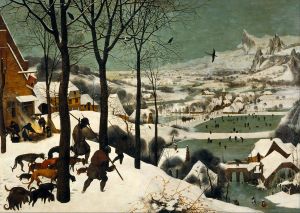

Writing, even writing fantasy, involves a certain amount of reality checking. You need to know how things actually worked.

Say you need to know what clothing the common European people wore during the renaissance looked like and how they dressed, both for celebrations, and for working.

I go to the 16th and 17th century painters and artists for that information. They always painted their subject with a heavy dose of religious allegory, but that was a part of village life–both the inquisition and the reformation was under way and the politics of religion was in the very air they breathed.

Any time you want an idea of average European village life in the Late Middle Ages through the 17th century, you need look no further than Wikimedia Commons.  There, under the heading  Category:Painters from the Northern Netherlands (before 1830) you will find the brilliant works of the Dutch Masters. These were artists living in what is now The Netherlands, and who were creating accurate records of the everyday life of the common people, along with stylized religious images.

During the 16th century, the Netherlands fought an 80 year war, trying to gain their independence from Spain, during the heart of the Spanish Inquisition. This was a period of extreme oppression and religious rebellion, and the art of times portrayed that very clearly.

I have learned, by rooting around the internet (so it must be true), that everything in the paintings of the time, no matter how commonplace, was allegorical, symbolic of some higher message. In art history (which I have always wanted to study), iconography is a visual language. This means that the way a subject is depicted and the way the image is organized, such as the number of figures used, their placing and gestures, all have specific meanings. The allegories they painted made heavy use of this visual language.

One particular family of of early Dutch painters from the county of Flanders pique my interest, the Brueghel Family. Five generations of their family were well-known painters, and print-makers.

One of my favorite early Dutch paintings is the Wedding Dance, by Pieter Brueghel the Elder:
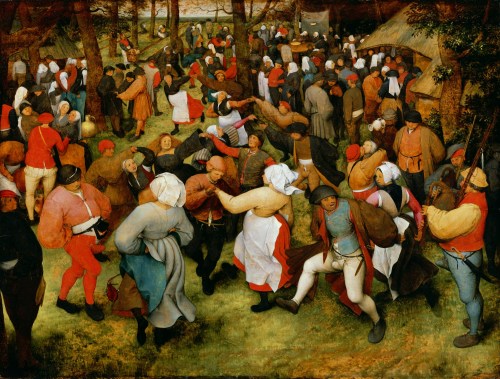
What makes this painting so spectacular to me is the amazing detail of the clothing. They loved color. From Wikipedia: The painting depicts 125 wedding guests. As was customary in the Renaissance period, the brides wore black and men wore codpieces. Voyeurism is depicted throughout the entire art work; dancing was tabooed at the time by the authorities and the church, and the painting can be seen as both a critique and comic depiction of a stereotypical oversexed, overindulgent, peasant class of the times.

All of these people are depicted as plump, which was a desirable trait–they were prosperous and not starving. All the things that (to this day) make a great party are there: music, food, and dancing. The men wear codpieces, emphasizing their male anatomy in the same way that in today’s society, women’s breasts are hyper-sexualized.  Perhaps codpieces should make a comeback in the men’s fashion world. I’ll show off my babyfeeders, if you parade your babymaker–that way we’ll both be sure we are getting something worth having. (or not.)

Anyway, back to the renaissance. They paid taxes, and this his how their IRS office looked to Brueghel’s eldest son, Pieter Jr. As you can see, not a lot has changed between then and now–we still pay in chickens and eggs. (heh heh.)
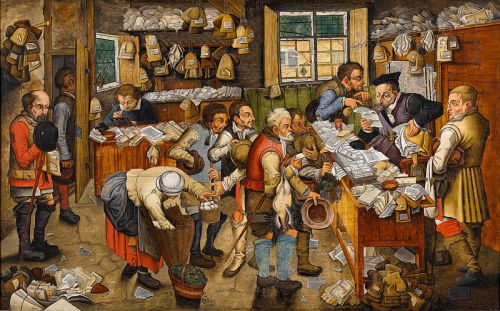
Brueghel’s eldest son, Pieter the Younger,  was never considered as fine a painter as his father or his brother, Jan Brueghel. He was considered a fine print-maker and his work shop was highly regarded. But he was not respected as an artist. Critics of the day felt he copied his father’s style, rather than developing his own. While he did paint in a folk-art style reminiscent of his father’s, his is sharper, more refined, taking it to the next level.

Notice how the people in the above picture are looking lean and ragged though, as opposed to the wedding picture painted by Pieter the Elder. The Little Ice Age had really gripped Europe, and times were hard.

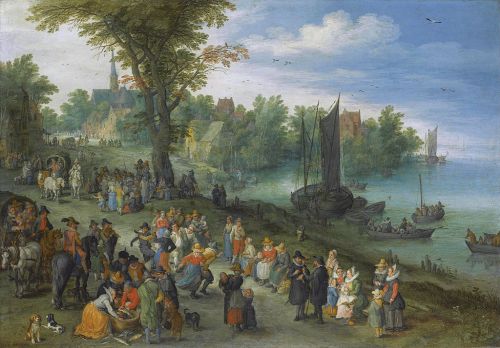
So here is a painting by the second son of Pieter Brueghel the Elder, and a man who fathered his own dynasty of artists, Jan Bruegel the Elder. This is called People Dancing on a Riverbank and by their dress, with the neck-ruffs, you can see it depicts a wealthier class than his brother’s images, perhaps the merchant class rather than the peasants.
One hundred years later, the Dutch were famous for their painters–and everyone wanted to own a Dutch masterpiece. Times had become quite hard, as the climate had cooled and crops regularly failed. Once-prosperous families often lived in the ruins of their family manors.
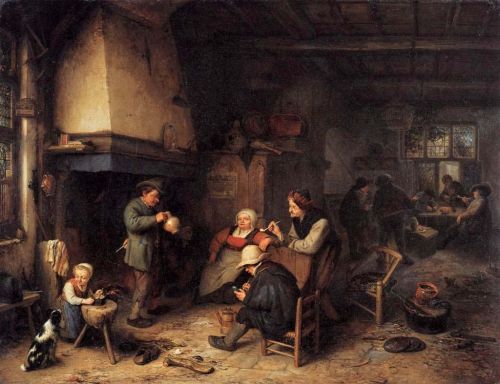
In the above picture by Adriaen Van Ostade, these peasants are living in an enormous, decrepit farmhouse, almost like squatters. They are no longer plump, and are living in filthy conditions. The fire in the fireplace is very low, as if fuel was scarce.

Another famous Dutch painting, from the same time period but showing a different segment of society is The Milkmaid, by Johannes Vermeer. In this painting, Vermeer shows an everyday task, a small glimpse of something that occurred daily in every household, a woman cooking.
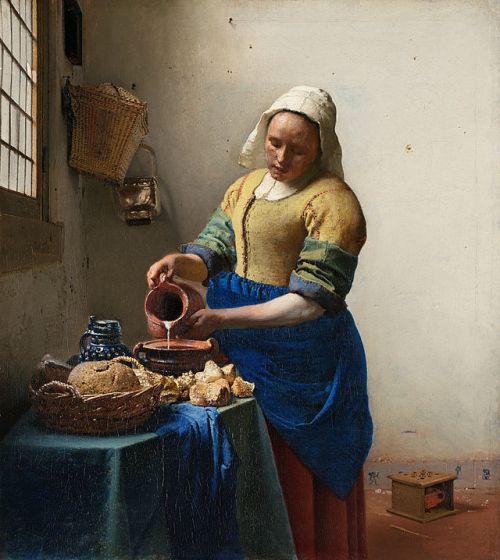
In the background on the floor is a foot-warmer which was filled with coals and was an essential luxury, showing this was one of the wealthier households.

According to Wikipedia, the fount of all knowledge: By depicting the working maid in the act of careful cooking, the artist presents not just a picture of an everyday scene, but one with ethical and social value. The humble woman is using common ingredients and otherwise useless stale bread to create a pleasurable product for the household.

I love art depicting the lives of ordinary people. I find the small details intriguing. It shows us that in many ways we are not that different than they were. We want food, decent shelter, and of course, stylish clothes to attract a mate.

And back then as it does now, a hint of anything taboo would most certainly find its way into even a religious painting.

The best part of all this is, a woman with an average education and on a tight budget (like me) can enjoy these wonderful works of art at will. I can examine them  in as much detail as I want, and take all the time I want, and no one will stop me or throw me out of their museum for loitering, because the internet is open all hours and is free.

Wikimedia Commons is a great resource to just roam around in, even when you are not looking for something specific.


Credits and Attributions:

This post was first published June 8,, 2015 under the title  #Inspiration: Oppression, rebellion and art, by Connie J. Jasperson, ©  2015 All Rights Reserved

Hunters in the Snow, Pieter Bruegel the Elder, PD|100 via Wikimedia Commons

The Wedding Dance, c.1566 (oil on panel) by Bruegel, Pieter the Elder (c.1525-69)

The Payment of the Tithes (The tax-collector), also known as Village Lawyer, Pieter Bruegel, the Younger, signed P Brueghel PD|100

People Dancing on a Riverbank, Jan Bruegel the elder, via Wikimedia Commons PD|100

Peasants in an Interior, Adriaen Van Ostade (1661) via Wikimedia Commons PD|100

The Milkmaid, Johannes Vermeer, via Wikimedia Commons PD|100
4 Comments

Filed under #FineArtFriday

Keeping the Goliardic Spark Alive #amwriting #NaNoWriMo

This week has been a struggle, what with cooking a Thanksgiving feast for my extended family and trying to keep my wordcount output up for #NaNoWriMo, so today I am reprising an essay written in 2015, on irreverent humor, the Carmina Burana, and medieval frat boys. Enjoy!


Crazy humor at the expense of the establishment is nothing new. It’s part of the Human Condition. And to that end, I love goliardic poetry.

Carl Orff and his amazing cantata, Carmina Burana, catapulted me into the poetry of the Goliards. But who and what were the goliards?

During what we call the Middle Ages, noble and wealthy middle-class families had a tradition that the eldest son inherited everything, the second son went into the church, and the younger sons went to the crusades.

The old-fashioned practice of “primogeniture” or bestowing the rights of inheritance upon the eldest son, often leaving younger sons penniless, is responsible for some of the most ribald and hilarious poetry of the middle ages. This was because the church had far too many clergymen who weren’t all that enthusiastic about having been forced into taking the ecclesiastical path, and who became, for lack a better definition, medieval frat-boys.

There was such an abundance of well-educated clergy that most were unable to gain a decent appointment within the church, despite good family connections.

Having been educated at the finest universities of France, Germany, Spain, Italy, and England these men weren’t content to spend their lives hidden away in a rural monastery painstakingly copying the great books written by others when they could be writing their own.

Going indie (or rogue) is nothing new.

They took their show on the road, going from town to town, protesting the growing contradictions within the church through song, poetry, and performance.

The disillusionment and disappointment they experienced regarding the hypocritical, abusive, greedy state of the hierarchy of the Catholic Church of that time, was fertile soil for medieval mockery on a grand scale. 

Not unlike the current political climate here in the US.

Most goliardic poetry is written in Latin, as Latin was the language of commerce, and every educated person understood and read it. Remember, if someone could read, they were well off, and if they could read, they read Latin. Those were the people the indie was writing books for in the early Middle Ages.

Some of the goliards’ more popular church services when they would arrive in a new town included celebrating the annual Feast of Fools, a brief social revolution, where roles were reversed, and power, dignity, and impunity were briefly conferred on the lowest of the social order. Thus, the town drunk or the local fool would be made mayor for a day, feted and given the status of a lord for a day.

As you might imagine, the nobility was unimpressed with that particular “holy” festival, and rarely participated.

Even less popular with those in power was the Feast of the Ass. From Wikipedia, the holy fount of all knowledge: A girl and a child on a donkey would be led through town to the church, where the donkey would stand beside the altar during the sermon, and the congregation would “hee-haw” their responses to the priest.

So, I guess you could say the goliards were a traveling Monty Python type of show, painfully hilarious and sometimes too good at what they did for the censor’s comfort.

Their point was that too much emphasis was placed on the pageantry and trappings of faith in Medieval Europe.

But the disaffected goliards couldn’t run forever. Their satires were almost always directed against the church, attacking even the pope, and the church didn’t take that well. Heresy, during the Middle Ages, was not something you wanted to be accused of, as the famous heretic and collector of goliardic poetry, Peter Abelard would tell you. Yet, though he was harshly punished, he remains one of the most respected philosophers and freethinkers of the Middle Ages.

By the 14th century, the word goliard had become synonymous with minstrel, no longer referring to this group of rebellious clergymen. However, a century after the overabundance of bored poor-little-rich-boy clergymen that spawned the goliards had been squashed by the church, that tradition of irreverence was carried on by Geoffrey Chaucer in his Canterbury Tales.

For me, Orff’s cantata was a ‘gateway drug.’ From first becoming intrigued by the libretto to  Carmina Burana, I moved on to “the hard stuff,” studying modern translations of the works of an author who was highly influenced by goliardic poetry, Geoffrey Chaucer.

Of course, that meant I had to go to the source, learning a great deal about the roots of our modern English language at the same time.

Chaucer was unique, in that he wrote in Middle English, the vernacular of his time, rather than in Latin. Because of this, and the enduring hilarity of his works, Chaucer is considered the Father of English Literature.

The goliardic works that survive to this day still surprise us with how relevant the concepts put forth in those poems and tales are to contemporary society.

It is through the surviving literature and song that the truth of a past culture is discovered. The true nature of the common medieval man and woman survives in the rebellious, ribald literary tradition of the naughty clergy, the goliards.

We may be separated in time by centuries, but we are not too different from those ancestors of ours who survived the Dark and early Middle Ages by getting drunk and singing bawdy songs and poking fun at the establishment.


Credits and Attributions:

Keeping the Goliardic Spark Alive, by Connie J. Jasperson, first appeared on Life in the Realm of Fantasy on September 28th, 2015.

Wikipedia contributors, “Feast of the Ass,” Wikipedia, The Free Encyclopedia, https://en.wikipedia.org/w/index.php?title=Feast_of_the_Ass&oldid=796169305

(accessed November 24, 2017).

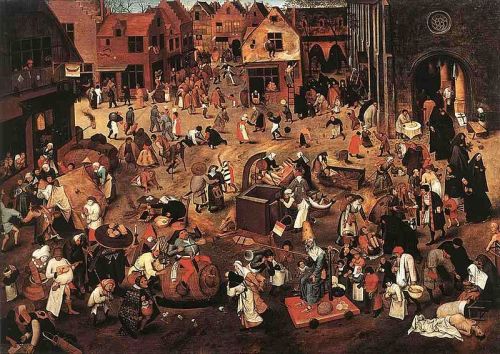
Image, The Fight Between Carnival and Lent, Pieter Bruegel the Elder, ca 1559  PD|100 via Wikimedia Commons

6 Comments

Filed under #FineArtFriday, #FlashFictionFriday

#FineArtFriday: Earthrise over Compton Crater


To write well, we need inspiration. Most of my inspiration comes for nature. That which I cannot visit in person is accessible through Wikimedia Commons. May today’s image inspire your writing.

Quotes from Wikimedia:

The Earth straddling the limb of the Moon, as seen from Lunar Reconnaissance Orbiter above Compton crater. The shadow in the foreground is from the crater’s central peaks, while the mountains just above it can be seen in the 10 o’clock position within the crater in this image or the 12 o’clock position in this image. Center of the Earth in this view is 4.04°N, 12.44°W, just off the coast of Liberia. The large tan area in the upper right is the Sahara desert, and just beyond is Saudia Arabia. The Atlantic and Pacific coasts of South America are visible to the left.

The Earth is much brighter (higher reflectance) than the Moon, especially from this angle; the Earth was captured near noon while the limb of the Moon was just appearing from the shadows of night, so the Moon was relatively dim. In the opening image the Moon and Earth were contrast-stretched separately to bring out details on the lunar surface. The two contrast stretch makes for a spectacular image, but it may be misleading in a purely scientific sense.


Images and Attributions:

Earthrise over Compton Crater, Image by NASA, Goddard Spaceflight Center, University of Arizona, Public Domain

Wikimedia Commons contributors, “File:Earthrise over Compton crater -LRO full res.jpg,” Wikimedia Commons, the free media repository, https://commons.wikimedia.org/w/index.php?title=File:Earthrise_over_Compton_crater_-LRO_full_res.jpg&oldid=264624407 (accessed November 3, 2017).

Comments Off on #FineArtFriday: Earthrise over Compton Crater

Filed under #FineArtFriday

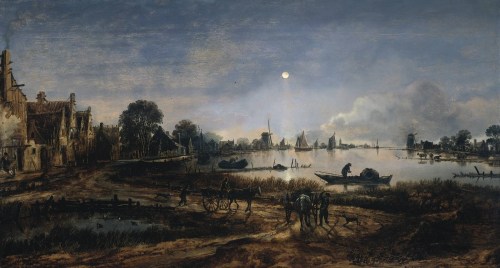
#FineArtFriday: River View by Moonlight, Aert van der Neer


River View by Moonlight, Aert van der Neer [Public domain], via Wikimedia Commons

Aert van der Neer, or Aernout or Artus (c. 1603 – 9 November 1677), was a landscape painter of the Dutch Golden Age, specializing in small night scenes lit only by moonlight and fires, and snowy winter landscapes, both often looking down a canal or river.

Description:
View of a village on a river by moonlight. In the foreground two horse and carriage on a dirt road. To the right a fisherman on a small boat on the water. On the horizon two windmills.
Date: Circa 1640-1650
Medium: oil on panel

Credits and Attributions:

River View by Moonlight, Aert van der Neer [Public domain], via Wikimedia Commons / Wikimedia Commons contributors, “File:Rijksmuseum neer.jpeg,” Wikimedia Commons, the free media repository,  https://commons.wikimedia.org/w/index.php?title=File:Rijksmuseum_neer.jpeg&oldid=194438646 (accessed October 27, 2017).

Wikipedia contributors, “Aert van der Neer,” Wikipedia, The Free Encyclopedia, https://en.wikipedia.org/w/index.php?title=Aert_van_der_Neer&oldid=770891498 (accessed October 27, 2017).

Comments Off on #FineArtFriday: River View by Moonlight, Aert van der Neer

Filed under #FineArtFriday

#FlashFictionFriday: Reflections on the Water

A rough, log bench at water’s edge

Pictured in mind’s eye,

Reflections on the water

Of an evening long gone by.

I see us as we were that night,

Grandmother, lake, and me.

Flannel shirt over frayed housedress

Beside denims worn with style,

Philosophies and grand ideas

Beside wisdom without guile.


She told me why the stars were hung

In the inky sea above.

A brilliant ebb and flowing dance

A ballet of starry love

To cricket song and bullfrog drum.

But I was bored with country life

And lured by rattle and hum.

“What you seek you’ll never find

In neon glow and city block.”

I longed to leave that place behind

New paths I yearned to walk.


And now I stand on memory’s shore

With Grandma once again.

The lake, and shore, and skies above,

Have gone, and gone again.

And simple wisdom I have gained,

Reflecting on the lake,

Grandma’s wisdom still remains

In who I came to be

Though different paths I take.


Credits and Attributions

Reflections on the Water by Connie J. Jasperson © 2017 All Rights Reserved

Moonrise, by Stanisław Masłowski   PD 100 yrs [[File:MaslowskiStanislaw.WschodKsiezyca.1884.ws.jpg|MaslowskiStanislaw.WschodKsiezyca.1884.ws]]

Comments Off on #FlashFictionFriday: Reflections on the Water

Filed under #FineArtFriday, #FlashFictionFriday, Poetry

#FineArtFriday: More Things in Heaven

And therefore as a stranger give it welcome.
There are more things in heaven and earth, Horatio,
Than are dreamt of in your philosophy.

Hamlet, Act 1, scene 5, by William Shakespeare


About the Eagle Nebula: Quote from Wikipedia:

The Eagle Nebula is part of a diffuse emission nebula, or H II region, which is catalogued as IC 4703. This region of active current star formation is about 7000 light-years distant. A spire of gas that can be seen coming off the nebula in the northeastern part is approximately 9.5 light-years or about 90 trillion kilometers long.[4]

The cluster associated with the nebula has approximately 8100 stars, which are mostly concentrated in a gap in the molecular cloud to the north-west of the Pillars.[5] The brightest star (HD 168076) has an apparent magnitude of +8.24, easily visible with good binoculars. It is actually a binary star formed of an O3.5V star plus an O7.5V companion.[6] This star has a mass of roughly 80 solar masses, and a luminosity up to 1 million times that of the Sun. The cluster’s age has been estimated to be 1–2 million years.[7]

The descriptive names reflect impressions of the shape of the central pillar rising from the southeast into the central luminous area. The name “Star Queen Nebula” was introduced by Robert Burnham, Jr., reflecting his characterization of the central pillar as the Star Queen shown in silhouette.[8]


Credits and Attributions

Quote from Hamlet, Act 1, scene 5, by William Shakespeare, [Public Domain]

The Fairy of Eagle Nebula  By NASA [Public domain], via Wikimedia Commons

Wikipedia contributors, “Eagle Nebula,” Wikipedia, The Free Encyclopedia, https://en.wikipedia.org/w/index.php?title=Eagle_Nebula&oldid=804691133 (accessed October 12, 2017).

2 Comments

Filed under #FineArtFriday, #FlashFictionFriday, writing

#FlashFictionFriday: The Watcher


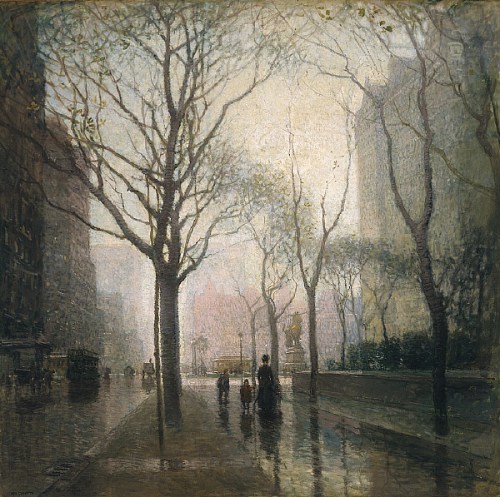
She stares out the window of her lonely room, watching the street below through the rivulets of water; blue and grey, washed away. Azure blue, the sky briefly shows itself and sunlight temporarily blinds her. Dry, elderly eyes watch as dark clouds once again overtake the blue. Rain pounds against the glass.

Rain beats down, and passersby on the street below vainly seek shelter beneath newspapers and fragile umbrellas, dodging under awnings, leaping into taxis waiting to whisk them away to distant places where the rains of March are just a rumor.

She looks down at the black of her dress. In her mind she sees him in the casket, looking as if he’d merely fallen asleep.

Her damp woolen coat lies on the bed, where sixty two years of her life were spent with him. Sixty two years of quarrels, of passion, sixty two years of love and jealous anger. Sixty two years of ties that bound them more securely than the mere vows of marriage two young people once took ever could.

Slightly ajar, the door of the closet reveals his clothes, suits and slacks hanging ready for the man who will never again wear them. The book he was reading rests on the nightstand by his pillow.

She stares out the window of her lonely room, watching the street below through the rivulets of water, blue and grey; washed away.

The sky weeps tears that faded blue eyes refuse to shed.


Credits and Attributions

The Watcher, by Connie J. Jasperson, © 2013-2017, Originally published on Wattpad March 21, 2013.

The Plaza After Rain, Paul Cornoyer, PD|100 via Wikimedia Commons

2 Comments

Filed under #FineArtFriday, #FlashFictionFriday

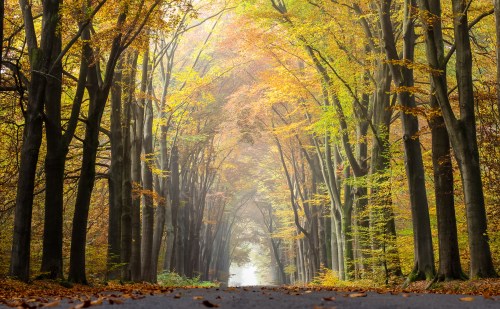
#FineArtFriday: Dietmar Rabich, Autumn in Börnste

The Wikimedia Commons Image of the Day for September 22, 2017.


Dietmar Rabich / Wikimedia Commons / “Dülmen, Börnste, Waldweg — 2015 — 4649” / CC BY-SA 4.0 

This image was selected as picture of the day on Wikimedia Commons for . It was captioned as follows:

English: Autumn in the hamlet Börnste, KirchspielDülmen, North Rhine-Westphalia, Germany

4 Comments

Filed under #FineArtFriday

#FineArtFriday: San Gabriel Mountains in the Haze


Today’s image is brought to you by Wikimedia Commons. It is an image of the San Gabriel Mountains in California rising out of the smoggy haze, taken by Doc Searls. In my mind it evokes a fairytale place, a somewhere full of possibilities. A writing prompt? Perhaps, but mostly it is a peaceful image, designed to rest the mind, a visual place where ideas are born.


S.GabrielHaze, by Doc Searls from Santa Barbara, USA – 2007_06_24_iah-lax_71.JPG, CC BY-SA 2.0, https://commons.wikimedia.org/w/index.php?curid=7737446

Comments Off on #FineArtFriday: San Gabriel Mountains in the Haze

Filed under #FineArtFriday, writing

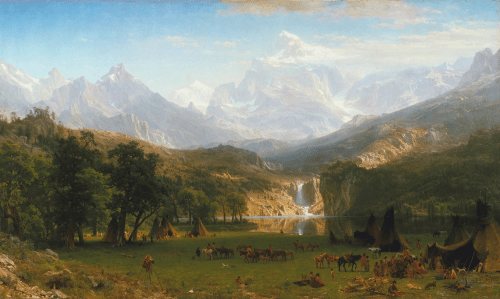
#FineArtFriday: Albert Bierstadt, The Rocky Mountains, Landers Peak 1860

When I sit down to write, my work is usually fiction. Even so, I want my work to have authenticity, although I might never have experienced what I am writing about. Whether a piece is set in an alternate world, or in this one, or if it is in the past, present, or future, a source of visual information you can use to fire your imagination exists on the internet–Wikimedia Commons.

For example, today’s image is a landscape painting by Albert Bierstadt, an American painter best known for his lavish, sweeping landscapes of the American West.  This painting shows what tribal life after a successful hunt might be like, and if you are writing about any group of people who hunt or gather food, this particular painting contain a wealth of historically accurate visual information. He painted what he saw. In all of Bierstadt’s work, you will find a world that existed 150 years ago, complete with children playing and dogs barking.

Wikipedia has this to say about the painter:

Born in Germany, Bierstadt was brought to the United States at the age of one by his parents. He later returned to study painting for several years in Düsseldorf. He became part of the Hudson River School in New York, an informal group of like-minded painters who started painting along the Hudson River. Their style was based on carefully detailed paintings with romantic, almost glowing lighting, sometimes called luminism. An important interpreter of the western landscape, Bierstadt, along with Thomas Moran, is also grouped with the Rocky Mountain School.

The life of the American West of the 19th century can be directly translated into a science fiction novel, or a fantasy novel–because the elements of hunting and gathering remain the same no matter what world you set it in. A great many people were involved in taking down a few animals–two antelope, one mountain sheep, and one bear. Hunts of this nature, even with modern weapons, are difficult and fraught with danger. For this reason, the take from this hunt will supply the entire camp of perhaps 100 people for one or two weeks., so foraging for roots, berries, and greens was an important task, as was fishing.

In this painting, you see how the tribe’s homes were constructed, and how the camp was laid out–the butchering party is well away from the rest of the camp, which is on the banks of a river. Everything that was important to the lives of these people is laid out in detail, exactly how it was the day the artist set up his easel in the wilderness and began painting.

Go to history for your world building, and go to art for your history. Don’t be afraid to ‘waste time’ looking at paintings and examining them for minute details, because your imagination will run with it, and your work will have a sense of realism.


Wikipedia contributors, “Albert Bierstadt,” Wikipedia, The Free Encyclopedia, https://en.wikipedia.org/w/index.php?title=Albert_Bierstadt&oldid=793302910 (accessed August 11, 2017).

The Rocky Mountains, Landers Peak; Albert Bierstadt 1863 [Public domain], via Wikimedia Commons, https://commons.wikimedia.org/wiki/File%3AAlbert_Bierstadt_-_The_Rocky_Mountains%2C_Lander’s_Peak.jpg, accessed August-11-2017.

Comments Off on #FineArtFriday: Albert Bierstadt, The Rocky Mountains, Landers Peak 1860

Filed under #FineArtFriday, writing