Category Archives: #FineArtFriday

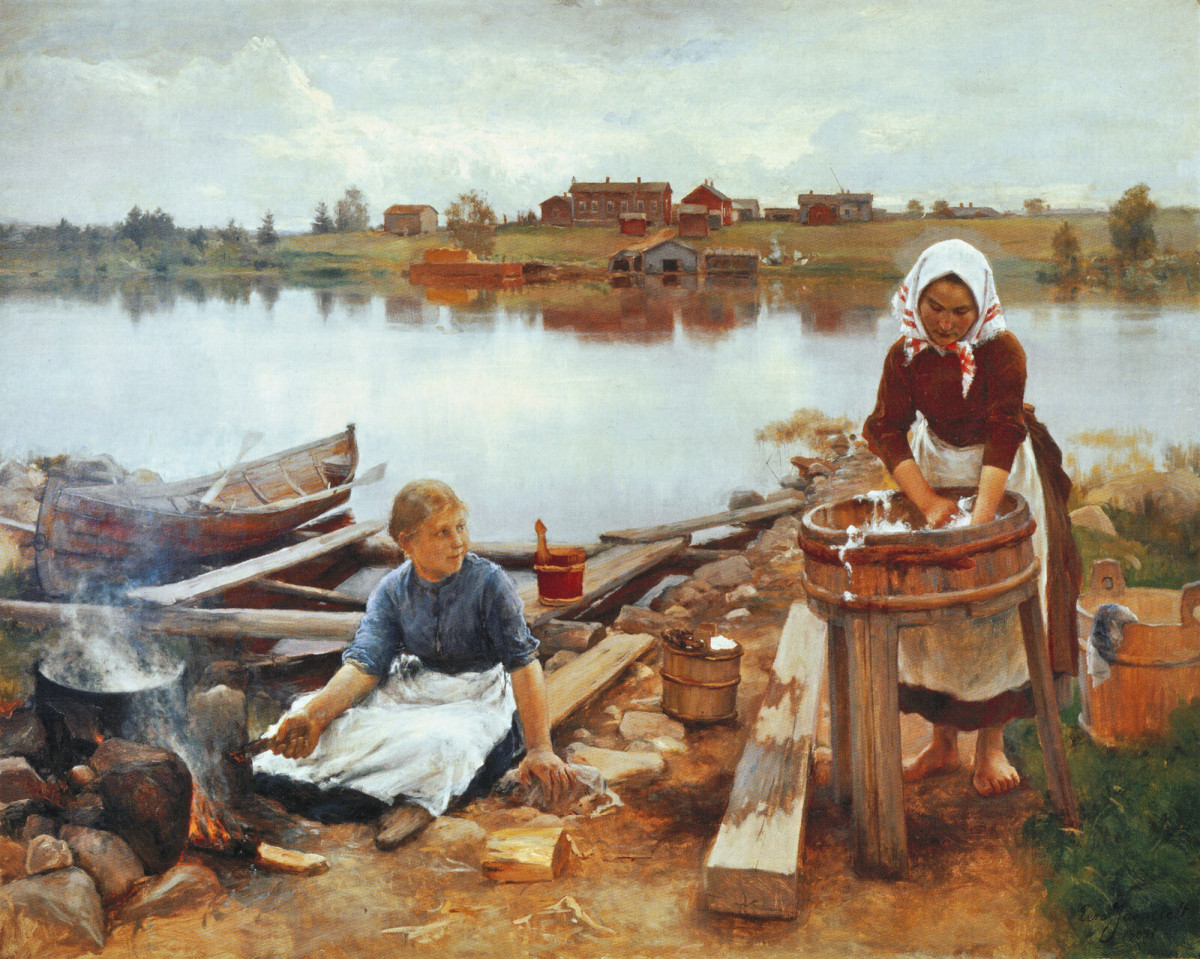
FineArtFriday: Laundry at the River Bank by Eero Järnefelt 1889

Artist: Eero (1863–1937)

Title:   English: Laundry at the River Bank (Suomi: Pyykkiranta)

Date:   1889

Medium:        oil on canvas

Dimensions:   height: 104 cm(40.9 in) width: 134 cm (52.7 in)

Collection:     Private collection

What I love about this painting:

When writers need to know how things were done historically, Wikimedia Commons is a vast resource of paintings and images made during all stages of recorded history.

This is a scene featuring two women on a sunny afternoon in the far north—Finland. They are spending the overcast summer’s day doing the distinctly not-so-glorious task of laundry. Very few artists painted scenes of women at work. So, those of us with modern conveniences have no real idea how labor-intensive women’s work was.

It was hot, heavy work. One had to carry and heat all the water, and once the clothes were washed, they had to be wrung out by hand unless one was fortunate enough to own a wringer/mangle. (Where I live, it’s called a wringer. Elsewhere in the world, it’s a mangle.) Then, it had to be hung on a line or spread out somewhere to dry.

And once the clothes were dry, they had to be ironed. This solid, heavy iron tool was heated on the stove and if one got it a bit too hot it could scorch the clothes. Not hot enough and it wouldn’t smooth away the wrinkles.

Thus, laundry was an all-day job.

Soaps were most often made of animal fats and lye (ashes steeped in water), along with other ingredients to improve the smell. This lye soap was harsh but effective.

In this scene, one woman keeps the water hot, adding wood to the fire. A bucket and ladle sit on the rocks behind her, handy for fetching more water and adding it to the boiler as needed. Certain items of clothing are most likely soaking in the boiling water. Whites were usually boiled.

While the peasants of the time didn’t know about germs, they did know that boiling water made things cleaner and that cleanliness made their families healthier.

My grandmother was born in 1909 in a rural cabin on the Olympic Peninsula of Washington State. She often pointed out how lucky I was because, prior to getting her first wringer washing machine in 1929, she had to do laundry the hard way. She boiled diapers, Grampa’s shirts, and “women’s things.” In the era before disposable bandages, material intended for use as bandages would also be boiled for at least an hour.

Peasant women were unaware of solar radiation and ultraviolet light. But they did know that diapers dried in the summer sun were less likely to cause a rash than those dried indoors in the winter.

Clearly, Järnefelt knew the amount of work it took to produce a clean shirt and respected the women who made his life easier.

About the artist, via Wikipedia:

Erik “Eero” Nikolai Järnefelt (8 November 1863 – 15 November 1937) was a Finnish painter and art professor. He is best known for his portraits and landscapes of the area around Koli National Park, in the North Karelia region of Finland. He was a medal winner at the Paris Exposition Universelle of 1889 and 1900, taught art at the University of Helsinki and was chairman of the Finnish Academy of Fine Arts.

To read more about the artist go to: Eero Järnefelt – Wikipedia


Credits and Attributions:

IMAGE: Laundry at the River Bank. Wikimedia Commons contributors, “File:Järnefelt Laundry.jpg,” Wikimedia Commons, https://commons.wikimedia.org/w/index.php?title=File:J%C3%A4rnefelt_Laundry.jpg&oldid=866950564 (accessed June 5, 2025).

5 Comments

Filed under #FineArtFriday

#FineArtFriday: Albert Bierstadt, The Rocky Mountains, Landers Peak 1860, revisited

When I sit down to write, my work is usually fiction. Even so, I want my work to have authenticity, although I might never have experienced what I am writing about. Whether a piece is set in an alternate world, or in this one, or if it is in the past, present, or future, a source of visual information you can use to fire your imagination exists on the internet–Wikimedia Commons.

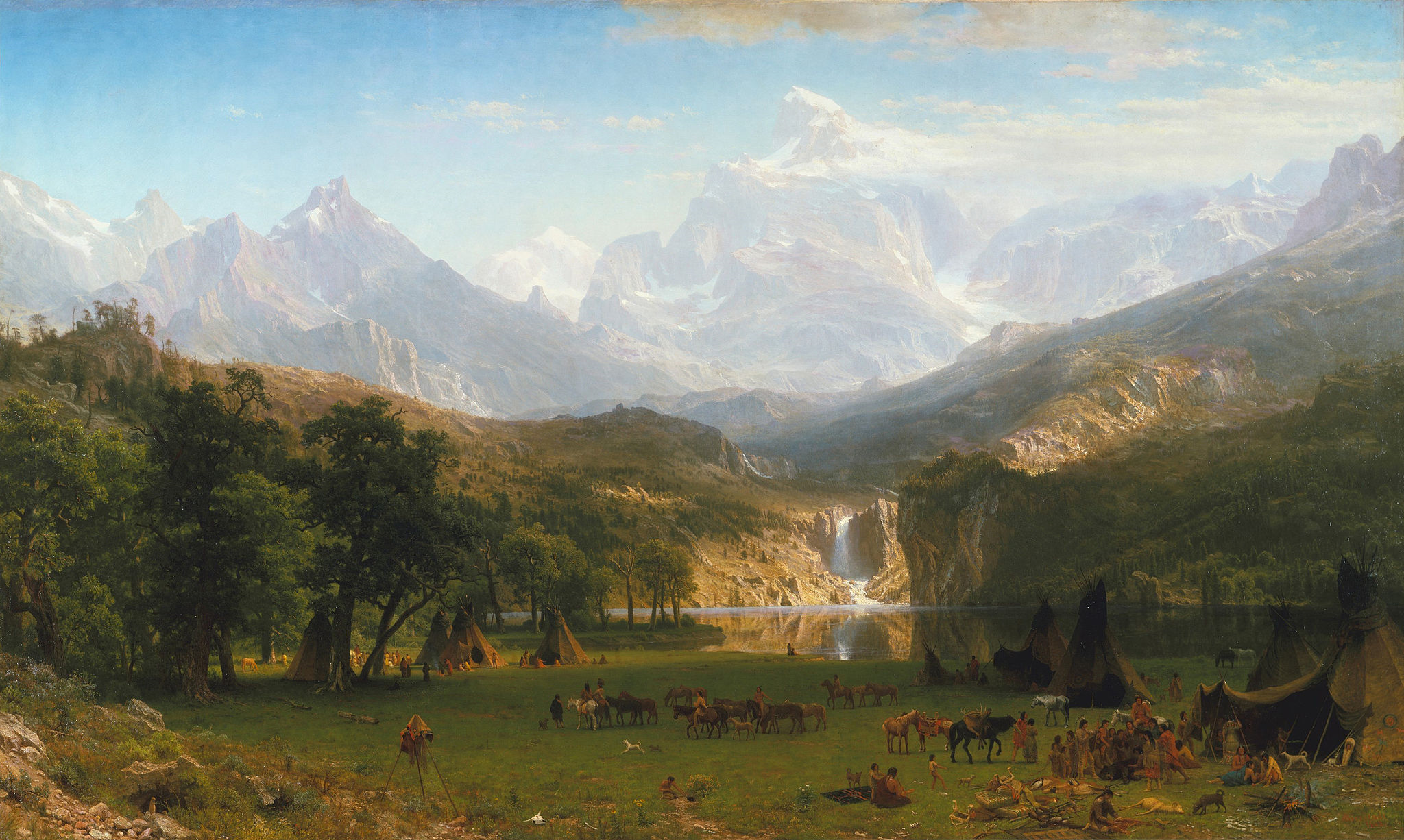
For example, today’s image is a landscape painting by Albert Bierstadt, an American painter best known for his lavish, sweeping landscapes of the American West.  This painting shows what tribal life after a successful hunt might be like, and if you are writing about any group of people who hunt or gather food, this particular painting contain a wealth of historically accurate visual information. He painted what he saw. In all of Bierstadt’s work, you will find a world that existed 150 years ago, complete with children playing and dogs barking.

Wikipedia has this to say about the painter:

Born in Germany, Bierstadt was brought to the United States at the age of one by his parents. He later returned to study painting for several years in Düsseldorf. He became part of the Hudson River School in New York, an informal group of like-minded painters who started painting along the Hudson River. Their style was based on carefully detailed paintings with romantic, almost glowing lighting, sometimes called luminism. An important interpreter of the western landscape, Bierstadt, along with Thomas Moran, is also grouped with the Rocky Mountain School.

The life of the American West of the 19th century can be directly translated into a science fiction novel, or a fantasy novel–because the elements of hunting and gathering remain the same no matter what world you set it in. A great many people were involved in taking down a few animals–two antelope, one mountain sheep, and one bear. Hunts of this nature, even with modern weapons, are difficult and fraught with danger. For this reason, the take from this hunt will supply the entire camp of perhaps 100 people for one or two weeks., so foraging for roots, berries, and greens was an important task, as was fishing.

In this painting, you see how the tribe’s homes were constructed, and how the camp was laid out–the butchering party is well away from the rest of the camp, which is on the banks of a river. Everything that was important to the lives of these people is laid out in detail, exactly how it was the day the artist set up his easel in the wilderness and began painting.

Go to history for your world building, and go to art for your history. Don’t be afraid to ‘waste time’ looking at paintings and examining them for minute details, because your imagination will run with it, and your work will have a sense of realism.


Wikipedia contributors, “Albert Bierstadt,” Wikipedia, The Free Encyclopedia, https://en.wikipedia.org/w/index.php?title=Albert_Bierstadt&oldid=793302910 (accessed August 11, 2017).

The Rocky Mountains, Landers Peak; Albert Bierstadt 1863 [Public domain], via Wikimedia Commons, https://commons.wikimedia.org/wiki/File%3AAlbert_Bierstadt_-_The_Rocky_Mountains%2C_Lander’s_Peak.jpg, accessed August-11-2017.

3 Comments

Filed under #FineArtFriday, writing

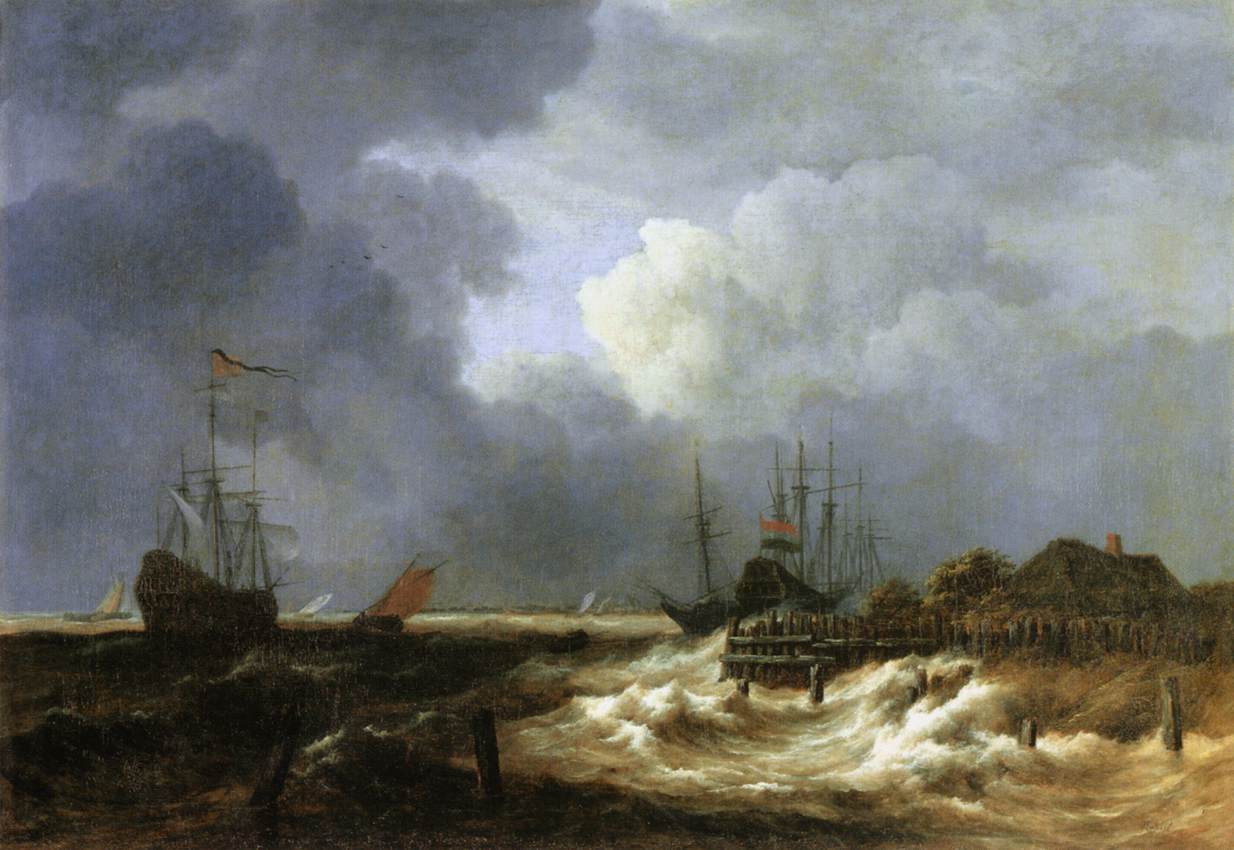
#FineArtFriday – “The Breakwater” or “Storm off a Sea Coast” by Jacob van Ruisdael ca. 1670

Artist: Jacob van Ruisdael (1628/1629–1682)

Titles: The Breakwater (current title)

Also known as: Storm off a Sea Coast

Also known as: Ships in Stormy Weather off the Coast

Also known as: A Storm at Sea Off the Dykes of Holland

Genre: marine art

Date: between 1670 and 1672

Medium: oil on canvas

Dimensions: height: 110 cm (43.3 in); width: 160 cm (62.9 in)

Collection: Louvre Museum

What I love about this painting:

Jacob van Ruisdael shows us a wild day down at the port. Several cargo ships are attempting to dock before the full force of the storm descends upon them. He shows us the action, the motion of the clouds flying across the sky above, and the roiling sea below. A shaft of light illuminates the white foam of the churning waves.

Will the ships’ captains and crews manage to get their vessels into the harbor and safely berthed? Will some be dashed against the rocks or tossed up onto the seawall?

Van Ruisdael paints us a story, but we must imagine the ending for ourselves.


About this painting via Wikipedia:

Storm Off a Sea Coast, also known as The Breakwater, is a 1670 oil on canvas painting by the Dutch Golden Age painter Jacob van Ruisdael. It is in the collection of the Louvre in Paris.

The painting is called A Storm at Sea Off the Dykes of Holland in the 1911 catalogue raisonné compiled by Cornelis Hofstede de Groot, in which it is catalogue number 961. De Groot described the scene: “On the right is a dyke lined with piles, beyond which is a fisherman’s cottage with a few trees. On the left corner of the dyke, great waves are breaking. Farther back rise the masts of several large vessels, as well as the stern with a Dutch flag.” The painting is called Storm Off a Sea Coast in Slive’s 2001 catalogue raisonné of van Ruisdael, in which it is given catalogue number 653.

In the 19th century, Vincent van Gogh called this painting by van Ruisdael, along with The Bush and Ray of Light, “magnificent”. The Louvre has in French: “L’Estacade ou Gros temps sur une digue de Hollande, dit aussi Une tempête” (the Jetty or Stormy Weather on a Dike in Holland, also known as A Storm). Its inventory number is INV. 1818. Its dimensions are 110 cm x 160 cm. [1]

About the artist, via Wikipedia:

Jacob Isaackszoon van Ruisdael c. 1629 – 10 March 1682) was a Dutch painter, draughtsman, and etcher. He is generally considered the pre-eminent landscape painter of the Dutch Golden Age, a period of great wealth and cultural achievement when Dutch painting became highly popular.

Prolific and versatile, Ruisdael depicted a wide variety of landscape subjects. From 1646 he painted Dutch countryside scenes of remarkable quality for a young man. After a trip to Germany in 1650, his landscapes took on a more heroic character. In his late work, conducted when he lived and worked in Amsterdam, he added city panoramas and seascapes to his regular repertoire. In these, the sky often took up two-thirds of the canvas. In total he produced more than 150 Scandinavian views featuring waterfalls.

Ruisdael’s only registered pupil was Meindert Hobbema, one of several artists who painted figures in his landscapes. Hobbema’s work has at times been confused with Ruisdael’s. Ruisdael always spelt his name thus: Ruisdael, not Ruysdael.

Ruisdael’s work was in demand in the Dutch Republic during his lifetime. Today it is spread across private and institutional collections around the world; the National Gallery in London, the Rijksmuseum in Amsterdam, and the Hermitage Museum in St. Petersburg hold the largest collections. Ruisdael shaped landscape painting traditions worldwide, from the English Romantics to the Barbizon school in France, and the Hudson River School in the US, and influenced generations of Dutch landscape artists. [2]


Credits and Attributions:

IMAGE: The Breakwater, Wikipedia contributors, “Storm Off a Sea Coast,” Wikipedia, The Free Encyclopedia, https://en.wikipedia.org/w/index.php?title=Storm_Off_a_Sea_Coast&oldid=1252177345 (accessed May 22, 2025).

[1] Wikipedia contributors, “Storm Off a Sea Coast,” Wikipedia, The Free Encyclopedia, https://en.wikipedia.org/w/index.php?title=Storm_Off_a_Sea_Coast&oldid=1252177345 (accessed May 22, 2025).

[2] Wikipedia contributors, “Jacob van Ruisdael,” Wikipedia, The Free Encyclopedia, https://en.wikipedia.org/w/index.php?title=Jacob_van_Ruisdael&oldid=1290856128 (accessed May 22, 2025).

2 Comments

Filed under #FineArtFriday

#FineArtFriday: A second look at “The Plaza After the Rain” by Paul Cornoyer

Paul_Cornoyer_-_The_Plaza_After_RainArtist: Paul Cornoyer  (1864–1923)

Title: The Plaza After Rain

Date: Before 1910

Medium: oil on canvas

Dimensions: 59 1/4 x 59 1/4 in. (150.5 x 150.5 cm)

Collection: Saint Louis Art Museum, Saint Louis, Missouri, United States

What I love about this painting:

This painting appeared here in January of 2024. Paul Cornoyer was a master at painting the way wet pavement looks, the reflections and the sheen. Rain is a near-constant companion during a Pacific Northwest winter and while it is now May, today is no exception.

Paul Cornoyer’s The Plaza After Rain depicts New York City, which is on the other side of the continent from me, and it takes place in a different era. But he shows the way rain is in early spring no matter where in the northern US you reside.

The sky is dark, but the trees are just beginning to leaf out. The rain is passing, and the streets are wet, but a hint of blue is showing through the dark sky. When you see this painting, you see the story of a cold spring day. Yet, one has the feeling that sunshine could happen any minute.

Impressionism is flash fiction on a canvas. All the important things are there, everything the eye needs to have a perfect vision of the mood, the setting, and characters at that moment in time. The important things at that moment are depicted within the piece, but with economy.

The St. Louis Art Museum says this about The Plaza After the Rain:

A drizzling rain creates watery reflections on the streets and sidewalks along the Grand Army Plaza in Manhattan. The rain hampers our view down the vista, though the moody tones of pinks, grays, and blues make up for this loss. The light in the distance offers a hazy glimpse of the southeast corner of Central Park, with its beloved bronze statue of Civil War general William Tecumseh Sherman. [2]

About the Author, via Wikipedia:

Paul Cornoyer (1864–1923) was an American painter, currently best known for his popularly reproduced painting in an Impressionisttonalist, and sometimes pointillist style.

Born in St. Louis, Missouri, Cornoyer began painting in Barbizon style and first exhibited in 1887. In 1889, He moved to Paris, where he studied at the Académie Julian alongside Jules Lefebvre and Jean-Joseph Benjamin-Constant. After returning from his studies in Paris in 1894, Cornoyer was heavily influenced by the American tonalists. At the urging of William Merritt Chase, he moved to New York City in 1899. In 1908, the Albright–Knox Art Gallery (formerly the Albright Gallery) hosted a show of his work. In 1909, he was elected into the National Academy of Design as an Associate Academician. He taught at Mechanics Institute of New York and in 1917, he moved to Massachusetts, where he continued to teach and paint.

Cornoyer received a retrospective exhibition entitled Paul Cornoyer: American Impressionist at the Lakeview Center for the Arts and Sciences in Peoria, Illinois in 1973. The exhibit drew heavily from the collection of Dr. and Mrs. Lawrence Ashby, who loaned multiple paintings to the exhibit, as well as over 20 works on paper. [1]


Credits and Attributions:

IMAGE: The Plaza After the Rain by Paul Cornoyer PD|100, Wikimedia Commons contributors, “File:Paul Cornoyer – The Plaza After Rain.jpg,” Wikimedia Commons, https://commons.wikimedia.org/w/index.php?title=File:Paul_Cornoyer_-_The_Plaza_After_Rain.jpg&oldid=345336218 (accessed January 18, 2024).

[1] Wikipedia contributors, “Paul Cornoyer,” Wikipedia, The Free Encyclopedia, https://en.wikipedia.org/w/index.php?title=Paul_Cornoyer&oldid=1118249028 (accessed January 18, 2024).

[2] St. Louis Art Museum contributors, the Plaza After the Rain by Paul Cornoyer, The Plaza after the Rain – Saint Louis Art Museum (slam.org) (accessed January 18, 2024).

2 Comments

Filed under #FineArtFriday, writing

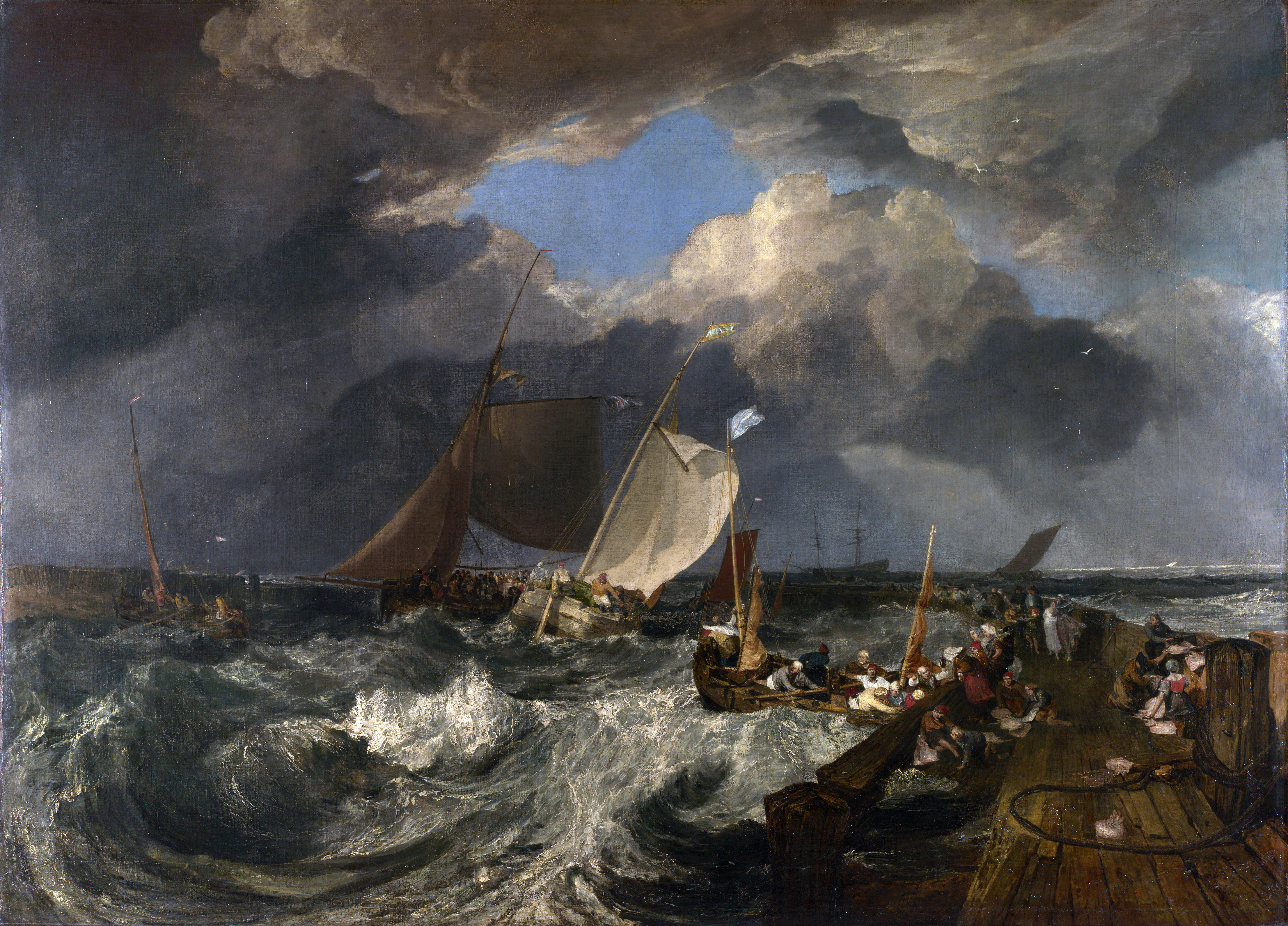
#FineArtFriday: a closer look at “Calais Pier by J.M.W. Turner, 1803”

Calais_pier_Joseph_Mallord_William_Turner_024

Artist: J. M. W. Turner (1775–1851)

Title: Calais Pier

Date: 1803

Medium: oil on canvas

Dimensions: height: 172 cm (67.7 in); width: 240 cm (94.4 in)

Collection: National Gallery

What I love about this painting:

The art of Joseph Mallord William Turner holds a large place in my heart. His originality, his later lack of deference to artistic conventions of the day often made his life hard. But what wonderful works emerged from his view of the world. Much like Van Gogh would do thirty years later, Turner’s work eventually evolved into a style that was original and sheer genius. His ability to paint what he saw and felt rather than the accepted classic literal depiction of a scene inspired the next generation of artists, the Impressionists.

Caiais Pier is one of his earlier works, painted when he was still influenced by his classical training. And yet, it is an emotion-packed image, the scene of a near-tragedy. The packet boat has arrived at Calais with a full load of passengers. The storm dominates the scene with lowering clouds and a heavy swell, but the sun breaks through and lights on the sail. A shaft of light shines down to the sea illuminating the center of the composition.  The young artist put his experience and terror into the image, depicting the ferocity of the sea and the violence of the landing.

The National Gallery website says of this picture, “Although it had a mixed response when first exhibited at the Royal Academy in 1803, the critic John Ruskin declared it to be the first painting to show signs of ‘Turner’s colossal power’. Calais Pier is based upon an actual event. On 15 July 1802, Turner, aged 27, began his first trip abroad, travelling from Dover to Calais in a cross-channel ferry (a packet) of the type shown here. The weather was stormy, and Turner noted in his sketchbook: ‘Our landing at Calais. Nearly swampt.’” [1] Joseph Mallord William Turner | Calais Pier | NG472 | National Gallery, London

About the Artist, Via Wikipedia:

Joseph Mallord William Turner RA (23 April 1775 – 19 December 1851), known in his time as William Turner, was an English Romantic painter, printmaker and watercolorist. He is known for his expressive coloring, imaginative landscapes and turbulent, often violent marine paintings. He left behind more than 550 oil paintings, 2,000 watercolors, and 30,000 works on paper. He was championed by the leading English art critic John Ruskin from 1840 and is today regarded as having elevated landscape painting to an eminence rivalling history painting.

Turner was born in Maiden Lane, Covent Garden, London, to a modest lower-middle-class family and retained his lower class accent, while assiduously avoiding the trappings of success and fame. A child prodigy, Turner studied at the Royal Academy of Arts from 1789, enrolling when he was 14, and exhibited his first work there at 15. During this period, he also served as an architectural draftsman. He earned a steady income from commissions and sales, which due to his troubled, contrary nature, were often begrudgingly accepted. He opened his own gallery in 1804 and became professor of perspective at the academy in 1807, where he lectured until 1828. He travelled around Europe from 1802, typically returning with voluminous sketchbooks.

Intensely private, eccentric, and reclusive, Turner was a controversial figure throughout his career. He did not marry, but fathered two daughters, Evelina (1801–1874) and Georgiana (1811–1843), by his housekeeper Sarah Danby. He became more pessimistic and morose as he got older, especially after the death of his father in 1829; when his outlook deteriorated, his gallery fell into disrepair and neglect, and his art intensified. In 1841, Turner rowed a boat into the Thames so he could not be counted as present at any property in that year’s census. He lived in squalor and poor health from 1845, and died in London in 1851 aged 76. Turner is buried in St Paul’s Cathedral, London. [2]


Credits and Attributions:

“Calais Pier” by J.M.W. Turner, 1801. Wikipedia contributors, “Calais Pier,” Wikipedia, The Free Encyclopedia, https://en.wikipedia.org/w/index.php?title=Calais_Pier&oldid=1287504024 (accessed May 9, 2025).

[1] National Gallery contributors, Calais Pier, Joseph Mallord William Turnerhttps://www.nationalgallery.org.uk/paintings/joseph-mallord-william-turner-calais-pier (accessed May 9, 2025).

[2] Wikipedia contributors, “J. M. W. Turner,” Wikipedia, The Free Encyclopedia, https://en.wikipedia.org/w/index.php?title=J._M._W._Turner&oldid=1289276733 (accessed May 9, 2025).

2 Comments

Filed under #FineArtFriday

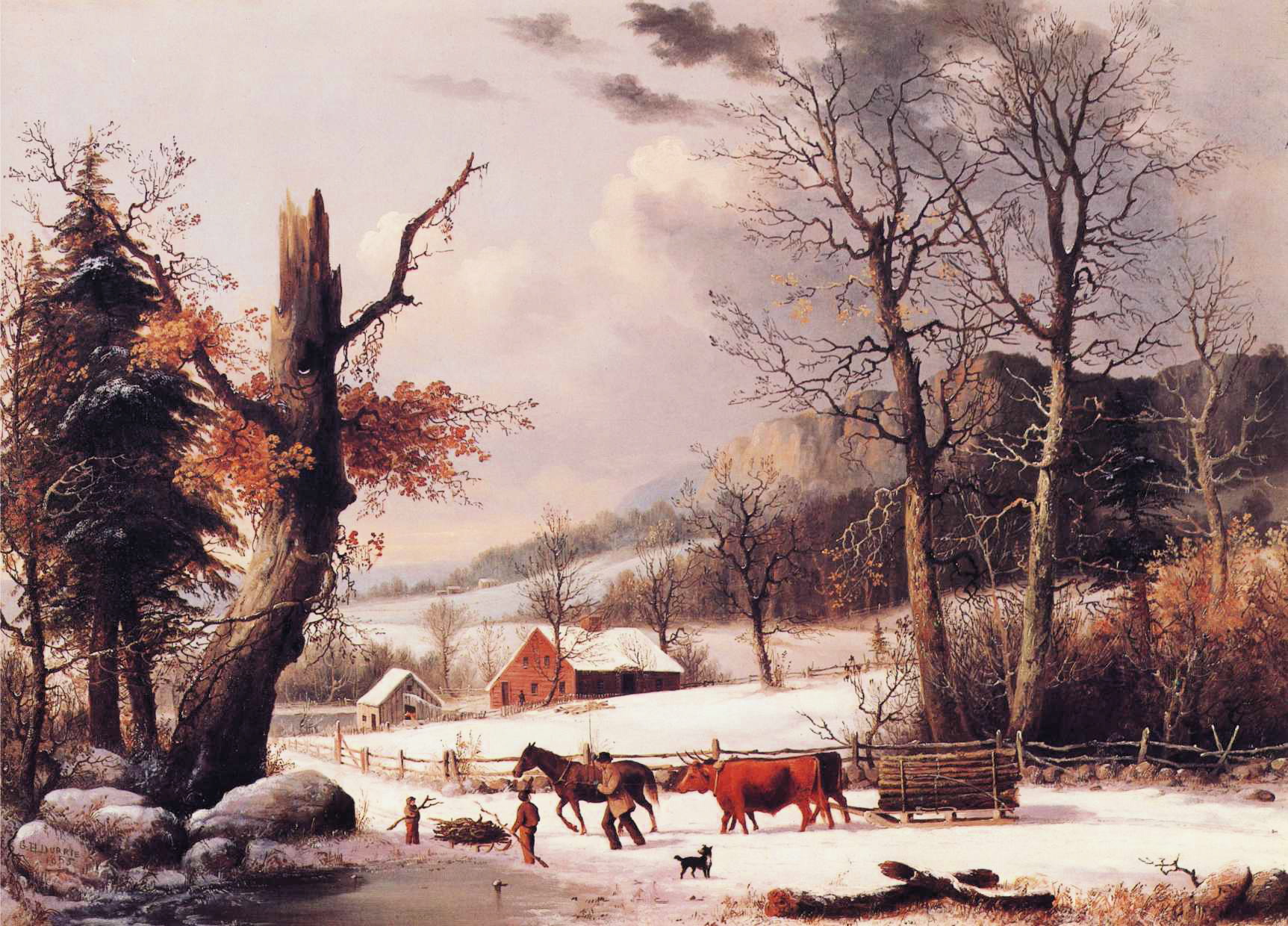
#FineArtFriday: Gathering Wood for Winter by George Henry Durrie 1855

Title: Gathering Wood for Winter

Artist: George Henry Durrie (1820–1863)

Date: 1855

Medium: oil on canvas

Dimensions: height: 26 in (66 cm); width: 36 in (91.4 cm)

Collection: Private collection

Why I love this painting:

Durrie shows us a day in late autumn. His characteristic use of reds and browns juxtaposed against lighter shades of white portrays the stark beauty of late autumn in New England.

The first snow has fallen, and the season is turning to winter. It’s more important than ever to gather as much wood as possible. Fortunately for our wood gatherers, a giant has fallen victim to a storm, snapping off halfway up.

This is not necessarily the end of the tree. Leaves still cling to the branches below the wound and will continue to provide shade and habitat for as long as it can. Someday, it may be cut down, as the fact it broke in half shows that it is nearing the end of its life and may present a hazard to those who walk beneath it.

Regardless of the tree’s future, the farmer and his son are taking advantage of the bounty so close to their home. They will stack it in the woodshed and allow it to dry out or “season” before they must burn it, hopefully not before the end of spring.

The more wood they gather now, the warmer they will be when winter’s grip tightens.

About the author, via Wikipedia:

George Henry Durrie (June 6, 1820 – October 15, 1863) was an American landscape artist noted especially for his rural winter snow scenes, which became very popular after they were reproduced as lithographic prints by Currier and Ives.

For many years, Durrie made a living primarily as a portrait painter, executing hundreds of commissions. After marriage, he made frequent trips, traveling to New York, Massachusetts, New Jersey,  and Virginia, fulfilling commissions and looking for new ones. His diary reveals that he was an enthusiastic railroad traveler, in the early days of the railroads. Durrie also painted what he called “fancy pieces”, whimsical studies of still lives or stage actors, as well as painting scenes on window-shades and fireplace covers. But portrait painting commissions became scarcer when photography came on the scene, offering a cheaper alternative to painted portraits, and, as his account-book shows, Durrie rarely painted a portrait after 1851.

Durrie’s interest shifted to landscape painting, and while on the road, or at home, made frequent sketches of landscape elements that caught his eye. Around 1844 Durrie began painting water and snow scenes, and took a second place medal at the 1845 New Haven State Fair for two winter landscapes. Although he had some training in portrait work, Durrie was self-taught as a landscape artist. He was undoubtedly influenced both by the American Hudson River School, and also by European artists, by studying exhibitions of their work at the New Haven Statehouse, the Trumbull Gallery, and at the Wadsworth Atheneum in Hartford, as well as in New York City. Durrie himself exhibited regularly, both locally, and in New York City at the National Academy of Design and the American Artists’ Union, and his reputation grew. Durrie was especially known for his snow pieces, and would often make copies or near-copies of his most popular pieces, with modifications to order.  The landscapes painted by Durrie offered a more intimate view than the panoramic landscapes painted by the Hudson River School, which was the leading school of American landscape painting. Colin Simkin notes that Durrie’s paintings took in a wide angle, but still “close enough to be within hailing distance” of the people who are always included in his scenes.

Currier and Ives

Durrie’s early landscapes were often of local landmarks, such as East Rock and West Rock, and other local scenes, which were popular with his New Haven clients, and he painted numerous variations of popular subjects. As his portrait commissions declined, Durie concentrated on landscapes. He wanted a wider audience, and he seemed to have a good sense of what would sell. Durrie realized that his paintings would have a wider appeal if he made them as generic New England scenes rather than as identifiable local scenes, retaining, as Sackett said, “a sense of place without specifying where that place was.” The New York City lithographic firm of Currier & Ives knew their audience; the American public wanted nostalgic scenes of rural life, images of the good old days, and Durrie’s New England scenes fit the bill perfectly. Lithographic prints were a very democratic form of art, cheap enough that the humblest home could afford some art to hang on the wall. Durrie had been marketing his paintings in New York City, and Currier and Ives, who had popularized such prints, purchased some of Durrie’s paintings in the late 1850s or early 1860s, and eventually published ten of Durrie’s pictures beginning in 1861. Four prints were published between 1861 and the artist’s death in New Haven in 1863; six additional prints were issued posthumously.

The popularity of Durrie’s snow scenes received an additional boost in the 1930s, when the Traveler’s Insurance Company began issuing calendars featuring Currier and Ives prints. Starting in 1946, the January calendar always featured a Durrie snow scene. Historian Bernard Mergen notes that “84 of the 125 paintings attributed to him are snowscapes, more than enough to make him the most prolific snow scene painter of his time.”

In Durrie’s time, winter landscapes were not popular with most curators and critics, but nevertheless, by the time of his death, Durrie had acquired a national reputation as a snowscape painter. Durrie died in 1863, at age 43, probably from typhoid fever, not long after Currier and Ives began reproducing his paintings as prints.

Durrie was dismissed by critics as a popular artist, an illustrator rather than a fine artist. Although Durrie’s Currier and Ives prints were popular, his name was still relatively unknown. But a revival of interest in Durrie began in the 1920s with the publication in 1929 of Currier and Ives, Printmakers to the American People, by collector Harry T. Peters, Sr., who called Durrie’s prints “among the most valued In the entire gallery [of Currier and Ives prints]”, and says that Durrie was known as the “snowman” of the group. [1]


Credits and Attributions:

IMAGE: Gathering Wood for Winter by George Henry Durrie 1855. Wikimedia Commons contributors, “File:George Henry Durrie – Gathering Wood for Winter.JPG,” Wikimedia Commons, https://commons.wikimedia.org/w/index.php?title=File:George_Henry_Durrie_-_Gathering_Wood_for_Winter.JPG&oldid=853995324 (accessed May 1, 2025).

[1]Wikipedia contributors, “George Henry Durrie,” Wikipedia, The Free Encyclopedia, https://en.wikipedia.org/w/index.php?title=George_Henry_Durrie&oldid=1282714933 (accessed May 1, 2025).

Comments Off on #FineArtFriday: Gathering Wood for Winter by George Henry Durrie 1855

Filed under #FineArtFriday, writing

#FineArtFriday – a second look at “Fishing for Oysters at Cancale” by John Singer Sargent 1878

2560px-John_Singer_Sargent_-_CancaleArtist: John Singer Sargent (1856–1925)

Title: En route pour la pêche (Setting Out to Fish) Fishing for Oysters at Cancale

Date: 1878

Medium: oil on canvas

Dimensions: height: 77 cm (30.3 in); width: 121.6 cm (47.8 in)

Inscription: Signed and Dated: John S. Sargent Paris 1878

Collection: National Gallery of Art

What I love about this picture:

Every time I see a painting by John Singer Sargent, I love him more. He is rapidly becoming one of my favorite artists of all time. (Don’t be jealous, Rembrandt. You are still number one in my heart.)

Sargent paints a perfect summer day for us, a good day to be out near the water. John Singer Sargent was a complicated man, as most artists are. Famous as a portrait artist, he painted landscapes that conveyed a sense of mood and emotion that few of his contemporaries could match. One of Sargent’s great skills was the ability to convey the sensory impressions of an environment.

He found beauty and drama in the lives of ordinary people and showed his characters outdoors in all the seasons. His paintings of working-class people didn’t romanticize how they dressed, conveyed their moods. Sargent showed the environment they lived and worked in, no matter how good or bad the weather.

Sargent had a gift for painting rare and expensive fabrics, yet no one is dressed in finery in this painting. On the contrary, the women are dressed in shabby clothes that protect them from the sun and salty wind, garments that have seen a great deal of wear. The children are bare-legged and barefoot, while the fishers wear clogs. These women carry baskets and the hope that they will find enough oysters and other shellfish to not only feed their family but have plenty to sell to the fishmonger.

About this picture via MFA Boston: Sargent’s choice of subject was not revolutionary – a similar scene of oyster harvesters had previously won a medal at the Salon. However, his ability to paint the reflections in the tidal pools and the light sparkling on the figures and clouds dazzled viewers, clearly demonstrating that his talents extended beyond portraiture. [1]

About the artist, via Wikipedia:

John Singer Sargent (January 12, 1856 – April 14, 1925) was an American expatriate artist, considered the “leading portrait painter of his generation” for his evocations of Edwardian-era luxury. He created roughly 900 oil paintings and more than 2,000 watercolors, as well as countless sketches and charcoal drawings. His oeuvre documents worldwide travel, from Venice to the TyrolCorfu, Spain, the Middle East, MontanaMaine, and Florida.

Born in Florence to American parents, he was trained in Paris before moving to London, living most of his life in Europe. He enjoyed international acclaim as a portrait painter. An early submission to the Paris Salon in the 1880s, his Portrait of Madame X, was intended to consolidate his position as a society painter in Paris but instead resulted in scandal. During the year following the scandal, Sargent departed for England, where he continued a successful career as a portrait artist.

From the beginning, Sargent’s work is characterized by remarkable technical facility, particularly in his ability to draw with a brush, which in later years inspired admiration as well as criticism for its supposed superficiality. His commissioned works were consistent with the grand manner of portraiture, while his informal studies and landscape paintings displayed a familiarity with Impressionism. In later life, Sargent expressed ambivalence about the restrictions of formal portrait work and devoted much of his energy to mural painting and working en plein air. Art historians generally ignored society artists such as Sargent until the late 20th century.

The exhibition in the 1980s of Sargent’s previously hidden male nudes served to spark a reevaluation of his life and work, and its psychological complexity. In addition to the beauty, sensation and innovation of his oeuvre, his same-sex interests, unconventional friendships with women and engagement with race, gender nonconformity and emerging globalism are now viewed as socially and aesthetically progressive and radical.


Credits and Attributions:

IMAGE: Wikimedia Commons contributors, “File:John Singer Sargent – Cancale.jpg,” Wikimedia Commons, https://commons.wikimedia.org/w/index.php?title=File:John_Singer_Sargent_-_Cancale.jpg&oldid=745727074 (accessed April 25, 2025).

[1] Quote: MFABoston contributors, Fishing for Oysters at Cancale – Works – Museum of Fine Arts, Boston (mfa.org) (accessed April 25,2025).

[2] Wikipedia contributors, “John Singer Sargent,” Wikipedia, The Free Encyclopedia, https://en.wikipedia.org/w/index.php?title=John_Singer_Sargent&oldid=1223506386 (accessed April 25, 2025).

Comments Off on #FineArtFriday – a second look at “Fishing for Oysters at Cancale” by John Singer Sargent 1878

Filed under #FineArtFriday

#FineArtFriday: a second look at “Canal in the Spreewald in Spring” by Bruno Moras

Artist: Bruno Moras, (1833 – 1939)

Title: Kanal im Spreewald im Frühling (Canal in the Spreewald in Spring)

Medium: oil on canvas

Dimensions Height: 79 cm (31.1″); Width: 119 cm (46.8″)

What I love about this picture:

I first featured this painting in March of 2020. I particularly like how comforting this scene is, how ordinary and yet how special. I grew up in a house on the shores of a lake, and waterside homes attract me. I would love to live beside this canal.

Spring is a hopeful season for me, a time of promise. Trees that have slept all winter are waking and blossoming, bringing color to the dark, gray world.

Moras captured the trees as they are when the leaves first burst forth, with a bright, yellow-green. The apple and plum trees, the first signs of spring around here, are blossoming. The water reflects the  colors of the world, yet a slight breeze moves it. The small boats drawn up to the shore can carry one or two fisher folk comfortably.

About the artist:

I have been unable to find much about Bruno Moras, other than he was the son of Walter Moras, was born, lived, and died in Berlin, and never achieved the fame his father had. This is too bad, as his works are just now becoming more in demand at auctions.

Still, his work survives. In a time when modern art was moving away from traditional landscape painting, Moras painted beautiful images of what he loved most: the countryside of his Germany.

Credits and Attributions:

Wikimedia Commons contributors, “File:Bruno Moras – Kanal im Spreewald im Frühling.jpg,” Wikimedia Commons, https://commons.wikimedia.org/w/index.php?title=File:Bruno_Moras_-_Kanal_im_Spreewald_im_Fr%C3%BChling.jpg&oldid=835727555 (accessed April 16, 2025).

2 Comments

Filed under #FineArtFriday, writing

#FineArtFriday: A closer look at “A Boating Party” by John Singer Sargent ca. 1889

RISDM 78-086

Artist: John Singer Sargent (1856–1925) 

Title: A Boating Party

Date: circa 1889

Dimensions: height: 88.3 cm (34.7 in) width: 91.4 cm (35.9 in)

Collection: Rhode Island School of Design Museum  

What I Love About this Painting:

This painting first appeared here in last autumn, and my mind keeps going back to it. This is one my favorite paintings by John Singer Sargent. He created this scene early in his career, but already his ability to show the many moods of water and the personalities of his characters is a strength.

Sargent painted portraits for commissions and was highly successful. However, he painted informal studies like today’s scene for himself, painting for sheer love of it. This scene seems like the perfect visual prompt for writers searching for inspiration.

We’re looking at a fine day toward the end of summer. The day is warm enough that light jackets are all that are needed. The trees along the riverbank have begun to turn, and some leaves have fallen. One thing that stands out to me is the way he shows the shrubbery along the bank. 

One thing I have always appreciated about John Singer Sargent’s subjects is the way he captures people in the act of doing something. The eye immediately goes to the lady in white who is carefully stepping from the riverbank and into a boat, aided by a man in the shadows on the bank. Her reflection on the still waters is masterfully done.

In the right foreground, a man lounges in another boat that is tied up at the pier, with his leg thrown over both the boat’s gunwale and the dock’s rail. Beside him, another lady sits on the pier. Judging from the way Sargent has positioned them, I feel they are a married couple, and they are in no hurry to go anywhere.

About the Artist, via Wikipedia:

[1] John Singer Sargent (January 12, 1856 – April 14, 1925) was an American expatriate artist, considered the “leading portrait painter of his generation” for his evocations of Edwardian-era luxury. He created roughly 900 oil paintings and more than 2,000 watercolors, as well as countless sketches and charcoal drawings. His oeuvre documents worldwide travel, from Venice to the Tyrol, Corfu, the Middle East, Montana, Maine, and Florida.

Born in Florence to American parents, he was trained in Paris before moving to London, living most of his life in Europe. He enjoyed international acclaim as a portrait painter. An early submission to the Paris Salon in the 1880s, his Portrait of Madame X, was intended to consolidate his position as a society painter in Paris, but instead resulted in scandal. During the next year following the scandal, Sargent departed for England where he continued a successful career as a portrait artist.

From the beginning, Sargent’s work is characterized by remarkable technical facility, particularly in his ability to draw with a brush, which in later years inspired admiration as well as criticism for a supposed superficiality. His commissioned works were consistent with the grand manner of portraiture, while his informal studies and landscape paintings displayed a familiarity with Impressionism. In later life Sargent expressed ambivalence about the restrictions of formal portrait work, and devoted much of his energy to mural painting and working en plein air. Art historians generally ignored artists who painted royalty and “society” – such as Sargent – until the late 20th century. [1]


Credits and Attributions:

IMAGE: Wikimedia Commons contributors, “File:John Singer Sargent – A Boating Party – 78.086 – Rhode Island School of Design Museum.jpg,” Wikimedia Commons, https://commons.wikimedia.org/w/index.php?title=File:John_Singer_Sargent_-_A_Boating_Party_-_78.086_-_Rhode_Island_School_of_Design_Museum.jpg&oldid=809452828 (accessed April 10, 2025).

[1]Wikipedia contributors, “John Singer Sargent,” Wikipedia, The Free Encyclopedia, https://en.wikipedia.org/w/index.php?title=John_Singer_Sargent&oldid=1283813769 (accessed April 11, 2025).

2 Comments

Filed under #FineArtFriday, writing

#FineArtFriday: Boys in a Dory by Winslow Homer 1873

Artist: Winslow Homer (1836–1910)

Title: Boys in a Dory

Date: 1873

Medium: Watercolor washes and gouache over graphite underdrawing on medium rough textured white wove paper

Dimensions: 9 3/4 x 13 7/8 in. (24.8 x 35.2 cm)

Collection: Metropolitan Museum of Art

Inscription: signed Homer 1873

What I love about this image:

Here we have four boys out for a summer’s day on the water. Are they brothers? They all wear similar long-sleeved lightweight cotton shirts and straw hats as protection against the sun.

The two youngest ride, while the older boys row. The water is calm, perfect for a sunny afternoon of freedom. Do they plan to fish or are they just out for the fun of it?

I especially like how Homer paints the water. He depicts the reflections perfectly, showing us how they mirror on the soft movement of the water’s surface. He shows us the sailing craft in the distance with minimal strokes, clearly showing the other boats heading out for a day’s fishing or pleasure boating.

About this painting via Wikipedia:

Boys in a Dory is one of Homer’s first watercolors. According to the Met’s description of the painting, the artist’s initial style of watercolors resulted in Boys being simple and direct.

The painting was rendered by Homer while he was in Gloucester, Massachusetts. [1]

About the dory, via Wikipedia:

The dory can be defined as a small boat which has:

  • a flat bottom, with the bottom planks fastened lengthwise (bow to stern).
  • a hull shape defined by the natural curve of a sawn plank (never steam-bent).
  • planks overlapping the stem at the front of the boat and an outer “false” stem covering the hood ends of the planks.
  • (with some exceptions) a fairly narrow transom often referred to as the “tombstone” due to its unique shape.

The hull’s bottom is transversely flat and usually bowed fore-and-aft. (This curvature is known as “rocker”.) The stern is frequently a raked narrow transom that tapers sharply toward the bottom forming a nearly double-ended boat. The traditional bottom is made from planks laid fore and aft and not transverse, although some hulls have a second set of planks laid over the first in a pattern that is crosswise to the main hull for additional wear and strength.

As the need for working dories diminished, the Swampscott or beach dory types were modified for pleasure sailing. These sailing dories became quite popular at the beginning of the 20th century around the town of Marblehead, Massachusetts. They were generally longer yet remained narrow with low freeboard and later were often decked over. Another common distinctive feature of the sailing dory was a long boom on the rig that angled up with a mainsail that was larger along the foot than the luff.  [2]

About the Artist via Wikipedia:

Winslow Homer (February 24, 1836 – September 29, 1910) was an American landscape painter and illustrator, best known for his marine subjects. He is considered one of the foremost painters of 19th-century America and a preeminent figure in American art in general.

Largely self-taught, Homer began his career working as a commercial illustrator. He subsequently took up oil painting and produced major studio works characterized by the weight and density he exploited from the medium. He also worked extensively in watercolor, creating a fluid and prolific oeuvre, primarily chronicling his working vacations. [3]


Credits and Attributions:

IMAGE: Boys in a Dory by Winslow Homer. Wikimedia Commons contributors, “File:Boys in a Dory MET DT5026.jpg,” Wikimedia Commons,  https://commons.wikimedia.org/w/index.php?title=File:Boys_in_a_Dory_MET_DT5026.jpg&oldid=928781177 (accessed April 3, 2025).

[1] Wikipedia contributors, “Boys in a Dory,” Wikipedia, The Free Encyclopedia, https://en.wikipedia.org/w/index.php?title=Boys_in_a_Dory&oldid=1249874568 (accessed April 3, 2025).

[2] Wikipedia contributors, “Dory (boat),” Wikipedia, The Free Encyclopedia, https://en.wikipedia.org/w/index.php?title=Dory_(boat)&oldid=1281846716 (accessed April 3, 2025).

[3] Wikipedia contributors, “Winslow Homer,” Wikipedia, The Free Encyclopedia, https://en.wikipedia.org/w/index.php?title=Winslow_Homer&oldid=1277975900 (accessed April 3, 2025).

Comments Off on #FineArtFriday: Boys in a Dory by Winslow Homer 1873

Filed under #FineArtFriday, writing