Category Archives: #FineArtFriday

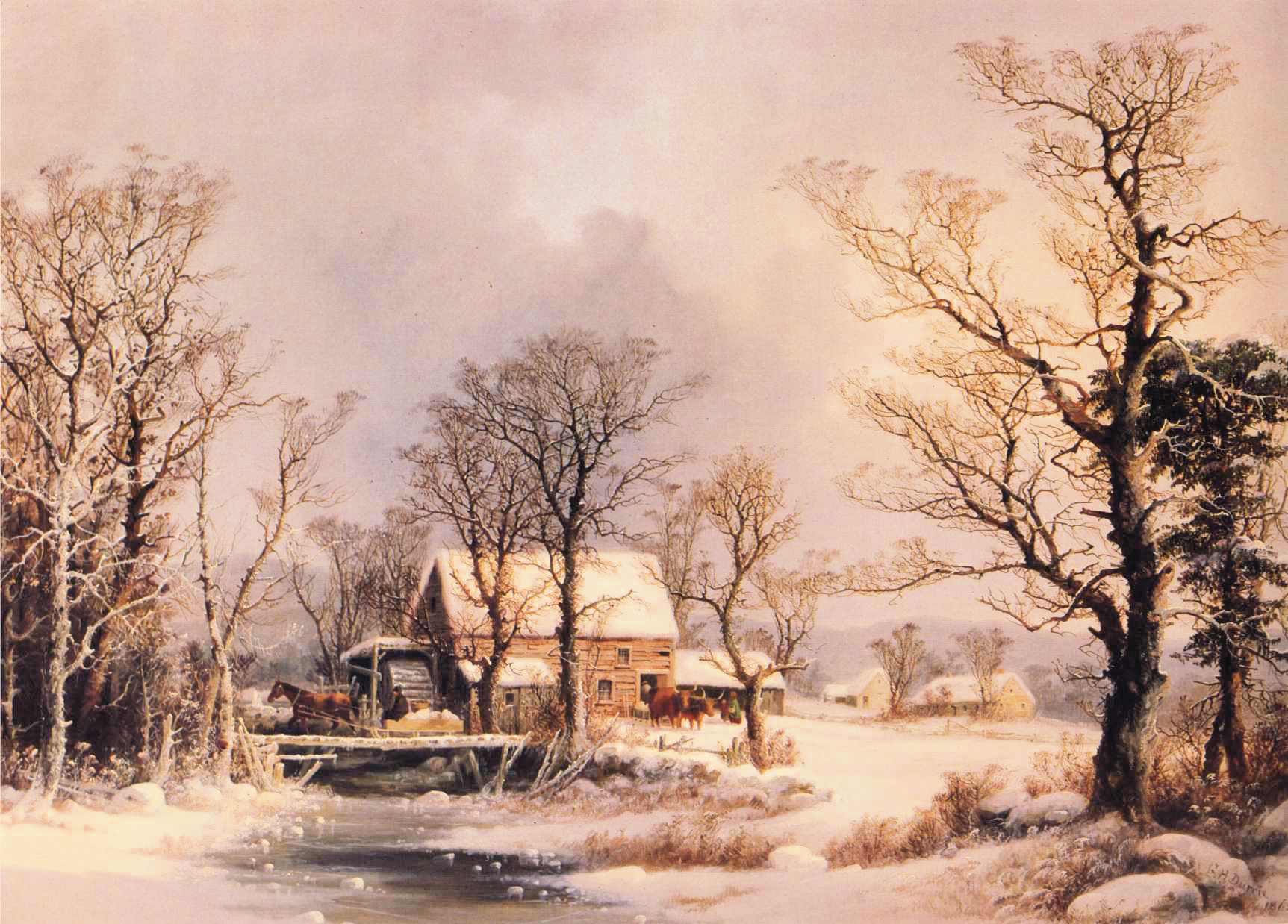
#FineArtFriday: Winter in the Country – The Old Grist Mill by George Henry Durrie

Artist: George Henry Durrie (1820–1863)

Painting: Oil on canvas, 26 x 36 in

Date: 1862

What I love about this painting:

George Henry Durrie is one of my favorite American artists. In this painting, he shows us a winter’s day in New England in 1862. Snow covers the ground, but the sun is shining, lending a rosy glow to the day.

The stream bears a light skim of ice, but though the millwheel is covered in snow, the mill is not idle. This late (or early) in the year there is no wheat to grind, but the grain from the previous autumn’s harvest has been turned to flour and shoveled into bags and barrels and stored for sale as needed.

A horse-drawn sled crosses the log bridge, loaded with white cotton bags of flour. Perhaps the driver intends to take advantage of the good weather and deliver them to the local General Store or Mercantile.

Durrie’s horses and cattle are as true to life as his landscapes are. One can almost see the muscles moving beneath the glossy coat as our horse pull the sleigh.

If you are writing a story set in an era of lower technology, I strongly suggest you go to the art of Durrie and his contemporaries to find inspiration for worldbuilding.

About the artist, via Wikipedia:

George Henry Durrie (June 6, 1820 – October 15, 1863) was an American landscape artist noted especially for his rural winter snow scenes, which became very popular after they were reproduced as lithographic prints by Currier and Ives.

In Durrie’s time, winter landscapes were not popular with most curators and critics, but nevertheless, by the time of his death, Durrie had acquired a national reputation as a snowscape painter. Durrie died in 1863, at age 43, probably from typhoid fever, not long after Currier and Ives began reproducing his paintings as prints.

Durrie’s paintings, depicting idyllic rural life, a world of stability and home comforts, held great appeal for the middle class and the working class, as an visual antidote for the growing industrialization of America, and the uncertainties of a boom-and-bust economy. The American ideal of a land of self-sufficient farmers, captured by Durrie’s paintings, was being replaced with factories belching smoke, along with a rise in urban populations, foreign immigration, and crime brought about by crowded conditions and poverty. The American descendants of the early English settlers felt that their values and way of life were threatened by these new developments and turned to nostalgic images such as Durrie’s for comfort. [1]


Credits and Attributions:

IMAGE: Wikimedia Commons contributors, “File:George Henry Durrie – Winter in the Country, The Old Grist Mill.JPG,” Wikimedia Commons, https://commons.wikimedia.org/w/index.php?title=File:George_Henry_Durrie_-_Winter_in_the_Country,_The_Old_Grist_Mill.JPG&oldid=995260526 (accessed February 10, 2025).

[1] Wikipedia contributors, “George Henry Durrie,” Wikipedia, The Free Encyclopedia, https://en.wikipedia.org/w/index.php?title=George_Henry_Durrie&oldid=1244671369 (accessed February 10, 2025).

5 Comments

Filed under #FineArtFriday, writing

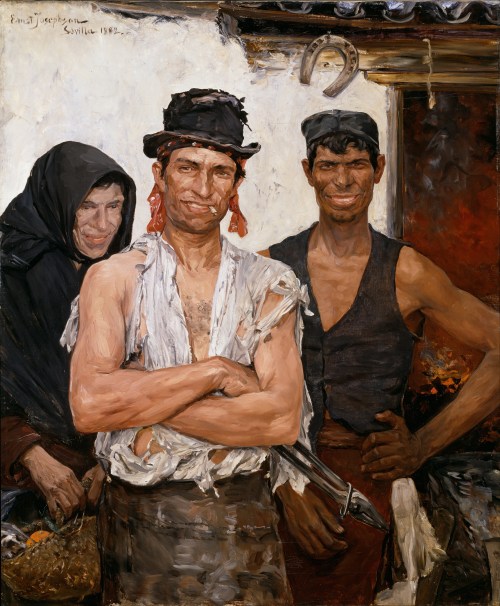
#FineArtFriday: a closer look at ‘Spanish Blacksmiths’ by Ernst Josephson 1882

Spanish Blacksmiths, by Ernst Josephson

  • Date: 1882
  • Medium: oil on canvas
  • Dimensions: width: 107 x height: 128.5 cm

What I love about this image:

This powerful painting is one of my all-time favorites–I have featured it here before. Josephson captures the boundless self-confidence and personalities of these young men. He has managed to portray their cock-of-the-walk swagger, and he has shown us the truth of their craft: that sparks fly and ruin their clothes; that the work is hard and their muscles strong. These men are full of life.

I can imagine them arriving at the tavern for supper, cleaned up and wearing their best shirts, eyeing the ladies and flirting with the serving girls.

The influence of Josephson’s having studied Rembrandt’s works closely can be seen here in the style with which he has painted their features. He has painted the men with truth—they are not classically handsome, but they are in the prime of life and have immense charisma. They wear their burned and ragged hats with pride. These men are good at what they do, and they know it. Their eyes dance and flirt outrageously with you across the years—they are full to bursting with machismo, daring you to just try to walk past and not notice them.

About the Artist, Via Wikipedia

(Ernst Josephson) was born to a middle-class family of merchants of Jewish ancestry. His uncle, Ludvig O. Josephson (1832-1899) was a dramatist and his uncle Jacob Axel Josephson (1818-1880) was a composer. When he was ten, his father Ferdinand Semy Ferdinand Josephson (1814-1861) left home and he was raised by his mother, Gustafva Jacobsson (1819-1881) and three older sisters.

At the age of sixteen, he decided to became an artist and, with his family’s support, enrolled at the Royal Swedish Academy of Fine Arts. His primary instructors there were Johan Christoffer Boklund and August Malmström. He was there until 1876, when he received a Royal Medal for painting.

After leaving the Academy, he and his friend and fellow artist Severin Nilsson (1846-1918) visited Italy, Germany and the Netherlands, where they copied the Old Masters. His breakthrough came in Paris, where he was able to study with Jean-Léon Gérôme at the École des Beaux-Arts. He soon began concentrating on portraits, including many of his friends and fellow Swedes in France. For a time, he shared a studio with Hugo Birger (1854–1887). His personal style developed further during a trip to Seville with his friend, Anders Zorn, from 1881 to 1882.

His private life did not go well, however. By his late twenties, he was afflicted with syphilis. His romantic life suffered as a consequence, as he was forced to break off a promising relationship with a young model named Ketty Rindskopf.

Josephson was deeply affected by his mother’s death in 1881, though had found respite when, in 1883, he had obtained the patronage of Pontus Furstenberg (1827–1902), a wealthy merchant and art collector. In 1885, he became a supporter of the “Opponenterna“, a group that was protesting the outmoded teaching methods at the Swedish Academy, but his interest in the group diminished when he failed to win election to their governing board.

By the summer of 1888, he was beginning to suffer delusions and hallucinations, brought on by the progression of his illness. Residing on the Île-de-Bréhat in Brittany, where he had spent the previous summer with painter and engraver Allan Österlind (1855–1938) and his family, he became involved in spiritism, possibly inspired by Österlind’s interest in occult phenomena. While in his visionary states, he wrote poems and created paintings that he signed with the names of dead artists. Some of his best known and most influential works were created during this period. [1]


Credits and Attributions:

Spanish Blacksmiths by Ernst Josephson 1882 PD|100, First published on Life in the Realm of Fantasy on August 16, 2019.

Wikimedia Commons contributors, “File:Ernst Josephson – Spanish Blacksmiths – Google Art Project.jpg,” Wikimedia Commons, the free media repository, https://commons.wikimedia.org/w/index.php?title=File:Ernst_Josephson_-_Spanish_Blacksmiths_-_Google_Art_Project.jpg&oldid=354761584 (accessed August 16, 2019).

[1] Wikipedia contributors, “Ernst Josephson,” Wikipedia, The Free Encyclopedia, https://en.wikipedia.org/w/index.php?title=Ernst_Josephson&oldid=1256604655 (accessed January 30, 2025).

2 Comments

Filed under #FineArtFriday

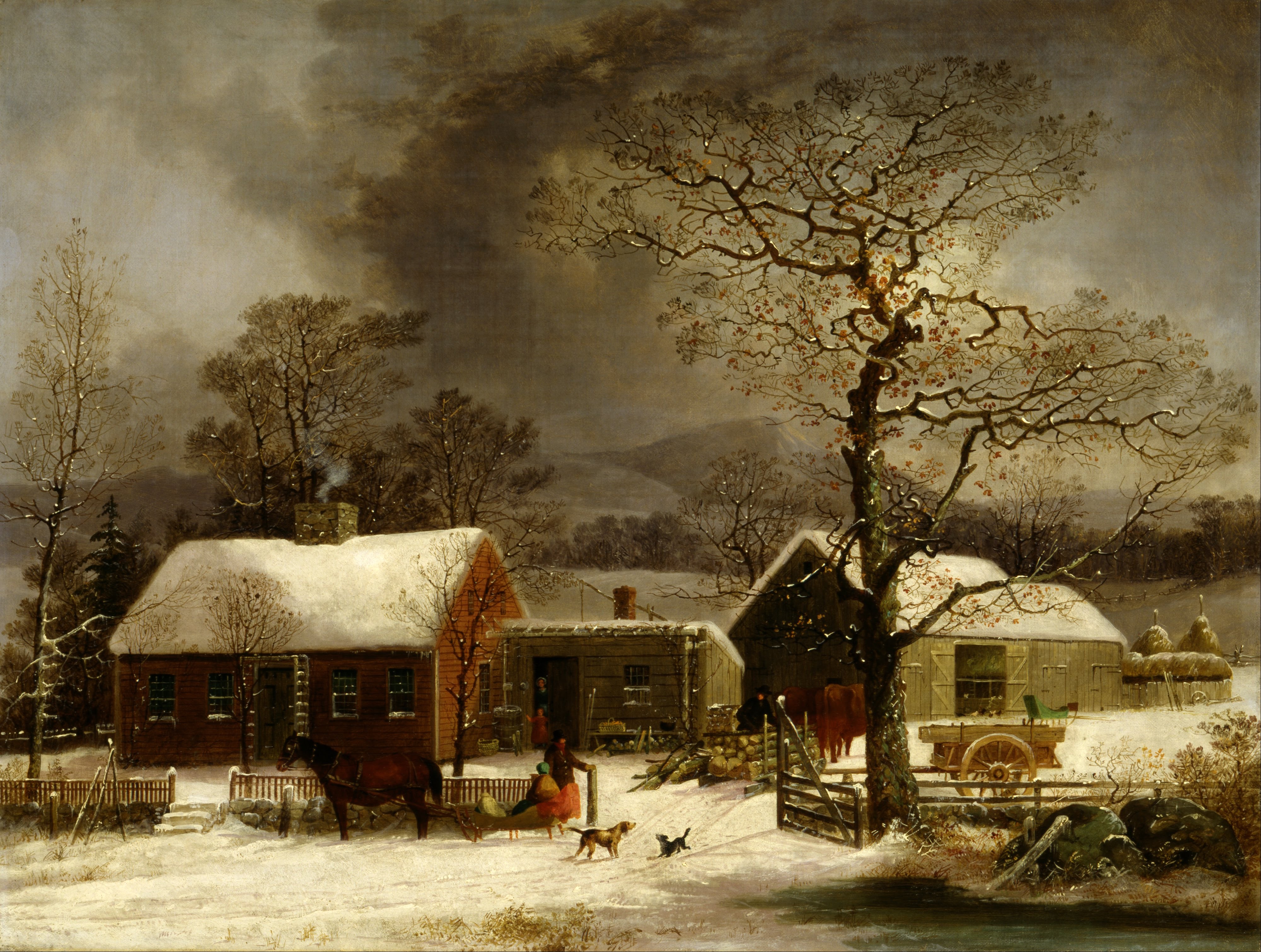
#FineArtFriday: Winter Scene in New Haven, Connecticut, by George Henry Durrie

I frequently find myself perusing the vaults at Wikimedia Commons, looking for clues about how people lived in times past. Winter Scene in New Haven, Connecticut, by George Henry Durrie is an intriguing window into the winter of 1858, a surprisingly intimate view of life in America just before the Civil War. I first posted this image in December of 2017, and it remains one of my favorite paintings, for a number of reasons.

Durrie had a modest reputation during his lifetime, an indie struggling unsuccessfully to market his works. After his death, the American printmaking firm, Currier and Ives, ensured his works were kept in the public eye.

The grandeur of the sky is reminiscent of Constable’s work, and the painting, overall, is both bold and comforting. Under a large sky, we find a small farm. It’s a simple pastoral scene, a moment painted during a winter long passed into memory. It’s pleasant, almost boring scene in its common hominess. When you look at the larger picture, you may ask, “How is this intimate? The landscape and the sky provide the drama, while the people are completely overshadowed by the scenery.”

But there is another, deeper story, one that is overshadowed by the majestic landscape and threatening winter skies, and Durrie included these people for a reason.

In Connecticut in 1858 things were not as simple and bucolic as the wide view of this image portrays.

Quote from Matthew Warshauer in his article for Connecticut History:

The state descended into chaos at the start of the war, splitting into warring Republican and Democratic factions that sometimes faced off violently.  Before the Southern states even seceded, the two parties faced off in the 1860 gubernatorial election, a contest that would decide the level of the state’s involvement once the war began.

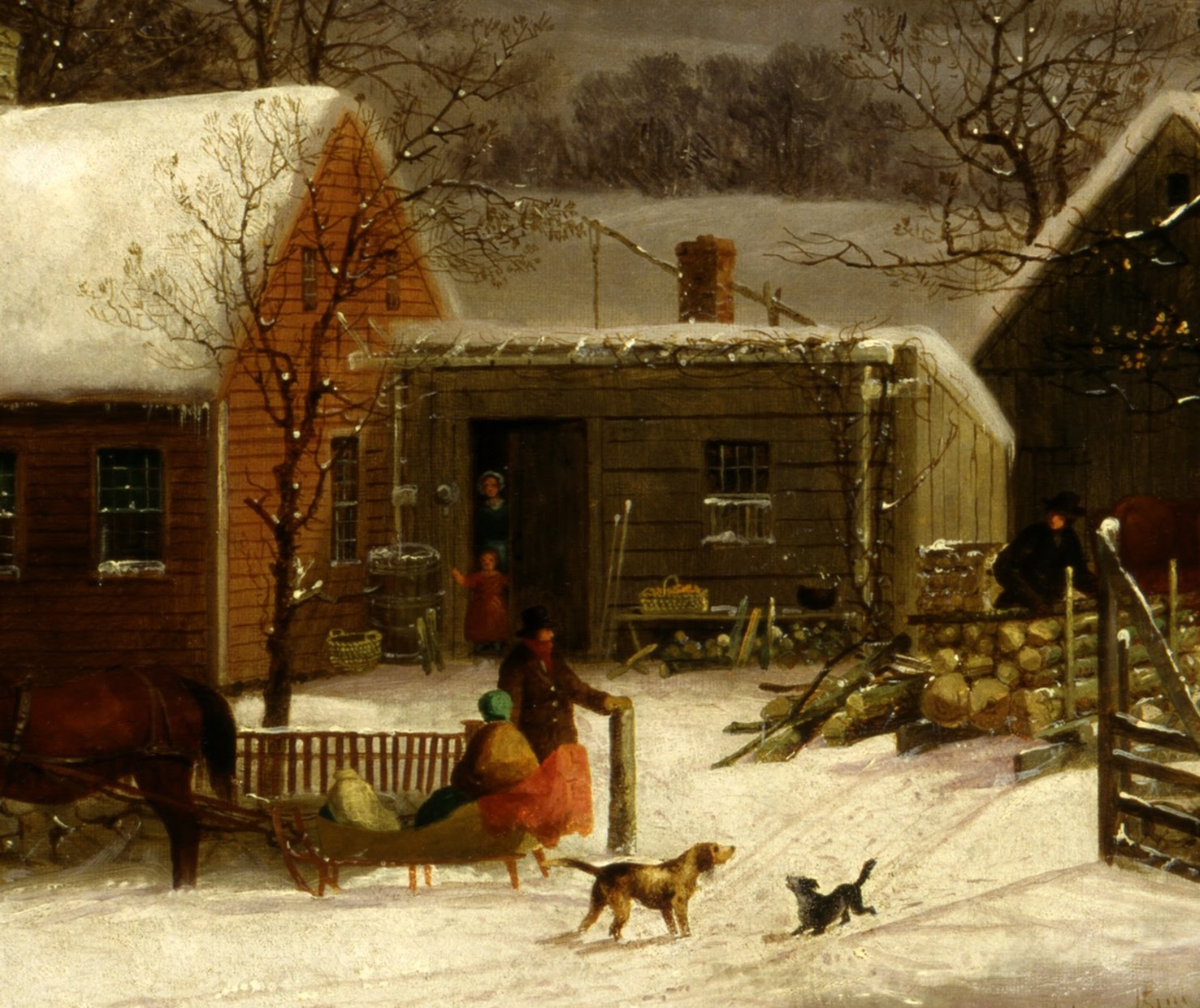
Artists, then and now, frequently deal in allegory and misdirection. Then, as now, they were pressured to portray an acceptable vision of life as it should be. They had to sell their work to live, so they did do that, but they still painted what they saw, inserting the truth into each painting. The story that Durrie hid within this painting can be found by examining the painting in detail. I have enlarged the important section for you.

A sled, drawn by a single horse and driven by a woman, has pulled up beside the gate. A man has emerged and is talking to her. In the doorway of the farmhouse, a woman and girl stand, watching the scene at the gate.

We can imagine that some drama exists in their relationships, beginning with the way the man is standing there, not inviting the woman in. She obviously doesn’t expect to be invited in by him but has come anyway.

The man speaks to the traveler, but his gaze is not focused on the woman who has traveled through the snow, bringing a large sack filled with… what? Presents? Food-gifts? Instead, he looks away, focusing on the fencepost. Is the visitor an unwelcome mother-in-law, or is she, perhaps, a travelling merchant and he is negotiating with her?

Did she purchase something? Perhaps they’re merely chatting and he just happens to be looking away.

The sky can be a clue to the deeper story, too. Dark clouds take up fully half of the scene, dwarfing the homestead. Storms threaten the peace and prosperity of this farm, and barren trees flourish. It’s 1858 and the country is divided politically and ideologically, and the threat of a civil war looms.

The final subliminal clue is in the title: Winter Scene in New Haven, Connecticut. The artist names the picture after the larger community, a town that doesn’t appear at all in the painting, instead of offering the farm’s name. Thus, the scene. the approaching storm threatening the peaceful farm, is an allegory depicting the mood of the larger community.

Does this small detail hidden in the larger picture depict a travelling merchant, a customer, or a disliked mother-in-law bringing gifts despite her son-in-law’s aversion? Or is there something deeper here? Nothing breaks up families or divides communities as surely as strongly held opposing opinions, and we were deeply divided in those turbulent times.

The story is there, and the world in which it is set is all prepared for you. George Henry Durrie painted it, and if you are looking for a deep story that echoes our modern political state of affairs, here it is.

Or, it could simply be a passing stranger, asking for directions on a winter’s day.

When you examine the art of the past closely and look for allegories, you may find a large story hidden within the the image.  It’s up to you to interpret it and then write it.


Credits and Attributions:

Wikimedia Commons contributors, “File:George Henry Durrie – Winter Scene in New Haven, Connecticut – Google Art Project.jpg,” Wikimedia Commons, https://commons.wikimedia.org/w/index.php?title=File:George_Henry_Durrie_-_Winter_Scene_in_New_Haven,_Connecticut_-_Google_Art_Project.jpg&oldid=761233247 (accessed January 23, 2025).

The Complicated Realities of Connecticut and the Civil War, by Matthew Warshauer, Ph.D., Professor of History at Central Connecticut State University. Copyright © Connecticut Humanities. Licensed under a Creative Commons Attribution Non-Commercial Share Alike 3.0 License (accessed January 23, 2025).

3 Comments

Filed under #FineArtFriday, writing

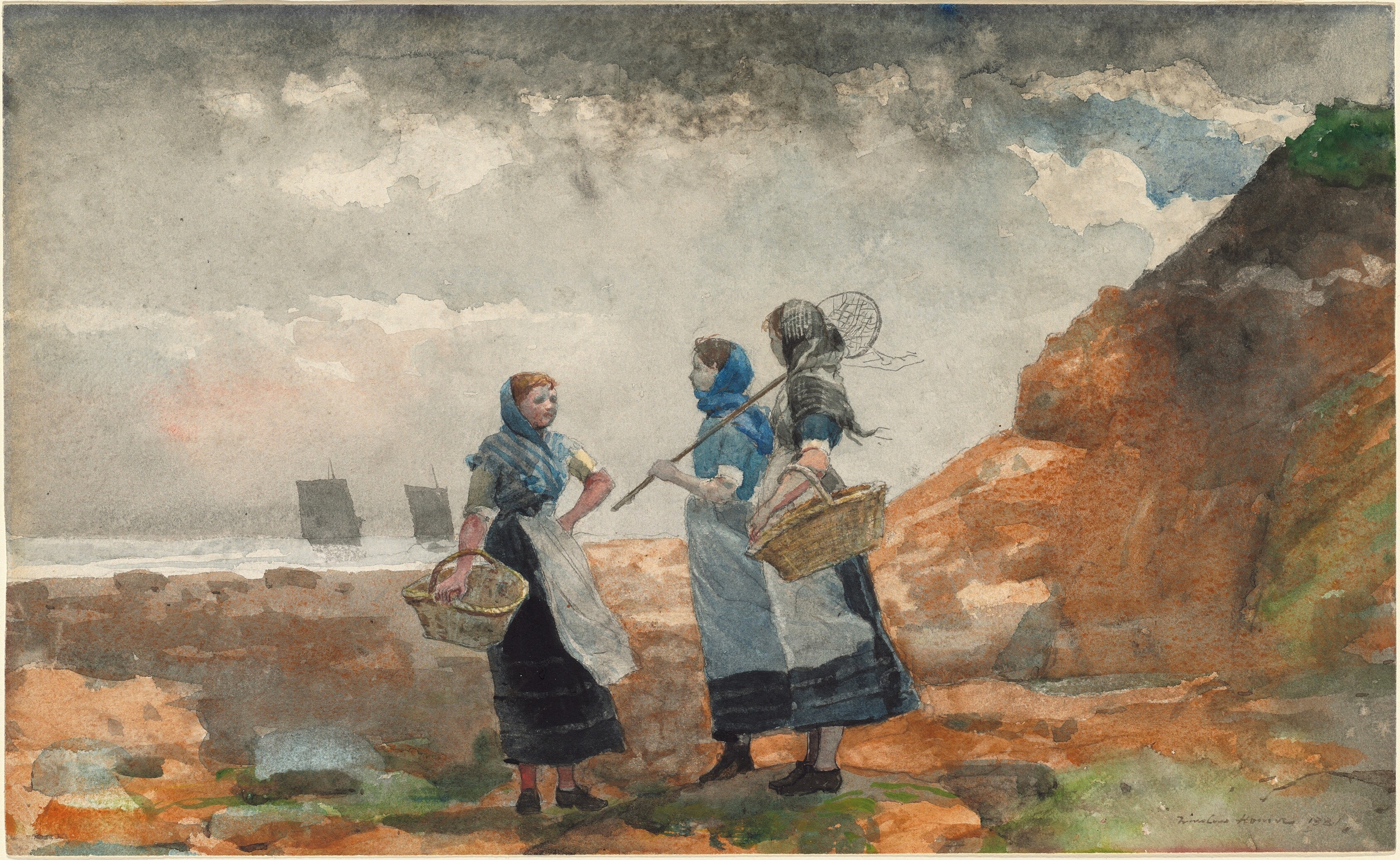
#FineArtFriday: Three Fisher Girls, Tynemouth by Winslow Homer

Artist: Winslow Homer  (1836–1910)

Title: Three Fisher Girls, Tynemouth

Date: 1881

Medium: watercolor over graphite pencil on wove paper

Dimensions: height: 19.8 cm (7.8 in); width: 48.9 cm (19.2 in)

Collection: National Gallery of Art

The above image is one of my favorite watercolors by Winslow Homer. In Three Fisher Girls, Tynemouth,  Winslow Homer captures the personalities and the youth of the girls who comb the cold beach for shellfish. The viewer wonders, are they good friends, or perhaps sisters? Rain has darkened the day and scarves protect their ears from the wind, yet they’ve rolled their sleeves up and fish in their ordinary work dresses. These hardy young women feed their family, and perhaps they gather enough extra to sell.

About this Image, Via Wikipedia:

Homer spent two years (1881–1882) in the English coastal village of Cullercoats, Tyne and Wear. Many of the paintings at Cullercoats took as their subjects working men and women and their daily heroism, imbued with a solidity and sobriety which was new to Homer’s art, presaging the direction of his future work. He wrote, “The women are the working bees. Stout hardy creatures.” His works from this period are almost exclusively watercolors. His palette became constrained and sober; his paintings larger, more ambitious, and more deliberately conceived and executed. His subjects more universal and less nationalistic, more heroic by virtue of his unsentimental rendering. Although he moved away from the spontaneity and bright innocence of the American paintings of the 1860s and 1870s, Homer found a new style and vision which carried his talent into new realms.

About the Artist, via Wikipedia

Winslow Homer never taught in a school or privately, as did Thomas Eakins, but his works strongly influenced succeeding generations of American painters for their direct and energetic interpretation of man’s stoic relationship to an often neutral and sometimes harsh wilderness. Robert Henri called Homer’s work an “integrity of nature”.American illustrator and teacher Howard Pyle revered Homer and encouraged his students to study him. His student and fellow illustrator, N. C. Wyeth (and through him Andrew Wyeth and Jamie Wyeth), shared the influence and appreciation, even following Homer to Maine for inspiration.  The elder Wyeth’s respect for his antecedent was “intense and absolute” and can be observed in his early work Mowing (1907). Perhaps Homer’s austere individualism is best captured in his admonition to artists: “Look at nature, work independently, and solve your own problems.” [1]


Credits and Attributions:

Image: Three Fisher Girls, Tynemouth, by Winslow Homer 1881 [Public domain] watercolor over graphite on wove paper, via Wikimedia Commons (accessed January 16, 2025).

[1] Wikipedia contributors, “Winslow Homer,” Wikipedia, The Free Encyclopedia, https://en.wikipedia.org/w/index.php?title=Winslow_Homer&oldid=1253319847 (accessed January 17, 2025).

9 Comments

Filed under #FineArtFriday

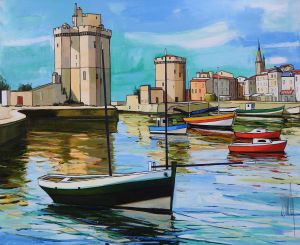
#FineArtFriday: La Rochelle, Charente-Maritime by Leon Zanella

Title: La Rochelle, Charente-Maritime

Artist: Leon Zanella

Date: 2018

What I love about this painting:

La Rochelle is a city on the west coast of France and a seaport on the Bay of Biscay, a part of the Atlantic Ocean. It is the capital of the Charente-Maritime department, a département in the Nouvelle-Aquitaine region on the southwestern coast of France.

Leon Zanella has captured the calm water of the ancient harbor on sunny day. Sailboats and motorboats are anchored there, floating serenely beneath the sky of many shades of blue. The bright colors of the modern boats and the soft, fluid motion of the waters are contrasted against the solid stone of the medieval architecture of the ancient town.

I love the simplicity of this scene, as well as the rich colors of the sea and sky.

About the artist:

Leon Zanella (1956 — present) was born in Marseille, France. He lives and works in the medieval town of Vaison La Romaine  a town in the Vaucluse department in the Provence-Alpes-Côte d’Azur region in southeastern France.

Zanella is deeply connected to his town and the surrounding countryside, which is featured in most of his work.

His work is straightforward and powerful, a clear depiction of each scene. The use of intense color celebrates the landscapes of his area of Provence. His style is bold and some have said it is reminiscent of the fauvist movement. And yet it is a unique interpretation of how he sees the world.

You can find his work at his website or view them in person at ARTE MUSEUM LAS VEGAS.


Credits and Attributions:

Wikimedia Commons contributors, “File:17-CHARENTE MARITIME-La Rochelle-20F-2018.jpg,” Wikimedia Commons, https://commons.wikimedia.org/w/index.php?title=File:17-CHARENTE_MARITIME-La_Rochelle-20F-2018.jpg&oldid=744455658 (accessed January 10, 2025).

4 Comments

Filed under #FineArtFriday, writing

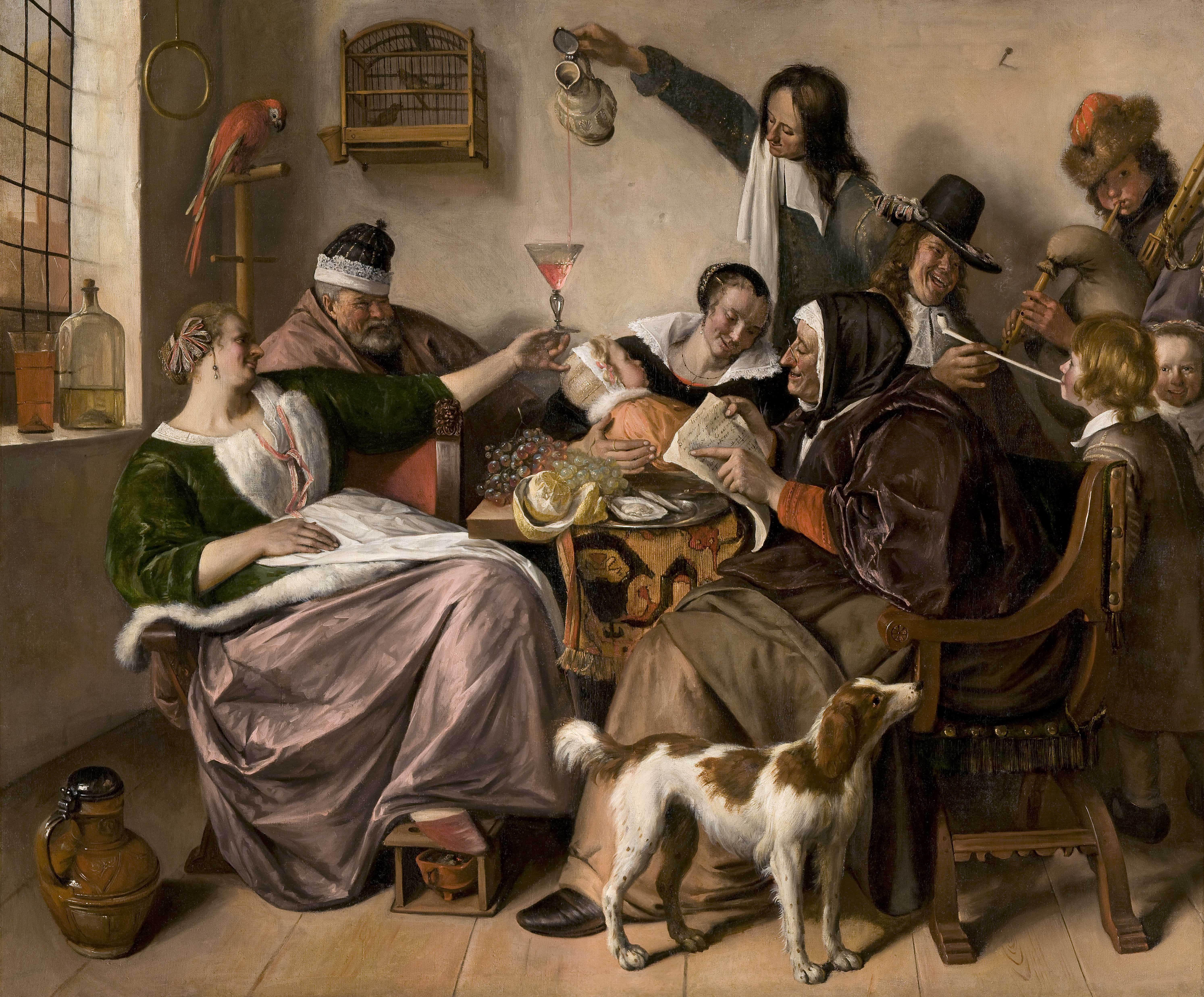
#FineArtFriday: Revisiting “The Way you Hear it is the Way you Sing It” by Jan Steen ca. 1665

Artist: Jan Steen  (1625/1626–1679)

Jan Steen: ‘As the Old Sing, So Pipe the Young’

Title: ‘The way you hear it, is the way you sing it’

Genre: genre art

Date: circa 1665

Medium: oil on canvas

Dimensions: Height: 134 cm (52.7 in); Width: 163 cm (64.1 in)

I always post a Jan Steen painting at New Years, because I love how raucous and down to earth his characters are. It’s a New Year and we’re having a party. No Puritans allowed, as we’ll have no feigning a dignified demeanor here–we’re drunk, and we don’t care. The people who posed for this painting are featured in many of Steen’s genre works, sometimes wearing the same costumes as we see here. I suspect we are seeing Steen’s family members or close friends acting out the story Jan wishes to show us.

About this painting:

Jan Steen’s work The Way you Hear it is the Way you Sing It depicts a Dutch Proverb, As the Old Sing, So Twitter the Young. It shows us a family carousing and overindulging in rich foods. Luxurious fabrics, a foot warmer, and rare birds show off this family’s wealth, which they are spending lavishly as fast as they can.

A young piper, who closely resembles a young Jan Steen (possibly one of his sons?), entertains them. He looks directly at us as if to ask what he’s gotten himself into.

Mother and Father, dressed as the King and Queen, are sumptuously attired, being served wine in an overlarge crystal goblet by the family’s servant. Both are indifferent to the chaos, too sated and drunk to care.

To the right of Father (his left, our right), a younger woman, perhaps an unmarried sister or eldest daughter, is holding the baby but has nodded off, having indulged too freely.

The wasting of money on so much luxury that one can’t consume it all is clearly represented here. Mother raises her glass high to have it refilled, as if it is the most important thing–indeed, the wine cascading down into the crystal goblet is the focal point of the picture.

A bottle of clear liquor (distilled?) and a beaker of ale are set on the windowsill behind Father, and a covered pitcher stands on the floor beside Mother. The table is laden with grapes and oysters, expensive luxuries.

Grandmother is singing from sheet music, leading the song that the family sings. This is the direct allegory for the proverb, as the old sing, so twitter the young.

A youngish man, either the eldest son or the Drunk Uncle (every family has one), finds it hilarious to teach the children to smoke.

Neither the dog nor the piper is impressed with the carrying on, and the servant has no comment, merely serving the wine as required.

In essence, Steen tells us that children learn what they live, so if you want sober, morally upstanding children, you must be a sober, morally upright parent.

About the Artist, via Wikipedia:

Jan Havickszoon Steen (c. 1626 – buried 3 February 1679) was a Dutch Golden Age painter, one of the leading genre painters of the 17th century. His works are known for their psychological insight, sense of humour and abundance of colour.

In 1648 Jan Steen and Gabriël Metsu founded the painters’ Guild of Saint Luke at Leiden. Soon after he became an assistant to the renowned landscape painter Jan van Goyen (1596–1656), and moved into his house on the Bierkade in The Hague. On Oct 3, 1649 he married van Goyen’s daughter Margriet, with whom he would have eight children. Steen worked with his father-in-law until 1654, when he moved to Delft, where he ran the brewery De Slang (“The Snake”) for three years without much success. After the explosion in Delft in 1654 the art market was depressed, but Steen painted A Burgomaster of Delft and his daughter. It does not seem to be clear if this painting should be called a portrait or a genre work.

Steen lived in Warmond, just north of Leiden, from 1656 till 1660 and in Haarlem from 1660 till 1670 and in both periods he was especially productive. In 1670, after the death of his wife in 1669 and his father in 1670, Steen moved back to Leiden, where he stayed the rest of his life. When the art market collapsed in 1672, called the Year of Disaster, Steen opened a tavern. In April 1673 he married Maria van Egmont, who gave him another child. In 1674 he became president of the Saint Lucas Guild. Frans van Mieris (1635- 1681) became one of his drinking companions. He died in Leiden in 1679 and was interred in a family grave in the Pieterskerk.

Daily life was Jan Steen’s main pictorial theme. Many of the genre scenes he portrayed, as in The Feast of Saint Nicholas, are lively to the point of chaos and lustfulness, even so much that “a Jan Steen household”, meaning a messy scene, became a Dutch proverb (een huishouden van Jan Steen). Subtle hints in his paintings seem to suggest that Steen meant to warn the viewer rather than invite him to copy this behaviour. Many of Steen’s paintings bear references to old Dutch proverbs or literature. He often used members of his family as models, and painted quite a few self-portraits in which he showed no tendency of vanity.

Steen did not shy from other themes: he painted historical, mythological and religious scenes, portraits, still lifes and natural scenes. His portraits of children are famous. He is also well known for his mastery of light and attention to detail, most notably in Persian rugs and other textiles.

Steen was prolific, producing about 800 paintings, of which roughly 350 survive. His work was valued much by contemporaries and as a result he was reasonably well paid for his work. He did not have many students—only Richard Brakenburgh is recorded—but his work proved a source of inspiration for many painters. [1]


Credits and Attributions:

IMAGE: The Way you Hear it is the Way you Sing It, Jan Steen, Public domain, via Wikimedia Commons

Wikimedia Commons contributors, “File:The way you hear it.jpg,” Wikimedia Commons, https://commons.wikimedia.org/w/index.php?title=File:The_way_you_hear_it.jpg&oldid=428340634 (accessed January 2, 2025).

[1] Wikipedia contributors, “Jan Steen,” Wikipedia, The Free Encyclopedia, https://en.wikipedia.org/w/index.php?title=Jan_Steen&oldid=1249713624 (accessed January 2, 2025).

4 Comments

Filed under #FineArtFriday

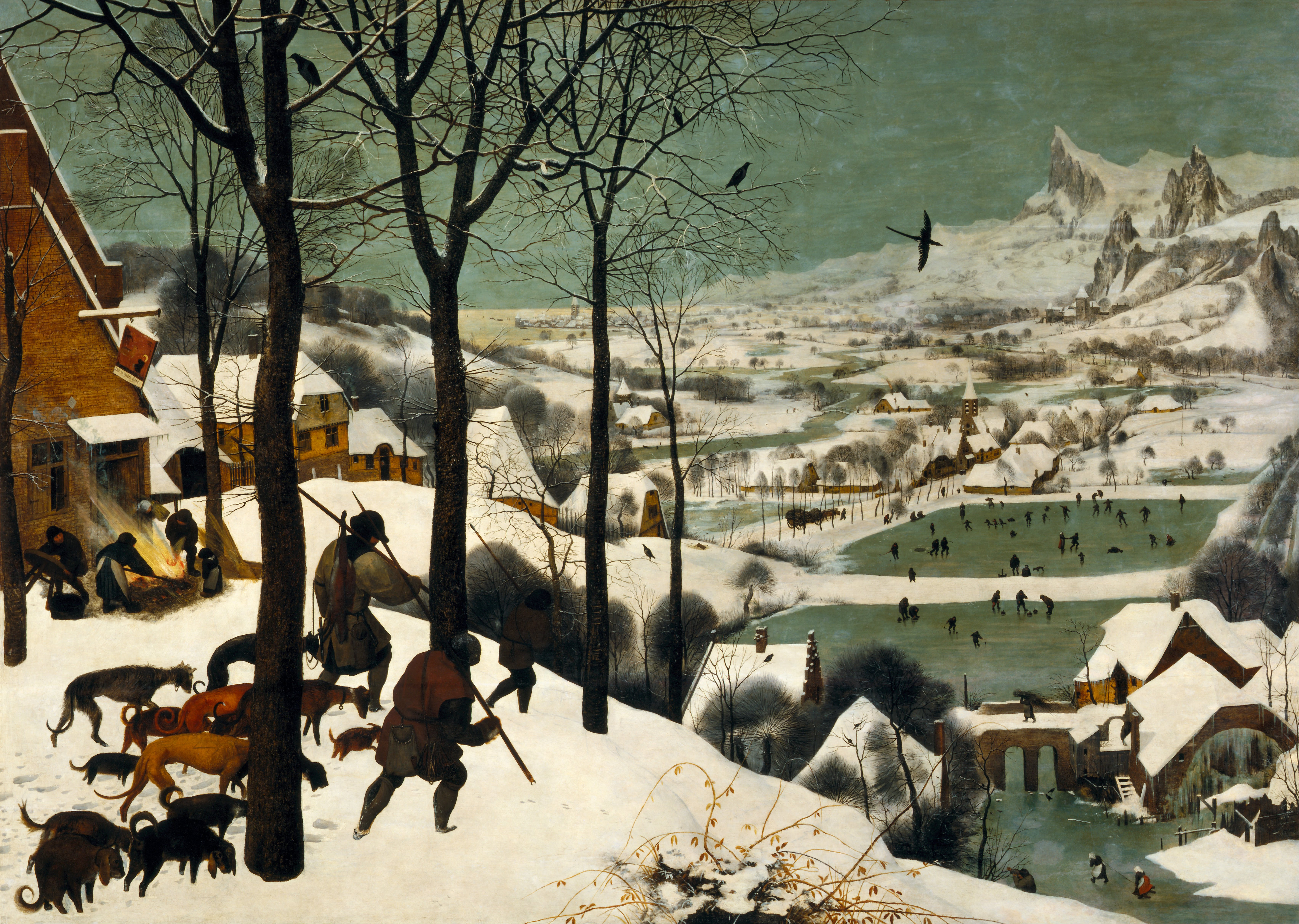
#FineArtFriday: allegory and symbolism in “Hunters in the Snow” by Pieter Brueghel the Elder 1565

Pieter_Bruegel_the_Elder_-_Hunters_in_the_Snow_(Winter)_-_Google_Art_ProjectArtist: Pieter Brueghel the Elder (1526/1530–1569)
Title: English: Hunters in the Snow (German: Jäger im Schnee) (Winter)

Date: 1565

Medium: oil on oak wood

Dimensions: height: 1,170 mm (46.06 in); width: 1,620 mm (63.77 in)

Collection: Kunsthistorisches Museum

What I love about this painting:

This is one of Pieter Brueghel the Elder’s most famous paintings and is a favorite of mine because of the rich societal commentary Brueghel painted into this scene.

Perhaps you have seen it at some point, on a calendar or a Christmas card, and after a cursory glance, you dismissed it as a bucolic illustration of a bygone era.

You fell for his trap. Bruegel the Elder was an observer of life and had a wide streak of sarcasm that emerged in his work. He lived in a time of extreme capitalism, where the nobility and the Church made the rules, with no regard for those whose labors had made them rich.

Brueghel was a master at slipping pointed observations into the scene in such a way that they go unnoticed if one can’t be bothered to look closely.

In his day, the fortunate few who were wealthy were gloriously, impossibly rich. Money was minted by the rulers in the form of coins, and trickle-down economics didn’t work then any better than it does now. The peasants struggled to find food and shelter, going underpaid and overworked.

The middle class hung on, doing comparatively well. However, all it took for the prosperous farmer to be reduced to starvation was one bad harvest. That bad harvest toppled the small traders and crafters as well. When the middle class can’t afford new shoes or garments, tailors and cobblers suffer as well.

Critics didn’t praise his work, as it is unabashedly primitive, created for the common person’s enjoyment, and art critics don’t care much about what the common folk like. Nonetheless, his work is still highly prized by collectors.

Brueghel had a sneaky sense of humor and employed it to show the truth about humanity and inhumanity in his work.

Even now, four centuries after his era, ordinary people can relate to his work because, underneath the technological advances that we will be remembered for, things haven’t changed that much. The uber-rich are still uber-rich, and the middle class is still footing the bill.

Brueghel lived during a time of religious revolution in the Netherlands, and walking the line between both factions must have been difficult. Some have said that Bruegel (and possibly his patron) were attempting to portray an ideal of what country life used to be or what they wished it to be.

That is because they didn’t look deeper, giving it a cursory glance and moving on. On the surface and from a distance, this is a bucolic scene depicting ordinary peasants enjoying the winter. But when you look deeper, really look at it, you can see the irony of it, the honesty that Brueghel hid in plain sight.

Brueghel used symbolism to convey an entire story by employing paradox and gallows humor in every painting. Here, he shows us that winter was harsh, and for the average person, survival required a lot of work, sometimes for nothing.

He shows us the hunters returning with empty game bags, the lone corpse of a skinny fox, and little else.

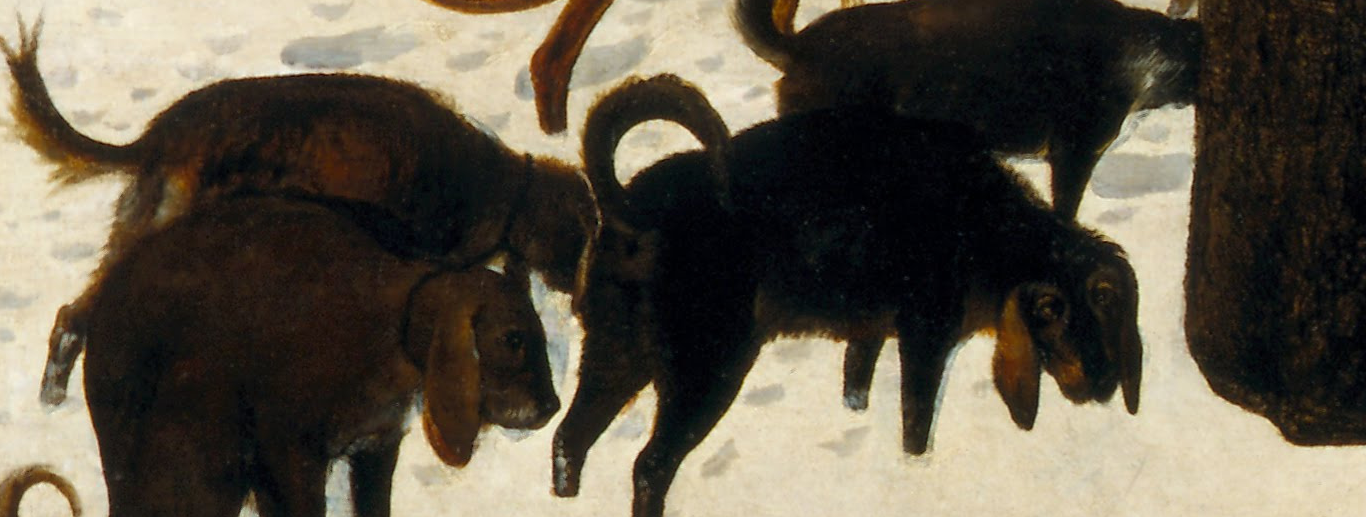
One dog looks at us with starving eyes, as if hoping for scraps.

detai_Dogs_hunters_in_the_snow_Brueghel

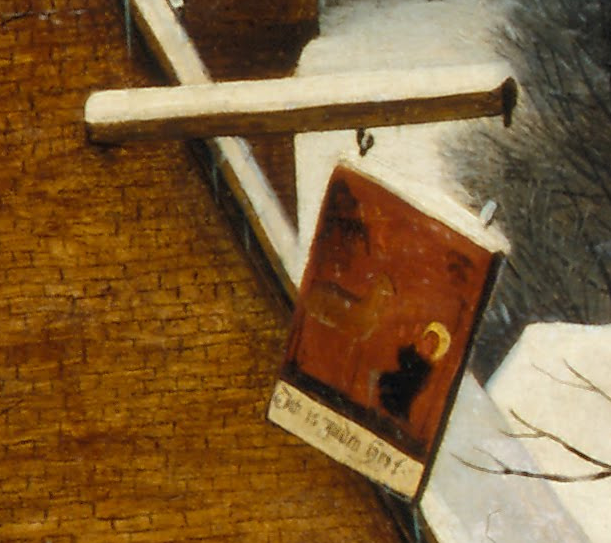
The tavern’s sign is about to fall down, a large hint that all is not well. That symbolic broken sign tells us the owners are bankrupt.

detai_sign_hunters_in_the_snow_Brueghel

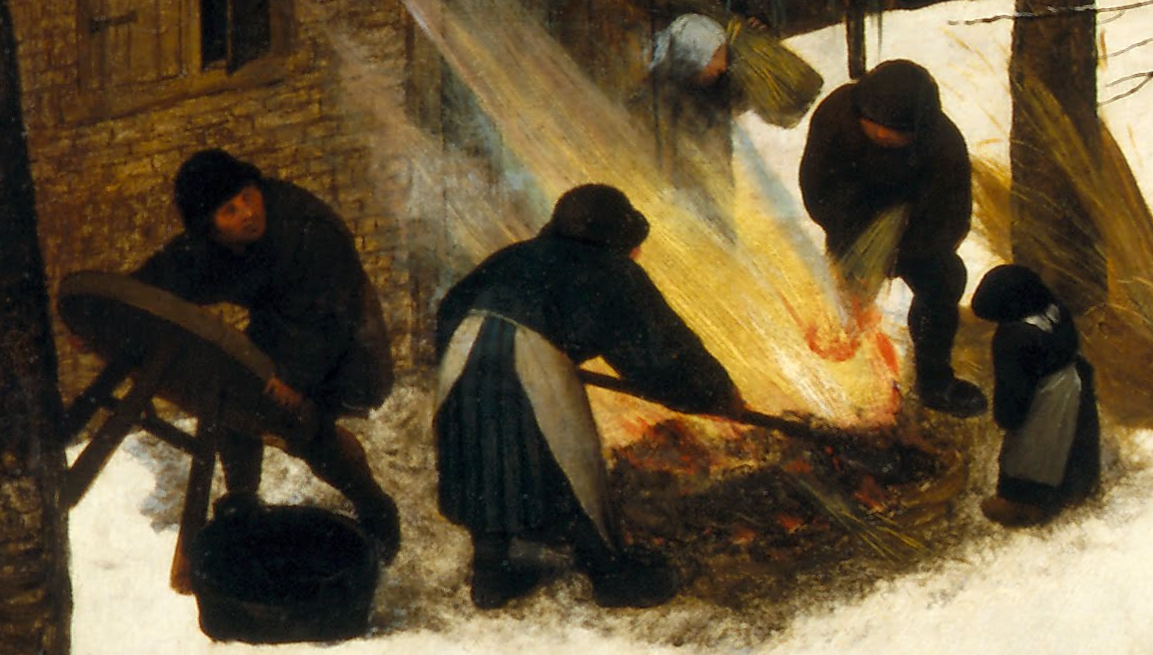
The owners are cooking outside, directly in front of the door, evicted from their home and business. A woman brings a bundle of straw out of the inn to use as fuel, while in the distance an ox-drawn wagon is heavily laden with firewood. Where is it going? Not to their inn, that is for sure.

And most intriguingly, a man is carrying a table away. He glances over his shoulder at the meager soup they are cooking, as if they had somehow gotten it away before he could take that, too. Is he the new owner, having acquired it for pennies from the city by paying the taxes at a forced bankruptcy sale? Or is he a hired thug employed by the new owner?

detai_innkeeprs_cooking_hunters_in_the_snow_Brueghel

A rabbit has crossed the hunters’ path and evaded their snares.

detai_rabbit_tracks_hunters_in_the_snow_Brueghel

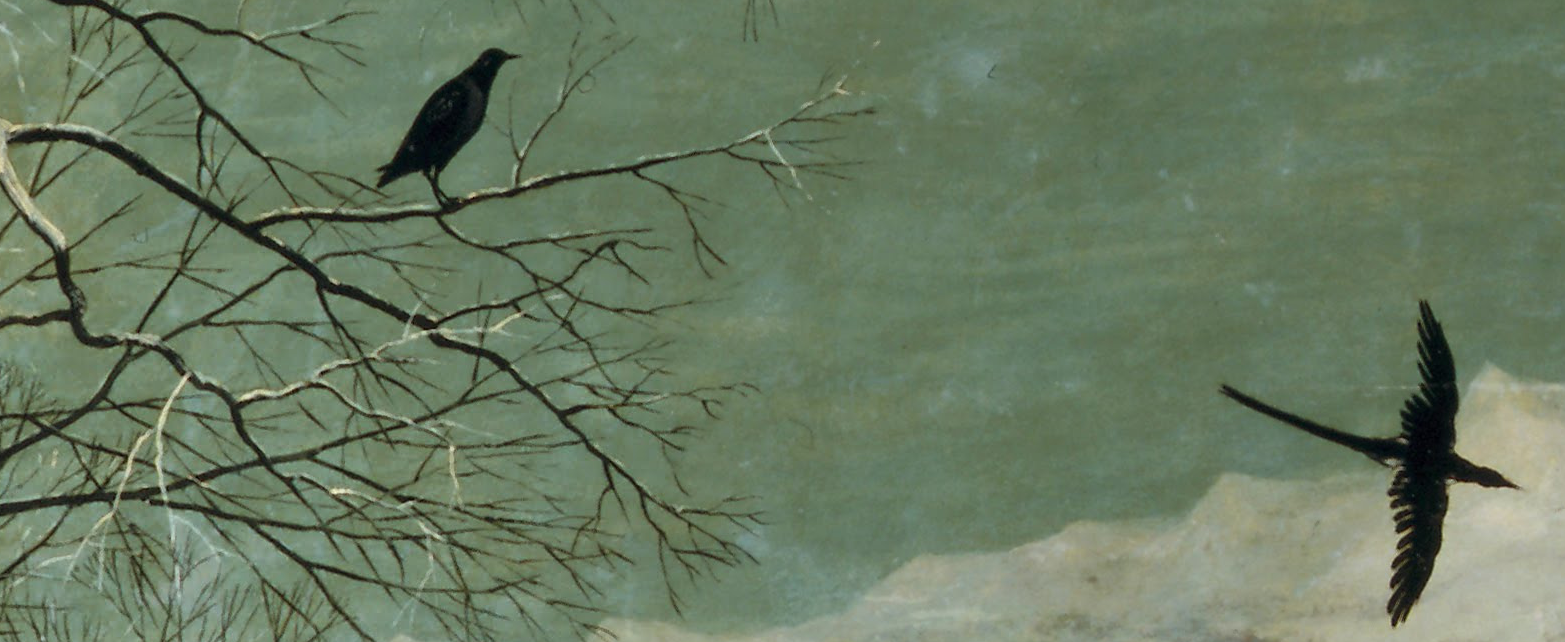
Ravens, long considered birds of ill omen, roost in the trees above the inn and the hunters and fly above the revelers, a portent of worse days to come.

detai_birds_hunters_in_the_snow_Brueghel

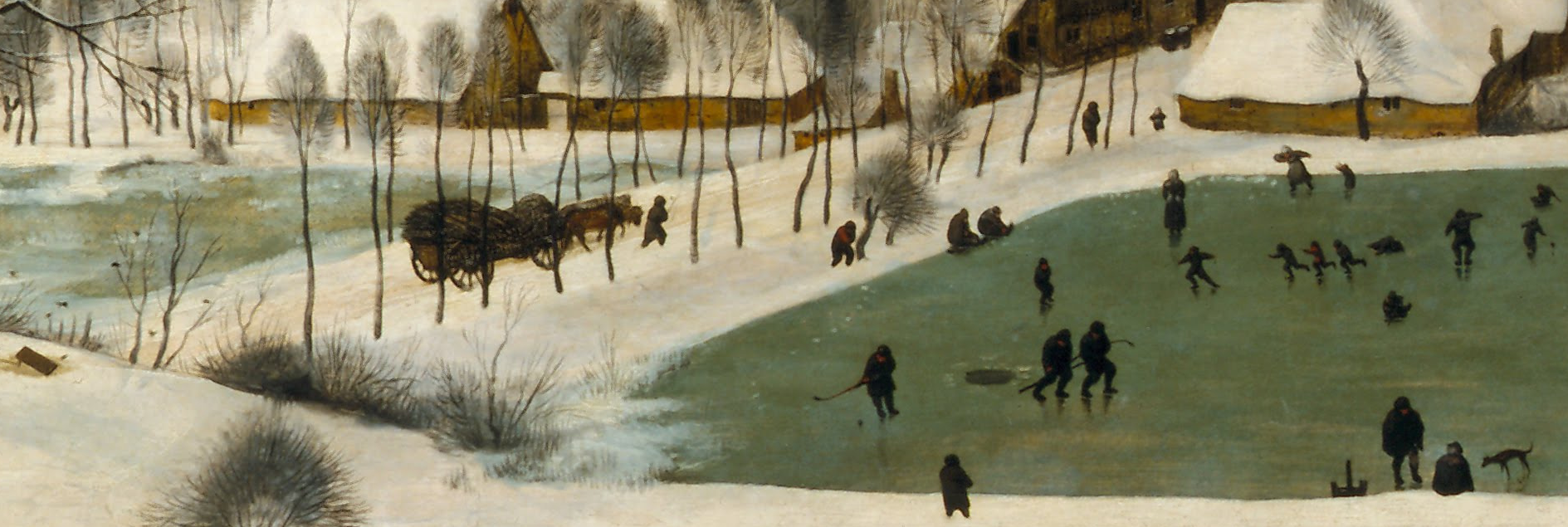
But in this story, Brueghel’s characters have hope and faith that things will improve. In the distance (the future) people are playing winter games.

detai_skaters_hunters_in_the_snow_BrueghelBut they are indistinct and far away, shown in a fantastic, mountainous landscape rather than the flat terrain of the Netherlands. It is almost as if they are visions of what winter could be if only the harvest had been good rather than the truth of the lone fox, hounds with empty bellies, a bankrupt tavern, and the rabbit that got away.

About this painting, via Wikipedia, the Fount of All Knowledge:

The Hunters in the Snow (Dutch: Jagers in de Sneeuw), also known as The Return of the Hunters, is a 1565 oil-on-wood painting by Pieter Bruegel the Elder. The Northern Renaissance work is one of a series of works, five of which still survive, that depict different times of the year. The painting is in the collection of the Kunsthistorisches Museum in ViennaAustria. This scene is set in the depths of winter during December/January.

The painting shows a wintry scene in which three hunters are returning from an expedition accompanied by their dogs. By appearances the outing was not successful; the hunters appear to trudge wearily, and the dogs appear downtrodden and miserable. One man carries the “meager corpse of a fox” illustrating the paucity of the hunt. In front of the hunters in the snow are the footprints of a rabbit or hare—which has escaped or been missed by the hunters. The overall visual impression is one of a calm, cold, overcast day; the colors are muted whites and grays, the trees are bare of leaves, and wood smoke hangs in the air. Several adults and a child prepare food at an inn with an outside fire. Of interest are the jagged mountain peaks which do not exist in Belgium or Holland. [1]


Credits and Attributions:

Wikimedia Commons contributors, “File:Pieter Bruegel the Elder – Hunters in the Snow (Winter) – Google Art Project.jpg,” Wikimedia Commons, https://commons.wikimedia.org/w/index.php?title=File:Pieter_Bruegel_the_Elder_-_Hunters_in_the_Snow_(Winter)_-_Google_Art_Project.jpg&oldid=898942431 (accessed December 18, 2024).

[1] Wikipedia contributors, “The Hunters in the Snow,” Wikipedia, The Free Encyclopedia, https://en.wikipedia.org/w/index.php?title=The_Hunters_in_the_Snow&oldid=1262746140 (accessed December 18, 2024).

2 Comments

Filed under #FineArtFriday, writing

#FineArtFriday: Selling Christmas Trees by David Jacobsen 1853

Selling Christmas Trees by David Jacobsen 1853Title: Selling Christmas Trees

Artist: David Jacobsen

Date: 2 January 1853

Medium: oils on canvas

What I love about this painting:

This painting was done early in Jacobsen’s career when he was still painting in the traditional style that he was taught at the Royal Danish Academy of Fine Arts. This scene shows us a time of year when woodcutters can count on a few extra coins to carry them through the winter. In addition to their regular work of cutting firewood, their families are bringing fresh-cut evergreens to the market, and they are quickly selling out.

There are many stories in this painting. The town square is decorated for the season with wreaths and a prominently displayed Nativity Scene. The market is busy, noisy, and filled with traders and shoppers. Some shoppers rest beside the frozen fountain, while others bargain for the best deals.

Who has the coins for a fine Christmas dinner, and who will go home empty-handed, unable to afford a family feast?

A pair of children, brother and sister, haul a small tree home, accompanied by the family dog. They will decorate it, and if they are fortunate, the dog will respect the tree and go out of its way to avoid knocking it over.

About the Artist:

David Jacob Jacobsen was a Danish 19th-century painter who was born in 1821 and died in 1871.[1] Jacobsen was the son of Jewish parents, Juda Jacobsen and Frederikke Jacobson. [2]

He was accepted into the Royal Danish Academy of Fine Arts in 1834 and began his education as a sculptor, studying under Herman Wilhelm Bissen. He switched to painting, preferring outdoor scenes.

His friendship with French artists like Camille Pissarro, with whom he shared a studio for a while, influenced Jacobsen’s art. Jacobsen was like many other Danish artists who traveled abroad. His choice of subject was not confined solely to the scenes of Danish life and landscape promoted by Danish critics such as NL Høyen. Despite Jacobsen’s efforts and his close friendships with the impressionists, he was unable to make a name for himself abroad.

Jacobsen’s work was exhibited at the Charlottenborg Spring Exhibition from 1849 until his death. He suffered from deep depression, exacerbated by the fact his work didn’t sell as well as he hoped.  He died by suicide in 1871 during a stay in Florence and was buried there. [1]


Credits and Attributions:

IMAGE: Wikimedia Commons contributors, “File:David Jacobsen – Selling Christmas Trees (1853).jpg,” Wikimedia Commons, https://commons.wikimedia.org/w/index.php?title=File:David_Jacobsen_-_Selling_Christmas_Trees_(1853).jpg&oldid=886774504 (accessed December 12, 2024).

[1] David Jacobsen – Artvee Artvee.com  © Artvee 2024 All Rights Reserved
[2] David Jacob Jacobsen | Biography © 2024 MutualArt Services, Inc.

3 Comments

Filed under #FineArtFriday

#FineArtFriday: Fruit Piece by Jan van Huysum 1722 #Thanksgiving

Fruit Piece by Jan van Huysum (Dutch, 1682 – 1749)– artist (Dutch)

Genre: still-life

Date: 1722

Medium: oil on panel

Dimensions: Height: 800 mm (31.49 in); Width: 610 mm (24.01 in)

What I love about this painting:

This painting first appeared here the day after Thanksgiving in 2020, the year of lockdown and virtual family gatherings via Zoom and Discord. Despite quarantine and lockdown, we gave thanks that year for the good things and for each other.

And this year, we did the same, with turkey, and all the family’s favorite side dishes. I made everything except the turkey using plant-based recipes that I have developed over the years of being vegan. My husband and son are not vegan, so I do go out of my way to accommodate their wishes while still keeping all the side-dishes plant-based.

I love the romance of today’s painting. The scene depicts the very essence of abundance and comfort. Every piece of fruit in this image is perfect, begging to be eaten, every flower wishes to be admired. Carnations, grapes, plums, figs, apples, a melon, raspberries, and numerous other fruits occupy the center of the image. Butterflies have found the flowers.

In the background, slightly out of focus as if the centerpiece is seen through a camera lens, we have a lush garden, a fantasy of earthly paradise. Far to the rear of the scene, painted as if they just happened to stray into it, two figures on a low bridge carry on a quiet conversation beneath a graceful statue.

More than any other artist of his time, van Huysum understood how to show the “life” aspect of still-life by combining fantasy with the faithful reproduction of perfect, ripe fruit.

Yesterday, we hosted our son and granddaughter and her husband, giving thanks for the abundance in our lives, the multitude of blessings for which we are truly grateful. While life has thrown us some hurdles in the last year, we have good food, safe shelter, and most importantly, we have each other.

This painting celebrates food in plentiful, mouthwatering profusion, a true blessing for which we should all be thankful.

About the Artist: The website at the National Gallery says:

Jan van Huysum (1682 – 1749)  was the last of the distinguished still life painters active in the Northern Netherlands in the 17th and early 18th centuries, and an internationally celebrated artist in his lifetime. Although he specialised in flower still lifes, van Huysum also painted a few landscapes.

His early works are more concentrated in design than his elaborate later paintings, like the Gallery’s Flowers in a Terracotta Vase, with its lighter background and superabundance of detail.

Van Huysum was a native of Amsterdam and was trained, according to Arnold Houbraken, by his father, who was also a still life painter. His first dated work is of 1706.

Van Huysum often travelled to horticultural centres like Haarlem so he could make sketches of rare and unusual flowers. During his lifetime, his flower paintings were sold for as much as 2,000 guilders, and he had famous patrons including the Duc d’Orléans, William VIII, Landgrave of Hesse-Kassel, and Sir Robert Walpole.


Credits and Attributions:

Wikimedia Commons contributors, “File:Jan van Huysum (Dutch – Fruit Piece – Google Art Project.jpg,” Wikimedia Commons, the free media repository, https://commons.wikimedia.org/w/index.php?title=File:Jan_van_Huysum_(Dutch_-_Fruit_Piece_-_Google_Art_Project.jpg&oldid=507579017 (accessed November 25, 2020).

National Gallery Contributors, Biography of Jan van Huysum (1682 – 1749) | National Gallery, London ©2020 National Gallery, London  https://www.nationalgallery.org.uk/artists/jan-van-huysum (accessed November 25, 2020).

4 Comments

Filed under #FineArtFriday

#FineArtFriday: Barge Haulers on the Volga by Ilya Repin, 1870 #writing #prompt

Barge Haulers on the Volga by Ilya Repin  (1844–1930)

  • Date: 1870
  • Medium: oil on canvas
  • Dimensions: Height: 131.5 cm (51.7 ″); Width: 281 cm (110.6 ″)
  • Current location: Ж-4056 (Russian Museum)
  • Inscriptions: Signature and date: И. Репин / 1870-73

To see this image best, right click on it and have it open in a new tab. or visit the Wikimedia page (which will open in a new tab).

What I love about this painting:

A burlak was a person who hauled barges and other vessels upstream from the 17th to 20th centuries in the Russian Empire. Most burlaks were landless or poor peasants.

These men are shown working, painted with brutal truth. They are beyond exhausted. Their skin is darkened and weathered from years of work in the unremitting sun, except for the young man in the middle. One day he will be like the older men, hardened to the misery and enduring his lot in life.

Each face is filled with emotion, with a story of their own. Who knows what tragedies brought them to agree to this terrible existence, this seasonal slavery of physically towing boats upriver?

For the women and men who towed the barges, winter was even worse, because once the river froze over these burlaki were unemployed. Their life was a constant circle of starvation and hellish labor under the harshest conditions.

This post first appeared in November of 2019. Each time I view this painting, I am moved by the unwritten stories, the tragedies that led these people to the life of a burlak, and the hardship shown so clearly here.

What stories are inspired by this image? Which burlak most inspires your creative mind?

About this Painting (via Wikipedia)

Barge Haulers on the Volga or Burlaki (Russian: Burlaki na Volge, Бурлаки на Волге) is an 1870–73 oil-on-canvas painting by artist Ilya Repin. It depicts 11 men physically dragging a barge on the banks of the Volga River. They are at the point of collapse from exhaustion, oppressed by heavy, hot weather.[1][2]

The work is a condemnation of profit from inhumane labor.[3] Although they are presented as stoical and accepting, the men are defeated; only one stands out: in the center of both the row and canvas, a brightly colored youth fights against his leather binds and takes on a heroic pose.

Repin conceived the painting during his travels through Russia as a young man and depicts actual characters he encountered. It drew international praise for its realistic portrayal of the hardships of working men, and launched his career.[4] Soon after its completion, the painting was purchased by Grand Duke Vladimir Alexandrovich and exhibited widely throughout Europe as a landmark of Russian realist painting. Barge Haulers on the Volga has been described as “perhaps the most famous painting of the Peredvizhniki movement [for]….its unflinching portrayal of backbreaking labor”.[5]

The characters are based on actual people Repin came to know while preparing for the work. He had had difficulty finding subjects to pose for him, even for a fee, because of a folklorish belief that a subject’s soul would leave his possession once his image was put down on paper.[8] The subjects include a former soldier, a former priest, and a painter.[9] Although he depicted eleven men, women also performed the work and there were normally many more people in a barge-hauling gang; Repin selected these figures as representative of a broad swathe of the working classes of Russian society. That some had once held relatively high social positions dismayed the young artist, who had initially planned to produce a far more superficial work contrasting exuberant day-trippers (which he himself had been) with the careworn burlaks. Repin found a particular empathy with Kanin, the defrocked priest, who is portrayed as the lead hauler and looks outwards towards the viewer.[10] The artist wrote,

“There was something eastern about it, the face of a Scyth…and what eyes! What depth of vision!…And his brow, so large and wise…He seemed to me a colossal mystery, and for that reason I loved him. Kanin, with a rag around his head, his head in patches made by himself and then worn out, appeared none the less as a man of dignity; he was like a saint.”[11]


Credits and Attributions:

Wikipedia contributors, “Barge Haulers on the Volga,” Wikipedia, The Free Encyclopedia, https://en.wikipedia.org/w/index.php?title=Barge_Haulers_on_the_Volga&oldid=918607811 (accessed November 1, 2019).

3 Comments

Filed under #FineArtFriday