Category Archives: #FineArtFriday

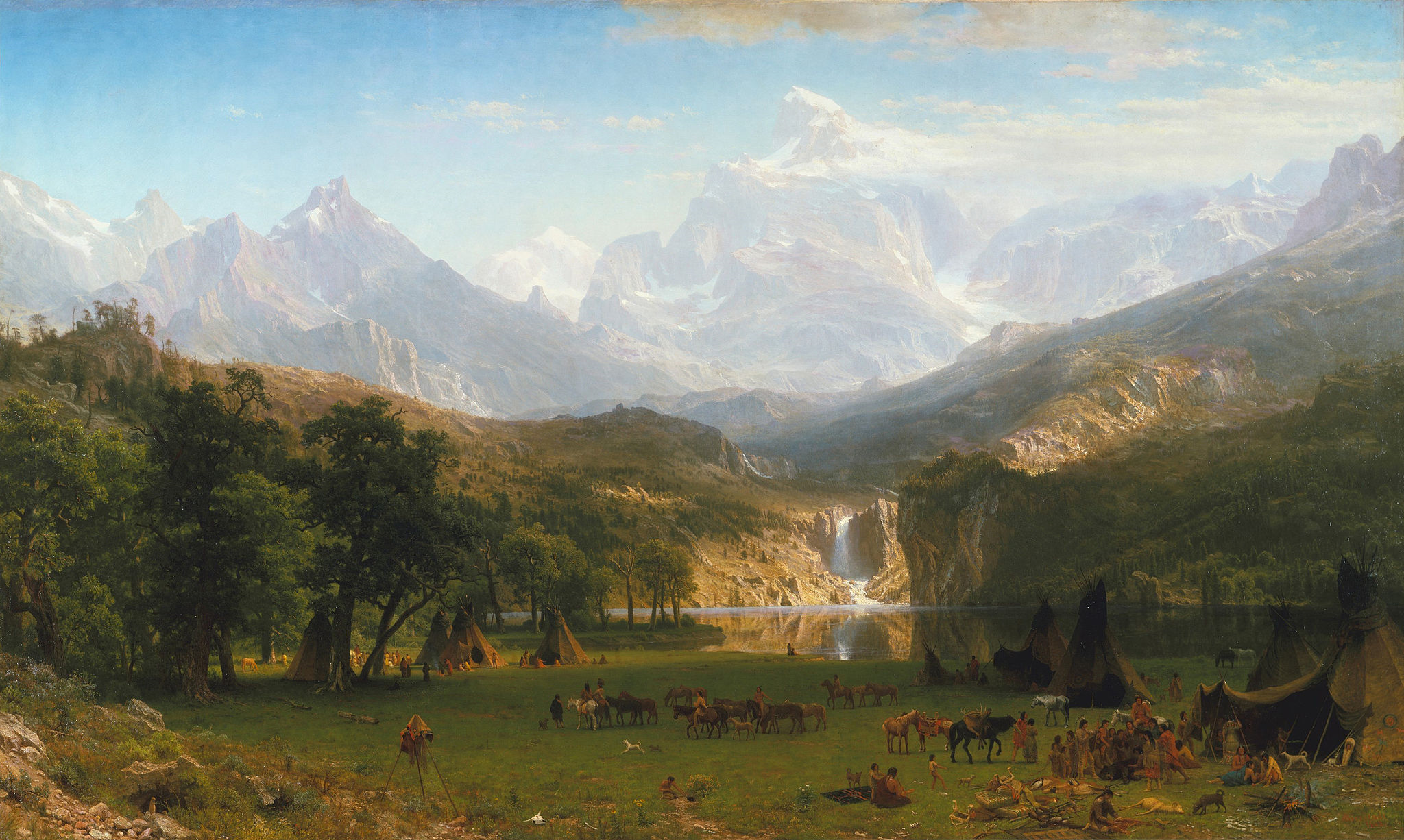
#FineArtFriday: Seal Rock by Albert Bierstadt

Artist: Albert Bierstadt (1830–1902)

Title: Seal Rock

Genre: marine art

Date: 1880s

Medium: oil on canvas

Dimensions:   height: 105 cm (41.3 in)

What I love about this painting:

It is a blustery day on the cold, wild sea. The sun briefly shines through, illuminating the rocks, glowing through a cresting wave. This is a masterful depiction of the scene, painted later in his life. It is dynamic and dramatic, conveying the power of the waves and the emotion of the scene.

Despite the efforts of the sea to wash them away, the rocks stand strong, offering a safe place for the seals.

As an avid watcher of nature shows, I love this painting.  Bierstadt captures these seals doing all the things seals do. They are fishing, lounging, and several pairs are apparently arguing.

Not unlike my family when we go out to lounge on a rock beside the sea.


About the Artist, via Wikipedia:

Albert Bierstadt (January 7, 1830 – February 18, 1902) was a German American painter best known for his lavish, sweeping landscapes of the American West. He joined several journeys of the Westward Expansion to paint the scenes. He was not the first artist to record the sites, but he was the foremost painter of them for the remainder of the 19th century.

Bierstadt was born in Prussia, but his family moved to the United States when he was one year old. He returned to study painting for several years in Düsseldorf. He became part of the second generation of the Hudson River School in New York, an informal group of like-minded painters who started painting along the Hudson River. Their style was based on carefully detailed paintings with romantic, almost glowing lighting, sometimes called luminism. Bierstadt was an important interpreter of the western landscape, and he is also grouped with the Rocky Mountain School. [1]


Credits and Attributions:

IMAGE: Seal Rock by Albert Bierstadt, Wikimedia Commons contributors, “File:Seal Rock by Albert Bierstadt, c. 1872-1887, oil on canvas – New Britain Museum of American Art – DSC09221.JPG,” Wikimedia Commons, https://commons.wikimedia.org/w/index.php?title=File:Seal_Rock_by_Albert_Bierstadt,_c._1872-1887,_oil_on_canvas_-_New_Britain_Museum_of_American_Art_-_DSC09221.JPG&oldid=975772252 (accessed March 27, 2025).

[1] Wikipedia contributors, “Albert Bierstadt,” Wikipedia, The Free Encyclopedia, https://en.wikipedia.org/w/index.php?title=Albert_Bierstadt&oldid=1277160716 (accessed March 27, 2025).

2 Comments

Filed under #FineArtFriday

#FineArtFriday:  Green Wheat Field with Cypress by Vincent van Gogh 1889

Artist: Vincent van Gogh (1853–1890)

Title: Green Wheat Field with Cypress / Green Wheat

Date: mid June 1889

Medium: oil on canvas

Dimensions: height: 73 cm (28.7 in); width: 92.5 cm (36.4 in)

Collection: National Gallery Prague


What I love about this painting:

This painting is an example of the quintessential Vincent van Gogh view of his world. He shows us a sunny afternoon in swirls and strong colors, painting it the way he experienced it.

Vincent’s superpower was the ability to show us the emotions he felt as he painted a scene. In this case, I think he was feeling a sense of peace at being outdoors.

If you have stopped by this blog before, you know I am a writer. Art inspires me and I’m always imagining the story behind each painting I feature here. As a dedicated Vincent Fangirl, I can picture him having a good day, enjoying the harmony of a sunny afternoon in June, however fleeting those moments of peace were for him.

This painting was done one year before his suicide, during a brief a time when he was relatively happy, just before his final breakdown. The clouds, the blades of grass—each thing he saw that day is there, depicted with the emotions he experienced.

About this painting via Wikipedia:

The painting depicts golden fields of ripe wheat, a dark fastigiate Provençal cypress towering like a green obelisk to the right and lighter green olive trees in the middle distance, with hills and mountains visible behind, and white clouds swirling in an azure sky above. The first version (F717) was painted in late June or early July 1889, during a period of frantic painting and shortly after Van Gogh completed The Starry Night, at a time when he was fascinated by the cypress. It is likely to have been painted “en plein air“, near the subject, when Van Gogh was able to leave the precincts of the asylum. Van Gogh regarded this work as one of his best summer paintings. In a letter to his brother, Theo, written on 2 July 1889, Vincent described the painting: “I have a canvas of cypresses with some ears of wheat, some poppies, a blue sky like a piece of Scotch plaid; the former painted with a thick impasto like the Monticelli‘s, and the wheat field in the sun, which represents the extreme heat, very thick too.” [1]


Wheat fields via Wikipedia:

The wheat field with cypresses paintings were made when van Gogh was able to leave the asylum. Van Gogh had a fondness for cypresses and wheat fields of which he wrote: “Only I have no news to tell you, for the days are all the same, I have no ideas, except to think that a field of wheat or a cypress well worth the trouble of looking at closeup.”

In early July, Van Gogh wrote to his brother Theo of a work he began in June, Wheat Field with Cypresses: “I have a canvas of cypresses with some ears of wheat, some poppies, a blue sky like a piece of Scotch plaid; the former painted with a thick impasto … and the wheat field in the sun, which represents the extreme heat, very thick too.” Van Gogh who regarded this landscape as one of his “best” summer paintings made two additional oil paintings very similar in composition that fall. One of the two is in a private collection. London’s National Gallery A Wheat Field, with Cypresses painting was made in September which Janson & Janson 1977, p. 308 describes: “the field is like a stormy sea; the trees spring flamelike from the ground; and the hills and clouds heave with the same surge of motion. Every stroke stands out boldly in a long ribbon of strong, unmixed color.”

There is also another version of Wheat Fields with Cypresses made in September with a blue-green sky, reportedly held at the Tate Gallery in London. [2]


About the Artist, via Wikipedia:

Vincent Willem van Gogh, 30 March 1853 – 29 July 1890) was a Dutch Post-Impressionist painter who posthumously became one of the most famous and influential figures in Western art history. In a decade, he created about 2,100 artworks, including around 860 oil paintings, most of which date from the last two years of his life. They include landscapes, still lifes, portraits, and self-portraits, and are characterised by bold colours and dramatic, impulsive and expressive brushwork that contributed to the foundations of modern art. He was not commercially successful, struggled with severe depression and poverty, and committed suicide at the age of 37.

Van Gogh was born into an upper-middle-class family, While a child he drew and was serious, quiet and thoughtful. As a young man he worked as an art dealer, often traveling, but became depressed after he was transferred to London. He turned to religion and spent time as a Protestant missionary in southern Belgium. He drifted in ill health and solitude before taking up painting in 1881, having moved back home with his parents. His younger brother Theo supported him financially; the two kept a long correspondence by letter. His early works, mostly still lifes and depictions of peasant labourers, contain few signs of the vivid colour that distinguished his later work. In 1886, he moved to Paris, where he met members of the avant-garde, including Émile Bernard and Paul Gauguin, who were reacting against the Impressionist sensibility. As his work developed he created a new approach to still lifes and local landscapes. His paintings grew brighter as he developed a style that became fully realised during his stay in Arles in the South of France in 1888. During this period he broadened his subject matter to include series of olive trees, wheat fields and sunflowers.

Van Gogh suffered from psychotic episodes and delusions, and though he worried about his mental stability, he often neglected his physical health, did not eat properly and drank heavily. His friendship with Gauguin ended after a confrontation between the two when, in a rage, Van Gogh severed a part of his own left ear with a razor. He spent time in psychiatric hospitals, including a period at Saint-Rémy. After he discharged himself and moved to the Auberge Ravoux in Auvers-sur-Oise near Paris, he came under the care of the homeopathic doctor Paul Gachet. His depression persisted, and on 27 July 1890, Van Gogh is believed to have shot himself in the chest with a revolver, dying from his injuries two days later.  [3]


Credits and Attributions:

IMAGE: Wikimedia Commons contributors, “File:Vincent van Gogh – Green Wheat Field with Cypress (1889).jpg,” Wikimedia Commons, https://commons.wikimedia.org/w/index.php?title=File:Vincent_van_Gogh_-_Green_Wheat_Field_with_Cypress_(1889).jpg&oldid=670096634 (accessed March 13, 2025).

[1] Wikipedia contributors, “Wheat Field with Cypresses,” Wikipedia, The Free Encyclopedia, https://en.wikipedia.org/w/index.php?title=Wheat_Field_with_Cypresses&oldid=1222477822 (accessed March 13, 2025).

[2] Wikipedia contributors, “Wheat Fields,” Wikipedia, The Free Encyclopedia, https://en.wikipedia.org/w/index.php?title=Wheat_Fields&oldid=1277932418 (accessed March 13, 2025).

[3] Wikipedia contributors, “Vincent van Gogh,” Wikipedia, The Free Encyclopedia, https://en.wikipedia.org/w/index.php?title=Vincent_van_Gogh&oldid=1279502999 (accessed March 13, 2025).

2 Comments

Filed under #FineArtFriday, writing

#FineArtFriday: a second look at ‘The Louvre, Morning, Spring’ by Camille Pissarro 1902

1902_Camille_Pissarro_Le_Louvre,_matin,_printempsArtist: Camille Pissarro  (1830–1903)

Title: French: Le Louvre, Matin, Printemps (English: the Louvre, morning, spring)

Date:1902

Medium: oil on canvas

Dimensions: height: 54 cm (21.2 in), width: 64.8 cm (25.5 in)

References: https://www.sothebys.com/en/buy/auction/2023/modern-evening-auction-5/le-louvre-matin-printemps

I first featured this painting last year, when I was desperate for a glimpse of spring. I’m feeling the same wish for color in the gray outdoor world, feeling as if spring can’t come too soon.

What I love about this picture:

This is the way spring begins, tentative and holding back as if gauging the audience before leaping to center stage. The style of brushwork lends itself to the misty quality of the pastels of March and early April.

This was one of Pissarro’s final works. It is a pretty picture, a simple scene not unlike one I might see here in the Pacific Northwest this weekend. We are supposed to see a sunny stretch tomorrow through Tuesday, a few days of warmth without rain. The flowering plum trees in my town are poised to burst forth, and we will take a long drive, soaking up the sunlight while we can.

As I said above, this is a pretty picture, not profound or revolutionary, not highbrow in any way. But sometimes, what the soul needs is a pretty picture featuring the beauty and serenity of a sunny day.

About the artist, via Wikipedia:

Jacob Abraham Camille Pissarro (10 July 1830 – 13 November 1903) was a Danish-French Impressionist and Neo-Impressionist painter born on the island of St Thomas (now in the US Virgin Islands, but then in the Danish West Indies). His importance resides in his contributions to both Impressionism and Post-Impressionism. Pissarro studied from great forerunners, including Gustave Courbet and Jean-Baptiste-Camille Corot. He later studied and worked alongside Georges Seurat and Paul Signac when he took on the Neo-Impressionist style at the age of 54.

In 1873 he helped establish a collective society of fifteen aspiring artists, becoming the “pivotal” figure in holding the group together and encouraging the other members. Art historian John Rewald called Pissarro the “dean of the Impressionist painters”, not only because he was the oldest of the group, but also “by virtue of his wisdom and his balanced, kind, and warmhearted personality”. Paul Cézanne said “he was a father for me. A man to consult and a little like the good Lord”, and he was also one of Paul Gauguin‘s masters. Pierre-Auguste Renoir referred to his work as “revolutionary”, through his artistic portrayals of the “common man”, as Pissarro insisted on painting individuals in natural settings without “artifice or grandeur”.

Pissarro is the only artist to have shown his work at all eight Paris Impressionist exhibitions, from 1874 to 1886. He “acted as a father figure not only to the Impressionists” but to all four of the major Post-Impressionists, Cézanne, Seurat, Gauguin, and van Gogh.

Founder of a Dynasty:

Camille’s son Lucien was an Impressionist and Neo-impressionist painter as were his second and third sons Georges Henri Manzana Pissarro and Félix Pissarro. Lucien’s daughter Orovida Pissarro was also a painter. Camille’s great-grandson, Joachim Pissarro, became Head Curator of Drawing and Painting at the Museum of Modern Art in New York City and a professor in Hunter College’s Art Department. Camille’s great-granddaughter, Lélia Pissarro, has had her work exhibited alongside her great-grandfather. Another great-granddaughter, Julia Pissarro, a Barnard College graduate, is also active in the art scene. From the only daughter of Camille, Jeanne Pissarro, other painters include Henri Bonin-Pissarro (1918–2003) and Claude Bonin-Pissarro (born 1921), who is the father of the Abstract artist Frédéric Bonin-Pissarro (born 1964).

The grandson of Camille Pissarro, Hugues Claude Pissarro (dit Pomié), was born in 1935 in the western section of Paris, Neuilly-sur-Seine, and began to draw and paint as a young child under his father’s tutelage. During his adolescence and early twenties he studied the works of the great masters at the Louvre. His work has been featured in exhibitions in Europe and the United States, and he was commissioned by the White House in 1959 to paint a portrait of U.S. President Dwight Eisenhower. He now lives and paints in Donegal, Ireland, with his wife Corinne also an accomplished artist and their children. [1]


Credits and Attributions:

IMAGE: Wikimedia Commons contributors, “File:1902 Camille Pissarro Le Louvre, matin, printemps.jpeg,” Wikimedia Commons, https://commons.wikimedia.org/w/index.php?title=File:1902_Camille_Pissarro_Le_Louvre,_matin,_printemps.jpeg&oldid=948378278 (accessed March 7, 2025).

[1] Wikipedia contributors, “Camille Pissarro,” Wikipedia, The Free Encyclopedia, https://en.wikipedia.org/w/index.php?title=Camille_Pissarro&oldid=1278793537 (accessed March 7, 2025).

3 Comments

Filed under #FineArtFriday

#FineArtFriday: a closer look at ‘History Painting, Titus (with self portrait)’ by Rembrandt Harmenszoon van Rijn 1626

History Painting, Titus (with self portrait of Rembrandt) by Rembrandt Harmenszoon van Rijn 1626

  • Artist: Rembrandt  (1606–1669) Rembrandt Harmenszoon van Rijn
  • Title: Historical Scene.
  • Inscriptions: Monogram and date bottom right: RH 16[2]6
  • Object type: painting
  • Genre: history painting
  • Depicted people: Titus
  • Date: 1626
  • Medium: oil on oak panel
  • Dimensions: Height: 89.8 cm (35.3 in); Width: 121 cm (47.6 in)
  • Collection:   Museum De Lakenhal

What I love about this Painting:

This is one of Rembrandt’s earliest history paintings. The young artist went all out to compose and execute this painting. I love the enthusiasm he had for this subject–he believed this painting would make his name as an artist.

Rembrandt scoured the city for props and found old armor and weapons. Then he dressed the players richly in the finest garments of his own day, so as to befit a beloved and respected emperor.

Wikipedia says: Rembrandt’s portraits of his contemporaries, self-portraits, and illustrations of scenes from the Bible are regarded as his greatest creative triumphs. His self-portraits form a unique and intimate biography, in which the artist surveyed himself without vanity and with the utmost sincerity.

The level of detail in the weaponry and richly worked garments is remarkable, as are the faces and features of each of the players. Emperor Titus is portrayed as slightly larger than life, noble, wise, and kind.

In the background, hidden by the scepter, we find Rembrandt himself, the witness who happened to come upon the scene and is looking on with wonder. Of the witnesses, he alone is shown dressed in the unadorned muted gray woolen clothing of a common man.

We know Rembrandt was well educated in history, and admired the Emperor Titus greatly, as he named his only surviving son after him.

About the Roman Emperor Titus, the Subject of this Painting (via Wikipedia):

Vespasian died of an infection on 23 June 79 AD, and was immediately succeeded by his son Titus. As Pharaoh of Egypt, Titus adopted the titulary Autokrator Titos Kaisaros Hununefer Benermerut (“Emperor Titus Caesar, the perfect and popular youth”). Because of his many (alleged) vices, many Romans feared that he would be another Nero. Against these expectations, however, Titus proved to be an effective Emperor and was well loved by the population, who praised him highly when they found that he possessed the greatest virtues instead of vices.

One of his first acts as Emperor was to order a halt to trials based on treason charges, which had long plagued the principate. The law of treason, or law of majestas, was originally intended to prosecute those who had corruptly “impaired the people and majesty of Rome” by any revolutionary action. Under Augustus, however, this custom had been revived and applied to cover slander and libel as well. This led to numerous trials and executions under TiberiusCaligula, and Nero, and the formation of networks of informers (Delators), which terrorized Rome’s political system for decades.

Titus put an end to this practice, against himself or anyone else, declaring:

“It is impossible for me to be insulted or abused in any way. For I do naught that deserves censure, and I care not for what is reported falsely. As for the emperors who are dead and gone, they will avenge themselves in case anyone does them a wrong, if in very truth they are demigods and possess any power.”

Consequently, no senators were put to death during his reign; he thus kept to his promise that he would assume the office of Pontifex Maximus “for the purpose of keeping his hands unstained.” The informants were publicly punished and banished from the city. Titus further prevented abuses by making it unlawful for a person to be tried under different laws for the same offense.  Finally, when Berenice returned to Rome, he sent her away.

As Emperor he became known for his generosity, and Suetonius states that upon realizing he had brought no benefit to anyone during a whole day, Titus remarked, “Friends, I have lost a day.” [1]


Credits and Attributions:

History Painting, Titus (with self portrait of Rembrandt) by Rembrandt Harmenszoon van Rijn 1626

[1] Wikipedia contributors, “Titus,” Wikipedia, The Free Encyclopedia, https://en.wikipedia.org/w/index.php?title=Titus&oldid=1275447925 (accessed February 28, 2025).

INSET IMAGE: Wikimedia Commons contributors, “File:Rembrandt Historical Painting 1626 (Detail, with self-portrait).jpg,” Wikimedia Commons, https://commons.wikimedia.org/w/index.php?title=File:Rembrandt_Historical_Painting_1626_(Detail,_with_self-portrait).jpg&oldid=694606337 (accessed February 28, 2025).

Comments Off on #FineArtFriday: a closer look at ‘History Painting, Titus (with self portrait)’ by Rembrandt Harmenszoon van Rijn 1626

Filed under #FineArtFriday

#FineArtFriday: Starry Night Over the Rhone by Vincent van Gogh 1888 

Artist: Vincent van Gogh  (1853–1890)

Title:  Starry Night Over the Rhone

Genre: landscape painting

Date:1888

Medium: oil on canvas

Dimensions: height: 720 mm (28.3 in)

Collection: Musée d’Orsay 

Exhibition history: Van Gogh and Britain, Tate Britain


What I love about this painting:

Vincent’s night sky is shown with reverence, the vault of heaven above shining the light of hope over the darkness of the world below. His colors are dark and intense, yet bright where light is needed—a kind of purity in execution that was one of his gifts.

In April of 2022, Fellow writer, Johanna Flynn and Greg and I joined friends to attend an immersive exhibit of Vincent van Gogh’s life through his work. We roamed freely inside an everchanging exhibit that flowed through many of his most famous works and zoomed in on bits one wouldn’t ordinarily notice.

The classical soundtrack was the perfect accompaniment. For several hours, we were immersed in Vincent’s visions of the world he loved but didn’t fit in.

The exhibit was such a moving, emotional experience. I felt as if I had seen into the man and his art.

That day, I became a Vincent van Gogh fangirl.

Vincent’s stars are surreal, yet they show the truth of how he saw the world.

About this painting, via Wikipedia:

Van Gogh announced and described this composition in a letter to his brother Theo:

Included a small sketch of a 30 square canvas – in short the starry sky painted by night, actually under a gas jet. The sky is aquamarine, the water is royal blue, the ground is mauve. The town is blue and purple. The gas is yellow and the reflections are russet gold descending down to green-bronze. On the aquamarine field of the sky the Great Bear is a sparkling green and pink, whose discreet paleness contrasts with the brutal gold of the gas. Two colorful figurines of lovers in the foreground.

In reality, the view depicted in the painting faces away from Ursa Major, which is to the north. The foreground indicates heavy rework, wet-in-wet, as soon as the first state was finished. The letter sketches executed at this time probably are based on the original composition.

Colors of the night

The challenge of painting at night intrigued van Gogh. The vantage point he chose for Starry Night allowed him to capture the reflections of the gas lighting in Arles across the glimmering blue water of the Rhône. In the foreground, two lovers stroll by the banks of the river.

Depicting colour was of great importance to Vincent; in letters to his brother, Theo, he often described objects in his paintings in terms of colour. His night paintings, including Starry Night, emphasize the importance he placed on capturing the sparkling colors of the night sky and of the artificial lighting that was new to the era.

The Great Bear

In September 1888, when Vincent van Gogh painted this picture on the banks of the Rhône, he saw the city of Arles looking south-west. The Great Bear will never be visible in that direction. On the other hand, he only had to turn his head to the north to see the constellation in exactly the position depicted. This painting is therefore an assemblage of a terrestrial plane and a celestial plane.

The Star Flowers

In 1888, when he painted the night sky, the stars resemble flowers. By the time he painted The Starry Night in 1889, his technique has evolved, the brightness of the stars being symbolized by concentric dotted circles. [1]

About the Artist, via Wikipedia:

Vincent Willem van Gogh, 30 March 1853 – 29 July 1890) was a Dutch Post-Impressionist painter who posthumously became one of the most famous and influential figures in Western art history. In a decade, he created about 2,100 artworks, including around 860 oil paintings, most of which date from the last two years of his life. They include landscapes, still lifes, portraits, and self-portraits, and are characterised by bold colours and dramatic, impulsive and expressive brushwork that contributed to the foundations of modern art. He was not commercially successful, struggled with severe depression and poverty, and committed suicide at the age of 37.

Van Gogh was born into an upper-middle-class family, While a child he drew and was serious, quiet and thoughtful. As a young man he worked as an art dealer, often traveling, but became depressed after he was transferred to London. He turned to religion and spent time as a Protestant missionary in southern Belgium. He drifted in ill health and solitude before taking up painting in 1881, having moved back home with his parents. His younger brother Theo supported him financially; the two kept a long correspondence by letter. His early works, mostly still lifes and depictions of peasant labourers, contain few signs of the vivid colour that distinguished his later work. In 1886, he moved to Paris, where he met members of the avant-garde, including Émile Bernard and Paul Gauguin, who were reacting against the Impressionist sensibility. As his work developed he created a new approach to still lifes and local landscapes. His paintings grew brighter as he developed a style that became fully realised during his stay in Arles in the South of France in 1888. During this period he broadened his subject matter to include series of olive trees, wheat fields and sunflowers.

Van Gogh suffered from psychotic episodes and delusions, and though he worried about his mental stability, he often neglected his physical health, did not eat properly and drank heavily. His friendship with Gauguin ended after a confrontation between the two when, in a rage, Van Gogh severed a part of his own left ear with a razor. He spent time in psychiatric hospitals, including a period at Saint-Rémy. After he discharged himself and moved to the Auberge Ravoux in Auvers-sur-Oise near Paris, he came under the care of the homeopathic doctor Paul Gachet. His depression persisted, and on 27 July 1890, Van Gogh is believed to have shot himself in the chest with a revolver, dying from his injuries two days later. [2]


Credits and Attributions:

IMAGE: Wikimedia Commons contributors, “File:Starry Night Over the Rhone by Vincent van Gogh, ‘lightballs’.jpg,” Wikimedia Commons, https://commons.wikimedia.org/w/index.php?title=File:Starry_Night_Over_the_Rhone_by_Vincent_van_Gogh,_%27lightballs%27.jpg&oldid=979586430 (accessed February 21, 2025).

[1] About this Painting via Wikipedia: Wikipedia contributors, “Starry Night Over the Rhône,” Wikipedia, The Free Encyclopedia, https://en.wikipedia.org/w/index.php?title=Starry_Night_Over_the_Rh%C3%B4ne&oldid=1272866843 (accessed February 21, 2025).

[2] About the artist:  Wikipedia contributors, “Vincent van Gogh,” Wikipedia, The Free Encyclopedia, https://en.wikipedia.org/w/index.php?title=Vincent_van_Gogh&oldid=1276412810 (accessed February 21, 2025).


3 Comments

Filed under #FineArtFriday, writing

#FineArtFriday: Winter in the Country – The Old Grist Mill by George Henry Durrie

Artist: George Henry Durrie (1820–1863)

Painting: Oil on canvas, 26 x 36 in

Date: 1862

What I love about this painting:

George Henry Durrie is one of my favorite American artists. In this painting, he shows us a winter’s day in New England in 1862. Snow covers the ground, but the sun is shining, lending a rosy glow to the day.

The stream bears a light skim of ice, but though the millwheel is covered in snow, the mill is not idle. This late (or early) in the year there is no wheat to grind, but the grain from the previous autumn’s harvest has been turned to flour and shoveled into bags and barrels and stored for sale as needed.

A horse-drawn sled crosses the log bridge, loaded with white cotton bags of flour. Perhaps the driver intends to take advantage of the good weather and deliver them to the local General Store or Mercantile.

Durrie’s horses and cattle are as true to life as his landscapes are. One can almost see the muscles moving beneath the glossy coat as our horse pull the sleigh.

If you are writing a story set in an era of lower technology, I strongly suggest you go to the art of Durrie and his contemporaries to find inspiration for worldbuilding.

About the artist, via Wikipedia:

George Henry Durrie (June 6, 1820 – October 15, 1863) was an American landscape artist noted especially for his rural winter snow scenes, which became very popular after they were reproduced as lithographic prints by Currier and Ives.

In Durrie’s time, winter landscapes were not popular with most curators and critics, but nevertheless, by the time of his death, Durrie had acquired a national reputation as a snowscape painter. Durrie died in 1863, at age 43, probably from typhoid fever, not long after Currier and Ives began reproducing his paintings as prints.

Durrie’s paintings, depicting idyllic rural life, a world of stability and home comforts, held great appeal for the middle class and the working class, as an visual antidote for the growing industrialization of America, and the uncertainties of a boom-and-bust economy. The American ideal of a land of self-sufficient farmers, captured by Durrie’s paintings, was being replaced with factories belching smoke, along with a rise in urban populations, foreign immigration, and crime brought about by crowded conditions and poverty. The American descendants of the early English settlers felt that their values and way of life were threatened by these new developments and turned to nostalgic images such as Durrie’s for comfort. [1]


Credits and Attributions:

IMAGE: Wikimedia Commons contributors, “File:George Henry Durrie – Winter in the Country, The Old Grist Mill.JPG,” Wikimedia Commons, https://commons.wikimedia.org/w/index.php?title=File:George_Henry_Durrie_-_Winter_in_the_Country,_The_Old_Grist_Mill.JPG&oldid=995260526 (accessed February 10, 2025).

[1] Wikipedia contributors, “George Henry Durrie,” Wikipedia, The Free Encyclopedia, https://en.wikipedia.org/w/index.php?title=George_Henry_Durrie&oldid=1244671369 (accessed February 10, 2025).

5 Comments

Filed under #FineArtFriday, writing

#FineArtFriday: a closer look at ‘Spanish Blacksmiths’ by Ernst Josephson 1882

Spanish Blacksmiths, by Ernst Josephson

  • Date: 1882
  • Medium: oil on canvas
  • Dimensions: width: 107 x height: 128.5 cm

What I love about this image:

This powerful painting is one of my all-time favorites–I have featured it here before. Josephson captures the boundless self-confidence and personalities of these young men. He has managed to portray their cock-of-the-walk swagger, and he has shown us the truth of their craft: that sparks fly and ruin their clothes; that the work is hard and their muscles strong. These men are full of life.

I can imagine them arriving at the tavern for supper, cleaned up and wearing their best shirts, eyeing the ladies and flirting with the serving girls.

The influence of Josephson’s having studied Rembrandt’s works closely can be seen here in the style with which he has painted their features. He has painted the men with truth—they are not classically handsome, but they are in the prime of life and have immense charisma. They wear their burned and ragged hats with pride. These men are good at what they do, and they know it. Their eyes dance and flirt outrageously with you across the years—they are full to bursting with machismo, daring you to just try to walk past and not notice them.

About the Artist, Via Wikipedia

(Ernst Josephson) was born to a middle-class family of merchants of Jewish ancestry. His uncle, Ludvig O. Josephson (1832-1899) was a dramatist and his uncle Jacob Axel Josephson (1818-1880) was a composer. When he was ten, his father Ferdinand Semy Ferdinand Josephson (1814-1861) left home and he was raised by his mother, Gustafva Jacobsson (1819-1881) and three older sisters.

At the age of sixteen, he decided to became an artist and, with his family’s support, enrolled at the Royal Swedish Academy of Fine Arts. His primary instructors there were Johan Christoffer Boklund and August Malmström. He was there until 1876, when he received a Royal Medal for painting.

After leaving the Academy, he and his friend and fellow artist Severin Nilsson (1846-1918) visited Italy, Germany and the Netherlands, where they copied the Old Masters. His breakthrough came in Paris, where he was able to study with Jean-Léon Gérôme at the École des Beaux-Arts. He soon began concentrating on portraits, including many of his friends and fellow Swedes in France. For a time, he shared a studio with Hugo Birger (1854–1887). His personal style developed further during a trip to Seville with his friend, Anders Zorn, from 1881 to 1882.

His private life did not go well, however. By his late twenties, he was afflicted with syphilis. His romantic life suffered as a consequence, as he was forced to break off a promising relationship with a young model named Ketty Rindskopf.

Josephson was deeply affected by his mother’s death in 1881, though had found respite when, in 1883, he had obtained the patronage of Pontus Furstenberg (1827–1902), a wealthy merchant and art collector. In 1885, he became a supporter of the “Opponenterna“, a group that was protesting the outmoded teaching methods at the Swedish Academy, but his interest in the group diminished when he failed to win election to their governing board.

By the summer of 1888, he was beginning to suffer delusions and hallucinations, brought on by the progression of his illness. Residing on the Île-de-Bréhat in Brittany, where he had spent the previous summer with painter and engraver Allan Österlind (1855–1938) and his family, he became involved in spiritism, possibly inspired by Österlind’s interest in occult phenomena. While in his visionary states, he wrote poems and created paintings that he signed with the names of dead artists. Some of his best known and most influential works were created during this period. [1]


Credits and Attributions:

Spanish Blacksmiths by Ernst Josephson 1882 PD|100, First published on Life in the Realm of Fantasy on August 16, 2019.

Wikimedia Commons contributors, “File:Ernst Josephson – Spanish Blacksmiths – Google Art Project.jpg,” Wikimedia Commons, the free media repository, https://commons.wikimedia.org/w/index.php?title=File:Ernst_Josephson_-_Spanish_Blacksmiths_-_Google_Art_Project.jpg&oldid=354761584 (accessed August 16, 2019).

[1] Wikipedia contributors, “Ernst Josephson,” Wikipedia, The Free Encyclopedia, https://en.wikipedia.org/w/index.php?title=Ernst_Josephson&oldid=1256604655 (accessed January 30, 2025).

2 Comments

Filed under #FineArtFriday

#FineArtFriday: Winter Scene in New Haven, Connecticut, by George Henry Durrie

I frequently find myself perusing the vaults at Wikimedia Commons, looking for clues about how people lived in times past. Winter Scene in New Haven, Connecticut, by George Henry Durrie is an intriguing window into the winter of 1858, a surprisingly intimate view of life in America just before the Civil War. I first posted this image in December of 2017, and it remains one of my favorite paintings, for a number of reasons.

Durrie had a modest reputation during his lifetime, an indie struggling unsuccessfully to market his works. After his death, the American printmaking firm, Currier and Ives, ensured his works were kept in the public eye.

The grandeur of the sky is reminiscent of Constable’s work, and the painting, overall, is both bold and comforting. Under a large sky, we find a small farm. It’s a simple pastoral scene, a moment painted during a winter long passed into memory. It’s pleasant, almost boring scene in its common hominess. When you look at the larger picture, you may ask, “How is this intimate? The landscape and the sky provide the drama, while the people are completely overshadowed by the scenery.”

But there is another, deeper story, one that is overshadowed by the majestic landscape and threatening winter skies, and Durrie included these people for a reason.

In Connecticut in 1858 things were not as simple and bucolic as the wide view of this image portrays.

Quote from Matthew Warshauer in his article for Connecticut History:

The state descended into chaos at the start of the war, splitting into warring Republican and Democratic factions that sometimes faced off violently.  Before the Southern states even seceded, the two parties faced off in the 1860 gubernatorial election, a contest that would decide the level of the state’s involvement once the war began.

Artists, then and now, frequently deal in allegory and misdirection. Then, as now, they were pressured to portray an acceptable vision of life as it should be. They had to sell their work to live, so they did do that, but they still painted what they saw, inserting the truth into each painting. The story that Durrie hid within this painting can be found by examining the painting in detail. I have enlarged the important section for you.

A sled, drawn by a single horse and driven by a woman, has pulled up beside the gate. A man has emerged and is talking to her. In the doorway of the farmhouse, a woman and girl stand, watching the scene at the gate.

We can imagine that some drama exists in their relationships, beginning with the way the man is standing there, not inviting the woman in. She obviously doesn’t expect to be invited in by him but has come anyway.

The man speaks to the traveler, but his gaze is not focused on the woman who has traveled through the snow, bringing a large sack filled with… what? Presents? Food-gifts? Instead, he looks away, focusing on the fencepost. Is the visitor an unwelcome mother-in-law, or is she, perhaps, a travelling merchant and he is negotiating with her?

Did she purchase something? Perhaps they’re merely chatting and he just happens to be looking away.

The sky can be a clue to the deeper story, too. Dark clouds take up fully half of the scene, dwarfing the homestead. Storms threaten the peace and prosperity of this farm, and barren trees flourish. It’s 1858 and the country is divided politically and ideologically, and the threat of a civil war looms.

The final subliminal clue is in the title: Winter Scene in New Haven, Connecticut. The artist names the picture after the larger community, a town that doesn’t appear at all in the painting, instead of offering the farm’s name. Thus, the scene. the approaching storm threatening the peaceful farm, is an allegory depicting the mood of the larger community.

Does this small detail hidden in the larger picture depict a travelling merchant, a customer, or a disliked mother-in-law bringing gifts despite her son-in-law’s aversion? Or is there something deeper here? Nothing breaks up families or divides communities as surely as strongly held opposing opinions, and we were deeply divided in those turbulent times.

The story is there, and the world in which it is set is all prepared for you. George Henry Durrie painted it, and if you are looking for a deep story that echoes our modern political state of affairs, here it is.

Or, it could simply be a passing stranger, asking for directions on a winter’s day.

When you examine the art of the past closely and look for allegories, you may find a large story hidden within the the image.  It’s up to you to interpret it and then write it.


Credits and Attributions:

Wikimedia Commons contributors, “File:George Henry Durrie – Winter Scene in New Haven, Connecticut – Google Art Project.jpg,” Wikimedia Commons, https://commons.wikimedia.org/w/index.php?title=File:George_Henry_Durrie_-_Winter_Scene_in_New_Haven,_Connecticut_-_Google_Art_Project.jpg&oldid=761233247 (accessed January 23, 2025).

The Complicated Realities of Connecticut and the Civil War, by Matthew Warshauer, Ph.D., Professor of History at Central Connecticut State University. Copyright © Connecticut Humanities. Licensed under a Creative Commons Attribution Non-Commercial Share Alike 3.0 License (accessed January 23, 2025).

3 Comments

Filed under #FineArtFriday, writing

#FineArtFriday: Three Fisher Girls, Tynemouth by Winslow Homer

Artist: Winslow Homer  (1836–1910)

Title: Three Fisher Girls, Tynemouth

Date: 1881

Medium: watercolor over graphite pencil on wove paper

Dimensions: height: 19.8 cm (7.8 in); width: 48.9 cm (19.2 in)

Collection: National Gallery of Art

The above image is one of my favorite watercolors by Winslow Homer. In Three Fisher Girls, Tynemouth,  Winslow Homer captures the personalities and the youth of the girls who comb the cold beach for shellfish. The viewer wonders, are they good friends, or perhaps sisters? Rain has darkened the day and scarves protect their ears from the wind, yet they’ve rolled their sleeves up and fish in their ordinary work dresses. These hardy young women feed their family, and perhaps they gather enough extra to sell.

About this Image, Via Wikipedia:

Homer spent two years (1881–1882) in the English coastal village of Cullercoats, Tyne and Wear. Many of the paintings at Cullercoats took as their subjects working men and women and their daily heroism, imbued with a solidity and sobriety which was new to Homer’s art, presaging the direction of his future work. He wrote, “The women are the working bees. Stout hardy creatures.” His works from this period are almost exclusively watercolors. His palette became constrained and sober; his paintings larger, more ambitious, and more deliberately conceived and executed. His subjects more universal and less nationalistic, more heroic by virtue of his unsentimental rendering. Although he moved away from the spontaneity and bright innocence of the American paintings of the 1860s and 1870s, Homer found a new style and vision which carried his talent into new realms.

About the Artist, via Wikipedia

Winslow Homer never taught in a school or privately, as did Thomas Eakins, but his works strongly influenced succeeding generations of American painters for their direct and energetic interpretation of man’s stoic relationship to an often neutral and sometimes harsh wilderness. Robert Henri called Homer’s work an “integrity of nature”.American illustrator and teacher Howard Pyle revered Homer and encouraged his students to study him. His student and fellow illustrator, N. C. Wyeth (and through him Andrew Wyeth and Jamie Wyeth), shared the influence and appreciation, even following Homer to Maine for inspiration.  The elder Wyeth’s respect for his antecedent was “intense and absolute” and can be observed in his early work Mowing (1907). Perhaps Homer’s austere individualism is best captured in his admonition to artists: “Look at nature, work independently, and solve your own problems.” [1]


Credits and Attributions:

Image: Three Fisher Girls, Tynemouth, by Winslow Homer 1881 [Public domain] watercolor over graphite on wove paper, via Wikimedia Commons (accessed January 16, 2025).

[1] Wikipedia contributors, “Winslow Homer,” Wikipedia, The Free Encyclopedia, https://en.wikipedia.org/w/index.php?title=Winslow_Homer&oldid=1253319847 (accessed January 17, 2025).

9 Comments

Filed under #FineArtFriday