Category Archives: #FlashFictionFriday

#FlashFictionFriday: The Cat was a Bastard

I love rhyming poems especially those with a simple, traditional feeling meter. And, every now and then I get in a silly mood, a moment where a single line will stick in my head, a simple, off-the-wall sentence that becomes something upon which to hang a comic poem. When that happens, all bets are off and this sort of thing is the result.

In this case, it was the stray memory of a joke my late father frequently told (and my mother deplored), “Home is where you can spit on the floor and call the cat a bastard.” This inappropriate oneliner morphed in my head to: The Cat was a Bastard, an equally inappropriate poem, displaying my low origins and affection for gallows humor.


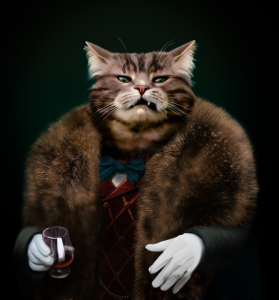
boss-cat-id-72054715-mariia-sigova-dreamstime

The Cat was a Bastard


Around the corner and down the lane

Hurtled my car through hard, driving rain.

And from the brush near the verge of the road

Came running a cat, now dead as a toad.


I stopped the car, to check on the corpse,

A cottage did see, the cat’s home of course.

And bearing the body through pouring down rain,

I pressed on the doorbell, and then pressed again.


A lady quite elderly, shriveled, and old,

Opened the door and eyed me, quite cold.

“Your cat, I presume?” I gravely inquired.

“He’s met his end, with the aid of my tire.”


Her gaze was quite steely, as coolly she said,

“And what’s it to me that the old wretch is dead?

“I always knew his would be a bad end,

“His tomcatting ways he never would mend.”


Mystified, I thought an error had been made

For she looked like a cat-lady, proper and staid.

“Are you speaking of this cat, Madame?” I said,

“This flat-headed cat, who surely is dead?”


“The cat was a bastard,” the woman replied.

“We’re glad to see the old lecher has died.

“An untidy end for the bastardly cat,

“The lazy old thing who ne’er caught a rat.”


Shocked, I just stared, then set down the corpse

And turned to depart, bewildered, of course.

Let this be a lesson to tomcats who stray,

Don’t cross the road on a cold, rainy day.


The Cat was a Bastard © Connie J. Jasperson 2017, All Rights Reserved

Stock Illustration:

Boss Cat ID 72054715 © Mariia Sigova | Dreamstime.com

3 Comments

Filed under #FlashFictionFriday, Poetry, writing

#FlashFictionFriday: In February the House is Smaller

white-cat-470px-franz_marc_013

In February the house is smaller,

Shrinking to just my office, nearer the furnace.

The Room of Shame, decorated with

Files and dusty computers, books, and cat fur,

From Yum Yum the Cat, dead these seven years.

She was old, even in cat years, and

This was her domain.


Like Jacob Marley and Scrooge’s knocker,

Her ghost inhabits this room,

Lurking behind boxes filled with books

And lit by the glow of the computer’s screen.

Little tufts of white fur hiding in places

The vacuum can’t reach,

A dusty memory keeping me company as I

Write novels that may or may not be read.


Four inches of snow fell last night, wet and heavy with water

And then froze, solid.

An iceberg enshrouded my bungalow, overtook my mini-van,

And weighs heavily on the rosemary shrubs.

And I am safe and warm inside this much smaller house

With my books and my computer,

And the ghost of my feline, past.


Attributions:

In February the House is Smaller,  Copyright © 2017 Connie J Jasperson, All rights reserved

Cat on Yellow Pillow, Franz Marc 1912 [Public domain or Public domain], via Wikimedia Commons

2 Comments

Filed under #FlashFictionFriday, Poetry, writing

#FlashFictionFriday: The Dog’s Tale

I used to spend a lot of time in the backyard, howling. What can I say? I was young and impulsive in those days.

However, Dave bought me this new collar, which, while it’s really nice to look at, has an inherent flaw. It becomes terribly uncomfortable when I howl or announce the arrival of that vandal who shoves trash through the slot in our door. He seems to be targeting our house. Since I can no longer yell at him to go away, I nip at his fingers through the slot. But he’s crafty now and doesn’t get close enough for me to do any damage.

I’m not complaining, though. I’m no different than any other girl. I’m quite partial to jewelry, and since Dave is my human, I always show my appreciation for his thoughtfulness, even though he has no idea what sort of collar I’d really like. It’s the thought that counts.

However, I hope he understands that the new cover he puts on the sofa when he leaves is not very comfy at all. It buzzes and zaps me when I step on it, so I have to sleep on the floor. At least he doesn’t put me in the kennel when he’s gone, the way some humans do. Bonzo, the dachshund from next door, spends all day in his kennel. I’m only forced to sleep in mine when Dave and that woman have a sleep-over.

It took a while, but I have Dave trained pretty well now. He’s a considerate man, and never forgets to feed me, and he has never once left me alone in the car on a hot day. It’s a good life.

I’m feeling sleepy now, so I’ll just go nap by the front door, and wait for the vandal. He shows up nearly every day just before noon. Today, if he’s careless, maybe I’ll finally draw blood, and he’ll stop throwing trash into our house.

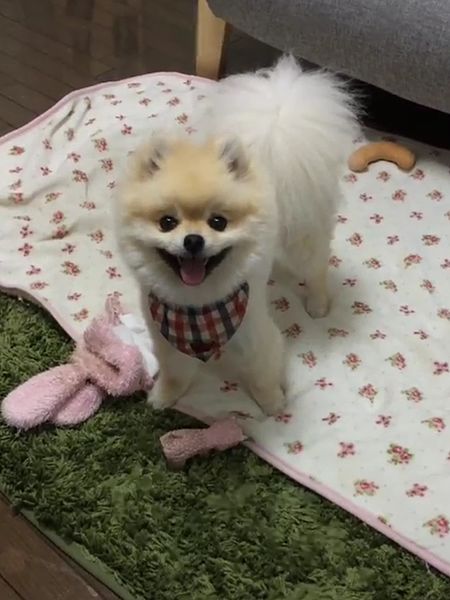
pomeranian-tb2


The Dog’s Tale, © Connie J. Jasperson, 2017

This little bit of flash fiction was inspired by the above photo, found on Wikimedia Commons.

Image: Pomeranian, By Chunbin (Own work) [CC BY-SA 4.0 (http://creativecommons.org/licenses/by-sa/4.0)%5D, via Wikimedia Commons

1 Comment

Filed under #FlashFictionFriday, writing

#FlashFictionFriday: Astorica (Reprise)

Astorica is a flash-fiction, set in a version of Astoria that may exist in a parallel universe, just one or two shadows away from our own frequently odd universe. It was originally posted here in July of 2016.  Enjoy!


Chance Jensen approached The Duck Walk Inn, aiming for the front door. It was classier than most of Astorica’s cocktail lounges, and was the third place she’d looked that afternoon. She entered, peering around to see if Jack was there.

He was, and ignoring the worried glances from the few men who were present in the otherwise empty bar, she walked toward him.

Stella, the bartender, chatted with Chuck Moore, Astorica’s lone hooker. Chuck’s clientele was comprised mostly of lonely, blue-collar laborers, women who worked in the shipyard. Stella nodded at Chance, as she lit Chuck’s cigarette.

Chuck exhaled a cloud of smoke, and glared at Chance. “You’ve been neglecting him, Chance Jensen. Don’t take your husband for granted. You’re a lucky woman to have a man like Jack. He shouldn’t be sitting in a place like this.”

“I know. I’ll do better, I promise.” She did have to smile, getting advice on her marriage from the local whore. But, she supposed, Chuck had seen plenty of marriages fail.

“Good. I don’t want to have this conversation again.” With a flounce, Chuck turned back to Stella.

The nervous-looking men at the corner table had moved their handbags to hide their cocktails, obviously regretting their decision to be so daring as to go into a cocktail lounge unaccompanied.

Jack looked out of place at the bar, dressed in his usual proper, suburban, house-husband style. He glanced up from his iced-tea. “What do you want? I’m not going back unless you’ve changed your mind.”

800px-Ladies_safety_bicycles1889“Jack, we had a quarrel. I’m sorry I shouted. But, you can’t file for a divorce, as you don’t have grounds. I don’t beat you or cheat on you. You’re just angry because I can’t afford to buy you a bicycle like Loris did her husband.”

Jack straightened his sweater and crossed his trouser-clad legs. “You’re right, I am unhappy about that. I might not be able to get a divorce, but I don’t need one. I’m not interested in dating, so I have no desire to be single. But no law says I have to share your roof. If I got a job as a waiter or a housekeeper, I could support myself and buy my own bicycle. One with a good-sized basket for carrying things.”

Chance attempted to reason with him. “Jack, if you took a job outside our home what would people think? They’d think I can’t manage on my salary. I’m just starting out with this company. I don’t need that kind of image dogging me, holding me back, or I’ll never be promoted. They’re assigning me better routes now, so things will improve. I promise.”

He burst out, “I have needs too, you know. I want to go places, and do things. I’m tired of being cooped up, with nothing to do but slave away, making sure that when you come home, you find a clean house and a hot meal. Where’s the joy in that?” Jack wiped a tear, a sure sign he was really worked up. His voice, however, was calm. “It’s just, if we had a child, I would feel needed. I don’t have a purpose, Chance.” He met her eyes. “Give me a purpose, and I’ll stay.”

Chance sighed. It always came back to that. “I’d like a child too. I don’t know why we haven’t been blessed. We’re both healthy. There’s no reason we haven’t conceived.”

Jack looked around the room. “See? They’re the same as me. We’re bored stiff. Playing bridge on Tuesdays and going to Tupperware parties just doesn’t fill the void. It’s not just us. Fewer and fewer babies—something’s wrong with this world, and no one will admit it.” He stared down at his handbag. “It’s more than that. It’s everything. I get up at five to cook  breakfast and fix your lunch. The darkest corners in our house are so clean they glow in the dark! I do laundry. I wash windows. Every day, the same things.”

Chance started to agree, but Jack cut her off.

“At ten I get all dressed up and take the bus to the market, then I haul the groceries home and put them away. Once that’s done, I change and go out to work in the flower beds, because God forbid the neighbors should see an untidy yard! Once every bloody just-sprouting weed has been yanked, I prepare your dinner, and fifteen minutes before you get home I get all dolled up, just to look good while I serve you dinner. Then I have to clean the kitchen. The next day it starts all over again. My life revolves around cooking, cleaning, and what the damned neighbors might think of us.”

Hoping to calm him, Chance said,“I know it’s difficult for you, depending on public transportation. But I’m a truck driver. You knew that when you married me. Maybe I’m not as romantic or rich as the wives in your soap operas, but I do try. Don’t I give you a large enough allowance? I never ask how you spend it. I don’t care if you have lunch out with the boys, or have your hair done twice a week. I love you! I married you for keeps, and I respect the vows we took.”

“You could tell me you love me more often.” Jack sat  hunched in on himself.

“I know. I’m not good at saying how I feel.” Chance put her hand on his shoulder. “I’ll try to do better.”

Jack burst out, “I could learn to drive, but men aren’t allowed to. I could vote and help pass laws that would improve society, but no, men aren’t allowed to. We’re too emotional, too high strung to be allowed the same privileges as women.”

Desperate to head off the men’s emancipation argument, Chance said, “I know you’d be great at all those things, better than some women if I’m truthful. But it’s the way things are, and we have to live with it. And guess what—I got a raise, today.”

Jack’s eyes it up. “Really? That’s wonderful.”

Pressing her advantage, Chance said, “You know what that means? We can save up for your bicycle. If we’re careful, next month you can buy it.”

Picking up his handbag, Jack stood up. “Let’s go home. I’ll make a pie to celebrate your raise.”

Relief flooded Chance. Taking his elbow, she opened the door for Jack and guided him across the parking lot, reminding herself that men were the fairer sex, and required gentle handling. Chuck was right–she had been neglecting Jack’s emotional needs. She resolved to be more attentive.

She loved Jack , but he confused her. He had an overabundance of paternal instincts. It occurred to her that a puppy might take Jack’s mind off things. And, it just so happened Chance’s new boss, Carol, was trying to find homes for six dachshund puppies.

That was a brilliant idea. She’d gain favor with the boss and surprise Jack with a puppy, solving both problems in one swoop. Smiling, Chance opened the car door for her husband, helping him into the sedan.


“Astorica” © 2016-2017 Connie J. Jasperson, All Rights Reserved

1 Comment

Filed under #FlashFictionFriday, writing

#FlashFictionFriday: Bond and Free, Robert Frost

Admiring the Galaxy |CCA 4.0 ESO/A. FitzsimmonsBond and Free

Love has earth to which she clings
With hills and circling arms about-
Wall within wall to shut fear out.
But Thought has need of no such things,
For Thought has a pair of dauntless wings.

On snow and sand and turf, I see
Where Love has left a printed trace
With straining in the world’s embrace.
And such is Love and glad to be.
But Thought has shaken his ankles free.

Thought cleaves the interstellar gloom
And sits in Sirius’ disc all night,
Till day makes him retrace his flight,
With smell of burning on every plume,
Back past the sun to an earthly room.

His gains in heaven are what they are.
Yet some say Love by being thrall
And simply staying possesses all
In several beauty that Thought fares far
To find fused in another star.


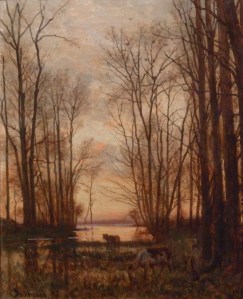
I have always loved this poem for iLouis_Français-Crépusculets complex serenity–the narrator is at peace within himself and accepts his turbulent nature.

Frost’s poems were a large part of my early life. I grew up in a house in the woods at the edge of a lake. It was quite rural, and the 1/4-mile long driveway leading from our house up to the road was a pleasant place to walk at any time of the year. Winter was especially beautiful, as the woods seemed to be peaceful, resting. When a blanket of snow had covered them they had a magical quality, one Frost had felt and written of so eloquently.

While many of Robert Frost’s poems show the tranquility of being in a quiet place close to nature, this poem, Bond and Free, is an internal poem, examining the soul and heart of a person.

When I walk in the woods or along the beach my mind strays to many places, absorbing both the sights and sounds, but also touching on ideas not previously thought of, small discoveries of “me.” Robert Frost was able to write about this simple yet complicated process, and have it make sense.

Quote from GradeSaver: The narrator describes the difference between Love and Thought. Love clings to the earth in such a way that makes it a denial of freedom and imagination. Thought, on the other hand, has cast aside the shackles of the tangible world and travels throughout the universe with a pair of wings. Yet, for all the freedom that Thought seems to have, the safe environment of Love is far more liberating.


Credits:

Bond and Free by Robert Frost, PD|1916

Images:

Admiring the Galaxy |CCA 4.0 ESO/A. Fitzsimmons

Crépuscule (Dusk) Louis Français, PD|100, By Ji-Elle (Own work) [CC BY-SA 3.0 (http://creativecommons.org/licenses/by-sa/3.0)%5D, via Wikimedia Commons

Vincent, Caitlin. Jordan Reid Berkow ed. “Robert Frost: Poems “Bond and Free” (1916) Summary and Analysis”. GradeSaver, 12 May 2009 Web. 6 January 2017.

Comments Off on #FlashFictionFriday: Bond and Free, Robert Frost

Filed under #FineArtFriday, #FlashFictionFriday, Poetry

#FlashFictionFriday: #NewYears2016

472px-judith_leyster_merry_trioAt this time of the year, I find myself looking back at my own life, and feeling such gratitude for the blessings and the bounty my husband and I have enjoyed.

All in all, 2016 was a good year on the home front, with the low points being more than balanced by the joys. My suspicion is that people who don’t know what it is like to suffer a little pain don’t appreciate the true beauty of life.

In some ways it has been a hard year, true, but through it all I had the joy of grandchildren, the love of my husband and our children,  great books to read, and music to surround me. I have rediscovered my gratitude — both for the bounty I enjoy, and the people I am privileged to share my life with.

On New Year’s Eve we will enjoy a dinner party at the home of close companions. We’ll party in the company of my sister and her husband, a few comrades from our old school days, and several soul-mates we have only met comparatively recently. We’re a mixed bag of nuts, as close as blood-relatives, a gang of retirees who support each other through the highs and lows of life.

May your new year bring you joy and prosperity and the ability to appreciate them. May you have the good health to enjoy them, and may your imaginary friends never stop talking to you!

In the meantime, I offer you this poem (originally posted on Jan 1 of this year):

>>><<<

New Years Eve at the Drunken Sasquatch

Bloody Bill reigns from behind his bar

Over the rowdy throng.

And I shall nurse my cider mulled

And sometimes sing along.


The Leprechaun plays Hendrix, loud,

The vampire sings the blues.

The dragon racks the billiard balls,

The Reaper chalks his cue.


We’re having such a lively time

The floorboards sway and heave.

The Drunken Sasquatch is the place

To spend a New Year ’s Eve.


New Years Eve at the Drunken Sasquatch, © 2016 Connie J. Jasperson

1 Comment

Filed under #FlashFictionFriday, writing

#BoxingDay: Post Holiday Wrap-up

dear-santa-t-shirtChristmas day was fun at Casa del Jasperson. We had our traditional dinner with friends who have the same vegan-married-to-a-carnivore dichotomy, and four grandkids were there too, so it was a perfect day. The best thing about days like yesterday is what I think of as “old-people’s MTV” (when it used to be music videos all day long instead of scripted un-reality shows): the Hallmark channel’s fire log with the cats and dogs. Just like a toddler parked in front of Disney’s “Frozen,” I could watch it all day.

And I did.

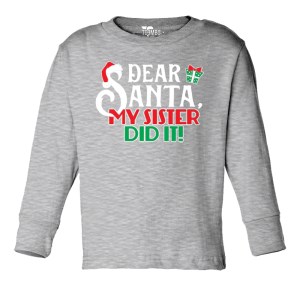
As many of you know, author/blogger David P. Cantrell is my good friend and writing buddy—he reads everything I write before I inflict it on my editors. Dave recently came up with a challenge based on a T-shirt he had seen an ad for:

So here is my burnt offering:

christmas-holly-sidebar 2

Dear Santa,

It was my sister’s fault.

Mostly. I also feel the Frigidaire company is partly to blame. They should make their products less prone to tipping over.

It all started because we were robbed on Halloween. Mrs. Sullivan gave out Snickers Bars, and Mr. Gentry gave Hershey Bars. Mrs. Morris had handed out M&Ms. In fact, all of Plum Street was handing out chocolate, so we knew we really did well that night. Chocolate is our favorite candy, so we were quite excited about having made such a grand haul. It was the best trick-or-treat night ever.

But by the time we had washed the face paint off our faces and changed into our jammies, and were allowed to sort through our candy, all that was left in our bags were Skittles, LifeSavers, Jujubes, Jolly Ranchers, and Tootsie Pops. I’m sure thieves snuck in and did it while Mom was watching Dancing with the Stars. Everyone knows our mom has sworn off sugar, so the thieves must have known there wouldn’t even be any stray Reese’s Pieces at our house under normal circumstances.

Cathy said the thieves must have spied on us as we made the rounds in the neighborhood and knew just where to come to steal it.

However, on Thanksgiving, we received reliable information from our cousin Jeremy (he’s fifteen and really tall) that some of the missing chocolate from our Halloween candy had been stashed in a secret cupboard on our premises. Probably the robbers couldn’t carry it all because there was so much chocolate, it took both Cathy and me to carry it home in the first place.

When Cathy counted what was left, it was clear the thieves had made off with more than half of it. We feared they would come back for the rest of it.

Now, I know I have a certain responsibility for how things turned out, as I am technically older. Mom is always telling us how sisters should be loyal to each other as they grow and venture into new territory.

The cupboard over the top of the refrigerator was definitely uncharted territory.

When Cathy told me about her plan to rescue the stolen chocolate, I felt she needed a safety net. Or at least someone to hold the chair while she climbed on top of the fridge.

We were surprised to discover her plan had a fatal flaw, although I should have expected it. After all, she’s only in third grade, so engineering is not her strong point. Although she’s amazing at drawing horses, much better than I am and I’m a year older. But I wasn’t consulted in the planning stage, or I would have suggested approaching the cupboard from the side via the counter instead of the front from a chair. All she asked me to do was to hold the chair, which I did until I had to drop it to catch the refrigerator.

Sort of.

I accidentally dropped that too.

You see, the door swung open, and she was hanging on it but managed to jump clear, and you know the rest.

Did you know that when your refrigerator falls on the door, more food falls out of it when you go to lift it back up? This is because the doors don’t latch too well.

So Santa, even though it wasn’t my idea to tip over the fridge, I did try to clean up the mess before Mom got back from the store. It’s just amazing how far pickles and olives can travel when they’re mixed with orange juice and moldy brussels sprouts. I didn’t realize they had rolled all the way to the back door. I felt terrible that mom slipped and dropped a gallon of milk.

And please don’t be too hard on Cathy. She was only trying to rescue the stolen chocolates.

Sincerely,

Jennifer Martin, Cathy’s sister


Dear Santa, It was my Sister’s Fault © 2016 Connie J. Jasperson, All Rights Reserved
Comments Off on #BoxingDay: Post Holiday Wrap-up

Filed under #FlashFictionFriday, writing

#MerryChristmas: Thoughts on “A Christmas Carol”

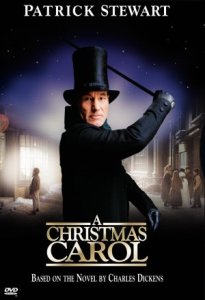
achristmascarol1999coverCharles Dickens was a master at creating marvelous hooks and using heavy foreshadowing. Let’s take the first line of my favorite Christmas story of all time,  A Christmas Carol. I love each and every version of it, will watch any movie version I can get my hands on:

“Marley was dead, to begin with. There is no doubt whatever about that. The register of his burial was signed by the clergyman, the clerk, the undertaker, and the chief mourner. Scrooge signed it. And Scrooge’s name was good upon ‘Change for anything he chose to put his hand to. Old Marley was as dead as a doornail.”

I hear a great deal of argument about how modern 21st century genre-fiction is nothing but sixty-second soundbites and bursts of action jammed together in dumbed-down prose.  I hate to say this, but that has been true of popular fiction for centuries–and if you look at this tale, you will see what I mean. The popular prose, at the time it was written, was more descriptive and leisurely than we enjoy nowadays, but even so, the really popular tales leaped straight to the action.

In that first paragraph, Dickens tosses out the bait, sinking the hook, and landing the fish (the reader) by foreshadowing the first plot point of the story–the visitation by Marley’s ghost. We want to know why Marley’s definite state of decay was so important that the conversation between you the reader, and Dickens, the author, was launched with that topic.

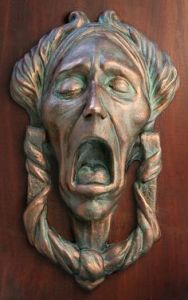
He picks it up and does it again several pages later, with the little scene involving the door-knocker: “Now, it is a fact, that there was nothing at all particular about the knocker on the door, except that it was very large.  It is also a fact, that Scrooge had seen it, night and morning, during his whole residence in that place; also that Scrooge had as little of what is called fancy about him as any man in the city of London, even including — which is a bold word — the corporation, aldermen, and livery.  Let it also be borne in mind that Scrooge had not bestowed one thought on Marley, since his last mention of his seven years’ dead partner that afternoon.  And then let any man explain to me, if he can, how it happened that Scrooge, having his key in the lock of the door, saw in the knocker, without its undergoing any intermediate process of change — not a knocker, but Marley’s face. 

Faux Marley Door Knocker“Marley’s face.  It was not in impenetrable shadow as the other objects in the yard were, but had a dismal light about it, like a bad lobster in a dark cellar.  It was not angry or ferocious, but looked at Scrooge as Marley used to look: with ghostly spectacles turned up on its ghostly forehead.  The hair was curiously stirred, as if by breath or hot air; and, though the eyes were wide open, they were perfectly motionless.  That, and its livid colour, made it horrible; but its horror seemed to be in spite of the face and beyond its control, rather than a part or its own expression.

“As Scrooge looked fixedly at this phenomenon, it was a knocker again.”

You have to admit, it’s a huge thing for a man of as limited an imagination as Scrooge was known to have, to suddenly see his dead friend staring back at him.

This is also the second foreshadowing of the events that will follow and makes the reader want to know what will happen next.

At this point, we’ve followed Scrooge through several scenes introducing the subplots. We have met the man who, as yet, is named only as ‘the clerk’ in the original manuscript, but whom we will later know to be Bob Cratchit, and we’ve met Scrooge’s nephew, Fred. These subplots are critical, as our man Scrooge’s redemption revolves around the ultimate resolution of these two separate mini-stories–he must witness the joy and love in Cratchit’s family, who are suffering but happy in the midst of grinding poverty for which Scrooge bears responsibility.

We see that his nephew, Fred, though orphaned is well enough off in his own right, but craves a relationship with his uncle with no thought or care of what he might gain from it financially.

All the characters are in place. We’ve seen the city, cold and dark, with danger lurking in the shadows. We’ve observed the way Scrooge interacts with everyone around him, strangers and acquaintances alike.

Now we come to the first plot point–Marley’s visitation. This is where the set-up ends and the story takes off.

Dickens raises the tension. The bells begin ringing for no apparent reason and “The cellar-door flew open with a booming sound, and then he heard the noise much louder, on the floors below; then coming up the stairs; then coming straight towards his door.

Scrooge, of course, is dismayed and tries to deny the strange happenings. He desperately clings to his view of reality.”It’s humbug still!” said Scrooge.  “I won’t believe it.”

However, he can’t deny this phenomenon forever and refusing to recognize it won’t make it go away. “Though he looked the phantom through and through, and saw it standing before him; though he felt the chilling influence of its death-cold eyes; and marked the very texture of the folded kerchief bound about its head and chin, which wrapper he had not observed before: he was still incredulous, and fought against his senses.

“How now!” said Scrooge, caustic and cold as ever. “What do you want with me?”

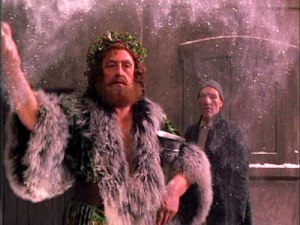
1999-xmas-present Desmond BarritThis is the turning point, the place where Ebenezer Scrooge is faced with a situation in which he will either succeed or fail and what will happen to him, the reader can’t guess. A deep sense of mystery now surrounds this miserly old man–what could possibly be so important about him that a man he cared so little for in life would go to such trouble as to return from the grave to save him?

In 1843 Charles Dickens showed us how to write a compelling tale that would last for generations. We start with the hook, use foreshadowing, introduce the subplots that ultimately support the structure of the tale, and arrive at the first plot point–these are the things that make up the first quarter of this timeless tale. Get these properly in line, and your story will intrigue the reader, involving them to the point they don’t want to set the book down.


Thoughts on “A Christmas Carol” was first published by Connie J. Jasperson here on Life in the Realm of Fantasy, Dec. 15, 2014 under the title, A Christmas Carol–what I’ve learned from Charles Dickens. It was true then, and it’s true today!

7 Comments

Filed under #FlashFictionFriday, writing

#FineArtFriday: Thoughts on a Christmas Card

 Vintage Christmas Card 1910

Somewhere, 100 and more years ago,

a unknown but talented artist painted

a warm, wonderful picture that

represents a feeling of home and family and joy,

and it fits neatly in an envelope.

A piece of fine art arriving in the mail,

Along with a little poem.

“Merry Christmas and a Happy New Year.”

I wish the same to you and you and you.

4 Comments

Filed under #FineArtFriday, #FlashFictionFriday

#FlashFictionFriday: remembering Mama and the year of the tipsy reindeer #christmas

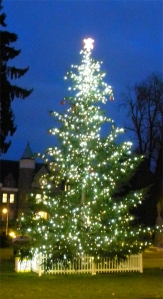
HolidayTree2012Web Olympia Downtown AssociationI live in a very small town. The residents here go all out decorating their houses and yards for the month of December. It makes for a wonderful drive after dark, just cruising the local neighborhoods admiring the inventive displays.

The city maintenance department decorates the main drag through town and it looks amazing. I wish we could have those awesome lights up all winter long. They make the long, dark nights feel so much kinder.

All up and down our street, homes are decorated for the season, but our home is always quite simple in its holiday decorating–a tree, candles, a cute centerpiece for the table. Outside, my hubby puts up small lighted displays,  but nothing too fancy.

We keep it simple because we have to tear it down and put it all away over New Year’s day, and that rapidly becomes a bore.  It’s work, and I don’t like anything that falls into the category of labor.

In 2008, my mother was terribly ill with lung cancer and was living with us in her final days. She was 82, and had always been an active, hardworking woman, managing a pizza parlor, and wrangling my eccentric, alcoholic father. She had kept an immaculate home with religious zeal, and maintained her garden just as neatly.

It was a sign of just how ill she was that she allowed me to move her into my home so I could care for her.

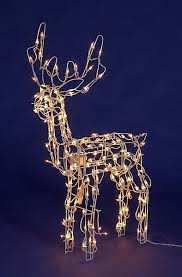
My hubby had set up the lighted reindeer  display: three sweet reindeer made of wire and white lights. However, the snow was quite deep, and around their little electric feet it would melt from the heat of the lights, but not evenly.

The little one kept falling over, which looked awful as compared to the neighbor’s fancy displays. Every day, Mama checked on that reindeer first thing in the morning, wanting to get out there and fix it herself, but she was too frail.

The disease had taken her health, but it hadn’t taken her sense of humor. The snow provided a form of entertainment for her, and she would laugh and make all sorts of ribald comments as she watched me or my hubby try to stand the rickety Rudolph back up and attempt to anchor it  more securely into the frozen turf.

No matter how we tried, our display that year was the lamest one on the street, with our neighbors pointing and laughing at the prone reindeer as they walked to the grocery store. We would check on it and make sure it was upright before we went to bed, but it never failed–sometime during the night, the wind would blow that one particular reindeer over.

lighted-reindeerOne morning, a few days before Christmas, I was in the kitchen, and Mama was looking out the front window, talking on the phone to my Aunt Lillian. “That littlest reindeer is a terrible influence. Usually he’s the only souse in the lot, but today we have a yard full of drunken reindeer.”

Aunt Lillian said something, and Mama replied, “I’m not joking. The whole herd is passed out in the snow. Either that, or we had a drive-by shooting and the reindeer were the casualties.”

Sure enough, when Greg went out to go to work, all three electric reindeer were laying on their sides.

That was Mama’s last Christmas.

I miss her when the neighborhood is decorated like wonderland and the yard is full of snow. She loved life so much and clung to it fiercely despite the chemo and the vile disease that was killing her.

This year, snow is falling again, and we will put up some sort of display, although the reindeer have long since gone to broken ornament heaven.

Somehow, decorating for Christmas isn’t the same without them.

4 Comments

Filed under #FlashFictionFriday