Category Archives: #FlashFictionFriday

#flashfictionfriday: Short Poetry: I Have Seen the Stars

Admiring the Galaxy |CCA 4.0 ESO/A. Fitzsimmons

Admiring the Galaxy |CCA 4.0 ESO/A. Fitzsimmons


I have seen the stars hung bright

Across the inky dark of night

Such beauty there displayed for me

I scarce can know their mystery.


Heaven’s vault with diamonds flung

Summer’s sky with beauty hung

Bursting forth, the joy in me

Humbled by the majesty.


I have Seen the Stars © Connie J. Jasperson 2016

5 Comments

Filed under #FlashFictionFriday, Poetry

#memorialday: In Flanders Fields, John McCrae

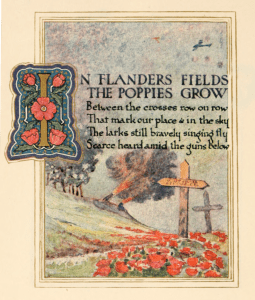
800px-In_Flanders_Fields_(1921)_illustrated by Ernest Clegg

In the US, today is the beginning of a 3-day holiday, the Memorial Day Weekend. The Indianapolis 500 takes place on Sunday, and while I won’t be there this year, my favorite drivers will be.

But Memorial Day is more than just the official launch of Summer here, more than just a car race–it began after the American Civil War in 1868 as “Decoration Day,” established as a time for the nation to decorate the graves of the war dead with flowers. Officially, Memorial Day is the last Monday in May.

After each great and terrible war of the last two centuries, the hope was always that we had fought a “war to end all wars.” World War I, also known as The Great War, was spoken of in literature as just that: a war to end all wars.

With each conflict we still hope, but we are less able to believe it.

“In Flanders Fields” is a war poem in the form of a rondeau, written during the First World War by Canadian physician, Lieutenant-Colonel John McCrae. He was inspired to write it on May 3, 1915, after presiding over the funeral of friend and fellow soldier Alexis Helmer, who died in the Second Battle of Ypres. According to legend, fellow soldiers retrieved the poem after McCrae, initially dissatisfied with his work, discarded it. In Flanders Fields was first published on December 8 of that year in the London-based magazine Punch. (Quoted from Wikipedia.)


In Flanders fields the poppies grow
Between the crosses, row on row,
That mark our place; and in the sky
The larks, still bravely singing, fly
Scarce heard amid the guns below.

We are the Dead. Short days ago
We lived, felt dawn, saw sunset glow,
Loved and were loved, and now we lie
In Flanders fields.

Take up our quarrel with the foe:
To you from failing hands we throw
The torch; be yours to hold it high.
If ye break faith with us who die
We shall not sleep, though poppies grow
In Flanders fields.


In Flanders Fields, by Lieutenant Colonel John McCrae, MD,  PD|75 years

John McCrae died of pneumonia January 28, 1918, near the end of the Great War. In Flanders’ Fields is a staple poem for Memorial Day services, a federal holiday celebrated the last Monday in May in the United States. It is a day traditionally set aside for remembering the people who died while serving in the country’s armed forces.

2 Comments

Filed under #FlashFictionFriday, Poetry

#FlashFictionFriday: The Cat, the Jeweler, and the Thief

Barliman gazed at the statue of the cat, and then out the polished window, not seeing the passersby. His eyes turned back to the stylishly dressed thief who stood before him. “It’s a nice enough  statue, well-made. What makes it worth the amount you are asking?”

Scuttle smiled. “It’s more than merely well-made. It’s brilliant. Look at it—have you ever seen such detail rendered in marble?” Thin, with a face slightly resembling that of a pleasant, well-favored weasel, he kept his desperation tightly tamped beneath a business-like demeanor.

Scuttle’s lady, Mari, was so ill that an ordinary herb doctor wouldn’t do. Their landlady believed she had contracted river fever and insisted only a healer from the Church could resolve it. But the Church never healed the poor; only the wealthy could afford a Church Healer. For that reason, Scuttle had to have those coins. He put on his most persuasive voice. “This is a miracle of art, created in marble. The hand of a master freed this cat from the stone.”

“I agree it’s beautiful, but I doubt you came by it honestly. I will be limited in who I can resell it to. Who made it? If I can at least tell a prospective purchaser whose hand created it, I will understand its value, and be better able to get a fair price for it.”

Scuttle snorted. “A fair price…usury has no concept of ‘fair.’ But all right, I’ll tell you who I believe to have made it. Benevolio.” Raising his hand, he forestalled Barliman’s comment. “I have no proof, and there is no maker’s mark on it anywhere.” Picking up the statue he held it to the light, turning it to reveal the remarkable craftsmanship. “Look at the face. Each hair, each whisker, every feature is there in the most minute detail, as if a cat had turned to stone as it sat there. Even soles of the paws which can’t be seen unless one picks the statue up–only Benevolio himself could have created such a masterpiece.”

Silence reigned in the shop as Barliman digested that comment. He pulled his magnifier from his pocket and examined the life-sized statue inch by inch. Scuttle had expected he would, and occupied himself with calculating the value of the objects displayed in the shop. Silver tea services, gold-handled cutlery, delicate jewelry set with precious stones—all rested on dark velvet in glass cases, gleaming in the light cast by wide diamond-paned windows. The fact they were on display meant those items had been purchased from more reputable sources.

The thief had come to Barliman because the jeweler sometimes supplied the wealthier class with things they could acquire nowhere else. Scuttle was a discreet thief, a man who ordinarily only stole on commission. However, the cat had been liberated from the house of a prosperous merchant newly in town, something he had only done because of Mari’s illness. The fact he was there in person to sell the statue indicated to the jeweler that this had been a private matter, making Scuttle’s bargaining position perilous. The jeweler was his only resort–no one else would have given him a copper for the statue, much less what he needed.

What Mari needed.

Barliman set the cat back down on the counter. He replaced the magnifier in the pocket of his vest. “With no maker’s mark, I can’t guarantee authenticity. That will substantially lower the price I can get for it. Therefore, I can’t give six golds coins. Three is my offer–consider, it please. It comes to three months wages for an ordinary man.”

“Five would be less than fair for a statue of this quality, and you would still make an absurd profit. If you can’t offer five, I must withdraw it.” Scuttle had no idea what he would do if Barliman refused. He didn’t dare take the time to go all the way to Westerberg. Three days there and back—Mari would be dead before he returned.

Barliman pursed his lips, deliberating. “Five golds, then.”

Though he felt like dancing, Scuttle comported himself with dignity as the coins were handed over. Barliman placed the cat statue beneath the counter and bowing, the thief departed the shop.

>>><<<

As the door closed behind the thief, the curtain behind the jeweler whisked open. Cardinal Valente stood framed in the doorway. “Good.” The Cardinal’s acidic tones fell like lead in the shop. “Here is your five golds, plus fifteen more for your trouble.”

Barliman handed Valente the heavy, marble statue. “Whose hand created this cat?” he asked. “Even Benevolio could never have done such fine work.”

Instead of answering, the Cardinal set the statue on the counter. “Observe.” He muttered some incomprehensible words, passing his hands over the cat.

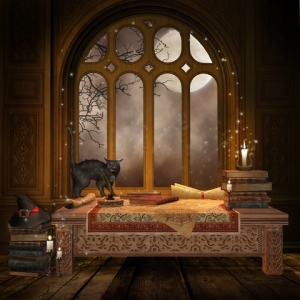
Fantasy Desk With Books And Scrolls © Unholyvault | Dreamstime.com

Fantasy Desk With Books And Scrolls © Unholyvault | Dreamstime.com

To Barliman’s surprise, the statue stretched and yawned, then stood up and jumped down. Twining about the Cardinal’s ankles, the cat purred.

“God’s hand created this cat. A spell turned it to stone, and I placed it in the home of my concubine. Then I allowed rumors of its existence to come to Scuttle’s ears.”

Barliman could not conceal his dismay. “Why? Was it to trap him? He has…skills. He’s useful, and not only to me. Imprisoning him would be bad for my business.”

“He is indeed useful. However, a personal matter  interfered with my thief’s ability to gain an artifact I must have. He needs coins to resolve the issue but he is not a man to ask for charity, and I am not known for my generosity. Hence, I devised a way for him to help himself.” The Cardinal laughed, a grating sound. “By the day after tomorrow at the latest, my thief will resume the important task I have set before him, and soon I will have my artifact.” A sly smirk lit his bony features. “And now I know what matters most in the world to my thief, and where to lay my hands on it if I should ever need a bargaining chip. That knowledge alone was worth twenty golds. Never forget this: knowledge is power, Barliman. It’s good to be the one with the knowledge.”


The Cat, the Jeweler, and the Thief © Connie J. Jasperson 2016 All Rights Reserved

Comments Off on #FlashFictionFriday: The Cat, the Jeweler, and the Thief

Filed under #FlashFictionFriday, Fantasy, Literature

#FlashFictionFriday: Scrofulous Mudd

The following bit of fluff and nonsense was prompted by the first line. Once I had that, the rest of the story sort of followed.


Scrofulous Mudd was a dirty old man.

By that I mean he was an elderly man who sorted through the leavings in ancient privies and wrote highly boring papers detailing the history of what he uncovered. He kept himself moderately clean, and took baths every Saturday unless an additional effort was required, such as for his mother’s funeral.

I suppose his fascination with filth began with his elegantly disease-ridden name. His was a difficult delivery, and when the elderly volunteer came around asking about the new baby’s name, Maude Mudd was still a little out of it. A scholar of Roman Literature, what she had actually said was “Rogellus.”

The volunteer, a retired nurse of infectious diseases, had misunderstood her mumbled words. Thus, Scrofulous, or Scroffy, as he was known at school, was given a name difficult to live up to.

Young Scroffy never knew his father, nor was any father named on his birth certificate. He assumed his had been a virgin birth, as his mother had never said otherwise and to his knowledge she never had gentlemen callers.

In truth, Maude’s single night of passion with the Professor of Antiquities had occurred after both had consumed far too much sherry at a faculty mixer at the at the beginning of fall semester. Hung-over, embarrassed, and terribly disappointed by sex in general, she immediately accepted the offer of a research position at a University far, far away, in Scotland to be exact.

It wasn’t until several months later that she realized she had a little Mudd in the oven. Things were different in those days, and rather than lose her position at the University for being morally unfit, she padded her chest, making herself appear to be merely stout. She hired a live-in housekeeper and continued with her work until the day of his delivery, which occurred just at the beginning of summer break. When the next term began, a much slimmer Professor Maude Mudd returned to school as if nothing had happened.
via wikimedia commons

Nanny MacDuff cared for young Scroffy as much as she was able, which was not a lot, as she had a pinched heart, but she did do her best by him. Many times Scroffy and his pram were left parked outside the post office, forgotten until Nanny arrived home and suddenly wondered where the washing powder she had tucked in his carriage was.

However, she saw to it he was as clean and well-fed as any other child. Both the infant Scroffy and Maude Mudd’s house were vigorously scrubbed daily, and both shone like polished chrome.

Never having been a maternal woman, Maude felt she had fulfilled her parental obligation, by hiring a nanny. While she did occasionally ask after his health in a general sort of way and whether he was doing well in school, she rarely had any reason to communicate with him.

As a small child, the books in his mother’s library fascinated him, but that room was strictly off limits. Nanny explained that little boys had dirty fingers, and so he should never touch the ancient, irreplaceable tomes. However, he often stood just outside the door, peering in, wondering what mysteries lay concealed within those pages.

Scroffy spent his childhood at boarding school. He did well in primary school and was a good student during his secondary years. It was there he discovered history could be uncovered by digging through the garbage left behind by our ancestors, and it was a science called Archaeology.

Perhaps it was his lifetime of rigorously enforced cleanliness at the hands of Nanny and the various Matrons, or perhaps it was the only rebellion he could think of, but dirt, and what it concealed, attracted him.

He was rarely invited home for holidays, and thus, Maude had nearly forgotten about her son when she was surprised to receive a letter from him thanking her for his education. He also explained he would be taking his newly earned Doctorate in Archaeology to London, and hoped she would understand.

In London, he indulged his passion for filth, digging up medieval midden heaps and privies, sifting the soil, and exclaiming over dubious treasures. Unlike his fellow scientists, he didn’t mind the filthy conditions, and relished a good, big find, feeling as if the night-soil of generations past somehow filled in the blank, far-too-clean slate of his childhood. He also began acquiring his own library of rare books, and manuscripts of historical significance, all of them shining a little light on the dark, dirty realities of medieval life.

It was said by his peers that Scrofulous Mudd knew more about the dark ages than the people who’d actually lived through those times. Had he been told that to his face, he would have agreed.

Forty years passed, during which time Maude Mudd rarely gave any thought to her absent son, although he thought of her at times. At first, he’d hoped for a letter or card, or an invitation to Christmas dinner but eventually gave up believing there was any connection there.

He had a brief, cordial conversation with his mother at Nanny’s funeral. Maude was heartbroken at Nanny’s loss, and terribly concerned she would never find a cleaner with as much respect for the many irreplaceable manuscripts in her library as Nanny had embodied. Scroffy had agreed it would be difficult. On the train back to London, he comforted himself with the thought his old nanny was in floor-polishing heaven.

He was a congenial, if obsessed, guest at faculty dinner parties, and was always willing to talk about his work. The more fastidious guests suspected he was invited as much for shock value as anything else. Conversations would stutter into pained silence when he began describing how the layers of earth and ancient human waste concealed the shards of history, things tossed into the privy or accidentally lost.

The arrival of the main course would inspire the observation that usually he found evidence of what people in various strata of society dined on, in their petrified dung. Then he would casually mention he didn’t watch the telly, as he spent his evenings with his microscope, puzzling over samples.

Time passed, the world changed, and having been born and raised in a life of academia, Scroffy evolved with it. He rose to a high post at his university. He had a team of several young women and men who were as intrigued by the waste and garbage of the past as he was. The BBC made several documentaries on what his work digging up medieval privies had unearthed, and how our ancestors had really lived.

When Scrofulous was sixty-five, he received a letter from Maude’s solicitor informing him of his mother’s passing. He had inherited the house and her library, which, as a child, he was never allowed to touch.

After the funeral, he walked through Maude’s house, looking into rooms that seemed so large when he was a child.

Walking through each room, he saw his mother had found another cleaning person as deeply offended by dust and dirt as Nanny MacDuff. Every room smelled of furniture polish and gleamed in the light shed by windows so clean he had to look twice to see they were there.

The ancient tomes that were his mother’s closest companions seemed as much a mystery to him as she had been.
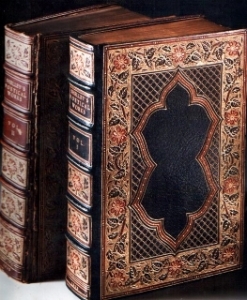
Old Restored booksA book lay on Maude’s desk, with an envelope sticking out of the top as if marking a place. A pair of clean, white, cotton gloves lay beside it. He opened the book, seeing it was a first edition of a famous treatise on an archaeological dig in Mesopotamia. It was a book which he also had in his collection, albeit his was a later edition. Then he saw the envelope was addressed to him, from his mother.

“I never really knew you, as my work precluded everything else. Nevertheless, I have always been pleased you were successful in your career. But whatever you do, wear gloves when you handle the pages of these books.”

Scroffy reflected that even in death Maude cared more for her books than her son. Yet, the scientist in him realized she must have left something behind for him to dig up about his own history, and he intended to discover it.

He looked down at the book in which he had found the note. The author had been one of his professors, a solitary man obsessed with antiquities, and who only came to life when discussing some of his more obscure finds. He’d learned a great deal from him, finding a kindred spirit when it came to unearthing the past.

He wondered why Maude had chosen that book, when she had been a scholar of Roman literature, and inherently unable to discuss anything else. He sat down suddenly, his knees giving way under the realization she had chosen the only way she knew to tell him something important, something she had withheld from him for all those years.

Nanny’s words came back to him, about little boys having dirty fingers. He was aware of how little had changed, that he was in actuality a dirty old man, due in part to his advanced age, but mostly to his profession. Accordingly, he drew on the white gloves and opened his mother’s desk. He pored through his mother’s papers, physician’s instructions, tax returns, payroll receipts–being who she was, Maude had been unable to dispose of any. She had kept everything, but had filed them as neatly as she had kept her library. He searched and sorted until he came to the year prior to his birth.

The light had begun to fade when he refiled his mothers papers as neatly she had originally, and shut the drawer. For a long while, he sat in his late mother’s study, staring into the gloom, thinking.

Having met both his mother and his father, and found them to be exceptionally solitary people, he concluded that his existence could only be explained as a miracle. And while, as a boy, he’d often wished for a less arduous name to explain to new acquaintances, he was terribly glad his mother hadn’t named him after his father.

If ‘Scrofulous Mudd’ had been the cause of the occasional fist fight at school, he suspected Hamza Pigg Jr. wouldn’t have been any easier.


Scrofulous Mudd © Connie J. Jasperson 2016, All Rights Reserved

17 Comments

Filed under #FlashFictionFriday, writing

#FlashFictionFriday: Jayne Has the Final Word

answering machineJayne Knight entered her kitchen from the garage, taking her shoes off and placing them on the rack beside the back door, and setting her purse on the counter.

The red light on the old answering machine that her husband had never gotten rid of was still flashing, as it had been for days. She continued ignoring it. She no longer had any friends, no one who would call her so it was either a message for Cameron, one more thing he had left dangling, or it was a telemarketer’s robo-call.

The funeral had been lengthy, and as she was the grieving widow, she had felt obligated to stay for the entire reception afterward. She had shaken hands with everyone, answered greetings, and thanked people for their condolences, but other than the employees she had met that week, she had recognized no one at the service. They were all people Cameron knew through his business or the Rotary—two aspects of his life she had been excluded from. Still, she had done her duty.

She had always been a quiet, somewhat naïve woman, even at thirty-two when she met Cameron. She had applied for a job at his firm, and gotten it. At the interview, she had met a large, handsome, charismatic man who gave the impression he was a secret romantic. He had seemed kind.

Despite having fallen for him at first sight, she had refused to date him for more than a year. Eventually, she had succumbed to his charm and agreed to have dinner with him. They were married two months later.

His death had happened so suddenly. One minute she was cleaning the attic, and the next minute she was answering the door, talking to two policemen who told her that her husband had been killed in a terrible accident on the expressway.

She had thanked them for letting her know what had happened.

They had been concerned about her and asked if she had any relatives or close friends to come and stay with her. She didn’t, but had lied, saying she would call a friend. The truth was, she had no one to celebrate with, so she had called a cab and went to the mall. She bought a smart new wardrobe, all in celebratory black, picked up a new laptop computer, and then bought a cell phone and an iPad.

Cameron had taken away her cell phone, saying it was too expensive, and she didn’t need one. It was the same reason he’d given for taking away her car. The only computer she had had the use of was the old one that was hers when they were married, and it was barely functional.

When she arrived home that night, she had a few moments of panic that he would find out she had spent the money, but soon her common sense reasserted itself. She was still a licensed CPA and would need all those things if she was going to get a job.

Cameron had cut her off from her friends and taken the joy of living from her, and no matter what she did to try to please him it wasn’t enough.

From the instant she had signed the marriage certificate, his sole purpose in life had been to control her every waking moment. He had never physically abused her, but he seized every opportunity to drive home how dependent on him she was, how she was nothing, without him.

And no matter what, Cameron always had to have the last, triumphant word.

For the last five years, she had wished him gone. Never dead, but just…not there. And now he was gone.

Not just gone, but dead.

After her first rush of euphoria, Jayne had put away her credit card, wondering how she would pay the bills as they never seemed to have any extra money. The first thing Cameron had made her give up was her job. He claimed he earned enough, and her working made him look bad. She hadn’t pursued it, as she had learned early on that no one ever got anywhere by disagreeing with him—Cameron always had the last word.

The next morning, Jayne went to the office at nine o’clock and introduced herself to the employees, none of whom had been there for more than a year. She explained what had happened, and asked them to continue working as if Cameron were there. She also said that the office would be closed for his funeral, which she thought would be on Friday.

They seemed stunned and offered her their sympathies. She sensed they hoped his demise meant they could look for work elsewhere, but were too polite to ask. After that, she made one more splurge and had her hair cut in an edgy new style at the shop next door to Knight Accounting.

Then she met with their attorney to make the funeral arrangements. That was when she discovered that Cameron had left her rather well off.

Rich, actually.

The lawyer had set her up with all the authorizations she needed to prove to the financial institutions that she was Cameron’s surviving spouse. As she didn’t actually know anything about their finances or how he managed them, she had then gone to the bank, getting printouts of all the monthly statements. That night she had made a detailed spreadsheet of who she owed money to, and how much.

During the next week, while the lawyer handled the details of her husband’s estate, Jayne immersed herself in Cameron’s financial life. The day after her visit to the lawyer she had purchased a modestly priced car and then returned downtown to the offices of Knight Accounting.

Ignoring the curiosity of the staff, she locked herself in Cameron’s office and methodically inspected his private files. It had been easy to log into his computer, as he used a ridiculously stupid login for everything—his birthday.

What she had discovered had given her pause.

Cameron had been systematically funneling money out of his own company and into offshore banks where he would owe no taxes. Not embezzling from the clients—thank god, not that.

It also appeared that he had lost many of his long-time customers, good clients who had left him for other, friendlier firms.

His funeral was finally over. All week long, she had been laying the groundwork for…what? She didn’t know, yet. But while she had sorted through everything and gathered information, she had deliberately put planning her future on hold until after his funeral.

And now that was done. She made herself a pot of tea.

Jayne had some crucial decisions to make. She could sell everything, sell the company and leave town. If she did that, she could start all over on a beach somewhere warm and sunny. She could live well, and would never have to worry.

But where was the challenge in that?

What she really should do, was sell the house and move into the rooms over Knight Accounting. If she worked at it, she could turn Knight into a respectable firm again. But she would change the name to Jayne Knight, Accounting.

She opened her iPad and began detailing a list of what she intended to do, starting on Monday when she would appear at Knight accounting and let them know her plans and that she was their new employer. The announcement of her changes would be followed by interviews with each employee and raises for those who chose to continue with her.

She glanced up and saw the light on the answering machine, still flashing. Sighing, she crossed the kitchen and pressed the button, allowing the message to play.

She nearly dropped her tea when Cameron’s voice emerged from the tinny speaker. Jayne shook her head, thinking about the man she had never actually known until she was married to him. “Traffic is hell tonight. I’ll be late….” His voice broke off, drowned out by a horrible cacophony of grinding, crashing sounds.

“Yes, Cameron.” She pressed ‘delete message,’ denying him the last word. “Indeed, you are.”


Jayne Has the Final Word © 2016 Connie J. Jasperson, All Rights Reserved

2 Comments

Filed under #FlashFictionFriday, Literature, writing

#FlashFictionFriday: Edna’s Garden

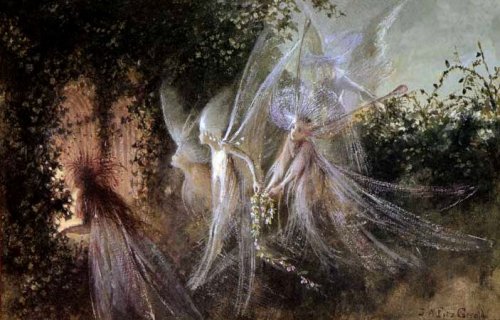
Fairies Looking Through A Gothic Arch John Anster Fitzgerald

Fairies Looking Through A Gothic Arch, John Anster Fitzgerald

This morning I noticed there were fairies in the back garden.

I was a little surprised. At first, I thought they were a side effect of my medication. But hallucinations were not listed on any of the labels, which, by the way, I had to read with the magnifier. I decided they weren’t, and several hours later they were still there.

At first, I couldn’t see them well, and wasn’t sure if they were bugs or birds, but no…when I looked closer with my magnifier, I could see they were definitely fairies.

It seems odd to me, to think that after all these years of wishing for a fairytale ending in my life, I should finally have a garden full of fairies. But life is what it is, and sometimes the things you want elude you until you no longer need them.

When I had lunch, they had progressed to building a rather large bower in the yew hedge. I was glad to see that because it meant they were staying, and they’re a lot more interesting to watch than birds.

They ignored me as they went about their business, rather like the rest of the world, probably just seeing a really old lady, nothing to worry or fret about. I was concerned that Rufus would pester them, but they didn’t interest him. He is the laziest cat, but he does sometimes work up the energy to bother the birds.

I thought about sharing the information with Violet, as they’re something she would enjoy, but she worries about me too much. If I were to call her up and say, “Violet, guess what! Fairies are nesting in the back yard,” she would say, “That’s nice, Edna. Have you a unicorn now too? Perhaps you should stop driving.” She would immediately call my daughter.

That would be bad.

Violet should talk…she’s as bad off as me or worse. But I think we’re doing quite well, for a couple of old crackpots. Funny how ninety-two doesn’t feel as old when you’re wearing that birthday hat as it seemed when we were young and whining about turning sixty-two.

So now I have a garden full of fairies. I wonder if they eat the same sort of things the birds like? Maybe I should get some of that fancy wild-bird food with all the sunflower seeds. And I should probably fill the birdbath.

Then I’ll give Violet a call and invite her over for coffee on the back porch, just to see if she notices anything out of the ordinary. If she does, I’ll pretend like I don’t see them.

She’s always moaning about how nothing exciting ever happens in this town, so this should be good for a laugh.


“Edna’s Garden” © 2016 Connie J. Jasperson, All Rights Reserved

Click here to read part 2

3 Comments

Filed under #FlashFictionFriday, Fantasy, Literature, writing

#FlashFictionFriday: Ballad of Jennet Adair

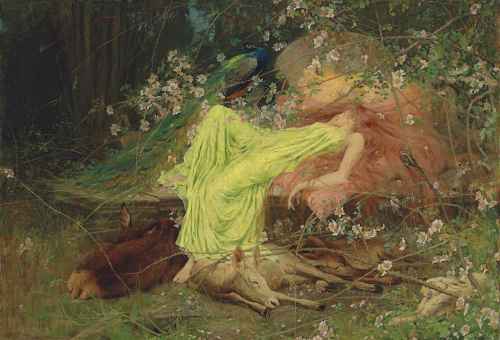
Arthur_Wardle_-_A_Fairy_Tale

A Fairy Tale, Arthur Wardle, via Wikimedia Commons

Jennet, she lies

‘Neath the white rose tree

And never again will she

Play false to me


T’was not my hands

Round her lily-white throat

But would that I could

Drown her deep in the moat


Her hair was as dark

As summer is fair

Her lips were for kissing

Sweet Rose of Adair


Jennet, she lies

‘Neath the rose tree white

My brother will hang

For her murder tonight


Jennet, she lies

‘Neath the white rose tree

Never again will

Those lips lie to me


T’was not my hands

Round her lily-white throat

She ruined my brother

She ruined us both


Played us like pawns

In the age-old game

Until she did misstep

To her sorrow and shame


My brother will hang

‘Neath the town hall light

And who will tell mother

What happened tonight?


Jennet, she lies

‘Neath the white rose tree

And never again will she

Play false to me.


Ballad of Jennet Adair (as composed by Huw the Bard) © Connie J. Jasperson 2016, All Rights Reserved

The Ballad of Jennet Adair was first published July 31, 2015 on Edgewise Words Inn

4 Comments

Filed under #FlashFictionFriday

#flashfictionfriday: The Iron Dragon

Earl Aeddan ap Rhydderch turned his gaze from the mist to the strange iron road that emerged from it, and then to where the road entered the cave. “Tell me again what happened.”

The peasant who had guided the earl and his men said, “The mist, the iron road, and the cave appeared yesterday, sir. We saw the beast entering its lair, and a fearful thing it is, too. No one dares to enter, but the monster can be heard in there. It’s a most dreadful dragon—we found the carcass of a large wolf that had been torn to shreds, trampled until it was nigh unrecognizable.”

The man’s companion said, “Everyone knows wolves are Satan’s hounds. It must have angered its hellish master. We found it lying cast to one side of the Devil’s Road.”

Aeddan looked back to the iron road, seeing where it emerged from the mist. He walked to the low-hanging fog bank, seeing that the road vanished just after it entered the mist, leaving no marks upon the soil. He turned and strode back to the peasants. “I agree it’s the work of the Devil, but why does the Lord of Hell require an iron road that leads nowhere?”

A faint grumbling sounded beneath Aeddan’s feet. “A light! Look to the mist!” shouted one of his men.

Turning, Aeddan saw a white glow forming in the fog, as if a large lamp approached from a great distance. “That’s no ordinary lantern. Mount up!” Moving quickly, he leaped into his saddle and turned his steed to face the demon. He freed his lance from its holster and settled it in the arret attached to his breastplate under his right arm. His fingers fumbled as he struggled to fasten the grapper, but at last it held firm. The peasants, knowing they were no match for whatever approached, had run for shelter up the hill.

The light deep within the fog grew and strengthened, as did the rumbling noise.  The light waxed brilliant and the earth shuddered as if beneath the pounding of a thousand hooves. Smoke filled the night air, reeking of the sulfurous Abyss, combined with a howling as cacophonous as the shrieks of all the damned in Hell.

What emerged from the mist was impossible—an Iron Dragon of immense height and girth.

“Courage men! For God and King Gruffydd!” His bowels had turned to water, but Aeddan and his men stood firm in the face of the demon, sure that death would be their reward.

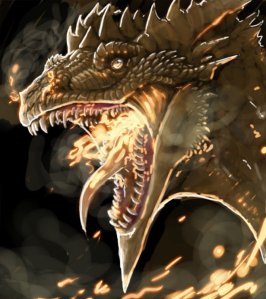
Dragon-Linda_BlackWin24_Jansson

Dragon, Linda Jansson PD/CC via Wikimedia Commons

The fiery light emanating from the burning maw lit the night, and the ground shook as the beast roared and raced ever closer. As the beast sped toward him, a burning wind blowing straight out of Hell knocked Aeddan and his horse to the side of the Devils Road, and using that opportunity, the Iron Dragon thundered past him, heading into its lair.

Stunned, Aeddan scrambled to his feet, staring as the length of the beast passed him by, the body taller than a house and long, like an unimaginably giant, demonic centipede. The length of the beast was incomprehensible, lit  by the fire within and glowing with row upon row of openings. The faces of the damned, souls who’d been consumed by the ravening beast peered out as they flashed by. Sparks flew from its many hooves.

Terrified his men would be crushed by the immense creature he shouted for them to back off, his voice drowned by the din.

Abruptly it was gone, vanished inside its lair. In the sudden, deafening silence, Aeddan wondered how such a thing could possibly have fit into the cave. Yet it had done so, and other than the stench of its passing, there was no sign of it.

He remounted and settled his lance in the holster beside his stirrup, then turned to his men. “Rouse the village. We must seal it’s lair with stone and mortar. We may not be able to kill it, but at least, we can stop it from marauding and decimating the countryside.”

>>><<<

Mist shrouded the small valley just outside of the village of Pencader. Engine Driver Owen Pendergrass looked at his pocketwatch and opened the logbook, noting the time and that they had just departed Pencader. He said to the fireman, Colin Jones, “We should be approaching the tunnel, though it’s hard to tell in this mist. We’re making good time despite the fog. We’ll be in Carmarthen on schedule.”

“Sir! Look just ahead! What…?” Colin pointed ahead.

A group of mounted men dressed like medieval knights, complete with lances lowered as if prepared to joust, appeared out of the mist, attempting to block their path. “God in heaven—what next!” Blowing the whistle to scare them off the tracks, Owen pulled the brake cord but there was no way the train could stop soon enough. In no time at all, the train was upon the knights, scattering them and blowing past. Owen looked out the window, to see if they’d survived but they were gone as if they’d never been.

“Vanished,” said Colin. “Like the ghosts when we passed through here yesterday.”

Hiding his trembling hands, Owen shook his head. “It was a close call, but no harm was done. We’ll not be mentioning this to the authorities, eh? Not after the way our report was received yesterday. It’s a haunted valley, but it’ll do us no good to mention it to anyone important.”

Colin agreed, and turned back to fueling his fire, shoveling coal as if he could work the fear out of his mind.

The connecting door opened and Harrison, the chief steward, entered. Pendergrass told him the same thing, and the old man agreed. “We got in enough trouble at the yard yesterday for mentioning the ghosts. I’ll go soothe the passengers.”

“Tell them it was just the mist and the dark playing tricks on their eyes.” Owen shook his head and glanced out the window, seeing they had emerged from the tunnel into a clear, cold evening and would soon be at the next stop, the village of Llanpumpsaint. “Playing tricks indeed.”


“The Iron Dragon” © 2016 Connie J. Jasperson, All Rights Reserved

For more stories involving what may or may not be dragons, check out today’s post by Chuck Wendig–he has posted a writing challenge and over the next two weeks the links to many great stories will be filling the comment section:

Terrible Minds/Chuck Wendig: Flash Fiction Challenge: the Dragon

6 Comments

Filed under #FlashFictionFriday, Dragons, writing

#flashfictionfriday: Dreams and Shadow Truths

Neil Gaiman Sandman quote memeTales, dreams, shadow-truths…the fabric of the multiverse. One universe touches upon another, and the dreamer dreams. The faerie queen leads her court though the forest and one more mortal falls in love.

Books are evidence that once upon a time a mortal slept, and dreamt. Within the pages of dusty, leather-bound books lies proof that the philosophers’ stone exists in the realm of imagination spinning words of straw into gold, and bequeathing immortality to those who possess it.

The multiverse is yours for the taking if you believe, and are unafraid to dream.

Open a book, and  step into a realm unknown.


“Dreams and Shadow Truths”  by Connie J. Jasperson © 2015 was first published on Aug. 10, 2015 on  Edgewise Words Inn

2 Comments

Filed under #FlashFictionFriday, writing

#FridayFiction: The Dunes at Westport

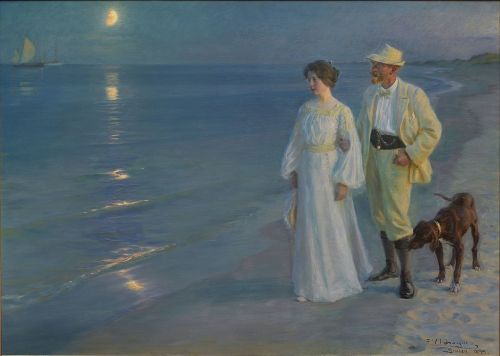
P.S. Krøyer, Summer Evening at Skagen Beach – The Artist and his Wife (1899) Via Wikimedia Commons

P.S. Krøyer, Summer Evening at Skagen Beach – The Artist and his Wife (1899) Via Wikimedia

The Dunes at Westport

Hidden where the dune grass grows

Beside the salty sea

Tall, the dune grass shields our tryst

Beside the wide, grey sea.


Hard and sweet, the wind does blow

From off the tumbling sea

The path is lined with strawberries

Wild and thriving in the lee.


A basket filled with simple foods,

Bread, and wine, and cheese,

A blanket spread upon the sand

Sheltered from the breeze.


Seabirds glide upon the wind

Calling from on high

Pipers step at water’s edge

With plovers they do vie.


We’ve slipped the bonds of modern life

And come down to the sea

Sheltered in the dunes we’ll rest

My only love and me.


A secret tryst, my love and I

Beside the salty sea

A day beneath the wide, blue sky

My dear, dear man and me.


“The Dunes at Westport” © 2016 Connie J. Jasperson, All Rights Reserved

2 Comments

Filed under #FlashFictionFriday, Poetry, writing