Category Archives: Food

Dinosaurs Among the Birds

200px-Hippie_bug!_(1043753793)We go through life and things happen. Friends drift apart and then we drift back together. When we meet again, we are all so curious about each other’s lives and where the road has taken us, curious about the visible changes and not-so-visible ones. Forty-odd years ago we were young and wild, determined to carve our path in the world and desperate to get on with living. We were tired of the war, tired of politics, and tired of being told what to think by media controlled by pin-headed men in suits. We were tired of congress selling us out.

We were going to change the world.

250px-Woodstock_posterWe did change the world, but not exactly the way we naively believed we would. Even though we were unable to solve all the problems we wanted to, we did manage to make some positive changes. Unfortunately, we were too few, voices shouting in the wind.

And now we are somewhat jaded. The country is still divided, big money still buys votes. Congress is still selling out, and the media is still owned by pin-headed men in suits. There is always a war somewhere, and it is never done with.

We cling to our belief that we will see positive changes, but we don’t believe we will live long enough to enjoy them. But change is inevitable, and it will happen, even if, like Moses and the promised land,  we stand on the opposite shore and see only what yet may be.

My old friends and I are not exactly who we were in those wild days. Now we are an amalgamation of everything we once believed would happen and everything that really happened. We are people who survived Reaganomics, who survived raising children through the MTV years. We held down three part-time jobs because trickle-down economics didn’t really trickle down the social ladder to our rung, and we had kids to feed. We survived the Bush years with some of our dignity intact, and didn’t fold under the “you’re with us or you’re against us” propaganda designed to shut us up.

194px-LennonWallImagineWe are jaded, but we have hope, we old hippies; we old women and men who are dinosaurs among the birds of the modern, hyper-connected world. We still believe the world can be a better place for everyone. The difference is now we know we can change the world…just not in the way we thought we would.

Now we put our money where our mouth is, donating to charities and spending our retirement years volunteering in schools and hospitals. We do it in small ways, chipping away, and little by little we have a positive effect.

We lost the battle to make the world a simpler, kinder place. Our parents won the war with their firm, 20th century belief that only through technology would mankind benefit, and that somewhere  was a miracle drug just waiting to cure every disease known to man.  It just hadn’t been discovered yet.

We were conquered, despite the struggle to keep it simple. We old hippies now embrace the technology and make it ours, because we must either adapt or die, and I am not ready to die. We are a wired society, and we old people have the luxury of a little free time and occasionally, extra money.

Writing is my opportunity to live in the world as I would like it to be, and it is my chance to get away from the war, from politics, and from crazy family issues. Adult children with complicated epilepsy issues, grandchildren having babies too young (did they learn nothing from my trials and errors?) –writing is my escape.  And when I am not reinventing the world, I donate my time and money to advancing humanity. My husband and I give to charities, both locally and internationally.

I support creativity and free-thinking on a local level. I volunteer as municipal liaison for NaNoWriMo. I encourage people from all walks of life, and from every point of view to write. It doesn’t matter to me if we agree politically or not. Everyone has a story to tell. Some stories are real and incredibly moving, and all they need is the skill to tell that story the way it should be told.

Generic-180x180They can gain that skill through participating in NaNoWriMo, National Novel Writing Month. Children and schools benefit year round from writing programs sponsored by this organization. November is coming, and for me November is the busiest month of the year. I will be meeting and getting to know many new people, and I will be writing the framework for a new novel.  For one month, thousands of people will be too busy writing to spend their evening in front of the electronic altar, being fed mindless pap in the form of ‘entertainment.’ Instead, they will entertain themselves and find they are so much more than they ever thought they could be.

With every new story that is told, the world opens its eyes a bit more, seeing more possibilities. There is more awareness that we are not islands disconnected from society, cocooned in our dark living-rooms unable to look away from the poorly crafted mind-porn we are force-fed to fill the void.

I am an old hippy, I admit it. But I am water, wearing away at society’s monument to ignorance, helping  the world learn how to tell its story one person at a time.  

Andreas_Achenbach_-_Felsige_Küste

4 Comments

Filed under Battles, Books, charity, Epilepsy, Fantasy, Food, Humor, Literature, Uncategorized, Vegan, writer, writing

Dad’s Leg

cover_art_Billy_39_s_RevengeWords are awesome. I love obscure, weird words.  J.K. Rowling uses the word ‘snogging’ in her Harry Potter series, to describe couples who were engaged in prolonged kissing, or as we sometimes say where I come from,  ‘canoodling.’ My friend Irene has a new favorite word: ‘kerfuffle,’  a Briticism for a  noisy disturbance or commotion. Americans would say a ‘dust-up.’ 

Words are the color palette an author uses to paint his image of the world.  In English, which is a mash-up language, we have so many wonderful, wild words it is impossible to use them all in one book.

Heck–William Shakespeare loved words so much that when he ran out of words to fit a particular sentence, he invented them!

To say my father was an interesting man would be an understatement.  Born September 22, 1923, he was a product of depression-era America. A farm-boy and big for his age, he enlisted in the US Army in 1938 at the age of 15. He thought he’d found his career, but he was injured in a motorcycle accident while riding dispatch in 1945, near the end of WWII. Nearly every bone in his body was broken, and in the hurry to save his life, his left leg was set crooked. A year later, they went in and re-broke it in order to reset it straight, but he developed osteomyelitis.

va logoDad spent the next 7 years after the war in and out of VA hospitals.   For 7 years, the army surgeons tried to save his leg but in 1954 he lost his left leg,.The US Army officially forced him to retire, at the age of 30.  Unfortunately, Dad was never able to wear the artificial leg the VA provided him with, although we children did find some creative uses for it. It stood in the hall closet in our house in Ballard, and we charged the neighbor kids  25 cents to look at it. In Olympia it was good for scaring our cousins. When I first married and left home, it stood in the corner of my living room holding plastic flowers, a conversation piece like no other.

There he was in 1952, a single guy with rather visible disability,  wearing a heavy leg-brace, living in a world that hid the disabled under a rug and pretended everything was perfect. It was 1952, after all.

For some people, that would have been the end of everything. But not my Dad. When things began going bad with his leg, he knew he would be forced in to early retirement. He was aware that dropping out of school in the 10th grade to join the army had limited his employment choices to logging or farming, all manual labor. Dad used that time he’d spent on extended medical leave getting his high-school diploma, and then going to college. He met my mother and the rest was history.

So what does Dad’s leg (or lack thereof) have to do with weird words?  Stick with me and you will see.

Dad was a voracious reader. He read everything from Tolkien to Tolstoy, and he remembered what he had read. Dad was a draftsman, and cartooning was his hobby. He played the guitar, played in a rockabilly band and partied with Les Paul and Mary Ford. Dad bought the Encyclopedia Britannica, the entire collection of Great Books of the Western World, Grolier’s Book of Knowledge, and a wonderful little collection of books called “Lands and Peoples.

Fred+Flintstone+FredFlintstoneDad was larger than life. He was loud, boisterous, opinionated, wide-open, a generous host, and he was always the center of attention. He made his own wine and brewed beer.  He was a ham radio operator (his call number was W7NEY) and had a First Class Radiotelephone Operator License. Every year his vegetable garden grew more food than we could possibly eat, no matter how much we canned.

Dad was Fred Flintstone on Steroids.

Dad Loved Words. Big words, small words, short words, long words–Dad loved them all. He spun hilarious yarns about the ‘Kamaloozi Indians’, a non-existent tribe whose beloved Chief, Rolling Rock had gone missing, The tribe was so distraught they posted signs in every mountain pass that read “Watch for Rolling Rock.”

Everything in his toolbox had a name that was his own invention: Screwdrivers were ‘Skeejabbers.

Dad loved words so much he mangled them just because he loved the way they sounded. Sometimes he became so frustrated he lost his words and resorted to creative cursing.

Dad’s birthday is coming up, September 22. He died in 1991 at the age of 66, from complications of Osteomyelitis. He would have been 90 years old this next Sunday. He is gone, but definitely he will never be forgotten. His love of words and of reading, art and music had an impact on me and my siblings we will never live long enough to outgrow.

What better environment for a future bender-of-words like me to grow up in than a home where any book was fair game, and reading was not only encouraged, it was required?

The word for the day is ‘querl’–which means to twist or curl. And that is what my family all loves to do with words!

rolling rocks sign

4 Comments

Filed under Adventure, Battles, Fantasy, Food, Humor, Literature, Uncategorized, Vegan, writer, writing

flippin’ it

An elf markswoman from the Wesnoth fantasy setting, created by Kathrin "Kitty" Polikeit for the homepage of WTactics, the customizable card game project based on The Battle for Wesnoth via Wikimedia Commons

An elf markswoman from the Wesnoth fantasy setting, created by Kathrin “Kitty” Polikeit for the homepage of WTactics, the customizable card game project based on The Battle for Wesnoth via Wikimedia Commons

You know you’ve taken a dip into the realm of fantasy when you’re editing a manuscript and one of your comments in the sidebar reads:  ? maybe a word or two to signify it wasn’t a random customer? Does he mean the elf?  

For some reason when I found myself making that particular comment I laughed like a loon.

I  marvel at my  ‘fantasy life’.  I’m really talking about an elf, and the author whose book I am editing won’t think I’ve ‘flipped it’ again. She has ‘flipped it’ too.

Flippin’ it‘ is an occupational hazard for authors, judging from what I see on Facebook!

When I was young, in my twenties and thirties and even into my fifties, I thought sixty was old, and that I would probably be too decrepit to enjoy life once I devolved to such an old age. However, I’ve been pleasantly surprised to discover my childhood lasted through my forties, and now here I am, sixty years old and feeling like the queen of everything!

Young adulthood is a a time of living in limbo–you go to work, you get married and have kids. It’s your fertile years after all, and your biology insists you take advantage of it!Young Woman Sitting Looking at Laptop Screen In your twenties, thirties and even forties,  creativity is something you pursue only in your free time, feeling guilty for taking time away from your obligations and from your children. You enjoy life, yes and you do find ways to have a satisfying and creative existence, but it’s on hold, and something in the back of your mind asks, “Is this it? Is this all there is?” You feel guilty for even thinking such a heinous thought. How could a lovely family, a good job and all the trappings of modern life not be satisfying? Of course you’re going to write that book someday, but…Jackie has soccer, David has piano lessons,  and you’ve a briefcase full of work to do when dinner is done. That’s if they don’t need too much help with their homework. If you fall into bed by eleven you’re doing well!

These years are the foundation years, the years of your late childhood, preparing you for the real adulthood that only begins once you are free of those responsibilities.

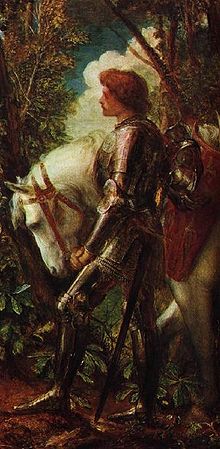
220px-Sir_Galahad_(Watts)Life gets put on hold until that blessed day when the last child leaves the nest. On that day, your real life begins. Yes, you will still need to work, but your life has gained that one rare and beautiful commodity you never had before: free time. Time to spend doing what you want in the evening–time to paint, or time to write. Time to be selfish and no one to make you feel guilty.

Yeah, you’re glad to hear from the kids, that won’t change.  You love being with them and look forward to seeing them for family get-togethers and visits, but you don’t live only for them any more.

There will be separation anxiety. It surprises them that you don’t call every hour to check on them, but they will get used to it, and even learn to accept your independence.

Eventually they will stop fearing that your not calling every hour means you’ve fallen and can’t get up. Promise them that if that becomes a valid concern, you will get a life-alert and life will go on.

They’ll get used to you traveling on your own, and making decisions for yourself. One day they will experience this part of life for themselves. They will realize they can count on you to be there when they need you, and accept that when the crisis is over, you will load your suitcase into the car and let them get on with living the first half of their lives.

You discover that you have a meaning and a purpose in your life that goes far beyond parenthood and biological imperatives, even if it’s a purpose only you and a few friends in your writing group understand.

The first half of my life I spent working three jobs and raising kids, writing only when I could, and too embarrassed to show it to anyone. Now, here I am embarking on the second half of my life, the part where my life really begins and I not only have a career that absorbs me, I get to read all I want! 

Of course I’ve ‘flipped it’. I love the freedom of writing fantasy, and the pleasure of being involved in editing awesome books by amazing authors. It doesn’t get any better than that!

4 Comments

Filed under Adventure, Battles, Fantasy, Food, Humor, Literature, Uncategorized, writer, writing

Grandma’s Ferrari and Style

chicago manual of styleOh golly gee–it’s that time of year again. What do I use,  “that” or “which?”   And what the heck are those rules again? Good grief…where did I put that bookmark for the online Chicago Manual of Style….

What? Doesn’t everyone have a bookmark in their list of favorites so they can immediately access a FREE style manual when questions of  style arise? Good lord people–we aren’t talking shoes and handbags here! We’re talking RULES! Specifically, the rules fer writin’ and ropin’ in them thar clauses!

And always remember–for the indie author, free is good. If you don’t have the funds to buy Strunk and White’s Elements of Style, for the love of Dickens, use the internet, Tiny Tim!

Personally, I use both manuals.

The traditional approach to the question of “that versus which” is to use “that” with restrictive clauses and “which” with nonrestrictive clauses. While some writers seem to have abandoned the distinction entirely, no better rule has come along to replace the traditional rule. Moreover, the rule is easy to master.

But what, you ask, is a stinking restrictive clause and why do you need one?

799px-Handcuffs01_2003-06-021.   A restrictive clause is one that limits — or restricts –the identity of the subject in some way. When writing a restrictive clause, introduce it with the word “that” and no comma. (However, if the subject is or was a human being, use “who” to introduce the clause.) This is where “that” goes:

Correct Restrictive Use:

The photograph that was hanging in the hotel lobby was stolen.

The use of “that” in this sentence is correct if the reader intends to single out the one photograph that was in the hotel lobby as the stolen photograph. However, if there were several photographs hanging in the lobby, this use would be incorrect, since it would mislead the reader into believing that there had been only one photograph in the hotel lobby. The restriction here tells us that the one photograph that had been hanging in the hotel lobby was stolen — not the photograph in the cocktail lounge, or the one in the guest library, or any of those in the restaurant.

MH9004387282.  Use “which” with nonrestrictive clauses. A nonrestrictive clause may tell us something interesting or incidental about a subject, but it does not define that subject. When writing a nonrestrictive clause, introduce it with “which” and insert commas around the clause. (However, if the subject is or was a human being, use “who” to introduce the clause and insert commas around the clause.)

According to Wikipedia, the Fount of all Knowledge: non-restrictive clause is a clause in which a noun phrase that is used to avoid repetition (as the referent of an anaphor, meaning that it is substituted by another word but refers to the same noun) is determined by its antecedent where the dependent is peripheral (non-essential) in the secondary constituent, as opposed to a restrictive clause, where the dependent is central (essential) to its primary constituent. A non-restrictive clause does not identify the referent of its noun, but only provides information about it.

220px-Metropolitan_police_BMW_3_seriesRestrictive example:

The officer helped the civilians who had been shot.

or

The officer helped those civilians who had been shot.

In this example, there is no comma before “who”. Therefore, what follows is a restrictive clause (not all of the civilians had been shot).

Non-restrictive example:

The officer helped the civilians, who had been shot.

Here, there is a comma before “who”. Therefore, what follows is a non-restrictive clause. It changes the sentence to mean that all the civilians had been shot.[1]

Correct Nonrestrictive Use:

The photograph, which was hanging in the hotel lobby, was stolen.

Explanation: While this nonrestrictive use tells us that the photograph was hanging in the hotel lobby, it does not tell us which of the several photographs in the hotel lobby was the stolen photograph. It would be incorrect to use this nonrestrictive clause if there had been only one photograph in the hotel lobby, as the sentence leaves open the possibility that there were others.

  1. Combining Restrictive and Nonrestrictive Clauses. One can provide both limiting and nonlimiting information about a subject in a single sentence. Consider the following.

Correct Use of Both Restrictive and Nonrestrictive Clauses:

220px-Looking_across_lake_toward_mountains,_-Evening,_McDonald_Lake,_Glacier_National_Park,-_Montana.,_1933_-_1942_-_Ansel AdamsThe Ansel Adams photograph that was hanging in the hotel lobby, which was purchased in 1969 for $100,000, was stolen.

The restrictive clause beginning with “that” tells us that only one Ansel Adams photograph was hanging in the hotel lobby and that it was stolen. The nonrestrictive clause beginning with “which” tells us what the owner had paid for the photograph, but it does not tell us that the owner did not pay another $100,000 for another photograph in the same year. It does not limit the possibilities to the Ansel Adams photograph that was in the lobby.

Restrictive and Nonrestrictive Clauses beginning with “Who.” When writing about human beings, we use “who” rather than “that” or “which” to introduce a clause telling us something about that human being. Since “who” is the only option, we distinguish between a restrictive use and a nonrestrictive use by the use of commas.


Ferrari_AssetResizeImageOld Mrs. Jasperson, who drives a Ferrari, is going through her second childhood.

Yes, I am a dreamer. Indies are lucky to be able to afford bus passes.

Anyway, that “who clause” is nonrestrictive because the information in the clause doesn’t restrict or limit the noun it modifies (Old Mrs. Jasperson.) The commas signify that the adjective clause provides added, but not essential, information. Use a pair of commas to set off words, phrases, or clauses that interrupt a sentence, as in these quotes:

Rudyard Kipling said, “Words are, of course, the most powerful drug used by mankind.”

Anthony Burgess said, “Literature is all, or mostly, about sex.”

But don’t use commas to set off words that directly affect the fundamental meaning of the sentence:

Samuel Johnson said, “Your manuscript is both good and original. But the part that is good is not original, and the part that is original is not good.”

400px-CH_cow_2See? I do understand the principles, and when it comes to theory, I can talk clauses and quarks ’til the cows come home.

But truthfully folks, when I am in the zone, I just bash out the words and trust that my editors will not only rein me in when  I get too free with my commas, they will weed out all the extraneous “thats” and “whiches” that creep into every author’s raw manuscript.

Comments Off on Grandma’s Ferrari and Style

Filed under Adventure, Battles, Books, Fantasy, Food, Humor, Literature, Uncategorized, Vegan, writer, writing

Alien Abduction or How I Spent my Summer Vacation

©Anthony May Photography, courtesy of seattle pi

©Anthony May Photography, courtesy of seattle pi

The days are shorter, but still warm and oh, so humid. The dry days of August have waved goodbye, and the monsoons of the Pacific Northwest fall have once again made their presence felt…three weeks ahead of schedule. Lightning flashes across the sky and thunder rolls, shaking the house and waking the occupants, who turn in their bed and hug each other for comfort.

The mornings are dark, and the kitchen feels warm and safe. The coffeemaker gurgles to a finish and I feel a sense of sadness, once again feeling as if I somehow missed the summer this year.

My husband walks quickly out to the old Forester and leaps in as nimbly as any strong old man might, dodging the wind and rain. He drives away through the dark, in the pouring rain.  I, faced with the dark house and a mountain of work in my office,  feel somehow abandoned by the gods of weather.

how-to-play-gin-rummy-1Where were the card games at my sister’s house that normally make the summers so much fun? How did the entire summer go by without even one game of San Felipe Rummy?

We didn’t have many dinners on the back porch. I don’t recall sitting in the pool more than once.

I don’t recall having my morning coffee on the back porch and that is something I look forward to all winter.

Was I abducted by aliens? Thinking logically, I must doubt that theory. My blog posts and work calendar all indicate I was here, apparently doing what I was supposed to be doing, but I don’t recall enjoying the rare bursts of sunshine that turn the summer skies a magical shade of blue here in Olympia.

clouds ms clipartI was here, because I definitely published a novella, Tales From the Dreamtime, a collection of three short stories, and I think it’s my best work yet. I’ve made a great deal of headway on various editing projects for private clients, and I have made headway on my own work. I wrote two posts a week for this blog, some of which I think are rather good posts.  I read at least two books a week all summer, and blogged about them on Best In Fantasy.  All these are proof I was here, but how did I miss the summer?

Both my mind and my Google Calendar say I was not abducted.

Nevertheless, I believe at least my mind was taken elsewhere, because summer has come and gone, and I have no recollection of it.

The rain pounds on the roof, and rattles the gutters. It flattens the grass and the flowers,  and thunder rolls down our little valley. The rain is our identity, and our curse: the one thing we can count on.

A patch of blue becomes a jewel, a treasure in the eye of the beholder.

6 Comments

Filed under Adventure, Books, Fantasy, Food, Humor, Literature, Uncategorized, Vegan, writing

Ah–sweet mysteries of life….

The Joy of Childhood  © Leah Reindl 2012

The Joy of Childhood
© Leah Reindl 2012

I’ve been babysitting The Boy this week.  This child has mad skills at keeping Grandma hopping.  We have played endless hours of hide-and-seek, we have watched “The Boy Who Cried Werewolf” five times, and we have scootered around the house until Grandma is dizzy.

Well, let’s be honest–Grandma was a bit dizzy when she got here, but you know what I mean.

And talk about fine cuisine–we walked down to the Java Haus for a pink cookie! The pink cookie was awesome, although Grandma makes the best ramen.

Yum!

Writing has been problematic, but you can’t have everything.

000510Being vegan sometimes conflicts with dining options, when I am not home.  A fully loaded pizza with three different meats and extra cheese is not really vegan. Sorry, son-in-law.

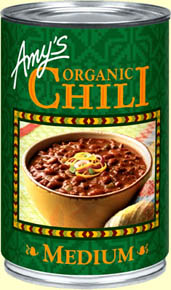
Yeah, I know it’s not a steak, but truthfully pizza is not a vegetable. Thanks for the thought anyway, dear. No worries, I have this lovely toast, made from Dave’s Killer Bread to go with my Amy’s Vegan Chili. Yay for portable processed food that not only tastes good, it’s good for you!

The wise vegan brings her own meals.

So now we are at the end of summer. School is about to begin and NaNoWriMo is just around the corner. I am not yet ready for NaNo, but I have my backup plan in place. I will get my 50,000 words, as always. I know what I have to do when my brain grinds to a halt and medieval warfare no longer rings my bells.

young frankensteinI Frankenstein it.

Yep! Some years at the end of November I have three different stories going in one manuscript. When I run out of ideas on one, I start another.  When it comes to getting your 50,000 words you have to do whatever you can. I stitch them together, using  a different colored font for each.

Using different colored fonts makes it easy at the end of NaNoWriMo to unzip the manuscript. Then when you are at a standstill on one work in progress you can easily move on to another.

Sigh.

The Boy starts first grade in only five days. I can’t believe summer is almost over.  It  feels like it only just began!

2 Comments

Filed under Battles, Books, Fantasy, Food, Literature, Vegan, writer, writing

It’s smart and clickable!

MH900314342As you know I have been working on the nuts-and-bolts end of the indie publishing business for a while now, but not really long in terms of my career. I only dove into this in 2011, and in the last two years of sometimes floundering I’ve picked up a few useful tricks.  One of the most useful in terms of a finished manuscript is how to create a table of contents for your eBook that is “clickable”, a Smart TOC.

When I read an e-book I really like it when I can easily navigate within the ms by using the hyperlinks embedded in the table of contents. This is a “Smart TOC” and is very easy to create when you are formatting your ms for publication.

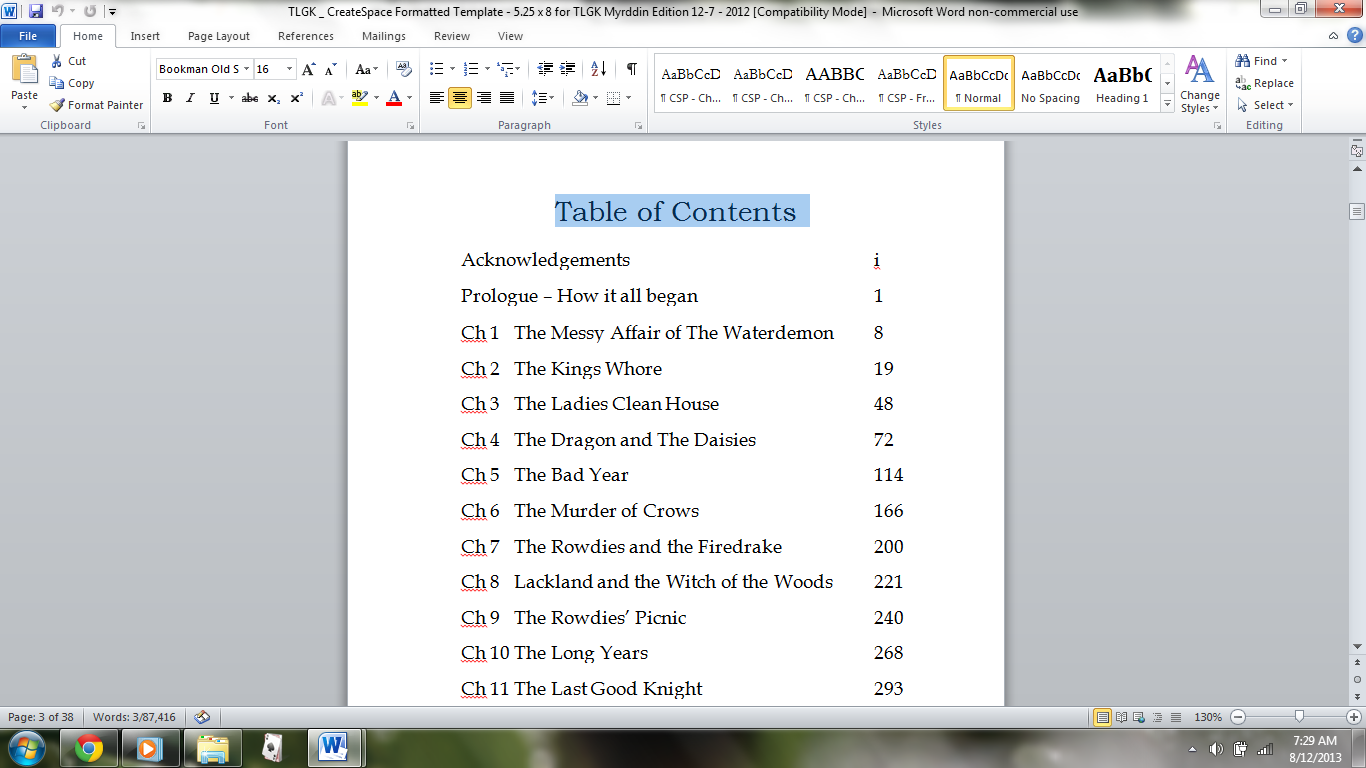
First make your table of contents. The one I am using for this is an old file for the original version of Billy’s Revenge, so ignore the page numbers. I didn’t know that page numbers are like prisoners—they just weigh you down! 

Your print manuscript will most likely not have a TOC as most novels don’t waste precious pages on such things. Technical manuals and textbooks must include a TOC, but every page you can do without when publishing your novel in paper form will keep the final cost down and make your paperback more affordable for your prospective reader. Very few people will pay $18.99 for a book by an unknown author.

prnt scrn SMART TOC 1

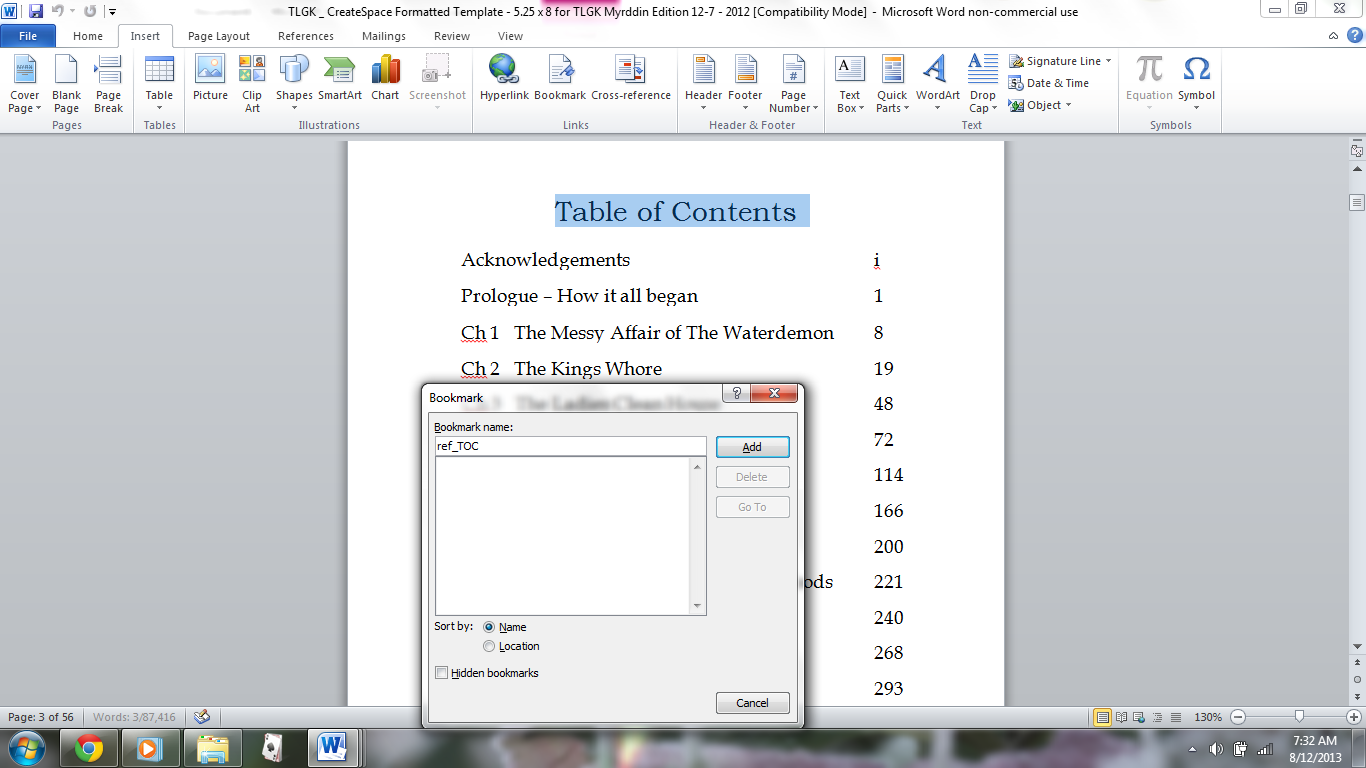
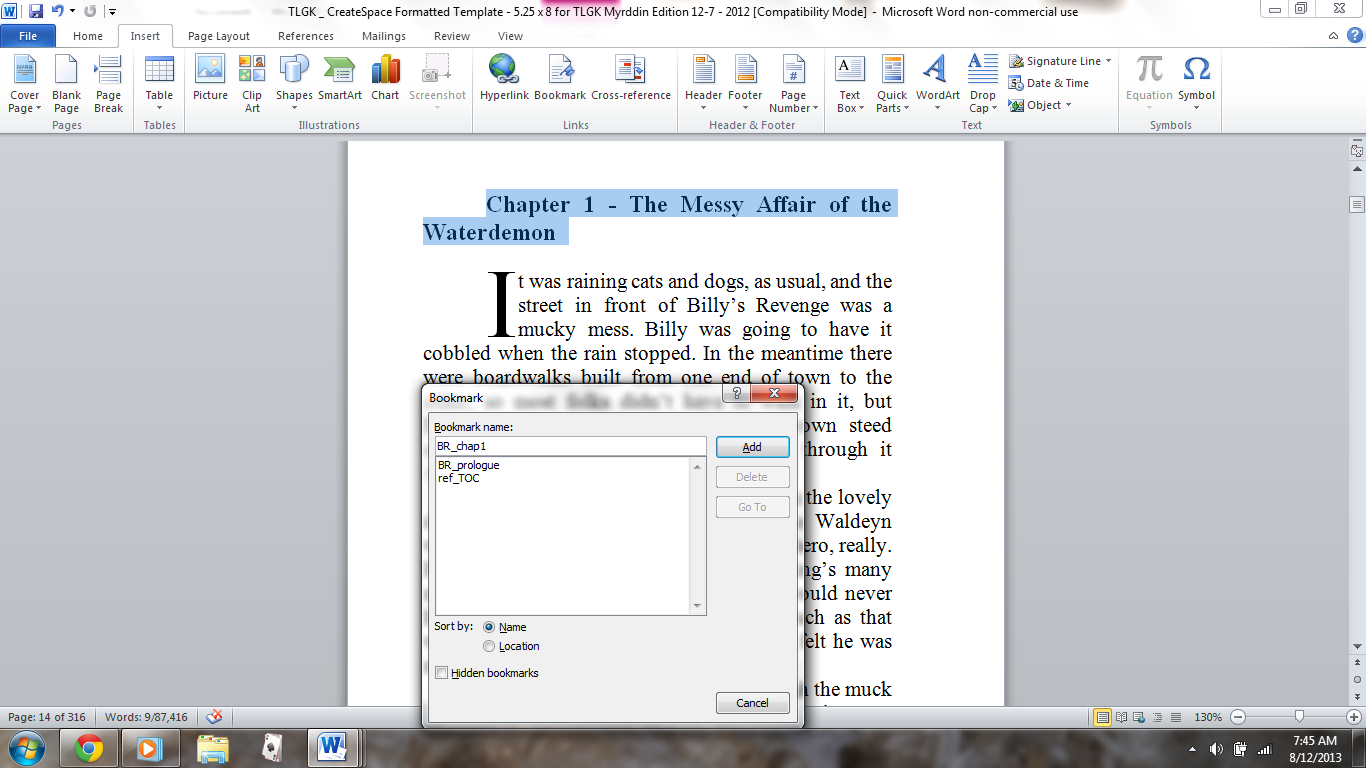
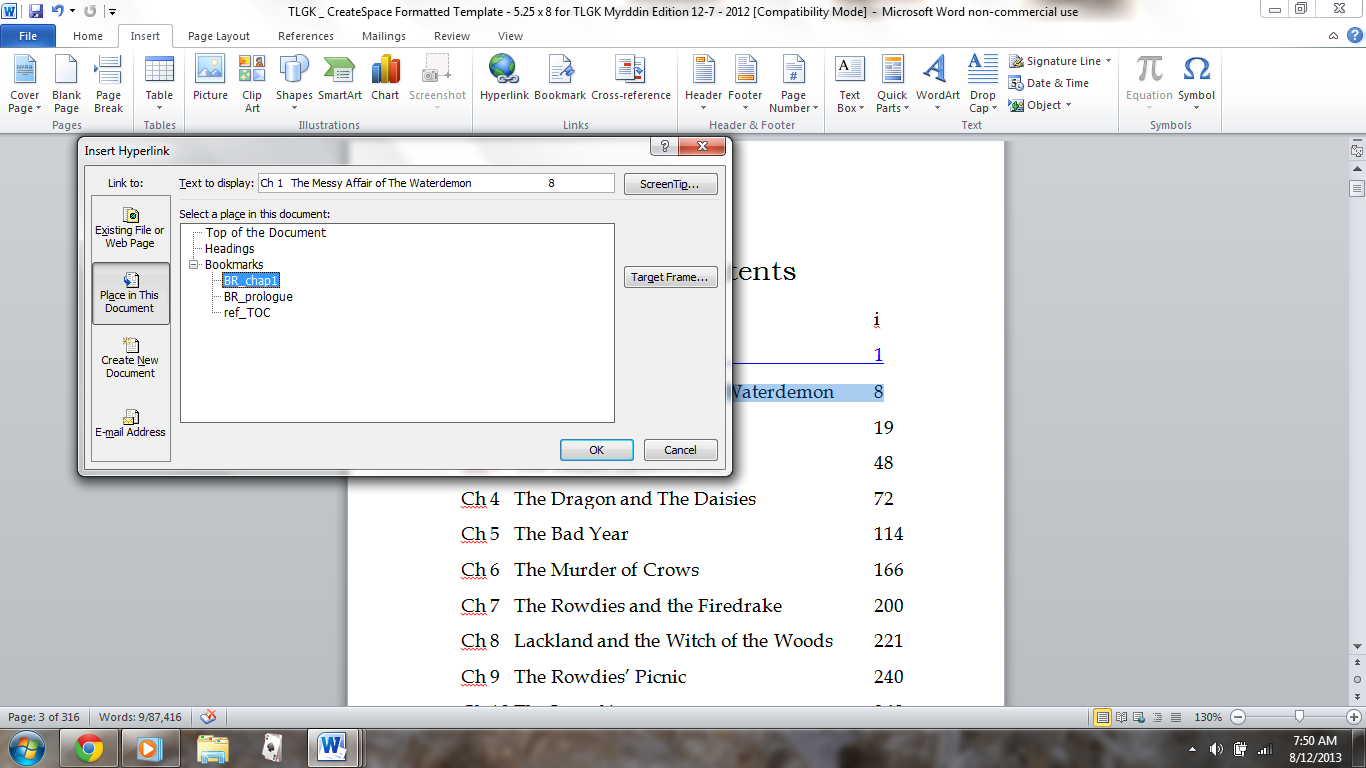
The first thing you want to do is create a bookmark.  First highlight the words  “Table of Contents” and then go to your ‘Insert’ tab.  Click on ‘Bookmark’ in that ribbon. Type in the words ref_TOC

Then click “Add”.  In every ms it is important to name the Table of Contents bookmark exactly that, including the underscore, because that’s what Smashwords looks for and it is simply a good practice to have a uniform system for naming files.  See the next picture for how it will look and ignore the page numbers:

prnt scrn SMART TOC 2

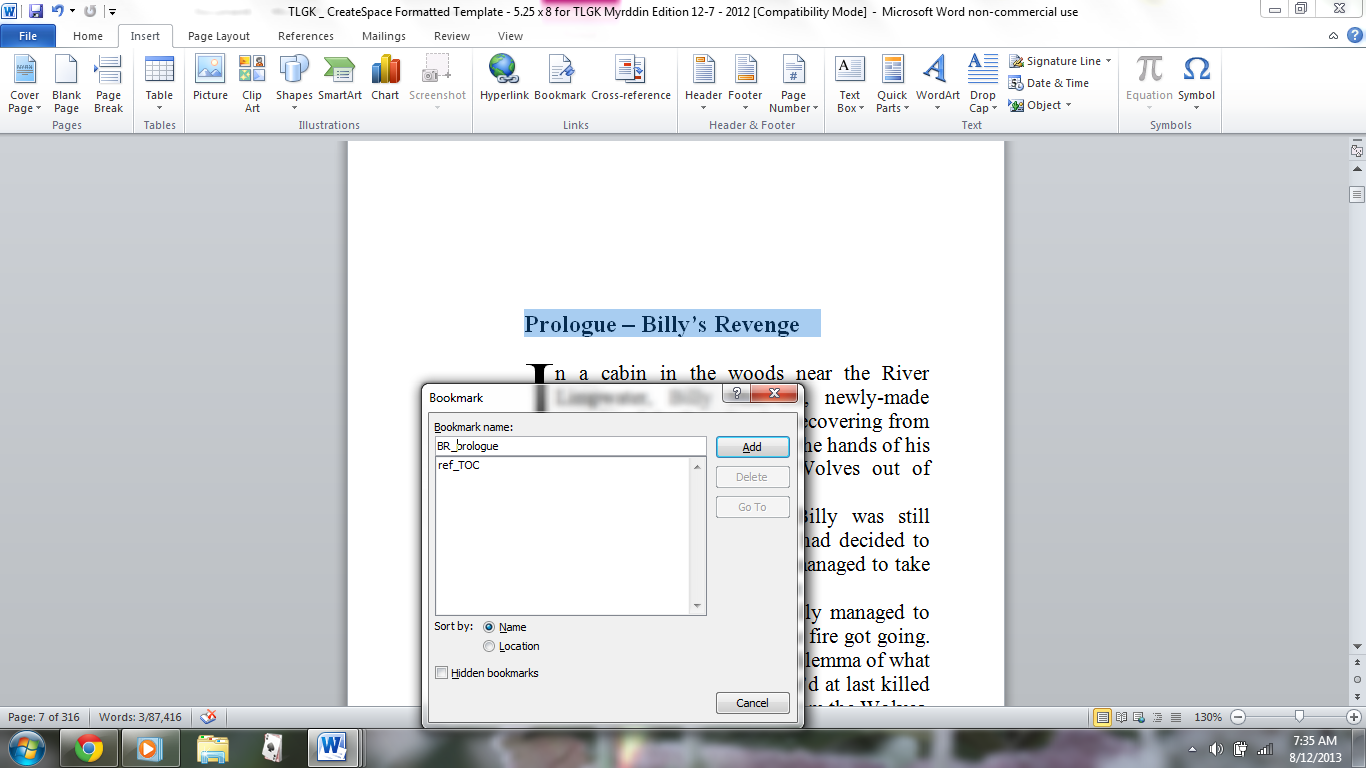
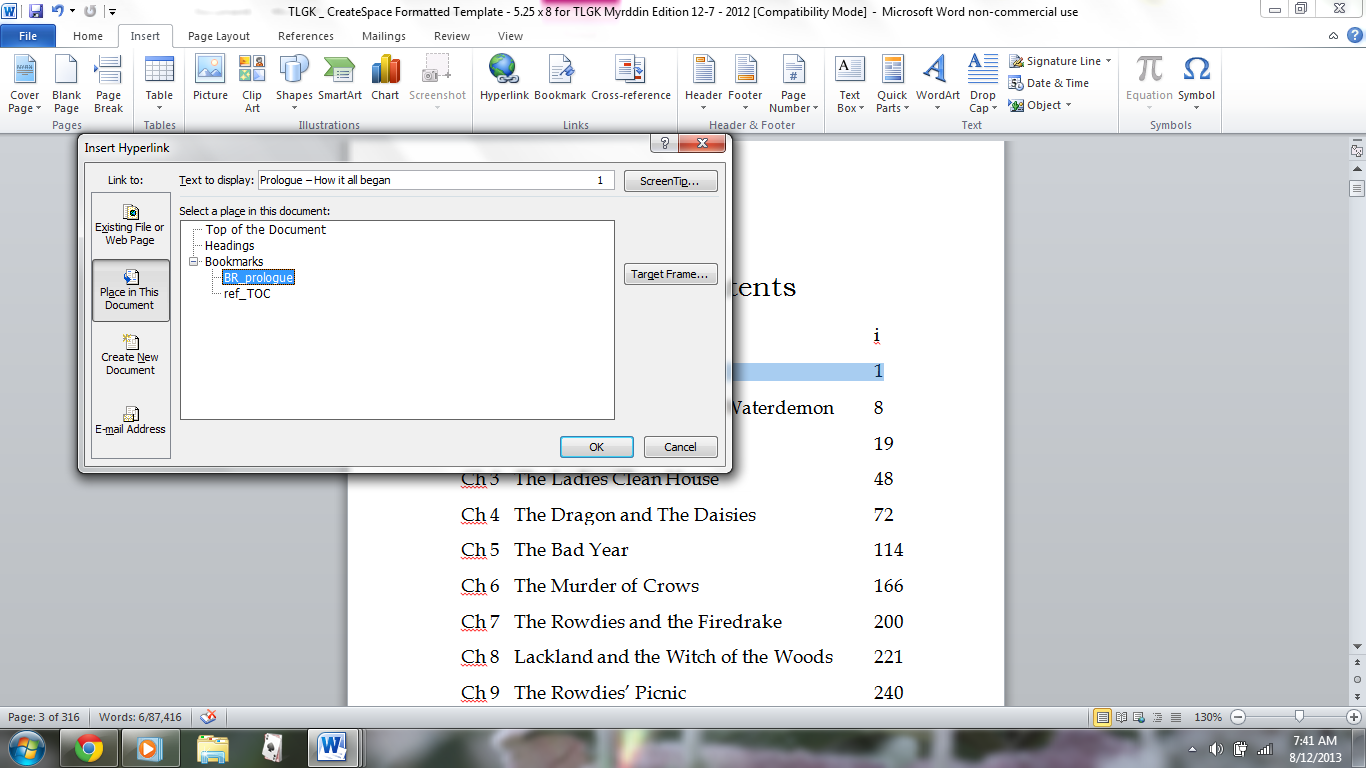
Now it’s time to bookmark  the prologue. Scroll down to your prologue and do it exactly the same way as you bookmarked the TOC, but for this ms let’s name it BR_prologue. You will name yours with your ms initials and the word prologue. If you have no prologue, skip this step.  See the picture below:

prnt scrn SMART TOC 3

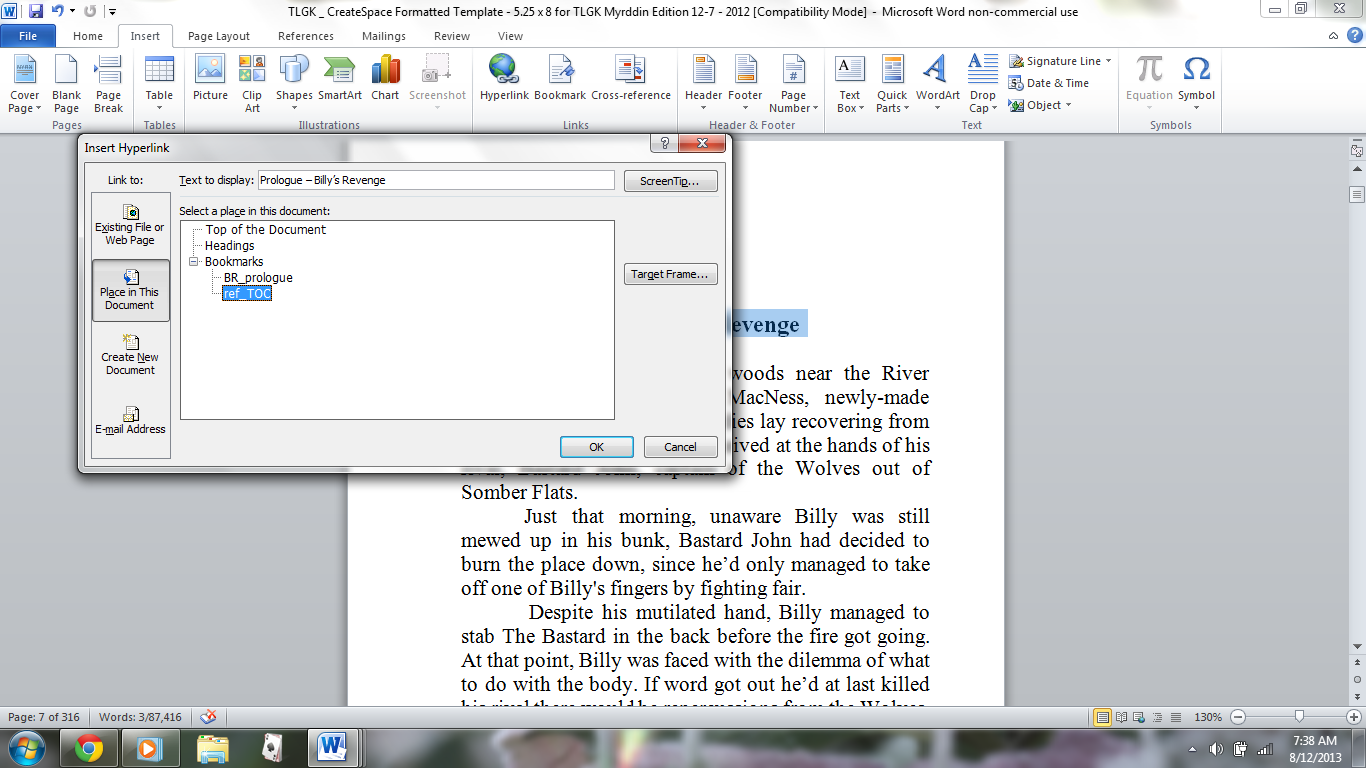
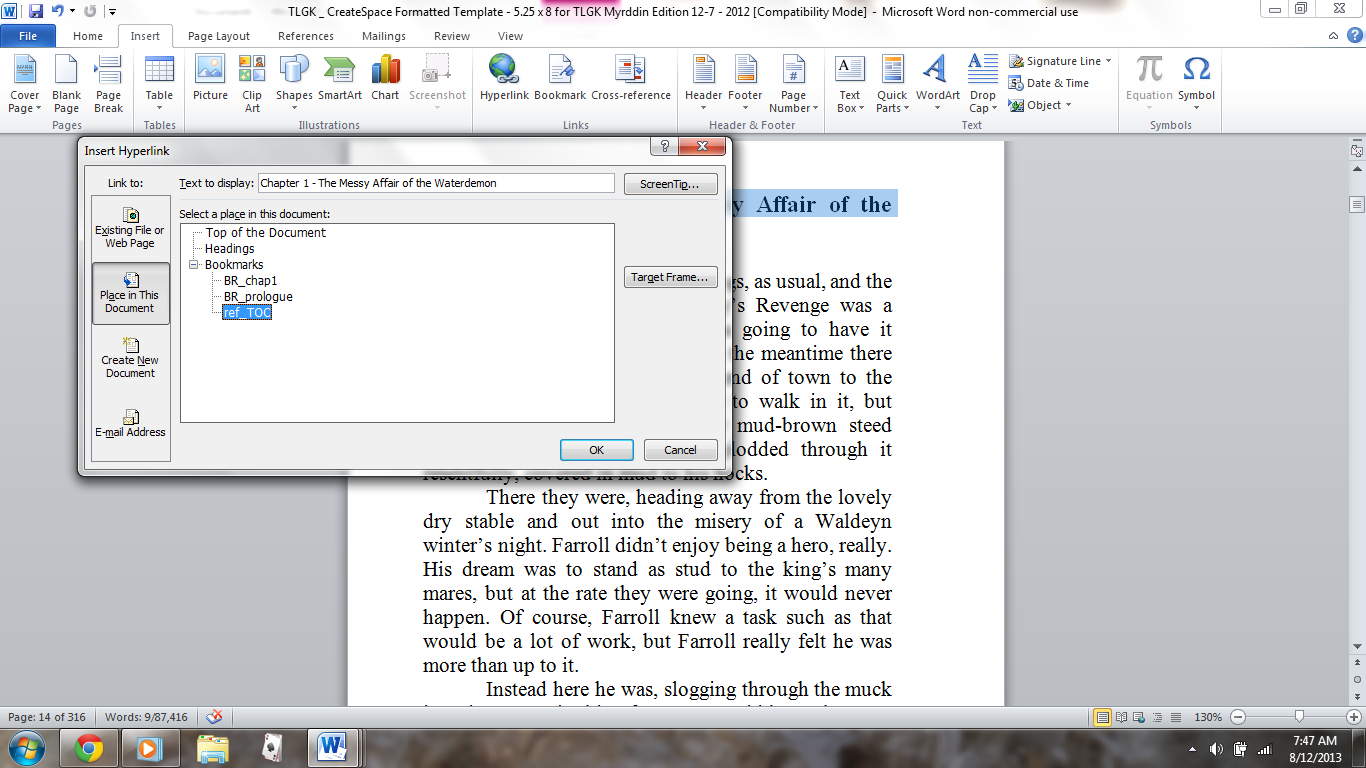
As long as you are there, with the chapter title highlighted, click “insert Hyperlink” on the ribbon. On the left, you want to ‘Link to:’  “Place in this Document”.  That will bring up your bookmarks. Select ‘ref_TOC’  and click OK.  This will turn your heading blue, which is called a ‘hyperlinky’. Press control and click on the link. it will take you back to the table of contents. Once you have used the hyperlinky it will turn purple. How cool is that! This is how that screen looks:

prnt scrn SMART TOC 4

Now that you are back at the Table of Contents, highlight “Prologue and click “insert Hyperlink” on the ribbon. On the left, you want to ‘Link to:’  “Place in this Document”. That will bring up your bookmarks. Select ‘BR_prologue’  and click OK.  That will turn it blue. Press control and click on the link. it will take you back to the heading of your prologue.

Do this for the entire table of contents, always remembering to link your chapter heading back to “ref_TOC”, and test each link as you go.  Four more pictures just to help you remember:

prnt scrn SMART TOC 5

prnt scrn SMART TOC 6

prnt scrn SMART TOC 7

prnt scrn SMART TOC 8

I hope this helps you in formatting your eBook manuscript. I just redid all my books so that they have Smart TOCs and will be building the TOC into my future manuscripts as I go.  This is an incredibly useful too to help you navigate within any long manuscript, and although I had used book marks before in the course of my work, I didn’t realize that the fancy TOCs I admired so in other people’s e-books was such a simple thing.

But that’s the way it always goes–things that seem like they should be hard are often the most simple, while something that should be easy turns into a drama of epic proportions.

Here’s to less drama and more simplicity! Learning how to format an e-book isn’t really that hard, and the wonderful people at both Smashwords and at Amazon have a lot of information freely available to you. Remember, as an indie, you are your own publisher, and what you put out there has to be the best you can make it.

Making use of the free information that is out there on the internet can only help you in this regard!

Comments Off on It’s smart and clickable!

Filed under Books, Fantasy, Food, Humor, Literature, Uncategorized, writer, writing

Hurricane Hilton

MH900175582Last week I attended a 4 day convention in Seattle where there were several glitches on the dietary front.

The kitchen at the hotel failed miserably on Thursday and Friday, but by Saturday they had figured it out at least for the final dinner.  In the meantime, there were a lot of starving authors sharpening their pens and busily writing culinary reviews that were less than glowing.

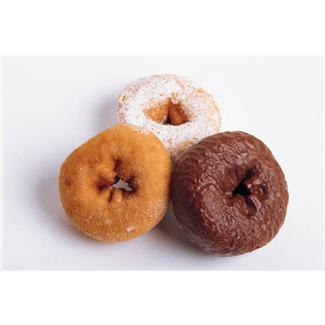
When we reserved our place in January, we were asked what dietary requirements we had, and were given many options.  The breakfast buffet was nothing but donuts, muffins and bagelsnone of which are vegan or gluten-free – options that were offered to registrants at the time of my original sign-up.

I am not gluten intolerant, but I am vegan, and not for moral reasons. I am vegan for health reasons, as I get horribly ill from eating even small amounts of meat and dairy. So, when I realized there was NOTHING for breakfast or lunch that I could eat, I figured I’d just go to the restaurant and order side dishes off the menu. I have usually found that to be an option that works for me. After all, hash browns and steamed veggies are usually easy for the kitchen to turn out.

MH900400553When faced with a simple request, such as, “Can I have veggies sautéed in olive oil instead of butter please?” or “May I have my toast with no butter, please?” the waiters and waitresses got the deer-in-the-headlights look.  

I know what it’s like to be faced with a horde of prima donnas who think they should have special treatment.  I worked in the food service industry as both a waitress and a dishwasher, and I was a hotel maid for 12 years, actually, during the Reagan and Bush Sr. years. That was one of my 3 jobs. I was also a free-lance bookkeeper and a darkroom technician during those years. Three part-time jobs kept the kids fed and the roof over their heads, right?

Trickle down economics didn’t always trickle down too far.

It’s amazing how many hotels and restaurants are not prepared for guests with strange dietary needs like those weirdo hippy-freak vegans.

I get it, and I understand it.  I left good tips in the VERY expensive coffee shop anyway, because everyone did their best, and why be more of a pain than you have to be? My fried spuds and steamed veg averaged $15.00 to $20.00 per meal for breakfast and lunch for 4 days. Hurricane Hilton blew through my wallet leaving behind a budgetary disaster.

curry and sweet potato soupBut in this case, I was not the only hungry author there.  There was little concession made for any of the other people who’d been offered diet options, including the carnivores.  In fact the first three days were total catering catastrophes, and hardly anyone was pleased with the pathetic offerings.

By Friday, things were looking up for me but the Carnivores were starving. The catering team had gotten the 3 vegans at the convention served, and the plate they put in front of me was lovely.

Yep. There I was alone, surrounded by starving authors, armed only with a plate of grilled asparagus.

The carnivores were all looking at my veggies covetously. Irene Roth Luvaul suffered worse than me. She was told that  A: they had run out of food, and B: they weren’t going to cook any more. 6 people at our table were yet to be served.

Irene is an editor. Did I mention that? Just in case I didn’t, I will just say it’s bad juju to cross an editor. And the room was full of them.

There was blood in the water.

The announcement that no food would be forthcoming didn’t fly well with the comma-Nazi. Irene said, “What do you mean, you aren’t going to cook any more food?” Her clipped Texas tones could have shaved the fur off a cat at fifteen feet, they were so sharp.

This was the voice of the woman who edited briefs for the Texas State Supreme Court. She wrangled lawyers for a living.

The server brought her a plate of cold ravioli in pale tomato sauce.

Faced with a resounding plea-bargain, Irene desperately wished she was a vegan, and eyed my asparagus with longing.

However, by Saturday night the catering staff had redeemed themselves beautifully with a lovely, well-prepared meal that even the gluten-free authors were pleased with, along with copious quantities of decent wine, proving that giddy, well-oiled authors are a bag of fun.

Despite near starvation, it was a fun week, and meeting Greg Bear was awesome. But making new friends and connections with both sides of the industry was the best part of this for me.

4 Comments

Filed under Battles, Fantasy, Food, Literature, Uncategorized, Vegan, writer, writing

Life Goes On, Maybe

Office Workers Clapping at Office PartySometimes you are going along just fine, flying like the wind and living the dream. Everyone loves you–you are riding high. Then the gods of perversity decide you’ve been having way too much fun and decide you need another one of those little reminders of your own mortality.  Perhaps you said something that offended someone, perhaps you didn’t say something you should have.

Perhaps you were less than kind when you should have been generous.

It appears to be an unfortunate fact of life in our society that when someone in the public spotlight appears to enjoying their success too much (Paula Deen, Frank Gifford), the carrion-eaters gather about them, waiting for them to stumble, plotting their downfall, desperate to be part of the feeding frenzy that is sure to follow.  That which passes for ‘news’ at 6:00 is frequently little more than juicy gossip and holier-than-thou finger-pointing by people with something to gain from the debacle. To me, the personal failings of public figures is not news, it is a terrible glimpse into someone else’s life that I wish I had never seen. People do wrong all the time–how can that be news? It reminds me of my mother and my Aunt Jo gossiping at the kitchen table about some neighbor caught with their pants down.

Eye on Flat Panel MonitorTo me, the real news isn’t that even famous people do cringe-worthy things.  The real news is on a more global scale. The real news never gets any airtime, because the real news-makers have the power to see to it that the populace is spoon-fed pap like who used the ‘N’ word (which is most certainly NOT cool) or who has been cheating on his wife (also not cool.) While I agree these are not good things for anyone, much less respected public figures, to do, I simply feel it is gossip and not news. This is the sort of thing that better belongs in scandal-rags like People or The National Enquirer.

In the US we have a free-press.  This means what you see on the television is what the big corporations want you to see, since they own the press, and it ‘s a free country, after all. We hear little of the real news, mentioned only in passing, such as the recent proposal for a  regulation by the European Parliament and of the Council. This proposal regulates the production and availability on the market of plant reproductive material (plant reproductive material law.) (Seeds.)

What this proposed law says (quoted from The Real Seed Catalogue):

The law starts from the premise that all vegetables, fruit and trees must be officially registered before they can be reproduced or distributed. This obviously is a major restriction on seed availability, as there are all sorts of costs in both time and money dealing with the bureaucracy of a central Plant Variety Agency. Then, after making that the basic rule, there are some exceptions made in limited cases:

  • Home gardeners will be permitted to save and swap unregistered seed without breaking the law.
  • Small organisations can grow and supply unregistered vegetable seed – but only if they have less than 10 employees
  • Seedbanks can grow unregistered seed without breaking the law (but they cannot give it to the public)
  • There might be easier (in an unspecified way) rules for large producers of seeds suitable for organic agriculture etc, in some (unspecified) future legislation – maybe.

There are also clauses that mean the above concessions could be removed or reduced at any time in the future without coming back to the Parliament for a vote.”

MH900438728Who benefits from this law? Only the ten largest seed companies in the world, who also just happen to be the largest pesticide producers in the world.

1.Monsanto (US)
2.DuPont (US)
3.Syngenta (Switzerland)
4.Groupe Limagrain (France)
5.Land O’ Lakes (US)
6.KWS AG (Germany)
7.Bayer Crop Science (Germany)
8.Sakata (Japan)
9.DLF-Trifolium (Denmark)
10.Takii (Japan)

Source: ETC Group

Variety in our seed crops is an absolute must, if we are to have strong, healthy sources of food. Genetically modifying crops so they are resistant to certain chemicals (patented, produced and sold only by these companies) and creating a monoculture food chain is not beneficial to the world, no matter how these companies proclaim their charitable desire to feed the world.  If they truly did care about that, they would not be trying to put the small farmer out of business. If their motives were truly as benevolent as their propaganda declares them to be they would be supporting and encouraging small farms, not putting them out of business and destroying entire cultures.

I leave you with this quote from the Daily Mirror–oddly enough I did find ‘news’ in a newspaper!

MH900438718“The social impacts of large-scale monocultures are often disastrous for communities who continue to grow local foods using sustainable practices. Small-scale farmers often cultivate local species which not only contain important minerals for the soils and for human health, but also have adapted to the local environment over many years.

When small-scale farmers are confronted with industrial large-scale monocultures in their area, they are faced with water and other resources shortages, contamination from pesticide spraying and from GMO crops.

The takeover of land by monocultures also causes rural depopulation, destroying local community life and local economies. Monoculture plantations usually provide only temporary labour, for which workers are often hired from outside the region. Land grabbing and forced evictions of local populations are strongly linked to the expansion of monocultures.”

This, to me, is the real news.

I leave the gossip to the corporate news giants who cultivate it as a way to divert our attention from the true threats to our existence, and to those who find pleasure in watching others fall from grace.

2 Comments

Filed under Adventure, Books, Epilepsy, Food, Literature, Vegan, writing