Category Archives: Humor

Thoughts on Internal Monologues

Young Woman Sitting Looking at Laptop ScreenI had a conversation with a friend in my writing group the other day. He paid for an expensive edit, but was not pleased with the results. The editor gave his ms only one fairly good look, and gave him a report with suggestions and ideas, but he was left more confused than ever. She has not worked with him to help him resolve those issues, and wants to be paid for a second look. This was more of a beta read than an edit, and that fact should have been disclosed when he hired her.

The professional editors I know do expect to be paid for their work, but they also work closely with the authors to help their clients turn out books that are finished to the best of their ability, thus giving the author their money’s worth. This involves many revisions of entire sections and lots of back and forth communication between the editor and the author.

When I looked at his ms, I could see one thing that stood out immediately.  His characters have a lot of internal dialogue. The editor told him not to set it off with italics, and technically she was correct, but she offered no insight to him on how to correctly portray his character’s thoughts. Unfortunately, with no way of distinguishing it, I found it difficult to differentiate the internal dialogue.

Now don’t get me wrong, the editor was technically correct. The  Chicago Manual of Style agrees with her, and in some ways, so do I.  As a reader, a wall of italics is daunting, and causes the eyes to get tired. If she was truly acting in his best interest, she could have shown him ways to get around the whole issue of internal dialogue, instead of just saying don’t use italics.

But I do use italics to set off certain thoughts in my own work, so how do I balance this apparent hypocrisy?  I have learned to use less internal dialogue, trying to only use it now when it is natural in the context of the scene.

As I look at my body of work, I can see it evolving toward a leaner style of writing, and less emphasis on idle thoughts is key to that style. My early work is rife with internal dialogue. In my recent work there is some internal dialogue, but not as much. The context of the story determines whether it is necessary or not.
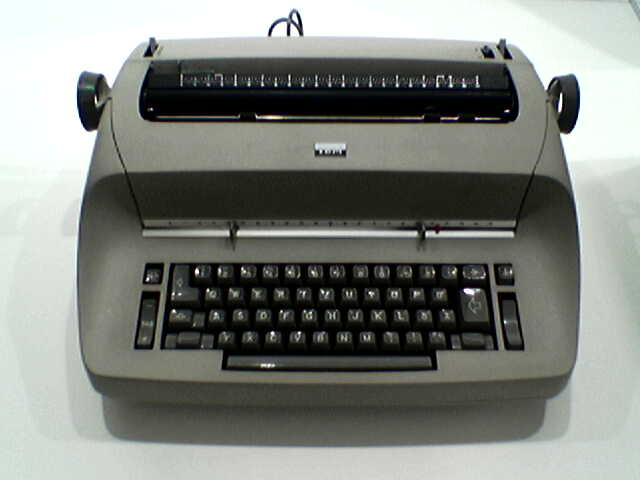
IBM_SelectricIn the days before computerized word processing and desktop publishing, the publishing process began with a manuscript and/or a typescript that was sent to a print shop where it would be prepared for publication and printed. In order to show emphasis—to highlight the title of a book, to refer to a word itself as a word, or to indicate a foreign word or phrase—the writer would use underlining in the typescript, which would signal the typesetter at the print shop to use italic font for those words.

Nowadays we have word-processors.  Authors can italicize to their hearts’ content and the ms will not be full of underlined words that distract the editor.  This has lead to some authors being a bit too free with italics, and I have been guilty of that.

The important thing to remember is that everything your  main characters think does not have to be written. When it is necessary, there are ways to get it across without resorting to italics except in the most important instances.

Indie author Karen Fox has an awesome post on common mistakes made by authors.  She says, (and I am directly quoting from http://www.karenafox.com/commonmistakes.htm,)

(Interior Monologues are) very important in writing. Reveals parts of the story not available through dialogue. A powerful way to establish character, but often overwritten. Again don’t explain if emotions or details are already shown through dialogue or action. This should be unobtrusive. Long passages of internal monologue often become ways of telling the reader information instead of showing.

One way to do this is to get rid of speaker attributions. Instead of Why had she said that? Because he drove her crazy, she thought, use Why had she said that? Because he drove her crazy.  He wondered what he’d done to make her leave can be transformed  to What had he done to make her leave?

Interior monologue helps set point of view. It is not the same thing as description, though the two can blend together.  Use impressions obtained through the POV character’s senses.  We use our sight, hearing, smell without thinking about it.   Your character will, too.

You can use italics to show a character’s thought, but use sparingly. Too many italics are irritating, but they can be a good way to set off a more important thought in the middle of a monologue.”

MP900321209Internal dialogue is necessary, but not if it is a crutch.  Authors tend to be lazy. Once we find an easy way to get a point across it becomes our go-to tool when a particularly tough scene is refusing to unravel for us. We tell ourselves it is “our voice” and therefore it is our style.

Yes, that can be true, but we must never rely on easy tricks to tell our stories.  Readers always notice, and it makes our work less enjoyable for them.

8 Comments

Filed under Adventure, Books, Humor, Uncategorized, Vegan, writing

Pub Crawling at Billy’s Revenge

800px-Southampton_Medieval_Merchants_House_kitchenOne of the things I find most entertaining about writing is putting myself mentally into the environment of the tale.   Currently in the works are 3 tales that take place, for the most part, in a wayside inn called Billy’s Revenge.

I love this place!  Billy Ninefingers, tall, genial and a bit dangerous runs a well-oiled machine. (Who doesn’t love a gorgeous man with an air hinting of danger about him?) Billy keeps the place running like a top and keeps his mercenaries, the Rowdies, working. Without Billy Ninefingers, there would be no town of Limpwater.

Billy needs to find some way to remain captain of the Rowdies and he hits on the notion of building his inn out in the middle of nowhere, a full day’s ride from the nearest town. His old family farm just happens to sit at the perfect place on the main trade road, smack in the middle of the most dangerous stretch. Lackland tells Billy right after the incident that maims his right hand and costs him his finger that if he builds his inn, a town will grow around it, and of course, Lackland is right.

The_Victorian_Kitchen_at_DalgarvenWhen Billy Ninefingers’s tale begins, we find him cooking in an old traditional farmhouse kitchen exactly like the one in the above picture. Billy is already cooking for a large group of mercenaries and realizes that even with hired help it will be difficult to provide all the services he wants to in a traditional kitchen, so he and Gertie the Smith (who is pregnant with Billy’s late father’s child) design an efficient kitchen with all the most modern of conveniences, more like the one in this picture, only much larger.  Achieving that in rural Waldeyn, using the materials and skills available to them is costly and frequently hilarious.

When I get stuck for inspiration I go to Wikimedia Commons and look up images that might relate to my tale–architecture, clothing, how they picnicked pre-modern times, anything that might give some idea an emerging culture might use when they stand at the beginning of an industrial revolution, as renaissance Europe did in the sixteenth century.  It’s a lot of fun, and I’ve learned that the really wealthy Elizabethans had access to some things we consider modern, such as indoor plumbing and stoves that not only heated their food, but also heated a cistern so they could have hot water.  These technologies were in turn based on Roman technologies.

On the surface, Billy appears to be an ordinary, if extremely large, man, but still waters run deep, as we often say. Most people passing through Limpwater and stopping for the night at Billy’s Revenge think brewing ale and serving cider is all there is about Billy, but they couldn’t be more wrong.  Billy is like any other mercenary, full of secrets and things he wishes he’d never seen. One wonders what is behind the name he chose for his inn–there’s a tale there, and when I’ve finished with the rewrite of The Last Good Knight, Billy will have his own stand alone tale.  The basic tale is drawn out already, and I’ve written perhaps 40,000 words, outlining the whole story-arc.

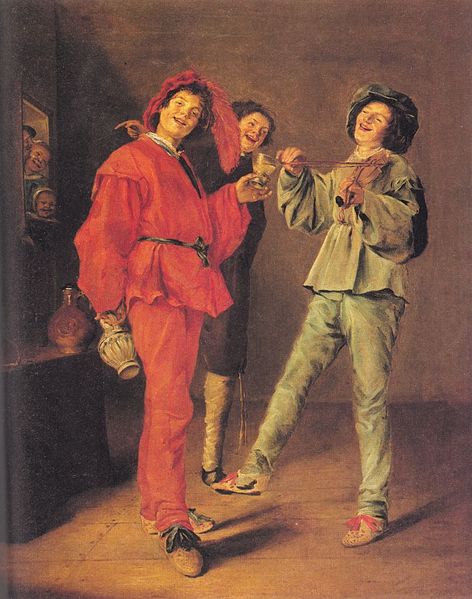
472px-Judith_Leyster_Merry_TrioSprinkled throughout the common room at Billy’s Revenge are many well-dressed men and women, none better dressed than those who wear the armband of the Rowdies. After all, what does a mercenary have to spend gold on, if not clothes and jewelry? Bert the Tailor, a former Rowdy who lost his leg to a highwayman’s sword keeps the men of Limpwater in shirts and breeches, and fine surcoats. With his wife, he employs several men and women to  dress the town of Limpwater in style. He would never have had such an opportunity if not for Billy Ninefingers building his inn out in the middle of the forest.

379px-Gustave_Jean_Jacquet_Girl_in_a_riding_habitDesigning the clothes and armor for the Lady Rowdies was a great deal of fun.  I had Gertie Smith team up with Bert’s wife, Lovely Ethel, the local dressmaker and also a retired mercenary to make my ladies their clothes and their armor.  We women of Limpwater are the most stylish women in any alternate reality!

Full, divided ankle-length skirts over high-heeled riding boots show nothing a lady doesn’t want to show, and emphasizes everything she wishes to flaunt. Ethel makes their bodices specifically to be worn under mail or armor, and yet stylish and very flattering in every way when the lady was not armored. Her surcoats are to die for, completely hiding the fact the lady is armored, and each of the ladies owns at least two of the embroidered creations. The dressmakers at King Henri’s court blatantly copy Ethel’s designs, but her flair is evident despite their best efforts.

BrewCh1When you set a tale in a common room, such as at Billy’s Revenge, kitchens and clothing are a huge part of the story, even if they are only mentioned in passing.  Knowing the environment we are writing in is crucial, even if we are melding (as I am) the Renaissance, Victorian, and Medieval eras into one collage of a world, and throwing in a bit of Waldeynier majik and a few impossible creatures of monstrous proportions.

Along the way I’ve learned how to brew hard cider the way our forefathers and mothers brewed it, and I learned to appreciate just how amazing and clever people really are.

Reading is an adventure when the research doesn’t get in the way of the tale, when it is there as an indefinable part of the background. I hope that when  Lackland’s tale is finished, the flavors and scents of the first version of Billy’s Revenge will still be there, welcoming us and leading us to a warm corner for a mug of ale or cider, and a bowl of stew.

8 Comments

Filed under Adventure, Books, Fantasy, Humor, Literature, Uncategorized, writing

June-uary Sucketh

clouds ms clipartHere on beautiful Puget Sound we are known for our depressing gray skies and eternally soggy weather. The lead up to the 4th of July is always hard for me, because it is cold and damp, and I find myself champing at the bit to see some sunshine. My husband and I have even been known to be so desperate for a little sunshine we jump in the car and drive to Eastern Washington, not stopping until we find the sun. That usually happens just as we arrive in Yakima, 3 hours later.

The patch of blue is a brief, cherished moment as that month known around here as June-uary gets into full swing. You plan a picnic, but only where there may be shelters.

weatherThe chance of sunshine is a chance we will take. We wear shorts and sandals with grim determination, convinced we can embarrass the sun into shining.

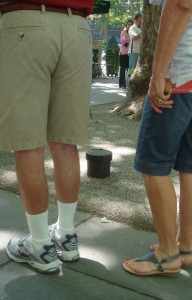
SocksIt probably won’t happen, no matter what color socks I wear with my sandals.

The sound of rain sizzling as it hits the cover of the barbecue is the music that tells us sunshine is just around the corner. Of course, we know the chance of rain on our 4th of July celebration is great–75%–we still go blue-tarp camping and drag the miserable dog out for a day at the beach whether he wants to go or not.

Then magically, on the 5th of July, God “flips the switch” and summer arrives, with heat no northwesterner can bear. “Gawd it’s hot! It’s got to be 75 degrees! Poor Earl is melting, we have the fan going on him. He can’t take the heat, you know.”

SOCKS-AND-SHORTS-192x300For those of you civilized folks, 75 degrees Fahrenheit is about 24 degrees Celsius.

Yup.

We have a narrow comfort range here–68 degrees to 75 degrees is about the limit.

I’m not sure where I’m going with this post, but I’m going in style.

2 Comments

Filed under Books, Fantasy, Humor, Literature, Uncategorized, writing

Fabulous Fibs

The BoyAs I write this, my grandson–The Boy–is holding an action figure of Mr. Freeze and a whole scenario is being played out:

Mr. Freeze and Spider-Man have teamed up.  They’re off to rescue Darth Vader, who has been kidnapped. Much screaming, and the sounds of bullets ring through the dining room.  The Boy leaps onto his scooter and races to the play-room, desperate to save Luke’s father.

My daughter’s house is being remodeled, and once the new floors are in, there will be no more scooter or skateboard in the house.  Frankly, I can live with that, but on the other hand, scootering about the place does keep him busy when it’s too cold and rainy to play outside.  June in Snohomish can be quite chilly and damp.

Early_razor_scooterEven so, I just find myself cringing as The Boy flies by the cherry-wood dining room table perfectly avoiding nailing a chair, cutting the angle fine. He narrowly misses every obstacle in as professional a manner as any pro athlete.

You would think the furniture would be a scarred and wretched mess, but it’s not. The Boy has talent.  I’ve gotten to the point it only bothers me when he sails too close to the dog. Neko glares at him, but for the most part she tolerates it too.

Darth_VaderThe whole point of this mental meandering on my part is how amazing I think his imagination is.  The Boy’s creativity is non-stop, and it never ceases to amaze me. He tells me fabulous fibs and swears they’re the truth, then admits it’s a story he would like to write. “Or maybe I’ll make it a movie. Like Star Wars or something.”

That makes Grandma happy!

If only Grandma had that sort of imagination!

Here I am, with four heroes about to embark into the snowy north, and I’ve no idea what to do with them.  They’re too smart to get frostbite, and that’s really not so glamorous to write about.

Handsome Hero limped, wincing with each step. His frost-bitten toes were swollen and painful. He worried that gangrene would set in, and he’d have to amputate his own foot. 

Meh.

Although…an occasional amputation could liven things up a bit.

Sharpen your sword, Handsome.

2 Comments

Filed under Adventure, Humor, Literature, Uncategorized, writing

Java and Imaginary Heroes

EspressoOnce again I am preparing to get in the car and trundle up the highway. Going north to Snohomish.  Gotta love that town!  They have a great new coffee shop, Rock City Cafe, where the owner roasts the day’s coffee every morning. I like to go there and write in the evenings.

As a true northwesterner, I love the artisan coffees we have available all up and down the Puget Sound.  When I am in Olympia, I go to Batdorf and Bronson coffee roasters for the ambiance and the brew.

The hard part of all this traveling is being away from my home and my husband. But, as with everything, we are committed to helping our kids as well as we can.

We have a Blended Family, three from my previous marriages and two from his. Together we have three daughters and two sons. Daughter 1 is 39, Daughter 2 is also 39, Son 3 is 37, Son 4 is 35, and Daughter 5 is 29. All but Son 4 have provided us with lovely grandchildren, two of whom are providing us with great-grandchildren.

Spike-wavesOur kids don’t need monetary help, but, as I have written before, two of them have epilepsy. The oldest by 3 months, Daughter 1, has seizures that have only once progressed to the Tonic Clonic stage.  Hers are more a matter of her going away for 3 to 4 minutes and then picking up right where she left off.  Her new meds are working perfectly with no allergic reactions, and if her EEG continues to look good, she will be able to resume driving in August. But right now, she needs help getting around as public transit does work well for where she needs to go. I go north every other week for 3 days and babysit her 6yr old and try not to be the pain-in-the-arse mother-in-law.

Son 4 is unmarried. He has seizures that manifest themselves in the Tonic Clonic form. Since his last episode he is doing really well.  The fact is, he doesn’t have them if he simply takes his meds. He has them if he doesn’t.

He is on board with his neurologist and is taking his meds.  His EEG looks good too! He has excellent public transportation where he lives, and is well enough employed he could take a cab to work if he chose to. I only need to drive him when it is something complicated.

We are fortunate to live in a time when the medical community has achieved some progress in both understanding this array of conditions we call epilepsy. My family is fortunate that there are effective medicines they can take that don’t turn them stupid, and that they aren’t allergic to.

We know this condition that two of my children share is from their father’s side, as our other 3 children don’t show any symptoms. Their father’s side of the family was quite secretive about some things, and with good reason. As a society we are only now emerging from the Dark Ages when it comes to epilepsy, just within the last 20 years.

Even though I hate the drive, I love being needed. Daughters 2 and 5 and Son 3 don’t need help, so my participation in their lives is by invitation only. I respect that, and encourage it, as I have my own life, and know what it is like. Nevertheless, when your children are well-grown and living productive adult lives it is easy to lose that feeling of being connected to them. That can devolve into a feeling of loneliness and self-pity.

I am so NOT that mama.

In my early twenties I dealt with in-laws who couldn’t let go, and who made my life a misery, so I could never do that to my sons-in-law.

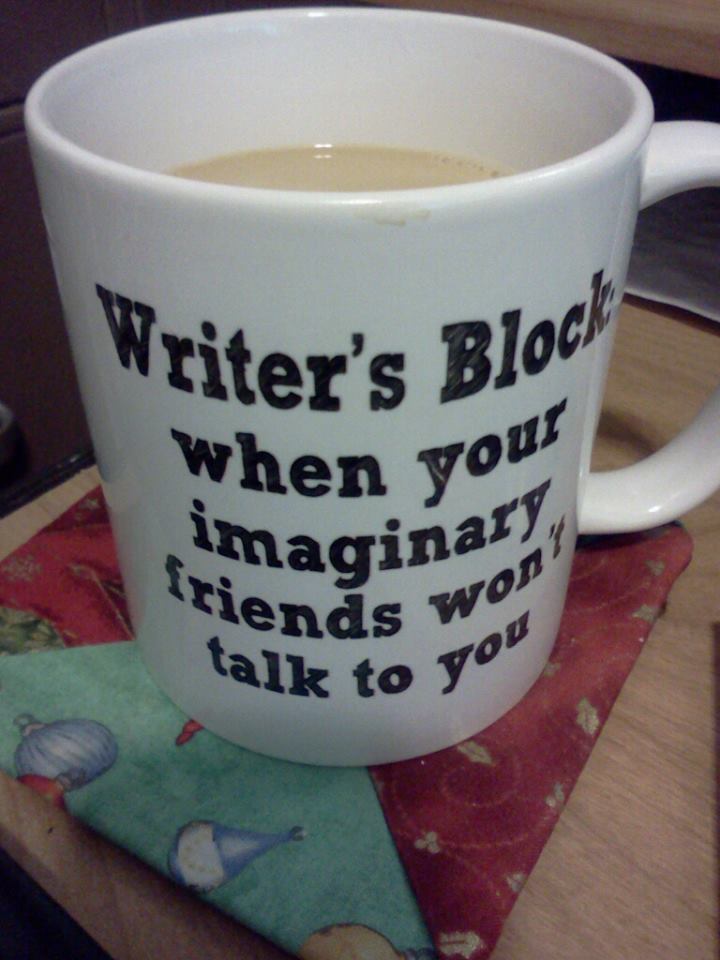
My Coffee Cup © cjjasp 2013Fortunately for them, I have my imaginary friends, and my fantasy life so I don’t really have time to hang around moping and feeling neglected.  The minute someone comes home to take The Boy off grandma’s hands, I am out the door!

Grandma has a coffee bar to go to, and four hunky, although quite imaginary, men who need to be told what to do! Leave the door unlocked, she’ll be staggering in about the time they shut the place down for the night.

Yes.

I’m THAT kind of grandma.

9 Comments

Filed under Adventure, Books, Dragon Age, Epilepsy, Fantasy, Humor, Literature, writing

Facebook–A Squirrel Ran Through It

After looking at my Facebook page today I am overwhelmed. So many random thoughts are piled up in my forehead I don’t know where to begin.

41TxMnE1AjL._BO2,204,203,200_PIsitb-sticker-arrow-click,TopRight,35,-76_AA278_PIkin4,BottomRight,-70,22_AA300_SH20_OU01_First, Dean Frank Lappi has rereleased his epic fantasy-horror, Black Numbers, along with a sequel, Blood Numbers.  The Aleph Null Chronicles has to be the most unique fantasy series ever written.  This book is not for the faint of heart, or for those who shy away from explicit and at times, violent sex. Yet the sex is not for prurient purposes–Lappi’s magic is created by melding high mathmatics (the sort that explain the universe) and that most powerful of human drives, sex. I have been waiting for more than a year for this, and I guess you know what’s on Grandma’s Kindle today!

Then, there was a hilarious post by a fellow Olympia area author, Elizabeth A.. It was a link to a blog called “Death and Taxes”, and the post is called “18 Obsolete Words Which Should Never Have Gone Out of Style.” 

They are all just so awesome, it’s hard to pick my favorite! I do think “Snoutfair: A person with a handsome countenance — “The Word Museum: The Most Remarkable English Words Ever Forgotten” by Jeffrey Kacirk” is a real winner.

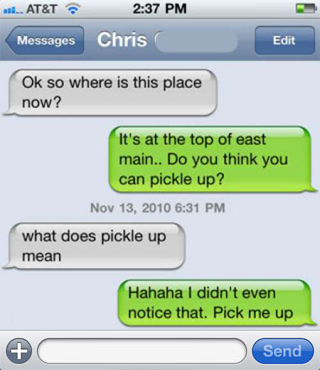
pickleupAlso there were the usual snarky, funny pictures that make the rounds.  So many posts by so many people, all intent on chatting…. If I’m Facebooking on my phone I’m in trouble. It takes me ten minutes to accurately text “On my way” so a readable post by me is out of the question. I do end up with some awesome auto-fill errors.

I love Facebook as much as I hate it.  It is a vast, time-sucking black-hole at the center of my universe, but some of the things I run across are just so hilarious.

Some things are really thought provoking. Today there was the blog post by Traci Tyne Hilton on being a writer and other people’s perceptions of you. It’s titled  “The Proof of the Writer is in the CV.”

“So the other day,when a friend called me a “new writer” my defensive nature kicked into high gear.

What did she mean by that? She just meant I hadn’t been writing long.

What did I hear when she said that? I heard: “You just picked up a pen for the first time, like, yesterday, and now look at you!” (She doesn’t talk like a Valley Girl, the voices in my head do.)”

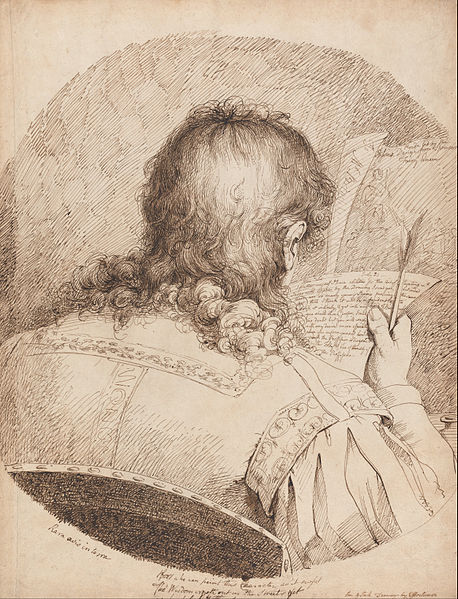
James_Jefferys_-_Self-Portrait_-_Google_Art_Project Public DomainI think a lot of authors can relate to that feeling of “Whoa– what do you think I’ve been doing for the last 30 years?” but, just as Traci does, we realize it’s perception and semantics, and try not to feel that pang of instant outrage that we suppress and cover with a smile. Frankly, how many people actually know we’ve been holed up in a dark room with only Strunk & White and a typewriter or keyboard for companionship for all these years? Who of my coworkers knew I could wallpaper an outhouse with my letters of rejection? Failure to land a publisher for a novel you penned in your own blood and tears is a deeply personal failure, and is not something you chat about over lunch with the girls in the data-entry pool.

To be honest, before I published my first book, probably only my husband, my kids and my sister knew I had this dark secret, so it shouldn’t bother me to be called a new writer. In the eyes of the world, I am a new writer, so I’ll embrace it, and roll with it.

450px-Tamiasciurus_douglasii_37808I love all the off-the-wall, hilarious and thought provoking posts I find on my Facebook page. In fact, today I found enough to keep me from having to write for nearly 3 hours!  Woot! Now the morning is gone, I guess it’s time to sit on the back porch and read me some Dean Frank Lappi! Strange, how dark and scary he can make a summer’s day appear….

8 Comments

Filed under Adventure, Books, Fantasy, Humor, Literature, Uncategorized, writer, writing

Sustaining the Passion

MH900438728The first days of summer have arrived. I’m not sure where the winter went, it flew by so fast. I’m many months behind on a gazillion things I wanted to have ready by now. I realize that goes without saying, but I had to say it anyway.

On a positive note I’m making headway on all sorts of side projects I had no intention of working on until next year.

Of course, the sky is gray until about 10:00 or 11:00 here much of the time, as we are so close to the Pacific Ocean, so the early morning is good writing time with no gorgeous blue skies to distract my sun-starved northwest eyes.

It all balances out.

My Coffee Cup © cjjasp 2013I have this incredible urge to spend all day sitting on my back porch reading, instead of writing.

I’ve been working on several new vignettes for Lackland, for the new edition of The Last Good Knight.  The trick is to keep the feeling of being on a roller-coaster that is part and parcel of the original work, and inject that sense of wonder and newness into the expanded work.

From my point of view, one of the best tales in The Last Good Knight is“The Dragon and the Daisies.”  The  story takes place some seven or eight years after Julian joins the Rowdies. Julian Lackland and Lady Mags have hit a rough spot, and it looks like they have gone their separate ways. Somehow, they work it out, and one of the more hilarious moments in Julian Lackland’s life ensues.

In order to recapture that feeling, I’ve been rereading my original work, and seeing it through new eyes. It’s amazing how much I loved that tale, and I feel that love every time I read my old ms.

I think that is what makes good reading–when the author is able to convey the passion for the story.  That passion is apparent in Anne McCaffrey’s early works, such as Dragonflight, Dragonquest and The White Dragon. I felt that intensity of feeling also when reading Orson Scott Card’s Ender’s Game, to name a few right off the top of my head.

COTS Front CoverThe real trick is feeling that passion while you are writing so that your work is not flat, and yet keeping the story coherent so you don’t devolve into gibberish only you can relate to.

Sigh.

Rather than force it, I think I’ll clean house for a while, and then go read on my back porch.

The good news is, along with a new book in the Tower of Bones series and the two books in the Billy’s Revenge series, a book that I began writing in 1998, The Curse of the Stuarts, will be published early in 2014. This book has taken so long for two reasons. First, even though my sister Sherrie says it’s the most hilarious book I’ve ever written (and she would know,) it’s filled with every error a raw, newbie author can possibly make. I’ve been working on getting it straightened out off and on for two years. The second reason is I only work on this tale when I am between other projects, so it is inching toward publication.

Somehow when I revisit this old manuscript I once again feel that love of writing that is all-consuming, but sometimes eludes me!

Perhaps a relationship with your writing muse is like the most passionate relationship with a partner, filled with moments of absolute joy and abandon, and also with moments of intense struggle. Passion is, after all a two-sided coin–love on one side and hate on the other. Worrying about whether you’re feeling it or not it is a waste of time, because nothing ever remains the same and tomorrow will bring a different emotion.

Keeping the coin spinning is the key to keeping it interesting.

12 Comments

Filed under Adventure, Books, Fantasy, Humor, Literature, Romance, Uncategorized, writing

Manners in the World of the Ephemeral

MC900343857Manners.

Etiquette.

Just what are they and what do they mean in the world of the internet? Indeed, what do they mean in our world at all?

Wikipedia, the Fount of All Knowledge, describes etiquette as a code of behavior that delineates expectations for social behavior according to contemporary conventional norms within a society, social class, or group.

Wendell Willkie, the early twentieth century American politician and author, said, “The test of good manners is to be able to put up pleasantly with bad ones.” 

I confess that I do this with great difficulty, but I do it and try not to brag about it.

Benjamin Banneker, born November 9, 1731 – died October 9, 1806, was a free African American scientist, surveyor, almanac author and farmer. On the subject of manners he is quoted as saying, “Evil communication corrupts good manners. I hope to live to hear that good communication corrects bad manners.”

Whoa! How prophetic was that? In this era of instant communication, a carelessly worded post on a forum can lead to flaming responses and accusations of trolling.

MC900445014Flaming, also known as bashing, is hostile and insulting interaction between Internet users, often involving the use of profanity. This occurs most commonly in eMail nowadays when the people involved have an emotional attachment to the subject and is compounded by the profound miscommunication caused by the lack of social cues available in face-to-face communication.

In the early days of the internet incidents of trolling were considered to be the same as flaming, but this has changed with modern usage by the news media to refer to the creation of any content that targets another person. The Internet dictionary NetLingo suggests there are four grades of trolling: playtime trolling, tactical trolling, strategic trolling, and domination trolling.

None of those activities are nice, as they are deliberate acts of bullying, and bullying is not polite.

Just sayin’.

The great American author, Flannery O’Connor,  has been quoted as saying, “Manners are of such great consequence to the novelist that any kind will do. Bad manners are better than no manners at all, and because we are losing our customary manners, we are probably overly conscious of them; this seems to be a condition that produces writers.” 

If she had lived to see the internet and the explosion of “invisible friends” with whom the average person is in daily communication she may not have said that. This world we live in is no longer a world where snail-mail and telephone conversations are the means by which we communicate. Today we live in a world where people are isolated and insulated from each other, and communicate via the internet using forums and social media. People of all walks of life come together in this vast melting pot of anonymity and they become ‘close friends’  or ‘dire enemies’ despite never having physically met.

Manners and proper etiquette are critical to maintaining one’s credibility in a world where you are represented by the picture you have selected as your ‘icon’ or ‘avatar’ and by what you write in the comments sections of public forums.

In this world, an icon or avatar is the graphical (pictorial) representation of the user or the user’s alter ego or character. This photo or graphic is the image beside our user-name before every comment we post in any forum on the internet. We are careful of what we put up to represent us, because we want people to see us as who we think we are.

I believe common courtesy that a person would extend in a face-to-face conversation should extend into our online conversations.

And this brings me to the ongoing breech of common courtesies that brought this subject up in my mind.

If you, as an author, are invited through a forum to ‘like’ another author’s facebook page or website AND you choose to do so, it’s not appropriate for you to then post a comment on their page that you have done so and also post the links to your pages or books.  The proper way to inform the author you have ‘liked’ their page is to send them a personal message saying you have done so and include those links in that message.

Frustrated Woman at Computer With Stack of PaperTo post links to YOUR website or books on another author’s page is tantamount to pissing on their doorstep. You are saying to this author and his fans that you consider this author to be nothing more than another venue for your marketing strategy. You are marking their territory with your scent, claiming a piece of it for yourself. I am sure most of the offenders have no idea how rude such behavior is.

We denizens of the 22nd century live in a world of the ephemeral, but the ramifications of what we do and say in that world are monumental. The internet is forever, and deleting a comment won’t make it go away, because it has already shown up in the in-boxes of all the users on that forum.  We communicate instantly and frequently with no filters  between the brain and the keyboard. In this world of instant communication and myriad opportunities for damaging your own reputation it is critical to think before you do.

To that end, I offer up this list of suggested “manners” for authors in the world of the internet. I didn’t invent them; they are copied directly from the website “Common Sense Media” and made to apply to indie authors trying to make their way in the cruel world of the internet:

Rules for Online Etiquette

Context is everything. If you want to have a silly online name that conforms to the convention of a particular online community and only your friends there will see it, fine. But for more formal communication — like email addresses, posting comments, or anything to do with work or school — choose a respectable screen name (though not your real name) that they wouldn’t be embarrassed to utter out loud in front of, say, their grandmother. If it is author related, use your author-name.

Double-check before you hit “send.” Could something you wrote be misinterpreted? Is it so littered with slang that it requires a Ph.D. in Urban Dictionary to be understood? Were you upset when you wrote it? Check to see if it’s rude, mean, or sarcastic. If so, don’t send it.

Take the high road (but don’t boast about it). Chatting, texting, and status updates are all “in-the-moment” communication. But if there’s an escalating sense of rudeness, sign off. No good will come of firing off a nasty comment. Authors, who are touchy, hypersensitive creatures at best, will NEVER forget how you flamed them. You can always write out a response to get something off your chest … without sending it.

Grammar rules. Rumors of grammar’s demise have been greatly exaggerated. (I love that line!) But again, context is key. An IM to a friend can dangle as many participles as you want, but anything more formal — for example, a public online comment or a note to a colleague — should represent your best self. This applies to capital letters, too. By now, everyone knows that writing in all caps means that you’re shouting, but it bears repeating once your kid starts interacting online.

Keep a secret. In today’s world, photos, texts, and videos can be posted, copied, forwarded, downloaded, and Photoshopped in the blink of an eye. If you think something might embarrass someone, get them in trouble, compromise their privacy, or stir up drama of any kind, keep it to yourself — and maybe delete it from your timeline or the thread for good measure.

Don’t hide. For safety’s sake, you should use untraceable screen names, but using anonymity to cloak your actions can poison the atmosphere — and hurt people. If your kids want to be contributing members of the online world, encourage them to post productively, and walk the walk yourself.

Eye on Flat Panel MonitorRemember the Golden Rule. Don’t post something online that you wouldn’t say to someone’s face. If you do have something negative to say, discussing it in person is a better way to resolve your issues. Post nothing on someone else’s wall that you would not be glad to have on your own.

These suggestions translate directly to Do No Harm. Behave with dignity, and extend the common courtesies to others that you wish to have extended to you.

To that end, I leave you with this quote from the beloved tennis great, Arthur Ashe, “Clothes and manners do not make the man; but when he is made, they greatly improve his appearance.”

I think that goes doubly for indie authors, because for us eking out a living in the world of the internet, appearance is everything.

14 Comments

Filed under Books, Fantasy, Humor, Literature, Uncategorized, writing

Stephen Hawking, Morgan Freeman and the Randomness of Squirrels

Stephen_Hawking.StarChildHere in the wild world of blogging, we spend many hours writing posts, only to find when we read them a day later that our personal editing skills are somewhat deficient, especially if one wings it, as I frequently do.

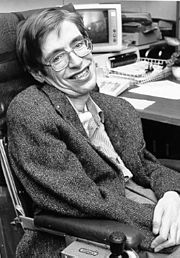
I’ve been told it’s a technical problem with my keyboard–something about operator error–but I disagree. The incidents of inappropriate self-editing are usually accompanied by the sightings of random squirrels and shiny objects. I’m sure it’s something to do with extra-dimensional  doppelgängers and particle physics as it seems to happen on a sub-atomic level, so I blame Stephen Hawking, Morgan Freeman and Michio Kaku. After all, if their documentaries weren’t so darned interesting and educational I would never be assailed by these thought of “what if….”

As I was writing this post, I was suddenly bowled over by a passing squirrel who casually reminded me that even worse than a badly edited post is the number of times I forget to properly tag my posts.

If you have a blog, and you are not having much luck attracting people to it, it could be as simple as you haven’t discovered the importance of ‘tagging’ your posts.

Many of us have WordPress blogs and many of us have Blogger Blogs. I have both, so I have a basic understanding of how some things work in both formats. Each one has its positive points.  One thing they have in common is that blog posts must be tagged in a way that attracts the eye if you want to attract readers from various search engines such as Google, Yahoo or Bing.

Tagging is an art I’ve not quite gotten the hang of in regard to twitter, but I’ve figured out what works for my blogs.prnt scrn bif

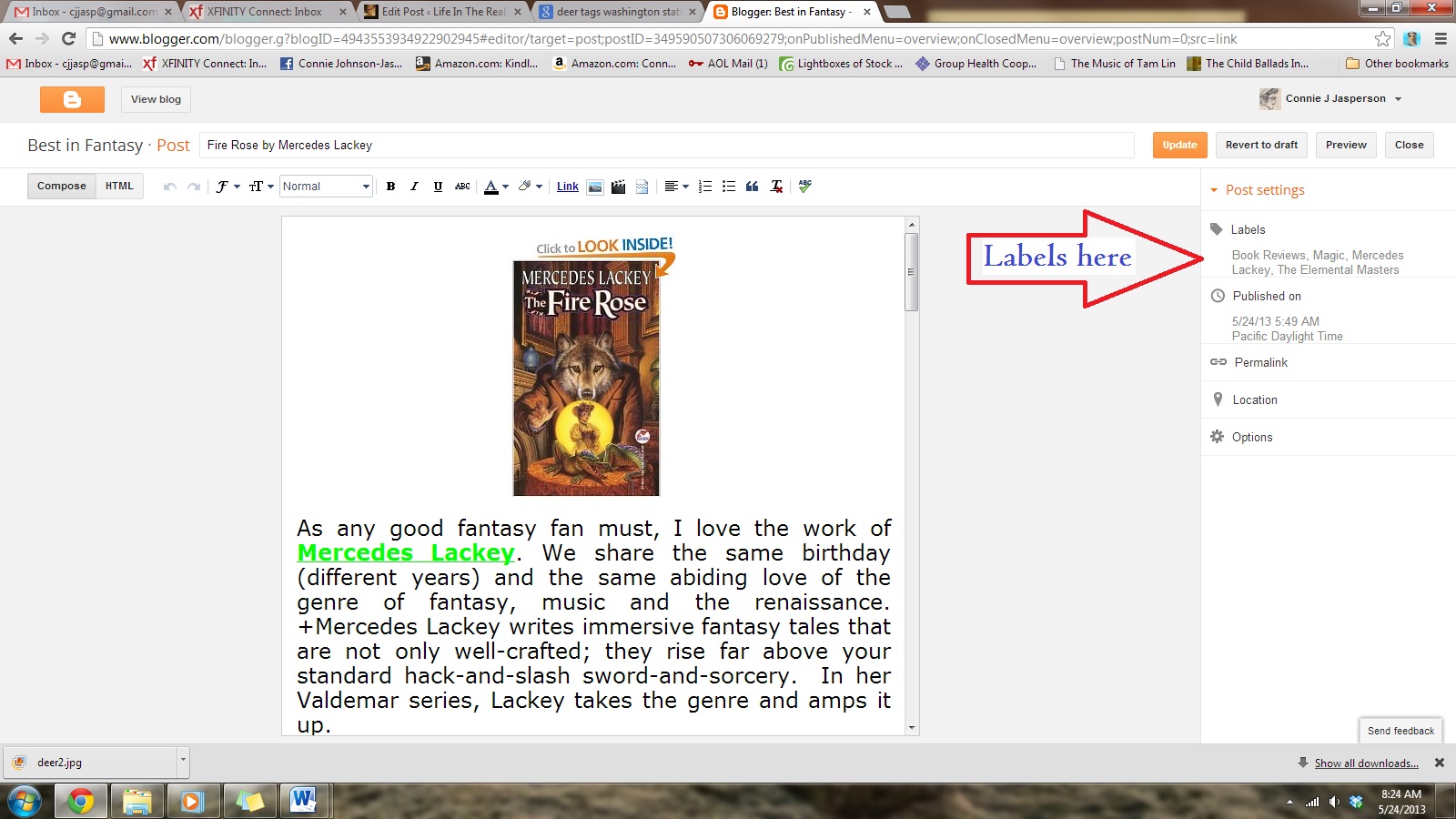
Blogger is simple. The right side of the dashboard has a section that refers to tags as ‘labels’. On my Best in Fantasy book review blog which is blogger, I label each post with the Author of the book I am reviewing, the series the book is a part of if that is a factor, and the other labels say book view, epic fantasy, and anything else that pertains to the book. This could be a ‘Dungeons & Dragons theme,’ or even ‘Society for Creative Anachronism,’.  I will use even just the label ‘humor’ if appropriate. You don’t want to use more than 9 labels. Because it is a book review blog, I just post once a week, whatever book I read that week that I really liked, and then tweet the post and sit back and let it perk along on its own. That blog is pretty much a self-maintainer, as long as I remember to assign ‘labels’ to each individual post.  Then I tweet the post and my work is done on that blog for the week.

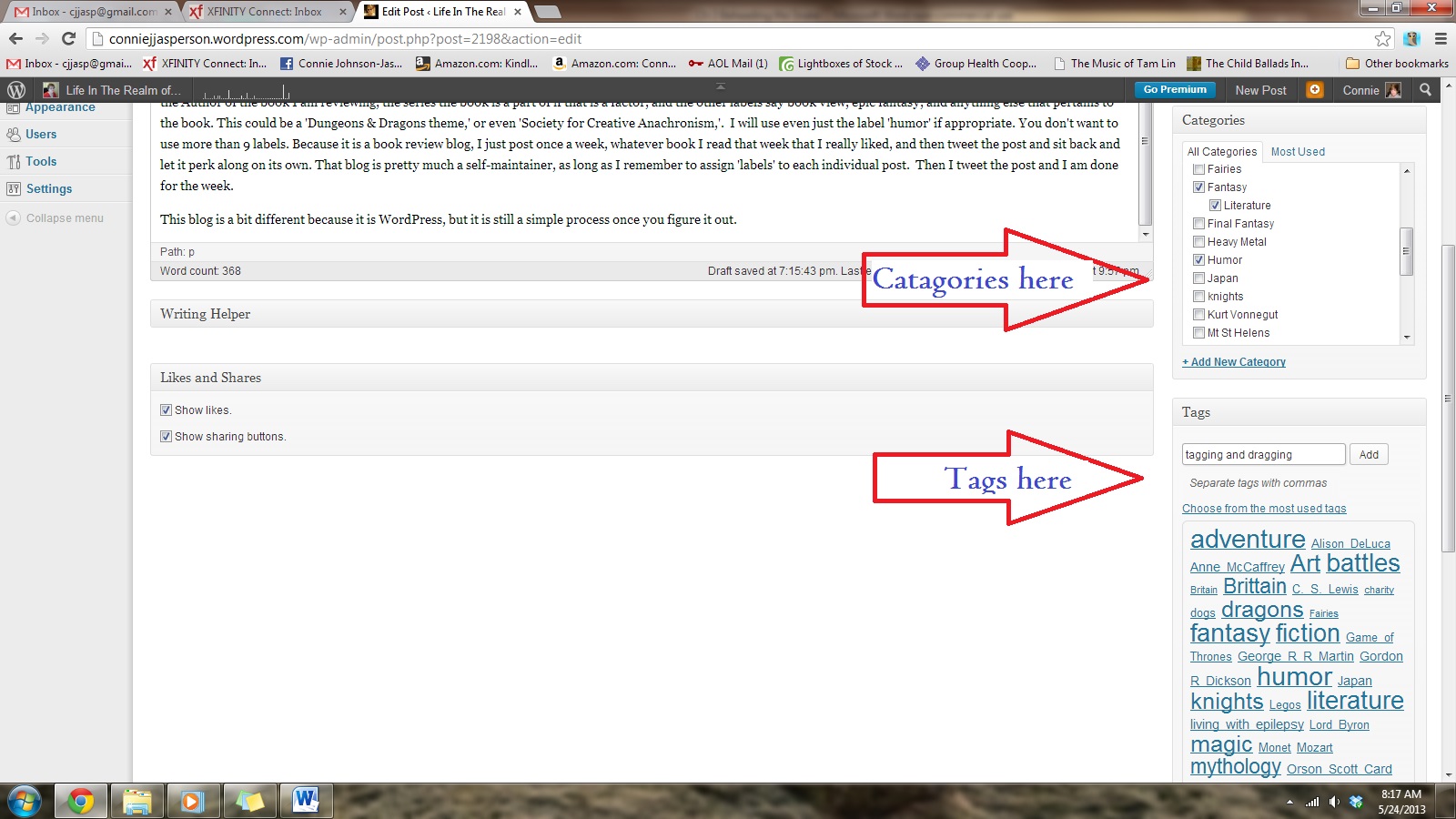
prn scrn tag and dragThe blog you are currently reading is a bit different because it is WordPress. It is a two-step process but it is simple once you figure it out. First go to the right hand side of your dashboard. Underneath the “Publish” button is a drop-down menu labeled “Categories.” Decide what categories most clearly represent your post and assign them.

Posts for Life in the Realm of Fantasy usually fall under one or more of these categories:  Adventure, Fantasy, Humor, Writing and Vegan Lifestyle.  DON’T FORGET TO DO THIS OR IT WILL DEFAULT TO “UNCATEGORIZED.”

That is bad, because then your blog will fall into a giant heap of uncategorized blogs with nothing to show what they are about. If you are writing about the potato famine, you want to make sure your category is Irish History, and so on.

Just as important as the categories in a WordPress blog are the TAGS.  The drop-down menu for the tags is located just below the categories. THIS IS CRITICAL! Select keywords AND themes that are mentioned prominently in the post, or that people who are Googling a subject might use in their search. This post’s tags will be:

fantasy, humor, literature, 
tagging and labeling blogs, 
writing, 
Stephen Hawking, Morgan Freeman, Michio Kaku,
Squirrels

According to what I read on the internet (so it must be true) the best rule-of-thumb is to not use more than nine or ten tags for a blog, and never more than three tags in a tweet.

So back to squirrels and particle physics.

According to Particle Physics for Dummies, we still do not understand 95% of the universe.

220px-Michio_Kaku_in_2012It comforts me to know that Morgan Freeman, Michio Kaku, and Stephen Hawking are just as confused as I am.

Comments Off on Stephen Hawking, Morgan Freeman and the Randomness of Squirrels

Filed under Adventure, Books, Fantasy, Humor, Literature, writing

Hacking through the brush

Shispar by Brian McMorrow CC 2.5 license Wikimedia

Writing is mountain climbing. Half of it is uphill.

Yesterday I spent all day writing a scene that occurs in the relationship of a main character, Billy Ninefingers, with the woman he loves. It’s a pivotal scene, and the way I first wrote it, she makes a decision that hurts Billy, but he goes along with it because he doesn’t know what else to do.

It didn’t read right to me.

So I rewrote it, making him angry, making him push to have his needs met in the situation. I was still not happy with it, so I trashed the new scene.

What I did yesterday was waste 11 hours writing 3624 words, which I then threw away.

Today I’m going to rearrange the living room instead.

MH900402708Some days you’re writing and the prose flows like fine wine into a crystal glass, gorgeous, smooth; a delight to senses.

Other days your writing takes you deep into the bug infested jungles of  Look-There’s-A-Squirrel Valley and the divergent paths you find yourself on are downright frightening.

Where does my mind come up with some of the crazy things that pop up in my work? I don’t know, but some days writing is as much about hacking through the brush trying to find your way back home as it is basking in the glory of a completed chapter.

The bright spots on my horizon are the two women who’ve dedicated a great amount of time to making my work readable, Carlie Cullen and Irene Roth Luvaul.

Irene is what some people in this industry are beginning to refer to as a ‘line editor.’ She helps me make my manuscript submission ready – that is, she makes sure I’ve dotted my ‘i’s and crossed my ‘t’s (insert comma) (delete comma) and that the manuscript is as clean as it can be before I submit it to my editor, Carlie Cullen.  Irene checks the manuscript for  consistency in spelling the frequently made-up names of people and places, so that my spelling doesn’t inadvertently drift (Liam…Lyam….)  Some authors have spouses who will do this for them, but  my husband doesn’t read fast enough and has a day-time job. Fortunately my best friend Irene saw I was struggling, and offered to help. This is the first stage of the process, and clears the way for Carlie to work her magic.

Irene is a retired legal secretary with  40 years of proofreading and punctuation behind her. That she WANTS to do this mammoth undertaking on my raw, bloody manuscripts is amazing to me. I’m not as well-educated as many other authors are, and my first drafts are clear evidence of that.

MH900448490By having the brush cut back (so to speak) before she gets the manuscript Carlie is able to concentrate on the true task of editing the work for publication. I’m not wasting Carlie’s time on things that should have been corrected before she was handed the manuscript. After all, she has other clients and also her own writing. I want her to enjoy working with me, not dread it!

Of course, she will make edits on grammar and things Irene and I may have missed, but Carlie guides me in cutting out the fluff and excessive backstory that finds its way into the tale. She has me expand on the important things, the points of the tale which are the real meat of the matter. She may have me take a minor thing and expand on it, or she may think something is not as important as I think it is. This is where the real story begins to unfold. Carlie turns my manuscript into a book.

If you have been suffering from a series of rejection letters and you don’t know why, it may be that your manuscript was not submission ready when you sent it in. You may not even have known your pride and joy was an unruly child. Many editors and agents will reject manuscripts with plots based on wonderful concepts and with great characters simply because the task of getting the grammar and punctuation corrected in order to get to the real editing is not worth the effort.

But after having been in this business for a while now, I’ve come to realize that it takes more than a great story to make a great book. I’ve seen manuscripts a third grader would not have been proud of, but they were the blood sweat and tears of an author and it killed me to tell them it wasn’t acceptable in its current state.

I’ve had other authors look at me with disdain and say, “Well I always refer back to Strunk and White when I am writing, so I don’t need an editor.”

Yep.

Well, so do I, when I pause long enough to think about it, but I write like a freight train–once the tale has me and I’m rolling, I’m not going to stop for anything so minor as grammar.

Strunk and White IS the final word when it comes to grammar and use, but unless those two lovely men have actually laid their eyes on your manuscript, you may have missed a few things or you may have a tale that, while it is grammatically perfect, it is full of dead ends and lackluster prose.

Having been through hell and back with “The Last Good Knight” I cannot express strongly enough the importance of having TWO sets of editorial eyes on your work.

Editors have eyes AND they have Strunk and White, and they are not afraid to use it. But editors also understand what makes a good tale and they will guide you in that direction if you will let them.

Elements of Style

3 Comments

Filed under Books, Fantasy, Humor, Literature, Uncategorized, writer, writing