Category Archives: Poetry

#amwriting: Interview with Terry Persun, poet and author

Today we are continuing a series of interviews with published authors who are also instructors. They write in a variety of fields, and each approaches the craft from a slightly different point of view. Because they come from such varied backgrounds, I have gained a great deal of knowledge of writing craft from attending their seminars.

As it’s Friday and I often post poetry and flash fiction on Fridays, we are talking with Terry Persun, a poet and novelist who resides in the Northwest.
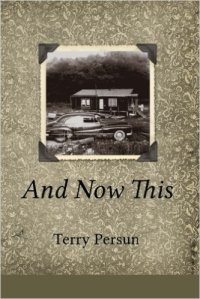
51eyfcn4pzl-_sx331_bo1204203200_CJJ: You write in three areas, poetry, nonfiction, and fiction. Your fiction work ranges through three sub-genres, Sci-fi/fantasy, mystery/thriller, and mainstream/historical. As are many poets, you’re well-known for questioning the political, spiritual, and cultural status quo.

How does your poetic bent shape your non-fiction and genre novel work?

TP: What an amazing question. I often think about how my poetry helps to shape my novels, but seldom my nonfiction. So let’s start with novels: much of the best poetry is about image, and the same goes for the novel. An image (showing not telling) can create an emotion that will stick with the reader. Poetry allows me to practice that. Even when you’re discussing cultural elements, an image is more important than abstract words like horrific or painful. A poet must know how to show those abstractions. Think about the last time you saw an image of a child in a war zone, it’s much more impactful than being told that there were several women and children killed in the attack. Even which image is important—movie directors know which angle to take. As for nonfiction: I think pacing and word choice stand out the most. In a poem, I can create a line break or a stanza break, similarly with nonfiction I might create a new paragraph or move the article from prose to bulleted copy. Again, an image might be best in nonfiction as well. For example, instead of saying, “Make sure your enclosure is leak proof.” I said, “Using the proper sealing approach will eliminate the concern of having grease oozing out of your enclosure.” Seeing the grease oozing out of something is much more impactual than telling someone to provide better sealing. There are probably many more things that poetry brings to my writing that I may not be completely aware of.

CJJ: You have published five poetry collections. I own one of them, And Now This. These poems resonated with me, as my father was also a WWII vet. These poems deal with the effects of your father’s wartime experiences on your family during the 1960s. Battle related PTSD is also a theme in my forthcoming novel. Reading your poetry made me feel less alone in that experience, and helped me develop my protagonist in the initial stages.

You seem to have an instinctive gift for meter in your free verse. One of my favorite opening passages of all time is from one of the poems in this collection, from the opening poem,

First Memory

I’m standing in the corner,

Crying.

My hands are not my own,

They’re trembling.

This passage drops the reader straight into your young reality, unapologetically showing the life you had then.  Because they are free verse, the lines don’t rhyme, yet they are poetic and speak to me on a level that the prose in a novel rarely does. I also love the opening passage from another poem in this collection, In the Story of My Father.

What advice would give budding poets in regard to meter and phrasing their free verse?

TP: Language has its own music. Even prose has music to it. It’s my assertion that the best prose can often be broken into poems. In classes I sometimes will take a Hemingway paragraph and create a poem from it. Having said that, the number of beats, the number of syllables, where you place commas or choose to create a complex sentence, all have an effect on the final work. What I advise new poets is to first of all read a lot of poetry—especially the kind you’re trying to write. Notice how much of a breath you need to take, where natural and unnatural breaks might occur (use both), and where can you end a line that leads a reader in a false direction. Poetry infused prose can only make it better.

Doublesight--Terry PersunCJJ: One of my favorite fantasy novels is Doublesight, in which you created a world populated by shapeshifters. Zimp is a wonderful character, and I like how you portrayed her growing into her responsibilities.

You have opened your Doublesight world to fans to create fanfiction in, via Kindle Worlds.

How has the work offered by others in your world affected your view of Zimp’s world, and has it changed your direction in anyway?

TP: That’s a tough question to answer, because anything written in that world changes the way I see it. Once it’s opened to other interpretations, each character becomes deeper and more mysterious. I start to see the character differently and wonder more about him or her. It also lets me see how others view the story, the time period, the characters. I become more interested in the world as others work in it. My hope is that it’s fun and expansive for the authors as well, offering them another viewpoint to explore, another idea to examine. Plus, every Doublesight story uploaded into Kindle Worlds helps to market all the other books in the world. This cross-marketing will eventually help each author gain a new audience for their own books.

CJJ: Your video course is quite extensive, and I’d like you tell the readers what the course entails, and how they can take it.

TP: I believe you’re talking about the “Make Money Writing” course. You can access it through my website or through Youtube. I have taught that class quite a bit and is often standing room only. I’ve been freelancing for 20 years and working with freelancers on the magazine side for another 20 prior to that. I know how magazine editors think, what they need, and how to reach them. I also know how to help a writer find their way into freelancing. In the course, I run through how to decide what to write, the parts of the magazine, the editorial calendar, how to touch base with editors, and the main types of articles they need for their publications. I’ve consulted with several major magazine groups about their editorial packages, as well as how to move copy through their company so that they don’t waist time and end up with the best possible pieces to publish.

CJJ: I’ve attended several of your seminars at the annual PNWA conference and enjoyed them immensely. You’re based in the Pacific Northwest and have taught many classes all over the region. Will you be offering any seminars over the next year?

TP: I will be at the PNWA Cottage in September teaching a course on working with Amazon’s 12+ platforms for writers (go to PNWA.org for the list of classes), then at Rivers of Ink in October where I’ll be one of their Keynote speakers and also teach a class called Use Your Writing as Marketing. In November, I’ll be in Kauai for their annual Writers’ Conference where I’m teaching Self and Independent Publishing, and will be working one-on-one with attendees interested in a variety of methods of publication. I was involved in three other groups/conferences earlier this year. I am always willing to come up with a program if there is enough interest. Just let me know.


Terry, thank you so much for your insights and advice, both here and at the annual PNWA conference.

I highly recommend Terry’s works. His poetry is deep and thought provoking, and his novels are fun and fantastic.  His books can be found on Amazon at:
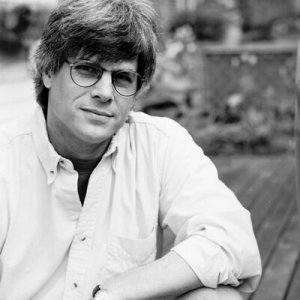
tpersun_the_mug_shot_pic_b-w_400x400Terry Persun on Amazon Author Central

For any of you who are interested in attending his seminars, or looking into his video course, you can find him at any of these places.

Facebook page:

https://www.facebook.com/TerryPersun

Website:

http://www.terrypersun.com

Twitter: @TPersun

Pinterest:

https://www.pinterest.com/terrypersun/ 

Goodreads:

https://www.goodreads.com/author/show/1219743.Terry_Persun

LinkedIn:

https://www.linkedin.com/profile/view?id=AAIAAAAwxc8B6UnSc6LNvK9rhZHPutf5VEgswes&trk=nav_responsive_tab_profile_pic


On  Monday, Scott Driscoll has agreed to join us here.
Comments Off on #amwriting: Interview with Terry Persun, poet and author

Filed under #FlashFictionFriday, Fantasy, Poetry, writing

#flashfictionFriday: Sonnet 116, by William Shakespeare

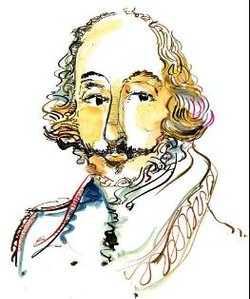
Wm Shakespeare Amazon Author Central portraitWe haven’t waxed poetic over Shakespeare recently, and I think it’s time to consider the prose of the master, both its meaning and its construction. To that end, I give you

Sonnet 116

Let me not to the marriage of true minds

Admit impediments, love is not love

Which alters when it alteration finds,

Or bends with the remover to remove.


O no, it is an ever fixèd mark

That looks on tempests and is never shaken;

It is the star to every wand’ring bark,

Whose worth’s unknown although his height be taken.


Love’s not time’s fool, though rosy lips and cheeks

Within his bending sickle’s compass come,

Love alters not with his brief hours and weeks,

But bears it out even to the edge of doom:


If this be error and upon me proved,

I never writ, nor no man ever loved.

Sonnet 116 is typical of what we think of as a classic English sonnet. The English sonnet has three quatrains (verses), followed by a final rhyming couplet. It follows the typical rhyme scheme of iambic pentameter, which is a type of poetic meter: one short (or unstressed) syllable followed by one long (or stressed) syllable.

The interpretation of this poem is open to many speculations, the most compelling of which I found in Cliffs Notes, and which I quote here:

Despite the confessional tone in this sonnet, there is no direct reference to the youth. The general context, however, makes it clear that the poet’s temporary alienation refers to the youth’s inconstancy and betrayal, not the poet’s, although coming as it does on the heels of the previous sonnet, the poet may be trying to convince himself again that “Now” he loves the youth “best.” Sonnet 116, then, seems a meditative attempt to define love, independent of reciprocity, fidelity, and eternal beauty: “Love’s not Time’s fool, though rosy lips and cheeks / Within his bending sickle’s compass come.” After all his uncertainties and apologies, Sonnet 116 leaves little doubt that the poet is in love with love.

The experts at Shakespeare Online say:

Sonnet 116 is about love in its most ideal form. The poet praises the glories of lovers who have come to each other freely, and enter into a relationship based on trust and understanding. The first four lines reveal the poet’s pleasure in love that is constant and strong, and will not “alter when it alteration finds.” The following lines proclaim that true love is indeed an “ever-fix’d mark” which will survive any crisis. In lines 7-8, the poet claims that we may be able to measure love to some degree, but this does not mean we fully understand it. Love’s actual worth cannot be known – it remains a mystery. The remaining lines of the third quatrain (9-12), reaffirm the perfect nature of love that is unshakeable throughout time and remains so “ev’n to the edge of doom”, or death.

In the final couplet, the poet declares that, if he is mistaken about the constant, unmovable nature of perfect love, then he must take back all his writings on love, truth, and faith. Moreover, he adds that, if he has in fact judged love inappropriately, no man has ever really loved, in the ideal sense that the poet professes.

Five hundred years after his time on this earth, the Bard of Avon’s crafting of ideals and emotions into words evokes powerful feelings in the reader. He is immortal, because we hear his words and feel their impact.

The secret poet within me hopes to one day develop more poetic skill, whether it is writing free-verse, or crafting a more traditional rhyming style of prose. To that end, I practice writing poetry when I am in the mood, and read the masters, and attend local poetry-slams. It’s amazing, the talent in your local poetry groups.


References:

Cliffs Notes, Sonnet 116 © 2016 Houghton Mifflin Harcourt. All rights reserved.

Shakespeare, William. Sonnet 116. Ed. Amanda Mabillard. Shakespeare Online. 8 Dec. 2012. http://www.shakespeare-online.com/sonnets/116detail.html

Comments Off on #flashfictionFriday: Sonnet 116, by William Shakespeare

Filed under #FlashFictionFriday, Literature, Poetry, writing

#flashfictionfriday: Short Poetry: I Have Seen the Stars

Admiring the Galaxy |CCA 4.0 ESO/A. Fitzsimmons

Admiring the Galaxy |CCA 4.0 ESO/A. Fitzsimmons


I have seen the stars hung bright

Across the inky dark of night

Such beauty there displayed for me

I scarce can know their mystery.


Heaven’s vault with diamonds flung

Summer’s sky with beauty hung

Bursting forth, the joy in me

Humbled by the majesty.


I have Seen the Stars © Connie J. Jasperson 2016

5 Comments

Filed under #FlashFictionFriday, Poetry

#memorialday: In Flanders Fields, John McCrae

800px-In_Flanders_Fields_(1921)_illustrated by Ernest Clegg

In the US, today is the beginning of a 3-day holiday, the Memorial Day Weekend. The Indianapolis 500 takes place on Sunday, and while I won’t be there this year, my favorite drivers will be.

But Memorial Day is more than just the official launch of Summer here, more than just a car race–it began after the American Civil War in 1868 as “Decoration Day,” established as a time for the nation to decorate the graves of the war dead with flowers. Officially, Memorial Day is the last Monday in May.

After each great and terrible war of the last two centuries, the hope was always that we had fought a “war to end all wars.” World War I, also known as The Great War, was spoken of in literature as just that: a war to end all wars.

With each conflict we still hope, but we are less able to believe it.

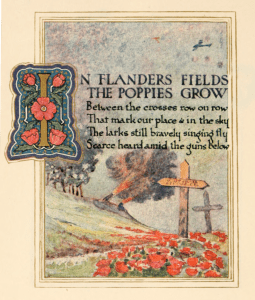
“In Flanders Fields” is a war poem in the form of a rondeau, written during the First World War by Canadian physician, Lieutenant-Colonel John McCrae. He was inspired to write it on May 3, 1915, after presiding over the funeral of friend and fellow soldier Alexis Helmer, who died in the Second Battle of Ypres. According to legend, fellow soldiers retrieved the poem after McCrae, initially dissatisfied with his work, discarded it. In Flanders Fields was first published on December 8 of that year in the London-based magazine Punch. (Quoted from Wikipedia.)


In Flanders fields the poppies grow
Between the crosses, row on row,
That mark our place; and in the sky
The larks, still bravely singing, fly
Scarce heard amid the guns below.

We are the Dead. Short days ago
We lived, felt dawn, saw sunset glow,
Loved and were loved, and now we lie
In Flanders fields.

Take up our quarrel with the foe:
To you from failing hands we throw
The torch; be yours to hold it high.
If ye break faith with us who die
We shall not sleep, though poppies grow
In Flanders fields.


In Flanders Fields, by Lieutenant Colonel John McCrae, MD,  PD|75 years

John McCrae died of pneumonia January 28, 1918, near the end of the Great War. In Flanders’ Fields is a staple poem for Memorial Day services, a federal holiday celebrated the last Monday in May in the United States. It is a day traditionally set aside for remembering the people who died while serving in the country’s armed forces.

2 Comments

Filed under #FlashFictionFriday, Poetry

#FridayFiction: The Dunes at Westport

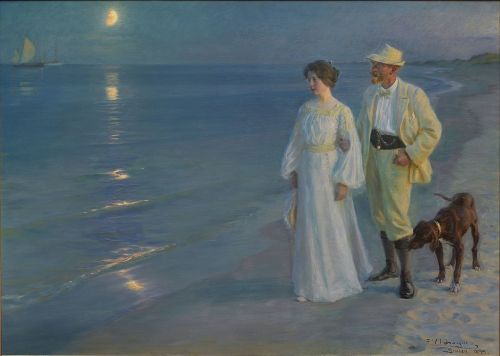
P.S. Krøyer, Summer Evening at Skagen Beach – The Artist and his Wife (1899) Via Wikimedia Commons

P.S. Krøyer, Summer Evening at Skagen Beach – The Artist and his Wife (1899) Via Wikimedia

The Dunes at Westport

Hidden where the dune grass grows

Beside the salty sea

Tall, the dune grass shields our tryst

Beside the wide, grey sea.


Hard and sweet, the wind does blow

From off the tumbling sea

The path is lined with strawberries

Wild and thriving in the lee.


A basket filled with simple foods,

Bread, and wine, and cheese,

A blanket spread upon the sand

Sheltered from the breeze.


Seabirds glide upon the wind

Calling from on high

Pipers step at water’s edge

With plovers they do vie.


We’ve slipped the bonds of modern life

And come down to the sea

Sheltered in the dunes we’ll rest

My only love and me.


A secret tryst, my love and I

Beside the salty sea

A day beneath the wide, blue sky

My dear, dear man and me.


“The Dunes at Westport” © 2016 Connie J. Jasperson, All Rights Reserved

2 Comments

Filed under #FlashFictionFriday, Poetry, writing

The Lake Isle of Innisfree, by W.B. Yeats

Skagit River Mist/PFly CC-BY-SA-2.0

THE LAKE ISLE OF INNISFREE

W.B. Yeats

I will arise and go now, and go to Innisfree,

And a small cabin build there, of clay and wattles made;

Nine bean-rows will I have there, a hive for the honey-bee,

And live alone in the bee-loud glade.


And I shall have some peace there, for peace comes dropping slow,

Dropping from the veils of the morning to where the cricket sings;

There midnight’s all a glimmer, and noon a purple glow,

And evening full of the linnet’s wings.


I will arise and go now, for always night and day

I hear lake water lapping with low sounds by the shore;

While I stand on the roadway, or on the pavements grey,

I hear it in the deep heart’s core.


William Butler Yeats (1865-1939), Nobel Prize winning Irish dramatist, author and poet.

The poetry of WB Yeats occupies a large place in my heart and is one of my favorite sources of inspiration.  In his early years, Yeat’s was not afraid to write of faeries and mystical things that fired my childish imagination. Later, as he grew as both a writer and as a person, he also wrote wonderful works that were more firmly rooted in reality. The Lake Isle of Innisfree was published in 1890.

3 Comments

Filed under #FlashFictionFriday, Fantasy, Poetry