Category Archives: Uncategorized

Crafting the narrative: the potty-mouthed vicar

Portrait of Vsevolod Mikhailovich Garshin by Ilya Repin

Portrait of Vsevolod Mikhailovich Garshin by Ilya Repin PD|100 via Wikimedia Commons

Look at poor Vsevolod Mikhailovich Garshin. The artist immortalized him at the unfortunate moment he realized he was faced with a gazillion hours of searching for overused words in his manuscript–and all of them in Russian.

Heh heh.

I wrote a post on this subject three years ago, but it’s time to  dust it off and play with it again. Overused words can be fun if done right:

Mark Twain said, “Substitute “damn” every time you’re inclined to write “very”; your editor will delete it and the writing will be just as it should be.”

Well now, we could have some fun with that!

Think of how often some beginning authors use the word very in their work:

“We are doing very well, thank you,” replied the vicar. “The weather is very nice, and the food  is very good.” 

Let’s do as Twain suggests and see what happens:

“We are doing damn well, thank you,” replied the vicar. “The weather is damn nice and the food is damn good.”

That was fun. The word ‘damn’ leaps out at you, because you don’t really expect it. I personally enjoyed replacing ‘very’ with ‘damn.’  But, hilarious though it is to give the vicar potty-mouth, in reality it’s unnecessary. Simply eliminating ‘very’ and not replacing it with anything goes a long way toward improving it:

“We are doing well, thank you,” replied the vicar. “The weather is nice and the food is good.”

Some times we repeat certain words and phrases for emphasis. This article is not about using repetition when crafting narrative. Instead, we are thinking about words that are overused, and which we can often do without.

In our rough drafts we overuse certain words because we are flying along and they are easy–they say what we want and we can keep on moving.

But in the second draft, we must look for them. Let take the word ‘very.’

Once you are finished with your first draft, do what is called a global search – in Microsoft WORD you click on the ‘Home’ tab, and at the far right hand side click on ‘Find,’ OR press the ‘Ctrl’ key and the ‘F’ key at the same time.  This will open the ‘find and replace’ menu:
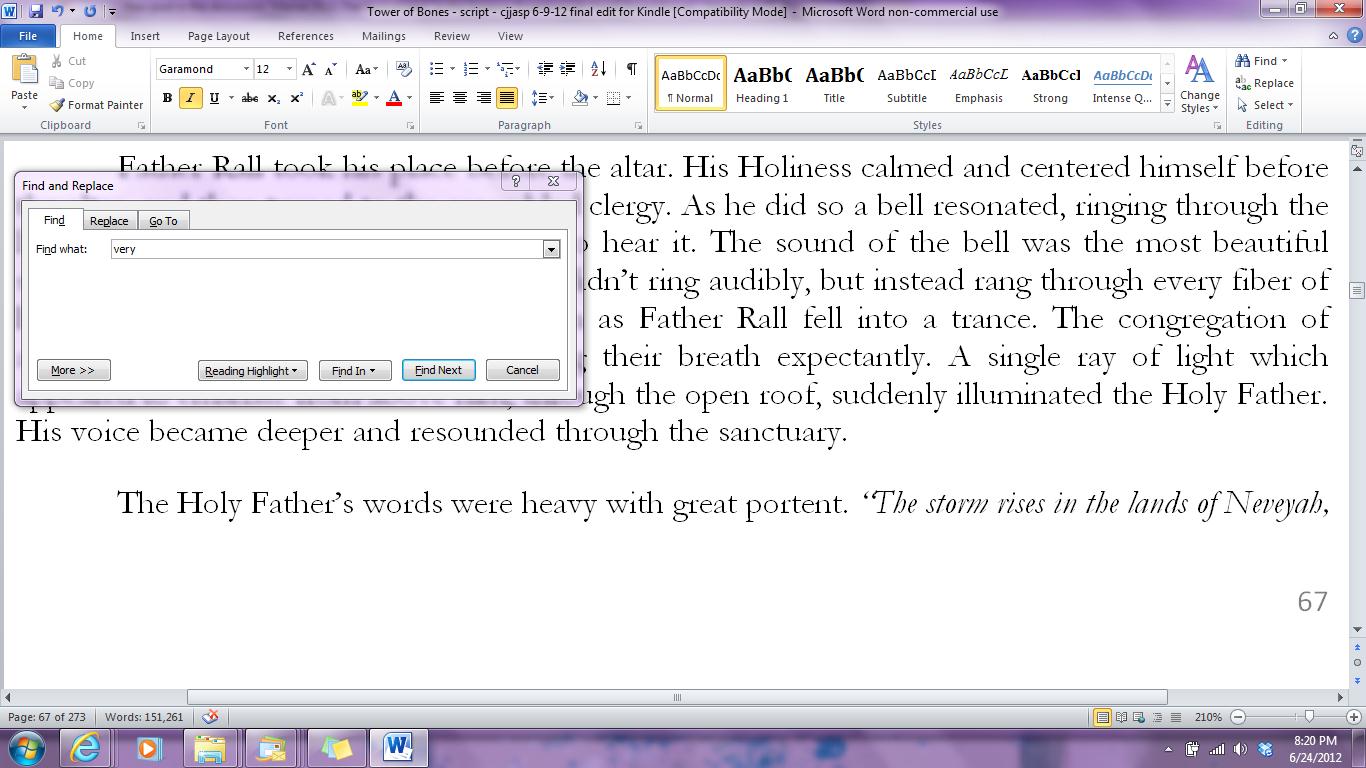
find graphics

In the ‘find and replace menu, type the word ‘very’ and click on ‘find next’.  The word ‘very’ will be highlighted in blue, and you can delete it.  I don’t recommend doing ‘replace all’ with any overused modifier, because you will create more problems than you can imagine!  Look at each individual instance of the word, and either delete it or change it to a stronger word.

Deleting them or changing to a stronger word will help you grow as writer.  You will begin to think about your sentences and stretch your vocabulary.

Next do the same with ‘that’ and ‘had.’ These are words  we all use too freely in our first draft, and until an editor pointed it out to me, I had no idea how they weakened my work. They are good words, used infrequently and only when another won’t do the job.

Here is a list of words that can appear with great frequency in your rough drafts, some of which are considered ‘tired.’ Some of these words can be made into contractions to eliminate wordiness. Some can be cut altogether, and some will need to stay. However, some of these words are ‘telling’ words, and we want to avoid that wherever possible. Look at each instance and make that decision.

  • about
  • am
  • are
  • bad
  • beautiful
  • big
  • could
  • did
  • fine
  • good
  • great
  • had
  • has
  • have
  • is
  • look
  • looked
  • nice
  • quite
  • seems
  • so
  • some
  • that
  • then
  • think
  • very
  • was
  • well
  • went

We all use these to excess in our rough draft, because we are laying the roadbed of the superhighway that is our book. The words we spew at this point are the framework we are going to build the true story around, the story that was in our heads, but that the rough draft doesn’t do justice to.
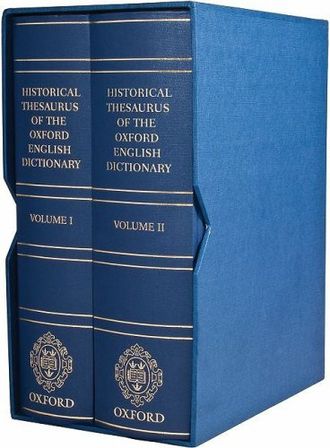
Historical_ThesaurusThis is where our thesaurus comes in handy. We need to express the thoughts our overused words evoke, but we don’t want to repeat them over and over. When a word seems to be cropping up with great frequency, try using the global search option. It will tell you how many instances of the word appears in your manuscript, and you might be surprised.

Highlight the word and right-click on it. A pop-up menu will appear. From that menu, choose ‘synonyms.’ Click on that, and a list of words with similar meanings will appear. If you need more than can be found in that list, click on ‘Thesaurus’ (at the bottom of the list) or google the word and add ‘synonyms’ to your search.

Consider my recent experience with gaped–a beta reader pointed out that I had my characters gaping at each other far too regularly. I had to go through it and have them stare, exchange glances, or simply look away. In several instances, I cut that sentence because it wasn’t really needed.

It can be difficult to see the words you have overused when it is your own work. But you can run your ms through a free, online  program like Word Count Tools and that will give you a heads up on how many times you have used each word.

2 Comments

Filed under Books, Literature, Publishing, Self Publishing, Uncategorized, writer, writing

What are you #writing: Identifying your theme

herowithathousandfacescd2000When I read a book, I connect to the sense of wonder that each event or plot twist in a story evokes for the protagonists.  I am extremely partial to those books in in which the protagonist faces his/her own demons and finds a hero within themselves, a person who faces the unknown and finds the courage to do what he/she believes is morally right.

Consider J.R.R. Tolkien’s  LOTR series. He clearly knew that personal growth and the many forms that heroism can take are central themes of his stories, and while there are many side-quests taking the different characters away from the physical journey of the One Ring, Tolkien never strayed from the concept of the hero’s journey.

What is the “hero’s journey”?  The concept of the heroic journey was first introduced by the American mythologist, writer and lecturer, Joseph Campbell in The Hero with a Thousand Faces (published in 1949). In this ground-breaking work, he discusses the monomyth, or the hero’s journey. He describes how this motif is the common template of a broad category of tales that involve

  1. a hero going on an adventure,
  2. and who, in a decisive crisis, wins a victory,
  3. and who then returns to his home changed or transformed.

Take Tolkien’s masterpiece, The Hobbit: When Bilbo Baggins faces the giant spiders he also faces his own cowardice, and he is filled with amazement that he could do such a thing. This is the first step in his realization that he has courage apart from the invisibility conferred on him by the ring he found earlier. He has courage, and yes, he is afraid, but he is not afraid to be courageous. This is a core concept of this book, and of the entire Lord of the Rings series, set in Middle Earth.

398px-Heroes journey by Christopher Vogler

The diagram is loosely based on Campbell (1949) and (more directly?) on Christopher Vogler, “A Practical Guide to Joseph Campbell’s The Hero with a Thousand Faces” (seven-page-memo 1985). Public Domain, via Wikimedia Commons

In my own work, personal growth and the hero’s journey are often the central themes. This is because those are the stories that intrigued me most as a young reader, and they intrigue me now as an adult.

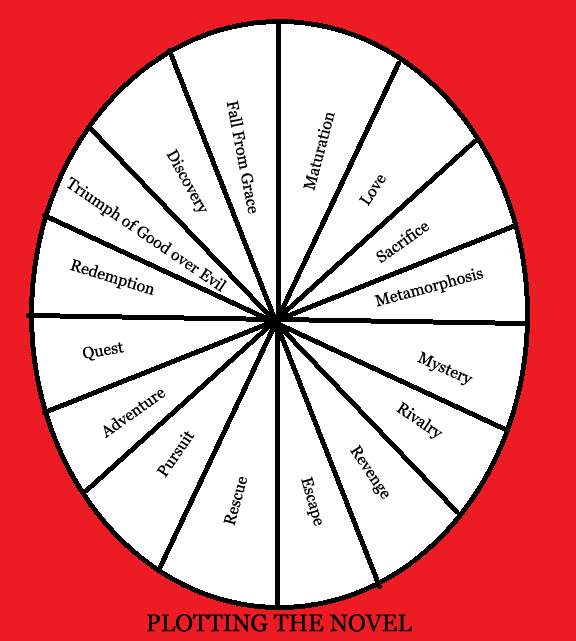
What is the central theme of your work? Here are a few themes commonly found in popular genre fiction, besides the Hero’s Journey:

Dial-a-Plot

Every one of these themes will force the protagonist to grow and change in some way. Every one of them will challenge his ideas of morality and push him to act in ways that force him to evolve. That kind of growth is what makes characters intriguing and memorable.

When we are constantly prodded to make our work focus on action instead of introspection, it becomes easy to wander way off track. Ask yourself if the action has been inserted for the sake of the shock value, or if this scene is necessary to force change and growth on the protagonist. How will her fundamental ethics and ideals be challenged by this event? If there is no personal cost, there is no need for that scene.

Caspar David Friedrich, Wanderer Above the Sea of Fog, 1818 PD|100 via Wikimedia Commons

Caspar David Friedrich, Wanderer Above the Sea of Fog, 1818 PD|100 via Wikimedia Commons

Writing these blind alleys is not a waste of time.

You never know when you will need those ideas, so never just throw them away–always keep the things you cut in a separate file. Remember, just because that idea doesn’t work for this book, doesn’t mean it won’t work in another book.

I label that file “outtakes,” and believe me, it has come in handy when I need an idea to jump-start a new story.

Keeping in mind the underlying theme of your story while you are laying down the first draft is important. If your inspiration seems to faint somewhere along the middle, it may be that you have lost track of what you originally imagined your story was about and your characters no longer know what they are fighting for. Was it love? Was it destiny? Was it the death of hope?

Sometimes we are so busy setting traps and roadblocks for our protagonist and his nemesis that the action takes over and becomes the theme. The action is there to force the character to grow, not simply for the sake of action. When we are deep in the creative process, it’s easy to forget that characters must evolve.

Remember, there was a fundamental theme in your mind when you first imagined you had a story to write, and once you identify that core concept, you may find you are no longer stuck.

5 Comments

Filed under Books, Uncategorized, writing

But what about poetry?

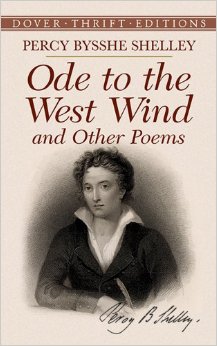
ode to the west wind-shelleyI love poetry because I love the many ways words can be manipulated on a blank page. To me, poetry is something beautiful and visually simple, a thing that looks like it should be uncomplicated. But nothing could be farther from the truth.

I guarrantee you, this post will not scratch the surface of why poetry is so much more than naughty limericks (which I do know a great many of and which are quite hilarious).

Bad poetry can be written by anyone, but writing great poetry takes a certain genius–I don’t consider myself a poet, although I do sometimes feel compelled to attempt poetry.

Poetry doesn’t always rhyme and it frequently involves complicated aesthetics that are both auditory and visual. This is because the reader may not always be reading the poem aloud, and so the visual art of the piece comes into play.

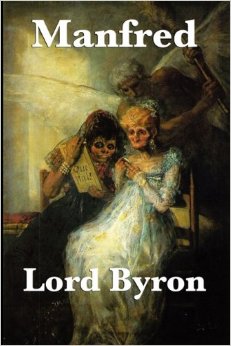
Sometimes, poetry is long, epic in actuality. Consider Manfred, by George Gordon, Lord Byron (From Wikipedia, the font of all knowledge): Manfred: A dramatic poem is a poem written in 1816–1817 by Lord Byron. It contains supernatural elements, in keeping with the popularity of the ghost story in England at the time. It is a typical example of a Romantic closet drama. (end quoted text)

Byron himself referred to his works as “closet dramas,” since they were intended more for the theater of the mind than the actual theater.

manfred-lord byronExcerpt from Act III, scene I of Manfred

There is a calm upon me–
Inexplicable stillness! which till now
Did not belong to what I knew of life.
If that I did not know philosophy
To be of all our vanities the motliest, 10
The merest word that ever fool’d the ear
From out the schoolman’s jargon, I should deem
The golden secret, the sought ‘Kalon,’ found,
And seated in my soul. It will not last,
But it is well to have known it, though but once.

And a “theater of the mind” is what Byron’s work sparks in me.

Words are bent and shaped by poets to evoke meanings, bent and formed into precise shapes. We novelists and writers’ of short fiction have the luxury of creating a long narrative. In poetry, space is intentionally limited by the author, forcing the the poet to write within narrow constraints. Thus, allegory, allusion, and indirection are common motifs in poetry.

Traditional forms have precise constraints: Sonnets are fourteen lines, following a set rhyme scheme and logical structure. Sonnets use iambic pentameter, which is characterized by the familiar “da dum da dum da dum da dum da dum” cadence of five sets of syllables.

Even in free verse, one must pay attention to the meter, the basic rhythmic structure  of a piece, the rhythm and cadence of the syllables. A clear example of this can be found in Walt Whitman’s poems, where he repeats certain phrases and uses commas to create both a rhythm and structure.

I love the poem,  When Lilacs Last in the Dooryard Bloom’d, written in free verse in 206 lines. Whitman used many of the literary techniques associated with the pastoral elegy. He composed it during the summer of 1865, a period of profound national mourning. The country was reeling in the aftermath of the assassination of President Abraham Lincoln, that occurred on April 14, 1865.

Despite the poem being an elegy to the fallen president, Whitman neither mentions Lincoln by name nor does he mention the circumstances of his death. Instead, Whitman used allegory–symbolic imagery:  the lilacs, a falling star in the western sky which was the planet Venus, and a shy bird, the hermit thrush. It is most definitely an elegy because he employed what scholars consider the traditional progression of the pastoral elegy: moving from grief toward an acceptance and knowledge of death.

It is is a beautiful poem, and is one I often return to. Lines 18-22 of Whitman’s leaves of grass-whitman When Lilacs Last in the Dooryard Bloom’d:

In the swamp in secluded recesses,
A shy and hidden bird is warbling a song.

Solitary the thrush
The hermit withdrawn to himself, avoiding the settlements,
Sings by himself a song.

And how has poetry evolved into the 21st century? For one unique direction of evolution check out the works of Seattle poet, Bill Carty on Pinwheel

For more famous contemporary poets, check out 31 Contemporary Poets You Need to Read.

I have always been a fan of the classic masters: Dickinson, Browning, the Brontë sisters, Byron, Shelley, Frost, Whitman. Wordsworth, and my beloved Yeats, among many.  I was raised in a home with their works proudly displayed on the bookshelves in the living-room, massive tooled-leather volumes from Grolier, smelling of romance and ideas.

I didn’t always understand the works of the great poets, and I still don’t–but I love them.

I leave you with a rhyming poem, The Song of the old Mother by William Butler Yeats:

I rise in the dawn, and I kneel and blow
Till the seed of the fire flicker and glow;
And then I must scrub and bake and sweep
Till stars are beginning to blink and peep;
And the young lie long and dream in their bed
Of the matching of ribbons for bosom and head,
And their days go over in idleness,
And they sigh if the wind but lift a tress:
While I must work because I am old,
And the seed of the fire gets feeble and cold.

4 Comments

Filed under Books, Fantasy, History, Literature, Publishing, Self Publishing, Uncategorized, writer, writing

Elements of the story: Conversation, gestures, and actions

My Writing LifeCreating memorable characters is the goal of all authors–after all, who would read a book if the characters are bland or uninteresting? But what is it that makes a character interesting? Is it just witty conversation?

That is surely a part of it, but think about the people you know. Picture the ones you like to spend time with. What is it about them that captured your interest in the first place? I’m not talking lovers here, so set the intangible, irresistible chemistry aside, for the moment.

Was it their gestures, their mannerisms that intrigued you before you got to know them? Something about them caught your interest, and you found a kindred spirit.

That is what we want to do for our characters.

And no, I don’t mean for you to inject an excess of flushing, smirking, eye-rolling, or shrugging into your story.

I want you to think natural: People don’t only use their faces to communicate. People’s bodies and faces are in constant motion, and that is how you want your characters to seem. You can do this in small, unobtrusive ways by visualizing your conversations and the character’s who are having them.

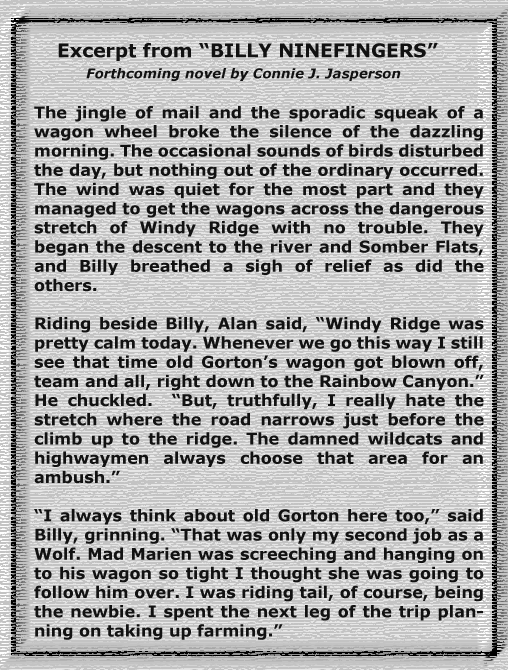
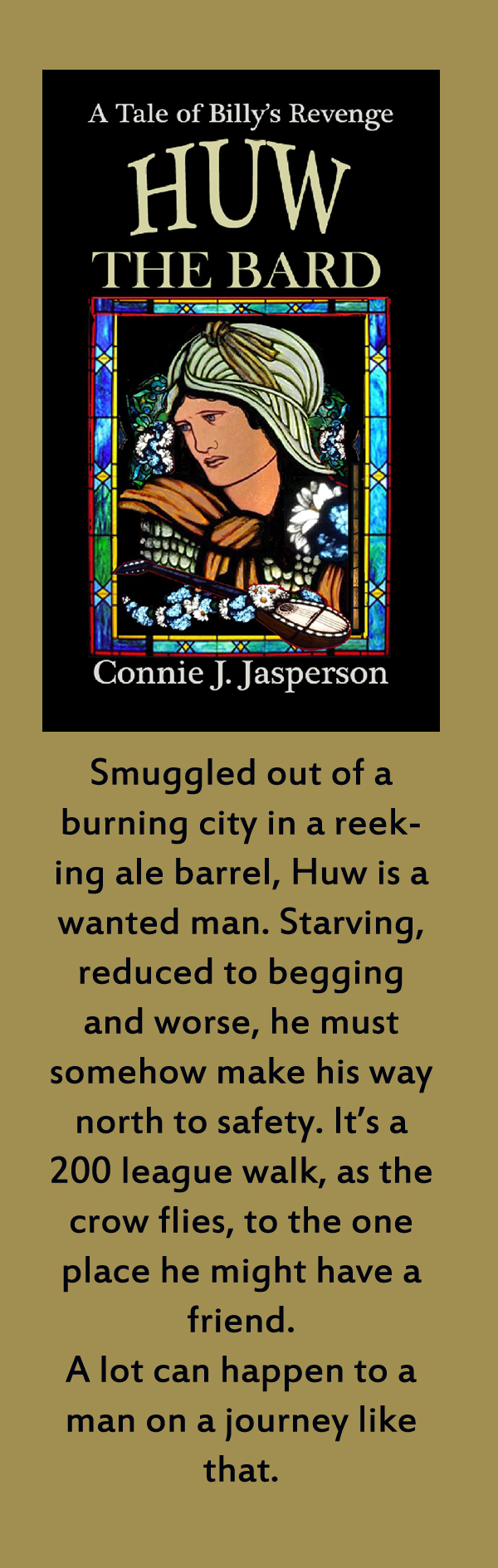
Consider this excerpt from one of my works in progress, Billy Ninefingers. These excerpts are from my rough draft and will be tightened up, but I am using them as the examples today.  This tale takes place in the world of Waldeyn, and Huw the Bard figures prominently in it, although not in the opening chapters. This conversation happens just before the first plot point. It is the calm before the storm and reveals some of Billy’s personality and his sidekick, Alan Le Clerk. It shows them as mercenaries and as people, and also shows their environment.

Conversation 1 Billy and Alan


Billy and Alan are clearly friends. It’s a sunny day and they are obviously wearing armor. Their conversation tells us they’re concerned about the trail they are on. Through that, we learn that world they live in is dangerous and people must hire guards to protect them from more than just highwaymen if they choose to travel. The three paragraphs of that conversation are all the reader needs to know about the work they do and the trail they are riding. That scene ends and the next scene  takes them and the merchant they are guarding to their destination, the dark, dirty town of Somber Flats.

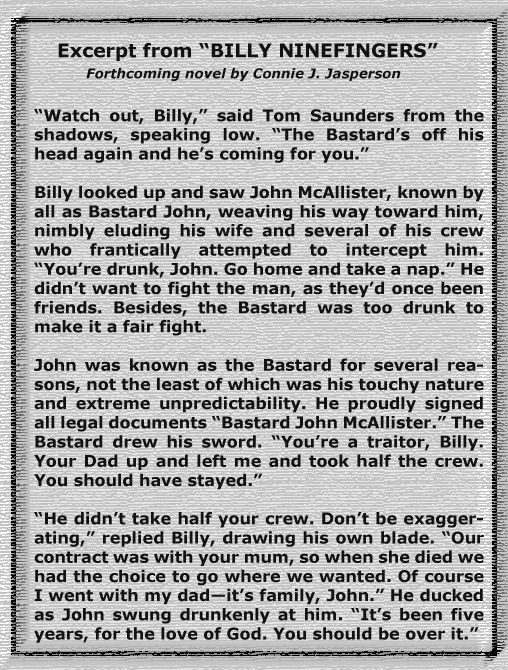
That is where we come to the lead-up to the inciting action. This is where we meet Bastard John, and it is one of the few times he will be in such a place that we can see who he is. The second plot point makes no sense unless the reader knows that the Bastard is an obnoxious bastard, and proud to be so-named.

Conversation 2 Billy and Bastard John


We know the Bastard is a bastard when he is drunk. We know he is capable of acting on any thought that passes through his alcohol-soaked mind. We also see that Billy has a sense of fair-play.

Picture your conversations as if your were there with them. People miss a few beats when they are speaking. They gather their thoughts and  speak in short bursts. They shift in their chair, or stand up, or wave a hand to emphasize a point. They turn, and they sometimes mumble.

And it is important to remember that every character’s mannerisms are individual, uniquely theirs. You, as the author visualize them this way, but it is your task to commit their personalities to paper, and that is where many authors fail.

Through physical actions and conversational interactions we make our characters knowable and likable (or not, as the case may be). Their actions also help to show the environment they exist in. Within the scene of the conversation, you have the opportunity to convey the setting and the mood of your characters.

Claude Monet Painting in his Garden, by Pierre-Auguste Renoir [Public domain or Public domain], via Wikimedia Commons

Claude Monet Painting in his Garden, by Pierre-Auguste Renoir [Public domain], via Wikimedia Commons

We use our words sparingly and with intention, painting the setting as if we were artists in the style of the  impressionists. With color and small hints a good author gives the impression of detail, offering the reader a framework for  to hang his imagination on.

When characters act and speak naturally within a clearly visualized impression of a setting, we as readers,  suspend our disbelief and become immersed in the story.

Comments Off on Elements of the story: Conversation, gestures, and actions

Filed under Fantasy, Literature, Publishing, Uncategorized, writer, writing

Lay, lie, laid

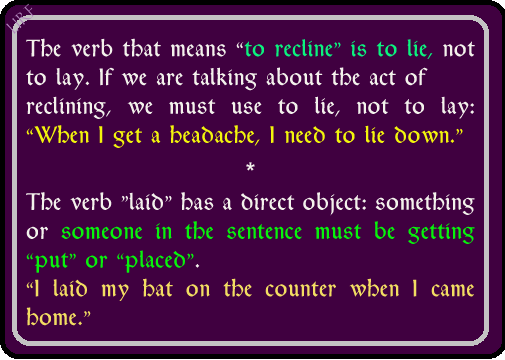
to lie means to restIs it to lay, to lie, or what? I want to get this right but these words can be a complicated morass of misery. It boils down to a simple concept: is it RECLINING  or was it PLACED THERE?

“Lay” is a verb meaning to put or place something somewhere. It has a direct object. Its principal parts are “lay,” “laid,” “laid,” and “laying.”

What the words refer to is the action: If you set it (object) there, it is laying there. Lay it there. Lay it on the pillow.

If it is resting or reclining, it is lying there. Lie down. Lying down. Lie down, Sally. (Clapton had it wrong? Say it isn’t so!)

The internet is your friend, and can teach you many things besides how to make cute kitty memes. Quote from the wonderful website Get it Write: The verbs to lie and to lay have very different meanings. Simply put, to lie means “to rest,” “to assume or be situated in a horizontal position,” and to lay means “to put or place.” (Of course, a second verb to lie, means “to deceive,” “to pass off false information as if it were the truth,” but here we are focusing on the meaning of to lie that gives writers the most grief.)

As another great resource, in his July 7th, 2015 post on this subject for Writers’ Digest,  Brian A. Klems gave us a useful chart:

Lay vs. Lie Chart


Infinitive    Definition         Present    Past    Past Participle    Present Participle


to lay      to put or place     lay(s)           laid     laid                     laying
something down

to lie     to rest or recline    lie(s)            lay      lain                     lying

“end of quoted text” 
Brian A. Klems is an awesome author and blogger. Check out his personal blog at The Life of Dad.

>>><<<

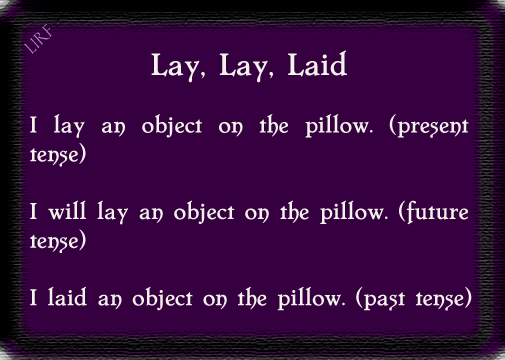
This is where things get tense: present, past and future.

A ring lay on the pillow. 

Lay, Lie, Laid

But I needed to rest:

LYING AS IN RESTING copy

So what this all boils down to is:

final comment lay laid

But just to confuse things:

A living body lies down and rests as is needed.

A dead body is cleaned up and laid out by other people,  if said corpse was important to them. However, after having been laid out, said corpse is lying in state to allow mourners to pay their respects.

5 Comments

Filed under Humor, Literature, Publishing, Uncategorized, writer, writing

Achieving balance

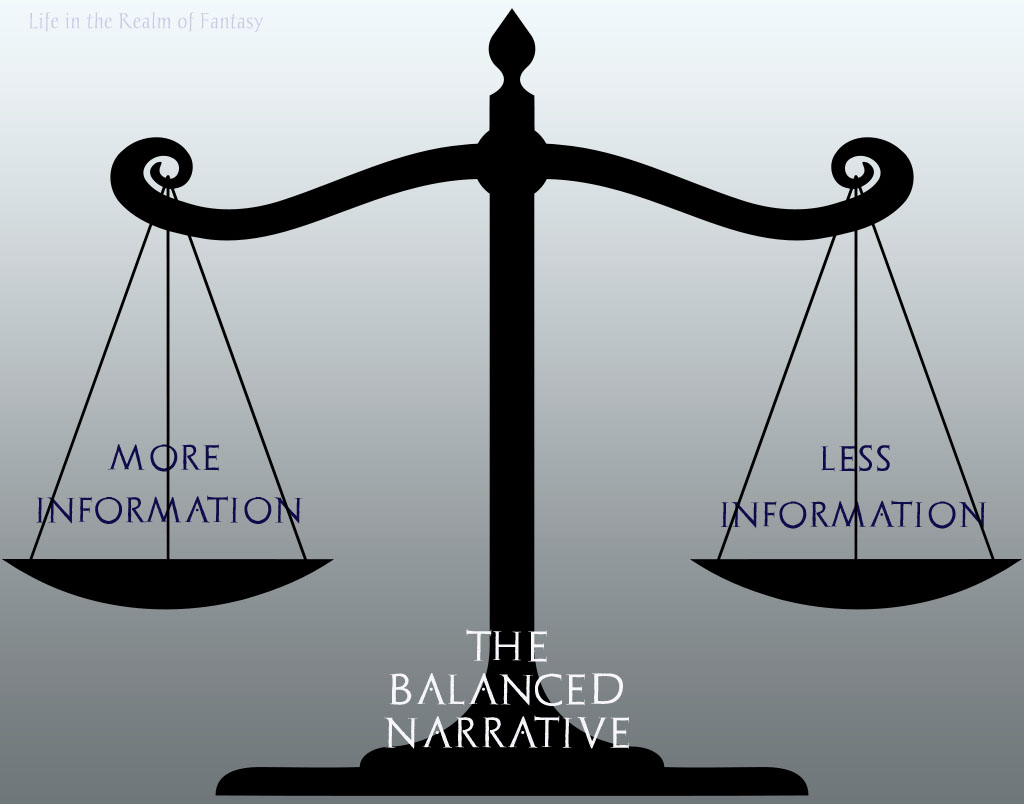
the balanced narrativeYou’ve heard the saying, “a little knowledge is a dangerous thing.” The implication is that a small amount of knowledge can lead to overconfidence and leaping to invalid conclusions based on what you do know without taking into account the things that you don’t know.

When we are newly-hatched authors, we eagerly soak up the wisdom offered to us through writing seminars and handbooks on the craft of writing.

But if you are an avid reader, someone who reads widely and in many different genres, you can see that writing is not simply a matter of following rules.

This is especially true in regard to the many-layered concept of exposition, introducing background and necessary information into the narrative.

Sometimes there is life in a manuscript that has broken all the rules. The work shines because it’s clear that the writer had passion and it was conveyed in the written word. Life is a natural consequence of the rush of creativity and is set into the manuscript when the first words are written.

Unfortunately it is easy to murder what began as a beautiful story. Consider those writers who spend years carefully combing every spark of accidental passion out of their work, creating textbook-perfect sentences that are flat, toneless. The reader has no desire to care about the characters or their struggle.

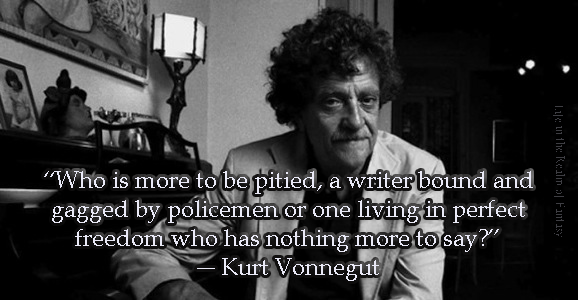
kurt-vonnegut_quoteI’ve also known people who use “the ‘f’ word” regularly in their work  because they think it’s cutting edge, and then they have the balls to say they write like Kurt Vonnegut.

They don’t.

Blindly breaking rules without understanding them is not good writing craft. Vonnegut understood the rules, and when he broke them, he did it to inject life into his work.

He understood balance and was not afraid to use it.

You want to create a balanced narrative:

  1. Information must be delivered only as the protagonists need it.
  2. The information can never be something everyone already knows.
  3. You must offer SOME information–people appearing out of nowhere mean nothing if you do not offer an explanation for them.
  4. No one will die if you use an adjective to describe an object, once in a while.
  5. Show people by using simple, general descriptions such as handsome or dark-haired, and use their mannerisms to convey their moods–things that allow the reader to form their own idea of what the characters look like and how they are feeling. But do give the reader something to build their visualization around.
  6. Stick to simple basic speech tags like said and replied, and if the conversation has only two people, skip them sometimes for a sentence or two.

I know a few authors who are like pendulums. They have no concept of balance and leave each meeting of their writing group with the notion that they have to go all or nothing when deploying information.

Thus, if they have been told they gave too much information, they go too far and now their characters appear out of the ether, with unexplained powers and do things that make no sense.

First you have to realize that no one writes a perfect, completely flawless manuscript, not even Neil Gaiman. And then you have to decide: are you writing for the critics who might be out there, or because you love to write.

If you are not writing for the joy of writing, quit now.

Otherwise, keep writing. Only by continued practice will you develop the balance you know you need. And you don’t have to be committed to only writing novels. Some of the best work I’ve ever read was in the form of short stories.

You can gain a handle on balance by writing short-stories and essays.

With each short-story you write, you increase your ability to tell a story with minimal exposition. This is especially true if you limit yourself to writing the occasional practice story—telling the whole story in 1000 words or less. These practice shorts serve several purposes:

  • You have a finite amount of time to tell what happened, so only the most crucial of information will fit within that space.
  • You have a limited amount of space so your characters will be limited to just the important ones.
  • There is no room for anything that does not advance the plot, or affect the outcome.
  • You will build a backlog of short stories and characters to draw on when you need a good story to enter into a contest.

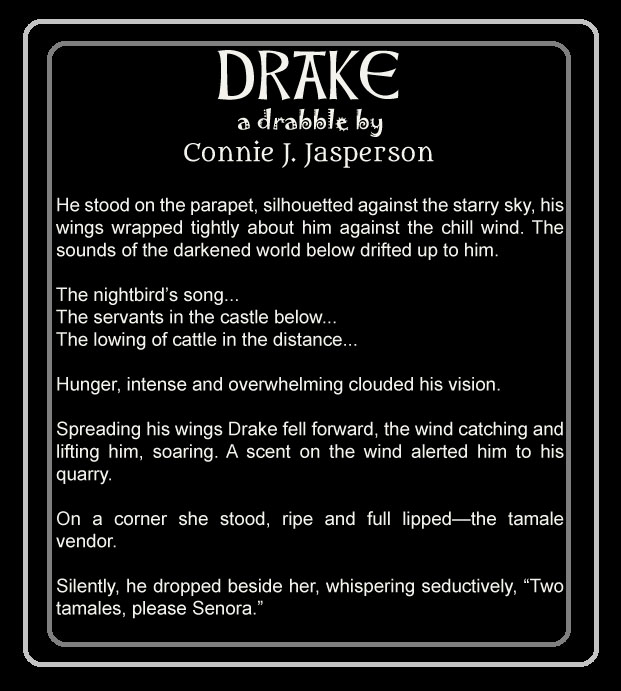
Go for the gusto, and try writing flash fiction–give yourself less than 1000 words to tell a story. Or really challenge yourself–tell that story in around 100 words ( a drabble):

Drake - a drabble by cjj

Drake, © Connie J. Jasperson 2013, All Rights Reserved

4 Comments

Filed under Humor, Publishing, Uncategorized, writer, writing

You have thirty seconds to sell me that book

HTB Bookmark side B copy

“Huw the Bard” bookmark side B: the business card

I try to do at least one book signing event a month. For me, these events are one of the trickier parts of the business, because I am trying to sell something I love, but I am not a natural-born salesman. You have to know what you’re trying to sell, and that is not as easy as it sounds.

First off, just because you wrote the book doesn’t mean you can give a concise two sentence pitch about it to a prospective customer. And don’t think you can just read them the blurb–they can do that for themselves and will walk away if they think you are not trying to engage them.

People have short attention spans, especially at events. You have thirty seconds to sell that book–sixty if you are really lucky.

What we are talking about here is called an “elevator pitch.” It goes like this: imagine you get on the elevator carrying a briefcase with your books in it. A fellow passenger asks what you’re selling. An elevator pitch is a short summary used to quickly and simply define your product in the time it takes for the elevator to go from one floor to the next, which is where your captive audience will get off. 

Remember what I have said about the internet giving you a free education? Here is one great example of that, quoted directly from Salisbury University’s career services webpage:

Essential Elements of a Powerful Elevator Pitch:

  • HTB Bookmark side A copy

    “Huw the Bard” bookmark side A: the pitch

    Concise. Your pitch should take no longer than 30-60 seconds.

  • Clear. Use language that everyone understands. Don’t use fancy words thinking it will make you sound smarter. Your listener won’t understand you and you’ll have lost your opportunity to hook them.
  • Powerful. Use words that are powerful and strong. Deliver the “Sis-Boom-Bang” to grab their attention!
  • Visual. Use words that create a visual image in your listeners mind. This will make your message memorable.
  • Tell a Story. A short story, that is. A good story is essentially this: someone with a problem either finds a solution or faces tragedy. Either type of story can be used to illuminate what you do.
  • Targeted. A great elevator pitch is aimed for a specific audience. If you have target audiences that are vastly different, you might want to have a unique pitch for each.
  • Goal Oriented. A kick-ass elevator pitch is designed with a specific outcome in mind. What is your desired outcome? You may have different pitches depending on different objectives. For instance do you want to: make a sale, gain a prospect, enlist support for an idea, or earn a referral.
  • Has a Hook. This is the element that literally snags your listener’s interest and makes them want to know more.  This is the phrase or words that strike a chord in your listener.

(end of quoted text)

Identify the key elements of your book (or series of books). Let’s consider the Tower of Bones series of books, based in the World of Neveyah.

  1. The underlying themes of the World of Neveyah series are brotherhood, family, romantic love, honor, and duty.
  2. The obvious theme is the successful resolution of a quest.
  3. The core plot device around which the story evolves is an ongoing War of the Gods, and the world in which the tale is set in is their battleground, offering all sorts of opportunities for mayhem

How do I boil that down into a seemingly off-the-cuff elevator pitch? So far, I have not been that successful, but I am getting better with each event I go to. Practice does help to improve how confident you feel when pitching your book to a potential reader.

  • WON Books Postcard Side A 6-23-2015

    “World of Neveyah” series postcard side A: the pitch

    Open your pitch by getting the potential buyer’s attention with a “hook.” This is a statement or question that piques their interest to want to hear more.

  • Craft your spiel so it’s about 150-225 words in length, as if it were a blurb. In fact, it is an alternate blurb to the one that is on the back of the book.
  • Remember, your pitch should go no longer than 60 seconds. 30 seconds is optimal.
  • Know your “script” so well that you can sound causal about it, and vary the way in which you deliver it, so that it does not sound rote or mechanical.
  • Readers expect dedication and sincere passion for the craft of writing from the authors they meet, so put some feeling into the delivery.
  • At the end of your pitch, offer to give them something. Would they like a bookmark or a postcard? (Both of which just happen to be beautifully crafted business cards thinly disguised to look like swag.)
WON Books Postcard white Side B 6-23-2015

“World of Neveyah” postcard side B: the business card

Two sorts of handouts are absolutely crucial, especially if they are eye-catchy. Bookmarks and postcards can be used to mark a place in any paperbook, whether it is yours or someone else’s book. When readers are just pausing as they pass through at events, bookmarks and colorful postcards are always welcome because they can use them, and your name and your book cover(s) will be there where they will see it.

These are even more critical if they only buy ebooks. Readers who only buy ebooks love getting them both for the artwork and the information they contain. These cards will tell them where they can get those morsels of goodness, all primed and ready to send to the electronic reading device of their choice.

I have been assured that over time, my elevator pitch will evolve, becoming more clear and powerful. And it’s true–as time goes on I’m becoming more confident in what I have to sell, and I am selling more books.

As I have discovered, confidence in your work does convey itself to the prospective reader.  Each time you, as a person, make a positive impression on a potential reader you have the possibility of creating a lifelong fan who will tell their friends about your work.

WON Books Postcard with writing as of June 2015

Mock-up for a possible banner/poster for the World of Neveyah. Did not use–too busy, but liked some aspects of it. Will likely cut it down to just the two main sentences that tell it all.

2 Comments

Filed under Uncategorized

Elements of the story: the structure of the scene

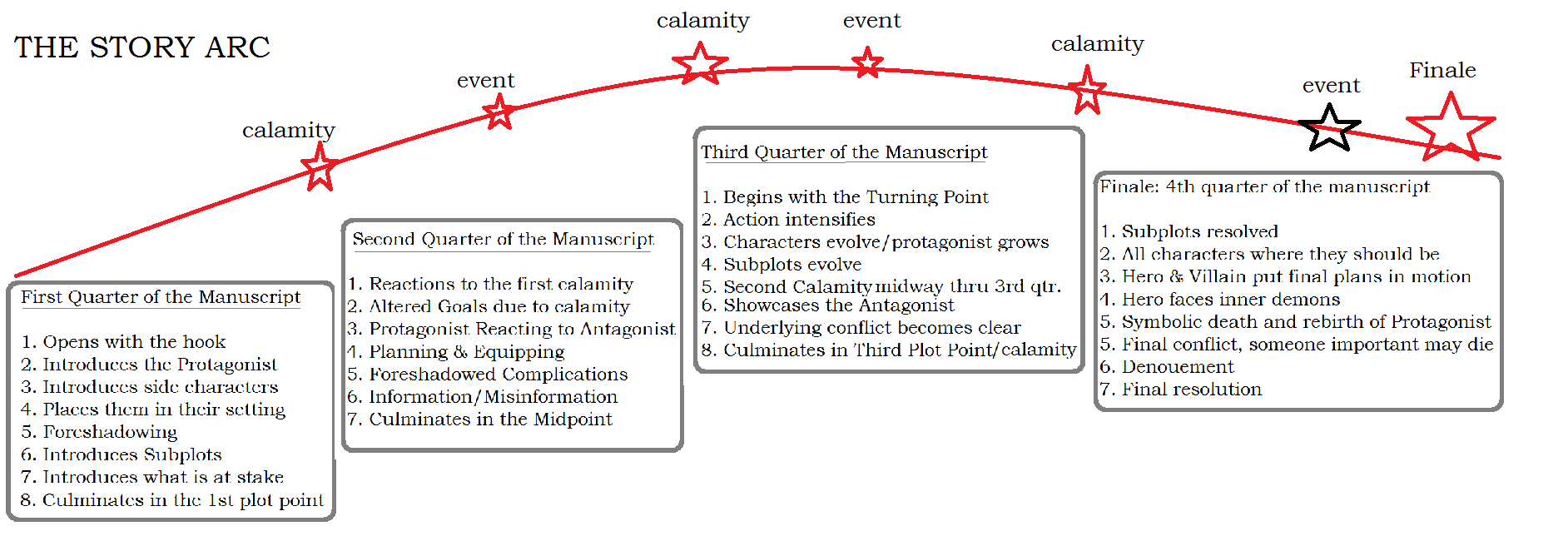
Most authors understand that there is an arc to the overall novel–the Story Arc  which  consists of :

  1. Exposition, where we introduce our characters and their situation.
  2. Rising Action, where we introduce complications for the protagonist
  3. Climax, the high point of the action, the turning point of the narrative
  4. Falling Action, the regrouping and unfolding of events that will lead to the conclusion
  5. Resolution, in which the problems encountered by the protagonist are resolved, providing closure for the reader.

The Arc of the Story

Wikipedia, the fount of all knowledge says, “In a story arc, a character undergoes substantial growth or change, and it ends with the denouement in the last third or quarter of a story: The end of a narrative arc is the denouement. It shows what happens as a result of all the conflict that the characters have gone through.”

However, as we’ve discussed before, within the larger story there are many smaller stories, “scenes” created with this same arc, that come together to create this all-encompassing drama. The way these scenes unfold is what keeps our readers interested and invested in the narrative until the end of the book.

Last July, at the 2014 PNWA Conference, in his seminar on the arc of the scene, author Scott Driscoll explained how the main difference in the arc of the scene vs the overall arc of the novel is this: the end of the scene is the platform from which your next scene launches.

Once he explained it in that fashion, I understood it. This means each scene begins at a slightly higher point on the novel’s Narrative Arc than the previous scene did, pushing the narrative toward the climax.

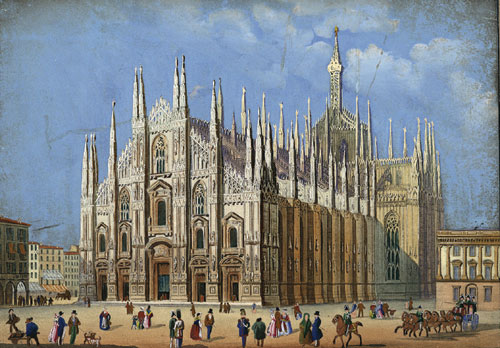
Milano_Duomo_1856

Milano Duomo 1856 via Wikipedia

In my mind, this means that novels are like Gothic Cathedrals–smaller arcs of stone support the larger arcs until you have a structure that can withstand the centuries. Each small arc of the scene builds and strengthens the overall arc of the greater novel.

These small arcs of action and reaction ensure the plot doesn’t stall and create tension that drives the story to the four cardinal points of the story arc.

Conversations are scenes that form a fundamental part of the overall arc: they begin, rise to a peak, and ebb. They inform us of something we must know to understand the forthcoming action. Conversations propel the story forward to the next scene. A good conversation is about something and builds toward something. J.R.R. Tolkien said “Dialogue has a premise or premises and moves toward a conclusion of some sort. If nothing comes of it, the dialogue is a waste of the reader’s time.”

That is true of every aspect of a scene: action, conversation, reaction. A scene that is is all action can be confusing if it has no context. A properly placed conversation can give the reader the context needed to understand the reason for the action.

A certain amount of context can arrive through internal monologue, but it must be done in such a way that the reader is not faced with a wall of italics. There are two problems with long mental conversations:

  1. italics are daunting in large chunks.
  2. it can become a thinly veiled cover for an info dump.

Remember, in novels, not everyone in the scene knows everything, so their thoughts won’t be that critical, and are therefore not needed. Plot points are driven by the the characters who do have the critical knowledge. The fact that some characters are working with limited information is what creates the tension.

Consider the concept of  asymmetric information–a situation in which one party in a business transaction has more or superior information compared to another. In business, one individual’s pursuit of pure self-interest can prevent other companies from effectively entering and competing in an industry or market–he has critical knowledge they don’t have, and effectively eliminates his competition. He has a monopoly.

That monopoly of information creates a crisis. In the novel, a conversation scene should be driven by the fact that one person has knowledge the others need. Idle conversation will bore your reader to tears.

We deploy info, but we don’t dump it in one large chunk though–the reader must find it out at the same time as the other characters, over the first 3/4 of the novel.

We do this in small arcs that combine to form the overall story arc. Events occur, linked by conversations, forming small arcs (scenes) that support the structure of the novel.

The Story Arc


By creating small arcs in the form of scenes, we offer the reader the chance to experience the rise and fall of tension, a pulse which never completely falls but is always increasing toward the high point of the book, giving the reader small rewards of emotional satisfaction along the way to the big event, the grand climax.

Comments Off on Elements of the story: the structure of the scene

Filed under Literature, Publishing, Uncategorized, writer, writing

Phrasal verbs–minions of evil, or sometimes useful?

Book- onstruction-sign copyPhrasal verbs are usually two-or three-word phrases consisting of a verb plus an adverb, or a verb plus a preposition, or both. They are just another aspect of English vocabulary, and can be considered a form of compound verbs.  We use them all the time, but what, exactly, are they?

First, what is an adverb?

The term adverb is somewhat of a catchall word to describe many kinds of words having little in common other than the fact they don’t fit into any of the other available categories (noun, adjective, preposition, etc.) and they modify an action word—a verb.

The principal function of adverbs is to act as modifiers of verbs or verb phrases. An adverb used in this way gives information about the manner, place, time, frequency, certainty, or other circumstances of the activity denoted by the verb or verb phrase. Too many modifiers in your narrative and voila! Purple prose.

phrasal verbsThere are three main types of phrasal verb constructions depending upon whether the verb combines with a preposition, a particle, or both.

Wikipedia, the fount of all knowledge, has a good example of these three forms:

Verb + preposition (prepositional phrasal verbs)

  1. Who is looking after the kids? – after is a preposition that introduces the prepositional phrase after the kids.
  2. They picked on nobody. – on is a preposition that introduces the prepositional phrase on nobody.
  3. ran into an old friend. – into is a preposition that introduces the prepositional phrase into an old friend.
  4. She takes after her mother. – after is a preposition that introduces the prepositional phrase after her mother.
  5. Sam passes for a linguist. – for is a preposition that introduces the prepositional phrase for a linguist.
  6. You should stand by your friend. – by is a preposition that introduces the prepositional phrase by your friend.

Verb + particle (particle phrasal verbs)

  1. They brought that up twice. – up is a particle, not a preposition.
  2. You should think it over. – over is a particle, not a preposition.
  3. Why does he always dress down? – down is a particle, not a preposition.
  4. You should not give in so quickly. – in is a particle, not a preposition.
  5. Where do they want to hang out? – out is a particle, not a preposition.
  6. She handed it in. – in is a particle, not a preposition.

Verb + particle + preposition (particle-prepositional phrasal verbs)

  1. Who can put up with that? – up is a particle and with is a preposition.
  2. She is looking forward to a rest. – forward is a particle and to is a preposition.
  3. The other tanks were bearing down on my panther. – down is a particle and on is a preposition.
  4. They were really teeing off on me. – off is a particle and on is a preposition.
  5. We loaded up on Mountain Dew and chips. – up is a particle and on is a preposition
  6. Susan has been sitting in for me. – in is a particle and for is a preposition.

(end of quoted example, thank you Wikipedia)

We use phrasal verbs all the time in our daily speech and in our writing. However, whenever it’s possible we should look for simpler ways to phrase our thoughts when writing, unless we are writing conversations spoken in the local vernacular.

Why do I feel that way? The way I see them, phrasal verbs are  two-or-three words (an action word and modifiers) forming what can be considered a separate verb-unit with a specific meaning. In other words, they use more words than is really needed to express a thought:

  • Who is looking after (verb unit) the kids? == Who is watching the kids?
  • They brought that up (verb unit) twice. == They mentioned it twice.
  • Who can put up with (verb unit) that? == Who can endure that?

We use these phrasings because they sound natural to us—that is the way people in your area might speak. But when used too frequently in a written piece, phrasal verbs junk up the narrative. They subtly contribute to what we call “purple prose” because the overuse of them separates the reader from the story.

Unless you are writing poetry, simplicity is best, because you want to immerse your reader in the experience.

ok to write garbage quote c j cherryhWhen we are revising our first draft, and tightening our narrative we should be examining the prose for weak phrasing. Each time you come across phrasal verbs in your work, look at the sentence it occurs in as if it were an isolated incident and ask yourself if it needs to be there. Many times a phrasal verb really is  the only way to express what you are trying to say, but equally often a more concise way can be found.

Phrasal verbs have their places, but if you can simplify a thought and make the sentence stronger, do so.

2 Comments

Filed under Literature, Publishing, Uncategorized, writer, writing

Mountains of the Moon Launches

Map of Neveyah, for MOTM 6-14-2015Mountains of the Moon is the newest release in the World of Neveyah. It is set in the same world as the Tower of Bones series but it is the original story that was written as the storyline for an old-school RPG game, along the lines of the early Final Fantasy games.

A prequel to Tower of Bones, the book follows the adventures of Wynn Farmer as he and his companions travel high into the mountains to stop the Tauron, Bull God, and his minotaurs from overrunning Neveyah. Nothing goes as it’s supposed to, and Wynn’s general naiveté often causes his companions serious trouble.

MOTM Front Cover Final 6-18-2015Wynn is seriously ignorant of the world in general, and at the outset, he’s in over his head, and he knows it. This book also introduces several characters as young men,  two of whom play a large role in the Tower of Bones series, Rall Ivarsson, and Jules Brendsson. Both these men figure strongly in later books, and at the time of Tower of Bones, Rall occupies the office of the Holy Seat, guiding the Temple of Aeos, and is the most powerful man in Neveyah.

Wynn’s story is sometimes hilarious and was fun to write–a contrast against the frequently dark situations they find themselves in. The world of Neveyah is a harsh place at times. Magic is a fundamental facet of life there, and many of the magical creatures that inhabit the world are just as deadly as the minotaur hordes of the Bull God.

THE BLURB:

Charged by the goddess Aeos, Wynn and his companions bicker and bumble their way through the Mountains of the Moon. Danger, mystery, and dark prophecies chase them through a gauntlet of jagged peaks and deadly traps.

Can they survive the dark secret hidden in Tauron’s crumbling castle before his minotaurs overrun Neveyah?

The Gods are at war, and Neveyah is the battlefield.

>>><<<

Mountains of the Moon is on sale at these fine online stores for $2.99 ebook and $17.99 for paperbook:

Barnes and Noble for Nook or paperback

Amazon.com for Kindle or paperback

Also available at SmashWords in a variety of ebook formats for your phone or tablet!

>>><<<

FOR CARLIE M.A. CULLEN’S REVIEW OF MOUNTAINS OF THE MOON, CLICK HERE Wow! She liked it!

>>><<<

And also, a reminder that I will be signing books at AFK Elixers and Eatery all afternoon and evening tomorrow, Saturday the 27th of June, 2015. Please–feel free to stop in and chat! I will be there with local authors AJ Downey, Sechin Tower, Lee French,  Lindsay Schopfer, Stephen Matlock, David Moore and Jeffrey Cook.

Comments Off on Mountains of the Moon Launches

Filed under Books, Publishing, Uncategorized, writer, writing