Category Archives: WordPress

Pareidolia

Martian_face_vikingSo I was reading a rather badly crafted novel last night–one that was entirely forgettable other than this one word: pareidolia.  I tried to get my kindle to find the meaning, and it was unable to answer that question too.  But  Wikipedia, the fount of all knowledge, came to the rescue:

Pareidolia (/pærɨˈdliə/ parr-i-doh-lee-ə) is a psychological phenomenon involving a vague and random stimulus (often an image or sound) being perceived as significant, a form of apophenia. Common examples include seeing images of animals or faces in clouds, the man in the moon or the Moon rabbit, and hearing hidden messages on records when played in reverse.

The word comes from the Greek words para (παρά, “beside, alongside, instead”) in this context meaning something faulty, wrong, instead of; and the noun eidōlon (εἴδωλον “image, form, shape”) the diminutive of eidos. Pareidolia is a type of apophenia, seeing patterns in random data.

Sir Paul McCartney, image from Rolling Stone MagazineHuh. Who knew? Apparently people have been suffering from pareidolia  for thousands of years: seeing patterns in the stars and calling them constellations,  faces and images in clouds, and seeing the face of the Virgin Mary in the patterns on their french toast. They also hear the Beatles implying “Paul is dead” when you play their songs backwards.   The Rorschach inkblot test uses pareidolia in an attempt to gain insight into a person’s mental state.

330px-Francesco_Melzi_-_Portrait_of_Leonardo_-_WGA14795You aren’t crazy–you are extremely creative and able to visualize it pretty clearly. Even Leonardo Da Vinci understood the phenomenon–apparently he wrote of pareidolia as a device for painters, writing “if you look at any walls spotted with various stains or with a mixture of different kinds of stones, if you are about to invent some scene you will be able to see in it a resemblance to various different landscapes adorned with mountains, rivers, rocks, trees, plains, wide valleys, and various groups of hills. You will also be able to see divers combats and figures in quick movement, and strange expressions of faces, and outlandish costumes, and an infinite number of things which you can then reduce into separate and well conceived forms.”

Well, it’s a word I most likely won’t use, but there it is — pareidolia — a new word in my vocabulary.


10 Comments

Filed under Adventure, Battles, blogging, Books, Fantasy, History, mythology, Self Publishing, WordPress, writer, writing

Analog, I revile thee, or how The Martian redeemed my faith in science fiction

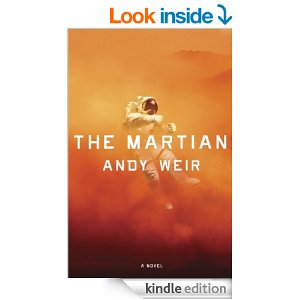
The MArtian Andy WeirI’m a book addict. Each time I crack open a book, whether in hard copy or on my Kindle, I’m hoping to be blown away by the imagery the author presents, hoping for that amazing high that comes from living a true classic. Lately I have been reading wide of my usual slot, not abandoning fantasy, but going back and seeing what I loved the most about the genre that was my first introduction to reading for pleasure. I recently had the experience of being completely and utterly blown away by a science fiction novel, The Martian, by Andy Weir.

It’s one of the best science fiction stories to come out of the last 20 years.  A real adventure story from the get-go, this story of an astronaut inadvertently left behind is gripping from page one. As a main character, Mark Watney is hilarious. He is the sort of man who gets through life by finding something positive in every disaster, and mocking the hell out of everything that is negative.

A horrendous storm destroys much of their base, and his team is forced to abort their mission.  During the emergency evacuation of the Ares 3 landing site, he is severely injured in an accident that appears to have killed him. His body is unretrievable, and unaware that he is still alive, he is left behind. His companions begin the long journey back to Earth, grief-stricken at his sudden death. THIS is an awesome, gripping, and hilarious story.

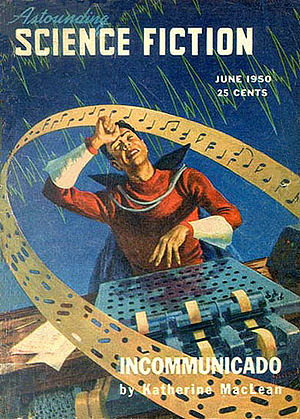
300px-Astound5006I’ve been a subscriber to a well-known science fiction magazine, Analog,  for many years. I am actually considering letting my subscription lapse, because for the last five years or so I have struggled to find something enjoyable in their magazine.  I no longer enjoy the work they are publishing and they no longer seem to care. While there are occasional nuggets, the majority of work they publish is frequently harsh, lifeless, depressing, and incomprehensible. The fact is, perhaps they have forgotten what real science fiction is about, what the average reader wants. Perhaps I am no longer smart enough for their publication–and I hate paying to be sneered at.

Despite the efforts of the publishing community, the genre of science fiction is not dead. Andy Weir ‘s brilliant work on The Martian proves that there are writers out there with exactly the sort of stories I am looking for.  And guess what–he published it in 2012 AS AN INDIE.  This is a really telling thing, that the watershed books are no longer being put out there by the Big Six, until they have proven their worth in the Indie market. Hugh Howey, A.G.Riddle, Rachel Thompson–INDIES, all of them.

In my sci-fi, I want human frailties, drama, adventure, intense life and survival against great odds, set against a backdrop of understandable and realistic science.

I want a Space Opera.  Andy Weir gave that to me.

It is that high drama that made the Star Trek empire what it is. High drama set in exotic places made George Lucas’s Star Wars series of movies the poster child for space operas. Those two series translated the intensity of feeling that the great authors of science fiction all brought to their work.

Over the years, I have written many short space operas for my own consumption. However, this fall I am embarking on the real test–putting my writing skill where my mouth is.  It just so happens that off and on for the last  3 years, I’ve been outlining a science fiction story.  Originally, I began this project  in preparation for NaNoWriMo 2013, but this will be the year to implement it, so in November this will be my work.

As a devoted fangirl of many well-known physicists, I’ve been doing  research for the last three years, and feel sure my science will hold up, which, in sci-fi, is key to the longevity of a tale. I have great characters, and a really plausible plot. I just have to spend 30 days stream-of-conscious writing to the prompts I have set forth and…well, that is the trick, isn’t it? But even if I fail to write anything worth publishing, I will have had a good time, and that is what this gig is all about: enjoying the ride.


2 Comments

Filed under Adventure, Battles, blogging, Books, Fantasy, Humor, Literature, Publishing, Self Publishing, WordPress, writer, writing

What does “Submission-Ready” mean?

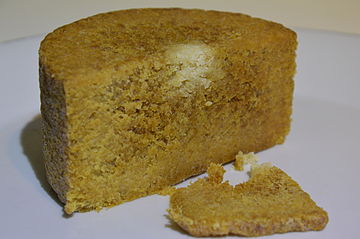
Gamalost-NorwegianOldCheeseI’m not talking bondage here, friends, so get your mind out of the erotica.

I’m talking about a manuscript with the potential to be made into something publishable.

I see a lot of manuscripts. Some are quite promising, some not so much. Literally anyone can write and publish a book nowadays, but not everyone can write a book others will want to read–THAT is a craft, and there are many who don’t feel the need to learn it before they submit their work to an editor or a publisher.  The quality of their work stinks like gamalost cheese, but they have the gall to wonder why the Big 6 haven’t snapped it up.

gibberish-american businesses onlineIt is important to learn the craft of writing, if you want readers to enjoy your work. Spend the time to learn the mechanics of the language you are writing in. However, if you are simply writing a pretentious pseudo-literary art piece, fine–go on and have at it–no one will ever read it, and you can feel superior for having written it. If you dare to compare yourself to James Joyce I will run you out of the writing group quicker than you can say Ulysses.

Before you submit your manuscript, take the time to make it submission-ready:

1. Properly format it: Set the indents, use a serif font of .11 or .12, double-space it with no extra space between the paragraphs, and do not justify it.

2. Hire an editor to help you straighten out the flaws YOU can’t see.

3. Go to the publisher’s website and find out what their submission guidelines are and FOLLOW THEM. (Yes, they apply to EVERYONE, no matter how famous, even  you.) If you skip this step, you will wait a year to hear that your ms has been rejected, and they won’t tell you why.  It’s not worth their time to teach you how to be a writer–you have to learn that on your own.

For a more in-depth description of this whole process, see my series “WORD-A Shifty Beast.”

learn something newTry to learn something new every day in your writing life, and with each success you have, try to keep some humility.  You will grow as an author, your work will remain fresh, and I will continue to beg to read it.

If you read the kind of work you want to write, you will gain inspiration from the masters in your genre. When I am not writing or editing, I am reading. And when I have the chance to read for pleasure, I read epic fantasy, paranormal fantasy and science fiction. When I find a book that rings my bells, I talk about it, and blog about it. Conversely, if I hated it, I never mention it again.

Yep–I’m that kind of a reader.


3 Comments

Filed under Blogger, blogging, Books, Fantasy, Humor, Literature, Publishing, Self Publishing, Vegan, WordPress, writer, writing

It may be rattlesnake, but it tastes like chicken

MSClipArt MP900390083.JPG RF PDWriting the first draft of your novel is a lot of fun, but there are times when getting your phrasing right is confusing. Wrangling words is not for the faint of heart! Many frequently used words are what is called “homonyms” — soundalike words.

Yeah–you know that casserole contains rattlesnake surprise, but it tastes like chicken, so the kids haven’t a clue.

You as the author, do not always see the rattlesnakes among the chickens in your work.

You MUST NOT expect an editor to straighten out a mess that you can take of with a little attention on your part, so it is important to do your  research, and learn your craft. Submitting a mess to an editor will result in rejection, as it is an expensive waste of time to try to teach a would-be author how to write a book.

At times, only a homonym, a word that sounds very much like another, can be used in a sentence. That similarity makes it hard to know which word is the correct word in a given circumstance, and when you are spewing the first draft of a manuscript, autocorrect may “help you” by inserting the wrong instance of those words. If their meaning is similar but not exactly the same, negotiating the chicken-yard of your manuscript in the second draft becomes quite tricky.

For instance, take this sentence from my current work in progress, where Friedr is explaining the events that led to Christoph’s sacrifice, speaking to Dane: “With Zan’s assistance, Edwin modified the parasite that will ensure no Bear Dogs can ever survive in Mal Evol ever again…”

Now I wasn’t sure that ensure was the correct word to express what I wanted to convey, because there are three words that could work and they sound alike, and have similar but different meanings.  So I did my research:

Assure: promise, as in I assure you the house is clean.

Ensure: confirm, as in Ensure that you have set the burglar alarm before going on a long trip.

Insure: protect with an insurance policy, as in Insure your home for your peace of mind.

Hmmm.  2 of these words will convey an intent that would work, but I think I will stay with my original idea– Ensure as in Confirm.


Some other oft confused soundalikes are ( these are borrowed directly from the Purdue Online Writing Lab)

  • advise = verb that means to recommend, suggest, or counsel:

advise you to be cautious.

  • advice = noun that means an opinion or recommendation about what could or should be done:

I’d like to ask for your advice on this matter.

  • advise = verb that means to recommend, suggest, or counsel:

advise you to be cautious.

  • advice = noun that means an opinion or recommendation about what could or should be done:

I’d like to ask for your advice on this matter.

Conscious, Conscience

  • conscious= adjective meaning awake, perceiving:

Despite a head injury, the patient remained conscious.

  • conscience = noun meaning the sense of obligation to be good:

Chris wouldn’t cheat because his conscience wouldn’t let him.

Idea, Ideal

  • idea = noun meaning a thought, belief, or conception held in the mind, or a general notion or conception formed by generalization:

Jennifer had a brilliant idea—she’d go to the Writing Lab for help with her papers!

  • ideal = noun meaning something or someone who embodies perfection, or an ultimate object or endeavor:

Mickey was the ideal for tutors everywhere.

  • ideal = adjective meaning embodying an ultimate standard of excellence or perfection, or the best:

Jennifer was an ideal student.

Its, It’s

  • its = possessive adjective (possessive form of the
    pronoun it):

The crab had an unusual growth on its shell.

  • it’s = contraction for it is or it has (in a verb phrase):

It’s still raining; it’s been raining for three days.

(Pronouns have apostrophes only when two words are being shortened into one.)

Lead, Led

  • lead = noun referring to a dense metallic element:

The X-ray technician wore a vest lined with lead.

  • led = past-tense and past-participle form of the verb to lead, meaning to guide or direct:

The evidence led the jury to reach a unanimous decision.

Than, Then

Than used in comparison statements: He is richer than I.
used in statements of preference: I would rather dance than eat.
used to suggest quantities beyond a specified amount: Read more than the first paragraph.
Then a time other than now: He was younger then. She will start her new job then.
next in time, space, or order: First we must study; then we can play.
suggesting a logical conclusion: If you’ve studied hard, then the exam should be no problem.

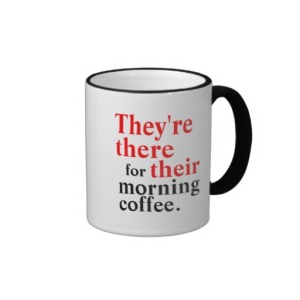
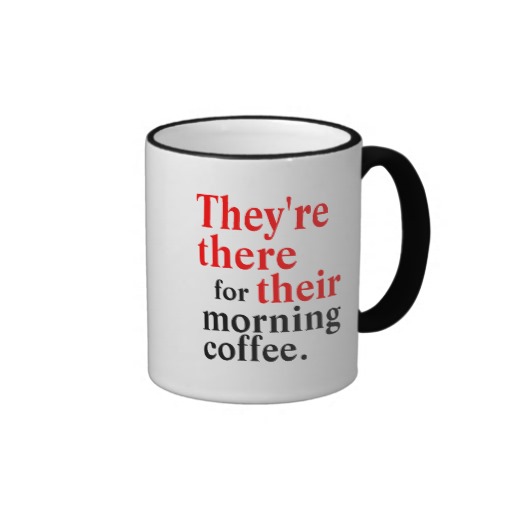
they're their there cupTheir, There, They’re

  • Their = possessive pronoun:

They got their books.

My house is over there.

(This is a place word, and so it contains the word here.)

They’re making dinner.

(Pronouns have apostrophes only when two words are being shortened into one.)

To, Too, Two

  • To = preposition, or first part of the infinitive form of a verb:

They went to the lake to swim.

  • Too = very, also:

I was too tired to continue. I was hungry, too.

  • Two = the number 2:

Two students scored below passing on the exam.

Twotwelve, and between are all words related to the number 2, and all contain the letters tw.

Too can mean also or can be an intensifier, and you might say that it contains an extra o(“one too many”)

We’re, Where, Were

  • We’re = contraction for we are:

We’re glad to help.

(Pronouns have apostrophes only when two words are being shortened into one.)

Where are you going?

(This is a place word, and so it contains the word here.)

  • Were = a past tense form of the verb be:

They were walking side by side.

Your, You’re

  • Your = possessive pronoun:

Your shoes are untied.

You’re walking around with your shoes untied.

(REMEMBER: Pronouns have apostrophes only when two words are being shortened into one.)

Special thanks to the Purdue Online Writing Lab for posting these amazing hints, and SO much more information crucial to the craft of writing. If you go out to their website you will find it chock full of really good lessons for you to use to improve your skill at the craft of writing.
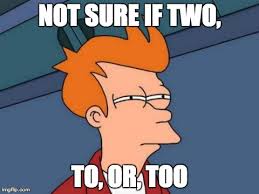
to, too, twoIt seems like a no brainer when you are reading it, but when you’re in the throes of a writing binge these little no-no’s will pop up and confuse you the second draft. The problem is, you will see it as you intend it to be, not as it is written, so these are words you must pay attention to. Sometimes, doing a search will locate these little inconveniences.

Some are obviously wrong and stick out like sore thumbs, like improperly used they’re, their, and there but some like accept and except are so frequently confused and misused in our modern dialect that it is best to simply look it up to make sure you are using the right word for that context. If you search for these now, you will save your editor having to do this for you, and your edit will be much more productive.

Searching for these bloopers is what I like to think of as sorting the rattlesnakes out of the chicken yard, and is part of making your manuscript submission-ready.


2 Comments

Filed under blogging, Books, Fantasy, Humor, Literature, Publishing, Self Publishing, WordPress, writer, writing

Comatose Ambiguity

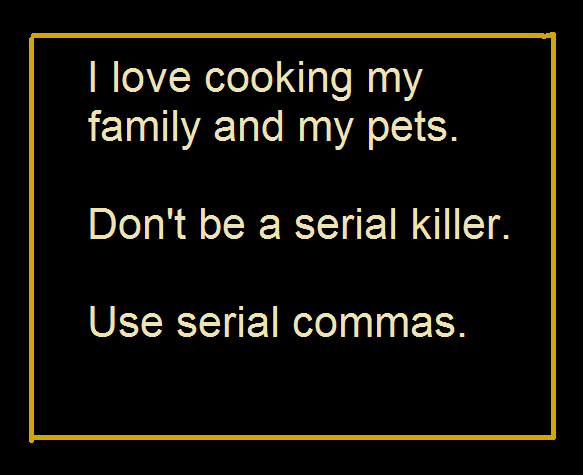
CommasThe Chicago Manual of Style, Strunk and White’s Elements of Style, most authorities on American English and Canadian English, and some authorities on British English (for example, Oxford University Press and Fowler’s Modern English Usage) recommend or require the use of the Oxford comma, also known as a serial comma.

Newspaper style guides (such as those published by The New York Times, The Los Angeles Times, the Associated Press, The Times newspaper in the United Kingdom, and the Canadian Press) recommend against it, possibly for economy of space.


IN GENERAL, OXFORD COMMAS ARE INTENDED TO RESOLVE AMBIGUITY:

ambiguityThe style that consistently uses the Oxford comma may be less likely to result in ambiguity. Consider the oft quoted, but (according to Snopes) mythological, book dedication:

To my parents, Ayn Rand and God.

There is ambiguity about the writer’s parentage, leading the reader to believe that the writer claims Ayn Rand and God are the parents. A comma before and removes the ambiguity:

To my parents, Ayn Rand, and God.

But lists can also be written in other ways that eliminate the ambiguity without introducing the serial comma, such as using other punctuation, or none, to introduce or define them. For example, in the following manner:

 To God, Ayn Rand and my parents.

I have used both styles in my writing, but am leaning more and more toward the Oxford comma.

Another wonderful example, reportedly collected by Nielsen Hayden, was found in a newspaper account of a documentary about country music legend, Merle Haggard:

Among those interviewed were his two ex-wives, Kris Kristofferson and Robert Duvall.

Whoa!  Who knew that Kris Kristofferson and Robert Duvall were Merle Haggard’s ex-wives? An Oxford comma would eliminate this hilarious inaccuracy:

Among those interviewed were his two ex-wives, Kris Kristofferson, and Robert Duvall.

I usually argue for consistent use of the serial comma because:

  1. Use of the Oxford comma is consistent with conventional practice as suggested by the Chicago Manual of Style, which is my primary reference manual.
  2. It matches the spoken cadence of sentences better, so reading passages aloud will flow more easily. This is something to consider if you intend to have your work turned into an audiobook.
  3. Properly used, it resolves ambiguity.
  4. Its use is consistent with other means of separating items in a list, for example, when consistently included before the last item even when and or or is present.
  5. Its omission can suggest a stronger connection between the last two items in a series than actually exists. (My parents, Ayn Rand and God.)

Common arguments against use of the serial comma:

  1. Improperly used, the comma may introduce ambiguity, and many authors are not clear on its proper use.
  2. I agree that it can be redundant in a simple list because the words  and & or  can serve to mark the logical separation between the final two items, when the final two items are a compound single item. (My parents, Marge and Bob.)
  3. When space is at a premium, the comma adds unnecessary bulk to the text—not usually an issue in a novel or short story. This is a journalistic issue common when writing for a newspaper.

It is fashionable for wouldbe writers to argue against using the Oxford comma, claiming it is unnecessary. However, I frequently see manuscripts where good authors fail to delineate a list in such a way that their intention is clear, by using and & or, thus resulting confusion, and a book that is less enjoyable than it should be.

_72982736_vikings courtesy of BBCThe Oxford comma is the basis of many violent quarrels in writing groups–people tend to be rabidly for or against either side. There is common ground here, people so put away the torches!

Good writing incorporates proper use of both styles and, above all else, avoids ambiguity.


1 Comment

Filed under Blogger, blogging, Books, Fantasy, Literature, Publishing, Uncategorized, WordPress, writer, writing

Dial-a-Plot

No matter how careful I am when building my outline, there is always a point where I am writing by the seat of my pants.  As I am normally rather a linear plotter, this can really change the direction a tale goes in.

I hear people whining all the time about this character or that one dying right and left in Game of Thrones. I don’t have HBO, so I’ve never seen it, but I have friends who seem to find this distressing.  I suspect that winging it and writing to a deadline is why people die  so frequently in George R.R. Martin’s world–it’s certainly how they meet a messy end in my world.

But how do we fly freely with our narrative, and yet not destroy the awesome story arc we have created? How do we avoid having to hide the mangled corpses of our beloved characters when they might be useful later?

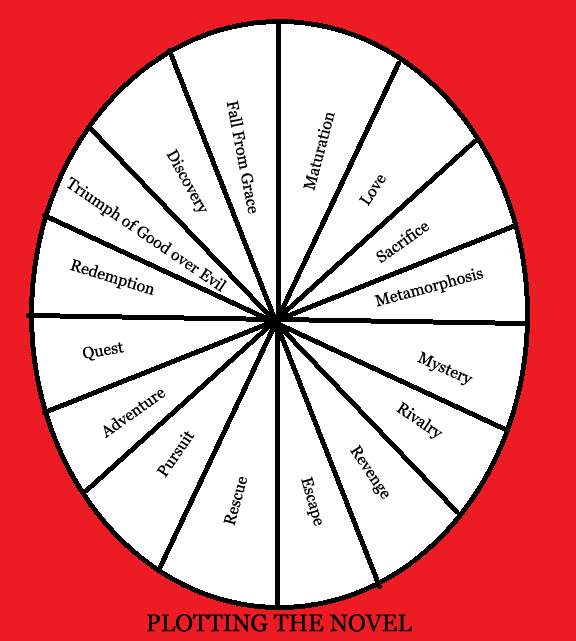
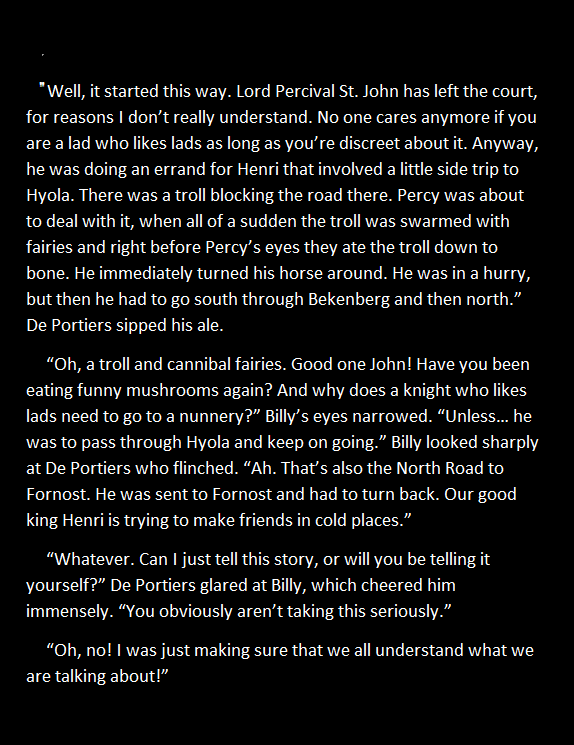
Enter my home-made Dial-a-Plot (sustainably powered by dark matter).  It’s just your standard circular thingy that can be printed out and taped to your desk.  Whenever you have lost your way writing your epic fantasy, rather than resort to a sudden influx of something as far-fetched as cannibal fairies, feel free to refer back to this little gadget to remind you of those elements that really drive a plot.

Dial-a-Plot

When your writing mind has temporarily lost its momentum and you are stretching the boundaries of common sense, it can’t hurt to take some time to consider the central themes that inject true tension into the story, to keep the action moving and the heroes swinging their swords.

Hopefully you won’t have to resort to killing anyone you might need later, and cannibal fairies won’t take your tale in a direction you can’t recover gracefully from…unless…heh heh…Cannibal FAiries

8 Comments

Filed under blogging, Books, Fairies, Fantasy, knights, Literature, Politics, Publishing, Romance, Self Publishing, Uncategorized, WordPress, writer, writing

la vie fantastique

Map-pugetsoundMy hubby and I went to Victoria, British Columbia (Canada) over this last weekend. It was a wonderful two days, spent in a town that exists partly to govern the Province of British Columbia, but mostly to help you lighten the burden in your pocket book, and make you beg to let them do it again.  We got up at 3:00 a.m. and left our house at 4:45.

(Gah!)

I am often up at that time of the day, but not intentionally, so it was no surprise to me that I could hardly pry my eyes open. Then we drove up to Seattle, collecting two of his sisters along the way.

It’s amazing how little traffic is on I5 at that time of the morning–perhaps I will do all my traveling at ungodly hours. And parking…OMG, it was heaven.

(Sorry, too much texting the GKs lately. Makes me want to lol out loud. Might write my next book in textspeak.)

Anyway, I had my pick of prime spots in the parking garage, and found one I was easily able to maneuver the old minivan into with no trouble. I hardly gave my poor brother-in-law, Dave, a heart-attack  at all on the way up to Seattle. He  is a sweetheart of a guy but the man is a nervous and verbal passenger.  The trip back–well lets just say he wanted me to take the Alaskan Way Viaduct, and I didn’t want to.

I’m sorry, Dave. I’m afraid I can’t do that. 

I don’t trust the viaduct. It’s as shaky and narrow as a one-legged ladder.  I’d much rather drive in aimless circles around downtown Seattle hunting for a southbound freeway on-ramp, counting the number of times we pass Nordstrom’s and he doesn’t see the fun in such an exercise. But that’s another post (the one on how our family puts the fun in dysfunctional.)

Catamaran_Victoria_Clipper_IVSo we got on the Victoria Clipper at 7:30 a.m., which is definitely the way to go if you are traveling from Seattle. Victoria Clipper catamarans typically complete a one-way trip in less than 3 hours, in our case, 2 hours and 45 minutes.   To drive there would take 6 hours from our house anyway and we would still have to take a ferry, so why not just leave the car in Seattle and go in style? And we were flying over the water, traveling at 30 knots, which is just a hair over 34.5 miles per hour in landlubber-speak. That’s cruising pretty fast on the inland Salish Sea.

Then we toured the Butchart Gardens. THAT place is most definitely a fairyland.  I can’t even find the words to explain how beautiful it is.  My cellphone photos suck, to use a technical term, so I am using images cadged from WIKIPEDIA to illustrate this:

1200px-Butchart_Sunken_Gardens


1200px-Butchart-gardens-002

Needless to say, after a long day of hiking the most gorgeous gardens, and then trundling all over the downtown, spending money like water in Victoria proper, I was SO ready for a lovely meal in what is really a lovely, vegan-friendly city. A long soak in the hotel hot tub, and followed by gin & tonic in the hotel lounge (light on the gin and lots of lime wedges, thank you) and this old lady was ready for bed.  I got on the internet just long enough to check my email.  I wasn’t completely out of writer-mode–I did note my ideas down in my little book while I was on the ferry.

So, while I didn’t get any writing done I had a wonderful time with my in-laws, and that’s paradise, to me.

Victoria_harbour_-_Victoria,_British_Columbia_-_2014

4 Comments

Filed under Adventure, Battles, blogging, Fairies, Fantasy, Humor, Literature, Publishing, Self Publishing, Vegan, WordPress, writer, writing

Lamed in the land of Language

IBM_SelectricMy first draft sits sullenly on my desk, glaring at me with repetitiousness and flatness of prose.  No matter how I grasp for words, a sword remains a sword, remains a sword…since to refer to it as a blade or weapon would require stretching the vocabulary…

…ellipses rise and fall with frequency across my page…boring, jarring frequency…

My characters are Angry!  Not mad, furious, enraged, excited, wrathful, indignant, exasperated, aroused, or inflamed–no–they are merely

‘angry.’

I frequently tell them how awesome they are, because my mind is inelastic, and awesome is all I know. Truthfully, they are amazing, incredible, unbelievable, improbable, fabulous, wonderful, fantastic, astonishing, astounding, AND extraordinary. But my lamed vocabulary shall forever deem them ‘awesome.’

Roget's Thesaurus 1st editionMy thesaurus has been used and abused, and still my lazy (indolent, slothful, idle, inactive, sluggish) mind gropes for words.

Inspiration has played me false. Fake, fraudulent, counterfeit, spurious, untrue, and unfounded? No! ’tis erroneous, deceptive, groundless and fallacious, this twisty beast, Inspiration.

I go quietly into the depths of the Room of Shame, that hall of horror that is my office, where I shall once again attempt to wrangle words in the desert of desperation.

4 Comments

Filed under Adventure, blogging, Books, Fantasy, Humor, Literature, Self Publishing, Uncategorized, WordPress, writer, writing

Cats and the Physical Laws of the Known Universe

ceramic cat and cupI realized the other day that I am a cat-lady. Oh, I don’t own a cat, or even a dog for that matter, but I am still a cat-lady.  I love cats…ceramic cats. I have 3 of them.

They are the perfect companions. Their demeanor is a little aloof, but what do you expect from a cat?  They rarely meow, eat very little, require only an occasional dusting, and never try to hijack my laptop.

I’ve never yet had to clean up a hairball.

That said, there is something lacking in my relationship with these strangely well-behaved creatures.

Alas, I am a lazy woman. The amount of vacuuming a living cat introduces into my life breaks the laws of physics. Let’s do the math–I’m an author so we’ll do it with a story-problem:

Mr. & Mrs. Catpeople  are humans who currently have 0 cats. They are ordinary people, not too messy, and not too tidy. Normally, they only have to vacuum their bungalow once a week. One spring day Mrs. Catpeople  loses her suburban mind and decides to bring home a cat. If she only had to vacuum the house 1 time a week when two humans resided in her home, how many times will she vacuum with the addition of a cat?

Cat on MozartOkay… 2 people + 1 cat = 3 creatures.  so, if she cleans once a week when there are 2 creatures in the house, with the addition of a third creature, and assuming you can’t half-vacuum (although you can vacuum half-assed), it should mean she has to vacuum twice. But the fur on the sofa appears every day as if by magic, increasing exponentially with the arrival of guests, which requires her to vacuum morning and evening…. so that = 14 times a week that Mrs. Catpeople must haul out the Hoover.

See? I’ve done the math and it doesn’t add up. Of course, I failed traditional math classes regularly, but according to my calculations,  Mrs. C will be up to her eyeballs in cat fluff inside of two weeks, because no normal human being can keep up with that amount of flying  fur.

The only reasonable conclusion one can come to is that cats clearly do not obey the same rules of physics as humans do. After all, when it stands on your chest at 3:25 a.m., does your 7 lb cat not gain 25 lbs?

And when they see an invisible object of their desire at the top of the new drapes, are they not able to travel faster than the speed of light?

These are proof to me that cats are like subatomic particles.  They are here and not here, both before and after, and only exist when you are looking at them.

Cat with attitudeBut, while math, or indeed physics, was never my forte, extrapolating stories always was, so here is the true ending of our story-problem, the one math teachers never tell you:

One day while eating his organic Cheerios, Mr. Catpeople suddenly realizes the cat is speaking to him. At first it seems fun, but gradually he realizes the evil creature is shooting feline  thought-rays at him, trying to take control of his mind. Every where he turns, the cat is looking at him.   “Get an ax…Kill the dog….”

Mr. Catpeople sets his spoon down and his remaining Cheerios go soggy while he wrestles with this directive. It seems reasonable, but… “Um, we don’t have a dog.” 

“Did I say ‘dog?’ Sorry. I meant kill the annoying woman with the evil vacuum….”

So the true answer to the problem is ‘0’ because after the funeral Mr. Catpeople will be vacuuming.


2 Comments

Filed under Adventure, blogging, Humor, Literature, Self Publishing, Uncategorized, WordPress, writer, writing

Fantasy and the cold hard truth

Saint_Alban_(cropped)In a good novel, there is a moment where the interactions between certain characters can become highly charged, fraught with anger and other intense emotions. That is the case with what I am writing now:  three of my characters spent a long time fighting alongside each other, brothers and sisters in arms, completely dependent on each other.

They have a long history. Several terrible incidents occurred during the war they once fought that they don’t understand, and which created a rift between them. Some of their close companions were killed under bad circumstances (are there ever any good ones?) and each of my characters suffers a little survivor’s guilt.

After the war, they went their separate ways and for the last 25 years, have rarely seen each other or spoken. They all bear a burden of responsibility for things they can’t change, and their lives are affected by this, although they don’t know why. For each of them, their anger and remorse are expressed in different ways.

Two of them can’t be in the same room for long without trying to kill each other.

One character in particular suffers disturbing recurring flashbacks, avoidance or numbing of memories of the event, and what we call ‘fight or flight syndrome,’ the uncontrollable urge to either fight or flee. These characters all three demonstrate varying degrees of avoidance,  withdrawal, aggressive defense, or in one case, complete frozen immobility. Certain memories trigger these behaviors, and now all three are being forced to face their demons.

My challenge is to bring these people back together with sensitivity and realism, in order to advance my story, and use only 1/3 of the allotted word-count for this book.

Does this sound like Post Traumatic Stress Disorder (PTSD)? You’re right. For more information on PTSD, see an article  on the website, Military Pathways, and this news article aired by CBS on their show, 60Minutes.

Because it’s a new term, I can’t refer to this ‘injury of the spirit’ as PTSD in my manuscript. But I can give it another name and air both the symptoms and the sometimes life-long problems untreated PTSD causes.

GeorgeSPatton - WikipediaMy father, and my uncles all suffered from this long after World War II ended. In many ways it has shaped our post WWII society. Our fathers were told to just shut up and  get on with their lives–something that is not always an easy thing. Alcoholism and domestic abuse lay just under the surface of many families in our community, hidden but there.

Prior to World War I, the U.S. Army considered the symptoms of battle fatigue to be cowardice or attempts to avoid combat duty. While the causes, symptoms, and effects of the condition were familiar to physicians, it was generally less understood in military circles. General George Patton garnered substantial controversy after he slapped two United States Army soldiers under his command during the Sicily Campaign of World War II.

It was common for soldiers who reported these symptoms to receive harsh treatment. At the time of the slapping incidents, the two soldiers Patton assaulted were suffering from “battle fatigue,” otherwise known as “shell shock” or “battle stress.” Today, this condition is characterized as a form of PTSD, which can result from prolonged severe exposure to death and destruction, among many other traumatic events.

220px-Sir_Galahad_(Watts)

Even though I write fantasy, the reactions of my characters to certain situations has to be realistic, and that is where a good grasp of what really happens to our vets comes in handy. Post Traumatic Stress Disorder (PTSD) is real and affects our returning veterans. More must be done to help ease our military wounded back into society, but generally speaking we pay more lip-service to that problem than we do tax dollars.

We write about incredible personal challenges, because they make great stories. But what about the people who live through those moments? How do they quietly go back to the farm once the war is over, and pretend it never happened? This is what I am writing about now, and it has been an emotional journey for me as as an author and a human being. Everyday, our paths are crossed by men and women living with PTSD caused by a variety of terrible circumstances,  They are just ordinary people trying to keep their lives together, not understanding why they sometimes do the things they do, and wondering why things just keep going to hell all around them.


2 Comments

Filed under Adventure, Battles, Blogger, blogging, Books, Fantasy, knights, Literature, Publishing, Self Publishing, WordPress, writer, writing