Category Archives: writer

Phrasal verbs–minions of evil, or sometimes useful?

Book- onstruction-sign copyPhrasal verbs are usually two-or three-word phrases consisting of a verb plus an adverb, or a verb plus a preposition, or both. They are just another aspect of English vocabulary, and can be considered a form of compound verbs.  We use them all the time, but what, exactly, are they?

First, what is an adverb?

The term adverb is somewhat of a catchall word to describe many kinds of words having little in common other than the fact they don’t fit into any of the other available categories (noun, adjective, preposition, etc.) and they modify an action word—a verb.

The principal function of adverbs is to act as modifiers of verbs or verb phrases. An adverb used in this way gives information about the manner, place, time, frequency, certainty, or other circumstances of the activity denoted by the verb or verb phrase. Too many modifiers in your narrative and voila! Purple prose.

phrasal verbsThere are three main types of phrasal verb constructions depending upon whether the verb combines with a preposition, a particle, or both.

Wikipedia, the fount of all knowledge, has a good example of these three forms:

Verb + preposition (prepositional phrasal verbs)

  1. Who is looking after the kids? – after is a preposition that introduces the prepositional phrase after the kids.
  2. They picked on nobody. – on is a preposition that introduces the prepositional phrase on nobody.
  3. ran into an old friend. – into is a preposition that introduces the prepositional phrase into an old friend.
  4. She takes after her mother. – after is a preposition that introduces the prepositional phrase after her mother.
  5. Sam passes for a linguist. – for is a preposition that introduces the prepositional phrase for a linguist.
  6. You should stand by your friend. – by is a preposition that introduces the prepositional phrase by your friend.

Verb + particle (particle phrasal verbs)

  1. They brought that up twice. – up is a particle, not a preposition.
  2. You should think it over. – over is a particle, not a preposition.
  3. Why does he always dress down? – down is a particle, not a preposition.
  4. You should not give in so quickly. – in is a particle, not a preposition.
  5. Where do they want to hang out? – out is a particle, not a preposition.
  6. She handed it in. – in is a particle, not a preposition.

Verb + particle + preposition (particle-prepositional phrasal verbs)

  1. Who can put up with that? – up is a particle and with is a preposition.
  2. She is looking forward to a rest. – forward is a particle and to is a preposition.
  3. The other tanks were bearing down on my panther. – down is a particle and on is a preposition.
  4. They were really teeing off on me. – off is a particle and on is a preposition.
  5. We loaded up on Mountain Dew and chips. – up is a particle and on is a preposition
  6. Susan has been sitting in for me. – in is a particle and for is a preposition.

(end of quoted example, thank you Wikipedia)

We use phrasal verbs all the time in our daily speech and in our writing. However, whenever it’s possible we should look for simpler ways to phrase our thoughts when writing, unless we are writing conversations spoken in the local vernacular.

Why do I feel that way? The way I see them, phrasal verbs are  two-or-three words (an action word and modifiers) forming what can be considered a separate verb-unit with a specific meaning. In other words, they use more words than is really needed to express a thought:

  • Who is looking after (verb unit) the kids? == Who is watching the kids?
  • They brought that up (verb unit) twice. == They mentioned it twice.
  • Who can put up with (verb unit) that? == Who can endure that?

We use these phrasings because they sound natural to us—that is the way people in your area might speak. But when used too frequently in a written piece, phrasal verbs junk up the narrative. They subtly contribute to what we call “purple prose” because the overuse of them separates the reader from the story.

Unless you are writing poetry, simplicity is best, because you want to immerse your reader in the experience.

ok to write garbage quote c j cherryhWhen we are revising our first draft, and tightening our narrative we should be examining the prose for weak phrasing. Each time you come across phrasal verbs in your work, look at the sentence it occurs in as if it were an isolated incident and ask yourself if it needs to be there. Many times a phrasal verb really is  the only way to express what you are trying to say, but equally often a more concise way can be found.

Phrasal verbs have their places, but if you can simplify a thought and make the sentence stronger, do so.

2 Comments

Filed under Literature, Publishing, Uncategorized, writer, writing

Mountains of the Moon Launches

Map of Neveyah, for MOTM 6-14-2015Mountains of the Moon is the newest release in the World of Neveyah. It is set in the same world as the Tower of Bones series but it is the original story that was written as the storyline for an old-school RPG game, along the lines of the early Final Fantasy games.

A prequel to Tower of Bones, the book follows the adventures of Wynn Farmer as he and his companions travel high into the mountains to stop the Tauron, Bull God, and his minotaurs from overrunning Neveyah. Nothing goes as it’s supposed to, and Wynn’s general naiveté often causes his companions serious trouble.

MOTM Front Cover Final 6-18-2015Wynn is seriously ignorant of the world in general, and at the outset, he’s in over his head, and he knows it. This book also introduces several characters as young men,  two of whom play a large role in the Tower of Bones series, Rall Ivarsson, and Jules Brendsson. Both these men figure strongly in later books, and at the time of Tower of Bones, Rall occupies the office of the Holy Seat, guiding the Temple of Aeos, and is the most powerful man in Neveyah.

Wynn’s story is sometimes hilarious and was fun to write–a contrast against the frequently dark situations they find themselves in. The world of Neveyah is a harsh place at times. Magic is a fundamental facet of life there, and many of the magical creatures that inhabit the world are just as deadly as the minotaur hordes of the Bull God.

THE BLURB:

Charged by the goddess Aeos, Wynn and his companions bicker and bumble their way through the Mountains of the Moon. Danger, mystery, and dark prophecies chase them through a gauntlet of jagged peaks and deadly traps.

Can they survive the dark secret hidden in Tauron’s crumbling castle before his minotaurs overrun Neveyah?

The Gods are at war, and Neveyah is the battlefield.

>>><<<

Mountains of the Moon is on sale at these fine online stores for $2.99 ebook and $17.99 for paperbook:

Barnes and Noble for Nook or paperback

Amazon.com for Kindle or paperback

Also available at SmashWords in a variety of ebook formats for your phone or tablet!

>>><<<

FOR CARLIE M.A. CULLEN’S REVIEW OF MOUNTAINS OF THE MOON, CLICK HERE Wow! She liked it!

>>><<<

And also, a reminder that I will be signing books at AFK Elixers and Eatery all afternoon and evening tomorrow, Saturday the 27th of June, 2015. Please–feel free to stop in and chat! I will be there with local authors AJ Downey, Sechin Tower, Lee French,  Lindsay Schopfer, Stephen Matlock, David Moore and Jeffrey Cook.

Comments Off on Mountains of the Moon Launches

Filed under Books, Publishing, Uncategorized, writer, writing

Heading to Renton at AFK Elixers and Eatery #Booksigning

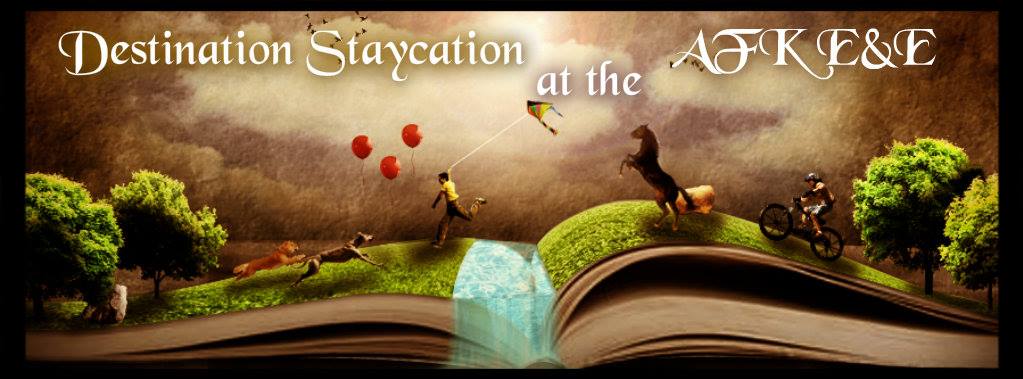
Destination StaycationOh, my gosh–I am getting so excited! The next event, Destination Staycation is happening in just 3 days, on Saturday the 27th of June.  Eight local, independent authors will be coming together for one event. We will be selling and signing books all afternoon and evening at AFK Elixirs & Eatery  in Renton, Washington, and I can hardly wait!

HTB Stamp copyWe will be offering reading-passports and stamping them with our book-related stamps.

Along with myself, AJ Downey, Sechin Tower, Lee French, Lindsay Schopfer, Stephen Matlock, David Moore, and Jeffrey Cook are the featured authors this time around.

And wow–what a fabulous venue–a gamer’s paradise!  AFK simply means Away From Keyboard. It’s commonly used in chatrooms and online games and it basically means that you won’t be available (Not at the keyboard = Not in front of your computer). But at AFK Elixers & Eatery you may be away from your computer, but you’re never far from gaming.

My friends and fellow gamers & book addicts in the western Washington/Seattle area are more than welcome to come on up (or down) and join us Saturday, between 2 and 9 pm.

Here are some samples of books being offered by the intrepid indie authors who will be joining me:

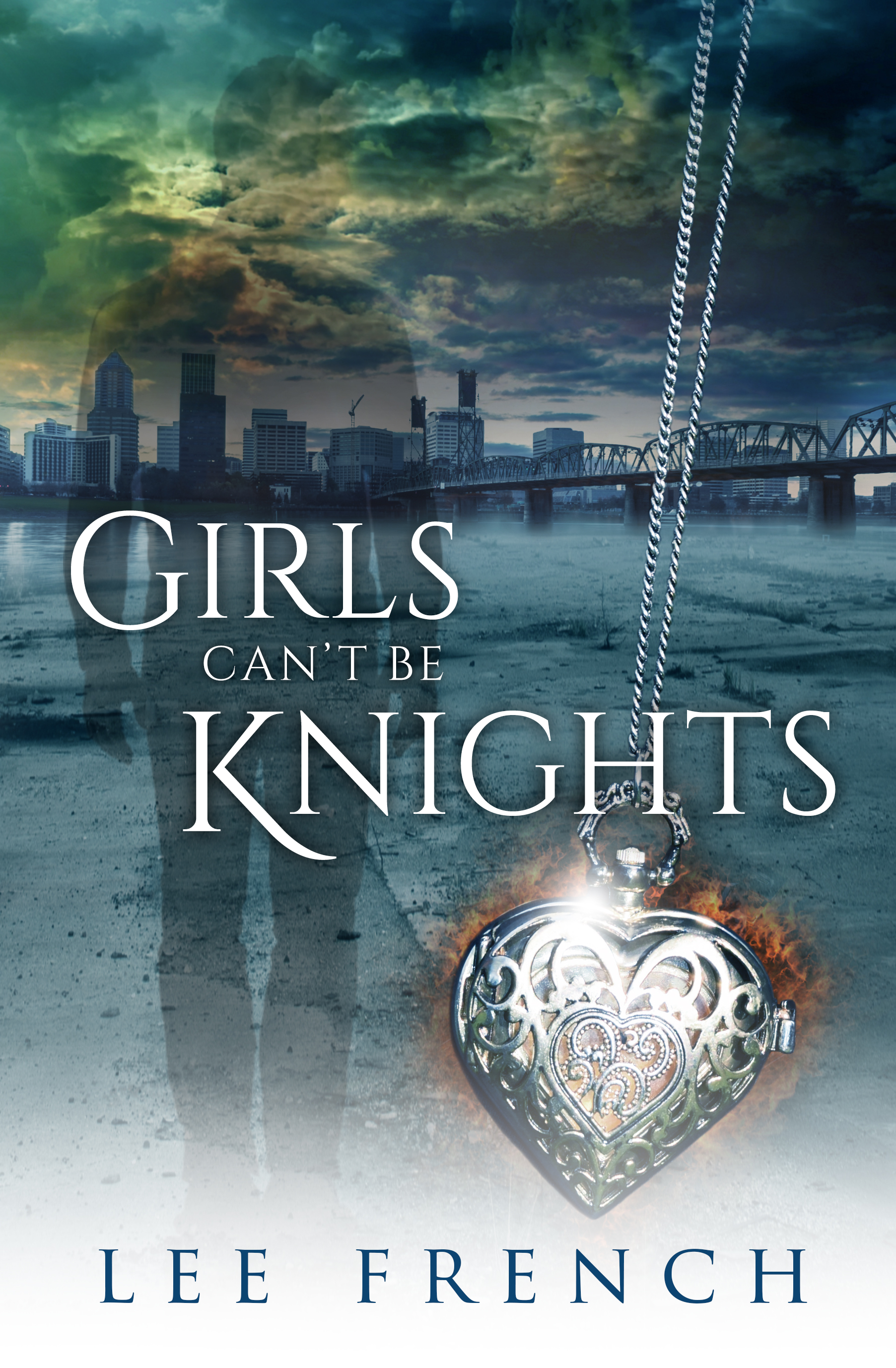
Girls Can't Be Knights KINDLEGirls Can’t be Knights, by Lee French

Portland has a ghost problem.

Sixteen-year-old Claire wants her father back. His death left her only memories and an empty locket. After six difficult years in foster care, her vocabulary no longer includes “hope” and “trust”.

Everything changes when Justin rides his magical horse into her path and takes her under his wing. Like the rest of the elite men who serve as Spirit Knights, he hunts restless ghosts that devour the living.

When an evil spirit threatens Claire’s life, she’ll need Justin’s help to survive. And how could she bear the Knights’ mark on her soul? Everybody knows Girls Can’t Be Knights.

Lost Under Two moons, Lindsay SchopferLost Under Two Moons, Lindsay Schopfer

Alone. Stranded. Richard finds himself on Other World, a place of fantasy and horror. With no companion but a makeshift journal, Richard must quickly learn the unfamiliar dangers around him as he struggles daily to survive. From the approach of winter to eerily intelligent packs of nightmarish creatures, each entry details another trial of life or death. But when Richard finds the remnants of an ancient civilization, he begins to wonder if he is truly alone, and whether or not the lost people of Other World still hold the secrets that could return him home to Earth.

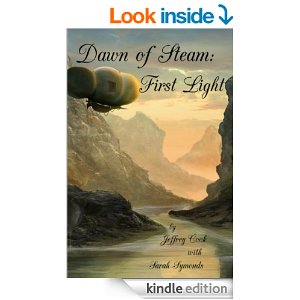
Dawn of Steam First Light Jeffrey CookDawn of Steam, Jeffrey Cook

In 1815, in the aftermath of the Napoleonic Wars, two of England’s wealthiest lords place a high-stakes wager on whether a popular set of books, which claim that the author has traveled to many unknown corners of the globe, are truth or, more likely, wild fiction. First Light is an epistolary novel, told primarily through the eyes of former aide-de-camp Gregory Conan Watts, describing the journeys of the airship Dame Fortuna and its crew through journals and letters to his beloved fiancee.
The first recruit is, necessarily, the airship’s owner: war hero, famed genius, and literal knight in steam-powered armor Sir James Coltrane. Persuading him to lend his talents and refitted airship to the venture requires bringing along his sister, his cousin, and the crew that flew with him during the Napoleonic Wars. Only with their aid can they track down a Scottish rifleman, a pair of shady carnies, and a guide with a strong personal investment in the stories.
When they set out, the wild places of the world, including the far American West, the Australian interior, darkest Africa, and other destinations are thought to be hostile enough. No one expects the trip to involve a legendary storm – or the Year Without a Summer of 1815-1816. The voyage is further complicated by the human element. Some parties are not at all happy with the post-war political map. Most problematic of all, the crew hired by the other side of the wager seem willing to win by any means necessary.

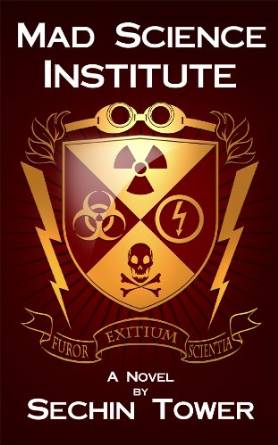
mad science institute Sechin TowerMad Science Institute, Sechin Tower

Sophia “Soap” Lazarcheck is a girl genius with a knack for making robots—and for making robots explode. After her talents earn her admission into a secretive university institute, she is swiftly drawn into a conspiracy more than a century in the making. Meanwhile and without her knowledge, her cousin Dean wages a two-fisted war of vengeance against a villainous genius and his unwashed minions. Separately, the cousins must pit themselves against murderous thugs, experimental weaponry, lizard monsters, and a nefarious doomsday device. When their paths finally meet up, they will need to risk everything to prevent a mysterious technology from bringing civilization to a sudden and very messy end.

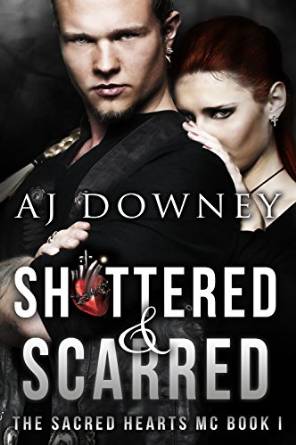
AJ Downey Shattered and ScarredShattered & Scarred: The Sacred Hearts MC, AJ Downey

She’s Shattered…

Ashton Granger is a perfect wife to her husband. She has to be, if she’s not, he will find a way to correct any perceived imperfections. Such is life, and so it has been for a very long time, eroding Ashton’s sense of self, cracking her sense of worth until she lays in a million pieces on the side of a stretch of lonely highway.

He’s Scarred…
Ethan “Trigger man” Howard is the Sergeant of Arms for The Sacred Hearts Motorcycle club. After several tours as a Marine Corps sniper overseas, he’s seen and done enough damage for a man three times his age. He’s out. Done. So over it, and home to nurse his wounds, physical, emotional and psychological with the help of his MC brothers. Now he simply deals with the scars that life handed him.

Was it more than just luck for he and Ashton both that he was the only other soul traveling that isolated stretch of highway that night?

**Mature Audiences Only (18+)**


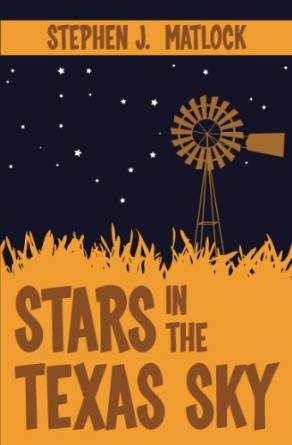
Stars in the Texas Sky Stephen J. MatlockStars in the Texas Sky, Stephen J. Matlock

STARS IN THE TEXAS SKY is a story about 13-year-old Henry Valentine. He’s the school’s star pitcher, intoxicated by first love of a young girl, and all seems right with his world of 1952 racially separated East Texas. Then he is confronted by an unlikely antagonist, a colored boy who challenges him in his town, bests him in a pitching duel, and fights him in the vacant lot outside of town. A wary distance becomes an unexpected friendship when they discover a common love for Texas beauty. He is devastated when a corrupt congressman sacrifices Henry’s friend to win re-election, and receives no sympathy or help from his disapproving family, church, and town. His finds support in the feisty, independent-minded widow with a taste for liquor in her lemonade who helps him fight against the powerful using only the tools of an innocent and powerless boy. In the end he learns the value of standing for what he believes in face of opposition, and discovers that there is nothing more powerful than a boy – or a man – who knows who he is.

This book is a 2012 Amazon Breakout Novel Award (ABNA) quarter-finalist.


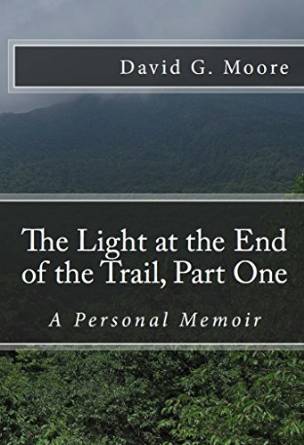
David Moore Light at end of trailThe Light at the End of the Trail, David G. Moore

This is a memoir of Moore’s early life–a life filled with equal parts light and darkness. Battling the neighborhood bullies, embracing the world of nature, surviving his mother’s depression, he finally descended into his own world of sadness. But the sadness was nothing compared to what awaited him at college. With the help of drugs and alcohol, a mysterious illness overtook him that baffled both him and the best of doctors. Meanwhile, the Moore family exploded. His parents separated, one sister joined a religious cult, the other buried herself in therapy, and his mother finally moved to the West Coast to escape it all. There were moments of bright light. At times, his illness vanished and during those reprieves he tried to live life to the fullest. But the quest for a life full of passion and joy pushed his mysterious psyche to the edge–then over the edge. It was time to enter the gates of hell.

>>><<<

And these are just the tip of the iceberg–the number of books my fellow authors and I will be offering is somewhat mind-boggling to me!

Check out the Destination Staycation Facebook Page!

I hope to see you at AFK E&E in Renton Wa on Saturday June 27th!


1 Comment

Filed under Books, Fantasy, Publishing, Uncategorized, writer, writing

Why I #amblogging

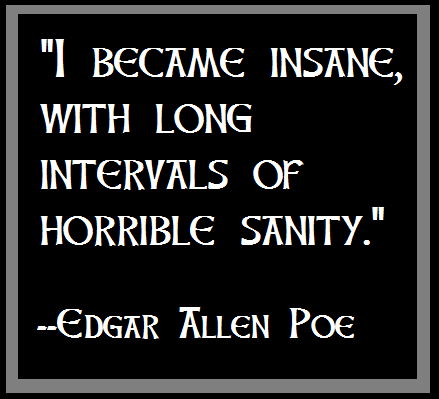
edgar allen poe quoteWriters need to write every day–that is a given. Writing every day takes discipline and dedication. We writers are often told we are undisciplined and lack drive, but nothing could be further from the truth. We simply lack the desire to do what we are told, and have this story that needs to be told.

Sometimes we have nothing to write that will advance our current work in progress. Inspiration has failed us. We have a kajillion ideas about things we could be writing, and things we plan to write…but nothing that sings in regard to the  task at hand.

When that happens, I sit down and look back through what has already been written, and inspiration fires me up again.

Other times, nothing. That is when I blog on the craft of writing. The act of blogging loosens my imagination when it is stuck.

One of the first chores I was given by my first publisher, was to blog regularly, at least once a week. This, he said, would help get my name out there, and give me a regular platform for my opinions.

I had no idea what I would ever blog about, and the idea of just sitting down and rambling on about nothing and then publishing it made me feel a bit faint. I have no issue with rambling on–I am grandma, it’s what I do. But publishing it weekly?

It began, as all love affairs do, somewhat awkwardly. I wrote short, stilted posts that were obviously forced and took days to write. I felt like blogging had taken up a large chunk of real estate in my writing time, and I resented it.

Then one day I didn’t know what to write about. The only thing I was interested in talking about was either books I had read or books I was writing. I found the words flowed easily when I talked about either of those. Thus was born this blog, Life in the Realm of Fantasy. This is where I talk about everything from Don Quixote to serial commas.

Blogging regularly has helped me to write more freely when I am using a stream-of-consciousness style of writing, such as during NaNoWriMo.

I have also made many friends through blogging, people all over the world who I may never meet in person, but who I am fond of, nevertheless.

And blogging is where I develop my seminars on the craft of writing. I find that talking to you about the craft helps me organize my thoughts. And, although I hate to say it, my first publisher was right about blogging. Blogging regularly does get your author name out there and does showcase what you are able to do.

I recommend blogging to anyone who has a craft they are passionate about. You want to talk about that craft, but your spouse’s eyes glaze over when you launch into one of your discussions.

Well, let me tell you, the internet is full of folks who want to talk about that same craft. Take welding–there are hundreds of blogs about welding, some popular, and some just getting started. Who knew welding was such a hot topic? Obsessed people make poor conversationalists, but writing a weekly blog about what you are passionate about gives you that platform to wax poetic about what you love.

If you want to know more about getting your own blog up and running, see my post of April 20, 2014: The Girl with the Tolstoy Tattoo:

  • Keep it down to about 1000 words more or less.
  • Use the spellchecker tool to look for obvious errors.
  • Write in in draft form and don’t publish it right away–come back and read it over again, and make corrections.
  • If you use information found elsewhere, quote it and credit the author
  • Use images that are either public domain, or that you have the right to use
  • Put links to other informative sites in the text

Blogging is fun. It’s where I blow off steam and grow as a writer. Every author should blog regularly–some of my most inspired moments have happened here in this crazy blog.

2 Comments

Filed under Humor, Literature, Publishing, Uncategorized, writer, writing

Technology #upgrade for when I #amwriting

Square Card Reader 1Two months ago, I got a new thingamajig for writing. I was actually upgrading the phone so that I could get a Square Card Reader to take credit card payments at book fairs. But when we walked in the door at the phone store our wireless provider made us a deal we couldn’t refuse: a Samsung Galaxy Tab 4 7-inch tablet for just .99 cents, to go with my fine new Galaxy s5 phone.

Technically my upgrade was “free,” and .99 cents seemed like a deal.

So of course I leaped on it. But then I had to get the heavy-duty Otterboxes to protect both the tablet($39.99)  and the phone ($29.99) The Otterboxes would have been cheaper at Amazon.

Square Card ReaderI also got the Square Card Reader while I was there, ($9.99)and well worth the price. I can now accept Visa, MasterCard, American Express, and Discover–or cash.

And of course, we had to upgrade the wireless plan to accommodate the new technology, so what with a nickel here and a dime there, we were beyond broke when we walked out of there, but we were technologically up-to-date.

We couldn’t afford to pay attention at that point, but on  the plus side,  I had this wonderful tablet. It’s an awesome way  to get email and check Facebook for the onslaught of grumpy cat memes.  All my reading apps are on there now, Kindle and Nook–so I can read any book in beautiful, clear color.

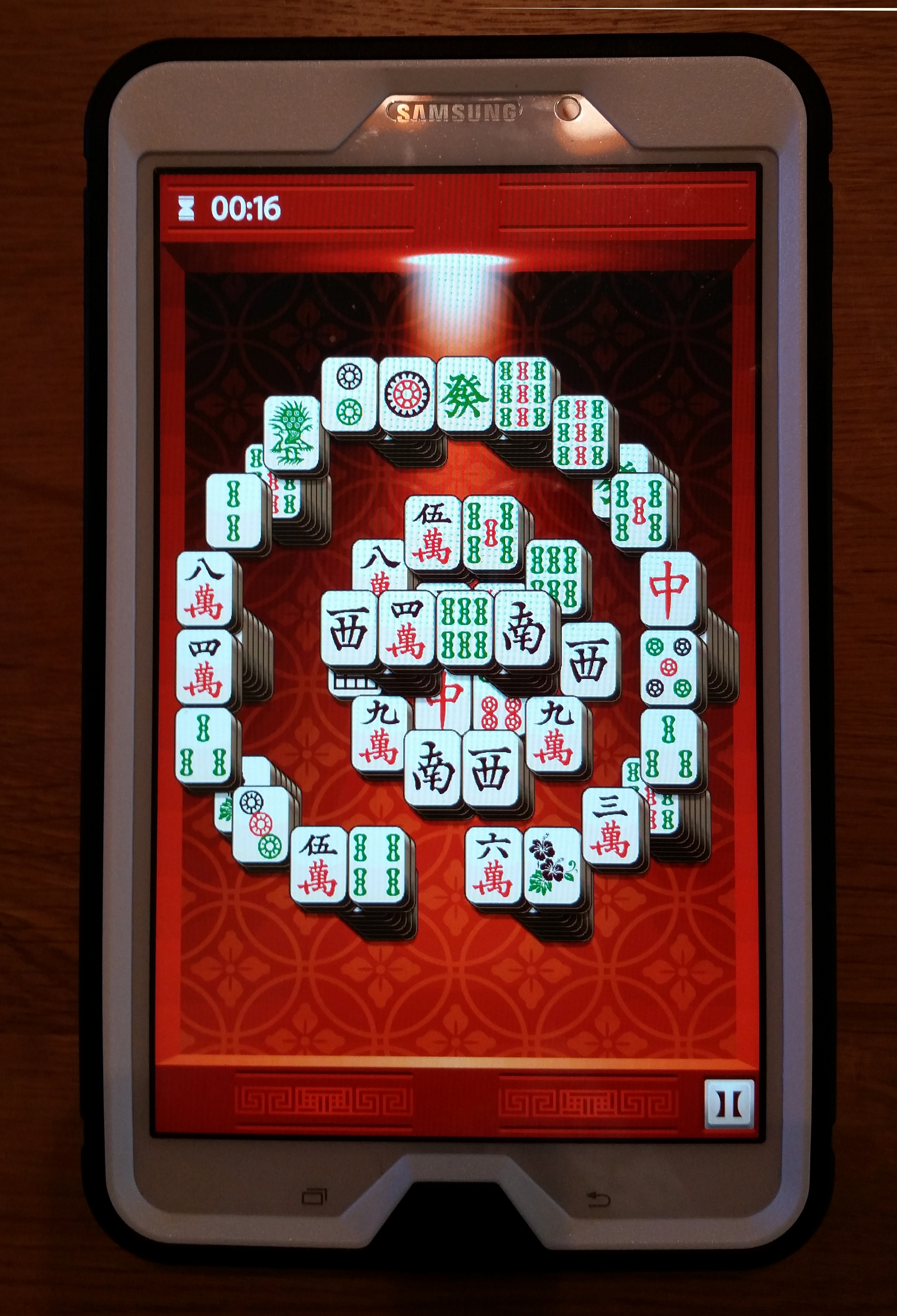
Or I can play Majong in bed instead of reading.

Acer-Aspire-One-AOD257-4I’ve been complaining about my Acer laptop for a year now, but I don’t have the funds to replace it. The wretched thing is a small, red boat-anchor. It takes an hour to load anything. I just need five or six hundred dollars to replace it with a better brand, which isn’t going to happen soon.

My new tablet’s charge lasts about 8 hours, and the it only weighs a little more than the cell phone I went to upgrade in the first place. It travels well in my purse, and so does the little external keyboard.

The tablet comes with a touchscreen keyboard, of course, but it isn’t very useful for an ungraceful typist like me, and I couldn’t see myself writing a book using one. Some people do, or so I hear.

Tablet and keyboardBUT, with a few accessories, my little tablet has become a great, if limited, word-processor. First of all, the top of the Otterbox converts to an easel for it, so it sits up at the perfect angle.

With the addition of the Bluetooth keyboard I can easily key anything with as much accuracy and speed as ever. It will be excellent for write-ins.

There is a reason it took me two months to get this circus on the road.

When I first got the tablet it came with a free word-processing app that had glowing reviews, but which I quite honestly thought sucked, Hancom Office. This app might work well enough for someone else, but it was useless to me.

It looks just like WORD, and seems to have most of the tools, but it wouldn’t connect to Dropbox or Google Drive.

Oh, I could do all the writing I wanted, and when I saved it,  it seemed to have been saved just fine. But the next time I opened that document, it had NOT been saved. Hours of work down the tubes, because I couldn’t make the darn thing save a document that had been edited. Nothing I edited and saved was actually saved.

I went to the internet to find a solution. The internet was rife with all sorts of posts touting how awesome a product it is compared to WORD, but apparently no one has that issue, so there were no solutions.

So, I thought it was just me, and I kept trying to figure out what the problem was.

Maybe it was just me, but  after two months of trying unsuccessfully to make that app work, I nearly gave up, thinking perhaps the tablet just wasn’t a good fit for me. On a whim, I went looking for Microsoft apps. I am really pleased with what I found.

SO, yes, in order to make this amazing little beast useful for what I need it for, I did have to buy some apps and get an external keyboard.

Costs to get Tablet up and running

Despite accidentally purchasing one item from Google Play that shows up on my Paypal account but I can’t figure out and don’t know what it is so I can’t return it, the Office Suite 8 was amazingly cheap as compared to the large cash outlay for my desktop programs. It is the shell for the Word, PowerPoint, and Excel programs, which cost nothing. Maybe you can get these apps for less elsewhere, but I just wanted to get it done so I could use it.

Now I can access my dropbox files, and work in any environment–a huge plus when I am on the road so much.

MajongFor me, this will not come near replacing my HP desktop. The screen is too small for my elderly eyes. Even with the extra font pack, the WORD app is limited in what it can do as compared to the full desktop program, so I don’t see me trying to edit or format a book–the little app is not appropriate for that, although I hear that it can be done. It doesn’t really have a good spell-check, and cutting and pasting without a mouse is a bit dicey. I’ll have to remember my keyboard shortcuts for that.

But I do like the way I can write anywhere in the house or on the back porch, or at a Starbucks, with ease, and on a machine that doesn’t randomly freeze up on me.

Or I can play Majong.

4 Comments

Filed under Humor, Publishing, Uncategorized, writer, writing

#Proofreading is not #editing

Epic Fails signWhile some people will dispute this, proofreading is not editing.

Proofreading is done after the final revisions have been made, and hopefully it is done by someone who has not seen the manuscript before. That way, they will see it through new eyes, and the small things in your otherwise perfect manuscripts will stand out.

Anita Campbell, in her May 28, 2015 guest post for the SBA’s Blog-Industry Word says: “The first step of effective proofreading is understanding that not every typo or issue is alike.  Each needs to be attacked in a different way.” While she is speaking of editing blogposts, and short works, that profoundly true of longer manuscripts.

Even though an editor has combed your manuscript and you have made thousands of corrections, both large and small, there may be places where the reader’s eye will stop. Words have been left out, punctuation is missing–any number of small, hard-to-detect things can occur even after the most thorough of edits.

After the final edit we go over our work with a fine-toothed comb, trying to proof it ourselves. We read it aloud, and we read it from the bottom up, but our eye sees what it expects to see. We catch many things, but we don’t catch it all.

This is where the third person in the process comes in–the proofreader.

First of all, proofreading is not editing. Editing is a process that I have discussed at length elsewhere, and is completed long before we get to the proofreading stage.

SO, at the outset, the proofreader must understand that no matter how tempting it may be, they have not been invited to edit the manuscript for content. That has already been done and done again. If they cannot refrain from asking for large revisions regarding your style and content, find another proofreader.

What The Proofreader Should Look For:

Spelling—misspelled words, and homophones (words that sound the same but are spelled differently). These are words that spell-checker may or may not catch, so a human eye is critical for this.

  • Wrong:  Bobby wint out the door, slamming the screen.
  • Right:  Bobby went out the door, slamming the screen.
  • Wrong: There cat escaped and he had to chase it
  • Right: Their cat escaped and he had to chase it.

Repeated words and cut-and-paste errors. These are insidious and damned difficult to spot, and spell-checker won’t find always them. Sometimes they seem like unusually garbled sentences.

  • Wrong: First of all, First of all, it is accepted practice to italicize thoughts.
  • WrongFirst of all, it is accepted practice to practice thoughts.
  • Wrong: First of all, it is accepted to ot  thoughts.
  • Right: First of all, it is accepted practice to italicize thoughts.

Missing closed quotes:

  • Wrong: “Doctor Mendel, you’re new to the area. What do you know about the dead man? asked Officer Shultz.
  • Right: “Doctor Mendel, you’re new to the area. What do you know about the dead man? asked Officer Shultz.

Numbers that are digits:

  • Wrong: There will be 3000 guests at the reception.
  • Right: There will be 300 guests at the reception.

Dropped and missing words:

  • Wrong: Within minutes the place was crawling with cops, and Officer Shultz was sitting at my kitchen table me gently while I made hot water for tea.
  • Right: Within minutes the place was crawling with cops, and Officer Shultz was sitting at my kitchen table grilling me gently, while I made hot water for tea.

keep clam and proofread

Each time you create a new passage in your already edited manuscript, you run the risk of creating another undetected error.

At some point your manuscript is done. You have been through the editing process, and the content and structure is as good as you can get it, but you need one last eye looking for small flaws. Before you upload that masterpiece to Kindle or wherever, do yourself a favor and have it proofread by an intelligent reader, who understands what you are asking them to do and who is willing to do only that.

11 Comments

Filed under Books, Humor, Literature, Publishing, Uncategorized, writer, writing

#Inspiration: Oppression, rebellion and art

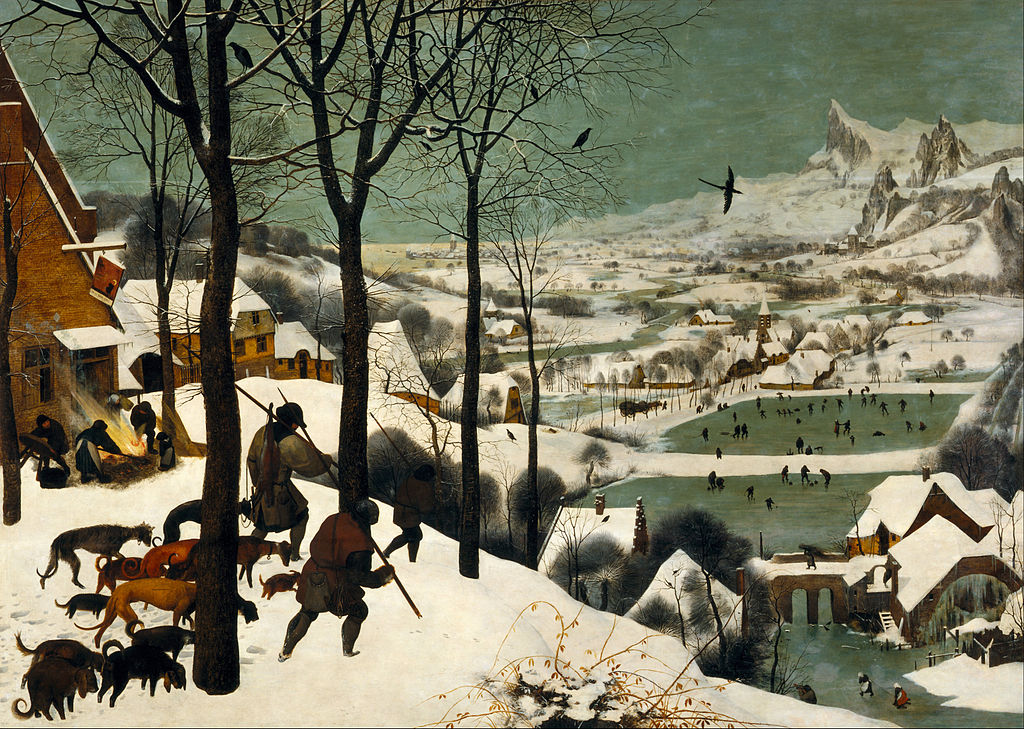
Hunters in the Snow, Pieter Bruegel the Elder, via Wikimedia Commons

Hunters in the Snow, Pieter Bruegel the Elder, via Wikimedia Commons

Writing, even writing fantasy, involves a certain amount of reality checking. You need to know how things actually worked.

Say you need to know what clothing the common European people wore during the renaissance looked like and how they dressed, both for celebrations, and for working.

I go to the 16th and 17th century painters and artists for that information. They always painted their subject with a heavy dose of religious allegory, but that was a part of village life–both the inquisition and the reformation was under way and the politics of religion was in the very air they breathed.

Any time you want an idea of average European village life in the Late Middle Ages through the 17th century, you need look no further than Wikimedia Commons.  There, under the heading  Category:Painters from the Northern Netherlands (before 1830) you will find the brilliant works of the Dutch Masters. These were artists living in what is now The Netherlands, and who were creating accurate records of the everyday life of the common people, along with stylized religious images.

During the 16th century, the Netherlands fought an 80 year war, trying to gain their independence from Spain, during the heart of the Spanish Inquisition. This was a period of extreme oppression and religious rebellion, and the art of times portrayed that very clearly.

I have learned, by rooting around the internet (so it must be true), that everything in the paintings of the time, no matter how commonplace, was allegorical, symbolic of some higher message. In art history (which I have always wanted to study), iconography is a visual language. This means that the way a subject is depicted and the way the image is organized, such as the number of figures used, their placing and gestures, all have specific meanings. The allegories they painted made heavy use of this visual language.

One particular family of of early Dutch painters from the county of Flanders pique my interest, the Brueghel Family. Five generations of their family were well-known painters, and print-makers.

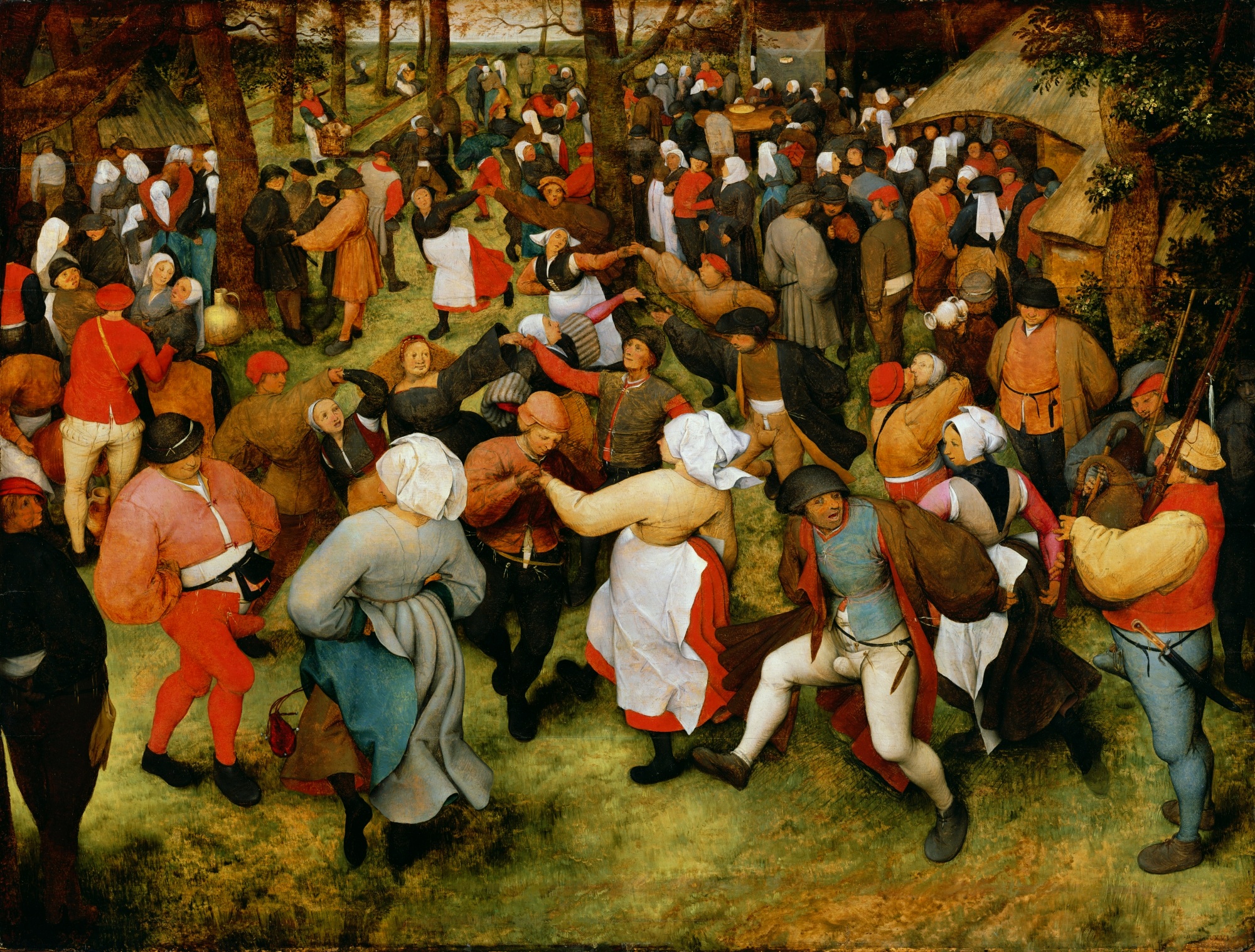
One of my favorite early Dutch paintings is the Wedding Dance, by Pieter Brueghel the Elder:

The Wedding Dance, c.1566 (oil on panel) by Bruegel, Pieter the Elder (c.1525-69)

The Wedding Dance, c.1566 (oil on panel) by Bruegel, Pieter the Elder (c.1525-69)

What makes this painting so spectacular to me is the amazing detail of the clothing. They loved color. From Wikipedia: The painting depicts 125 wedding guests. As was customary in the Renaissance period, the brides wore black and men wore codpieces. Voyeurism is depicted throughout the entire art work; dancing was tabooed at the time by the authorities and the church, and the painting can be seen as both a critique and comic depiction of a stereotypical oversexed, overindulgent, peasant class of the times.

All of these people are depicted as plump, which was a desirable trait–they were prosperous and not starving. All the things that (to this day) make a great party are there: music, food, and dancing. The men wear codpieces, emphasizing their male anatomy in the same way that in today’s society, women’s breasts are hyper-sexualized.  Perhaps codpieces should make a comeback in the men’s fashion world. I’ll show off my babyfeeders, if you parade your babymaker–that way we’ll both be sure we are getting something worth having. (or not.)

Anyway, back to the renaissance. They paid taxes, and this his how their IRS office looked to Brueghel’s eldest son, Pieter Jr. As you can see, not a lot has changed between then and now–we still pay in chickens and eggs. (heh heh.)

Pieter_Brueghel_the_Younger_(or_workshop)_The_Payment_of_the_Tithes_

The Payment of the Tithes (The tax-collector), also known as Village Lawyer, Pieter Bruegel, the Younger, signed P Brueghel

Brueghel’s eldest son, Pieter the Younger,  was never considered as fine a painter as his father or his brother, Jan Brueghel. He was considered a fine print-maker and his work shop was highly regarded. But he was not respected as an artist. Critics of the day felt he copied his father’s style, rather than developing his own. While he did paint in a folk-art style reminiscent of his father’s, his is sharper, more refined, taking it to the next level.

Notice how the people in the above picture are looking lean and ragged though, as opposed to the wedding picture painted by Pieter the Elder. The Little Ice Age had really gripped Europe, and times were hard.

So here is a painting by the second son of Pieter Brueghel the Elder, and a man who fathered his own dynasty of artists, Jan Bruegel the Elder. This is called People Dancing on a Riverbank and by their dress, with the neck-ruffs, you can see it depicts a wealthier class than his brother’s images, perhaps the merchant class rather than the peasants.

People_dancing_on_a_river_bank_by_Jan_Brueghel_the_elder

People Dancing on a riverbank, Jan Bruegel the elder, via Wikimedia Commons

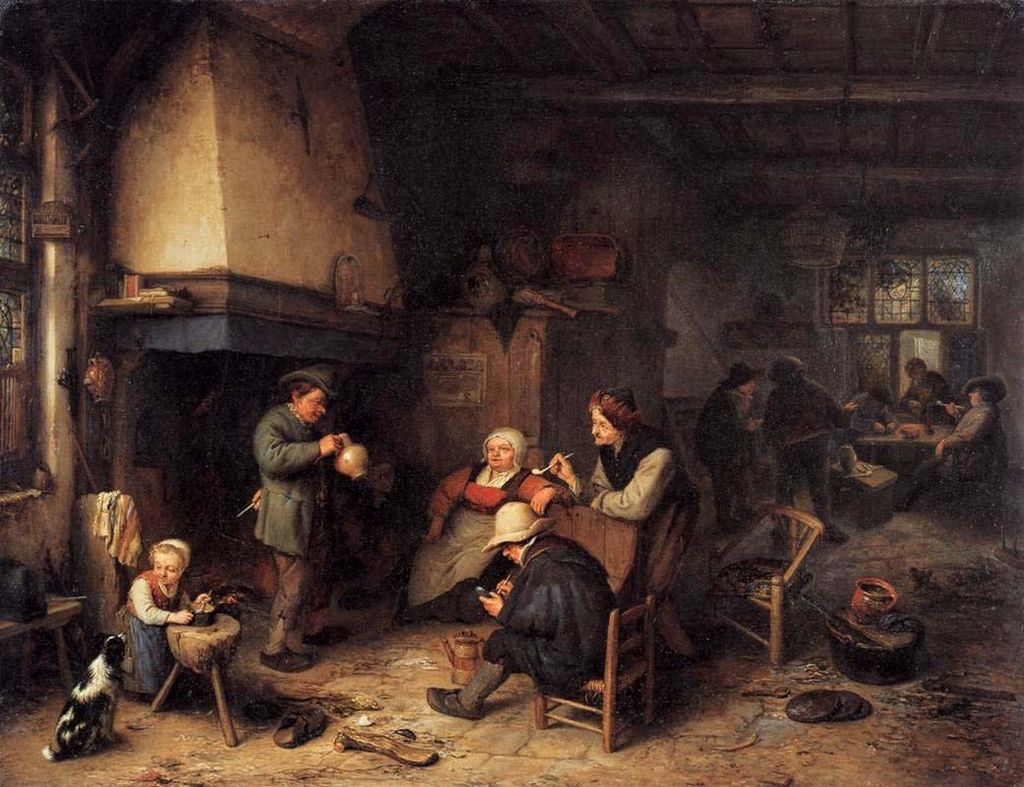
One hundred years later, the Dutch were famous for their painters–and everyone wanted to own a Dutch masterpiece. Times had become quite hard, as the climate had cooled and crops regularly failed. Once-prosperous families often lived in the ruins of their family manors.

Peasants_in_an_Interior_(1661)_Adriaen_van_Ostade

Peasants in an Interior, Adriaen Van Ostade (1661) via Wikimedia Commons

In the above picture by Adriaen Van Ostade, these peasants are living in an enormous, decrepit farmhouse, almost like squatters. They are no longer plump, and are living in filthy conditions. The fire in the fireplace is very low, as if fuel was scarce.

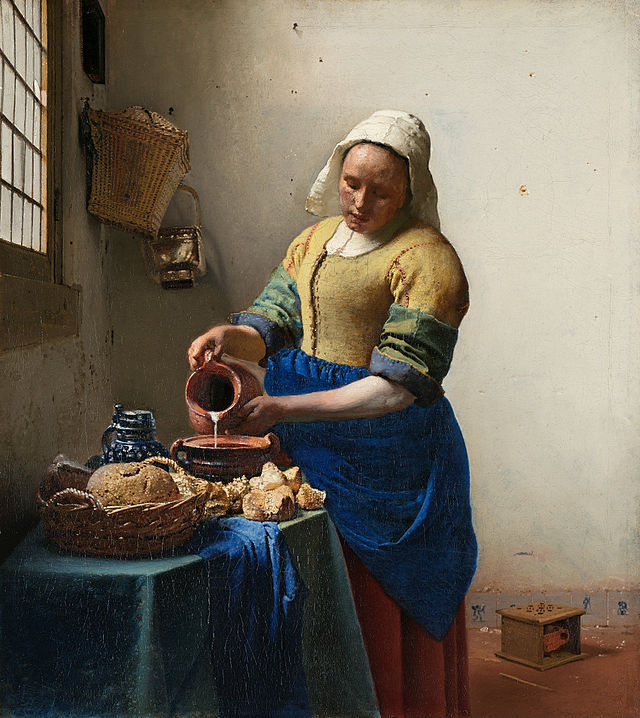
Another famous Dutch painting, from the same time period but showing a different segment of society is The Milkmaid, by Johannes Vermeer. In this painting, Vermeer shows an everyday task, a small glimpse of something that occurred daily in every household, a woman cooking.

The Milkmaid, Johannes Vermeer, via Wikimedia Commons

The Milkmaid, Johannes Vermeer, via Wikimedia Commons

In the background on the floor is a foot-warmer which was filled with coals and was an essential luxury, showing this was one of the wealthier households.

According to Wikipedia, the fount of all knowledge: By depicting the working maid in the act of careful cooking, the artist presents not just a picture of an everyday scene, but one with ethical and social value. The humble woman is using common ingredients and otherwise useless stale bread to create a pleasurable product for the household.

I love art depicting the lives of ordinary people. I find the small details intriguing. It shows us that in many ways we are not that different than they were. We want food, decent shelter, and of course, stylish clothes to attract a mate.

And back then as it does now, a hint of anything taboo would most certainly find its way into even a religious painting.

The best part of all this is, a woman with an average education and on a tight budget (like me) can enjoy these wonderful works of art at will. I can examine them  in as much detail as I want, and take all the time I want, and no one will stop me or throw me out of their museum for loitering, because the internet is open all hours and is free.

Wikimedia Commons is a great resource to just roam around in, even when you are not looking for something specific.

8 Comments

Filed under Books, Humor, Literature, writer, writing

Beta Reading, or Editing–what’s the difference?

Book- onstruction-sign copyIndies rely heavily on what we refer to as beta readers to help shape their work and make it ready for editing. But in many forums, I’ve seen authors  use the term used interchangeably with editing, and the two are completely different.

And unfortunately, some indie published works are clear examples of work by authors who don’t realize the importance of working with an editor, although it is apparent that they have had assistance from beta-readers.

What is quite disappointing to me, is the many traditionally published works that seem to fall into the same lack-of-good-editing category, and I am at a loss as to why this is so.

So what is the difference between a beta reader and an editor?

Well, there is a HUGE difference.

Editing is a process, one where the editor goes over the manuscript line-by line, pointing out areas that need attention: awkward phrasings, grammatical errors, missing quote-marks or a myriad of things that make the manuscript unreadable. Sometimes, major structural issues will need to be addressed. It may take more than one trip through to straighten out all the kinks.

  1. In scholastic writing, editing involves looking at each sentence carefully, and making sure that it’s well designed and serves its purpose. In scholastic editing, every instance of grammatical dysfunction must be resolved.
  2. In novel writing, editing is a stage of the writing process in which a writer and editor work together to improve a draft by correcting errors and by making words and sentences clearer, more precise, and more effective. Weak sentences are made stronger, nonessential information is weeded out, and important points are clarified, while strict attention is paid to the overall story arc.
  3. The editor is not the author She can only suggest changes, but  ultimately all changes must be approved and implemented by the author.

Beta Reading is done by a reader. One hopes the reader is a person who reads and enjoys the genre that the book represents. Beta reading is meant to give the author a general view of  the overall strengths and weaknesses of his story.

The beta reader must ask himself:

  1. Were the characters likable?
  2. Where did the plot bog down and get boring?
  3. Were there any places that were confusing?
  4. What did the reader like? What did they dislike?
  5. What do they think will happen next?

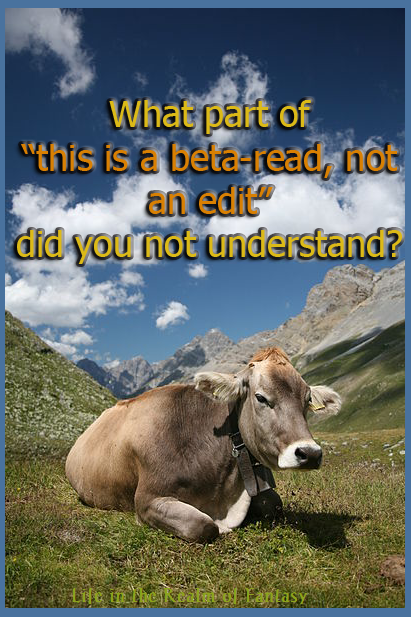
beta read memeBeta Reading is not editing, and  the reader should not make comments that are editorial in nature. Those kinds of nit-picky comments are not helpful at this early stage, because the larger issues must be addressed before the fine-tuning can begin, and if you are beta reading for someone, the larger issues are what the author has asked you to look at.

This phase of the process should be done before you submit the manuscript to an editor, so that those areas of concern will be straightened out first.

Editors and other authors make terrible beta readers, because it is their nature to dismantle the manuscript and tell you how to fix it. That is not what you want at that early point–what you want is an idea of whether you are on the right track or not with your plot and your characters, and whether or not your story resonates with the reader.

Do your self a favor and try to find a reader who is not an author to be a first reader for you. Then hire a local, well-recommended editor that you can work with to guide you in making your manuscript readable, and enjoyable.

If you notice a few flaws in your ms but think no one else will notice, you’re wrong. Readers always notice the things that stop their eye.

In my own work I have discovered that if a passage seems flawed but I can’t identify what is wrong with it, my eye wants to skip it. But another person will see the flaw, and they will show me what is wrong there.

That tendency to see our own work as it should be and not how it is, is why we need editors.

1 Comment

Filed under Books, Literature, Publishing, writer, writing

Mary Shelley and the Era of Romanticism

Mary_Shelley_by_Reginald_Easton.

Mary Shelley, by Reginald Easton

We often think that the great authors and artists of history were somehow wiser than we are.  We read their brilliant works, and they shine, as if they were slightly superhuman, and perfect in every way.

This is not always true. Sometimes they were wild teenagers with unrealistic ideals, haring off on adventures while their parents had nervous breakdowns over their behavior.

Mary Shelley , famous as the author of Frankenstein; or, The Modern Prometheus was born Mary Wollstonecraft Godwin on August 30, 1797. Her father was the political philosopher, William Godwin, and her mother was the philosopher and feminist, Mary Wollstonecraft. Both were famous in their day, and are still well known.

Mary’s mother died when she was eleven days old. Afterwards, Mary and her older half-sister, Fanny Imlay (her mother’s first child by an affair with a married man) were reared by their father. When Mary was four, her father married his neighbor, Mary Jane Clairmont. Mary Jane had a two year old daughter, Clara (Claire). Godwin considered all three girls his daughters and raised them accordingly.

William Godwin provided his three daughters with a good education, encouraging them to adhere to his liberal political theories, and values. He raised them to think independently, to his eternal regret.

Joseph Severn, 1845, Posthumous Portrait of Shelley Writing Prometheus Unbound in Italy.

Posthumous Portrait of Shelley Writing Prometheus Unbound in Italy, Joseph Severn, 1845

In 1814, at the age of seventeen, Mary Godwin began a romantic relationship with one of her father’s political followers, the married Percy Bysshe Shelley. Together with Mary’s stepsister, fifteen-year-old Claire Clairmont, Mary and Percy left for France and traveled through Europe.

Their relationship created a huge scandal among the nobility. Mary’s father completely disowned her, which both surprised and hurt her deeply.

Upon their return to England, Mary was pregnant with Percy’s child. Over the next two years, she and Percy faced social ostracism, they were in constant debt (often fleeing creditors), and they also suffered the death of their prematurely born daughter.

640px-George_Gordon_Byron,_6th_Baron_Byron_by_Richard_Westall_(2)

George Gordon Byron, 6th Baron Byron, by Richard Westall

In 1816, the couple famously spent the summer with Lord Byron, John William Polidori, and Claire Clairmont near Geneva, Switzerland. While the weather was horrendous, the summer was the most important, in literary terms, of any summer since.

This is where Mary conceived the idea for her novel, Frankenstein; or, The Modern Prometheus. It was also the infamous summer with no sun, a volcanic-winter event caused by the massive 1815 eruption of Mount Tambora in the Dutch East Indies (now known as Indonesia).  It was the largest eruption in at least 1,300 years, and, falling in the Little Ice Age as it did, caused worldwide famine in the year that followed.

They were prompted to go to Geneva by Mary’s stepsister, Claire Clairmont, who, in competition with her sister, had initiated a liaison with mad, bad, and dangerous to know Lord Byron the previous April.  Obsessed with him despite the fact that Byron’s interest in her had already waned, Claire used the opportunity of introducing him to the Shelleys to act as bait to lure him to Geneva.

The Shelleys and Byron rented neighboring houses on the shores of Lake Geneva. According to Wikipedia, the source of all knowledge:

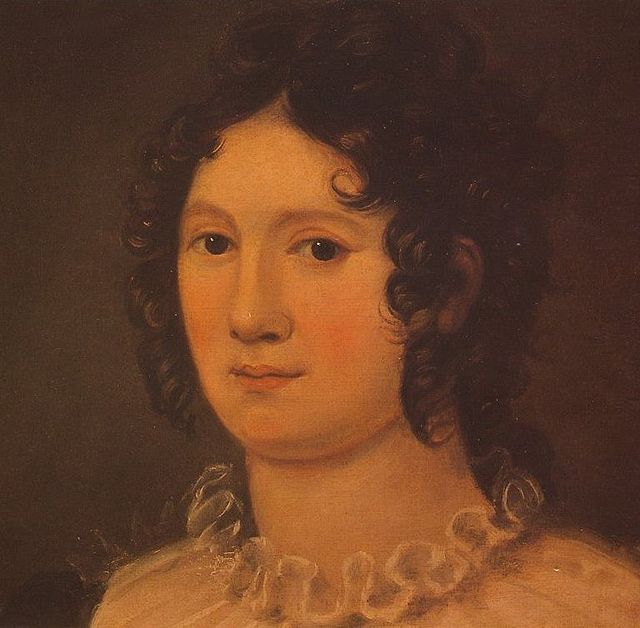
Claire Clairmont, by Amelia Curran

Claire Clairmont, by Amelia Curran

While on a boating tour the two took together, Shelley was inspired to write his Hymn to Intellectual Beauty, often considered his first significant production since Alastor, or The Spirit of Solitude. A tour of Chamonix in the French Alps inspired Mont Blanc: Lines Written in the Vale of Chamouni.

Shelley also encouraged Byron to begin an epic poem on a contemporary subject, advice that resulted in Byron’s composition of Don Juan.

Mary and Percy married in late 1816 after the suicide of Percy Shelley’s first wife, Harriet.

John William Polidori, by F.G. Gainsford

John William Polidori, by F.G. Gainsford

This reads more like a modern soap-opera than what we nowadays think would be the accepted behavior of well-to-do people living during the early 19th century.

But it was the Era of Romanticism.  Again, the Fount of All Knowledge, Wikipedia, has this to say about that:

The German painter Caspar David Friedrich said “the artist’s feeling is his law.”

To William Wordsworth, poetry should begin as “the spontaneous overflow of powerful feelings,” which the poet then “recollect[s] in tranquility,” evoking a new but corresponding emotion the poet can then mould into art. 

Wanderer Above the Sea of Fog, Caspar David Friedrich, 1818

Wanderer Above the Sea of Fog, Caspar David Friedrich, 1818

In order to express these feelings, it was considered that the content of the art needed to come from the imagination of the artist, with as little interference as possible from “artificial” rules dictating what a work should consist of. Samuel Taylor Coleridge and others believed there were natural laws which the imagination, at least of a good creative artist, would unconsciously follow through artistic inspiration if left alone to do so.

In other words–they were hippies, and it was the Regency equivalent of the summer of love.

The Shelleys left Britain in 1818 for Italy, where their second and third children died before Mary Shelley gave birth to her last and only surviving child, Percy Florence Shelley. In 1822, Percy Bysshe Shelley drowned when his sailing boat sank during a storm near Viareggio.

Mary Wollstonecraft Shelley was a prolific author. She wrote

  • History of a Six Weeks’ Tour (1817)
  • Frankenstein; or, The Modern Prometheus (1818)
  • Mathilda (1819)
  • Valperga; or, The Life and Adventures of Castruccio, Prince of Lucca (1823)
  • Posthumous Poems of Percy Bysshe Shelley (1824)
  • The Last Man (1826)
  • The Fortunes of Perkin Warbeck (1830)
  • Lodore (1835)
  • Falkner (1837)
  • The Poetical Works of Percy Bysshe Shelley (1839)
  • Contributions to Lives of the Most Eminent Literary and Scientific Men (1835–39), part of Lardner’s Cabinet Cyclopaedia
  • Rambles in Germany and Italy in 1840, 1842, and 1843 (1844)

She also wrote numerous short stories and articles that were widely published, along with many children’s stories, and numerous other unpublished work found in her papers after her death. After 200 years of being just Percy Shelley’s wife who got lucky with the popularity of Frankenstein, scholars now admit that Mary Shelley was a major figure of the Romantic Movement, significant for both her literary achievements and her political voice as a woman and a liberal.

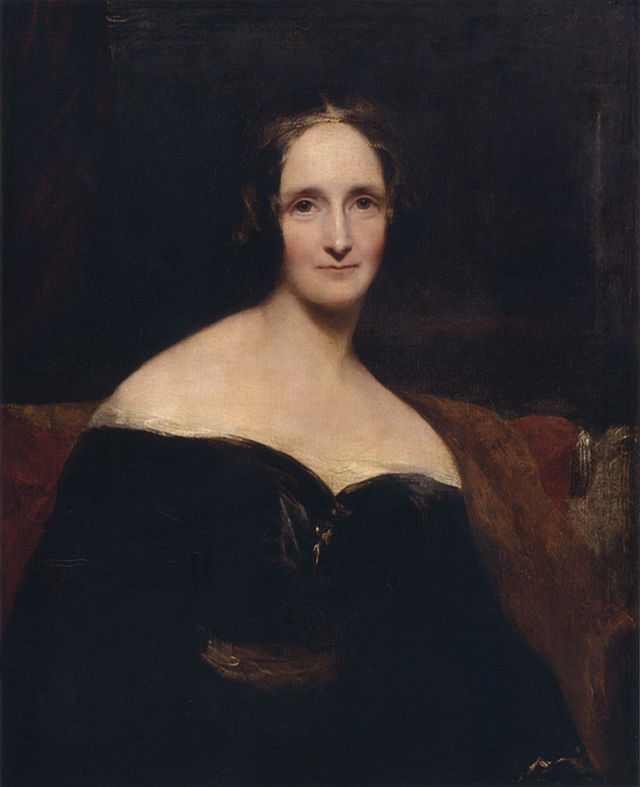
Mary Shelley, by Richard Rothwell

Mary Shelley, by Richard Rothwell

Mary Shelley died at the age of 53 from a brain tumor.

Her life was not long, by today’s standards, but she lived it to the fullest. She gave up everything to follow Percy, and while he loved her, she nevertheless had to sit by while he had affairs, even with her stepsister, Claire.

Mary suffered terrible personal losses, the deaths of her children and her husband, and her sister Fanny. She lived every day of her life with passion, and dared to write articles and stories with a sharp political edge, and she got away with it in an era when women had no voice. Percy Shelley himself called her a “child of love and light.”

9 Comments

Filed under Literature, Publishing, writer, writing

The harsh truth, and cold comfort

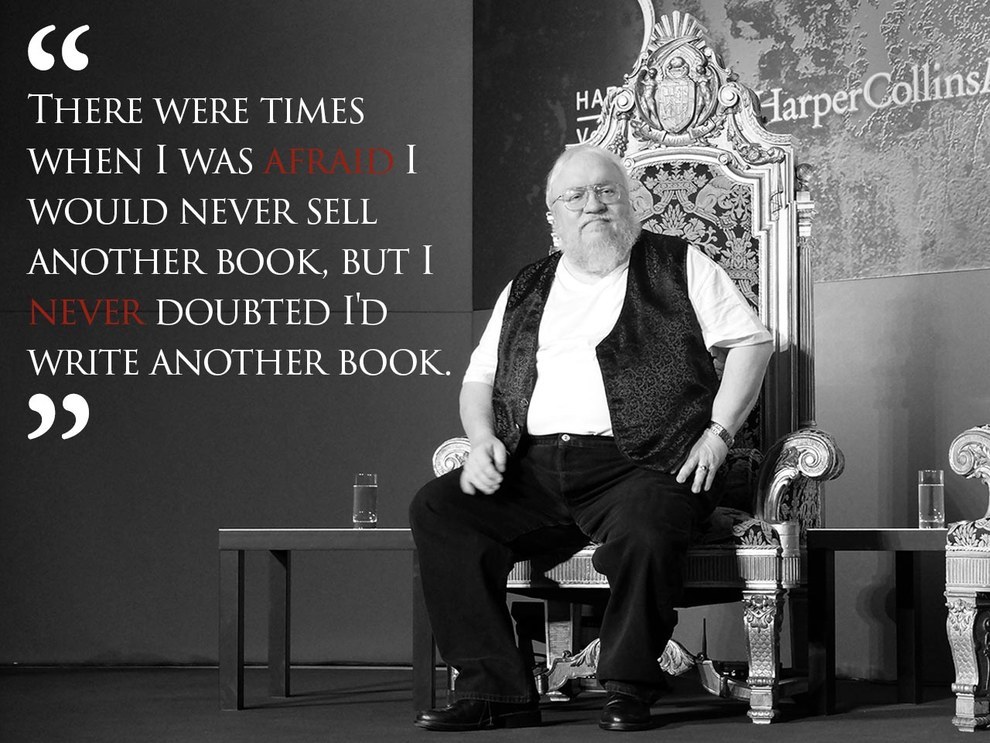
GRRM Meme 2Authors are not really great at social stuff. On top of that, we tend to be horribly insecure about our work, but it’s all we can think of to talk about.

We are thin-skinned and bleed profusely when you cut our work to shreds. Some of us handle that with grace and dignity, and others go ballistic and make an uncomfortable situation worse.

Now we come to a problem affecting a friend who lives far way from me–authors undercutting authors. She has left her writing group and will not be going back because one new member is harsh and unfair in the way they critique this author’s work–under the arrogant pretense of “just telling the truth.”

The new member is published, an indie, and seems to be selling a fair amount of books. She was invited to join a group of authors who are not not yet published, but who all hope to be. Each member is in various stages of courting agents and editors. An editor for a respected mid-sized press has shown interest in my friend’s manuscript. The new member started out friendly enough, but began by making belittling remarks about the way the group had been doing things, implying they were just playing at being authors. Then, suddenly feeling inferior and hoping to be more “legitimate,” the group allowed her to take charge. Things went downhill from there, with the new queen-bee as the center of attention.

quarrabtine symbol

Now I don’t know if my friend will ever write again. I do know she won’t join another group, which is sad, because MOST groups are not like that. Yes, they dig deep, and work on structural issues, but they don’t phrase their comments in a deliberately cruel manner. She knew her work wasn’t ready for publication, but she didn’t know it was “crap.”

And it isn’t crap.

I hate that she has put aside the makings of what could someday be a great novel, all because a person she respected as an author belittled her attempts in such a way that she is now afraid to share that most intimate part of her soul–her creativity.

But this is a problem that affects authors of all stations, not just indies and hopefuls. People feel its acceptable to say the most disparaging things, especially if an author has become successful, as if that author’s success negatively affects their own chances. And they seem to to take it beyond criticizing their work–they get personal about it.

Indie authors need to help each other advance, not tear each other down. The world is full of readers, so there is room for everyone, and if we ridicule each other and make disparaging, mocking remarks about the quality of others’ work just because we don’t care for their style of writing, shame on us.  There is an ocean of difference between badly crafted work, and work that is written in a style you don’t care for. I read many things written in a style I don’t care for, but if it is well-crafted and written with some attention to the aspects that make a good tale, I will give it a decent review, and I refuse say negative things about the author who wrote it, no matter how popular it may be to do so.

Successful author bashing has become an acceptable topic at parties due in part, I think, to the fact that with the rise of ebooks and Amazon’s eagerness for buyer reviews, any reader can become a critic, regardless of the quality of their “review.” This is both good and bad, because you do sometimes get a real-world view of what readers think of a book. But conversely an illiterate review that gives only one star and just says (in misspelled words) that they hated it and didn’t read the book doesn’t help help anyone.

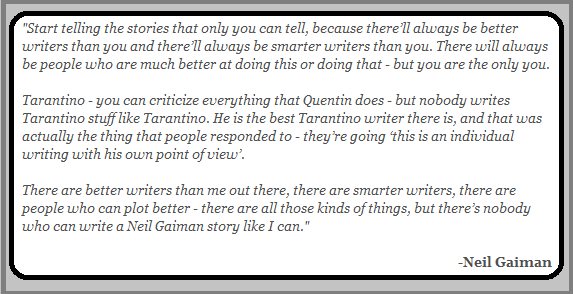
Neil Gaiman quote 3

Trolling and internet bullying has become an addiction for some people, and it’s apparent that their anonymity gives them a sense of power. To be able to destroy a person with a few well-chosen words–they see themselves as king-breakers, and they like that.

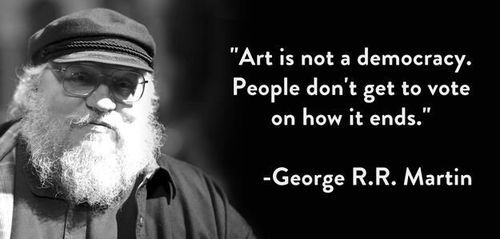
Even mega-successful authors like George R.R. Martin deal with an avalanche of poison and angst from trolls–I hope that what he deals with is not typical of what successful authors must endure, although Stephanie Meyer, E.L. James, and J.K. Rowling have all endured this sort of spew. Of course George’s TV series is the source of most of his grief, but still–these people show so little respect for a kind, decent man who sincerely cares about his craft and whose work has provided them with countless hours of entertainment.

GRRM Meme 3All that aside, NO author, no matter how famous, crafts perfect work that resonates with every reader, every time. We sometimes hit a pure note with one particular piece, but we will spend the rest of our writing lives trying to live up to the potential that piece had, with varying degrees of success. And when we were writing that story, perhaps it didn’t go the way the reader thought it should, and someone had to die.

That happens all the time, because the READER DOES NOT WRITE THE BOOK.  Readers who want to write the book badly enough become authors and DO it, instead of whining about it.

So we authors try to develop a thick skin and continue doing what we do. We keep learning. We keep working on the craft, and we never stop striving to be just a little better with our next short story or novel. And if, when you are in a writing group and another author makes cutting remarks in regard to your writing style, ask yourself why they feel that your style deserves harsh criticism. Don’t feel badly about walking away from that group before it gets to the level that my friend experienced, even if you like a few of the people who remain–because you won’t gain anything by staying around for more humiliation.
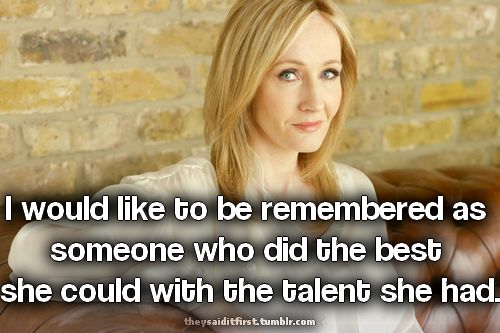
JK Rowling MemeMy friend–there will be other groups, and with a little checking around, you will find the one that welcomes you and your work.

Or maybe you need to go solo for a while.

That is cold comfort if someone you once respected has trashed your work and humiliated you, I know. But keep learning and keep writing. Rise above the naysayers and don’t let them steal the joy you have in your craft.

25 Comments

Filed under Literature, Publishing, writer, writing