Category Archives: writing

#amwriting: Two punctuation wrongs that don’t make a right

semicolon memeToday, I am revisiting independent clauses and how NOT to join them. This has been discussed at length elsewhere on this blog, so I’ll keep today’s discourse short and to the point.

You do not join independent clauses (clauses that can stand alone as separate sentences) with commas as that creates a rift in the space/time continuumthe Dreaded Comma Splice:

Comma Splice: My car is a blue Chevy Malibu and I like it, the dog likes to ride shotgun.

Same thought, written correctly: My car is a blue Chevy Malibu, and I like it. The dog likes to ride shotgun.

Would it be better if we used a semicolon? No. The dog riding shotgun is an independent clause and does not relate at all to the color of the car.

A semicolon in an untrained hand is a needle to the eye of an editor.

Remember: Semicolons join independent clauses, which are clauses that can stand alone, and your best bet is to avoid using them except under extreme duress as they can create some lo-o-o-o-ong, run-on sentences.

But what if you absolutely, positively have to use a semicolon, or your hair will fall out? Trust me, it won’t happen, but there are rules for using this type of punctuation, and the wise author will follow them:

Two clauses that are joined together with a semicolon should be

  1. complete sentences that relate to each other
  2. if they don’t relate to each other, make them separate sentences and reword them so they are not choppy.

Two separate ideas done wrong: We should go to the Dairy Queen; it’s nearly half past five.

The first sentence is one whole idea—they want to go somewhere. The second sentence is a completely different idea—it’s telling you the time.

Two separate ideas done right, assuming the mention of time is important: We should go to the Dairy Queen soon. They close at eight, and it’s nearly half past five.

If time is the issue in both clauses, and you feel like you absolutely MUST use a semicolon or you will explode, say, “The Dairy Queen is about to close; it’s nearly half past five.”

I generally try to find alternatives to semicolons, but I don’t dislike them, as some editors do. I do think they are too easily abused and misused, and should not be used if you are in doubt.

Comma splices—don’t do it. The universe will grind to halt, and everyone will die, and it will be your fault.

Semicolons—use only when two stand-alone sentences or clauses are really short and relate directly to each other.

Comma Splice Meme


7 Comments

Filed under writing

#flashfictionfriday: The Sea Doves

sanddollar

For more information on the life cycle of the common sand dollar, go to http://www.gma.org/tidings/sand-dollar

An older lady walking with a cane, and a young boy of about four strolled along the beach, following the line of shells and debris left by the retreating tide.

“Grandma, what’s this?” The boy picked up a round, flat shell, with a design that looked like a flower etched on the rounded top.

“It’s a sand dollar,” replied the grandmother. “When the little creature inside dies, it leaves its teeth behind. Their teeth are shaped like doves. If you shake it you can hear the doves inside, rattling around.”

“Real doves? Like the ones by our house?” He peered intently at it, turning it over in his chubby hands and then, holding it up to his ear, he shook it.  He  danced with excitement, his eyes bright. “I can hear them!”

They walked a while further and the boy bent down again, picking up another sand dollar. “This one is is broken. What happened to the doves? Did they fly to my yard back home?”

The grandmother chuckled. “Perhaps they did. Shall we open one and see if they’re the kind of doves that fly?”

“Okay. I’ll find one.”  After a few moments of searching, the boy shouted, “I found it.” Quickly bending down, he picked up his find and held it out to his grandmother. “Can you open it now?”

“We’ll need a rock,” said Grandma. “Get me a good rock for pounding on things, about the size of your fist.”

Soon the two were bent over a driftwood log, with the sand dollar lying ready to be opened. “What should I do?”

“Give it a good whack. Not too hard, but just enough to crack it open.”

The boy shook his head. “I’m too strong. What if I smash it? I’m much stronger than you, so maybe you should whack it.”

Laughing again, Grandma complied. Soon the shell was opened and the little dove-shaped teeth were exposed.

The boy waited for a moment, then asked, “How come they aren’t flying away?”

Grandma thought for a moment. “Perhaps they only fly when we aren’t looking at them. Maybe we have to close our eyes and wish as hard as we can.”

The boy did so and after a moment Grandma said, “Look!”

His eyes flew open and he saw in the distance five white birds, flying away. “They did it! We let them loose! But they turned into seagulls.”

Grandma fingered the tiny bones in her pocket. “You’re right. Those were seagulls. Maybe they only turn into sea doves if we let them break out naturally.”

“Okay. We won’t hatch any more. I think there are enough seagulls on this beach right now. What we need are sea doves.”

Grandma agreed. The two walked on, stopping occasionally and examining the amazing finds left behind by the tide.


The Sea Doves, © Connie J. Jasperson 2016, All Rights Reserved

7 Comments

Filed under #FlashFictionFriday, Fantasy, writing

#amwriting: mind wandering

IMG_1068

Sea Stacks at Tillamook Head © 2016 Connie J. Jasperson

We have long known that creative people are often guilty of daydreaming, but researchers have shown that daydreaming makes you more creative. Right now I am on vacation, and my output of writing has been sporadic–it comes in bursts. Here by the sea I find myself thinking about…nothing.

Sometimes I realize I’ve been gazing at the scenery with no conscious awareness of thought for long stretches of time. This means my mind is completely at rest. With this relaxing of conscious thought, I become rested, and my mind is cleared of the white-noise that hinders my creative process.

Eugenio M. Rothe, a psychiatrist at Florida International University, says:  “Many times the ‘dialogue’ that occurs when the daydreaming mind cycles through different parts of the brain accesses information that was dormant or out of reach. Likewise, the daydreaming mind may make an association between bits of information that the person had never considered in that particular way.”

Intriguingly, the physiology of the brain itself, and not the “mind” controls our daydreams. Anthony Jack, a cognitive scientist at Case Western Reserve University in Ohio says,

“How we daydream and think depends on the brain’s structure. …(That) structure is constantly changing in small ways—as we learn new things the connections between nerve cells change.” (Read “Beyond the Brain” in National Geographic magazine.)

I usually work 10-16 hour days. I don’t do it intentionally, but it happens. Thus, taking a complete break away from my desk is critical. At home, I might go out to my back porch and observe the neighborhood. It’s peaceful out there, but here, where Ecola Creek meets the Pacific Ocean, I am away from my usual tasks. I have no schedule, and my editing work is on hold. I am writing this post via the stream-of-conscious method rather than preparing it ahead on Sunday as I usually do.

My mind has been defragging this week. I can feel my spirit growing lighter, less concerned about the small annoyances. I don’t need sunshine to free my subconscious thoughts–I just need the sea.

My husband is relaxing too. He has only called his office once, and on finding the small problem there was easily settled, he is relaxing and enjoying the peace of the moment.

IMG_1074

Sea Stacks in the Mist at Tillmook Head © Connie J. Jasperson 2016

The ocean right now at 5:57 am is shrouded in fog. The sea stacks are islands in the mist. For an hour or so more, the gulls and other sea birds will own the beach, and they are making the most of their time.

Soon early risers like me will be up, some letting the dogs go for a run, others just wandering the shore, thinking about nothing in particular.

Today we will go down to Haystack Rock with a picnic lunch and if the wind is right we’ll fly the kite. That is all the plans we have for the day. I may write when I get back, or I may continue reading. Whichever I do, it will be interspersed with long moments of staring out at those amazing rock formations where Ecola meets the sea.

2 Comments

Filed under Adventure, writing

#amwriting: finding paradise

Amaranthus and Savvy at the needles by haystack rock cannon beach 2012My annual visit to the sunless Oregon Coast is upon us. For the next week I’ll be reading and gazing out the window at the ghostly rocks of Tillamook Head rising from the mist. Terrible Tilly, the most infamous lighthouse on the West Coast rises a mile out to sea, but is shrouded in fog and mist–I can’t see her today.  It is supposed to rain most of the week here–and that is what we come to this place for.

The many moods of the stormy waters, the seabirds–this place inspires me and clears my head like no other place.

I will be writing whenever the muse seizes me. Our condo is one we often stay at, and is perfect for us with a fully outfitted kitchen. I will cook many meals for my family, as being vegan, I can’t really eat in too many restaurants, although there are a few beginning to offer vegan options here.

As I write this at 06:15 a.m., the rain-slick streets are nearly empty, making this my town, my personal paradise. Despite the bad weather, people will soon be out, and it won’t be mine any more, but the hum and bustle of the streets brings a different vibe of excitement.

Walking along the beach in this sort of weather, one finds so many more things. The wave deposit sand dollars and the seabirds dine on them, leaving behind the hollowed shell for me.

The author goes kite flying in the fog, Cannon Beach, Haystack Rock , August 2013I may not have the chance to fly my kite until later in the week, but then again, some years I find myself kite-flying in the fog. Rather like my normal life, I suppose–with so many stories whirling in my head I’m always in a fog, so to speak.

Sun or no, this is my writing and reading paradise. I have the opportunity to do both here, in undisputed peace. Today, my husband and I will stroll along the beach, or visit the small shops, or just chill on the deck, observing the sea in all her many moods.

This is my piece of Heaven. Have you found yours?


Comments Off on #amwriting: finding paradise

Filed under Adventure, writing

#flashfictionFriday: Sonnet 116, by William Shakespeare

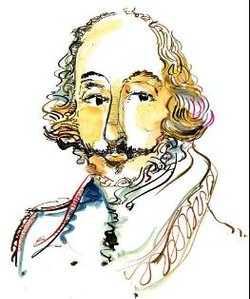
Wm Shakespeare Amazon Author Central portraitWe haven’t waxed poetic over Shakespeare recently, and I think it’s time to consider the prose of the master, both its meaning and its construction. To that end, I give you

Sonnet 116

Let me not to the marriage of true minds

Admit impediments, love is not love

Which alters when it alteration finds,

Or bends with the remover to remove.


O no, it is an ever fixèd mark

That looks on tempests and is never shaken;

It is the star to every wand’ring bark,

Whose worth’s unknown although his height be taken.


Love’s not time’s fool, though rosy lips and cheeks

Within his bending sickle’s compass come,

Love alters not with his brief hours and weeks,

But bears it out even to the edge of doom:


If this be error and upon me proved,

I never writ, nor no man ever loved.

Sonnet 116 is typical of what we think of as a classic English sonnet. The English sonnet has three quatrains (verses), followed by a final rhyming couplet. It follows the typical rhyme scheme of iambic pentameter, which is a type of poetic meter: one short (or unstressed) syllable followed by one long (or stressed) syllable.

The interpretation of this poem is open to many speculations, the most compelling of which I found in Cliffs Notes, and which I quote here:

Despite the confessional tone in this sonnet, there is no direct reference to the youth. The general context, however, makes it clear that the poet’s temporary alienation refers to the youth’s inconstancy and betrayal, not the poet’s, although coming as it does on the heels of the previous sonnet, the poet may be trying to convince himself again that “Now” he loves the youth “best.” Sonnet 116, then, seems a meditative attempt to define love, independent of reciprocity, fidelity, and eternal beauty: “Love’s not Time’s fool, though rosy lips and cheeks / Within his bending sickle’s compass come.” After all his uncertainties and apologies, Sonnet 116 leaves little doubt that the poet is in love with love.

The experts at Shakespeare Online say:

Sonnet 116 is about love in its most ideal form. The poet praises the glories of lovers who have come to each other freely, and enter into a relationship based on trust and understanding. The first four lines reveal the poet’s pleasure in love that is constant and strong, and will not “alter when it alteration finds.” The following lines proclaim that true love is indeed an “ever-fix’d mark” which will survive any crisis. In lines 7-8, the poet claims that we may be able to measure love to some degree, but this does not mean we fully understand it. Love’s actual worth cannot be known – it remains a mystery. The remaining lines of the third quatrain (9-12), reaffirm the perfect nature of love that is unshakeable throughout time and remains so “ev’n to the edge of doom”, or death.

In the final couplet, the poet declares that, if he is mistaken about the constant, unmovable nature of perfect love, then he must take back all his writings on love, truth, and faith. Moreover, he adds that, if he has in fact judged love inappropriately, no man has ever really loved, in the ideal sense that the poet professes.

Five hundred years after his time on this earth, the Bard of Avon’s crafting of ideals and emotions into words evokes powerful feelings in the reader. He is immortal, because we hear his words and feel their impact.

The secret poet within me hopes to one day develop more poetic skill, whether it is writing free-verse, or crafting a more traditional rhyming style of prose. To that end, I practice writing poetry when I am in the mood, and read the masters, and attend local poetry-slams. It’s amazing, the talent in your local poetry groups.


References:

Cliffs Notes, Sonnet 116 © 2016 Houghton Mifflin Harcourt. All rights reserved.

Shakespeare, William. Sonnet 116. Ed. Amanda Mabillard. Shakespeare Online. 8 Dec. 2012. http://www.shakespeare-online.com/sonnets/116detail.html

Comments Off on #flashfictionFriday: Sonnet 116, by William Shakespeare

Filed under #FlashFictionFriday, Literature, Poetry, writing

#amwriting: ensuring consistency: the stylesheet

Book- onstruction-sign copyWhen a manuscript comes across their desk, editors and publishers create a list of names, places, created words, and other things that may be repeated and that pertain only to that manuscript. This is called a stylesheet. Some editors refer to this as a “bible.”

The stylesheet can take several forms, but it is only a visual guide to print out or keep minimized until it’s needed. I copy and past every new word or name onto my list,  doing this the first time they appear in the manuscript. If I am conscientious about this, I’ll be less likely to inadvertently contradict myself later on in the tale.

Some people use a program called Scrivener which is not too expensive, but which seems to have a tricky learning curve. I downloaded the free version but couldn’t make heads or tails of it and found it quite frustrating. Nevertheless, I understand that it works well for many people, and to them, I say, “Good for you.”

For myself, I don’t want a fancy word-processing program. I just use MS Office, because I have been using the programs that come with that software since 1993, and I’ve been able to adapt to each upgrade they have made. It’s affordable, so I use Word to write and edit in, and occasionally use Excel to make small charts that are my style guides for each novel or tale I write, and also for every book I edit.

You can do this in Google Docs too, and that is free.

Regardless of how you create your stylesheet, I suggest you include these elements:

  • Word/Name
  • Page it first appears
  • Meaning

Bleakbourne Style Sheet

This is especially crucial for fantasy authors because we invent entire worlds, creating names for people, places, and creatures.

Take my own work-in-progress: it has characters with names that can be spelled several ways, and when I am in the throes of writing the first draft I fling them out any old way.

Thus, a character named Claire on page one can become Clair by page six. Dominick can become Dominic. Place names become mushy, and any word that is important or invented can evolve over the course of a manuscript.

I first learned about creating a stylesheet years ago when Huw the Bard was being edited. As she was editing my manuscript, my editor made a global search for every possible variant of the words I had created. She alerted me to these discrepancies, and I replaced the incorrect instances with the version I like best.

I have kept a Stylesheet for every work in progress since then, for short stories as well as novels.

map of Waldeyn 2015 with lettering cooper black copyPlace names evolve too, so maps are essential tools when you are building the world. Places written on a map tend to be ‘engraved in stone’ so to speak. Readers will wonder where the town of Maldon is when the only town on the map at the front of the book that comes close to that name is listed as Malton.

To prevent that from happening, double check what you have written on the map, and then do a global search for every possible variant of that name in your rough draft.

Just because you invented the world doesn’t mean you know it like the back of your hand. That world is constantly evolving in your mind. I have been writing in the world of Neveyah since 2009, and I still frequently contradict myself, which is why the stylesheet is so important.

9 Comments

Filed under writing

#ammwriting: Firing Chekhov’s gun

Motivation memeThis last weekend, I attended PNWA’s annual writing conference in Seattle, Washington. I garnered a great deal of advice from industry professionals and took seminars offered by well-known authors, agents, and editors.

I attend this conference every year. PNWA is where I come to learn both the craft of writing and business of publishing. Craft and business: two aspects of writing that every serious author must know whether they are going indie or taking the traditional route.

Today’s post is about identifying what motivates your characters. Well-known writing coach,  Lindsay Schopfer, gave a seminar on this, which unlocked ideas for my works in progress. That is how writers’ conferences work for me—they pry loose the ideas that have been stuck and help me verbalize them.

You have probably heard of the literary rule known as Chekhov’s Gun, which says nothing should appear in the scene that has no use. If a rifle is important enough to be shown hanging on the wall, someone had better fire it, or it should be removed from the setting.

Firing Chekhov’s gun brings us to motivation. When I was in elementary school, I was taught  “the 5 Ws” of journalism. I feel sure they still teach this, but just to remind you, they are:

  • Who
  • What
  • When
  • Where
  • Why

These five words form the core of every story. Who did what? When and where did it happen?

Why did they do it?

In some stories the author had made the what quite clear, but the why is murky. I hate it when the author is at a loss as to why their protagonist wants to do the task set before them.

If a character commits a murder, you’d better know why they were compelled to do it. Random events inserted to keep things interesting don’t advance the story.

When a character arrives at the inciting event, the things that motivate him/her should already be established. Identifying what makes your character do the things they do is the core of character development. Some characters are easy:

  • Edwin wants to save Marya.
  • Wynn wants to get back to his wife and his forge.
  • Huw wants to avoid being hanged for treason.

Some characters have motives that are more difficult to identify. Motives are driven by need, what a character desires, and what they are willing to do to attain it.

Suppose we have a protagonist who realizes her marriage is failing. We’ll call her Anna. Before we begin writing, we need to do a little brainstorming about Anna and find out who she is and what makes her tick.

She is a well-educated, professional woman, a writer of paranormal fantasy. She is married to another writer, David.

What motivates her? David is strong, charismatic and brilliant. There is nothing he doesn’t feel entitled to, and he will do anything to achieve his goals. Although she is a best-selling author of popular fiction and is the person paying the bills, Anna has made a habit of catering to his needs.

At first, she wants to keep her marriage together and presents herself as whatever she thinks David wants her to be. She feels as if she casts no shadow of her own. As the summer progresses and events unfold, she evolves, becoming an individual who no longer needs his validation. In the process, Anna finds that she is, and has always been, the strong one in the relationship.

With those paragraphs, we know the main protagonist’s desire—on the surface she has a deadline for her book and wants to save her marriage, but really she is seeking her sense of self-worth, trying to find who she is.

Now, let’s find out who the other characters are:

Anna and David rent a secluded house on the wild Washington coast for the summer. They invite 3 companions to join them for the summer, as a working retreat. All five characters have deadlines, and that is their official reason for accepting Anna’s invitation. However, the four other characters each have their own agendas. Other than Anna, they each have strong personalities, are charismatic, and are used to a certain amount of privilege. At first, although it is subtle, each of them uses and manipulates Anna for their own purposes.

Every member of the cast has a secret, including Anna. With the revelation of each secret to the reader, the motivations for subsequent actions become clear. Someone will attempt murder to ensure their secret is kept. In the end, three will die by accident, and two will be left to pick up the pieces.

With this information complete, we know the genre–this novel is a contemporary fiction, and is the story of Anna’s journey to self-knowledge. It will be slower paced than a thriller, and will be about the people and their relationships more than the events. However, the events will shape the people.

LOTR advance poster 2Unless each character’s wants and needs are clearly defined, the events won’t make any sense. Without clear motivations, it’s just a bunch of drama queens cooped up with a psychopath, in a house by the gloomy Washington North Pacific coast. Once we know their motivation, it becomes a story. And as a writer trying to flesh out characters, it becomes easy to picture these five people as individuals possessing depth and desires.

Motivation is the character’s quest to fulfill his/her deepest needs. Consider Frodo: he has seen what the ring did to Bilbo and Gollum, but more than that, he loves the Shire and does’t want it to fall to shadow. Without a real, personal motivation, there is no reason for Frodo to  agree to walk to Mordor and certain death just to toss a ring into an active volcano.


1 Comment

Filed under Literature, writing

#amreading: The Karaoke Novelist

BIF Blog Print ScreenI used to write an indie book review blog, before I got too busy to read as much as the blog required. The blog was called Best in Fantasy, and I still post reviews to it once in awhile, but only when something really rings my bells.

Sometimes I had to attempt to read six novels before I found one worth reviewing. In the process of searching Amazon for those really good fantasy reads, I’ve read a large share of badly written books. There is no  describing the agony of seeing a perfectly good idea for a plot destroyed by an author who was too eager to share their genius and rushed to publish what was clearly an excellent first draft .

You will get no snarky reviews from me—in fact I don’t review books I don’t like. I just move on to the next one in my pile and hope for the best.

Instead, I focus on the really awesome books I have enjoyed, some written by the famous, but most by the NOT so famous. Many of the great books I have enjoyed will never be best sellers because they are just one drop in an ocean of Kindle books.

It’s the wild west of indie publishing right now, and while it’s not necessarily a terrible thing, many untutored authors publish less than stellar works. These books are written and published by people who have no idea how the industry works.

Writing is like any other craft. There is a learning curve. Publishing is a separate craft, but nowadays the two go hand-in-hand.

At some point,  as indies gain the knowledge of what is involved in writing and publishing a good novel, the overall quality will  improve and level out. Those who are in it for the long haul will gain better visibility.

I have some hard-earned advice for new authors, those of you who want to leave the ranks of the Karaoke novelists, screeching their inept renditions of Wind Beneath my Wings. If you’re serious about your work, get your manuscript professionally edited.

Yes, it will cost you money, and you may get feedback you don’t want to hear. But that experience will enable you to put a book out there that you can be proud of, one that will stand up to any put out by the big publishers.

When I was writing a book review blog on a weekly basis, I often spent my week looking through five reasonably priced books only to discover they were

  1. Poorly formatted.
  2. Poorly edited.
  3. Rife with newbie errors such as beginning the book with a big info dump (been there done that).
  4. Thick, lush descriptions of “creamy blue eyes” (pardon, must barf now).
  5. Written by an author with no concept of a story arc.
  6. Boring filler conversations to fluff up the word count.
  7. Threads to nowhere,
  8. A random event that was intended as a cliff-hanger ending, but was obviously stuck there to entice the reader to get the sequel, which hadn’t been written yet and was now on my “No Way in Hell” list.

This also happens regularly with traditionally published books.  TOR can publish a novel that was poorly edited and no one will blink an eye, because they are one of the Big 5 Publishing houses.

Indies have to be better than that. Indies are scrutinized more closely and are held to a much higher standard. Flaws in our work are held up as an example of all that is wrong with the industry.

I used to curse at my Kindle when I read the first pages of books, both indie and traditionally published, that were  travesties. Many had gorgeous covers. I feel strongly the authors would be better served if they spent that money having their manuscript professionally edited.

I cringe when someone blithely tells me their friends edit for them. Most people aren’t best mates with a professional editor, and if you don’t have a degree in creative writing, you probably need a professional eye on your work.

Indies–aren’t you glad I only reviewed the books I liked? I didn’t want to be known for being a bitch, which is what I felt like when I read some of those travesties.

Thus, I say

  1. Go to writing craft seminars and conventions.
  2. Take writing classes at your local community college.
  3. Take online classes in writing.
  4. Buy and read books on the craft of writing.
  5. Write every day, even if it is only a paragraph.
  6. Hire a professional editor and consider following their suggestions.
  7. Have your manuscript proofread professionally before you publish it.

keep clam and proofreadI can’t stress this enough: before you publish that book you wrote during NaNoWriMo, please develop the craft of writing and rewrite that amazing novel.

You can join a writing group in your town and they will help you with these things. With the right group helping you grow, you will develop the skills needed to truly be a published author. And remember, if one group doesn’t really feel like a good fit, keep looking until you find a group you can work with.

2 Comments

Filed under writer, writing

#amwriting: learning from the masters: Kurt Vonnegut

Timequake(Vonnegut)I haven’t written about Kurt Vonnegut in a while, and I believe it’s time to revisit him and his wisdom. I am dusting off a piece I wrote several years ago, as it has merit in my writing life today.

Kurt Vonnegut (November 11, 1922 – April 11, 2007) was one of my literary heroes. He was considered to be one of the most outrageously creative writers of our time, and indeed time figures prominently in much of his work – such as in his semi-autobiographical novel, Timequake. In this novel, he writes about trying to write a story. He understood writers’ block, because he had experienced it. Reading Timequake is like seeing my own struggle to write reflected in another author’s life.

His most famous work, Slaughterhouse-Five came out of his experiences in WWII as a prisoner of war. Vonnegut understood being a prisoner of war because he had experienced it.

In 1982, Vonnegut wrote a short piece for the International Paper Company, titled simply, ‘How to Write with Style.’ He began his essay by first considering the question of “why we should strive to improve our writing style”:

  1. “Do so as a mark of respect for your readers, whatever you’re writing. If you scribble your thoughts any which way, your readers will surely feel that you care nothing about them. They will mark you down as an egomaniac or a chowder-head — or worse, they will stop reading you.”

For me as both an editor and a reader, this is a critical point, because if you, as an author, become irate at hearing honest opinions from your beta readers or editors, you are doing them a disservice. We all experience this feeling of shock and dismay, but do take the medicine and try to understand what your reader saw that wasn’t up to par.

My most painful moments have been at the hands of editors who truly wanted to help me improve my work. I thank God they cared enough to tell me the truth.

If you’re doing this only for your ego, then, by all means, enjoy writing whatever falls out of your head. Do it and have fun, but don’t show it to anyone for if you do, your ego is in for a bruising.

That joy and abandonment is how a first draft should be written. But, if you have a first draft, don’t ask me what I think of it, no matter how proud you are unless you want my perspective because we all know every ms has flaws.

After Vonnegut had explained why authors must work to improve their knowledge of the craft, he went on to present 7 more concepts authors must strive to achieve:

  1. Find a subject you care about.

Let’s be real – if we don’t have a passion for our subject, it’s difficult to wax poetic about it. But when you are passionate, you can’t stop discussing it. It takes all your attention, and you find new things to say about it every day.

  1. Do not ramble, though.

What a sense of humor!  He was right – keep it brief!  Don’t spend 50 words when 10 will do.  The longer a sentence is, the more opportunity an author has to weaken it.  I am terrible at putting this concept into action.

  1. Keep it simple.

(note to self) Simplicity is the key to Not Rambling!

  1. Have the guts to cut.

Sometimes an author is in love with a particular sentence or paragraph – and it may be one which, to an editor, doesn’t really work. You must be prepared to divorce the sentences you are married to. This happens to me all the time – and now I try not to cry when my most beautiful, alliterative prose is given the boot.  Nine times out of ten tossing out the offending gibberish improves the reader’s experience. After all, this isn’t only an ego trip – it’s the reader I’m writing for, right?

  1. Sound like yourself.

You may find this to be a ‘Well, duh!’ moment, but take a moment to think about how you actually speak.  Do you say “I shall meet you anon.” …er…no… probably not.  I usually say, “I’ll meet you as soon as I can.”  Write it the way it feels most comfortable to say it. (Thank you, my many wonderful editors, for helping me to understand this concept!)

  1. Say what you mean to say.

Another ‘Well, duh!’ moment, you might say, but think about how hard it is to express your thoughts when you are trying to tell a stranger how to get from your house to the Walmart in the next town just south of you. Use the words that most clearly express your thoughts. Don’t use vague words to describe simple things – don’t say ‘red marks that started to bleed slightly’ if what you’re describing are ‘bloody scratches.’

  1. Pity the readers.

kurt-vonnegut_quoteDon’t make your readers want to put down your book at the end of the first page. Write the sort of story you want to read – put yourself in the reader’s place.  All we dedicated readers really want is the best tale we’ve ever read!

Is that too much to ask?

No, and maybe.  We’re only human after all so mixed in with our flashes of literary brilliance are the occasional things which do well for lining the bottom of the bird-cage.

As writers, we struggle to grow every day, and yes, there are times when what we put to paper isn’t our best work.  But that is where having the guts to cut is important.

I just hate it when one of my most beautiful turns of phrase during the first draft of a tale becomes not-so-pretty in the second draft and ends up on the verbiage-heap when the editing is done!

Sometimes we find ourselves writing in a desert, a place where the words won’t come. We feel that our work is dry and uninspiring, but I guarantee the most famous and well-loved authors have suffered the same dry-spells, suffered the same feelings of miserable failure we aspiring indies feel.

When I read their beautiful, harsh, and diverse work, I am inspired. I believe I can do this crazy thing. I remind myself that, for me, it’s not about numbers and sales, because it can’t be. For me, it has to be about improving the quality of my work and the telling of the tales I have locked in my brain and getting them out there in book form to the best of my ability.

Reading and understanding how the great authors write is one of the keys to unlocking our own potential. We indies have to use every tool we have available in this rough business, and we have to know what we want to achieve.

I want to achieve great sales, of course. But more than that I want to write compelling tales that move my readers. I may never achieve the first, but I think I can do the second.

6 Comments

Filed under writing

#amwriting: Physician to The Vampire

John William Polidori (7 September 1795 – 24 August 1821) was an English writer and physician. He was best known for his involvement in the Romantic movement, an artistic, literary, musical and intellectual movement that originated in Europe toward the end of the 18th century. He is considered by many as the originator of the vampire genre of fantasy fiction. His most successful work was the short story The Vampyre (1819), which was the first published, modern vampire story.

Perhaps because John Polidori was a physician, he was able to bring all the disparate elements of 19th-century vampirism mythology into a coherent, compelling short story.  With just that one short story, he spawned an entire literary genre.

How did this come about? The story had its genesis in the summer of 1816, the Year Without a Summer when Europe and parts of North America underwent a severe climate abnormality.

Lord Byron and his young, twenty-year-old physician, John Polidori were staying at the Villa Diodati by Lake Geneva.

On the run from creditors and Shelley’s ailing, understandably jealous wife, Percy Bysshe Shelley, Mary Wollstonecraft Godwin (who later became Mary Shelley) and Claire Clairmont, Mary’s stepsister, visited them.

The group was kept indoors by the incessant rain of that cold, wet, unpleasant summer during a three-day stretch in June. Bored at being cooped up, the five turned to telling fantastic tales, and which inspired them to write their own.

Reportedly, they were fueled by ghost stories such as the Fantasmagoriana, William Beckford’s Vathek, and laudanum, to which Byron was addicted. Mary Shelley, in collaboration with Percy Bysshe Shelley, produced what would become Frankenstein, or The Modern Prometheus.

Polidori was the outsider, the man who was only included as he was in the employ of Byron. Lord Byron made him the butt of many jokes at dinner parties, taking great pleasure in humiliating him. This cruel treatment of anyone in his power was well documented by his contemporaries.

the-vampyrePolidori was inspired by a fragmentary story of Byron’s, Fragment of a Novel (1816), which is also known as “A Fragment” and “The Burial: A Fragment.” Over the course of several mornings, he wrote “The Vampyre.” The manuscript was overlooked for three years when it was discovered by a disreputable publisher, Henry Colburn. He published it in his New Monthly Magazine under the title “The Vampyre: A Tale by Lord Byron.” It was received with acclaim, much to Polidori’s surprise and chagrin.

Polidori struggled to assert his rights to the work, and Lord Byron did have the grace to declare promptly the work was Polidori’s and not his. Despite that assertion, proper credit for authorship of the story was muddy for many years.

Still, Byron was firm that he was not the author. Apparently, Byron felt that the destruction of a man’s soul was no great thing, but theft of his intellectual property was a crime.

Polidori’s work had an immense impact on his contemporary readers. Numerous editions and translations of the tale were published. The influence of The Vampyre as described by Polidori has continued into the twenty-first century, as until recently, his work was frequently considered the primary source of what is accepted as “canon” when writing about vampirism.

What are the traditional tropes of vampire fantasy? First of all, we must think Lord Byron. He was an arrogant, self-centered, charismatic, sociopath with a gift for writing brilliant poetry. From birth, Byron suffered from a deformity of his right foot and by the time he hired Polidori, he was addicted to laudanum which had been prescribed for the pain. He treated the young Polidori atrociously, engendering deep antipathy for his patient in the young doctor.

John_William_Polidori_by_F.G._GainsfordWithin the pages of Polidori’s diary, I see “The Vampyre” as an allegory of Byron’s abuse of John Polidori himself. It is easy to visualize Byron as a man possessed of the power to drain one of their soul when seen through the eyes of the man he had in his power, and whom he treated abominably as an employer.

Byron was described as the devourer of souls in the book, Glenarvon, by Lady Caroline Lamb, one of Byron’s former lovers.  “Ruthven” is the name Lady Caroline Lamb referred to Byron as in her novel. Polidori had read Glenarvon that summer, and blatantly used Lamb’s protagonist’s name for his vampire, and Byron proudly admitted he was the role model.

The Public Domain Review article, The Poet, the Physician and the Birth of the Modern Vampire, says this about the rocky relationship between Polidori and Byron:

“It was no great leap for Polidori to believe that Byron was sucking the life from him, just as others had accused Byron of possessing a charismatic power that eclipsed their own identities. Amelia Opie, one of the many women Byron had charmed, described him as having “such a voice as the devil tempted Eve with; you feared its fascination the moment you heard it,” a mesmeric quality that critics also found in his verse, which had, according to the critic Thomas Jones de Powis, “the facility of…bringing the minds of his readers into a state of vassalage or subjection.”

So we know vampires are charismatic and seductive. Their bite would enslave their victims. Folktales from hundreds of years ago tell us they can take the form of bats and fly through the windows of even the tallest buildings. Historically, vampires are powerful, but unable to withstand the light of day, which would burn them, and destroy them forever.

A patch of Dry Skin, Stephen SwartzHowever, that which was once canon regarding vampires is no longer set in stone.

Modern vampires are often able to stay outside during the day, and some even sparkle.  Many are model citizens who get their blood from robbing blood banks.

I love Stephen Swartz’s medical take on vampirism in his book, A Dry Patch of Skin.

But underneath it all, I still have a fondness for the mad, bad, dangerous to know Lord Byron style of vampire.

7 Comments

Filed under History, Literature, vampires, writing