Category Archives: writing

#amwriting: don’t gut your novel

Excalibur London_Film_Museum_ via Wikipedia

This post has nothing to do with swords, but I felt one should be pictured, so here is Excalibur.

I have another novel in the editing process, one with many sections written before I embarked on my quest to discover how to write. I am now culling many unnecessary words and awkward phrases from the older sections.

If you’re a regular reader of my blog, you know the word “that” is like a keyboard tic for me. I use it a lot in my personal speech, and it falls into my work with a little too much regularity. I thought I had them pretty well under control, but one doesn’t see one’s own work with eyes of the disinterested reader.

Because of this, my editor and I are now combing each section for words I can eliminate and still retain the flow of the narrative.

Yes, I know I claim to be an editor. But I am first and foremost a writer, so I do have an editor because an unbiased eye is critical to producing a good, tight, manuscript.

When it comes to eliminating the word “that,” it’s crucial you look at each instance of how it is used.  Sometimes, “that” is the only word for a given situation. If a particular idea can’t be conveyed any other way, for the love of Tolstoy, use it. Don’t gut your prose just because some online guru tells you ‘that’ is the devil. If you remove every instance of “that” you’ll end up with a mess on your hands.

And just so you know, “that” and “which” are not interchangeable so you can’t just change every instance of “that” to “which.”

“That” is a pronoun used to identify a specific person or thing observed by the speaker, a determiner, an adverb, and a conjunction.

  1. “That’s his dog on the curb.” (Identifier)
  2. “Look at that red car.” (Determiner)
  3. “I wouldn’t go that far.” (Adverb)
  4. “She claimed that she was married.” (Conjunction)

In the case of number 4, the sentence would be stronger without it. Most of the time, prose is made stronger when the word “that” is simply cut and not replaced with anything. I say most, but not all of the time. Use common sense and if a beta reader runs amok in your manuscript telling you ax “this and that,” examine each instance of what has their undies in a twist and try to see why they are pointing it out.

There are cases where only “that” will suffice. When do we use the word “that?” We use it when we have something called a ‘Restrictive Clause’:

Quote from Grammar Girl, “A restrictive clause is just part of a sentence that you can’t get rid of because it specifically restricts some other part of the sentence.”  She goes on to give a specific example of a restrictive clause: “Gems that sparkle often elicit forgiveness.”  See?  Not just any gems elicit forgiveness in this sentence. Only gems that sparkle bring about clemency. In this sentence, forgiveness is restricted to one kind of gem.

“Which” is a pronoun asking for information. It specifies one or more people (or things) from a particular set, and it is also a determiner:

  1. “Which are the best diapers for newborns?” (Pronoun)
  2. “I’m looking at a house which is for sale on Black Lake.” (Determiner)

Go lightly with “which” and “that” but use them when they are required.

keep clam and proofreadThe same common sense approach goes for “very.” I seldom need to use it, but I do when it’s required. However, some people employ it too frequently, and it’s rarely needed in the context they  place it, fluffing up the word count. As with every word, there are times when it’s the only one that will convey an idea crucial to your story.

Mark Twain had a perfect comment regarding overusing “very.”

“Substitute ‘damn’ every time you’re inclined to write ‘very;’ your editor will delete it and the writing will be just as it should be.”

I’d love to be that editor.

6 Comments

Filed under writing

#amwriting: homonyms and honorifics

MSClipArt MP900390083.JPG RF PDAn editor once told me, “If you’re going to use grammar improperly, at least have the decency to misuse it consistently.” Since that day, I have made every effort to do so.

However, as a reader, I like to see that the author and editor both had a good grasp of the basics, and if a book is written with too many inconsistencies it ‘s hard to get involved in it.

We are all guilty of typos, homonym misuse, and the occasional comma splice. We sometimes are inconsistent with the words “sir” and “Son.” We make every effort to have our work read by editors and proofreaders, and still, invariably, some glaring blot of darkness sneaks through because certain aspects of the English language are as difficult to wrangle as a van full of toddlers on coca-cola.

One thing I’ve regularly noticed people have trouble with is the proper use of terms of endearment, such as “Sir,” or “Dad,” and “Mom.” The rules are basically simple to remember:

For people who are related, if you are saying it directly to them in place of their name, capitalize it.

  • “I love you, Son.”

If you are mentioning them in conversation, don’t capitalize it.

  • “My son is wonderful.”

Terms of endearment can also be relatively impersonal, denoting a friendship, or can even be slightly patronizing. If the speaker is not related to the person in question, do not capitalize it.

  • “I wouldn’t do that, son.”

Then there is the issue of the word “sir.” It is an honorific. Quoted from the Chicago Manual of Style section 8.32:

Honorific titles and respectful forms of address are capitalized in any context with several exceptions:

  • sir

  • ma’am

  • my lord

  • my lady

Where king/queen, Lord, or Sir is used as part of someone’s name, it is always capitalized, as are these honorifics:

  • King Olav, and Lucille, the Queen of Darkness
  • Lord John Davies; Lady Mary Shelton
  • Sir William Neville

Where king/queen is employed in the context of a general reference it is lowercased:

  • “Hello,” said the king.

But should one capitalize the word “sir” when it’s used in dialogue? Which of the following would be correct? “Yes sir.” OR “Yes Sir.”

If the reply is to a respected person in general, it is written with no capital, as it’s not a formal name. But you do need a comma just you would with a formal name:

“Yes, sir.”

“Yes, George.”

For a more in-depth exploration of that subject see my post of March 14, 2016: son and sir: to capitalize or not?

When writing dialogue: if your speaking character is in the military and the person he/she is addressing has a military rank above them, and is speaking in their military capacity you must capitalize it. The exception to this is if a younger person of lesser rank is talking to an older person of higher rank in an informal setting. At that point, the younger person is simply speaking respectfully to an older person, and “sir” does not need to be capitalized.

Remember, English is a strange and mysterious language, and is one even which even native-born speakers rarely master. While it has rules, it has many exceptions to those standards, so it is easy to be confused. Your word-processing program’s spell checker won’t notice these things because they aren’t misspelled.

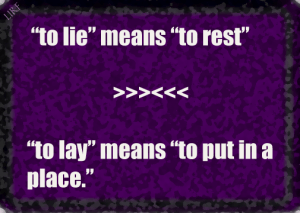
to lie means to restHomophones: Words that share the same pronunciation, regardless of how they are spelled and Homonyms: Words that sound alike, but have different meanings:

  • there, they’re, their
  • to, too, two

It’s also good to recognize homographs (words that share the same spelling) that have different pronunciations and meanings. These words include:

  • desert (to abandon) and desert (arid region)
  • tear (to rip) and tear (a drop of moisture formed in the eye)
  • row (to argue or an argument) and row (as in to row a boat or a row of seats—two words which are also a pair of homophones)
  • bark (the sound of a dog) and bark (the skin of a tree)

Capitonyms are words that share the same spelling but have different meanings when capitalized. They may or may not have different pronunciations. Such words include:

  • polish (make shiny) and Polish (from Poland)
  • march (walk or advance) and March (the third month of the year in the Gregorian calendar)

chicago manual of styleNegotiating the shoals of English grammar can be tricky, and it’s easy to get a fortune tied up in reference books. However, if you are on a tight budget, these two good references will help immensely with gaining some mastery of it:

I always recommend these two as they are the most comprehensive examples of their kind, and good, lightly used volumes are sometimes available second hand through Amazon.

Strunk and White’s Elements of Style is an excellent reference book if the Chicago Manual of Style is too daunting for you, as it’s not nearly as detailed and does hit the high points, and old copies are always available in second-hand bookstores.

Comments Off on #amwriting: homonyms and honorifics

Filed under writing

#amwriting: the rough draft

My Writing LifeI have begun a new novel set in Neveyah. It is the “how it all began” novel and takes place at the beginning of their recorded history. It’s been rolling around my head, and bits of this story are alluded to at various points all through the Tower of Bones series and also Mountains of the Moon.

The protagonist of this story is mentioned regularly in the Tower of Bones series as a character featured in children’s books. He’s portrayed as a kind of superhero, doing many impossible things.

But as always, there was a real man and real events at the core of the mythology.

I am taking the mythical man and giving him his place in history as the founder of the City of Aeoven, the College of Warcraft and Magic, and the first leader of the Temple of Aeos. I had the basic story drawn up back in 2009 when I began devising the world of Neveyah—three lines mentioning their childhood heroes.

The events that launch Aelfrid down the path of the mythic hero are all laid out. Now I must connect the dots and bring him to life.  If the story grows too large, it will be published as a two volume set, but my intention is to keep it to the same length as Valley of Sorrows.

As an indie, I must pay CreateSpace up front for my stock whenever I go to book fairs or signing events, so keeping my costs down is critical. CreateSpace costs are dependent on the length of the book, so if I have to pay $6.99 for each book, it limits  how much stock I can afford to keep on hand. I don’t want to run short of books, so I try to keep my costs to below  $5.00 per book. This also makes donating them to libraries and shelters affordable.

Even though Tower of Bones was published first, the rough draft of Mountains of the Moon was actually written first. In early 2009 I had been asked to write an epic fantasy story-line for a Final Fantasy-style anime-based RPG that was never built. For that reason, the world building was super-heavy.

Before I even had a story, I had to spend months

  • devising history and mythology
  • designing all the many environments where the story would take place
  • drawing maps
  • designing the creatures the characters do battle with
  • I also had to design the rules for magic, including its limitations

Having all these things so well-drawn and documented has been a bonus, as I can just write the story. The setting is clear in my head, laid out in a style sheet for that world, and the terrain is detailed on maps.

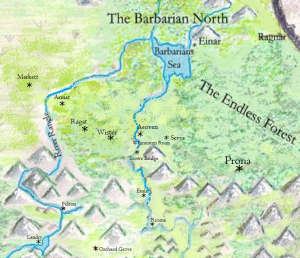
The north in the time of AelfridI have learned from the mistakes of others. Unlike the Saga of Recluce series, my maps for the early days detail the world as it was then, so there is no struggling to guess where the major towns are. (See my post, of  March 10, 2014, Spanking L.E. Modesitt Jr.)

I would definitely do two things differently, if I were to create that world today: the calendar, and the names of the days. I wouldn’t go with a 13-month lunar calendar, and I wouldn’t name the days after Norse gods.

But the calendar is canon now, and just as in real life, you must work with what you have. So, right now I am nearing the first plot point, where the first calamity occurs. Since this is the rough draft, everything to this point is really sketchy—a lot of “he said,” and “he went,” just to get the ideas down and everything in place.

These “telling and not showing” places are road marks, to guide me when I sit down to write the true first draft. My synopsis was about 3000 words. This rough draft will top out at about 55,000 words, and the first draft of the novel itself will be around 90,000 to 100,000 words.

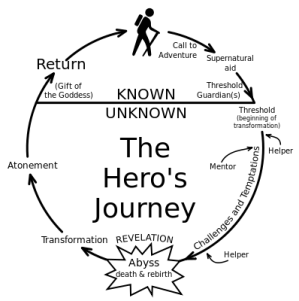
398px-Heroes journey by Christopher Vogler

Hero’s Journey, by Christopher Vogler, via Wikipedia

What I am doing at this point is setting the scene, introducing and developing the characters, and finding the reasons why they are who they are as people. I have a grip on my mentor’s character, and also the side characters.

I know my protagonist fairly well, although what initially motivates him is still a bit of a mystery. His personality and what he has to do are clear, but I haven’t yet discovered what lies within him that pushes him to achieve this thing. That is part of the journey for me.

For this book, I know exactly who my villain is, and how he came to be that person. He is new to me, but his motivation is clear and easy to imagine. I feel a real connection to him.

Altogether, if everything goes according to plan, writing this book will take about a year for me to get it to the final draft and into the editing process.

3 Comments

Filed under writing

#amwriting: When reality meets fantasy

800px-Flexham_coppice_bluebells

Bluebells in Sweet Chestnut coppice at Flexham Park, Bedham near Petworth, West Sussex, England. via Wikimedia Commons

Over the weekend, I discovered how to make charcoal, in a sustainable way, learning how it was done in medieval Europe. Of course, I learned about this by going to the internet, to one of my favorite go-to sites for research: Medieval Histories.

I’ve read before about how the massive production of charcoal in the Middle Ages was a major cause of deforestation—everyone needed it to heat their homes, and entire economies depended on it.

However, as time went on, people learned how to create sustainable sources of wood for both firewood and carpentry, by coppicing. Coppices were cut and regrown cyclically so that a steady supply of charcoal would be available.

Archaeological evidence for this style of forestry management goes back 5,000 years in England. Timber in the Sweet Track in Somerset (built in the winter of 3807 and 3806 BC) has been identified as coppiced lime trees (also known as linden or basswood).

According to the Fount of All Knowledge, Wikipedia: Coppicing is an English term for a traditional method of woodland management which takes advantage of the fact that many trees make new growth from the stump or roots if cut down. In a coppiced wood, young tree stems are repeatedly cut down to near ground level. In subsequent growth years, many new shoots will emerge, and, after some years the coppiced tree, or stool (what we think of as a stump), is ready to be harvested, and the cycle begins again.

So, in doing research for a tiny portion of my new, just begun work-in-progress, I learned something new.

Over the years, when I tell people what I write, some have laughed and said I’m lucky I write fantasy because I can make any old thing up and it will fly.

Nothing could be further from the truth. I spend hundreds of hours researching the most trivial details for every book I write. If I get it wrong, it’s because I failed to do the research. In the process, I’ve learned as much as many medieval scholars about how people dressed, what they ate, how they earned a living, how they preserved food and every intimate detail of their lives that is researchable.

I know all of this because I read scientific papers written by experts on the subject, all of which are available to us via the internet. My files are full of the fruits of other peoples efforts, with the sources documented and the authors credited so I know where to go to find out more if I need to. Lists of links to websites for further research is critical because when one book goes to press, a new book is already falling out of my fevered mind and onto the paper.

Readers are smart. If something is impossible, and you don’t somehow make it probable, you will lose your readers. The best way to make the impossible probable is to mix your fantasy with a good dose of real history. Be historically accurate as often as you can, so that when your blacksmith makes a weapon, readers who know about smithing will not be jarred out of the story by inaccuracy.

Most of the time, these things you spend untold hours researching will only get one line in your narrative, but if that line is inaccurate or impossible your readers will know you were too lazy to do it right.

This is my short list of go-to websites for in-depth, accurate information for when I am writing. They are fairly self-explanatory:

Medieval Histories  http://www.medievalhistories.com

Academia http://www.academia.edu/

NASA https://www.nasa.gov/

Physics http://www.physics.org/

Wikimedia Commons https://commons.wikimedia.org/

Grammarist  http://grammarist.com/

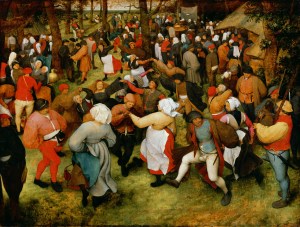
The Wedding Dance, c.1566 (oil on panel) by Bruegel, Pieter the Elder (c.1525-69)

The Wedding Dance, c.1566 (oil on panel) by Bruegel, Pieter the Elder (c.1525-69)

I’ve learned a great deal from reading the literature of medieval times. If you really want to know how people lived, read a modern translation of Chaucer’s Canterbury Tales. They were bawdy, irreverent, and loved nothing more than a good joke. If you want to know how they dressed, look no further than the “The Wedding Dance” a literal painting, steeped in allegory by Pieter Bruegel the Elder.

The internet is your friend, and researching your fantasy novel can be incredibly entertaining. For me, that is what slows me down more than anything. I spend far too many, but happy, hours on Wikimedia Commons, looking at 16th-century Netherlandish paintings.

15 Comments

Filed under writing

#amwriting: advancing the plot

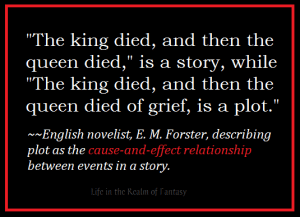
e.m. forster plot memeIn the previous post, I discussed the story arc, and how it relates to what E.M. Forster said about the plot: that plot is the cause-and-effect relationship between events in a story. The story arc is a visual description of where events should occur in a story. For me, knowing where they should happen is good, but it doesn’t tell me what those events are.

Planning what events your protagonist will face is called plotting, and I make an outline for that.

“Pantsing it,” or writing using stream-of consciousness, can produce some amazing work. That works well when we’re inspired, as ideas seem to flow from us. But for me, that sort of creativity is short-lived.

Participating in nanowrimo has really helped me grow in that ability, and one nanowrimo joke-solution often bandied about at write-ins is, “When your’re stuck, it’s time for someone to die.” But we all know that in reality, assassinating beloved characters whenever we run out of ideas is not a feasible option because soon we will run out of characters.

As devotees of Game of Thrones will agree, readers (or TV viewers) get to know characters, and bond with them. When cherished characters are too regularly killed off, the story loses good people, and we have to introduce new characters to fill the void. The reader may decide not to waste his time getting invested in a new character, feeling that you will only break their heart again.

The death of a character should be reserved to create a pivotal event that alters the lives of every member of the cast, and is best reserved for either the inciting incident at the first plot point or as the terrible event of the third quarter of the book. So instead of assassination, we should resort to creativity.

This is where the outline can provide some structure, and keep you moving forward.  I will know what should happen in the first quarter, the middle, and the third quarter of the story. Also, because I know how it should end, I can more easily write to those plot points by filling in the blanks between, and the story will have cohesion.

Think about what launches a great story:

The protagonist has a problem.

You have placed them in a setting, within a given moment, and shown the environment in which they live.

You have unveiled the inciting incident.

Now you need to decide what hinders the protagonist and prevents them from resolving the problem. While you are laying the groundwork for this keep in mind that we want to evoke three things:

  1. Empathy/identification with the protagonist
  2. Believability
  3. Tension

We want the protagonist to be a sympathetic character whom the reader can identify with; one who the reader can immerse themselves in, living the story through his/her adventures.

Also, we want the hindrances and barriers the protagonist faces to feel real to the reader. They must be believable so that the reader says, “Yeah, that could happen.” Within every scene, you must develop setups for the central events of that moment in their lives and show the payoffs (either negative or positive) to advance the story: action and reaction.

Each scene propels the characters further along, each act closing at a higher point on the story arc, which is where the next one launches from.

Some authors resort to “idle conversation writing” when they are temporarily out of ideas.  Resist the temptation—it’s fatal to an otherwise good story. Save all your random think-writing off-stage in a background file, if giving your characters a few haphazard, pointless exchanges helps jar an idea loose.

imagesDon’t introduce random things into a scene unless they are important. What if you had a walk-on character who was looking for her/his cat just before or just after the inciting incident? If the loss of the cat is to demonstrate the dangers in a particular area, make it clear that it is window dressing or remove it.

If the cat has no purpose it needs to be cut from the scene. To show the reader something  is to foreshadow it, and the reader will wonder why the cat and the person looking for it were so important that they had to be foreshadowed.

Every memorable element in a fictional story must be necessary and irreplaceable.  In  creative writing, this concept is referred to as “Chekhov’s Gun,” as it is a principal formally attributed to the great Russian playwright, Anton Chekhov.

Finally, we want to keep the goal just out of reach, to maintain the tension, and keep the reader reading to find out what will happen next. Readers are fickle, and always want what they can’t have. The chase is everything, so don’t give them the final reward until the end of the story.

But do have the story end with most threads and subplots wrapped up, along with the central story-line. Nothing aggravates readers more than going to all the trouble of reading a book to the end, only to be given no reward for their investment of time.

2 Comments

Filed under writer, writing

#amwriting: revisiting the story arc

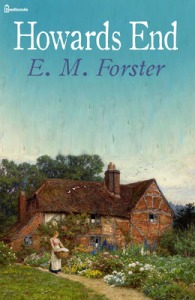
howards endE.M. Forster was one of the great English novelists. He was also a short story writer, essayist, and wrote librettos. Forster was considered a master of creating ironic, well-plotted novels that examined class difference and hypocrisy in early 20th-century British society. He really understood how to structure a novel or short story.

He has been quoted as saying that plot is the cause-and-effect relationship between events in a story. His example was, “‘The king died, and then the queen died,’ is a story, while ‘The king died, and then the queen died of grief,’ is a plot.”

That is the absolute truth. You can tell that story baldly, but without a plot, the above story is only a casual commentary on the death of two monarchs.

I am not good at winging it when it comes to plotting a novel. I find it helps me to spend a day or two thinking about the story as a whole, how it begins, how it ends, and why it went that way. While I am brainstorming, I write an outline to use as a framework to guide the story. I may not keep to the outline exactly, but the plot points occurring at each of the four quarters will be met, to maintain momentum and not inadvertently introduce inconsistencies.

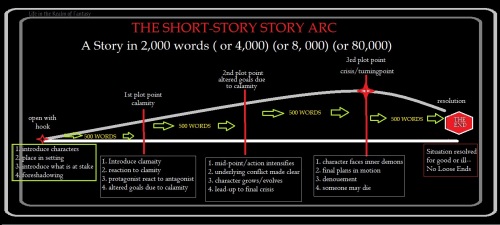
Inside every good story that seizes the reader’s imagination, there is an arc to the action within the plot, and when it is graphed out, it forms an arc: the story arc. My outline will provide me with the framework for this story arc.

51i0K3WVpML._SX312_BO1,204,203,200_The story begins with the opening act, where the characters are introduced, and the scene is set. It then kicks into gear with the occurrence of the “inciting incident,” which is the first plot point. It occurs around the ¼ mark and triggers the rest of the story. It is “the problem,” the core conflict of the story. This is where the protagonist is thrown into the action and is also where they first find themselves blocked from achieving the desired goal.

Even if you open the story by dropping the character into the middle of an event, you will need to have a pivotal event at the 1/4 mark that completely rocks his/her world. The event that changes everything is what really launches the story.

Following the inciting incident is the second act: more action occurs which leads to more trouble, rising to a severe crisis. At the midpoint, the protagonist and friends are in grave difficulty and are struggling. Within the overall story arc, there are scenes, each of which propels the plot forward, moving the protagonist and antagonist further along the story arc to the final showdown. Each scene is a small arc of action that illuminates the motives of the characters, allows the reader to learn things as the protagonist does, and offers clues regarding things the characters do not know that will affect the plot.

Those clues are foreshadowing. Through the first half of the book, foreshadowing is important, as it piques the reader’s interest, and makes them want to know how the book will end.

At the midpoint, another serious incident occurs, launching the third act and setting them back even further. Now they are aware that they may not achieve their objectives after all. Bad things have happened, and the protagonists have to get creative and work hard to acquire or accomplish their desired goals. They must overcome their own doubts and make themselves stronger.

Someone may die.

Midpoint is also where we get to know the antagonist and learn what the enemy knows that the protagonists do not. We discover his/her motives and what they may be capable of.

By the end of the third act, the protagonists are getting their acts together. They are finding ways to resolve the conflict and are ready to commence the final, fourth act, where they will embark on the final battle. They will face their enemy and either win or lose.

By the end of the book, all the threads have been drawn together and resolved for better or worse. The ending is finite and wraps the conflict up.

No matter how many or how few words you intend to write, your story arc should work the same way. I do this all the time with short stories, because if you know what has to happen at what point in a narrative, you can develop the characters and write each section to that point.

short story arc

In genre fantasy and science fiction, we often have story arcs that evolve and take place across multiple volumes. If you are writing the first novel in what you plan to be a series, it must have a finite ending, regardless of how many books you plan to follow. Even a famous author should obey this rule.

Out of respect for the time the reader has spent reading your work, do not leave them hanging. A second volume can have a less conclusive ending, but the first and the third books must end well or at least finitely. Readers will want to buy that second book simply because of the characters you have created and the great experience they had reading the book they just finished.

5 Comments

Filed under writing

#amwriting: keyboard tics and power punctuation

Exclamation points, Emdashes, Ellipses memeWhen a friend phones us, we’re usually able to identify them from the sound of their voice. We take this for granted, accepting the singularity of each speaker, seeing their idiosyncratic speech habits as part of what makes them who they are.

We writers communicate through our fingers, keying our thoughts. Our readers can recognize our work because we each have a unique voice and pattern to our writing, not unlike our individual manner of speaking.

And just as we do when we are speaking, we may have ‘keyboard tics’ when writing the first draft of a given work. These small keying habits occur as a pause in our thoughts, a simple twitch of a finger, liberally sprinkling the work with hyphens, semicolons, and exclamation points, to the extent the work makes our first reader breathless.

These punctuations have their place, but when they are used excessively, they must be weeded out, and this is part of making effective revisions.

One good way to do this is to print out each chapter, one at a time. Use a blank page, and work your way from the bottom up, covering all above except the paragraph you are looking at.

When you go back and isolate each paragraph, removing the context, you can make a better determination of how you really want to punctuate those ideas. Eight times out of ten, a simple period or comma will better serve the sentences and make the paragraph less confusing.

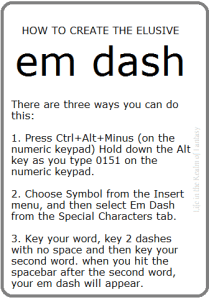
Using semicolons to make strong pauses in your sentences is WRONG, so remove them and use a comma or a period. Use an emdash or a hyphen to set a clause off for emphasis, and an ellipsis to show uncertainty.

But don’t go nuts.

No one enjoys reading a choppy narrative because  short sentences are distracting and hard to get into. The way we smooth the narrative is to join short sentences into longer, compound sentences, but frequently that creates run-on sentences. (I am the queen of those.)

You do not join independent clauses with commas as that creates a rift in the space/time continuum: the Dreaded Comma Splice:

Comma Splice: My car is a blue Chevy Malibu and I like it, the dog likes to ride shotgun.

Same thought, written correctly: My car is a blue Chevy Malibu, and I like it. The dog likes to ride shotgun.

So when do we use a semicolon? Semicolons join independent clauses, which are clauses that can stand alone, and your best bet is to avoid using them except under extreme duress.

The two clauses that are joined together with a semicolon should be

  1. complete sentences that relate to each other
  2. if they don’t relate to each other, make them separate sentences and reword them so they are not choppy.

Two separate ideas done wrong: We should go to the Dairy Queen; it’s nearly half past five.

The first sentence is one whole idea—they want to go somewhere. The second sentence is a completely different idea—it’s telling you the time.

Two separate ideas done right, assuming the mention of time is important: We should go to the Dairy Queen soon. They close at eight, and it’s nearly half past five.

If time is the issue in both clauses, and you feel like you absolute MUST use a semicolon or you will explode, say, “The Dairy Queen is about to close; it’s nearly half past five.”

I generally try to find alternatives to semicolons, but I don’t dislike them, as some editors do. I think they are too easily abused and misused.

But what about exclamation points! I get so excited when I see a plethora of pointy exclamations! It makes me breathless! Too many, and your reader will be thrown out of the narrative and put the book down, never to pick it up again.

We shouldn’t resort to creating excitement with the overuse of exclamation points. I am just as guilty as anyone when it comes to peppering the first draft with exclamations, em dashes, and ellipses, because a little power is a dangerous thing, and certain punctuation has power:

em dash memeExclamation points!

Em dashes—

Ellipses…

Never underestimate the power of the “e-punctuation,” and never forget how easy it is to get carried away with them.

Exclamation points, em dashes, and ellipses should be used at important points. For the most part, the way you have set the scene combined with the dialogue itself will convey the tension without your having to sprinkle the narrative with ‘e’ punctuation.

Generally, dialogue worded powerfully, along with the way you show the attitude of the characters and their situation will serve to convey the emotions. Done right, you will only need one or two morsels of power punctuation. The common, garden-variety period or comma will usually serve the situation well, and won’t throw the reader out of the book.

Power punctuation can inadvertently become keyboard tics when we are laying down the first draft. They are road marks to show us how we felt when we first expressed that thought and want to just get it down on paper before we forgot it. The second draft requires us to step back and craft the narrative so that we are not relying on these signs to tell the story.

We want to show the story with mood, atmosphere, and setting the scene. The words we choose for each character’s conversation conveys their emotions, as does the way you have portrayed them. Thus, power punctuation should be used, but sparingly and for emphasis.

7 Comments

Filed under writer, writing

#amwriting: MS Office 365 Crash and Document Loss Workaround

windows-10-blue screen of deathThose of us who use Microsoft Office are familiar with both its versatility and its problems. In many ways, it is a great package of programs, but it has several major flaws.

The very annoying issue I never had with Office 2010, but now have with Office 365 (2016) is the program crashing right as I go to “save” a new document or spreadsheet. The program shuts down and the file vanishes, never to be found again, when the program reopens itself a minute later.

I will have the file library open, and the correct Master file open, and have correctly named the sub-file and then…just as I am about to click “save”…

Word (or Excel) shuts itself down. Any work that was done on that particular document or spreadsheet is GONE.

And no, kind sir, that document is not recoverable in my unsaved files as “Document 1.docx” nor is it listed anywhere as some gobbledygook file name with a .tmp extension. Even when you search the hard drive files by date, which should bring up anything you have done that day, the file is gone.

I’m actually quite Microsoft-savvy. When this first happened to me, I did the research and tried all the measures and remedies posted on the internet for recovering these lost files. Those remedies don’t work because the techs assume the machine’s default autosave function is working. The glitch is actually in that particular function, so it does not, and the file is not even stored in a temp file.

The program crashed, dumped the file into the ether and then said, “Oops! My bad.”

The tech support out there on the Microsoft boards seem as mystified as anyone else, and gives the same stock, canned answers. I feel bad for them–they want to help, but don’t know how.

Microsoft Office 365 Logo 1280px PNGI have an idea as to why these documents that were lost at the moment you tried to save them are unrecoverable.

The document is lost because the Windows autosave function does not always work properly, and it is the autosave glitch that causes the program to hang and then crash. Something about the  process of relabeling from the generic “Document 1” title that Word names all new documents, to whatever you need it to be,  seems to short circuit the program, causing it to shut down. 

And, the moment the unsaved document vanishes, it is as if it never existed. It was never autosaved to begin with, so there is no autosaved version to retrieve. I am sorry my friend, but that document is gone.

I have a simple workaround. It is old-school and dates back to the early days of Windows when everyone knew Word and Excel could crash at any moment. But unless you could afford Corel WordPerfect, which was horrifically expensive in those days, most businesses were stuck with Microsoft. We knew and used several workarounds which we have not had to do for many years. However, it’s time to pull them out and dust them off:

  • For every new document you create, I recommend that while the page or spreadsheet is still blank, before you do any work whatsoever on that document, you give the file a working name and save it to whatever folder you normally work out of. Do that immediately.

I work out of Dropbox, so my files look like this:

  1. Main Folder: Dropbox
  • Subfolder > cjjasperson
  • Subfolder> LIRFblogposts
    • >post_May_15_2016_microsoft_rant

However, it is when we get to the  subfolder folder and attempt to give our work a file name that Word/Excel crashes.

This is the problem scenario: I went to save the blank page on which I intended to write a post for this blog this morning and Word crashed. But, unlike several times previously, I had lost nothing as I hadn’t done any work at that point. The level of frustration is much lower when you’ve lost no work.

As long as I name my file first, before I do any work in the body of the document, I will never lose the beginnings of an entire project even if the program crashes, as it does periodically.

And once the file is renamed, autosave seems to work more efficiently.

This issue is not just with users of Dropbox.

I mentioned above that I have researched this extensively. The internet is rife with complaints that Office 365 crashes just as frequently when people are trying to save to the Documents file on their computer’s hard drive, and also occurs when saving to Microsoft’s own One Drive, and also Google Drive, and any other way people can save their files.

This means it is an issue inherent in the program itself, and not a compatibility issue. This is a problem with the software, and it needs to be addressed.

So, if you are using Office 365, name that file the minute you open a new document or spreadsheet. Once you have successfully saved your blank document/spreadsheet the first time, you will never completely lose it if Word or Excel crashes again while you are trying to save or are just working as sometimes happen.

However, if autosave hangs and fails, you will lose work you didn’t manually save prior to the crash.

But there is an old-school workaround to help with that too:

  • On the ribbon, open the File tab again and this time, scroll down to Options:
  • Click to open the Options menu and a large menu will open
  • In the left-hand menu underneath Word Options, scroll down and click on Save
  • This will open the menu to where you will reset your autosave options.
  • The default option for autosave is 10 minutes, and yours will likely say that.
  • I reset mine to 2 minutes.
  • When you are satisfied with your choices, click ‘OK.’

ms_word_rant_5-14-2015_LIRF

You can always change the working name of your document later, but once it has an official name and a place in your file directory, a temporary file will be saved should it crash again and all you will lose is what you did in the two minutes prior to the crash, assuming autosave worked at all.

Save manually and save regularly, because you never know when autosave will fail. Here we are, back to the mid 1990s, when the dreaded Blue Screen of Death owned you.

Some people use Open Office, or Google Documents quite successfully. They are free to the user and are ideal for some people. Google Docs even saves as you go, which is a really nice function. But while those two products are basically useful for simple projects, they are quite limited and don’t have the range of tools I need for my word-processing and spreadsheet programs.

I owned a Mac in the mid 1990s, and it was okay, and I’ve held jobs where my machine was a Mac, but I never really been a Mac devotee. I’m a PC person through and through. I need a program with all the features of Microsoft Office 365. All I ask is that it work reliably, the way Office 2010 did.

I confess, I’ve been checking into dumping this hinky, already-paid-for program and switching to Corel WordPerfect Office. I have used earlier versions in various work environments and absolutely loved the the program and what it offered. However, the reason I haven’t gone with it in my home office was cost–it was an extremely expensive program.

corel wordperfect office 8

Switching to Corel products is a real option for me now, as in recent years they have become competitively priced. Documents can be saved in .doc and .docx format which most publishers want, so the program will work just fine for my needs. It may be time to reconsider my loyalties.

Making the switch at the end of my subscription would require retraining myself, as there is a learning curve when you get a new program. Also, Office 365 is useful across all three of my electronic devices, which is the main reason I went with it.

But I can work out of Google docs when I am on the road, if I must.

This fall when my subscription is nearing the end, I will be weighing what my time spent learning how to use a new program is worth against how high my level of frustration with Microsoft’s lack of accountability is.

I will be watching the tech boards as always. The way Microsoft addresses this problem will determine if it is worth the time and effort for me to make that switch.

10 Comments

Filed under Technology and Software, writer, writing

#FlashFictionFriday: Scrofulous Mudd

The following bit of fluff and nonsense was prompted by the first line. Once I had that, the rest of the story sort of followed.


Scrofulous Mudd was a dirty old man.

By that I mean he was an elderly man who sorted through the leavings in ancient privies and wrote highly boring papers detailing the history of what he uncovered. He kept himself moderately clean, and took baths every Saturday unless an additional effort was required, such as for his mother’s funeral.

I suppose his fascination with filth began with his elegantly disease-ridden name. His was a difficult delivery, and when the elderly volunteer came around asking about the new baby’s name, Maude Mudd was still a little out of it. A scholar of Roman Literature, what she had actually said was “Rogellus.”

The volunteer, a retired nurse of infectious diseases, had misunderstood her mumbled words. Thus, Scrofulous, or Scroffy, as he was known at school, was given a name difficult to live up to.

Young Scroffy never knew his father, nor was any father named on his birth certificate. He assumed his had been a virgin birth, as his mother had never said otherwise and to his knowledge she never had gentlemen callers.

In truth, Maude’s single night of passion with the Professor of Antiquities had occurred after both had consumed far too much sherry at a faculty mixer at the at the beginning of fall semester. Hung-over, embarrassed, and terribly disappointed by sex in general, she immediately accepted the offer of a research position at a University far, far away, in Scotland to be exact.

It wasn’t until several months later that she realized she had a little Mudd in the oven. Things were different in those days, and rather than lose her position at the University for being morally unfit, she padded her chest, making herself appear to be merely stout. She hired a live-in housekeeper and continued with her work until the day of his delivery, which occurred just at the beginning of summer break. When the next term began, a much slimmer Professor Maude Mudd returned to school as if nothing had happened.
via wikimedia commons

Nanny MacDuff cared for young Scroffy as much as she was able, which was not a lot, as she had a pinched heart, but she did do her best by him. Many times Scroffy and his pram were left parked outside the post office, forgotten until Nanny arrived home and suddenly wondered where the washing powder she had tucked in his carriage was.

However, she saw to it he was as clean and well-fed as any other child. Both the infant Scroffy and Maude Mudd’s house were vigorously scrubbed daily, and both shone like polished chrome.

Never having been a maternal woman, Maude felt she had fulfilled her parental obligation, by hiring a nanny. While she did occasionally ask after his health in a general sort of way and whether he was doing well in school, she rarely had any reason to communicate with him.

As a small child, the books in his mother’s library fascinated him, but that room was strictly off limits. Nanny explained that little boys had dirty fingers, and so he should never touch the ancient, irreplaceable tomes. However, he often stood just outside the door, peering in, wondering what mysteries lay concealed within those pages.

Scroffy spent his childhood at boarding school. He did well in primary school and was a good student during his secondary years. It was there he discovered history could be uncovered by digging through the garbage left behind by our ancestors, and it was a science called Archaeology.

Perhaps it was his lifetime of rigorously enforced cleanliness at the hands of Nanny and the various Matrons, or perhaps it was the only rebellion he could think of, but dirt, and what it concealed, attracted him.

He was rarely invited home for holidays, and thus, Maude had nearly forgotten about her son when she was surprised to receive a letter from him thanking her for his education. He also explained he would be taking his newly earned Doctorate in Archaeology to London, and hoped she would understand.

In London, he indulged his passion for filth, digging up medieval midden heaps and privies, sifting the soil, and exclaiming over dubious treasures. Unlike his fellow scientists, he didn’t mind the filthy conditions, and relished a good, big find, feeling as if the night-soil of generations past somehow filled in the blank, far-too-clean slate of his childhood. He also began acquiring his own library of rare books, and manuscripts of historical significance, all of them shining a little light on the dark, dirty realities of medieval life.

It was said by his peers that Scrofulous Mudd knew more about the dark ages than the people who’d actually lived through those times. Had he been told that to his face, he would have agreed.

Forty years passed, during which time Maude Mudd rarely gave any thought to her absent son, although he thought of her at times. At first, he’d hoped for a letter or card, or an invitation to Christmas dinner but eventually gave up believing there was any connection there.

He had a brief, cordial conversation with his mother at Nanny’s funeral. Maude was heartbroken at Nanny’s loss, and terribly concerned she would never find a cleaner with as much respect for the many irreplaceable manuscripts in her library as Nanny had embodied. Scroffy had agreed it would be difficult. On the train back to London, he comforted himself with the thought his old nanny was in floor-polishing heaven.

He was a congenial, if obsessed, guest at faculty dinner parties, and was always willing to talk about his work. The more fastidious guests suspected he was invited as much for shock value as anything else. Conversations would stutter into pained silence when he began describing how the layers of earth and ancient human waste concealed the shards of history, things tossed into the privy or accidentally lost.

The arrival of the main course would inspire the observation that usually he found evidence of what people in various strata of society dined on, in their petrified dung. Then he would casually mention he didn’t watch the telly, as he spent his evenings with his microscope, puzzling over samples.

Time passed, the world changed, and having been born and raised in a life of academia, Scroffy evolved with it. He rose to a high post at his university. He had a team of several young women and men who were as intrigued by the waste and garbage of the past as he was. The BBC made several documentaries on what his work digging up medieval privies had unearthed, and how our ancestors had really lived.

When Scrofulous was sixty-five, he received a letter from Maude’s solicitor informing him of his mother’s passing. He had inherited the house and her library, which, as a child, he was never allowed to touch.

After the funeral, he walked through Maude’s house, looking into rooms that seemed so large when he was a child.

Walking through each room, he saw his mother had found another cleaning person as deeply offended by dust and dirt as Nanny MacDuff. Every room smelled of furniture polish and gleamed in the light shed by windows so clean he had to look twice to see they were there.

The ancient tomes that were his mother’s closest companions seemed as much a mystery to him as she had been.
Old Restored booksA book lay on Maude’s desk, with an envelope sticking out of the top as if marking a place. A pair of clean, white, cotton gloves lay beside it. He opened the book, seeing it was a first edition of a famous treatise on an archaeological dig in Mesopotamia. It was a book which he also had in his collection, albeit his was a later edition. Then he saw the envelope was addressed to him, from his mother.

“I never really knew you, as my work precluded everything else. Nevertheless, I have always been pleased you were successful in your career. But whatever you do, wear gloves when you handle the pages of these books.”

Scroffy reflected that even in death Maude cared more for her books than her son. Yet, the scientist in him realized she must have left something behind for him to dig up about his own history, and he intended to discover it.

He looked down at the book in which he had found the note. The author had been one of his professors, a solitary man obsessed with antiquities, and who only came to life when discussing some of his more obscure finds. He’d learned a great deal from him, finding a kindred spirit when it came to unearthing the past.

He wondered why Maude had chosen that book, when she had been a scholar of Roman literature, and inherently unable to discuss anything else. He sat down suddenly, his knees giving way under the realization she had chosen the only way she knew to tell him something important, something she had withheld from him for all those years.

Nanny’s words came back to him, about little boys having dirty fingers. He was aware of how little had changed, that he was in actuality a dirty old man, due in part to his advanced age, but mostly to his profession. Accordingly, he drew on the white gloves and opened his mother’s desk. He pored through his mother’s papers, physician’s instructions, tax returns, payroll receipts–being who she was, Maude had been unable to dispose of any. She had kept everything, but had filed them as neatly as she had kept her library. He searched and sorted until he came to the year prior to his birth.

The light had begun to fade when he refiled his mothers papers as neatly she had originally, and shut the drawer. For a long while, he sat in his late mother’s study, staring into the gloom, thinking.

Having met both his mother and his father, and found them to be exceptionally solitary people, he concluded that his existence could only be explained as a miracle. And while, as a boy, he’d often wished for a less arduous name to explain to new acquaintances, he was terribly glad his mother hadn’t named him after his father.

If ‘Scrofulous Mudd’ had been the cause of the occasional fist fight at school, he suspected Hamza Pigg Jr. wouldn’t have been any easier.


Scrofulous Mudd © Connie J. Jasperson 2016, All Rights Reserved

17 Comments

Filed under #FlashFictionFriday, writing

#amwriting: Thoughts on Italics

strange thoughts 2One of the virtues of being a part of a group of writers is that you can bounce questions and ideas off them. And, one thing the authors I hang out with all agree on is that italics are the devil.

We don’t like them because they are hard on the eyes, daunting, and difficult to read in large chunks when the main character is waxing internally poetic. Also, many readers subconsciously skip them, and so they have missed important information you may have imparted there. Having not read it, they may think your book is confusing and disjointed.

Yet the standard practice in genre fantasy is to set internal dialogue off in italics. For this reason, I no longer give my characters a lot of time to think, as such. In my more recent work, only rarely do my characters think in italics. I believe thoughts occur as an organic part of the narrative as a whole, and should be identified as if with a speech tag:

  • I wondered, why the red hat? Surely it meant something, as she was the second person I’d seen with a red hat. But perhaps I saw what I wanted, a conspiracy where none existed.
  • The flash of a purple stocking covering a shapely ankle, quickly hidden by her skirts, caught his attention. Was she a whore? He wondered. Some women working the streets wore red to advertise their profession, but she didn’t have the look of disillusionment the others wore beneath their masks of false desire. Why did she wear purple stockings?
  • His sword belt hung on the chair just as he’d left it the night before. But while the scabbard had been left behind, Caliburn was gone. His heart sank, and he cast his mind back, picturing his room before he’d gone down to breakfast. Nothing had seemed out of place, but had he seen the grip sticking out of sheath? He couldn’t recall.

Most thoughts don’t have to be italicized. My recommendation is to only voice the most important thoughts via an internal monologue, and in this way, you will retain the readers’ interest. The rest can be presented in images that build the world around the characters.

The exception to this is if the person who is thinking is also speaking with other people, and his thought could be mistaken as dialogue spoken aloud.

Many other, equally insidious reasons exist as to why authors may choose to use italics, most of which I think should be formatted in a better, easier to read style that still sets them off:

  • Mental telepathy, which is technically spoken dialogue
  • Letters, which are the written thoughts of people from far away
  • Emails, which are electronic letters
  • Text messages

Let’s consider correspondence between characters: some work is written in an epistolatory style. The entire narrative is told in the form of letters exchanged between the characters, as in the case of the brilliant steampunk Dawn of Steam series by Jeffrey Cook with Sarah Symonds. In that case, with each exchange of letters, the speaking character/author is made clear.

However, correspondences inserted into the body of a narrative should be formatted to set them apart, but not to throw the reader out of the story. For that passage, add an extra space both before and after, and inset both left and right margins by one-half inch (.5).

He looked at the missive from Father Rall, wondering how his day could get any worse.

Cayne,

I understand you are too unwell to duel lately. Your students’ health is at risk if you have a contagious disease. You must go to the infirmary today. If your illness is treatable, you should be back to dueling soon. If you are suffering from the prolonged use of magic, many treatments are now available that will help you live a long and productive life. Either way, Darlen is expecting to see you today.

Rall

Cursing, he wadded the note and threw it toward the wastebasket. 

To inset the margin in Microsoft Word: Highlight the section you want to inset. On the ribbon, go to the home tab. On the paragraph menu, click the little grey square on the lower right-hand corner to open the menu. Then on the indentation menu set both right and left to 1”. Click okay

inset_margin_how_to_printscreen_LIRF_cjj

Emails should also be represented this way, set in 1/2″ (.5), as they are the most common form of modern correspondence, but you want to show they are emails:

To: Ima.Fool@maildelivery.com

From:M.Jones@buenavuecorps.com

We regret to inform you that your manuscript “Under the Grandstand” is not what we are looking for at this time. 

Good luck in your future endeavors,

Maurice Jones

Editor, Buenavue Magazine

And what about text messages? They can be inset too.

Helen:

Hi. R U on ur way?

                 —-

Joe:

What? I only speak English. I’m on my way.

So that leaves us with mental telepathy. Mental telepathy is a commonly used trope in genre fantasy, and I have one series where it figures prominently. In writing groups you will hear of a variety of ways to deal with that.

Some authors will use italics.

  • I am always with you. Zan’s smile and supportive thought warmed her

Some authors use parentheses:

  • (I am always with you.) Zan’s smile and supportive thought warmed her.

Some authors will preface mental communication with a colon:

  • : I am always with you.: Zan’s smile and supportive thought warmed her.

When a story is mental-telepathy heavy, I personally will do anything to avoid throwing the reader out of the story.

  • Through their link, Zan said, “I am always with you.” His smile and supportive thought warmed her.

How you choose to portray thoughts and mental telepathy is purely your choice, and reflects what you see as your style. I was not always a purist—this lack of enthusiasm for italics has evolved along with other aspects of writing. But as an editor, when I am faced with large blocks of italics, I find them difficult to read. And frankly, some authors use internal monologues as a way to dump large amounts of background info.

When you have a thought-heavy narrative, I would suggest you find an alternative way to phrase your characters’ ruminations, making them an active part of the story. Avoiding italics will force you to write a stronger narrative, and your readers will thank you.

6 Comments

Filed under writing