Category Archives: writing

#amwriting: wrangling that, which, and semicolons

em dash memeSemicolons are misused morsels of punctuation. Some authors believe they are extra-long pauses: half-way between a comma and a (full stop)period. These bits of typographical madness litter their work.

Semicolons  are NOT extra-firm pauses. Em dashes or (if you are British) hyphens serve that function. Semicolons have a different place in the universe. For this post, we are going to look at semicolons as joiners.

The proper use of a semicolon is to join two short sentences that are directly related to each other, turning them into a compound sentence.

No one enjoys reading a choppy narrative. Too many short sentences can be distracting and hard to get into. The way we smooth the narrative is to join short sentences into longer, compound sentences. But frequently, that creates run-on sentences. (I am the queen of those.)

  1. Short and choppy: I’d love some ice-cream. We should go to the Dairy Queen.
  2. Compound sentence: I’d love some ice-cream; we should go to the Dairy Queen.

Comma Splice MemeYou do not join independent clauses with commas as that creates a rift in the space/time continuum: the Dreaded Comma Splice.

  1. WRONG: It’s nearly half past five, we can’t reach town before dark.
  2. BETTER: It’s nearly half past five; we can’t reach town before dark.

The two clauses that are joined together with a semicolon should relate to each other. The above sentences work because the lateness of the day means they might have to travel after dark.

  1. WRONG: We should go to the Dairy Queen; it’s nearly half past five.
  2. BETTER: We should go to the Dairy Queen. It’s nearly half past five.

If time is actually the issue in the above sentence, and you absolutely MUST use a semicolon or you will explode, say, “The Dairy Queen is about to close; it’s nearly half past five.”

I generally try to find alternatives to semicolons, but I don’t dislike them, as some editors do. I think they are too easily abused and misused, so I encourage myself and my authors to think outside the semicolon.

Another sticky area for the some authors are the words ‘that’ and ‘which.’ They are often difficult for new authors to get the hang of. They are not interchangeable, and overuse of the word ‘that’ cannot be cured by using ‘which’ instead.

‘That’ is a pronoun:

  1. Used to identify a specific person or thing observed by the speaker.

“That’s his dog on the curb.”

  1. Referring to a specific thing previously mentioned, known, or understood.

“That’s a good idea.”

‘That’ is also a determiner:

  1. Used to identify a specific person or thing observed or heard by the speaker.

“Look at that house fire.”

  1. Referring to a specific thing previously mentioned, known, or understood.

“He lived in Tacoma at that time.”

‘That’ is also an adverb

  1. Indicating to such a degree; so.

“I wouldn’t go that far.”

And ‘that’ is a conjunction:

  1. Introducing a subordinate clause expressing a statement or hypothesis.

“She claimed that she was married.”

‘That’ can also be a literary conjunction expressing a wish or regret:

“Oh, that I had known this before.”

<><>

‘Which’ is a pronoun:

  1. asking for information specifying one or more people or things from a definite set.

“Which are the best diapers for newborns?”

Which’ is a determiner:

  1. used referring to something previously mentioned when introducing a clause giving further information.

“A house on Black Lake, which is for sale.”

Some people will rather forcefully say you must never use the word ‘that,’ but those people are clearly unaware of the larger grammatical picture—do not listen to them.

Sigh.

So, when do we use the word ‘that’ in an appropriate and defensible fashion?  After all, too many ‘that’s’ make the prose boring and forgettable.

So does Grammar Girl, (Mignon Fogarty) on her awesome website for writers with questions. This website is an invaluable resource for folks like me, with some education, but no memory of what we were actually taught.

that which does not kill meThere are instances where only ‘that’ will suffice. When do we use the word that?

We use it when we have something called a ‘Restrictive Clause’:

Quote from Grammar Girl, “A restrictive clause is just part of a sentence that you can’t get rid of because it specifically restricts some other part of the sentence.”  She goes on to give a specific example of a restrictive clause: “Gems that sparkle often elicit forgiveness.”  See?  Not just any gems elicit forgiveness in this sentence. Only gems that sparkle bring about clemency. In this sentences, forgiveness is restricted to one kind of gem.

So, now we know about restrictive clauses, but what about nonrestrictive clauses? Again we turn to the Grammar Girl and she says, “A nonrestrictive clause is something that can be left off without changing the meaning of the sentence. You can think of a nonrestrictive clause as simply additional information.”

Again the Grammar Girl gives the example, “Diamonds, which are expensive, often elicit forgiveness.”  The word ‘which’ isn’t really necessary, as the meaning of the sentence would not be changed if you left it out. “Diamonds are expensive, but often elicit forgiveness.”

stop don't click replace allOften the sentence is better without the words ‘that’ or ‘which,’ but each instance must be examined individually, to ensure you are making the best choice.

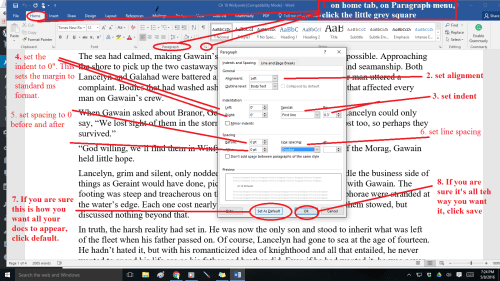
This is yet another time when making a global search for these words is a good idea. (And never choose ‘replace all’.) On an individual basis, decide which word is the correct word, ‘that’ or ‘which’ and then decide whether to delete it or keep it. If the sentence makes good sense without it, lose it.

4 Comments

Filed under Self Publishing, writing

#amwriting: Couriers, Pigeons, and Excalibur

Medieval_forest wikimedia commons PD 100 yrs

Russian Forest in medieval France (1405-1410) Gaston Phoebus

I have a great deal of interest in Medieval history because I have ancestors who lived then. I’m not bragging–everyone who is alive today is here because one or two ancestors survived the Dark Ages long enough to leave behind a child who did the same.

Life was perilous, even if you grew up in a fairly sheltered environment. No one was exempt from disease–even kings regularly died young from plagues and injuries. Regardless of their personal safety, medieval kings were forced to go to war in person. They did this for several reasons.

  1. The only way for the monarch to know what was actually happening on the battlefront was to be there
  2. It was expected that a monarch should understand the art of warfare and be proficient as a warrior. He was responsible for winning or losing the battle.

Portrait of Henry VIII (1491-1547) by Hans HolbeinDuring the Dark Ages, official news was delivered by a royal messenger and read aloud in church or in the market.

Messengers were a permanent fixture on the royal payroll. They were dedicated and well-paid to travel the kingdom continuously, carrying the king’s word. In medieval England, kings did not stay in London. Instead, they traveled all over their lands and the noble families were required to feed and house them at great expense. Their gypsy-like existence kept the messengers busy.

Wars were expensive. Henry VIII’s habit of medieval couch-surfing at the country homes of his noble courtiers was a great way for an impoverished king and his entourage to live well and cheaply, conserving the cash to pay for the troops. But it also meant that an organized and efficient messenger service was required to ensure that correspondence to and from the king: royal letters, grants, patents, and such, arrived at their intended destinations.

Tancred, Count of Lecce, King of Sicily via Wikimedia

Tancred, Count of Lecce, King of Sicily via Wikimedia

In the year 1190, when my direct maternal ancestor, Tancred, King of Sicily, faced Richard I of England, he was limited to what information a messenger could convey. Thus, their battles were fought in person and so were their negotiations.

These were not native Italians–the original Tancred of Hauteville (980 – 1041) was an 11th-century Norman and a minor baron of Normandy about whom little is known, other than eight of his twelve sons joined the crusades and became kings of southern Italy in the process.

So his illegitimate great-grandson, King Tancred, and King Richard the Lionhearted were Norman kings, squabbling over what was left of the Holy Land and the Mediterranean at the end of the crusades. However, Tancred was born and raised there so he was a third generation Sicilian, being the out-of-wedlock son of Roger III, the Norman duke of Apulia and Emma of Lecce, who was married to Ruggero III de Hauteville.

Quote from Wikipedia: “In 1190 Richard I of England arrived in Sicily at the head of a large crusading army on its way to the Holy Land. Richard immediately demanded the release of his sister, William II’s wife Joan, imprisoned by Tancred in 1189, along with every penny of her dowry and dower. He also insisted that Tancred fulfill the financial commitments made by William II to the crusade. When Tancred balked at these demands, Richard seized a monastery and the castle of La Bagnara.” (end quoted text)

Richard I Google Art Project via Wikimedia

Richard I Google Art Project via Wikimedia

Richard was joined in Sicily by the French crusading army, led by his soon-to-be-former friend,  King Philip II of France. The presence of two foreign armies highly aggravated the local citizens who, rightfully, demanded the foreigners leave their island.

Ever the good guest, King Richard responded by attacking Messina, which he captured on 4 October 1190. Once the city had been looted and burned, Richard established his base there and decided to stay the winter—after all, winters in Sicily are a bit more pleasant than those in Normandy.

But what’s a little looting and pillaging among friends? According to Wikipedia:

“Richard remained at Messina until March 1191, when Tancred finally agreed to a treaty. According to the treaty’s main terms:

  • Joan was to be released, receiving her dower along with the dowry.
  • Richard and Philip recognized Tancred as King of Sicily and vowed to keep the peace between all three of their kingdoms.
  • Richard officially proclaimed his nephew Arthur of Brittany as his heir presumptive, and Tancred promised to marry one of his daughters to Arthur when he came of age (Arthur was four years old at the time).
Excalibur London_Film_Museum_ via Wikipedia

Excalibur London Film Museum via Wikipedia

After signing the treaty, Richard and Philip finally left Sicily for the Holy Land. It is rumored that before he left, Richard gave Tancred a sword he claimed was Excalibur in order to secure their friendship.”

Yes, you read this correctly. King Richard the Lionhearted gave my many-times great grandfather Excalibur, the legendary sword of mythical King Arthur.

I doubt Richard the Lionhearted would really give away a sword that was supposed to prove his lineage back to the Pendragon if he actually believed it was truly Arthur’s. However, it is a documented fact that he did indeed give this sword of historical significance to Tancred.

I suspect that Tancred believed it was the true sword of King Arthur as much as I do, but in the interest of peace, he most likely smiled and thanked his departing guest. Whatever he did with it, it was never seen again. When he came to reclaim his island after Tancred’s death, Henry IV, king of the Holy Roman Empire, pillaged Tancred’s treasury and the sword was not there.

But what, you ask, does my illegitimate many-times-great grandfather’s possession of the possibly faux Excalibur have to do with communication?

Tancred and Richard both had to be there in Sicily in person and had to communicate through messengers to arrange all this swapping of women and dowries and swords of dubious origin.

Good long-distance communication has always been seen as critical to good governing. Wars were won and lost based on the information those kings and generals received. During the Middle Ages, postal systems were invented, became corrupt, and fell into disuse all over Europe. This recurred at different times up through the eighteenth century.

In 1505, Emperor Maximilian I established one of the more stable postal systems, but it was not a thing the peasant class could avail themselves of. An illiterate peasant could hire a scribe, but then they would also have to scrape up more coins to get the note sent to its destination. It was better to pay a neighbor to carry the news to wherever it had to go.

420px-Pigeon_Messengers_(Harper's_Engraving)There was a faster method of getting a letter home. Long before the Middle Ages and during them, homing pigeons were used to carry messages. Rock pigeons have the ability that taken far from their nest, they’re able to find their way home. This due to a particularly developed sense of orientation. Messages were then tied around the legs of the pigeon, which was freed and could reach its original nest.

This is of limited usefulness because pigeons will only go back to the one place that they have identified as their home. Pigeon mail can only work when the sender has a specific recipient in mind and has possession of that receiver’s pigeons.

So how did they  do this? The sender had to hand-carry the pigeons with them. Once released, the pigeons would fly back home with the note. Correspondents could not send a pigeon anywhere but the one place the birds considered their home.

If you are an author writing in an era other than the modern times, be diligent and do the research before you write about things that are outside your personal experience. Readers may have knowledge that you don’t and they will definitely not be shy about letting you know where you’ve gone wrong.

Much of my work is set in medieval environments, and so I can’t have my characters getting instantaneous information from afar without divine intervention. If my characters need to communicate over long distances, I have to consider the length of time it would take even a fast messenger to travel over roads we would consider impassable, but which were the medieval equivalent of I-5.

This kind of information is available via the internet.  Researching my subject online is how I discovered that regular mail delivery is a relatively modern invention. Perusing Ancestry.com is how I discovered the medieval Norman/Sicilian roots of my mother’s family, the (Fitz)Rogers family.

4 Comments

Filed under Battles, History, Humor, Literature, writing

#amwriting and #amrevising: weeding the garden of words

Free-range pansies by cjjaspersonWhen I write a novel, I always end up with a lot of back story. These are details that are important for me to know, but not meant for the actual novel. It’s more a way for me to mentally talk my way through the first draft.

I think of my manuscript as a garden of words, and by the time the novel is complete, it will have been weeded, dug up, and replanted many times.

Every author has their own style, their own way of getting the story down on paper. My style is not the usual way, but it works for me.

The way I do a first draft is this: First, I put together an outline listing all the characters and plot points.  Second, I write the ending and then write the scenes for the large events and turning points. Once those are in place, I start at the beginning and write the story in a linear form, connecting the large events and finally meeting up with the end.

Along the way, my story evolves. A lot of fluff gets added in because I need to sort the story out in my head and writing it down is the way I do that. This fluff is all written in a passive, telling voice, and is part of my road map for creating the first draft–it was put down in that fashion so I would remember it later when I came back to rewrite the scene and turn it into an action sequence or cut it entirely.

I’ll give you an example of a telling sequence from Julian Lackland’s story, which is set in Waldeyn, Huw the Bard’s world. It was written down in this way so I would have a mental picture:

“In Port Lanque, the harbor itself was accessible only by one broad cobbled street, Quay Street, snaking down the steep cliffs to the piers. This wide boulevard ran through the center of town, twisting and turning in a sharp descent down to the piers, and had been kept in good repair by the pirates as it was the only way to move carts and drays down to the ships for off-loading loot. At the very top of Quay Street, in the worst part of town, an immense, rundown palace loomed. Now less than a filthy slum, it was once the home of generations of kings.”

Little or none of that passage will make it into the final manuscript because it doesn’t advance the plot. It was originally written to set the scene in MY mind. But I didn’t throw it away–I kept it in my file of outtakes along with some useful conversations further down the page that may come in handy in a different story:

“You’re wearing a dress, madam, not a crown. How can I be sure you’re the real king?” King Harry eyed the pirate. “You could be any old thief claiming to know how to sail a ship. I happen to like this ship, and I’m not disposed to give her away to some random old man in a dress.”  

That above passage is why I say you shouldn’t be married to your prose. I love the scene and the conversation, and the action that follows, but the plot thread it is part of does not advance Julian Lackland’s story. However, I intend to turn it into a short story set in Waldeyn.

By the time I finish a manuscript, I will have written the beginning three different ways, some names will have changed, and relationships will have evolved. But the major plot points and the ending will usually be the same as I had originally envisioned.  I say ‘usually’ because that was not the case for Valley of Sorrows. I ended up completely rewriting the end of that manuscript.

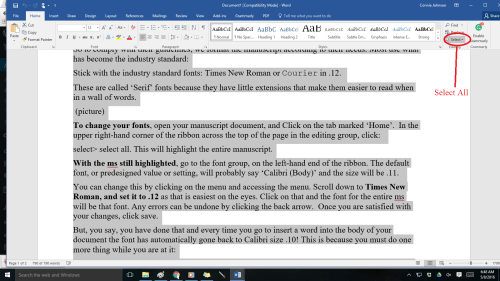
prnt screen 1 never delete cut passagesI can’t say it often enough: never delete any passage that you have cut from your manuscript. Save it in a separate file labeled ‘outtakes,’ because you may need that information later, or you may be able to turn that work into a short story.

A lot of authors use Scrivener for this, and it seems to work for them. I find it simpler to just copy and paste the work into a new file and save it in my outtakes for that particular novel. That way it’s out there in my dropbox or google drive and available no matter where I go or what happens to my computer.

Short stories are the bread-and-butter of many authors. You get paid a small sum for them, and your author name is published in one more place. The small story you toss out there could attract new fans to your other work.

Our work starts out full of passion and promise. Like a garden, it can grow wildly out of control. When you can’t see the flowers for the weeds, the garden must be cut back and pruned. The wild weed-words must be pulled in order for the reader to enjoy the real story.

Sometimes those weeds produce beautiful flowers when you get them into a different garden.

2 Comments

Filed under Self Publishing, writer, writing

#amwriting: drawing on personal experience

Map of Mal Evol, color full size, no roadsWith Valley of Sorrows on the editor’s desk, I can finish revising my other book based in the world of Neveyah. This is a stand-alone novel, The Wayward Son, which will be published late in 2016 after Valley of Sorrows comes out. It tells the story of John Farmer, Edwin’s father, and takes place concurrently with Forbidden Road. This book was far easier to write than many others, as it explores combat-related post-traumatic stress disorder (PTSD), a condition I am all too familiar with, as a bystander.

John’s story opens with an incident that changes his life. Twenty-five years later, John must return to Aeoven and face the past, and somehow learn to live with himself.

We writers all use our knowledge of the world around us to draw on when we are creating a scene or a character, even if we are not aware of having done so. I have deliberately drawn on observations made during my childhood and young adult years to create John’s gut-reactions and to show how his life was colored by his experiences.

My father was a veteran of WWII, and a man who’d intended to make the military his career. The loss of his left leg changed his career path. He became a draftsman and made a very good living. Other than being inconvenienced by having only one leg, everything went on normally.

On the surface, anyway.

US Army Signal Corps photo of SCR-299 radio set in operation 1942, US Army Signal Corps

US Army Signal Corps photo of SCR-299 radio set in operation 1942, US Army Signal Corps

The injury that had cost my father his leg was not combat-related, although it occurred while he was on active duty.  But  the most devasting things that impacted him had happened long before he met his fate in El Paso, TX in 1946.

Dad joined the army in 1938. He rose to staff sergeant in charge of a radio unit. During his time in the military, he had marched across Europe carrying his SCR-300, a portable radio transceiver used by US Signal Corps in World War II. One thing he was always willing to discuss was how his backpack-mounted unit was a large two-way radio, and it was called a “walkie-talkie.”

Later in the war, he was in charge of something called an SCR299. This was a large mobile radio station.  The Signal Corp and men like my father provided long-range communications between permanent bases and the battlefront.

Dad was always just behind the actual battlefront, always passing through the aftermath. He never discussed it, but the enemy knew how important these communications outfits were, so they must have been important targets. I do know he’d lost several close companions, men who were there one minute and gone in a pile of wreckage the next.

Drafting Table, courtesy Wikimedia Commons {PD GNU Free}

Drafting Table, courtesy Wikimedia Commons {PD GNU Free}

My dad and my uncles never really got over the war, and they all suffered from survivor’s guilt to a certain degree. They came home and settled back into society, and began building the American Dream. When he was sober, all Dad ever really said about the war was that the good guys had won. When he’d been drinking, he might say more, but not much.

Dad was an avid gardener, a musician, a brewer, and a winemaker. He was passionate about his interests, a renaissance man who insisted we read (and discuss) all manner of books from the classics to comic books, be athletic, and learn to play a musical instrument.

But Dad was also a volatile man who drank too much every weekend and partied as hard as he worked. We all knew how to mix drinks and serve canapés by the time we left home, as we were Dad’s bartenders whenever there was a party. That may be why I have always been more of a non-drinker.

90px-US_Army_WWII_SSGT.svgAs my dad grew older his lifestyle began to catch up with him. He grew erratic and his once hilariously cynical wit became less funny and more bitter. Good Dad lost the battle to Bad Dad. We never knew just what would trigger a tirade, and we developed coping mechanisms.

When I look back, I can see that some of his most outrageous tantrums were actually panic attacks. When he was in the grip of one of those, all bets were off–your best choice was to just walk away and let him rave until he was done. His health suffered–he developed type-II diabetes and never got it under control. He was forced to retire early from his job at the age of 59 because of his health, but he had two good pensions, one from the military, and one from the State of Washington.

San-felipe-baja-california-2000 via WikipediaAfter he retired,  he and mom, along with Aunt Lillian and Uncle Wes, who’d been in Germany and North Africa during WWII, began wintering in San Felipe, Baja, Mexico for most of the year.  Dad was happier there. He loved the sun and people of Mexico. Even so he lost many lifelong friends who loved him but couldn’t stand him when he was drinking. He had destroyed his marriage–Mom hung on out of old-school Lutheran stubbornness.

Dad died at the age of sixty-six from complications of penicillin-resistant osteomyelitis (the cause of the loss of his leg 34 years prior), diabetes, and alcoholism. In his last years, he wanted to be happy, but he couldn’t, and his confusion and instability was a black pall that darkened every day for those of us around him.

WWII US Soldiers Marching, image courtesy www.berkeley.edu

WWII US Soldiers Marching, image courtesy http://www.berkeley.edu

As a child I saw how my uncles were also affected by war–Uncle Don came home from the Battle of the Bulge with a metal plate in his head, Uncle Dean spent the war on a destroyer in the Pacific theater. Uncle Billy died in Korea, and Uncle Bobby came home from Korea a changed, angry man. They all experienced the trauma and flashbacks differently, but the lives of everyone who loved them was affected in negative ways.

There was no help for them. They were told to suck it up and be men about it, no matter what it was. To a certain extent, the US government is still dropping the ball when it comes to caring for our combat veterans, whose many documented mental illnesses stem directly from their war experiences.

Using this unfortunate personal knowledge of how witnessing events in war can affect a soldier for decades after the war has ended, I created John’s story. His story and those of his companions were written in my head long before I ever began writing Tower of Bones. I wrote John’s story for my father, my uncles, my older brother and for all the young soldiers, men and women who’ve seen combat and who must somehow reintegrate into society.

5 Comments

Filed under writing

#amwriting: World building: Society, and Magic

Today we will examine society and magic, two disparate concepts with one thing in common: both require a solid framework to imagine the story around. In other words, you have to understand them well.

Luca Giordano, Frescoes in the gallery of the Palazzo Medici-Riccardi in Florence, Scene - Justizia ca 1584

Luca Giordano, Frescoes in the gallery of the Palazzo Medici-Riccardi

First let’s discuss religion and society: Who are the movers and shakers?

In all societies, there is a hierarchy of power. Someone is at the top and someone else is at the bottom.

As I create the political power-structure, I find that the opportunities for creating tension within the story also grow. I keep a list of those ideas so that when I run short on creativity I have a bit in the bank, so to speak.

When you are building a world that only exists on paper, you have a microcosm of space in which you can convey the social, religious, and political climate of your story.  You show this in small ways, with casual mentions in conversation when it becomes pertinent, and not through info dumps.

However, in order to convey that information logically and without contradictions, you must have an idea of how things work.

  • Who has the power and privilege in that society, and who is the underclass?
  • How is your society divided? Who has the wealth?
  • Who has the power? Men, women—or is it a society based on mutual respect? Is one race more entitled than another?
  • Who wants power, and what lengths are they willing to go to gain it?
  • What place does religion have in this society? Is it central to the governance of the society, or is it a peripheral, perhaps nonexistent thing?
  • What passes for morality? Is sex before marriage taboo? What constitutes murder and how is it viewed? Remember, you only need to worry about the moral dilemmas that come into your story.
  • If a character goes against society’s unwritten or moral laws what are the consequences?

This creates atmosphere. This is knowledge the characters have but the reader does not. There is no need to have an introductory chapter describing the laws and moral codes of the religious order of Grok, or the political climate of West Berlin in 1961. The way you convey this is to show how these larger societal influences affect your character and his/her ability to resolve their situation.

Consider this story: a woman is separated from her husband by the Berlin Wall.  Every day, on her way to her job, she rides her bicycle past the wall, knowing that on the other side, less than a block away, is her husband. Yet the couple is divided by an impassable barrier. How the wall affects her is shown in her everyday life. In this story, the history of how the wall came into existence isn’t as important as how its presence destroys her family. The wall represents the ideology of those who rule in her divided city, so the reader comes to know the politics of both East and West Berlin by her experiences in trying to cross that barrier.

And now for the magic:

If magic is central to your story, it is critical that you have finite rules for limiting how magic works. If you make your characters too clever, readers won’t be able to relate to their story. 

Harry_Potter_and_the_Philosopher's_Stone_Book_CoverWhen magic is part and parcel of a story, rules and limitations create the tension that moves the plot forward. J.K. Rowling’s Harry Potter series is an excellent example of this. No one character has all the power. The two most powerful wizards, Dumbledore and Voldemort, are evenly matched, but neither one is all-powerful. Both wizards want something from Harry. Harry has to work hard to gain his the full use of his abilities.

Harry’s struggle is the story.

  • Who has the magic, and what social power does this give them?
  • What are the limitations of his/her powers?

Each time you make parameters and frameworks for your magic you make opportunities for conflict within your fantasy world. Conflict is what drives the plot.

What challenge does your character have to overcome in regard to his magic?

  • Is he unable to fully use his own abilities?
  • If that is so, why is he hampered in that way?
  • How does that inability affect his companions and how do they feel about it?
  • Are they hampered in anyway themselves?
  • What has to happen before your hero can fully realize his abilities?

Without rules, there would be no conflict, no reason for the hero to struggle, and no story to tell.

Merlin, by Douglas Baulch, Via Wikimedia Commons

Merlin, by Douglas Baulch, Via Wikimedia Commons

I have three worlds with three radically different systems of magic. My serial, Bleakbourne on Heath, is set in a parallel earth that is one shadow away from this one. Bleakbourne, situated on the Heath River, is where the fey and the mortal worlds meet. Leryn, my main character, has many adventures with people who have certain parallels with our history and who are drawn from Arthurian legend, but who are given my own particular twist.

I had to sit down and write out the rules for Merlin’s magic. In Bleakbourne’s world, wizards are born with the latent ability to wield magic, but it is considered a science, and craftsmanship is valued above all else. Skill is what gives a sorcerer power. Certain rituals must be observed.

  • Spells work two ways, and the second way always reverses the first way—this is called symmetry.
  • The words used in spells are of the old, dead, Romani language. Unwords are syllables that have a null meaning and are often inserted for symmetry.
  • All the Romani words with more than one meaning must be chosen carefully because they can be either too short or too long for symmetry. Too long a word will not work at all as you can lengthen, but not shorten them. The sorcerer must choose a shorter word, which requires him/her to insert an extra, closing unword, or the two spells wouldn’t be symmetrical. There are four unwords to choose from, but only three chances to get the spell right

In the Bleakbourne series, the use (and abuse) of magic is the underlying theme.

In creating both social and magic systems, you are creating a hidden framework that will support and advance your plot. Within your magic system, there can be an occasional exception to a rule, but there has to be a damned good reason for it, and it must be clear to the reader why that exception is acceptable.

The only time the reader needs to know these systems exist is when these institutions affect the characters and their actions. Dole this information out in conversations or in other subtle ways and it will become a natural part of the environment rather than an info dump.

1 Comment

Filed under Fantasy, Publishing, writing

#amwriting: world building: maps and the mythology of history

The world Ortelius' Typus Orbis Terrarum, first published 1564

The world Ortelius’ Typus Orbis Terrarum, first published 1564

After years of work on the author’s part, regardless of whether the book is an encyclopedia, a contemporary thriller, a historical fiction, or even a travelogue with photographs, the world that the book details remains untouchable by our human hands. This is because that world only exists between those pages and in the mind’s eye.

The fundamental laws of physics bar us from going back and viewing or experiencing the reality of a historical event as a participant. We can, however, read about it, paint images of it, or make a film depicting what we believe happened during the event. This is where world building comes in.

WWII US Soldiers Marching, image courtesy www.berkeley.edu

WWII US Soldiers Marching, image courtesy http://www.berkeley.edu

But wait, you say. I’m not writing fantasy. I’m writing a story about France, in 1945. I don’t have to build that world–it actually exists.

I’m sorry–the world of France in 1945 is long gone. It no longer exists, except as a memory.

Let’s assume you are writing a historical accounting of the Battle of the Bulge. But, even though it may explore a soldier’s true experiences through newsreels, the pages of his diary, and  the interview you had with him, in reality, the world of this book exists only in three places:

  • it flows from the author’s mind
  • to the pages of the book
  • into the reader’s mind through the written word

Because we can only view history through the stained glass of time, we must accept that it assumes a mythical quality when we attempt to record it. Even a documentary movie that shows events filmed by the news camera may not be portrayed exactly as it was truly experienced. The facts are filtered through the photographer’s eye and the historian’s pen.

Your mind is the medium through which the idea for a novel or story is filtered and words are how it is made real. The key to making both fiction and non-fiction real for the reader is subtle but crucial: worldbuilding. It is worldbuilding that makes a stark accounting of incidents and conversations seem real to the person reading the book.

To build a world out of ideas and words, the author must know it well:

  • Create a stylesheet to avoid contradictions in your work. This is covered in my post, Stylesheets.
  • If your work is set in a contemporary setting, make use of Google Earth. This allows you to see a recent image of the place for yourself, even if you can’t afford to travel there.
  • Go to the internet and find maps of the place in the time your are writing about. If you are writing genre fantasy or speculative fiction of any sort, create a hand-drawn map for your own reference. We will discuss this below.
  • Research/or Create and these systems if they pertain to your work: Political, Social, Religious, and Magic. (We will discuss how to do this simply in my next post.)

If you are writing fantasy you need to know what the world looks like.

Original Map of Neveyah from 2008 ©cjjasp

Original Map of Neveyah from 2008 ©cjjasp

I love maps. My own maps start out in a rudimentary form, scribbled in pencil on graph paper, just as a way to keep my work straight. They begin looking like the one to the left of this paragraph, and evolve as the first draft of the story evolves.

Towns get renamed. They get moved to more logical places. Whole mountain ranges are moved, and forests and savannas appear where they are supposed to be. Over the course of writing the first draft, my world becomes real and the pencil sketch  map will become the digital art you see below.

In my books, people are going hither and yon with great abandon, and if I am not really on top of it, the names of towns will evolve over the course of the novel–Maudy will become Maury (this actually happened) and distances will become too mushy even for me. The map is my indispensable tool for keeping my story straight.

Map of Neveyah, for RizAero

Map of Neveyah 2015 ©cjjasp

When your characters are traveling great distances, they may pass through villages on their way, and if these places figure in the events of the book, they should be noted on the map. This prevents you from:

  • accidentally naming a second village the same name later in the manuscript
  • misspelling the town’s name later in the narrative
  • forgetting where the characters were in chapter four

Perhaps certain things will impede your characters. If they are pertinent to the story, you will want to note their location of on your map so that you don’t contradict yourself if your party must return the way they came:

  • Rivers
  • swamps
  • mountains
  • hills
  • towns
  • forests
  • oceans

Billy's Revenge Floor plan ground floorIf your work is in sci-fi, consider making a rudimentary star-chart, if space-travel is a part of your tale. For Sci-fi, you might want to know:

  • the name of the star or stars if the system is binary/trinary
  • number of planets, their names and positions
  • which planet the story takes place on
  • moons and asteroid belts that may be relevant to the tale
  • map of the area on the planet your story takes place or
  • map of space station/ship if the story takes place in space

In the narrative, if you are writing fantasy, I suggest you keep the actual distances mushy because some readers will  nitpick the details, no matter how accurate you are. Yes, you wrote it, but they don’t see it the way you do. This is because their perception of a league may be three miles while yours might be one and a half. Despite the fact that a league has no finite length and is whatever the author decides it is, some readers feel their opinion is of such worth that they will never back down. They will become so annoyed by this that they will give your book a three-star review, simply because they disagree with the length of time your character took to travel a certain distance. 

From Wikipedia, the fount of all knowledge: “A league is a unit of length (or, in various regions, area). It was long common in Europe and Latin America, but it is no longer an official unit in any nation. The word originally meant the distance a person could walk in an hour.[1] Since the Middle Ages, many values have been specified in several countries.”

Map of Eynier Valley for 'Huw the Bard, ' ©cjjasp 2014

Map of Eynier Valley for ‘Huw the Bard, ‘ ©cjjasp 2014

Therefore, a league is what you say it is, within some loose parameters. I go with the distance you can walk in an hour, but you have to take into consideration the terrain.

Huw the Bard takes two months to travel between Ludwellyn and Clythe. In his story, Huw Owyn is walking through fields, woods, and along a several winding rivers for the first half of  his journey. He has to backtrack as frequently as he goes forward in order to sneak around those who would kill him. It’s only safe for him to walk on the main road once he makes it to Maury, weeks after fleeing Ludwellyn.

It is a stretch of road that he could have done in two weeks if he had been able to stay on the main road, and if he hadn’t had to do so much backtracking. But that inability to make progress creates opportunities for tension.

Readers love to see maps in the front of books, but you don’t have to put yours there if you don’t like your own handiwork. This map can be only for your purposes, so you will know in a concrete way where every town and village is in relation to your story.

Fantasy readers like maps. If you choose not to include your map in the finished product, consider hiring an artist to make your map from your notes. Because I am an artist, my pencil-drawn map always evolves into artwork for the book.

Every book, fiction or non-fiction, takes an idea, translates it into words, and dares the reader to believe it. It is our job as authors to take what is intangible and make it seem real to the reader who is experiencing the world and a moment in history through our writing.

11 Comments

Filed under Fantasy, writing

St Albans – stained glass and medieval paint

I have enjoyed this journey through the history and architecture of St. Albans so much! I can’t thank Sue Vincent enough for sharing it with us, through both her camera and her eye for the poetry in things. What I’ve learned from observing her as she experiences this place, is that writers must see the world through the eye of the artist.

3 Comments

Filed under Adventure, writing

#amwriting: the author’s voice

The sense of style steven pinkerAnyone who is a member of a writing group is regularly beaten over the head with certain basically good, but occasionally clichéd, rules. Improperly applied, this mindless interpretation of proper grammatic style can inhibit an author’s growth.

These rules are fundamentally sound, but cannot be rigidly applied across the board to every sentence, just “because it says so in Strunk and White.” I rely on the Chicago Manual of Style, but I also understand common sense.

English is a living language. As such it is in a continual state of evolution and phrasing that made sense one-hundred years ago may not work well in today’s English.

We may be writing a period piece, but we are writing it for modern readers.

You can split an infinitive: it is acceptable to boldly go where you will.

You can begin a sentence with a conjunction if you so choose. And no one will die if you do.

Stephen Pinker discusses many rules in his controversial book, The Sense of Style, and finds that some of them no longer make sense.

For example, Pinker points out that “The prohibition against clause-final prepositions is considered a superstition even by the language mavens, and it persists only among know-it-alls who have never opened a dictionary or style manual to check.” 

He notes that rigidly following “the rules” would have you doing silly things like turning “What are you looking at?” into “At what are you looking?”  I don’t know about you, but for me the first example is preferable.

In the example, the word at is a preposition, and placing it after looking makes it a clause-final preposition.  Such a construct is technically a no-no, but I suggest you break that rule.

Stardust, Neil GaimanWe are constantly told that we need to make our verbs active, rather than relying on passive constructions, and for the most part, this is true. But Pinker reminds us that “The passive is a voice and not a tense.” There are times when the use of passive phrasing is appropriate.

Consider the difference between ‘the cat scratched the child’ and ‘the child was scratched by the cat.’  The second sentence is written in the passive voice, and in this context the active voice is the one I would choose because it is simpler and less fluffy.

Pinker agrees with me that there are contexts in which the passive is preferable. Quote from The Sense of Style: “Linguistic research has shown that the passive construction has a number of indispensable functions because of the way it engages a reader’s attention and memory.”

And in writing, context is everything. 

For most genre work, editors push for active voice, but truthfully, mainstream fiction and literary fiction can use the passive voice and still sell boatloads of books. Some of the most beautiful prose out there in genre fantasy mixes passive voice in with the active, and when done right  it is immersive.

name of the wind -patrick rothfussPatrick Rothfuss’s Name of the Wind is one example, and Neil Gaiman’s Stardust is another.

These books are best sellers because both Rothfuss and Gaiman understand how to craft prose that mingles passive and active phrasings, drawing us into their work. They choose when to use passive phrasing, and apply it appropriately so the narrative is a seamless blend of properly constructed sentences chosen to reflect their distinct voices.

The modern prohibition against passive phrasing exists for a reason: improperly and excessively used, the passive voice can weaken your narrative.

Knowledge of grammar and sentence construction is critical if you are an author: Sloppy grammar habits show that your work is badly crafted.

Your voice is the way you habitually phrase things despite your vast knowledge of how grammar is correctly used. Take a look at the great authors: Raymond Chandler, Ernest Hemingway, F.Scott Fitzgerald, and James Joyce: these authors each had such a distinctive voice that when you read a passage of their work, you knew immediately who you were reading.

They ALL broke the rules in their work and were famous for doing so.

Raymond chandler quote split infinitivesHowever, they understood the rules they were breaking and broke them deliberately and selectively in the crafting of their narrative.

Imagine a story set in an expensive restaurant. This story revolves around a marriage that is disintegrating. The couple, Jack and Diane, dine in silence. The food is important, but only because of what it represents. How do you convey this?

The steak was well-prepared and melted in Jack’s mouth. Nevertheless, Diane wielded her knife like a surgeon, cutting her meat into tiny, uniform chunks, chewing each bite slowly before swallowing. Jack imagined her carving his heart similarly, chewing it carefully and then spitting it out.

800px-Night_Sky_Stars_Trees_Quote“The steak was well-prepared and melted in Jack’s mouth” is written with a passive voice, and that is okay. The important thing is Jack’s observation of Diane and her mad knife skills. You don’t need to say “The chef had prepared the steak perfectly.” Unless he is having an affair with Jack or Diane, the chef who prepared the tender steak is not important and doesn’t need to be mentioned.

Steven Pinker has some words of wisdom for would-be editors: “It’s very easy to overstate rules. And if you don’t explain what the basis is behind the rule, you’re going to botch the statement of the rule—and give bad advice.”

Knowing what the rule is and why it exists allows you to choose to break it if that is your desire.

Writing style is a combination of so many things. It is how you speak through your pen or keyboard. Craft your prose with an eye to what is important to your story, and say it with your voice. With that said, your voice should not be so distinct and loud that it makes your prose obnoxious. A good editor will understand the difference and guide you away from bad writing, helping you find your voice in such a way that your work will be a joy to read.

8 Comments

Filed under Fantasy, Publishing, writing

#amwriting: stylesheets

IBM_SelectricWriting a fictional novel is really the same as telling a whopping lie that you believe in with all your heart and keeping it straight for 80,000 words or more.

Everyone knows how lies evolve in the telling. That tendency to elaborate and embellish is the eventual downfall of even the most believable of liars.

What the writer has going for them that the average liar doesn’t is paper. We write the falsehood down on paper the way we pretend it happened. Once the fabrication is complete we have the luxury to go back and forth over it, making sure we haven’t contradicted ourselves, and then we dare the reader to believe it.

I posted a blog to this effect on November 9, 2015: 3 steps for keeping the story straight. One step that I discussed is what editors refer to as the “stylesheet.”

Bleakbourne Style SheetWhen a manuscript comes across their desk, editors and publishers create a list of names, places, created words, and other things that may be repeated and that pertain only to that manuscript. This is called a stylesheet.

The stylesheet can take several forms, but it is only a visual guide to print out or  keep minimized until it’s needed. I copy and past every new word or name the first time they appear in the manuscript, and if I am conscientious, I’ll be less likely to inadvertently contradict myself later on in the tale.

Many people use a program call Scrivener for this and they are happy with it, but I found it didn’t mesh well with the way MY mind works, so I went back to my one-page list and hand scribbled map.

Regardless of how you create your stylesheet, I suggest you include these elements:

  • Word/Name
  • Page it first appears
  • Meaning

Stylesheet_example_LIRF_cjjasp

This is especially crucial for fantasy authors because we invent entire worlds, creating names for people, places, and creatures.

Take my own work-in-progress: it is the final volume of the Tower of Bones trilogy, and has people with names that can be spelled several ways, and when I am in the throes of writing the first draft I fling them out any old way.

Thus, a character named Linette on page one can become Lynette by page six. Kalen can become Kalin. Place names become mushy, and any word that is important or invented can evolve over the course of a manuscript.

Now I am in the final stages of making the manuscript submission-ready. I have completed a global search for every possible variant of the words on my list, and replaced the incorrect instances with the version I like best.

Valley of Mal Evol ©Connie J. Jasperson 2016Place names evolve too, so maps are essential tools when you are building a world. Places written on a map tend to be ‘engraved in stone’ so to speak. Readers will wonder where the town of Maudy is when the only town on the map at the front of the book that comes close to that name is listed as Maury.

To prevent that from happening, double check what you have written on the map, and then do a global search for every possible variant.

Just because you invented the world doesn’t mean you know it like the back of your hand. That world is constantly evolving in your mind. I have been writing in the world of Neveyah since 2009, and still I find that I frequently contradict myself, which is why the stylesheet is so important.

11 Comments

Filed under Fantasy, Publishing, writing

#FridayFiction: Meriko’s Eyes

Meriko's Eyes © cjjasp 2016

Meriko pressed against the wall, hiding ever deeper in the shadows.  One never knew what lurked in the streets of the city anymore. Since the change, things had been difficult. According to the internet, society was crumbling.

Of course, the web had always declared that.

The darkness in the alley emphasized the scarcity of electricity even though the grid was back up. Meriko’s own scant ration of wattage was reserved for her computer—her lifeline, her source of income and her only reliable link to the life she once had.

She knew things were still bad but had no idea how widespread the problems were. She hadn’t witnessed any violence outside her windows in weeks, but still, emails from her fellow employees at GiantSoft were rife with rumors of murder and worse, and now she went out only when she had no other choice. She wasn’t completely out of touch—she still had interactions with friends through emails and social media. Even if they never saw each other, the network of workers did have a kind of camaraderie.

It was just…she had found a solitary existence more difficult to endure than she had initially believed it would be.

Normally, she had everything delivered to her: food, clothing, everything. She never had to leave home.  However, her self-imposed solitude had at last driven her out of her flat; loneliness and the handsome face of a young man viewed from her window.

She emerged into the alley behind her building. The cool, damp air held a musty scent of mold and garbage mingled with other even less desirable odors, but she didn’t notice them, her senses open to other, worse things. Fortunately she didn’t sense the evil miasma of nightwalkers in the area. Nevertheless, she cleared her mind of any thoughts that might draw attention to her and quickly crossed the alley to the Double Joy restaurant, melting into the shadows. After a moment’s indecision, she entered the café through the backdoor.

Boldly walking as if she had simply been to the restroom, she sat on the only empty stool at the counter and ordered yaki-soba and bubble tea, adding a tip as she paid the bill.  Sipping her drink, she waited for her meal. Even if nothing came of her plan, it was good to be around real people, hearing real voices instead of virtual conversations through the social interface.

She had a flat full of cat statues to keep her company, but they only underscored her isolation, their marble features forever perfect and unchanging.

Meriko could barely tolerate the aromas of the restaurant, the scents of food mingled with the odors of others like her, people so desperate to escape their solitary lives that they would brave the shadowed streets just to dine in a sweltering café with strangers.

“How can you see with those dark glasses, girlie?” said the drunk next to her, with a leer.  The smell of stale beer made her ill, and reflexively, she leaned away from him.

“Oh, you know,” she said noncommittally. “It’s the fashion, so….”

“Hey there! Don’t be bothering the other customers,” the man behind the counter warned the drunk. “If you bother her again, you’re out of here.”

“I’m behaving, don’t worry,” the drunk mumbled, and after a few moments, he staggered out the front door into the night. As he left, fresh air came in, but it was quickly cut off by the slamming of the door.

“I hate drunks,” the man behind the counter said.  “They can eat elsewhere. I don’t need their money.” He busied himself with cleaning the counter and the soda machine.

Meriko pushed her food around the plate and stared through the service window at the young cook in the back.  He was why she came here, despite the danger in doing so.

Tonight she had come in close to closing time, and soon she was the only customer there. So she had timed it right.

She’d watched him come and go every night since he had started working there, observing him from the window of her flat.  The restaurant was just across the alley from her building, so much of her view was taken up by the alley and the back of this restaurant.

“May I have a box to take my leftovers home in?” The man behind the counter brought her a box. “Have a nice evening,” she said, as she walked out the front door.  She was so lonely.  Maybe tonight she would find a friend.  Other people had companions in their lives. Maybe this was the night for Meriko.

***

Ten minutes after closing the restaurant, the cook, a young man named Kai, walked down the dark city street to his bus stop. Usually he was the only one there, but tonight a girl was there, and a to-go box from his restaurant sat on the bench beside her.  He was sure she’d been in the café earlier. He’d seen her carrying the box as she left.

He’d noticed her because she was wearing dark glasses.

“Hello,” he said cheerfully. “Did I see you tonight in my restaurant? Well, it’s not mine, but I work there.”  His smile was unforced and honest, elevating his face from handsome to beautiful.

“Yes,” she said, smiling. “I go there often, but tonight I was later than usual. They were almost closed.”

“I only work the late shift, so that’s why I haven’t seen you before,” he said as he sat on the bench and checked his phone to see the time.  “My name is Kai.  What’s yours?”

“Meriko,” she answered, feeling happy for the first time in weeks.  He was so handsome!

They sat talking for five or so minutes.  Finally he asked, “Why do you wear dark glasses in the night? You wore them inside our restaurant.  I heard you tell the drunk that it was the fashion, but…well, maybe I am not up on the current trends or something.”

“Ah…it’s a genetic condition. My eyes are extremely sensitive to the light,” she told him. “Do you have any hobbies?” she asked, trying to distract him.

“Oh, so it’s painful to go without them,” he said, as if he understood. “So are you a vampire or something?” he joked. “That would be a hoot, me hanging out with a vampire.”

“No.” She laughed. “I’m not a vampire! I am just a girl, just a regular girl. Hobbies…I like collecting old Pokémon cards from before the change. Do you collect anything?”

“So let me see your eyes then, Meriko, who is just a regular girl,” he said, leaning forward to take the sunglasses off her.

“No! Don’t do that,” she said. But it was too late.

Meriko looked at the statue of the handsome young man sitting on a bus bench, holding a pair of dark sunglasses.  The lights of the approaching bus turned the corner as it made its way to her stop, but Meriko had already fled into the darkness, crying.

“Why do they always want to see my eyes?  Why can’t they ever just want to talk?”  Still sobbing, she crept through the shadows to her home.

Statues.  Meriko’s life was full of statues.


Meriko’s Eyes © 2016 Connie J. Jasperson, all rights reserved

Meriko’s Eyes was first published on WattPad in January 2013 as Fortune’s Fool. It was republished in March 2015 by Edgewise Words Inn, under the title Meriko’s Eyes.

8 Comments

Filed under Fantasy, writing