
Today we are looking at a series of photographs taken over the space of several years. All but one are my own work.
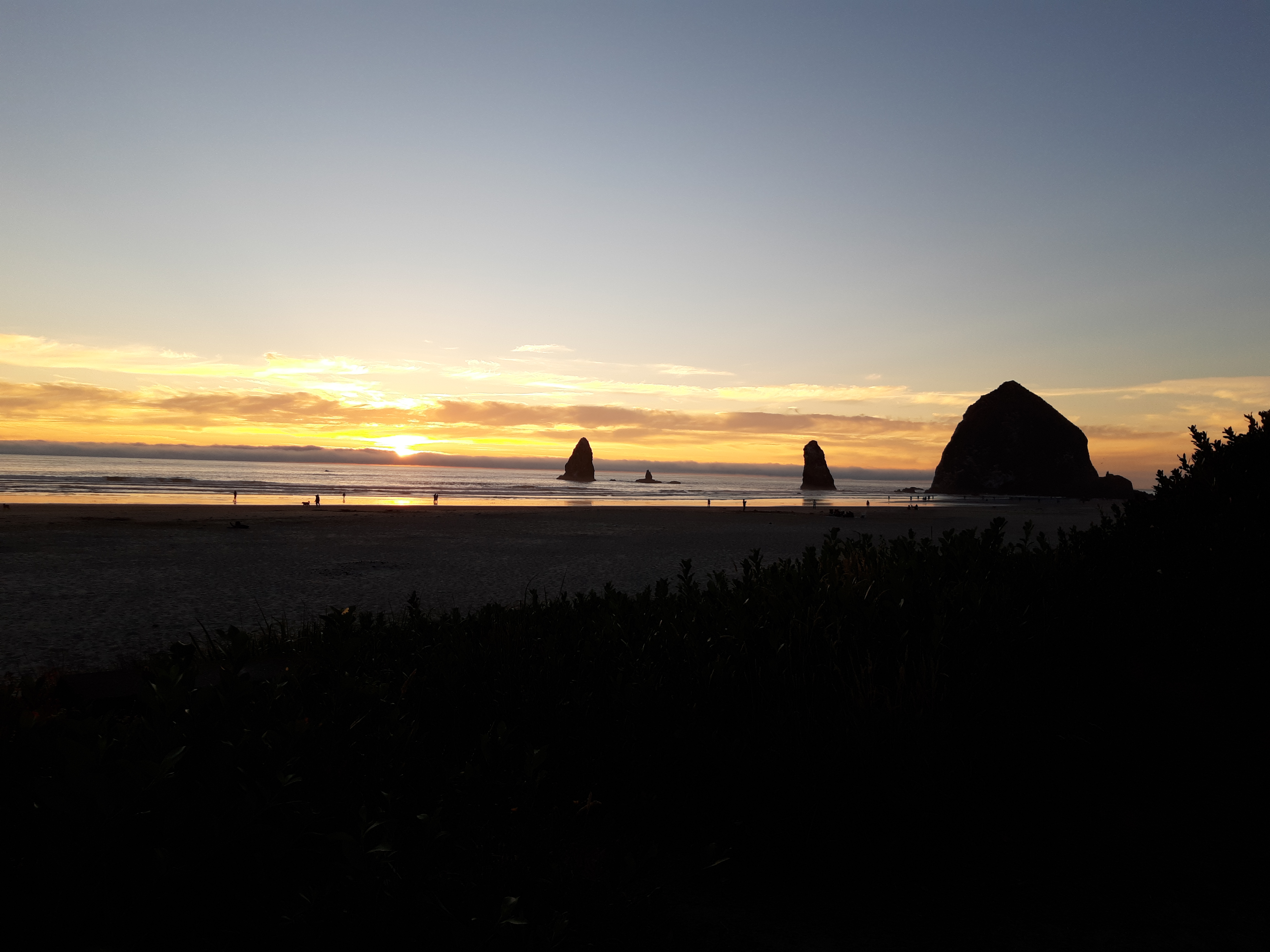
The first image is a sunset shot of what I think of as the Monarch of the Beach, the God-Rock dominating the shores of Cannon Beach Oregon. I took it in 2021 from the south end of the long stretch of sand. I have always loved the silhouettes of the sea stacks against the sky.
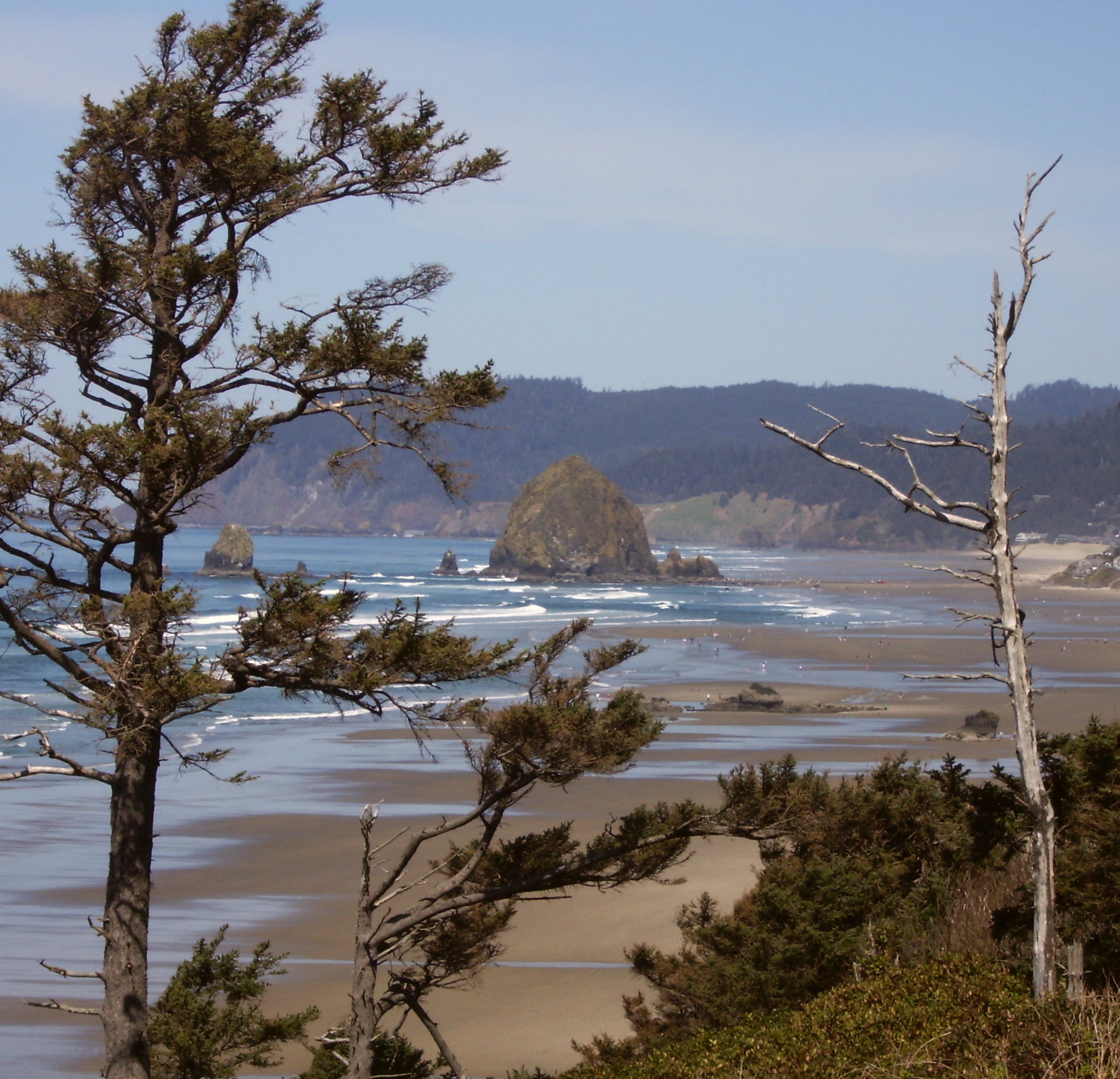
The following image, Haystack Rock, is not one of mine. It was shot and uploaded to Wikimedia Commons by Tiger635. They perfectly captured the sky, showing the amazing shade of blue with stratus clouds overhead and sea below. All the world converges on Haystack,the king rock, the monarch of the beach. The photographer did everything right to capture the beauty of this place.
 This year we are in the condo we like best and have a great view of Tillamook Head. When the fog lifts. I will see my favorite lighthouse, Tillamook Rock Light. I wanted to capture the pelicans and seagulls in flight, but the haze in 2020 made getting clear images difficult even with my cannon digital camera. But I managed to get this image with the aid of my tripod and a telephoto lens:
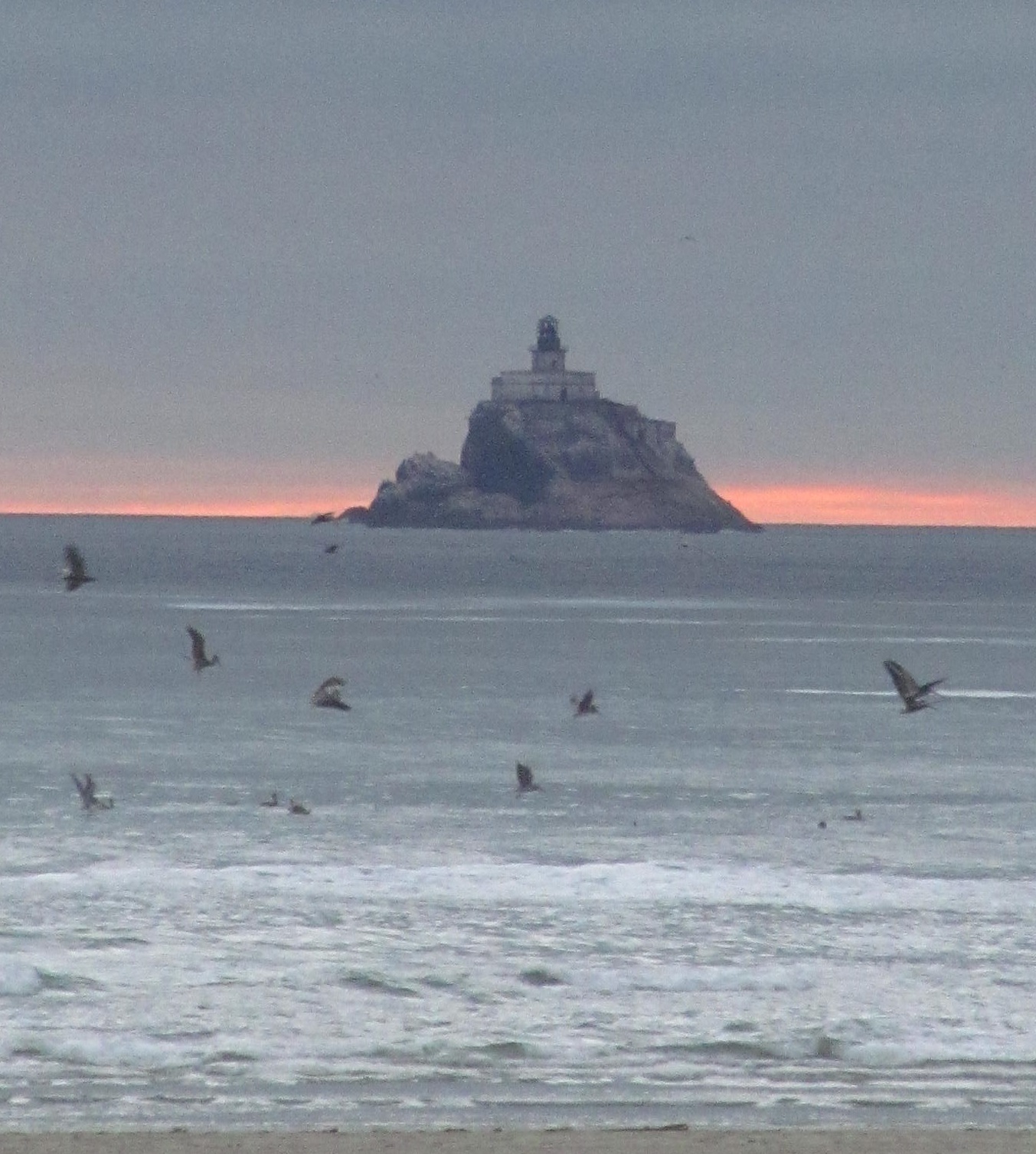
The next image is one I shot in 2018, an unusually hot year, when we were plagued with massive wildfires here on the west coast of America. The sunsets that year were unbelievable.
 The following image is of the Needles, those acolyte sea stacks gathered around Haystack’s knees. They are slowly disintegrating, more and more every year.
I shot it at low tide on Monday August 5, 2019, with my cellphone. Little did I know that it would be the last image I would ever get of that particular sea-stack. The two final images were also shot on my cell phone.
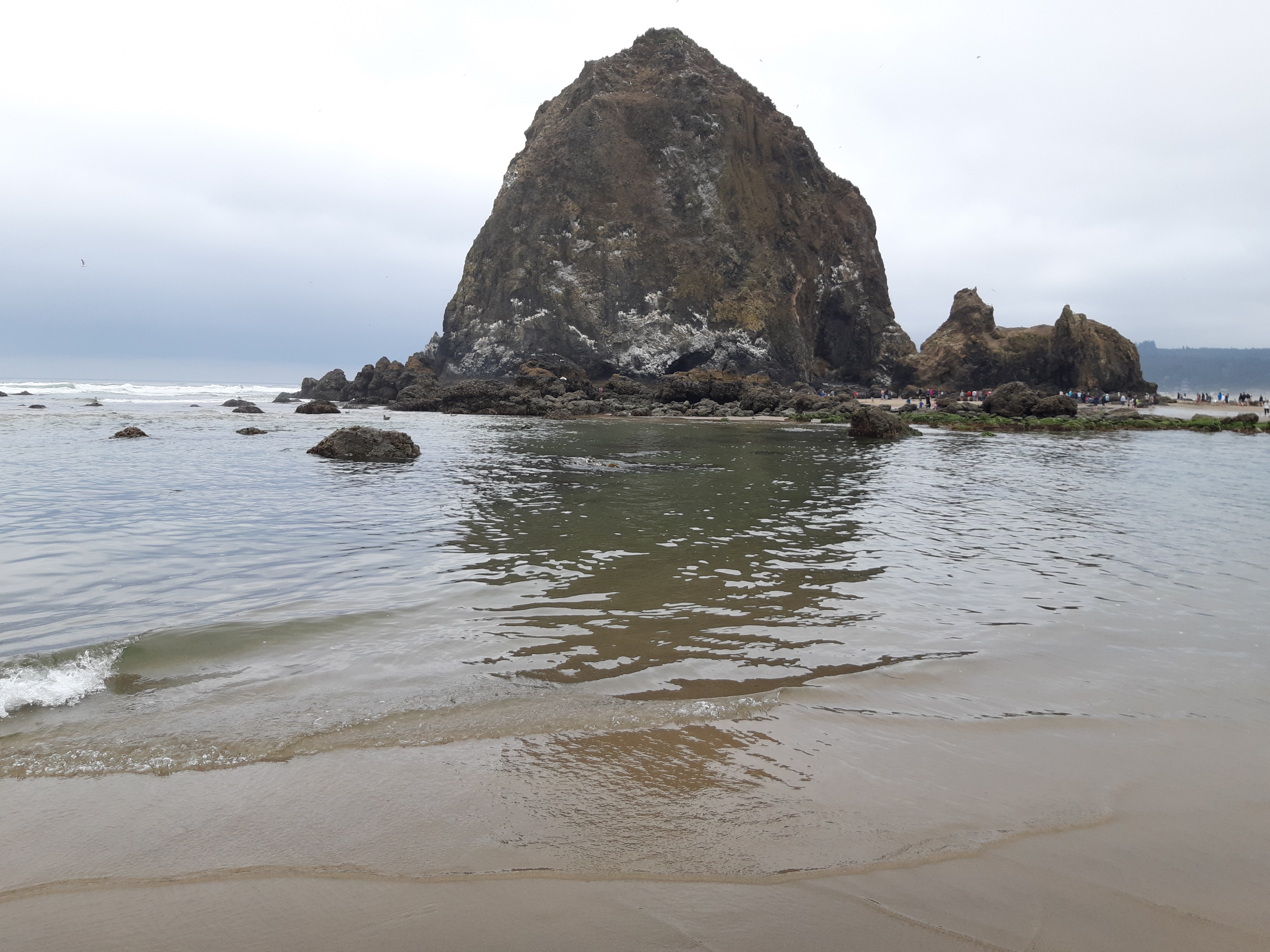
The sky that year was a shade of gray that is impossible to describe. I particularly love the way the tidal pools came out in my photo, the green of the sea moss, and the reflection of the spires across the shallow sea.
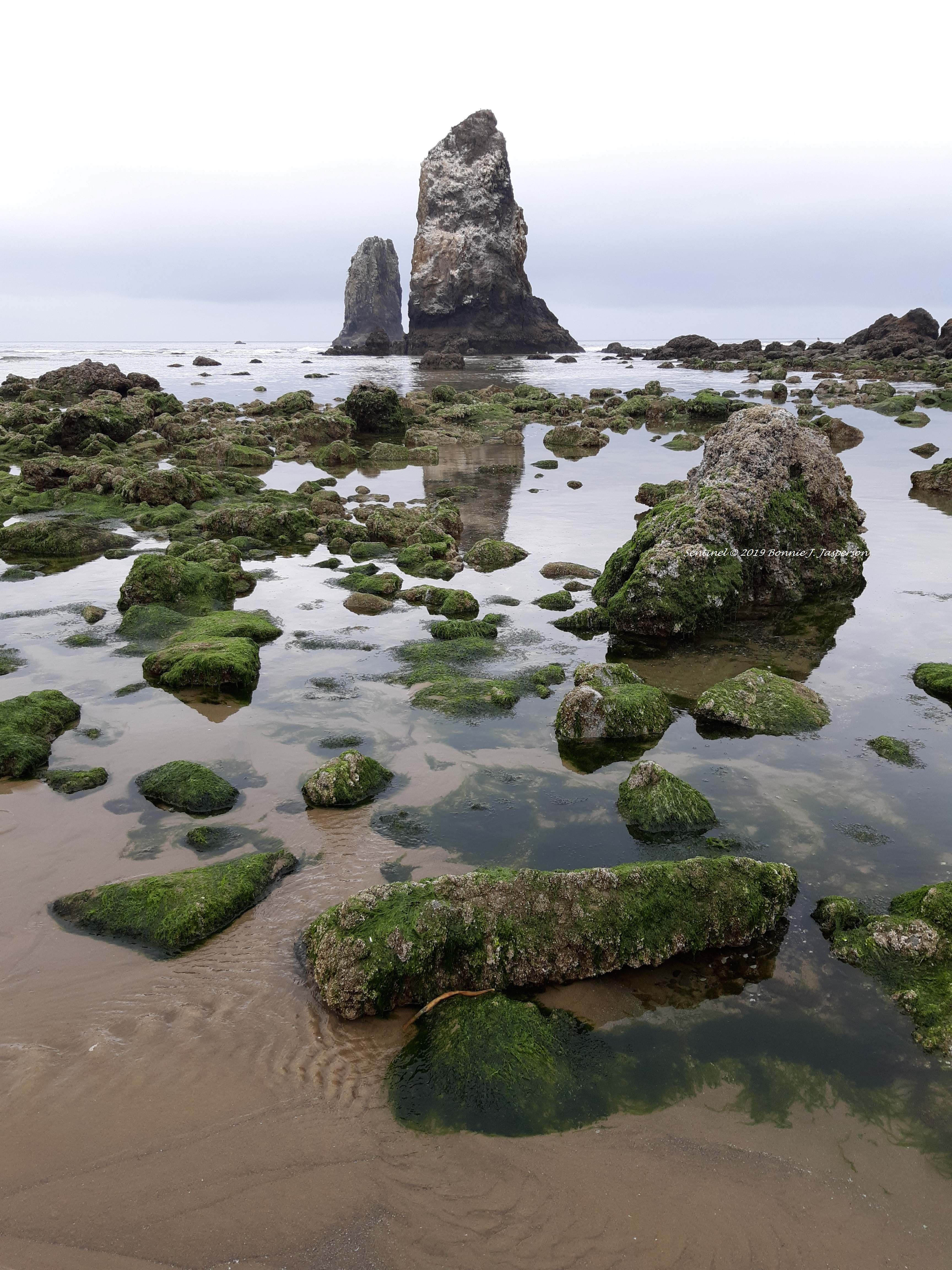
Now that sea stack is only a low hump, not too different from any other lump of basalt cresting the waves in the shallows. Where once there were three, now there are only two and a half.

Haystack Rock and the Two Needles, 20 August 2020 © 2020 by Connie J. Jasperson, All Rights Reserved
Time eventually wears everything to sand. All these sea stacks, even the God Rock, will one day be gone, shattered to rubble and ground to sand, a testimony to the violence of the wild Northeast Pacific winters. That is the way life is, and I find it reflected in myself.
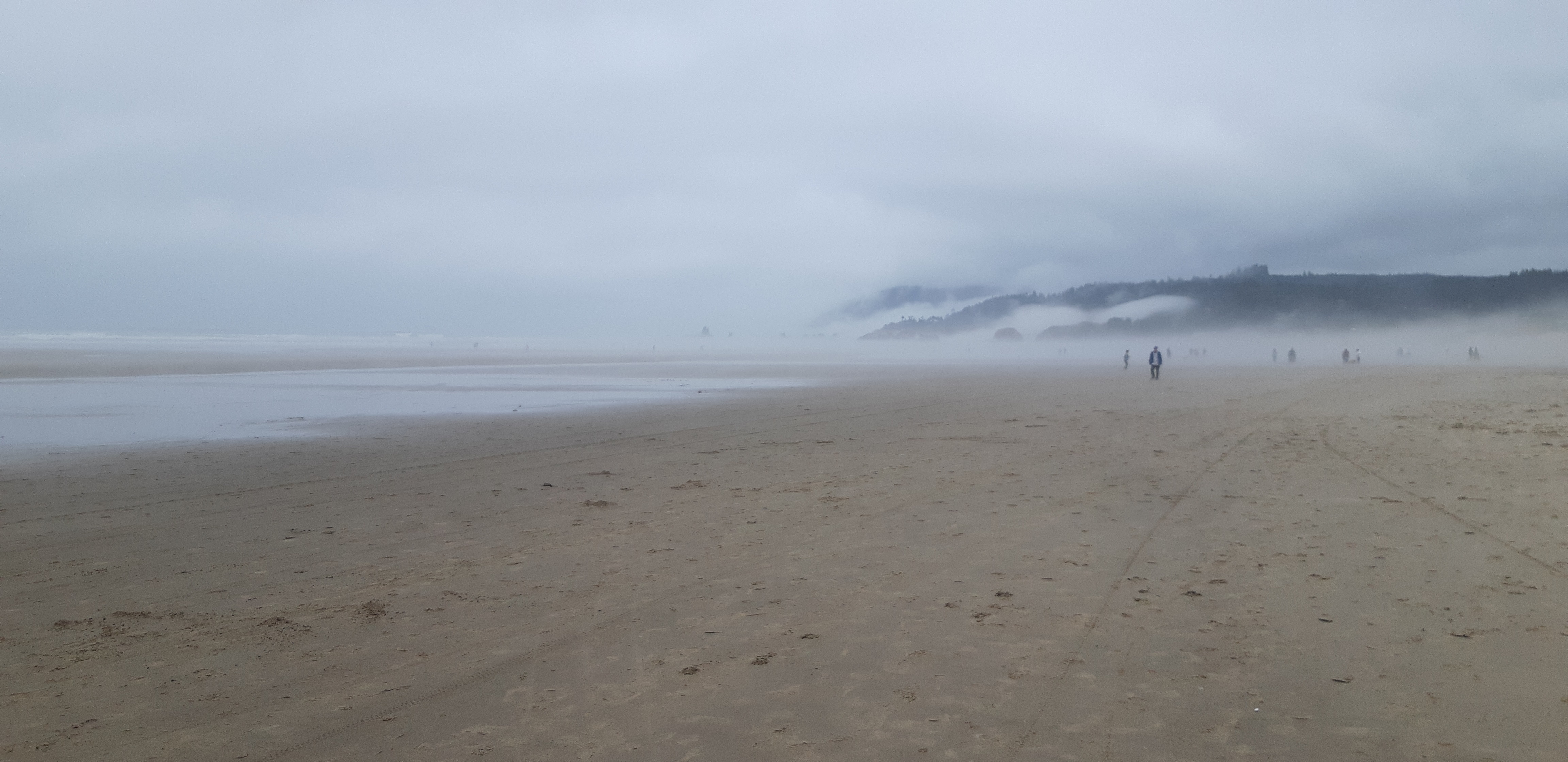
North View of Cannon Beach in the Fog July 06, 2023 © Connie J. Jasperson 2023
But no matter how fast our human lives change, pelicans, puffins, terns, seagulls, and rare wide-winged wanderers from far out to sea still come to nest on the Monarch of the Beach, Haystack Rock and his attendants.
Tidal pools change from day to day, but still they shelter starfish, anemones, and a multitude of other small creatures. These tiny water-worlds remind us that we are part of something larger, something deeper, a mysterious world far more bountiful than we who walk the land can know.
The sea is never the same. Untamed and dangerous one day, it is calm and serene the next.
The most important thing I’ve learned from my many walks among the tide pools at the foot of the Monarch is this: we humans are not islands—we are part of a world that extends below the surface and conceals secrets and lives we surface dwellers can only dimly imagine.
Above the eternal sea, on the strand below and around the God Rock, the Monarch of the Beach, my husband and I rediscover who we are, and we are made stronger.
The bonds my family forges each year in this place bind us together. These ties will always remain, no matter how far apart we are or how long we are separated, even after the Monarch of the Beach crumbles into the sea.
Credits and Attributions:
Haystack Rock, by Tiger635 [CC BY-SA 3.0 (https://creativecommons.org/licenses/by-sa/3.0)]
Tillamook Head at Sunset © Connie J. Jasperson 2018 All Rights Reserved
Sentinel, 05 August 2019 (One of the Needles, Cannon Beach) © 2019 by Connie J. Jasperson, All Rights Reserved (author’s own work).
Haystack Rock and the Two Needles, 20 August 2020 © 2020 by Connie J. Jasperson, All Rights Reserved (author’s own work).
Sunset at Haystack, 19 August 2020 © 2020 by Connie J. Jasperson, All Rights Reserved (author’s own work).
Sunset at Tillamook Head, 18 August 2020 by © Connie J. Jasperson 2023
North View of Cannon Beach in the Fog July 06, 2023 © Connie J. Jasperson 2023
 Most years, we visit the brewery and each of the several coffee roasters and sit for long hours, enjoying both the view and la vita dolce. This year we plan to do more than window-shop in the numerous art galleries. We have a wall in our new apartment that needs art. Of course, we will spend time in the local bookstores.
 Each year I watch the everchanging weather as it blows in, imagining stories about the pelicans and other seabirds who hang out on the sandbar opposite our condo.
 One of my favorite authors writes great storylines and creates wonderful characters. Unfortunately, the quality of his work has deteriorated over the last decade. It’s clear that he has succumbed to the pressure from his publisher, as he is putting out four or more books a year.
 This frequently happens to me in a first draft, but whoever is editing for him is letting it slide, as it pads the word count, making his books novel-length. I suspect they don’t have time to do any significant revisions.
 When we lay down the first draft, the story emerges from our imagination and falls onto the paper (or keyboard). Even with an outline, the story forms in our heads as we write it. While we think it is perfect as is, it probably isn’t.
 Inadvertent repetition causes the story arc to dip. It takes us backward rather than forward. In my work, I have discovered that the second version of that idea is usually better than the first.
 You see things from a different angle when you start reading the chapter from the end and work your way toward the beginning. It’s amazing how many bloopers show up when you do this, even though you have already read it aloud. When you read it aloud you were going the direction you always go, the way you know so well. The mind tricks us, and we read what should be there instead of what is.
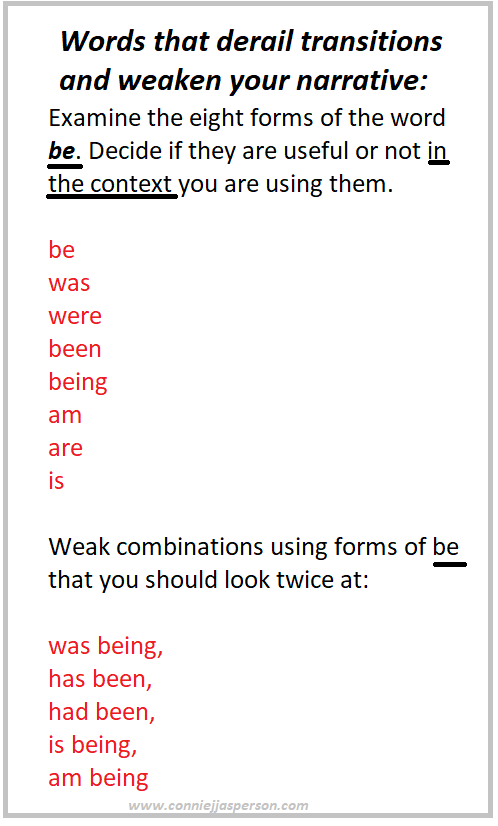 Here are a few things that stand out when I do this:
 If you have the resource of a good writing group, you are a bit ahead of the game. I suggest you run each revised chapter by your group and listen to what they say. Some of what you hear won’t be useful, but much will be.
 I am fortunate to have excellent friends willing to do this for me. Their suggestions are thoughtful and spot-on.
 Characters: Is the point of view character (protagonist) clear? Did you understand what they were feeling? Were they likable? Did you identify with and care about them? Were there various character types, or did they all seem the same? Were their emotions and motivations clear and relatable?
 Editing is a process unto itself and is the final stage of making revisions. The editor goes over the manuscript line-by-line, pointing out areas that need attention: awkward phrasings, grammatical errors, missing quotation marks—many things that make the manuscript unreadable. Sometimes, major structural issues will need to be addressed. Straightening out all the kinks may take more than one trip through a manuscript.
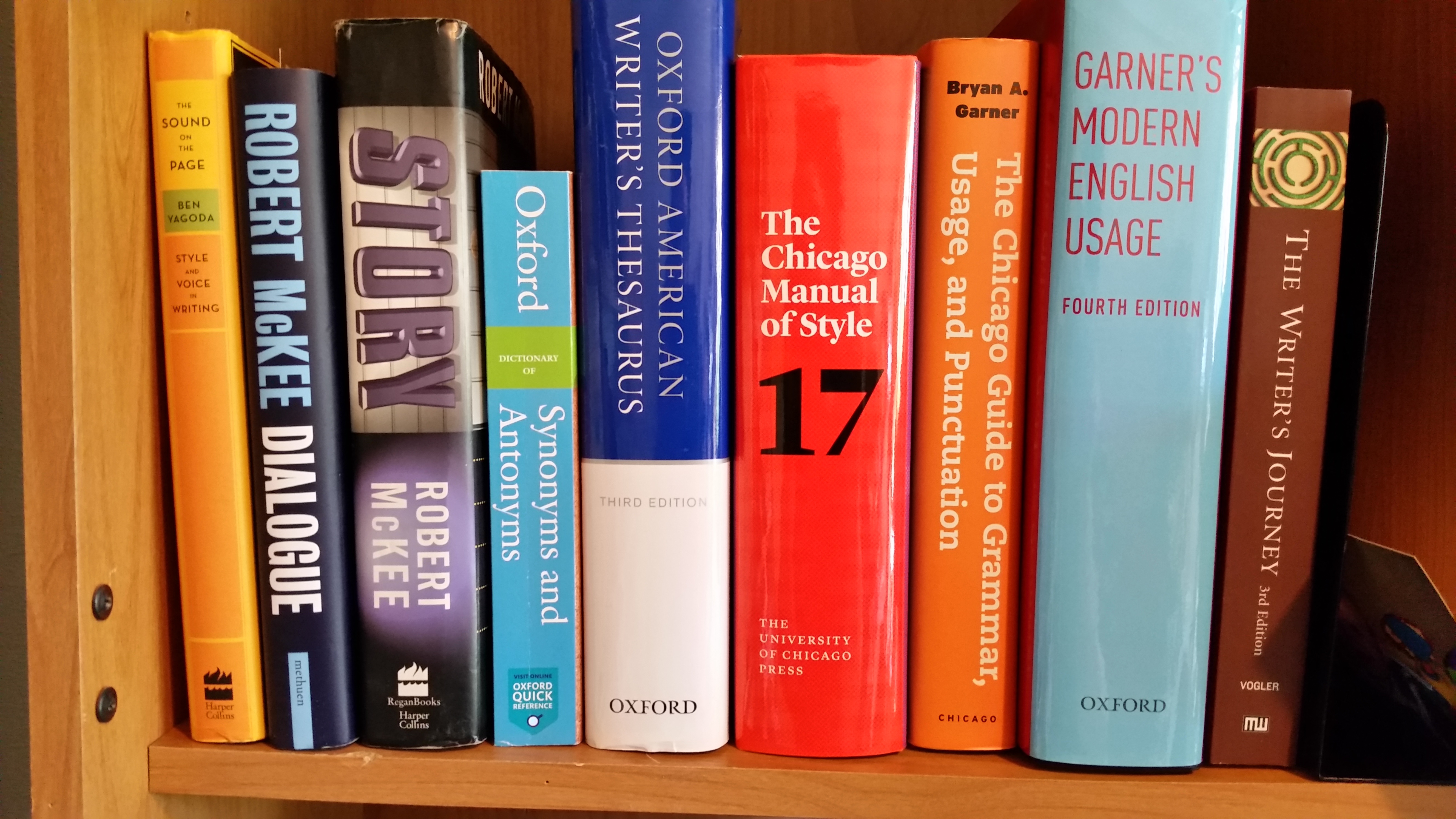 A reader won’t be familiar with it and will notice what we have overlooked.
 When observed by others, a person who is daydreaming appears lazy. Mind-wandering has no obvious purpose, but it is critical for creativity. Every groundbreaking discovery in science, every great invention we enjoy today—all were inspired by ideas that came to a person while thinking about something else or when they were mind-wandering.
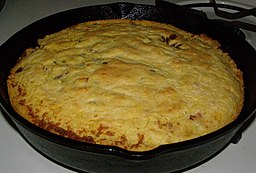 My oldest daughter, looking at our dinner, a casserole of beans with cornbread baked on top like a cobbler: “What the heck is that?”
 Perception is in the eye of the beholder. Observation and thought are seeds that inspire extrapolation, leading the viewer to come away with new ideas. When I see the story captured in a single scene by an artist, my mind always surmises more than the painting shows. I see the picture as depicting the middle of the story and imagine what came before and what happened next. Unintentionally, I put a personal spin on my interpretation, and ideas are born. I don’t mean to, but everyone does.
 This means that daydreaming is actually good for you. It boosts the brain, making our thought process more effective. Letting the mind wander allows a kind of ‘default neural network’ to engage when our brain is at wakeful rest, as in meditation, rather than actively focusing on the outside world. When we daydream, our brains can process tasks more effectively.
 You could be watching the birds, as my husband and I often do. Or maybe you’re perusing the display in a local art gallery or listening to music. I love all genres of music, but for writing I often find inspiration in powerhouse classical pieces such as Orff’s cantata,
  Today, however, I plan a long walk along the beach.
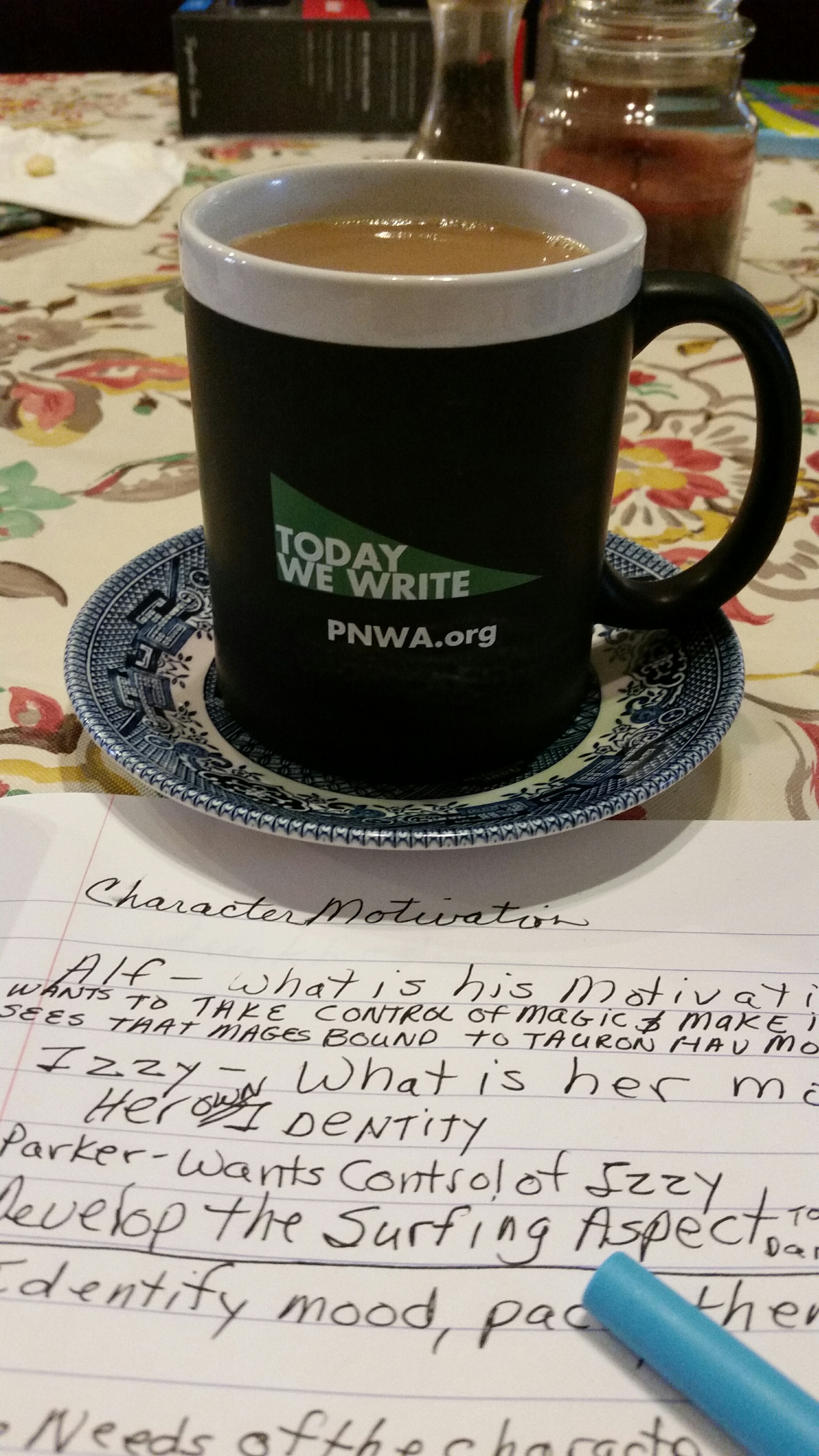 Next week on this blog we will talk about the creative process and the importance of mind-wandering. We’ll also talk about why it is important to beta read for your fellow writers, and how to be a good reader, one who gives positive feedback and offers constructive suggestions.
 I have “pantsed it” occasionally, which can be liberating but for me, there always comes a point where I realize my manuscript has gone way off track and is no longer fun to write. Then I must return to the point where the story stopped working and make an outline.
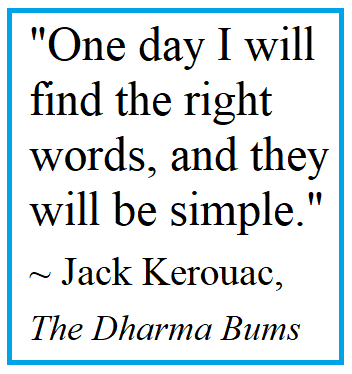 The first tool is a sense of balance. Every published novel has entire sections that were cut or rewritten at least once before it got to the editing stage.
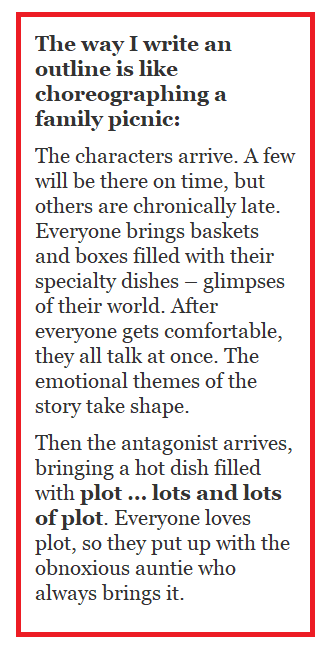
 At first, the page is only a list of headings that detail the events I must write for each chapter. I know what end I have to arrive at. But the chapter headings are pulled out of the ether, accompanied by the howling of demons as I force my plot to take shape:

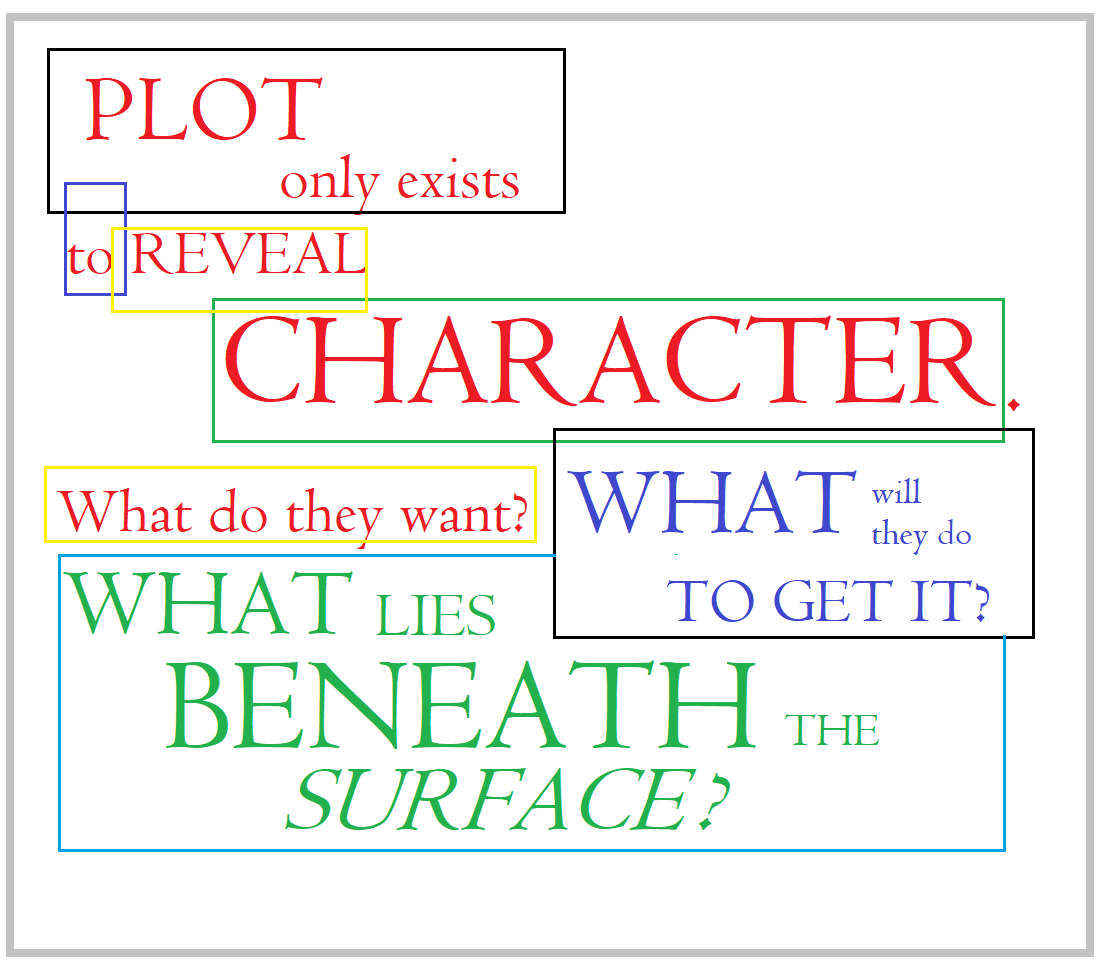
 Some novels are character-driven, others are event-driven, but all follow an arc. I’m a poet, and while I read in every genre, I seek out literary fantasy, novels with a character-driven plot. These are works by authors like
 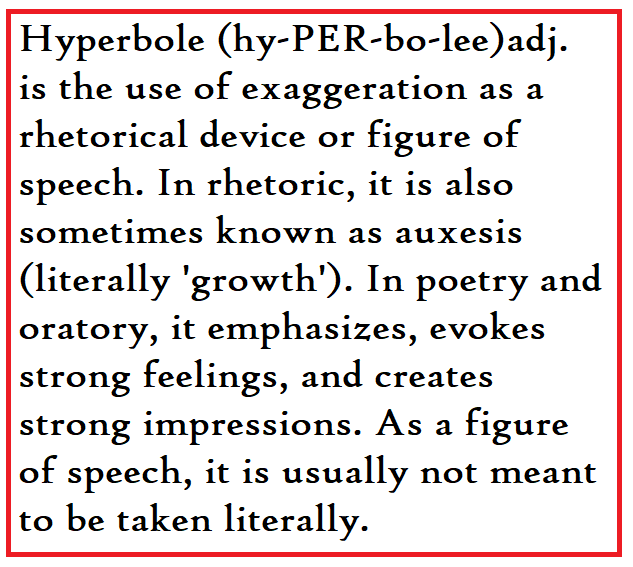 And the prose … words with impact, words combined with other words, set down in such a way that I feel silly even thinking I can write such works. Thankfully, my editor weeds out pretentious hyperbole and slaps me back to reality.
 This part of the novel is often difficult for me to get right. The protagonist must be put through a personal crisis. Their inner world must be shaken to the foundations.
 This emotional low point is necessary for our characters’ personal arcs. It is the place where they are forced to face their weaknesses and rebuild themselves. They must discover they are stronger than they ever knew.
 And what of my female protagonist? Where does her story begin?
 I must introduce a story-worthy problem in those pages, a test propelling the protagonist to the middle of the book. The opening paragraphs are vital. They are the hook, the introduction to my voice, and must offer a reason for the reader to continue past the first page.
 My favorite books open with a minor conflict, evolving to a series of more significant problems, working up to the first pinch point, where the characters are set on the path to their destiny.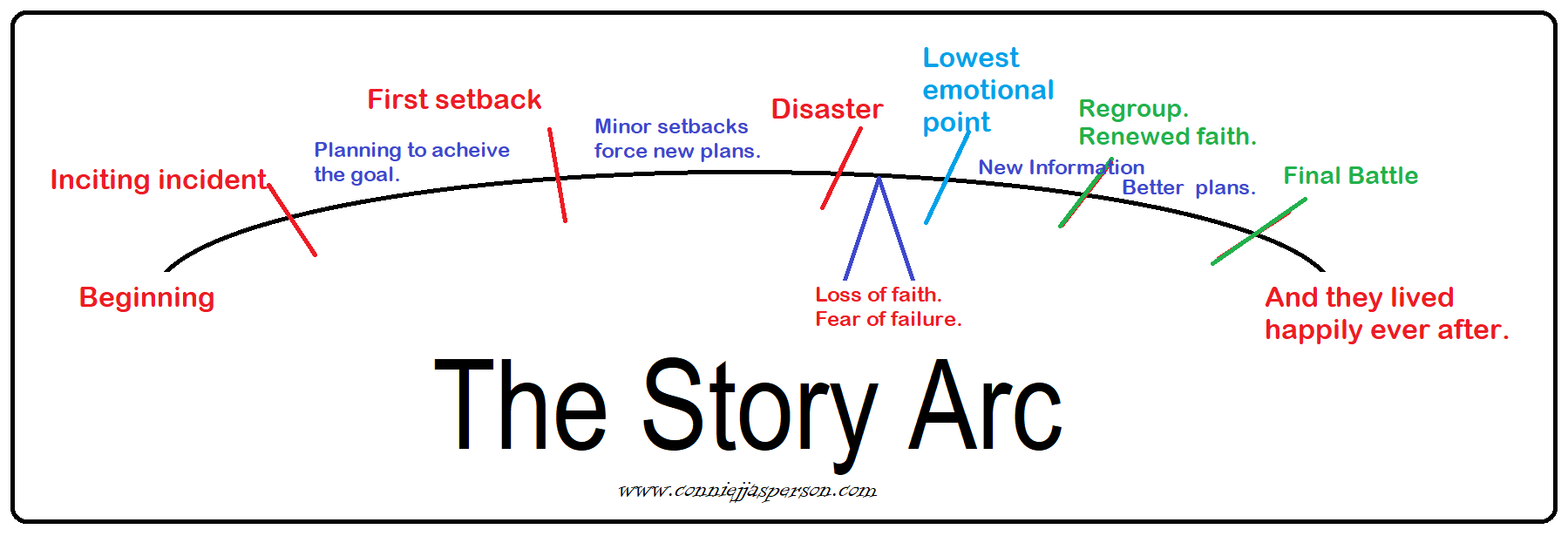


 Life in the Realm of Fantasy
.jpg&oldid=449104554)