
If you have been following my blog, you might know my husband and I are selling our home of eighteen years and moving back to the town we both grew up in. Currently, we live in a small quarry town twenty miles south of the state capitol. It is historic and small. But it is a vibrant town, creative and open to entrepreneurs, and has a close-knit community.
 If I were writing a story starring me as the main character, I would open it in the year 2005 with a couple of empty-nesters buying a house in a bedroom community twenty miles south of Olympia.
But what sort of town is this?
Tenino (Teh-nine-oh) is situated at the southern edge of Thurston County. Many people working for the State of Washington live here because the commute isn’t too bad and homes here are affordable, whereas homes in Olympia are expensive. This town has a long history of boom and bust; quarrymen, loggers, and farmers settled here, and they are still hanging on. But government employees don’t earn as much as private sector employees, and they can afford to buy homes here. So, the demographic is slowly changing.
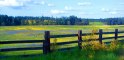
Timber is no longer king here. Nowadays, our town is famous for Wolf Haven International, sandstone art, crafted whiskey, and award-winning wine. We still have a few large cattle ranches out on the Violet Prairie, between Tenino and Interstate 5. But 5-to-7-acre executive “horse properties,” antique stores, cheese makers offering goat yoga, and soap-making classes have found fertile ground here.
In the early 20th century, bootlegging was an industry here (my maternal grandfather’s line of work during prohibition). The distilleries here are the legal continuation of an old tradition.
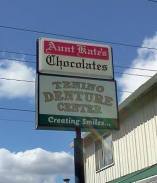 The city center is isolated, twelve miles from the freeway and twenty miles away from every other town in the south county. If a fictional story were set in this town, it would feature the same political and religious schisms that divide the rest of our country. There are other tensions. Some families have been here for generations, and a few don’t appreciate the influx of low-paid state workers buying cookie-cutter tract homes (like mine) here.
Other than those employed by the local businesses, most people commute to work in Olympia or Centralia.
My street is a stretch of rough blacktop with no sidewalks. Most of the driveways, including ours, are paved. Our street runs east and west, with a fabulous view of Mount Rainier rising at the east end.
Homes line our street on both sides, but it’s visually divided. A nicely landscaped manufactured home park is on the north side of the road, across from my front door. On the south side, my side, a long row of forty stick-built homes was tossed up in 2005, just before the housing bubble crashed.
And I do mean tossed up. Some things that went into building these houses were bottom-of-the-barrel bargains, cheap toilets, cheaper water heaters, and improperly installed bathtubs—all things that failed and were replaced over the last eighteen years.
The row of homes on my side is nearly identical to each other, as there are only two types of floor plans, one for three bedrooms (mine) or the four-bedroom version. People have made their homes as unique as possible. For a few years, we had the only house with an orange door, but now our door is white, as we had to replace it and never got around to painting it.
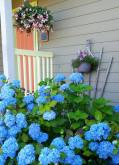 Two inches of rain fell the day we moved into our brand-new home in 2005, making moving our furniture into this house a misery. Our new house had no landscaping and rose from a sea of mud and rocks. With a lot of effort, we made a pleasant yard. When the housing bubble burst in 2008, many people on my side of the street lost their jobs, and some homes went into foreclosure.
Flippers found a wealth of projects here. For several years, wherever there were two or more empty houses, it looked somewhat like a ghost town.
That has changed. Now we are bustling, people walking up and down the street to and from the store.
Tenino has one grocery store, which also has a hardware store inside. The market carries the basics, but the quality of their fresh produce can be iffy. You really have to check the pull dates on things like eggs, hummus, and cottage cheese. It’s far more affordable to shop in Olympia.
However, the meat department sources beef from a local ranch. Their meat department smokes their own ribs and other cuts. Carnivores love this place because the wind carries the smoky aroma all over the neighborhood.
Even Tenino is changing with the times, with more hybrid cars in the parking lots. A large wind farm graces the top of the hills south of here. The store has always carried tofu but has lately begun carrying some plant-based sources of protein and dairy-free ice cream. That discovery was a Hallelujah moment for those of us with milk sensitivity!
 Our main street, Sussex, passes through a historic district. The buildings are all built from sandstone quarried at the old quarries. Many of the old buildings are home to antique stores. The masonic lodge is made of Tenino sandstone.
It’s a slice of rural America with a Northwest twist, a quiet town that is the perfect setting for a paranormal fantasy or a murder mystery.
What about my immediate environment? In the morning, birdsong fills the air. Robins, wrens, finches, hummingbirds, crows, Stellar’s jays, mourning doves – the neighborhood borders Scatter Creek and is alive with birds.
During the day, I can hear the children playing at the school. In the evening, the neighborhood is filled with the sounds of kids playing in each other’s yards.
Highway 507 passes through the center of town, becoming Sussex Street. The sounds of traffic, from semi-trucks to sirens, occasionally vie with the horns from freight trains passing at the west end of town.
Even so, it’s a quiet place, a good place to live.
We’re sad to leave here, but it’s the right thing to do. We have rented an apartment and will be completely resettled by the middle of June. Our new home is in a terrific neighborhood, with easy access to shops and restaurants. It will be intriguing to rediscover the world we left behind and to see how it has changed since we left there.
The setting of your story is a multipurpose layer embedded in the depths, and is itself comprised of layers: sounds, scents, and visual details. It shows the immediate area and conveys your characters’ society, political climate, and economic class. These aspects are subtle, yet they’re as fundamental to the story as the blood in your veins. And like that blood, we only notice it when something draws our attention to it—which usually happens at inconvenient moments.
As an exercise, visualize your own community and write a word picture of it as if you were telling me about it. Then imagine the community your characters live in and write a word picture of how they would describe their world. Feel free to post your word-pictures in the comments!
 In writing, we add depth and contour to our prose by how we choose and use our words. We “paint” a scene using words to show what the point-of-view character is seeing or experiencing. Yes, we do need to use some modifiers and descriptors.
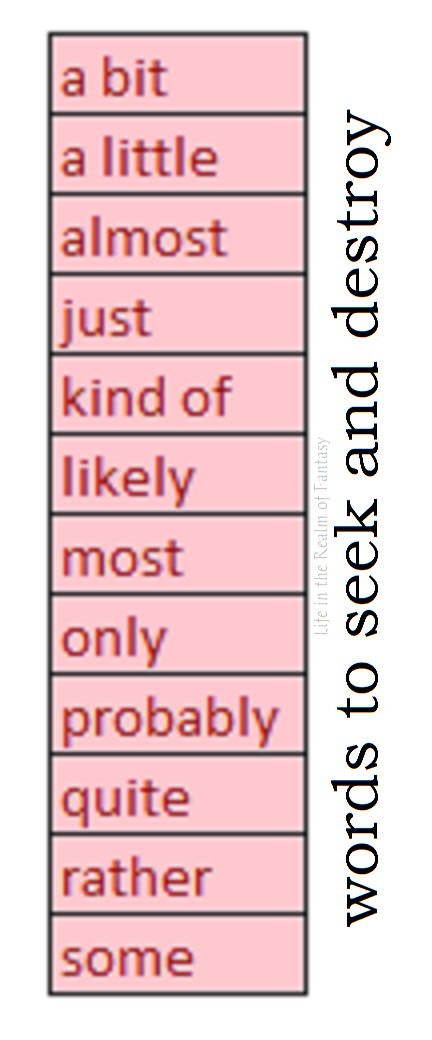
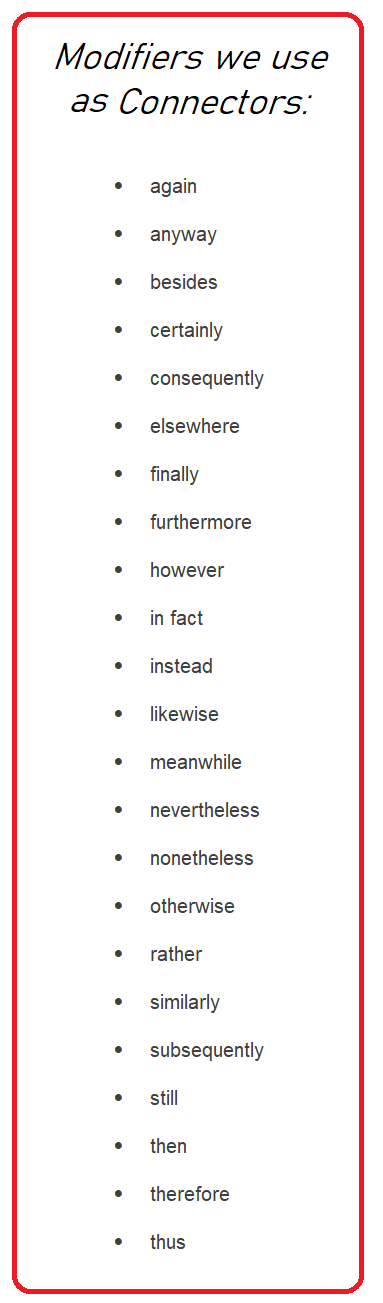 One of the cautions those of us new to the craft frequently hear are criticisms about the number of modifiers (adjectives and adverbs) we habitually use. This can hurt, especially if we don’t understand what the members of our writing group are trying to tell us.
 In the above sentence, the essential parts are structured this way: noun – verb (sunlight glared), adjective – noun (cold fire), verb – adjective – noun (cast no warmth), and finally, verb-article-noun (burned the eyes). Lead with the action or noun, follow with a strong modifier, and the sentence conveys what is intended but isn’t weakened by the modifiers.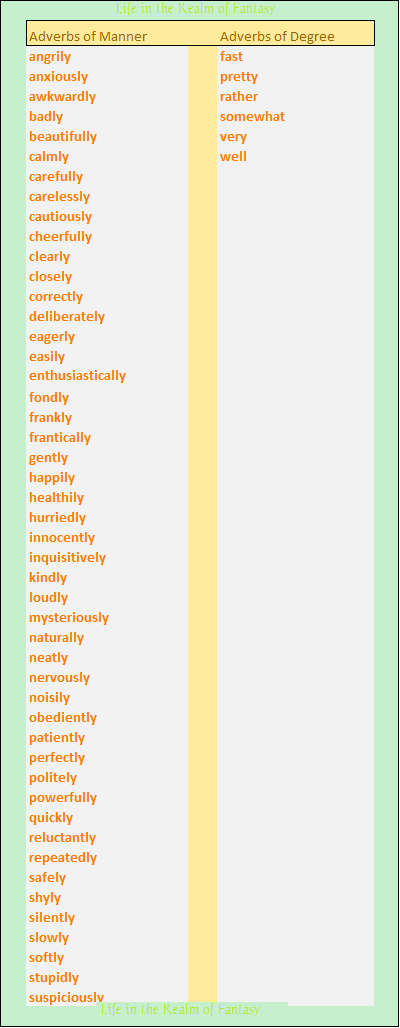
 In his book,
 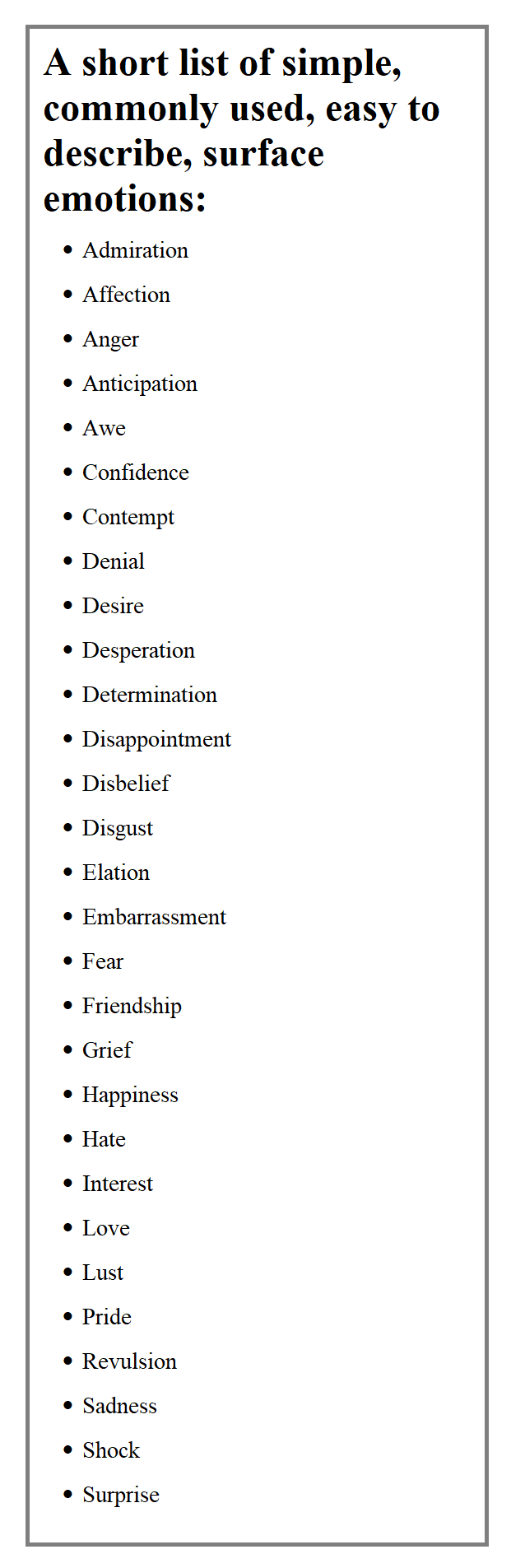 Truthfully, I find detailed descriptions of facial expressions to be boring and sometimes off-putting. Every author armed with a little knowledge writes characters with curving lips, stretching lips, and lips doing many things over, and over, and over … with little variation.
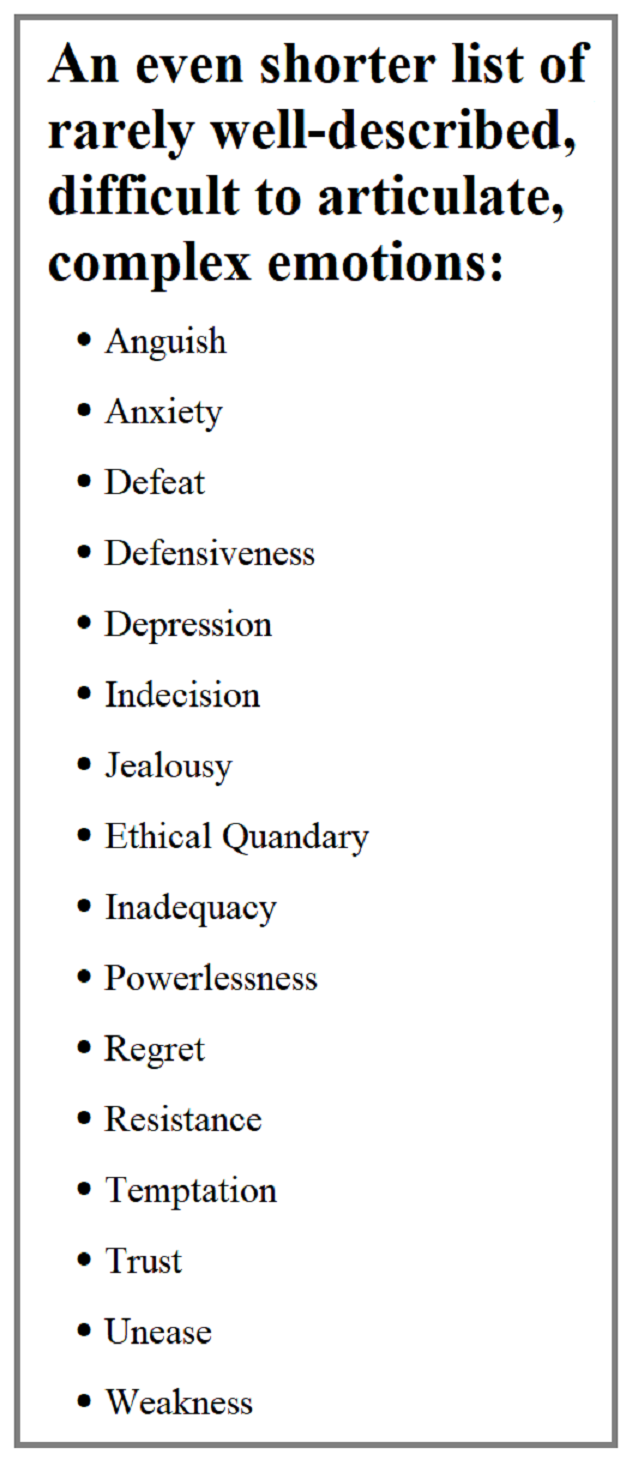 Simplicity has an impact, but I struggle to achieve balance. When looking for words with visceral and emotional power, consonants are your friend. Verbs that begin with consonants are powerful.
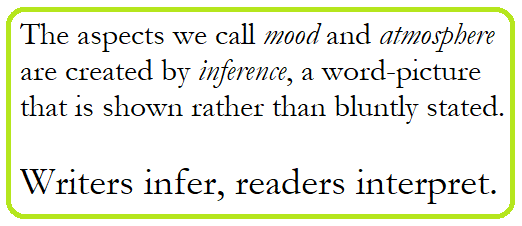 Mood is long-term, a feeling residing in the background, going almost unnoticed. Mood affects (and is affected by) the emotions evoked within the story.
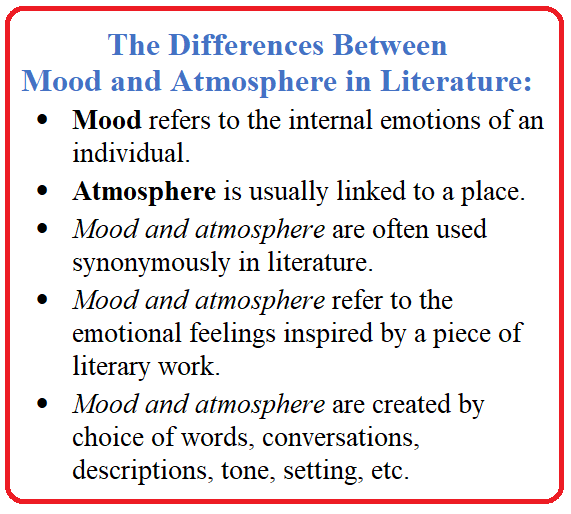 Undermotivated emotions lack credibility and leave the reader feeling as if the story is flat. In real life, we have deep, personal reasons for our feelings, and so must our characters.
 Robert McKee tells us that the mood/dynamic of any story is there to make the emotional experience of our characters specific. It makes their emotions feel natural. After all, the mood and atmosphere
  We know our story has a beginning, a middle, and an end. We sense something murky and mysterious in the middle. We instinctively know the pond is made up of layers, although we may not consciously be aware of it or be able to explain it.
 Surrealism seeks to release the creative potential of the unconscious mind, for example, by the irrational juxtaposition of images—think
  All the characters have reasons for their actions. The author offers implications and lets the reader come to their own conclusions. The reader sees the hints, allegations, and inferences, and the underlying story of each character takes shape in their mind.
 This layer will be shallower in Romance novels because the book’s point isn’t a more profound meaning—it’s interpersonal relationships on a surface level. However, there will still be some areas of mystery that aren’t spelled out entirely because the interpersonal intrigues are the story.
 This is the interpretive level:
 The commonly bandied proverbs of writing are meant to encourage us to write lean, descriptive prose and craft engaging conversations. These sayings exist because the craft of writing involves learning the rules of grammar, developing a broader vocabulary, developing characters, building worlds, etc., etc.
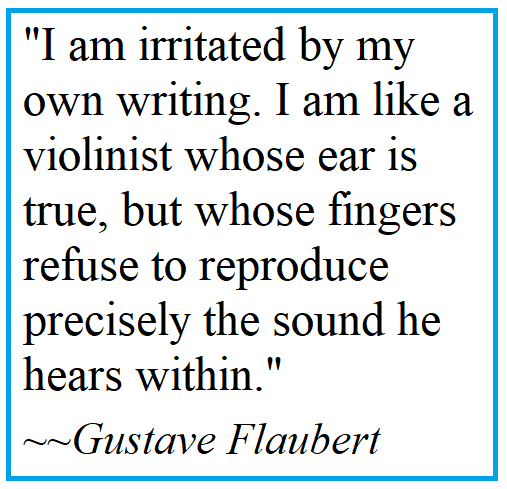 Then, there are the stories where the author leans too heavily on the internal. Creased foreheads are replaced with stomach-churning, gut-wrenching shock or wide-eyed trembling of hands.
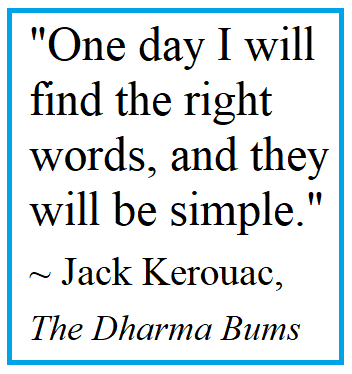 Indeed, we shouldn’t be married to our favorite prose or characters. Sometimes we must cut a paragraph, a chapter, or even a character we love because it no longer fits the story. But have a care – people read for pleasure. Perhaps that phrase does belong there. Maybe that arrangement of words really was the best part of that paragraph.
 Handy, commonly debated mantras become engraved in stone because proverbs are how we educate ourselves. Unless an author is fortunate enough to have a formal education in the subject, we must rely on the internet and handy self-help guides to learn the many nuances of the writing craft.
 We have gotten a grip on my husband’s battle with
  LSVT BIG therapy
 Mornings usually find us wondering what we can get done that day, and evenings are often spent contemplating what could have gone better. I write whenever I can, and often end up rewriting something that seemed like a good idea at first, but which no longer works.
 We add depth and dimension to our work layer by layer. Some layers are more abstract than others, but each layer adds an element that gives a sense of reality to the fictional world.
 The mayor likes their community’s small-town feeling and ambiance and doesn’t want it to change. Her husband is trapped, as his job is to ensure his employer gets their foot in the door. He struggled for years to rise to his current position and can’t imagine giving it up.
 And we, the readers, desperately want our protagonist, the mayor, to get up and go to the coffeemaker. We can’t rest until we know if she either gets up and steps away from the table or someone notices the abandoned backpack and clears the meeting room.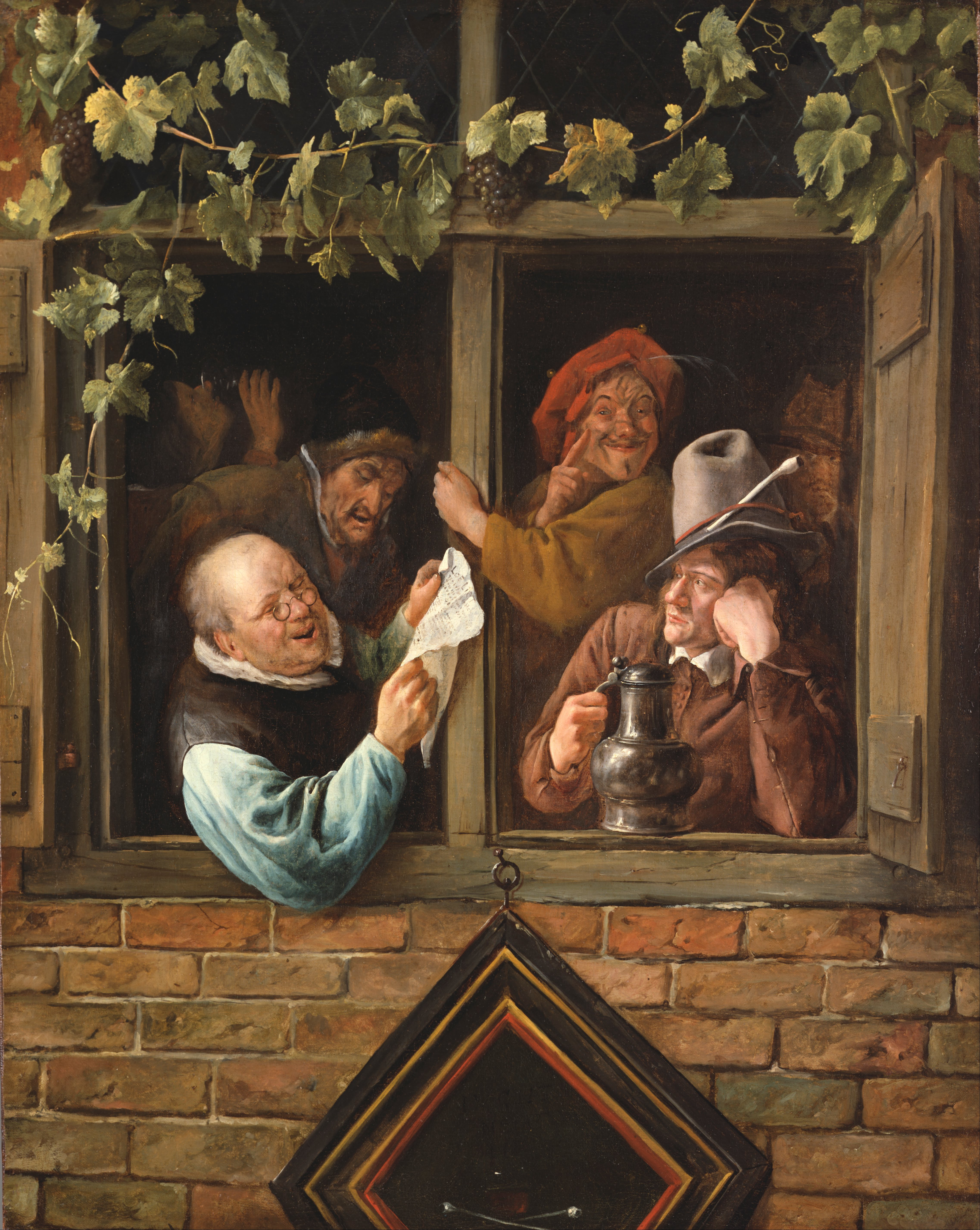
 I will have to spend a day or two thinking about the story as a whole and writing an outline as a framework to guide the story. The plot points I originally planned to occur at each of the four quarters of the story will be met, but how?
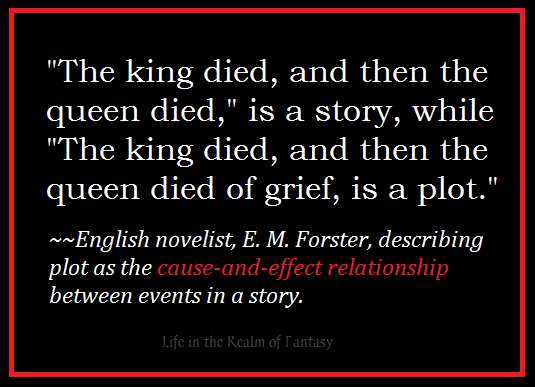 The midpoint of the story arc is often where the protagonists lose their faith or have a crisis of conscience. Something terrible happens, and they must learn to live with it.
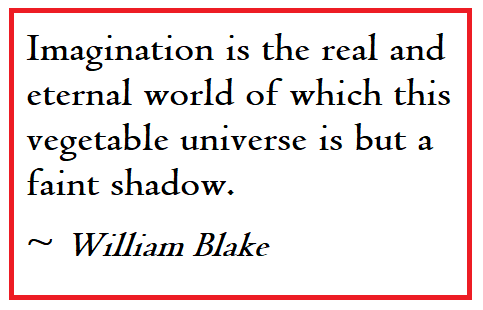 So, starting at the end, I look at my characters’ location when the story finishes. Then I ask myself what they were doing just before the final encounter.


 Life in the Realm of Fantasy