
Today we’re continuing our discussion of characterization by examining the nebulous antagonist.
 In many thrillers and cyberpunk novels, the faceless behemoth of corporate greed is the overarching antagonist. It can be represented by characters who are portrayed as utterly committed to doing their job and loyal to their employer. In many cyberpunk novels, the antagonists tend to be goons-in-suits, enforcers who work for the corporation.
In fantasy, the nebulous antagonist might be a powerful queen/king or sorcerer whose forces/minions the protagonist must defeat.
The ultimate mind behind the conflict is a person they might not meet face to face. How the protagonist reacts internally to the threat posed by the machinations of those distant antagonists is the story.
While the true enemy might be a faceless power supporting the intrigues of their servants, their laws and rules are the ultimate evil that must be defeated.
Alternatively, the enemy might be a technological breakdown in hard sci-fi and sometimes in contemporary military novels. The novel Level 7 by Mordecai Roshwald was a groundbreaking example of this:
From Wikipedia:
Level 7 is a 1959 science fiction novel by the Ukrainian-born Israeli writer Mordecai Roshwald. It is told from the first-person perspective (a diary) of a modern soldier, X-127, living in the underground military complex Level 7, where he and several hundred others are expected to reside permanently. X-127 fulfills the role of ‘push-button’ offensive initiator of his nation’s nuclear weapons capacity against an unspecified enemy. X-127 narrates life within a deep shelter before, during, and after a nuclear war that wipes out the human species. [1]
Just so you know, the book doesn’t end well—I read it in high school.
The enemy could be a military coup or a mega-corporation whose “guards” are really an elite military. A few soldiers could represent the antagonist and enforce their wishes. Getting to know those characters and their motives adds depth to the story.
We’ve all seen disaster movies like Titanic and Twister. We know the enemy can be the environment. Andy Weir in The Martian made the planet of Mars the antagonist.
I love the notion of the faceless behemoth that threatens all we love. When a novel has an immense, nebulous antagonist, the possibilities for creating the hazards that impede the heroes are endless. Giant waves, hurricanes, weapons of mass destruction–these are worthy obstacles our protagonists must surmount.
Fear makes the risk feel genuine to the reader. To show great evil in genre fiction, we take that which is damaging and destructive to an extreme and show the emotion of living through that experience.
When we are writing a story where the root of evil is represented by its minions, the perception of corruption and the evil humans are capable of sometimes horrifies us. As a character, the mega-villain can be shown in the actions of certain employees who don’t consider the human cost of their loyalty.
 This type of psychopathic antagonist is explored exceedingly well in George Saunders’ brilliant sci-fi short story, Spiderhead, a short story in the award-winning compilation, Tenth of December.
For a reader, perception and imagination are everything. As children, what we infer from the visible evidence in a dark room after the lights have been turned out can be terrifying.
We’re still subconsciously hunter-gatherers, always watching for lions and tigers (oh my). As children, the formless monster lurking in the darkness of our room terrifies us until we discover the truth: several toys were piled there and never put away.
As adults, what we infer from the visible evidence in a dark story can be equally terrifying. Thus, you can write dark, frightening scenes but don’t have to be utterly graphic.
No matter how right the cause, war is an evil that is too large to personify and is challenging to make sympathetic. But sometimes, war, a faceless blob of evil, is the proper villain for the narrative. We represent that evil in the actions taken by the characters.
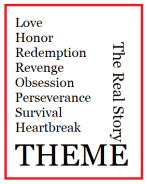
I try to choose a single word (and its synonyms) to characterize my antagonist, even when it is something as significant as a pandemic. That one word becomes the theme, the underpinning of how evil is portrayed.
In one of my practice short stories, I used the word escape as the theme. The first paragraph opens with that word, and every synonym for escape is used to underscore that thread woven throughout the story.
Another example is the word corruption. We tend to think of it as referring only to illegal activities, but it has many meanings and uses. Its synonyms are bribery, debasement, debauchery, decadence, degeneracy, distortion, exploitations, fraud, and immorality.
We view the antagonist through the protagonist’s eyes, so a strong theme that colors the enemy with a perception of corruption drives home the evil they represent.
Someone—and I wish I could remember who—said a few years ago in a seminar that the author is the character’s attorney, not their judge.
This is an important distinction and applies to villains as much as it does the heroes.
 When evil is a behemoth on the order of a mega-corporation or a military coup, the villains who represent it all have reasons for their loyalty. They’re like the hero; they care intensely, obsessively about something or someone. They have logical motives for supporting what we are portraying as the enemy. Our job as authors is to make those deeply held justifications the driving force behind their story.
True villains are motivated, logical in their reasoning, and utterly convinced of their moral high ground. They are creatures of emotion and have a backstory. As the author and their lawyer, you must know what their narrative is if you want to increase the risk for the protagonist.
As always, the reader doesn’t need to wade through an info dump, but you, the author, need to know those details. Having this backstory to draw on will make your characters easier to flesh out. Hints of their thought processes and motivations will emerge gradually.
But more importantly, once we know what drives them all, we know what is at stake for those who represent your antagonist. You will understand how much they are willing to sacrifice for it.
Credits and Attributions:
Wikipedia contributors, “Level 7 (novel),” Wikipedia, The Free Encyclopedia, https://en.wikipedia.org/w/index.php?title=Level_7_(novel)&oldid=1132228006 (accessed February 12, 2023). [1]
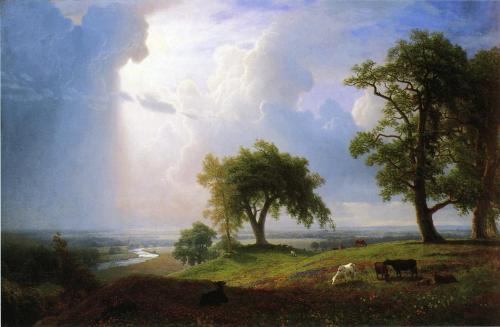 Artist: Albert Bierstadt (1830–1902)
 Volume control is a crucial part of the overall pacing of your story. “Loud” deafens us and loses its power when it’s the only sound. However, like the opening movement of Beethoven’s 5th Symphony, the entire range of volume can be effectively used to create a masterpiece.
 Dark emotions, such as depression, can be shown through a character’s reactions to things that once pleased them. Perhaps they no longer find beauty in the things they once enjoyed.
 Visceral reactions are involuntary—we can’t stop our face from flushing or our heart from pounding. We can pretend it didn’t happen or hide it, but we can’t stop it. An internal physical gut reaction is difficult to convey without offering the reader some information, a framework to hang the image on.
 Conflict keeps the protagonist from achieving their goals. Significant conflicts and emotions are easy to write about. But in real life, our smaller, more internal conflicts frequently create more significant roadblocks to success than any antagonist might present.
 In real life, we are drawn to certain people and get to know them better through conversations.
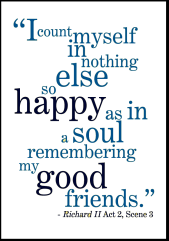
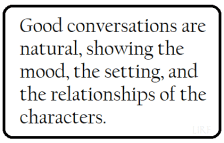
 Good conversations and mental dialogues bring written characters to life and turn them into people we want to know, our closest friends.
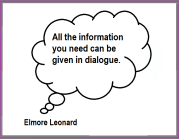
 Internal dialogues (rambling thoughts) are often a thinly disguised info dump in my first drafts. I seek those out in the second draft and either cut them to a line or two or eliminate them entirely. I try to avoid italics if possible, so this is how I write thoughts nowadays:
 However, I have no problem understanding an accent and visualizing a character as foreign when the author consistently uses one or two well-known words that a non-native speaker might use, such as si, ja, or oui, in place of yes. Most English speakers recognize and know the meaning of these words when they see them. All it takes is a straightforward word to convey the proper foreign flavor.
 The laws of grammar sometimes break down on the quantum level in conversations with our friends. This is also true of written exchanges.
 Rule 3: Commas—Do not place a period between the closed quotes and the dialogue tag. Use a comma because when the speech tag follows the spoken words, they are one sentence consisting of clauses separated by a comma: “I’m here,” he said.
 Conversations, both spoken and internal, light up and illuminate the individual corners of the story, bringing the immensity of the overall story arc down to a personal level.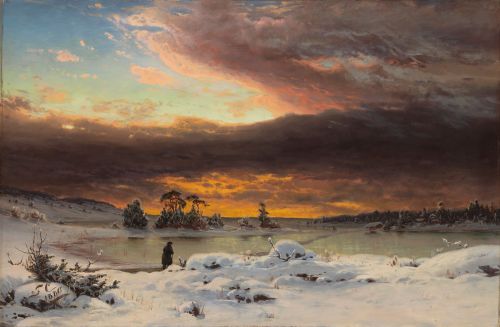
 In his book,
 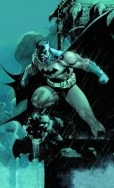 Batman is a
  Apollo 13 (April 11–17, 1970) was the seventh crewed mission in the
  No matter what genre we write in, when we design the story, we build it around a need that must be fulfilled, a quest of some sort.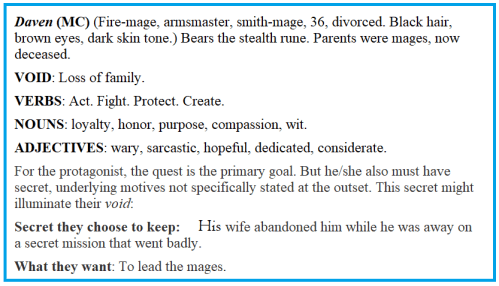
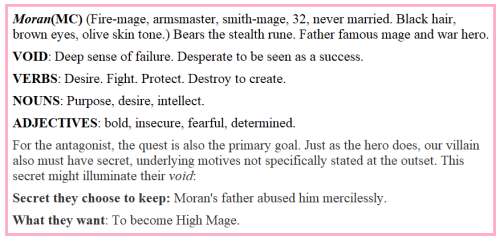
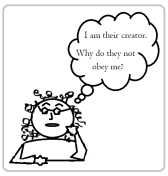 I recently had a manuscript undergo a complete change from what I originally planned. The original antagonist had such an engaging story that he had become more important to me than the protagonists.
 As a reader, I dislike discovering the author is at a loss as to what their protagonist wants. Without that impetus, they don’t have a good reason for the villain to be there either. Random events inserted to keep things interesting don’t advance the story, but motivation does.
 You’ve taken them through two revisions and think these characters are awesome, perfectly drawn as you intend. The overall theme of the narrative supports the plot arc, and the events are timed perfectly, so the pacing is good.
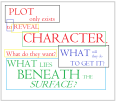 But in real life, I often find little distinction between heroes and villains. Heroes are often jackasses who need to be taken down a notch. Villains will extort protection money from a store owner and then turn around and open a soup kitchen to feed the unemployed.
 Both heroes and villains must have possibilities – the chance that the villain might be redeemed, or the hero might become the villain. As an avid gamer, I think of this as the “
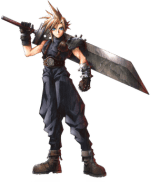 In Final Fantasy VII, the 1997 game that started it all, we meet Cloud Strife, a mercenary with a mysterious past. Gradually, we discover that, unbeknownst to himself, he is living a lie that he must face and overcome to be the hero we all need him to be.
 I try to keep the ensemble narrow in my work, limiting points of view to only one, two, or three characters at most. I keep the core cast limited to four or five, as it takes a lot of effort to show more people than that as being separate and unique.
 Moriarty’s characters are immediately engaging. They sucked me into their world in the opening pages. I couldn’t set the book down, as I wanted to know everyone’s dark secrets. I was hooked; I had to understand what led these people to book themselves into that exceedingly unusual health spa.
 The guests are immediately thrust into an unknown and possibly dangerous environment. The food they are offered is high quality but not what they are used to and varies from guest to guest.
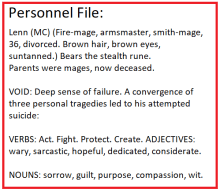 Character Names. I list the essential characters by name and the critical places where the story will be set.
 But what I realized is this—had he lived, my father would be turning one hundred. Our two oldest daughters will be turning fifty. Our two sons are in their mid and late forties, and our youngest daughter, the baby, will be forty.
 This diagnosis has prompted us to downsize and sell our home. We currently live in a tiny, rural town twenty miles south of Olympia, where all the services we need easy access to are located. So now we’re planning to move back to a city of politics, art, and creativity. Since leaving there in 2005, we have enjoyed the quiet of our little quarry town—but now we’re looking forward to seeing plays and attending concerts again.
 We have upped our garbage collection to weekly instead of bi-weekly, and we have no trouble filling that bin with things no sane person would have saved in the first place.
 This behavior occurs on a subatomic level, something to do with
  The most important things we will keep are the memories, things that take up no room and never need dusting. We’ve had family parties for every holiday, including Easter Egg hunts that are legendary among the grandchildren.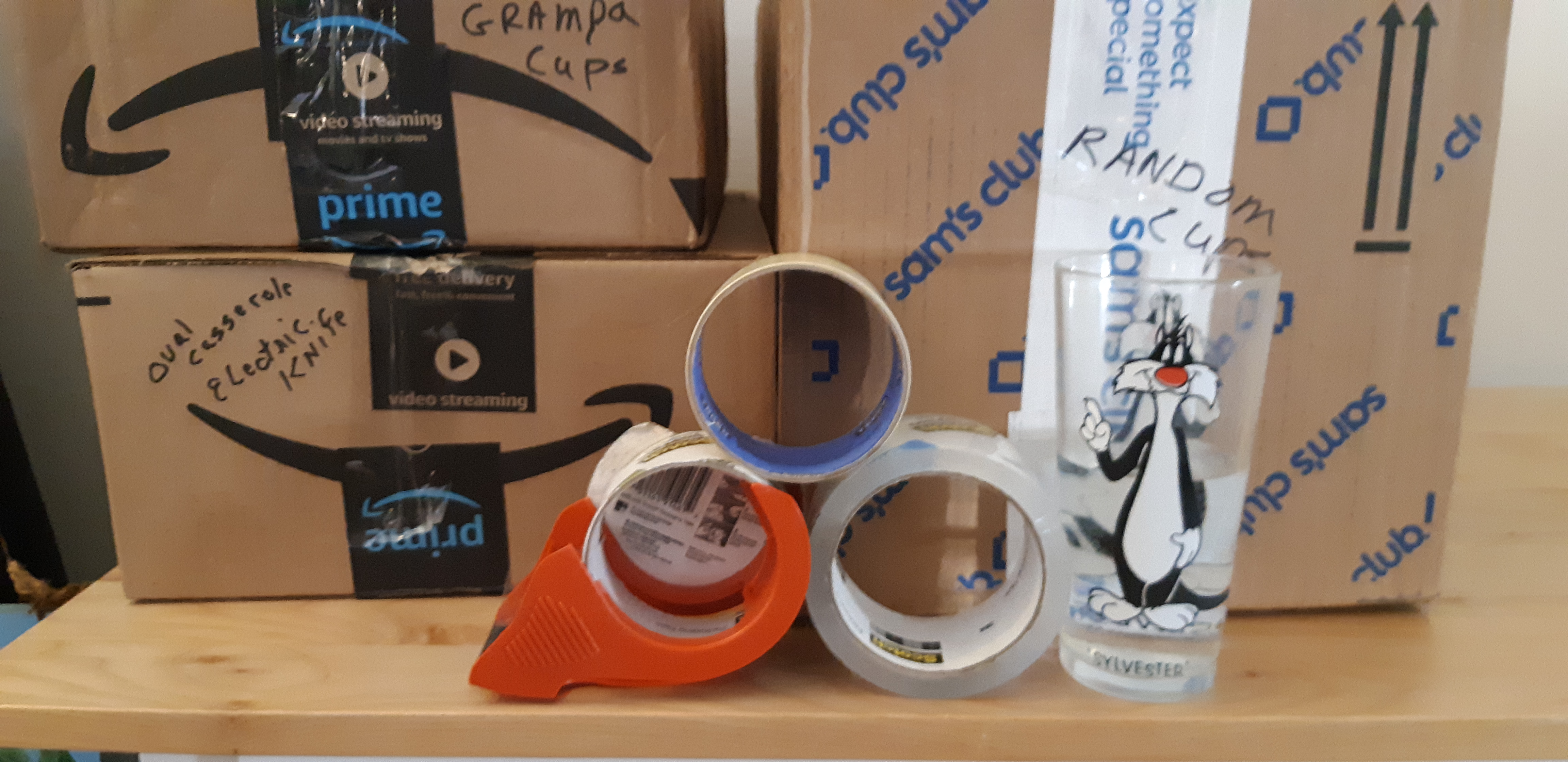


 Life in the Realm of Fantasy