Category Archives: writing

The business side of the business: budgeting for in-person sales events #amwriting

Spring and summer are conference and convention seasons. Regardless of your publishing path, indie or traditional, you must budget for certain things. You can’t expect your royalties to pay for them early in your career. And just so you know, many award-winning authors must still work their day jobs to pay their bills long after becoming bestsellers.

Its a BusinessAt first, getting your books in front of readers is a challenge. The in-person sales event is one way to get eyes on your books. This could be at a venue as small as a local bookstore allowing you to set up a table on their premises.


Or it could be as large as a table at a regional conference or convention.

Signings at writers’ conferences are usually a bit pricy for the number of books you might sell, but they are great ways to network.

What are the minimum costs for working a table at a signing event?

The bare minimum expenses:

You must have a stock of books on hand. You can’t sell books that you haven’t ordered. I order well in advance, as it can take three weeks for an order to arrive via the least expensive shipping method. Paying for overnight shipping of fifteen to twenty books is well out of my price range.

coins

Coins, Microsoft content creators

We must consider the table fee. A bookstore might not charge you anything for the table, but they may take a small cut if they run your sales through their cash registers.

However, large conferences and conventions will charge table fees ranging from $70.00 to as high as $300.00 or more. This varies with the size and type of conference, the venue where the convention is being held, and the vendors you will be competing with.

Sci-fi and Fantasy fan conventions can be quite pricy. You will be in an immense, crowded room, competing with big-name RPG game franchises and movie franchises, plus all the vendors of memorabilia and collectibles that are available in the vendors’ alley.

If you are able to get a table at a major fan convention, you must pay for transportation, food, and lodging. These costs could be gas, parking, airfare, hotel, etc., if you don’t have friends or family in that area. If you are planning to stay in a hotel, take simple foods that can be prepared without a stove. Being vegan, I tend to be an accomplished hotel-room chef, as most coffee bars don’t offer many plant-based options. While that bias is changing, I still go prepared.

Bring at least one pen for signing your books. I bring four or five because sometimes the pens don’t work as advertised.

Square Card Reader 1The final thing you will need is a way of accepting money. I have a metal cash box, but you only need something to hold cash and some bills to make change with. A way to accept credit cards, something like Square, is a good option. You will find a lot of vendors use Square, but there are other options out there.
These things are the bare minimum you will need to provide. At many shows, you’ll be given a table with skirting and a sign attached to the front with your name in block letters. You can get by with this if you’re on a tight budget. New vendors manage with this minimal setup all the time. This option lets you squeak by on little more than the cost of your books. Your setup and teardown time will be short, and you’ll have little to transport—always a positive, in my opinion.

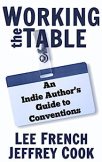
My good friend, Lee French, is a pro when it comes to selling at conventions. She co-wrote the book, Working the Table: An Indie Author’s Guide to Conventions with Jeffrey Cook. She tells us that to really succeed, you’ll need to invest a bit more.

It helps to have some kind of promotional handout. I find bookmarks and business cards are the most affordable option. I know a few authors who have all sorts of little buttons and promotional trinkets relating to their books made. They give them out to everyone who passes their table, buyers or not.

However, most of my friends agree that business cards and bookmarks are the best bang for the buck in promotional material. They are less expensive when purchased in bulk, so I get as many as my budget allows.

You will need a business license to sell books at most conventions. Each state in the US has different requirements for getting these, so do the research and get whatever business license your local government requires. This allows you to get a reseller’s permit, enabling you to buy copies of your own books without paying sales tax. If your state doesn’t assess sales tax, you don’t need this, but you’ll still need the business license.

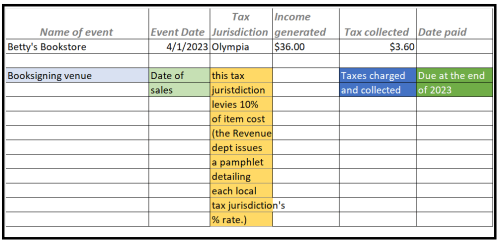
If you live in a state like Washington State, be smart and set aside the money collected as sales tax. It is not yours and shouldn’t be considered part of your income.

Investing in some large promotional graphic, such as a retractable banner, is a good idea. A large banner is a great visual to put behind your chair. A second banner for the front of the table looks professional, but they do require some fiddling with pins.

Lee French suggests getting a custom-printed tablecloth that drops over the front of the table, acting as a banner. It looks more professional, and the books will hold it down, so you don’t have to mess with pins. You can find a wide variety of sizes and shapes of banners and graphic promotional props on the internet.

I have an inexpensive black tablecloth for under my books, but you can get one in the color of your choice. Venues will often provide a white tablecloth, so buying one isn’t necessary, but it makes your display look more professional. Most shows offer a 6×3 table.

steampunk had holding pen smallI suggest buying book stands of some sort. Recipe stands work, as do plate and picture stands. Whether they’re fancy or cheap, be sure you know how to use them properly so they aren’t falling over when someone bumps the table. I use folding plate stands as they store well in the rolling suitcase I use for my supplies.
This brings us to storage and shifting goods. We must move our gear between the table and our vehicle, and sometimes we’re forced to park in inconvenient places. Many people use wheeled bins or fold-up handcarts. Luggage carts are a great, lightweight option when you only have a few books. I use a large wheeled suitcase, as I travel pretty light.

I have a plastic container with a good lid for storing pens, bookmarks/cards, book stands, and other whatnot.

I suggest you keep it simple because the more you add to your display, the longer setup and teardown will take. The shows and conferences I have attended offered plenty of time for this, but I’ve heard that some require you to be in or out in two hours or less.

Aside from the table fee and transportation, Lee French says it will cost about $400 for your stock of books, banners, bookmarks, and odds & ends. The way inflation is going, it may take more than that.

Shop the internet for sales on banners and similar items. You will need to replace bookmarks, business cards, and book stock, but most larger promotional items won’t need to be repurchased for a year or two.

working the tableIf you plan to get a table at a large conference this year, I highly recommend Working the Table: An Indie Author’s Guide to Conventions by YA authors Lee French and Jeffrey Cook. This book has all the tips and tricks you will need to successfully navigate the wild seas of selling your books at conventions.

And if you choose to embark on the in-person event circuit, I wish you good luck and many happy sales.

4 Comments

Filed under writing

#FineArtFriday: Red hollyhocks in the garden of the Ancher family at Markvej in Skagen by Anna Ancher ca. 1916 (revisited)

Anna_Ancher_-_Røde_stokroser_i_haven_ved_Ancher-familiens_hus_på_Markvej_i_SkagenArtist: Anna Ancher  (1859–1935)

Title: English: Red hollyhocks in the garden of the Ancher family at Markvej in Skagen.

Date: circa 1916

Medium: oil on canvas

Dimensions: Height: 63 cm (24.8 in); Width: 47 cm (18.5 in)

Collection: Unknown

Inscriptions: Signature bottom right: A. Ancher

What I love about this painting:

Winters tends to be dark and rainy here in the Pacific Northwest. Sunshine is brief and gloomy skies seem eternal. I need a summer day! I found us this gorgeous painting last year and loved it so much. One of my favorite artists, Anna Ancher gives us a perfect day in Skagen a century ago.

She is mostly known for her interiors, but Anna Ancher captured the essence of summer in this painting. Along with foxgloves, hollyhocks are my favorite summer flowers. Anna’s are beautiful, contrasted against the blue sky. Her eye for color was amazing. The yellow and red flowers perfectly complement the color of the building behind the garden.

I feel so much better for having had this glorious day in Anna’s serene garden.

About the Artist via Wikimedia: Anna Ancher preferred to paint interiors and simple themes from the everyday lives of the Skagen people, especially fishermen, women, and children. She was intensely preoccupied with exploring light and color, as in Interior with Clematis (1913). She also created more complex compositions such as A Funeral (1891). Anna Ancher’s works often represented Danish art abroad. Ancher has been known for portraying similar civilians from the Skagen art colony in her works, including an old blind woman.

While she studied drawing for three years at the Vilhelm Kyhn College of Painting in Copenhagen, she developed her own style and was a pioneer in observing the interplay of different colors in natural light. She also studied drawing in Paris at the atelier of Pierre Puvis de Chavannes along with Marie Triepcke, who would marry Peder Severin Krøyer, another Skagen painter.

In 1880 she married fellow painter Michael Ancher, whom she met in Skagen. They had one child, daughter Helga Ancher. Despite pressure from society that married women should devote themselves to household duties, she continued painting after marriage. [1]


Credits and Attributions:

Anna Ancher, Public domain, via Wikimedia Commons. Wikimedia Commons contributors, “File:Anna Ancher – Røde stokroser i haven ved Ancher-familiens hus på Markvej i Skagen.jpg,” Wikimedia Commons, the free media repository, https://commons.wikimedia.org/w/index.php?title=File:Anna_Ancher_-_R%C3%B8de_stokroser_i_haven_ved_Ancher-familiens_hus_p%C3%A5_Markvej_i_Skagen.jpg&oldid=616771666 (accessed January 14, 2022).

[1] Wikipedia contributors, “Anna Ancher,” Wikipedia, The Free Encyclopedia, https://en.wikipedia.org/w/index.php?title=Anna_Ancher&oldid=1041257716 (accessed January 14, 2022).

5 Comments

Filed under #FineArtFriday, writing

Scenes, pacing, and chapter length #amwriting

Chapter breaks are transitions. I have found that chapter breaks fall naturally at certain places as I write. I’ve discussed this before, but I’m always happy to repeat myself. In my opinion, chapters can be the length they need to be.

chapterLengthWhen we commit to writing daily, our writing style grows and changes. When I began writing, some chapters totaled over 4,000 words.
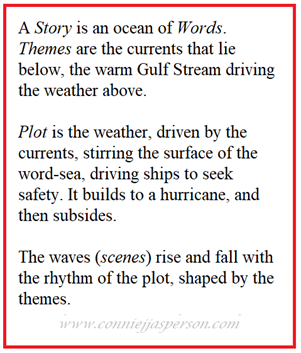
As my writing style evolved, chapters became shorter. Now they average between 1,500 to 2,250. Some will be much shorter and some might be longer if the story demands it.

I try to consider the comfort of my reader. Many readers are like me—they want to finish a chapter in one sitting. Several years ago, I attended a seminar by a well-known author who said he has a specific word-count limit for chapter length.

 I’ve read and enjoyed many books where the authors made each scene a chapter, even if it was only two or three hundred words long. They ended up with over 100 chapters in their books, but the chapter length went unnoticed by me when I read it. L.E. Modesitt Jr. sometimes has chapters of only five or six hundred words, which keeps each point-of-view character’s storyline separate and flows well.

So, chapter length is a personal choice. But it does affect how the pacing of the overall story is perceived by the reader.

pacing memeAs a reader, books work best for me when each chapter details the events of one large scene or several related events. I think of chapters as if they were paragraphs. Paragraphs are not just short blocks of randomly assembled sentences.
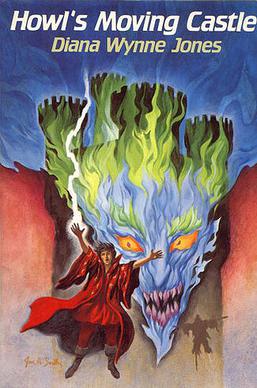
  • A paragraph is a group of sentences that fleshes out a single idea.
  • That means that only one thought or speaker is featured in each paragraph.

Chapters are hard breaks. They are like paragraphs and can affect the overall pacing of the narrative. Packing too many unrelated ideas into one place makes them feel erratic and disconnected and throws off the pacing. It’s only my opinion, and in the end, you must decide what your style is going to be.

The way an author handles transitions is the key to a smooth, seamless narrative. As discussed in my previous post, a transition is a connecting scene moving the story forward to the following incident.

Conversely, the transition can be a scene that opens or closes a chapter by offering a tidbit of information that compels the reader to turn the page—the hook:

Conversations should detail something one or more characters don’t know.  A conversation is an opportunity to close a scene or chapter with a hook.

Fade-to-black: I’m not too fond of fade-to-black transitions except as a finish to a chapter. Fading-to-black in the middle of a chapter makes the story feel mushy.

Hard scene breaks: Sometimes, we must indicate that a space of time has passed with nothing happening that’s important or worth wasting words on. When a length of time has passed between the end of one scene and the beginning of the next, it makes sense to use the old 1-2-3:

  1. Wind the scene up with a firm finish.
  2. Leave the reader with a hook that makes them want to turn the page.
  3. Start a new chapter.

Sometimes an event occurs where more than one character has a point of view that needs to be shown. How you navigate this will significantly affect the readability of the narrative.

Most readers find it easier to follow the story when they are only in one character’s mind for the majority of the narrative.

If you switch POV characters, I strongly suggest changing scenes with a hard, visual break such as a blank space between paragraphs or ending the chapter.

Some editors suggest you change chapters, no matter how short when you switch to a different character’s point of view. That is my choice also, as a hard transition between characters is the best way to avoid head-hopping.

Head-hopping: first, you’re in his head, then you’re in hers, then you’re back in his—it gives the reader “tennis neck” and makes following the storyline difficult.

Howl's_Moving_Castle_(Book_Cover)I’ve mentioned before that one of the complaints some readers have with Robert Jordan’s brilliant Wheel of Time Series is how he wandered around between storylines as if he couldn’t decide who the main character was.
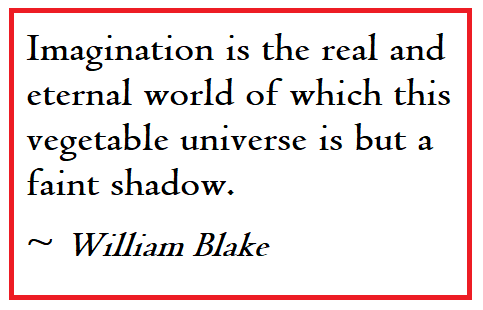
Then there is Howl’s Moving Castle, by Diana Wynne Jones. She consistently wrote two points of view into one paragraph. The story and characters are brilliant, but that habit made the dialogue difficult to follow in some places.

I don’t write at the level of Robert Jordan’s or Diana Wynne Jones’s prose and storytelling, so I try to focus on one storyline per scene and not head hop.

Now we come to a commonly asked question: Should I use numbers or give each chapter a name?

There is no rule—only authorial preference.

What is your gut feeling about how you want to construct this book or series? If good titles pop up in your mind for each chapter, by all means, go for it. Otherwise, numbered chapters are perfectly fine and don’t throw the reader out of the book.

Whether you choose numbered or titled chapter headings, be consistent and stay with that choice for the entire book.

To sum things up:

  • Limit point of view characters to one per scene.
  • Each chapter should detail related scenes and events rather than a jumble of unrelated happenings.
  • In regard to chapter length, you, as the author, must decide what the right word count is.
  • End your chapters at a logical place, but doend each chapter with a hook that begs the reader to continue on to the next chapter.

One final thing – Some literary contests and publications have a “novella,” a “novelette,” and a “short story” category. The length for these categories is based on word count.

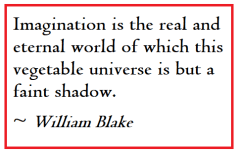
WilliamBlakeImaginationLIRF05072022Short stories run up to 7,000 words, with under 4,000 being the most commonly requested length. 7,500–17,500 is the expected length for novelettes, and between 17,500 and 40,000 words are the standard length for novellas.
Short stories are constructed like novels but with one difference. If you are writing a short story, dividing it into chapters isn’t an option, but you may feel that a hard break is required at the end of a scene. In that case, editors with open calls for short stories will often ask that you insert an asterisk or hashtag to indicate a hard scene break.

Longer novelettes might have chapters. Novellas will probably be broken into chapters. The piece’s length determines whether or not hard chapter breaks are useful.

We each have an idea of how we want our finished work to look. We know what works for us as readers. Go with your gut, and chances are you will do fine.

2 Comments

Filed under writing

Information, Pacing, and the Function of the Transition Scene #amwriting

The transition scene is the hardest part of a story for me to figure out when writing the first draft. I get stuck, trying to decide what information needs to come out and what should be held back. I forget that the first draft is only the foundation.

transitionsIn my work, the first draft is really more of an expanded outline, a series of scenes that have characters doing things. But those scenes need to be connected so each flows naturally into the next without jarring the reader out of the narrative.
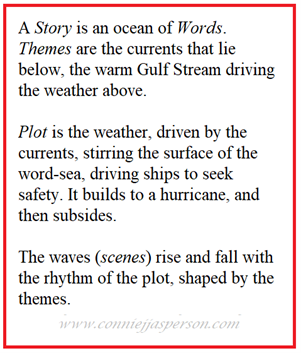
My first draft manuscript is finished in the regard that it has a beginning, middle, and ending. But it’s only a skeleton, a pile of bones I’ve unearthed, waiting for the anthropologist’s forensic reconstruction. It still needs muscles and heart and flesh.

In a story, muscle is applied to the bones in the form of the transition scene. Transition scenes propel the weight of the narrative, pushing things forward. Action, transition, action, transition—this is called pacing.

Pacing of a story is created by the rise and fall of action. We have our characters do a little something, then they show something, then they tell us something, and it begins again.

I picked up my kit and looked around. No wife to kiss goodbye, no real home to leave behind, nothing of value to pack. Only the need to bid Aeoven and my failures goodbye. The quiet snick of the door closing behind me sounded like deliverance.

The character in the above transition scene completes an action in one scene and moves on to the next event. It reveals his mood and some of his history in 46 words and propels him into the next scene.

He does something: I picked up my kit and looked around.

His emotional state is shown through his thoughts: No wife to kiss goodbye, no real home to leave behind, nothing of value to pack. Only the need to bid Aeoven and my failures goodbye.

The scene is concluded with one last thought and an action that pushes him to the next event: The quiet snick of the door closing behind me sounded like deliverance. The door has closed, there is no going back, and he is now in the next action sequence. We find out who and what is waiting for him on the other side of that door.

pacing memeWe are always told, “Don’t waste words on empty scenes.” I find this part of the revision process the most difficult. Frankly, I have a million words at my disposal, and wasting them is my best skill.

Most fiction has one thing in common regardless of genre and tropes: characters we can empathize with are thrown into chaos-with-a-plot.

To make an enjoyable story out chaos, we must have an underlying foundation of order in the layout of the narrative. This is pacing, and it’s subliminal. But without it, the book is either flat and boring or too chaotic and confusing.

Pacing looks like this:

  • Processing the action.
  • Action again.
  • Processing/regrouping.

Our scenes have an arc, one that is as defined as the overarching arc of the story. A transition scene reveals something new and pushes the characters toward something unknown and unavoidable. It pushes us forward and lays the groundwork for what comes next.

what_transition_scenes_can_show_LIRF023252023If you ask a reader what makes a memorable story, they will tell you that the emotions it evoked are why they loved that novel. They were allowed to process the events, given a moment of rest and reflection between the action. Our characters can take a moment to think, but while doing so, they must be transitioning to the next scene.
The narrative is driven by the characters who have information that must come out. This information must only be given at a certain point in the storyline, and only to those who must have that knowledge in order to accomplish their goal.

These information scenes are transitions and are vital to the reader’s understanding of why these events occur. They show us what must be done to resolve the final problem. The fact that some characters must work with limited information creates roadblocks and raises tension in the reader.

The transition is also where you ratchet up the emotional tension. As I showed in the example above, introspection offers an opportunity for clues about the characters to emerge. It opens a window for the reader to see who they are and how they react. It illuminates their fears and strengths. It makes them seem real and self-aware.

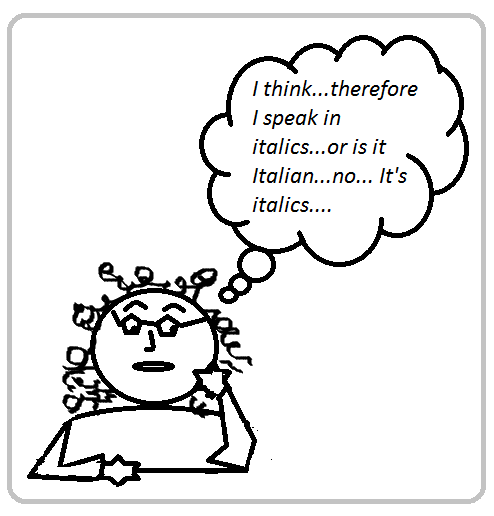
Characters’ thoughts must illuminate their motives at a particular moment in time and explore information not previously discussed. Keep the moments of mind wandering brief. Go easy if you use italics to set your thoughts off. A wall of italics is hard to read, so don’t have your characters “think” too much if you use them.

Internal monologues should humanize our characters and show them as clueless about their flaws and strengths. It should even show they are ignorant of their deepest fears and don’t know how to achieve their goals.

With that said, we must avoid “head-hopping.” The best way to avoid confusion is to give a new chapter to each point-of-view character. (Head-hopping occurs when an author describes the thoughts of two point-of-view characters within a single scene.)

strange thoughtsVisual Cues: In my own work, when I come across the word “smile” or other words conveying a facial expression or character’s mood, it sometimes requires a complete re-visualization of the scene. I’m forced to look for a different way to express my intention, which is a necessary but frustrating aspect of the craft.

Fade-to-black is a time-honored way of moving from one event to the next. However, I don’t like using fade-to-black scene breaks as transitions within a chapter. Why not just start a new chapter once the scene has faded to black?

One of my favorite authors sometimes has chapters of only five or six hundred words, keeping each character thread separate and flowing well. A hard scene break with a new chapter is my preferred way to end a nice, satisfying fade-to-black.

Chapter breaks are transitions. I have found that as I write, chapter breaks fall naturally at certain places.

Writing isn’t the simplest occupation I could have chosen. I struggle, trying to make each scene as emotionally powerful as possible without going overboard. In my case, walking the line between monotonous and melodramatic is a balancing act.

13 Comments

Filed under writing

Making Your Author’s Website Work for You #amwriting

Whether we are indie or traditionally published, we are responsible for getting our author name out there via the available social media. Expenses can mount up and finding affordable ways to get your name out there can be difficult.

blogging memeBut when it comes to having a website, don’t sweat it. WordPress and Blogger (Google’s platform) offer free blogs and theme templates. You can have a nice-looking website, with only a small amount of effort and a little self-education.

I began this site in 2011. I used WordPress’s free plan and had no website skills whatsoever. I also had a book review site, Best in Fantasy using Google’s Blogger platform. I used both platforms’ learning tools and can hold my own now.

Your website is your store, a newsletter, and is also your public presence. We want people to find and read our work. It’s a platform where you can advertise your books and have links to where they are available.

I belong to several professional organizations. One of the comments even traditionally published, well-known authors make most often when explaining why they don’t keep their blogs updated, is this:

They don’t know what to write about.

Several years ago, a well-known author told me that updating her blog is as exciting as doing laundry. This is because it hasn’t occurred to her to write about her passions.

She is an avid music fan and gets to every festival she can. I think her fans would have loved to hear about 2022’s Bonnaroo, a music festival I’ve never had the chance to attend. It sounded amazing when she told me about it, and she could have made a quick post featuring photos and tweet-length comments.

However, my friend regularly posts on Instagram and Twitter about her garden and what she had for dinner. Many authors use twitter to connect with fans, but they don’t think their thoughts are worth more than the 280 characters in a tweet.

Yet those small chunks of personal life could be stretched a bit to make a delightful short read.

Margaret Atwood on writing LIRF07252022A blog post doesn’t have to be long. Think of it as a slightly longer tweet or Facebook post. Just write a paragraph or two about what you are interested in at that moment. You will have 300 – 500 words written in no time.

That is an acceptable length for a blog post. My first posts averaged 400 words and detailed my experience of floundering around as a writer. I began with four followers, and while I’m not burning up the internet, I’m connecting with many more people now than I was then.

Many of us are adept at using Facebook to connect with readers. The work you put into a Facebook post for your author page could easily be turned into a short blog post.

If you fall into that category, even a bi-monthly update on your works in progress and where you will be signing books is a good option. We only need something to keep our fans engaged.

Rembrandt_-_Rembrandt_and_Saskia_in_the_Scene_of_the_Prodigal_Son_-_Google_Art_Project

Rembrandt and Saskia as the Prodigal Son.

I have made a personal commitment to post three times a week on this blog. This allows me to rant about the craft of writing and gives me a place to talk about fine art – something I love.

Financial constraints mean I can’t travel the world to view great art in person. Wikimedia Commons allows me to see the works of all the artists from prehistoric times to the present. I love talking about what I have discovered at Wikimedia Commons.

Writing blog posts requires me to be a thinking author as well as a pantser. I can write using the “stream-of-consciousness” method or from an outline of whatever interests me at the time. I do the research, and the post begins to write itself.

This blog never fails to provide me with a sharp dose of reality and has made me a better writer. I proofread my work, run it through Grammarly, have the Read-Aloud function of my word-processing program read it back to me, and then publish it.

Nothing bursts your bubble of self-importance like discovering gross errors and bloopers several days after you published the post.

I do admit, finding new and interesting content can be a challenge. Sometimes, I consider cutting back to publishing only on Mondays and Fridays. I have written posts on nearly every aspect of the craft and am repeating myself.

But then, a complex subject will be raised in a forum, and I hear a new point of view on it. I see things from a different perspective, and I’m fired up again.

I know it’s hard to gain readers when you first start out. But it’s like Twitter, Instagram, or Facebook. If you keep at it, you gain readers. If you write it, readers will comeif you do these three things:

  1. Tweet the new post’s link.
  2. Post the link to Instagram.
  3. Post it to your author Facebook

You can set WordPress up to post automatically to Twitter and Facebook, taking the work out of everything.

I advise writing short posts, scheduling them for a particular day and time and not worrying about how many hits, likes, or comments you get. That’s a stress you don’t need.

Instead, write your posts as if every person on the planet will read them. Just post them and forget about them until it’s time to post the next one.

  • Don’t even look at the stats for the first six months.

Quill_pen smallAfter six months, you’ll have a history of stats to look at. Use that information to gauge what topics did best. Make sure the time the blog goes live is a good slot. You want to post it when people are looking for something short to read, like when riding the bus or train to or from work.

Updating your website twice a month to discuss your writing and how life treats you will be interesting to people who read. They are your target audience.

If that’s too much work, approach it like your other social media. Any social media platform post can be converted into a quick blog post.

It is another good way to connect with your readers. And if you go the free route as I did for the first five years, it costs you nothing.

6 Comments

Filed under blogging, writing

Writing through the chaos #amwriting

I have to say, it’s been a bit chaotic here at Casa del Jasperson. Writing goes on amidst the boxes and procrastination. We’re sorting things into “keep” and “toss” piles, and the toss piles are far bigger than the keepers. At some point, we will be done with the big dig, and whether we move or stay put, we’ll be better off for having done it.

MyWritingLife2021Who needs a box of corkscrews? Apparently, we do as they go along with our three boxes of wine glasses. Greg’s medication precludes alcohol consumption, and I am a teetotaler. But we proudly serve Washington wines – Wikipedia. Party on!

Twenty coffee cups from friends, seven travel mugs from organizations we volunteer with, two boxes of home canning supplies, nine flower vases, six forms for making heart-shaped fried eggs (unused for twelve years since I became vegan), and two large muffin tins ….

I miss the days when I could load everything I owned into a Volkswagen Beetle and move house in one day.

Writing continues despite the distraction. Living in my fantasy world for several hours each evening keeps me functioning normally and allows me an escape from the mess.

My NaNoWriMo novel has a complete story arc now. All I need to do is stop binge-watching Death in Paradise and get on with it.

coffee cupsThe house seems to have a rhythm. In the morning, a tide of ancient artifacts rolls into the living room from every closet and corner, making me irritable. The afternoon sees boxes of items ebb out to the car, driven away to be donated to charities. By evening the sea of clutter is down to a moderately tidy level, only for the tide of chaos to rise again the next day.

Writing is my place of normalcy. When I can’t focus on my current work-in-progress, I can always come here to my blog and chat about the craft of writing. This blog is where everything is tidy and neatly put away.

Life is good, and to be honest, packing up isn’t all that terrible. The objects and appliances that found their way to our home and never left are intriguing in their own right.

Four Japanese porcelain dolls. The complete works of William Shakespeare. Five worn-out sets of the Lord of the Rings Trilogy, one for each of the last five decades.

And look, here are seven cookbooks on Vegan Cuisine—these are keepers. My favorite is Miyoko Schinner’s The Homemade Vegan Pantry. I’ve given each of my vegan friends a copy of that book.

667px-PlayStation_3_Logo_neu.svgAnd over here, we have three PlayStation consoles (1, 2, and 3), an early Wii, a Super Nintendo console, and a cabinet full of the games that go with every platform. I quit playing console games after the PS3, and now I play on the PC with an Xbox controller. It’s simpler and takes up less space.

Thank heavens for my nephew Robbie, who used to manage a Game Stop. He works in the tech world now but still collects old game consoles, gear, and memorabilia. I know my precious darlings have gone to a good home.

My Coffee Cup © cjjasp 2013Yes, getting our house ready to put on the market is a daunting task, and it sometimes makes me crazy. But something gets done every day, and we’re inching closer to being able to make that final decision.

So that is the update from Casa del Jasperson. Life is good!

8 Comments

Filed under writing

Short Fiction – the narrative essay #amwriting

We discussed micro fiction in Monday’s post. Today we’re continuing to look at writing short works by looking at the narrative essay/article. Many will wonder just what a narrative essay is.

narrative essayIf you enjoy reading magazines like the New Yorker, Harper’s, or Reader’s Digest, you have read and enjoyed many narrative essays.

A narrative essay/ article is not a newspaper article, which (usually) deals in facts – who, what, why, when, and where.

The primary purpose of an essay is to offer readers thought-provoking content. Many narrative essays take an event and play fast and loose with the facts. Some elements are exaggerated, and others might be skipped over. The same is true of how the people involved are portrayed.

It might detail an actual event but will be colored and shaped by the author’s personal point of view.

A-supposedly-fun-thing-first-edition-coverThe narrative essay conveys our experiences and ideas in a form that is easy to digest, so writing this kind of piece requires authors to have some idea of the craft of writing.

A list of highly regarded narrative essays and links to them can be found at 40 Best Essays of All Time (Including Links & Writing Tips) (rafalreyzer.com).

To write a good narrative essay, an author must understand the publishing industry’s grammar and mechanics standards. This is critical because the people who read this kind of work are dedicated readers.

Dedicated readers might vary in their level of formal education, but all are knowledgeable and will recognize when a writer is untrained.

I enjoy reading narrative essays when the author uses the opportunity to explore themes and subthemes.

Theme is vastly different from the subject of a work. Theme is an underlying idea, a thread woven through the story from the beginning to the end, binding the plot together. An example I regularly use is the movie franchise Star Wars.

  • The subject of the first three movies is the battle for control of the galaxy between the Galactic Empireand the Rebel Alliance. That is what the story is about.
  • Two of the themesexplored in those films are the bonds of friendship and the gray area between good and evil—moral ambiguity. Each character arc and every incident explores this struggle in subtle ways.

Original_New_Yorker_coverA narrative essay is a story that begins with an experience you once had. You know how that event began and ended. Just like any other form of short fiction, a narrative essay has a plot arc.

  • Make an outline as you must develop both content and structure.
  • Take some time to consider how you want your account to be perceived by the reader.

The arc of an essay is the same as that of a fictional story. It has

  • an introduction,
  • a plot,
  • characters,
  • a setting,
  • a climax,
  • a conclusion.

It’s not a memoir, so exposition must be limited. For me, the challenge is to not frontload the story. Offer the information at the moment the reader needs it. We must convey the most information with the least number of words.

If you love writing prose and choosing the right words, this might be a good medium for you.

Authors of narrative essays sometimes meet with criticism regarding the subject matter and how they present their opinions. This is because narrative essays often present profound and (sometimes) uncomfortable ideas.

A skillful writer can offer these concepts in a way that the reader feels connected to the story, even if they disagree.

Good essays express far more than mere opinion—they tell a story. The story is what keeps the reader engaged.

If you are writing about an actual event, names should be changed for your protection. This is because narrative essays are filled with information. They expose the places we go and detail the people we meet.

Harpers_Magazine_1905We don’t want to disclose too much information about ourselves or the people we have encountered. An honest narrative essay contains an author’s opinions. Sometimes those sentiments are not glowing accolades. One can lose friends if they aren’t careful.

Those who write narrative essays can make a living because literary magazines have open calls for them. Editors and publishers are seeking well-written essays/articles with fresh ideas about wide-ranging topics.

Some will pay well for first publication rights.

HOWEVER – if you want to be published by a reputable magazine, you must pay strict attention to grammar and editing.

Never submit anything less than your best work. After you have finished the piece, I suggest you set it aside for a week or two. Then come back to it with a fresh eye and check the manuscript for:

  • Spelling—misspelled words, autocorrect errors, and homophones (words that sound the same but are spelled differently).
  • Repeated words and cut-and-paste errors. These are sneaky and dreadfully difficult to spot. Spell-checker won’t always find them.
  • Missing punctuation and closed quotes. These things happen to the best of us.
  • Dropped and missing words.

As I mentioned above, don’t be afraid to use your words. Readers of narrative essays have a wide vocabulary. But there is one caveat to that:

  • Never use jargon or technical terms that only people in certain professions would know unless it is a piece in a publication geared for that segment of readers.

Above all, be intentional and active with your prose, and be bold. I enjoy reading works by authors who are adventurous in their prose.

EPSON MFP image

And on that note, we must be realistic. Breaking into any sort of traditional publishing is difficult. You will have trouble selling your work at first. You haven’t gained a reputation yet, and no one knows what to expect from you.

Also, you may have gauged your audience wrong, and your work might not appeal to the first editors you send it to.

Don’t be discouraged by rejection. Rejection happens far more frequently than acceptance, so don’t let fear of rejection keep you from writing pieces you’re emotionally invested in.

I have said this many times, but it is true:

How you handle critiques and rejections tells editors what kind of person you are to work with. Rejection allows you to cross the invisible line between amateur and professional.

Always take the high ground. If an editor has sent you a detailed rejection, don’t be angry or upset at their remarks. No editor sends a detailed rejection unless they see promise in the author’s work.

  • Let it rest for a day or two, then respond with a simple “thank you for your time.”

367px-Saturday_evening_post_1903_11_28_aTake some time to review what you submitted, keeping those comments in mind. Then form a plan to address those issues with a rewrite.

If you received a form letter rejection, don’t reply. But do look at your work critically and try to see what can be changed to improve it.

When you receive that email of acceptance, celebrate.

There is no better feeling than when someone, whose publication you respect, liked your work enough to publish it.

8 Comments

Filed under writing

#PiDay: Elegy for Hawking

Stephen Hawking, Star Child,

Entered the world in the Year of the Horse

While bombs fell over London.

Rebel,

Always went his own way

Even when his way was difficult.

Revolutionary,

Freed his mind to travel the cosmos.

Sat taller in his chair than giants stand.

Quantum thinker,

Body shrunken to a singularity,

Mind as expansive as the universe.

Dreamer,

Stephen Hawking

Left us in the Year of the Dog

While we baked Pi for Einstein

And marveled at what we had lost.


Stephen Hawking,

Born 8 Jan 1942; died 14 Mar 2018 at age 76.

Author, Motivational Speaker, English Theoretical Physicist.

Hawking was the Lucasian Professor of Mathematics at Cambridge University, a position once held by such notables as Charles Babbage and  Sir Isaac Newton. Afflicted with amyotrophic lateral sclerosis (Lou Gehrig’s disease, or ALS), Hawking was confined to a wheelchair and was unable to speak without the aid of a computer voice synthesizer. However, despite his challenges, he made remarkable contributions to the field of cosmology, which is the study of the universe. His principal areas of research were theoretical cosmology and quantum gravity.

Hawking also co-authored five children’s books with his daughter, Lucy.

Hawking’s book list can be found at Amazon: Stephen Hawking’s Author Page 

Popular books

  • A Brief History of Time (1988)
  • Black Holes and Baby Universes and Other Essays (1993)
  • The Universe in a Nutshell (2001)
  • On the Shoulders of Giants (2002)
  • God Created the Integers: The Mathematical Breakthroughs That Changed History (2005)
  • The Dreams That Stuff Is Made of: The Most Astounding Papers of Quantum Physics and How They Shook the Scientific World (2011)
  • My Brief History (2013)

Co-authored

  • The Nature of Space and Time (with Roger Penrose) (1996)
  • The Large, the Small and the Human Mind (with Roger Penrose, Abner Shimony and Nancy Cartwright) (1997)
  • The Future of Spacetime (with Kip Thorne, Igor Novikov, Timothy Ferris and introduction by Alan Lightman, Richard H. Price) (2002)
  • A Briefer History of Time (with Leonard Mlodinow) (2005)
  • The Grand Design (with Leonard Mlodinow) (2010)

Forewords

  • Black Holes & Time Warps: Einstein’s Outrageous Legacy (Kip Thorne, and introduction by Frederick Seitz) (1994)

Children’s fiction

Co-written with his daughter Lucy

  • George’s Secret Key to the Universe (2007)
  • George’s Cosmic Treasure Hunt (2009)
  • George and the Big Bang (2011)
  • George and the Unbreakable Code (2014)
  • George and the Blue Moon (2016)

Stephen Hawking, StarChild, Image By NASA [Public domain], via Wikimedia Commons

Wikipedia contributors, “Stephen Hawking,” Wikipedia, The Free Encyclopedia, https://en.wikipedia.org/w/index.php?title=Stephen_Hawking&oldid=830584312 (accessed March 15, 2018).

Elegy for Hawking, by Connie J. Jasperson © 2018 All Rights Reserved

2 Comments

Filed under #FlashFictionFriday, Poetry, writing

Micro Fiction: Goals and Rewards #amwriting

The habit of creative writing usually begins small. It’s an idea, something we wish someone would write. At first, it’s a hobby we must fit around our work schedule and family obligations. Somehow, that hobby grows and grows. For some of us, it becomes a second job that pays little and demands a great deal of attention.

WritingCraft_short-story-drabbleWhen a new writer decides to begin their career by embarking on writing a novel, the magnitude of the undertaking soon becomes apparent.

At first, they are fired up about the project. For several pages, the words flow. Unfortunately, the fire of enthusiasm burns low as creativity fails.

They have the idea. They have the characters. But they don’t have the skills to write something as long and involved as a novel.

Many people see that as a sign that they are untalented. They put it away and never write again.

But the truth is, the project was too ambitious for their skill level. They haven’t learned the tools of the trade and received no reward for their efforts.

I suggest people begin by writing micro fiction. Drabbles are a form of micro fiction, an entire story in exactly 100 words.

Some forms of poetry, such as haiku, are not micro fiction, as they don’t tell a fully developed story.

My Coffee Cup © cjjasp 2013 iconWriting a drabble takes less time than writing a 3,000-word story or a 70,000-word novel, but all writing is a time commitment. When writing a drabble, you can expect to spend an hour or more getting it to fit within the 100-word constraint.

First, we need a prompt, a jumping-off point. We have 100 words to write a scene that tells the entire story of a moment in a character’s life.

Some contests give whole sentences for prompts. Others offer one word, and still others have no prompt at all.

prompt is a word or visual image that kick-starts the story in your head. If you need an idea, go to Reedsy’s Weekly Writing Prompts.

But prompts are only the beginning. To write a story of any length, we need these essential components:

  • A setting
  • One or more characters
  • A conflict
  • A resolution.

writer_at_work_nanowrimo_signI use a loose outline to break the arc of every story I write into acts, each with a specific word count. (I’ve included a graphic at the bottom of this post.)

A drabble may have only 100 words, but my process works the same as for a novel.

For a novel, I divide my outline this way: 10,000 or so words to open the story, set the scene, introduce the characters and get to the inciting incident. 50,000 or so words for the heart of the story. 10,000 or so words for the conclusion.

A micro fiction is outlined the same way:

  • I have about 25 words to open the story and set the scene.
  • I have about 50 – 60 for the heart of the story.
  • I give myself 10 – 25 words to conclude it.
  • The story must be told in precisely 100 words. (Not more, and not less—exactly 100 words.)

Writing micro fiction teaches you to tell a story without exposition.

However, you should save the clumps of exposition and backstory in a separate file because they do come in usefully as part of your world-building and character development exercises.

  • Every word you write and discard might be useful in a later story.
  • Label the file with a title that says what it is.
  • Save it in a master file that contains ideas for longer stories.

Drabble_LIRF_1_jan_2018_cjjapI mentioned rewards in the title of this post. The completed story is a small gift you give yourself, and the surge of endorphins you experience in that moment of “Yes! I can write after all!” are the reward.

When you write to a strict word count limit, every word is precious and must be used to the greatest effect. By shaving away the unneeded info in the short story, the author has more room to expand on the story’s theme and how it supports the plot.

I suggest you save your drabbles and short scenes in a clearly labeled file for later use. Each one has the potential to be a springboard for writing a longer work. Or you might want to submit it to a drabble contest.

Contests for micro fiction abound on the internet. Whether you choose to submit a drabble to a contest or hang on to it doesn’t matter. Either way, the act of writing micro fiction hones your skills, and you will have captured the heart of your brilliant idea.

Micro fictions are the distilled essence of novels. They contain everything the reader needs to know about that one moment in time. The reader wants to know what happens next.

You will have succeeded in writing your story, and that success is a reward in itself.

short-story-arc

25 Comments

Filed under writing

#FineArtFriday: View to a Clearing by Albert Bierstadt (revisited)

Title: View to a Clearing by Albert Bierstadt

Medium: oil on paper mounted on canvas

Dimensions: Height: 14 in (35.5 cm); Width: 19 in (48.2 cm)

Inscriptions: Signature bottom left: ABierstadt

What I love about this painting:

I first posted this painting a year ago. Sometimes life gets ahead of us, and we just need moment of serenity, a chance to relax and let go of stress. Life is a little hectic right now, with sorting through the possessions we’ve acquired over the years of living in this house. A box filled with corkscrews … how many does one family need?  A shopping bag packed with coaxial cables and no hint of what they were once connected to. What were we saving these for? And then there are the things people give you that you wouldn’t have bought for yourself, but which you now own and feel guilty for not appreciating.

We are moving those things on, donating them to Value Village, a store where someone else will want them and love them as they deserve. Today’s picture is a moment in time, a day long ago, but which is exactly what I needed on this dark and rainy March day.

I love the peace of this scene, one of Bierstadt’s quieter paintings.  The muted colors, the rising mist, the filtered light, and the cattle grazing show us a hazy afternoon. It was perfect for a picnic, for mind-wandering, and a good day for painting.

Bierstadt is one of my favorite artists because he was often over the top, a little fantastic, and usually epic. He saw drama in nature and painted it, and like every good storyteller, his imagination filled in the blanks, employing powerful imagery to show his stories.

About the artist, via Wikipedia:

Despite his popular success, Bierstadt was criticized by some contemporaries for the romanticism evident in his choices of subject and his use of light was felt to be excessive. Some critics objected to Bierstadt’s paintings of Native Americans on the grounds that Indians “marred” the “impression of solitary grandeur.”

Interest in Bierstadt’s work was renewed in the 1960s with the exhibition of his small oil studies.  Modern opinions of Bierstadt have been divided. Some critics have regarded his work as gaudy, oversized, extravagant champions of Manifest Destiny. Others have noted that his landscapes helped create support for the conservation movement and the establishment of Yellowstone National Park. Subsequent reassessment of his work has placed it in a favorable context, as stated in 1987:

The temptation (to criticize him) should be steadfastly resisted. Bierstadt’s theatrical art, fervent sociability, international outlook, and unquenchable personal energy reflected the epic expansion in every facet of western civilization during the second half of the nineteenth century.

Bierstadt was a prolific artist, having completed over 500 paintings during his lifetime.


Credits and Attributions:

Wikimedia Commons contributors, “File:Albert Bierstadt – View to a Clearing.jpg,” Wikimedia Commons, the free media repository, https://commons.wikimedia.org/w/index.php?title=File:Albert_Bierstadt_-_View_to_a_Clearing.jpg&oldid=343092014 (accessed March 5, 2021).

Wikipedia contributors, “Albert Bierstadt,” Wikipedia, The Free Encyclopedia, https://en.wikipedia.org/w/index.php?title=Albert_Bierstadt&oldid=1009967730 (accessed March 5, 2021).

12 Comments

Filed under writing