Category Archives: writing

#FineArtFriday: The Milkmaid by Johannes Vermeer (revisited)

What I love about this painting:

It seems like a good time to revisit Vermeer’s famous painting, known as “the Milkmaid.” This is lovely look into the past, a window into daily life of 1657 – 1658. I love the realism, the way the maid carefully pours the milk into the bread.

All of Vermeer’s known works illustrate how the quiet moments in life can be the most profound.

Wikipedia has many things to say about this painting.


About Johannes Vermeer, the Master of Light (from Wikipedia)

Johannes Vermeer (October 1632 – December 1675) was a Dutch painter who specialized in domestic interior scenes of middle-class life. He was a moderately successful provincial genre painter in his lifetime but evidently was not wealthy, leaving his wife and children in debt at his death, perhaps because he produced relatively few paintings.

Vermeer worked slowly and with great care, and frequently used very expensive pigments. He is particularly renowned for his masterly treatment and use of light in his work.

Vermeer painted mostly domestic interior scenes. “Almost all his paintings are apparently set in two smallish rooms in his house in Delft; they show the same furniture and decorations in various arrangements and they often portray the same people, mostly women.”

He was recognized during his lifetime in Delft and The Hague, but his modest celebrity gave way to obscurity after his death. He was barely mentioned in Arnold Houbraken‘s major source book on 17th-century Dutch painting (Grand Theatre of Dutch Painters and Women Artists), and was thus omitted from subsequent surveys of Dutch art for nearly two centuries. In the 19th century, Vermeer was rediscovered by Gustav Friedrich Waagen and Théophile Thoré-Bürger, who published an essay attributing 66 pictures to him, although only 34 paintings are universally attributed to him today. Since that time, Vermeer’s reputation has grown, and he is now acknowledged as one of the greatest painters of the Dutch Golden Age. [2]

About the featured painting, The Milkmaid, also from Wikipedia:

Despite its traditional title, the picture clearly shows a kitchen or housemaid, a low-ranking indoor servant, rather than a milkmaid who actually milks the cow, in a plain room carefully pouring milk into a squat earthenware container (now commonly known as a “Dutch oven”) on a table. Also on the table are various types of bread. She is a young, sturdily built woman wearing a crisp linen cap, a blue apron and work sleeves pushed up from thick forearms. A foot warmer is on the floor behind her, near Delft wall tiles depicting Cupid (to the viewer’s left) and a figure with a pole (to the right). Intense light streams from the window on the left side of the canvas.

The painting is strikingly illusionistic, conveying not just details but a sense of the weight of the woman and the table. “The light, though bright, doesn’t wash out the rough texture of the bread crusts or flatten the volumes of the maid’s thick waist and rounded shoulders”, wrote Karen Rosenberg, an art critic for The New York Times. Yet with half of the woman’s face in shadow, it is “impossible to tell whether her downcast eyes and pursed lips express wistfulness or concentration,” she wrote.

“It’s a little bit of a Mona Lisa effect” in modern viewers’ reactions to the painting, according to Walter Liedtke, curator of the department of European paintings at The Metropolitan Museum of Art, and organizer of two Vermeer exhibits. “There’s a bit of mystery about her for modern audiences. She is going about her daily task, faintly smiling. And our reaction is ‘What is she thinking?'” [1]


Credits and Attributions:

The Milkmaid, by Johannes (Jan) Vermeer ca. 1658 [Public domain or Public domain], via Wikimedia Commons.

[1] Wikipedia contributors, “The Milkmaid (Vermeer),” Wikipedia, The Free Encyclopedia, https://en.wikipedia.org/w/index.php?title=The_Milkmaid_(Vermeer)&oldid=853243011 (accessed August 31, 2018).

[2] Wikipedia contributors, “Johannes Vermeer,” Wikipedia, The Free Encyclopedia, https://en.wikipedia.org/w/index.php?title=Johannes_Vermeer&oldid=854172655 (accessed August 31, 2018).

7 Comments

Filed under #FineArtFriday, writing

Writing through the Block #amwriting

We all have moments where our creativity has failed us. Maybe we had an idea, but the words wouldn’t come. Or when they did, they felt stilted, awful. We feel alone and isolated in this because we are writers. The words are supposed to flow from our fingers like water down the Columbia River.

MyWritingLife2021BSome people call this writers’ block. I think of it as a temporary lull in my creativity.

I have learned to write my way through these dry spells. Usually, the work I produce at that moment is awful, and I wouldn’t share it with anyone. But I am a professional writer and the act of writing every day keeps me fit and in the habit of working.

Writing is like participating in sports or playing a musical instrument. We must practice if we want to be good at it. Doing well at writing requires some discipline on our part. I lose my momentum and purpose when I stop writing for any reason.

I lose my passion for my work.

At times, we come to a place where we can’t think of what to write. It happens to everyone, and we each handle it differently. I will share how I deal with lulls in creativity—and I know it’s not a one-size-fits-all solution.

Before we begin, I suggest you save the file you are working on, the one you can’t seem to make headway on. Close it, and delete nothing. You will be able to use this work later, so file it properly.

mindwanderingLIRF02212023Sometimes, the problem is that your mind has seen a shiny thing, a different project that wants to be written, and you can’t focus on the job at hand. If that is the case, work on the project that is on your mind. Let that creative energy flow, and you can reconnect with the first project once the new project is out of the way.

For me, writer’s block manifests not as a block per se. It will appear as an inability to visualize a scene I must write to advance a story. If I can’t picture it, I can’t describe it.

That can be quite frustrating.

Unfortunately, some people have a different experience, one where they have no words whatsoever. They try, they struggle, and nothing comes to them.

This creates a kind of trauma. Once a person has experienced that moment of complete inability, fear of being unable to write can magnify the problem until it paralyzes them.

So what do I do when the words don’t come?

First, I open a new document. At the top of this document, I type: Where I Am Today.

  • I look around myself and see the room I am in, trying to see it with a stranger’s eyes.
  • I briefly describe what the stranger might see on entering that room.
  • Then I describe how I feel sitting in that place at that moment in time.

I write two or three paragraphs just to prove I can do it.

Next, I go somewhere else and take my notebook. I am a stranger there, so I write three more paragraphs detailing how I fit into that new space and how it makes me feel.

You could do this at the mall, a coffee shop, or the parking lot at the supermarket.

Me working in a starbucks, through the fishbowl, copyright Dan Riffero 2013

Me writing in a Seattle Starbucks, taken through a fish tank. I was the big fish in that tank! Photo by Dan Riffero.

The last exercise is more abstract: Where do I want to be? I visualize it and describe my imaginary scene as if I am looking at it.

I want to walk along the high-tide mark on a foggy beach. I want to hear the gulls and the waves. I want to feel at peace again.

It’s weird but writing about nothing in particular is like doodling. It is a form of mind wandering. It can jar your creative mind loose. With perseverance, you will be writing your other work again.

Everyone has family, jobs, and external demands that limit their writing time. Sometimes the world gets in the way of writing. We might feel unwell or have too many things to accomplish and not enough time to get it all done.

WilliamBlakeInfinityAndEternityLIRF05072022In my real life, getting our house ready to put on the market saps my creativity, but I am muddling along. Boxes here and there, getting rid of this and that—it’s exhausting. Sometimes I don’t have the energy to write.

But I sit down and get at least 100 words on paper just to prove I can. That usually leads to a more productive writing session.

The most important thing is to care for my family first. Sometimes just doing laundry can jar an idea loose, and I feel incredibly productive at the same time.

However, when I am stuck for words to write, the most important thing I do is to sit somewhere quiet and let my mind wander.

Daydreaming is good for you. It boosts the brain, making our thought process more effective. Apparently, letting the mind wander allows a kind of ‘default neural network’ to engage when our brain is at wakeful rest, like in meditation, unlike when it’s actively focused on the outside world.

Book- onstruction-sign copyWhen we daydream, our brain is free to process tasks more effectively.

This is good to know because I spend an astounding amount of time daydreaming, and I would hate to be simply wasting time.

This is how my mind works. I hope that what works for me will work for you. Remember, if you are suffering from a temporary dry spell, you are not alone. We all go through those times.

When you want to talk about it, you will find friends here.

14 Comments

Filed under writing

Characterization: Layers of a Scene #amwriting

Our characters feel real to us, their creators, but the trick is making them seem natural to our readers.

WritingCraftSeries_character-arcWhen I begin writing a first draft, I try to approach writing each scene as if I were shooting a movie. We know that each conversation is an event that must advance the story, but it must also give us glimpses of who each person is.

To that end, dialogue must do at least one (if not all) of these things:

  • Offer information the characters are only now learning.
  • Show the state of mind the characters are experiencing.
  • Show the relationship of the characters to each other.
  • Show the relationship of the characters to their world.

However, dialogue is only one layer of the scene. We try to establish the world environment in the opening pages but world-building is an ongoing task and is a foundational layer of each scene.

  • We continue world-building by showing our characters as they interact with the immediate environment.

In the first stage of the rough draft, I sit down and picture the characters and their relationships, with those goals in mind.

  • Then, I write just the dialogue for several back-and-forth exchanges. I use minimal speech tags for this because I want to get the discussion written down the way I hear it.

I do this in short bursts, getting the basic words down. It’s a two-stage process—the scenery and background get filled in after the dialogue has been written. Here is an example of four lines of dialogue:

Ann: “What are you doing?”

Jon: “Oh, just drawing.”

Ann: “Drawing what?”

Jon: “You’ll laugh or find a reason to mock me for it.”

good_conversations_LIRFmemeHaving the fundamentals of the conversation to work with sharpens the scene in my mind, enabling me to frame it properly. Once I know what they are talking about and have the rudimentary dialogue straight, I add the scenery. Then, I insert the props and add the speech tags. The interaction grows, shedding more light on their relationship.

So let’s take those four lines of dialogue and set them in a kitchen. We have two characters who are wary of each other and have radically different views of their relationship.

The following day, when Ann came down for coffee, she found her stepson was once again working on something in his sketchbook. He stood when she entered, gathering his pens. “The coffee should be ready.”

“What are you doing?” Ann’s clipped tones cut the silence.

“Oh, just drawing.”

“Drawing what?”

Jon’s expression was closed, indecipherable. “You’ll laugh or find a reason to mock me for it.” He shut his sketchbook and stood, intending to leave her to her breakfast.

“Show me. Please.” When Ann repeated her demand, he reluctantly opened the book. Page after page was covered in stylized dragons, leafy vines, and runes. “Why do you waste your time with this crap? You could be brilliant, but no. People want real art, not fairies and dragons.”

“Art is not reserved just for some elite aficionado. Everyone has a different idea of it, and what appeals to you doesn’t appeal to everyone. This is how I earn my living, even though it’s not up to your standards.”

Ann poured herself a cup of coffee. “You could do so much better. I’ve tried to steer you toward success, but—”

“Stop it. I’m happy with my life.” Jon reclaimed the sketchbook. “Tim was right. Coming back was a mistake. We did it because Dad asked us to and because it’s Christmas.” He opened the door to the dining room. “Enjoy your breakfast, and don’t start in on Tim when he gets up.” The door closed behind him.

Ann gripped her cup. Where had she gone wrong? Why couldn’t the boys see how much she cared? All she had ever wanted was for them to be successful and happy.

Plot-exists-to-reveal-characterMy above sample is not perfect, as it is from the first draft of a short story I never actually finished, but you get the idea. We learn more about the characters’ relationship with each other and see their place in this environment. The layers that form this scene are:

Action: Jon, one of our protagonists, has risen first and made coffee. He sits in the kitchen drawing in his sketchbook. An adversarial conversation ensues. Later he gathers his pens, stands, and leaves the room.

Dialogue: The conversation illuminates long-simmering differences between the two players and gives us a time reference—it’s Christmas. It also hints that the father wants the family to be reunited.

Internal Dialogue: Ann’s thoughts offer us the first glimpse of her reasoning. Tim and Jon are stepbrothers, but they were raised together and consider themselves brothers. Ann loves them fiercely, Jon as much as Tim, and we see the first indication of her inner battle in the story. We learn more about the family dynamics that must be overcome if their Christmas is to be saved.

Environment: a kitchen, closed off from the rest of the house. In this story, the woman’s closed-off kitchen symbolizes her closed-off personality. The place that is the heart of a home is closed off.

As the story progresses, we find Ann is at odds with her own son as well as her stepson and is gradually losing her husband to dementia. She’s afraid and needs emotional support from Tim and Jon but is her own worst enemy.

No matter the plot or setting, each scene we write should be formed of layers:

  • environment
  • props
  • characters

chekhovs gun layers of a sceneSet dressing (the props you place in the scene) shows the immediate environment. Having characters interact with props provides opportunities to insert hints that a deeper backstory exists. However, only have them interact with props that are organic or crucial to the story. This eliminates the problem of Chekhov’s Gun.

Because they are layered into the work, the scenery and props become unobtrusive. This allows the conversation to show the reader everything they need to know about our characters at a singular moment in time. It also gives us logical places for introspection and foreshadowing, integral aspects of pacing.

I can get the words down before I forget them by starting with the dialogue that will form the basis for each scene. Then I can concentrate on visualizing the conversation’s setting and decide what props to insert. The items I place in that scene must show something about the characters who interact with them.

As the story progresses along the plot arc, readers are gradually shown the world these characters live in. They will see that world without our having to dump a floor plan or itinerary on the reader. Remember our basic conversation?

“What are you doing?”

“Oh, just drawing.”

“Drawing what?”

“You’ll laugh or find a reason to mock me for it.”

We could put that exact dialogue and the notebook into a fantasy setting, sci-fi, or any other genre. The book’s plot would change what the conversation reveals about the two characters.

Each scene has a purpose, which is to reveal information and move the plot forward. All it takes is a few lines of dialogue and a moment of introspection on the part of the point-of-view character.

Characterization definitionBy beginning with the conversation and envisioning each scene as if I were filming a movie, I can flesh it out and show everything the reader needs to hang their imagination on. The reader’s mind will supply the details of the immediate setting depending on the clues I give.

We try to layer conversations and world-building to bring depth to our characters. When we do it right, the possibilities are endless.

18 Comments

Filed under writing

Characterization part 4 – Doling out the Backstory #amwriting

Every story has a past, a present, and hopefully, a future. The past shapes what we know as the here and now. The past also gives history to our characters, so when they first step onto the page, they are formed in the author’s mind and ready to begin their journey.

MyWritingLife2021Every writer knows the backstory is what tells us who the characters are as people and why they’re the way they are. At the beginning of our career, it seems logical to inform the reader of that history upfront. “Before you can understand that, you need to know this.”

As we progress, we learn not to drop the history of the intended conflict in the first five pages of a novel or to waste the first three paragraphs of a short story on it.

We understand that those are the pages and paragraphs editors look at first. From those pages, acquisitions editors will decide whether or not to continue reading the submission.

For those of us planning to go the indie route, those first five pages are what the prospective buyer sees in the “look inside” option when buying an eBook. For us, the prospective reader is the acquisition editor. They will buy the book if they like what they see on those pages.

Walls of fictional history muck up the transitions and negate our hooks. We know that infodumps block the doors from one scene to the next.

strange thoughts 2But knowing this and putting it into action are two different things.

So, how do our favorite authors deliver the backstory and still sell books?

First, they consider what must be accomplished in each scene and allow the backstory to inform the reader only when (and if) it’s needed to advance the plot.

Look at the first scene of your manuscript. Ask yourself three questions.

  1. Who needs to know what?
  2. Why must they know it?
  3. How many words do you intend to devote to it?

Dialogue, both spoken and internal, is the easiest way to dole out information but can be the gateway to an infodump.

  • Don’t give your characters long paragraphs with lines and lines and lines of uninterrupted dialogue. (Trust the voice of experience, please.)

Doling out the information is a double-edged sword, one all authors must learn to wield with skill. Beginnings must be active, yet those precious first lines must step onto the stage in such a way that they are original, informative, and engaging.

After we open with our best work, the passages and chapters that follow must reflect and build upon the tone and cadence of the opening pages. If not, the reader may be disappointed and choose to not buy any more books by us.

We’re all familiar with the term ‘flatlined,’ a medical expression indicating the patient has died. When the story arc is imbalanced, it can flatline in two ways:

  • Not enough backstory: The action becomes random, an onslaught of meaningless events that make no sense.
  • Too much backstory: The pauses become halts, long passages of random info dumps that have little to do with the action.

A good way to avoid this is to have your characters briefly discuss what is on their minds. Then they will bravely muck on to the next event, keeping the story moving at a good pace.

  • Don’t allow conversations to deteriorate into bloated exposition.
  • Do set forth the necessary information.

This can be accomplished in several ways. For my novels and short stories, I tend to write in either a close third-person or first-person point of view, so my comments in this post are geared toward that style of writing.

Short moments of introspection (thinking, reminiscing, etc.) offer opportunities for doling out new information essential to the story. Their thoughts shed light on how they really feel, illuminating their secret fears or voicing knowledge, giving it to the reader at the moment it is needed.

F Scott Fitzgerald on Good Writing LIRF07252022Be aware: if you are writing from an omniscient POV, this can be tricky and lead to “head-hopping,” which can lead to confusion on the reader’s part. When I change point-of-view characters, I do a hard scene or chapter break.

Letters and messages received or written can give needed information.

Conversations between witnesses and adversarial dialogues (quarrels) can shine a light on a festering past. But remember, if you go on for too long, your reader will either skip forward and miss what was really important or close the book and walk away.

Those are only a few ways to briefly open a window for the reader to see who the characters think they are and how the other characters see them. They offer a hint of how the characters became the way they are portrayed.

In the most gripping narratives I have read, character introspection is brief but delivers crucial information. Their internal monologues illuminate a character’s motives at a particular moment in the story arc, cluing the reader in on what is happening and why.

As the plot progresses, conversation and introspection are good opportunities to deliver information not previously discussed.

Consider the most popular genre: Romance novels. These things fly off the shelves. Why?

  • Because the path to love is never straightforward, and a reward awaits the reader who sticks with it.
  • Some characters will have an air of mystery about their past that isn’t fully revealed until the end.

The pacing in a Romance novel is crucial and is something all writers can learn from:

  • It speeds up (a small reward), and
  • Then it is slowed (dangling the carrot),
  • Then, it goes a little ahead (slightly larger reward),
  • But is slowed (enticement),
  • Finally, the two overcome the circumstances and things that have barred the way to their true happiness. (Gratification and endorphins abound.)

Flaubert on writing LORF07252022Romance novels average 50,000 to 70,000 words. In shorter novels, there is no room for sweeping, epic backstories. Instead, information and backstory are meted out only as needed through conversations and internal dialogue/introspection.

All obstacles to the budding romance are followed by small rewards that keep the reader involved and make them more determined to see the happy ending.

As a reader, I can say that a long-winded rant is not a reward.

This holds true in every book and story, regardless of genre: enticement, reward, enticement, reward. In all stories, complications create tension, and information is a reward.

The combination of those elements keeps the reader reading.

It’s difficult to see bloated exposition in my own work, but one trick I have found is this: word count.

I look at each conversation and assess how many words are devoted to each character’s statement and response. Then, when I come to a passage that is inching toward a monologue, I ask myself, “What can be cut that won’t affect the flow or gut the logic of this exchange? Can some of this be moved to a later conversation?”

to err is human to edit divineEven with all the effort I apply to it, my editor will find things that don’t matter. She will gently take a metaphorical axe to it, highlighting that which doesn’t advance the story or add to the intrigue.

Sometimes we write brilliantly; other times, not so much. Sorting the diamonds from the gravel is hard when it comes to doling out the backstory, but your readers will be glad you made an effort.

16 Comments

Filed under writing

Characterization part 3 – When the Antagonist is a Nebulous Behemoth

Today we’re continuing our discussion of characterization by examining the nebulous antagonist.

WritingCraft_Dark_EnergyIn many thrillers and cyberpunk novels, the faceless behemoth of corporate greed is the overarching antagonist. It can be represented by characters who are portrayed as utterly committed to doing their job and loyal to their employer. In many cyberpunk novels, the antagonists tend to be goons-in-suits, enforcers who work for the corporation.

In fantasy, the nebulous antagonist might be a powerful queen/king or sorcerer whose forces/minions the protagonist must defeat.

The ultimate mind behind the conflict is a person they might not meet face to face. How the protagonist reacts internally to the threat posed by the machinations of those distant antagonists is the story.

While the true enemy might be a faceless power supporting the intrigues of their servants, their laws and rules are the ultimate evil that must be defeated.

Alternatively, the enemy might be a technological breakdown in hard sci-fi and sometimes in contemporary military novels. The novel Level 7 by Mordecai Roshwald was a groundbreaking example of this:

From Wikipedia:

Level7Roshwald (1)Level 7 is a 1959 science fiction novel by the Ukrainian-born Israeli writer Mordecai Roshwald. It is told from the first-person perspective (a diary) of a modern soldier, X-127, living in the underground military complex Level 7, where he and several hundred others are expected to reside permanently. X-127 fulfills the role of ‘push-button’ offensive initiator of his nation’s nuclear weapons capacity against an unspecified enemy. X-127 narrates life within a deep shelter before, during, and after a nuclear war that wipes out the human species. [1]

Just so you know, the book doesn’t end well—I read it in high school.

The enemy could be a military coup or a mega-corporation whose “guards” are really an elite military. A few soldiers could represent the antagonist and enforce their wishes. Getting to know those characters and their motives adds depth to the story.

We’ve all seen disaster movies like Titanic and Twister. We know the enemy can be the environment. Andy Weir in The Martian made the planet of Mars the antagonist.

I love the notion of the faceless behemoth that threatens all we love. When a novel has an immense, nebulous antagonist, the possibilities for creating the hazards that impede the heroes are endless. Giant waves, hurricanes, weapons of mass destruction–these are worthy obstacles our protagonists must surmount.

Fear makes the risk feel genuine to the reader. To show great evil in genre fiction, we take that which is damaging and destructive to an extreme and show the emotion of living through that experience.

When we are writing a story where the root of evil is represented by its minions, the perception of corruption and the evil humans are capable of sometimes horrifies us. As a character, the mega-villain can be shown in the actions of certain employees who don’t consider the human cost of their loyalty.

Tenth_of_DecemberThis type of psychopathic antagonist is explored exceedingly well in George Saunders’ brilliant sci-fi short story, Spiderhead, a short story in the award-winning compilation, Tenth of December.

For a reader, perception and imagination are everything. As children, what we infer from the visible evidence in a dark room after the lights have been turned out can be terrifying.

We’re still subconsciously hunter-gatherers, always watching for lions and tigers (oh my). As children, the formless monster lurking in the darkness of our room terrifies us until we discover the truth: several toys were piled there and never put away.

As adults, what we infer from the visible evidence in a dark story can be equally terrifying. Thus, you can write dark, frightening scenes but don’t have to be utterly graphic.

No matter how right the cause, war is an evil that is too large to personify and is challenging to make sympathetic. But sometimes, war, a faceless blob of evil, is the proper villain for the narrative. We represent that evil in the actions taken by the characters.

I try to choose a single word (and its synonyms) to characterize my antagonist, even when it is something as significant as a pandemic. That one word becomes the theme, the underpinning of how evil is portrayed.

In one of my practice short stories, I used the word escape as the theme. The first paragraph opens with that word, and every synonym for escape is used to underscore that thread woven throughout the story.

Another example is the word corruption. We tend to think of it as referring only to illegal activities, but it has many meanings and uses. Its synonyms are bribery, debasement, debauchery, decadence, degeneracy, distortion, exploitations, fraud, and immorality.

We view the antagonist through the protagonist’s eyes, so a strong theme that colors the enemy with a perception of corruption drives home the evil they represent.

Someone—and I wish I could remember who—said a few years ago in a seminar that the author is the character’s attorney, not their judge.

This is an important distinction and applies to villains as much as it does the heroes.

theRealStoryLIRF01102021When evil is a behemoth on the order of a mega-corporation or a military coup, the villains who represent it all have reasons for their loyalty. They’re like the hero; they care intensely, obsessively about something or someone. They have logical motives for supporting what we are portraying as the enemy. Our job as authors is to make those deeply held justifications the driving force behind their story.

True villains are motivated, logical in their reasoning, and utterly convinced of their moral high ground. They are creatures of emotion and have a backstory. As the author and their lawyer, you must know what their narrative is if you want to increase the risk for the protagonist.

As always, the reader doesn’t need to wade through an info dump, but you, the author, need to know those details. Having this backstory to draw on will make your characters easier to flesh out. Hints of their thought processes and motivations will emerge gradually.

But more importantly, once we know what drives them all, we know what is at stake for those who represent your antagonist. You will understand how much they are willing to sacrifice for it.


Credits and Attributions:

Wikipedia contributors, “Level 7 (novel),” Wikipedia, The Free Encyclopedia, https://en.wikipedia.org/w/index.php?title=Level_7_(novel)&oldid=1132228006 (accessed February 12, 2023). [1]

15 Comments

Filed under writing

#FineArtFriday: California Spring by Albert Bierstadt 1875

Albert_Bierstadt_California_SpringArtist: Albert Bierstadt (1830–1902)

Title: California Spring

Genre: landscape art

Date: 1875

Medium: oil on canvas

Dimensions: height: 187.3 cm (73.7 in); width: 264.2 cm (104 in)

Current location: Fine Arts Museums of San Francisco

What I love about this painting:

I love this composition, the way everything is deliberately placed. Cattle graze on a hilltop beneath a grove of trees, uncaring of the rainstorm sweeping across the valley below, far off in the distance. The immensity of the sky is the focus of this scene, with the sun emerging from the clouds, a brief promise of warmer days. Spring has arrived on this hilltop.

Here at Casa del Jasperson, we’re tired of winter, done with rain and dark days. Albert Bierstadt paints us an idyllic scene of seasonal weather and the harmony of nature. The grass is green, the cattle are happy, and while rain may come, summer is around the corner.

About the artist, via Wikipedia:

Albert Bierstadt (January 7, 1830 – February 18, 1902) was a German American painter best known for his lavish, sweeping landscapes of the American West. He joined several journeys of the Westward Expansion to paint the scenes. He was not the first artist to record the sites, but he was the foremost painter of them for the remainder of the 19th century.

Bierstadt was born in Prussia, but his family moved to the United States when he was one year old. He returned to study painting for several years in Düsseldorf. He became part of the second generation of the Hudson River School in New York, an informal group of like-minded painters who started painting along the Hudson River. Their style was based on carefully detailed paintings with romantic, almost glowing lighting, sometimes called luminism. Bierstadt was an important interpreter of the western landscape, and he is also grouped with the Rocky Mountain School. [1]


Credits and Attributions:

Image: Wikimedia Commons contributors, “File:Albert Bierstadt California Spring.jpg,” Wikimedia Commons, the free media repository, https://commons.wikimedia.org/w/index.php?title=File:Albert_Bierstadt_California_Spring.jpg&oldid=701053175 (accessed February 9, 2023).

[1] Wikipedia contributors, “Albert Bierstadt,” Wikipedia, The Free Encyclopedia, https://en.wikipedia.org/w/index.php?title=Albert_Bierstadt&oldid=1137881139 (accessed February 9, 2023).

5 Comments

Filed under #FineArtFriday, writing

Characterization part two – writing subtle emotions and reactions

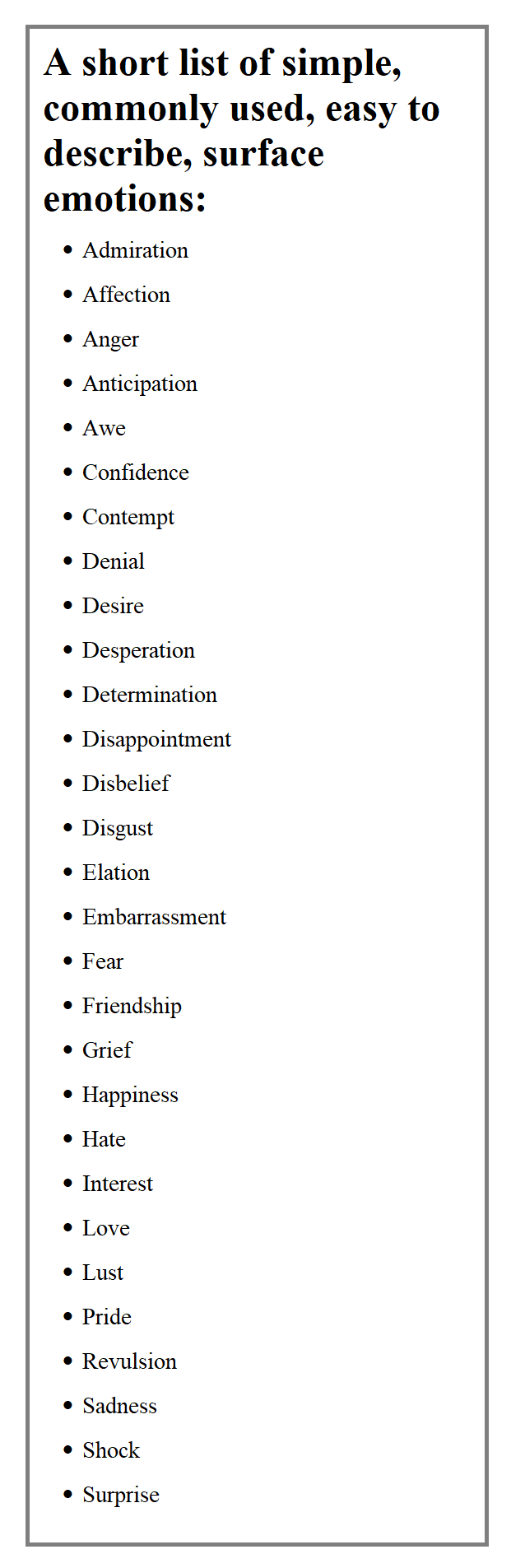
Most writers find it easy to connect with flamboyant emotions, such as hate, anger, desire, and adoration. However, emotions have “volume,” ranging from soft to loud. Today we are looking at emotions we need to show with less noise.

mood-emotions-1-LIRF09152020Volume control is a crucial part of the overall pacing of your story. “Loud” deafens us and loses its power when it’s the only sound. However, like the opening movement of Beethoven’s 5th Symphony, the entire range of volume can be effectively used to create a masterpiece.

Subtle reactions have power when contrasted against more forceful displays of emotion.

Low-key thoughts and feelings can go almost unnoticed. Under the surface, positive or negative vibes give us a rounded view of a character, making them less two-dimensional, a more natural person.

We’re all aware of one positive emotion that can go bad – love. When love is reciprocated, it’s a positive feeling. We all enjoy a good love story.

However, when love starts out with promise and then goes terribly wrong, you have the makings of a deep, dark story filled with possibilities. Anger, despair, revenge—these can be loud and also be subtle, brooding.

Maas_Emotional_Craft_of_FictionDark emotions, such as depression, can be shown through a character’s reactions to things that once pleased them. Perhaps they no longer find beauty in the things they once enjoyed.

What about lighter emotions? The way we feel joy ranges from mild to overwhelming, from a slight smile to an experience so profound it brings tears to one’s eyes.

Subtle emotions don’t stand out and grab the reader. But when they’re swimming just under the surface, they have impact. Subtleties color and shape the reader’s opinions about the story and the characters.

One negative aspect of our human character is our tendency to experience an uncharitable emotion known as schadenfreude. We all go through it on a personal level every now and then. Some people take great joy in it, gaining a sense of superiority. But most of us are embarrassed to admit to it.

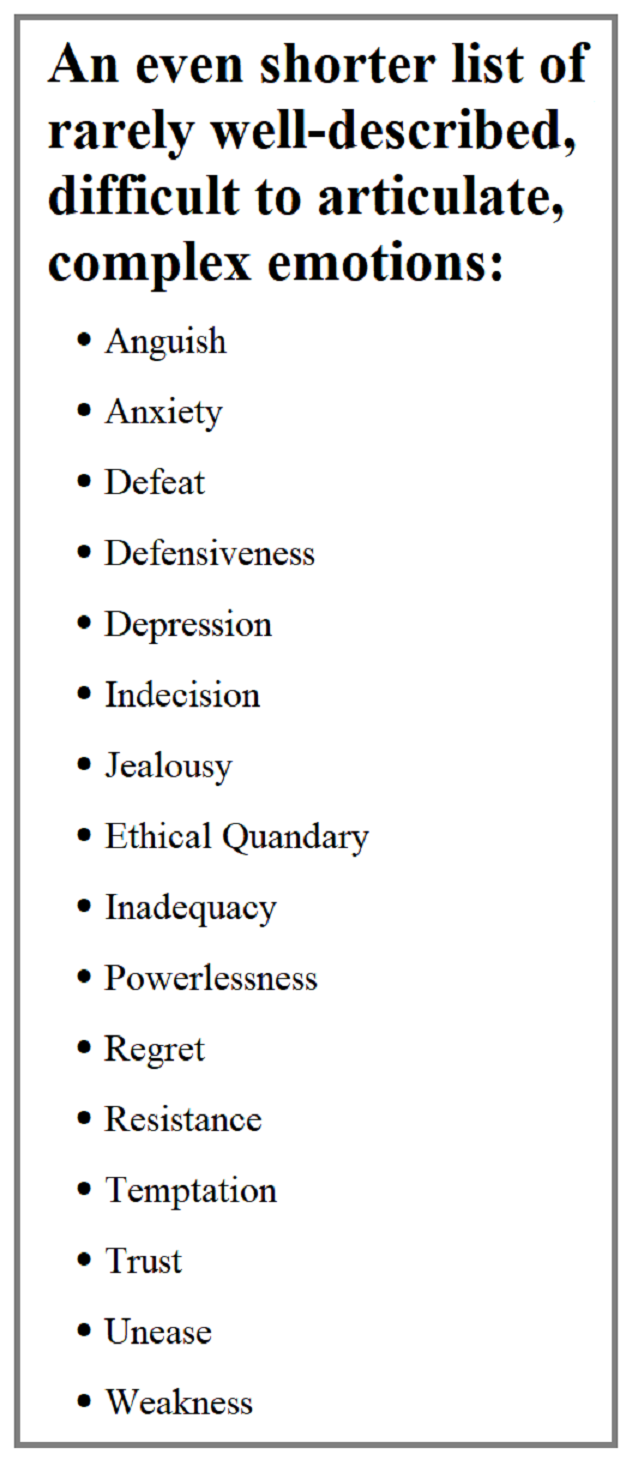
Small, quiet emotions linger and leave an impression but are hard to articulate. It helps to include small indicators of mood such as:

  1. Anguish
  2. Anxiety
  3. Competence
  4. Confidence in their friends
  5. Cooperation
  6. Courage
  7. Decisiveness
  8. Defeat
  9. Defensiveness
  10. Depression
  11. Discovery
  12. Ethical Quandaries
  13. Group ethics
  14. Happiness
  15. Inadequacy
  16. Indecision
  17. Individual moral courage
  18. Jealousy
  19. Paranoia
  20. Powerlessness
  21. Purposefulness
  22. Regret
  23. Resistance
  24. Revelation
  25. Satisfaction
  26. Self-confidence
  27. Serenity
  28. Strength
  29. Success
  30. Sufficiency
  31. Temptation
  32. Trust
  33. Unease
  34. Weakness

These attributes are rarely spelled out, but they color how the characters interact with each other.

Some positive emotions can be more intense, yet not overpowering. Those moments can be shown by an immediate physical reaction combined with internal dialogue or conversations.

Severe emotional shock strikes us with a one-two-three punch: the disbelief/OMG moment, followed by knocking knees, shaking hands, or a shout of “No!” which is sometimes followed by disassociation.

emotion-thesaurus-et-alVisceral reactions are involuntary—we can’t stop our face from flushing or our heart from pounding. We can pretend it didn’t happen or hide it, but we can’t stop it. An internal physical gut reaction is difficult to convey without offering the reader some information, a framework to hang the image on.

We use the same one-two-three trick when describing a mild experience as we do with louder emotions.

Start with the visceral response. There will be an instant reaction. How does a “gut reaction” feel? Nausea, gut-punch, butterflies … how do you respond to internal surprises?

Emotions are felt in the chest in varying degrees, from a slight warmth or chill to a stronger heart-pounding sensation. But we’re keeping it subdued here.

Follow the visceral up with a thought-response. Whatever your style and word choices are, showing the characters’ joy or dismay makes them human. If it is a mild reaction, give it a moderate thought response. Showing small moments of relatable happiness or displeasure makes our protagonist more sympathetic.

Third, finish up with body language. That is how emotions hit us. We feel the shock and then experience the mental reaction as we process the event. Our body language reflects these things.

What if you are writing a story where one of the antagonists eventually becomes part of the protagonist’s inner circle? Including small positive thoughts early on in their narrative can foreshadow that this character may become the ally that turns the tide.

Conversely, when the antagonist begins as part of the protagonist’s inner circle, minor negatives like envy and schadenfreude in their narrative can foreshadow that this character is not what they seem.

ICountMyself-FriendsConflict keeps the protagonist from achieving their goals. Significant conflicts and emotions are easy to write about. But in real life, our smaller, more internal conflicts frequently create more significant roadblocks to success than any antagonist might present.

Large emotions are easy to visualize. But frequently, in real life, our smaller joys have a longer-lasting impact, and the memory of these can be the impetus that keeps the soldier fighting during the darkest hours.

If we contrast the loud emotions against the soft ones, the reader will experience those emotions as if they are theirs. The story detailed in that book will be more meaningful to them.

14 Comments

Filed under writing

Characterization part one – 7 rules for writing conversations plus 4 for extra credit

WritingCraftSeries_depth-through-conversationIn real life, we are drawn to certain people and get to know them better through conversations.

At first, they’re an unknown quantity. They become individuals to us once we’re introduced and we discover their speech habits, resonate with their sense of humor, and learn bits of their backstory.

On the opposite side of the coin, conversations can alert us to people we choose to avoid.

Elmore Leonard quote re dialogueGood conversations and mental dialogues bring written characters to life and turn them into people we want to know, our closest friends.

Here are seven rules for adding depth to our characters through their conversations.

One: Don’t indulge in the exposition dump: “Bob, remember how I told you (blah blah blah)?”

In real life, we might say this and not notice it. However, when we see it written, it becomes word padding, adding fluff to the narrative. This is a classic example of something we don’t need to know.

Two: Don’t repetitively name the characters being spoken to: “Bob, remember how I told you (blah blah blah)?”

The reader knows Dave is talking to Bob. If it’s only the two of them, no direction is necessary—they can just say what they need to with a few speech tags to keep the “who said what” straight. If there are three or more characters in the conversation, have Dave turn to Bob and then speak.

Three: Don’t use bizarre speech tags.

I don’t care for reading graphic and disgusting speech tags such as ejaculated. “Telling” words do our narratives no favors when used as speech tags. We are creative and can do better than that by showing a character’s shock, dismay, or joy as they are speaking. We intersperse actions with simple speech tags that don’t stop the reader’s eye.

Bob’s eyes widened, and he grabbed the letter. “You idiot.”

Don’t make the mistake of getting rid of speech tags and attributions entirely. Even with only two characters in a scene, the verbal exchanges can become confusing. Use speech tags every third exchange or so to keep things clear for your reader. Nothing is worse than trying to figure out which character said what.

Four: Please don’t indulge in internal dialogues (thoughts) that are a wall of italics going on forever.

William Falkner quote re dialogueInternal dialogues (rambling thoughts) are often a thinly disguised info dump in my first drafts. I seek those out in the second draft and either cut them to a line or two or eliminate them entirely. I try to avoid italics if possible, so this is how I write thoughts nowadays:

Dave fought down a wave of nausea, followed by a surge of anger so raw, it burned. The effort to stifle it took all he had. Brandon was at least ten years younger than her, barely old enough to legally drink beer.

Five: Don’t spell out accents to the point they are visually incomprehensible. “Oive got a luverly bunch uv coconuts….”

I refuse to review books I dislike. This is because some books I despise are beloved bestsellers, demonstrating that I don’t know everything. (What? Say it ain’t so!) As in all other things, it’s a matter of taste.

One of the many reasons I disliked “Where the Crawdads Sing” was how the accents were portrayed. They were shown in a demeaning way, in my opinion. I know that many readers didn’t see that as a problem; as I said, it is only my opinion.

gobbledegook detectedHowever, I have no problem understanding an accent and visualizing a character as foreign when the author consistently uses one or two well-known words that a non-native speaker might use, such as si, ja, or oui, in place of yes. Most English speakers recognize and know the meaning of these words when they see them. All it takes is a straightforward word to convey the proper foreign flavor.

Six: Please, please, please … pretty please … don’t make a habit of leading sentences off with drone words. “Aahhh … ummm …”

These are ‘thinking syllables.’ This is known as a ‘verbal tic’ and can be an ingrained habit that the speaker is unaware of.

Verbal tics are supremely annoying in real life and are excruciating to read when peppered throughout the narrative. Once in a while, a non-word like “Ah …” adds a moment for the character to show shock or another emotion in the narrative. But do go lightly with them.

You may have met someone who habitually opens every sentence with a meaningless syllable, such as “Aaaaaaaahh….” They continue droning while they gather their thoughts, holding the conversation hostage and not allowing the other person to speak.

The guilty party may suffer hurt feelings when you try to hurry them along.

Seven: Never use Google Translate (or any other translation app) to write foreign languages.

As mentioned in rule 5, a word or two used consistently here and there to convey the sense of foreignness is one thing, but in general, if you don’t speak the language, don’t write it.

good_conversations_LIRFmemeThe laws of grammar sometimes break down on the quantum level in conversations with our friends. This is also true of written exchanges.

Many new authors are confused about how to punctuate conversations. It’s not complicated, so here are four simple rules for punctuating discussions (offered for your extra credit):

Rule 1: Surround everything that is spoken with quotation marks. “I’m back,” he said.

In the US, we begin and end the dialogue with “double quotes.” These are also called closed quotes and all punctuation goes inside them. This is a universal, cast-iron rule that we must follow because readers expect to see them and become confused when you don’t set dialogue off this way.

Rule 2: When quoting someone else (as part of a conversation), you should set the quoted speech apart with single quotes (apostrophes, inverted commas) and keep it inside the closed quotes.

You can do this in two ways:

  • Dave said, “When I asked her, Jill replied, ‘I can’t go.’ But I’m sure she was lying.”
  • Dave said, “When I asked, Jill replied, ‘I can’t go.'”

In the second sentence, 3 apostrophes are placed after the period (full stop): One apostrophe and one double (closed) quote mark. This is in keeping with the rule that all punctuation in dialogue goes inside the quotation marks.

Indirect dialogue is a recapping of a conversation:

  • When asked, Dave said Jill told him she couldn’t go.

We don’t use quotes in indirect dialogue. Also, in the above sentence, “that” is implied between said and Jill.

comma or apostropheRule 3: Commas—Do not place a period between the closed quotes and the dialogue tag. Use a comma because when the speech tag follows the spoken words, they are one sentence consisting of clauses separated by a comma:  “I’m here,” he said.

  • When leading with a speech tag, the commas are placed after the tag and are not inside the quotation marks: He said, “I’m here.”
  • Dialogue split by the speech tag is all one sentence: “The flowers are lovely,” she said, “but they make my eyes water.” Note that the first word in the second half of the sentence is not capitalized.

Rule 4: When a speaker’s monologue must be broken into two paragraphs, lead off each with quotation marks but only put the closed quote at the end of the final paragraph. A wall of dialogue can be daunting in a story, but sometimes happens in essays and when quoting speeches.

Characterization definitionConversations, both spoken and internal, light up and illuminate the individual corners of the story, bringing the immensity of the overall story arc down to a personal level.

In good dialogue, readers are given all the information they need and are shown the characters’ motives and deepest desires.

They illustrate our heroes and villains as the people we imagine them to be—without making them cartoonish.

25 Comments

Filed under writing

#FineArtFriday: Winter Landscape Evening Atmosphere by Fanny Churberg 1880 (revisited)

Title:  Winter Landscape, Evening Atmosphere

Artist: Fanny Churberg

Genre: landscape art

Date: 1880

Medium: oil on canvas

Dimensions     Height: 73.5 cm (28.9 in); Width: 105 cm (41.3 in)

Collection: Finnish National Gallery

What I love about this  painting:

Fanny Churberg (12 December 1845 Vaasa – 10 May 1892 Helsinki) was a Finnish painter and one of the great masters of her time. She is one of my favorite landscape artists. In terms of talent and technique, she is on a scale with the most renowned painters of all time in that genre.

She is generally considered by art historians as one of the greatest masters of landscape painting. She is relatively unknown as she only exhibited her work in Finland.

Winter Landscape, Evening Atmosphere is one of the last scenes Fanny Churberg ever painted. The impact of the angry sky is breathtaking. Churberg packs emotion into that sunset.

The snow on the vast Finnish countryside had fallen the day before, so the wind had a chance to sweep the ice clear. She perfectly captured the way snow looks when it’s had a chance to melt a bit and mold itself to the shrubs and grasses.

The winter-barren land reflects the tint of the sky, but the despite the transitory warmth of that rosy light, the world is frozen, shrouded in ice.

Above it all, the sky tells us the day was a brief respite. Dark clouds gather, looming and waiting for their chance to enshroud the world in new snow.

As you might guess, when I view art, I see it through the eyes of a storyteller. In my mind, the painting and the life of the artist are intimately connected. The events and passions of their lives are reflected in their work, in the same way as those of we who write books.

When I look at the emotion, raw and powerful, that has been instilled into this painting, I wonder if the scene is an allegory for her life. For reasons we may never know, Fanny stopped painting soon after this and never lifted a brush again.

Fanny had never married, and I suspect her art was her creative child. Many of the pressures that fell on women’s shoulders in that era must have led to this decision. Whatever her reason was, it must have felt like a deeply personal tragedy at the time.


About the Artist, via Wikipedia:

Fanny Churberg (1845–1892) started her artistic training in Helsinki in 1865 with private lessons from Alexandra Frosterus-SåltinEmma Gyldén, and Berndt Lindholm. Her studies continued in Düsseldorf, Germany, but she always returned to Finland to paint during the summer. She was also one of the first Finnish painters to study in Paris, France. Although Churberg remained to a large extent within the conventions of the Düsseldorf school of painting, she openly expressed her enthusiasm for the countryside and its dramatic situations, relying above all on colour and a fast brush technique to do so. The charged quality of her work differed sharply from that of her contemporaries, as did her subjects, for example the tense atmosphere before a thunderstorm in the open country or the deep, swampy heart of the forest. Churberg founded the Friends of Finnish Handicrafts in 1879. She urged Finnish women to join the Friends’ effort to revive textile practice in Finland.

Fanny Churberg’s career ended suddenly in 1880. Her health was weaker and she took care of her brother Torsten who was suffering from tuberculosis. Torsten’s death in 1882 made her quite lonely and her will to live lessened as did her energy. The other brother Waldemar, to whom she used to be very close, had married in 1877. The reason for ending her career might also have been the harsh criticism she had met before, but she never withdrew completely from the art circles. She did not however paint anymore after 1880, not even for her own amusement, but during her career she had still managed to produce over 300 paintings.


Credits and Attributions:

Wikimedia Commons contributors, “File:Fanny Churberg – Talvimaisema, auringon mailleen mentyä – A I 189 – Finnish National Gallery.jpg,” Wikimedia Commons, the free media repository, https://commons.wikimedia.org/w/index.php?title=File:Fanny_Churberg_-_Talvimaisema,_auringon_mailleen_menty%C3%A4_-_A_I_189_-_Finnish_National_Gallery.jpg&oldid=468220757 (accessed November 5, 2020).

Wikipedia contributors, “Fanny Churberg,” Wikipedia, The Free Encyclopedia, https://en.wikipedia.org/w/index.php?title=Fanny_Churberg&oldid=973669647 (accessed November 5, 2020).

7 Comments

Filed under writing

Heroes and Villains part 3 – Drawing on the Shadow Within #amwriting

Today we’re continuing to explore character creation and the dark energy the villain of a piece brings to a story.

WritingCraft_Dark_EnergyIn his book, The Writer’s Journey, Mythic Structure for Writers, Christopher Vogler discusses how the villain of a piece represents the shadow. The antagonist provides the momentum of the dark side, and their influence on the protagonist and the narrative should be profound.

The shadow character serves several purposes.

  • He/she/it is usually the main antagonist and represents darkness(evil) against which light (good) is shown more clearly.
  • The shadow, whether a person, place, or thing, provides the roadblocks, the reason the protagonist must struggle.

The shadow lives within us all, and our heroes must also struggle with it. The most obvious example of this in pop culture is that of “Batman.”

About the original concept of Batman, via Wikipedia:

Batman_InfoboxBatman is a superhero appearing in American comic books published by DC Comics. The character was created by artist Bob Kane and writer Bill Finger, and debuted in the 27th issue of the comic book Detective Comics on March 30, 1939. In the DC Universe continuity, Batman is the alias of Bruce Wayne, a wealthy American playboy, philanthropist, and industrialist who resides in Gotham CityBatman’s origin story features him swearing vengeance against criminals after witnessing the murder of his parents Thomas and Martha as a child, a vendetta tempered with the ideal of justice. He trains himself physically and intellectually, crafts a bat-inspired persona, and monitors the Gotham streets at night. Kane, Finger, and other creators accompanied Batman with supporting characters, including his sidekicks Robin and Batgirl; allies Alfred PennyworthJames Gordon, and Catwoman; and foes such as the Penguin, the RiddlerTwo-Face, and his archenemy, the Joker. [1]

Bruce Wayne is a flawed character. He is both a generous benefactor of many charities and a vigilante with little or no remorse for his actions. As Batman, he is a hero, a defender of the weak and defenseless. Much of what makes his story compelling is how he justifies indulging his darker side.

The story of Batman is complex, which is why so many movies have emerged exploring his story. We sit in theaters and applaud Batman’s dark side because it’s confined to taking on criminals.

The evil in a narrative is not always represented by a person. Sometimes war is the villain. Hurricanes, tornadoes, earthquakes, wildfires—nature has a pantheon of calamities for us to overcome and no end of stories that emerge from such events.

True heroes don’t necessarily wear capes, and the evils they fight against are often disasters of epic proportions. Ordinary people can become heroes when faced with disasters of any sort.

Consider the true-life events of April 11 through the 17th, 1970. Via Wikipedia:

Apollo_13_liftoff-KSC-70PC-160HRApollo 13 (April 11–17, 1970) was the seventh crewed mission in the Apollo space program and the third meant to land on the Moon. The craft was launched from Kennedy Space Center on April 11, 1970, but the lunar landing was aborted after an oxygen tank in the service module (SM) failed two days into the mission. The crew instead looped around the Moon and returned safely to Earth on April 17. The mission was commanded by Jim Lovell, with Jack Swigert as command module (CM) pilot and Fred Haise as Lunar Module (LM) pilot. Swigert was a late replacement for Ken Mattingly, who was grounded after exposure to rubella. [2]

The villain in that epic space adventure was mechanical failure. The heroic efforts of the ground crew to brainstorm ways to get the astronauts home is one of the most powerful stories of the 20th century. We were glued to the television, watching as remedies for each disaster were devised, celebrating as the crew made their way home safely.

The villains we write into our stories represent humanity’s darker side, whether they are a person, a mechanical failure, a dangerous animal, or a natural disaster. They bring ethical and moral quandaries to the story, raising questions of morality, dilemmas we should examine more closely.

When the protagonist must face and overcome the shadow on a profoundly personal level, they are placed in true danger. Which way will they go? This is where my characters have agency, and they sometimes surprise me. They may unknowingly offer up their souls if they stray from the light.

Every character has a different personality and should respond to each event differently. The freedom you allow the protagonist and antagonist to steer the events is crucial for them to emerge as real to the reader.

Sometimes my characters make their own choices. Other times, they go along as I, their creator, have planned for them. Ultimately, they do things their own way and with their own style.

Our fictional heroes must recognize and confront the darkness within themselves. As they do so, the reader also faces it. The hero must choose their own path—will they fight to uphold the light? Will they walk in that gray area between? Bruce Wayne is a good example of one who walks the gray area.

The reader forms opinions and makes choices too, and these subliminal ideas sometimes challenge their ethics.


Credits and Attributions:

[1] Wikipedia contributors, “Batman,” Wikipedia, The Free Encyclopedia, https://en.wikipedia.org/w/index.php?title=Batman&oldid=1135964072 (accessed January 30, 2023).

[2] Wikipedia contributors, “Apollo 13,” Wikipedia, The Free Encyclopedia, https://en.wikipedia.org/w/index.php?title=Apollo_13&oldid=1133889788 (accessed January 30, 2023).

Image: Batman, drawn by Jim Lee for the cover of Batman: Hush. Created by       Bob Kane and Bill Finger. DC Comics; 15794th edition (December 6, 2011) (Fair Use) Wikipedia, The Free Encyclopedia, https://en.wikipedia.org/w/index.php?title=Batman&oldid=1135964072 (accessed January 30, 2023).

Image: Apollo 13 Lift off, Wikimedia Commons contributors, “File:Apollo 13 liftoff-KSC-70PC-160HR.jpg,” Wikimedia Commons, the free media repository, https://commons.wikimedia.org/w/index.php?title=File:Apollo_13_liftoff-KSC-70PC-160HR.jpg&oldid=560250836 (accessed January 30, 2023). Public Domain.

3 Comments

Filed under writing