Category Archives: writing

How a monopoly of information drives the arc of the scene #amwriting

NaNoWriMo is in full swing. Many people are discovering that writing is much more work than they realize. Some have fallen by the way already, and others will falter along for a few more days. Then they too will disappear, and their work will lie forgotten until the urge to write resurfaces, like the sneaky shark that creativity is.

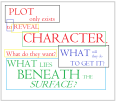
However, a few people new to the craft are developing a pPlot-exists-to-reveal-characterassion for the dirty habit of writing every day. They are joining the ranks of the old pros, the people who “do NaNo” every year whether they expect to be published or not.

But all writers begin as readers. As we read, we see an arc to the overall novel consisting of:

  1. Exposition, where we introduce our characters and their situation.
  2. Rising action, where we introduce complications for the protagonist
  3. Climax, the high point of the action, the turning point of the narrative
  4. Falling action, the regrouping, and unfolding of events that will lead to the conclusion
  5. The resolution, in which the protagonist’s problems are resolved, providing the reader with closure.

Scenes are mini stories that support the overall arc. They come together to create the all-encompassing drama that is the novel. The way the narrative unfolds keeps our readers interested until the end of the book. Each scene has a job and must lead to the next. If we do it right, the novel will succeed.

The main difference in the arc of the scene vs. the overall arc of the novel is this: the end of the scene is the platform from which your next scene launches. This means each scene begins at a slightly higher point on the novel’s plot arc than the previous scene, driving the narrative.

876MilanoDuomoIn my mind, novels are like Gothic Cathedrals–arcs of stone supporting other arches until you have a structure that can withstand the centuries. Each scene is a tiny arc that supports and strengthens the construct that is our plot.

These small arcs of action, reaction, and calm push the plot and ensure it doesn’t stall. This tension increases the overall conflict that drives the story.

My writing style in the first stages may be different than yours. I lay down the skeleton of the tale, fleshing out what I can as I go. But there are large gaps in this iteration of the narrative.

So, once the first draft is finished, I flesh out the story with visuals and action. These are things I can’t focus on in the first draft, but I do insert notes to myself, such as:

  • Fend off attack here. Bandits wound Lenn. I don’t know how.

Or my notes might say something like:

  • Contrast tranquil scenery with turbulent emotions here.

plottingLIRF07122020For me, the first draft is always rough, more like a series of events and conversations than a novel. In the second draft, I stitch it all together and fill in the plot holes.

In the first draft, most scenes I write are conversations interspersed with actions. Conversations between our characters should have an arc that supports the cathedral of the novel. They begin, rise to a peak, and ebb.

They inform us of something we must know to understand the forthcoming action. Conversations propel the story forward to the next scene.

A good conversation is about a thing or idea and builds toward some other thing or idea. Dialogue must have a premise and move toward a conclusion of some sort. Otherwise, it’s is a waste of words.

A scene that is all action is confusing if it has no context, no frame. A properly placed conversation can give the reader perspective when there is no silent witness (an omniscient presence). This view is needed to understand the reason for events.

A certain amount of context can arrive through internal monologue. But we don’t want the reader to face a wall of italics. I have two problems with long mental conversations:

  1. Italics are daunting in large chunks.
  2. Internal dialogue is frequently a thinly veiled cover for an info dump.

plot is the frame upon which the themes of a story are supportedPlot points are driven by the characters who have critical knowledge. The fact that some characters are working with limited information creates tension.

This inequality of knowledge is called asymmetric information. We see this all the time in the corporate world.

  • One party in a business transaction has more or superior information compared to another.
  • This individual’s drive and pursuit of pure self-interest can prevent others from entering and competing in an industry or market.
  • This person has the critical knowledge the competitors don’t have.
  • That inequality of information effectively eliminates his competition.

In other words, he has a monopoly and rises to the top.

In literary terms, a monopoly of information creates a crisis. In the novel, a conversation scene should be driven by the fact that one person has knowledge the others need. An idle conversation will bore your reader to tears, so only discuss things that advance the plot.

The reader must get answers at the same time as the other characters, gradually over the length of a novel.

I struggle with this too. Dispersing small but necessary bits of info at just the right moment is tricky. Hopefully, by the end of my second draft, all these bumps will have been smoothed out.

Now that we are a week into NaNoWriMo, I have written 20,000 words into my outline, which is gradually becoming a novel. Already many things have changed from the original plan.

Whether it will be an engaging story for a reader (or not) is something I can’t predict, but I’m enjoying writing it.

The Arc of the Scene

And that is what writing should be about—writing the story you want to read.

18 Comments

Filed under writing

#FineArtFriday: Indian Summer by William Trost Richards 1875

Indian_Summer_MET_DT276257Title: Indian Summer by William Trost Richards

Genre: landscape art

Date: 1875

Medium: oil on canvas

Dimensions: 24 1/8 x 20 in. (61.3 x 50.8 cm)

Collection: Metropolitan Museum of Art

What I love about this painting:

Richards has captured a singular moment of tranquility for us all to enjoy in these troubled times. A light breeze barely ruffles the surface of our pond. At the bottom right, two girls play beside a large boulder at the waters’ edge.

Across the pond, in the center and nearly hidden in the shadows, a teamster and his oxen wade across the shallows.

Autumn’s haze lends a feeling of mystery to the scene, muting the reds, yellows, and oranges of leaves about to fall. This last burst of grandeur can’t hold back winter, though it tries. Soon the forest will sleep, soon snow and ice will decorate barren limbs and ice will stop the waters’ gentle motions.

But beneath the grasp of winter, new life will bide its time, and winter will fade into spring. The seasons will follow their course, but today is autumn’s day to shine, to go down in a blaze of golden glory.

Richards paints a day of peace and serenity, a small pocket of time where one can just sit back and admire the beauty of our world.

 >>><<<

About William Trost Richards:

William Trost Richards (November 14, 1833 – November 8, 1905) was an American landscape artist. He was associated with both the Hudson River School and the American Pre-Raphaelite movement. [1]

1856 he married Anna Matlack Richards (1834–1900), a 19th-century American children’s author, poet and translator best known for her fantasy novel, A New Alice in the Old Wonderland. The couple had eight children, only five of whom lived past infancy. Anna educated the children at home to a pre-college level in the arts and sciences. [2]

One of the couple’s sons, Theodore William Richards, would later win the 1914 Nobel Prize in Chemistry. Anna Richards Brewster, their sixth child, went on to become an important painter in her own right, having received an early arts education from her father as well. [2]

Richards rejected the romanticized and stylized approach of other Hudson River painters and instead insisted on meticulous factual renderings. His views of the White Mountains are almost photographic in their realism. In later years, Richards painted almost exclusively marine watercolors. [1]


Credits and Attributions:

Indian Summer by William Trost Richards, Wikimedia Commons contributors, “File:Indian Summer MET DT276257.jpg,” Wikimedia Commons, the free media repository, https://commons.wikimedia.org/w/index.php?title=File:Indian_Summer_MET_DT276257.jpg&oldid=678817431 (accessed November 3, 2022). Public Domain.

[1] Wikipedia contributors, “William Trost Richards,” Wikipedia, The Free Encyclopedia, https://en.wikipedia.org/w/index.php?title=William_Trost_Richards&oldid=1089835304 (accessed November 3, 2022).

[2] Wikipedia contributors, “Anna Matlack Richards,” Wikipedia, The Free Encyclopedia, https://en.wikipedia.org/w/index.php?title=Anna_Matlack_Richards&oldid=1055684363 (accessed November 3, 2022).

1 Comment

Filed under #FineArtFriday, writing

The Story is in the Drama #amwriting

Drama and disaster can and will happen on a wide scale in our real lives. Tornadoes, hurricanes, earthquakes, volcanoes, droughts—the path of a natural disaster is erratic. Sometimes they miss you, and other times, your home is in their way.

modesitt quote the times we live LIRF11012022Lesser dramas might only touch us on a peripheral level, yet they can affect our sense of security and challenge our values.

On May 18th, 1980, my friends and I watched the eruption of Mt. St. Helens from atop a hill in the middle of nowhere. My children had visited their father for the weekend, so my friends and I planned a fishing trip to a beaver pond in the next county. It was a long drive on narrow, dirt logging roads, but the possibility of trout for supper was just an excuse for a day spent in the deep forest.

We loaded our gear into my boyfriend’s Land Rover and set off at about 5:00 am, all five of us laughing and having a great time. The radio never worked, but the cassette deck played Led Zeppelin, Robin Trower, Genesis, and Ritchie Blackmore’s Rainbow as the soundtrack to our trek through the gorgeous country.

At about 09:00, we came up over the top of a treeless hill. The view was breathtaking, as if all of Lewis County lay before us in springtime glory.

Above it all towered a sight I will never forget, turning the blue sky black.

MSH80_eruption_mount_st_helens_05-18-80-dramatic-edit

Eruption of Mt. St. Helens May 18, 1980 Public Domain, via Wikimedia Commons

Conversations suddenly silenced, and we stopped, turning the engine off. We got out and stared, first at the raging column of dust, rocks, and lightning that dwarfed the mountain and then at each other. Helicopters and airplanes from news agencies and the USGS circled like so many carrion birds. What so many people had thought was just hysteria was true—the mountain had blown.

We never did make it to the beaver pond. The only fish we caught that day were the tuna sandwiches we had packed. Conversations were sober as we picnicked on that hilltop and watched the incredible show.

We had no way of hearing the news, but we knew it was terrible, that some people had died and others had lost everything. We had no idea just how bad it was, that one of our favorite places to fish, the Mount St. Helens Lodge at Spirit Lake, had disappeared along with its cantankerous owner. Harry R. Truman had become famous in the weeks before the eruption for refusing to evacuate.

Toward midafternoon, we returned to Olympia, all of us grateful to have homes to go to. When I turned on the television and found that more than fifty people had lost their lives, I felt devastated for them.

The true story of that day in my life is in disaster contrasted against calm and tranquility.

The story is in the hectic start to the morning, of five friends off on a day trip to go fishing. It is in the peace of the deep woods along those old dirt roads.

640px-St_Helens_before_1980_eruption_horizon_fixedThe camera zooms out and now we see the idyllic serenity of a clear sunny morning on Spirit Lake and Harry doing his morning chores.

This allows us to see what will be lost.

Then disaster strikes. The side of the mountain gives way, and the eruption is on.

Contrast that catastrophe against five people serenely picnicking on a hill, observing the apocalypse as it happens. The drama is in old Harry R. Truman’s stubborn end, and how it didn’t occur to us who watched from a distant hill that we would never rent a boat from him or fish in that lake again.

The bad juxtaposed against the good is the plot, but the experiences of those who witnessed it is the story. Contrast provides drama and texture, turning a wall of “bland” into something worth reading.

Stories of apocalyptic catastrophes resonate because disaster drives humanity to bigger and better things, and those who survive and rise above it become heroes. Readers love the drama of it all.

Disaster isn’t always apocalyptic, though. Dramas regularly happen on what seems an unimportant level to people who have resources. Not everyone has money, and not everyone can surmount the odds. The story is in the battle.

Think about those small daily tragedies people face, deeply personal catastrophes, which only they are experiencing. Love and loss, safety and danger, loyalty and betrayal are the eternal themes of tragedy and resolution. These are the seeds of a good story.

30 days 50000 wordsWe writers must make our words count. We must show our characters in their comfort zone in the moments leading up to the disaster. Not too much of a lead in, but just enough to show what will soon be lost.

Then, we bring on the disaster and attempt to write it logically, so it makes sense.

Contrast is a crucial aspect of worldbuilding and storytelling. In the end, we want readers to think about the story and those characters long after the last paragraph has been read. Drama and resolution are the keys to a great story.

Comments Off on The Story is in the Drama #amwriting

Filed under writing

#NaNoWriMo prep part 8: Finding Time to Write #amwriting

Today is the final post in 2022’s NaNoPrep series. The game will be afoot on Tuesday!

30 days 50000 wordsMany authors are prepping for NaNoWriMo 2022. They are mentally committing to writing 1,667 new words every day beginning on November 1st or a total of 50,000 words by midnight on November 30th.

Right now, they are wondering how they will meet this goal. I don’t have a one-size-fits-all answer for that, as you must be able to pay your bills, or no books will ever be written.

When we are just beginning on the path to becoming an author, we feel guilty for taking the time to indulge in such a profoundly personal pleasure. Life tosses up roadblocks, and developing a regular writing habit is difficult.

We have jobs, families, duties to our religious faith, and many demands upon our time. We have all the extra work and activities that come along with living our lives.

In the 1980s, I could only write for half an hour or so at night after my children were asleep, pouring my angst into lyrics for songs. This is why my poetry has a rhythm: I’m a songwriter at heart, and there is always a melody in my head.

The most important thing about developing a writing process is to find one that works for you.

Give yourself permission to try different things until something works.

  • Do you work best in short bursts?
  • Are you at your best when you have a long session of privacy and quiet time?
  • Or is your process something in the middle, a melding of the two?

What if my style changes? What if the way that worked last month no longer works?

Give yourself permission to change, to find a way that does work. Be willing to be flexible.

Alarm clock quote ray bradburyUntil this past June, I wrote best when I had a long stretch of time to just sit down and immerse myself. Then my husband was diagnosed with Parkinson’s, a degenerative neurological disease, and our life underwent a fundamental change. I am now the only driver in the family, and we live in an area without public transportation.

Varying my projects and writing in bursts broken up by daily activities works best for my schedule nowadays.

The truth is, we must be open to the writing process that makes us feel productive, whether it works for someone else or not. We feel good when we’re productive.

I have my best ideas when I’m about to leave the house—no joke. If that is you too, do as I do and write those thoughts down. I keep a notebook around just for those moments.

You will be productive once you find your best style.

But first—you must give yourself permission to write. Once you do that, your family will too.

I have plenty of downtime between my daily tasks. That is when I work on whatever revisions are needed. You would be amazed at what you can get done in ten-minute bursts.

Balance is the key to a happy life. We want to feel productive and creative, and we need to share our lives and interests with our family and friends.

Therefore, we who wish to write must set aside time to do it. This allows us to be creative and still support our families, who all have activities and interests of their own.

As I have said many times before, being a writer is to be supremely selfish about every aspect of life, including family time.

  1. It also requires discipline and the ability to set aside an hour or so just for that pursuit, a little time where no one is allowed to disturb you.

800px-NotebooksA good way to ensure you have that time is to encourage your family members to indulge in their own interests and artistic endeavors. That way, everyone has the chance to be creative in their own way during that hour, and they will understand why you value your writing time so much.

Many times I wrote while my children did their homework. I was there, able to help, but I was doing my own “homework.”

To be happy, one must have a balanced life. Don’t become so obsessed with writing about fictional lives that you aren’t present in your own.

That need to be present in my real life is why I schedule my writing time. It’s also why I reward myself for achieving my writing goals.

  • Some people manage to fit short bursts of writing into their daily schedule, writing at work during breaks or at lunch.
  • Others must schedule a dedicated block of time for writing, either rising two hours before they depart for work or skipping some TV in the evening.

If you are a person who needs a dedicated block of time, do it even if you have to get up at 4:00 a.m., and don’t let anything disrupt you. On December 1st, you can reward yourself by sleeping in.

But maybe you can’t sit still for too long.

  • Write in small increments—ten minutes here, half an hour there. These short bursts add up.

If you want to meet the goal of 50,000 new words during the 30 days of November, I can’t stress this one thing enough: write every day, whether you have an idea worth noting or not.

dylan moran quote TIMEPerhaps your mind has gone blank. An idea is locked in your head, but you don’t have the words to free it. You can still advance your rough draft and meet your word count goal. Step back and view your story from a distance:

  • Write several paragraphs detailing what must happen in your story, such as: Fergus dyes Mason’s hair orange here. I don’t know why. Then comes the chase through midtown on bicycles. Fergus gasping, out of shape. Mason catches sight of Leo entering the museum.

Make a note about what blocks you and move on. Once you are past that spot, you will be writing the narrative again. Those notes will be there for you to flesh out when you come back to them. Plus, everything tallies toward your daily word count goal, even those paragraphs that are just thinking out loud.

I am a slow keyboard jockey, and I can do about 1,100 wonky, misspelled words an hour during NaNoWriMo. But every word counts, misspelled or not.

Writers and other artists do have to make sacrifices for their craft. It’s just how things are. But you don’t have to sacrifice your family for it. Sacrifice one hour of sleeping in, and sacrifice something ephemeral and unimportant, like one hour of TV.

By writing in short bursts whenever you have the opportunity, you might finish your first draft and get that certificate that says you completed 50,000 words in 30 days.

Time_Management_Quayle_Quote

9 Comments

Filed under writing

#NaNoWriMo prep part 7: Resources #amwriting

We are in the last week of prepping for NaNoWriMo 2022. Today we’re going to look at affordable resources for developing writing craft and sourcing information pertinent to your project.

orson_scott_card_write_scifi_fantasyLet’s start with craft. If you are at the beginning stage of your writing life, it’s hard to know where to find help in shaping your work into a coherent story. For many years, I didn’t even know books on the craft of writing existed.

One day in 1990, I stumbled upon a book offered in the Science Fiction Book Club catalog: How to Write Science Fiction and Fantasy by Orson Scott Card. The day that book arrived in my mailbox changed my life. That was the day I gave myself permission to be a writer.

I recommend checking out the NaNoWriMo Store, as it offers several books to help you get started. These books have good advice for beginners, whether you participate in November’s writing rumble or want to write at your own pace.

Brave the Page

Are you a first-time writer or a young author? While it is written for middle graders, adults just starting out will find good information in this book.

From the official Blurb: Partly a how-to guide on the nitty-gritty of writing, partly a collection of inspiration to set (and meet) ambitious goals, Brave the Page is the go-to resource for middle-grade writers. Narrated in a fun, refreshingly kid-friendly voice, it champions NaNoWriMo’s central mission that everyone’s stories deserve to be told. The volume includes chapters on character, plot, setting, and the like; motivating essays from popular authors; advice on how to commit to your goals; a detailed plan for writing a novel or story in a month; and more!

Ready, Set, Memoir!

Are you writing a memoir but don’t know how to get started?

From the official Blurb: Written by former NaNoWriMo Program Director Lindsey Grant, Ready, Set, Memoir! is full of helpful lists, exercises, inspiring quotes from famous memoirists, advice, lessons, and humor to help walk you through the writing process. This guided journal will inspire and motivate you to write—and finish!—your memoir.

no plot no problem_mainFinishing off the resources from the official NaNoWriMo store is the handbook, No Plot, No Problem!

This book is a resource for people who want to write but don’t know where to start.

From the official Blurb: When you add No Plot? No Problem! to your personal library, it’ll give you a run for your lexical money! It’s a writing heavyweight, muscled with advice, activities, pep talks, and prompts that are sure to match your brain swing for swing in a literary tussle. Challenge this guide, and win, and you’ll have written a champ of a novel that can hold its own in the ring!

What if you are ready to move beyond the beginning stages and need more advanced information? My personal library of books on craft is huge. I can’t stop buying them. But what are the books I refer back to most frequently?

emotion-thesaurus-et-alThe following is the list of books that are the pillars of my reference library:

How do we source information that pertains to our story? What about the internet?

activateWe usually start our online hunt for information by “googling” a question, no matter what browser you use. Be wary and read several articles to get a broader view of what you are looking for. I also check dates to ensure the information is current and bookmark it if it is relevant to my story. Note: Your browsing history may look a little … unusual … after a while.

Some libraries have a service where one can submit a question and have it answered by email. If that isn’t an option and we’re feeling ambitious, we can check out books on any subject.

Resources for authors to bookmark in general:

my-books-cjjasp-own-workwww.Thesaurus.Com This is good for when I need to know, “What’s another word that means the same as this word but isn’t weird or repetitive?”

Oxford Dictionary online is brilliant for when I need to know, “Does this word mean what I think it means? Am I using it correctly?”

Wikipedia – The font of all knowledge, or so I hear. My go-to source of info is often Wikipedia. This resource is created and edited by volunteers. All articles must provide proper citations and reference links to outside sources to support every statement. Articles that don’t meet specific criteria are flagged. Some opinions may be presented as facts when discussing art or literature. But overall, I always find something useful by looking at the links in their footnotes and going directly to those sources.

You can learn just about anything on YouTube. That’s where I learned how to make a glass orb and is where I learned how medieval swords were made.

conflict thesaurusSo, let’s talk about writers’ groups. A good group is the best way to learn about this craft. Your area may have established writers’ groups, and some may be able to accept new members. The best way to find out is to google writer’s groups in your town and make inquiries.

Attend a few meetings as an observer to see if this group is a good fit for you.

If you don’t feel comfortable meeting in person or via Zoom, see what online writers’ forums might fit your needs. I participated in an excellent online group, Critters Workshop, for several years while testing the waters of the writing community.

In 2010, I gained a wonderful local group through attending write-ins for NaNoWriMo. Nowadays, we meet weekly via zoom. My fellow writers are a never-ending source of support and information about both the craft and the industry. We write in a wide diversity of genres and gladly help each other bring new books into the world. But more than that, we are good, close friends.

So this is my short list of resources for the beleaguered author. Monday will be the final post in this NaNoWriMo Prep series and will focus on how to find time to write when life wants to derail you.

Posts in this series:

#NaNoWriMo prep part 1: Deciding on the Project #amwriting

#NaNoWriMo prep part 2: Character Creation #amwriting

#NaNoWriMo prep part 3: Designing Worlds #amwriting

#NaNoWriMo prep part 4: Plot Arc #amwriting

#NaNoWriMo prep part 5: How the Story Ends #amwriting

#NaNoWriMo prep part 6: How the Story Begins #amwriting

6 Comments

Filed under writing

#NaNoWriMo prep part 6: How the Story Begins #amwriting

Today we’re continuing to prep for NaNoWriMo by thinking about the plot and the story our characters inhabit. In post one, we thought about what kind of project we intend to write—novels, short stories, poems, memoirs, personal essays, etc.

Post two of this series introduced the protagonist(s), giving us an idea of who they are and what they do. Post three explored the setting, so we know where they are and their circumstances. Post four detailed creating the skeleton of a plot. Post five jumped to the end, giving us a finite event to write to.

beginnings are endingsToday, we will pinpoint the moment in our protagonist(s) life where the story starts. We’re locating the point where this particular memoir, poem, novel, or short story begins.

The day that changed everything should open the story.

We see the protagonists in their familiar environment. By evening, a chain of events has begun. A tiny, insignificant stone rolls downhill, the first incident that will soon precipitate an avalanche of problems our protagonist must solve.

When we are new in this craft, we have a burning desire to front-load the history of our characters into the story, so the reader will know who they are and what the story is about.

I am the queen of front-loading. Fortunately, my writer’s group is made up of industry professionals and one in particular, Lee French, has an unerring eye for where the story a reader wants to know begins.

I have to remind myself that the first draft is the thinking draft. It’s where we build worlds and flesh out characters and relationships. It’s also where the story grows as we add to it.

We need a finite starting point, a place of interest. Have faith—the backstory will emerge as the story progresses. If we have our world solidly in our heads as we write, the reader will visualize a version of it that works for them, without our info dumping the history.

Let’s plot the beginning of a medieval fantasy:

Act 1: the beginning:

lute-clip-artSetting: Venice in the year 1430.The weather is unseasonably cold. A bard is concealed amongst the filth and shadows in a dark, narrow alley. Sebastian hides from the soldiers of a prince he has unwisely humiliated in a comic song.

Opening plot point–the hook: the soldiers surround and capture Sebastian, and he is hauled before the angry prince. The trial is brief and painful. Beaten and bloody, Sebastian is thrown into prison and sentenced to be beheaded at dawn.

That moment of despair is the end of chapter one.

You have done some prep work for character creation, so Sebastian is your friend. You know his backstory, who he is attracted to (men, women, none, or both), how handsome he is, and his personal history.

You know who he will meet in prison, someone who will help him escape. Depending on Sebastian’s romantic preference, Chance (an assassin’s professional name) will be male or female and dislikes the bard on sight. Still, Chance needs Sebastian’s help to escape as he/she/they will also die at dawn.

You have decided that the prince is a dark-path warlock. His brother is a highly placed cardinal who intends to become pope, protects him.

You have designed Sebastian and Chance’s escape, which is the first pinch point— the place where what they learn from each other fuels a quest: that of killing the Warlock Prince. Each has different reasons for this, but the enemy of my enemy is my friend, and all that.

But now they are on the run and have no idea how to accomplish that task. Circumstances force them to work together despite their clash of personalities.

And we all know how friction heats things up. Romance or no romance, this tension is crucial.

We (the author) know the Warlock Prince must die if they are to save Venice, but who will be willing to help them, and what roadblocks stand in their way? These people will emerge as you write the first draft.

You’ve written down some ideas for the ending, so you have a goal to write to. At this point, the middle of the story is murky, but it will come to you as you write toward the ending. Every event and roadblock that happens to Sebastian between his arrest and the final moments of his victory will emerge from your imagination as you write your way through this first draft.

Mardi_Gras_mask_cateyes_iconBut the opening moment, the scene showing a lowly bard hiding behind a rubbish heap, is the moment in Sebastian’s life where the story the reader wants to hear starts. That scene is where this story begins regardless of how interesting Sebastian’s story, Venice’s story, or the Warlock Prince’s story was before that day. It is the beginning because this is the point where all the essential characters are in one place and are introduced:

  • The reader meets the villain and sees him in all his power
  • Sebastian knows one thing—the Warlock Prince must be stopped. He can sink no lower—he has hit bottom, and from there he can only go up.
  • Chance is in the same low emotional place, but he/she/they have an escape plan.

The story kicks into gear at this pinch point because the assassin is at risk on two fronts, which means Sebastian is too. Chance’s original task of killing the prince has failed, so now they must avoid both the prince’s soldiers and the mysterious employer‘s goons. For Chance, it’s a matter of pride that the original commission must be fulfilled despite the fact there will be no payment. Sebastian agrees to help ensure it happens because he has a conscience and wants to protect the people of Venice from the prince and his brother.

Attraction often grows in the most unlikely of places. Will it blossom into romance? It’s Venice, a city filled with romance and intrigue. But you’re the author, so only you know how their relationship grows as you write their adventure.

What else will emerge over the following 40,000 or more words (lots more in my case)?

  • Who is the assassin’s mysterious employer and what is their agenda?
  • Who is Chance really, what is their true name, and how did he/she/they become an assassin?

Sebastian will find this information out as the story progresses and only when he needs to know it. With that knowledge, he will realize his fate is sealed—he’s doomed no matter what. But it fires him with the determination that if he goes down, he will take the Warlock Prince and his corrupt brother with him.

If you dump the history at the beginning, the reader has no reason to go any further. You have wasted words on something that doesn’t advance the plot, doesn’t intrigue the reader.

Finding the beginning of the story

The people who will help our hapless protagonist will enter the story as he needs them. Each person will add information the reader wants, but only when Sebastian requires it. Some characters, people who can offer the most help will be held back until the final half of the story.

By the end of the novel, the reader will have acquired the important history of Sebastian, Chance, the mysterious employer, and the Warlock Prince. With the last bits of information, the final pieces of the puzzle will fall into place.

Gaining all that knowledge is the carrot that keeps the reader involved in the book.

Next up, in post 7, we will talk about resources for beleaguered writers. Memoirs, poems, essays, novels–every author needs handy resources to bookmark.

The final post in this 8-part series will be on how to carve out time for writing whether you are participating in NaNoWriMo or just writing for fun.


Posts in this series:

#NaNoWriMo prep part 1: Deciding on the Project #amwriting

#NaNoWriMo prep part 2: Character Creation #amwriting

#NaNoWriMo prep part 3: Designing Worlds #amwriting

#NaNoWriMo prep part 4: Plot Arc #amwriting

#NaNoWriMo prep part 5: How the Story Ends #amwriting

3 Comments

Filed under writing

#NaNoWriMo prep part 5: How the Story Ends #amwriting

Today we’re continuing to prep our novel by thinking about the plot and the story our characters inhabit. In post one, we thought about what kind of project we intend to write—novel, short stories, poems, memoir, personal essays, etc.

nano prep end this messPost two of this series introduced the protagonist(s), so we have an idea of who they are and what they do.

Post three explored the setting, so we already know where they are and their circumstances.

Post four detailed creating the skeleton of a plot.

Now we’re going to jump to the end. I know it’s rude to read the end of a book before you even begin it, but I am the kind of writer who needs to know how it ends before I can write the beginning.

Don_Quijote_and_Sancho_Panza

Don Quixote and Sancho Panza, Gustave Dore PD|100

Julian Lackland was my first nano novel. In its proto form, it was my 2010 NaNoWriMo project. That novel emerged from my mind because I had written a short story of about 2500 words featuring an elderly knight-at-large. Julian was a Don Quixote kind of knight, returning to the town where he had spent his happiest days in a mercenary crew.

He enters the town and finds it completely changed. The town has grown so large that he becomes lost. Julian talks to his horse, telling him how wonderful the place they are going is, and all about the people he knew and loved. When he does find the inn he’s looking for, nothing is what he expects. The innkeeper he was so fond of has died of old age, and stranger still, the old innkeeper’s middle-aged youngest son, is the man behind the bar. Most of the friends he’d ridden with are dead. The story ends with Lady Mags, the third leg of his love triangle, entering the tap room and their reunion.

On October 28, 2010, I was scrambling, trying to find something I could write, but my thoughts kept returning to the old man’s story. The innkeeper had referred to him as the Great Knight, stupidly brave but harmlessly insane. Had he always been that way? Who had he been when he was young and strong? Who did he love? How did Julian end up alone if Julian, Beau, and Mags were madly in love with each other?

What was their story?

Excalibur London_Film_Museum_ via Wikipedia

Excalibur London_Film_Museum_ via Wikipedia

On November 1, I still had nothing for a new novel, but I had committed to writing 50,000 words. The short story nagged at me. I found myself keying the hokiest opening lines ever, and from those lines emerged the story of an innkeeper, a bard, three mercenary knights, and the love triangle that covered fifty years of Julian’s life.

That book spawned Huw the Bard and Billy Ninefingers. While Julian Lackland was the last book in the Billy’s Revenge trilogy to be published, it was the first to be written.

The trials and tribulations of that first novel’s publishing path, the title change, and the numerous reasons it took so long for Julian to make it to the finish line is another story, but he did eventually make it.

If I know how the story will end, I can build a plot to that point. So, let’s look at my current project. I have one book that has been languishing for 5 years now because I don’t know how it ends. Unfortunately, the ending I’m detailing here is not for that book.

For my new novel, I have my characters in place. We’ll call them Marco and Dinah for this post. In reality, they have other names, but I am using their situation to show how I brainstorm my plots. I have my setting, and I know their place in that society.

This story is a murder mystery with no title as of yet. The exact details of solving the murders are still a bit murky. However, I know who is dead, how they died, and who the murderer is.

Right now, the end of the outline just says, “Marco and Dinah prevail, Klaus dead. Sarie and Jon safe.” That isn’t a lot to hang a story on, and when I begin writing the novel, I will need to know a little more, or I will lose the plot.

What I do is write an outline that will become the final chapters. This is what I came up with:

Klaus ties his barge up at the pier and goes to the inn while his crew offloads the cargo. He overhears that the mages have repaired the Temple. He decides there is only one way to end it: to take out the healers who had failed to save his daughter.

Dinah spots Klaus entering the Temple and is surprised because he didn’t pass through the gate. She recognizes him from down at the docks and wonders why he’s there when he’s been so anti-Temple. Something about him bothers her, so she follows him.

CAUTION INFO DUMP ZONE AHEADMarco arrives at the inn. The innkeeper mentions Klaus was there, but now he’s gone. Marco sees his barge is still there, and the deckhands don’t know where he is. He goes to the gatehouse where Dinah is supposed to be on duty and immediately knows something is wrong. He fears Klaus has gotten to her, and instinct tells him to go to the Temple.

Dinah tracks Klaus toward the infirmary, where Sarie and Jon are working, treating an elderly man. They’re in a healing trance, unaware of anything other than their patient.

Loren is working in his study, unaware his wife and her journeyman are in danger. He glimpses Dinah sneaking through the shadows and knows something is wrong. He follows her, meeting up with Marco as he leaves his study. The two confer and move on to the infirmary.

Klaus senses he’s being followed. He steps behind a pillar, ambushing Dinah. He attempts to strangle her, but she grabs him by the hair. Her feet slip out from under her, and she falls, pulling him down to the floor. Twisting around, she pushes him away with her feet and manages to grab her staff as she stands. Klaus has also regained his footing and is coming for her, but as she swings her staff, she slips again, cracking his skull, just as Marco arrives and fires off a lightning bolt, killing Klaus.

Or something like that. I’ll choreograph the fight when I get to that spot, but I guarantee it will be quick. I dislike reading drawn-out fight scenes and usually skip over them.

Anyway, Sarie and Jon have no idea what has just gone on, and the patient is healed. Loren agrees the new floor is too slick after all, but at least it won’t burn. Dinah finally tells Marco she’s expecting, and they all live happily, at least for a while.

30 days 50000 wordsIn real life, people live happily, but no one really lives deliriously happy ever after. But that’s another story and a different genre.

So now I know how the novel ends, and I thank you all for listening to my mental ramblings—I hope they help you. All I need are a few paragraphs, a skeleton to hang the story on, dots to connect, and I can write the first draft.

Next up, we will decide where and how the story begins.

Posts in this series:

#NaNoWriMo prep part 1: Deciding on the Project #amwriting

#NaNoWriMo prep part 2: Character Creation #amwriting

#NaNoWriMo prep part 3: Designing Worlds #amwriting

#NaNoWriMo prep part 4: Plot Arc #amwriting

5 Comments

Filed under writing

#NaNoWriMo prep part 4 Plot Arc #amwriting

Today we’re continuing prepping our novel by thinking about the plot, the story our characters inhabit. In post one, we thought about what kind of project we want to write–novel, short stories, poems, memoir, personal essays, etc.

Post two of this series introduced the protagonist(s), so we have an idea of who they are and what they do.

In post three, we explored the setting, so we already know where they are and what their circumstances are.

plot is the frame upon which the themes of a story are supportedNow we’re going to design the conflict by creating a skeleton, a series of guideposts to write to. I write fantasy, but every story is the same, no matter the set dressing: Protagonist A needs something desperately, and Antagonist B stands in their way.

What does the protagonist want? Everyone wants something. The story is in if they acquire it or not. Doubt, uncertainty, the unknown—these nouns comprise the story.

This is where we have to sit and think a bit. Are we writing a murder mystery? A space-opera? A thriller? The story of a girl dealing with bulimia?

Let’s write a historical fiction.

My uncle fought in WWII in Ardennes and was wounded. He never discussed his wartime experiences, but I like to use that battle as my example for plotting. Here in the US, that battle is referred to as the Battle of the Bulge. A book about that battle may be compiled from personal accounts, interviews, photographs, and diaries. But the author must build the events of Ardennes in December 1944 and January 1945 out of words that express memories, opinions, and wishes.

Even though your novel about this battle may explore an Allied soldier’s experiences, in reality, this narrative is a fantasy because the events it explores have disappeared into the mists of a long-ago time. They now exist only in a few places:

  • military archives
  • newspaper accounts
  • history as written by the victors
  • the memories of a dying generation
  • the handwritten diary of the soldier
  • the author’s mind
  • the pages of the book you are constructing
  • the readers’ minds as they are reading

Plot-exists-to-reveal-characterWhere does our soldier’s story begin? We open the story by introducing our characters, showing them in their everyday world, and then we kick into gear with the occurrence of the “inciting incident,” which is the first plot point. That might be their arrival at their first camp in the Ardennes region.

For our soldier, the inciting incident might be the orders that transfer him and his unit to Ardennes. After that, many things will occur before he and his fellow soldiers return home. Each event will range in intensity from the inconvenience of filthy living conditions to the unavoidable confrontation with the horror of war.

We will make a list, a ladder of events that give us landmarks to write to, like a connect-the-dots picture.

First, how long do you plan the book to be? If you plan to write 50,000 words, take that word count and divide it by 4. The first quarter opens our story and introduces the inciting incident. This is the moment of no return, even if our characters still believe they can salvage things.

The following two quarters are the middle of the narrative, exploring the obstacles that our soldier faces. If you are writing a historical novel, your plot will follow the historical calendar of actual events. The Battle of the Bulge was fought between 16 December 1944 and 25 January 1946, and reams of documentation still exist about that terrible month.

117th_Infantry_North_Carolina_NG_at_St._Vith_1945

117th Infantry North Carolina NG at St. Vith.

Your plot arc might include these events, but in chronological order:

  • Initial German assault
  • Attack on the northern shoulder
  • German forces held up
  • Germans advance west
  • German advance halted

Attack in the center: our soldier will either be with the US 30th Infantry Division at the Battle for St. Vith (Americans) or the Meuse River bridges (British 29th Armoured Brigade of 11th Armoured Division). He likely couldn’t be at both unless he was in the US Army Air Force.

  • Attack in the south
  • Allied counteroffensive
  • German counterattack
  • Allies prevail

You will connect those dots. Take each incident and write the scenes that our soldier experiences. You might also write scenes showing the commanders planning the offensives and switch to show the enemy’s plans.

No matter what sort of book you plan to write, this is all you need at first. It’s just a skeleton of the plot. You will write the scenes between these events, connecting them to form a story with an arc to it.

As we write, our soldier’s thoughts and interactions will illuminate and color in the scenes. His encounters, how he saw the enemy—were they people like him or were they faceless—all his emotions will emerge as you write his story.

No matter what genre we are writing in, you must introduce a story-worthy problem, a test that will propel the protagonist to the middle of the book.

300px-SCR-299dooropen

US Army Signal Corps photo of SCR-299 radio set in operation 1942, US Army Signal Corps

This event is the hook. We raise a question and set the protagonist on the trail of the answer. In finding that answer, the protagonist is thrown into the action.

  • If you are writing genre fiction, get to the action quickly.

Drop the protagonist into the soup as soon as possible, even if the conflict is interpersonal. Some books open with a minor hiccup that spirals out of control with each attempt to resolve it. This is the place where the characters are set on the path to their destiny.

Some plots are action and adventure. Other books explore a relationship that changes a character’s life for good or ill, while others detail surviving hardship.

When do the protagonists first realize they’re utterly blocked from achieving their desired goal? Note this event on your outline somewhere in the first quarter. This is the moment our protagonist realizes their problem is much worse than they initially thought.

At this point, they have little information regarding the magnitude of the trouble.

This is where the skeleton list comes in handy for me. Crucial knowledge that affects my characters’ choices, the information they don’t have, should be doled out at the point in the story arc where they need it. If I give all the information in the first 10 pages, there’s no point in reading the book any further—the reader knows it all.

plottingLIRF07122020One thing that I do is make notes that help limit my tendency toward heavy-handed foreshadowing. I try to keep it brief, but what will be enough of a hint, and where should it go?

Subplots will emerge as we begin writing. It’s a good idea to note them on the outline as they come to you. In my opinion, side quests work best if they are presented once the book’s tone and the central crisis have been established. Good subplots are excellent ways of supporting the emotional parts of the story.

Now is the time to read in your genre and let your ideas simmer for a while. If you are writing in a fiction genre, read the bestsellers so you know what kind of plot the reading public is looking for. Don’t worry about inadvertently channeling their ideas—there is no such thing as a story that has never been told.

Whatever you write, you will take it one step further and give it your own spin.


Posts in this series:

#NaNoWriMo prep part 1: Deciding on the Project #amwriting

#NaNoWriMo prep part 2: Character Creation #amwriting

#NaNoWriMo prep part 3: Designing Worlds #amwriting


Credits and Attributions:

Wikimedia Commons contributors, “File:117th Infantry North Carolina NG at St. Vith 1945.jpg,” Wikimedia Commons, the free media repository, https://commons.wikimedia.org/w/index.php?title=File:117th_Infantry_North_Carolina_NG_at_St._Vith_1945.jpg&oldid=661386897 (accessed October 14, 2022).


14 Comments

Filed under writing

#FineArtFriday: Rhetoricians at a Window by Jan Steen ca. 1666 #prompt

Artist: Jan Steen  (1625/1626–1679)

Title: Rhetoricians at a Window

Genre: genre art

Date: c. 1661-66

Medium: oil on canvas

Dimensions: Height: 759.46 mm (29.90 in); Width: 586.23 mm (23.07 in)

Collection: Philadelphia Museum of Art

Today we’re looking to art for ideas, and our prompt is Rhetoricians at a Window by the Dutch master, Jan Steen.

What I love about this painting:

This is one of my all-time favorite Dutch genre paintings. It has inspired some the characters who pass through my stories, people my protagonists meet along the way. These jolly rogues have such vivid personalities that the viewer immediately feels a kinship to them. Who were they? Did they keep their day jobs?

The reading of a poem or play was clearly the opportunity for the performers to have a good time. From the drinker in the shadows of the background, to the grapevines growing around the window, Steen tells us that wine and rhetoric are clearly entwined.

I love the inclusion of both “the critic” who leans his head on his hand and listens analytically, and the man behind him, who is clearly “a little over the limit,” and supports himself by grasping the window frame and heartily agreeing with some point.

The actor who reads is clearly enjoying himself, as are the others.

About the Artist (Via Wikipedia):

Jan Havickszoon Steen (c. 1626 – buried 3 February 1679) was a Dutch Golden Age painter, one of the leading genre painters of the 17th century. His works are known for their psychological insight, sense of humour and abundance of colour.

Daily life was Jan Steen’s main pictorial theme. Many of the genre scenes he portrayed, as in The Feast of Saint Nicholas, are lively to the point of chaos and lustfulness, even so much that “a Jan Steen household”, meaning a messy scene, became a Dutch proverb (een huishouden van Jan Steen). Subtle hints in his paintings seem to suggest that Steen meant to warn the viewer rather than invite him to copy this behaviour. Many of Steen’s paintings bear references to old Dutch proverbs or literature. He often used members of his family as models, and painted quite a few self-portraits in which he showed no tendency of vanity.

Steen did not shy from other themes: he painted historical, mythological and religious scenes, portraits, still lifes and natural scenes. His portraits of children are famous. He is also well known for his mastery of light and attention to detail, most notably in Persian rugs and other textiles.

Steen was prolific, producing about 800 paintings, of which roughly 350 survive. His work was valued much by contemporaries and as a result he was reasonably well paid for his work. He did not have many students—only Richard Brakenburgh is recorded—but his work proved a source of inspiration for many painters. [2]

About this painting, Via Wikipedia:

Chambers of rhetoric (Dutch: rederijkerskamers) were dramatic societies in the Low Countries. Their members were called Rederijkers (singular Rederijker), from the French word ‘rhétoricien’, and during the 15th and 16th centuries were mainly interested in dramas and lyrics. These societies were closely connected with local civic leaders and their public plays were a form of early public relations for the city. [1]

In 1945, Sturla Gudlaugsson, a specialist in Dutch seventeenth-century painting and iconography and Director of the Netherlands Institute for Art History and the Mauritshuis in The Hague, wrote The Comedians in the work of Jan Steen and his Contemporaries, which revealed that a major influence on Jan Steen’s work was the guild of the Rhetoricians or Rederijkers and their theatrical endeavors.

It is often suggested that Jan Steen’s paintings are a realistic portrayal of Dutch 17th-century life. However, not everything he did was a purely realistic representation of his day-to-day environment. Many of his scenes contain idyllic and bucolic fantasies and a declamatory emphasis redolent of theater.

Jan Steen’s connection to theater is easily verifiable through his connection to the Rederijkers. There are two kinds of evidence for this connection. First, Jan Steen Steen’s uncle belonged to the Rhetoricians in Leiden, where Steen was born and lived a substantial part of his life. Second, Jan Steen portrayed many scenes from the lives of the Rederijkers, an example being the painting Rhetoricians at a Window of 1658–65. The piece is currently held in the Philadelphia Museum of Art which was established in February 1876. The humanity, humor and optimism of the figures suggest that Jan Steen knew these men well and wanted to portray them positively.

With his lavish and moralising style, it is logical that Steen would employ the stratagems from theater for his purposes. There is conclusive evidence that the characters in Steen’s paintings are predominantly theatrical characters and not ones from reality. [2]


Credits and Attributions:

This post first appeared here on Life in the Realm of Fantasy  in September of 2020.

[1] Wikipedia contributors, “Jan Steen,” Wikipedia, The Free Encyclopedia, https://en.wikipedia.org/w/index.php?title=Jan_Steen&oldid=950709901 (accessed September 10, 2020).

[2] Wikipedia contributors, “Chamber of rhetoric,” Wikipedia, The Free Encyclopedia, https://en.wikipedia.org/w/index.php?title=Chamber_of_rhetoric&oldid=975283829 (accessed September 10, 2020).

Wikimedia Commons contributors, “File:Jan Steen, Dutch (active Leiden, Haarlem, and The Hague) – Rhetoricians at a Window – Google Art Project.jpg,” Wikimedia Commons, the free media repository, https://commons.wikimedia.org/w/index.php?title=File:Jan_Steen,_Dutch_(active_Leiden,_Haarlem,_and_The_Hague)_-_Rhetoricians_at_a_Window_-_Google_Art_Project.jpg&oldid=355150081 (accessed September 10, 2020).

4 Comments

Filed under #FineArtFriday, writing

#NaNoWriMo prep part 3: Designing Worlds #amwriting

Today we’re continuing our NaNo Prep by imagining a world. These exercises will only take a few minutes unless you want to spend more time on them. They’re just a warmup, getting you thinking about your writing project. In our previous post, we asked ourselves who we think our characters might be. Now we ask, “Where do my characters live? How do they see their world?”

WritingCraftWorldbuildingEvery world in which every story is set is imaginary. This is true whether it is a memoir, a cookbook, a math book, a sci-fi novel, a contemporary novel set in London, or an encyclopedia.

All written worlds exist only in our minds, even those non-fiction books detailing recent events.

The world you paint with words will be inhabited by the characters you create. I write fantasy, and I have three created worlds, peopled with characters I cherish and places where I feel at home.

But my created worlds didn’t begin that way. They emerged as the first draft of the first novel evolved. Each world started as an idea and grew in detail as the narrative unfolded in my imagination.

But what if you aren’t writing fantasy? Creating a fantasy or sci-fi world is exactly the same as detailing a historical time or a current event.

The difference is in documentation. While you can use Google Earth to visit a distant city, read documentation concerning a historical event, or view maps drawn by contemporaries, you must create the history and landscape of your fantasy world. With fiction, your preparatory world-building is the documentation.

800px-Mount_Rainier_sunset_and_cloudsWhen writing our narrative, we want to avoid contradicting ourselves about our protagonist’s world. Keeping it all in your head is not a good idea, especially if you’re like me—too much data means I regularly have the eternal loading screen when trying to recall something. (I’ll never forget what’s-his-name.)

I recommend you create a file containing all your ideas regarding your fictional world, including the personnel files you are making. I learned to do that the hard way, so take my advice: write down your ideas, and update them with later changes.

I list all my background information in a separate Excel workbook for each book or series. You don’t have to go that far; you can use any kind of document, handwritten or digital. Many people make notes on their phones. You just need to document your ideas. If you want to get fancy, see my post, Ensuring Consistency: the Stylesheet.

Find images on the internet that are either historical or represent your ideas. Paintings and great photography inspire me and fire my imagination. Go to the internet and find maps.

If you are writing a fantasy or sci-fi novel, sketch a map. It doesn’t have to be pretty, but I recommend you use a pencil in case you need to rearrange it.

Clementines_Astoria_Dahlia_Garden2019Just like we do when creating our characters, we want to begin with a paragraph that might be the encyclopedia explanation of where the action takes place. I write fantasy, so here is the one paragraph I might start with:

The Citadel of Kyrano, a port city along the River Fleet. Its population is around five thousand, and its primary industry is wool production. Every industry in Kyrano supports the cloth trade in one way or another. The merchants’ council rules the citadel and a small armed militia keeps the peace and patrols the walls, repelling the occasional band of highwaymen.

I will ask myself several questions about Kyrano.

  • What objects do the characters see in their immediate environment?
  • When they step outside, what ambient sounds do they hear?
  • What odors and scents do they encounter indoors and out?
  • What objects do the characters interact with?
  • What weapons does this society use for protection? (swords, guns, phasers, etc.)
  • How important is religion?
  • What are the layers of society, and where do my characters fit?
  • Is the use of magic a part of my story? If so, who can use it, and what is the science of that magic? What are its limits?
  • Are science and technology a part of my story? If so, who can use it, and what are its limits?

Keep your world-building document handy, or a notepad and pen. As you go about your life, observe the world around you and make notes of smells and sounds you can incorporate into your work. I spend a lot of time walking in my neighborhood, but my own backyard is a haven for birds and insects. If you plan to set your work in a fantasy or sci-fi world, what can you incorporate into it that is familiar, something the reader can identify with?

Write a paragraph or two about what you think your characters might see and hear in their environment. What do they smell? It’s been exceptionally warm and dry so far this autumn here in the Northwest. When I go outside, I smell smoke from distant wildfires. I see browning vegetation, falling leaves, and a militant spider colony attempting to annex my back porch.

An author takes an idea, translates it into words, and dares the reader to believe it. Successful fantasy and sci-fi authors take the world they see and reshape it just a little, just enough so it seems alien yet familiar.

Every novel requires world-building.

Make notes about possible places where events will occur, writing them down as they come to you. Remember, the setting for a contemporary novel requires the same thinking and the same imagining of place as a fantasy novel does.

Seattle from the w space needle 2011If I were to write a thriller set in the current Seattle of 2023, I’d want the reader to see the landscape as if they lived there. I would use the eternal gray of certain times of the year to underscore my dark themes.

In fact, world-building is nothing more than taking what we know and reshaping it into what might be and then dropping casual hints about it into the narrative. It is only the backdrop against which our characters live out their lives. But without that backdrop, the story unfolds on a barren stage.

Pike_Place_Market_SeattleThe internet has information about every kind of environment that exists on Earth. All we have to do is use it.

Google Earth is a good tool for contemporary world-building if you can’t travel to the place in person.

The websites of NASA and other international space agencies are bottomless wells of information about the environment of space and what we know about other worlds.

Over the next few months, it’s up to you who write fantasy and science fiction to take what we know and make that intuitive leap to what might be.

Those of you who write romance, or thrillers, or action adventures, cozy mysteries or any other kind of novel—you must also take what we know of this world and turn it into what might be.


Posts in this series:

#NaNoWriMo prep part 1: Deciding on the Project #amwriting

#NaNoWriMo prep part 2: Character Creation #amwriting


Credits and Attributions:

Pike Place Market, by Daniel Schwen, CC BY-SA 4.0 https://creativecommons.org/licenses/by-sa/4.0, via Wikimedia Commons. (Accessed October 10, 2022)

Mount Rainier Sunset and Clouds, US National Park Service, Public domain, via Wikimedia Commons (accessed October 10, 2022).

Downtown skyline in Seattle viewed from the w:Space Needle, by M.O. Stevens. Wikimedia Commons contributors, Wikimedia Commons, the free media repository, File:Downtown Seattle skyline from Space Needle May 2011.JPG – Wikimedia Commons (accessed October 10, 2022)

15 Comments

Filed under writing