
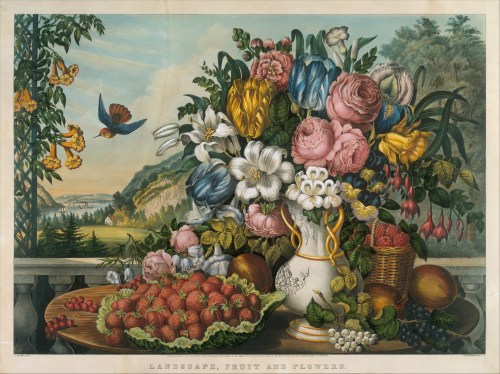
 Artist: Frances Flora Bond Palmer (1812–1876)
Title: Landscape, Fruit and Flowers
Description: Lithographed and published by Currier & Ives
Date: 1862
Medium: Hand-colored lithograph
Dimensions: height: 19.8 in (50.3 cm); width: 27.5 in (69.8 cm)
Collection: Metropolitan Museum of Art, bequest of Adele S. Colgate, 1962
What I love about this picture:
This is a romantic Victorian image of what a prosperous life might be. Lush, rich, pastoral, and bountiful. The artist created a renaissance-style composition, but with Victorian touches – the hummingbird poised to sip nectar, flowers arranged over ripe fruit, and golden globes (pears?) tucked in amongst strawberries and raspberries. In the background, a farmhouse is situated on a green pasture that stretches to the sea. The fruit and flowers are posed in the front and center, yet they feel organic and natural, as if a picnic were about to occur.
About the Artist, via Wikipedia:
Frances Flora Bond Palmer (July 24, 1812 – August 20, 1876), often referred to as Fanny Palmer, was an English artist who became successful in the United States as a lithographer for Currier and Ives.
In her youth, Palmer, with her sister Maria, attended Miss Linwood’s School for young ladies, a select private school in London run by needlework artist Mary Linwood. There she was instructed in music, literature, and the fine arts.
On July 13, 1832, Frances Flora Bond married Edmund Seymour Palmer. They had a daughter, Frances E. Palmer, in 1833, and a son Edmund Jr., in 1835.
By the year 1841, the Palmers operated a lithography business together with Frances as the artist and Edmund as the printer. The first notice of their work appeared in the Leicester Journal on May 13, 1842. As an artist-printer team, the Palmers began a series of topographical prints under the title of Sketches of Leicestershire. These prints were very well received and often advertised in the Leicester Journal and the Leicester Chronicle amongst enthusiastic reviews.
When the Palmers were unable to secure enough work for themselves, their business failed. Nathaniel Currier then took over their stock and, recognizing Palmer’s talents, hired her to work for his firm.
During Palmer’s association with the printing companies of N. Currier and Currier and Ives, between 1849–1868, she is credited with producing around two hundred lithographs. She participated in every stage of the lithographic printing process in some way and was widely renowned for her technical skills. She is also credited with assisting Nathaniel Currier in the improvement of existing lithographic technology, including Currier’s own lithographic crayon.
Palmer specialized in landscape and genre prints. Among her subjects were rural farm scenes, famous American ships and architecture, hunters, and Western landscapes. A notable example of these prints during her time with Currier and Ives is her highly regarded series of six bird hunting scenes. Palmer sketched these scenes from life using her husband Edmund Palmer, his friends, and their hunting dogs as models. Each medium-folio print is labeled “Drawing from nature and on stone by FF Palmer,” and was priced at two dollars at the time of its publication in 1852.
Though her work was mainly directed by the type of prints that Currier and Ives wanted to sell or determined by preexisting prints, her few original pieces received praise for their compositional fluidity and technical skill. Her most notable original work is titled Landscape, Fruit, and Flowers, published in 1862. In Still Life Painting in America, Wolfgang Born describes the composition of this work as “flawless.” He also describes the piece as an example of early chromolithography anticipating the impressionist movement. [1]
Credits and Attributions:
Image: Landscape, Fruit and Flowers by Frances Flora Bond Palmer 1862 Wikimedia Commons contributors, “File:Landscape, Fruit and Flowers.jpg,” Wikimedia Commons, the free media repository, https://commons.wikimedia.org/w/index.php?title=File:Landscape,_Fruit_and_Flowers.jpg&oldid=303703279 (accessed August 25, 2022).
[1] Wikipedia contributors, “Frances Flora Bond Palmer,” Wikipedia, The Free Encyclopedia, https://en.wikipedia.org/w/index.php?title=Frances_Flora_Bond_Palmer&oldid=1091932065 (accessed August 25, 2022).
 Unfortunately, although we asked for a ground-floor condo, we were assigned a second-floor unit. My husband is managing the stairs – slowly. On the good side, we have the god’s-eye view of a wide stretch of beach, the perfect deck overlooking it all.
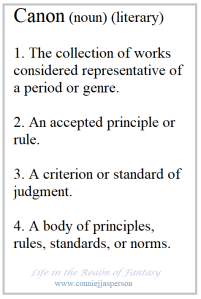 Writing is going as well as ever, a little up and down. I’m building the framework for a new story, which I will begin writing on November 1st. The world is already built; it’s an established world with many things that are canon and can’t be changed. So, I’m working my way through the bag of tricks that help me jar things loose.
 Protagonist HER: Anna Lundquist, an unemployed game developer. She inherited an old farm and has moved there. She embarks on creating her own business designing anime-based computer games. Anna is shy, not good with men unless discussing books or computer games. VOID: Loss of family. VERBS: Create, Build, Seek, Defend, Fight, Nurture. Modifiers: Adaptable, ambitious, focused, independent, industrious, mature, nurturing, private, resourceful, responsible, simple, thrifty.
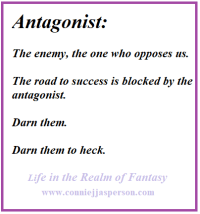 Antagonist HIM: Matt Gentry, owner of MGPopularGames and Anna’s former boss, is angry at Anna for leaving his firm. On a skiing trip with an old fraternity brother who owns an art supply store in Starfall Ridge, he sees her entering Nic’s coffeeshop. Matt discovers that Anna is now living in that town. He learns she has started her own company and is building an anime-based RPG. He goes back to Seattle and files an injunction to stop her, claiming that he owns the rights to her intellectual property. VOID: Narcissist. VERBS: Possess, Control, Desire, Covet, Steal, Lie, Torment.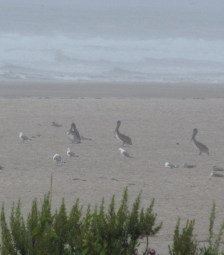
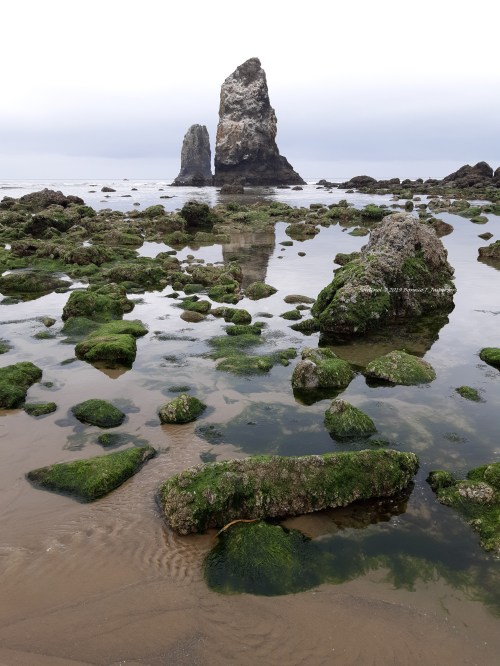

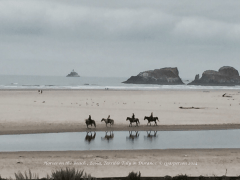 The view from our condo is one that never fails to soothe me. Tillamook Head is just off to the north. A mile out to sea, resting atop a sea stack of basalt, is the notorious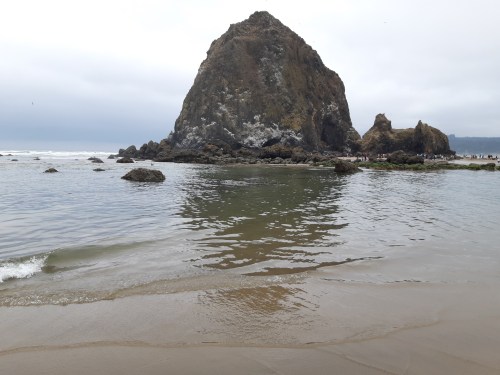
 The final aspect of narrative voice or style arises from our deeply held beliefs and attitudes. We may or may not consciously intend to do it, but our convictions emerge in our writing, shaping character and plot arcs.
 Whether or not we are aware of it, our societal and religious beliefs emerge in our writings. Subliminal fears of climate change, worry about a world on the edge of economic collapse, and our hopes for a better society come out in our plot arcs and world-building. How they appear may have nothing to do with real life, but they add color to our worlds.

 Why do I say such a terrible thing? It’s true. All stories are derived from a few basic plots, and we have only so many words in the English language with which to tell them.
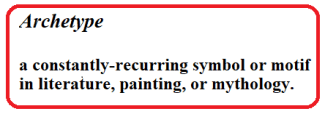 Overcoming the monster
 For that reason, I have the
  Noisy
Noisy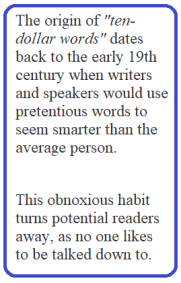 My Texan editor refers to those convoluted morsels of madness as “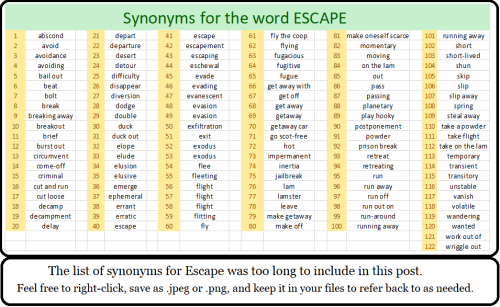
 Today’s post focuses on word choice. What do you want to convey with your prose? This is where the choice and placement of words come into play. Active prose is constructed of nouns followed by verbs or verbs followed by nouns.
 The second draft revisions are where I do the real writing. It involves finetuning the plot arc, character arcs, and most importantly, adjusting phrasing.
 Some types of narratives should feel highly charged and action-packed. Most of your sentences should be constructed with the verbs forward if you write in genres such as sci-fi, political thrillers, and crime thrillers.
 What clues should you look for when trying to see why someone says you are too wordy?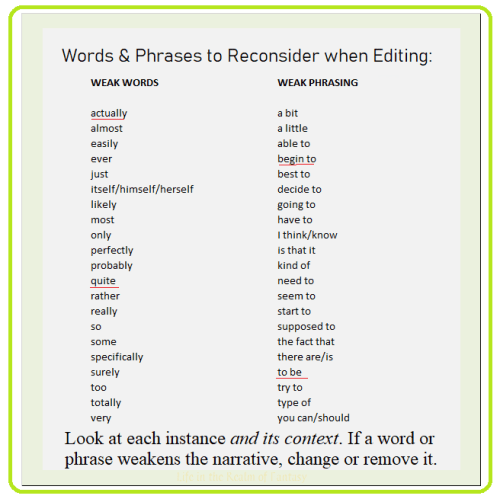
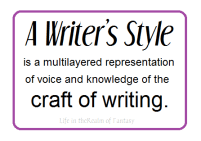 Some authors are forceful in their style and throw you into the action. They have an in-your-face, hard-hitting style that comes on strong and doesn’t let up until the end.
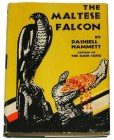 “I’m going to send you over. The chances are you’ll get off with life. That means you’ll be out again in twenty years. You’re an angel. I’ll wait for you.” He cleared his throat. “If they hang you I’ll always remember you.” [1]
 But I prefer to keep my research in hardcopy form, rather than digital.
  As we become confident in our writing, we learn more about grammar and punctuation in our native languages. We learn to write so others can understand us.
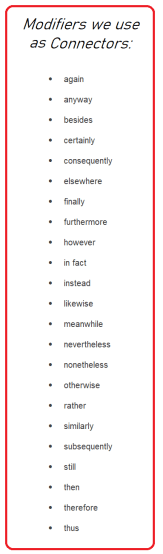
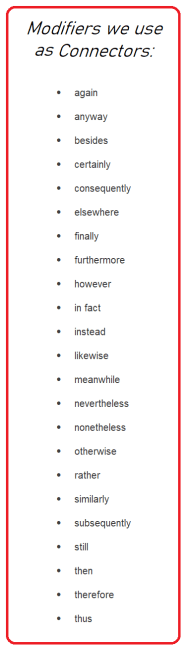
 However, quantifiers have a bad reputation because they can quickly become habitual, such as the word very.
 Our narrative voice comes across in our choice of hard or soft words and where we habitually position verbs in a sentence. Where we automatically place the words in the sentence is a recognizable fingerprint.
 In
In 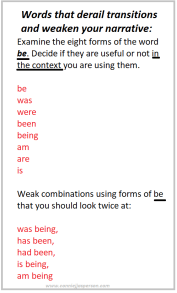 If we write a sentence that says a character is hot and thirsty, we leave nothing to the reader’s imagination. However, when we change the tense, we are often inspired to rephrase a thought.
 Other authors manipulate time. They may start with a chapter of action and commentary set in the past. The experiences shown in the prologue show the reason for present day events and actions that are yet to unfold.
 I’ve read some excellent narratives where the author uses the flashback to ratchet up the suspense in a danger scene. An example could be a character trapped in a small space while a killer searches for her. She remembers being a small child during the war and being hidden in a cupboard by her father when enemy soldiers arrived. Through the keyhole, she witnesses the slaughter of her family.
 Narrative time and calendar time are separate entities. Point of view and narrative time work together.
 Some stories work best with a first-person point of view, while others are too large and require an omniscient narrator.
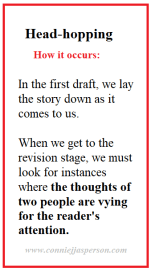 Head-hopping occurs when an author switches point-of-view characters within a single scene. It sometimes happens when using a third-person omniscient narrative because each character’s thoughts are open to the author.
 One example of a bestseller written in second person POV is
 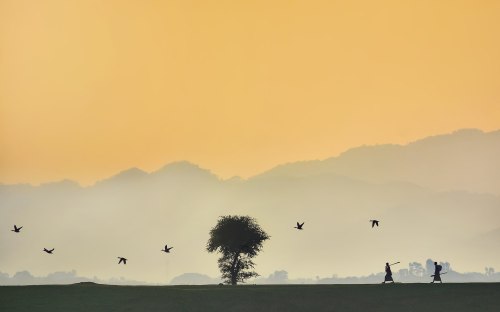 Photograph: Tanguar Haor by Abdul Momin


 Life in the Realm of Fantasy