Category Archives: writing

#NaNoPrep, Terrain and Geography

We are continuing the build of our storyboard for NaNoWriMo2021. My planned NaNoWriMo project takes place in the world of Neveyah, a world where five other books have been set. Neveyah is an alien environment, yet it’s extremely familiar to me.
WritingCraft_NaNoPrep_101I know that world because I based the plants and topography on the Pacific Northwest, where I live. Other than the Escarpment, which is the visible scar left behind by the Sundering of the Worlds, the plants and geography are directly pulled from the forested hills and farmlands of Southern Puget Sound and Western Washington State.

In 2008, when I first began writing in this world, I went to science to see how long it takes for an environment to recover from cataclysmic events. I took my information from the Channeled Scablands of Washington State, a two-hour drive from my home. This vast desert area is comprised of the scars of a series of natural disasters that occurred around 13,000 years ago.

From Wikipedia: The Cordilleran Ice Sheet dammed up Glacial Lake Missoula at the Purcell Trench Lobe. A series of floods occurring over the period of 18,000 to 13,000 years ago swept over the landscape when the ice dam broke. The eroded channels also show an anastomosing, or braided, appearance.

The story I’m prepping for takes place only a century after a world-shattering disaster, so the way the world was before the Sundering is still fresh in their lore. The elders remember the culture and technology and know firsthand what was lost in the cataclysm. I am plotting book 2 of a duology, so I’ve already established that my protagonist is a shaman and devoted to caring for the fragile ecology.

But perhaps you are writing a historical novel. A certain amount of worldbuilding will be required, no matter when or where your book is set.

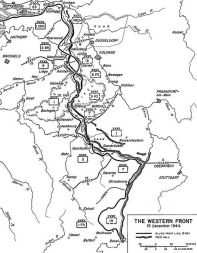
Let’s say you are writing an account of a soldier’s experiences in the Battle of the Bulge, also known as the Ardennes Counteroffensive. This battle was a pivotal point in World War II. American forces endured most of the attack, suffering their highest casualties of any operation during the war.
512px-Western_Front_Ardennes_1944

US Army Center for Military History, Public domain, via Wikimedia Commons

Researching and building the world this novel takes place in will be time-consuming but easy because a great deal of information about this battle exists. You can access documents and accounts from both sides of the war. The Ardennes region covers the province of Wallonia in eastern Belgium, northeast France, and Luxembourg, and many maps showing the area as it was in 1945 are still available in libraries and on the internet.

In regard to the events and battles of World War II, generals of both sides left many documents detailing how the terrain they were forced to fight on affected their decisions.

But even though your book may explore a real soldier’s experiences through newsreels, the pages of his diary, and the interview you had with him just before his death at the age of 94, you are still writing a fantasy.

This is because, in reality, the world of this book exists only in three places:

  1. it flows from the author’s mind
  2. to the pages of the book
  3. into the reader’s mind through the written word

We can only view history through the stained-glass of time. History, even recent events, assumes a mythical quality when we attempt to record it. Even a documentary movie that shows events filmed by the news camera may not be portrayed exactly as it was truly experienced. The facts are filtered through the photographer’s eye and the historian’s pen.

Modern Romance, historical, and contemporary novels are genres set in real-world locations. Their authors are fortunate, as information is usually available for the researcher to dig up. For an author recounting any historical era, information will be accessible since archaeologists and historians are constantly expanding our knowledge of history.

Any story set in prehistorical times is a fantasy.

  • Historical eras are those where we have written records.
  • Any story taking place in a society that left no written records must be considered a fantasy as little scientific facts are available, although mythology, conjecture, and theorizing abound.

If you are setting your novel in a real-world city as it currently exists, make good use of Google Earth. Bookmark it now, even if you live in that town, as the maps you will generate will help you stay on track while you are winging it during NaNoWriMo.

If you are writing a tale set in a fantasy or sci-fi setting, you are creating that world.
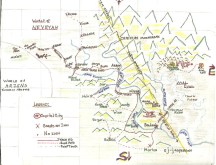
Neveyahmap jpeg of original scanned doc

Original Map of Neveyah from 2008 © Connie J. Jasperson

The first map of my world of Neveyah series was scribbled with a pencil on graph paper. Over time it evolved into a full-color relief map of the world as it exists in my mind.

I love maps. My own maps start out in a rudimentary form, just a way to keep my story straight. I use pencil and graph paper at this stage because:

  • As the rough draft evolves, sometimes towns must be renamed.
  • They may have to be moved to more logical places.
  • Whole mountain ranges may have to be moved or reshaped so that forests and savannas will appear where they are supposed to be in the story.
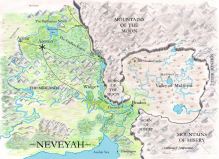
Map of Neveyah, color copy compressed

Neveyah © 2015 – 2021 Connie J. Jasperson

What should go on a map? At this point, not a whole lot.

  • The name of the town or area where the story begins.

Yep, that’s it, unless you are in the mood to draw maps. All you need for now is the jumping off point.

In November, you will add all the details as they occur to you, and believe me, they will come. In the meantime, your map page will be ready and waiting for you to note the particulars. When you are spewing words, the details will emerge, and you will have a place ready for them.

Why should you be worried about this now? It will be one thing you don’t have to worry about when you are pantsing it. The page will be there, and the map will be waiting for you to add to it.

When your characters are traveling great distances, they may pass through villages on their way. Perhaps the environment will impede your characters.

If environmental or geographical obstacles are pertinent to the story, it will be easy for you to take a moment to note their location on your map. This way, you won’t interrupt the momentum of your writing, and won’t contradict yourself if your party must return the way they came.
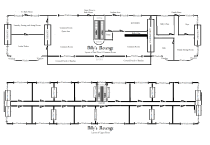
Billy's Revenge Floor plan ground floorIf your work is sci-fi, consider making a map of the place where the action happens. It could be a pencil-drawn floor-plan of a space station/ship or the line drawing of part of an alien world. I drew the floorplan of Billy’s Revenge for my reference, as most of the novel, Billy Ninefingers, takes place there.

Your storyboard is your lifeline in November, offering you dots to connect and help you stay organized when you are writing stream-of-consciousness. During the lead-up to November, make notes about your environment whenever you have an idea that you’d like to incorporate into your novel.


The #NaNoPrep series to date:

#NaNoPrep: part 1: What’s the Story?

#NaNoPrep, Setting: Creating the Big Picture

#NaNoPrep, Building Characters

#NaNoPrep, More Character Building

#NaNoPrep, Creating Societies

#NaNoPrep, Designing Science, Magic, and the Paranormal

Today’s post: #NaNoPrep, Terrain and Geography


Credits and Attributions:

Wikipedia contributors, “Channeled Scablands,” Wikipedia, The Free Encyclopedia, https://en.wikipedia.org/w/index.php?title=Channeled_Scablands&oldid=1031181669 (accessed September 21, 2021).

Wikimedia Commons contributors, “File:Western Front Ardennes 1944.jpg,” Wikimedia Commons, the free media repository, https://commons.wikimedia.org/w/index.php?title=File:Western_Front_Ardennes_1944.jpg&oldid=470134455 (accessed September 21, 2021).
11 Comments

Filed under writing

#NaNoPrep: Designing Science, Magic, and the Paranormal

Many authors will begin writing novels on November 1st.  Some will be genre fiction–fantasy, romance, sci-fi, etc.. I read sci-fi and seek out fantasy but I’m also a born skeptic. Logic is an area many first-time authors ignore, because some wonderful trick has captured their imagination. It may be a good idea but they didn’t think it through very well, so it doesn’t work.

Science, the paranormal, and magic must be written in such a way that we can easily and wholeheartedly suspend our disbelief.

WritingCraft_NaNoPrep_101Open your storyboard and create a new page. You are going to create the limits of science, magic, or the paranormal. By creating limitations, you create opportunities for conflict.

  • Hint: make a “glossary,” a list of the proper spellings for all words that relate to or are special to the science or magic in your story. This will save your sanity later on.

In designing a story where superpowers, super weapons, or magic are key elements, we have to keep two important ideas in mind:

Science is not magic. The writer of true science fiction must know the difference, especially when creating possible weapons. Superweapons and superpowers are science based. Think Stan Lee’s Spider-Man. The theory behind superweapons and /or superpowers might be improbable, but it’s logical and rooted in the realm of theoretical physics.

scienceAuthors of sci-fi must research and understand the scientific method. This path of testing and evaluation objectively explains nature and the world around us in a reproducible way. Sci-fi authors must look things up, read scientific papers, and ask questions.
An important thing for authors to understand is who their intended readers are. Those who read and write hard science fiction are often employed in various fields of science, technology, or education in some capacity. They know the difference between physics and fantasy.

The paranormal is not science or magic. It works best when the opening pages establish that the paranormal exists as a part of that world but has limitations. The paranormal should follow a logic of some sort. Start with a premise: Ghosts, or vampires, or shapeshifters, or werewolves, or any kind of paranormal entity exist.

  1. What are the conditions under which they cannot exist?
  2. If ghosts, can they interact with the physical world? Why or why not?
  3. What powers do the paranormal characters have?
  4. Under what conditions do their powers not work?
  5. What harms them? (Sunlight? A silver bullet? Something must be their kryptonite or there is no story.)

Magic is not science, but it should be. Magic also works best when the population accepts that it exists and has limitations. When you think about it, magic should only be possible if certain conditions have been met. It should be logical and follow a set of rules.

For me, magic as an element of a fantasy novel works under the following conditions:

  1. if the number of people who can use it is limited.
  2. if the ways in which it can be used are limited.
  3. if the majority of mages are limited to one or two kinds of magic and only certain mages can use every kind of magic.
  4. if there are strict, inviolable rules regarding what each kind of magic can do and the conditions under which it will work.
  5. if there are some conditions under which the magic will not work.
  6. if the damage it can do as a weapon or the healing it can perform is limited.
  7. if the mage or healer pays a physical/emotional price for the use.
  8. if the mage or healer pays a hefty price for abusing it.
  9. if the learning curve is steep and sometimes lethal.
  10. Is your magic spell-based rather than biological/empathic?
  11. If magic is spell-based, can any reasonably intelligent person learn it if they find a teacher or are accepted into a school?

magicSatisfying these conditions sets the stage for you to create the Science of Magic. This is an underlying, invisible layer of the world. By creating and following the arbitrary rules of this “science,” your story won’t contradict itself.

What challenges do your characters have to overcome when learning to wield their magic/superpower or super weapon?

Is the character born with the ability to use the superpower or magic? Or was it learned or conferred?

  • Are they unable to fully use their abilities?
  • If not, why?
  • How does their inability affect their companions?
  • How is their self-confidence affected by this inability?
  • Do the companions face learning curves too?
  • What has to happen before your hero can fully realize their abilities?

Personal Power and the desire for dominance is where the concepts of science, magic, and the paranormal converge.

In all my favorite science fiction and fantasy novels, the enemy has access to equal or better science/magic/superpower. How the protagonists overcome their limitations is the story.

The_Pyramid_Conflict_Tension_PacingConflict forces the characters out of their comfortable environment. The roadblocks you put up force the protagonist to be creative. Through that creativity, your characters become stronger than they believe they are.
Take the time to create the rules and write a document for yourself that clearly defines what limits characters face when using their magic.

  • If the protagonist and their enemy are not from the same school of magic or science, you should take the time to write out what makes them different and why they don’t converge.
  • You must also clearly state the limits of science for both the protagonist and antagonist. Take the time to write it out and be sure the logic has no hidden flaws.

In creating science technologies and magic systems, you are creating a hidden framework that will support and advance your plot. Within either system, there can be an occasional exception to a rule, but there must be a good reason for it, and it must be clear to the reader why that exception is acceptable.

An important thing to consider whether using magic or technology: the only time the reader needs to know these systems exist is when it affects the characters and their actions. Write it as a natural part of the environment rather than discussing it in an info dump.

Science and magic are two sides of the personal-power coin.

2020_nano_Project_coverIf you design this now, on November 1st, you will have the framework to showcase your characters ambitions, the drive to acquire more personal power, and the lengths characters will go to in their efforts to gain an edge over their opponents. Everything will be in place for a free-wheeling dive deep into the consequences of your protagonist’s struggle.
The fundamental tropes of science, magic, or superpowers offer your characters opportunities for success. But to be believable, those opportunities must not be free and unlimited.

Magic, science, and superpowers share common ground in one area—they offer characters an edge in whatever struggle they face.

However, neither science nor magic can support a poorly conceived novel. Both science and magic are just tools. Strong, charismatic characters, powerful struggles, and serious consequences for failure make a brilliant novel.

Do a little planning now so that when you begin writing on November 1st, you see your characters clearly and know what they are capable of and what they can’t do. Those limitations will offer you many opportunities for mayhem.


#NaNoPrep series to date:

#NaNoPrep: part 1: What’s the Story?

#NaNoPrep, Setting: Creating the Big Picture

#NaNoPrep, Building Characters

#NaNoPrep, More Character Building

#NaNoPrep, Creating Societies

15 Comments

Filed under writing

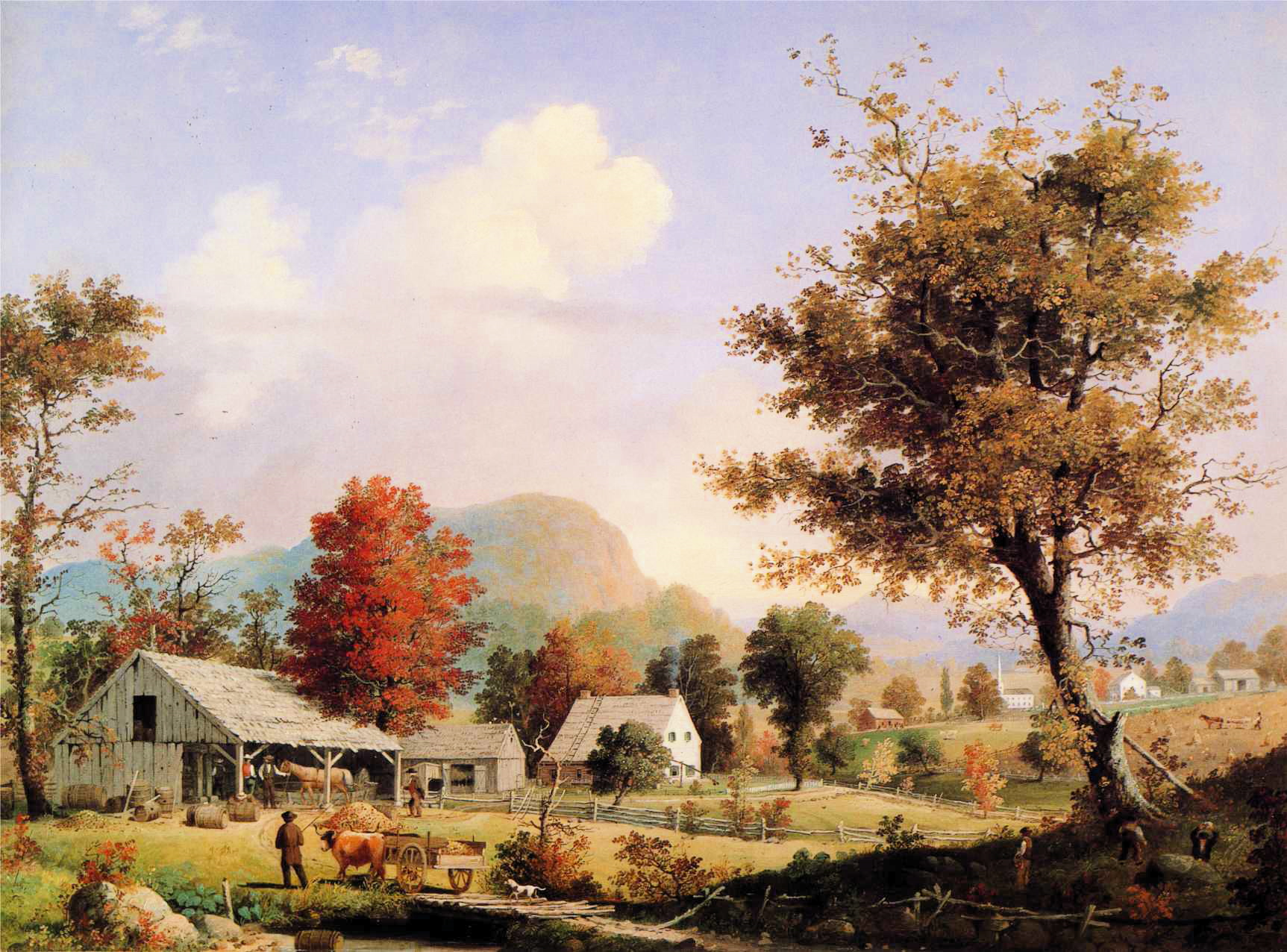
#FineArtFriday: Cider Pressing by George Henry Durrie 1855
George_Henry_Durrie_-_Cider_PressingCider Pressing by George Henry Durrie 1855

Date: 1855

Medium: oil on canvas

Dimensions: Height: 22.2 in (56.5 cm); Width: 30.2 in (76.8 cm)

Collection: Private collection (Mr. & Mrs. Eugene Bugbee)

What I love about this painting:

This is a quintessential, slightly romantic, view of history, a window into a New England day in autumn during the 19th century. A farmer leads his ox-drawn cart to the cider press. Is he selling them to the cider-man or just paying to have them juiced? Does he make his own apple jack, or is he a teamster, transporting goods for a fee?

A story can be found here, as in all Durrie’s paintings.

Juicing apples for unfermented ciders juices, jellies, and the highly fermented apple jack was an essential part of bringing in the harvest and preparing for winter, a part of the food chain we who get our food from the supermarket are disconnected from. But this was a scene that played out every fall, in every town and village.

Durrie’s colors are intensely vibrant, deep and rich, and each part of the scene is clear and placed with intent. The air is crisp and cool, but not yet cold. The leaves are turning all shades of red and gold, just as they are doing here today in the Pacific Northwest.

About the Artist, quoted from the National Gallery of Art:

Born in New Haven in 1820, the son of a Connecticut stationer, George Henry Durrie remained in that city virtually his entire life. Married to a choirmaster’s daughter, Sarah Perkins, in 1841, he immersed himself in the quiet pursuits of family and church. While he never achieved the fame of the most renowned nineteenth century American landscape painters, he appears to have had a fulfilling, productive career. His letters show that he never felt the need to move beyond his community, although he once briefly took a studio in New York and exhibited there regularly at the National Academy of Design.

Almost all of his compositions are relatively small in scale, few exceeding 18 x 24 inches, and his views are quiet and intimate. He knew and admired the works of Thomas Cole, and may have tried to emulate certain aspects of Cole’s style, yet he eschewed the Hudson River School’s compositional complexity and expansiveness. Because his paintings combined extensive genre elements with landscape they had a story-telling content that made them pleasant, accessible images to the average viewer.

The lithographic firm of Currier & Ives successfully reproduced ten of Durrie’s scenes and these, in turn, became popular calendar illustrations in the twentieth century. As a result, Durrie’s depictions of rural life in the mid-nineteenth century are now among the most familiar images in all of American art. As Martha Hutson has noted, however, these printed pictures do not convey the keen sensitivity to and understanding of conditions of atmosphere and light that are so pronounced in Durrie’s paintings. [1]

From Wikipedia:

In his teens the self-taught artist painted portraits in the New Haven area. In 1839 he received artistic instruction from Nathaniel Jocelyn, a local engraver and portrait painter. After 1842 he settled in New Haven, but made painting trips to New Jersey, New York, and Virginia. Around 1850, he began painting genre scenes of rural life, as well as the winter landscapes that became popular when Currier and Ives published them as lithographs. Four prints were published between 1860 and the artist’s death in New Haven in 1863; six additional prints were issued posthumously. The painter Jeanette Shepperd Harrison Loop studied with him. [2]


Credits and Attributions:

Wikimedia Commons contributors, “File:George Henry Durrie – Cider Pressing.JPG,” Wikimedia Commons, the free media repository, https://commons.wikimedia.org/w/index.php?title=File:George_Henry_Durrie_-_Cider_Pressing.JPG&oldid=369724230 (accessed September 15, 2021).

[1] National Gallery of Art contributors, “George Henry Durrie,” biography, © 2018 – 2021 National Gallery of Art, https://www.nga.gov/collection/artist-info.6397.html

[2] Wikipedia contributors, “George Henry Durrie,” Wikipedia, The Free Encyclopedia, https://en.wikipedia.org/w/index.php?title=George_Henry_Durrie&oldid=861433469 (accessed September 15, 2021).

2 Comments

Filed under #FineArtFriday, writing

#NaNoPrep, Creating Societies

Worlds are comprised of plants, animals, and geology, which we touched upon in the first post of this series. But if intelligent life-forms are living on that world, there will also be societies.

WritingCraft_NaNoPrep_101We humans are tribal and like having an overarching power structure because someone has to be the leader, which isn’t a job most people want once they see what is involved. Being the leader means bearing the responsibility when things go wrong, usually more often than basking in the glory when it’s all good.
Proving how tribal we are, all smaller segments within societies, from families to businesses, to churches, to governments – all have organized leadership structures, even if they aren’t formally described as such.

We will be pantsing it (writing stream-of-consciousness) for the month of November, which means we’ll be writing at least 1667 new words every day, connecting the events that we will be storyboarding later in this series. We won’t have time to think about logic once we begin writing the narrative, which is why we’re creating the storyboard.

If your society is set in modern suburbia, that culture and those values will affect your characters’ view of their world.

But perhaps you are writing a sci-fi or fantasy novel. To show a world logically and without contradictions, we must know how things work in the cities and towns, whether set in a medieval world or on a space station. Merchants, scientists, priests, soldiers, teachers, healers, thieves – each occupation has a place in the hierarchy and has its own chain of command.

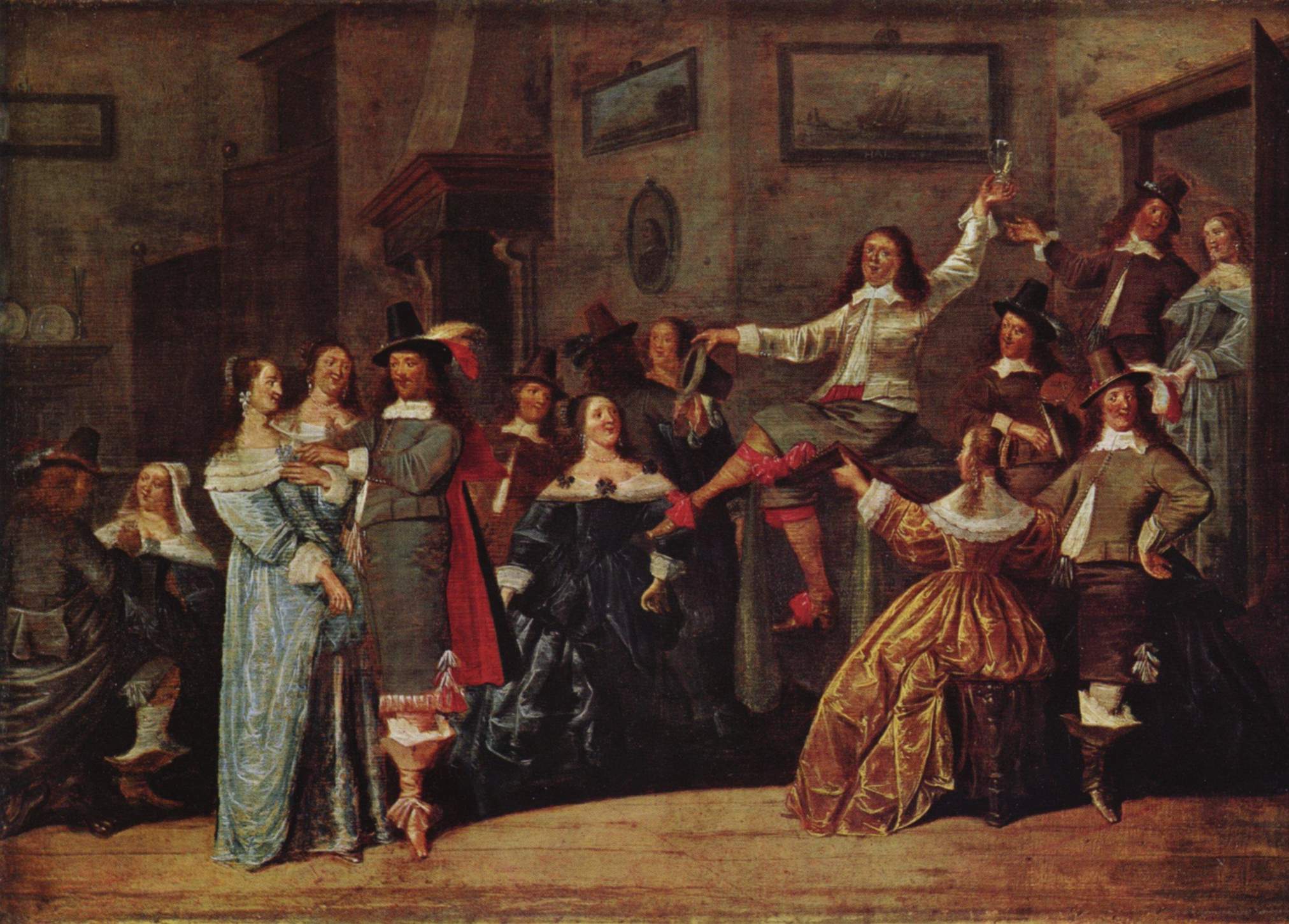
Dirck_Hals_001Society is always composed of many layers and classes. Below is a list of questions for you to consider when building your fantasy or sci-fi civilization. I admit it’s long, but please bear with me.
These are what I think of as “porch questions.” This is the stage where I sit on the  back porch and consider the world my characters will inhabit. Going somewhere quiet and pondering these questions will make the culture your characters inhabit clearer in your mind. 

How is your society divided? Who has the wealth? (Feel free to copy and paste the list to a page you can print out.)

  • Is there a noble class?
  • Is there a servant class?
  • Is there a merchant class
  • Is there a large middle class?
  • Who makes up the most impoverished class?
  • Who has the power, men, women—or is it a society based on mutual respect?

Ethics and Values: What constitutes morality and how do we treat each other?

  • Is marriage required?
  • How are women treated?
  • How are men treated?
  • How are the different races viewed?
  • Is there a cisgender bias or is there acceptance of different gender identities?
  • How are same-sex relationships viewed?
  • How are unmarried sexual relationships seen in the eyes of society?
  • How important is human life?
  • How is murder punished?
  • How are treachery, hypocrisy, envy, and avarice looked upon?
  • What about drunkenness?
  • How important is the truth?
  • What constitutes immorality?
  • How important is it to be seen as honest and trustworthy?

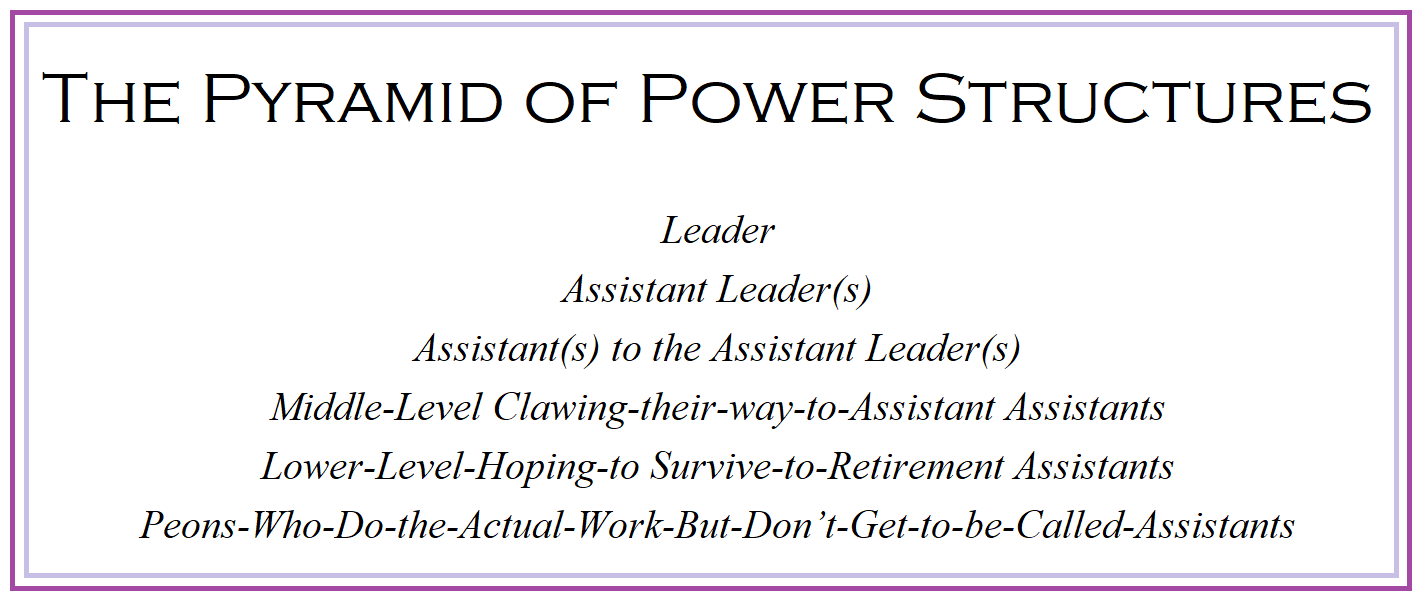
Power structures are the hierarchies that encompass the leaders, the people with the power. It is an overall system of restraint and control among selected members of a group. Think of it as a pyramid.

Pyramid_of_Power_Structures_09132021LIRF

Religion rarely is a component of sci-fi but often figures prominently in fantasy work. In sci-fi, science and technology take the place of religion, with similar hierarchies and fanatics, just with different job titles.

Archbishop might be replaced with Head of Research and Development.

Cardinal or Pope might be replaced with General, Admiral, or CEO (Chief Executive Officer).

Level of Technology: What tools and amenities are available to them? What about transport?

  1. Hunter/Gatherers?
  2. Agrarian/farming?
  3. Greco-Roman metallurgy and technology?
  4. Medieval metallurgy and technology?
  5. Pre-industrial revolution or late Victorian?
  6. Modern-day?
  7. Or do they have a magic-based technology?
  8. How do we get around, and how do we transport goods? On foot, by horse & wagon, by train, or by space shuttle?

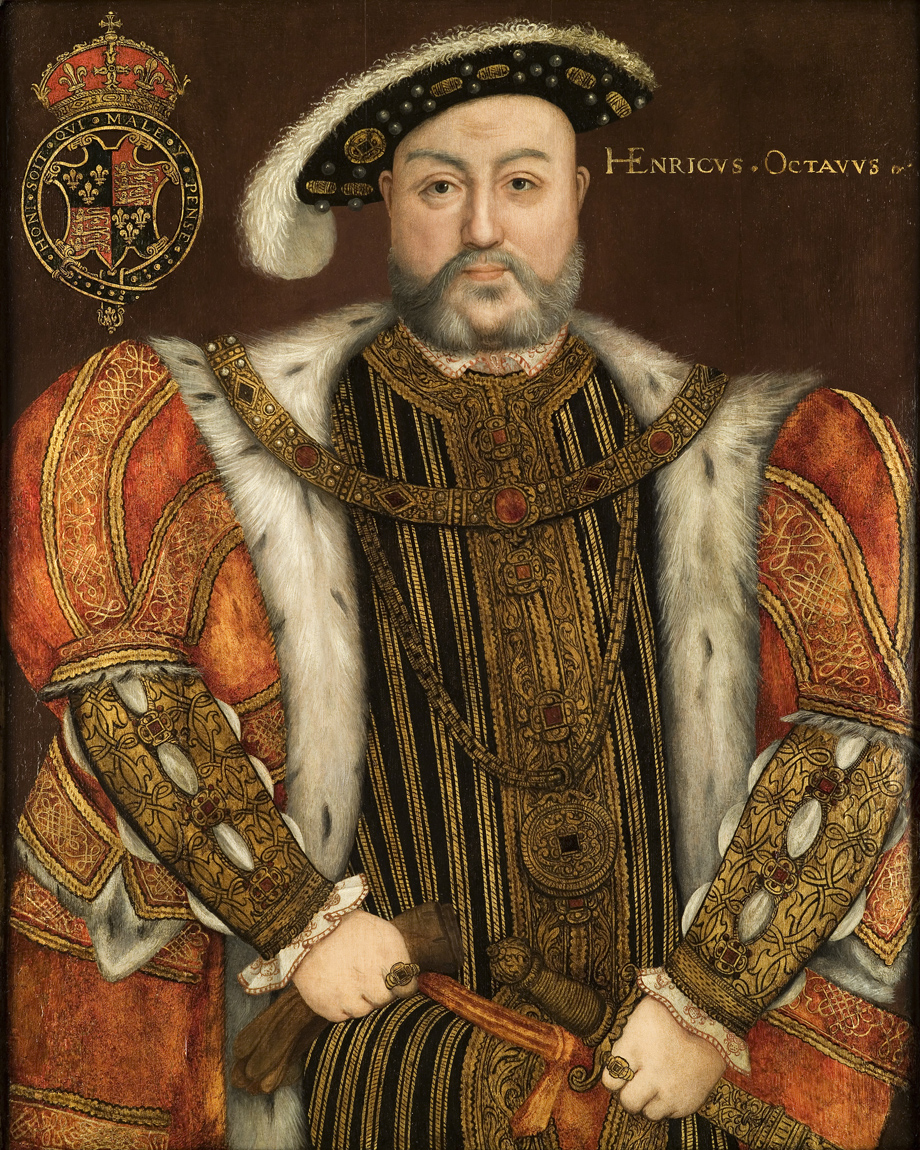
Portrait_of_King_Henry_VIII, Hans Holbein the YoungerGovernment: There will be a government somewhere, even if it is just the local warlord. Someone is always in charge because it’s easier for the rest of us that way:
  1. Is it a monarchy, theocracy, or a democratic form of government?
  2. How does the government fund itself?
  3. How are taxes levied?
  4. Is it a feudal society?
  5. Is it a clan-based society?
  6. How does the government use and share the available wealth?
  7. How do the citizens view the government?

Crime and the Legal System: What constitutes criminal behavior, and how are criminals treated?

Foreign Relations: Does your country coexist well with its neighbors?

  • If not, why? What causes the tension?

Waging War: This is another area where we have to ask what their level of technology is. It is critical for you, as the author, to understand what weapons your characters will bring to the front. You must also know what the enemy will be packing. Do the research and choose weaponry that fits your established level of technology.

  • What kind of weaponry will they use?
  • How are they trained?
  • Who goes to battle? Men, women, or both?
  • How does social status affect your ability to gain rank in the military?

A common trope in fantasy is magic, which brings up the need to train magic-gifted people. Authors use everything from dumb luck and experimentation to apprenticing to sorcerers, to training by religious orders, and in the case of Harry Potter, a school of some sort. (Never fear, we’re going to build believable magic and future-tech systems next week.)

In many real-world historical societies, the Church/Temple is the governing power. The head of the religion is the ruler, and the higher one rises within the religious organization, the more power one has. The same is true of both universities and research facilities.

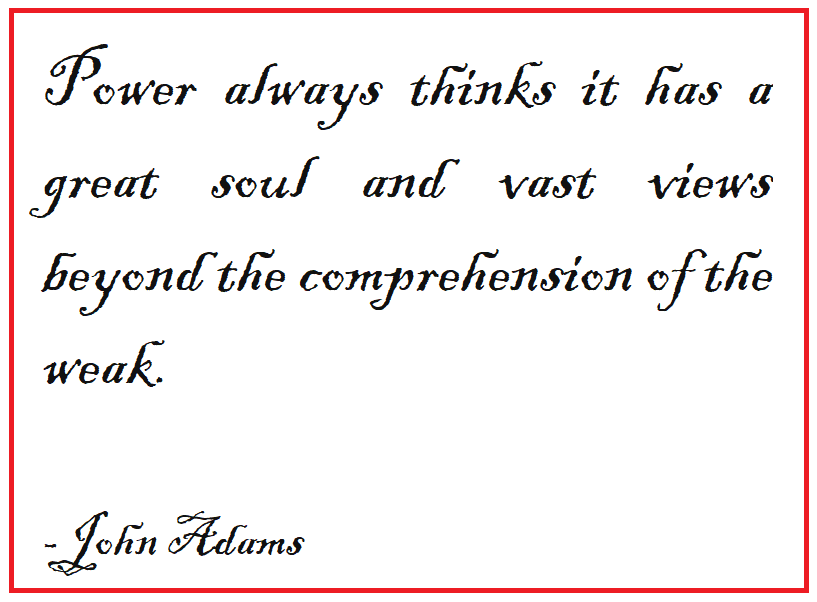
Power quote John AdamsPower in the hands of only a few people offers many opportunities for mayhem—followers may inadvertently create a situation where the leader believes they are anointed by the Supreme Deity. Even better, they may become the God-Emperor/Empress.
The same sort of God-complex occurs among academicians and scientists. Some people are prone to excess when presented with the opportunity to become all-powerful.

If you were unsure what your plot was before you got to this stage, now you might have a real villain, one presented to you by your society.

SO, in your world, what sort of society do you envision? How will that culture shape your characters?

Up Next: Magic and Future-tech

#NaNoPrep series to date:

#NaNoPrep: part 1: What’s the Story?

#NaNoPrep, Setting: Creating the Big Picture

#NaNoPrep, Building Characters

#NaNoPrep, More Character Building


Credits and Attributions:

Image: The Merry Company, Wikimedia Commons contributors, “File:Dirck Hals 001.jpg,” Wikimedia Commons, the free media repository, https://commons.wikimedia.org/w/index.php?title=File:Dirck_Hals_001.jpg&oldid=549782256 (accessed September 13, 2021).

Image: Henry VIII of England, Wikimedia Commons contributors, “File:Portrait of King Henry VIII.jpg,” Wikimedia Commons, the free media repository, https://commons.wikimedia.org/w/index.php?title=File:Portrait_of_King_Henry_VIII.jpg&oldid=250517909 (accessed September 13, 2021).

14 Comments

Filed under writing

#NaNoPrep, More Character Building

We are still working on creating the characters for our NaNoWriMo 2021 novels. Our plan is to have everything in place on November 1st to begin writing with all the prep work done. We intend to have the first draft of our novel written from beginning to end on November 30th.

WritingCraft_NaNoPrep_101When we commence writing on the 1st of November, we will know what has to happen at each point along the story arc, but we will have the freedom to “pants it” between each plot point. “Pantsing” is writer slang for “flying by the seat of your pants.” Hopefully, we will be able to write 1,667 words every day and meet our goal of a finished novel or 50,000 words at midnight on the 30th.

We are still working on our storyboard, and today we are fleshing out the sidekicks and other characters. To see how I do a storyboard, check out this post: #NaNoPrep: part 1: What’s the Story? | Life in the Realm of Fantasy .

My main character, Ivan, has a complicated life. He is a husband and father, a master armorsmith, and a shaman. A fire-mage, he is a Sword of Aeos, dedicated to serving the people of Neveyah. He is secretly a Hunter of rogue-mages and mindbenders (empathically gifted healers who have gone rogue.)

Lee French, my co-municipal liaison here in the Olympia Region, suggests you identify what your main character wants. She says, “Everybody has goals, and so does your MC. They want things. Some goals are big and world-shaking. Other goals are small and personal. Some goals are easy and quick to achieve, others take months or years, or a 20-book series.

“For your MC, define at least three goals your character has at the start of the story, either knowingly or not. Big, small, easy, or hard, they need or want something, and that’s what will get your story rolling.”

These are some examples of goals that Lee suggests:

  1. Survive
  2. Make a friend
  3. Find love
  4. Kill the bad guy
  5. Escape a bad situation, like prison or an abusive relationship
  6. Find food and/or water
  7. Steal something specific
  8. Admit they have an addiction problem
  9. Take Thing X to Location Y
  10. Learn a specific skill
  11. Get a job
  12. Earn respect from Person A
  13. Acquire $Z
  14. Rescue or protect Person B
  15. Save the world

Any of the above goals can be the main driving force of a story, or they can be secondary goals that help determine how your MC pursues the primary objective (s).

My main character, Ivan, wants to eliminate the rogue-mage, save the people of Tribe Anendale, and get home to his children.

With Ivan’s goals identified, I move on to the others with a part in this story. I will add a little information to my storyboard every day as I think about it.

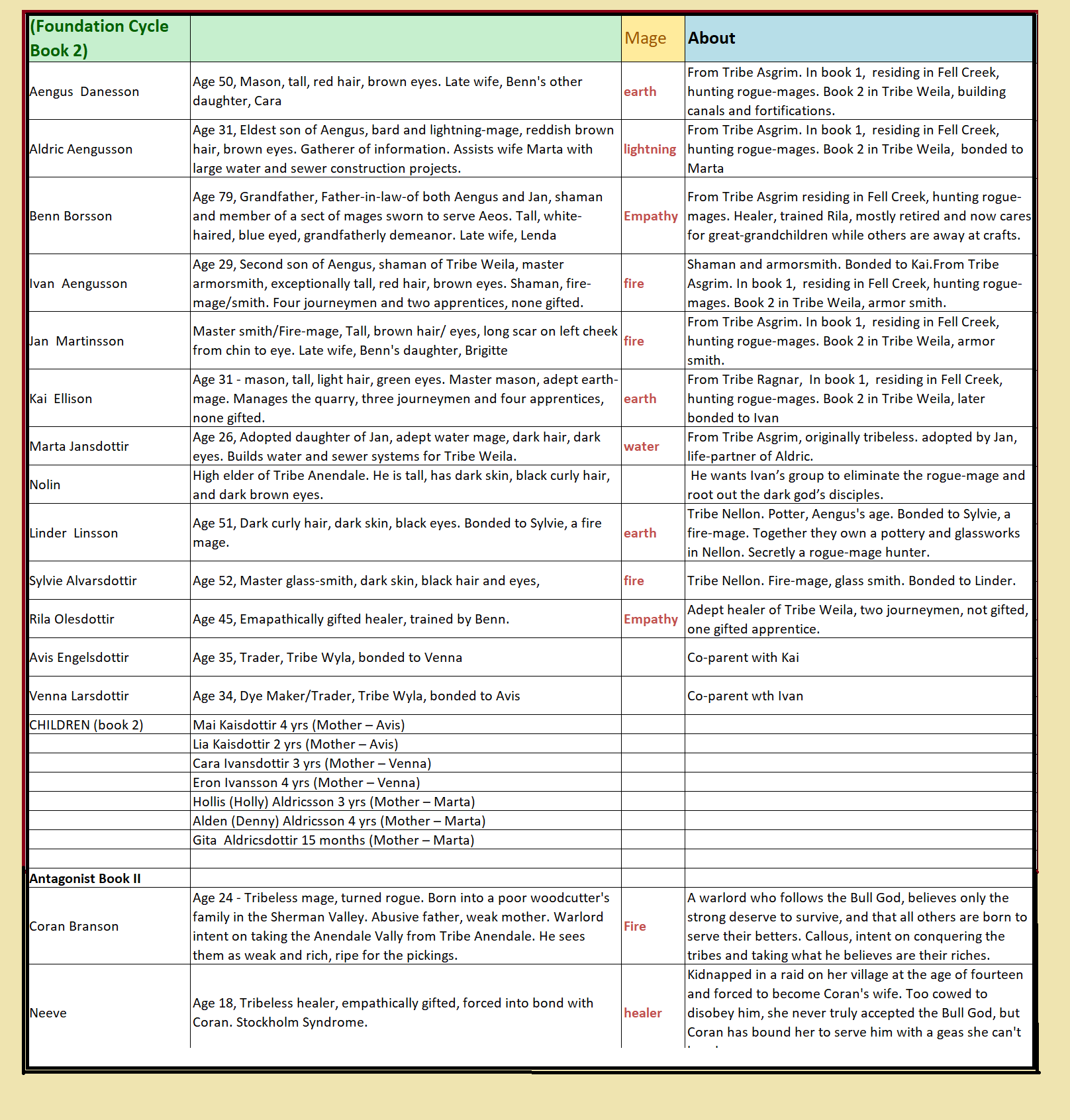
Who are Ivan’s side characters? As this is a book two, Ivan’s support group is established.

Kai is an earth-mage and a master mason, Ivan’s life-partner. Kai is tall, has brown hair, green eyes. He and Ivan’s father, an earth-mage named Aengus, have a quarry on the outskirts of Weiland. Aengus usually manages large building projects for the tribe, such as canals or fortifications, and Kai runs the quarry and builds the occasional home for community members as needed. They have four children. Ivan’s obligations as a shaman limit his free time, but he and Kai share parenting and homemaking duties.

The rest of Ivan’s family lives in the same row of five rowhouses, joined by a long porch. The family consists of his brother Aldric whose wife Marta is a water-mage and their three children. In the center house is their maternal grandfather, Benn, who cares for the children while the others work. Also living in their row of houses are his father, Aengus, and Jan, a master-smith and Ivan’s business partner (Aldric’s father-in-law). All but Benn are involved with hunting rogue-mages and mindbenders.

Nolin is the high elder of Anendale. He is tall, has dark skin, black curly hair, and dark brown eyes. He wants Ivan’s group to eliminate the rogue-mage and root out the dark god’s disciples.

Neveyah_storyboard_Characters_09112021LIRFEvery side character has hopes and wants something, so that will be noted.
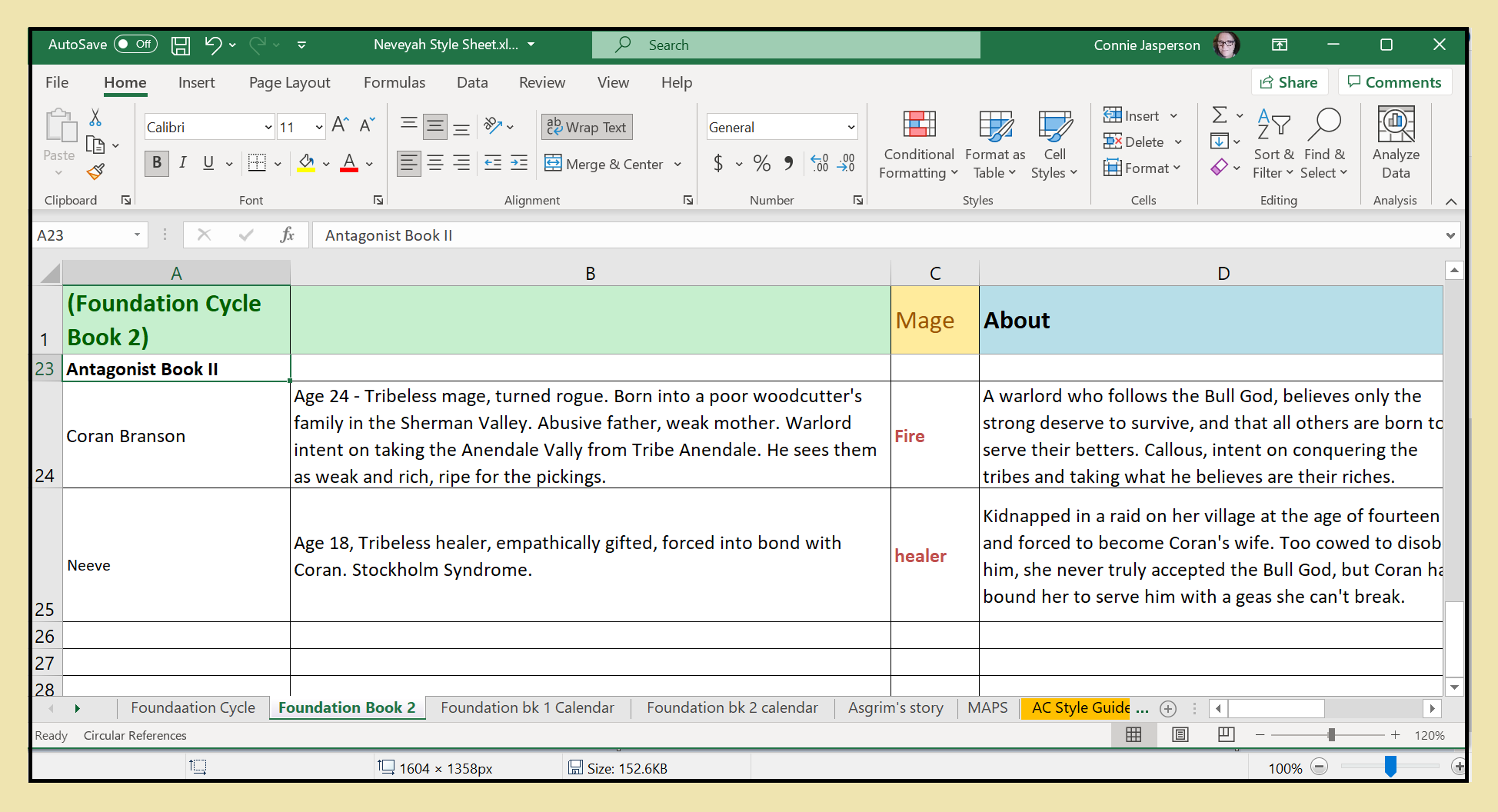
But what of my antagonist? I’m plotting book two, so a new antagonist is required.

Coran Branson: Tribeless fire-mage, turned rogue. Follows Tauron the Bull God. Born into a poor woodcutter’s family in the Sherman Valley. Abusive father, weak mother. Warlord intent on carving his empire. He considers the tribes weak and rich, ripe for the pickings. Sees himself as an all-conquering emperor on a holy mission of pillage and plunder, a Genghis Khan but with fire magic.

Neeve: Tribeless healer, empathically gifted. Kidnapped in a raid on her village at the age of fourteen and forced to become Coran’s wife. Too cowed to disobey him, she never truly accepted the Bull God, but Coran has bound her to serve him with a geas she can’t break. Think Stockholm Syndrome.

Neveyah_storyboard_antagonist_LIRF09052021My antagonist will have trusted captains, who will carry out his orders. I just haven’t met them yet, and probably won’t until I begin plotting the antagonist’s arc of the story.
If you see something in your storyboard that no longer fits, don’t be afraid to modify it. While we are in the planning stage is a perfect time to do so.

I work back and forth, make changes, and adjust things as I go. That way, I’m not wasting writing time in November.

Now that we have a cast of characters, we will go back to looking at the world they inhabit and their place in that setting.

As Lee French regularly tells me, the process of planning involves making changes now, so we’re not making them while writing or in revision.

The #NaNoPrep series so far:

#NaNoPrep: part 1: What’s the Story?

#NaNoPrep, Setting: Creating the Big Picture

#NaNoPrep, Building Characters


8 Comments

Filed under writing

#NaNoPrep: Building Characters

If you have been following this series, you know that I rely heavily on a storyboard. If you are curious how I create this thing, you can find the first post here: #NaNoPrep: part 1: What’s the Story? But don’t worry. The list of articles in this series is included at the bottom of this post.

WritingCraft_NaNoPrep_101We have opened the discussion on setting, and we will continue that later in this series. But today we are going to take an hour or so to build our main character. No matter how many primary or POV characters you have, pick the one you consider the most important or the main character. My protagonist is Ivan Aengusson. He is bonded (married) to Kai Ellison.

Who is this person? Start with the basics: race, ethnicity, age, gender, sexuality, appearance/coloration.

Who are youRace: This is a post-apocalypse world. When the survivors were preparing to leave the catacombs, they divided into 50 tribes and blended the various races and ethnicities as evenly as possible to widen the gene pool. Everyone is of mixed-race heritage, regardless of outward coloring and appearance.
Appearance and coloration: Ivan is exceptionally tall, has red hair, brown eyes, and light coloring.

Ethnicity: Both Ivan and Kai were born into tribes that settled in the north.

Age: Ivan is 27, Kai is 29.

Gender/sexuality: This is important, as gender and sexuality play a role in my novel. A broad view of gender/sexuality is a fact of life in their culture. Ivan and Kai are life-partners. The elders of each tribe arrange co-parenting pairings for the purpose of childbearing based on how distantly a man and woman are related. This evolved as a way to prevent inbreeding because they were sprung from so few people. Regardless of who they share children with, people are free to live with the partner of their choice. These co-parenting contracts will be discussed when we get to the next stage of world building.

Lashei indicates those attracted to the same sex. Kai is lashei.

Non, those attracted to the opposite sex.

Bin, those who are both lashei and non. Ivan falls into this category. Non and bin are the most common sexual preferences.

Other-born, souls born into the wrong gender. Also, people with no interest in sex consider themselves other-born.

My co-Municipal Liaison, Lee French, suggests you write once sentence to describe them, and move on. I’m not good at one-sentence descriptions, sorry. A paragraph is more my style. I suggest you write what comes to mind, and you will fill it in later with the details.

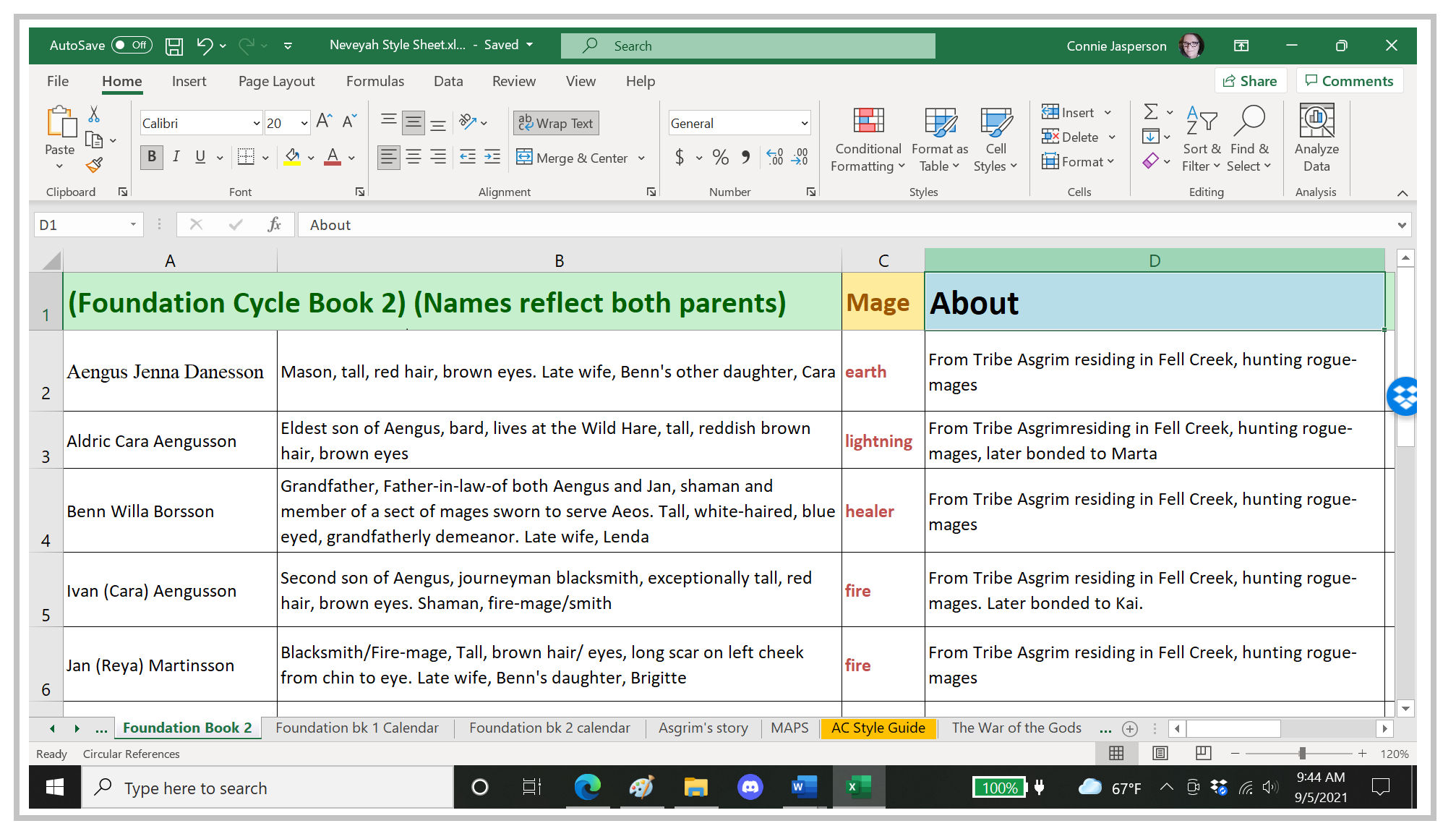
Who is your main character in their ordinary life? Think about their job, hobbies, relationships, possessions, or anything else that defines who they are. This is how my storyboard looks:

Neveyah_storyboard_characters_LIRF09052021

I will fill it in with more information: Ivan is a shaman and fire-mage. From 5:00 a.m. to 11:30 a.m., he is a master armor smith. In tribal society, everyone who can lift a weapon is trained to fight and defend the community from predatory animals and tribeless raiders. Ivan’s grandfather cares for the children while Ivan and Kai work at their crafts. After the midday meal, Ivan and the other adults in the family train with their various apprentices and journeymen in weaponry and fighting for one hour. Afterward, Ivan may be called to act as a justicer, truth reading miscreants, usually ale-hounds whose love of ale has gotten out of hand.

Ivan, like all mages, is sworn to use his magic only in his craft and to serve the people of Neveyah, but (plot point) all members of Ivan’s family belong to a sect of sworn mages who secretly hunt rogue mages. He and Kai share four children.

These are the seeds of who my main character is. The page of my storyboard with the characters listed and what I know about them is growing.

powerwordsWordCloudLIRF06192021Next up, we will look closer at our characters and see who their companions are. Some of Ivan’s companions are already established as they were featured in last year’s NaNoWriMo novel. Others are new, and I need to understand who they are and how they fit into Ivan’s story.
#NaNoPrep series

#NaNoPrep: part 1: What’s the Story?

#NaNoPrep, Setting: Creating the Big Picture

13 Comments

Filed under writing

#NaNoPrep, Setting: Creating the Big Picture

Today we’re going to visualize the place where our proposed NaNoWriMo 2021 novel is set.

WritingCraft_NaNoPrep_101Where do you see your story taking place? In the real world? A fantasy realm? Space? An alternate dimension? Alternate Earth? Setting is what we are focusing on today.

Much of my work is set in a world called Neveyah. To explain the geography, flora, and fauna there, I need to see how the War of the Gods changed the landscape of three worlds.

What follows is cut directly from my storyboard, which was begun in 2007 when we started planning an anime-style RPG game. The story evolved out of the three paragraphs that answer the following question.

For my planned work, religion is a central driving force. Why is religion so important?

There are eleven deities: six gods and five goddesses. Tauron, the Bull God, is the only god with no wife. He is the youngest of the gods, resentful and jealous of his brothers. He decides to murder his brother, Ariend the Mountain God, and steal his wife, Aeos, the Goddess of Hearth and Home.

Gods are immortal and cannot die. Tauron carves an immense spear out of Ariend’s world and seals his brother in it, thrusting it into the earth and creating the Valley of Mal Evol. He then begins stealing Ariend’s world, binding it to his.

Aeos finds her husband’s prison and recaptures it, saving what she can of his world and binding it to her world of Neveah so that she can be a guardian to his people.

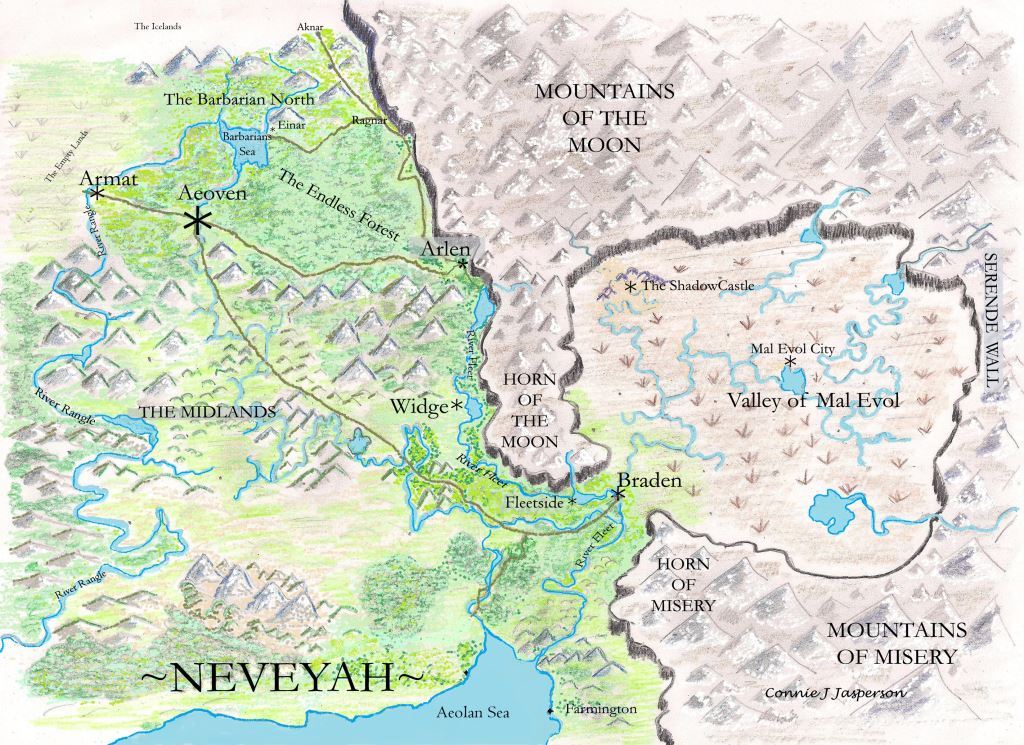
The War of the Gods is central to Neveyah’s religion, a trauma that shapes their lives. One can never escape the visible scar, the immensity that divides the world in half: the Escarpment. It is an impossibly high black wall topped by mountains. The people of Neveyah can’t survive in the heights where Ariend’s people live, and his people can’t survive in the lowlands. It is the wound where the World of Cascadia was joined to the World of Neveyah. Below is the World Map of Neveyah, which I created in 2007.

Map of Neveyah, color copy compressedEvery series set in this world happens at a different point in their history. The current novel is set in the year 131 AS (After the Sundering). The Tower of Bones series begins in the year 3254 AS. In that era, the Sundering of the Worlds is almost a legend, yet the black wall of the Escarpment topped by the Mountains of the Moon still testifies to the reality of the event.
At this point in storyboarding a book, I ask myself, “What kind of society do my characters live in?” For my NaNoWriMo project this year:

Plot-exists-to-reveal-characterIt’s a low-tech agrarian society. Tribal villages are communal, run by a council of elders. Everyone contributes to the community’s storehouses and benefits equally. While some earn more and others less, there is no class disparity. Ivan lives in Weiland, the main citadel of a western tribe, Weila.
Widden, an eastern tribe, has chosen to break away from the traditions that helped rebuild their world. They abandon the practices that brought the tribes safely through the first years. The Tribeless people would prefer to forget the past. Instead of building with stone and brick, they clear-cut forests because it’s faster, and dump their waste into streams in the name of expediency, thinking it all just goes away. Poverty is a way of life in tribeless towns, and jobs that pay a decent wage are scarce. Many people are forced into workhouses, which the Merchant Class perpetuates as a source of free slave labor. The upper-class lives like royalty, while the large underclass lives hand-to-mouth.

Each culture has logical reasons for their way of life. Both cultures have positive qualities, and both have negatives. Neither understands why the other chooses their way.

So, there is a wide disparity between the cultures of the tribes and the tribeless. Finally, I ask myself, “Where does the story open?”

My story opens in a Tribal town, Weiland.

Why do I need those paragraphs that describe the world and their society?

I still need to see that raw, just-born environment. A theme running through the series is the balance of nature and how delicate it is. My protagonist is a shaman, keenly aware that what the tribes have gained in the 125 years since they emerged from the safety of the catacombs and spread across the land can be lost, perhaps forever.

No matter where you set your novel, your characters identify with the community where they live. This is true of murder mysteries and thrillers as well as fantasy and sci-fi stories.

An exercise I find helpful to practice worldbuilding is to close your eyes and visualize your real-world environment. Then, without looking around, write a word picture of it. Once you have written a paragraph or two that describes your personal world, you understand how worldbuilding works. You can visualize your characters’ community and write a two-paragraph word picture of that imaginary place.

WritingCraft_mapsIf our work is set in an actual location, we should know where to find resources for appropriate slang, urban myths, and other local peculiarities. I suggest adding a list of where to easily access the resources about your chosen community to your storyboard. My co-Municipal Liaison, Lee French, reminds us that we don’t have to immerse ourselves immediately, just lay the groundwork for November.
Sci-fi writers should bookmark or list sites for any science you may need. If it takes place on a spaceship, you should have a good idea of what the ship looks, sounds, and smells like, a floorplan, and maybe consider what might power it.

Fantasy writers, if your novel is set in a made-up universe/world/town, what are the big-picture parameters of your setting? Again, you don’t have to know everything in precise detail, but you should put down some starter notes.

If you’re writing in the real world as we know it but with sci-fi or fantasy elements, such as zombies, magic, dragons, or future tech, you’ll want to think about how those elements affect your society.

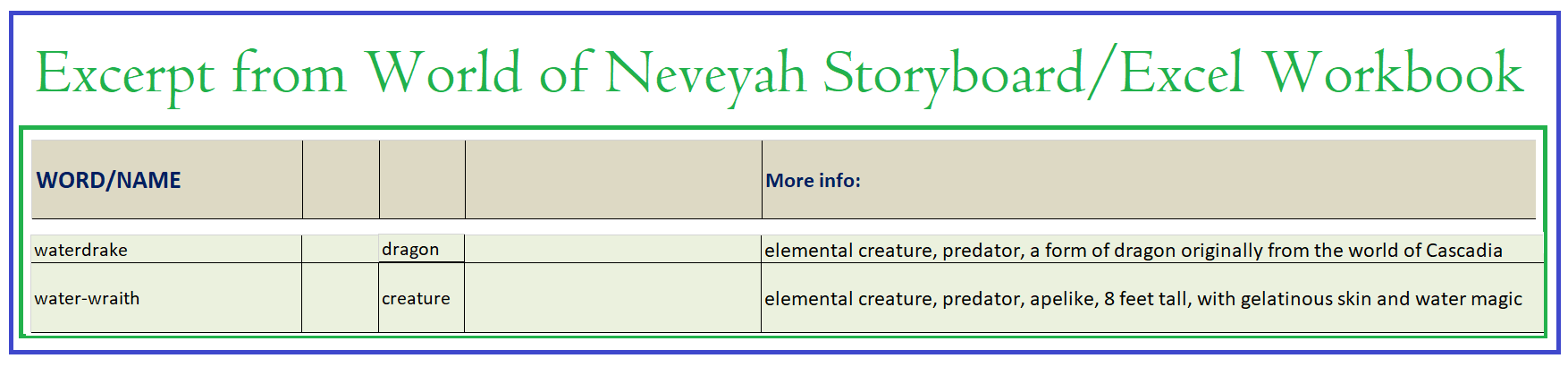
My world has creatures that cast certain magic as weapons or defensively. Their presence in the wild makes traveling without guards dangerous. Below is an image of an excerpt from the bestiary page in my storyboard.

Just note your ideas because we will flesh out the details later. For now, all you need is the overview.

Previous in this series: Creating a storyboard.

#NaNoPrep: part 1: What’s the Story?

Excerpt from World of Neveyah Storyboard Glossary,

12 Comments

Filed under writing

#NaNoPrep: part 1: What’s the Story?

I have developed mad skills at carving out time for writing because I participate in NaNoWriMo every November. As a municipal liaison for the Olympia area, I must get a minimum of 1,667 new words written each day. I  suggest to my fellow writers that they shoot for 1,670 to allow a little cushion in case the validator counts differently than their word processor.

I usually average 3,000 to 5,000 words per day, but writing is my job. When I was working in Corporate America, I managed 2,000 words per day.

nano-computer-word-countI do this by having my daily prompts all set out in advance in the outline. Then I set myself in front of my computer and wing it for at least two hours.
Some passages that emerge are good, and others, not so much. But it is an exercise in stream-of-consciousness writing at its most extreme. Some of my best literary work has been produced in its raw form during NaNoWriMo.

Preparation is the key for me. I apply project management skills developed during my years working in Corporate America.

The first step of project management is to Identify your Project Goals. Your story is your invention. You want to be able to sell that invention.

Some inventions take years. Others are complete and ready to market in a relatively short time. Regardless of your timeline, this is where project management skills come into play.

I use a phased (or staged) approach. This method breaks down and manages the work through a series of distinct steps to be completed.

  1. The Brilliant Idea. Make a note of that idea, so you don’t forget it.
  2. The Planning Phase, creating the storyboard. Some people don’t need this step, but you will see why this step is so crucial to ending with a novel that will be acceptable to an agent or can easily be Indie published.
  3. The Construction Phase begins on November 1st—connecting the dots and writing the first draft from beginning to the end in 30 days.

After this, we have several more steps to go through to end with a publishable book, but we won’t be concerned with them until January.

First, what are you going to write?

Identify your proposed book as either fiction or nonfiction.

  • If it’s fiction, what’s the genre and subgenre?
  • If nonfiction, what kind? Is it a memoir, a history, or a technical book?

2020_nano_Project_coverLee French, my co-municipal liaison, has given us great advice over the years. One thing she starts us with is something writers usually don’t think of until they have to: genre and keywords.

If we wanted to search for your book on Amazon, what would we look for, and how would we find it? What genre are you writing? What keywords would we use to be directed to it?

But what are keywords, and why should you care? This question is important to consider at the outset because you need to know what market you are writing for, no matter if you are going with an agent or intend to go Indie.

Search engines use keywords to recognize what a website or web page features, their products, (or in the case of authors) the kind of book they have written. Amazon and all other book retailers are simply large search engines that want to sell your book.

It helps me direct my creative energy at the outset if I know what I will eventually want to sell. Thanks to Lee French, I know the genre of my next novel is epic fantasy. I also know a few keywords would be male protagonist, LGBTQ, magic, mysticism.

WritingCraftSeries_narrative modeOther things to consider are point of view and narrative tense. Who can tell the story most effectively, a protagonist, a sidekick, or an unseen witness? And will it be written in the 1st person, 2nd person, 3rd person limited, or 3rd person omniscient? What narrative time will the story be set in, the present or past tense?
Will you switch between multiple characters?

Sometimes, it takes more than one point of view character to tell the story. I have three strong characters, one of which is the antagonist. I always feel one should have a little sympathy for the devil, so seeing things from his point of view is valuable when trying to show the struggle.

Therefore, my project is in the 3rd-person limited, involves three POV characters, and has hard chapter breaks between each switch.

What is your story? Example: I’ll be writing a novel detailing a shaman’s struggle to keep his people safe from a rogue mage and his raiders.

To succeed in completing a project with such an ambitious goal, I storyboard all my ideas, making this effort when the idea first enters my head. If I become lost or find myself floundering in the writing process, I can come back to my original files and remind myself of the original concept of the story.

The storyboard for my ideas works this way:

First, I open a word document or an Excel workbook. You can use a program like Scrivener, or use a paper notebook and pencil, whatever makes you most comfortable.

My current novel is in an existing world that has an Excel workbook devoted to it.

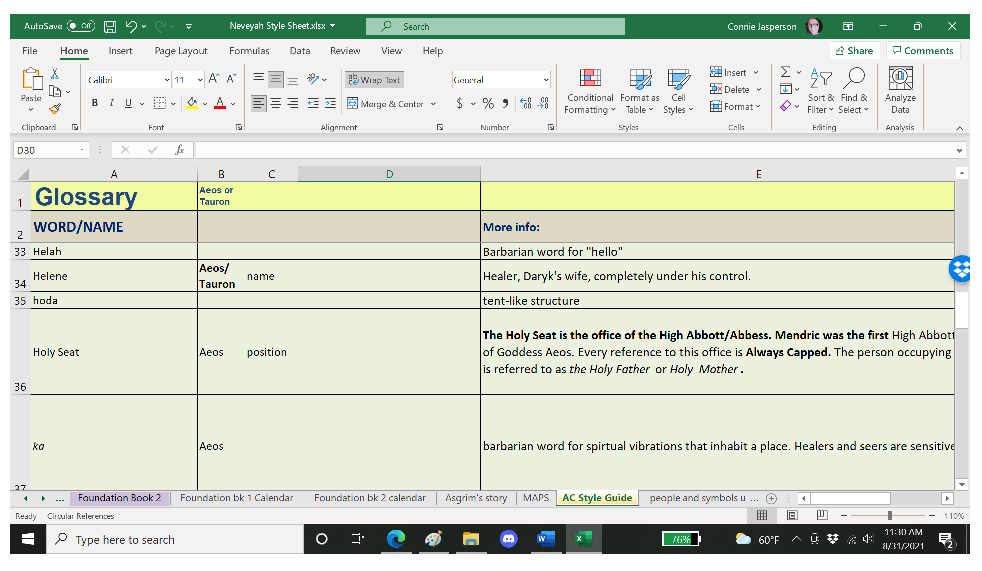
This workbook has ten active spreadsheets. All my information is right there, from magic systems to the spelling of made-up words and what they mean.

Neveyah_storyboard_printscreenLIRF08312021I always give the proto novel a working title that becomes the storyboard’s label. The book I am writing is set in the world of Neveyah, and so it belongs with the rest of the books set in that world. The workbook is labeled Neveyah.xls, and the spreadsheet that I will be working on will be labeled “Ivan’s Story II,” as I currently don’t have a title.
Over the next few weeks, we will identify and answer as many questions about our November novel as we can.

And some of what we think now will grow and change once we begin the actual writing because stories always do.

ProjectManagementLIRF05232021Preplanning takes advantage of all the pertinent ideas I have at the outset and offers me a jumping-off point. Like a connect the dots game, I know how to write the story that happens between and because of each event. Having this knowledge helps me take the story to its conclusion, allowing me to have the full story arc written in thirty days.

That doesn’t mean the book is finished, not by any means. We have only completed the first draft and gotten the basic structure finished.

But as I said, we’ll deal with all that in January.

Next up, we will talk about setting, and get to know the place where your novel takes place.

11 Comments

Filed under writing

What is National Novel Writing Month, and should I participate?

September is nearly here. I’m a Municipal Liaison for NaNoWriMo (National Novel Writing Month). Over the next two months, my focus will be on preparing my region for 30 consecutive days dedicated to the act of writing a novel, and my posts here will reflect that.

MyWritingLife2021BIf you haven’t heard of this before, it’s a worldwide event that happens in November. Each year thousands of people in all parts of the world dedicate themselves to writing a 50,000-word narrative in only thirty days.
I’m a rebel. Some years I work on a new novel, and others, I scratch out as many short stories as possible in those thirty days.

NaNoWriMo is a contest in the sense that if you write 50,000 words and have your word count validated through the national website, you win. But it is not a contest in any other way as there are no monetary prizes or fame for those winners, only a PDF winner’s certificate that you can fill out and print to hang on your wall.

Depending on your intended audience, a manuscript of only 50,000 words is a short novel. It’s a good length for YA or romance, but it’s only half a novel for epic fantasy or literary fiction.

Regardless of the planned length of their finished novel, a dedicated author can get the basic structure and storyline of a book down in those thirty days. They sit for an hour or two each day and write a minimum of 1667 words.

That’s all you need to do, write 1667 words every day. At the end of 30 days, you will have written 50,000 words.

Author Lee French and I are co-MLs for the Olympia Region for NaNoWriMo. In our region last year, 175 writers created profiles and began an official manuscript at www.nanowrimo.org.

We’ve been doing this for a while, and we have seen a pattern.

powerwordsWordCloudLIRF06192021The first roadblock happens when reality sets in and the writers realize that it is work.

This usually occurs within the first few days. Last year 64 writers in our region never got more than 5,000 words written. One stopped at 34.

A majority of new NaNo writers are people who “always wanted to write a book.” Often, they don’t know what they want to write and have no clue how to be disciplined enough to write any words, much less the number it takes to make a novel.

They start, get 30 to 1,000 words in, and realize they have nothing to say. But in our region, 17 of these people made it to the 10,000-word mark before they stopped writing. That’s an achievement—it’s almost a novella.

Other new writers are fired up on day one. They go at it full tilt for a week, or even two, and then, at the 20,000-word mark, they take a day off. Somehow, they never get back to it. Their novels will languish unfinished, perhaps forever.

Even seasoned writers who have crossed the finish line at NaNoWriMo in previous years may find the commitment to sit and write 1,667 words every day is not doable for them. Things come up—life happens.

Plot-exists-to-reveal-characterBut by November 30th last year, 70 writers out of the 175 in our region had made it to the 50,000-word mark, 3 made it to above 80,000, and 1 exceeded 100,000 words.

Some of these novels had complete story arcs and were ready for revisions. Most were not, but these proto-novels could be made publishable with a lot of work.

It takes commitment and discipline to write 1,667 new words every day. You are not revising old work. Instead, you’re writing something new and not looking at what you wrote yesterday.

To do this, you must sit down at the keyboard, open the document to where you left off, and begin writing forward.

For me, having an outline keeps me on track and writing a coherent novel. We will talk about this later.

How did I do last year? I got started and was doing well, finishing a novel that only needs another 20,000 words or so. Then I intended to write the ending for Bleakbourne on Heath, a serialized novel that only needs 4 chapters. After that, I planned to write several short stories to keep on hand in case I needed a quick story to submit to an anthology or magazine.

strange thoughtsBut I got side-tracked. On day 5, I thought about an artifact’s origin that has a role in my still-unfinished novel. 80,000 words later, that bunny trail had become a novel, The Ruins of Abeyon.
I’m not a good typist. The words that fall out of my head during NaNoWriMo are not all golden, just so you know. When writing stream-of-consciousness, many words will be garbled and miskeyed.

This means that for me, the revision process is a long and winding road.

I had begun Ruins with no outline, so the story arc evolved as I wrote the book. I outlined as I went. Later, when I was revising, it was easy to see the arc and make decisions to move certain events to more logical places.

Fortunately, the story is set in Neveyah, a world I have been writing in for twelve years. I have a stylesheet for that world, so the magic and political systems are all in place, along with good maps.

Having the fundamental prep-work of magic and social structure in place made switching to a new project easy. This is because, unlike Bleakbourne on Heath, which was written and published one chapter at a time six years ago for a now-defunct website, Ruins had a coherent story arc from the beginning.

Participating in NaNoWriMo is a watershed experience. Some people don’t thrive when they have deadlines, but others work better under pressure.

The_Pyramid_Conflict_Tension_PacingSucceeding in writing even a short story gives many authors the confidence to continue. In their case, NaNoWriMo is about writing and completing a novel they had wanted to write for years, something that had been in the back of their minds for all their lives.

If you have a novel in your soul and it’s bursting to get out, this might be your chance. However, planning for a successful NaNoWriMo is like preparing for a marathon.

We let our families know well in advance that it’s coming and share how vital reaching our goal is to us. That way, we have their emotional support. We also plan ahead for meals and family time, so the important people in our lives aren’t neglected.

In many ways, we’re preparing for a writing marathon, physically and mentally. We build our strength and get our families behind us by ensuring we have prepared well in advance.

strange thoughts 2Over the next few weeks, we will focus on laying the groundwork for our novels so that we will be ready and able to write when November comes. Much of what I will be discussing has emerged from our experience and comes from my co-ML Lee’s prep work as much as from mine.

Together, we will get that novel written.

12 Comments

Filed under writing

How I Became a Keyboard-wielding Writing Fool

I grew up in a home that had more books than some libraries. My parents were voracious readers who insisted we read too. We had all the great children’s classics, and when we couldn’t play outside and were bored, we’d read the Encyclopedia Britannica.

Yep.

We read the encyclopedia for fun.

MyWritingLife2021My parents also had bought Grolier‘s Great Books of the Western World. Dad would occasionally assign me a book to read, something that I didn’t understand but wanted to.

This probably influenced my choice of classes in college, which is where I learned to understand and love Chaucer and James Joyce. Joyce may be the king of brilliant one-liners, but F. Scott Fitzgerald holds a place in my heart for his phrasings.

When I was first out in the world, I held two and sometimes three jobs just to pay the rent and feed my kids. My go-to genres were sci-fi and fantasy, but books were expensive, and food came first.

The libraries stocked a few sci-fi or fantasy books, but I had read all the classics in those genres. For whatever reason, librarians didn’t stock new speculative fiction books as comprehensively as they did contemporary and literary fiction.

The book aisle at the supermarket had a better selection, but they cost as much as I made for one hour of work, so I could only get one book per bi-monthly payday. Tad Williams and Anne McCaffrey got most of my “fun” money in those days.

My budget forced me to write the stories I wanted to read. Most evenings, I sat listening to music on the stereo, writing my thoughts and ideas in a notebook while my kids did their homework.

Besides the poetry or song lyrics I regularly turned out, my pen and ink ramblings weren’t “writing” as I see it now. They were more like frameworks to hold ideas that later became full-fledged stories.

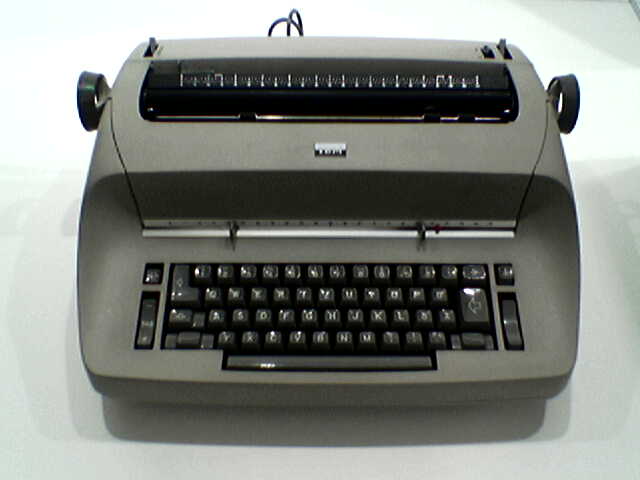
IBM_Selectric (1)Then, in 1987, my father bought me a secondhand IBM Selectric Typewriter, and my writing addiction took off.
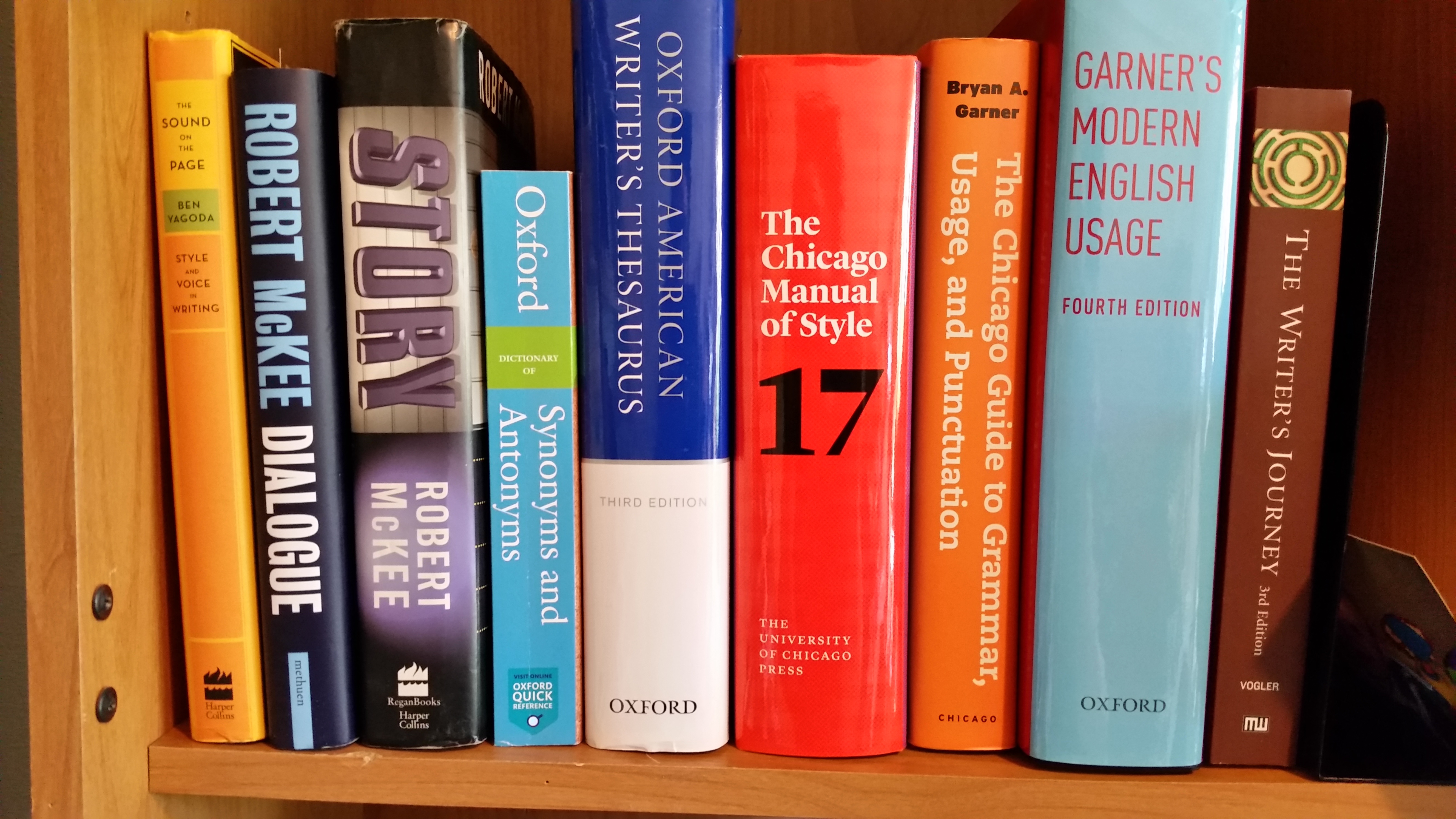
When my job situation improved, I scrimped and saved for my monthly Science Fiction Book Club purchase. I also scoured the secondhand bookstores for sci-fi or fantasy novels, budgeting for books the way others of my acquaintance budgeted for beer.

I found a secondhand bookstore where I could get novels that were in too poor a condition to sell on their shelves. A full shopping bag of beat up, and sometimes coverless books was only two dollars, if you had a bag of better books to trade.

I went through a full shopping bag of books every week, and within a year, I had read every book they had in my favorite genres. Agatha Christie’s books were high on my list of hoped-for treasures.

In the process, I discovered a new (to me) genre: regency and gothic romances written by Georgette Heyer, Barbara Cartland, and other romance writers of that generation. Along with beat-up copies of bestsellers by Jack KerouacJames Michener, and Jacqueline Susann, those books known as “bodice-rippers” began to show up in the pile beside my bed.

Always when the budget permitted, I returned to Tolkien, Zelazny, McCaffrey, AsimovBradbury, and as time passed, Piers AnthonyDavid EddingsTad WilliamsL.E. Modesitt Jr., and Robert Jordan, to name only a few.

And there were so many, many others whose works I enjoyed. By the 1990s, the genres of fantasy and sci-fi were growing authors like a field grows weeds, and I loved it.

All of the books I read as a child and young adult have influenced my writing. They still inspire me.

Editors_bookself_25May2018I’m proud to admit that my literary influences can be traced back to dragons, booze, elves, space-operas, Roaring Twenties morality, Don Quixote, and England’s romantic Regency, all of which I lived vicariously through these authors’ eyes.

Nowadays, I can barely read more than a chapter or two before falling asleep. My Kindle is full of books and having the luxury to spend a day wallowing in a book is a treat to be treasured.

I became a writer because my parents loved books and allowed me to read whatever I wanted, whenever I wanted.

Thanks to the uncountable authors whose works I’ve been privileged to read, I was inspired to think that my own stories might have value.

In the beginning, my writing style was unformed and reflected whoever I was reading at the moment.

ok to write garbage quote c j cherryhI shared what I wrote with other people and got feedback, some good, some bad. I learned from it all and kept trying. I bought books on the craft of writing.

I gained confidence and began to trust my own ideas and stories. Once that happened, I became a keyboard-wielding writing junkie.

Writing has always been necessary to me, as natural as breathing. Some days I write well, and others not so much, but every day I write something.

And every day, I find myself looking for the new book that will rock my universe, a new “drug” to satisfy my craving, even if I know I won’t have time to read it.

Reading is my form of mind-expanding inspiration. Without the authors whose books formed my world, I would never have dared to write.


Credits and Attributions:

Wikimedia Commons contributors, “File:IBM Selectric (02).jpg,” Wikimedia Commons, the free media repository, https://commons.wikimedia.org/w/index.php?title=File:IBM_Selectric_(02).jpg&oldid=555742863 (accessed August 24, 2021).

2 Comments

Filed under writing