
NaNoWriMo 2021 officially begins one week from today on November 1st. For those of us who love a challenge, that will be the day we set the pen to paper and begin the actual writing of our projects.
 So, what do we need to have in place during the next seven days before the big event?
One: We need to have characters.
Two: Our characters need an environment to live in, a world to inhabit.
Three: Our characters need some sort of backstory, so we know who they are when we begin writing.
Four: We need a plot or at least an inciting incident. We should have some idea of that moment when our frogs leap from the frying pan into the fire.
Five: You should try to identify your subject and unifying theme. We’ll talk about those things further on in this post.
How does my storyboard look right now?
Characters: This will be Ivan’s second book, so I have his backstory and don’t need to worry too much about that. Ivan is a fire-mage, an armorsmith, and a shaman. He is a father, a husband to his life partner, Kai. Kai is an earth-mage and a mason. The two share four children with another lashei couple, Avis and Venna. The children live with Ivan and Kai, as Avis and Venna are traveling dye traders.
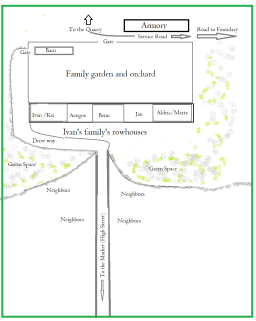 Environment: Ivan and Kai live in Weiland, Tribe Weila’s riverport and mining center. Ivan’s extended family has five rowhouses at the upper end of High Street. It’s a steep but easy walk to the market for his grandfather, who lives next door and watches the children while Ivan and Kai work. I drew a little map for my notes, so I know the layout of where everything is in regard to their home and businesses. It could change, but I have something to start with.
His brother, Aldric, and his wife, Marta, have three children. They live at the other end of the row of houses. Ivan’s father, Aengus, and mentor, Jan, have their homes there too. Behind the rowhouses are a walled shared garden and orchard and the family’s barn. Ivan and Jan’s armory is a short walk through the back garden, and beyond that is Kai’s quarry.
The backstory: is already established for this book, as book one is currently being edited.
The inciting incident: At this point, the inciting incident is the arrival of news that a neighboring town has been attacked by tribeless raiders. It’s suspected the raiders are led by a rogue mage. Ivan and Kai must go and deal with that, a simple-sounding thing that becomes complicated. Aldric and Marta join them, leaving the children in the care of the three grandfathers.
What I hope to achieve by the last paragraph of this book: Ivan will be forced to grow in his role as a shaman and mage. Kai will be challenged when an old acquaintance is discovered in the rogue mage’s entourage. Aldric’s and Marta’s skills with weapons will be critical, and the blade that Ivan made for Marta when they were young will be the key to resolving the final encounter. Each character will be tempered steel, able to do what must be done, and still remain compassionate.
Subject and Theme: So, what is a theme? It’s different from the subject of a work. An example that most people are familiar with is the Star Wars series and franchise. The subject is “the battle for control of the galaxy between the Galactic Empire and the Rebel Alliance.” The themes are “moral ambiguity” or “the conflict between technology and nature.”
The subject of this book is how the desire for dominance and power corrupts an abused young mage, and the destruction he creates in his attempt to control his life. This book will explore the theme of good vs. evil and the subthemes of comradeship and love of family. The books I am drawn to often feature these themes.
How do you identify your theme? Sometimes it’s difficult unless you start out with one in mind. Here is a short list of some themes for you to consider:
- Abuse
- Alienation/loneliness
- Ambition
- Coming of age
- Conspiracy
- Crime and Justice
- Fall from Grace
- General dehumanization of society
- Good vs. Evil
- Grief
- Humanity in jeopardy
- Love
- Nostalgia for the good old days
- Plagues
- Rebellion and revolution
- Redemption
- Religious intolerance
- Separation and reunion
- The hero’s journey
- War
 A common theme in fantasy is the juxtaposition of chaos and stability (or order). This subtheme will feature strongly in my novel. Good vs. evil is a trope of the speculative fiction genre. Evil is usually portrayed by taking one or the other of these concepts to an extreme.
Epic fantasy is usually good vs. evil, based on the hero’s journey. The stories detail how events shape the characters.
That is what I am writing in November.
#NANOPREP SERIES TO DATE:
#NaNoPrep: part 1: What’s the Story? (the storyboard)
#NaNoPrep, Setting: Creating the Big Picture
#NaNoPrep, Building Characters
#NaNoPrep, More Character Building
#NaNoPrep, Designing Science, Magic, and the Paranormal
#NaNoPrep, Terrain and Geography
#NaNoPrep, Connections and Interconnections
#NaNoPrep, Construction and Deconstruction
#NaNoPrep, The Story Arc Part 1
#NaNoPrep, The Story Arc Part 2
#NaNoPrep, The Story Arc part 3, the End
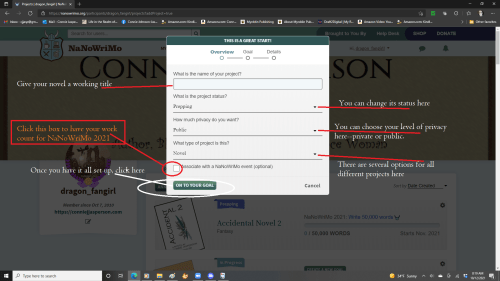
#NaNoPrep: Signing up and Getting Started
#NaNoPrep: Guernica, Inspiration, and Finding Writing Prompts
This Post: #NaNoPrep: Countdown to November, Subject and Theme
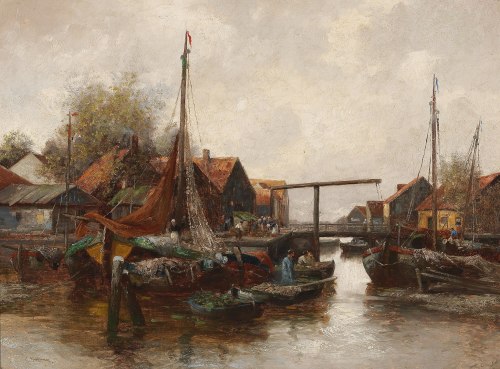 Artist: Adolf Kaufmann (1848–1916)
 Writing is easier once it becomes a daily
  We have this perception that taking time for creativity is selfish, and that will be your biggest hurdle. Trust me, it is not asking too much of your family for you to have some time every day that is sacred and dedicated to writing.
 Write for five minutes here and ten minutes there all day long if that is all you can do. Every word counts toward your finished manuscript. I took my lunch to work and wrote during my lunch half-hour whenever possible. I also wrote on the bus when I didn’t own a car.
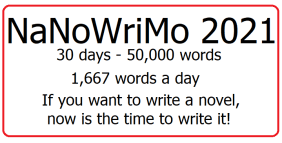
 Remember, what you are writing is a rough draft, so your story arc will be bumpy and uneven. It doesn’t have to be perfect, so don’t worry about making it so. The goal of NaNoWriMo is to get that first draft written in thirty days. So, every time you have fifteen minutes to spare, sit down and write as much as you can in that short length of time. Spew your story as fast as you can in those moments before you are pulled away. With six or seven short bursts of writing, you can really rack up the word count.
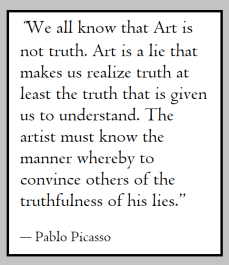 Often the work that is inspired by a visual prompt has nothing to do with the image. But it has everything to do with the nature of storytelling. The ability to explain the world through stories and allegory emerges strongly in some people. Many are naturally able to form and express a story, and others find the subliminal prompting of an image will be the spark that lights their creativity.
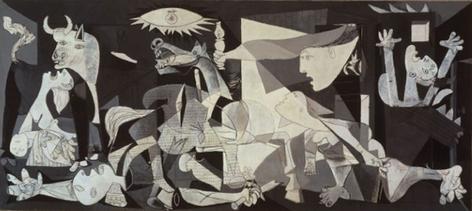 Picasso’s choice to use black and white to tell that story is brilliant. Newsreels of the day were black and white, which influenced his decision. This piece is powerful because of the emotion the artist painted into the image.
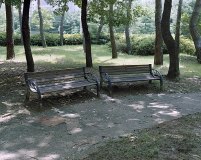 nspiration can be found in the image of an unoccupied park bench in winter. The gray weather, the barren scenery, the loneliness of the empty bench could be the seeds from which a novel grows. Who is that bench waiting for? Who has just left it? Is the story light or dark?
 Once there, create a profile. You don’t have to get fancy unless you are bored and uber-creative.
 You can play around with your personal page a little to get used to it. I use my NaNoWriMo avatar and name as my Discord name and avatar. This is because I only use Discord for NaNoWriMo and one other large organization of writers. (Next week, we’ll talk about Discord and why NaNoWriMo HQ wants us to use it for word sprints and virtual write-ins.)
 Next, check out the community tabs. If you are in full screen, the tabs will be across the top. If you have the screen minimized, the button for the dropdown menu will be in the upper right corner and will look like the blue/green and black square to the right of this paragraph.
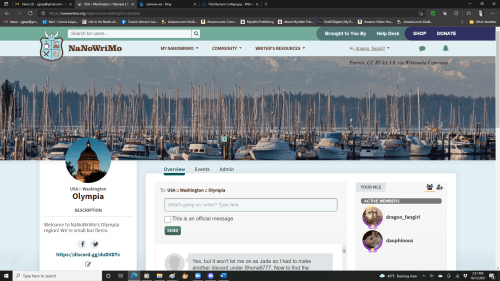 You may find the information you need in one of the many forums listed here.
 Make a master file folder that is just for your writing. I write professionally, so my files are in a master file labeled Writing.
 Give your document a label that is simple and descriptive. My NaNoWriMo manuscript will be labeled: Accidental_Novel_2.
 Still, we can come together and support each other’s writing via the miracle of the internet. My region is finalizing a schedule for “Writer Support” meet-ups via Zoom – little gab sessions that will connect us and keep us fired up.
 But sometimes, when writing the first draft, we realize our manuscript has gone way off track and is no longer fun to write. That is where the storyboard and my loose outline become important.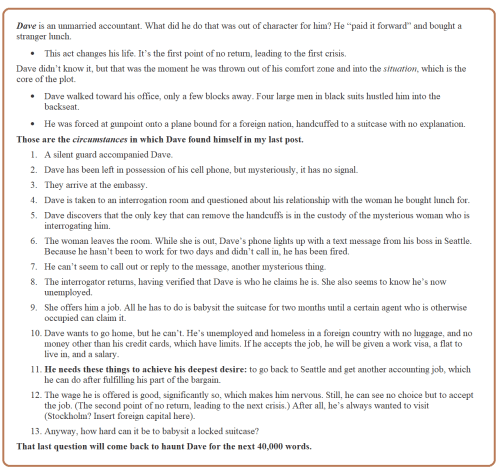
 Every novel is different, has a different genesis, and emerges from the author’s mind with its own personality.
 I usually do this with a little advance preparation. Then on November 1st, I sit in front of my computer, and using the ideas I have outlined as my prompts, I wing it for at least two hours.
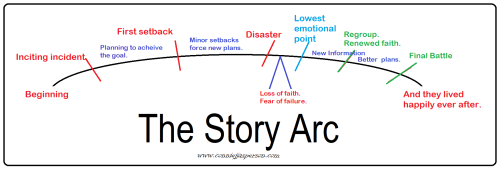
 How will the next phase of Dave’s story start? That will begin the middle section of the story, and this is what we are going to give a brief outline of.
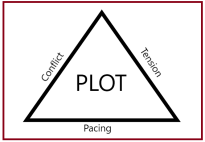 In any story, the crucial underpinnings of conflict, tension, and pacing are bound together. Go too heavily on one aspect of the triangle, and the story fails to engage the reader. By outlining a few important events now, we can add trouble and hitches during the writing process and increase the tension. Pacing will be something to worry about in the second draft—at this point, we just want to get the bones of his adventure down on paper.
 We know our genre and have written a few paragraphs that describe our characters and who they are the day before the story opens. Also, we know where the story takes place. (To catch up on earlier posts, the list is at the bottom of this article.)
 Every reader knows that stories have a beginning, a middle, and an end. They start in a place of relative comfort, and through rising action, they follow the characters through events that change them for better or worse.
 In your musings, on what day does the serious event occur, the one that changes everything? THAT day is where the story begins, and everything that happens before that moment is backstory and isn’t necessary. A plot outline I have used before as an example is set as a political thriller, but it could easily be a paranormal fantasy, a sci-fi thriller, or a romance.
 If you work at a day job and using the note-taking app on your cellphone to take notes during work hours is frowned on, you can still capture your ideas for the storyboard.
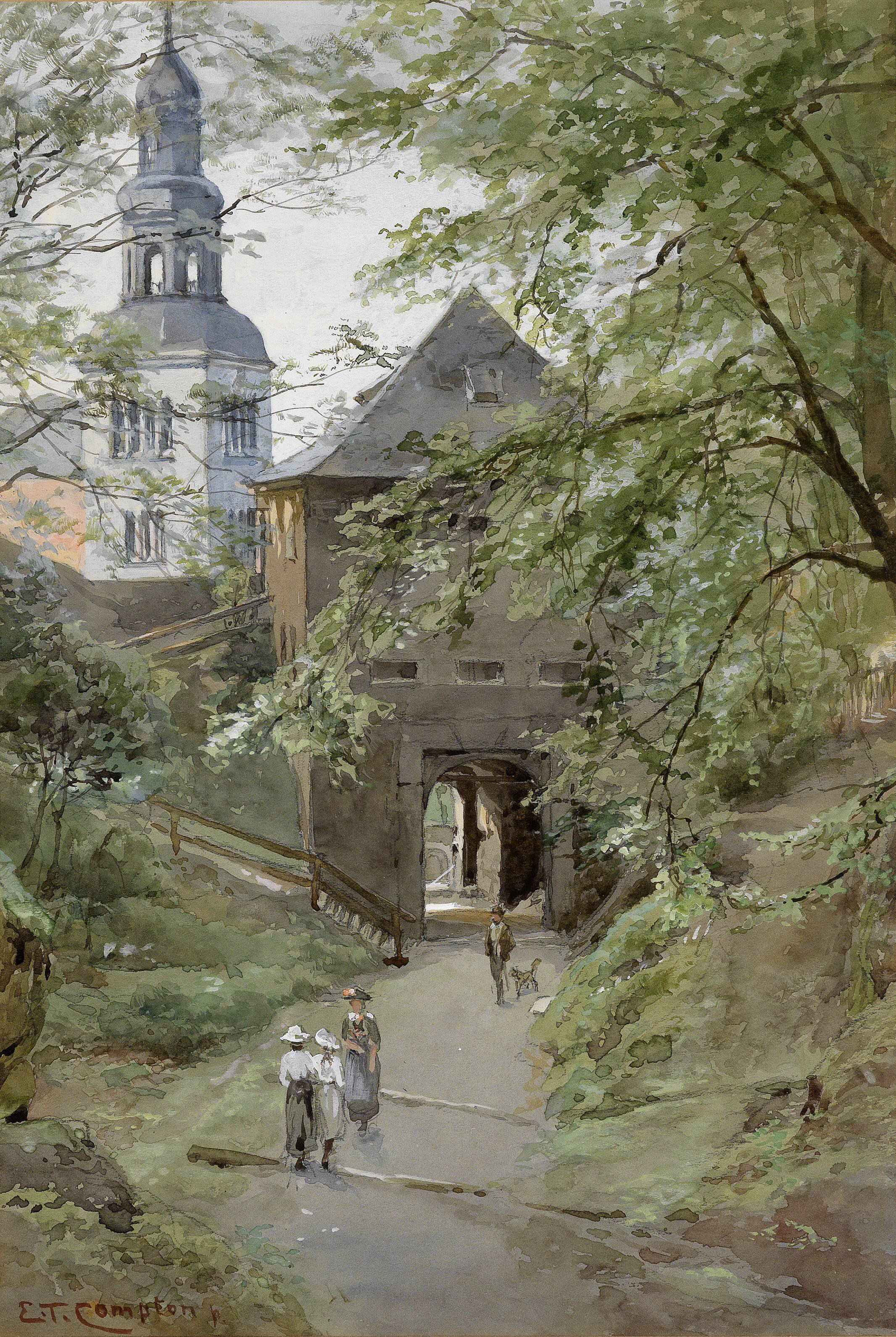 Painting:


_-_WGA24677.jpg&oldid=268076769)
