
 One of the best ways to learn about the craft of writing is to talk with other authors. We all have different ways of creating our work, so hearing how another author works always gives me new ideas.
Ellen King Rice writes mysteries set in the South Puget Sound area of the Pacific Northwest. She is a wildlife biologist and is happiest when out in the woods on a fungi hunt with her camera.
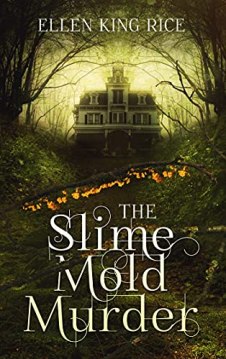
Ellen has a new book out, The Slime Mold Murder, and as one the advance readers, I found it witty and the series of events are well-plotted. The characters are engaging, and their stories emerge as the plot unfolds. She has agreed to talk about her characters in this book, and how she came to know them.
CJJ: Tell us about Dylan. When did he first come into your mind as a protagonist?
EKR: Dylan was in my first book, The EvoAngel, as a precocious eleven-year-old with impulse-control challenges. He channels my own life as someone who speaks boldly and often irritates others.
CJJ: This book has number of credible characters. Which character was most difficult to write, and why?
 EKR: Mitchell and Mark are a gay couple, but I didn’t want to write them as caricatures. I spent a great deal of time trying out descriptions to come up with two men who are individuals in their own right but collectively a pair who would rattle the conservative county commissioner.
CJJ: Which character do you identify with on a personal level. Why?
EKR: Mari reminds me of myself at eighteen. I was keen to explore romance but terribly inept.
CJJ: Do you create an outline for structuring a character arc, or do you wing it?
EKR: Authors are often divided into the pantser or plotter groups. Some of us are plontsers – a lovely hybrid who think they have a plan but are really making it up as they go along. No kidding. I do start with a plan and then I get distracted with new ideas.
 CJJ: Do you think your characters or events drive the plot? How are your characters shaped by the events they live through?
EKR: For me it is the events that drive the plot and the characters respond, hopefully growing as they take action.
CJJ: Are there any final words you would like to say regarding the characters and events of The Slime Mold Murder?
EKR: The inclusion of the sclerotia in the story is meant to be inspirational. Slime molds can enter a dry phase where they do not grow. This phase can last for years, but when conditions improve, there can be a vibrant response. I so hope that we humans can move past months of a global pandemic to build a better world where more of us thrive.
Ellen, thank you for taking the time to talk about how you approach the craft of writing and creating your wonderful characters.
If you are curious about this book, The Slime Mold Murder is available at Amazon as a paperback, and will be released for the Kindle on June 24th, 2021: The Slime Mold Murder.
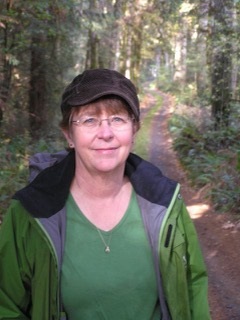
About Ellen King Rice:
I am a wildlife biologist who suffered a spinal cord injury many years ago. Although my days of field work are over, biology continues to intrigue me.
I am fascinated by sub-cellular level responses to ecosystem changes. I also like the predictability of animal behavior, once it is understood.
A fast-paced story filled with twists is a fun way to stimulate laughs, gasps and understanding. I work to heighten ecological awareness. I want the details and your new insights to remain in your thoughts forever.
You can find me and my books at www.ellenkingrice.com
Please join me on Instagram at:
https://www.instagram.com/mushroom_thrillers.
And on Facebook:
https://www.facebook.com/mushroomthriller/
Credits and Attributions:
All photos copyright 2021 Ellen King Rice. All images used in this post are the work and intellectual property of Ellen King Rice. She has kindly given me permission to use them in this post.
 Some scenes have no dialogue, are comprised of the actions that propel the plot forward. But often, conversations are the core of the passage, propelling the story onward to the launching point for the next act.
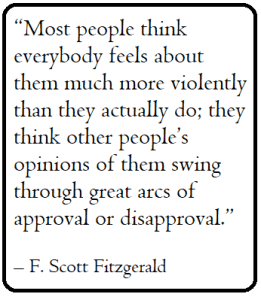 This pertains to the thoughts of your characters too.
 I have said this before, but it bears mentioning again: Never resort to writing foreign languages using Google Translate (or any other translation app). Also, please don’t go nuts writing out foreign accents. It’s frustrating for readers to try to untangle garbled dialogue. A word or two, used consistently, is all that is needed to convey foreignness.
 To achieve a sense of depth, we begin with simplicity. Each character’s sub-story must be built upon who these characters think they are.
 They might think one thing about themselves, but this verb is the truth.
 Knowing the verb (action word) and the noun (object of the action) that best represented my characters made writing
  STOP! If you value your reputation, you won’t rush to publish that mess just yet.
 Now you must set it aside, as you must gain a little distance from it to see it with a clear eye. This is where I seek an outside opinion on the strengths and weaknesses of my proto-novel. I am fortunate to have a local writing group of highly talented published authors. I also trade services with several editors. When the first draft of my manuscript is finished, I send it to a reader. While they are reading it, I work on something completely different.
 At this point, an amateur decides the beta reader missed the point and chooses to ignore their comments. Our unrealistic belief that our work is perfect as it falls from our minds is a failing that we must overcome if we want to engage readers.
 In my current work, the thoughts and motives of the characters are critical to the midpoint event and subsequent crisis of faith. Yes, who these people are, and their place in the story at the point where we meet them is crucial to the plot.
 Then there is the marketing of the finished product, but that is NOT my area strength, so I won’t offer any advice on that score.
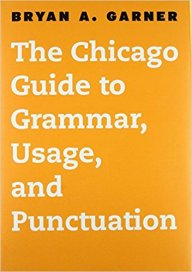 If you are writing in US English, I can highly recommend getting a copy of
  Creating a
  Write the basic story. Take your characters all the way from the beginning through the middle and see that they make it to the end. If you have completed the story and have it written from beginning to end, you can concentrate on the next level of the construction phase: adding depth.
 My husband is recovering from a total hip replacement, so traveling out of town for an extended stay involves a lot of logistics. Also, I am vegan, which has an impact on things. I can eat in restaurants, but once I am away from my part of the world, the menu is often limited to a garden salad.
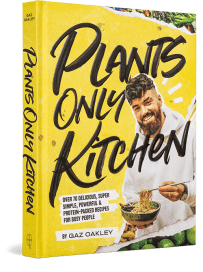 Protein is essential, and I have many delicious options to make that don’t involve processed foods. My favorite “impress-the-son-in-law” cookbook is this gem by
 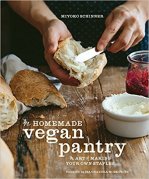 The most surprising thing about being vegan is how little it costs to eat well once you have your pantry basics. Going sans meat is the lazy person’s dream diet. It’s amazing how quickly you can get a meal on the table, and whether you are making beans or soup, the crockpot is your best friend. I often make my own bread from several different recipes, a tasty treat that takes less than five minutes to put together using my bread machine.
 Sturm und Drang, as a literary form, evolved during the time of the American Revolutionary War. This was an era of global unrest and great hardship, especially in Europe. The main feature of Sturm und Drang is the expression of high emotions, strong reactions to events, and rebellion against rationalism. It is characterized by intense individualism and complex reactions.
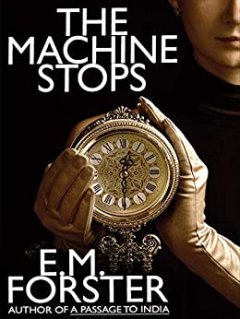 So, this brings me to the subgenre of cyberpunk. One of the earliest science fiction short stories to feature a dystopian society was
 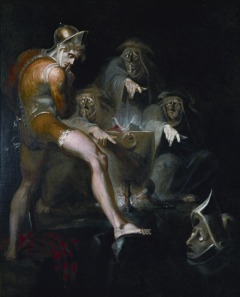 Many authors whose works appeared in the early days of cyberpunk were indies hoping to go mainstream. Their short stories appeared in popular sci-fi magazines because visionary editors risked their jobs and reputations by accepting and publishing work that their readers could have rejected.
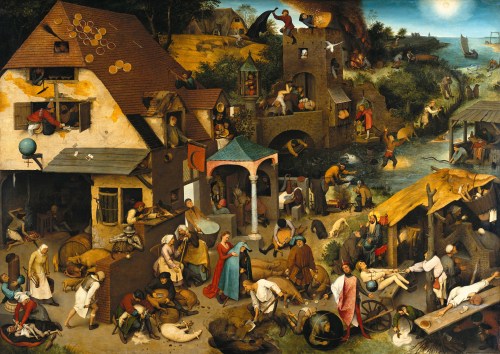 One of the best allegorical paintings of all time is
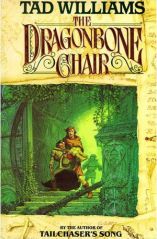 Tad Williams’s
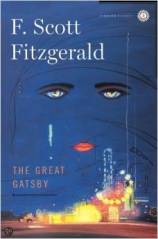 No matter where we live, San Francisco, Seattle, or Middle Earth, these fundamental human experiences are personal to every reader. We have each experienced pain and loss, joy and love.
 Plot, in my opinion, is driven by the highs and lows. You don’t need to pay for books you won’t like. Go to the library or to the secondhand bookstore and see what they have from the NYT bestseller list that you would be willing to examine.
 The human body moves in many ways when fighting, some of which are effective, and others not so much. In the 1990s, I studied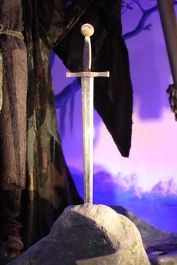
 Scenes that involve violence are difficult to write well unless you know how the action will affect your protagonist. Also, you must remember to give the protagonist and the reader a small break between incidents for regrouping.


