Category Archives: writing

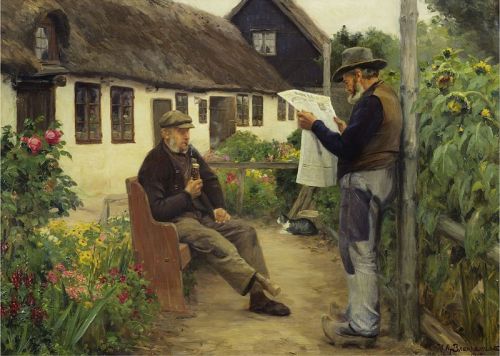
#FineArtFriday: While reading the newspaper by H. A. Brendekilde 1912

Artist: H. A. Brendekilde  (1857–1942)

Title: While reading the newspaper news

Date: 1912

Medium: oil on canvas

Dimensions: Height: 61 cm (24 in); Width: 85 cm (33.4 in)

Inscriptions: Signature and date bottom right: H. A. Brendekilde / 1912

What I love about this painting:

There is a story in this well-executed painting. I particularly like the details: the patched trousers of the gardener, the mud on his clogs, the other man’s wooden leg— I like the way they are juxtaposed against the lush spring garden and prosperous village life of Denmark in 1912.

Their hands and clothes indicate they have stopped work to read the newspaper. Both men seem stunned. Are they perhaps reading of the death of King Frederick VIII, who died on 14 May 1912?

Whatever they are reading, the cat remains undisturbed by the news.

H. A. Brendekilde was a forerunner of the social realist style, embraced by Diego Rivera. His early work often depicted the daily lives of the rural working class.


Credits and Attributions

While reading the newspaper  by H. A. Brendekilde 1912 [Public domain], via Wikimedia Commons

Wikimedia Commons contributors, “File:H. A. Brendekilde – Mens du læser avisen nyheder (1912).jpg,” Wikimedia Commons, the free media repository, https://commons.wikimedia.org/w/index.php?title=File:H._A._Brendekilde_-_Mens_du_l%C3%A6ser_avisen_nyheder_(1912).jpg&oldid=300367623 (accessed February 5, 2021).

Comments Off on #FineArtFriday: While reading the newspaper by H. A. Brendekilde 1912

Filed under writing

Genre and Tropes #amwriting

When we first begin writing, we know what genre of book we usually like to read, and our work will probably fall into that category.

So, what exactly are genres? Author Lee French puts it this way, “Literary genres are each a collection of tropes that create expectations about the media you consume.”

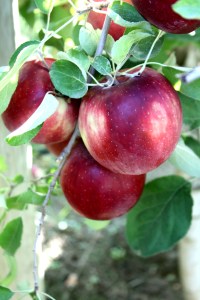
Genres are categories the publishing industry developed so that shoppers in bookstores can easily find what they are looking for. They’re like a display of apples at the grocery store – many baskets, each filled with a different variety of apple. I always head straight to the Cosmic Crisps.

On the display of each overarching genre, such as sci-fi, romance, mystery, etc., are baskets. Each contains a subgenre. Each subgenre is a different variety of that particular genre and features tropes that readers expect to see as fundamental aspects of the story.

But what are tropes?

Wikipedia defines literary tropes this way: The word trope has come to be used for describing commonly recurring literary and rhetorical devices motifs or clichés in creative works. [1]

Let’s look at the big display of sci-fi. On those shelves are many subgenres, so many that I don’t have the time or patience to list them all here.

Each subgenre includes tropes that are not usually found in other sci-fi subgenres. However, some features are common to the overarching genre, which is why they fall in the sci-fi category.

For instance, ScifiIdeas.com describes the subgenre of CyberPunk this way: Fiction relating to the science of cybernetics, which views nature as a series of interconnecting mechanical systems. Specifically, cyberpunk deals with the link between biology and computer technology, and explores humanity’s changing relationship with computer systems. Virtual reality, prosthetics, cyborgs and internet fraud are all part of the cyberpunk niche, and usually go hand-in-hand with social decline. [2]

For more of their article on the many different subgenres of sci-fi and the expected tropes therein, go to A Guide to Science Fiction Subgenres (scifiideas.com)

What about other genres? Fantasy is another set of shelves full of subgenres. Just as in sci-fi, each has a particular set of tropes their readers expect to see.

Let’s look at the subgenre of Portal Fantasy.

Nicola Alter at Thoughts on Fantasy has this to say about Portal Fantasy: A fantasy where characters travel from the real world into a fictional fantasy world, often through a portal or gateway. They are usually swept up in the problems and politics of the fantasy world and become important to the course of history there, then return to the real world greatly changed by their experience.

Typical Elements: Magical portals, magical objects, evil kings or queens, problematic family relationships in the real world, time discrepancy between the two worlds. [3]

For more of what Nicola has to say about the tropes unique to the many subgenres of fantasy, go to 17 Common Fantasy Sub-Genres | Thoughts on Fantasy.

Sometimes, we hear the comment that “certain tropes are overused.” This blanket statement is incorrect because a literary trope is a fundamental aspect of subgenre.

Therefore, one can’t say a trope is overused.

However, readers can and do eventually become bored with the books available in their favorite genres and no longer find those tropes attractive. Maybe you’re tired of Epic Fantasy’s central trope, tired of the Hero’s Journey.

In that case, it’s time to widen your reading horizons and move on to a different subgenre. Maybe you’d like a space opera.

I hear a wailing on the wind, the pathetic cries of the ghosts of bad books past. “But what if I don’t like it?”

No one says you have to finish a book you hate just because a friend said they loved it. If you’re tired of the commonalities in the books you are reading, be bold.

If you don’t try reading outside your favorite genre, you’ll never know what you are missing.

It’s like trying to get a child to eat guacamole for the first time. It’s a green paste and different looking. They don’t want to try it. But once they do taste it, they may love it. Then, keeping them out of the guacamole bowl will be a challenge.

Go out and research the many different tropes that make up the subgenres of each of the main literary genres. I have written several portal fantasies, but I also write medieval fantasy and Arthurian fantasy (two different subgenres).

If you want to know what reader to market your novel to, you need to know what the tropes are that you have written into your work. Each subgenre has a niche of avid readers, so make sure you understand what you have written.

Readers of vampire romances won’t like a story with no happy ending, so if that is what you write, you’d better have both vampires AND a traditional Romance ending.

The genre of Romance always ends with a happily ever after.

For me as a reader, if a novel is character-driven and the plot is believable, I don’t really notice the tropes. If I like a book, the labels don’t matter.


Credits and Attributions:

[1] Wikipedia contributors, “Trope (literature),” Wikipedia, The Free Encyclopedia, https://en.wikipedia.org/w/index.php?title=Trope_(literature)&oldid=1003372690 (accessed 02 February, 2021).

[2] Quote from A Guide to Science Fiction Subgenres (scifiideas.com), ©2021 ScifiIdeas contributors, https://www.scifiideas.com/posts/a-guide-to-science-fiction-subgenres/, accessed 02 February 2021.

[3] Quote from  17 Common Fantasy Sub-Genres | Thoughts on Fantasy, © 2015/2021Nicola Alter, https://thoughtsonfantasy.com/2015/12/07/17-common-fantasy-sub-genres/, accessed 02 February 2021.

“File:Cosmic Crisp.jpg.” Wikimedia Commons, the free media repository. 24 Oct 2020, 15:25 UTC. 3 Feb 2021, 13:08 <https://commons.wikimedia.org/w/index.php?title=File:Cosmic_Crisp.jpg&oldid=499534971>.

5 Comments

Filed under writing

#BookReview: A Cold and Quiet Place by @AlisonDeLuca #amreading

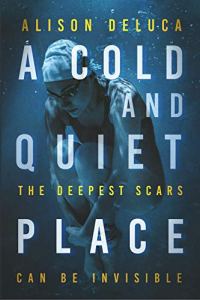
I read many books, and while most novels have some redeeming qualities, a few stand out as stellar. A Cold and Quiet Place by Alison DeLuca is one of those.

While I no longer have the time to put out a weekly book review blog, I do still review the books I love, and when I come across one that is worth sharing, I will gladly share it here.

Everyone who was ever a teenager knows the years between childhood and adulthood are fraught with danger, as the social skills we form either help or handicap us, and the traumas we suffer haunt us forever after.

The novel opens with a girl on the edge of adulthood and takes us through a powerful coming-of-age story.

But first, THE BLURB:

A Cold and Quiet Place by Alison DeLuca

Publisher : Myrddin Publishing Group (December 27, 2020)

Publication date : December 27, 2020

Language : English

Print length : 183 pages

The deepest scars can be invisible. Lily’s swimming career is jeopardized when she dates Tyler, her attractive teammate. At first he seems like the perfect boyfriend. But Tyler’s insults and demands increase, and Lily has to decide if her relationship is worth the emotional torture. Between Tyler, the pressure of competition, and an anonymous online bully, Lily risks losing everything she has fought for as a 15-year old swimmer. A Cold and Quiet Place is a YA novel about competitive swimming and the dark world of emotional abuse.

MY REVIEW:

This book is an emotional rollercoaster, powerful and deeply moving. DeLuca’s prose is lean and evocative, and her narrative transitions smoothly from scene to scene. The story is so compelling I was halfway through the book before I knew it.

This is a novel of achievement and despair. It details the chaotic mystery of Lily’s situation and the cold calculation of her abuser, laying bare the toxic high school relationships that are a terrible rite of passage many young people go through in their teen years.

High School in the US generally encompasses grades 9 through 12, and ages 14 to 18, with some variations depending on the school district.

When I began reading this novel, I knew nothing about competitive swimming other than as an Olympic level sport, one I watch every four years when the world meets to compete. I knew nothing of the athletes’ personal journey to get to that place.

Now, I see the humanity of each competitor, the person who has a life apart from their sport. Yet with each event, they challenge themselves to be better than their previous best.

Lilly’s story as an athlete and young woman is both heartbreaking and empowering. When I finished the last page, I felt as wrung as if I had lived that story, and in many ways, I had.

There is no blunting of the trauma, no dancing around the issues. DeLuca takes us into Lily’s world and tells a gripping story that has to be read to the last page. This is a powerful story of a girl growing into womanhood.

I give A Cold and Quiet Place by Alison DeLuca 5 stars.

Comments Off on #BookReview: A Cold and Quiet Place by @AlisonDeLuca #amreading

Filed under Book Reviews, writing

Conveying Mood part 2: adverbs #amwriting

Today is the second installment of a series on modifiers, words we use to describe nouns and verbs. I’m on a quest to find ways to use fewer of them and make the most of the ones I do use.

In the previous post, I  mentioned going to an online thesaurus and looking up your overall mood word. This is where you will find synonyms for your mood words and also the opposites.

In the root form, adverbs are adjectives, words that modify nouns. Add the suffix ‘ly’ to them, and they become words that modify verbs.

Adverbs tend to be fluffy. Most readers don’t like fluffy prose. I suggest you don’t muck up your modifiers by adding ‘ly’ at the end of them unless it is the only thing that works.

With that said, my rule is don’t write clumsy prose just to avoid using ‘ly.’

In the first draft, modifiers are brain-storming words. They show us what we intended to convey when we first wrote the narrative.

For that reason, they are essential parts of English and can’t be completely discarded as some deluded authors loudly swear they have done.

I suppose one could write a novel without using any modifiers whatsoever, but I wouldn’t want to read it. However, modifiers can weaken verbs by telling the story rather than showing it.

I don’t self-edit my first drafts as I write, so my prose is always a mess when I begin revisions.

This year’s NaNoWriMo novel was written with no outline, so it’s an example of my worst “thinking habits.” It is a sea of adverbs and adjectives, but these words are the roadmap that tells me what prose need reshaping to show the story.

At the time, I was imagining the scenes and plotting as I wrote. When I look back, the early drafts for all my work are littered with adverbs.

When you imagine your adverbs as signals from your creative mind, you see them a guide leading you to the story you really wanted to write.

In the second draft, I want to inject impact into the opening paragraphs and all the sentences that follow right to the grand finale. But I also want them to show what I envision.

That requires rewording the sentences to make them active. Look at your sentence structure.

Sentence structure matters.

Where you place an adjective relative to the noun they are modifying affects how a reader perceives it. Noun-verb is a strong lead in. Nouns work best when one strong, well-chosen adjective shows us what the point-of-view characters sees, hears, smells, touches, and tastes, rather than fluffing the verbs and hindering the action.

Sunlight glared over the ice, a cold fire in the sky that cast no warmth but burned the eyes.

The example sentence contains four nouns, one modifier (an adjective), and three verbs. The sentence is structured this way: noun-verb (sunlight glared) adjective-noun (cold fire), verb-adjective-noun (cast no warmth), and finally, verb-article-noun (burned the eyes).

Verb followed by noun shows us what the noun did. Verb-adjective-noun shows us how the noun looked (smelled, tasted, or felt) during the action.

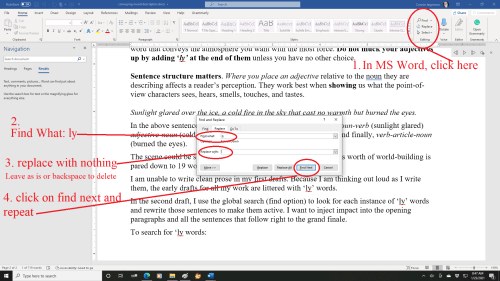
To search for unnecessary adverbs, look for ‘ly’ words in MS Word:

1: Click replace in the upper right corner of the Home tab.

2: Type ly into the “Find What” box.

3: Leave the “Replace With” box blank.

4: Look at each instance individually and decide to keep the ly or delete it. Many words, such as early or easily, have ly as their suffix, so look at each instance and decide if it stays or goes.

5: Once you have decided, click find next and repeat the process.

The above instructions are for MS Word, but Google Docs and Open Office both have some kind of search and replace function. Go to the internet and find the instructions!

In the first draft, the important thing is to get the idea down without self-editing. For this reason, we don’t publish our first drafts.

If you are like me in your first drafts, cleaning up and strengthening the prose could take a while, especially in a large manuscript. However, it is part of the revision process and is well worth the time you put into it.

The English language has evolved over the last century. The word very has become a ‘fluff word’ that sticks out when we see it written too freely in a narrative. It has a purpose but is easy to overuse. In that case, it adds nothing of value to the prose, so editors will suggest you remove it to make your sentences stronger.

Below is a list of modifiers, words that paint an image of the world our characters inhabit. Some will change the voice from active to passive, so be wary of how you use them.

When you do use a modifier, be creative. Sometimes, using an unexpected adjective lends life to an otherwise ordinary scene.

Nouns like a well-placed modifier, but most of the time, verbs are stronger when they work alone.

313 Modifiers for Nouns

  • Abnormal
  • Absentminded
  • Accidental
  • Adventurous
  • Afterward
  • Almost
  • Always
  • Annual
  • Anxious
  • Arrogant
  • Awkward
  • Bashful
  • Beautiful
  • Bitter
  • Bleak
  • Blind
  • Blissful
  • Boastful
  • Bold
  • Brave
  • Brief
  • Bright
  • Brisk
  • Broad
  • Busy
  • Calm
  • Careful
  • Careless
  • Cautious
  • Certain
  • Cheerful
  • Clear
  • Clever
  • Close
  • Coaxing
  • Colorful
  • Common
  • Continual
  • Cool
  • Correct
  • Courageous
  • Cross
  • Cruel
  • Curious
  • Dainty
  • Dear
  • Deceiving
  • Deep
  • Defiant
  • Deliberate
  • Delightful
  • Diligent
  • Dim
  • Doubtful
  • Dreamy
  • Easy
  • Elegant
  • Energetic
  • Enormous
  • Enthusiastic
  • Equal
  • Especial
  • Even
  • Even
  • Eventual
  • Exact
  • Excited
  • Extreme
  • Fair
  • Faithful
  • Famous
  • Far
  • Fast
  • Fatal
  • Ferocious
  • Fervent
  • Fierce
  • Fond
  • Foolish
  • Fortunate
  • Frank
  • Frantic
  • Free
  • Frenetic
  • Frightful
  • Full
  • Furious
  • General
  • Generous
  • Gentle
  • Glad
  • Gleeful
  • Graceful
  • Grateful
  • Great
  • Greedy
  • Happy
  • Hasty
  • Healthy
  • Heavy
  • Helpful
  • Helpless
  • High
  • Honest
  • Hopeless
  • Hungry
  • Immediate
  • Innocent
  • Inquisitive
  • Instant
  • Intense
  • Intent
  • Interesting
  • Inward
  • Irritable
  • Jagged
  • Jealous
  • Jovial
  • Joyful
  • Joyous
  • Jubilant
  • Judgmental
  • Just
  • Keen
  • Kidding
  • Kind
  • Kindhearted
  • Knavish
  • Knowing
  • Knowledgeable
  • Kooky
  • Lazy
  • Less
  • Light
  • Like
  • Limp
  • Live
  • Lofty
  • Longing
  • Loose
  • Loud
  • Loving
  • Loyal
  • Mad
  • Majestic
  • Meaningful
  • Mechanical
  • Merry
  • Miserable
  • Mocking
  • Month
  • More
  • Mortal
  • Most
  • Mysterious
  • Natural
  • Near
  • Neat
  • Nervous
  • Never
  • Nice
  • Noisy
  • Not
  • Obedient
  • Obnoxious
  • Odd
  • Offensive
  • Official
  • Often
  • Open
  • Optimistic
  • Overconfident
  • Painful
  • Partial
  • Patient
  • Perfect
  • Physical
  • Playful
  • Polite
  • Poor
  • Positive
  • Potential
  • Powerful
  • Prompt
  • Proper
  • Punctual
  • Quaint
  • Queasy
  • Queer
  • Questionable
  • Quick
  • Quicker
  • Quiet
  • Quirky
  • Quizzical
  • Random
  • Rapid
  • Rare
  • Ready
  • Real
  • Reassuring
  • Reckless
  • Regular
  • Reluctant
  • Repeated
  • Reproachful
  • Restful
  • Righteous
  • Rightful
  • Rigid
  • Rough
  • Rude
  • Safe
  • Scarce
  • Scary
  • Searching
  • Sedate
  • Seldom
  • Selfish
  • Separate
  • Serious
  • Shaky
  • Sharp
  • Sheepish
  • Shrill
  • Shy
  • Silent
  • Sleepy
  • Slow
  • Smooth
  • Soft
  • Solemn
  • Solid
  • Sometimes
  • Soon
  • Speedy
  • Stealthy
  • Stern
  • Strict
  • Successful
  • Sudden
  • Supposed
  • Surprising
  • Suspicious
  • Sweet
  • Swift
  • Sympathetic
  • Tender
  • Tense
  • Terrible
  • Thankful
  • Thorough
  • Thoughtful
  • Tight
  • Tomorrow
  • Too
  • Tremendous
  • Triumphant
  • True
  • Truthful
  • Ultimate
  • Unabashed
  • Unaccountable
  • Unbearable
  • Unethical
  • Unexpected
  • Unfortunate
  • Unimpressive
  • Unnatural
  • Unnecessary
  • Upbeat
  • Upright
  • Upside-down
  • Upward
  • Urgent
  • Useful
  • Useless
  • Usual
  • Utter
  • Vacant
  • Vague
  • Vain
  • Valiant
  • Vast
  • Verbal
  • Very
  • Vicious
  • Victorious
  • Violent
  • Vivacious
  • Voluntary
  • Warm
  • Weak
  • Weary
  • Well
  • Wet
  • Whole
  • Wild
  • Willful
  • Wise
  • Woeful
  • Wonderful
  • Worried
  • Wrong
  • Yawning
  • Year
  • Yearning
  • Yesterday
  • Yielding
  • Youthful
  • Zealous
  • Zest
  • Zestful

Previous in this series:

Conveying Mood Part 1: Adjectives

Short Story part 1: word choice

The Short Story part 2: Setting and Atmosphere 

Theme part 1

Theme part 2

7 Comments

Filed under writing

Conveying Mood part 1: adjectives #amwriting

This week we are continuing our exploration of words. I’m on a quest to find ways to use fewer of them and make the most of the ones I do use.

I’ve said many times that words are the colors we use to show entire worlds. Today, I’m exploring the many ways we use words for better impact.

I like to find my information easily, so I make a new file for every story I write. Once I know what the mood for the story I intend to write is, I go out and look for the mood words I want to have on hand. I list them in a document that I will save in that file with a proper file name, such as: mood_words_Rainbows_End.

This takes very little time, and I have a supply of mood descriptors to draw on to build my world without having to stop and look things up. Having this list helps me avoid crutch-words.

Because I am currently writing several pieces with a Gothic mood, my example word last week was ominous. It is an adjective that conveys the impression that something bad or unpleasant is going to happen.

But first, what is an adjective? For those of us who can’t remember what we ate for dinner last night, much less what we learned in grade school, adjectives are words or phrases that modify a noun, which is a person, place, or thing. They add to (or grammatically relate to) a noun and act to modify or describe it.

We don’t want to get crazy with adjectives, because they’re like salt–too much and you’ve ruined your food.

However, they are a fundamental part of English grammar, and while we can be sparing with them, we can’t eliminate them because (again) they are like salt: some are essential.

I use the Oxford Dictionary of Synonyms and Antonyms. But if you don’t own a good thesaurus, the Merriam-Webster online thesaurus is your best friend. https://www.merriam-webster.com/thesaurus

You will find many words, some of which are obscure.

Do yourself a favor and choose words that are fairly common, ones most readers with an average education won’t have to stop and look up.

Synonyms for ominous I can use: baleful, dire, direful, foreboding, ill, ill-boding, inauspicious, menacing, portentous, sinister, threatening.

Related words to subtly reinforce the mood: black, bleak, cheerless, chill, cloudy, cold, comfortless, dark, darkening, depressing, depressive, desolate, dim, disconsolate, dismal, drear, dreary, forlorn, funereal, gloomy, glum, godforsaken, gray/grey, lonely, lonesome, miserable, morbid, morose, murky, plutonian, saturnine, sepulchral, somber/sombre, sullen, sunless, threatening, wretched.

Other related words:

discouraging, disheartening, hopeless, unfavorable, unpromising, unpropitious, ill-fated, ill-starred, star-crossed, troubled, unfortunate, unlucky, evil, malign, malignant.

Antonyms for ominous, opposites I can use to provide contrast, so my mood is made more explicit: unthreatening.

Near Antonyms for ominous:

auspicious, benign, bright, encouraging, favorable, golden, heartening, hopeful, promising, propitious, prosperous. [1]

Toward the end of my work, I will want things to feel hopeful. So, I have researched the word auspicious the same way as I did ominous.

Definition of auspicious: having qualities that inspire hope or pointing toward a happy outcome.

Synonyms for auspicious: bright, encouraging, fair, golden, heartening, hopeful, likely, optimistic, promising, propitious, rose-colored, roseate, rosy, upbeat.

Words related to auspicious:

cheering, comforting, reassuring, soothing, assured, confident, decisive, doubtless, positive, sure, unhesitating, favorable, good.

Antonyms for auspicious: bleak, dark, depressing, desperate, discouraging, disheartening, dismal, downbeat, dreary, gloomy, hopeless, inauspicious, pessimistic, unencouraging, unlikely, unpromising.

Near Antonyms for auspicious: cheerless, comfortless, doubtful, dubious, uncertain, grim, negative, unfavorable, funereal, glum, gray/grey, miserable, wretched. [2]

If you are writing any kind of genre work, the best way to deploy your descriptors is to find the word that conveys the atmosphere you want with the most force.

Sentence structure matters. Where you place an adjective relative to the noun they are modifying affects a reader’s perception. They work best when showing us what the point-of-view characters sees, hears, smells, touches, and tastes.

Sunlight glared over the ice, a cold fire in the sky that cast no warmth but burned the eyes.

In the above sentence, the essential parts are structured this way: noun-verb (sunlight glared) adjective-noun (cold fire), verb-adjective-noun (cast no warmth), and finally, verb-article-noun (burned the eyes).

The scene could be shown in a multitude of ways, but a paragraph’s worth of world-building is pared down to 19 words, three of which are action words (verbs).

In my next post, we will go deeper into the uses and abuses of modifiers.


Credits and Attributions:

[1] “Ominous.” Merriam-Webster.com Thesaurus, Merriam-Webster, https://www.merriam-webster.com/thesaurus/ominous. Accessed 23 Jan. 2021.

[2] “Auspicious.” Merriam-Webster.com Thesaurus, Merriam-Webster, https://www.merriam-webster.com/thesaurus/auspicious. Accessed 23 Jan. 2021.

4 Comments

Filed under writing

The Short Story part 2: Setting and Atmosphere #amwriting

When I begin writing a short story, I want my first paragraphs to surprise an editor in a good way, to make them suspend their disbelief long enough to finish reading the story.
Especially in a short story, we must use the setting to establish a feeling of atmosphere, a mood that will hint at what is to come. Atmosphere is the part of a world created by your inclusion of colors, scents, and ambient sounds. The words you choose determine how the visuals are shown.

A reader’s perception of a setting’s reality is affected by emotions they aren’t even aware of. So, in a short story those first paragraphs must give the reader a sense of familiarity even though it’s a place they’ve never been.

We give the reader something they can understand without being bluntly told.

Do you want to convey a sense of danger? Imagine a woodland pond. On a windless day, the pool will be calm, still. The sky and any overhanging trees will be reflected in it. When a storm rolls in, things change. The waters move. Ripples and small waves stir the surface, reflecting the dark gray of the stormy sky.

Use the colors of the sky, the chill of the wet earth. Allow the scent of rotten leaves to linger in the air.

In the previous installment of this series, we talked about how important word choice is when attempting to communicate a feeling of action.

This is also true when you want to show the atmosphere of a setting. A dark, gloomy setting created by “weighted words” establishes an ominous atmosphere. This will be reflected in the mood of your characters.

“Weighted words” are those with strong descriptive power. Choose words that are intense and bold in their own right. This is crucial when writing a short story because you have a word count limit to consider.

Lighter words, such as those that begin with softer consonants, will create an atmosphere that feels gentler.

We have mentioned this before: while the two terms, mood and atmosphere, are usually used as synonyms, they are different from each other. In literature, mood refers to an individual’s internal feelings and emotions as often as it does the piece’s overall atmosphere. The term atmosphere is always associated with a setting.

The characteristics we call mood and atmosphere are created by inference. We offer the reader a word-picture that is hinted at and suggested rather than bluntly stated. Writers give the reader something to infer, something they can interpret.

What is the interpretive aspect of this layer? The author’s job is to use inference so that the reader can interpret their intention. That is, a reader can effortlessly understand what the author was attempting to convey.

The general mood is heavily influenced by other aspects of the narrative: setting, theme, ambiance, and phrasing.

A reader’s perception of a setting’s atmosphere is affected by a character’s emotions. Emotion, as written on the page, is the character’s experience of transitioning from the negative to the positive and back again.  As the characters’ emotions change from high to low throughout the story, the overall mood is influenced.

In this layer, visual objects in a room or an outdoor space color the atmosphere and affect the characters’ moods. Think about the word” Gothic.” Gothic atmosphere has a winter feel to it, even in summer.

Barren landscapes and low windswept hills feel gothic to me. The word Gothic in a novel’s description immediately tells us we are looking at a dark, moody piece set in a stark, desolate environment. We know it will include some supernatural elements.

The atmosphere/mood dynamic of any narrative is there to make the story’s emotional experience specific. It is not a substitute for emotions that an author can’t figure out how to write.

For me, as an author, creating the right atmosphere leads to shaping the characters’ overall mood. The right mood can help you articulate specific emotions.

Environmental symbols are subliminal landmarks for the reader. Thinking about and planning symbolism in an environment is key to developing the general atmosphere and affecting the mood.
In a short story, you have only the first few paragraphs to set the scene and establish the mood. If you can do it in one sentence, even better.

Sunlight glared over the ice, a cold fire in the sky that cast no warmth but burned the eyes.

And so, to wind this up, setting, atmosphere, and mood are intertwined. Getting those three aspects right and establishing them at the outset means making good word choices. Where you find atmosphere in the setting, you also find mood in the characters.

To do that, go to the thesaurus and look up synonyms and antonyms for your mood word. Are you writing a dark story? Is the mood ominous?

Synonyms & Antonyms of ominous

Definition: being or showing a sign of evil or calamity to come.

Synonyms: baleful, dire, direful, doomy, foreboding, ill, ill-boding, inauspicious, menacing, portentous, sinister, threatening.

Related words:

black, bleak, cheerless, chill, cloudy, cold, comfortless, dark, darkening, depressing, depressive, desolate, dim, disconsolate, dismal, drear, dreary, forlorn, funereal, gloomy, glum, godforsaken, gray (also grey), lonely, lonesome, miserable, morbid, morose, murky, plutonian, saturnine, sepulchral, somber (or sombre), sullen, sunless, wretched.

Other related words:

discouraging, disheartening, hopeless, unfavorable, unpromising, unpropitious, ill-fated, ill-starred, star-crossed, troubled, unfortunate, unlucky, evil, malign, malignant.

Antonym for ominous: unthreatening.

Near Antonyms for ominous:

auspicious, benign, bright, encouraging, favorable, golden, heartening, hopeful, promising, propitious, prosperous.


Previous in this series:

Theme part 1

Theme part 2

Short Story part 1 word choice


Credits and Attributions:

“Ominous.” Merriam-Webster.com Thesaurus, Merriam-Webster, https://www.merriam-webster.com/thesaurus/ominous. Accessed 19 Jan. 2021.

3 Comments

Filed under writing

The Short Story part 1: word choice #amwriting

Last week, we discussed how important exploring the theme is when writing for a themed anthology. This week, we are going deeper, finding ways to show a story and keep it within the word count limits.

Skill as a writer comes with practice. As we continue to work with our writing groups, we become technically better at the mechanics (grammar and punctuation).

Voice is how we bend the rules and is our authorly fingerprint. It will always be distinctly ours, because we all speak differently. However, many of the ways we express ourselves when speaking don’t translate well to writing within a tight framework.

Writing to a strict word count limit forces an author to pare away all that is unnecessary. To do that in 4,000 words or fewer, we choose words that have power.

We have talked about this before: active prose is Noun-Verb centric. If you are writing only for yourself, write any way you choose. But if you are hoping to sell books, it’s wise to keep in mind that today’s reader has high expectations and a great many other books to choose from.

We who write genre fiction (Sci-fi, Fantasy, Mystery, Thriller, Romance) must use words that are dynamic and convey a feeling of action.  In English, words that begin with hard consonants sound tougher and more powerful.

Say you have been invited to submit your work to an anthology. You have been given the theme which plays well to an idea you’ve had for a short story, and you are ready to write it.

But what is the mood you want to convey with your prose? Where you place the words in the sentence dramatically affects the mood, which either highlights or plays down the theme.

  • Placement of verbs in the sentence
    1. Moving the verbs to the beginning of the sentence makes it stronger.
    2. Nouns followed by verbs feel active.

Let’s look at four sentences, two of which are actively phrased, and two are passive. All describe the same self-destructive person, and none are “wrong.” Each conveys a different mood because of how they are expressed.

  1. She runs toward danger, never away.
  2. She never runs away from danger.
  3. Danger approaches, and she runs to meet it.
  4. If it’s dangerous, she runs to it.

I like it when an author makes good use of contrast when describing the difference(s) between two or more things in one sentence. Simplicity has impact. When looking for words with visceral and emotional power, consonants are your friend.

Sunlight glared over the ice, a cold fire in the sky that cast no warmth but burned the eyes.

Verbs are power words. If you choose forceful words, you won’t have to resort to a great deal of description. Weak word choices separate the reader from the experience, dulling the emotional impact of what could be an intense scene.

How we add depth to our prose without weakening it takes time and involves thought in the revision process. Consider word order, think about where you place your verbs, and use ordinary words that most people know and don’t have to look up in a dictionary.

We who write fiction create pictures without paint. We must learn to convey an inner landscape and imaginary world by painting a picture of the setting with a few deliberately chosen words. We also must show the atmosphere, the emotions, and the action.

Readers want us to use words that are “primary colors,” the words most people with an average education understand without having to go to a dictionary.

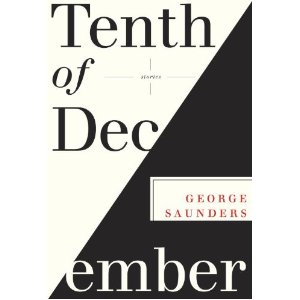
An example of this is Escape from Spiderhead,” a short science fiction story written by George Saunders and published in his 2013 anthology collection Tenth of December. It was first published in the New Yorker on Dec. 13, 2010.

This is a riveting story, one that challenges the reader to consider the ideas of free will and determinism. It also points out how easy it is for a society to strip certain individuals of their humanity, and how we justify it to ourselves.

Escape from Spiderhead is gut-wrenching and memorable because the words Saunders used to paint it with and the way he used them have power.

Emotional impact is created when an author combines common, everyday words in uncommon ways. I love finding an author whose words speak to me. Their stories surprise me, and the ideas they transmit fundamentally alters my perceptions of the world around me.

Previous in this series:

Theme part 1

Theme part 2

7 Comments

Filed under writing

Theme part 2 #amwriting

Not every anthology is themed, but many are. Most will also be restricted to one genre (romance, sci-fi, fantasy, crime) or a particular location, like a city or a place such as a coffee shop, etc. This is because theme alone isn’t enough to unify a book encompassing ten or more stories that are widely divergent in genre.

The concept of how to create a cohesive anthology was explained to me this way:

Consider a community art project where you ask five local artists to paint murals of cats to be displayed in the local community center. You will get five wildly divergent styles, and clashing colors, and cats that don’t go together well. But, if you ask them to paint black cats (or orange or red), your community wall art will have a consistency that celebrates the variety of the artists’ different styles rather than an eye-bleeding jumble of cats.

Therefore, when planning a story for a particular anthology, you must take the theme and any other setting or genre restrictions and run with it.

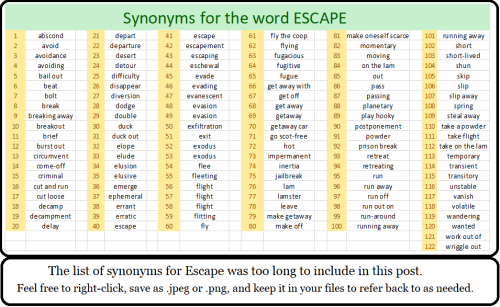
The first thing I do is research all the synonyms for that word. I recently wrote for an anthology with the theme of Escape, and it had to be set in the Pacific Northwest. I set my story in Olympia, Washington, in the area I grew up in. With my setting established, I went online and looked up every synonym for the word “escape.”

The above list is an image and not text, but feel free to copy it for your files.

Then after I had all the synonyms, I looked for the antonyms, the opposites.

Capture. Imprisonment. Confront.

Once I had a full understanding of all the many nuances of the theme, I asked myself how I could write a fantasy set in my real-world environment. My solution was to set it in a historical time, the late 1950s. I was a very small child then so anything I know about that era is a fantasy that I learned from television.

Then, I began plotting. I asked what my character needed most in her effort to escape. My gut answer was courage.

Sometimes, it helps if I use polarities (opposites, contrasts) to flesh out a character. These polarities helped me in fleshing out a protagonist and also the antagonist:

  • courage – cowardice
  • crooked – honorable
  • cruel – kind

As an editor, when I begin reading a short story, I want the first paragraphs to hook me. Those opening sentences establish three vital things:

  1. They introduce the problem.
  2. They introduce the characters and show us how they see themselves.
  3. They introduce the theme.

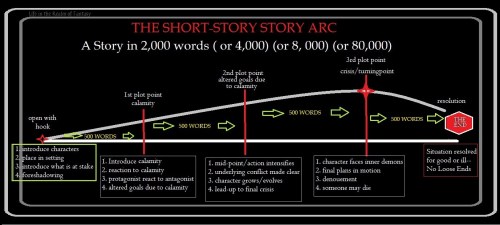
When writing a short story, it helps to know how it will end. I suggest you put together a broad outline of your intended story arc. I’m a retired bookkeeper, so I have a mathematical approach to this. Divide your story arc into quarters, so you have the essential events in place and occurring at the right time.

Assume you have a 4,000 word limit for your short story.

The Setup: The first 250 words are the setup and hook. You must have a compelling hook. In some cases, the first line is the clincher, but especially in a short story, by the end of the first page, you must have your reader hooked and ready to be enthralled.

The next 750 words take your characters out of their comfortable existence and launch them into “the situation” –will they succeed or not? What will be your inciting incident? How does it relate to the theme?

The next 2,500 words detail how the protagonist arrives at a resolution. What is the goal/objective? How does it relate to the theme? How did the underlying theme affect every aspect of the protagonists’ evolution in this story?

The final 500 words of your story are the wind-up. You might end on a happy note or not—it’s your story, but no matter what else you do, in a short story, nothing should be left unresolved. For this reason, subplots should not be introduced into the short story.

Word Count: Many times, publications and anthologies will have strict limits on the word count, such as no more than 4,000 or less than 2,000. For this reason, when writing short stories, we keep the cast of characters to a minimum.

When you’re only allowed 4,000 words, you must make each one count. You want that story to be the one the publication’s editor can’t put down.

We also keep the setting narrow: one place, one environment, be it a cruise ship, a restaurant, or a gas station—the location shouldn’t be epic in scale.

In a novel, side-quests and subthemes help keep the story interesting. This should go without saying, but you would be surprised at how often it doesn’t: you have no room to introduce side-quests in a short story.

When your writing mind has temporarily lost its momentum, and you are stretching the boundaries of common sense, it’s time to stop and consider the central themes. It helps to remind myself of the elements that really drive a plot.

Allegory is an essential tool for the author who wants to underline a theme and express crucial ideas with the least number of words. Using allegory and symbolism in the objects in the environment is a way to subtly underscore your theme. It allows you to show more without resorting to info dumps.

Consider a scene where you want to convey a sense of danger. Go to the “D” section of the Oxford Dictionary of Synonyms and Antonyms and look up “danger”:

  • danger – safety

Just past danger, we find

  • dark – light

And just beyond dark, we find

  • despair – hope

All of the above polarities would play well to the theme and would give your characters depth.

In any work, novel or short story, once you have identified the main theme, you can write the story in such a way that it is shown through:

  • Actions
  • Symbolic settings/places
  • Allegorical objects deliberately placed within the setting
  • Conversations

One final suggestion: Don’t think you can pull out some old story you have in a drawer, dust it off and tack on the theme word in a few places. No editor will be fooled.

Editors will look for many things when they are reading submissions. But no matter how brilliant the story is, if it doesn’t explore the theme well enough, they won’t accept it.

11 Comments

Filed under writing

Theme part 1 #amwriting

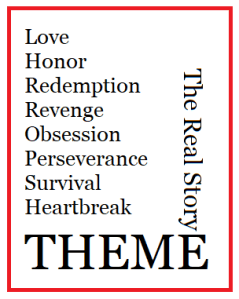
As an editor, one aspect of a story that I look at is theme. It is the invisible backbone of your story, a thread connecting disparate events that would otherwise appear random. Themes are often polarized, and multiple themes can emerge, creating opportunities for adding depth.

How do you identify your theme? Sometimes it’s difficult unless you start out with one in mind. Most of my books are based around the hero’s journey and detail how large events shape, and sometimes skew, the protagonists’ morals and ethics.

A common theme in fantasy is the juxtaposition of chaos and stability (or order). Good versus evil is a trope of the speculative fiction genre. Evil is usually portrayed by taking one or the other of these concepts to an extreme.

Riffing on the hero’s journey allows me to employ the theme of good vs. evil and the sub-themes of brotherhood and love of family. These concepts are important to me personally, so they find their way into my writing.

What themes are important to you? When you look for a book, what catches your interest? I am not talking genre here; instead, I am speaking of the deeper story. When you look at it from a distance, what do all the stories you love best have in common? That commonality is probably the theme.

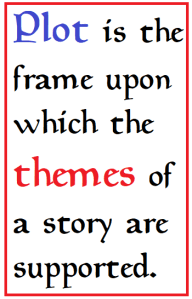
A crucial consideration in planning a short story is plot structure or how the story is arranged. The underlying theme is introduced with the first paragraph and supports the plot through to the end.

Theme is rarely stated baldly. Even if it isn’t overtly stated, it’s a unifying thread that goes through the story from beginning to end.

When an author is new to writing short stories, limiting the background information, and sticking to the theme can be the most challenging part. In my own early drafts, I often have a lot of information that doesn’t advance the story.

Still, I have found that writing backstory is a form of mind-wandering, an exercise that helps to cement the story in my mind. For this reason, I write the backstory in a separate document.

In the final draft, that 2000 words of background information I so lavishly laid down is not needed. Nor is any background on the setting required unless the location is a core plot point.

You must focus on one idea in a short story and riff on it until you reach the end. If you are writing for a themed anthology or magazine, you are fortunate! The editors have given you a framework on which to hang your plot.

So, what is theme actually? It’s different from the subject of a work. An example that most people know of, is the Star Wars series and franchise. The subject is “the battle for control of the galaxy between the Galactic Empire and the Rebel Alliance.” The themes are “moral ambiguity” or “the conflict between technology and nature.”

At some point, serious writers become brave enough to submit their work to a magazine or anthology. Most anthologies and many magazines are themed.

When you choose to submit to an open call for themed work, your manuscript must demonstrate your understanding of what is meant by the word ‘theme’ as well as your ability to craft compelling prose and produce a clean, well-edited manuscript.

I write and submit many short stories. It’s always intriguing how some find good homes in anthologies and other publications, and others don’t. When the story is good enough but “lacking something” indefinable, even our writing group members may not see why a particular story doesn’t work.

Possibly, there is no unifying theme to give events and conversations meaning.

The next installment in this series will go further into building a plot around a theme, or conversely, identifying and expanding on the theme in your already-written story.

8 Comments

Filed under writing

Do the research before you do the murder #amwriting

I recently began reading a murder mystery where the author used a mushroom to kill the first victim. That’s where this book fell apart—the idea was good, but the facts and execution weren’t.

Using a mushroom stroganoff to poison him was a poor choice because fungi is an undependable weapon unless you are an expert. Also, individually, one mushroom may be more or less poisonous than another of the same kind, rather like people are. Judging how many one would need to kill a three-hundred-pound man takes more thought than I am capable of plotting out.

Also, it was stroganoff, which is basically beef and mushrooms in a sour cream sauce. This author danced over the fact that serving the food at this dinner party would have been a tactical nightmare. It would have been nearly impossible to ensure the intended victim got the poison mushrooms and no one else did, which is how this murder was written.

Agatha Christie knew that and regularly poisoned entire dinner parties, literarily speaking. Her murderers made everyone at the table sick but only the intended victim actually died.

This particular mystery was set in Scotland, and I don’t know how poisonous their mushrooms are, but I think that logic would hold true there as well as it does here in the Pacific Northwest.

If I hadn’t been on several nature walks with Ellen King Rice, a wildlife biologist and amateur mycologist who writes well-plotted mushroom thrillers, I would have accepted the slightly contrived fatal dinner as written and focused on the other failings of this novel.

This experience reinforced my belief that readers are often more knowledgeable than we authors are. E-readers can do the research just by highlighting the word and hitting search.

For this reason, having a solid base of information to back up what we are writing is critical.

My disappointment as a reader could have been avoided if the author had gone out to several mushroom hunter websites or even if she had found a local person to talk with. With only a small amount of effort, she could have made her plot a little less flimsy.

Targeted research is essential if you want your fiction to convey a feeling of truth. Identify what you want to know, use the internet, ask an expert, and create a searchable file or database of information that backs up your assertions.

Once you establish the technological era you are writing in, you know what you need to research and how theoretical you may have to get.

Here are some of my go-to sources of information:

If you seek information about low-tech societies (the past) :

My best source of information on low-tech agrarian (farm) life and culture comes from a book I found at a second-hand book store in Olympia in the mid-to-late-1980s. Lost Country Life by Dorothy Hartley is still available as a second-hand book and can be found on Amazon. This textbook was meticulously researched and illustrated by a historian who personally knew the people she wrote about.

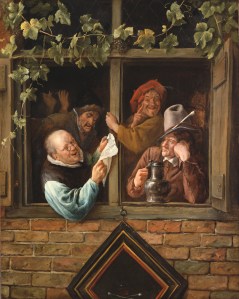
I also find a lot of information on how people lived from Wikimedia Commons.  Under the heading  Category: Painters from the Northern Netherlands (before 1830), you will find the brilliant works of the Dutch Masters, artists living in what is now The Netherlands.

These painters created accurate records of ordinary people going about everyday life. Their genre art depicts how they dressed, and what was important to them.

Talk to police, talk to doctors, talk to lawyers–many are willing to help you with your quest for accuracy about their professions. Also, you can Google just about anything. Fads, fashion, phone tech, current robotics tech, automobile tech—it’s all out there.

Looking things up on the internet can suck up an enormous amount of your writing time. Do yourself a favor and bookmark your resources so all you have to do is click on a link to get the information you want. Then you can quickly get back to writing.

Resources to bookmark in general:

www.Thesaurus.Com (What’s another word that means the same as this but isn’t repetitive?)

Oxford Dictionary (What does this word mean? Am I using it correctly?)

Wikipedia (The font of all knowledge. I did not know that.)

TED Talks are a fantastic resource for information on current and cutting edge technology.

ZDNet Innovation is an excellent source of current tech and future tech that may become current in 25 years.

Tech Times is also a great source of ideas.

Nerds on Earth has useful information about swords and how they were used historically.

If you want to know what interests the people in the many different layers of our society, go to the magazine rack at your grocery store or the local Big Name Bookstore, and look at the many publications available to the reading public. You can find everything from mushroom hunting, to culinary, to survivalist, to organic gardening. If people are interested in it, there is a magazine for it.

We can only extrapolate how societies will look in the future by taking what we know is possible today and mixing it with a heavy dose of what we wish were possible.

SpaceX

NASA

Digital Trends

If you write sci-fi, you must read sci-fi as that is where the ideas are. Much of what was considered highly futuristic in the era of classic science fiction is today’s current tech.

Ion drive, space stations—these are our reality but were only a dream when science fiction was in its infancy.

Think about it: your Star Trek communicator is never far from your side, and your teenagers won’t put theirs down long enough to eat dinner.

MAPS: If you are writing a story set in our real world and your characters will be traveling, walking a particular city, or visiting landmarks, bookmark google maps for that area and refer back to it regularly to make sure you are writing it correctly.

USE GOOGLE EARTH!

If you are writing about a fantasy world and your characters will be traveling, quickly sketch a rough map. Refer back to it to ensure the town names and places remain the same from the first page to the last. Update it as new locations are added.

Do the right research, target it to your needs, and don’t allow yourself to be sidetracked by the many bunny trails that lead you away from actually writing. And for the love of Agatha Christie, make sure your literary murders are done in a way that doesn’t fly in the face of logic.


Credits and Attributions:

Wikimedia Commons contributors, “File:Jan Steen, Dutch (active Leiden, Haarlem, and The Hague) – Rhetoricians at a Window – Google Art Project.jpg,” Wikimedia Commons, the free media repository, https://commons.wikimedia.org/w/index.php?title=File:Jan_Steen,_Dutch_(active_Leiden,_Haarlem,_and_The_Hague)_-_Rhetoricians_at_a_Window_-_Google_Art_Project.jpg&oldid=355150081 (accessed September 10, 2020).

13 Comments

Filed under writing