Category Archives: writing

Voice #amwriting

If you write professionally, you develop habits, ways of expressing yourself that “sound” like you. Voice is how you bend the rules and is your fingerprint. For your voice to be compelling and not jarring, you must understand what rules you can break with impunity, and which ones must be obeyed. Knowledge is key—it enables you to craft your work so it says what you want, in the way you want it said.

Most editors will ignore liberties you take with dialogue but will point out habitual errors in the rest of the narrative.

If you work with an editor, you must be willing to explain why you are choosing to flout a particular rule. If you don’t understand the rule to begin with, you can’t defend your position with authority.

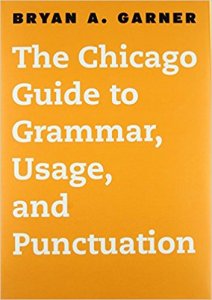
This is why I always suggest you buy a good style guide. I like the simplicity and thoroughness of Bryan A. Garner’s The Chicago Guide to Grammar, Usage, and Punctuation.

If an editor asks you to change something you did deliberately, you are the author. Explain why you want that particular grammatical no-no to stand. If you have a concrete reason, your editor will most likely understand.

Repetition of a key word for emphasis is one example of breaking a rule with style.

This is why it’s important to educate yourself. If you know the rule you are breaking, you will be better able to explain why you are doing so, and your work will reflect that confidence.

However, if I am your editor, you must be prepared to break that rule consistently. Readers do notice inconsistencies.

No one is perfect, and even authors who also work as editors need and use editors. Certainly, I have benefited from the editors I have worked with. I began this journey knowing nothing about the mechanics of writing, other than that which I had retained from my school days. Writers who were further along in the craft gave me good advice, and I began growing as a writer.

To go back to what I said in the first paragraph, you must understand what rules you can break with impunity, and which of them must be obeyed. The average reader doesn’t take joy in reading James Joyce’s experimental prose. Alexander Chee can be difficult for an average reader to enjoy. This is because both Joyce and Chee take liberties with punctuation that makes reading their work a real challenge. Some readers are up to that, others not so much.

I will admit, I had to take a class to be able to understand James Joyce’s work, and I did have to resort to the audiobook for Alexander Chee’s work. It’s the hypercritical editor coming out in me, making it difficult for me to set that part of my awareness aside. It’s my job to notice those things.

I can hear you now: these are literary authors, and you are writing genre fantasy fiction or sci-fi. Shall I toss out another name or two?

Tad Williams mixes his styles. His Bobby Dollar series is Paranormal Film Noir: dark, choppy, and reminiscent of Sam Spade. In this series, he seems to be somewhat influenced by the style of crime authors, such as Raymond Chandler or Dashiell Hammett. It is a quick read and is commercial in that it is for casual readers.

Yet his fantasy work set in Osten Ard has lusher prose, multiple storylines, dark themes. It is written for serious fantasy readers. The story starts slow, but his powerful writing has generated millions of fans who are thrilled to know he has set more work in that world.

Beginning slow and working up to an epic ending is highly frowned upon in writing groups, but Tad broke that rule and believe me, it works.

George Saunders writes sci-fi and historical fantasy but is considered literary. He has a unique, literary voice because he takes liberties with the rules.  His work reads like a conversation with him, a little crisp and choppy, but intimate.
If you are writing a genre such as fantasy or sci-fi or mystery, I suggest you do not get experimental with your punctuation unless you don’t mind bad reviews. People who look for quick reads for the adventure and romance don’t want experimental. They want an escape; they want prose that doesn’t interfere with the narrative. Run on sentences, commas inserted every place you breathe, or no commas at all—these are flaws that ruin the experience for the casual reader.

Get a good style guide and stop guessing about where the commas go and how to use that ellipsis.  Don’t know if you should use a semicolon or not?

Get a style guide.

Your writing will go faster, and your beta readers will be able to give you better opinions on what reads well and what needs more work.
2 Comments

Filed under writing

Formatting and Submission Guidelines #amwriting

Writing can be a solitary occupation, but as we gain confidence, we join writing groups and larger professional organizations. We become involved in the writing community because writers need to be able to talk about writing with people who understand. Through that network of professional acquaintances, we make connections with more experienced authors, people who are happy to mentor us. The knowledge I have gained about the craft of writing from those generous mentors has been invaluable.

Mentors have much to offer us about the mechanics of writing, such as grammar and industry practices. Also, they will often know of open opportunities our work might be suitable for, publications and anthologies with open calls. It takes courage to submit our work to any kind of contest or publication the first few times, but that is part of the process. We learn by doing.

New and beginning authors sometimes do the craziest things with their manuscripts. If you are serious about writing and submitting short stories, you must follow publisher and contest guidelines in formatting your manuscript before you submit it. No matter how pretty you make that manuscript for your own pleasure, if it doesn’t follow the submission guidelines for the place you are submitting it, you have wasted your time.

Perhaps you feel that the rules shouldn’t apply to you –  it’s your manuscript and by golly, you like the way it looks. It took you forever to make it look that good. Why should you have to take the time to completely reformat your perfectly fine manuscript to fit some stupid set of arbitrary rules no one cares about?

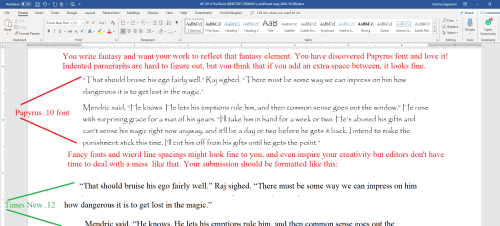
Maybe you don’t care about those rules, but editors and publishers do, and they are the people you want to please. They don’t have time to deal with a manuscript that is justified, single spaced, has block paragraphs, has an extra space between each paragraph, and is in Papyrus font .10.

When the editor of a contest, publication, or anthology opens the call for submissions, they will get hundreds of entries, perhaps thousands. When a call for submissions goes out, their editors will have no time to deal with badly formatted manuscripts.

Publication dates are set well in advance and must be adhered to. Time is always of the essence in the publishing world.

Editors are only one person, and they want to read each and every submission. Unfortunately, out of all those entries some will be great stories that won’t even be read because the author couldn’t be bothered to format the manuscript in the way that the submission rules stated.

Publishers have specific, standardized formatting they want you to use, and these guidelines are clearly posted on their websites. If the first page shows the manuscript is not formatted to industry standards, expediency kicks in. The editor must reject it and move on to the next submission.

Word processing programs are inherently hinky because they are built out of new versions layered over the old versions, and the bugs in the old versions are often still there. This is why some really large formatting issues are nearly impossible to iron out.

And then there is the issue of reasonable effort. It’s time-consuming and difficult enough for a publisher to make a final manuscript of thirty short stories by thirty different authors look good when each submission was formatted correctly. If you have thirty short stories, each formatted differently with random fonts, different paragraph spacing, and different font sizes – you have a nightmare to edit. Even after editing it can take days to make a final compilation manuscript fit for publication.

For the most part, the requirements are basically the same from company to company with minor differences. To make sure your work conforms to the intended recipient’s requirements go to the publication’s website and read the standards they have laid out.

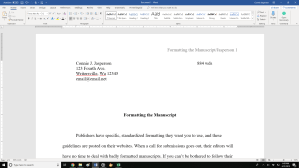
Publications will want your contact information on the upper left of the first page, and your approximate word count on the right. The title should be centered, and the first paragraphs should begin at the halfway point down the first page.

To get your paragraphs and line spacing right, you need to know a few simple tricks for using your word processing program. These tools come with the software and are there to make your documents look as professional as is possible. I have covered how to do that in my post of January 15, 2018, Formatting Short Stories for Submission.

These rules are not only for short stories. Every contest and publication wants the submissions in the same professional format whether it is a printout or an electronic submission.

Too many extra spaces in an electronic document cause the formatting to fail when converted to electronic publishing formats (mobi, epub, etc.) so keep extra spaces to a minimum. Most publishers require manuscripts to be submitted electronically so you will have to go in and remove these tabs. You can do it by following the instructions in my post of March 27, 2019, Formatting Your Paragraphs. If you are not using MS Word or you don’t have a ten key on your keyboard, you may have to do it by hand. It’s a tedious job but do it now, if you have been using the tab key.

You should make sure the font is Times New Roman or Courier .12 font and the body of the manuscript is aligned left.

  1. 1 in. margins
  2. Double-spaced
  3. 1 space after each sentence (NOT 2 as we dinosaurs were taught in typing class)
  4. Each page is numbered in the upper right hand corner
  5. Has formatted indented paragraphs
  6. The header contains the title and author name
  7. The first page contains the author’s mailing address and contact information in the upper left hand corner

Please, if you consider yourself a professional, format your submissions properly. You want to stand out but getting fancy with your final manuscript is not the way to do that—you will be rejected out of hand if you don’t make this effort.

Again, the posts (with screenshots) detailing how to make your manuscript submission ready can be found at these links:

Formatting Your Paragraphs

Formatting Short Stories for Submission

4 Comments

Filed under writing

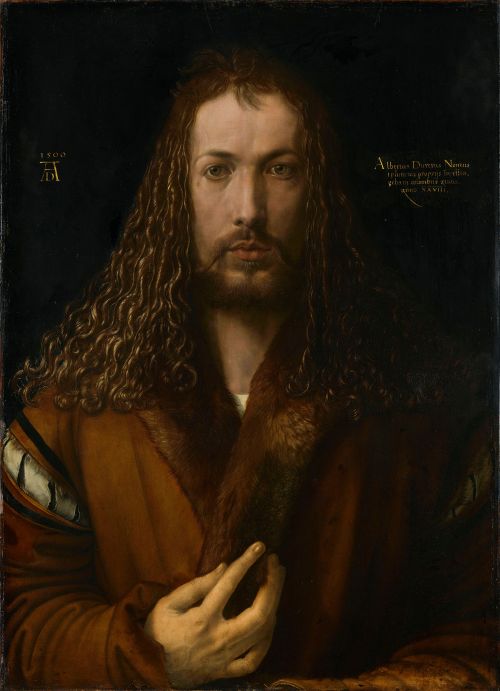
#FineArtFriday: Self-portrait by Albrecht Dürer 1500

About this painting, via Wikipedia:

Dürer chooses to present himself monumentally, in a style that unmistakably recalls depictions of Christ—the implications of which have been debated among art critics. A conservative interpretation suggests that he is responding to the tradition of the Imitation of Christ. A more controversial view reads the painting is a proclamation of the artist’s supreme role as creator.

The inscription reads, I, Albrecht Dürer of Nuremberg portrayed myself in appropriate [or everlasting] colors aged twenty-eight years.

What I like about this painting:

I like how dark and precise this portrait is compared to his earlier self-portraits. Dürer’s eyes are compelling. They tell us he is a complicated man with many secrets. The year 1500 was significant to him, as it was the turn of the millennium and his studio was enjoying great success as a print maker. Dürer traveled often and had spent a great deal of time in Italy where he made the acquaintance of Leonardo da Vinci. It is clear he was highly influenced by da Vinci’s work, as were most artists of the day.

I’m intrigued by the way he has chosen to depict himself in a pose that was traditionally that of Christ as Savior Mundi (Savior of the World). His hair, in this painting, is portrayed as dark brown but was actually a lighter red. He shows it as parted down the middle, very like da Vinci’s Salvator Mundi.

He raises his hand toward his heart, as if blessing us, the viewers. The position of the fingers is symbolic; some would say it is a Templar/Masonic gesture for the letter M, signifying Mary. If you try to hold your hand that position, you discover it is impossible to do so in a relaxed, natural way. The fingers must be purposefully held that way and it isn’t really comfortable.  Others would say hands are difficult to paint, and were frequently copied from famous paintings; still other will say certain gestures showed social status. It was the Renaissance and art was a way to express one’s rebellion through symbolism and allegory. Therefore, we know the gesture has meaning.

His signature is also clever: 1500 Anno Domini or 1500 Albrecht Dürer.

About the Artist, via Wikipedia:

Albrecht Dürer (21 May 1471 – 6 April 1528) sometimes spelt in English as Durer or Duerer, without umlaut, was a painter, printmaker, and theorist of the German Renaissance. Born in Nuremberg, Dürer established his reputation and influence across Europe when he was still in his twenties due to his high-quality woodcut prints. He was in communication with the major Italian artists of his time, including Raphael, Giovanni Bellini and Leonardo da Vinci, and from 1512 he was patronized by Emperor Maximilian I. Dürer is commemorated by both the Lutheran and Episcopal Churches.

Dürer’s vast body of work includes engravings, his preferred technique in his later prints, altarpieces, portraits and self-portraits, watercolors and books. The woodcuts, such as the Apocalypse series (1498), are more Gothic than the rest of his work. His well-known engravings include the Knight, Death and the Devil (1513), Saint Jerome in his Study (1514) and Melencolia I (1514), which has been the subject of extensive analysis and interpretation. His watercolors also mark him as one of the first European landscape artists, while his ambitious woodcuts revolutionized the potential of that medium.

Dürer’s introduction of classical motifs into Northern art, through his knowledge of Italian artists and German humanists, has secured his reputation as one of the most important figures of the Northern Renaissance. This is reinforced by his theoretical treatises, which involve principles of mathematics, perspective, and ideal proportions.


  • Title:  Albrecht Dürer: Self-Portrait
  • Artist: Albrecht Dürer  (1471–1528)
  • Genre: self-portrait
  • Date: 1500
  • Medium: oil on lime
  • Dimensions: Height: 67.1 cm (26.4 ″); Width: 48.9 cm (19.2 ″)
  • Collection:  Alte Pinakothek
  • Current location: 1st floor room IX Alte Pinakothek, Raum IX

Credits and Attributions:

Self-portrait, 1500 by Albrecht Dürer [Public domain] Wikimedia Commons contributors, “File:Albrecht Dürer – 1500 self-portrait (High resolution and detail).jpg,” Wikimedia Commons, the free media repository, https://commons.wikimedia.org/w/index.php?title=File:Albrecht_D%C3%BCrer_-_1500_self-portrait_(High_resolution_and_detail).jpg&oldid=292769964 (accessed May 2, 2019).

Wikipedia contributors, “Albrecht Dürer,” Wikipedia, The Free Encyclopedia, https://en.wikipedia.org/w/index.php?title=Albrecht_D%C3%BCrer&oldid=894882291 (accessed May 3, 2019).


2 Comments

Filed under writing

Introspection and Dialogue #amwriting

Scenes that involve violence are difficult to write as they require serious choreography. However, no matter how well we write them, they won’t accomplish their task if we don’t allow time for introspection. Action without a frame of reference is confusing. Also, if we don’t allow our characters a chance to consider what just happened and how they want to proceed, we can end up with undeveloped, two-dimensional characters.

How does the action affect our protagonist? Action, aftermath, action, aftermath—a rhythm that is often compared to the way a skater crosses the ice: push, glide, push, glide.

These moments in the aftermath of violence are opportunities. We want to avoid info dumps, but we also have to provide some information to explain events. These moments of respite are opportunities for us to dole out information that might be needed to answer questions and yet keep the reader engaged. Doling out the backstory only as it is needed keeps the reader reading.

So, we only need to discuss in conversation or internal dialogue things that pertain to

  1. What just happened or
  2. What is about to happen.

Action is important because it is interesting and provides drama. Even when we are “gliding” we want to keep the story moving forward. So, we allow the reader to process things at the same time the protagonist does, or we run the risk of losing the story in the confusion.

The story is the hero’s journey, and it must be as much a personal journey as a physical one.

We’re all familiar with the term ‘flat-lined’ as a medical expression indicating the patient has died.

When the story arc is imbalanced, it can flat-line in two ways:

  • The action becomes random, an onslaught of meaningless events that make no sense.
  • The pauses become halts, long passages of random internal monologues that have little to do with the action.

Readers only connect with a protagonist’s story if they can sympathize with them. They want a relationship with the people who inhabit the books they read. The way we build relationships between our readers and the characters in our stories is through the characters’ conversations and introspections.

The trick is balancing the introspection and chaos, ensuring that contemplation and dialogue don’t devolve into info dumps where your character ponders everything at length.

Some stories are more literary and are meant to be more introspective than active. My favorite literary classics are all about the character’s thoughts rather than their actions.

But if you are writing genre fiction, you must ensure you have properly balanced your action and introspection.

A good way to avoid a flatlined story arc is through character interaction. Your characters briefly discuss what is on their minds. With the conversation over, they move forward to the next event. This offers an opportunity for new information important to the story to emerge.

Introspection opens a window for the reader to see who the characters secretly are, how they react and illuminates their fears and strengths. It shows that they are self-aware.

In an action-based narrative, introspection is brief but important. Internal monologues are minimal and serve to illuminate a character’s motives at a particular moment in time.

Internal monologues should not make our characters seem too clever by introducing convenient knowledge. We like characters who are somewhat clueless about their situation as well as about their own flaws and strengths.

When characters are having a discussion, our point-of-view character will be in the most danger of being too smart. We have to ensure the dialogue is not too exact when the protagonist and her cronies are making predictions because it ruins the mystery of the piece.

The same follows for inner monologues, perhaps even more so.

Throughout the course of the story, each of the characters’ faults and flaws diminish (or in the case of the antagonist they become clearer) because the characters grow and change as people, as human beings. The protagonist is pushed down the path to wisdom. Self-awareness should gradually blossom toward the “resurrection” that occurs near the end of the hero’s journey.

Introspection is important for the protagonist because surviving the journey to self-knowledge is as important as living through the physical journey.

The antagonist should also have moments of introspection as they take greater chances, risk more, apply more effort to winning at any cost.

My characters begin in an unfinished state, like a pencil sketch. My goal is for them to emerge from the events of their journey in full color, fully realized in a multi-dimensional form that readers will remember and think about after the last page has been read.


Credits and Attributions:

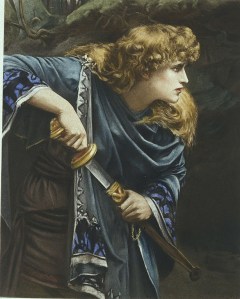
Wikimedia Commons contributors, “File:Imogen – Herbert Gustave Schmalz.jpg,” Wikimedia Commons, the free media repository, https://commons.wikimedia.org/w/index.php?title=File:Imogen_-_Herbert_Gustave_Schmalz.jpg&oldid=342359236 (accessed May 1, 2019).

5 Comments

Filed under writing

3 Rules I knew but never knew I knew #amwriting

In English, as in other languages, certain rules of speech are learned so early on in life that they are instinctual. No matter the level of our education or the dialect we speak, we use these rules and don’t know we are doing so.

Today I have three wonderful quotes on these rules from linguist Steven Pinker, editor Stan Carey, and Tim Dowling, journalist for The Guardian.

The Jolly Green Giant rule:

The rule is that multiple adjectives are always ranked accordingly: opinion, size, age, shape, colour, origin, material, purpose. Unlike many laws of grammar or syntax, this one is virtually inviolable, even in informal speech. You simply can’t say My Greek Fat Big Wedding, or leather walking brown boots. And yet until last week, I had no idea such a rule existed. Tim Dowling, for The Guardian, Sept 13, 2016

Word order is why certain sentences seem wrong when you are in the middle of laying down the first draft of a new manuscript. We are madly getting the words out of our heads, and they may fall out in the “wrong” order.  My red large Cadillac is comfortable to ride in. Sometimes these wonky phrasings don’t stand out to us because our minds automatically put the words in the right order, so we don’t see what we have actually written.

My large red Cadillac is comfortable to ride in. 

Actually,my large dirty mini-van is comfortable to ride in, but that’s another story.

To boil what he said down to a bite sized chunk, we automatically order our words this way:

  1. opinion,
  2. size,
  3. age,
  4. shape,
  5. color,
  6. origin,
  7. material,
  8. purpose

Sharon’s light blue wool jacket was left behind.

The Mishmash rule:

“Reduplication” is when a word or part of a word is repeated, sometimes modified, and added to make a longer term, such as aye-aye, mishmash, and hotchpotch. This process can mark plurality or intensify meaning, and it can be used for effect or to generate new words. The added part may be invented or it may be an existing word whose form and sense are a suitable fit. Stan Carey, A hotchpotch of reduplication, MacMillan Dictionary Blog 2012

I love mishmash words. They are fun to say, and while I regularly taunt my grandchildren with them, I hardly ever get to write them. Mishmash. Hip-hop.

The Hip-Hop rule:

Have you ever wondered why we say fiddle-faddle and not faddle-fiddle? Why is it ping-pong and pitter-patter rather than pong-ping and patter-pitter? Why dribs and drabs rather than vice versa? Why can’t a kitchen be span and spic? Whence riff-raff, mish-mash, flim-flam, chit-chat, tit for tat, knick-knack, zig-zag, sing-song, ding-dong, King Kong, criss-cross, shilly-shally, seesaw, hee-haw, flip-flop, hippity-hop, tick-tock, tic-tac-toe, eeny-meeny-miney-moe, bric-a-brac, clickey-clack, hickory-dickory-dock, kit and kaboodle, and bibbity-bobbity-boo? The answer is that the vowels for which the tongue is high and in the front always come before the vowels for which the tongue is low and in the back.(Pinker, The Language Instinct, 1994:167)

So now you have it – a mishmash of three rules native speakers of English know and use without consciously thinking about it – the whole kit and kaboodle with all the words placed in the right order.


Credits and Attributions:

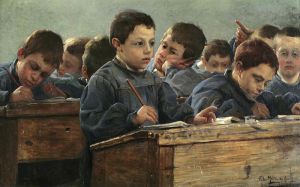
Media: In the Classroom, Paul Louis Martin des Amoignes (1858–1925) [Public domain] via Wikimedia Commons. Wikimedia Commons contributors, “File:P L Martin des Amoignes In the classroom 1886.jpg,” Wikimedia Commons, the free media repository, https://commons.wikimedia.org/w/index.php?title=File:P_L_Martin_des_Amoignes_In_the_classroom_1886.jpg&oldid=273566736 (accessed April 28, 2019).

Tim Dowling, Order force: the old grammar rule we all obey without realizing, © The Guardian 2016, https://www.theguardian.com/commentisfree/2016/sep/13/sentence-order-adjectives-rule-elements-of-eloquence-dictionary (accessed 25 May 2018)

Stan Carey, A hotchpotch of reduplication, MacMillan Dictionary Blog 2012 © Macmillan Publishers Limited 2009-2018. http://www.macmillandictionaryblog.com/a-hotchpotch-of-reduplication (accessed 25 May 2018)

Steven Pinker, The Language Instinct, Pinker, Steven. 1994. The Language Instinct. New York: HarperPerennial.

9 Comments

Filed under writing

The transition scene #amwriting

A well-paced narrative has a kind of rhythm. Instructors commonly refer to this as “push, glide, push, glide,” as if skating. What that means is that while the characters might be in the midst of chaos, there is order in the layout and pacing of the narrative.

  • action,
  • processing the action,
  • action again,
  • another connecting/regrouping scene

These “processing” scenes are transitions, moving the plot forward while allowing the reader to process what just happened.

We can’t have non-stop action, as that is exhausting to write and more exhausting to read. The character arc is often at the forefront during these transitional scenes as that period of relative calm is when you allow your characters’ internal growth to emerge.

We justify what just happened, making it believable. It is also where you ratchet up the tension.

When it comes to writing transitions between scenes, we have several paths to choose from.

Introspection:

  • Introspection offers an opportunity for new information important to the story to emerge.
  • It opens a window for the reader to see who the characters are, how they react and illuminates their fears and strengths. It shows that they are self-aware.

Keep the scenes of introspection brief, and go easy on them if you are given to using italics to set them off. A wall of italics is hard to read, so don’t “think” too much if you are using those.

  • Characters’ thoughts must serve to illuminate their motives at a particular moment in time.
  • In a conversation between two characters, introspection must offer information not previously discussed.
  • Internal monologues should not make our characters too wise. Humanize them, show them as a bit clueless about their flaws, strengths, or even their deepest fears and goals.

Conversations:

  • Conversations should not become clumsy info-dumps. “As you know….”
  • Each character must speak uniquely, sounding like themselves. Don’t dump conversations into a blender and pour out a string of commentary that makes them all sound alike.

Don’t get fancy with speech tags/attributions. It’s best for me as a reader when the author avoids words that take me out of the narrative. Some words are eye-stoppers. I recommend you stick with said, replied, answered—common and ordinary  tags that don’t leap out at the reader like ejaculated, disgorged, spewed, and so on. Occasionally, you can get away with more forceful tags, but keep them to a minimum. Make the characters’ actions and words show the force of their words. In my opinion, you can do away with speech tags for some brief exchanges if the scene contains only two characters.

Fade-to-black and hard scene breaks:

I’m in two minds about using fade-to-black scene breaks as transitions. Why not just start a new chapter?

One of my favorite authors, L.E. Modesitt Jr. sometimes has chapters of only five or six-hundred words, which keeps each character thread truly separate and flows well.

In a short story, a hard scene break is sometimes required, as you don’t have the option to do chapters. Use an asterisk or hashtag between scenes. * #

New chapter:

Each of the major players has a point of view. Some authors use the aftermath of an action scene as an opportunity to advance the antagonist’s story line. That is a good strategy, as we do need to show why the enemy is the enemy.

The key is to avoid “head-hopping,” and I feel like the best way to do that is to give a new chapter to the point-of-view character. Head-hopping occurs when an author switches point-of-view characters within a single scene. It happens most frequently when using a third-person omniscient narrative because the thoughts of every character are open to the reader.

My favorite authors will employ all the above listed transitions as they move their characters through the story arc. Each transition will lead us into a new scene, and when they are done right, we the readers won’t even notice that they are transitional.

The transition is the most difficult part of the narrative for me to formulate in the first draft. I get stuck, trying to decide what information needs to come out, and what should be held back.

Sometimes, a transition just will not work no matter what. This happens when a flaw in the logic exists in the scene preceding it. Usually, I can’t see it at that point, but my writing group will show me what the problem is.

This struggle to connect my action scenes into a seamless arc is why writing isn’t the easiest occupation I could have chosen. But when everything comes together, it is the most satisfying job.


Credits and Attributions:

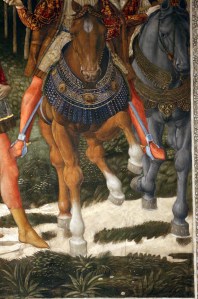
Detail from: Journey of the Magi (East Wall) by Benozzo Gozzoli 1459Magi Chapel of Palazzo Medici-RiccardiFlorence, 1459–1461. Wikimedia Commons contributors, “File:Benozzo gozzoli, corteo dei magi, 1 inizio, 1459, 51.JPG,” Wikimedia Commons, the free media repository, https://commons.wikimedia.org/w/index.php?title=File:Benozzo_gozzoli,_corteo_dei_magi,_1_inizio,_1459,_51.JPG&oldid=179731811 (accessed April 24, 2019).

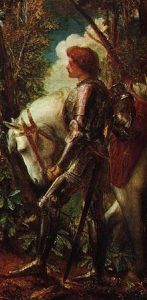
Wikimedia Commons contributors, “File:Sir Galahad (Watts).jpg,” Wikimedia Commons, the free media repository, https://commons.wikimedia.org/w/index.php?title=File:Sir_Galahad_(Watts).jpg&oldid=277887181 (accessed April 24, 2019).

9 Comments

Filed under writing

Update on Works in Progress #amwriting

I hope you had a happy Easter weekend, celebrating the advent of spring your way. We share five children, and they all have children, so warm weather and the addition of extended family made for a great family party on Saturday. Unfortunately, our poor abused vacuum cleaner died the final death before we were finished preparing for the party and there was no time to get a new one.

Near the front door, beneath the growing pile of cast off shoes, bags, and backpacks, lay an expanse of unvacuumed carpet. Strangely, no one seemed to notice.

By three in the afternoon, my kitchen was loaded with every kind of food imaginable, and the party was in full swing. While the younger children involuntarily were held captive indoors behind closed drapes, the teenagers hid well over a hundred plastic eggs. Each was filled with cash, toys, and candy.

Somehow, in the process, the rod holding up my front drapes was pulled loose from the wall. It still hangs there, like everyone’s drunken uncle…precariously positioned and slightly askew.

Thunder shook my suburban neighborhood when we released the captives and the front door burst open. Tender shoots of green lawn met a grisly fate as the mob of crazed grandchildren descended on our yard.

High drama unfolded as toddlers fell and scraped their knees and older children took advantage of their distraction. Oh, the carnage!

At around seven PM, the last car left the driveway. We geared up in hazmat suits and began the cleanup—sans vacuum cleaner.

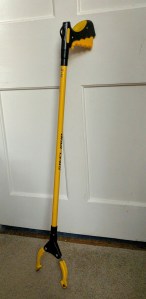
However, I’m a pro. My husband and I are both suffering from back injuries, so in the aftermath, we were forced to be creative. Who needs a stinkin’ vacuum cleaner? My broom works on the carpet, and I have developed mad skills with my new tool of choice—the reach extender.

It’s amazing the things you can do with long-handled grabbers. They make excellent tools to extricate candy wrappers from the shrubbery and retrieve the few eggs that were overlooked in the stampede. Being able to grab the toy cars and plastic farm animals out from under the porch is a real plus.

Inside the house, wide-spread devastation made negotiating the hallway to the bathroom difficult for travelers in a hurry. Muffled cursing was heard as sock-footed old people stepped on abandoned Legos.

I’m talented—I can pick up the merest fragment of potato chip from under a bed with my long handled grabber, without crushing it. This tool, properly wielded, works on every kind of debris—lint, broken crayons, Legos, Polly Pocket purses, Barbie shoes, and half-eaten Cadbury eggs.

You can lean on it when you need propping up.

We dug a path and cleaned the kitchen before going to bed. But by noon on Sunday, the cleanup had been completed, and the toy room was once again a place of moderate order.

Speaking of order, I have ordered a new, sturdier vacuum cleaner, and peace reigns once again here at Casa del Jasperson.

Now that the madness of the family Easter rumble is over, I will continue working on my three projects. I have just finished a large editing job for a client but now will get back to work on several smaller editing jobs.

I am still working on the final revisions for Julian Lackland and intend to have him ready for publication by mid-July. This book is both the final installment in the Billy’s Revenge series and was the original book that the series grew out of. It has been unpublished for seven years and during that time, it has been re-written, expanded, and edited properly. It is about to go to the beta readers.

I am also nearing completion of the first draft of a new book set in Neveyah, the Tower of Bones world. For me, in the first draft of any work, long or short, writing the transition scenes between events are difficult to imagine.

I think of them as “just” moments: adjust and justify. That sort of thinking takes a bit of mind-wandering, so while I ponder ways to move my characters gracefully from disaster to disaster, I work on other projects.

Writing keeps me busy, but the grandchildren are a never-ending source of entertainment for me.


Credits and Attributions:

Shmuser at English Wikipedia [CC BY-SA 4.0 (https://creativecommons.org/licenses/by-sa/4.0)]

Wikimedia Commons contributors, “File:36 inch reach extender.jpg,” Wikimedia Commons, the free media repository, https://commons.wikimedia.org/w/index.php?title=File:36_inch_reach_extender.jpg&oldid=307417600  (accessed April 21, 2019).


3 Comments

Filed under writing

#FineArtFriday: Painting Easter Eggs, by Mykhaylo Chornyi

Today’s image is a wonderful excursion into Ukrainian Neo-Folk style. The artist, Mykhaylo Chornyi, lives and paints in the Ukraine. Many European ethnic groups have traditions for using the wax-resist method (psyanky) for inscribing designs on eggs.

From Wikipedia:

pysanka (Ukrainianписанка, plural: писанки) is a Slavic egg , decorated with traditional folk designs using a wax-resist method. The word pysanka comes from the verb pysaty, “to write” or “to inscribe”, as the designs are not painted on, but written (inscribed) with beeswax.

I’m captivated by the colors, the life in this amazing depiction of that most popular of Easter activities. It was painted in 2000, and to me, while it is highly stylized, it is passionate. Every time I look at this photograph of the painting, I see something new, some small detail that enchants me and draws me deeper into it. I feel like it’s an Easter gift from the artist to me.

Coloring eggs is a common activity this time of year, but these artists don’t simply dye their eggs in pastel shades the way most children here in the US do. These painters are intent, creating brilliant works of art on the most delicate of canvasses—the eggshell.

There is something reverent about the painters as they go about their work. The religious themes in the background are so much a part of the overall scene they are nearly subliminal, yet they are not hidden in any way. Who are the eggs intended as gifts for?

About the Artist, Via Wikipedia:

Mykhaylo Nikiforovich Chornyi (Ukrainian: Михайло Никифорович Чорний; Russian: Михаил Никифорович Чёрный; November 26, 1933) is a Ukrainian Realist, Neo-Primitivist) painter and graphic artist. Chornyi is described as “the founder of Ukrainian Neo-Folk Style”. A member of Ukrainian National Artists’ Union since 1968. People’s Artist of Ukraine (2003).


Credits and Attributions:

Painting Easter Egg, by Mykhaylo Chornyi (Black milly [CC BY-SA 3.0 (https://creativecommons.org/licenses/by-sa/3.0)] )

Wikimedia Commons contributors, “File:Painting Easter Eggs.jpg,” Wikimedia Commons, the free media repository, https://commons.wikimedia.org/w/index.php?title=File:Painting_Easter_Eggs.jpg&oldid=185923430 (accessed April 19, 2019).

Wikipedia contributors, “Mykhaylo Chornyi,” Wikipedia, The Free Encyclopedia, https://en.wikipedia.org/w/index.php?title=Mykhaylo_Chornyi&oldid=838782944 (accessed April 19, 2019).

Lubap Creator:Luba Petrusha [CC BY-SA 3.0 (https://creativecommons.org/licenses/by-sa/3.0)%5D

Wikipedia contributors, “Pysanka,” Wikipedia, The Free Encyclopedia, https://en.wikipedia.org/w/index.php?title=Pysanka&oldid=893148353 (accessed April 19, 2019).


4 Comments

Filed under writing

The author’s blog #amwriting

Today I want to encourage authors to make use of their websites, by blogging occasionally.

For an author, the goal of a website is not to gain “fans” – it is to gain readers. Your website is a resource that offers readers a place to meet you and see what you are interested in. It is also your storefront, a place where readers can find and buy your books.

Writing three times a week for this blog has helped me grow more confident as a writer. I can write using the “stream of consciousness” method, or I can write it several days in advance. Usually, I put together a quick outline and do the research on whatever aspect of writing has been on my mind, and soon I have written 700 or more words.

I have made many friends through blogging, people all over the world whom I may never meet in person, but who I am fond of, nevertheless. Readers love to talk about what they are reading, and authors want to talk about what they’re writing. Both subjects are obsessions for me.

And I can’t tell you how much I enjoy discussing my little passion for 16th and 17th century Netherlandish art. When I write about a particular artist or picture, I find some new bit of creativity to admire, things that make me almost feel the artist is someone I might know.

I think the best bloggers are those who are passionate about something and who have the courage to write about it. Here are only some blogs I follow:

Lee French – Finding Family in Strange Places

Sue Vincent’s Daily Echo

Aaron Volner

Stephen Swartz’s Deconstruction of the Sekuatean Empire

Chris the Story Reading Ape’s Blog

These are the just the blogs I can think of off the top of my head – in reality I follow many, many more. In fact, if you are already a regular blogger, I am probably following you and reading your posts!

Real life can be a rolling disaster, as everyone knows. This is why I occasionally write about the difficulties of traveling and how hard it is for a vegan to find food on a long road trip. At times, I write about the challenges of having two adult children with epilepsy.

I’ve sometimes written about the dysfunctionality of growing up with a father suffering from battle-related PTSD.

I have also talked about growing up in a family of word-nerds, and the shock of discovering we weren’t “normal.”

Whatever I am thinking about, I post a short piece on it.

If I can do it, so can you.

If you are an author, having a blog on your website and updating it at least twice a month is a good way to connect with your readers on a human level. Readers will enjoy hearing what your writing goals are.  They want to know where you will be signing books, or if you will be at a convention near them. Also, they love to know what you are reading.

I do recommend publishing short pieces occasionally. Bits of flash fiction are fun to write and readers enjoy them. These pieces can find their way into your larger work, as they are a great way to brainstorm ideas.

At the bottom of each flash-fiction piece, I post a disclaimer that it is copyrighted:

  • Bleakbourne on Heath, by Connie J. Jasperson, © 2016 All Rights Reserved

I suppose I am a compulsive blogger. I sometimes think about slowing down, but then I suddenly have an idea that I need to write about. In no time flat, I will have written 500 words. In fact, this post is around 600- 700 words long.

Not a bad length and not too long to write.


Image Credits:

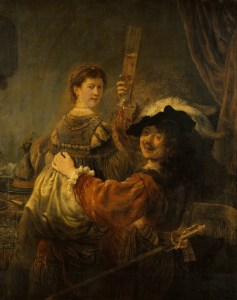
Wikimedia Commons contributors, “File:Rembrandt – Rembrandt and Saskia in the Scene of the Prodigal Son – Google Art Project.jpg,” Wikimedia Commons, the free media repository, https://commons.wikimedia.org/w/index.php?title=File:Rembrandt_-_Rembrandt_and_Saskia_in_the_Scene_of_the_Prodigal_Son_-_Google_Art_Project.jpg&oldid=340120613 (accessed April 17, 2019).

7 Comments

Filed under writing

Plagiarism, Citations and Footnotes #amwriting

I write posts for several other blogs besides Life in the Realm of Fantasy. During the week, I make a note of any interesting topic that might make a good blogpost. Today, the subject of citing sources came up again in conversation, so I am going back to an article I first published here on September 4, 2017.

This post pertains only to blogging. To use copyrighted material in your book, you need to contact the publisher. Follow their guidelines to obtain the right to quote from a published book. This is NOT a simple process, but you must do it if you plan to quote anyone whose work is NOT in the Public Domain.

Plagiarism and quoting are two different things. Plagiarism is lifting entire sections and publishing it as yours. For more on the current scandal emerging in the world of “fast-track” publishing, read this article at the Fussy Librarian. Romance authors discover they’ve been plagiarized.

I always write my posts in a Word document because it is easier for me to edit. Sometimes, there is research involved. When that is the case, I make footnotes at the bottom of my composition document as I go.

So why did I mention making footnotes? Many people think that is just for academic stuff.

It is important to give credit to people whom you quote, whether it is verbatim or paraphrased. When I first began blogging, I didn’t understand the nuts and bolts of citing sources, as I hadn’t really had to do much of that in college. I learned about this by looking things up on the internet.

It’s your legal obligation to cite your sources, but there is a moral one here too. Perhaps you wrote something that other people found useful. Wouldn’t you want to be credited? It’s a rough business, and as we have recently discovered, plagiarism is rife. As ethical people, we must make it our business to not be a part of the problem.

First, let’s talk images:

When we first begin blogging, sourcing images seems easy. You Google your subject and a lot of images pop up. You see one you like, right click on it, copy it, and paste it. The images are on the internet, so it’s free to use them, right?

Not true.

I’ve mentioned this article before, and it bears being referenced here again: The $7,500 Blogging Mistake That Every Blogger Needs to Avoid!

I either make my own images or get them from Creative Commons. An excellent article on using Creative Commons Images can be found here:

I often go to Wikimedia Commons to find Public Domain images. I really like Wikimedia and Wikipedia because they make it easy for you to get the attributions and licensing for each image. Another good source is Allthefreestock.com, where you can find hundreds of free stock photos, music, and many other things for your blog and other projects.

Sometimes I need images I can only get by paying for. For those, I go to Dreamstime or Canstock, and several other reputable sources. For a few dollars, usually only two or three, I then have the right to use the image of my choice, and it’s properly licensed. The proper legal attribution is also there on the seller’s website, clearly written out with the copyright and artist name, so all you need to do is copy and paste it to your footnotes.

I love being able to copy and paste citations, as it saves a little time.

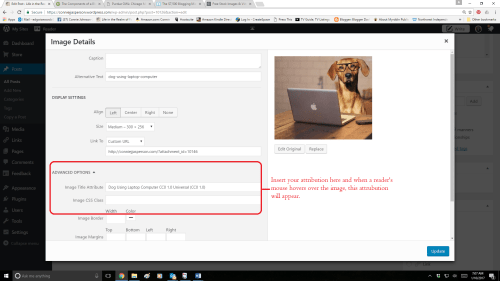
I keep a log of where my images are sourced, who created them, and what I used them in. I also insert the attribution into the image details on my website so that when a mouse hovers over the image, curious readers can go to the source. (In WordPress, you must be on the WP Admin dashboard. Click on the image and go to edit details.) If you can do this, you won’t have to credit them in your footnotes.

We may want to quote another blogger or use the information we have learned from them. Good citations are absolutely critical and can help you build friendships within the writing community.

I recommend you don’t quote too long a passage, or your “quote” could be interpreted as reprinting their entire work. Quote only the pertinent information and cite your source in proper footnotes. The instructions for citing sources follows:

First, I open a document in my word-processing program (I use Word), save it as whatever the title of the post is in that blog’s file folder. I compose my post the way I would write a story.

  • Composing the body of my post in a document rather than the content area of the blog-template here at WordPress allows me to spell check and edit my work first, and I feel more comfortable writing in a document rather than the content-window.

As I work and do research, I keep a log at the bottom of my page, listing what website I found information at, who the author was, the date of publication, and the date I accessed it. I have found the simplest method is the Chicago Manual of Style method:

Purdue OWL Online Writing Lab,  General Model for Citing Books in the Chicago Notes and Bibliography System, Copyright ©1995-2019 by The Writing Lab & The OWL at Purdue and Purdue University. All rights reserved. Website: https://owl.english.purdue.edu/owl/resource/717/03 Accessed Jan 10, 2017

When you quote from Wikipedia, you can click on the ‘cite this page’ link. This can be found in the left-hand column of the page. In fact, the left-hand column of a Wikipedia page is a menu of items about Wikipedia in general, and of that article specifically. ‘Cite this page’ is listed under ‘tools.’ Clicking on this link takes you to a page offering citations for that page in CMOS, APA, or MLA style, whichever suits your need. All you need to do is copy and paste the one you prefer into your footnotes, and your due diligence has been done.

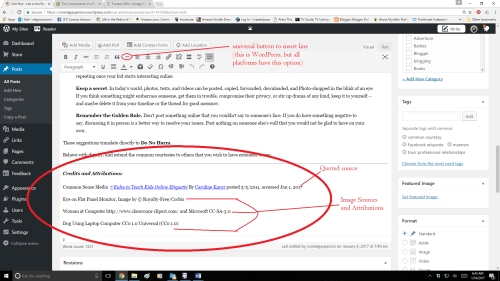
All this information for your footnotes should be inserted at the BOTTOM of your current document, so everything you need for your blog post is all in one place. When my blog article is complete and ready to post, I will insert a line to separate the body of the post from the credits and attribution notes.

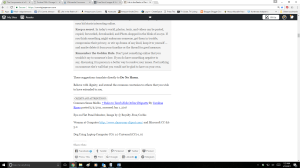
When I have sources to cite, readers will see this at the bottom of the post:

Authors should blog about who they are and what they do because they can connect with potential readers that way. Using pictures and quoting good sources makes your blog more interesting and encourages regular readers to follow your blog.

I always think that anytime you can direct curious readers to other websites that might be new to them, we all win.

Photographers and artists are as proud of their work as we are of ours and want to be credited for it. Protect your reputation by giving credit to the authors and artists whose work you use.


Credits and Attributions

Portions of this article and the screenshots first appeared on the Northwest Independent Writers’ Association  Blog in January of 2017, written by Connie J. Jasperson, All Rights Reserved.

6 Comments

Filed under writing