Category Archives: writing

#FineArtFriday: Tronie of an Old Man by Rembrandt van Rijn

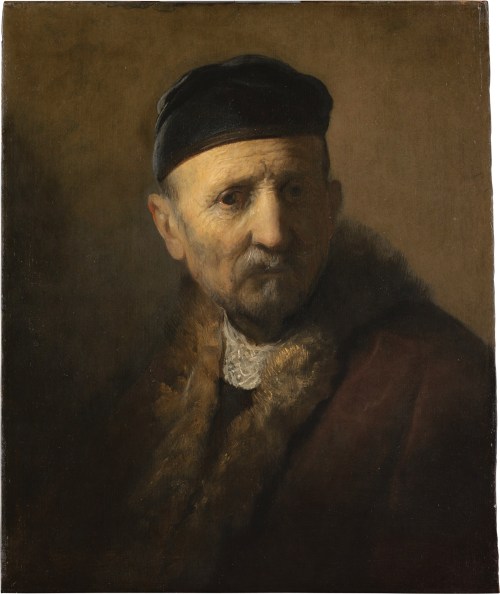
Tronie of an Old Man by Rembrandt van Rijn is a portrait of Rembrandt’s father, Harmen Gerritszoon van Rijn.  Harmen was a miller in Leiden.

About the word “tronie” from Wikipedia: A tronie (16/17th-century Dutch for “face”) is a common type, or group of types, of works common in Dutch Golden Age painting and Flemish Baroque painting that shows an exaggerated facial expression or a stock character in costume. It is related to the French word “tronche” which is slang for “mug” or head.

Rembrandt’s family was quite well-to-do and as such, young Rembrandt was educated in the best schools, which his father paid for.  Rembrandt’s father encouraged his son’s talent.

To my opinionated eyes, this painting shows Rembrandt’s affection for his father.

Rembrandt resembled  his father, if this portrait was accurate, and I think we can assume it was. As an artist, Rembrandt was unflinchingly honest in the portrayal of his subjects, while always managing to show their humanity.


Credits and Attributions

Tronie of and Old Man by Rembrandt van Rijn

Wikipedia contributors, “Tronie,” Wikipedia, The Free Encyclopedia,https://en.wikipedia.org/w/index.php?title=Tronie&oldid=872242306 (accessed March 15, 2019).

Rembrandt and workshop [Public domain]

Comments Off on #FineArtFriday: Tronie of an Old Man by Rembrandt van Rijn

Filed under #FineArtFriday, writing

Thoughts on Character and Place Names #amwriting

I have addressed the subject of names for both places and people before, in my post of January 14, 2019, Naming Characters. A conversation in an online writers’ group has prompted me to revisit it, but there’s no reason for me to repeat the bulk of that post. However, there are some points that could use a little more expansion.

To begin with, names are more than just handles to carry your characters. How we name our characters, and the names we give places in our worlds offers the reader cultural information that you don’t have to resort to giving through an info dump.

A Viking named “Wayne” wouldn’t be believable. But for most Americans and many Europeans, Viking names are difficult to pronounce when written in Old Frisian, which is the root language that English shares with Danish. A good way to keep a cultural feel but make the tale easier to read is to write the names the way they are pronounced or use simple ones.

Many modern Nordic names are easy for English speakers to read and pronounce and will give your story that Saxon flair. So, consider looking names up on baby naming websites rather than the hokey “Discover-Your-Viking-Name” type websites. While “Wayne” doesn’t really work in an Old Saxon-style society, “Fritjof the Flatulent” doesn’t either, unless you are writing comedy.

I stressed this in my previous post, but I feel it needs to be said again. Do keep the simplicity of spelling and ease of pronunciation in mind when sourcing names for your work.  I didn’t understand that concept when I first began writing seriously. When I named my characters, I did it for how the words looked on the page, never considering that they might be read aloud.

When I wrote Huw the Bard, it never occurred to me that most people wouldn’t know that Huw is Welsh for Hugh and is pronounced the same. I was raised around people of both Welsh and Irish origin, and I wanted Huw to have that cultural flavor.

That spelling choice has been a problem since publication because most people are unaware that a “W” is actually a “Double U” – UU -2 U(s). It is pronounced “Yoo” or “oo” (like goo) in Welsh and in old English words.

I have another character in my Tower of Bones series named Friedr – pronounced Free-der. This name is also a problem for readers.

Audio books are the new “must do” way to get your work into the hands of “readers.” How will that name be pronounced when it is read out loud? Take my advice and write your names so a narrator can easily read it aloud without stumbling. If you are just beginning your career as an author, you probably don’t realize how  important this is.

I learned several things about names the hard way. I only have one book that is an Audio book, but the experience of making that book taught me to spell names simply. I resolved my stupidity by telling the narrator he should pronounce the problem names the way that worked best for him, and that made him happy.

There are many good sites for names on the internet. You can find Norse, French, Hawaiian—they are all out there and they have some wonderful, simple names for you to use. You can get a little fancy—that is good and adds a cultural flavor to your characters. But when readers aren’t sure how to pronounce your main character’s name, they might focus on that rather than on your novel.

Speaking as one author to another, you never want to write something into your narrative that will throw the reader out of the book.

7 Comments

Filed under writing

Mind Wandering #amwriting

I write my blog posts a day or two ahead, usually trying to get them written and scheduled on Sundays. That way, I can concentrate on pretending to be an author.

It’s a pretense today because I just want to slounge around out on my back porch and enjoy that rarest of winter glories—the sunny day.

Some days are perfect for sitting on the porch and just letting my mind wander and this day is too cold, but I don’t care. I’ve had enough of winter and just want to sit in the sunshine, cold though it may be.

I take my blanket out and uncover a chair. I do check for spiders before I sit—they like the porch as much as I do, sadly. Every sunny morning from here on through September will find me out with a broom, chasing spiders off MY territory. My relocation program is inefficient and by August they will far outnumber me, but I don’t kill them. They have a place in this yard, just not on my porch or in my chair.

Fluffy white clouds drift overhead, hummingbirds dart here and there, my eyes close, and I absorb the sounds of my small town all around me.

The trees and shrubs of this small neighborhood harbor mourning doves and they seem to be speed-dating—eager to get on with nest building and rearing chicks.

The drone of large helicopters flying low over my home as they leave the base nearby shakes the house and rattles the dishes. I don’t like helicopters, and really don’t like them so low over my home, but it’s a disturbance I must put up with, as all who live in my area must do.

They pass over the hills and fade into the distance, diminishing altogether. A passing train resounds from the other end of town, sounding its horn to alert vehicles at the crossings. I like hearing the train in the distance.

But back to the finches, hummingbirds, and mourning doves. They share this neighborhood with chickadees, nuthatches, and brown tree-creepers. Crows and stellar-jays, starlings, and wrens also live here.

I need to just let my mind wander. I have a short story jammed in my head, and it will have to find its own way out. I know from experience that forcing them never works for me. Mind wandering is the only way to pry it loose.

Winter has been a long, drawn-out affair this year. We’ve had snow on and off for weeks, and while the piles of dirty snow in the local parking lots are mostly gone, it’s cold, only a few degrees above freezing. I should pull myself together and go inside. I have an editing job I need to finish, but the sun is shining, and the birds are out, and I’m warm enough under this blanket.

The finches and doves go quiet—a lady jay has landed in my still-barren maple tree. She flies down, picking something from the ground, then flies away.

Soon the sounds of the local mourning doves advertising their availability for mating resume, a gentle background to my thoughts.


Credits and Attributions:

Mourning Dove on Easter Day, by Kazvorpal [CC BY-SA 3.0 (https://creativecommons.org/licenses/by-sa/3.0)]

Wikimedia Commons contributors, “File:Mourning Dove on Easter day.jpg,” Wikimedia Commons, the free media repository,

4 Comments

Filed under writing

#FineArtFriday: The Boating Party, by Mary Cassatt

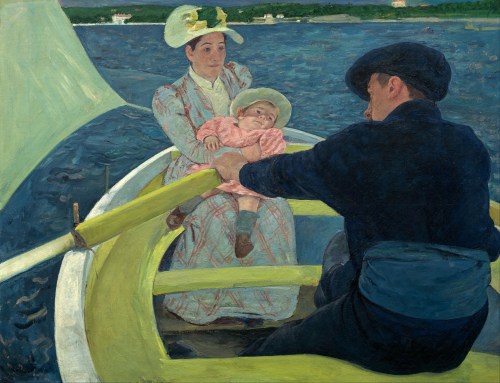
What I love about The Boating Party by American artist, Mary Cassatt, is impression of movement, of the life of the water. It has a feeling of contentment, of peace. There is a serenity about this painting that evokes wonderful memories of boating and water sports, of the time when my family still lived on a lake. It reminds me of the sheer joy and freedom of being on the water with no purpose other than to enjoy one’s self.

About this painting, from Wikipedia:

Art historian and museum administrator Frederick A. Sweet calls it “One of the most ambitious paintings she (Cassatt) ever attempted.” His 1966 analysis focuses on the balance of the “powerful dark silhouette of the boatman”, the angle between the oar and the arm that “thrusts powerfully into the center of the composition towards the mother and child” and “delicate, feminine ones.”

Cassatt placed the horizon at the top of the frame in Japanese fashion.

  • In 1890 Cassatt visited the great Japanese Print exhibition at the ecole de Beaux-arts in Paris.
  • Mary Cassatt owned Japanese prints by Kitagawa Utamaro (1753–1806).
  • The exhibition at Durand-Ruel of Japanese art proved the most important influence on Cassatt.

(Influence of) Manet

Frederick A. Sweet suggests that Cassatt may have been inspired by Édouard Manet‘s Boating from 1874.

I hadn’t considered that position of the horizon as being a traditional Japanese style until I read that paragraph. Then I realized that most Western artists place it lower on the canvas. In Western art, the sky (an allegory for God) traditionally dominates the work.

This painting has made me aware of  how greatly the ability to travel the world via ocean liners and contact with other cultures changed the way we produce art. Impressionism was new and daring in its time. The eye of the artist was freed from traditional confines of the various schools (Hudson Valley, etc.) by exposure to the simplicity and elegance of the previously unknown tradition of Japanese art.

Every new painting I come across leads me to another, which often leads me to another country and another tradition of style and form.

My life as an admirer of art is one of constantly finding something new about history and the world around me.

About the artist, Via Wikipedia:

Mary Stevenson Cassatt (May 22, 1844 – June 14, 1926) was an American painter and print-maker. She was born in Allegheny City, Pennsylvania (now part of Pittsburgh’s North Side), but lived much of her adult life in France, where she first befriended Edgar Degas and later exhibited among the Impressionists. Cassatt often created images of the social and private lives of women, with particular emphasis on the intimate bonds between mothers and children.

She was described by Gustave Geffroy in 1894 as one of “les trois grandes dames” (the three great ladies) of Impressionism alongside Marie Bracquemond and Berthe Morisot.


Credits and Attributions:

The Boating Party by Mary Cassatt, 1893–94

Wikipedia contributors. “The Boating Party.” Wikipedia, The Free Encyclopedia. Wikipedia, The Free Encyclopedia, 9 Dec. 2018. Web. 8 Mar. 2019.

Comments Off on #FineArtFriday: The Boating Party, by Mary Cassatt

Filed under writing

Identifying Genre, revisited #amwriting

Some of you have been following my advice to build a backlog of short pieces to enter in contests and submit to various publications. But where should you try to sell your work?

When you open the Submittable App and begin shopping for places to submit your work, you may find the list of open calls confusing. Many times contests, publications, and anthologies are genre specific.

When your work is nonfiction, it’s no problem because your work is targeted to a magazine with a specific readership, so the sub-genre will be clear and where you should submit it was likely evident the day you decided to write it.

When you write short fiction with no specific contest or magazine in mind you can run into problems of where to send it. If you are like me, some of your work may straddle genres, and in that case, how do you decide who will be most receptive to it? Spur-of-the-moment stories may be widely different from your normal work, and perhaps are not in a genre you can easily identify.

This list of genres and what they represent has appeared on this blog before. Genre is defined by setting and content, the author’s intention, their approach, and the way resolutions happen. The ideas explored within the setting are the provinces of these industry-wide distinctions.

Mainstream (general) fiction—Mainstream fiction is a general term publishers and booksellers use to describe works that may appeal to the broadest range of readers and have some likelihood of commercial success. Mainstream authors often blend genre fiction practices with techniques considered unique to literary fiction. It will be both plot- and character-driven and may have a style of narrative that is not as lean as modern genre fiction but is not too stylistic either. The prose of the novel will at times delve into a more literary vein than genre fiction, but the story will be driven by the events and action that force the characters to grow.

Science fiction—Futuristic settings, futuristic science and technology, space travel, time travel, faster than light travel, parallel universes and extraterrestrial life are the core of science fiction. You should be aware that the internet is rife with purists and impurists ranting on what does or does not constitute  sci-fi. If you use magic for any reason you are NOT writing any form of sci-fi.

  • Hard Sci-fi is characterized by rigorous attention to accurate detail in the physics, chemistry, and astrophysics. Emphasis is placed on accurately depicting worlds that more advanced technology may make possible.
  • Soft Sci-fi is characterized by works based on social sciences such as psychology, economics, political science, sociology, and anthropology.
  • Other main sub-genres of Sci-fi include Space-operasCyberpunk, Time Travel, Steampunk, Alternate history, Military, Superhuman, Apocalyptic, and Post-Apocalyptic.

The main thing to remember is this–Science and Magic cannot coexist in the Genre of Science Fiction. The minute you add magic to the story, you have Fantasy.

Fantasy is a genre of fiction that commonly uses magic and other supernatural phenomena as a primary plot element, theme, or setting.  Like sci-fi and literary fiction, fantasy has its share of snobs and damn fools when it comes to defining the sub-genres:

  • High fantasy–High fantasy is defined as fantasy fiction set in an alternative, fictional world, rather than the real, or “primary” world, with elves, fairies, dwarves, dragons, demons, magic or sorcery, wizards or magicians, constructed languages, quests, coming-of-age themes, and multi-volume Often the prose is literary and the primary plot is slowed by many side quests. Think William Morris and J.R.R. Tolkien.
  • Epic Fantasy–These stories are often serious in tone and epic in scope, dealing with themes of grand struggle against supernatural, evil forces.Epic fantasy shares some typical characteristics of high fantasy includes fantastical elements such as elves, fairies, dwarves, dragons, demons, magic or sorcery, wizards or magicians, constructed languages, quests, coming-of-age themes, and multi-volume narratives. Tad Williams’s Memory Sorrow and Thorn is classic Epic Fantasy.
  • Paranormal Fantasy–Paranormal fantasy often focuses on romantic love and includes elements beyond the range of scientific explanation, blending together themes from all the speculative fiction genres. Think ghosts, vampires, and supernatural.
  • Urban Fantasy–can take place in historical, modern, or futuristic periods, and the settings may include fictional elements. The prerequisite is that they must be primarily set in a city.

Horror—Horror fiction  shocks or frightens the reader. Some horror induces a feeling of repulsion or loathing – people who read horror like to be challenged by their fears.

Romance—Novels of this type of genre fiction place their primary focus on the relationship and romantic love between two people and must have an emotionally satisfying and optimistic ending.

(07 Mar 2019) Edited to add Mystery and Mystery/Adventure. Mystery is a genre with several subgenres.

  • “Who Dunnit” mysteries, cozy (think Agatha Christie)
  • Mystery, true crime
  • Mystery, hardboiled detective
  • Political thrillers
  • Legal thrillers
  • Medical Thrillers
  • Supernatural Mysteries
  • Romantic Mysteries

I mention Literary Fiction last because it is the most complicated and least understood genre of all.

Literary fiction can be adventurous with the narrative. The style of the prose has prominence and may be experimental, requiring the reader to go over certain passages more than once. Stylistic writing, heavy use of allegory, the deep exploration of themes and ideas form the core of the piece.

I have discussed the following  three books before, but they illustrate the problem of perception—the question of what constitutes Literary Fiction.

Alexander Chee’s The Queen of the Night is a historical fantasy. However,  the style and voice in which it is written makes it a powerful literary work.

The same goes for George Saunders work. Tenth of December is technically sci-fi, and Lincoln in the Bardo is historical fantasy, but it is his style and voice that makes George Sanders literary.

Neil Gaiman’s book, Stardust, is a magnet for the “that’s not literary/yes it is” debate. The prose is literary, the narrative has a relaxed, thought provoking style to it. I consider it literary.

Be careful of how you present yourself and your work. Never submit anything that is not your best work, and do not assume they will edit it because they won’t.  No publisher will accept work that is poorly written, sloppily formatted, and generally unreadable.

Choose carefully who you submit your work to and be scrupulous in following their submission guidelines. Read a sample of what they publish and only submit the work you have that best fits their publication.

12 Comments

Filed under writing

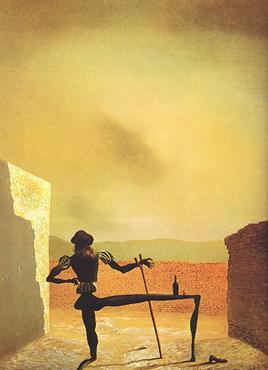
#FineArtFriday: The Ghost of Vermeer of Delft Which Can Be Used As a Table by Salvador Dalí, 1934

About the painting, from Wikipedia:

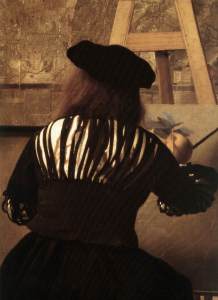
The Ghost of Vermeer of Delft Which Can Be Used As a Table is a small Surrealist oil painting by Salvador Dalí. Its full title is The Ghost of Vermeer of Delft Which Can Be Used as a Table (Phenomenologic Theory of Furniture-Nutrition). It makes reference to The Art of Painting by Johannes Vermeer, a famous seventeenth-century work in which a painter, thought to be a self-portrait of Vermeer, is depicted with his back to us, in distinctive costume. It is one of a number of paintings expressive of Dalí’s enormous admiration for Vermeer.

Vermeer is represented as a dark spindly figure in a kneeling position. The figure’s outstretched leg serves as a table top surface, on which sits a bottle and a small glass. This leg tapers to a baluster-like stub; there is a shoe nearby. The walls and the distant views of the mountains are based on real views near Dalí’s home in Port Lligat. In Vermeer’s painting the artist leans on a maulstick, and his hand is painted with an unusual blurriness, perhaps to indicate movement. In Dalí’s painting Vermeer rests the same arm on a crutch.

What I love about this painting:

I love the composition, the detail Dali puts into Vermeer’s hair and doublet–the attention Vermeer applied to his own work. This speaks to me of the desert, the way the sky looks in the afternoon just as the hottest part of the day slides into a cooler evening. Vermeer, the Master of Light, is enjoying the view. He is shown in a small courtyard, enclosed. Vermeer rarely left his rooms in Delft.


It is unsigned and undated but known to have been completed c.1934. It is currently on display at the Salvador Dalí Museum in St. Petersburg, Florida, on loan from the E. and A. Reynolds Morse collection.


Credits and Attributions:

Wikipedia contributors, “The Ghost of Vermeer of Delft Which Can Be Used As a Table,” Wikipedia, The Free Encyclopedia,https://en.wikipedia.org/w/index.php?title=The_Ghost_of_Vermeer_of_Delft_Which_Can_Be_Used_As_a_Table&oldid=861917029 (accessed March 1, 2019).

Wikimedia Commons contributors, “File:Johannes Vermeer – The Art of Painting (detail) – WGA24677.jpg,” Wikimedia Commons, the free media repository, https://commons.wikimedia.org/w/index.php?title=File:Johannes_Vermeer_-_The_Art_of_Painting_(detail)_-_WGA24677.jpg&oldid=268076769 (accessed March 1, 2019).

5 Comments

Filed under writing

Characterization #amwriting

The stories that interest me most have a strong character arc.  The protagonist begins as one sort of person, and through the events they experience, they are transformed. Often they change for the better, but sometimes the change is for the worse.

Each time I open a new book, I want to meet a circle new of friends, each of whom is distinguishable from the other characters. Every one of them must be a unique person with a distinctive thought process. What choices will they make, and how will those decisions affect their life?

Consequences are key to the forward momentum of the plot.

I have used the word consequences before when talking about the choices our protagonist must make. I use that word intentionally. If there are no consequences for bad decisions, what is the story about?

Equally, I want the side-characters and antagonist to be just as singular with their reactions and choices as the protagonist is.

A bit of unpredictability to a character’s nature keeps them interesting. They have an air of mystery—how will they react in a given situation? It must be slightly random, but please, keep it real and in character.

In other peoples’ work, I particularly notice when a protagonist or side-kick’s gut reaction causes them to act out-of-character for the person they have been portrayed as, up to that point. Am I able to see it in my own? I hope so.

Even in a fantasy setting, all the characters must be believable. If the author introduces an elf to me, I want to believe in that elf. I want to see him/her as if they are real throughout the entire story. I want to be invested in them for their entire arc, and I want to care what happens to them.

The motivations are crucial. What drives them and what will they do to achieve their goal. Just as importantly, what will they NOT do? What is out of character for them?

The obstacles your characters face and the choices they make in those situations are the story. Giving your characters an active role and allowing them agency is what drives a great, absorbing story. Agency is the power of an individual to act independently. When we give the protagonist/antagonist agency, we allow them to make their own free choices.

When I am first writing any story, giving my characters agency is difficult to do. This is because, in the first draft of my manuscripts, the motives of my protagonist haven’t quite come into focus for me. I tend to allow a character’s choices to push their personal growth.

At some point in every great novel, the protagonists may lose their faith or have a crisis of conscience. In the second draft, I see this moment as an opportunity to learn who they really are as individuals. The events leading to that point break the character, knocking them down to their lowest emotional state. How do they react? What keeps them pushing on in the face of such despair?

At times, I have a character I simply can’t figure out. I do a character study, and in that short document, one of the questions I ask myself is “What personal revelations come out about them?” Also, I ask, “What does he discover about himself?”

When those questions are answered, I look at the final event, the situation that ends the story. These people’s personal quirks and characteristics, their moral compass influenced the decisions that led them to that place.

Did I keep those clues distinct to that character, or was there a blurring of personalities, making the group all sound and look alike?

Most importantly, those people must have understandable motivations. We can’t be too obscure in trying to keep the air of mystery because if a reader can’t follow our protagonist’s reasoning, we haven’t done our job.

It’s part of the balancing act—creating intrigue yet making it believable. As I have said many times, this is a gig where I never stop learning and trying to grow in the craft. Reading is the key. Every story that leaves a mark on my heart has unique, individual characters that I can relate to. Even if I don’t like them, their motivations make sense because they are in line with how that character would think.

If I can visualize my characters as real people that I know and believe in, hopefully my readers will believe in them too.

8 Comments

Filed under writing

Conflict, Tension, and Pacing #amwriting

When we sit down to read a book, most readers don’t consciously look for certain key elements, but we know when something is missing. Unfortunately for most authors, I am not most readers. I can’t just read a book anymore. I must dissect it to see what makes it tick. When a story works well, I  want to know why. Then, as needed, I hope to incorporate that bit of author-magic into my writing.

Consider conflict—What pushes the characters? What element drives and forces the momentum of the story?

My book reading group just finished Ender’s Game by Orson Scott Card. I had read it in 1985 when it was first published, re-read it for a book review five years ago, and re-read it again for the group’s February book. I don’t like the book, but I admire it.

I know–that doesn’t make sense. But it does, because I admire it in a purely mechanical, technical way.

From Wikipedia:
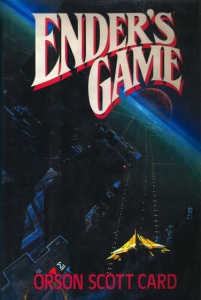
Ender’s Game is a 1985 military science fiction novel by American author Orson Scott Card. Set at an unspecified date in Earth’s future, the novel presents an imperiled mankind after two conflicts with the Formics, an insectoid alien species which they dub the “buggers”. In preparation for an anticipated third invasion, children, including the novel’s protagonist, Andrew “Ender” Wiggin, are trained from a very young age through increasingly difficult games including some in zero gravity, where Ender’s tactical genius is revealed.

Even though I had read it before, I became involved in Ender’s story on this third read primarily because the author did all the right things.

This, despite the fact I don’t care for Card’s writing style. His ability to convey both character and story outweighs the irritation I have with the prose and style of his work.

  • The plot is always moving forward.
  • There is no overuse of backstory.
  • Showing is well-balanced with telling—it’s not obnoxiously in-your-face with descriptions of minute facial expressions but has enough active prose to keep the reader involved in the narrative.
  • The characters are shown to have a believable internal/external struggle, even though the book is about training children to kill.

Card explores the theme of “Compassion vs. Ruthlessness,” and the book has some exceedingly violent scenes. The three Wiggins children are the primary characters, with Ender being the main protagonist.

Ender is compassionate, and yet ruthless. One thing I found disturbing is that in the book, Ender was 6 when he leaves Earth for Battle School and 11 by the time of the final examination battle. During that time, he has killed (in self-defense) two boys who were bullying him, and untold numbers of the enemy, although he never learns that he caused their deaths until much later.

Valentine, Ender’s older sister, is compassionate, but without the power of ruthlessness both Ender and Peter demonstrate. She becomes Peter’s accomplice.

Peter, the oldest of the Wiggin children, is ruthlessness embodied and is utterly without compassion—a sociopath. His one ambition is to rule the world, and he will stop at nothing and use anyone to achieve that end. Yet, despite his personal lack of compassion, he turns out to be a good ruler. Evil in this book is represented by his acting for the wrong reasons, regardless of the outcome.

I may not like his style, but I have a great appreciation for Card’s ability to reveal a character, and I admire the way he paced the narrative.

The resolution of one conflict leads to another, which is resolved and turns into another—the author keeps the pressure on, raising the tension by always raising the stakes. Yet, he gives both Ender and the reader a chance to rest a little and regroup before flinging them into the (slightly more intense) action again. In these less intense moments, the story is still moving because we are learning something we didn’t know, and that knowledge is crucial to what may follow.

The serious topics of genocide and Western expansionism are explored. These actions are justified or regretted depending on the character in this book. Also, we see lessons in training methodology, leadership, and ethics acted out in a Military environment by bright young children.

The eternal problem of intention and morality is explored. Ender is able to strike and kill his enemies yet remain morally clean.

Those themes fuel the narrative and push the story when the physical action has temporarily calmed. They drive the conflict, create a constant raising of tension, and allow the pacing of the book to hard and fast but not overwhelming.

It is easy to unbalance a narrative by not allowing the reader to rest between scenes of intense violence and action. A scene that is all action is confusing if it has no context. Conversations are crucial because they give context to whatever action follows.

In any story, the crucial underpinnings of conflict, tension, and pacing are bound together. Go too heavily on one aspect of the triangle and the story fails to engage the reader. Balance the three, and the story works even if the reader doesn’t care for the writer’s style or prose.

The book group is going to read The Tattooist of Auschwitz next, for the May meeting. This is a book I haven’t read yet, so I’m looking forward to it. I will be looking at how characters are portrayed, what makes them compelling,  and how the pyramid of conflict, tension, and pacing pushes their growth.


Credits and Attributions:

Cover art, Ender’s Game by Orson Scott Card, published 1985 by Tor Books,  Fair Use.

Wikipedia contributors, “Ender’s Game,” Wikipedia, The Free Encyclopedia, https://en.wikipedia.org/w/index.php?title=Ender%27s_Game&oldid=880941502 (accessed February 25, 2019).

2 Comments

Filed under writing

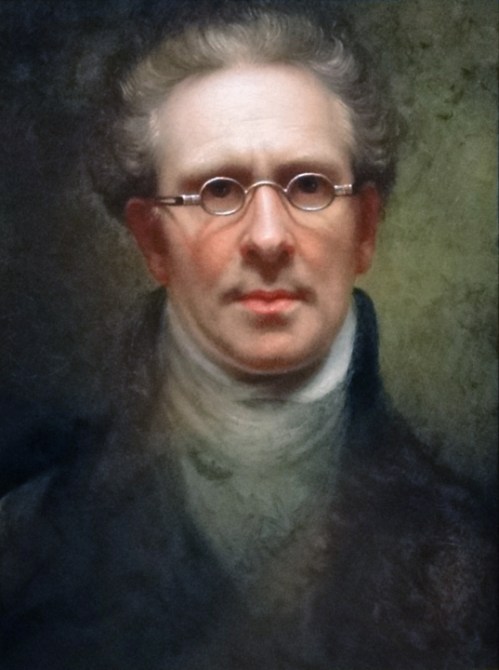
#FineArtFriday: Rembrandt Peale, self-portrait

About the artist via Wikipedia:

Rembrandt Peale (February 22, 1778 – October 3, 1860) was an American artist and museum keeper. A prolific portrait painter, he was especially acclaimed for his likenesses of presidents George Washington and Thomas Jefferson. Peale’s style was influenced by French Neoclassicism after a stay in Paris in his early thirties.

Rembrandt Peale was born the third of six surviving children (11 had died) to his mother, Rachel Brewer, and father, Charles Willson Peale in Bucks County, Pennsylvania, on February 22, 1778. The father, Charles, also a notable artist, named him after the noted 17th-century Dutch painter and engraver Rembrandt Harmenszoon van Rijn. His father also taught all of his children, including Raphaelle PealeRubens Peale and Titian Peale, to paint scenery and portraiture, and tutored Rembrandt in the arts and sciences. Rembrandt began drawing at the age of 8. A year after his mother’s death and the remarriage of his father, Peale left the school of the arts, and completed his first self-portrait at the age of 13. The canvas displays the young artist’s early mastery. The clothes, however, give the notion that Peale exaggerated what a 13-year-old would look like, and Peale’s hair curls like the hair of a Renaissance angel. Later in his life, Peale “often showed this painting to young beginners, to encourage them to go from ‘bad’ to better…”[1]

In July 1787, Charles Willson Peale introduced his son Rembrandt to George Washington, and the young aspirant artist watched his father paint the future president. In 1795, at the age of 17, Rembrandt painted an aging Washington (with whom he shared a birthday), making him appear far more aged than in reality. The portrait was well received, and Rembrandt had made his debut.


Credits and Attributions

Wikimedia Commons contributors, “File:Rembrandt Peale self-portrait.jpg,” Wikimedia Commons, the free media repository, https://commons.wikimedia.org/w/index.php?title=File:Rembrandt_Peale_self-portrait.jpg&oldid=336752881 (accessed February 22, 2019).

Wikipedia contributors, “Rembrandt Peale,” Wikipedia, The Free Encyclopedia, https://en.wikipedia.org/w/index.php?title=Rembrandt_Peale&oldid=879098650 (accessed February 22, 2019).

Comments Off on #FineArtFriday: Rembrandt Peale, self-portrait

Filed under writing

Characters: the Legalities Rant #amwriting

Reality is stranger than anything I could write. This is why I write fiction—I put reality into more palatable chunks so I can digest it better.

Drawing on the real world to help design the unreal is where good world building comes  into play. However, we shouldn’t use the real names and exact situations of people we are acquainted with in our work. Don’t thinly disguise them with a different name—they can sue us.

Consider the late Betty MacDonald, whose first published book was picked up by J.B. Lippincott. The Egg and I is a fictionalized account of Betty’s life as a chicken farmer. It was set in Chimacum, a small community in rural Washington State. The book was a success, selling well over a million copies and spinning off several movie adaptations.

It also spun off several lawsuits for defamation of character. Although the book was a critical and popular success at publication, in the 1970s it fell into disfavor because of the clichéd treatment and lack of understanding of the culture of our local Native people. The book did give rise to a perception of Washington State as a place full of eccentrics.

We are different, but every part of the country has its oddballs.

From Wikipedia:

Post-publication lawsuits

Following the success of the book and film, lawsuits were filed by members of the Chimacum community. They claimed that characters in The Egg and I had been based on them, and that they had been identified in their community as the real-life versions of those characters, subjecting them to ridicule and humiliation. The family of Albert and Susanna Bishop claimed they had been negatively portrayed as the Kettles. Their oldest son Edward and his wife Ilah Bishop filed the first lawsuit, which was settled out of court for an undisclosed amount.

The second lawsuit was filed against MacDonald, publisher J. B. Lippincott Company, and The Bon Marché (a Seattle department store which had promoted and distributed the book) for total damages of $975,000, as sought by nine other members of the Bishop family ($100,000 each) and Raymond H. Johnson ($75,000), who claimed he had been portrayed as the Indian “Crowbar.” The case was heard before a jury in Judge William J. Willkins’ (who was also one of the presiding judges at the Nuremberg Trials) courtroom in King County Superior Court beginning February 6, 1951. MacDonald testified that the characters in her book were composite sketches of various people she had met. The defense produced evidence that the Bishop family had actually been trying to profit from the fame the book and movie had brought them, including testimony that son Walter Bishop had had his father Albert appear onstage at his Belfair, Washington, dance hall with chickens under his arm, introducing him as “Pa Kettle.” On February 10, 1951, the jury decided in favor of the defendants.[3]

Some ideas will come to us from real life, but if we are writing fiction, we must never detail people too closely. If you become a success, some people may see that as their ticket to a little extra money at your expense. This, despite the disclaimer we put on the copyright page:

This is a work of fiction. Names, characters, places, and incidents are products of the author’s imagination or are used fictitiously and are not to be construed as real. Any resemblance to actual events, locales, organizations, or persons, living or deceased, is entirely coincidental.

We can and will, however, draw impressions from them.

A common “coffee shop” game is a good way to develop characters for your stories and won’t get you sued. When you go to a coffee shop that you don’t normally frequent, sit and watch your fellow patrons. Observe their behavior, their speech habits and unconscious mannerisms. It’s easy to imagine who they might be and build a whole fantasy about them.

That character sketch is the kernel that can be the start of a short story or even a novel–and all of it is fiction.

You don’t actually know a thing about them other than they like a Double Tall Vanilla Soy Latte with cinnamon sprinkles. The idiosyncrasies you see in strangers will give rise to a character you can use without risking your financial security and your reputation.


Credits and Attributions:

Wikipedia contributors, “The Egg and I,” Wikipedia, The Free Encyclopedia,https://en.wikipedia.org/w/index.php?title=The_Egg_and_I&oldid=878829393 (accessed February 20, 2019).

8 Comments

Filed under writing