Category Archives: writing

Update and Resolutions for 2019 #amwriting

Here in the Pacific Northwest, the year of 2018 is enjoying its last hurrah. People are getting ready for parties and counting both their successes and failures. It has been an eventful year for both my family and my writing life, so I am looking forward to what 2019 will bring.

My quest to complete the three-book literary fantasy series, Billy’s Revenge, will finally come to an end. Julian Lackland is on the home stretch and will go to the editor on February 1st. Depending on how quickly that goes, he will be published in June. Julian began life as my first NaNoWriMo Novel in 2010 and was picked up by a small press. Unfortunately, that didn’t go well.

It has taken me eight years to undo the damage they did and get this manuscript into proper shape. Julian Lackland is why I have been on this quest to educate myself about the craft of writing. I wanted to give Julian the kind of book he deserves, and judging by my beta readers’ comments, the effort has been worth it.

I am also closing in on finishing the first draft of a new duology set in Neveyah, the Tower of Bones world. One of the things I learned when I was trying to finish Valley of Sorrows, is that readers who begin a series want the next book in a timely fashion. They might wait a year, but after that, they will forget about it. It takes me four years to get a book from concept to publication, which can be a problem.

What I am doing differently with Alf’s story is this: I’m writing the first draft of the entire story arc before I begin revisions on the first book. So, this means I am writing a 250,000 word manuscript. Only when the entire first draft is finished will I begin the editing process. The manuscript will be broken in half and published as a duology, hopefully six months apart, assuming that editing goes smoothly when we get to that stage.

I am also finishing the stand-alone book that was begun as a serial in 2015, Bleakbourne on Heath. I have approximately 20,000 words left to write before it goes to the editor. Leryn’s story was so much fun to write. I had never done a serial, and unfortunately, I soon discovered I couldn’t keep up the daunting schedule I had set for getting my installments published. It was like “live television.” Whenever I sat down to write a chapter, I had no idea what was going to happen next.

One day I realized I had reached a creative plateau and had no idea how to finish the damned thing. Some people consider that writer’s block, but not me. When I can’t think of a way to advance a particular story, it’s time to rein it in and put it aside for a while to work on something else. So, I wrote a wedding scene, and ended the serial on a happy note, winding up most of the threads, but with the main quest still unfinished.

Last year was a good year for short stories, some of which found good homes in forthcoming anthologies. Also, two of my poems were selected for publication in the I Hear Olympia Singing poetry anthology and were chosen as the opening verses. I survived my first live poetry reading and met some amazing people in the process. Yay for that!

Despite cutting back on my professional editing schedule, I was privileged to edit several wonderful books for my clients—what a joy that aspect of my life is. I can’t completely drop out of that part of this business, as I love working with my clients, helping them to realize the vision they originally had for their book.

My resolutions for 2019 are to publish at least one novel, have a second one either published by the end of the year or ready to go in 2020, finish the first draft of my duology, and continue to write short stories and poetry, and continue to edit for my private clients.

I will keep writing new words every day, and I will remain involved in the local writing community. That connection with other writers feeds my creativity, offers me a sounding board, and keeps me working with good people who will read for me and show me what needs to be rewritten.

Thank you for being a part of my writing life. May the new year bring you good fortune, good food, and good friends. May the new year bring us all inspiration and determination—the two most important gifts a writer could have.


Credits and Attributions

Wikimedia Commons contributors, “File:Dirck Hals – Musicians – WGA11043.jpg,” Wikimedia Commons, the free media repository, https://commons.wikimedia.org/w/index.php?title=File:Dirck_Hals_-_Musicians_-_WGA11043.jpg&oldid=253948561 (accessed December 31, 2018).

6 Comments

Filed under writing

#FineArtFriday: A Christmas Carol, revisited

Today’s images are two illustrations by John Leech from the first edition of A Christmas Carol, by Charles Dickens,  published in book form in 1843.  The body of this post first appeared here on Dec, 23, 2015. This is the first time I have included the original art of John Leech, which Dickens himself chose to include in the book.

From Wikipedia: John Leech (29 August 1817 – 29 October 1864 in London) was a British caricaturist and illustrator.[1] He is best known for his work for Punch, a humorous magazine for a broad middle-class audience, combining verbal and graphic political satire with light social comedy. Leech catered to contemporary prejudices, such as anti-Americanism and antisemitism and supported acceptable social reforms. Leech’s critical yet humorous cartoons on the Crimean War help shape public attitudes toward heroism, warfare, and Britons’ role in the world.[2][3]

Four of John Leech’s etchings were included in the first edition of A Christmas Carol.


Another Christmas is about to join the Ghosts of Christmas Past–although, until December 26th, it is still the Ghost of Christmas Present. And as always, I want to talk about my favorite Christmas story of all time, A Christmas Carol, by Charles Dickens.

Charles Dickens was a master when it came to creating marvelous hooks and using heavy foreshadowing. Let’s have a look at the first lines of this tale:

“Marley was dead, to begin with. There is no doubt whatever about that. The register of his burial was signed by the clergyman, the clerk, the undertaker, and the chief mourner. Scrooge signed it. And Scrooge’s name was good upon ‘Change for anything he chose to put his hand to. Old Marley was as dead as a doornail.”

In that first paragraph, Dickens  tosses out the bait, sinking the hook, and landing the fish (the reader) by foreshadowing the first plot point of the story–the visitation by Marley’s ghost. We want to know why Marley’s definite state of decay was so important that the conversation between you the reader, and Dickens the author, was launched with that topic.

He picks it up and does it again several pages later, with the little scene involving the door-knocker, where Scrooge sees the face of his late business partner superimposed over the knocker.

At this point we’ve followed Scrooge through several scenes introducing the subplots. We have met the man who, as yet, is named only as ‘the clerk’ in the original manuscript, but whom we will later know to be Bob Cratchit, and we’ve met Scrooge’s nephew, Fred.

These subplots are critical, as our man Scrooge’s redemption revolves around the ultimate resolution of these two separate mini-stories–he must witness the joy and love in Cratchit’s family, who are suffering but happy in the midst of grinding poverty for which Scrooge bears a responsibility. We see that his nephew, Fred, though orphaned is well off in his own right, but craves a relationship with his uncle with no thought or care of what he might gain from it financially.

All the characters are in place. We’ve seen the city, cold and dark, with danger lurking in the shadows. We’ve observed the way Scrooge interacts with everyone around him, strangers and acquaintances alike. Now we come to the first plot point in Dickens’ story arc–Marley’s visitation. This is where the set-up ends and the story begins to take off.

I love tales of redemption–and A Christmas Carol by Charles Dickens remains one of the most beloved tales of redemption in the Western canon. Written in  1843 as a serialized novella, A Christmas Carol continues to inspire adaptations, in both movies and books.

This is a short tale, but it is a deeply moving allegory of the Christian concept of redemption that remains pertinent in modern society.

In this tale, Dickens asks you to recognize the plight of those whom the Industrial Revolution has displaced and driven into poverty, and the obligation of society to provide for them humanely. This is a concept our society continues to struggle with, and perhaps will for a long time to come.

It is that deep, underlying call for compassion that resonates down through the centuries, a call that is, unfortunately, timeless.


Credits and Attributions:

The Art of Foreshadowing: Charles Dickens, first appeared here on Life in the Realm of Fantasy, on Dec. 23, 2015.

Wikipedia contributors, “John Leech (caricaturist),” Wikipedia, The Free Encyclopedia, https://en.wikipedia.org/w/index.php?title=John_Leech_(caricaturist)&oldid=871947694 (accessed December 21, 2018).

Wikimedia Commons contributors, “File:Christmascarol1843 — 040.jpg,” Wikimedia Commons, the free media repository, https://commons.wikimedia.org/w/index.php?title=File:Christmascarol1843_–_040.jpg&oldid=329166198 (accessed December 21, 2018)

A colourised edit of an engraving of Charles Dickens’ “Ghost of Christmas Present” character, by John Leech in 1843. Wikimedia Commons contributors, “File:Ghost of Christmas Present John Leech 1843.jpg,” Wikimedia Commons, the free media repository, https://commons.wikimedia.org/w/index.php?title=File:Ghost_of_Christmas_Present_John_Leech_1843.jpg&oldid=329172654 (accessed December 21, 2018).


2 Comments

Filed under #FineArtFriday, writing

Stormy Weather #amwriting

Today is one of the darkest days so far this winter. As I write this, it’s noon, but the sun struggles to penetrate the gloom. Wind-driven rain bullets pound at the windows and all I want to do is hibernate. The wind howls around my house, seeming like a living thing.

I am warm and snug and wrapped in a cozy, fleece-lined blanket, with a cup of hot tea in my hands. I sit with my eyes closed, imagining warmer places, lands where the sun shines every day, and a gentle rain only falls in the small hours before dawn.

Yep. I write fantasy.

This post was supposed to be about world building. I could probably look out my window and tell you what my world looks and feels like. I’d intended to show you how the rain and murkiness make the world seem two-dimensional, a study in shades of gray. I wanted you to feel the cold and damp working its way inside your hood, making walking to the store a misery. I should  warn you, though. Today is a bad day to walk anywhere. Flying branches and airborne trashcans might make your walk…an adventure.

Had we gone through the exercise that was planned, I would have asked you to talk to the friendly golden Labrador who lives inside the fenced yard on the corner and reassure him that his owner will indeed come home after work. The poor dog is doubtful, awash with separation anxiety despite the fact his owner has never failed to return.

But no.

I don’t think I will write a blog post today. Instead, I’m going to sit in my favorite chair and read. And when I put the book down for a moment, I will remember how warm the breezes of Oahu were, how different from my cold, dark, inland home. I’m going to think of Waikiki and mojitos at Duke’s Canoe Club. Sitting on the beach afterward and feeling the softness of golden sand against my bare feet. How gentle the surf seemed during our stay there, as compared to the chill of the wild North Pacific as it crashes into the Washington coast.

I’m going to remember the exhilaration of snorkeling in Hanauma Bay. The pictures didn’t do it justice, but it shines in my memory. And the next day? How do I show you the incredulous joy of sitting on a North Shore beach and being visited by giant tortoises?

Instead of being visited by thunder and lighting.

The storms may swirl and rage outside my house, but I am warm and cozy. I have orange spice tea to keep me warm and the memories of warmer places and gentler breezes to keep me company.


Credits and Attributions:

The Plaza After Rain, Paul Cornoyer [Public domain], via Wikimedia Commons

Waikiki Beach by Helen Whitney Kelley, c. 1900 [Public domain], via Wikimedia Commons

3 Comments

Filed under writing

Logic and the Deus Ex Machina #amwriting

I write fantasy novels, but I also write contemporary fiction.  All fiction, literary as well as fantasy, requires world building and a certain amount of planning as any novel or short story must have a logical story arc. Without a fundamental logic to the events, the reader can’t suspend their disbelief.

NaNoWriMo is prime “pantsing it” time. For those who don’t know that term, “pantsing” is writer-speak for “flying by the seat of your pants.” I always begin by writing to an outline, but in the mad rush to the finish, my story goes in directions I never planned for.

I outline in advance because (when writing in any genre) if you are pantsing your way through a story that encompasses 75,000 to 100,000 words, it is easy to get involved in large info dumps and bunny trails to nowhere. A loose outline will tell you what must happen next to arrive at the end of the book with a logical story set in a solidly designed world.

However, I’ve never yet written a story that stuck strictly to the original outline.

Characters develop lives and personalities of their own, and stuff happens that wasn’t planned for. When I finish the first draft, it always makes sense in my head, and I usually feel confident it can pass the logic test.

So, what is the logic test? Once you have the first draft written, let it sit for a few weeks, then come back to it. If I was smart, during my writing process I made notes where the scenes began deviating from the outline.

Screen writers have it right, so the layout of my outline is divided into acts and beats, the same as a screenplay would be listed with a brief description.

Act One

  • Opening scene–characters in “normal” environment–/ Hook
  • Inciting Incident–characters thrown out of “normal” and into new circumstances.
  • End of the Beginning

Act Two takes up 50% of the novel—it is the second quarter and third quarter combined.

  • Pinch Point #1
  • Midpoint
  • Pinch Point #2
  • Crisis

Act Three

  • Climax
  • Final resolution

Each section has a brief description of what occurs there, such as:

Act Three, scene 1

  • Leave Hemsteck
  • First campsite, Alf /Ronan talk. Dex overhears.

If I have made notes of my changes to the story line, I have a guide showing me what those changes were. I know where to go back and check to make sure the events are foreshadowed logically, and not a clumsy Deus Ex Machina. (Pronounced: Day-us ex Mah-kee-nah.) (God from the Machine.)

This is a plot twist that is used to miraculously resolve an issue. (Miraculous is the key word.) A Deus Ex Machina occurs when, toward the end of the narrative, an author inserts a new event, character, ability, or otherwise resolves a seemingly insoluble problem in a sudden, unexpected way.

So, let’s consider an indie novel I tried to read a week ago and didn’t finish. I was in the mood for a trashy  adventure/romance, and for the first few chapters, I was able to overlook some technical annoyances because the characters were hilarious. After thinking about it, I doubt the author intended it to be such a hilarious mockery of 19th century upper class mores, as everything was written so earnestly, so faux Charlotte Bronte.

The setting for the final incident that threw me out of the book completely is a grand ball at a Buckingham Palace. The main character, whom we just spent a chapter dressing in an excessive amount of detail, becomes involved in a quarrel. She draws her sword, and the fight is on.

Where did that weapon come from? Swords aren’t easy to conceal. It wasn’t part of the highly detailed scene where her maid was dressing her one layer at a time. Why was she wearing a sword at a formal event? Do all the ladies go armed at these events? If so, it should have been made a part of the choosing-the-gown scene. Give her a fancy scabbard to keep that handy  rival-stabber in, something that looks all bejeweled and goes with the outfit.

In late Regency/early Victorian times, officers wore ceremonial swords to formal events. Women were never armed openly. Any weapons they had would have been knives, poison, or pistols and would have been concealed, not hanging from their waist in a long scabbard. A pistol in her bodice would have almost logical. So, if you intend for her to draw her sword, there must be a logical reason for these men and women to be armed.

When I look back at my story’s outline, starting from the ending and working forward, does the characters’ journey to the final page make sense? If my characters must show up to a grand ball fully armed, it must be logical, a part of their culture.

Good writers don’t rely on miracles to ensure things work out to the main character’s advantage. They use logic and insert small clues and hints into the narrative, so the reader doesn’t feel cheated. To that end, I suggest keeping an updated outline of what happens in each scene.


Credits and Attributions:

Wikimedia Commons contributors, “File:Rembrandt – Rembrandt and Saskia in the Scene of the Prodigal Son – Google Art Project.jpg,” Wikimedia Commons, the free media repository, https://commons.wikimedia.org/w/index.php?title=File:Rembrandt_-_Rembrandt_and_Saskia_in_the_Scene_of_the_Prodigal_Son_-_Google_Art_Project.jpg&oldid=302686497 (accessed December 16, 2018).

4 Comments

Filed under writing

I’ll do it Mañana #amslacking #amwriting (a little)

For those of us who regularly participate in NaNoWriMo, the month of December can be a comparatively unproductive time. I average 500 – 1000 new words each day, mostly in the form of re-writing and tweaking existing prose.

I find myself cooking a lot and doing some housework. I’m not a great housekeeper but I do like to keep things dug out, so some sort of chore is always on the list. Whatever can be done in one hour gets done. Everything else can be done mañana (tomorrow).

It’s the end of the year and a good time to look back, and see your accomplishments for the year. One of my personal goals this year was to clean out the garage.

Oops.

Maybe next year. I’m sure it will happen in 2019.

The weather has been dark and dreary here in the Pacific Northwest, and I’ve been reading old Agatha Christie novels. When I’m not reading or writing, I like to bake bread at this time of the year. Few things are homier than the aroma of freshly baked bread wafting through the house.

And, when I have a little urge to write, I find myself in the Room of Shame, taking a look at existing work with a fresh eye and checking for:

  • Spelling—misspelled words, auto-correct errors, and homophones (words that sound the same but are spelled differently). These words are insidious because they are real words and don’t immediately stand out as being out of place.
  • Repeated words and cut-and-paste errors. These are sneaky and dreadfully difficult to spot. Spell-checker won’t always find them. To you the author, they make sense because you see what you intended to see. For the reader, they appear as unusually garbled sentences.
  • Missing punctuation and closed quotes. These things happen to the best of us.
  • Digits/Numbers: Miskeyed numbers are difficult to spot when they are wrong unless they are spelled out.
  • Dropped and missing words.

These are things that always find their way into my work during the mad rush of NaNoWriMo. In my writing hours, I’m working on things to submit and don’t want to send out work that looks unprofessional.

I plan on taking it easy for the rest of the month, cooking a little, cleaning a little, and making revisions, but mostly I’m going to spend the dark time of December curled up on the sofa with Agatha Christie, lost in as many Miss Marple mysteries as I can stuff into my Kindle.

4 Comments

Filed under writing

Conflict #amwriting

Winter has embraced my Northern home. For the last two weeks, cold and clear days have been followed by freezing, foggy nights. Each morning the roads have been covered with black ice, making the morning commute an adventure. We expect black ice here, but we don’t enjoy it.

The sun was so brilliant I had to locate my sunglasses when I went to my writing group last week. Driving east as the sun rose was like driving into a solar flare.

Alas, this week the rains have returned. But I am warm and dry here in the Room of Shame. I am now rewriting what was spewed forth during NaNoWriMo, turning garbage into something marketable, I hope.

I am taking a piece set in Neveyah, my Tower of Bones world, and rewriting it, so it is a story. This is something that happens to me all the time—4,000 words of a character talking, with no reason for them to be there. I loved the character that emerged, and I wrote what I thought was a story, but something was lacking.

Situations like this are why it is good to have a group of fellow writers whose opinions you value, and who can be trusted to see your work with unbiased eyes. I sensed something was wrong with it but didn’t know what, so I showed it to two of my writing friends, and they both gave me good insights.

What I had written was a character study. My characters are engaging, but there is no obvious obstacle for them to overcome, other than a minor quest for self-knowledge. So, now I am taking these people and that quest and turning it into a larger quest, making it a real story.

The story is for an anthology and can be only 5,000 words long so only one quest will be explored. That quest will not be the obvious quest, in which the hero believes he must free a kidnapped girl. The real quest will be for self-knowledge, and for his superiors, who see promise in him, to help him develop humility.

If I do this one right, there should be ample opportunity for hilarity.

So how do we create conflict in an established story?

We must ask our characters three things:

  1. What is the core of the problem? In the case of my story, the core of the problem is my Main Character is a cocky, arrogant sort, a young man who is good at everything and is quite “honest” about it. His Mentors fear his boasting will hold him back, as no one wants to work with him.
  2. What do the characters want most? The Main Character wants to be just like his childhood hero, or better. He desires approval and admiration. Everything he does is calculated to make him look like a hero. His Mentors have plenty of heroes on hand and just want a mage that can be relied upon to get a job done well and with no fanfare.
  3. What are they willing to do to get it? The Main Character has boasted many times that he will overcome any obstacle no matter how difficult the path to success is. His Mentors devise a simple quest with dirty and disgusting obstacles that he hasn’t planned for, and they ensure that when he does “rescue the hostage,” he gets their message quite clearly.
  4. How will it end? Quite messily, and with all the acclaim the young hero could ask for. But somehow, he won’t feel quite as proud as he thought he would. (Cue the evil laughter.)

I started with the core conflict: his arrogance. I didn’t see the way to take that arrogance and make it a story until my writing friends showed me what it was lacking. They didn’t tell me what to write, but their input gave me that “Ah hah!” moment where I knew just what had to be done. I think this will be one of my favorite Neveyah stories, as it is not dark—it’s full of gallows humor, detailing the deeds of a hero who becomes a man.


Credits and Attributions:

The Green Knight, by N.C,Wyeth [Public domain], via Wikimedia Commons. Wikimedia Commons contributors, “File:Boys King Arthur – N. C. Wyeth – p82.jpg,” Wikimedia Commons, the free media repository, https://commons.wikimedia.org/w/index.php?title=File:Boys_King_Arthur_-_N._C._Wyeth_-_p82.jpg&oldid=304597062  (accessed December 9, 2018).

6 Comments

Filed under writing

The character sketch and motivation #amwriting

Sometimes a novel gets off track half way through the first draft and we don’t know why it isn’t working. At that point, it may be a good time to take a look at the characters and rediscover what motivates them.

A character sketch is a tool that can help solidify the story in the planning stage. It is also a way to rein in characters who have taken over the story to no good effect. Once I remind myself of who my characters are and what their secrets were at the outset, I can get them back to the path that will take the novel to its completion.

Sometimes, I need to remind myself why they commit the sometimes heinous acts they do.

It’s a good idea to make a character sketch of the main players with all the important points mentioned, but not too detailed. With a paragraph for each character, the document isn’t too long. For example, two good characters might be:

Isobel (Izzy) Gardner: 41, vegan, novelist, lives in Seattle with her husband, Parker. Writes fantasy novels, has a deadline for next book. Her stepsister lives when them when she isn’t on tour, putting stress on an already difficult marriage.

Claire Claymont: 39, world renowned pianist, with secret opiates addiction. She is obsessively in love with Dominic, obsessed to the point she would do anything to keep him. Insists on living with Izzy when she isn’t touring.

Once the character sketches are out of the way, I do a short synopsis of the story as I intended it go. Basically, it’s a few words that just hit the high points of the novel, a few paragraphs that briefly tell me the story as I imagine it will go. An example:

The inadvertent revelation of Claire’s unplanned pregnancy throws Izzy’s plans for a productive working summer and the reconciliation of her marriage into chaos. Claire’s refusal to name the father threatens each of the three men.

Someone will attempt murder. Not sure yet who, but it will be one of the three men.

This might tell me that some events I have written into the story need to be cut, as they are what I think of as NaNoWriMo fluff—the stuff that falls out when I am writing stream-of-conscious and not looking at my outline.

I go back and look at the original motives of each character, and if the new elements are good and a side-character should have more prominence, I expand their character sketch, detailing what motivates them and why they are more important than a character I first thought would work. This is where doing a new character sketch can resurrect a stalled novel.

Motivation is everything. Motivation is the character’s quest to fulfill his/her deepest needs.

  1. What do these people have to lose?
  2. Who has the most to lose?
  3. What is their greatest fear?
  4. What is their greatest hope?

John Pierce: 42, Claire’s cousin, a licensed doctor, he practices exclusively by volunteering with Doctors Without Borders for half the year, and the rest of the time he works as a well-known painter/illustrator. Illustrates Izzy’s book covers. His longtime relationship has disintegrated, and he is trying to process that. Served as an Army doctor in Afghanistan, has PTSD from his tour of duty, which is worsened by his missions in third world countries. Mentally exhausted, he is conflicted, considering leaving medicine for good. His subconscious motivation for art is escapism.

His wife has left him. As a way of dealing with the failure of his marriage, he engages in some risk-taking behavior, such as storm surfing, a hobby embraced by Parker and Dominic.

John’s conscious motivation–hopes to use the time to make a decision regarding his medical career.

Each of the main characters gets an expanded paragraph.

Then I sit down and consider how I want to use symbolism to emphasize the environment and the emotional chaos of those people. If I were writing this novel, I would want to bring out the Gothic feeling of the summer house, the unspoken undercurrents, and fractured relationships. I make a list of symbolic things to support the atmosphere I’m trying to convey:

  1. Jigsaw puzzles – many dramas going on, but it’s hard to see the pattern until the pieces are put together.
  2. Broken and cracked objects visible in the landscape and environment.
  3. Mist and fog rising from the sea in the mornings and evening – everyone hides something behind a smiling façade.
  4. Scenes and fragments of interactions viewed in mirrors – Parker attempts to divert Izzy’s suspicions with “smoke and mirrors.”
  5. Izzy’s unfinished novel is an subconscious mirror of real events she doesn’t seem to recognize.

Nothing that muddies the story arc needs to remain in the story unless it is important to advance the plot. If it is necessary but isn’t working well, then you must rewrite that plot point until it pushes the story forward.

In my work, a plot twist that is not working generally has failed because I have stuffed too much detail into it. The things that make a character feel conflicted are important, as are their negative qualities, but minute details don’t matter.

The downside to the work I produce during NaNoWriMo is that much of it requires massive reshaping. The positive side is that some of my best ideas for later projects seem to spew forth during that month of madness—it’s just that they are unformed and unwieldy, and may just be an exercise in creative writing, not a novel.

And that’s okay too—it’s good to admit to yourself that some words were written just for you.

3 Comments

Filed under writing

5 things I’ve learned #amwriting

I’ve been writing for all of my adult life, but for most of it, not professionally. For the majority of my writing life, I was new, untutored in the craft, writing words that shouldn’t have been shown to anyone. I didn’t have the information I needed to make my work readable and didn’t know how to get it.

I felt embarrassed for even thinking that I could be an author.

One day in 1990, I stumbled upon a book that was offered in the Science Fiction Book Club catalog: How to Write Science Fiction and Fantasy by Orson Scott Card. The day that book arrived in my mailbox changed my life. It was possible for me to become a writer, and one of my favorite authors was going to tell me how to do it.

In the years since that book, I have amassed a library of books on the craft. Some are brilliant, some not so much, but I always learn something from them. However, personal experience is a great teacher, and I’ve learned many things by trial and error.

So here in no particular order are five things I would like to pass on to you:

Make a style-sheet as you go, a glossary of words and spellings unique to your story, and be sure to list names especially. I use an Excel spreadsheet, but use anything you like, and that will help you stay consistent in your spellings.

Develop a good system for naming your files and save regularly. Save each version of your manuscript with a different name so you can go back and retrieve bits you may need later. I use a system like this:

Heavens_Altar_V5.docx

That stands for Heaven’s Altar version five, and I work out of Word, so the extension is automatically a docx.

Find a local group of writers to meet with and talk about the craft. Critique groups are great, but they are only one small part of the picture. Authors need to network with other authors because we need to discuss the craft with someone who doesn’t look at you with glazed eyes. I gained my extended author network for by joining The Pacific Northwest Writers Association and going to their conferences. This is how we educate ourselves. I also gained a local support group through attending Write Ins for NaNoWriMo.

Don’t even consider signing with any slick-talking publisher that contacts you out of the blue, saying they want your work if you haven’t submitted your work to them. How can they possibly want work they haven’t seen?

Make use of SFWA’s Writer Beware site. These predators want your work all right—and want to sell you publishing services you can do for yourself. You won’t benefit from the publisher’s “services,” but they will benefit from your desperation to be published. They will publish your work unedited, and your payment is the glory of having it published, as you will never see any royalties. They will expect you to market their product and offer you all manner of for-payment services that are dubious at best. Worst of all, you will have signed away the rights to your work for nothing.

Even though you are writing that novel, write short stories. Short stories are a training ground, a way to hone your developing skills. They’re also the best way to get your name out there. My advice is to build a backlog of work in lengths from 2000 to 5000 words ready to submit to magazines, anthologies, and contests. All those fabulous scenes and vignettes that roll though your head can be made into short pieces. Get the Submittable App and see who is asking for what sort of work, and start submitting.

These are five things that I wish I had known in 2010 but didn’t.

7 Comments

Filed under writing

The End #NaNoWriMo2018

Today is the final day of that annual writing rumble, NaNoWriMo. Many writers have passed the hurdle and already collected their winners’ goodies. They have ordered their winner’s T-shirt and are embarking on revisions.

Many other writers are scrambling to get that final thousand words written, the words that will reach the golden ring of 50,000 words before midnight tonight.

Others have decided that they are never going to finish, it’s a waste of time, and they’ll never do this again.

But they will.

They will come back in a year or two with a plan and they will beat those inner demons that block our creative mind and keep us from succeeding.

This year, I have so far written over 90,000 words. I’ve expanded my novel some, written many short stories and vignettes. I’ve written poems that made me happy,  and also chugged out a great many words that will never see the light of day.

But buried deep within the rubbish are some good words, words that are useful and make me happy.

I’ve been participating in NaNoWriMo since 2010. This annual burst of word-spewing has forced me to become disciplined. It makes me do what is for me the most difficult thing—I have to ignore my inner editor to get my wordcount. By November 30th, the little voice that slows my productivity down and squashes my creativity is numb and has accepted that no one is listening.

For that reason alone, I will most likely always “do” NaNoWriMo, even when I am no longer able to be a Municipal Liaison.

I love the rush, the thrill of having written something for myself, something that I alone will see and enjoy. But more than that, I love knowing that some of what I have written is good and is worthy of submission.

Perhaps one or more of these short stories will be accepted by a contest or magazine. Perhaps one of these little jewels will see the light of day and make a reader happy too.

9 Comments

Filed under writing

Sculpting the second draft #amwriting

The end of NaNoWriMo approaches. Many novels have been written, and many are still incomplete. And when we do finally write the last words, we will get that happy-dance feeling, that moment where the world is singing.

Following that burst of joy, we have the urge to immediately share it. I know it’s tempting, but don’t do it.

We need to gain some distance from our work to see it more clearly, so put it aside. If you work on something else for a couple of weeks, or even a month or two, you will gain a better perspective on what you just finished, and your revisions will bring out the best in your work.

Writers tell me all the time how new and intriguing characters pop up and take their tale in a different direction. Sometime this works out well. Other times, not so much. I floundered for years on my first novel, only to have it never be published.

So, when we do get back to our manuscript, where do we start so we can avoid the failed novel syndrome? I didn’t know the first thing about how to write a novel, which is clear when you look at that old ms.  I didn’t know that we are like sculptors. The first draft is not the finished product–it really is our block of clay.

I know—you see a complete novel, but trust me, others won’t see what you do in it, just yet. When a sculptor sees a block of clay, she also sees what it can become. She begins scraping the layers away, and that is what we must do.

We scrape the layers away scene by scene. As you revise, keep in mind:

  1. Each chapter is made up of scenes. It might be one scene or several strung together.
  2. These scenes have an arc to them: action and reaction.
  3. These arcs of action and reaction begin at point A and end at point B.
  4. Each launching point will land on a slightly higher point of the story arc.
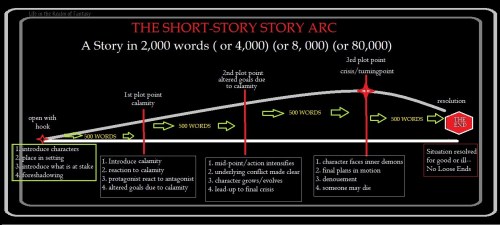
  5. Strung together, these scenes form the entire story arc, with a beginning, middle and end.

If somewhere near the middle you discover that you have lost the overall plot of your novel, remind yourself what the original idea was. This happens to me for several reasons.

First, it can happen because I deviate from the outline, and while my new idea is better, it lacks something. I can

  • Go back to the original idea and rewrite it so that it conforms to that outline.
  • Try to figure out why the plot has failed.

More often, I have to ask myself, did the original quest turn out to be a MacGuffin?

Every story has a quest of some sort. It can be a personal quest for enlightenment or a quest for the Holy Grail. No matter what, the characters want something, and that thing must be sharply defined.

Alfred Hitchcock popularized the name “MacGuffin” in the 1930s. The MacGuffin’s importance to the plot is not the object or goal itself, but rather the effect it has on the characters and their motivations. Many times, it is inserted into the narrative with little or no explanation, as the sole purpose of the MacGuffin is to move the plot forward.

The Maltese Falcon is a classic example of a MacGuffin. The object of the quest might not be the purported “Maltese Falcon” after all, despite the obvious quest to acquire it and the lengths the characters must go to in the process. The true core of the story is the internal journey of both Sam Spade and Brigid O’Shaunessy, two people brought together by the quest, and whose lives are changed by it.

If the quest has become a MacGuffin, the effect that searching for it has on the characters must be clearly shown. The true quest is not for the object. It is for power, love, money, or personal growth and must be given more prominence.

As we are peeling back the layers of our rough draft, what symbolism have we subconsciously inserted into the story that we can work with? Once we identify the symbolic aspect of the plot, we must amplify it. Symbolism is a powerful tool and is part of the subtext that pushes the story forward. In my opinion, one of the most masterful uses of symbolism happens in the film, The Matrix.

In one of my favorite scenes, when Neo answers the door and is invited to the party, he at first declines. But then he notices that Du Jour, the woman with Choi, bears a tattoo of a white rabbit. He remembers seeing the words: follow the white rabbit, on his computer.

Curious and slightly fearful of what it all means, he changes his mind and goes to the party, setting a sequence of events in motion. The white rabbit tattoo is a symbol, an allegorical reference to Alice in Wonderland, a subliminal clue that things are not what they seem.

What is the deeper story? With each pass through our manuscript, we are sharpening the final product, scraping away from this part and adding over here, rewording and redefining as we go.

Ultimately, we will have exposed the core of our original vision, revealed the parts we couldn’t articulate at first. Some things only become clearer to us as we dig deeper.

This is why, while many people can write, not just anyone can write well. It takes patience and time to cut away the fat and bring out the true story that needs to be told. It also takes practice. Digging the deeper story out doesn’t happen overnight.

A first draft is our block of clay, and after much effort, the final draft is our finished sculpture.


Credits and Attributions:

Portrait of German-American sculptor Elisabeth Ney with a bust of King George V of Hanover, 1860, by Friedrich Kaulbach. PD|100. Wikimedia Commons contributors, “File:Elisabeth Ney by Friedrich Kaulbach.jpg,” Wikimedia Commons, the free media repository, https://commons.wikimedia.org/w/index.php?title=File:Elisabeth_Ney_by_Friedrich_Kaulbach.jpg&oldid=286953027 (accessed November 27, 2018).

5 Comments

Filed under writing