Category Archives: writing

How contrasts drive the story #amwriting

The Buddha offered a morsel of wisdom that authors should consider, “There has to be evil so that good can prove its purity above it.”

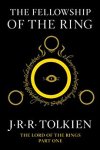
J.R.R. Tolkien understood this quite clearly.

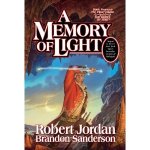
Written in a style that was popular one-hundred years ago, the Lord of the Rings trilogy is a large reading commitment, one fewer and fewer readers are willing to undertake. Yet, compared to Robert Jordan or Tad Williams’ epic fantasy series, it is short, totaling only 455,175 words over the course of three books.

The story is sprawling, showing a world of plenty, ignorant of the disaster lurking at the edge of their border. Tolkien shows the peace and prosperity that Frodo enjoys and then forces him down a road not of his choosing. He takes the hobbit through personal changes, forces him to question everything. In the final confrontation with Sauron’s evil influence, Tolkien forces Frodo to face the fact he isn’t quite strong enough to destroy the ring. Frodo can’t give it up—he is willing to risk everything to retain possession of it when Gollum amputates his finger and takes the ring.

Frodo and Sam hunting down a case of genuine Canadian beer and spending spring break in Fort Lauderdale wouldn’t make much of a story, although it could have made an awesome straight-to-DVD movie.

Frodo’s story is about good and evil, and the hardships endured in the effort to destroy the One Ring and negate the power of Sauron. Why would ordinary middle-class people, comfortable in their rut, go to so much trouble if Sauron’s evil was no threat?

In both the Lord of the Rings trilogy and Tad Williams epic fantasy Osten Ard series, we have two of the most enduring works of modern fiction. Both feature an epic quest where through it all, we have joy and contentment sharply contrasted with deprivation and loss, drawing us in and inspiring the deepest emotions.

This use of contrast is fundamental to the fables and sagas humans have been telling since before discovering fire. Contrast is why Tolkien’s saga set in Middle Earth is the foundation upon which modern epic fantasy is built. It’s also why Tad Williams’ work in The Dragonbone Chair, first published in 1988, changed the way people saw the genre of epic fantasy, turning it into hard fantasy. The works of these authors inspired a generation of writers: George R.R. Martin and  Patrick Rothfuss, to name just two of the more famous.

My favorite books convey the beauty of life by contrasting joy, companionship, and love with drama, heartache, and violence. No matter the setting, Paris or Middle Earth, these fundamental human experiences are personal to each reader. They have experienced pain and loss, joy and love. When the author does it right, the reader empathizes, feels the emotions written into the story as if they were the protagonist.

Hunger is a fundamental agony that can linger for years. People can survive on very little, and unfortunately, many do. To have only enough food to keep you alive, but never enough to allow you to grow and thrive forms a person in a singular way. Acquiring food becomes your first priority. Having a surplus of food becomes a reason to celebrate. To go without adequate food for any length of time changes you, makes you more determined than ever to never go hungry again.

Thirst is a more immediate pain than hunger. The human animal can survive for up to three weeks without food, but only three to four days without water. Rarely, one can survive up to a week. When one has gone without water for any length of time, even brackish water must taste sweet. And when one is without food, even food they would never normally eat will fill their belly.

War happens because of famine and deprivation. Wars are fought over water. We forget this when we have plenty to eat and never worry if we will have water or not as long as we can pay the bills.

Need drives the human story, which is why we love tales of heroism and great achievements. Love and loss, safety and danger, loyalty and betrayal—contrast provides the story with texture, turning a bland wall of words into something worth reading.  First comes the calm, and then the storm, and then the aftermath. Feast is followed by famine, thirst followed by a flood. War, famine, and flood are followed by a time of peace and plenty. This is our history, and our future, and is how good tales are played out.

Employing contrast gives texture to the fabric of a narrative. When an author makes good use of contrasts to draw the reader in, readers will think about the story and those characters long after it has ended.

I say this regularly, but I must repeat it: education about the craft of writing has many facets. We must learn the basics of grammar, and we must learn how to build a story. We learn the architecture of story by reading novels and short stories written by the masters, both famous and infamous.

We can’t limit our reading to the classics. Those books may be the basis for the way fiction is written today, but the prose and style don’t resonate with the majority of modern readers.

I have a piece of homework for you. You can copy and use the following list of questions as part of your assignment.

We may not love the novels on the NY Times bestseller list, and we may find them hard going, but stay with it. Go to the library or to the bookstore and see what they have from that list that you would be willing to examine. Your local second hand bookstore might have quite a few recent bestsellers in their stock of general fiction. Buy or borrow it and give it a postmortem. Why does—or doesn’t—the piece resonate with you? Why would a book that you dislike be so successful?

As I said at the beginning, the plot is driven by the events and emotions that give it texture. How did they unfold? Did the book have a  distinct plot arc? Did it have:

  • A strong opening to hook you?

  • Was there originality in the way the characters and situations were presented?

  • Did you like the protagonist and other main characters? Why or why not?

  • Were you able to suspend your disbelief?

  • Did the narrative contain enough contrasts to keep things interesting?

  • By the end of the book, did the characters grow and change within their personal arc? How were they changed?

  • What sort of transitions did the author employ that made you want to turn the page? How can you use that kind of transition in your own work?

  • Did you get a satisfying ending? If not, how could it have been made better?

Reading and dissecting the works of successful authors is a necessary component of any education in the craft of writing. Answering these questions will make you think about your own work, and how you deploy the contrasting events that change the lives of your characters.


Credits and Attributions:

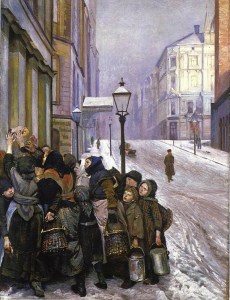
Struggle for Survival by Christian Krohg, 1889, oil on canvas.  Now hanging in the National Gallery of Norway.

Wikimedia Commons contributors, “File:Christian Krohg-Kampen for tilværelsen 1889.jpg,” Wikimedia Commons, the free media repository, https://commons.wikimedia.org/w/index.php?title=File:Christian_Krohg-Kampen_for_tilv%C3%A6relsen_1889.jpg&oldid=301415583 (accessed February 10, 2019)

Comments Off on How contrasts drive the story #amwriting

Filed under writing

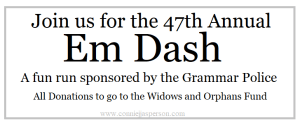
The Em Dash— #amwriting

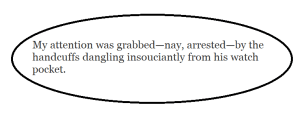
Over the years, I have seen many books written by wonderful authors who overuse em or en dashes.

I also tend to do that in blogging and in Facebook posts, and my first drafts can be peppered with them. Em dashes are a kind of author’s crutch because it is easy to rely on them.

Trust me, readers find it distracting to see an em dash in every paragraph. Some editors don’t want to see one on every page. Their point of view is that the em dash is like any other repetitive word in a manuscript. As a tool, it’s useful as a way to emphasize certain ideas, and can also be used to good effect in the place of a semicolon. In my opinion, the em dash should be used sparingly to be most effective.

So, what is the difference between the hyphen and the em dash? Aren’t they the same thing?

Not at all. Hyphens are used to join two words to create a compound word. Never use a hyphen in the place of an em dash or en dash.

  • Time-saving
  • Twenty-one

Hyphens are not always necessary. If the meaning of a compound adjective is perfectly clear when written as two separate words, a hyphen is not necessary. If its meaning is understood when written as one word and common usage writes it as one word, again, a hyphen is not necessary.

Dashes are not hyphens and are used in several ways. One kind of dash that is frequently used is the ‘en dash,’ which is the width of an ‘n.’ UK usage frequently employs the en dash in the place of the em dash.

In US usage, En dashes join two numbers that are written numerically, not spelled. To insert an en dash in a Word document: type a single hyphen between two words, with a space on either side of it:

1994 – 1996 (1994SpaceHyphenSpace1996) Once you hit the space key after the second word, the hyphen will form an en dash.

The dash we are discussing today is the ‘em dash,’ which is the width of an ‘m.’

An em dash (—)   is a versatile punctuation mark. It is the width of an ‘m,’ hence the name. An em dash can serve as a comma. It does the same task as parentheses and serves the same purpose as a colon when used in the narrative.

Misty Barnett—my dog walker—loves to tango.

Tonight’s featured dances—the foxtrot, the waltz, and the Basque Sword Dance.

Used in these situations, the em dash feels less formal than a colon. This shift in usage is all about economics. The reading public drives our written language. Their preference for books with narratives light on formality is why colons are no longer used in narrative prose.

To insert an em dash in a Word document: type two hyphens next to each other without any space between the words or hyphens:

A—B (LetterHyphenHyphenLetter) Once you hit the space key after the second word, the two hyphens will form an em dash.

The em dash can be more emphatic than a comma, yet not as firm a stop as the period. It sets apart any clause bracketed by them—such as this clause—which can easily be overdone.

Their main use in my work is in dialogue. Most editors will agree that current accepted practice for fiction is to not use semicolons in dialogue. Instead, we use the em dash to join short related independent clauses. Used wisely, they can smooth a choppy conversation and make it more normal sounding. A good writer will not pepper their manuscript with them.

In the rush of getting a first draft committed to paper, we use certain words and symbols as a kind of shorthand to ourselves for later, and the emdash can be one of them. When we are making revisions, we need to be alert and reword as much as we can to do without them. Used too exuberantly, they can create a mish-mash of run-on sentences where brevity would be a better choice.

So, what are these alternative forms of punctuation to create that dramatic pause? Be creative with your word choices, phrase things carefully, and see if one of these will work as well or better:

  • PERIOD = a full stop. End of Sentence. That’s all folks.
  • SEMICOLON: Use a semicolon in place of a period to separate two sentences where the conjunction has been left out.Call me tomorrow; we’ll go dancing then. (The AND has been left out.) As I said, the semicolon has fallen out of favor with many editors for dialogue. Also, many people don’t understand how to use them. However, I have nothing against them when they are used properly.
  • COMMA:  We purchased apples, oranges, and bananas.

Authors and editors become habituated to using emdashes without thinking. After a while, the little finger just hits that hyphen key twice whenever the mind pauses.

I have mentioned this wonderful quote before, which is from a blog post called “The Case—Please Hear Me Out—Against the Em Dash.”  The post was written by the witty Noreen Malone, staff writer for The New Republic:

“What’s the matter with an em dash or two, you ask?—or so I like to imagine. What’s not to like about a sentence that explores in full all the punctuational options—sometimes a dash, sometimes an ellipsis, sometimes a nice semicolon at just the right moment—in order to seem more complex and syntactically interesting, to reach its full potential? Doesn’t a dash—if done right—let the writer maintain an elegant, sinewy flow to her sentences?”

Write the way you want to, use em dashes where you think they work best, and rely on proper punctuation for the rest of your narrative.

Happy writing!


Credits and Attributions:

“The Case—Please Hear Me Out—Against the Em Dash”  by Noreen Malone, staff writer for The New Republic 24 May 2011 (accessed 11 March 2018).

10 Comments

Filed under writing

The Ellipsis #amwriting

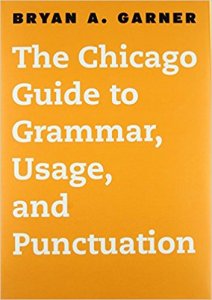
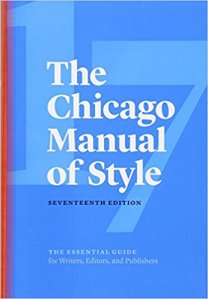
Today we’re continuing my series of handy one-page reference guides for the struggling author. The information I am imparting to you is drawn from my reference manual of choice, Bryan A. Garner’s The Chicago Guide to Grammar, Usage, and Punctuation. It takes the relevant parts of the Chicago Manual of Style and puts them into an understandable form.

On deck today is the ellipsis, that symbol of omitted words so beloved and so misused by the new, uninformed author. A signifier of things left unsaid, the ellipsis does many things, but is not punctuation in itself.

In my opinion, some people rely too heavily on the ellipsis in their prose. Used too freely, the narrative becomes halting…stuttering…gasping to a near stop.

However, just as adverbs and other descriptors are, the ellipsis is a tool and we must know how and when to use it to the greatest effect.

Quote from Wikipedia:

The Chicago Manual of Style suggests the use of an ellipsis for any omitted word, phrase, line, or paragraph from within but not at the end of a quoted passage. There are two commonly used methods of using ellipses: one uses three dots for any omission, while the second one makes a distinction between omissions within a sentence (using three dots: . . .) and omissions between sentences (using a period and a space followed by three dots: . …)

The ellipsis is a symbol, and as such, requires punctuation, even if it is at the end of a sentence of dialogue. Again, Wikipedia makes this clear:

More commonly, a normal full stop (period) terminates the sentence, then a separate three-dot ellipsis is used to indicate one or more subsequent elided sentences before continuing a longer quotation. Business Insider magazine suggests this style,[10] and it is also used in many academic journals. Even the Associated Press Stylebook[11] – notably hostile to punctuation that journalists may consider optional and removable to save newsprint column width – favors this approach. It is consistent in intent if not exact form with the agreement among those in favor of a fused four-dot ellipsis that the first of them is a full stop terminating the sentence and the other three are the ellipsis.

You can create one two different ways.

  1. Hit the period key three times in a row: …
  2. If you are using Word and have a number pad on your keyboard, press Alt 0133, which gives you the …

Bryan A. Garner, on page 396 of The Chicago Guide to Grammar, Usage, and Punctuation lists five uses and two misuses of the ellipsis.

First, we’ll talk about the uses, listed with examples on page 396.

  1. Use an ellipsis when an unfinished sentence trails off.

  2. Use an ellipsis to signal rumination, musing, or hesitant continuation of thought.

  3. Use three ellipsis dots to signal that you’ve omitted one or more words within a sentence you are quoting.

  4. Use four dots—an ellipsis and a period—when you’ve omitted one or more words at the end of a sentence. A space goes before the first ellipsis dot.

  5. Use four dots—an ellipsis and a period—when you’ve omitted material within a quoted sentence, but the quotation continues. No space goes before the first dot (the period).

On page 398, Garner lists two misuses.

  1. Don’t use the ellipsis dots without the equivalent of a letter space between each pair, and don’t allow the string of dots to be split between consecutive lines.

  2. Don’t begin a quotation with an ellipsis.

What I have discovered in my quest for enlightenment is that it is easy to misread and misinterpret rules as laid down by those who have a lot of knowledge. As I frequently say, I am always learning new things and unlearning the errors of my writing past.

Editors and publishers rely on the Chicago Manual of Style for all questions of grammar and punctuation. Indies and small presses should too, but it is a massive tome and is enormously difficult to understand, even by the most dedicated editors.

Garner’s rules are drawn from the CMoS and phrased in ways that are simple and easy to understand. If you’re serious about the craft, I urge you to do yourself a favor and invest in the Chicago Guide to Usage and Punctuation to see his explanations and examples.

Bryan A. Garner has taken the big, blue, and expensive Chicago Manual of Style and boiled it down to the things that the average writer needs to know about the grammar aspects of our craft and placed it in an affordable package.


Credits and Attributions:

“Ellipses defined”The Chicago Manual of Style Online (16th ed.). 2010.

Wikipedia contributors, “Ellipsis,” Wikipedia, The Free Encyclopedia, https://en.wikipedia.org/w/index.php?title=Ellipsis&oldid=880964812 (accessed February 3, 2019).

Bryan A. Garner, The Chicago Guide to Grammar, Usage, and Punctuation, pages 396 – 399. © 2016 Bryan A. Garner, published by University of Chicago Press.

Cover illustration, The Chicago Guide to Grammar, Usage, and Punctuation. © 2016 Bryan A. Garner, published by University of Chicago Press. Fair use.

Cover illustration, The Chicago Manual of Style, © 2017 by University of Chicago Press. Fair use.

10 Comments

Filed under writing

Sound-alike words #amwriting

The large number of common homonyms, or sound-alike words, in our everyday usage are what makes English so tricky to learn as a second language. But even those of us who claim it as our native language get confused. Authors must learn how to recognize and use them properly.

Consider whether or not you want to use the word “ensure.” This word is so commonly abused that many native speakers don’t know which word to use in what context.

Three words could work, and they are quite similar to each other. Even worse, they have similar but different meanings.  This is when we go to the dictionary for a little research. All you have to do is use the dictionary that comes with your word processing program. (In Word, you type the word, right click on it, and when the menu opens, click on ‘look up.’)

Assure: promise, as in I assure you the house is clean.

Ensure: confirm, as in Ensure that you have set the burglar alarm before going on a long trip.

Insure: protect with an insurance policy, as in Insure your home for your peace of mind.

One of the worst failings for new authors is the word “it.” If problems appear in a manuscript, this word will likely be a major culprit. In my own work, I try to do a global search for every instance, and make sure the word is correctly used:

  • The texture of the wall—it’s rough. (It is rough.)
  • I scratched myself on its surface. (The wall’s surface.)

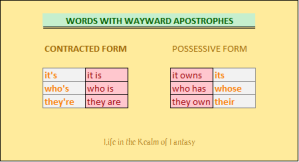
Its… it’s… which is what and when to use it?

The trouble here can be found in the apostrophe. In most English words an apostrophe indicates possession, but once in a while, it indicates a contraction.

  1. It’s is the contraction of “it is” and sometimes “it has.”
  2. Its denotes possession: It owns it

Some words jump right out at you as a reader:

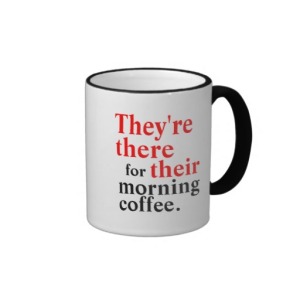
  • they’re,
  • their,
  • there.

But others are more sneaky:

  • accept
  • except

Accept and except are so frequently confused and misused in our modern dialect that, if you doubt yourself, it is best to simply look it up. If you search for these now, you will save your editor having to do this for you, and your edit will be much more productive.

6 Comments

Filed under writing

Chaos Theory, Commas, and Basic Punctuation #amwriting

Punctuation and the fundamentals of how to use it can be confusing for many new writers. Most grammar books and style guides are difficult to understand and seem intimidating. What follows is only a quick guide, a “How-To Guide for Basic Punctuation.”

The many convoluted laws of grammar can make the literary universe a chaotic place. Commas can be tricky because some applications are open to interpretation. However, the most basic laws of comma use are not open to interpretation.

Two things we never do:

  1. Never insert commas “where you take a breath” because everyone breathes differently.
  2. Do not insert commas where you think it should pause, because every reader sees the pauses differently.

Commas and the fundamental rules for their use exist for a reason. If we want the reading public to understand our work, we need to follow them.

The Fundamental Laws of Commas:

Commas join two independent clauses. The independent clause is a complete stand-alone sentence.

  • Boris worships the ground I walk on, but his adoration tires me.

Dependent clauses are unfinished and can’t stand on their own. They should be joined to the sentence with a conjunction.

  • Boris worships the ground I walk on and brings me my coffee.

You do not join independent clauses (clauses that can stand alone as separate sentences) with commas as that creates a rift in the space/time continuum: the Dreaded Comma Splice:

Comma Splice: Boris kissed the hem of my garment, the dog likes to ride shotgun.

The dog has little to do with Boris, other than the fact they both adore me. The same thought, written correctly: Boris kissed the hem of my garment. The dog likes to ride shotgun.

Comma splices? Don’t do it! The universe will grind to halt, and everyone will die, and it will be your fault.

Would it be better if we used a semicolon? No. That would create a nuclear holocaust of the literary persuasion.

The dog riding shotgun is an independent clause and does not relate at all to Boris and his adoration of me.

I have said this before, but semicolon in an untrained hand is a needle to the eye of an editor.

Remember: Semicolons join independent clauses, which are clauses that can stand alone, but which relate to each other.

Your best bet is to avoid using them except under extreme duress as they can create some lo-o-o-o-ong, run-on sentences.

But what if you absolutely, positively have to use a semicolon, or your skin will melt? Trust me, it won’t happen, but there are rules for using this type of punctuation, and the wise author will follow them:

Two clauses that are joined together with a semicolon should be

  • complete sentences that relate to each other
  • if they don’t relate to each other, make them separate sentences and reword them so they aren’t choppy.

Two separate ideas done wrong: Boris attempted to kiss the hem of my garment; my boot was in his face.

The first sentence is one whole idea—Boris adores me. The second sentence is a completely different idea—my boot was someplace inconvenient.

Two separate ideas done right, assuming the mention of my boot is important: Boris attempted to kiss the hem of my garment, but my boot was in his face.

I don’t dislike semicolons as some editors do, but I generally try to find alternatives to them. I think they are too easily misused because people forget the simple rule:

Semicolons (;) should be used only when two stand-alone sentences or clauses are really short and relate directly to each other.

We like people to understand exactly what we mean, so we ALWAYS use the Oxford Comma, also known as the Serial Comma.

If there are only two things (or ideas) in a list, they do not need to be separated by a comma. If there are more than two ideas, the comma should be used as it would be used in a list.

Dogs, cats, rabbits, and birds.

Colons (:) head lists but are never to be used in the literary narrative, so YES, we DO use serial commas to prevent confusion when we are listing things. You’ve all seen the memes—and you’ve heard the arguments.

On a personal level, I do love cooking my pets and my family. (But not in the same pot.) They’re happy that I use serial commas. Argue against the Oxford comma all you want–you will never change my mind.

I want to thank my parents, Ralph and Maggie Johnson and Poseidon.

Although the dog thinks I’m a goddess, I am not really the daughter of Poseidon. Parents, when named, are a single unit. A comma after Johnson would eliminate confusion.

We use a comma after most common introductory clauses.

After dark, Boris would change into his bat form and go hunting for insects.

To wind that up, commas tame the chaos that our words can become. They are the traffic signals, signifying a pause or a joining.

>Periods, also called full stops, end sentences.

In dialogue, all punctuation goes inside the quote marks. A comma follows the spoken words, separating the dialogue from the speech tag, and the period (or question mark, or exclamation point) ends the sentence.

“I agree,” said the editor.

If you follow these simple rules, your work will be readable. 

8 Comments

Filed under writing

The Pitch #amwriting

On Monday we talked about the synopsis, which you would send to lure a prospective agent. Today we’re talking about the pitch and how it differs from a synopsis.

The front cover of your book is important, but great covers alone don’t sell books. The back of a paper book is critical because it contains the all-important pitch—also known as a blurb.

For an eBook, the pitch is on the seller’s product page. Either way, the shopper will read your pitch and decide if they want to know more. If they open the book or use the “look inside” option, you have a good chance of selling that book.

But how do we write a pitch?

First, you want to identify the key elements of your book (or series of books).

Consider a fantasy that features themes of friendship, family, romantic love, honor, and duty. In this story, the obvious theme might be the successful resolution of a quest. Identifying the core plot device around which your story revolves is important.

  1. Who or what is your book about?

You can emphasize either the idea of the book or the main character. Once you choose what you want to sell, main character or idea, stick to that. If you choose the character, use only the main character in your description, and forget the others, because it is that character’s story that you are trying to sell.

  1. Keep it short. It’s easy to be long-winded about our work but not here. You only have about 60 seconds to sell that book.

Since length is bad in a pitch, we must learn to write concisely. I learned to write drabbles—100 word flash fictions. I wrote one every day for nearly a year. I did this because you really have to choose your words wisely if you want to tell your story in such a short space.

Besides helping me learn how to write concisely, writing drabbles was a great way to build a backlog of ideas that became short stories later.

  1. Use power words. Don’t use “telling” words—make every word in that pitch count.
  2. Be visual. Use words that create a visual image in your reader’s mind.

Give us just enough intriguing insight into the main character and the story to make us want to know more about them. Make us curious.

Consider the 69-word pitch for Wool,’ by Hugh Howey. Howey was an indie when he published Wool in 2012.

This is the story of mankind clawing for survival, of mankind on the edge. The world outside has grown unkind, the view of it limited, talk of it forbidden. But there are always those who hope, who dream. These are the dangerous people, the residents who infect others with their optimism. Their punishment is simple. They are given the very thing they profess to want: They are allowed outside.

Howey opted for powerful and visual right out of the gate: clawing for survival. He packed his blurb with persuasive, graphic words that spark curiosity and make you feel that you are holding a powerful story in your hand (or your eReader). He chose not to go with a tagline, but the final sentence is so powerful, it doesn’t need one.

Next, let’s look at the pitch for Roadmarks,’ a classic sci-fi fantasy written by the late Roger Zelazny. It was published in 1979 by Del Rey Science Fiction, so the publisher wrote the blurb. I was in the grocery store when I first saw this book, and the cover art caught my eye. I picked the book up and turned it over to read the pitch.

The pitch made me curious and was what sold me the novel:

The Last Exit to Babylon

“The Road runs from the unimaginable past to the far future, and those who travel it have access to the turnoffs leading to all times and places—even to the alternate time-streams of histories that never happened. Why the Dragons of Bel’kwinith  made the Road—or who they are—no one knows. But the Road has always been there and for those who know how to find it, it always will be!”

Zelazny’s publisher, Del Rey, opted for a mysterious pitch, but they also used powerful words in the first sentence:  “The road runs,” “unimaginable,”— words that pique curiosity. They began the pitch with a great tag line. When I bought that book, I ignored the glowing reviews the publisher plastered beneath the pitch because I don’t care what reviewers think–I make up my own mind.

A word of caution: Indies should never put glowing reviews on their covers unless they are reviews by big-name reviewers or authors.

Del Rey got away with it because the book had been a bestseller in hard cover for a year before the paperback came out, and Zelazny was brilliant and sold books as fast as they could print them.

We don’t put a synopsis on the back of the book. A synopsis is a bald recounting of the novel’s bare bones—why should the reader buy it if they already know the story?

What sort of pitches lure you into buying a book? We write what we want to read, so chances are, you are writing a book along those lines. Go back and read those blurbs and start creating your pitch.

Pitches give away no secrets but hint at the mysteries within. For this reason, you want to ask your friends and your writing group to look at your blurb. If they tell you it’s too long-winded and doesn’t sell the book well, don’t be angry. Be glad they were honest.

Rewrite it, pare it down again, and rewrite it until your pitch is a concise enticement that sells the mystery of what lies within your book. Make the prospective reader open the book or click on the look inside option to see more.

Once they have sampled what’s inside the book, you are halfway there. At that point, your writing and your voice is what will clinch the sale.

18 Comments

Filed under writing

The Synopsis #amwriting

If your publishing path is the traditional route, you must attempt to get an agent. It’s a rare thing for an author to get a book published traditionally without an agent. Agents want to sell your book, and they love to read. So you must first sell the book to an agent, and to do that, you must know how to write a synopsis.

The synopsis is not a blurb.

It is a short description of your book, hitting the high points and it does give away the ending.

The synopsis should only be one page long, written in third person, present tense. Many agents say three to five paragraphs will do it. So how do you fit a novel onto one page?

You give the agent the bare bones of the book.

Things they want to see detailed in those paragraphs:

  • Genre
  • Setting
  • Protagonist and major characters
  • What the conflict/major goals are
  • Character arc (how the characters grow/devolve throughout the book)
  • Resolution

Things you should leave out at this point? Don’t wax poetic on specific descriptions of

  • setting,
  • side characters,
  • sub plots, and
  • specific, highly detailed descriptions of plot points and the resolution.

You start with a statement that describes the books premise: A young man abandoned by his wife and left with a terminally ill child must find the one healer who can cure his son.

Introduce the protagonist and his/her problem:

Janse, a young water-mage, has been tapped to be his clan’s shaman. His wife who is not of the clan doesn’t understand the demands that responsibility places on him, and deserts him, leaving him to care for an infant with a terminal heart condition. His clan’s healer is young and untrained, but Janse’s grandfather tells him of a healer in a citadel far to the south, a journey of many months.

The next paragraphs should detail the bulk of the story. What does the protagonist do in reaction to the inciting incident? What obstacles does he/she face, and who helps or hinders them along the way?

Janse and his cousins, one of whom, Landry, is the clan’s healer, set out, taking the baby on the perilous journey. Many times on the journey, Janse must use his magic or his wiles to extricate them from trouble. They must pass through dark forests and travel through high mountain passes. Along the way, they are robbed. When they seek shelter at the first village on their route, they are turned away. No one will sell them supplies. Desperate to make it to a friendly village, they keep going but make a wrong turn and enter the lair of the Griphon. Using guile and magic, they escape from the beast. Just when it seems they will make it, the baby has a crisis. Landry is able to get the baby through the crisis, but now they know time is short. When they arrive at the citadel, they are at first turned away. Then they are directed down dangerous streets to an obscure address in the worst part of town.

Give the resolution in a nutshell. Detail isn’t important.

The elderly woman who opens the door welcomes them. She immediately takes the baby to her daughter, Ethella, who is the healer they have been seeking. Using her magic, Ethella is able to heal the baby, teaching Landry the skills he needs.

Janse and his cousins make ready to return to the clan, feeling confident. Janse has grown as both a mage and a shaman and now feels able to take his grandfather’s place and lead his clan with wisdom. Landry has grown in his abilities and is able to be the healer his clan needs.

The synopsis is only difficult because we have the urge to put all the details into it.

Being able to put your book into four paragraphs is a trick all authors need to know, whether we go the traditional route or not. People always ask you what the book is about, and wouldn’t it be nice to be able to tell them?

16 Comments

Filed under writing

Honesty in Writing #amwriting

As writers, we are entertainers. We write books for people who want a diversion from the daily grind. No matter what the subject or genre is, we write escapes, windows into other lives, other places, other realities. When we offer the book to the public, we hope the reader will stay with us to the end, hope they find the same life in the narrative that we thought we were imparting when we wrote it.

This can only happen if we are honest. When I first started out, I wrote poetry, lyrics for a heavy metal band. I was young, sincere, and convinced I had to impart a message with every word. I didn’t know until twenty years later when I came across my old notebook—my poems weren’t honest. I wasn’t honest with myself, and when I looked back at my work, I could see the falseness clearly. My words were contrived, formed too artfully. They shouted, “Look at me! I’m young and full of angst, but I’m talented and artsy!”

When I began writing stories for my children, I still wrote crap, but it was honest crap. I no longer had anyone to impress—children are never impressed by parents who write. They are also quite honest about where a story fails to impress them, and why. I began to write fairy tales that were honest, but not written by an educated author.

With that as my training ground, learning how to make my writing enjoyable became a goal. It was there that I discovered that, besides writing honestly, an author needs to be consistent with punctuation. I had no idea I was uneducated—after all, I had done well in school.  Even so, I had to re-learn the fundamentals of American English grammar because my first real editor pointed out that I hadn’t retained much of what I was taught in elementary school.

As Ursula K. LeGuin said in her wonderful book, Steering the Craft, A 21st Century Guide to Sailing the Sea of Story, “If you aren’t interested in punctuation, or are afraid of it, you’re missing out on some of the most beautiful, elegant tools a writer has to work with.”

My rule is to embrace what I fear, so I embraced grammar. I’m not perfect, but I make an effort.

I have always been a reader, enjoying books in every genre and style.  While the books I love are scattered all across the spectrum, they have one thing in common—they are all written by authors with an understanding of the basic rules of punctuation. Sure, they break other rules of grammar with style and abandon, but they do pay attention to punctuation.

This is because punctuation is the traffic signal telling the reader to go, slow, pause, yield, go again, or stop. Punctuation at most of the right places allows the reader to forget they are reading and encourages them to suspend their disbelief.

Writers begin as readers. In his book, On Writing, Stephen King gives us permission to read for six hours a day, should we so desire. Reading is how we come to understand writing and the art of story. (He also admonishes us to learn the fundamentals of punctuation and grammar.)

In my quest to understand the art of story I have come across some pretty awful books. I don’t consider “hard to read because it is written in an old-fashioned style” awful. However, I do consider “hard to read because the author wasted my time” awful.

Contrived prose is not poetic. Hokey and forced situations are not exciting. Perfectly beautiful people bore me. Long passages about clothing and furnishings bore me.

Write me an honest story about “real” people with real problems, one that comes from your deepest soul. Set it in outer space, or the Amazon Jungle—I don’t care. I read all genres and all settings. I will forgive imperfect grammar and punctuation for a great story that rings of truth and touches my heart.

Let me sink into your story. Let me forget the world—let me become so into the book I forget to cook dinner.


Credits and Attributions:

Quote: Ursula K. LeGuin, Steering the Craft, A 21st Century Guide to Sailing the Sea of Story, ©1999 Ursula K. LeGuin, First Mariner Books Edition 2015, page 11.

10 Comments

Filed under writing

Naming Characters #amwriting

I have mentioned (several times) one of my mistakes in naming characters. In the Tower of Bones Series, I have a main character named Marya. She is central to the series. Also, in the first book, a side character was important enough to have a name. My mind was in a rut when I thought that one up because I named her Marta.

You can see why this is bad—the two names are nearly identical.

To really confuse things, halfway through the first draft of the second book in the series, Marta suddenly was a protagonist with a major storyline. She actually becomes Marya’s mother-in-law in the third book. Fortunately, I was in the final stage of editing book one, Tower of Bones, for publication, and immediately realized I had to make a major correction: Marta was renamed Halee.

In my family, “Robert” is a name with a great deal of repetition. My father was named Robert, my two brothers are both named Robert (with different middle names), and my mother’s younger brother is named Robert. My younger brother’s son is named Robert, as is his son. We have a Bob, a Little Bob, a Rob, a Bobby, a Robby, and a Quatro.

I took this absurdity to an extreme in Billy Ninefingers. In Waldeyn, every third boy is named William, which is why Billy MacNess embraces the name his mercenaries give him after the injury. In that novel, “Williams” generally go by their last names.

Other than Billy Ninefingers where it was intentional and integral to the story, my personal rule is to NEVER name two characters in such a way that the first and last letters of their names are the same. To avoid that circumstance, I try to never have two that even begin with the same letter.

But who should go and who should stay? What is the optimal number of characters for a book? Some say only four, others fifteen.

I feel an author should introduce however many characters it takes to tell the story but should also use common sense.

A name implies a character is an important part of the story. Ask yourself if the character is an example of “Chekhov’s Gun.” Does the person return later in the story or does he or she act as part of the setting, showing the scenery of, say, a coffee shop, or a store? Is it someone the reader should remember? Even if this character offers information the protagonist and reader must know, it doesn’t necessarily mean they need to be named.

Some throw-away characters will give us clues to help our protagonist complete his/her quest or show us something about the protagonist. Their comments could offer us a clue into the protagonist’s personality or past. Other random people are in the scene purely for the ambiance, part of the world-building. A woman smoking in an alley outside the back door to an office needs no name, but she serves as a visible clue about the world the main character is walking in.

Even if they do speak a few lines, if they are just part of the scenery, they don’t need a name.

In an excellent article on screenwriting, Christina Hamlett of the Writer’s Store writes:

In a screenplay, the rhythm you’re attempting to establish–along with the emotional investment you’re asking a reader to make–is disrupted whenever you devote more than two lines of introduction to a character who is simply there to take up space. In order to justify their existence, each player in your script should perform a unique function or deliver a specific line that:

  1. Advances the plot,
  2. Thwarts the hero’s objectives,
  3. Provides crucial background, and/or
  4. Contributes to the mood of the scene.

If you’ve included characters who don’t fulfill one or more of these jobs, they’re probably not critical to the storyline and can be deleted.

While she is speaking of screenplays, this is true of a novel or short story.

We want the reader to stay focused on the protagonist(s) and their story. The desire to make every character a memorable person must be ignored. When we begin revising second draft of our manuscript, we must find and resolve the distractions we inadvertently introduced in our first draft.

My current work in progress has a passage that takes place in an inn and involves a conversation overheard from a table adjacent to my two protagonists and their sidekicks. Despite the fact the merchant and his sons give my protagonists information they needed, they are in that scene for only one purpose. They are to be overheard and don’t appear again. For this reason, only my main characters are named in the full transcript of this scene.

Finding that we have too many named characters is an easy one to fix, once we decide how important that character is to the story. If they don’t appear again, the reader will move on and forget about them. The information they imparted will remain.

I have found that a great use for my extra walk-on characters is the short story. The world is already built, and they have a story, albeit a short one. Use them to your advantage.

I now keep in mind simplicity of spelling and ease of pronunciation when I name my characters. How will that name be pronounced when it is read out loud? You may not want to get too fancy with the spelling, so that the narrator can easily read that name aloud. You may not think this is important, but it is.

My advice is to keep it simple. Don’t confuse your readers by giving unimportant walk-on characters names. Be vigilant when choosing names—don’t give two characters names that are nearly identical.

Do make your spellings of names and places easily pronounceable. You may decide to have your book made into an audio book, and the process will go more smoothly if you’ve considered this in advance. I only have one book that is an Audio book and the experience of making that book taught me to spell names simply.


Credits and Attributions:

Minor Characters Don’t Need Major Introductions, Christina Hamlett, Copyright © 1982 – 2017 The Writers Store ® Incorporated, accessed Mar. 11, 2017.

14 Comments

Filed under writing

#FineArtFriday: A Sunday on La Grande Jatte by Georges Seurat circa 1884

A Sunday Afternoon on the Island of La Grande Jatte by Georges Seurat (1884–1886) is a landmark painting. Art historians agree that with this image, Seurat changed the direction of modern art and began the era of Neo-impressionism. It is one of the most recognizable of late 19th-century paintings.

About this painting from Wikipedia: In summer 1884, Seurat began work on A Sunday Afternoon on the Island of La Grande Jatte.

The painting shows members of each of the social classes participating in various park activities. The tiny juxtaposed dots of multi-colored paint allow the viewer’s eye to blend colors optically, rather than having the colors physically blended on the canvas. It took Seurat two years to complete this 10-foot-wide (3.0 m) painting, much of which he spent in the park sketching in preparation for the work (there are about 60 studies). It is now in the permanent collection of the Art Institute of Chicago.

What I love about this painting is the preciseness of each component. This painting proudly declares it is not “real”—it is instead an impression of a moment in time, a summer day spent on the River Seine. It is both sharply delineated and dreamlike. That is a neat trick.

Seurat used individual dots of only primary colors (Red, green, yellow, blue) but the way he places them, they seem muted and blended into shades of rose and purple, and even pale pink. I’m captivated by a technicality – obsessed by the way the primary colors of each dot are juxtaposed with other primary colors, tricking the eye into believing it sees light and dark, and all shades between.

About the Artist, via Wikipedia: (Seurat) is noted for his innovative use of drawing media and for devising the painting techniques known as chromoluminarism and pointillism. Seurat’s artistic personality was compounded of qualities which are usually supposed to be opposed and incompatible: on the one hand, his extreme and delicate sensibility; on the other, a passion for logical abstraction and an almost mathematical precision of mind.

This technique is one I hadn’t given much thought to until I ran across a postcard with this image on it. Other notable artists who explored this method were Paul Signac and Vincent van Gogh.

For me, studying these images of masterpieces for the Friday posts on art teaches me how to be creative with my words. Artists both push the limits of their color palettes and yet force external constraints on themselves to create images that fool the eye.

Authors must do the same with how we shape our words.

About the Pointillist technique of painting, from Wikipedia: If red, blue, and green light (the additive primaries) are mixed, the result is something close to white light. Painting is inherently subtractive, but Pointillist colors often seem brighter than typical mixed subtractive colors. This may be partly because subtractive mixing of the pigments is avoided, and partly because some of the white canvas may be showing between the applied dots.

The painting technique used for Pointillist color mixing is at the expense of the traditional brushwork used to delineate texture.

The majority of Pointillism is done in oil paint. Anything may be used in its place, but oils are preferred for their thickness and tendency not to run or bleed.


Sources and Attributions:

Wikimedia Commons contributors, “File:Georges Seurat – A Sunday on La Grande Jatte — 1884 – Google Art Project.jpg,” Wikimedia Commons, the free media repository, https://commons.wikimedia.org/w/index.php?title=File:Georges_Seurat_-_A_Sunday_on_La_Grande_Jatte_–_1884_-_Google_Art_Project.jpg&oldid=90112845 (accessed January 10, 2019).

Wikipedia contributors, “A Sunday Afternoon on the Island of La Grande Jatte,” Wikipedia, The Free Encyclopedia,https://en.wikipedia.org/w/index.php?title=A_Sunday_Afternoon_on_the_Island_of_La_Grande_Jatte&oldid=875941354 (accessed January 10, 2019).

Wikipedia contributors, “Georges Seurat,” Wikipedia, The Free Encyclopedia, https://en.wikipedia.org/w/index.php?title=Georges_Seurat&oldid=877532379 (accessed January 10, 2019).

Wikipedia contributors, “Pointillism,” Wikipedia, The Free Encyclopedia, https://en.wikipedia.org/w/index.php?title=Pointillism&oldid=874469961(accessed January 10, 2019).

Comments Off on #FineArtFriday: A Sunday on La Grande Jatte by Georges Seurat circa 1884

Filed under writing