Category Archives: writing

Author Simon Wood on Plotting #amwriting

In my post, Theme and the Short Story, I discussed how, as part of my pre-NaNoWriMo exercise regimen, I create small outlines of the short stories I intend to write. Using an outline is also how I write novels.

  • First, I divide my story arc into quarters, so the important events are in place at the right time. When I try to “pants” it, I sometimes end up with a mushy plot that wanders all over the place and a story that may not be commercially viable.
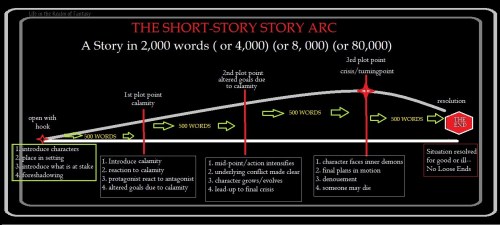
  • What length am I writing to? Knowing the word count in advance will help you keep on track.
  • What will be the inciting incident? How does it relate to the theme?
  • What is the goal/objective? How does it relate to the theme?
  • At the beginning of the story, what could the hero possibly want to cause him to risk everything to acquire it?
  • How badly does he want it and why?
  • Who is the antagonist? What does he want and why?
  • What moral (or immoral) choice is the protagonist going to have to make in his attempt to gain that objective?
  • What happens at the first pinch point?
  • In what condition do we find the group at the midpoint?
  • Why does the antagonist have the upper hand? What happens at the turning point to change everything for the worse?

For novels, I make a larger outline, offering myself a more in-depth exploration of the intended story, and I discussed that process here: Jumpstart #NaNoWriMo2017, the Storyboard.

I do it this way because I can’t keep all the many threads on track if I don’t have some sort of a road map to follow. The outline is my literary GPS device.

Recently, at the Southwest Washington Writer’s Conference, I attended a two-part seminar on plotting, given by Simon Wood, author of such USA Today bestsellers as The One that Got Away.

Simon’s outline goes even deeper than mine. His outline is simple and linear, and color-coded to each character. Numbered from 1 to 80 (or however many scenes you have) each scene is listed with a sentence or two describing what happens at that point, something like Jack meets the dealer at the drop point. Argument ensues.

The sentences are small road maps from which he develops the entire scene. Each line is colored red, yellow, or green depending on whose point of view the scene is being shown from. Green is the protagonist’s point of view.

His outline doesn’t go into so much detail that the story is already written, but it ensures the plot goes in the intended direction with good pacing. Pacing is the reason why I outline—my earlier work was inconsistent.

What struck me in Simon’s seminar was the idea of color-coding each POV—when you have large stories encompassing the points-of-view for three or more characters, all it takes is a glance at your first-draft list of scenes to see if there is an imbalance in who’s talking.

Simon began this style of plotting in 1998, long before Scrivener. Some of you will say you use Scrivener for this, and to you, I say bravo! I find that program isn’t intuitive, is less than user-friendly, and is extremely annoying to try to learn. So, I have it, sitting in my computer taking up valuable real estate on my hard drive, going unused and unloved.

Simon writes thrillers, and I write fantasy, but we both create our outlines in Excel. However, this could easily be done in any word-processing or spread-sheet program (such as Google docs/sheets) or in Word, simply by changing the color of your fonts. You can even do this on colored post-it notes, as some authors do. For visual people who are not Scrivener savvy, being able to use the cut-and-paste function to move scenes around to where they are most effective is critical.

Simon was kind enough to answer a few questions via email about his process.

CJJ: First of all, what do you consider a scene? Is it a chapter or a portion of a chapter?

SW: A scene isn’t a chapter necessarily.  It may be made up of  2-3 scenes.  It depends on how the scenes connect.  Say the chapter was “Robbing a bank.”  To me that would be broken into three scenes: Getting into the bank, Getting into the vault, Getting the money out.  An over simplified answer but I hope it illustrates the point.

CJJ: How do you decide if a character is important enough to warrant a voice and becoming a viewpoint character?

SW: I just assess whether a particular character has valuable insight to share.  If a supporting character’s POV gives additional context to the relationship on how the protagonist and antagonist are behaving then their POV is valuable. Essentially a POV character has to add something to the story.

CJJ: How long are your scenes in terms of word count? For purposes of NaNoWriMo, 1,667 words a day is needed to reach 50,000 words by November 30th and some will plan to write a chapter a day.

SW: Usually my scenes are 1500 words.

CJJ: In your own experience, during the process of getting a novel to the final draft, how many times will the direction of the story and the outline change from the original?

SW: It all depends on how well I did my original outline or how well I had conceived the idea.  Sometimes it’s changed several times.  Others it’s pretty much stayed true to the original.  Usually a couple of times at least.

Thank you, Simon, for sharing your insights with us. For all who are curious about his process, Simon offers several wonderful seminars on writing craft, the links to which are at the bottom of this post. Do yourself a favor and sign up for one!

In the end, we as authors must each find our own best way to free the story from our creative minds. For some of you, a program like Scrivener might fill the bill, but for me, a simple outline to begin with, the willingness to change course when the intended storyline isn’t working, and sheer stubbornness are what it takes to get a book out.

You must give your plot structure. In other words, use an outline to create a good story arc at the outset, but within the structure of your outline, allow your characters to surprise you. We know that the way to avoid obviousness in a plot is to introduce a big threat. How our characters react to that threat should be unpredictable because they have agency.

When we give our characters agency, threats take away the option of going about life as normal and leave characters with several choices, all of which are consequential, the final one of which should be made in a stressful situation. I intentionally used the word consequential relating to the choices your characters must make. If there are no consequences for the bad decisions a character might make, what is the story about?

Simon’s idea of color-coding the scenes in the outline is a great addition to my writers’ toolbox. Being able to see at a glance if my story is imbalanced away from the protagonist’s thread will be a good way for me to avoid having to scrap a few months’ work to get a novel back on the right path.


About Simon Wood:

USA TODAY bestselling author, Simon Wood is a California transplant from England. He’s a former competitive racecar driver, a licensed pilot, an endurance cyclist, an animal rescuer and an occasional PI. He shares his world with his American wife, Julie. Their lives are dominated by a longhaired dachshund and six cats. He’s the Anthony Award winning author of The One That Got Away, Accidents Waiting to Happen, Paying the Piper, Terminated, Deceptive Practices and the Aidy Westlake series. His latest book is SAVING GRACE. He also writes horror under the pen name of Simon Janus. Curious people can learn more at http://www.simonwood.net.

Website: Simon Wood’s Web Hideout

Check out Simon’s workshops here: Simon Wood’s Workshops

Follow Simon on Twitter: https://twitter.com/simonwoodwrites
10 Comments

Filed under writing

#FineArtFriday: The Emerald Pool, Worthington Whittredge

About this image:

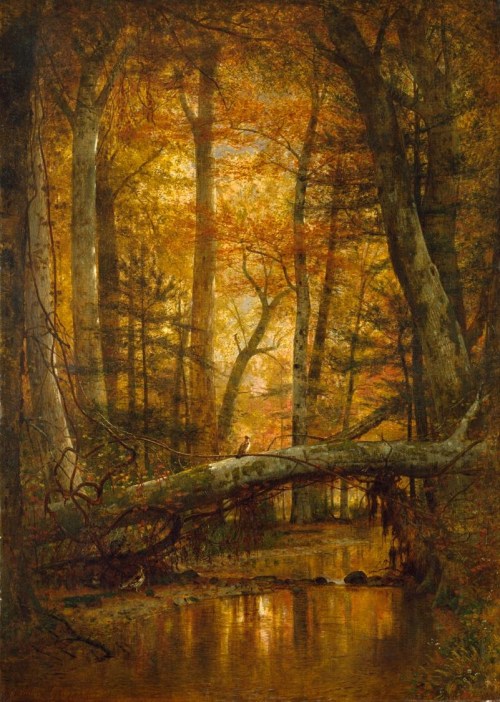
“The Emerald Pool” is also titled “Woods of Ashokan” and is a gloriously composed representation of an Autumn afternoon in the quiet woods. Sunlight is the core element here, in the way it filters through the leaves and touches branch and trunk, and then reflects from the pool.

The trees look very much like those that would have existed in parts of the woods near the house I grew up in, places where the evergreens had been cut and maples, alder, and ash could grow. Sun filters through the leaves which have turned colors but still remain on the trees. A few small firs struggle to grow in the deciduous forest, but one day those firs will cast a wide, dark shadow and the sunlit glade will be no more.

A pheasant (I think?) poses for his portrait, bringing the center focus of the painting to the calm pool beneath the log he stands on. The pool is masterfully shown, its waters rippling as if touched by a slight breeze, reflecting the scene above.

>>><<<

ABOUT THE ARTIST (From Wikipedia): Thomas Worthington Whittredge (May 22, 1820 – February 25, 1910) was an American artist of the Hudson River School. Whittredge was a highly regarded artist of his time, and was friends with several leading Hudson River School artists including Albert Bierstadt and Sanford Robinson Gifford. He traveled widely and excelled at landscape painting, many examples of which are now in major museums. He served as president of the National Academy of Design from 1874 to 1875 and was a member of the selection committees for the 1876 PhiladelphiaCentennial Exposition and the 1878 Paris Exposition, both important venues for artists of the day.

Artist:  Worthington Whittredge  (1820–1910)

Title:   The Emerald Pool

Date    1868

Medium          oil on canvas

Dimensions     Height: 144.8 cm (57 in); Width: 102.9 cm (40.5 in)

Current location: Chrysler Museum of Art


Credits and Attributions

Wikipedia contributors, “Worthington Whittredge,” Wikipedia, The Free Encyclopedia, https://en.wikipedia.org/w/index.php?title=Worthington_Whittredge&oldid=857357141 (accessed September 13, 2018).

Wikimedia Commons contributors, “File:Thomas Worthington Whittredge – Woods of Ashokan.jpg,” Wikimedia Commons, the free media repository, https://commons.wikimedia.org/w/index.php?title=File:Thomas_Worthington_Whittredge_-_Woods_of_Ashokan.jpg&oldid=296638658 (accessed September 13, 2018).

2 Comments

Filed under writing

Titling that book, or wringing blood from a stone #amwriting

A great book title can sell a book or short story to the reader:

We all start out with a working title—after all, we have to label our files somehow. But how do we come up with a catchy title for that finished product? It’s an issue we all face.

First of all, write the book and don’t obsess about the title until you are at the stage where something must be put in place on the cover. During the writing of the book the perfect title might come to you, so don’t sweat it.

What is the book’s genre? Go to the bookstore (or online to Amazon) and look at books in that genre to see how other authors are naming them. This will also give you an idea of how the cover should look if you are an indie. You will know what to ask of your cover designer.

Your friends and your writing group are good resources for brainstorming titles, so get them involved. Your writing group will know what the book is about, so their ideas will be valuable. If they haven’t been able to help and you are in the editing stage, ask your editor for some ideas.

I have two books titled after the main character’s name, Huw the Bard and Billy Ninefingers. This works because their names are unique. Other authors have done this too:

Are there any scenes that depict watershed moments in the protagonist’s life, places that are turning points? Settings that represent the theme can be great titles.

What is the central plot point?

If your story is dark, you might want to emphasize that theme by going the mysterious route.

Giving your work an official title is sometimes difficult, and it’s hard to find good titles that aren’t already famous. In the US, book titles aren’t copyrighted so there may be multiple books out there with the title you want to use—take my advice and research your prospective title thoroughly.

I once was at a book signing event with my epic fantasy book, Mountains of the Moon (World of Neveyah), seated opposite an author selling a travel book, Mountains of the Moon, detailing his journeys in Africa. We laughed and helped sell each other’s books—because he was a good sport, the identical names worked to our advantage at that show, and we sold more books than we would have. But knowing what I do now, I would definitely give my book a different name–I had no idea such a place existed here in this world.

The right title is a subliminal lure enticing the reader into opening the book or clicking on the “look inside” option.

In 1989, I bought a book by Tad Williams: The Dragonbone Chair. That title hooked me, and the book itself lived up to its promise so well that I patiently waited two years between books for Mr. Williams to finish each installment in the series.

In my case, good titles are as much of a hook as an intriguing cover design.

Comments Off on Titling that book, or wringing blood from a stone #amwriting

Filed under writing

What is NaNoWriMo and why bother with it? #amwriting

As most of you know by now, I regularly participate in the annual writing rumble known as NaNoWriMo (National Novel Writing Month). I’m a rebel in that I usually scratch out as many short stories as I am able in those thirty days.

I participate every year because for 30 precious days, writing is the only thing I “have” to do.

My friends and family all know that November, in our house, is referred to “National Pot Pie Month,” so if you drop by expecting a hot meal from Grandma, it will probably emerge from the microwave in the form of a formerly frozen hockey puck.

I usually have my “winners’ certificate” by the day they become available, but I continue writing every day through the 30th and update my word count daily.

NaNoWriMo is a contest in the sense that if you write 50,000 words and have your word count validated through the national website you ‘win.’ But it is not a contest in any other way as there are no huge prizes or great amounts of acclaim for those winners, only a PDF winner’s certificate that you can fill out and print to hang on your wall.

It is simply a month that is solely dedicated to the act of writing a novel.

Now let’s face it–a novel of only 50,000 words is not a very long novel. It’s a good length for YA or romance, but for epic fantasy or literary fiction it’s only half a novel. But regardless of the proposed length of their finished novel, a dedicated author can get the rough draft–the basic structure and story-line of a novel–down in those thirty days simply by sitting down for an hour or two each day and writing a minimum of 1667 words per day.

With a simple outline to keep you on track, that isn’t too hard. In this age of word processors, most authors can double or triple that. As always, there is a downside to this intense month of stream-of-consciousness writing. Just because you can sit in front of a computer and spew words does not mean you can write a novel that others want to read.

Every year many cheap or free eBooks will emerge testifying to that fundamental truth.

The good thing is, over the next few months many people will realize they enjoy the act of writing and are fired to learn the craft. They will find that for them this month of madness was not about getting a certain number of words written by a certain date, although that goal was important. For them, it is about embarking on a creative journey and learning a craft with a dual reputation that difficult to live up to. Depending on the cocktail party, authors are either disregarded as lazy ne’er-do-wells or given far more respect than we deserve.

As I said in my previous post on NaNoWriMo, more people do this during November than you would think–about half the NaNo Writers in my regional area devote this time journaling or writing college papers.

For a very few people, participating in NaNoWriMo will give them the confidence to admit that an author lives in their soul and is demanding to get out. In their case, NaNoWriMo is about writing and completing a novel they had wanted to write for years, something that had been in the back of their minds for all their lives.

These are the people who will join writing groups and begin the long journey of learning the craft of writing. Whether they pursue formal educations or not, these authors will take the time and make an effort to learn writing conventions (practices). They will attend seminars, they will develop the skills needed to take a story and make it a novel with a proper beginning, a great middle, and an incredible end.

They will properly polish their work and run it past critique groups before they publish it. They will have it professionally edited. These are books I will want to read.

The life of an artist or author is not one of constant accolades and fetes. After you have downloaded the PDF Winners’ Certificate from www.NaNoWriMo.org, you will rarely receive an award to show for your labors. Yes, some people will love and admire what we have created, but other times what we hear back from our beta readers and editors is not what we wanted to hear.

The smart authors haul themselves to a corner, lick their wounds, and persevere. They pull up their socks and keep to the path and don’t expect or demand overnight success.

When we write something that a reader loves—that is a feeling that can’t be described. That moment makes the months of intense work and financial sacrifice worth it.

And whether we go indie or the traditional route, writing is a career that will require financial sacrifice.

Most authors must keep their day jobs because success as an author can’t always be measured in cash or visibility in the New York Times bestsellers list. For most authors, success can only be measured in the satisfaction you as an author get out of your work. Traditionally published authors see a smaller percentage of their royalties than the more successful indies, but if they are among the lucky few, they can sell more books and earn more because of that.

The fact your book has been picked up by a traditional publisher does not guarantee they will put a lot of effort into pushing the first novel by an unknown author. You will have to do all the social media footwork yourself, tweeting, getting an Instagram account, getting a website, etc. You may even have to arrange your own book signing events, just as if you were an indie.

This is time-consuming, and you will feel as if you need a personal assistant to handle these things—indeed, some people rely on the services of hourly personal assistants to help navigate the rough waters of being your own publicist.

Every year, participating in NaNoWriMo will inspire many discussions about becoming an author. Going full-time or keeping the day job, going indie or aiming for a traditional contract—these are conundrums many new authors will be considering after they have finished the chaotic month of NaNoWriMo. While few of us have the luxury to go indie and write full-time (my husband has a good job), many authors will struggle to decide their publishing path.

However, if you don’t sit down and write that story, you aren’t an author. You won’t have to worry about it. With that in mind, November and NaNoWriMo would be a great time to put that idea on paper and see if you really do have a novel lurking in your future.

13 Comments

Filed under NaNoWriMo, writing

Who should participate in #NaNoWriMo #amwriting

As summer ends and fall approaches, those of us who are regular NaNoWriMo writers begin to plan for November, our month of committed writing. We are making notes to and jotting down ideas as they occur to us. Some of us are making brief outlines which we may or may not follow.

Some years I start with the idea for a novel. The first draft of Huw the Bard was written during NaNoWriMo 2011, although he wasn’t published until 2014.

However, for the last four years, I have written short stories and novellas during NaNoWriMo, because I have several fantasy novels in progress and what I really need are literary fiction short stories for submitting to contests and magazines.

I always enter November with my literary guns blazing. I have a list of ideas for plots and hit the keyboard at 12:01 a.m. on November 1st by attending a virtual midnight write in.

Many people have heard of NaNoWriMo, but think the month is only dedicated to novel writing. People are always glad to learn that many people with no desire to be published authors use this month to create 50,000 word manuscripts.

  • Family historians
  • Dedicated diarists
  • People working on their PhD
  • people writing cookbooks

Anyone who wants or needs a month dedicated to getting a particular thing written will do so in November.

More people do this during November than you would think–about half the NaNo Writers in my regional area are journaling or writing college papers. The support of our online group gives the graduate student an added incentive to stay focused on writing their thesis.

This support group offers moral support to diarists and encourages them to write more about their world, their thoughts, and their philosophies.

I’ve been asked many times what I see as the differences between journaling and noveling. (Sorry, word-nazis—”noveling” is a word. I invented it several years ago for a blog post and still use it regularly.)

Anyway, journaling is keeping a personal diary with an eye to stress management.  As a self-exploration tool, journaling works best when done consistently. You write on a daily basis, or at least frequently.

According to the website, Very Well Mind: Journaling allows people to clarify their thoughts and feelings, thereby gaining valuable self-knowledge. It’s also a good problem-solving tool; oftentimes, one can hash out a problem and come up with solutions more easily on paper.

Diarists detail their lives, the world around them, and how the larger events of society affect them. A famous diarist was Samuel Pepys, whose diary details the Great Fire of London and include many tidbits about the famous people he knew.

From the fount of all knowledge, Wikipedia: The detailed private diary that Pepys kept from 1660 until 1669 was first published in the 19th century and is one of the most important primary sources for the English Restoration period. It provides a combination of personal revelation and eyewitness accounts of great events, such as the Great Plague of London, the Second Dutch War, and the Great Fire of London.

Noveling is telling lies, keeping them straight, and making the world believe it until the last page.

When I first began with NaNoWriMo, I spent some time lurking on the various threads on the national website. To my utter surprise, I discovered a contingent of writers who were not trying to write a book that could be published. For them, this was a game they wanted to win at any cost, and their goal was to see how high their word count could get.

One suggestion from them for increasing your word count was to use no contractions.

Let’s be clear: I do NOT recommend this. If you ever want to publish your manuscript, you will have a lot of work ahead of you to make it readable if you do that.

Whether you are journaling or noveling, participating in NaNoWriMo helps you develop the discipline of writing daily. Write for as long as you can when you can, and that will build your ‘writing’ muscles.

As a novelist, if I dedicate 3 hours of every day in November to just writing stream of conscious, I will chunk out 2500 to 3000 words a day, half of which are miskeyed and misspelled. No one is perfect.

When I can’t find a word to express a thought, I invent one. In reality, some words I invent, and some words invent me.

If you should choose to enter this highly addictive adrenaline rush of a month-long activity, go to www.nanowrimo.org and sign up! Pick your name, get your author profile started, and look up dragon_fangirl (that’s me). Add me as your writing buddy, and I will be part of your writing posse, cheering you on when you need a morale boost.


Credits and Attributions:

Wikipedia contributors, “Samuel Pepys,” Wikipedia, The Free Encyclopedia, https://en.wikipedia.org/w/index.php?title=Samuel_Pepys&oldid=854824642 (accessed September 4, 2018).

Quote from Journaling for Stress Management, by Elizabeth Scott, MS for Very Well Mind, https://www.verywellmind.com/the-benefits-of-journaling-for-stress-management-3144611, Ⓒ 2018 About, Inc. (Dotdash) — All rights reserved (accessed September 4, 2018).

Image courtesy of National Novel Writing Month.

13 Comments

Filed under writing

Works in Progress Update #amwriting #NaNoWriMo

I don’t write quickly, as some of the authors I know do. Some write well in the first draft and can turn out a good book every six months but not me. It takes me several drafts to get a manuscript to a publishable form. I have a mind like a grasshopper in the sun, hopping around in the first draft of a manuscript with each new thought that occurs to me. While the initial outline I made for the novel is linear and details the important points of a complete story arc, the way I put the story on paper is not.

During the initial writing process, I have a friend who is a structural editor who points out plot holes and places where a story arc has flatlined. He sees the larger picture. The final draft goes to my editor, who line-edits and gets into the smaller issues of usage and style.

For me, taking a novel from concept to publication takes about four years. This is because after I finish writing each scene, I have to decide how I want to proceed with what I know must happen the next.

So, I work on something else until I get that flash of inspiration that kickstarts my brain again. The plots and characters of all my works in progress are lurking in the back of my mind at all times, which is why I always have several manuscripts in various stages of the process.

The manuscript that is currently closest to completion is in third draft form and just came back from my beta readers. I have some large changes to make, but thanks to their input this will go much more quickly than the previous drafts. I still expect to publish it next summer.

I am still working on the first draft of a new duology (2 novels) set in the world of Neveyah, a prequel to Tower of Bones. That manuscript is at the ¾ mark for the first novel and the first draft of book 1 will possibly be completed by Christmas.

I also have a contemporary fiction novel in the works that has been pushed back, but whenever I have a flash of inspiration, I do pull it out and get a bit more done on it.

But September, October, and November are what I think of as Short Story Season.

The calendar is full of conventions and NaNoWriMo events. My ability to focus on a long project becomes fractured, so I use this time to write as many short stories as I can so that I have a backlog of work to submit to magazines and anthologies.

And on the short story front, I’ve received minor edit requests on work I submitted to two anthologies, which I will have resolved today.

By using the Submittable App, I have found three more anthologies that have interesting themes that I would like to write stories to. The final dates for submissions are still six months out on these so I may have something worth sending by then.

This will be my eighth year of participating in NaNoWriMo, and my seventh as a municipal liaison. That month of merry madness forces me to become disciplined, to lose the bad habits I slip into during the rest of the year. It forces me to ignore the inner editor, that unpleasant little voice that slows my productivity down and squashes my creativity.

Also, for this one month of the year, nothing comes before writing. Some years flu season has gotten in the way, and I was in bed for part of the time. Nevertheless, I was still writing and getting my wordcount when I was awake. Thank God for NyQuil.

My rules for NaNoWriMo:

  1. Write at least 1,670 words every day (three more than is required) This takes me about 2 hours – I’m not fast at this.
  2. Write every day, no matter if you have an idea worth writing about or not. Do it even if you have to get up at 4:00 am to find the time and don’t let anything derail you.
  3. If you are stuck, write about how your day went and how you are feeling about things that are happening in your life, or write that grocery list. Use this time as a brainstorming session and just write about what you would like to see happen in your story. Change the color of the font so you can easily cut your ruminations out later.
  4. Check in on the national threads at http://www.NaNoWriMo.org and your regional thread to keep in contact with other writers.
  5. Attend a write-in if your region is having any, or join a virtual write-in at NaNoWriMo on Facebook. This will keep you enthused about your project.
  6. Delete nothing. Passages you want to delete later can be highlighted, and the font turned to red or blue, so you can easily separate them out later.
  7. Remember, not every story is a novel. If your story comes to an end and you are only at 7,000 words, start a new story in the same manuscript. Use a different font or a different color of font, and you can always separate the stories later. That way you won’t lose your word count.
  8. Validate your word count every day.

As writers, we tend to forget that output is important too. NaNoWriMo reminds us that if we don’t write a paragraph or two of new material every day we stagnate.  How unexciting it is to be stuck, going over and over the same stale passages, wondering why the book isn’t finished.

The act of sitting down and just writing whatever comes into your mind is liberating. Even if you don’t want the world to see what you write during the 30 days of NaNoWriMo, you have an outlet for your creative mind, a sounding board for your opinions and ideas.

Watching TV and playing video games all evening long doesn’t allow for creative thinking.  Your mind doesn’t get to rest from the daily grind. Creative thinking—assembling puzzles, quilting, writing, painting, building Lego cities—these activities are far more relaxing than vegetating in front of the TV. Assembling puzzles is a great way to sort out plot points.

If you have an obsession for a TV show that is interfering with your ability to find time to write, maybe this isn’t your time to be a writer.

My thought is that those shows will be available forever on Hulu, Netflix, or Amazon Prime and your favorite video games will be available too.

Something I have found  over the years is that by getting away from the TV for a while, your mind becomes sharper. By doing something different, you give your active mind a vacation. You rest better and your whole body benefits from having done something positive and restful with your free time.


Credits and Attributions

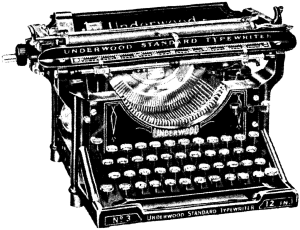
Underwood Standard Typewriter, PD|75 yrs image first published in the 1st (1876–1899), 2nd (1904–1926) or 3rd (1923–1937) edition of Nordisk familjebok.

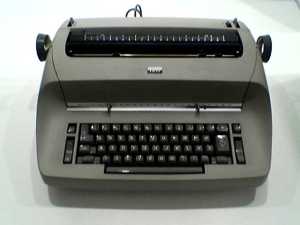
IBM Selectric, By Oliver Kurmis [CC BY 2.5 (https://creativecommons.org/licenses/by/2.5), from Wikimedia Commons

6 Comments

Filed under writing

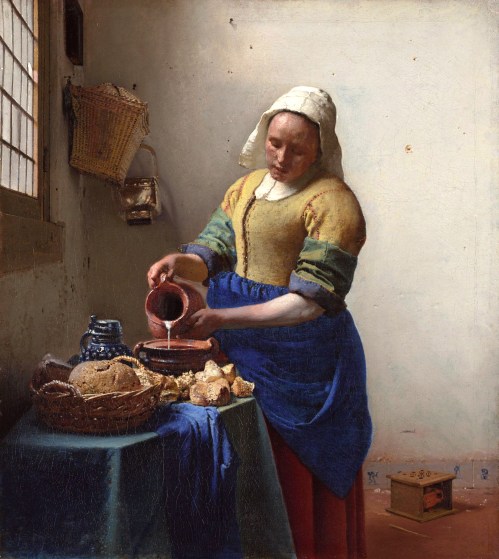
#FineArtFriday: The Milkmaid, by Johannes Vermeer #laborday

In America, the first Monday in September is Labor Day, the last long weekend of summer. The weather is still warm, and many people will be enjoying the last big holiday of the summer, barbecuing or camping out. Many will be traveling long distances and staying in hotels.

Because Labor Day is a national holiday, many workers will have Monday off. But those who work in the hospitality industry and in food service will be working overtime, making the holiday good for everyone else. People in the retail industry will also be working long hours, as the last big sales before Halloween will be in effect.

Over the course of my life, I have worked in a wide variety of jobs, most of them paying a low wage. By the mid-nineties, things were easier. As a bookkeeper/office manager I made $7.50 an hour (two dollars over minimum at the time) but I worked less than 30 hours a week with no benefits whatsoever. On weekends and holidays, I worked as a hotel housekeeper in a union shop, making $8.50 (three dollars over minimum), working about 20 hours a week. That gave me enough income from the two jobs to live on and provide for my children.

While I was raising my children, no matter what job I had during the week, I kept my weekend job at the hotel, because when other jobs went away, I always had that one to fall back on.

Only hotel housekeepers with the highest seniority will work a forty hour week. The rest average twenty to thirty hours a week because people travel on weekends more than they do during the week, and certain times of the year are less traveled than others. We maids and laundry workers would have had nothing more than minimum wage without the union. Because of the union, we who did the dirty work earned a little more than those who worked at non-union hotels, and we had a few benefits such as health insurance and a 401k to set aside a little money for our retirement.

Not every union is good, and not every union is reasonable. But I have gratitude that my family and I were protected by a good, reasonable labor organization during those years that were such a struggle for me. Every worker deserves that his/her employer treats them with respect and a fair wage in return for their labor.

As we entered the new millennium, the entry-level job market had improved, and I joined the ranks of Corporate America. Working in the data entry pool for several large corporations over the next few years, I earned enough to give up my part-time job as a hotel maid.

I now have the luxury to live my dream, writing the books that I always wanted to write when I didn’t have the time. And while the world is a different place in many ways than it was in the 1980s, someone still must do the dirty jobs, the work that no one else wants. These people are heroes.

I have nothing but respect for those people who work long hard hours in all areas of the service industry, struggling to support their families. Look around you and see the people who make your life easier just by being there every day doing their job.

Every one of them is a person just like you, a living, caring human being with hopes, ambitions, triumphs, and tragedies. Every one of them has a story and a reason to be where they are, doing the task they have been given. Most love what they do and do the best job that they can.

Take the time to say a little “thank you” to all those women and men who take your unintentional abuse when you are stressed out and “don’t have time to wait,” or are upset by things you have no control over and need to vent at someone who can’t or won’t fight back. Give a little thanks to those who do the dirty work and enable you to live a little easier.


About Johannes Vermeer, the Master of Light (from Wikipedia)

Johannes Vermeer (October 1632 – December 1675) was a Dutch painter who specialized in domestic interior scenes of middle-class life. He was a moderately successful provincial genre painter in his lifetime but evidently was not wealthy, leaving his wife and children in debt at his death, perhaps because he produced relatively few paintings.

Vermeer worked slowly and with great care, and frequently used very expensive pigments. He is particularly renowned for his masterly treatment and use of light in his work.

Vermeer painted mostly domestic interior scenes. “Almost all his paintings are apparently set in two smallish rooms in his house in Delft; they show the same furniture and decorations in various arrangements and they often portray the same people, mostly women.”

He was recognized during his lifetime in Delft and The Hague, but his modest celebrity gave way to obscurity after his death. He was barely mentioned in Arnold Houbraken‘s major source book on 17th-century Dutch painting (Grand Theatre of Dutch Painters and Women Artists), and was thus omitted from subsequent surveys of Dutch art for nearly two centuries. In the 19th century, Vermeer was rediscovered by Gustav Friedrich Waagen and Théophile Thoré-Bürger, who published an essay attributing 66 pictures to him, although only 34 paintings are universally attributed to him today. Since that time, Vermeer’s reputation has grown, and he is now acknowledged as one of the greatest painters of the Dutch Golden Age.

About the featured painting, The Milkmaid, also from Wikipedia:

Despite its traditional title, the picture clearly shows a kitchen or housemaid, a low-ranking indoor servant, rather than a milkmaid who actually milks the cow, in a plain room carefully pouring milk into a squat earthenware container (now commonly known as a “Dutch oven”) on a table. Also on the table are various types of bread. She is a young, sturdily built woman wearing a crisp linen cap, a blue apron and work sleeves pushed up from thick forearms. A foot warmer is on the floor behind her, near Delft wall tiles depicting Cupid (to the viewer’s left) and a figure with a pole (to the right). Intense light streams from the window on the left side of the canvas.

The painting is strikingly illusionistic, conveying not just details but a sense of the weight of the woman and the table. “The light, though bright, doesn’t wash out the rough texture of the bread crusts or flatten the volumes of the maid’s thick waist and rounded shoulders”, wrote Karen Rosenberg, an art critic for The New York Times. Yet with half of the woman’s face in shadow, it is “impossible to tell whether her downcast eyes and pursed lips express wistfulness or concentration,” she wrote.

“It’s a little bit of a Mona Lisa effect” in modern viewers’ reactions to the painting, according to Walter Liedtke, curator of the department of European paintings at The Metropolitan Museum of Art, and organizer of two Vermeer exhibits. “There’s a bit of mystery about her for modern audiences. She is going about her daily task, faintly smiling. And our reaction is ‘What is she thinking?'”


Credits and Attributions:

The Milkmaid, by Johannes (Jan) Vermeer ca. 1658 [Public domain or Public domain], via Wikimedia Commons.

Wikipedia contributors, “The Milkmaid (Vermeer),” Wikipedia, The Free Encyclopedia, https://en.wikipedia.org/w/index.php?title=The_Milkmaid_(Vermeer)&oldid=853243011 (accessed August 31, 2018).

Wikipedia contributors, “Johannes Vermeer,” Wikipedia, The Free Encyclopedia, https://en.wikipedia.org/w/index.php?title=Johannes_Vermeer&oldid=854172655 (accessed August 31, 2018).

2 Comments

Filed under #FineArtFriday, writing

Final Revisions #amwriting

The question came up in a professional Indie writers’ group I frequent on Facebook: Do I need to get an editor for my final manuscript or is a good proofread enough?

The overwhelming answer was a resounding “Yes!”

I am an editor but I always have my final manuscript edited by a professional editor, and I get a final proofread by members of my writing support group before I hit the publish button. As authors, we never see all our own mistakes although we catch many. We see what we intended to write rather than what is written. We misread clumsy sentences and overlook words that are missing or are included twice in a row. Our brain fills in the missing words and doesn’t notice when we use ‘its’ rather than ‘it’s,’ or ‘their’ rather than ‘they’re’ or ‘there.’

Also, we tend to overlook clumsy and inadvertently awkward phrasing.

  • Her eyes rolled over her host’s attire.
  • Delicious sounds assaulted his eardrums.

We overlook little things like those examples in our own work because we are visualizing the scene as we read it, and to us, they convey what we are thinking. We can’t see our own work with an unbiased eye, any more than we can see our children with an unbiased eye.

If you are unable to afford a full edit, and they are not cheap, there is a way to make a pretty good stab at revising your own manuscript, but it is time consuming. If you aren’t going to hire an editor, you should consider investing in the Chicago Guide to Grammar, Usage, and Punctuation. This is a resource with all the answers for questions you might have regarding grammar and sentence structure.

To do a thorough revision of your manuscript:

  1. Print out the first chapter. Everything looks different printed out, and you will see many things you don’t notice on the computer screen.
  2. Turn to the last page. Cover the page, leaving only the last paragraph visible.
  3. Starting with the last paragraph on the last page, begin reading, working your way forward.
  4. With a yellow highlighter, mark each place that needs correction.
  5. Look for
    • Typos,
    • Missing quotation marks,
    • Punctuation that is outside of the quotations.

Wrong: “dorothy flew over the rainbow in a house”. Said Toto. I went with her”.

Right: “Dorothy flew over the rainbow in a house,” said Toto. “I went with her.”

  • Words that are spelled correctly but are the wrong word – there-their-they’re, etc.
  • Look up “comma splice” and eliminate them from your manuscript.
  • Remove repetitions of entire ideas. If you explained it once, that was probably all you needed.
  • Check for repetitious use of certain key words and phrasing.
  • Eliminate all timid phrasing and remove unnecessary words. That and very are two words that can often be cut and not replaced with anything. Often cutting them makes a sentence stronger.

An editor points out and encourages you to correct all instances of timid phrasing. Timid phrasing leads to wordiness, and we really want to avoid that. Overuse of forms of to be (is, are, was, were) also lead to wordiness. Long, convoluted passages rife with compound sentences turn away most readers.

To avoid wordiness, use action words (verbs) in place of forms of to be. In active prose, our characters don’t begin (start) to move. Instead, they move. They act as opposed to beginning or starting to act.

  1. Open your manuscript on your computer and make your corrections.
  2. Repeat these steps with every chapter.

If you notice a few flaws in your manuscript in your final pass but think no one will be bothered by them, you’re wrong. Readers always notice the things that stop their eye.

In my own work, I have discovered that if a passage seems flawed, but I can’t identify what is wrong with it, my eye wants to skip it. But another person will see the flaw, and they will show me what is wrong there. This is why this editor always has a professional editor go over her manuscripts.

Once you have finished revising your manuscript in this fashion, have it proofread by a member of your writing group. If you are in a critique group, you have a great resource in your fellow authors as proof readers—they will spot things you have overlooked your work just as you do in theirs.

Editors do more than point out comma errors–they will make a note of incongruities, and contradictions.  They will also note inconsistent style and usage. When a manuscript comes across their desk, editors and publishers create a list of names, places, created words, and other things that may be repeated and that pertain only to that manuscript. This is called a style sheet.

The style sheet can take several forms, but it is only a visual guide to print out or  keep minimized until it’s needed. I copy and past every invented word, hyphenated word, or name the first time they appear in my manuscript, and if I am conscientious, I’ll be less likely to inadvertently contradict myself later on in the tale. My editor is grateful that I make this list so that she doesn’t have to!

Be aware that it is not an edit if you have done it yourself–it is only a deep revision. The best we can do with our own work is to keep revising it until it is as clean as we can make it. (See my article of June 20, 2018 – Thoughts on Revisions and Self-editing.) Only an external eye can see our work with an unbiased eye and properly edit it. But with diligence and the assistance of your critique group, it is possible to make good revisions yourself and you can turn out an acceptable book that a casual reader will enjoy.

I hope these suggestions help you in your revision process. We want our work to be enjoyable by the casual reader, and if we are conscientious in the final stages, we can turn out a readable manuscript that is not rife with easily fixable errors.

17 Comments

Filed under writing

Weather, a central component of world building #amwriting

Whether you write literary fiction, epic fantasy, historical fiction, or any other genre, you must carefully construct the environment your novel is set in. The weather is a constant in our lives and affects how we dress, how we travel, and what we eat. Therefore, it is a central component of world building. How does the weather come into play in your novel?

If your novel’s setting is a low-tech society, the weather will have more of an effect on your characters than one set in a modern society. However, in any era, the weather will affect the speed with which your characters can travel great distances, and it will affect how they dress. Bad weather always has a detrimental effect on transportation, a serious point to consider.

The weather can be shown in small, subtle ways. We use the weather to show the world in such a way that it doesn’t become the star of the story. What follows are excerpts from three of my works in progress, using weather to show the world in three different genres.

Weather is an integral part of world building in contemporary literary fiction:

The path was slippery and required scaling the cliff in some places. By the time they arrived at the clifftop, the weather had begun to clear, and the low fog was dissipating. Patches of blue peeked from behind the gray clouds, and the wind had picked up.

Parker absorbed the solitude, enjoying the way he could see the entirety of Baron’s Hollow, from one end of the cove to the other. He turned to Dominic. “You were right. This is perfect.” Gazing down on the world, he saw Izzy running with the dogs at the south end, heading toward the lighthouse as if she were trying to outrun her anger, the wind tearing her blonde hair from its braid. At the house, John stood on the deck, absorbed in whatever it was he was painting, oblivious to the drama.

Far down at the north end of the cove, Leo and Claire walked beside the surf, with Leo’s gestures emphasizing his words. Claire was alternately agitated and hunched against the sharp breeze in her hooded sweatshirt. It was clear her agent had told her something she didn’t want to hear. Parker chuckled; she looked like a little girl being chastised by her father.

How does the weather look, feel, smell? What does it sound like? I use it to show the world in my medieval fantasy:

In the absence of battle noises, the hissing of the rain on the foliage was loud in Julian’s ears. The odors of wet horses mingled with the scents of blood and damp, musty undergrowth.

Our characters are not always traveling or fighting in the rain. Use the weather:

Dust hung in the air, burning his eyes, a thick pall that concealed him but also hid his quarry.

Even in an epic fantasy, at times our characters are moved by the beauty of the world around them.

Alf’s gaze was caught by a giant maple, far across the valley. The setting sun lit the halo of spring’s new leaves, and the maple’s glowing crown of iridescent green became a beacon, shining in the forest of dark evergreens. The thought crossed his mind that the tree was like hope. It shone against the darkness of the trees around it, a guiding light for the weary to cling to. Maybe his son would live. Maybe the new treatments would work.

We are able to find out how various modern societies deal with severe weather, simply by looking on the internet. Hurricanes, blizzards, wildfires–how local communities prepare for and deal with these events is newsworthy. But historical societies also had ways of dealing with the weather when they had to be out in it, and the internet is also your friend when you are researching this.

In early medieval times, people of England, Wales, and Ireland didn’t have to deal with the extreme temperatures they experienced in the 17th and 18th centuries, as it was a warmer time. However, they did get some occasional snow and cold in the winter, and at times they suffered heat waves during the summer.

In a cold, wet winter, a simple shawl won’t cut it. Layers are critical, and the materials they would use are simple and readily available—linen and wool.

I hate it when I come across an improbability in an otherwise good narrative. If you write fantasy or romance, you must remember that while fur-trapping is a common way of earning money in a lower-tech society, only the wealthier classes, the merchants, and nobility, will be able to buy those furs. The trapper and his/her family will have fur lining and fur trim on some of their cold-weather garments, but they won’t be ostentatious or stylish. Their clothes will be strictly utilitarian, designed for warmth, as everything they trap will be sold. Certainly, the best furs will be sold, so what they wear will not be the rarest. After all, the trapper is working to earn money for their family.

In tropical climates, people wear fewer clothes, and those they do wear are much lighter in weight. They protect the wearer from the sun, but breathe, allowing for comfort in times of high heat and humidity.

The average medieval agrarian society will have access to fleeces, though spun wool is more common. Also, in the more urban centers of a low-tech society, the average person’s winter garments, hooded cloaks, gloves, and even bedding would be made of thick wool, layered and felted.

Wool has been a winter mainstay since humans first began making cloth. Some garments will be made of heavy canvas or oil-cloth. Oilcloth, close-woven cotton canvas or linen cloth with a coating of boiled linseed oil,  was a product available from the late middle ages on.

Clothing and cold weather gear will make their appearance in relatively few sentences in your novel. Most likely it will only be mentioned in passing, but it is important as part of what builds the world you are creating. A little research on your part regarding what technology might be plausible in your society will lend a sense of realism to your work.

The world we set our character in is far more than whether they travel on horseback or in a Maserati, more than clothes and fashion, more than décor and food. The world has weather, which affects everything and makes the décor and the Maserati real. When you include the sounds and sensations of the weather, it lends a sense of solid reality to the words you write on paper.

These words we write are, after all, only a dream with a beginning, middle, and end, a vision we want to make believable through solid world building.


If you need to know how people protected themselves against the weather in the middle ages, here are several good websites for research:

Sarah Woodbury, Romance and Fantasy in the Middle Ages

Medieval Gloves, etc.

Castles and Manor Houses


Credits and Attributions:

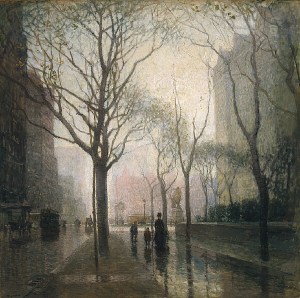
The Plaza After Rain,  Paul Cornoyer PD|100 via Wikimedia Commons

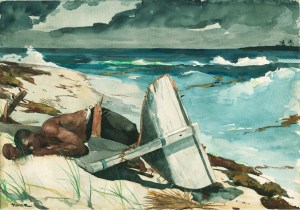
After the Hurricane, Bahamas by Winslow Homer, [Public domain], via Wikimedia Commons

17 Comments

Filed under writing

#FineArtFriday: Two Photographs, Two Years Apart

As I mentioned in my last post, The Summer Retreat, I am enjoying the last days of summer in Cannon Beach, Oregon. We will go back north to our home tomorrow. This has been a strange year, with unusual heat and a thick, smoky haze that marred the first three days.

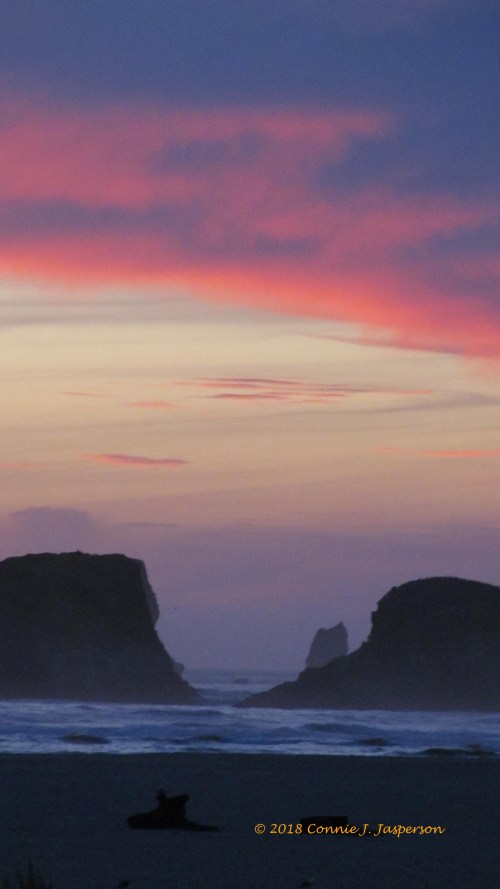
This is the view of Tillamook Head as seen from Ecola Creek on August 13, 2016. That was a year of fabulous sunsets, deep blue skies and perfect kite flying winds.

This following image is the shot I took of  sunset three days ago on the same beach, with a more southern angle–the sea stacks are to the right, just out of the frame. At the time the photo was taken, the sun was still an hour above the horizon, and it should have been full daylight instead of twilight.

The brown haze is so thick, it looks as as if the image is grainy and overexposed, but as you can see by the red sun, it is just smoke obscuring the view of the ocean, hiding the rocks, and nearly hiding the sun. That was a difficult day for those of us with asthma, as the sun was obscured for most of the day, despite the intense humidity and 90 degree heat. The surf looks unreal, as if it were a badly composed painting.

Today the brown haze cleared and the temperatures dropped to the normal high 60’s to mid 70’s–which is perfectly comfortable. Not breathing the smoke from the West Coast Wildfires is a relief, although I suspect we will return to that misery once we return to our own inland valley.

Nevertheless, it will be good to be home. We love this place and this beach and return every year. And every sojourn here is  so different, so unique, always with something new to enjoy. Even when, as it was this year, it is a strange, nearly post apocalyptic year.


Credits and Attributions:

Images and text © 2018 Connie J. Jasperson, All Rights Reserved

Comments Off on #FineArtFriday: Two Photographs, Two Years Apart

Filed under #FineArtFriday, writing