#FineArtFriday – “The Breakwater” or “Storm off a Sea Coast” by Jacob van Ruisdael ca. 1670

Artist: Jacob van Ruisdael (1628/1629–1682)

Titles: The Breakwater (current title)

Also known as: Storm off a Sea Coast

Also known as: Ships in Stormy Weather off the Coast

Also known as: A Storm at Sea Off the Dykes of Holland

Genre: marine art

Date: between 1670 and 1672

Medium: oil on canvas

Dimensions: height: 110 cm (43.3 in); width: 160 cm (62.9 in)

Collection: Louvre Museum

What I love about this painting:

Jacob van Ruisdael shows us a wild day down at the port. Several cargo ships are attempting to dock before the full force of the storm descends upon them. He shows us the action, the motion of the clouds flying across the sky above, and the roiling sea below. A shaft of light illuminates the white foam of the churning waves.

Will the ships’ captains and crews manage to get their vessels into the harbor and safely berthed? Will some be dashed against the rocks or tossed up onto the seawall?

Van Ruisdael paints us a story, but we must imagine the ending for ourselves.


About this painting via Wikipedia:

Storm Off a Sea Coast, also known as The Breakwater, is a 1670 oil on canvas painting by the Dutch Golden Age painter Jacob van Ruisdael. It is in the collection of the Louvre in Paris.

The painting is called A Storm at Sea Off the Dykes of Holland in the 1911 catalogue raisonné compiled by Cornelis Hofstede de Groot, in which it is catalogue number 961. De Groot described the scene: “On the right is a dyke lined with piles, beyond which is a fisherman’s cottage with a few trees. On the left corner of the dyke, great waves are breaking. Farther back rise the masts of several large vessels, as well as the stern with a Dutch flag.” The painting is called Storm Off a Sea Coast in Slive’s 2001 catalogue raisonné of van Ruisdael, in which it is given catalogue number 653.

In the 19th century, Vincent van Gogh called this painting by van Ruisdael, along with The Bush and Ray of Light, “magnificent”. The Louvre has in French: “L’Estacade ou Gros temps sur une digue de Hollande, dit aussi Une tempête” (the Jetty or Stormy Weather on a Dike in Holland, also known as A Storm). Its inventory number is INV. 1818. Its dimensions are 110 cm x 160 cm. [1]

About the artist, via Wikipedia:

Jacob Isaackszoon van Ruisdael c. 1629 – 10 March 1682) was a Dutch painter, draughtsman, and etcher. He is generally considered the pre-eminent landscape painter of the Dutch Golden Age, a period of great wealth and cultural achievement when Dutch painting became highly popular.

Prolific and versatile, Ruisdael depicted a wide variety of landscape subjects. From 1646 he painted Dutch countryside scenes of remarkable quality for a young man. After a trip to Germany in 1650, his landscapes took on a more heroic character. In his late work, conducted when he lived and worked in Amsterdam, he added city panoramas and seascapes to his regular repertoire. In these, the sky often took up two-thirds of the canvas. In total he produced more than 150 Scandinavian views featuring waterfalls.

Ruisdael’s only registered pupil was Meindert Hobbema, one of several artists who painted figures in his landscapes. Hobbema’s work has at times been confused with Ruisdael’s. Ruisdael always spelt his name thus: Ruisdael, not Ruysdael.

Ruisdael’s work was in demand in the Dutch Republic during his lifetime. Today it is spread across private and institutional collections around the world; the National Gallery in London, the Rijksmuseum in Amsterdam, and the Hermitage Museum in St. Petersburg hold the largest collections. Ruisdael shaped landscape painting traditions worldwide, from the English Romantics to the Barbizon school in France, and the Hudson River School in the US, and influenced generations of Dutch landscape artists. [2]


Credits and Attributions:

IMAGE: The Breakwater, Wikipedia contributors, “Storm Off a Sea Coast,” Wikipedia, The Free Encyclopedia, https://en.wikipedia.org/w/index.php?title=Storm_Off_a_Sea_Coast&oldid=1252177345 (accessed May 22, 2025).

[1] Wikipedia contributors, “Storm Off a Sea Coast,” Wikipedia, The Free Encyclopedia, https://en.wikipedia.org/w/index.php?title=Storm_Off_a_Sea_Coast&oldid=1252177345 (accessed May 22, 2025).

[2] Wikipedia contributors, “Jacob van Ruisdael,” Wikipedia, The Free Encyclopedia, https://en.wikipedia.org/w/index.php?title=Jacob_van_Ruisdael&oldid=1290856128 (accessed May 22, 2025).

2 Comments

Filed under #FineArtFriday

Phrasing, pacing, and voice #writing

Today, we are revisiting the way our habitual word choices affect the pacing of our narrative.

We are encouraged to write active prose as opposed to passive, but what does that mean? First, the term “active prose” does not refer to the events that keep the plot arc moving.

Active prose refers to our word choices and how we construct our sentences.

A passive sentence is not “wrong.” No matter how active the phrasing, a poorly written sentence is not “better.”

Passive phrasing slows the reader’s perception of the story, which may be what you want.

  • “Deep in the forest, there was a cabin.” Passive, descriptive, longer.
  • “A cabin stood deep in the forest.” Active, verb forward, shorter.

The two examples say the same thing, but the words that surround and modify “cabin” change the mood of the sentence and set the tone for what follows. Neither sentence is right or wrong. It’s up to the writer to choose which style they go with.

Most modern readers don’t have the patience for long strings of descriptive, wordy sentences. However, they do like a chance to breathe and absorb what just happened.

Our task is to mingle active and passive phrasing to keep things balanced. That skill is a fundamental aspect of pacing.

Good pacing is about balanced prose as much as it is about staging the events. It is dynamic, engaging, and immersive.

How do we write balanced prose? It begins with the words we choose to show our story and the order in which we place them in the sentence.

The ways we combine active and passive phrasing are part of our signature, our voice. By mixing active phrasing with a little passive, we choose areas of emphasis and places in the narrative where we want to direct the reader’s attention.

Some types of narratives should feel highly charged and action-packed. Most of your sentences should be constructed with the verbs forward if you write in genres such as sci-fi, political thrillers, and crime thrillers.

  • Stephenie gripped the handhold, bracing herself.

The above sentence is Noun + verb + article + noun + transitive verb + noun.

Verbs are action words, but all verbs are not equal in strength.

Verbs that begin with hard consonants are power verbs. They push the action outward from a character. Other verbs pull the action inward. The two forces, push and pull, create a sense of opposition and friction. Dynamism in word choices injects a passage with vitality, vigor, and energy.

  • When we employ verbs that push the action outward from a character, we make them appear authoritative, competent, energetic, and decisive.
  • Conversely, verbs that pull the action in toward the character make them appear receptive, attentive, private, and flexible.

A poor choice of words makes a sentence weak. Passive construction can still be strong despite being poetic.

Has someone said your work is too wordy? An excess of modifiers could be the offenders.

  1. Look for the many forms of the phrasal verb to be. These words easily connect to other words and lead to long, convoluted passages.
  2. Look for connecting modifiers (still, however, again, etc.).

Concise writing can be difficult for those of us who love words in all their glory. Nevertheless, I work at it.

My goal during revisions is to make use of contrasts to show the story with the least number of words.

  • dwell on / ignore
  • embrace / reject
  • consent / refuse
  • agony / ecstasy

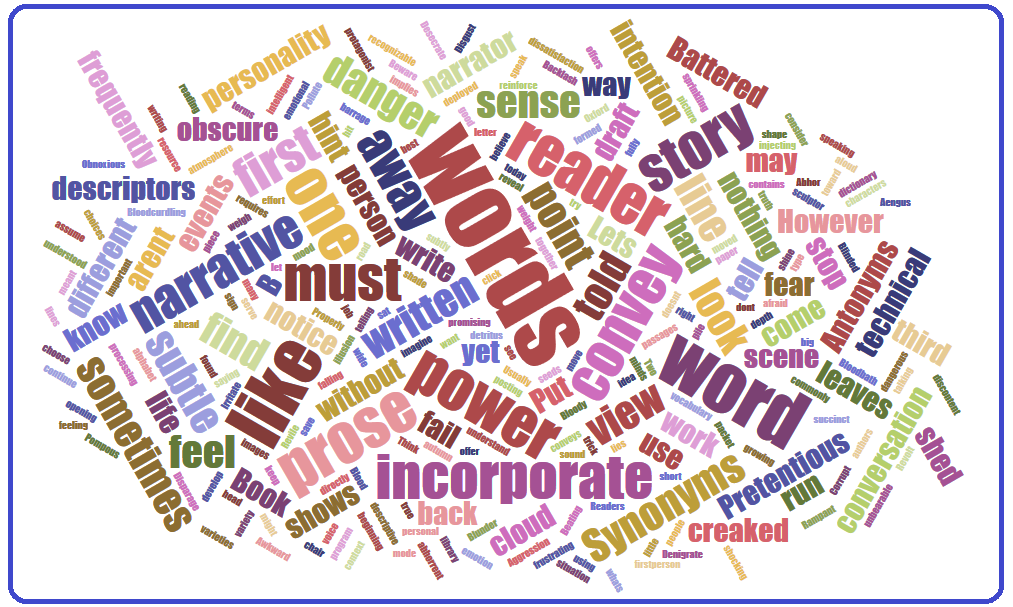
Many power words begin with hard consonants. The following is a short list of nouns and adjectives that start with the letter B. The images they convey when used to describe action project a feeling of power:

  • Backlash (noun)
  • Beating (noun or verb)
  • Beware (verb)
  • Blinded (adjective)
  • Blood (noun)
  • Bloodbath (noun)
  • Bloodcurdling (adjective)
  • Bloody (adjective)
  • Blunder (noun or verb)

courtesy Office360 graphics

As you can see, some nouns are also verbs, such as beating or blunder. When you incorporate any of the above “B” words into your prose, you are posting a road sign for the reader, a notice that danger lies ahead.

If I want to create an atmosphere of anxiety, I would use words that push the action outward:

  • Agony (noun)
  • Apocalypse (noun)
  • Armageddon (noun)
  • Assault (verb)
  • Backlash (noun)
  • Pale (modifier)
  • Panic (verb or noun)
  • Target (verb)
  • Teeter (verb)
  • Terrorize (verb)

If I want to show the interior workings of a character without resorting to a dump of italicized whining, I could write their internal observations using words that draw us in:

  • Delirious (modifier)
  • Depraved (modifier)
  • Desire (verb)
  • Dirty (modifier)
  • Divine (modifier)
  • Ecstatic (modifier)

So why are verbs so crucial in shaping the tone and atmosphere of a narrative? When things get tricky and the characters are working their way through a problem, verbs like stumble or blunder offer a sense of chaos and don’t require a lot of modifiers to show the atmosphere.

We are drawn to the work of our favorite authors because we like their voice and writing style. The unique, recognizable way they choose words and assemble them into sentences appeals to us, although we don’t consciously think of it that way.

In the second draft, I finetune the plot arc and character arcs, and most importantly, I adjust phrasing.

The tricky part is catching all the weak word choices. Those of you who write a clean first draft are rare and wonderful treasures. I wish I had that talent.

When I find a stretch of blah-blah-blah, I reimagine the scene. I go to the thesaurus to see how to strengthen the narrative while still keeping to my original intention.

There are times when nothing will improve an awkward scene, and it must be scrapped. Be brave and be bold, and cut away the dead wood.

Things to remember:

  • Where we choose to place the verbs changes their impact but not their meaning.
  • The words we surround verbs with change the mood but not their intention.
  • Modifiers are words that alter their sentences’ meanings. They add details and clarify facts, distinguishing between people, events, or objects.
  • Infinitives are mushy words, words with no definite beginning or end.

Modifiers and infinitives are necessary for good writing. However, like salt or any other seasoning, they have the power to strengthen or weaken our prose.

So now you know what I have been doing here at Casa del Jasperson. Cleaning up my excessively wordy work-in-progress is time-consuming. However, I enjoy this aspect of the craft as much as writing the first draft.

Comments Off on Phrasing, pacing, and voice #writing

Filed under writing

#FineArtFriday: A second look at “The Plaza After the Rain” by Paul Cornoyer

Paul_Cornoyer_-_The_Plaza_After_RainArtist: Paul Cornoyer  (1864–1923)

Title: The Plaza After Rain

Date: Before 1910

Medium: oil on canvas

Dimensions: 59 1/4 x 59 1/4 in. (150.5 x 150.5 cm)

Collection: Saint Louis Art Museum, Saint Louis, Missouri, United States

What I love about this painting:

This painting appeared here in January of 2024. Paul Cornoyer was a master at painting the way wet pavement looks, the reflections and the sheen. Rain is a near-constant companion during a Pacific Northwest winter and while it is now May, today is no exception.

Paul Cornoyer’s The Plaza After Rain depicts New York City, which is on the other side of the continent from me, and it takes place in a different era. But he shows the way rain is in early spring no matter where in the northern US you reside.

The sky is dark, but the trees are just beginning to leaf out. The rain is passing, and the streets are wet, but a hint of blue is showing through the dark sky. When you see this painting, you see the story of a cold spring day. Yet, one has the feeling that sunshine could happen any minute.

Impressionism is flash fiction on a canvas. All the important things are there, everything the eye needs to have a perfect vision of the mood, the setting, and characters at that moment in time. The important things at that moment are depicted within the piece, but with economy.

The St. Louis Art Museum says this about The Plaza After the Rain:

A drizzling rain creates watery reflections on the streets and sidewalks along the Grand Army Plaza in Manhattan. The rain hampers our view down the vista, though the moody tones of pinks, grays, and blues make up for this loss. The light in the distance offers a hazy glimpse of the southeast corner of Central Park, with its beloved bronze statue of Civil War general William Tecumseh Sherman. [2]

About the Author, via Wikipedia:

Paul Cornoyer (1864–1923) was an American painter, currently best known for his popularly reproduced painting in an Impressionisttonalist, and sometimes pointillist style.

Born in St. Louis, Missouri, Cornoyer began painting in Barbizon style and first exhibited in 1887. In 1889, He moved to Paris, where he studied at the Académie Julian alongside Jules Lefebvre and Jean-Joseph Benjamin-Constant. After returning from his studies in Paris in 1894, Cornoyer was heavily influenced by the American tonalists. At the urging of William Merritt Chase, he moved to New York City in 1899. In 1908, the Albright–Knox Art Gallery (formerly the Albright Gallery) hosted a show of his work. In 1909, he was elected into the National Academy of Design as an Associate Academician. He taught at Mechanics Institute of New York and in 1917, he moved to Massachusetts, where he continued to teach and paint.

Cornoyer received a retrospective exhibition entitled Paul Cornoyer: American Impressionist at the Lakeview Center for the Arts and Sciences in Peoria, Illinois in 1973. The exhibit drew heavily from the collection of Dr. and Mrs. Lawrence Ashby, who loaned multiple paintings to the exhibit, as well as over 20 works on paper. [1]


Credits and Attributions:

IMAGE: The Plaza After the Rain by Paul Cornoyer PD|100, Wikimedia Commons contributors, “File:Paul Cornoyer – The Plaza After Rain.jpg,” Wikimedia Commons, https://commons.wikimedia.org/w/index.php?title=File:Paul_Cornoyer_-_The_Plaza_After_Rain.jpg&oldid=345336218 (accessed January 18, 2024).

[1] Wikipedia contributors, “Paul Cornoyer,” Wikipedia, The Free Encyclopedia, https://en.wikipedia.org/w/index.php?title=Paul_Cornoyer&oldid=1118249028 (accessed January 18, 2024).

[2] St. Louis Art Museum contributors, the Plaza After the Rain by Paul Cornoyer, The Plaza after the Rain – Saint Louis Art Museum (slam.org) (accessed January 18, 2024).

2 Comments

Filed under #FineArtFriday, writing

Foreshadowing and pacing #writing

I’m sitting here on a cloudy Sunday morning in May, sipping tea and wondering what to write for this post. Things have been crazy on the home front for a couple of months. Well, for the last year, really. Now my husband is settled in a good place where he can be properly cared for around the clock. I am adjusting to having more time on my hands than I’m used to.

He’s in a lovely, caring home now. I go there to visit him every morning after I tend our small veggie plot in the community garden. And yes, although I do have the time now, I struggle to find the ambition to reorganize my jumble of an office.

However, while housekeeping still bores me, and I no longer have a valid excuse for not doing it, I always feel like writing.

Which seems more important than filing the pile of medical and legal documents that depress me.

I just don’t always know what to write.

And, sometimes, it’s hard to know where a story should actually begin. Is it the eve of a party? Is it the day of a friend’s funeral? Where does the story begin?

Wherever the story starts, I want the reader to keep turning the pages, and a little foreshadowing can encourage them to do that.

Hints that all is not what it seems are an important aspect of the narrative. They pique the reader’s interest and make them want to know what is really going on and how the book will end.

But what is foreshadowing? It is the subtle warning that danger lurks ahead, a few clues embedded in the first quarter of the story to subliminally alert the reader that things may not go well for the protagonist. We include small warning signs of future events, bait, if you will, to lure the reader and keep them reading

In the opening paragraphs, I will focus on the protagonists and hint at their problems. Novels are built the same way as a Gothic cathedral. Each scene is a small arc of action and reaction. These arcs support other arcs in layers, creating an intricate structure that rises high and withstands all that nature can throw at it.

In the first draft, we all commit sins of craftsmanship. These are secret codes, road signs for us to examine in the second draft:

  1. Clumsy foreshadowing, baldly stating what is going to happen later. We rewrite those scenes to make the clues less obvious.
  2. Or we might commit the opposite sin, neglecting to foreshadow so that events seem to arrive out of nowhere.

Recognizing those signals can be a challenge, but hopefully, our beta readers will notice and comment. My writing group is central to my work process.

We all know the opening paragraphs are vital. They are the hook and must offer a reason for the reader to continue past the first page. These paragraphs usually sell the book.

Getting the pacing right in those opening paragraphs and maintaining it to the last page is, in my opinion, the most challenging part of writing.

How much exposition is needed? What can be cut without making the story choppy and confusing? What must stay? When a possibility is briefly, almost offhandedly mentioned, but almost immediately overlooked or ignored by the protagonists, that is a form of foreshadowing.

Is that hint enough for the reader to understand what is going on? It’s easy to accidentally frontload the opening pages with a wall of backstory. I learned the hard way that long lead-ins ruin the chances of your book making readers happy.

I try to open the story with my characters in place and get the introductions out of the way. Within the first few pages, a question of some sort must be raised, or I must get the inciting incident underway. This is crucial for the pacing as it sets the characters and the reader on the trail of the answer, throwing them into the action.

Usually, there is no reason for the characters to hear the twelve-paragraph saga of the Caverns of Despair before they enter them. The readers also don’t need to know that history. The name is descriptive and is an indicator of what lies ahead. Names of places can be a form of foreshadowing that don’t slow the pacing.

Often, side characters will drop clues regarding things the protagonist doesn’t know, knowledge that affects the plot. Subplots that advance the main story’s plot arc are excellent ways of introducing the emotional part of the story, but beware.

Side quests are often fun in a video game but can ruin the pacing of a novel. They can be distracting and make for a haphazard story arc if they don’t relate to the central quest. I think side quests work best if they are presented once the book’s overall atmosphere is established and the core crisis is underway, and only if they are necessary for the completion of the principal quest.

Like Bilbo finding the One Ring.

Sometimes, we open the story by dropping our characters into the middle of an event. Even if we do that, we still need a pivotal event at the 1/4 mark that completely rocks their world. The event that changes everything is the jumping-off point for the story.

As a reader, I notice when a character suddenly displays a new skill or knowledge, something they never showed before. When this happens, it’s usually explained away as a Chekhov’s Skill. I usually stop reading at that point and forget about finishing the book.

Without briefly foreshadowing that superior ability, the reader will assume the character doesn’t have it, and the narrative becomes unbelievable. A casual mention early on of the characters using or training to use that skill would make it believable.

The most crucial aspect of foreshadowing is the surprise a reader feels when the clues come together to form a complete picture of the imminent disaster. This is the moment when the reader says, “I should have seen that coming.”

We have many reasons to pursue good foreshadowing skills. In my opinion, the most important is that it helps avoid using the clumsy Deus Ex Machina (pronounced: Day-us ex Mah-kee-nah) (God from the Machine) as a way to miraculously resolve an issue.

That literary faux pas occurs when, toward the end of the narrative, an author inserts a new event, character, ability, or otherwise resolves a seemingly insoluble problem in an unexpected and miraculous way.

Pacing is a combination of action and reaction. Transitions bookend each scene. They are a door into the scene and the way out. The way out is always the way into the next scene. How we use those transitions determines the importance of the passage. The bookends determine the narrative’s pacing.

Transition scenes get us smoothly from one event or conversation to the next. They push the plot forward and control pacing.

  • Action, reaction, information, reaction, action, reaction, rinse, and repeat until the story reaches its conclusion.

So, now that I have rambled on about writing, I will get busy and clear up my office. I always feel better once a disagreeable task is properly finished.

And then, maybe I will make some headway on my work in progress. Working in a lovely, organized space—what a concept!


Credits and Attributions:

IMAGE: The Crystal Ball by John William Waterhouse, 1902. Wikimedia Commons contributors, “File:John William Waterhouse – The Crystal Ball.JPG,” Wikimedia Commons, https://commons.wikimedia.org/w/index.php?title=File:John_William_Waterhouse_-_The_Crystal_Ball.JPG&oldid=1009616986  (accessed May 11, 2025).

IMAGE: The One Ring, Wikimedia Commons contributors, “File:One Ring Blender Render.png,” Wikimedia Commons, https://commons.wikimedia.org/w/index.php?title=File:One_Ring_Blender_Render.png&oldid=914989927 (accessed May 11, 2025).

2 Comments

Filed under writing

#FineArtFriday: a closer look at “Calais Pier by J.M.W. Turner, 1803”

Calais_pier_Joseph_Mallord_William_Turner_024

Artist: J. M. W. Turner (1775–1851)

Title: Calais Pier

Date: 1803

Medium: oil on canvas

Dimensions: height: 172 cm (67.7 in); width: 240 cm (94.4 in)

Collection: National Gallery

What I love about this painting:

The art of Joseph Mallord William Turner holds a large place in my heart. His originality, his later lack of deference to artistic conventions of the day often made his life hard. But what wonderful works emerged from his view of the world. Much like Van Gogh would do thirty years later, Turner’s work eventually evolved into a style that was original and sheer genius. His ability to paint what he saw and felt rather than the accepted classic literal depiction of a scene inspired the next generation of artists, the Impressionists.

Caiais Pier is one of his earlier works, painted when he was still influenced by his classical training. And yet, it is an emotion-packed image, the scene of a near-tragedy. The packet boat has arrived at Calais with a full load of passengers. The storm dominates the scene with lowering clouds and a heavy swell, but the sun breaks through and lights on the sail. A shaft of light shines down to the sea illuminating the center of the composition.  The young artist put his experience and terror into the image, depicting the ferocity of the sea and the violence of the landing.

The National Gallery website says of this picture, “Although it had a mixed response when first exhibited at the Royal Academy in 1803, the critic John Ruskin declared it to be the first painting to show signs of ‘Turner’s colossal power’. Calais Pier is based upon an actual event. On 15 July 1802, Turner, aged 27, began his first trip abroad, travelling from Dover to Calais in a cross-channel ferry (a packet) of the type shown here. The weather was stormy, and Turner noted in his sketchbook: ‘Our landing at Calais. Nearly swampt.’” [1] Joseph Mallord William Turner | Calais Pier | NG472 | National Gallery, London

About the Artist, Via Wikipedia:

Joseph Mallord William Turner RA (23 April 1775 – 19 December 1851), known in his time as William Turner, was an English Romantic painter, printmaker and watercolorist. He is known for his expressive coloring, imaginative landscapes and turbulent, often violent marine paintings. He left behind more than 550 oil paintings, 2,000 watercolors, and 30,000 works on paper. He was championed by the leading English art critic John Ruskin from 1840 and is today regarded as having elevated landscape painting to an eminence rivalling history painting.

Turner was born in Maiden Lane, Covent Garden, London, to a modest lower-middle-class family and retained his lower class accent, while assiduously avoiding the trappings of success and fame. A child prodigy, Turner studied at the Royal Academy of Arts from 1789, enrolling when he was 14, and exhibited his first work there at 15. During this period, he also served as an architectural draftsman. He earned a steady income from commissions and sales, which due to his troubled, contrary nature, were often begrudgingly accepted. He opened his own gallery in 1804 and became professor of perspective at the academy in 1807, where he lectured until 1828. He travelled around Europe from 1802, typically returning with voluminous sketchbooks.

Intensely private, eccentric, and reclusive, Turner was a controversial figure throughout his career. He did not marry, but fathered two daughters, Evelina (1801–1874) and Georgiana (1811–1843), by his housekeeper Sarah Danby. He became more pessimistic and morose as he got older, especially after the death of his father in 1829; when his outlook deteriorated, his gallery fell into disrepair and neglect, and his art intensified. In 1841, Turner rowed a boat into the Thames so he could not be counted as present at any property in that year’s census. He lived in squalor and poor health from 1845, and died in London in 1851 aged 76. Turner is buried in St Paul’s Cathedral, London. [2]


Credits and Attributions:

“Calais Pier” by J.M.W. Turner, 1801. Wikipedia contributors, “Calais Pier,” Wikipedia, The Free Encyclopedia, https://en.wikipedia.org/w/index.php?title=Calais_Pier&oldid=1287504024 (accessed May 9, 2025).

[1] National Gallery contributors, Calais Pier, Joseph Mallord William Turnerhttps://www.nationalgallery.org.uk/paintings/joseph-mallord-william-turner-calais-pier (accessed May 9, 2025).

[2] Wikipedia contributors, “J. M. W. Turner,” Wikipedia, The Free Encyclopedia, https://en.wikipedia.org/w/index.php?title=J._M._W._Turner&oldid=1289276733 (accessed May 9, 2025).

2 Comments

Filed under #FineArtFriday

Worldbuilding – Calendars and Maps #writing

I discovered early on that keeping a calendar and a map gives me a realistic view of my plot arc. A calendar of events helps me remember in what season an incident occurred when something arises later in the first draft that pertains to it. Foliage changes with the seasons, and weather is a part of worldbuilding. Spring foliage is very different from autumn in the part of the world I am from.

And there are other reasons for keeping a calendar as well as sketching a simple map that no one but yourself will see.

A calendar of events helps you with pacing and consistency. In conjunction with a map, a calendar keeps the roadblocks moving along the story arc. It ensures you allow enough time to reasonably accomplish large tasks, enabling a reader to suspend their disbelief.

When it comes to calendars, I suggest you stick with what is familiar, and here is why. In 2008, a lunar calendar seemed like a good thing when creating my first world. The storyline and world of Mountains of the Moon was originally for an anime-style RPG that was never built due to several reasons, a tech crash being only one. When the project was scrapped, I still had the rights to my storyline, maps, and calendars.

My calendar for that world was (and still is) a hot mess.

In the game as we envisioned it, the calendar wouldn’t have been a problem as the days of the week were only mentioned in terms of when a shop was open. But that storyline eventually became my Tower of Bones series, which is set in the world of Neveyah. The calendar I devised so long ago for the game is an annoyance to me now.

  • Thirteen months, twenty-eight days each, named after astrological signs. Capricas, Aquis, Piscus, etc. (Not that many people know what time of year Taurus or Capricorn are unless it’s their birth sign.)
  • The names I assigned to the dates and months are problematic: Lunaday, Tyrsday, Odensday, Torsday, Frosday, Sunnaday, and Restday.

Not confusing at all. Nope.

In 2008, I had no idea just how awful my choice of names for the days and months would end up being. The calendar could have been scrapped and switched to our real-world calendar when I decided to turn it into a novel, but that didn’t occur to me.

And now, seventeen years later, I’m stuck with it. It’s why all my other books are plotted using the modern Gregorian calendar.

So take my advice and keep it simple.

But lets go back to the maps. 

Maybe you think you aren’t artistic enough for mapmaking.

Original Map of Neveyah from 2008 © 2008 cjjasperson

You don’t have to be an artist to draw a rudimentary map of an imaginary place. The rudimentary elements of the first map of my World of Neveyah series were scribbled on graph paper during a phone conversation. It evolved from there to the map you see at the left.

Later, it evolved into an art piece for the books because I love pretty maps, such as those in the Wheel of Time books by Robert Jordan and Brandon Sanderson.

I use pencil and graph paper at this stage because the story chooses the geography. As the rough draft evolves, sometimes towns must be renamed. They may have to be moved to more logical places. Whole mountain ranges may have to be moved or reshaped so that forests and savannas will appear where they are supposed to be in the story.

Maybe you think you don’t need a map. If your characters are going from hither to yon, and you are writing about their travels, you probably should at least make good notes. But truthfully, it’s not a lot of work to scribble a few lines and note towns and landmarks. If you are designing a fantasy world, you only need a pencil-drawn map. Even if the story is set in a town, it helps to know where our characters are going in relation to their home base.

These maps and notes and calendars are for your use only, a way to avoid introducing confusion into the story. So, your map doesn’t have to be fancy. Lay it out like a standard map with north at the top, east to the right, south to the bottom, and west to the left. Those are called cardinal points, each at 90-degree intervals in the clockwise direction, which is standard in modern maps.

Many towns are situated on rivers. Water rarely flows uphill. While it may do so if pushed by the force of wave action or siphoning, water is a slave to gravity and chooses to flow downhill. When making your map, locate rivers between mountains and hills. Rivers flow to a valley and either continue on to the ocean or pool in low spots and form lakes and ponds.

You might want to note where rivers and forests are situated relative to towns, or in the case of towns, what streets and cross streets our Heroes must travel. We need to take into account the fact that detours add to the distance and increase the time it takes to travel using the common mode of transportation.Rivers, mountains, lakes, and ponds make travel difficult, forcing a road or trail to go around them. This creates opportunities for plot twists in a fantasy story. Thieves, highwaymen—a lot of good plot fodder can be had with the right geography.

If your work is sci-fi, consider making a map of the space station/ship if that is where the story takes place. Billy Ninefingers is set in a wayside inn. I made a drawing of the floor plan for my purposes, noting who resided in each room, on the Rowdies’ floor because the inn is the world in which Billy’s story takes place.

If your characters travel, I suggest you keep the actual distances a bit general in the narrative because some readers will nitpick the details, no matter how accurate you are. Readers may not see it the way you do because their perception of a league might be three miles, while yours might be one and a half.

Both are correct. League (unit) – Wikipedia

Fantasy readers like maps. If you are writing fantasy but feel your hand-drawn map isn’t good enough to include in the finished product, consider hiring an artist to make a nice map from your notes.

No matter what genre we write in, we want the narrative to feel real for the reader. We do this through worldbuilding. Maps and calendars, no matter how rudimentary, are foundation tools of worldbuilding in my writing process.

I hope this little two-part series on worldbuilding has helped you visualize your work more easily.


Previous in this series:

Worldbuilding – the stylesheet/storyboard #writing | Life in the Realm of Fantasy

4 Comments

Filed under writing

#FineArtFriday: Gathering Wood for Winter by George Henry Durrie 1855

Title: Gathering Wood for Winter

Artist: George Henry Durrie (1820–1863)

Date: 1855

Medium: oil on canvas

Dimensions: height: 26 in (66 cm); width: 36 in (91.4 cm)

Collection: Private collection

Why I love this painting:

Durrie shows us a day in late autumn. His characteristic use of reds and browns juxtaposed against lighter shades of white portrays the stark beauty of late autumn in New England.

The first snow has fallen, and the season is turning to winter. It’s more important than ever to gather as much wood as possible. Fortunately for our wood gatherers, a giant has fallen victim to a storm, snapping off halfway up.

This is not necessarily the end of the tree. Leaves still cling to the branches below the wound and will continue to provide shade and habitat for as long as it can. Someday, it may be cut down, as the fact it broke in half shows that it is nearing the end of its life and may present a hazard to those who walk beneath it.

Regardless of the tree’s future, the farmer and his son are taking advantage of the bounty so close to their home. They will stack it in the woodshed and allow it to dry out or “season” before they must burn it, hopefully not before the end of spring.

The more wood they gather now, the warmer they will be when winter’s grip tightens.

About the author, via Wikipedia:

George Henry Durrie (June 6, 1820 – October 15, 1863) was an American landscape artist noted especially for his rural winter snow scenes, which became very popular after they were reproduced as lithographic prints by Currier and Ives.

For many years, Durrie made a living primarily as a portrait painter, executing hundreds of commissions. After marriage, he made frequent trips, traveling to New York, Massachusetts, New Jersey,  and Virginia, fulfilling commissions and looking for new ones. His diary reveals that he was an enthusiastic railroad traveler, in the early days of the railroads. Durrie also painted what he called “fancy pieces”, whimsical studies of still lives or stage actors, as well as painting scenes on window-shades and fireplace covers. But portrait painting commissions became scarcer when photography came on the scene, offering a cheaper alternative to painted portraits, and, as his account-book shows, Durrie rarely painted a portrait after 1851.

Durrie’s interest shifted to landscape painting, and while on the road, or at home, made frequent sketches of landscape elements that caught his eye. Around 1844 Durrie began painting water and snow scenes, and took a second place medal at the 1845 New Haven State Fair for two winter landscapes. Although he had some training in portrait work, Durrie was self-taught as a landscape artist. He was undoubtedly influenced both by the American Hudson River School, and also by European artists, by studying exhibitions of their work at the New Haven Statehouse, the Trumbull Gallery, and at the Wadsworth Atheneum in Hartford, as well as in New York City. Durrie himself exhibited regularly, both locally, and in New York City at the National Academy of Design and the American Artists’ Union, and his reputation grew. Durrie was especially known for his snow pieces, and would often make copies or near-copies of his most popular pieces, with modifications to order.  The landscapes painted by Durrie offered a more intimate view than the panoramic landscapes painted by the Hudson River School, which was the leading school of American landscape painting. Colin Simkin notes that Durrie’s paintings took in a wide angle, but still “close enough to be within hailing distance” of the people who are always included in his scenes.

Currier and Ives

Durrie’s early landscapes were often of local landmarks, such as East Rock and West Rock, and other local scenes, which were popular with his New Haven clients, and he painted numerous variations of popular subjects. As his portrait commissions declined, Durie concentrated on landscapes. He wanted a wider audience, and he seemed to have a good sense of what would sell. Durrie realized that his paintings would have a wider appeal if he made them as generic New England scenes rather than as identifiable local scenes, retaining, as Sackett said, “a sense of place without specifying where that place was.” The New York City lithographic firm of Currier & Ives knew their audience; the American public wanted nostalgic scenes of rural life, images of the good old days, and Durrie’s New England scenes fit the bill perfectly. Lithographic prints were a very democratic form of art, cheap enough that the humblest home could afford some art to hang on the wall. Durrie had been marketing his paintings in New York City, and Currier and Ives, who had popularized such prints, purchased some of Durrie’s paintings in the late 1850s or early 1860s, and eventually published ten of Durrie’s pictures beginning in 1861. Four prints were published between 1861 and the artist’s death in New Haven in 1863; six additional prints were issued posthumously.

The popularity of Durrie’s snow scenes received an additional boost in the 1930s, when the Traveler’s Insurance Company began issuing calendars featuring Currier and Ives prints. Starting in 1946, the January calendar always featured a Durrie snow scene. Historian Bernard Mergen notes that “84 of the 125 paintings attributed to him are snowscapes, more than enough to make him the most prolific snow scene painter of his time.”

In Durrie’s time, winter landscapes were not popular with most curators and critics, but nevertheless, by the time of his death, Durrie had acquired a national reputation as a snowscape painter. Durrie died in 1863, at age 43, probably from typhoid fever, not long after Currier and Ives began reproducing his paintings as prints.

Durrie was dismissed by critics as a popular artist, an illustrator rather than a fine artist. Although Durrie’s Currier and Ives prints were popular, his name was still relatively unknown. But a revival of interest in Durrie began in the 1920s with the publication in 1929 of Currier and Ives, Printmakers to the American People, by collector Harry T. Peters, Sr., who called Durrie’s prints “among the most valued In the entire gallery [of Currier and Ives prints]”, and says that Durrie was known as the “snowman” of the group. [1]


Credits and Attributions:

IMAGE: Gathering Wood for Winter by George Henry Durrie 1855. Wikimedia Commons contributors, “File:George Henry Durrie – Gathering Wood for Winter.JPG,” Wikimedia Commons, https://commons.wikimedia.org/w/index.php?title=File:George_Henry_Durrie_-_Gathering_Wood_for_Winter.JPG&oldid=853995324 (accessed May 1, 2025).

[1]Wikipedia contributors, “George Henry Durrie,” Wikipedia, The Free Encyclopedia, https://en.wikipedia.org/w/index.php?title=George_Henry_Durrie&oldid=1282714933 (accessed May 1, 2025).

Comments Off on #FineArtFriday: Gathering Wood for Winter by George Henry Durrie 1855

Filed under #FineArtFriday, writing

Worldbuilding – the stylesheet/storyboard #writing

If you want to succeed at completing a project with the ambitious goal of writing a novel, I suggest planning in advance. I have mentioned before that I like to storyboard all my ideas.

That way, if I become lost or find myself floundering in the writing process, I can come back to my stylesheet and remind myself of the original concept of the story.

Many people use Scrivener for this, but I was a bookkeeper for most of my working years, so I still use a spreadsheet program. Excel works for me because I have used Microsoft products since the early nineties and am comfortable with that program.

Some people use a whiteboard, and others use Post-It Notes or a combination of the two.

Scrivener currently (in 2025) costs around $60.00, which is not too bad. I have never invested in it, but some of my friends swear by it. On the good side, they have a 30-day free trial period, so if you are interested, test it out. #1 Novel & Book Writing Software For Writers

However, Google Drive has a free program called Google Sheets. This program is similar to Excel (which I use), so the principles I will be discussing are the same.

Admittedly, this program doesn’t do what Excel does, but it is perfect for this if you don’t have Microsoft Office.

However, you can create a stylesheet in any way that makes you happy, even using a notepad and a pencil.

The important thing is to organize your plot notes, research, and background materials in a way that is accessible and makes sense to you.

On line one of page one – I give my project a working title and write that at the top of the spreadsheet (line 1). I save it with that label, something like Strange_story_stylesheet_05-May-2025. That label tells me three things: Working title (Strange Story), type of document (stylesheet), and date begun (May 5, 2025).

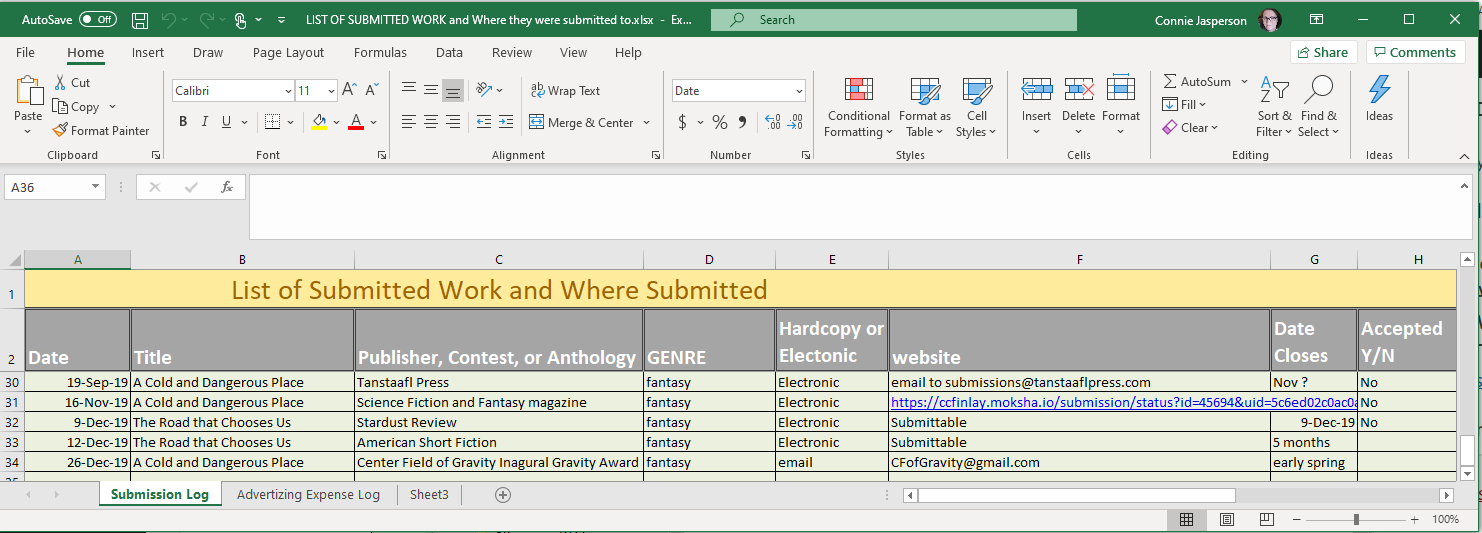
  • If my outline is an idea for a short story meant for a specific purpose, I include the intended publication and closing date for submissions. (This is necessary for anthologies but not needed for a novel)

On line two, I label my columns with the categories listed below. Then, on the ribbon, I open the view tab, highlight the third row, and click freeze panes. This allows me to scroll down the spreadsheet while keeping the title and column headings visible.

Page one of my storyboard works this way: I make a list of names and places with four pieces of information pertaining to the story, all on the same line.

Column A heading – Character Names: list the important characters by name and also list the important places where the story will be set.

Column B heading – Role: What their role is, a note about that person or place, a brief description of who and what they are.

Column C heading – What do they want? What does each character desire?

Column D heading – What will they do to get it? How far will they go to achieve their desire?

Page Two contains a brief synopsis of what I imagine the plot will be. This will be the jumping-off point for when I start writing and will change radically by the end of the process.

Page three of my storyboard contains An OUTLINE of events, including a prospective ending. I keep this page updated as things evolve. In every novel, a point of no return, large or small, comes into play, so I will make a note of when and where it should occur in the timeline of the plot arc.

Page four might be the GLOSSARY. This page is a list of names and invented words, which I list as they arise, all spelled the way I want them.

Page five will have MAPS. They don’t have to be fancy. All you need is something rudimentary to show you the layout of the world.

Page six will feature the CALENDAR of events. This is especially important, as readers despise mushy timelines.

This is how the tabs for the storyboard are labeled, allowing me to easily access what I need:

But what if your book spawns a series? The next novel should be easier to write if you kept a storyboard for book one. The storyboard will grow with each installment in that series.

The stylesheet/storyboard is a good tool for fantasy authors because we invent entire worlds, religions, and magic systems. We don’t want to contradict ourselves or have our characters’ names change halfway through the book with no explanation.

Creating the storyboard/stylesheet helps me to know who my characters think they are in the first draft. Having an idea of their story and seeing them in their world is a good first step. Write those thoughts down so you don’t lose them. Keep writing as the ideas come to you, and soon, you’ll have the seeds of a novel.

Storyboarding plays a direct role in how a linear thinker like me works. It takes advantage of the ideas I have that might make a good story as they come to me. Those notes inspire me to begin writing the first draft and keep my imagination running.

Next week, we’ll talk about how maps and calendars are essential tools, how to make them, and why I include them in my storyboard.


Credits and Attributions

The Screenshots of the Sample Storyboard Template are my own work, © 2025 Connie J. Jasperson, All Rights Reserved.

1 Comment

Filed under writing

#FineArtFriday – a second look at “Fishing for Oysters at Cancale” by John Singer Sargent 1878

2560px-John_Singer_Sargent_-_CancaleArtist: John Singer Sargent (1856–1925)

Title: En route pour la pêche (Setting Out to Fish) Fishing for Oysters at Cancale

Date: 1878

Medium: oil on canvas

Dimensions: height: 77 cm (30.3 in); width: 121.6 cm (47.8 in)

Inscription: Signed and Dated: John S. Sargent Paris 1878

Collection: National Gallery of Art

What I love about this picture:

Every time I see a painting by John Singer Sargent, I love him more. He is rapidly becoming one of my favorite artists of all time. (Don’t be jealous, Rembrandt. You are still number one in my heart.)

Sargent paints a perfect summer day for us, a good day to be out near the water. John Singer Sargent was a complicated man, as most artists are. Famous as a portrait artist, he painted landscapes that conveyed a sense of mood and emotion that few of his contemporaries could match. One of Sargent’s great skills was the ability to convey the sensory impressions of an environment.

He found beauty and drama in the lives of ordinary people and showed his characters outdoors in all the seasons. His paintings of working-class people didn’t romanticize how they dressed, conveyed their moods. Sargent showed the environment they lived and worked in, no matter how good or bad the weather.

Sargent had a gift for painting rare and expensive fabrics, yet no one is dressed in finery in this painting. On the contrary, the women are dressed in shabby clothes that protect them from the sun and salty wind, garments that have seen a great deal of wear. The children are bare-legged and barefoot, while the fishers wear clogs. These women carry baskets and the hope that they will find enough oysters and other shellfish to not only feed their family but have plenty to sell to the fishmonger.

About this picture via MFA Boston: Sargent’s choice of subject was not revolutionary – a similar scene of oyster harvesters had previously won a medal at the Salon. However, his ability to paint the reflections in the tidal pools and the light sparkling on the figures and clouds dazzled viewers, clearly demonstrating that his talents extended beyond portraiture. [1]

About the artist, via Wikipedia:

John Singer Sargent (January 12, 1856 – April 14, 1925) was an American expatriate artist, considered the “leading portrait painter of his generation” for his evocations of Edwardian-era luxury. He created roughly 900 oil paintings and more than 2,000 watercolors, as well as countless sketches and charcoal drawings. His oeuvre documents worldwide travel, from Venice to the TyrolCorfu, Spain, the Middle East, MontanaMaine, and Florida.

Born in Florence to American parents, he was trained in Paris before moving to London, living most of his life in Europe. He enjoyed international acclaim as a portrait painter. An early submission to the Paris Salon in the 1880s, his Portrait of Madame X, was intended to consolidate his position as a society painter in Paris but instead resulted in scandal. During the year following the scandal, Sargent departed for England, where he continued a successful career as a portrait artist.

From the beginning, Sargent’s work is characterized by remarkable technical facility, particularly in his ability to draw with a brush, which in later years inspired admiration as well as criticism for its supposed superficiality. His commissioned works were consistent with the grand manner of portraiture, while his informal studies and landscape paintings displayed a familiarity with Impressionism. In later life, Sargent expressed ambivalence about the restrictions of formal portrait work and devoted much of his energy to mural painting and working en plein air. Art historians generally ignored society artists such as Sargent until the late 20th century.

The exhibition in the 1980s of Sargent’s previously hidden male nudes served to spark a reevaluation of his life and work, and its psychological complexity. In addition to the beauty, sensation and innovation of his oeuvre, his same-sex interests, unconventional friendships with women and engagement with race, gender nonconformity and emerging globalism are now viewed as socially and aesthetically progressive and radical.


Credits and Attributions:

IMAGE: Wikimedia Commons contributors, “File:John Singer Sargent – Cancale.jpg,” Wikimedia Commons, https://commons.wikimedia.org/w/index.php?title=File:John_Singer_Sargent_-_Cancale.jpg&oldid=745727074 (accessed April 25, 2025).

[1] Quote: MFABoston contributors, Fishing for Oysters at Cancale – Works – Museum of Fine Arts, Boston (mfa.org) (accessed April 25,2025).

[2] Wikipedia contributors, “John Singer Sargent,” Wikipedia, The Free Encyclopedia, https://en.wikipedia.org/w/index.php?title=John_Singer_Sargent&oldid=1223506386 (accessed April 25, 2025).

Comments Off on #FineArtFriday – a second look at “Fishing for Oysters at Cancale” by John Singer Sargent 1878

Filed under #FineArtFriday

Idea to story part 12 – theme, plot, and the character arc #writing

Two months ago, we began our series, Idea to Story. The previous eleven installments are listed below. We have created a sample story, a romantasy. We have met our protagonists and the ultimate antagonist. We know what their world is like and have given them a worthy quest, and we discovered what genre we are writing by paying attention to the tropes that arose as we were laying down the plot.

Now, we’re going to examine the themes that have emerged. We will strengthen the story arc and make the characters more vivid by ensuring a strong central theme is woven through the story.

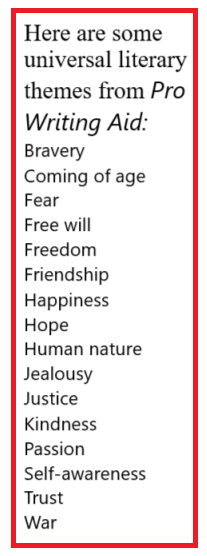
But first, what is a theme? It is an idea, an unspoken message that winds through the arc of the story and generates action. Themes are subtle but move the characters to action and define why the action happens. For an incredible list of themes, go to A Huge List of Common Themes – Literary Devices.

Before we talk about the themes we want to incorporate in our story, let’s look at how the master of themes, Henry James, wove them into his work.

Henry James is a 19th-century writer you might have heard of but never read. However, he can teach us so much about using a story’s themes to create memorable characters. You may be familiar with the titles of some of his works, such as The Turn of the Screw and The Golden Bowl. Filmmakers and playwrights are still turning his work into movies and plays.

Henry James was a master at writing one common theme into a story—lust. Lust for sex. Lust for money. Lust for control.

Lust for power.

Henry James wrote one of the most famous novellas ever published, the Turn of the Screw.

On the surface, the Turn of the Screw is a gothic horror story. The four main themes are the corruption of the innocent, the destructiveness of heroism, the struggle between good and evil, and the difference between reality and fantasy. A fifth theme is the perception of ghosts. Are the ghosts real or the projection of the governess’s madness?

However, there are several subthemes interwoven into the fabric of the narrative:

  • Secrecy.
  • Deception.
  • The lust for control.
  • Obsession.

What I take home from the longevity of Henry James’s work is this: find a strong theme and use it to underscore and support our characters’ motives.

So, now we know that literary themes are a pattern, a “melody” that recurs in varying forms throughout a story. They emphasize mood and shape the plot.

The main theme of our story is the struggle between good and evil. In Donovan’s well-planned manipulation of Kai under the guise of brotherly mentoring, we have the subthemes of deception and the corruption of the innocent. In Val and Kai, we have the dangers of ignorance and the subthemes of arrogance and class prejudice.

Our three main characters are people. In real life, people are a mix of good and bad at the same time. Some lean more toward good, others toward bad. Either way, their intentions are logical, and they desperately want what they think they deserve.

Most importantly, our characters lie to themselves about their own motives and obscure the truth behind other, more palatable truths. These unspoken truths are the themes we must weave into the fabric of our story by subtly showing a pattern.

Two themes we want to emphasize in Donovan are the desire for power and the use of fear as a means of control. However, at first, we want the tug-of-war for control of the child king, Edward, to be focused on the regents, Kai Voss and Valentine.

The story opens from Val’s point of view, so we lean a bit toward her. But not entirely, as Kai’s chapter shows he has good intentions.

By hinting at the pattern of Donvan’s actions in the first quarter of the book, his lust for power becomes clear. We hope to create in the reader a sense of helplessness to stop what we see coming. This is emphasized as clues appear, indicating that Val and Kai are acting on misinformation that is deliberately fed to them.

Once Val and Kai find themselves in the dungeon, new themes will join the story. Both are in their mid-thirties and are established and respected in their respective peer groups. However, both must have a coming-of-age arc. Despite their apparent adulthood, they each have a lot to learn about real life.

But what about young King Edward? For Val and Kai, the theme of parental love is shown in their actions of caring for him from the beginning. While he is not their child, he is in their care and both love him as if he were their son and are secretly jealous of each other. They have differing goals for him, which causes friction, but the reader doesn’t doubt their sincere love for the boy.

Edward is sickly, cursed with a wasting disease. All through this tale, he has been a McGuffin, the object of the quest and a pawn in Donovan’s game of power. His character arc is limited because he is bedridden and unaware of the war for control centered on him.

When she wakes up in the dungeon, Val realizes who truly set the curse on Edward and who murdered the boy’s parents in the first place. She realizes that if she can’t rescue Edward, Donovan’s curse will kill him, and Donovan will become king. She is miserably aware that she will need a wizard to counter Donovan’s sorcery. Unfortunately, the only sorcerer she has access to is Kai, which means she must rescue him first, something she despises having to do.

Conversely, Kai is glad to be free but not pleased that it is Valentine who has rescued him. He doubts her motives and refuses to believe his brother betrayed him, until they overhear the guards talking.

Val and Kai must learn to work together. As they do, the theme of romantic love will emerge.

What other themes might emerge as we write our story? How will we recognize and underscore the patterns, the melodies that appear in the narrative?

This is where writing becomes a craft, and to excel at any craft, we must work at it.

Thank you for sticking with me as we worked our way through this long and involved process of taking an idea for a story and building the characters, the world, and the plot.

While the story of Val and Kai is just a sample plot for demonstration, I have used these weeks to reexamine the different aspects of my current work in progress. Talking my way through a plot with my friends really helps, so thank you!


Previous in this series:

Idea to story, part 1: novel, poetry, memoir, or short story? #writing | Life in the Realm of Fantasy

Idea to story part 2: thinking out loud #writing | Life in the Realm of Fantasy

Idea to story part 3: plotting out loud #writing | Life in the Realm of Fantasy

Idea to story part 4 – the roles of side characters #writing | Life in the Realm of Fantasy

Idea to story part 5 – plotting treason #writing | Life in the Realm of Fantasy

Idea to story part 6 – Plotting the End #writing | Life in the Realm of Fantasy

Idea to story part 7 – Building the world #writing | Life in the Realm of Fantasy

Idea to story part 8 – world-building and society #writing | Life in the Realm of Fantasy

Idea to story part 9 – technology and world-building #writing | Life in the Realm of Fantasy

Idea to Story part 10 – science and magic as world-building #writing | Life in the Realm of Fantasy

Idea to story part 11: Genre and expected tropes #writing | Life in the Realm of Fantasy

5 Comments

Filed under writing