#FineArtFriday: Perseid Meteor Shower; Aug.11, 2015, by Brad Sutton

This weekend, August 11th through the 13th, 2018, is the annual show of lights known as the Perseid Meteor Shower. My husband and I will watch them as we always do. Sometimes I fall asleep before they appear, but I always try to be awake for them. After midnight is the best time.

The National Park Service photographer, Brad Sutton, caught this dreamscape perfectly. The Joshua trees are black against the  sky and he managed an exposure that was perfect: the meteor was captured yet the brilliance of the stars and the color of the night wasn’t washed out.

That, my friends, is no easy trick. I know a little about photography, having worked as a darkroom tech during the 1980s. Processing and printing is a digital no-brainer now, but in those days it was a worthy career. During my time in that line of work, I was privileged to handle the work of many fine professional nature photographers, and have retained my appreciation for the art-form.

About the scene portrayed in this image:

From Wikipedia, the Fount of All Knowledge: The Perseids are prolific meteor showers associated with the comet Swift–Tuttle. The Perseids are so called because the point from which they appear to hail (called the radiant) lies in the constellation Perseus.

The other thing of beauty in this wonderful image is the setting, Joshua Tree National Park. It is an alien landscape to my northern eyes. The silhouettes of the Yucca against the clear, star-strewn sky calls to me in some lonely way.

Someday, I will travel to the American Southwest and see this place, and more. Perhaps I will see the Perseids from there. As all new experiences do, the feelings and emotions these places and events inspire will find their way into my work. I have been so privileged to see and touch the alien beauty that is our Planet Earth.

Also, from the Fount of Knowledge: Straddling the border between San Bernardino County and Riverside County, the park includes parts of two deserts, each an ecosystem whose characteristics are determined primarily by elevation: the higher Mojave Desert and the lower Colorado Desert. The Little San Bernardino Mountains traverse the southwest edge of the park.

Looking further into Wikipedia:

In a 2001 paper published in the journal Ecosystems, Joshua trees are one of the species predicted to have their range reduced and shifted by climate change. There is concern that they will be eliminated from Joshua Tree National Park, with ecological research suggesting a high probability that their populations will be reduced by 90% of their current range by the end of the 21st century, thus fundamentally transforming the ecosystem of the park. There is also concern about the ability of the species to migrate to favorable climates due to the extinction of the giant Shasta ground sloth (Nothrotheriops shastensis) 13,000 years ago; ground sloth dung has been found to contain Joshua tree leaves, fruits, and seeds, suggesting that the sloths might have been key to the tree’s dispersal.


Credits and Attributions:

Perseid Meteor Shower; 8-11-15 by Brad Sutton for the National Park Service. Taken in Joshua Tree National Park. © CC-BY-2.0 via Wikimedia Commons

Wikipedia contributors, “Perseids,” Wikipedia, The Free Encyclopedia,https://en.wikipedia.org/w/index.php?title=Perseids&oldid=853424957 (accessed August 9, 2018).

Wikipedia contributors, “Joshua Tree National Park,” Wikipedia, The Free Encyclopedia, https://en.wikipedia.org/w/index.php?title=Joshua_Tree_National_Park&oldid=852008844 (accessed August 9, 2018).

Wikipedia contributors, “Yucca brevifolia,” Wikipedia, The Free Encyclopedia, https://en.wikipedia.org/w/index.php?title=Yucca_brevifolia&oldid=854060539 (accessed August 9, 2018).

Comments Off on #FineArtFriday: Perseid Meteor Shower; Aug.11, 2015, by Brad Sutton

Filed under #FineArtFriday, writing

Things to check for before submitting to a beta reader #amwriting

When we finish writing a story, an article, or a novel, we feel a rush of pride. The urge to immediately send it to a magazine or contest is strong, but the wise author must overcome it.

Don’t even show it to your writing group at this stage, because you are too involved in it, and there may be some awkward flaws that were introduced into the narrative during the rush of creation. You want their feedback to be constructive and not focused on the editable flaws.

Set your manuscript aside for a week or so then come back to it and look for

  1. Dropped or missing words.
  2. Words that spell check won’t find because they are spelled correctly but are wrong: They went their for breakfast.
  3. Extra spaces in odd places, and after sentences. Editors want one (1) space after each sentence.
  4. The paragraphs are indented, NOT WITH TABS, but by formatting the paragraphs correctly.

Tabs >.< I feel it’s important to revisit this subject, as I have recently seen two manuscripts where authors used the tab key to indent their paragraphs.

That is a huge no-no, and screams “never done this before.” Ninety percent of publications and publishing houses want electronic submissions. Too many spaces messes up the final formatting. For this reason, make sure you have removed the tabs. You may have to do it by hand which is a daunting task no publisher or editor has time for.

You want your work to look professional, even if you are only submitting it to your writing group for a critique. Always format the paragraphs by either opening the home tab and choosing ‘normal’ from the styles tab on the ribbon OR format by using the simple formatting tool:

Step 1: On the home tab, look in the group labeled ‘Paragraph.’ On the lower right-hand side of that group is a small grey square. Click on it.  A pop-out menu will appear, and this is where you format your paragraphs.

Step 2: On the indents and spacing tab of the menu: Use standard alignment, align LEFT. The reason we use this format is we are not looking at a finished product here. We are looking at a rough draft that will be sliced, diced, and otherwise mutilated many times before we get to the final product.

Step 3: Indentation: leave that alone or reset both numbers to ‘0’ if you have inadvertently altered it.

Step 4: Where it says ‘Special’: on the drop-down menu select ‘first line.’ On the ‘By’ menu, select ‘0.5.’ (Some publishers will specify a different number, 0.3 or 0.2, but 0.5 is standard.)

Step 5: ‘Spacing’: set both before and after to ‘0.’

Step 6: ‘Line Spacing’: set to ‘double.’

To summarize, standard paragraph format has:

  • margins of 1 inch all the way around
  • indented paragraphs with no extra space between
  • double-spaced text
  • Align Left. This is critical.

Do not justify the text. In justified text, the spaces between words, and letters (known as “tracking”) are stretched or compressed. Justified text aligns with both the left and right margins. It gives you straight margins on both sides, but this type of alignment only comes into play when a manuscript is published, and at that point, the publisher will handle the formatting.

Also, I have two things for you to look for before you submit your work to a beta reader or writing group, much less a prospective agent or publisher.

First up: Dialogue.

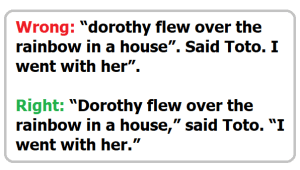
  1. Make sure every spoken sentence is enclosed in double quotes. All punctuation goes INSIDE the closed quotes, and quoted dialogue is enclosed in single quotes, ALSO inside the closed quotes.

Good: “I’m sorry, Mary. Your punctuation is horrific. Jake said, ‘I won’t accept it,’” said Helen.

When using dialogue tags, the spoken sentence ends in a comma, inside the closed quotes, followed by the dialogue tag which is NOT CAPITALIZED.

Bad: “I’m sorry, Mary. Your punctuation is horrific. Jake said, ‘I won’t accept it.’” Said Helen.

Good: “I’m sorry, Mary. Your punctuation is horrific. Jake said, ‘I won’t accept it,’” said Helen.

Next up: Commas. If you have a basic grip on commas, perfection is not needed. But commas separate clauses and act as traffic signals for our words.

  1. Use commas to separate independent clauses when they are joined by any of these seven coordinating conjunctions: and, but, for, or, nor, so, yet.

Good: My dog has fleas, and he needs to go to the vet.

Do not join dependent clauses to independent clauses with commas.

Good: My dog has fleas and needs to go to the vet.

Avoid comma splices at all cost. Use conjunctions or semicolons to join related independent clauses, not commas.

Bad: My dog has fleas, he needs to go to the vet.

Good: My dog has fleas, and he needs to go to the vet. OR if you absolutely must use a semicolon, write it as, My dog has fleas; he needs to go to the vet.

By searching for these simple errors before you submit your work,there’s a good chance that an editor will read beyond the first page.

Even if you intend to hire an editor, if you have these sorts of major amateurish flaws in your work, the editor will most likely refuse to take on the task of editing your work, as it would be too difficult to complete in a reasonable amount of time.

If I receive a request from a prospective client to edit a manuscript, and a glance through the first few chapters shows a clear lack of knowledge of how to write, my policy is to refuse it. The author owes it to herself, and the craft in general, to learn how to write.

In these instances, I am always gentle, but firm. I usually suggest the author join a writing group and invest in some books on writing craft. Many times, I see wonderful, amazing stories that are so poorly written no editor would take them.

It’s important to remember that we all begin at that place. With practice and feedback from others, we grow. These first drafts of our writing life are the beginner stories, the ones that come from the heart and which we learn from. I have a desk full of examples of “What was I thinking?” Each one of those stories had great bones. They are the foundation of all my work.

16 Comments

Filed under writing

Character Growth/Arc #amwriting

When we think of epic fantasy, the first books that come to mind are J.R.R.Tolkien’s The Hobbit and The Lord of the Rings trilogy. Tolkien’s work was compelling not only for the quality of his prose and the events, but for the characters and how they grew and changed in the course of their adventures.

Genre authors spend a lot of time plotting the events a character will go through. Equal time must be given to character development.

A great story evolves when the antagonist and protagonist are strong but not omnipotent. Both the antagonist and protagonist must have character arcs that show personal growth or inability to grow.

Sometimes, an antagonist’s weakness is their inability to accept change and adapt to it. Other times, events cause them to devolve, sending them into a downward spiral. Either way, for the antagonist to be realistic, this must be clearly shown.

Once we meet the hero, small hindrances must occur between the larger events, frustrating their path to success. As each hindrance is overcome, the reader feels a small sense of satisfaction. Following the protagonist as he/she is negotiating these detours is what makes the story captivating, in my opinion.

  1. The story begins with the opening act, where the characters are introduced, and the scene is set. It then kicks into gear with the occurrence of the “inciting incident,” that first plot point at the ¼ mark that triggers the rest of the story. It is “the problem,” the core conflict of the story. This is where the protagonist is thrown into the action and is where they first find themselves blocked from achieving the desired object.

At this point, the protagonist is not fully formed—they must grow as a result of their experiences. They may make mistakes, cause themselves more trouble because they are untried and don’t know what they are doing.

Also, at this point, the protagonist may be confused as to what is really going on. This is a good place to introduce a mentor, someone who can offer a little wisdom or set the hero on the right path.

  1. Following the inciting incident is the second act: more action occurs which leads to more trouble, rising to a severe crisis. At the midpoint, the protagonist and friends are in grave difficulty and are struggling.

Each scene is a small arc of action that illuminates the motives of the characters, allows the reader to learn things as the protagonist does, and offers clues regarding things the characters do not know that will affect the plot.

Those clues are foreshadowing. Through the first half of the book, foreshadowing is important, as it piques the reader’s interest, and makes them want to know how the book will end.

The characters begin to be changed by the events they experience. How you show their emotional state is critical at this point because emotions engage readers. If you want your readers to feel the crisis, your characters must feel it and show their reactions to the reader.

We must contrast the relative security of the characters’ lives as they were in the opening paragraphs with the hazards of where they are now. We show the uncertainty, fear, anger, sense of loss they are experiencing.

  1. At the midpoint, another serious incident occurs, launching the third act and setting them back even further.

Now they are aware that they may not achieve their objectives after all. Bad things have happened, and the protagonists have to get creative and work hard to acquire or accomplish their desired goals. They must overcome their own doubts and make themselves stronger.

The midpoint is also where we really get to know the antagonist and learn what the enemy knows that the protagonists do not. We discover his/her motives and what they may be capable of.

First, we need to remember that very few people are evil for no reason at all. Sometimes they are likeable, people who appear innocuous, even loving. If this is the case in your story, you need to insert small clues for the reader about their personality into the narrative in the beginning pages.

Fleshing out the antagonist and making their motives realistic is important. He/she is as central to the story as the protagonist because their actions force the protagonist to grow as a human being.

  1. By the end of the third act, the protagonists are finding ways to resolve the conflict and are ready to commence the final, fourth act, where they will embark on the final battle. They will face their enemy and either win or lose.

By the end of the narrative, the protagonist has been through life changing events. They are no longer naïve but have knowledge and wisdom of their own. They are fit to be the mentors of the next generation.

It’s important to remember that at no point in the narrative can people be sitting around idly chit-chatting about the changes they have been through. The reader knows and doesn’t want to read a rehashing of events at the end of each chapter.

Many authors who are new to the craft say their characters just evolve with no thought ahead of time. As this lack of planning is clear in their muddy work, perhaps it’s a good idea to give a little thought to plotting the personal growth of the characters, how the experiences will change them. Readers become invested in the characters and want to see what happens next. Reward the reader by making the journey about the characters as much as you do about the events.


Credits and Attributions:

The Lord of the Rings The Fellowship of the Ring, 2001 theatrical poster, Copyright 2001, New Line Cinema, Fair Use

Wikipedia contributors, “The Lord of the Rings: The Fellowship of the Ring,” Wikipedia, The Free Encyclopedia, https://en.wikipedia.org/w/index.php?title=The_Lord_of_the_Rings:_The_Fellowship_of_the_Ring&oldid=853509330 (accessed August 5, 2018)

2 Comments

Filed under writing

#FineArtFriday: Don Quixote in the Library, by Adolf Schrödter

An area of art I haven’t discussed, but which has often been a primary reason why I buy books, is the illustrations. The artwork that went into many books in the 19th and early 20th centuries was sometimes exquisite. Yet, these illustrators remained unknown for the most part and unsung. Today’s image is from Wikimedia Commons and is by a German artist, Adolf Schrödter.

Little is known about Schrödter other than he was born on June 28, 1805, and died Dec. 9, 1875, and was a genre painter of the Düsseldorf school of painting. According to Wikipedia, the Fount of All Knowledge:

The Düsseldorf School had a significant influence on the Hudson River School in the United States, and many prominent Americans trained at the Düsseldorf Academy and show the influence of the Düsseldorf School, including George Caleb BinghamDavid Edward CroninEastman JohnsonWorthington WhittredgeRichard Caton WoodvilleWilliam Stanley HaseltineJames McDougal HartHelen Searle, and William Morris Hunt, as well as German émigré Emanuel LeutzeAlbert Bierstadt applied but was not accepted. His American friend Worthington Whittredge became his teacher while attending Düsseldorf.

However, some of Schrödter’s art survives in the form of illustrations and a few prints have been sold at auctions.

In today’s image what impresses me is the level of detail. Here we see Alonso Quixano reading, lounging in a room that is clearly a book lover’s sanctuary. He is a descendant of the family of “Gutierre Quijada” by direct lineage and is proud to be part of a long and noble tradition of knights. In the first part of the book, Alonso, later Don Quixote de la Mancha, is a dreamer, preferring to imagine himself as a superhero, living out a knightly story.

Books are strewn everywhere, beautiful, heavy leather-bound tomes. Schrödter shows him in a relaxed pose, deep into a book. The light of the room comes from a large window. He is a very human, ordinary middle-aged man, relaxing in the most cherished place in his universe: his library.

Alonso Quixano, the protagonist of the novel (though he is not named until much later in the book), is a retired country gentleman nearing fifty years of age, living in La Mancha with his niece and housekeeper. Although he is mostly a rational man, his excessive reading of books of chivalry has produced a skewed view of reality and what we might consider dementia. In keeping with the theories of the time, not sleeping adequately—because he was reading—has caused his brain to dry.

I love that notion.

As a result, Alonso is easily given to anger and believes every word of these fictional books of chivalry to be true. Don Quixote’s niece commits, what is to me, the most heinous crime–she and the Parrish curate burn his library, and lie to him, telling him it was the work of an evil magician.

He descends completely into his fantasy world and decides to become a knight-errant in search of adventure. Schrödter has captured the essence of the making of Don Quixote in this painting—the man who loves books is in his element, the one place where he fits. When that is taken from him, the story begins.


Credits and Attributions:

Don Quixote in the Library, by Adolf Schrödter, 1834 PD|100, via Wikimedia Commons.

Wikipedia contributors, “Düsseldorf school of painting,” Wikipedia, The Free Encyclopedia, https://en.wikipedia.org/w/index.php?title=D%C3%BCsseldorf_school_of_painting&oldid=822264175 (accessed August 3, 2018).

Comments Off on #FineArtFriday: Don Quixote in the Library, by Adolf Schrödter

Filed under #FineArtFriday

How I became an author #amwriting

I have always been a writer, and a lover of music and art. Music was important in our house, as my parents had a large collection of vinyl records and the stereo was always cranking. Whether it was classical, jazz, or rock and roll, music was played loud enough to hear outside.

In an afternoon, you might hear the Beatles, followed by Vivaldi, Dean Martin, Herman’s Hermits, Loretta Lynn, the Monkees, and capping the evening—Mozart. Simon and Garfunkle, The Who, The Rolling Stones, 101 Strings, Electric Light Orchestra, Eddy Arnold, Count Basie, Stevie Wonder—you name it, the music was always played at a high volume in our home.

The books in our home were just as eclectic. My parents were prolific readers and were members of both Doubleday Book Club and Science Fiction Book Club. They also purchased two to four paperbacks a week at the drugstore and subscribed to Analog and several other magazines.

There was always something new and wonderful to read around our house, and most of it was literary fiction or speculative fiction, although we had the entire 54 volume leather-bound set of the Great Books of the Western World, and our father insisted we attempt to read and discuss what we could.

Some of those books were mostly understandable, such as William Shakespeare and Samuel Pepys.

Plato, not so much, and yet his work did influence me.

At the age of fourteen, I didn’t understand Pepys, but I read him, and while we were bass fishing on a Saturday morning, Dad would talk about the differences and commonalities between life and morality in Pepys’ London and our life in suburban America in 1968. His thought was that I should learn about the 17th century and the Great Fire in London from an eyewitness, just as I had learned about the war in the Pacific from John F. Kennedy‘s autobiographical novel, PT 109.

But Pepys’ London of 1666 was so different from the ‘Mod’ subculture of the London of 1968 (and the Beatles) that I was familiar with thanks to Life magazine. To me, it was almost like speculative fiction. In many ways, it was more difficult for me to believe in historical London than Tolkien’s Middle-Earth.

Everything I knew about sex, I learned from the books I stole from my mother’s nightstand.

When I married and left home, I still read every sci-fi or fantasy novel that came out in paperback, budgeting for books the way others of my acquaintance budgeted for beer. I read the classics for my irregular college classes and learned to love Chaucer and James Joyce. For a variety of reasons I never earned a college degree, but I’ve never stopped reading and researching great literature.

But reading for entertainment was still my “drug.” I jonesed for new books by the great ones, Anne McCaffreyJack Chalker, and Roger Zelazny, reading and rereading them until they were shreds held together with duct tape.

As a married student attending college in Bellingham Washington, purchasing books for pleasure became a luxury. I found a secondhand bookstore where I could get a brown paper shopping bag full of novels in too poor a condition to sell on their shelves for $2.00 a bag if you had a bag of better books to trade in.

As a college drop-out I went through a full shopping bag of books every week, and within a year, I had read every book they had.

Thus, out of desperation, I discovered a whole new (to me) genre: regency romances written by Georgette Heyer, and other romance writers of that generation. Those books, along with beat up copies of bestsellers by Jack KerouacJames Michener, and Jacqueline Susann began to show up in the pile beside my bed.

So at least some of my literary influences can be traced back to dragons, booze, morality, and England’s romantic Regency—lived vicariously through these authors’ eyes.

Always when the budget permitted, I returned to Tolkien, Zelazny, McCaffrey, AsimovBradbury, and as time passed, Piers AnthonyDavid EddingsTad WilliamsL.E. Modesitt Jr., and Robert Jordan to name only a few.

And there were so many, many others whose works I enjoyed. By the 1990s, the genres of fantasy and sci-fi were growing authors like a field grows weeds, and I loved it.

All of the books I read as a child and young adult have influenced my writing. They still inspire me.

Nowadays I rarely am able to read more than a chapter or two before falling asleep. My Kindle is full of books, and I haven’t got the time to read them because I have to write my own stories. Having the luxury to spend a day wallowing in a book is a treat to be treasured.

But it is because of the uncountable authors whose works I have been privileged to read that I was inspired to think that my own scribbles might be worth pursuing.

Writing has always been necessary for me, as natural as breathing. In the beginning, my writing was unformed, a reflection of whatever I was reading at the moment. As I matured and gained confidence, I found my own ideas and stories, and they took over my life.

Once that happened, I became a keyboard-wielding writing junkie.

Some days I write well, and others not so much, but every day I write something.

And every day I find myself looking for the new book that will rock my universe, a new “drug” to satisfy my craving, even if I know I won’t have time to read it.

I’m addicted to dreams and the people who write about them. Reading is my form of mind expanding inspiration. Without the authors whose books formed my world, I would never have dared to write.


Credits and Attributions

Potions of this article have appeared previously here on Life in the Realm of Fantasy in the post, The Genesis of an Author, © Connie J. Jasperson 2016, posted Jan 27, 2016

4 Comments

Filed under writing

Theme and the Short Story #amwriting

Even if you are a confirmed Indie author, as I am, you may feel the desire to write short pieces and submit them to anthologies, magazines, or contests. Writing a short story is an excellent way to explore in detail an idea that is inspired by your longer work, but that you don’t have room to include there.

If you are writing a series of speculative fiction novels set in a world of your creation, writing short stories is a good way to develop that world. You also have the opportunity to develop characters you can use later.

Once you submit your story, it will be up against many entries, so you must make yours as unique as is possible.

Anthologies are usually themed. According to Wikipedia:

A theme is not the same as the subject of a work. For example, the subject of Star Wars is “the battle for control of the galaxy between the Galactic Empire and the Rebel Alliance.”

The themes explored in the films might be “moral ambiguity” or “the conflict between technology and nature.”

If you intend to submit your work to an editor with an open call for themed work, you must demonstrate your understanding of theme as well as your ability to craft brilliant prose.

Analyze the theme and try to think creatively—think a little wide of the obvious tropes. Look for an original angle that will play well to that theme and then go for it. As an author, most of my novels have been epic or medieval fantasy, based around the hero’s journey, detailing how their experiences shape the characters’ reactions and personal growth. The hero’s journey is a theme that allows me to employ the sub-themes of brother/sisterhood, and love of family.

These concepts are important to me on a personal level, and so they find their way into my writing.

To support the theme, you must layer

  • character studies,
  • allegory, and
  • imagery

These three layers must all be driven by the central theme and advance the story arc.

The theme is introduced, either subtly or overtly, at the first plot point. In a really short story, this must happen on the first page. Many times, we are given a specific word count we cannot exceed, so lengthy lead-ins are not possible.

When writing a short story, it helps to know how it will end. I suggest you put together a broad outline of your intended story arc. Divide your story arc into quarters, so you have the important events in place at the right time. If you try to “pants” it, you might end up with a mushy plot that wanders all over the place and a story that may not be commercially viable.

When you assemble your outline, ask yourself

  • What will be your inciting incident? How does it relate to the theme?
  • What is the goal/objective? How does it relate to the theme?
  • At the beginning of the story, what could the hero possibly want to cause him to risk everything to acquire it?
  • How badly does he want it and why?
  • Who is the antagonist?
  • What moral (or immoral) choice is the protagonist going to have to make in his attempt to gain that objective?
  • What happens at the first pinch point?
  • In what condition do we find the group at the midpoint?
  • Why does the antagonist have the upper hand? What happens at the turning point to change everything for the worse?
  • At the ¾ point, your protagonist should have gathered his resources and companions and should be ready to face the antagonist. How will you choreograph that meeting?
  • How does the underlying theme affect every aspect of the protagonists’ evolution in this story?

In my own writing life, too much background info has been my greatest challenge. Writing short stories has helped me find ways to write more concisely. What is important for the reader to know? What is just info for me? Knowing what is important in my own work is difficult because it all seems so important.

Short stories follow a single thread in a character’s life. Each word must advance that one story thread. Work that wanders all over the place will be summarily rejected, and the editor will most likely not give more than a stock rejection.

Having your work beta read by your critique group will help you identify those places that need to be trimmed down. I have close friends who see my work first and who help me see what the real story is before I bother my editor with it. My beta readers are published authors in my writing group.

Because I am a wordy writer, I always have to keep in mind that info dumps about character history and side trails to nowhere have no place in short stories because every word is precious. By shaving away the unneeded info in the short story, the author has more room to expand on the theme of the story and how it drives the plot.


Credits and Attributions:

Wikipedia contributors, “Theme (arts),” Wikipedia, The Free Encyclopedia, https://en.wikipedia.org/w/index.php?title=Theme_(arts)&oldid=848540721(accessed July 29, 2018).


6 Comments

Filed under writing

#FineArtFriday: Imogen, by Herbert Gustave Schmalz

Herbert Gustave Schmalz (1856–1935) was an English painter who named himself Herbert Gustave Carmichael in 1918. He is counted among the Pre-Raphaelites , and Imogen, which was painted in  1888 is a classic example of the hyper-romanticized Pre-Raphaelite style.

The Pre-Raphaelite Brotherhood produced some spectacularly beautiful work, as well as some rather awkwardly posed, overly sentimental pieces. Schmalz was famous for his romantic pictures depicting medieval scenes, Arthurian scenes, and vignettes from Shakespeare’s work.

Schmalz turned his brush to portraiture in his later work, as that was where the money was.

From Wikipedia:

The Pre-Raphaelite Brotherhood (later known as the Pre-Raphaelites) was a group of English painters, poets, and critics, founded in 1848 by William Holman HuntJohn Everett Millais and Dante Gabriel Rossetti. The three founders were joined by William Michael RossettiJames CollinsonFrederic George Stephens and Thomas Woolner to form the seven-member “brotherhood”. Their principles were shared by other artists, including Ford Madox BrownArthur Hughes and Marie Spartali Stillman.

A later, medievalising strain inspired by Rossetti included Edward Burne-Jones and extended into the twentieth century with artists such as John William Waterhouse.

The group’s intention was to reform art by rejecting what it considered the mechanistic approach first adopted by Mannerist artists who succeeded Raphael and Michelangelo. Its members believed the Classical poses and elegant compositions of Raphael in particular had been a corrupting influence on the academic teaching of art, hence the name “Pre-Raphaelite”. In particular, the group objected to the influence of Sir Joshua Reynolds, founder of the English Royal Academy of Arts, whom they called “Sir Sloshua”. To the Pre-Raphaelites, according to William Michael Rossetti, “sloshy” meant “anything lax or scamped in the process of painting … and hence … any thing or person of a commonplace or conventional kind”.[1] The brotherhood sought a return to the abundant detail, intense colours and complex compositions of Quattrocento Italian art. The group associated their work with John Ruskin,[2] an English critic whose influences were driven by his religious background.

The group continued to accept the concepts of history painting and mimesis, imitation of nature, as central to the purpose of art. The Pre-Raphaelites defined themselves as a reform movement, created a distinct name for their form of art, and published a periodical, The Germ, to promote their ideas. The group’s debates were recorded in the Pre-Raphaelite Journal.


Credits and Attributions

Wikipedia contributors, “Herbert Gustave Schmalz,” Wikipedia, The Free Encyclopedia, https://en.wikipedia.org/w/index.php?title=Herbert_Gustave_Schmalz&oldid=829134407 (accessed July 27, 2018).

Wikipedia contributors, “Pre-Raphaelite Brotherhood,” Wikipedia, The Free Encyclopedia, https://en.wikipedia.org/w/index.php?title=Pre-Raphaelite_Brotherhood&oldid=846744412 (accessed July 27, 2018).

7 Comments

Filed under #FineArtFriday

logic, objective, and circumstance #amwriting

We begin any writing project with an idea, a flash of “What if….” Sometimes, that “what if” is inspired by an idea for a character, or perhaps a setting. Maybe it was the idea for the plot that had your wheels turning. Whatever the inspiration, a little pre-planning and a bit of an outline are beneficial in getting the manuscript started.

If you work at a day job and using the note-taking app on your cellphone to take down notes during work hours is frowned on, do as I still do. Carry a pocket-sized notebook and pen and write those ideas down. This is old-school but will enable you to discreetly make notes whenever you have an idea that would work well in your story, and you don’t appear to be distracted or off-task.

Once you have assembled your random ideas, and maybe even written a chapter or two, it’s time to think about where you are going with your story.

At the outset of the story, we find our protagonist and see him/her in their normal surroundings. Once we have met them and seen them in their comfort zone, an event occurs which is the inciting incident. This is the first point of no return.

Pretend we are writing a mystery/thriller: On page one, Dave, an unmarried accountant, sees a woman from across a cafe, and through a series of innocuous actions on his part, he is caught up in thwarting a spy ring.

  • What could possibly entice him out of his comfort zone? What would he spontaneously do that is out of character for him? Perhaps he buys a stranger lunch. You must show him as a shy person not given to buying lunch for strange women. This act must change his life.

Because he suddenly decided to “pay it forward” and paid for her lunch on his way out, he draws the attention of people who were following her. They suddenly think he is more than a simple accountant, that the act of buying her lunch was a secret code, making him a suspect.

Now, he is thrown out of his comfort zone and into the situation which is the core idea of your plot.

  • On his way back to his office, a white limousine pulls up alongside him, and four men in black suits hustle him into the backseat. He is forced at gunpoint onto a plane bound for Oslo, Norway, handcuffed to a suitcase. The only other key that can remove the handcuffs is at the American Embassy in the custody of a mysterious woman, Jeanne Delamont.

This is the circumstance in which your protagonist finds himself at the beginning of the story.

  • How will the next phase of the story start? Who is Ms. Delamont?
  • What is the hero’s personal condition (strength, health) at the beginning?
  • How will that condition be changed, for better or worse, by the hero himself or by the antagonistic force?

Now we come to the next part of the core of your plot: objective.

In every class I’ve taken on plotting, the instructors have said that if your main character doesn’t want something badly enough to do just about anything to achieve it over the next couple hundred pages, then he/she doesn’t deserve to have a story told about them.

  • At this point, our hero just wants to get rid of the suitcase and go back to his job. He wants that desperately.
  • What does the woman at the café for whom he bought lunch have to do with the whole mess?

Everything you will write from the point of the inciting incident to the last page will detail that quest and answer that question. Your protagonist must desire nothing more than to achieve that objective. Every scene and conversation will push the protagonist closer to either achieving that goal or failing, so if you make it a deeply personal quest, the reader will become as invested in it as you are.

I find it helps to have a broad outline of my intended story arc. Speaking as a reader, at some point near the outset of their manuscript authors need to have an idea of how it will end, so the story flows smoothly to the best conclusion.

It’s okay to have several possible endings in mind, as long as each fits logically to the events that led up to them.

Try them all and choose the one that you like best.

If you try to wing it through the whole book, you might end up with a mushy plot that wanders all over the place and a story that may not be commercially viable.

  • What will be your inciting incident?
  • What is the goal/objective?
  • At the beginning of the story, what could the hero possibly want that pushes him to risk everything to acquire it?
  • How badly does he want it and why?
  • Who is the antagonist?
  • What moral (or immoral) choice is the protagonist going to have to make in his attempt to gain that objective?
  • What happens at the first pinch point?
  • In what condition do we find the group at the midpoint?
  • Why does the antagonist have the upper hand? What happens at the midpoint to change everything for the worse?
  • At the ¾ point, your protagonist should have gathered his resources and companions and should be ready to face the antagonist. How will you choreograph that meeting?

I write fantasy novels, but I also write literary fiction. Writing fantasy does require a certain amount of planning because so much goes into world building and creating magic systems. Literary fiction must also have a logical arc or the characters won’t evolve.

In any novel, when you are winging it through a story that encompasses 75,000 to 100,000 words, it is easy to get involved in large info dumps and bunny trails to nowhere. A loose outline will tell you what must happen next to arrive at the end of the book with a logical story set in a solidly designed world.

You don’t have to go into detail in that little framework, but if you give yourself a rough outline, you will know what you must do to accomplish each task within the storyline.

I always feel it’s necessary to have an outline of the story arc even if my novel has multiple possibilities for endings, as was the case in The Wayward Son. Winging it in short bursts can be exhilarating, but my years of experience with NaNoWriMo has taught me that when we are winging it for extended lengths of time, we sometimes run out of fresh ideas of what to do next.

With a simple outline, you won’t become desperate and resort to killing off characters just to stir things up once the real work of writing starts.

Readers become frustrated with authors who randomly kill off characters they have grown to like.

Besides, you might need that character later.


Credits and Attributions

Cover of the original novel “The Maltese Falcon” 1930, by Dashiel Hammett, published by Alfred A Knopf, Fair Use. Wikipedia contributors, “The Maltese Falcon (novel),” Wikipedia, The Free Encyclopedia, 

https://en.wikipedia.org/w/index.php?title=The_Maltese_Falcon_(novel)&oldid=851535327 (accessed July 25, 2018).

6 Comments

Filed under writing

Life is a river #amwriting

Most people have struggled in their personal life at one time or another. During the years I was raising my children, I had three failed marriages, worked three part-time jobs, and it was hard to find time to write.

We came through the lean times as a tight-knit family. But I think of life as being like a river, because you never know what is around the bend. By the time my last chick left the nest, I had gained financial security, but a new difficulty arose.

Two of my children developed adult onset epilepsy, a complication which has made our comfortable life… interesting.

When you look at the statistics detailing the age of all patients at the time of their first seizure, the number of those whose first documented seizure occurs after reaching adulthood is far higher than those who experience it as children.

Yet little research has been done to document the experience of living with a seizure disorder as an adult.

They once lived their lives the way normal adults do. They used to be able to legally drive a car without endangering other people, to say nothing of themselves. They didn’t have to worry that a short flight of stairs could kill them or that cooking their breakfast could send them to a long stay in the burn unit.

There is anger, confusion. Why me? What did I do wrong? What can I change? There is even denial–it can’t be epilepsy; it’s never going to happen again.

The truth is, no one knows what causes most forms of epilepsy, and each patient responds to the medications differently. And every well-meaning auntie in the universe has sage advice to offer, despite not having any experience with it. “Try marijuana.” “Go on a Keto diet.” These are effective treatments for some people, but not for everyone, and not my son or daughter.

There is no miracle drug or diet out there at this time.

Epilepsy is not a poster-child kind of disease, so funding for research is limited. At this point, because the cause is rarely knowable, all the medical community can do is offer drugs to control the symptoms. Most times, seizure disorders are not operable, unless it is a tumor or some other obvious thing. When you look at the wide spectrum of patients with adult onset, you see those “easy-to-find with an MRI” causes are quite rare.

Many, like my son, are never quite able to get it under control, and it affects their jobs, their relationships, and their ability to live a fully independent life.

Others, like my daughter, go many years between seizures, and their lives are mostly unaffected by it. She has her own business, volunteers at her son’s school and is also the co-chairwoman of the PTA there.

Both of my children have suffered terrible injuries during seizure episodes. Both have spent time in the hospital, had to have surgeries to repair wounds incurred, and no one has ever been able to find the cause of their seizures.

Writing has been an escape that kept me sane when nothing was certain except my daughter and son were in terrible trouble, and the doctors didn’t know why and couldn’t cure it. The medical community wants to cure it, but the way this condition affects each sufferer is different, which frustrates the doctors as much as the patients.

For many people, after they have a large seizure event, there is a post-seizure stage where they suffer an altered state of consciousness. This can be dangerous if they are alone. They’re locked in a dream and make no sense when they speak. As they begin to come out of that stage, they’re unable to think clearly, can’t focus their attention or follow a conversation. This altered state is like sleepwalking and sleep-talking, which is why it’s dangerous. As they move out of this stage, they will also have problems with short term memory, and may have decreased verbal and interactive skills.

Fortunately, that is a temporary thing, lasting only one or two hour for some, but it can go one or two days for my son. After recovering from that stage, it still takes about two weeks for my son to get back to where he can think clearly enough to work on whatever project he is doing. He can’t be alone then, but  between his wonderful girlfriend and I, we care for him until he can be on his own again.

This post-seizure state cost my son his long-time job (ten years) as a software developer at Amazon and made it difficult for him to find work elsewhere. Most employers can’t accommodate an employee who is randomly unable to work for two weeks, two or three times a year.

After a time of intense depression and searching for answers that don’t exist, my son decided to be proactive. He started his own company, doing what he loves. He is now writing his own software and apps and is his own boss so he can work around his situation.

We could allow this epilepsy thing to overshadow our every waking moment, but that would change nothing. Research, they say, is ongoing, but nothing has changed treatment-wise since my daughter’s first seizure at the age of twenty-eight—sixteen years ago. My children still sometimes have seizures, and we have learned to laugh and enjoy our life despite the occasional setback.

The hours spent in hospitals as my son or daughter recovered from injuries incurred during a seizure helped forge my writing. Life is what happens when we aren’t on that merry-go-round, and other than that, our lives are good.

Life is a journey, and you never know what lies around the corner, but a sense of humor can be a solace when nothing else is. Wikipedia, the fount of all knowledge, says: Gallows humor has the social effect of strengthening the morale of the oppressed and undermines the morale of the oppressors. According to Wylie Sypher, “to be able to laugh at evil and error means we have surmounted them.”

Laughing and making crude jokes about the situation is how we survive the chaos and fear—it is what gets us through to the better days that wait just beyond the battle. Life can deal us a hand full of the worst cards, and epilepsy is not the end of the world.

My father’s career in the military ended when he lost his left leg as a result of a bone infection–he was forced into retirement after 15 years of service. While he was in the hospital, his family lost everything when their farm burned to the ground. He had survived WWII, but lost his brother in Korea. Yet despite what he had been through in France and the losses on the home front, he had a wicked sense of humor and an enormous passion for life.

Other people inspire me to avoid self-pity. I have two writing companions, one here in Washington state and one in California. Both are paralyzed, life changing events that would be devastating to any family. Yet they made it through the dark days and live every day to the fullest. Both have wonderful laughs, both make me feel weak in the face of their power and self-determination.

Loss of limbs, loss of physical independence, loss of loved ones, loss of jobs, loss of dignity, loss of face—we all deal with loss and hard times in one way or another.

But in between those rough times, we have times of happiness and joy, forgetting the pain and anger for a moment. Those are the precious hours we have earned, and they are the real life we are given.

Life is a river. What the river has taken is gone, and we can’t get it back, but the currents are carrying us in a different direction, to new shores. Yes, we must adapt to these changes, but that is what humans do.

My life is good today, and easy as compared to last summer. “Easy” won’t always be the case, so I am enjoying it while I have it. Life is always in a state of change, and when I next find myself in the midst of chaos and pain, I will try to think of the good things I still have, and I will find a way to be grateful.

We none of us know what the future holds—all we can ever really be sure of is this moment, this minute, and this beautiful day.


Credits and Attributions:

Wikipedia contributors, “Gallows humor,” Wikipedia, The Free Encyclopediahttps://en.wikipedia.org/w/index.php?title=Gallows_humor&oldid=759474185     (accessed  July 22, 2018).

8 Comments

Filed under Epilepsy, writing

#FineArtFriday: Joos van Craesbeeck

Joos van Craesbeeck (c. 1605/06 – c. 1660) was an interesting character, standing out among the many interesting characters of the seventeenth century Flemish art community. He was a Flemish baker and an artist, a friend and contemporary of  Adriaen Brouwer. They most likely met while Brouwer was jailed in the citadel of Antwerp, although why he was imprisoned is unknown. But the bakery in the Antwerp citadel was operated at that time by Joos van Craesbeeck.

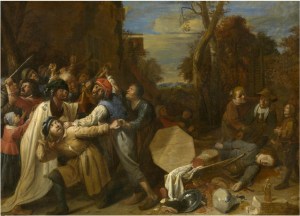
Van Craesbeeck was fascinated with the portrayal of violence and the senses of taste and smell. He painted the dissolute side of life, shocking in its intensity and honesty. Death is Violent and Fast: Quarrel in a Pub, is an excellent example of his almost brutish depiction of peasants brawling. Blood flows, one man lies dead, and in the lower right hand corner, Death smiles, pleased with that night’s work.

He often painted himself, as is seen in The Smoker, a self-portrait that was at one time attributed to Adriaen Brouwer, depicting the senses of smell and taste. He shows himself clutching both a bottle of hard liquor and a pipe, as if they are the dearest things to him. He exhales a stream of smoke, savoring it.

He also painted his own self-portrait as the central nightmare from which other nightmares spawn in the Temptation of St. Anthony. Note the way his mouth is full of little demons entering and leaving, and his head is open to reveal an artist painting beneath wild dark hair in which geese nest. St. Anthony himself is small, placed to the right, almost unnoticed in the onslaught of demons and temptations, both physical and moral. A cacophony of violence and evil rages as Anthony clings to the scriptures. This is a revealing portrait of how the artist viewed himself and the demons he battled, in my opinion.

The work of Joos van Craesbeeck is not comforting or warm. It is always allegorical, showing us something we don’t like about the world we live in. Violence and vice were as much a part of life in his time as they are today, and perhaps will always be.

Quote from Wikipedia: Van Craesbeeck painted at least five portraits which are presumed to be self-portraits and in which he depicts himself in a ‘dissolute’ manner. The dissolute self-portrait was a genre that had taken root in Dutch and Flemish genre painting in the 17th century. It was an inversion of the Renaissance ideal of the ‘pictor doctus’: the artist as an intellectual and gentleman. This ideal was replaced by the new model of the prodigal artist who is characterized by his creative inspiration and talents. These self-portraits emphasized the artists’ dissolute nature by creating associations with traditional moral themes such as the Five Senses and the Prodigal Son in the tavern. Van Craesbeeck painted himself four times in low-life guises depicting the sense of Taste.


Credits and Attributions:

Wikipedia contributors, “Joos van Craesbeeck,” Wikipedia, The Free Encyclopedia, https://en.wikipedia.org/w/index.php?title=Joos_van_Craesbeeck&oldid=823865809 (accessed July 20, 2018).

Death is Violent and Fast: Quarrel in a Pub, painting by Joos van Craesbeeck, ca. 1630 – 1635 PD|100 via Wikimedia Commons.

The Smoker, Joos van Craesbeeck ca.1635 – 1636 [Public domain], via Wikimedia Commons

The Temptation of St Anthony, Joos van Craesbeeck ca. 1650 [Public domain], via Wikimedia Commons

Comments Off on #FineArtFriday: Joos van Craesbeeck

Filed under #FineArtFriday