#amwriting: son and sir: to capitalize or not?

Tom Hiddleston MemeTerms of endearment are often used in casual conversation. Each has their own implications which are highly dependent on tone of voice, body language, and social context.

They can be fairly impersonal, denoting a friendship. Conversely, they can be intimate, indicating a close relationship.

Used by perfect strangers they can also be patronizing and rude.

These words vary in creativity from the sublime to the ridiculous:

  • dear
  • mate
  • chum
  • darling
  • honey
  • baby-cakes
  • sweetheart
  • sugar
  • wuvvy-dovey

From Wikipedia, the fount of all knowledge: Saying “Hey baby, you’re looking good” varies greatly from the use “Baby, don’t swim at the deep end of the pool!” Certain terms can be perceived as offensive or patronizing, depending on the context and speaker. (end quoted text.)

This brings us to the word “son.” Again, as in so many other aspects of the writing craft, context is everything.

  • “I love you, Son,” said the doting father.

The_Chicago_Manual_of_Style_16th_editionFrom the Chicago Manual of Style, Section 8.35: Kinship names are lower-cased unless they immediately precede a personal name or are used alone:

  • my father and mother
  • Aunt Jane
  • the Bronte sisters
  • I believe Grandmother’s name was Marie
  • Please, Dad, let’s go.
  • She adores her aunt, Maud

But, in the past, instead of a boy’s name, men commonly called boys boy, kid or son, not as a name but as a neutral term of endearment. My interpretation of the word “son” in casual conversation is like this: I feel it should not be capitalized if it is being used to indicate friendship, or in a patronizing fashion.

Wikipedia claims that in an informal setting, such as a pub or gym, the use of terms of endearment is a positive politeness strategy among men. A term like “mate” or “son” shifts the focus toward the friendship existing between the speakers, yet maintains a slight emotional distance.

The problem here is the term “son.” In some cases, it is used when speaking to a man not related, but indicates friendship on the part of an older speaker in regard to a younger companion. I feel that, when used as a neutral form of endearment, the word “son” falls into the same class as:

  • Hand me the scissors, darling.
  • Have a beer, mate.
  • Gloria, dear—how’s your mother?
  • Grab that remote for me, love.
  • How’ve you been, old son?

The above endearments are not between speakers with a deep emotional attachment. They indicate camaraderie and nothing more–they are neutral. Therefore, “son” should not be capitalized if it is being used as a neutral term of endearment when speaking to a person you are not related to.

  • “Okay, son. Tell your ma I stopped by,” said his neighbor.
  • “Get off your high-horse, son,” said man next to him.

As stated above, The Chicago Manual of Style’s preference has always been to lowercase pet names, (which are terms of endearment) but in reality, you can’t go wrong unless you’re inconsistent, since the issue is guided by preference rather than rule.

The word preference means:

  1. a greater liking for one alternative over another or others.

synonyms: liking, partiality, predilection, proclivity, fondness, taste, inclination, leaning, bias, bent, penchant, predisposition

So, if you do choose to capitalize the word “son” when used as a term of endearment, be consistent. But also be aware that it’s not necessary.

Then there is the question of the word “sir.” It is an honorific. From the Chicago Manual of Style section 8.32

Portrait of Henry VIII (1491-1547) by Hans HolbeinHonorific titles and respectful forms of address are capitalized in any context with several exceptions:

  • sir
  • ma’am
  • my lord
  • my lady

Always capped:

  • Madam Speaker
  • Your Honor
  • Your Excellency
  • Her (His, Your) Majesty; His (Her, Your) Royal Highness
  • The Most Reverend William Ronstadt (Roman Catholic Bishop)
  • Lord John Davies; Lady Mary Shelton
  • The First Gentleman; the First Lady
  • The Right Honourable John Carter

Where king/queen is used as part of someone’s name, it is always capitalized:

  • King Bob, and Evelyn, the Queen of Darkness

Where king/queen is used as part of a general reference it is lower-cased:

  • “Hello,” said the king.

Should one capitalize the word sir when it’s used in dialogue? Which of the following would be correct? “Yes, sir.” OR “Yes, Sir.”

Paul-McCartney-on-playing-Rock-BandIf the reply is to a respected person in general, it is written with no capital, as it’s not a formal name. But you do need a comma just as you would with a formal name:

  1. “Yes, sir.” (General politeness.)
  2. “Yes, Sir Paul.” (Formally agreeing with a knight.)
  3. “Yes, Larry.” (Proper use of comma.)

When writing dialogue: if your speaking character is in the military and the person he/she is addressing has a military rank above them, THEN you must capitalize it.

If you are writing about Sir Paul McCartney’s favorite brand of socks, capitalize it.

You must also capitalize the words “sir” and/or “madam” when beginning a letter or an email. My favorite internet example of this is:

Dear Sir or Madam,

I am writing to inform you that you a related to a Nigerian prince. (Grammar Party Blog)

Just refer to me as “my lady” from here on out. Email doesn’t get better than that!

6 Comments

Filed under Publishing, writing

#flashfictionfriday: A Little Love Story

In the long ago days, before every home had a word-processor, and even before I had my beloved secondhand typewriter, I wrote stories. My writing was for myself, or for my children, as it never occurred to me that I could ever really “be a writer,” although that was what I always answered when asked.

My handwriting was better in those days, perhaps because I wrote daily. Some of my short tales were good, some were bad, and most have vanished over time.

This little tale survived the many moves and purges, and dates back to 1984.

Duet, by David Teniers de Jonge - (1640s) via Wikimedia Commons

Duet, by David Teniers de Jonge – (1640s) via Wikimedia Commons

A LITTLE LOVE STORY

An old man and his wife of many years sit on a rough bench outside the door to their home.  It’s a rough cabin, just one large room with a large attic. The furniture is rough but sturdy and clean from daily scrubbing as is the rest of the home.  Everything in their home they built or made for themselves, right down to the small flute the old man plays as the old woman mends his rough, homespun shirt.

It’s just the two of them now; their son has long since married and moved away. Occasionally they walk the two day’s journey to see him and his family, but it’s unlikely they will ever do so again.

To look at them it would be hard – nay – impossible to believe they ever were young and beautiful or strong and handsome but once upon a time they were just that.

Once upon a time, the old woman had abundant dark hair, thick and curling to her knees when it was unbound.  Her dark eyes were full of fun and her red lips smiled often.  When she thought of what her life would be like, she knew without a doubt she would be as rich as a queen, and as happy as any woman could ever be.  To her, the future was as bright as new-minted gold; all things were possible.

Her laughter made the grumpiest person smile.  The entire village loved her, and though many a handsome, well-to-do young man wanted her for his wife, her eyes saw only the poor but hardworking son of the carpenter’s widow. Whenever she was asked, she vowed she would only marry the young man with the easy smile that charmed all who saw him.

Once upon a time, the old man was handsome, tall and strong, with a smile to melt the hardest heart. But no matter how many beautiful girls danced with him, or tried to kiss him, he only saw her – the merchant’s daughter. She filled his dreams and he vowed to all that he would wed only her.

Everyone said theirs was a story of true and eternal love.

He worked hard, and built the small house for her with his own hands, swearing it was only the beginning of the fine mansion he would build for her and vowing she would live a life of ease and luxury.  Her father was pleased and gave him her hand in marriage.

She didn’t care. She would have lived in a mud hut if it meant she would be with him.

One beautiful spring day and they were married and the entire village celebrated. They lived blissfully for the first year, and the following spring they were blessed with a child.

It is sad but true: to know what happiness is, a person must understand sorrow and pain. Their infant son didn’t live for more than a day. Heartbroken, they buried their child and tried to go on with their life.  Over the next five years, they buried three more children. Only the love she had for her husband kept her going. In his arms, she found solace and peace.  His steadfast love and support carried her through those dark days, and though she was not the merry girl she once had been, she was still a good-natured, loving wife.

The good old king died, and his son took the throne. The young king’s rule was not as kind or as benevolent as his father’s rule had been.  He taxed the people cruelly and life became hard, but still their home was their haven.

Each night they fell asleep in each other’s arms and in the morning they woke happy.

One spring the brash young king’s men came to the village and took her husband to fight the war in a land far away. Bereft and alone, she struggled to keep the home they had built, taking in sewing and laundry, working hard and praying morning and night for her husband’s safe return.

After two seasons had passed, the goddess heard her prayers. Though she feared he would be lost to her, her husband came home, wounded and with a limp which he never lost, but alive and still strong in his love for her. His smile had grown melancholy while he was away, but still melted her heart whenever he smiled at her, which he did at every opportunity.

At long last they were blessed with a healthy boy, and not only did he survive, he thrived in the sunshine of his parent’s love.

And their days passed, turning into years. The king’s taxman saw to it they never grew rich, but he could never steal their true wealth. The boy grew to be a strong, handsome lad and one day he married, leaving his parents somewhat lonely but happy for their son.  And still time passed.

In middle age the woman was still striking; strong and nice to look at, though she had grown somewhat stout. Her laugh was jolly, and her smile still as free as it had always been and she was known by all to be a good and generous woman. When good advice was needed the village sought her out, and her wisdom never failed them; she was as a mother to them all.

The man was still strong but needed a straw hat when working, as his hair was growing thinner with the years. The younger men admired his strength and heeded his wisdom.

Each night the man and woman kept each other warm and every morning they woke happy, knowing they would spend it working together in the little kingdom which was their home.

The old woman’s hair became thin and white, and her smile lacked all the teeth she once had, but the old man still saw the most beautiful girl in the world.

The old man’s pate became as bald as an egg, and his scraggly beard white as snow. He too lacked some teeth, but when she looked at him she saw the one boy in the world who made her heart skip a beat; the boy for whom she would have done anything to have for her own.

An old man and his wife of many years sit on a rough bench outside the door to their home.  When they sit there, they are rich.  Their home is finer than any castle ever known and their lives more blessed. Every promise the man ever made to his wife was kept, if not in the manner he once had planned, although he has only just recently come to understand that.

Every dream she’d ever had came true, though she too only realized it as she became an old woman.

The Goddess of Hearth and Home looks on them and smiles.  One day soon, they will be young and strong, and merry and free again. One day soon they will rise from the bench hand in hand and walk into the sunlight, together forever and always, leaving old shells behind, no longer needed.

One day, soon.


A Little Love Story, © 2016 Connie J. Jasperson

2 Comments

Filed under #FlashFictionFriday, Literature, Romance, writing

#amwriting: using repetition as a literary device

fitzgerald-great gatsby memeUnconsciously using the same words too often in our descriptions is one of the pitfalls of writing. It happens to all of us, and for me it occurs most often when I am laying down the first draft. I’m hurrying and trying to get the ideas out of my head and onto the paper and my vocabulary can’t keep up.

Many common words (the, and, etc.) don’t really stand out when used more than a few times in a paragraph, and you couldn’t write well if not for those words. However, some words will always stand out more than others, and if you use them more than once in a paragraph it looks like you’re unimaginative or a lazy writer. This is especially true if the word in question has a lot of synonyms you could have used instead of repeating the same word. Having a good thesaurus at hand is a great help to the brain-stranded author.

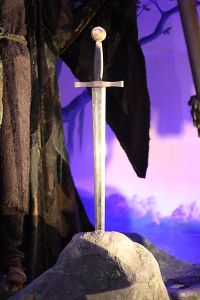
Scottish claymore replica Albion Chieftain, Søren Niedziella, CC BY 2.0

Some words don’t have a lot of obvious synonyms so you get hung up on the few you can find.  In my own work, the word sword is one of the main culprits. The type of blade my characters wield in the World of Neveyah books is a claymore, and four ensorcelled blades figure prominently in the Tower of Bones series.

Therefore, some obvious synonyms will not work as these are distinct blade types that are in no way like a broadsword.

  • Rapier
  • Epee
  • Foil

Because of this constraint, I am limited to:

  • Sword
  • Blade
  • Weapon
  • Steel (if I’m desperate, but I despise using that to reference a weapon that isn’t an epee or a rapier)

ozford american writers thesaurusHowever, sometimes we use intentional repetition:

Sometimes we want to emphasize a concept and repetition is the way to do it. Some of the best authors use the repetition of certain key words and phrases to highlight an idea or to show the scene. This technique is an accepted rhetorical device and is commonly found in mainstream fiction. It is used to evoke an emotional response in the reader, and can be exceedingly effective when done right.

Literarydevices.net says, “The beauty of using figurative language is that the pattern it arranges the words into is nothing like our ordinary speech. It is not only stylistically appealing but it also helps convey the message in much more engaging and notable way. The aura that is created by the usage of repetition cannot be achieved through any other device.”  (End quoted text)

Also according to literarydevices.net, repetition as a literary device can take these forms:

  • Repetition of the last word in a line or clause.
  • Repetition of words at the start of clauses or verses.
  • Repetition of words or phrases in opposite sense.
  • Repetition of words broken by some other words.
  • Repetition of same words at the end and start of a sentence.
  • Repetition of a phrase or question to stress a point.
  • Repetition of the same word at the end of each clause.
  • Repetition of an idea, first in negative terms and then in positive terms.
  • Repetition of words of the same root with different endings.
  • Repetition both at the end and at the beginning of a sentence, paragraph, or scene.
  • A construction in poetry where the last word of one clause becomes the first word of the next clause. (End quoted text)

Some famous examples of repetition as a literary device:

“Every book is a quotation; and every house is a quotation out of all forests, and mines, and stone quarries; and every man is a quotation from all his ancestors.”  Ralph Waldo Emerson, Prose and Poetry

f scott fitzgerald The Great Gatsby“About half way between West Egg and New York the motor-road hastily joins the railroad and runs beside it for a quarter of a mile so as to shrink away from a certain desolate area of land. This is a valley of ashes—a fantastic farm where ashes grow like wheat into ridges and hills and grotesque gardens, where ashes take the forms of houses and chimneys and rising smoke and finally, with a transcendent effort, of men who move dimly and already crumbling through the powdery air.” F. Scott Fitzgerald, The Great Gatsby

When an author writes it intentionally to drive home a point, repetition is an effective tool. It is when words are inadvertently used with a lack of creativity that repetition ruins a narrative.

Consider buying a thesaurus or make use of the many online thesauruses that are available.

I have a well-worn copy of the Oxford American Writer’s Thesaurus. This book has become just as important to me as my copy of the Chicago Manual of Style. This large book of synonyms can be purchased used from Amazon, for as little as $9.99 in the hardcover form. I do recommend purchasing this as a paper book rather than an ebook. Once you see the amazing variety of words at your disposal, it’s one you will refer back to regularly.


4 Comments

Filed under Literature, writing

#amwriting: poetry in prose

MSClipArt MP900390083.JPG RF PD Both poetry and prose have evolved over the last two-hundred years. In 1816 words were art, and they were frequently crafted into a piece  as if you were decorating a house–the author placed them in such a way as to be artistic as well as impactful.

Think Dickens, and Byron, and Mary Shelley.

A random comment in another forum led me to think about poetry and prose, which of course, led to a blog post.

Much of the time, modern poetry doesn’t rhyme. And even without rhyme, some authors write poetic narratives. But if it doesn’t rhyme, what makes poetry “poetic?” And where does it fit into modern prose?

As always, I turned to the “college of the internet” and did some research. Wikipedia, the fount of all knowledge says, “Poetry is a form of literature that uses aesthetic and rhythmic qualities of language—such as phonaesthetics, sound symbolism, and metre—to evoke meanings in addition to, or in place of, the prosaic ostensible meaning.” (End quoted text.)

In his April 19, 2012 blog post for Harriet, (the Poetry Foundation’s blog for poetry and related news) titled The Difference Between Poetry and Prose,  Martin Earl says a number of things.

Quote: “Prose is all about accumulation (a morality of work), while poetry as it is practiced today is about the isolation of feelings (an aesthetics of omission).” 

Well, that didn’t help. Taken individually, I understood each of the words that make up that sentence. Unfortunately, I didn’t understand what Mr. Earl intended to say by combining them so incomprehensibly.

I realized I would need an interpreter. So I prevailed upon Stephen Swartz, author, and professor of English at a well-known university, who is also a good friend of mine.

Stephen explained what Martin Earl may have meant: “I can only take that to mean that the writing of prose is, e.g. like a description, a compiling of details. a productive activity. I agree with the definition of poetry being a limitation of words/details in the service of presenting something esoteric such as thoughts and feelings, abstractions rather than the concrete. For prose, we accumulate words; for poetry we try to do more with less.”

Now THAT made sense to me.

However, I did find a portion of Martin Earl’s post to be understandable without the aid of my friendly neighborhood professor. Toward the middle, he explains the evolution of how poetry became prose, places it in a historical context and then explains that continued progression away from poetic prose in modern literature.

Earl writes, “In both classical and modern languages it is poetry that evolves first and is only much later followed by prose, as though in a language’s childhood, as in our own, poetry were the more efficient communicator of ideas.”

He goes on to say, “With the spread of the printing press after 1440, texts no longer had to be memorized. Poetry’s inbuilt mnemonics (rhyme, meter, refrain, line breaks) were no longer essential for processing and holding on to knowledge. Little hard drives were suddenly everywhere available.” (End quoted text.)

That makes complete sense to me on a personal level. I can remember anything I can set to a rhyme, or make into a song.

I believe using rhymes as mnemonics (which is defined as a memory device) is fundamental to human nature. We developed complex languages within our tribal communities while we were still in Africa, before the great diaspora. It was there in the earliest stages of our humanity that we gained the ability to describe the wider world to our children. With that, we had the capacity to understand and describe the motives of another person.  We could explain the how and why of an incident. We saw the divine in every aspect of life and developed mythologies combining all of these concepts to explain the world around us and our place in it.

Printer_in_1568-ceWe learned ways to memorize  and pass on ideas as abstract as legends or sagas. Through those stories, we could learn larger lessons from the mistakes and heroism of our ancestors.  My theory is that we developed poetry at the same time as we developed language.

Every tribe, every culture that ever arose in our world had this same tradition of passing down stories and legends using rhyme and meter.  Rhyme combined with repetition and rhythmic simplicity enabled us to remember and pass on wisdom to our children.

Wikipedia describes poetry as: “a form of literary art in which language is used for its aesthetic and evocative qualities in addition to, or in lieu of, its apparent meaning.”

It also describes prose as: “the most typical form of language. The English word ‘prose’ is derived from the Latin prōsa, which literally translates as ‘straight-forward.’”

In poetry, saying more with fewer words forces us to think on an abstract level. We have to choose our words based on the emotions they evoke, and the way they portray the environment around us. This is why I seem to gravitate to narratives written by authors who are also poets—the creative use of words elevates what could be mundane to a higher level of expression, and when it’s done well, the reader doesn’t consciously notice the prose, but they are moved by it.

We have no need to memorize our cultural knowledge anymore, just as we no longer need the ability to accurately tally long strings of numbers in our head.  We’ve begun to like our books with straightforward prose. Flowery language is no longer acceptable in the books we read.

This is also true of modern poetry.

The love of poetry continues, and new generations seek out the poems of the past while creating powerful poetry of their own.

Authors craft incredible narratives, often without knowing they are poets.

The Name of the Wind by Patrick Rothfuss 2nd coverPatrick Rothfuss, The Name of the Wind:

“It was night again. The Waystone Inn lay in silence, and it was a silence of three parts.

“The most obvious part was a hollow, echoing quiet, made by things that were lacking. If there had been a wind it would have sighed through the trees, set the inn’s sign creaking on its hooks, and brushed the silence down the road like trailing autumn leaves. If there had been a crowd, even a handful of men inside the inn, they would have filled the silence with conversation and laughter, the clatter and clamor one expects from a drinking house during the dark hours of night. If there had been music…but no, of course there was no music. In fact there were none of these things, and so the silence remained.” (End quoted text)

That is some powerful prose. It is both straightforward, and poetic.

That is where craft comes in. Choosing words for the emotions they evoke and the way they portray the environment the author has imagined is what lends great narrative prose its power. We can still appreciate beauty combined with impact when it comes to our prose.

6 Comments

Filed under Literature, writing

#amreading: The Queen of the Night by Alexander Chee

Queen of the Night alexander cheeEvery now and then I find myself reading/listening to a mainstream bestseller, and enjoying it. Alexander Chee has written just such a novel, in The Queen of the Night.

This novel has one of the best openings since Patrick Rothfuss’s brilliant opening lines in The Name of the Wind.

Quote from The Queen of the Night: When it began, it began as an opera would begin, in a palace, at a ball, in an encounter with a stranger who, you discover, has your fate in his hands. He is perhaps a demon or a god in disguise, offering you a chance at either the fulfillment of a dream or a trap for the soul. A comic element—the soprano arrives in the wrong dress—and it decides her fate.

These lines presage an immersive, sumptuous reading experience.

But first, THE BLURB:

Lilliet Berne is a sensation of the Paris Opera, a legendary soprano with every accolade except an original role, every singer’s chance at immortality. When one is finally offered to her, she realizes with alarm that the libretto is based on a hidden piece of her past. Only four could have betrayed her: one is dead, one loves her, one wants to own her. And one, she hopes, never thinks of her at all.

As she mines her memories for clues, she recalls her life as an orphan who left the American frontier for Europe and was swept up into the glitzy, gritty world of Second Empire Paris. In order to survive, she transformed herself from hippodrome rider to courtesan, from empress’s maid to debut singer, all the while weaving a complicated web of romance, obligation, and political intrigue.

Featuring a cast of characters drawn from history, The Queen of the Night follows Lilliet as she moves ever closer to the truth behind the mysterious opera and the role that could secure her reputation — or destroy her with the secrets it reveals.

The book so far:

From those intiguing opening lines forward it is filled with every kind of emotion, every human tragedy and triumph imaginable. It resounds with the pomp and grandeur of the most thrilling opera–as it should since it details the life of a Parisian opera star of outstanding brilliance–a true diva in the operatic sense.

Rumors abound regarding Lilliet–she is the topic of many conversations, but rumors barely touch on the truth of her life. Even she is not truly sure of who or what she is. Despite having achieved everything and more, she lacks something and is waiting for a “meeting with destiny” which she hopes will transform her life into the paradise she wants it to be.  That moment comes in chapter one, but the transformation….

You will have to read it to see.

This book is not cheap–the Kindle edition is $14.99. I bought it as an Audible download ($17.95) because I am heavily involved in editing right now for a Myrddin author and am also making revisions on my own work under an editor’s guidance. Then I bought the hardcover edition.

I am unable to read for pleasure until I am done with these two tasks. And because of some interesting style choices on the part of the author, such as not enclosing dialogue in quotes, I especially dare not attempt to read this particular book just now.

But I can listen to audio books, and what I am hearing in this book captivates me. When I am once again able to read for pleasure, this book will the first I crack open.

To purchase a book published by the large traditional publishers is a hefty financial commitment. To make your decision a little easier, Longreads posted the first chapter here: The Queen of the Night by Alexander Chee. Please go out to their wonderful site and if you like what you see, consider becoming a member.

4 Comments

Filed under Books, Literature

#amblogging: wanted: flatiron for curly quotes and other blogging twists

300px-Barnum_&_Bailey_clowns_and_geese2Blogging regularly is one of the best ways to improve your writing chops but it can be like working for the circus.  Even when you really know the vagaries of your platform, a lot of strange things can happen in your work. They go unnoticed, doing their thing in the background, keeping it interesting.

WordPress, the mighty bastion upon which my empire rests, uses ‘fancy quotes’ as the default format. While they do look better in a document, blogging can often be an off-the-cuff thing. Straight quotes are less apt to go awry.  I am not sure why this is the default, nor am I able to find a way to ‘unfancy’ them.

WordPress chooses to make things  fancy, but I don’t need fancy. Judging from the number of posts in their forums on the subject, I am not the only one.

In some places, these curvy morsels of madness are called ‘smart quotes.’ In others, they are ‘curly.’ I don’t like them because sometimes they end up facing the wrong way, and being a bit unobservant, I don’t catch that until after I’ve posted it.

I’ve discovered some out of date plug-ins that are no longer available for uncurling my curly quotes, but alas– ‘no longer available’ is not really helpful. I have a flatiron for my curly hair–I need one for WordPress’s curly quotes.

straight and curly quotesAnother seemingly random thing I’ve discovered the hard way: occasionally I will decide to cut a section and paste it elsewhere, only to find (after having published the post) that the cut section has magically reappeared, and I am now repeating myself, verbatim.

This happens so often that I neurotically look at the menu every time I right-click-cut anything, to make sure I am actually cutting and not merely copying.

I double-check the text. Yes, the cut piece is definitely cut and successfully pasted elsewhere. But when I click ‘save draft’ it magically reappears back in the place from which it was cut, and I am once again repeating myself.

gibberish-american businesses onlineThen there is the hinky formatting. Sometimes the formatting goes crazy  and no matter what I do, the spaces between the paragraphs vanish. My post becomes a wall of words. Highlighting the post and clicking on ‘clear formatting’ does not help.

The spaces will show up on the editing side of the piece, but they will have vanished when the post is saved and published. (Edit: removed repeated line. Cursed fluently.)

My hubby, the programmer, says this is most likely caused by some hidden formatting issue that happens when I am copying from a Word doc and pasting it into the post. I usually write my posts in a Word doc because I catch more mistakes that way. Then I paste it here and, using the ‘preview’ option, check, double-check, and check again for bloopers.

Randomly, the posts are rife with strange formatting that will not be removed no matter what remedy I try. If I was a programmer, I would know exactly what bit of code was causing it and fix it. Alas! I’m only an old lady with just enough knowledge to be dangerous.

Hinky formatting also occurs in my Blogger sites, but not as often. I love the way WordPress looks when it’s all going right, but I love the options Blogger offers and the compatibility with Google products such as YouTube videos. (Blogger is a Google product.)

Dealing with these little issues are why I try to write my posts several days in advance and schedule them for the time I want them to post. Once I have it scheduled, I will let it sit overnight and then come back and read it with fresh eyes. I catch a lot that way, but it’s amazing how many slip by me.

This is why I always say self-editing is not as effective as we’d like. No one sees my blog posts before they are published but me and invariably I miss some whopping eye stopper.

1024px-Trapeze_Artists_in_CircusThe most mysterious problem is the inadvertent posting of a piece that is

  • in the draft stage
  • full of bloopers
  • looks illiterate

Technically, that happens because I get side-tracked and instead of scheduling it as I normally do, for some crazy reason I click ‘publish’ instead of ‘save draft.’

I blame ghosts.

And curly quotes.

9 Comments

Filed under blogging, writing

#amwriting: tips for writing clear dialogue

gibberish quoteDialogue can be tricky. Often, in our rush to get the ideas on paper, we have left off quotes, misplaced punctuation, and written interrupted dialogue with inconsistency.

While a certain amount of literary license in dialogue can enrich our work, our dialogue may be too rich with run-on sentences, and not in a good way.

Also, while everyone has read books that inspire them to become writers, some authors never learned how to write the kind of dialogue they envision. They don’t understand the fundamentals and don’t realize how their lack of understanding ruins their work.

Always begin what is actually spoken (dialogue) with a capitalized word, no matter where in the sentence it begins.

  • Mary glanced over her shoulder and said, “I’m sorry. I can’t go with you.” 

However, interrupted dialogue, when it resumes, is not capped, although the rules of punctuation and quotation marks still apply.

  • “I’m sorry to tell you,” said Mary, “but I can’t go with you.”

Direct dialogue is someone speaking to you or someone else and requires quotation marks.

  • I’m sorry. I can’t go with you,” said Mary.

I’m a US author, so I used double quotes, also called closed quotes. The UK usage is different and often uses apostrophes, or what they call inverted commas. Either way, be consistent and make sure ALL punctuation goes inside the quote marks.

Yes, I did say All punctuation. How does one set off a quote from someone else within dialogue? Set it apart with single quotes (apostrophes, inverted commas) and keep it inside the closed quotes.

George said, “When I asked her, Mary replied ‘I can’t go.’ But I’m sure she was lying.”

George said, “When I asked, Mary replied ‘I can’t go.'” Note there are 3 apostrophes there: 1 apostrophe and 1 double (closed) quote mark. This is in keeping with the rule that all punctuation in dialogue goes inside the quotation marks.

Indirect dialogue is a recapping of dialogue that someone previously spoke.

  • When asked, George said Mary couldn’t go.

Note there are no quotes used in indirect dialogue. Also in this sentence, the word that is implied between said and Mary.

Dialogue tags, or attributions, can come before the dialogue, especially if you want the dialogue tag to be noticed. To make them less noticeable put them in the middle or at the end of sentences. In my own work, I want the dialogue and not the attribution to stand out. However, when more than two people are involved in a conversation, I move the dialogue tags further to the front so the reader isn’t left wondering who is speaking.

DialogueI’ve mentioned before that I prefer simple attributions such as said, replied, and answered because they are not as likely to stop the reader’s eye. People don’t snort, smirk, smile, or frown dialogue as it is physically impossible. They can say it with a smile, but the smile is a facial expression and does not speak.

Avoid verbal tics like “hmmm…” and “ahhh…” as they just take up space and add fluff to your narrative. When people in real life preface all of their sentences with drawn-out ahs and hmms it can be aggravating to listen to them. Consider how irritating it would be to read it.

Sometimes we have two ideas in a sentence that we think are one, and we connect them with commas.  But closer examination shows they are not.

  • “Hello, sir, we bathed your dog,” she said.

The above dialogue contains a run-on sentence, despite its shortness. We may actually speak it in this fashion, words run together, but for a reader, punctuation clarifies ideas.

The dialogue contains two separate ideas. “Hello, sir,” is an acknowledgment and a greeting. “We bathed your dog,” indicates an action was taken in regard to his dog. It should be:

  • “Hello, sir. We bathed your dog,” she said.
  • When we write our conversation using proper punctuation, it looks natural, and the reader will hear it the way it was intended.

When it’s done right, dialogue is, in my opinion, the best part of the story. It’s where we discover who the characters are, and how the larger events affect them. Conversations show the world as the protagonist sees it. We can take some style and voice liberties with dialogue, and indeed, we should, but adhering to industry standard rules of punctuation ensures your reader can remain immersed in the story, and forget they are reading.

And THAT is what we all hope for.

21 Comments

Filed under Literature, writer, writing

#amwriting: Our shifting language

English is the third most widely spoken native language in the world (behind Mandarin Chinese and Spanish). It is the first language of four countries and is spoken by more than 400 million people, with five major dialects and distinct accents:

  • Countries where English is spoken natively by the majority of the populationBritish English
  • North American English
  • Australian English
  • New Zealand English
  • South African English

An American girl from a rural corner of the US can understand a girl from New Zealand fairly well, and after they adjust to the differences in their accents, they can chat freely.

Many other countries use English as their official language. According to Google, fifteen more countries have their own native language, but use English as an “Official Language and the Language of Instruction in Higher Education”:

Anguilla Ireland, Northern Singapore
Antigua and Barbuda Ireland, Republic of Solomon Islands
Australia Jamaica South Africa
Bahamas Kenya Swaziland
Barbados Lesotho Tanzania


According to Wikipedia, the Fount of All Knowledge: “Estimates that include second language speakers vary greatly, from 470 million to more than 1 billion. David Crystal calculates that non-native speakers as of 2003 outnumbered native speakers by a ratio of 3 to 1. When combining native and non-native speakers, English is the most widely spoken language worldwide.

All English speaking people can communicate through writing, and while they might not be able to understand each other well in person, they can easily communicate via the written word.

In medieval times, the lingua franca was Latin. Lingua Franca means a language that is adopted as a common language between speakers whose native languages are different. An historical example of how people can communicate using a lingua franca in writing and still be unable to understand each other when speaking it: Richard the Lionhearted spoke langue d’oïl, a French dialect, and lenga d’òc, a Romance language, and his wife, Berengaria of Navarre, spoke Navarro-Aragonese, a Spanish dialect.

During the political negotiations arranging their marriage, Richard and Berengaria communicated via letters composed and written in Latin, as neither one spoke the other’s native language. However, when they met, even though they were both speaking Latin, their accents made it nearly impossible for them to understand each other until they became used to the other’s pronunciations.

That bit of historical trivia brings us back to the modern day lingua franca: English. With so many people speaking it, new usages come into play and spread through the speaking community, and the language shifts. Sometimes it shifts more rapidly than I can keep up with.

This blending and shifting of the common usage demonstrate what happened to Latin. Latin is frequently referred to as a dead language, but it is not. Latin is actively spoken in the modern Romance languages. (Romance referring to Roman, not love.)

The five most widely spoken Romance languages by number of native speakers are:

  • Spanish (410 million)
  • Portuguese (216 million)
  • French (75 million)
  • Italian (60 million)
  • Romanian (25 million)

Latin also appears in and strongly influences our Germanic, Frisian-based English, through our Norman ancestry—after all, our great Norman kings and queens spoke Medieval French: langues d’oïl, which itself was a mingling of Gallic and Roman based languages.

The Normans came to Britain speaking French, and their children remained, speaking a blend of Anglo-Saxon-French: Old English.

270px-Rosetta_StoneAll spoken language evolves. Only languages whose sole known records are actually engraved in stone, such as Egyptian Hieroglyphics and Ancient Sumerian, are unchanging.

English is continually evolving in more than just the obvious way of snappy catch-phrases and new technology. It is evolving in its formal usage

Consider the word whilst. As conjunctions go, the words whilst and while are technically interchangeable in meaning, but whilst has become less common in standard American English. If whilst appears in an American genre fiction book, it’s an eye-stopper, awkward and old-fashioned, more suited to classical poems and literary prose. Therefore, an American author may not use whilst, but a British author might.

Yet, despite its having fallen out of fashion in the US, we all understand the word whilst when we see it written and when we hear it.

At some point, everything we write in our modern language will be as unintelligible to those who speak the future modern English as Geoffrey Chaucer’s work is to the contemporary eye and ear today:

chaucer modern translate wife of bath meme

It is clear that the eye of the translator and his perception can greatly influence the modern translation of the work. I disagree with the use of the word “Ruled” in the second line, as the intent of “Were” in this case is clearly “was.” In the common usage of the day, “were” was interchangeable with “was.” Had I been in the same program as the above translator, we would have argued over this point.

I’d have translated it as:

Experience, though no authority,

Was in this world  enough for me

To speak of the woe that is marriage.

For, Lordings, since I was twelve years of age,

Thanks be to God eternally alive!

Husbands at the church door, I have had five.

We can only see the works of our great literary giants through the lens of time, filtered through our own wishes and interpretations. And this is how our greatest works, those which do survive into the next millennium, will be seen and interpreted.

Title page of Geoffrey Chaucer’s Canterbury Tales in the hand of his personal scribe Adam Pinkhurst, c. 1400Perhaps our published work will remain a part of the public record as it is today, and be available for students of “classic” literature to interpret. Or perhaps our works will be forgotten, lodged in the dusty vaults of Bowkers, only rarely resurfacing, having been ironically relegated to the dark corners of scholastic research on obscure texts in forgotten languages.

Soon-to-be forgotten or not, I am writing for today, and writing for a contemporary reader. My usages will evolve over the life of my writing career–I ‘ve already seen this evolution at work. That is the process of growth, and it’s clear how my early works differ from my more recent work.

Growth and change drives and forms the new canon of 21st century world literature. We are all a part of its birth, whether we are readers or authors. Readers choose the works they buy and those works are written by people who chose to record the thoughts, values, and misdeeds of their contemporary society in story form.

I am so blessed to be both a reader and an author.

3 Comments

Filed under Literature, writing

#amreading: The Well at World’s End, William Morris

TheWellattheWorldsEnd423x630First published in 1896, and now in the public domain, The Well at World’s End by William Morris has inspired countless great fantasy authors. J.R.R. Tolkien and C.S. Lewis were students at Oxford when they became devotees of Morris’s work, to name just two. I first read this book in college (back in the dark ages) when Ballantine released it as a two-volume set. The original Ballantine covers are below, at the end of this post.

This fairly unknown literary treasure is available for free, as a download for your Kindle or any other reading device. I got my Kindle version through the Gutenberg Project on Google–and it reminded me of what my true roots as a reader of fantasy are. Give me the beautiful prose, the side-quests to nowhere, and wrap them in an illusion of magic, and I’m yours forever.

First, The Blurb:

The rich, interwoven tapestry of William Morris’s four-volume epic, “The Well at the World’s End”, is brought together in a handsome edition featuring the tale of Ralph of Upmeads. Literally and figuratively, this story is the wellspring that gave rise to both C.S. Lewis’ “Chronicles of Narnia”, and J.R.R. Tolkien’s “The Hobbit” and “Lord of the Rings”. Many elements of the story will be familiar to those who love these and other modern narratives of fantasy and adventure, set in a mythical world.

Ralph of Upmeads is the fourth and youngest son of the king of a small monarchy, and the only one forbidden of his elder brothers from going in search of his fortune. He runs away, but not before his godmother gives him a necklace with a bead on it, which unerringly directs his destiny to seek out the legendary and titular well at the end of the earth. Along the way, he encounters friends and foes in an ever-changing landscape of rolling hills and barren wood, towering mountains and meandering rivers. Through them all pass roads down which many heroes since have sojourned; united in fellowship, or alone on solitary quests.

Great and splendorous cities await, and in between, thriving towns, tiny villages, and protective farms at the edge of vast wildernesses. The further our intrepid wayfarer gets from home, the more he misses the simple pleasures of his hearth, table, and bed. Many have followed in his footsteps since, both character and reader alike.

Its language is that of another age, but its archetypical settings and denizens are the timeless stuff of once and future legend.

William_Morris_-_Project_Gutenberg_eText_13619

Portrait of William Morris by George Frederic Watts, 1870

My Review:

William Morris wrote beautifully crafted poems. The prose in this narrative is both medieval and sumptuous. He was born in 1834 and died in 1896. He was an important figure in the emergence of socialism in Britain, founding the Socialist League in 1884, but breaking with that organization over goals and methods by the end of the decade. Famous as a designer of textiles and wallpaper prints that made the Arts and Crafts style famous, Morris devoted much of the rest of his life to the Kelmscott Press, which he founded in 1891. Kelmscott was devoted to the publishing of limited-edition, illuminated-style print books. The 1896 Kelmscott edition of the Works of Geoffrey Chaucer is considered a masterpiece of book design.

The Well at World’s End is a real departure for the literature of the Victorian era, in that the morality is indicative of the free-thinking bohemian lifestyle of the famous and infamous artists of the day. William Morris was a member of the Pre-Raphaelite Brotherhood and was a man who enjoyed an unconventional lifestyle in the company of like-minded people, with few permanent ties, all of them celebrating musical, artistic, and literary pursuits.

Using language with elements of the medieval tales written by Chaucer and Chrétien de Troyes, who were his models, Morris tells the story of Ralph of Upmeads, the fourth and youngest son of a minor king. The king is wise and his kingdom prosperous, but nevertheless his four sons are not content. The three older brothers set out, with their father’s blessing. Ralph is still young, and his father wishes him to remain at his side.

Not happy with his lot, Ralph departs without his father’s blessing. He yearns to find knightly adventure and is encouraged by a lady, Dame Katharine, to seek the Well at the World’s End, a magic well which will confer a near-immortality and strengthened destiny on those who drink from it. The Dame is childless, and sees Ralph as a son; she gives him a necklace of blue and green stones with a small box of gold tied on to it, telling him to let no man take it from him, as it will be his salvation. She also gives him money for his journey.

The well lies at the edge of the sea beyond a wall of mountains called “The Wall of the World” by those on the near side of them but “The Wall of Strife” by the more peaceful and egalitarian people who live on the seaward side.

Ralph meets a mysterious Lady of the Dry Tree, the Lady of Abundance who has drunk from the well, and they become lovers. Together and separately, they face many foes and dangers including brigands, slave traders, unscrupulous rulers and treacherous fellow travelers. The lady is murdered, leaving Ralph bereft. Later, Ralph meets another lady, Ursula, and with her help and the aid of the Sage of Sweveham, an ancient hermit who has also drunk of the well, Ralph eventually attains the Well, after many more adventures.

Because the main character, Ralph, and a nameless lady become lovers with no thought of marriage, the novel was not well known in its time, until twenty years after Morris’s death when it was discovered by free-thinking university students, to the dismay of their strait-laced parents.

The underlying story is strong, with many twists and turns. The relationship between the Ralph and the Lady of Abundance is well portrayed, as is the jealousy of her former lover, the death of her husband, and the way she is either loved or feared by everyone around her driving the plot forward. She is a woman of mystery, alternately cruel and kind, one minute the Lady of the Dry Tree, and the next, the Lady of Abundance.

Ralph’s story really begins after her death and the intertwined threads of fate and magic are compelling. The characters Ursula and the Sage of Sweveham are both deep and well-drawn.

I freely confess that in the same way as the works of William Shakespeare are hard for a modern reader to translate, the language of William Morris’s work is difficult to follow. A quote will show you what I mean: “But Ralph gave forth a great wail of woe, and ran forward and knelt by the Lady, who lay all huddled up face down upon the grass, and he lifted her up and laid her gently on her back. The blood was flowing fast from a great wound in her breast, and he tore off a piece of his shirt to staunch it, but she without knowledge of him breathed forth her last breath ere he could touch the hurt, and he still knelt by her, staring on her as if he knew not what was toward.”

When you read it aloud, it rolls off the tongue with beauty and grace and is somehow easier to understand.

I was always intrigued by the works of the medieval and renaissance authors whose works I had to work to translate into modern English. Once translated, reading it was like opening a time capsule. It was a window into a lost world of romance and mystery.

The Well at the Worlds End is a foundational work in the canon of modern fantasy literature. All the great works of the twentieth century have some roots in this novel. The hard-core devotee of true fantasy literature will not be intimidated by the archaic prose. A wealth of tales lies within this volume, all of which come together in the end.

The_Well_at_the_Worlds_End_1-2


Parts of this review were originally published  on 31-Jan-2014 on Best in Fantasy

5 Comments

Filed under Books, Fairies, Fantasy

#amwriting: wrangling that, which, and semicolons

em dash memeSemicolons are misused morsels of punctuation. Some authors believe they are extra-long pauses: half-way between a comma and a (full stop)period. These bits of typographical madness litter their work.

Semicolons  are NOT extra-firm pauses. Em dashes or (if you are British) hyphens serve that function. Semicolons have a different place in the universe. For this post, we are going to look at semicolons as joiners.

The proper use of a semicolon is to join two short sentences that are directly related to each other, turning them into a compound sentence.

No one enjoys reading a choppy narrative. Too many short sentences can be distracting and hard to get into. The way we smooth the narrative is to join short sentences into longer, compound sentences. But frequently, that creates run-on sentences. (I am the queen of those.)

  1. Short and choppy: I’d love some ice-cream. We should go to the Dairy Queen.
  2. Compound sentence: I’d love some ice-cream; we should go to the Dairy Queen.

Comma Splice MemeYou do not join independent clauses with commas as that creates a rift in the space/time continuum: the Dreaded Comma Splice.

  1. WRONG: It’s nearly half past five, we can’t reach town before dark.
  2. BETTER: It’s nearly half past five; we can’t reach town before dark.

The two clauses that are joined together with a semicolon should relate to each other. The above sentences work because the lateness of the day means they might have to travel after dark.

  1. WRONG: We should go to the Dairy Queen; it’s nearly half past five.
  2. BETTER: We should go to the Dairy Queen. It’s nearly half past five.

If time is actually the issue in the above sentence, and you absolutely MUST use a semicolon or you will explode, say, “The Dairy Queen is about to close; it’s nearly half past five.”

I generally try to find alternatives to semicolons, but I don’t dislike them, as some editors do. I think they are too easily abused and misused, so I encourage myself and my authors to think outside the semicolon.

Another sticky area for the some authors are the words ‘that’ and ‘which.’ They are often difficult for new authors to get the hang of. They are not interchangeable, and overuse of the word ‘that’ cannot be cured by using ‘which’ instead.

‘That’ is a pronoun:

  1. Used to identify a specific person or thing observed by the speaker.

“That’s his dog on the curb.”

  1. Referring to a specific thing previously mentioned, known, or understood.

“That’s a good idea.”

‘That’ is also a determiner:

  1. Used to identify a specific person or thing observed or heard by the speaker.

“Look at that house fire.”

  1. Referring to a specific thing previously mentioned, known, or understood.

“He lived in Tacoma at that time.”

‘That’ is also an adverb

  1. Indicating to such a degree; so.

“I wouldn’t go that far.”

And ‘that’ is a conjunction:

  1. Introducing a subordinate clause expressing a statement or hypothesis.

“She claimed that she was married.”

‘That’ can also be a literary conjunction expressing a wish or regret:

“Oh, that I had known this before.”

<><>

‘Which’ is a pronoun:

  1. asking for information specifying one or more people or things from a definite set.

“Which are the best diapers for newborns?”

Which’ is a determiner:

  1. used referring to something previously mentioned when introducing a clause giving further information.

“A house on Black Lake, which is for sale.”

Some people will rather forcefully say you must never use the word ‘that,’ but those people are clearly unaware of the larger grammatical picture—do not listen to them.

Sigh.

So, when do we use the word ‘that’ in an appropriate and defensible fashion?  After all, too many ‘that’s’ make the prose boring and forgettable.

So does Grammar Girl, (Mignon Fogarty) on her awesome website for writers with questions. This website is an invaluable resource for folks like me, with some education, but no memory of what we were actually taught.

that which does not kill meThere are instances where only ‘that’ will suffice. When do we use the word that?

We use it when we have something called a ‘Restrictive Clause’:

Quote from Grammar Girl, “A restrictive clause is just part of a sentence that you can’t get rid of because it specifically restricts some other part of the sentence.”  She goes on to give a specific example of a restrictive clause: “Gems that sparkle often elicit forgiveness.”  See?  Not just any gems elicit forgiveness in this sentence. Only gems that sparkle bring about clemency. In this sentences, forgiveness is restricted to one kind of gem.

So, now we know about restrictive clauses, but what about nonrestrictive clauses? Again we turn to the Grammar Girl and she says, “A nonrestrictive clause is something that can be left off without changing the meaning of the sentence. You can think of a nonrestrictive clause as simply additional information.”

Again the Grammar Girl gives the example, “Diamonds, which are expensive, often elicit forgiveness.”  The word ‘which’ isn’t really necessary, as the meaning of the sentence would not be changed if you left it out. “Diamonds are expensive, but often elicit forgiveness.”

stop don't click replace allOften the sentence is better without the words ‘that’ or ‘which,’ but each instance must be examined individually, to ensure you are making the best choice.

This is yet another time when making a global search for these words is a good idea. (And never choose ‘replace all’.) On an individual basis, decide which word is the correct word, ‘that’ or ‘which’ and then decide whether to delete it or keep it. If the sentence makes good sense without it, lose it.

4 Comments

Filed under Self Publishing, writing