#FineArtFriday: Fisherwomen, Cullercoats by Winslow Homer 1881, a second look

Homer,_Winslow_-_'Fisherwomen,_Cullercoats',_1881,_graphite_&_watercolor_on_paperArtist: Winslow Homer  (1836–1910)

Title: Fisherwomen, Cullercoats

Date:   1881

Medium: watercolor and graphite on paper

Dimensions: height: 34.2 cm (13.4 in); width: 49.2 cm (19.3 in)

Collection: Honolulu Museum of Art

What I love about this painting:

Homer shows us a foggy morning at the beach, capturing the quality of light on the strand at Cullercoats, Tyne and Wear, England. He paints the background with an impressionist’s eye and gives us realistic portraits of the working women whose labors fed the country.

The fish baskets are heavy, but they share the load. Their sleeves are rolled up for work, and skirts are shorter than if they were in town—no one wants wet skirts dragging around their ankles.

I love the way he shows these women as they were that day, treating them with respect. During his lifetime, Winslow Homer depicted men and women of all races, slaves and former slaves, and soldiers. He showed us people who worked hard, not giving us caricatures but painting portraits of real people.

Homer loved the sea and traveled widely, painting everywhere he went. Critics sometimes dismiss his work as “calendar art, appealing to the unschooled masses.” But think about it – calendars and magazines often were the only art poor and working-class people had in their homes. If you don’t have access to art, how can you become “schooled” in it? Some art critics are a little too schooled.

If you are interested in knowing more about the art of Winslow Homer, this documentary is excellent: FAKE OR FORTUNE SE1EO4 WINSLOW HOMER – YouTube

About the Artist, via Wikipedia:

Homer started painting with watercolors on a regular basis in 1873 during a summer stay in Gloucester, Massachusetts. From the beginning, his technique was natural, fluid and confident, demonstrating his innate talent for a difficult medium. His impact would be revolutionary. Here, again, the critics were puzzled at first, “A child with an ink bottle could not have done worse.” Another critic said that Homer “made a sudden and desperate plunge into water color painting”. But his watercolors proved popular and enduring, and sold more readily, improving his financial condition considerably. They varied from highly detailed (Blackboard – 1877) to broadly impressionistic (Schooner at Sunset – 1880). Some watercolors were made as preparatory sketches for oil paintings (as for “Breezing Up”) and some as finished works in themselves. Thereafter, he seldom traveled without paper, brushes and water based paints.

As a result of disappointments with women or from some other emotional turmoil, Homer became reclusive in the late 1870s, no longer enjoying urban social life and living instead in Gloucester. For a while, he even lived in secluded Eastern Point Lighthouse (with the keeper’s family). In re-establishing his love of the sea, Homer found a rich source of themes while closely observing the fishermen, the sea, and the marine weather. After 1880, he rarely featured genteel women at leisure, focusing instead on working women. [1]


Credits and Attributions:

Image: Fisherwomen, Cullercoats by Winslow Homer 1881. Wikimedia Commons contributors, “File:Homer, Winslow – ‘Fisherwomen, Cullercoats’, 1881, graphite & watercolor on paper.jpg,” Wikimedia Commons, https://commons.wikimedia.org/w/index.php?title=File:Homer,_Winslow_-_%27Fisherwomen,_Cullercoats%27,_1881,_graphite_%26_watercolor_on_paper.jpg&oldid=721923030 (accessed August 3, 2023).

[1] Wikipedia contributors, “Winslow Homer,” Wikipedia, The Free Encyclopedia, https://en.wikipedia.org/w/index.php?title=Winslow_Homer&oldid=1168361459 (accessed August 3, 2023).

2 Comments

Filed under #FineArtFriday

Layers of the Scene: conversation #writing

WritingCraftSeries_depth-through-conversationMost of my novels and short stories begin life as exchanges of dialogue between two characters. Their conversations shed light on what each character’s role in the story might be.

We all know that dialogue must do at least one (if not all) of these four things:

  1. It must share information the characters are only now learning.
  2. It should show the characters’ mood and state of mind.
  3. It must shed light on the relationship of the characters to each other.
  4. We include props that show the world and the characters’ places in their society.

So, once I have an idea for a story, I think about the characters and ask what they need to know, either about their quest or themselves. It’s a two-stage process—the scenery and background get filled in after the dialogue has been written.

I picture the scene. Then, I write just the dialogue for several back-and-forth exchanges, getting the basic words down.

“What are you doing?”

“Oh, just drawing.”

“Drawing what?”

“You’ll laugh or find a reason to mock me for it.”

Once I know what they are talking about and have the rudimentary dialogue straight, I add basic scenery and speech tags. The dialogue grows with each layer because the scene becomes sharper in my mind.

The next morning, when his stepmother came down for coffee, John was once again working on something in his notebook.

“What are you doing?” Ann’s clipped tones cut the silence.

“Oh, just drawing.” He stood, gathering his pens. The peace he’d sought had gone earlier than he hoped.

“Drawing what?”

John’s normally open features were closed, inscrutable. “You’ll laugh or find a reason to mock me for it.” Closing his sketchbook, he attempted to leave but stopped when she put her hand on his shoulder.

“Show me. Now.” When Ann repeated her demand, he reluctantly opened the book. Page after page was covered in stylized dragons, leafy vines, and runes. “Why do you waste your time with this crap? You could be brilliant, but no! People want real art, not this drivel.”

“This is how I earn my living.”

Ann poured herself a cup of coffee, pausing only to sneer. “You don’t have a pot to—”

“It pays my mortgage. What more do you want?” John reclaimed the sketchbook. “Coming back here was a mistake. I did it because David asked me to, because Dad is ill, and because it’s Christmas.”

“Don’t talk to me about David. You encouraged my son to abandon a brilliant career in the law firm that has been in the family for four generations.”

“Stop. I encouraged my stepbrother to have faith in himself. Yes, I urged him to try out for the position of symphony concertmaster, and he got the job. He’s incredibly talented and loves what he does.” John crossed toward the dining room, aware that arguing with her would change nothing. “Enjoy your breakfast.” The kitchen door closed behind him, cutting off his stepmother’s rant.

The layers that form this scene are:

  1. good_conversations_LIRFmemeAction: She comes down for coffee. He holds a notebook, gathers pens, and stands.
  2. Dialogue: shows long-simmering resentment between the two players and gives us a time reference—it’s Christmas.
  3. Environment: a kitchen, closed off from the rest of the house.
  4. The story: Ann is under severe stress in her work and at home. In this story, her closed-off kitchen is symbolic of her closed-off personality. The place that is the heart of a home is walled away. She doesn’t want to examine why she is enraged by David and John’s freedom to make their own choices.

We work with layers to create each scene. With these layers, we show the reader everything they need to know about that moment in time.

Over the course of a narrative, conversations will take place in different settings. Readers will gradually see the world through the characters’ eyes. They will visualize the world without our having to dump a floor plan or itinerary on the reader. Remember our basic conversation?

“What are you doing?”

“Oh, just drawing.”

“Drawing what?”

“You’ll laugh or find a reason to mock me for it.”

Let’s keep the names and put that dialogue and the notebook into a fantasy setting. We’ll change how the characters are related to each other and see what comes up:

Logically, Ann knew John wasn’t responsible for David’s death. Two years on, and it still colored her life. But he’d come back alive when her brother hadn’t, and a secret part of her blamed him for that. Still, her curiosity grew stronger every time she saw him with his pencils beside the campfire, drawing something in his notebook.

Ann knelt and turned the flatbread so it would cook evenly. She couldn’t ask him about the stupid notebook. Why had she volunteered to cook? It was bad enough that she was traveling alone with him. The last thing she wanted was for him to think she was open to resuming their old accord.

But curiosity, her greatest curse, got the better of her. To her horror, she heard herself ask, “What are you doing?”

“Oh, just drawing.”

“Drawing what?”

“You’ll laugh or find a reason to mock me for it.” Closing his sketchbook, John attempted to rise but stopped when she put her hand on his shoulder.

“I promise I won’t. Please? I’m just curious.”

John’s guarded expression said he doubted her. Of course, he did. She’d been cold to him since David was killed. But he opened his notebook.

Page after page was covered with portraits of all the members of their clan, including her. Each looked as full of life as if they could step off the page. Tears sprang to her eyes on seeing the many portraits of her brother, handsome and laughing. “All these drawings of David … it’s the way I want to remember him.” She met his gaze. “Thank you.”

John looked away. “I dream all night long of that day and all the things I could have done to change what happened. And then I have to draw. I don’t know why.”

Ann’s eyes burned again. She owed him an apology. But how? “Maybe you draw portraits to keep the people you love alive.” She sighed, saying what she knew was the truth. “It was an avalanche. You couldn’t have changed anything.”

We used the same words as in the previous scene for the core of the conversation and included a sketchbook. We used the same names. John is still an artist, and Ann is still under stress, in this case, grief. However, with different relationships, we have different histories. We end up with different character arcs and a different outcome.

The layers that form this scene are:

Family Camping Clipart

Action: Ann is cooking—the campfire is her kitchen. John opens a notebook.

Dialogue: shows a wary interaction between two people who know each other well but are estranged and who may be entering a different stage in their relationship.

Environment: a campsite, an open fire. It is set in the wide outdoors, yet in the darkness, it is intimate.

The core of the dialogue is the same, but the direction the conversation takes is changed because the story and the characters are different.

By beginning with the conversation and envisioning it as if it were a scene in a movie, I can flesh it out and show everything the reader needs to know. Readers are smart and don’t want to be told what to think. Their minds will supply the details of a kitchen or a campsite, depending on the props I include when I add the set dressing.

The layers of action, dialogue, and environment form the framework that supports the story. Where will the layers you add to your conversations take your stories? The possibilities are endless.

4 Comments

Filed under writing

#FineArtFriday: Two Watermills and an Open Sluice by Jacob van Ruisdael 1653 revisited

Jacob_Isaacksz._van_Ruisdael_-_Two_Watermills_and_an_Open_Sluice_-_WGA20479Artist: Jacob van Ruisdael  (1628/1629–1682)

Title: Two Watermills and an Open Sluice

Genre: landscape art

Date: 1653

Medium: oil on canvas

Dimensions: height: 664 mm (26.1 in)

Collection: Getty Center

What I Love about this painting:

This painting is the perfect writing prompt. Peaceful and serene, the scene shows us two watermills opposite each other on the stream, sharing the power of the water. These mills were examples of the highest technology of that time, and the families who owned them were prosperous middle-class people. Very likely they were literate, well-respected members of the local community.

Were these mills owned by the same family?

Or were they owned by rivals, competing to grind the grain produced by the local farmers? Is one a grist mill and the other a lumber mill? Or a weaver’s mill housing looms?

Was there a love story behind their being so close to each other, perhaps a Romeo and Juliet-style romance? (Tragedy averted, of course, or it wouldn’t be a romance.)

This is a wonderful painting, a window into the past.

About the artist, via Wikipedia, the free encyclopedia:

Jacob Isaackszoon van Ruisdael (Dutch pronunciation: [ˈjaːkɔp fɑn ˈrœyzˌdaːl] ; c. 1629 – 10 March 1682) was a Dutch painter, draughtsman, and etcher. He is generally considered the pre-eminent landscape painter of the Dutch Golden Age, a period of great wealth and cultural achievement when Dutch painting became highly popular.

Prolific and versatile, Ruisdael depicted a wide variety of landscape subjects. From 1646 he painted Dutch countryside scenes of remarkable quality for a young man. After a trip to Germany in 1650, his landscapes took on a more heroic character. In his late work, conducted when he lived and worked in Amsterdam, he added city panoramas and seascapes to his regular repertoire. In these, the sky often took up two-thirds of the canvas. In total he produced more than 150 Scandinavian views featuring waterfalls.

Ruisdael’s only registered pupil was Meindert Hobbema, one of several artists who painted figures in his landscapes. Hobbema’s work has at times been confused with Ruisdael’s. Ruisdael always spelt his name thus: Ruisdael, not Ruysdael.

Ruisdael’s work was in demand in the Dutch Republic during his lifetime. Today it is spread across private and institutional collections around the world; the National Gallery in London, the Rijksmuseum in Amsterdam, and the Hermitage Museum in St. Petersburg hold the largest collections. Ruisdael shaped landscape painting traditions worldwide, from the English Romantics to the Barbizon school in France, and the Hudson River School in the US, and influenced generations of Dutch landscape artists. [1]

To read more about this artist, go to Jacob van Ruisdael – Wikipedia

About this painting via Wikipedia, the free encyclopedia:

Two Water Mills with an Open Sluice, also known as Two Watermills and an Open SluiceTwo Undershot Water Mills with an Open Sluice is a 1653 painting by the Dutch Golden Age painter Jacob van Ruisdael. It is in the collection of the Getty Museum in Los Angeles.

The painting shows two working undershot water mills, with the major one being half-timbered with a cob-facade construction, tie beams, and vertical plank gable. This is characteristic of the water mills in the Bentheim area in Germany, to where Ruisdael had travelled in the early 1650s. This painting is one of six known variations on this theme and the only one that is dated.

Although other Western artists had depicted water mills before, Ruisdael was the first to make it the focal subject in a painting. Meindert Hobbema, Ruisdael’s pupil, started working on the water mills subject in the 1660s. Today Hobbema is more strongly associated with water mills than his teacher.

The painting is known by various names. The painting is called Two Water Mills with an Open Sluice in Seymour Slive‘s 2001 catalogue raisonné of Ruisdael, catalogue number 119. In his 2011 book on Ruisdael’s mills and water mills Slive calls it Two Undershot Water Mills with an Open Sluice. The Getty Museum calls it Two Watermills and an Open Sluice on their website, object number 82.PA.18. [2]


Credits and Attributions:

Wikipedia contributors, “Two Water Mills with an Open Sluice,” Wikipedia, The Free Encyclopedia, https://en.wikipedia.org/w/index.php?title=Two_Water_Mills_with_an_Open_Sluice&oldid=1160869306 (accessed November 16, 2023).

[2] Wikipedia contributors, “Jacob van Ruisdael,” Wikipedia, The Free Encyclopedia, https://en.wikipedia.org/w/index.php?title=Jacob_van_Ruisdael&oldid=1181677660 (accessed November 16, 2023).

9 Comments

Filed under #FineArtFriday

Voice and Style vs. the Grammar Police #writing

Many of my blog posts revolve around grammar and the mechanics of writing. As authors, it’s important to understand the rules of the language in which we write. Yet, powerful writing often breaks those rules, and we are better for having read it.

MyWritingLife2021So why am I always pressing you to use proper punctuation? Authors must know the rules to break them with style. Readers expect words to flow in a certain way. If you break a grammatical rule, be consistent about it.

We who are serious about the craft of writing attend critique groups, and we submit our best work. At first, we feel bombarded with reprimands, spotlights highlighting the flaws in our beloved narrative.

  • Show it, don’t tell it.
  • Simplify, simplify.
  • Don’t write so many long sentences.
  • Don’t be vague—get to the point.
  • Don’t use “ten-dollar words.”
  • Cut the modifiers—they muck up your narrative.

These comments are painful but necessary. Putting this knowledge to work enables us to produce work our readers will find enjoyable.

However, all rules can be taken to an extreme. I’ve said this before, but it bears repeating. The most important rules are:

  • Trust yourself,
  • Trust your reader.
  • Be consistent.
  • Write what you want to read.

Queen of the Night alexander cheeErnest Hemingway, James Joyce, Alexander Chee, and George Saunders all have unique voices in their writing. Each of these writers has written highly acclaimed work. Their prose is magnificent. When you have fallen in love with an author’s work, you will recognize their voice.

Ernest Hemingway used commas freely, passing them around in his narratives like party favors. Alexander Chee employs sentences that run on forever and doesn’t use quotation marks when writing dialogue.

James Joyce wrote hallucinogenic prose and, at times, dispensed with punctuation altogether.

George Saunders writes as if he is speaking to you and is, at times, choppy in his delivery.

But their voices work because they know the kind of reader they are writing for. Each of the above authors breaks those rules consistently, and their work stands the test of time. Readers fall into the rhythm of their prose.

I HAVE A CONFESSION. I had to take a college class to understand James Joyce’s work.

Also, I grew frustrated and resorted to listening to the audiobook of Alexander Chee’s The Queen of the Night. Not setting dialogue apart with quotes? AAAAAAUGH!!! I’m an editor, and it’s my job to notice those things. It’s difficult for me to set that part of my awareness aside, but the audiobook resolved that issue.

I can hear the grumbles now. I just mentioned literary authors, and you are writing a cozy mystery, a fantasy, a romance, women’s fiction, or sci-fi. Shall I toss out a few more names?

Happy Hour In Hell, Bobby Dollar 2 - Tad WilliamsTad Williams mixes his styles. His Bobby Dollar series is Paranormal Film Noir: dark, choppy, and reminiscent of Sam Spade. In this series, he seems to be somewhat influenced by the style of crime authors, such as Raymond Chandler or Dashiell Hammett. Each installment is a quick read for me and is commercial in that casual readers would enjoy Bobby’s predicaments as much as I did.

Yet Tad’s Memory, Sorrow, and Thorn Trilogy was a groundbreaking series that inspired countless fantasy authors. Those first three books and the subsequent novels set in that world are solidly epic fantasy. They are written for serious fantasy readers, people who want big stories set in big worlds.

These readers like BIG books. In that series, Tad Williams employs lush prose, multiple storylines, and dark themes. Beginning slow and working up to an epic ending is highly frowned upon in local writing groups, but Tad broke that rule, and believe me, it works. His powerful writing has generated millions of fans who are thrilled that he’s written more work in that amazing world.

Roger Zelazny wrote one of the most famous fantasy series of all time, the Chronicles of Amber, and was famous for his crisp, minimalistic dialogue. The style of his contemporary wisecracking, hardboiled crime authors also influenced him.

LincolnInTheBardo_SaundersCraft your work to make it say what you intend in the way you want it said, but be prepared to defend your choices if you deviate too widely from the expected.

Sometimes, I feel married to a particular passage, and it breaks my heart when someone points out that my beautifully crafted passage adds nothing to the narrative.

The fact is, some words and phrases are distracting. It is easy to fluff things up with descriptors and modifiers, which only increase the wordiness. Those mucky morsels are known as “weed words,” and I make an effort to cut them before my editor sees them, as she will gladly point out each one in a sea of red.

There will be times when you choose to use a comma in a place where an editor might suggest removing it. If asked, you should explain that you have done this to make something clear. Conversely, you might omit a comma for the same reason.

An editor might ask you to change something you did intentionally. Remember, you are the author, and it’s your manuscript. If you know the rule you are breaking, you will be able to explain why you are doing so.

Most editors will gladly ensure that you break that rule consistently—mine surely does.

Voice is how you break the rules. When you understand what you are doing and do it deliberately, your work will convey the story to the reader in the way you want.

The great blessing for those of us who pull novels out of our souls is this: the majority of readers are not editors or professional writers. Readers will either love or hate your work based on your voice, but they won’t know why.

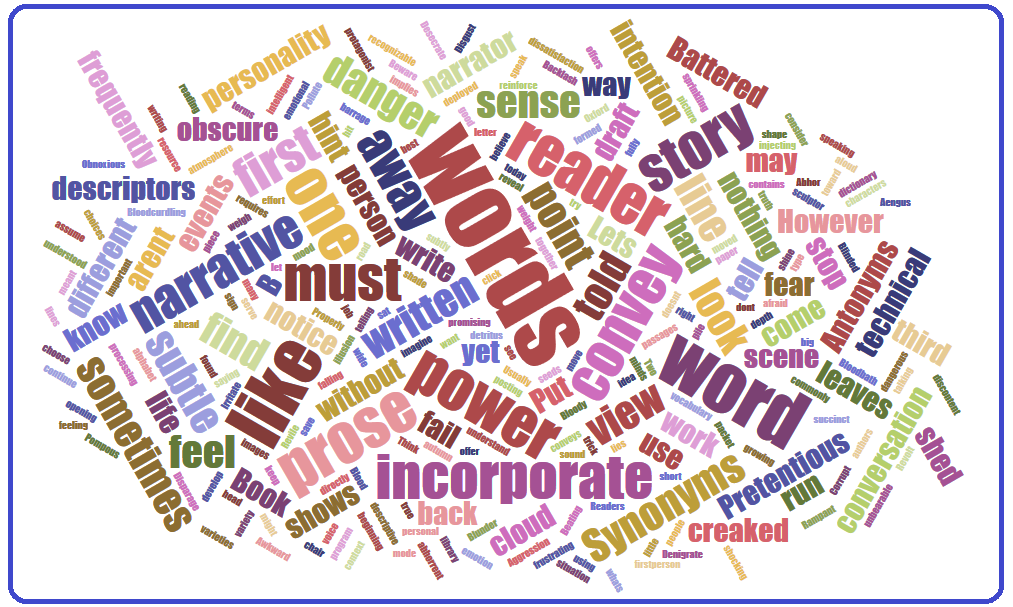
powerwordsWordCloudLIRF06192021

4 Comments

Filed under writing

FineArtFriday: Poder da Trinidad by Diego Mato Toledo

DIGITAL CAMERA

DIGITAL CAMERA

Artist: Diego Mato Toledo

Title: Querétaro Otomi: Poder da Trinidad (English: The Power of Being a Trinity)

Spanish: Poder da Trinidad

Date: 02/06/07

Medium: oil on canvas

Dimensions: 100 × 90 cm (39.3 × 35.4 in)

What I love about this painting:

This is a wonderful exploration of form and color. The sky is powerful, the visual representation of the Triune God watching over the town and its people. I love the passion, the vibrancy of the town and the way Diego Mato Toledo brings life to this scene.

This painting tells the story of the spirit of the people of Central America, the mix of indigenous and Spanish religion that makes a culture that is so uniquely theirs.

It is an image that makes me happy.

About the Artist: Diego Gustavo Mato Toledo was born in 1978 in Montevideo, Uruguay. His work celebrates the life and culture of Uruguay and also that of Central America. You can visit his personal website at Ateliê Crea-Sion Artes Visuales. Also, you can find his art for sale at Artlista.com.


Credits and Attributions:

IMAGE: Poder da Trinidad by Diego Mato Diego. Uploaded to Wikimedia Commons 02-06-2007. Wikimedia Commons contributors. “File:116 – Poder da Trinidad – 100×90 cm.jpg,” Wikimedia Commons, https://commons.wikimedia.org/w/index.php?title=File:116_-_Poder_da_Trinidad_-_100x90_cm.jpg&oldid=764498925 (accessed August 7, 2024).

Comments Off on FineArtFriday: Poder da Trinidad by Diego Mato Toledo

Filed under #FineArtFriday

Action and Reaction #writing

Arcs of action drive plots. Every reader knows this, and every writer tries to incorporate that knowledge into their work. Unfortunately, when I’m tired, random, disconnected events that have no value will seem like good ideas. Action inserted for shock value can derail what might have been a good plot.

action_and_reactionMy writing projects begin with an idea, a flash of “What if….” Sometimes, that “what if” is inspired by an idea for a character or perhaps a setting. Maybe it was the idea for the plot that had my wheels turning.

Nowadays, I avoid forcing my brain to work when it’s on its last legs. I no longer commit myself to a manuscript rife with random events inserted out of desperation. I brainstorm my ideas in a separate document and choose the ones that work best. So, in that regard, my writing style in the first stages is more like creating an extensive and detailed outline. This method allows me to be as creative as I want while I build an overall logic into the evolving story.

At the story’s outset, we meet our protagonist and see them in their familiar surroundings. The inciting incident occurs once we have met them, whether they are ready for it or not. At that point, we must take them to the next stumbling block. But what is that impediment, and how do we overcome it?

Answering that question isn’t always easy. The place where writing becomes work is a hurdle the majority of people who “always wanted to be an author” can’t leap. Their talents lie elsewhere.

IBM_Selectric (1)I’m writing a fantasy, and I know what must happen next in the novel because the core of this particular story is romance with a side order of mystery. I see how this tale ends, so I am brainstorming the characters’ motivations that lead to the desired ending.

Sometimes, it helps to write the last chapter first – in other words, start with the ending. That is how my first NaNoWriMo novel in 2010 began. I was able to pound out 68,000 words in 30 days because I had great characters, and I was desperate to uncover how they got to that place in their lives.

So, where are we in the story arc when the first lull in creativity occurs? Many times, it is in the first ten pages.

An imbalance of power drives plots. The dark corners of the story are illuminated by the characters who have critical knowledge.  This is called asymmetric information, and the enemy should have more of that commodity than our protagonist.

The enemy puts their plan in motion, and we have action. The protagonists are moved to react. The characters must work with a limited understanding of the situation because asymmetric information creates tension. A lack of knowledge creates a crisis.

plottingLIRF07122020Plots are comprised of action and reaction. I must place events in their path so the plot keeps moving forward. These events will be turning points, places where the characters must re-examine their motives and goals.

At several points in this process, I will stop and think about the characters. What do they want? How motivated are they to get it? If they aren’t motivated, why are they there?

Answering a few questions about your characters can kick the plot back into motion. Start with the antagonist because his actions force our characters to react:

  1. Why does the enemy have the upper hand?
    • How does the protagonist react to pressure from the antagonist?
    • How does the struggle affect the relationships between the protagonist and their cohorts/romantic interests?
    • What complications arise from a lack of information?
    • How will the characters acquire that necessary information?

e.m. forster plot memeOur characters are unreliable witnesses. The way they tell us the story will gloss over their failings. The story happens when they are forced to rise above their weaknesses and face what they fear.

I lay down the skeleton of the tale, fleshing out what I can as I go. However, there are significant gaps in this early draft of the narrative.

So, once the first draft is finished, I flesh out the story with visuals and action. Those are things I can’t focus on in the first draft, but I do insert notes to myself, such as:

  • Fend off the attack here.
  • Shouldn’t they plan some sort of assault here? Or are they just going to defend forever? Make them do something!
  • Contrast tranquil scenery with turbulent emotions here.

My first drafts are always rough, more like a series of events and conversations than a novel. I will stitch it all together in the second draft and fill in the plot holes.

At least, that is my intention, but it usually takes five or six drafts to make a coherent story with a complete plot arc and interesting characters with logical actions and reactions.

Margaret Atwood on writing LIRF07252022

Comments Off on Action and Reaction #writing

Filed under writing

#FineArtFriday: Chahut (The Can-Can) by Georges Seurat 1889

Georges_Seurat,_1889-90,_Le_Chahut,_Kröller-Müller_MuseumArtist: Georges Seurat  (1859–1891)

Title: Chahut (English: The Can-Can)

Genre: Genre Art

Description: Français : Le Chahut | English: Can-can

Date: 1889

Medium: oil on canvas

Dimensions: 170 × 141 cm (66.93 x 55.51 in)

Collection: Kröller-Müller Museum

Current location: Otterlo

What I love about this painting:

I love everything about Seurat’s work. This painting is full of life—the vibrant, amazing, and unsavory life of dancehalls like the Moulin Rouge in Montmartre. It was a part of Paris the decent people didn’t go. It was a free-wheeling place where the artists and students of the day partied and lived on the edge, pushing the boundaries of sexual morality as far as they were able. An ordinary middle-class woman such as I am would have been out of place here. But she would have secretly enjoyed the hedonism while decrying the lack of public decency–and would have loved the opportunity to indulge in a little moralizing to the younger generation. (Hypocrisy and “do-as-I-say, not-as-I-did” never goes out of style.)

About this painting via Wikipedia:

Le Chahut (English: The Can-can) is a Neo-Impressionist painting by Georges Seurat, dated 1889–90. It was first exhibited at the 1890 Salon de la Société des Artistes Indépendants (titled Chahut, cat. no. 726) in Paris. Chahut became a target of art critics, and was widely discussed among Symbolist critics.

Formerly in the collection of French Symbolist poet and art critic Gustave KahnChahut is located at the Kröller-Müller Museum in Otterlo, Netherlands.

John Rewald writes of both Le Chahut and Le Cirque:

The figures in these paintings are dominated by monotony or joy (there is no sadness in the pictures of Seurat) and are, of course, governed by strict rules, being controlled by that play of line and color whose laws Seurat had studied. In these canvases, Seurat, without yielding in any way to the literary or the picturesque, rehabilitated the subject which had been relinquished by the impressionists. His works are “exemplary specimens of a highly developed decorative art, which sacrifices the anecdote to the arabesque, nomenclature to synthesis, the fugitive to the permanent, and confers on nature—weary at last of its precarious reality—an authentic reality,” wrote Fénéon. [1]

About the artist via Wikipedia:

Georges Pierre Seurat, 2 December 1859 – 29 March 1891) was a French post-Impressionist artist. He devised the painting techniques known as chromoluminarism and pointillism and used conté crayon for drawings on paper with a rough surface.

Seurat’s artistic personality combined qualities that are usually thought of as opposed and incompatible: on the one hand, his extreme and delicate sensibility, on the other, a passion for logical abstraction and an almost mathematical precision of mind. His large-scale work A Sunday Afternoon on the Island of La Grande Jatte (1884–1886) altered the direction of modern art by initiating Neo-Impressionism, and is one of the icons of late 19th-century painting.

Seurat took to heart the colour theorists’ notion of a scientific approach to painting. He believed that a painter could use colour to create harmony and emotion in art in the same way that a musician uses counterpoint and variation to create harmony in music. He theorized that the scientific application of colour was like any other natural law, and he was driven to prove this conjecture. He thought that the knowledge of perception and optical laws could be used to create a new language of art based on its own set of heuristics and he set out to show this language using lines, colour intensity and colour schema. Seurat called this language Chromoluminarism.

In a letter to the writer Maurice Beaubourg in 1890 he wrote: “Art is Harmony. Harmony is the analogy of the contrary and of similar elements of tone, of colour and of line. In tone, lighter against darker. In colour, the complementary, red-green, orange-blue, yellow-violet. In line, those that form a right-angle. The frame is in a harmony that opposes those of the tones, colours and lines of the picture, these aspects are considered according to their dominance and under the influence of light, in gay, calm or sad combinations.”

Seurat died in Paris in his parents’ home on 29 March 1891 at the age of 31. The cause of his death is uncertain and has been variously attributed to a form of meningitispneumonia, infectious angina, and diphtheria. His son died two weeks later from the same disease. His last ambitious work, The Circus, was left unfinished at the time of his death. [2]


Credits and Attributions:

[1] Wikipedia contributors, “Le Chahut,” Wikipedia, The Free Encyclopedia, https://en.wikipedia.org/w/index.php?title=Le_Chahut&oldid=1177459932 (accessed August 1, 2024).

[2] Wikipedia contributors, “Georges Seurat,” Wikipedia, The Free Encyclopedia, https://en.wikipedia.org/w/index.php?title=Georges_Seurat&oldid=1231112655 (accessed August 1, 2024).

IMAGE: Wikipedia contributors, “Le Chahut,” Wikipedia, The Free Encyclopedia, https://en.wikipedia.org/w/index.php?title=Le_Chahut&oldid=1177459932 (accessed August 1, 2024).

2 Comments

Filed under #FineArtFriday

The business side of the business: budgeting for in-person sales events #writing

Regardless of your publishing path, indie or traditional, you must budget for certain things. You can’t expect your royalties to pay for them early in your career. And just so you know, many award-winning authors must still work their day jobs to pay their bills long after becoming bestsellers.

Its a BusinessNowadays, I am rarely able to do in-person events due to family constraints, but I used to do four events a year. However, I have some tips to help ease the path for you.

At first, getting your books in front of readers is a challenge. The in-person sales event is one way to get eyes on your books. This could be at a venue as small as a local bookstore allowing you to set up a table on their premises.

Or it could be as large as a table at a regional conference or convention. Regardless, if you are traditionally published, your publisher won’t provide you with free copies of your book to sell at the signing event. You will pay for them at a reduced cost. If not up front, then you will pay out of any future royalties. You will also have to be your own publicist and getting the word out about your event will be your responsibility. On the good side, you will keep the monies earned by your in-person sales.

Signings at writers’ conferences are usually a bit pricy for the number of books you might sell, but they are great ways to network.

What are the minimum costs for working a table at a signing event? The bare minimum expenses are as follows:

  1. You must have a stock of books on hand. You can’t sell books that you haven’t ordered. I order well in advance, as it can take three weeks for an order to arrive via the least expensive shipping method. Paying for overnight shipping of fifteen to twenty books is well out of my price range.
  2. We must consider the table fee. A bookstore might not charge you anything for the table, but they may take a small cut if they run your sales through their cash registers.

However, large conferences and conventions will charge table fees ranging from $70.00 to as high as $300.00 or more. This varies with the size and type of conference, the venue where the convention is being held, and the vendors you will be competing with.

Sci-fi and Fantasy fan conventions can be quite pricy. You will be in an immense, crowded room, competing with big-name RPG game franchises and movie franchises, plus all the vendors of memorabilia and collectibles that are available in the vendors’ alley.

  1. If you are able to get a table at a major fan convention, you must pay for transportation, food, and lodging. These costs could be gas, parking, airfare, hotel, etc., if you don’t have friends or family in that area. If you are planning to stay in a hotel, take simple foods that can be prepared without a stove. Being vegan, I tend to be an accomplished hotel-room chef, as most coffee bars don’t offer many plant-based options. While that bias is changing, I still go prepared.
  2. Bring at least one pen for signing your books. I bring four or five because sometimes the pens don’t work as advertised.
  3. cashbox 3The final thing you will need is a way of accepting money. I have a metal cash box, but you only need something to hold cash and some bills to make change with. A way to accept credit cards, something like Square, is a good option. You will find a lot of vendors use Square, but there are other options out there.

These things are the bare minimum you will need to provide. At many shows, you’ll be given a table with skirting and a sign attached to the front with your name in block letters. You can get by with this if you’re on a tight budget. New vendors manage with this minimal setup all the time. This option lets you squeak by on little more than the cost of your books. Your setup and teardown time will be short, and you’ll have little to transport—always a positive, in my opinion.

My good friend, Lee French, is a best-selling YA author and a pro at successfully working conventions. She co-wrote the book, Working the Table: An Indie Author’s Guide to Conventions with the late Jeffrey Cook. She tells us that to really succeed, you’ll need to invest a bit more.

It helps to have some kind of promotional handout. I find bookmarks and business cards are the most affordable option. I know a few authors who order all sorts of little buttons and promotional trinkets advertising their books. They give them out to everyone who passes their table, buyers or not.

Trinkets are nice, but if you are cash-strapped, business cards and bookmarks offer the best return on your cost outlay for promotional material. They are less expensive when purchased in bulk, so I get as many as my budget allows.

You will need a business license to sell books at most conventions. Each state in the US has different requirements for getting these, so do the research and get whatever business license your local government requires. This allows you to get a reseller’s permit, enabling you to buy copies of your own books without paying sales tax. If your state doesn’t assess sales tax, you don’t need this, but you’ll still need the business license.

If you live in a state like Washington State, be smart and set aside the money collected as sales tax. It is not yours and shouldn’t be considered part of your income.

the _book_signing_eventInvesting in some large promotional graphics, such as a retractable banner, is a good idea. A large banner is a great visual to put behind your chair. A second banner for the front of the table looks professional but requires some fiddling with pins.

Lee French suggests getting a custom-printed tablecloth that drops over the front of the table, acting as a banner. It looks more professional, and the books will hold it down, so you don’t have to mess with pins. You can find a wide variety of sizes and shapes of banners and graphic promotional props on the internet.

I have an inexpensive black tablecloth for under my books, but you can get one in the color of your choice. Venues will often provide a white tablecloth, so buying one isn’t necessary, but it makes your display look more professional. Many shows offer a 6’x3′ table, but, as with the tablecloth, check first to be sure you don’t need to bring your own.

I suggest buying book stands of some sort. Recipe stands work, and so do plate and picture stands. Whether they’re fancy or cheap, be sure you know how to set them up so they don’t fall over when someone bumps the table. I use folding plate stands as they store well in the rolling suitcase I use for my supplies.

This brings us to storage and shifting goods. We must move our gear between the table and our vehicle, and sometimes we’re forced to park in inconvenient places. Many people use wheeled bins or fold-up handcarts. Folding luggage carts are a great, lightweight option when you only have a few bins and boxes. I use a large, wheeled suitcase for my books, as I travel pretty light.

I also use a plastic container with a good lid for storing pens, bookmarks/cards, book stands, and other whatnot.

HTB Bookmark side A copyMake your display attractive, but I suggest you keep it simple. People will be able to see what you are selling, and the more fiddly things you add to your display, the longer setup and teardown will take. The shows and conferences I have attended offered plenty of time for this, but I’ve heard that some of the big-name conventions require you to be in or out in two hours or less.

Aside from the table fee and transportation, Lee French says it will cost about $400 for your initial stock of books, banners, bookmarks, and odds & ends. The way inflation is going, it may take more than that, but you can make it less painful by purchasing one thing at a time in advance as your budget allows.

Shop the internet for sales on banners and similar items. You will need to replace bookmarks, business cards, and book stock after each event, but most larger promotional items won’t need to be repurchased or updated for a year or two.

If you plan to get a table at a large conference this year, I highly recommend Working the Table: An Indie Author’s Guide to Conventions. This book has all the information you will need to successfully navigate the wild seas of selling your books at conventions.

And if you choose to embark on the in-person event circuit, I wish you good luck and many happy sales.

working_the_table_French_and_Cook

3 Comments

Filed under writing

#FineArtFriday – the Mountain Brook by Albert Bierstadt 1863

Mountain_Brook_oil_1863_Albert_BierstadtArtist: Albert Bierstadt  (1830–1902)

Title: Mountain Brook

Genre: landscape painting

Date: 1863

Medium: oil on canvas

Dimensions: height: 111.8 cm (44 in); width: 91.4 cm (35.9 in)

Collection: Art Institute of Chicago

What I love about this painting:

This is an unusual subject for Albert Bierstadt. There is no immensity of sky watching over all who walk below. Instead, he gives us the immensity of a quiet wood and the solitude of a small mountain stream.

I love this peaceful glade, with the sun filtering through the forest canopy. I could sit there happily, writing the day away.

About the artist, via Wikipedia:

Albert Bierstadt (January 7, 1830 – February 18, 1902) was a German American painter best known for his lavish, sweeping landscapes of the American West. He joined several journeys of the Westward Expansion to paint the scenes. He was not the first artist to record the sites, but he was the foremost painter of them for the remainder of the 19th century.

Bierstadt was born in Prussia, but his family moved to the United States when he was one year old. He returned to study painting for several years in Düsseldorf. He became part of the second generation of the Hudson River School in New York, an informal group of like-minded painters who started painting along the Hudson River. Their style was based on carefully detailed paintings with romantic, almost glowing lighting, sometimes called luminism. Bierstadt was an important interpreter of the western landscape, and he is also grouped with the Rocky Mountain School.

In 1851, Bierstadt began to paint in oils. He returned to Germany in 1853 and studied painting for several years in Düsseldorf with members of its informal school of painting. After returning to New Bedford in 1857, he taught drawing and painting briefly before devoting himself full-time to painting.

Bierstadt’s popularity in the U.S. remained strong during his European tour. The publicity generated by his Yosemite Valley paintings in 1868 led a number of explorers to request his presence as part of their westward expeditions. The Atchison, Topeka, and Santa Fe Railroad also commissioned him to visit and paint the Grand Canyon and surrounding region.

Despite his popular success, Bierstadt was criticized by some contemporaries for the romanticism evident in his choice of subjects and for his use of light, which they found excessive.

Some critics objected to Bierstadt’s paintings of Native Americans based on their belief that including Indigenous Americans “marred” the “impression of solitary grandeur.” [1]


Credits and Attributions:

IMAGE: Wikimedia Commons contributors, Mountain Brook by Albert Bierstadt, Public domain, via Wikimedia Commons Commons, https://commons.wikimedia.org/w/index.php?title=File:Bierstadt_Albert_Bavarian_Landscape.jpg&oldid=823443562 (accessed July 25, 2024).

[1] Quote: Wikipedia contributors, “Albert Bierstadt,” Wikipedia, The Free Encyclopedia, https://en.wikipedia.org/w/index.php?title=Albert_Bierstadt&oldid=1210445403 (accessed July 25, 2024).

3 Comments

Filed under #FineArtFriday

Thoughts on Poetry and the Evolution of Language #writing

This last week has been extremely busy. I was able to bring my husband home from the rehab facility, and that was a wonderful thing. However, the transition has not been painless. He is mostly wheelchair-bound and can’t reliably communicate his needs. Fortunately, I have caregivers coming in every morning and evening to help with the rougher parts of his day.

Prose, and finding the right words to convey more than merely a recounting of fictional events is on my mind. Unfortunately, I was so busy that time got away from me, and I didn’t have time to write a proper post on that subject.

So, I am revisiting a post from 2020. The evolution of language is, I believe, a natural thing. And now, without further discussion, here is my post:


Words-And-How-We-Use-ThemI think of poetry and language as coming into existence as conjoined twins. I can remember anything I can set to a rhyme or make into a song.

Yet, much of the time, modern songs and poetry don’t rhyme. Even so, they have tempo and rhythm.

If it doesn’t rhyme, what makes poetry “poetic?” And where does it fit into modern narrative prose?

Poetry is a primal form of communication in the human species, the literary invention that emerged as soon as we had words. It presents thoughts and feelings as abstractions and allusions rather than the concrete.

Poets select words for the impact they deliver. An entire story must be conveyed using the least number of words possible. For that reason, choices are made for symbolism, power, and syllabic cadence, even if there is no rhyme involved.

Narrative prose is broader, looser, more all-encompassing, with no limit on how long it takes for the story to unfold.

Modern humans deliver highly detailed concepts and ideas with packets of noise formed into individual words. We learn the meanings of these sound-packets as infants. By stringing these meaningful sound-packets together, we can share information with others of our species.

I suspect using rhyme as a mnemonic is fundamental to human nature. Research with modern primates in the wild proves that, while we were still in Africa before the great diaspora, humans developed complex languages within our tribal communities.

By observing primates in the wild, we see that our earliest ancestors had the ability to describe the wider world to their children. With that, we could teach them skills and the best ways to acquire food.

We understood and were able to see the motives of another person.

We developed compassion and burial rites.

Early humans relied on the cadence of repetition and rhyme. They could explain the how and why of a great flood or any other natural disaster, passing it forward across many generations.

The availability of food is central to the prosperity of all life, not just humans. Our ancestors saw the divine in every aspect of life, especially around the abundance or scarcity of food. They developed mythologies combining all of these concepts to explain the world around us and our place in it.

With the ability to pass on knowledge of toolmaking, we had leisure to contemplate the world. We discussed these things while eating and sharing food with each other.

We now know that other primates also deliver information by using sound-packets. Gorillas have been observed singing during their meals. Humans have always sung.

Chimpanzees and Bonobos have been observed chatting during leisurely meals.

We humans love to sit around the table and chat.

The larynx and vocal cords of each primate species are formed differently, which affects how they communicate. They understand each other perfectly, but because they are so different from us, our human ears can’t differentiate the meanings of the individual sound-packets that make up their calls.

To us, their communications are just mindless screeching, and so we have always assumed they must not be self-aware.

I suspect that in years to come we will find that we have been wrong. We may be the only species we reliably converse with, but we are not the only self-aware species who communicate through vocalizations.

For many humans, dogs and cats are their beloved family members, self-aware people who love and accept them like no one else does.

This brings me to another point – if we can’t figure out and understand the languages of the other intelligent creatures in this world, i.e., Elephants, Cetaceans, and other Primates, then how can we ever expect to communicate with an alien extraterrestrial being?

And if we can’t recognize, value, and protect the individual self-awareness and personhood of beings like Elephants, Cetaceans, and other Primates, how will we recognize an extraterrestrial life-form? How will we behave toward them? After all, to us, these fellow creatures of earth have been nothing but resources for us to exploit.

Like modern Great Apes, proto humans used rhyme and cadence to memorize and pass on ideas as abstract as legends or sagas to their children and to others they might meet in friendly circumstances. By handing down those stories through the generations, we learned lessons from the mistakes and heroism of our ancestors.

Rhyme and cadence were fundamental to our ability to make tools out of stone and bone. The capacity to learn, remember, and reliably pass on knowledge was why the three human genomes we call Homo Sapiens, Neanderthal, and Denisovan could master fire. This is why they could develop the tools that made them the apex predators we became. We could reliably feed our young, rear them to adulthood, and still have time to create art on the walls of caves.

Every tribe, every culture that ever arose in our world, had a tradition of passing down stories and legends using rhyme and meter. Rhyme, combined with repetition and rhythmic simplicity, enabled us to remember and pass on our histories and knowledge to our children.

In times gone by, writers used words for their beauty, employing them the way they decorated their homes. Authors labored over their sentences, ensuring each word was placed in such a way as to be artistic as well as impactful.

In writing poetry, we are forced to think on an abstract level. We must choose words based on their power. The emotions these words evoke, and the way they show the environment around us is why I gravitate to narratives written by authors who are also poets—the creative use of words elevates what could be mundane to a higher level of expression. When it’s done subtly, the reader doesn’t consciously notice poetic derivations in prose, but they are moved by them.

We have no need to memorize our cultural knowledge anymore, just as we no longer need the ability to accurately tally long strings of numbers in our heads. Readers seek out books with straightforward prose and few descriptors. Words for the sake of words is no longer desirable to the modern reader.

Modern poetry has evolved too. The love of poetry continues, and new generations seek out the poems of the past while creating powerful poetry of their own.

Modern authors, such as Patrick Rothfuss in his novel, The Name of the Wind craft narratives packed with powerful, evocative prose. We eagerly read their work because it is both straightforward and poetic. Most readers are unaware that they are drawn to the subtle poetry of his work as much as to the story that unfolds within the narrative.

I write poetry, some that follow traditional rhyming, and much that does not. Regardless of the structure, the cadence of syllables and the words I choose are recognizably mine. The emotions they evoke and the way they portray the environment I imagine is what lends my voice to my work.

Authors like me who read and sometimes write speculative fiction can enjoy our modern stripped-down narratives, guilt free.

That said, we who love the rhythm and cadence of words can still appreciate beauty combined with impact when it comes to our prose. And, if you love dark, heroic speculative fiction and haven’t yet read The Name of the Wind, by Patrick Rothfuss, I highly recommend it.


Credits and Attributions:

Admiring the Galaxy |CCA 4.0 ESO/A. Fitzsimmons

5 Comments

Filed under writing